CNIT 160:
Cybersecurity
Responsibilities
3. Information Risk
Management

Part 4

Pages 158 - 182
Topics
• Part 1 (p. 102 - 115)
• Risk Management Concepts
• Implementing a Risk Management Program
• Part 2 (p. 114 - 125)
• The Risk Management Life Cycle
• Part 3 (p. 125 - 158)
• The Risk Management Life Cycle
• Part 4 (p. 158 - 182)
• Operational Risk Management
Operational Risk
Management
• Concerned with financial losses and
survival of an organization
• Operational risk is
• Risk of loss resulting from
• Failed controls, processes, and systems
• Internal and external events
• Other occurrences that impact business
systems
Recovery Objectives
• Time intervals for
• Business resiliency and recovery
• From security and disaster events
• Pay attention to third-party risk
• More difficult to obtain usable risk
information
Risk Register
• The key business record in risk
management
• Log of historic and newly identified risks
• Contains risk metadata about each risk
• Helps understand which risks are more
serious than others
Risk Management
Objectives
Risk Management
Objectives
• Recovery Time Objective (RTO)
• Recovery Point Objective (RPO)
• Recovery Capacity Objective (RCapO)
• Service Delivery Objective (SDO)
• Maximum Tolerable Downtime (MTD)
• Maximum Tolerable Outage (MTO)
• Service Level Agreements (SLA)
Recovery Time Objective
(RTO)
• The priod of time from the onset of an
outage until the resumption of service
• Different processes have different RTO's
• The RTO may vary with time
• Point-of-sale terminals
• Short RTO during peak business hours
• Longer RTO at other times
RTO Considerations
• RTO is interrelated with
• Data classification
• Asset classification
• Processes with short RTO's
• Likely to have data and assets that are
classied as operationally critical
Establishing RTOs
• Security managers interview
• Personnel in middle management
• Senior and executive management
• Executive prioritization prevails
• RTOs come from Business Impact Analysis
(BIA)
• A cornerstone in Business Continuity
Planning (BCP)
Recovery Point Objective
(RPO)
• The period of acceptable data loss
• From an incident or disaster
• Period between backups or data
replication
• Shorter RPOs have higher costs
Recovery Capacity
Objective (RCapO)
• Capacity of a temporary or recovery
process
• A percentage of the normal process
• Example: hand-writing paper receipts
might mean that cashiers do 80% as
much work
Service Delivery Objective
(SDO)
• Level or quality of service
• Required after an event
• Compared to normal operation
• Measured in transaction throughput,
response time, available capabilities and
features, etc.
• SDO, RTO, RPO, and RCapO are all related
Maximum Tolerable
Downtime (MTD)
• Theoretical time period
• Measured from start of a disaster
• After which the organization's ongoing
viability would be at risk
• Organizations may start with MTD
• And then derive RTO, RPO, and RCapO
• MTD is also called Acceptable Interruption
Window (AIW)
Maximum Tolerable
Downtime (MTD)
• Different for each major business function
• Ex: MTD is 7 days for website, but 28
days for payroll
Maximum Tolerable Outage
(MTO)
• Maximum period of time
• That organization can tolerate operating
in recovery mode
• Example: CCSF has two layers of firewalls
• When one fails, we operate with a
reduced level of security

Service Level Agreements
(SLA)
• A written agreement
• Specifies quantity of work, quality,
timeliness
• And remedies for shortfalls
Risk Management and Business
Continuity Planning (BCP)
Similarities
• Risk Management and BCP both
• Seek to discover risks and remedies
• Rely on risk assessments
• Can rely on Business Impact Analsys
(BIA)
• Identify threats that can lead to disasters
Third-Party Risk
Management (TPRM)
Third-Party Risk
Management (TPRM)
• Activities to discover and manage risk
• Associated with external organizations
• Performing operational functions
• Outsourcing to the cloud
• Software as a Service (SaaS)
• Platform as a Service (PaaS)
Third-Party Risk
Management (TPRM)
• Complexities in identifying risks in third-
party organizations
• Must solicit information to identify risks
• Outside of organization's direct control
• More than half of all breaches come
through third parties
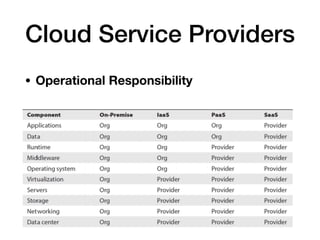
Cloud Service Providers
• Operational Responsibility
Cloud Service Providers
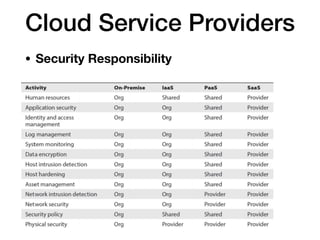
• Security Responsibility
TRPM Life Cycle
• Initial Assessment
• Legal Agreement
• Classifying Third Parties
• Questionnaires and Evidence
• Assessing Third Parties
• Risk Mitigation
Initial Assessment
• Evaluate third party for suitability
• Often competitive
• Often requires each third party to provide
information
• Through a Request for Information (RFI)
• Or a Request for Proposal (RFP)
• Often including sections on security
and provacy
Legal Agreement
• Describes
• Services provided
• Service levels
• Quality, pricing, other terms
Legal Agreement
• Security and privacy section
• Formal security and/or privacy program
• Security and/or privacy controls
• Vulnerability assessments
• External audits and certifications
• SOC1, SOC2, ISO 27001, HITRUST, PCI
ROCs, etc.
• Formal incident response capability
Legal Agreement
• Security and privacy section
• Security incident notification
• Must notify organization within a
specic time frame, typically 24 hours
• Careful language around "suspected"
and "conrmed"
• Ex: Uber concealed a ransomware
incident by calling it a "Bug Bounty"
Legal Agreement
• Security and privacy section
• Right to Audit
• Periodic review
• Annual due diligence
• Questionnaires and evidence
• Cyber insurance
Classifying Third Parties
• Wide range of risk among third parties
• Risk level depends on what services are
used
• Risk level may change as more functions
are outsourced
Questionnaires and
Evidence
• Questionnaires to periodically assess third
parties
• Can also request Evidence
• Specific artifacts to support the
questionnaire responses
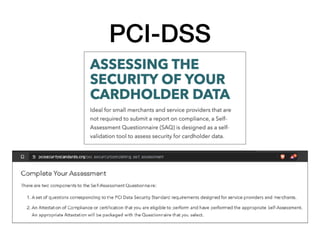
PCI-DSS
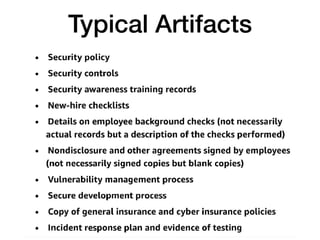
Typical Artifacts
Assessing Third Parties
• Required at the onset of the business
relationship
• And periodically thereafter
• Assess
• IT and security controls, and
• Other information on next slide
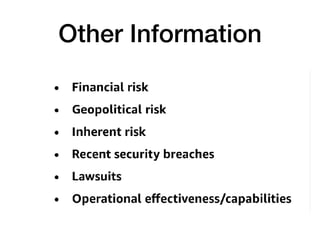
Other Information
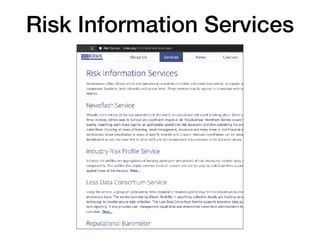
Risk Information Services
Risk Mitigation
• Often, third parties have unacceptable
practices
• Such as lacking annual security
awareness training or encryption
• Possible responses
• Convince third-party to change
processes
• They may refuse because of the expense
Ch 3d-1
The Risk Register
Risk Register
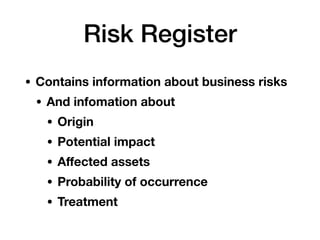
• Contains information about business risks
• And infomation about
• Origin
• Potential impact
• Affected assets
• Probability of occurrence
• Treatment
Risk Register
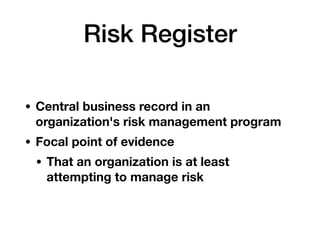
• Central business record in an
organization's risk management program
• Focal point of evidence
• That an organization is at least
attempting to manage risk
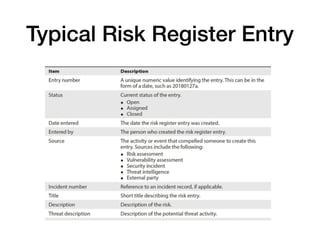
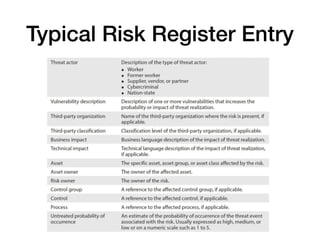
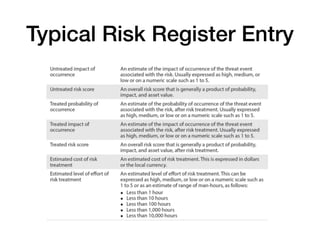
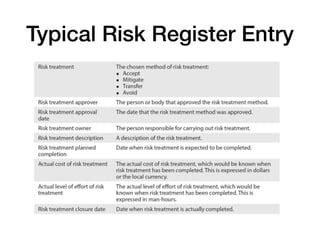
Typical Risk Register Entry
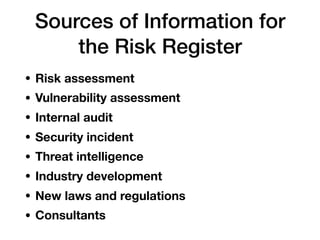
Sources of Information for
the Risk Register
• Risk assessment
• Vulnerability assessment
• Internal audit
• Security incident
• Threat intelligence
• Industry development
• New laws and regulations
• Consultants
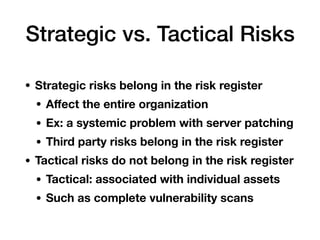
Strategic vs. Tactical Risks
• Strategic risks belong in the risk register
• Affect the entire organization
• Ex: a systemic problem with server patching
• Third party risks belong in the risk register
• Tactical risks do not belong in the risk register
• Tactical: associated with individual assets
• Such as complete vulnerability scans
Risk Analysis Contribution
• Detailed risk analysis required for each
entry in the risk register
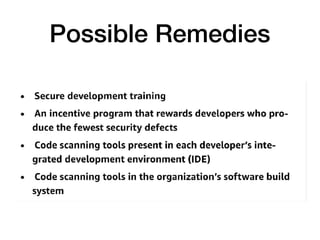
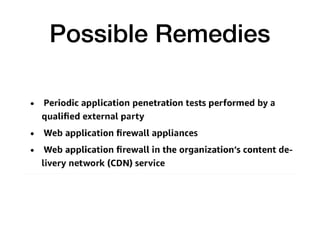
• For example: software development team
continues to produce defective code
• Possible remedies on next two slides
Possible Remedies
Possible Remedies
Residual Risk
• Even after risk treatment, some risk
remains
• An individual risk may undergo two or more
cycles of treatment
• Until the residual risk is accepted
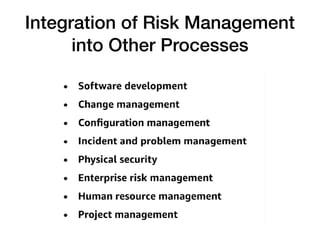
Integration of Risk Management
into Other Processes
Integration of Risk Management
into Other Processes
Secure Software
Development
• Threat modeling during design phase
• Coding standards, specifying allowed and
disallowed techniques
• Code reviews
• Code scanning
• Application scanniung
• Application penetration testing
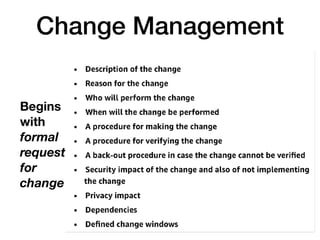
Change Management
Begins
with
formal
request
for
change
• Change review board discusses change
requests
• Often includes security personnel
Change Management
• Usually uses automated tools
• Configuration management database
(CMDB)
• Repository of this information
• Security considerations
• Protecting configuration data from
unauthorized access
• Inclusion of security-related information in
conguration management data
Conguration Management
Incident and Problem
Management
• Incidents and problems include outages,
errors, bugs, etc.
• Four security considerations
• Personnel analyzing a problem need to
understand its security impacts
• Ex: malfunctioning firewall
• Actions taken to restore service may have
a security impacts
• Ex: rebooting a server
Incident and Problem
Management
• Four security considerations
• Root-cause analysis may have security
impacts
• Ex: file permission changes
• Corrective action may have security
impacts
• Ex: elevating a service account
privileges
Physical Security
• Integrating information and physical
security
• Ensure that risk and threat assessments,
BCP, and DRP cover both areas
• Include both on the risk register
• Ensure that high-avilability systems have
appropriate physical security
Physical Security
• Integrating information and physical security
• Incorporate IT-based physical security
assets into
• Overall technology and security
architecture
• Information and asset classification
• Identity and access management
program
Physical Security
• Integrating information and physical
security
• Ensure that SCADA and ICS systems
monitor and control the environmental
systems (heating, venvilation, and air
conditioning)
Information Risk and ERM
(Enterprise Risk Management)
• ERM has its own risk register
• For business-specific risks
• It may make sense to use a common risk
register for both information risk and ERM
Human Resource
Management
• Background checks
• Legal agreements
• Training
• Development
• Management of the Human Resource
Information System (HRIS)
• Often integrated with Identity and Access
Management (IAM) platform
Project Management
• At onset of a project, perform a risk
analysis
• Establish impact on security, compliance,
and privacy before implementing a project
• Verifiable security requirements need to be
included in any activity where requirements
are developed
Risk Monitoring and
Reporting
Risk Monitoring and
Reporting
• Typical activities:
• Internal audit
• Control self-assessment
• Vulnerability assessment
• Risk assessment
• Primary audience is executive
management
• Often done with dashboards
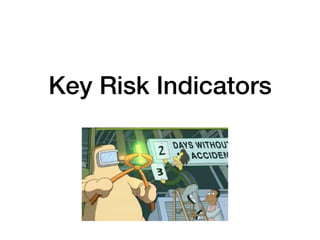
Key Risk Indicators
Key Risk Indicators (KRIs)
• Measure of information risk
• Used to reveal trends
• Often derived from operational activities
• Examples:
• Number of vulnerabilities found
(useless to executives)
• Time to remediate critical
vulnerabilities (better)
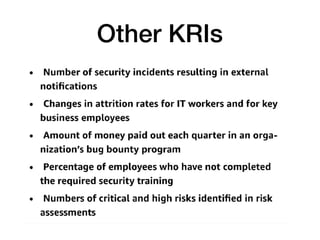
Other KRIs
Training and Awareness
Factors
Risk Documentation
Risk Documentation
Risk Documentation
Ch 3a-2

CNIT 160: Ch 3d: Operational Risk Management

  • 1.
    CNIT 160: Cybersecurity Responsibilities 3. InformationRisk Management Part 4 Pages 158 - 182
  • 2.
    Topics • Part 1(p. 102 - 115) • Risk Management Concepts • Implementing a Risk Management Program • Part 2 (p. 114 - 125) • The Risk Management Life Cycle • Part 3 (p. 125 - 158) • The Risk Management Life Cycle • Part 4 (p. 158 - 182) • Operational Risk Management
  • 3.
    Operational Risk Management • Concernedwith financial losses and survival of an organization • Operational risk is • Risk of loss resulting from • Failed controls, processes, and systems • Internal and external events • Other occurrences that impact business systems
  • 4.
    Recovery Objectives • Timeintervals for • Business resiliency and recovery • From security and disaster events • Pay attention to third-party risk • More difficult to obtain usable risk information
  • 5.
    Risk Register • Thekey business record in risk management • Log of historic and newly identified risks • Contains risk metadata about each risk • Helps understand which risks are more serious than others
  • 6.
  • 7.
    Risk Management Objectives • RecoveryTime Objective (RTO) • Recovery Point Objective (RPO) • Recovery Capacity Objective (RCapO) • Service Delivery Objective (SDO) • Maximum Tolerable Downtime (MTD) • Maximum Tolerable Outage (MTO) • Service Level Agreements (SLA)
  • 8.
    Recovery Time Objective (RTO) •The priod of time from the onset of an outage until the resumption of service • Different processes have different RTO's • The RTO may vary with time • Point-of-sale terminals • Short RTO during peak business hours • Longer RTO at other times
  • 9.
    RTO Considerations • RTOis interrelated with • Data classification • Asset classification • Processes with short RTO's • Likely to have data and assets that are classified as operationally critical
  • 10.
    Establishing RTOs • Securitymanagers interview • Personnel in middle management • Senior and executive management • Executive prioritization prevails • RTOs come from Business Impact Analysis (BIA) • A cornerstone in Business Continuity Planning (BCP)
  • 11.
    Recovery Point Objective (RPO) •The period of acceptable data loss • From an incident or disaster • Period between backups or data replication • Shorter RPOs have higher costs
  • 12.
    Recovery Capacity Objective (RCapO) •Capacity of a temporary or recovery process • A percentage of the normal process • Example: hand-writing paper receipts might mean that cashiers do 80% as much work
  • 13.
    Service Delivery Objective (SDO) •Level or quality of service • Required after an event • Compared to normal operation • Measured in transaction throughput, response time, available capabilities and features, etc. • SDO, RTO, RPO, and RCapO are all related
  • 14.
    Maximum Tolerable Downtime (MTD) •Theoretical time period • Measured from start of a disaster • After which the organization's ongoing viability would be at risk • Organizations may start with MTD • And then derive RTO, RPO, and RCapO • MTD is also called Acceptable Interruption Window (AIW)
  • 15.
    Maximum Tolerable Downtime (MTD) •Different for each major business function • Ex: MTD is 7 days for website, but 28 days for payroll
  • 16.
    Maximum Tolerable Outage (MTO) •Maximum period of time • That organization can tolerate operating in recovery mode • Example: CCSF has two layers of firewalls • When one fails, we operate with a reduced level of security

  • 17.
    Service Level Agreements (SLA) •A written agreement • Specifies quantity of work, quality, timeliness • And remedies for shortfalls
  • 18.
    Risk Management andBusiness Continuity Planning (BCP)
  • 19.
    Similarities • Risk Managementand BCP both • Seek to discover risks and remedies • Rely on risk assessments • Can rely on Business Impact Analsys (BIA) • Identify threats that can lead to disasters
  • 20.
  • 21.
    Third-Party Risk Management (TPRM) •Activities to discover and manage risk • Associated with external organizations • Performing operational functions • Outsourcing to the cloud • Software as a Service (SaaS) • Platform as a Service (PaaS)
  • 22.
    Third-Party Risk Management (TPRM) •Complexities in identifying risks in third- party organizations • Must solicit information to identify risks • Outside of organization's direct control • More than half of all breaches come through third parties
  • 23.
    Cloud Service Providers •Operational Responsibility
  • 24.
    Cloud Service Providers •Security Responsibility
  • 25.
    TRPM Life Cycle •Initial Assessment • Legal Agreement • Classifying Third Parties • Questionnaires and Evidence • Assessing Third Parties • Risk Mitigation
  • 26.
    Initial Assessment • Evaluatethird party for suitability • Often competitive • Often requires each third party to provide information • Through a Request for Information (RFI) • Or a Request for Proposal (RFP) • Often including sections on security and provacy
  • 27.
    Legal Agreement • Describes •Services provided • Service levels • Quality, pricing, other terms
  • 28.
    Legal Agreement • Securityand privacy section • Formal security and/or privacy program • Security and/or privacy controls • Vulnerability assessments • External audits and certifications • SOC1, SOC2, ISO 27001, HITRUST, PCI ROCs, etc. • Formal incident response capability
  • 29.
    Legal Agreement • Securityand privacy section • Security incident notification • Must notify organization within a specific time frame, typically 24 hours • Careful language around "suspected" and "confirmed" • Ex: Uber concealed a ransomware incident by calling it a "Bug Bounty"
  • 30.
    Legal Agreement • Securityand privacy section • Right to Audit • Periodic review • Annual due diligence • Questionnaires and evidence • Cyber insurance
  • 31.
    Classifying Third Parties •Wide range of risk among third parties • Risk level depends on what services are used • Risk level may change as more functions are outsourced
  • 32.
    Questionnaires and Evidence • Questionnairesto periodically assess third parties • Can also request Evidence • Specific artifacts to support the questionnaire responses
  • 33.
  • 34.
  • 35.
    Assessing Third Parties •Required at the onset of the business relationship • And periodically thereafter • Assess • IT and security controls, and • Other information on next slide
  • 36.
  • 37.
  • 38.
    Risk Mitigation • Often,third parties have unacceptable practices • Such as lacking annual security awareness training or encryption • Possible responses • Convince third-party to change processes • They may refuse because of the expense
  • 39.
  • 40.
  • 41.
    Risk Register • Containsinformation about business risks • And infomation about • Origin • Potential impact • Affected assets • Probability of occurrence • Treatment
  • 42.
    Risk Register • Centralbusiness record in an organization's risk management program • Focal point of evidence • That an organization is at least attempting to manage risk
  • 43.
  • 44.
  • 45.
  • 46.
  • 47.
    Sources of Informationfor the Risk Register • Risk assessment • Vulnerability assessment • Internal audit • Security incident • Threat intelligence • Industry development • New laws and regulations • Consultants
  • 48.
    Strategic vs. TacticalRisks • Strategic risks belong in the risk register • Affect the entire organization • Ex: a systemic problem with server patching • Third party risks belong in the risk register • Tactical risks do not belong in the risk register • Tactical: associated with individual assets • Such as complete vulnerability scans
  • 49.
    Risk Analysis Contribution •Detailed risk analysis required for each entry in the risk register • For example: software development team continues to produce defective code • Possible remedies on next two slides
  • 50.
  • 51.
  • 52.
    Residual Risk • Evenafter risk treatment, some risk remains • An individual risk may undergo two or more cycles of treatment • Until the residual risk is accepted
  • 53.
    Integration of RiskManagement into Other Processes
  • 54.
    Integration of RiskManagement into Other Processes
  • 55.
    Secure Software Development • Threatmodeling during design phase • Coding standards, specifying allowed and disallowed techniques • Code reviews • Code scanning • Application scanniung • Application penetration testing
  • 56.
  • 57.
    • Change reviewboard discusses change requests • Often includes security personnel Change Management
  • 58.
    • Usually usesautomated tools • Configuration management database (CMDB) • Repository of this information • Security considerations • Protecting configuration data from unauthorized access • Inclusion of security-related information in configuration management data Configuration Management
  • 59.
    Incident and Problem Management •Incidents and problems include outages, errors, bugs, etc. • Four security considerations • Personnel analyzing a problem need to understand its security impacts • Ex: malfunctioning firewall • Actions taken to restore service may have a security impacts • Ex: rebooting a server
  • 60.
    Incident and Problem Management •Four security considerations • Root-cause analysis may have security impacts • Ex: file permission changes • Corrective action may have security impacts • Ex: elevating a service account privileges
  • 61.
    Physical Security • Integratinginformation and physical security • Ensure that risk and threat assessments, BCP, and DRP cover both areas • Include both on the risk register • Ensure that high-avilability systems have appropriate physical security
  • 62.
    Physical Security • Integratinginformation and physical security • Incorporate IT-based physical security assets into • Overall technology and security architecture • Information and asset classification • Identity and access management program
  • 63.
    Physical Security • Integratinginformation and physical security • Ensure that SCADA and ICS systems monitor and control the environmental systems (heating, venvilation, and air conditioning)
  • 64.
    Information Risk andERM (Enterprise Risk Management) • ERM has its own risk register • For business-specific risks • It may make sense to use a common risk register for both information risk and ERM
  • 65.
    Human Resource Management • Backgroundchecks • Legal agreements • Training • Development • Management of the Human Resource Information System (HRIS) • Often integrated with Identity and Access Management (IAM) platform
  • 66.
    Project Management • Atonset of a project, perform a risk analysis • Establish impact on security, compliance, and privacy before implementing a project • Verifiable security requirements need to be included in any activity where requirements are developed
  • 67.
  • 68.
    Risk Monitoring and Reporting •Typical activities: • Internal audit • Control self-assessment • Vulnerability assessment • Risk assessment • Primary audience is executive management • Often done with dashboards
  • 69.
  • 70.
    Key Risk Indicators(KRIs) • Measure of information risk • Used to reveal trends • Often derived from operational activities • Examples: • Number of vulnerabilities found (useless to executives) • Time to remediate critical vulnerabilities (better)
  • 71.
  • 72.
  • 73.
  • 74.
  • 75.
  • 76.
  • 77.