Module 4
Subtractive
Manufacturing
Dr. Umesh Mane
Assistant Professor,
VCET, Vasai
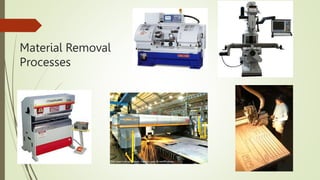
Material Removal
Processes
Numerical Control
1. NC Technology
2. Computer Numerical Control
3. Distributed Numerical Control
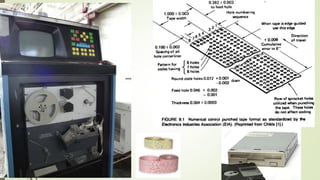
PROGRAM INPUT DEVICE
The program input device is the mechanism for
part programs to be entered into the CNC control.
The most commonly used program input devices
are keyboards, punched tape reader, diskette
drivers, throgh RS 232 serial ports and networks.
DNC
 Direct numerical control (DNC) – control of multiple machine tools by a
single (mainframe) computer through direct connection and in real time
 1960s technology
 Two way communication
 Distributed numerical control (DNC) – network consisting of central
computer connected to machine tool MCUs, which are CNC
 Present technology
 Two way communication
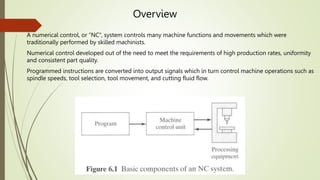
Overview
A numerical control, or “NC”, system controls many machine functions and movements which were
traditionally performed by skilled machinists.
Numerical control developed out of the need to meet the requirements of high production rates, uniformity
and consistent part quality.
Programmed instructions are converted into output signals which in turn control machine operations such as
spindle speeds, tool selection, tool movement, and cutting fluid flow.
MACHINE CONTROL UNIT
The machine control unit (MCU) is the heart of a CNC system. It
is used to perform the following functions:
 Read coded instructions
 Decode coded instructions
 Implement interpolations (linear, circular, and helical) to
generate axis motion commands
 Feed axis motion commands to the amplifier circuits for
driving the axis mechanisms
 Receive the feedback signals of position and speed for each
drive axis
 Implement auxiliary control functions such as coolant or
spindle on/off, and tool change
CNC PROGRAMMING
 Offline programming linked to CAD programs.
 Conversational programming by the operator.
 MDI ~ Manual Data Input.
 Manual Control using jog buttons or `electronic handwheel'.
 Word-Address Coding using standard G-codes and M-codes.
https://www.fanucamerica.com/products/cnc/cnc-technology/conversational-programming
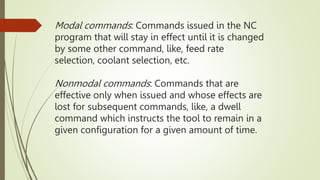
Modal commands: Commands issued in the NC
program that will stay in effect until it is changed
by some other command, like, feed rate
selection, coolant selection, etc.
Nonmodal commands: Commands that are
effective only when issued and whose effects are
lost for subsequent commands, like, a dwell
command which instructs the tool to remain in a
given configuration for a given amount of time.
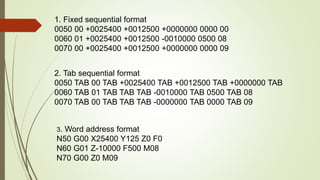
1. Fixed sequential format
0050 00 +0025400 +0012500 +0000000 0000 00
0060 01 +0025400 +0012500 -0010000 0500 08
0070 00 +0025400 +0012500 +0000000 0000 09
2. Tab sequential format
0050 TAB 00 TAB +0025400 TAB +0012500 TAB +0000000 TAB
0060 TAB 01 TAB TAB TAB -0010000 TAB 0500 TAB 08
0070 TAB 00 TAB TAB TAB -0000000 TAB 0000 TAB 09
3. Word address format
N50 G00 X25400 Y125 Z0 F0
N60 G01 Z-10000 F500 M08
N70 G00 Z0 M09
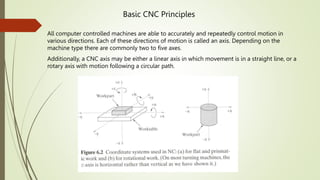
Basic CNC Principles
All computer controlled machines are able to accurately and repeatedly control motion in
various directions. Each of these directions of motion is called an axis. Depending on the
machine type there are commonly two to five axes.
Additionally, a CNC axis may be either a linear axis in which movement is in a straight line, or a
rotary axis with motion following a circular path.
Basic CNC Principles
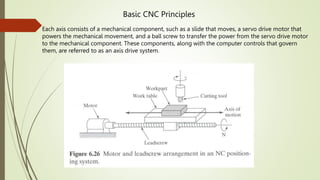
Each axis consists of a mechanical component, such as a slide that moves, a servo drive motor that
powers the mechanical movement, and a ball screw to transfer the power from the servo drive motor
to the mechanical component. These components, along with the computer controls that govern
them, are referred to as an axis drive system.
Basic CNC Principles
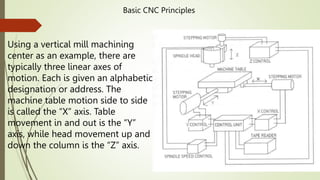
Using a vertical mill machining
center as an example, there are
typically three linear axes of
motion. Each is given an alphabetic
designation or address. The
machine table motion side to side
is called the “X” axis. Table
movement in and out is the “Y”
axis, while head movement up and
down the column is the “Z” axis.
Basic CNC Principles
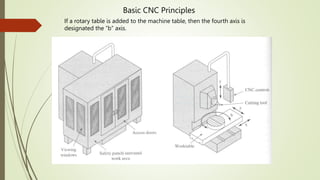
If a rotary table is added to the machine table, then the fourth axis is
designated the “b” axis.
The method of accurate work positioning in relation to the cutting tool is called
the “rectangular coordinate system.” On the vertical mill, the horizontal base line
is designated the “X” axis, while the vertical base line is designated the “Y” axis.
The “Z” axis is at a right angle, perpendicular to both the “X” and “Y” axes.
Increments for all base lines are specified in linear measurements, for most
machines the smallest increment is one ten-thousandth of an inch (.0001). If the
machine is graduated in metric the smallest increment is usually one thousandth
of a millimeter (.001mm).
Work Positioning
CNC instructions are called part program commands.
When running, a part program is interpreted one command line at a time until all lines
are completed.
Commands, which are also referred to as blocks, are made up of words which each
begin with a letter address and end with a numerical value.
Each letter address relates to a specific machine function. “G” and “M” letter addresses
are two of the most common. A “G” letter specifies certain machine preparations such
as inch or metric modes, or absolutes versus incremental modes.
A “M” letter specifies miscellaneous machine functions and work like on/off switches for
coolant flow, tool changing, or spindle rotation. Other letter addresses are used to
direct a wide variety of other machine commands.
CNC Programming Basics
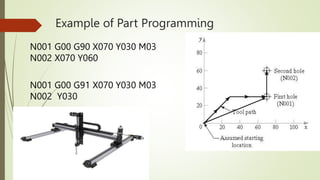
Example of Part Programming
N001 G00 G90 X070 Y030 M03
N002 X070 Y060
N001 G00 G91 X070 Y030 M03
N002 Y030
G Codes
 G00 Rapid traverse
 G01 Linear interpolation
 G02 Circular interpolation, CW
 G03 Circular interpolation, CCW
 G04 Dwell
 G08 Acceleration
 G09 Deceleration
 G10 Tool Length Offset
 G17 X-Y Plane
 G18 Z-X Plane
 G19 Y-Z Plane
 G20 Inch Units (G70) Some Systems
 G21 Metric Units (G71) Some Systems
 G40 Cutter compensation CANCEL
 G41 Cutter compensation left
 G42 Cutter compensation right
 G43 Cutter compensation ON
 G70 Inch format
 G71 Metric format
 G74 Full-circle programming off
 G75 Full-circle programming on
 G80 Fixed-cycle cancel
 G81-G89 Fixed cycles
 G90 Absolute dimensions
 G91 Incremental dimensions
M Codes
 M00 Program stop
 M01 Optional program stop
 M02 Program end
 M03 Spindle on clockwise
 M04 Spindle on counterclockwise
 M05 Spindle stop
 M06 Tool change
 M08 Coolant on
 M09 Coolant off
 M10 Clamps on
 M11 Clamps off
 M30 Program stop, reset to start
N Codes
 Gives an identifying number for each block of information.
 It is generally good practice to increment each block number by 5 or 10 to allow
additional blocks to be inserted if future changes are required.
X,Y, and Z Codes
 X, Y, and Z codes are used to specify the coordinate axis.
 Number following the code defines the coordinate at the end of the move relative
to an incremental or absolute reference point.
F,S, and T Codes
 F-code: used to specify the feed rate
 S-code: used to specify the spindle speed
 T-code: used to specify the tool identification number associated with the tool to
be used in subsequent operations.
Format: N_ G01 X_ Y_ Z_ F_
 Linear Interpolation results in a straight line feed move.
 Unless tool compensation is used, the coordinates are associated with the centerline of the tool.
Three Main parts of a CNC program
 N5 G90 G21 (Absolute units, metric)
 N10 M06 T2 (Stop for tool change, use tool # 2)
 N15 M03 S1200 (Turn the spindle on CW to 1200 rpm)
Part 1- Program Petup
Three Main parts of a CNC program
 N20 G00 X1 Y1 (Rapid to X1,Y1 from origin
point)
 N25 Z0.125 (Rapid down to Z0.125)
 N30 G01 Z-0.125 F100 (Feed down to Z-0.125 at
100 mm/min)
 N35 G01 X2 Y2 (Feed diagonally to X2,Y2)
 N40 G00 Z1 (Rapid up to Z1)
 N45 X0 Y0 (Rapid to X0,Y0)
Part 2- Chip Removal
Three Main parts of a CNC program
 N50 M05 (Turn the spindle off)
 N55 M00 (Program stop)
Part 3- System Shutdown
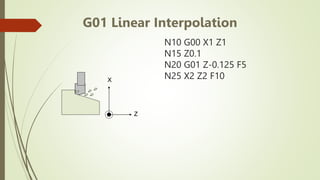
N10 G00 X1 Z1
N15 Z0.1
N20 G01 Z-0.125 F5
N25 X2 Z2 F10
G01 Linear Interpolation
X
Z
G02 Circular Interpolation (CW)
The G02 command requires
an endpoint and a radius in
order to cut the arc.
N_ G00 G71 G90 X1 Y2
N_ G02 X2 Y1 R1
N_ G00 G91 X1 Y2
N_ G02 X1 Y-1 R1
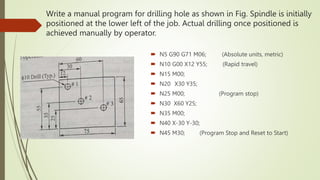
Write a manual program for drilling hole as shown in Fig. Spindle is initially
positioned at the lower left of the job. Actual drilling once positioned is
achieved manually by operator.
 N5 G90 G71 M06; (Absolute units, metric)
 N10 G00 X12 Y55; (Rapid travel)
 N15 M00;
 N20 X30 Y35;
 N25 M00; (Program stop)
 N30 X60 Y25;
 N35 M00;
 N40 X-30 Y-30;
 N45 M30; (Program Stop and Reset to Start)
 N5 G90 G71 M06; (Absolute units, metric)
 N10 G00 X-2.75 Y-2.75 ; (Rapid travel)
 N15 M00 ;
 N20 G01 X77.75 F500 M03; (Material Removal with feed rate)
 N25 Y67.75; (Program stop)
 N30 X-2.75;
 N35 Y-2.75;
 N40 X-2.5 Y-2.5;
 N45 Y67.5;
 N50 X77.5;
 N55 Y-2.5;
 N57 X-2.5;
 N60 M00;
 N65 G00 X-30 Y-30
 N70 M30;
0-2.5-.25=-2.75
Write a manual program for milling a rectangular part (Finished size as
shown in Fig). Numbers indicate the sequence of positions to be followed
by tool. Two passes around the part will be made with roughing pass and a
finishing pass of 0.25mm will be left for the finishing pass. Assume 5mm
cutter diameter. Assume feed rate equal to 500mm/min.
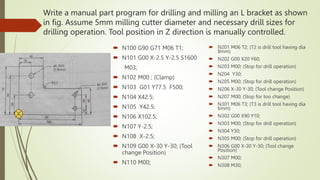
Write a manual part program for drilling and milling an L bracket as shown
in fig. Assume 5mm milling cutter diameter and necessary drill sizes for
drilling operation. Tool position in Z direction is manually controlled.
 N100 G90 G71 M06 T1;
 N101 G00 X-2.5 Y-2.5 S1600
M03;
 N102 M00 ; (Clamp)
 N103 G01 Y77.5 F500;
 N104 X42.5;
 N105 Y42.5;
 N106 X102.5;
 N107 Y-2.5;
 N108 X-2.5;
 N109 G00 X-30 Y-30; (Tool
change Position)
 N110 M00;
 N201 M06 T2; (T2 is drill tool having dia
8mm)
 N202 G00 X20 Y60;
 N203 M00; (Stop for drill operation)
 N204 Y30;
 N205 M00; (Stop for drill operation)
 N206 X-30 Y-30; (Tool change Position)
 N207 M00; (Stop for too change)
 N301 M06 T3; (T3 is drill tool having dia
6mm)
 N302 G00 X90 Y10;
 N303 M00; (Stop for drill operation)
 N304 Y30;
 N305 M00; (Stop for drill operation)
 N306 G00 X-30 Y-30; (Tool change
Position)
 N307 M00;
 N308 M30;
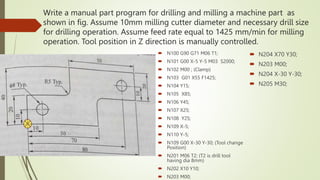
Write a manual part program for drilling and milling a machine part as
shown in fig. Assume 10mm milling cutter diameter and necessary drill size
for drilling operation. Assume feed rate equal to 1425 mm/min for milling
operation. Tool position in Z direction is manually controlled.
 N100 G90 G71 M06 T1;
 N101 G00 X-5 Y-5 M03 S2000;
 N102 M00 ; (Clamp)
 N103 G01 X55 F1425;
 N104 Y15;
 N105 X85;
 N106 Y45;
 N107 X25;
 N108 Y25;
 N109 X-5;
 N110 Y-5;
 N109 G00 X-30 Y-30; (Tool change
Position)
 N201 M06 T2; (T2 is drill tool
having dia 8mm)
 N202 X10 Y10;
 N203 M00;
 N204 X70 Y30;
 N203 M00;
 N204 X-30 Y-30;
 N205 M30;
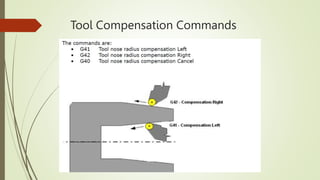
Tool Compensation Commands
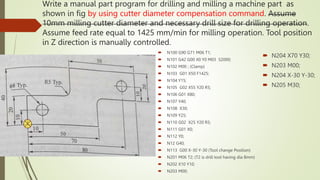
Write a manual part program for drilling and milling a machine part as
shown in fig by using cutter diameter compensation command. Assume
10mm milling cutter diameter and necessary drill size for drilling operation.
Assume feed rate equal to 1425 mm/min for milling operation. Tool position
in Z direction is manually controlled.
 N100 G90 G71 M06 T1;
 N101 G42 G00 X0 Y0 M03 S2000;
 N102 M00 ; (Clamp)
 N103 G01 X50 F1425;
 N104 Y15;
 N105 G02 X55 Y20 R5;
 N106 G01 X80;
 N107 Y40;
 N108 X30;
 N109 Y25;
 N110 G02 X25 Y20 R5;
 N111 G01 X0;
 N112 Y0;
 N12 G40;
 N113 G00 X-30 Y-30 (Tool change Position)
 N201 M06 T2; (T2 is drill tool having dia 8mm)
 N202 X10 Y10;
 N203 M00;
 N204 X70 Y30;
 N203 M00;
 N204 X-30 Y-30;
 N205 M30;
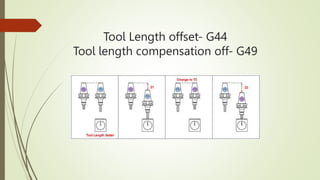
Tool Length offset- G44
Tool length compensation off- G49
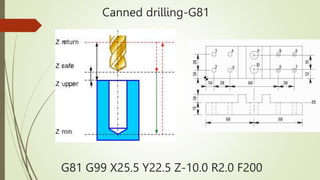
Canned drilling-G81
G81 G99 X25.5 Y22.5 Z-10.0 R2.0 F200
Tapping Process
Canned Tapping-G84
G84 G99 X25.5 Y22.5 Z-10.0 R2.0 F200

CAD-CAM-Module-4-Subtractive-Manufacturing-1-print.pptx

  • 1.
    Module 4 Subtractive Manufacturing Dr. UmeshMane Assistant Professor, VCET, Vasai
  • 2.
  • 3.
    Numerical Control 1. NCTechnology 2. Computer Numerical Control 3. Distributed Numerical Control
  • 4.
    PROGRAM INPUT DEVICE Theprogram input device is the mechanism for part programs to be entered into the CNC control. The most commonly used program input devices are keyboards, punched tape reader, diskette drivers, throgh RS 232 serial ports and networks.
  • 6.
    DNC  Direct numericalcontrol (DNC) – control of multiple machine tools by a single (mainframe) computer through direct connection and in real time  1960s technology  Two way communication  Distributed numerical control (DNC) – network consisting of central computer connected to machine tool MCUs, which are CNC  Present technology  Two way communication
  • 7.
    Overview A numerical control,or “NC”, system controls many machine functions and movements which were traditionally performed by skilled machinists. Numerical control developed out of the need to meet the requirements of high production rates, uniformity and consistent part quality. Programmed instructions are converted into output signals which in turn control machine operations such as spindle speeds, tool selection, tool movement, and cutting fluid flow.
  • 8.
    MACHINE CONTROL UNIT Themachine control unit (MCU) is the heart of a CNC system. It is used to perform the following functions:  Read coded instructions  Decode coded instructions  Implement interpolations (linear, circular, and helical) to generate axis motion commands  Feed axis motion commands to the amplifier circuits for driving the axis mechanisms  Receive the feedback signals of position and speed for each drive axis  Implement auxiliary control functions such as coolant or spindle on/off, and tool change
  • 9.
    CNC PROGRAMMING  Offlineprogramming linked to CAD programs.  Conversational programming by the operator.  MDI ~ Manual Data Input.  Manual Control using jog buttons or `electronic handwheel'.  Word-Address Coding using standard G-codes and M-codes.
  • 10.
  • 11.
    Modal commands: Commandsissued in the NC program that will stay in effect until it is changed by some other command, like, feed rate selection, coolant selection, etc. Nonmodal commands: Commands that are effective only when issued and whose effects are lost for subsequent commands, like, a dwell command which instructs the tool to remain in a given configuration for a given amount of time.
  • 12.
    1. Fixed sequentialformat 0050 00 +0025400 +0012500 +0000000 0000 00 0060 01 +0025400 +0012500 -0010000 0500 08 0070 00 +0025400 +0012500 +0000000 0000 09 2. Tab sequential format 0050 TAB 00 TAB +0025400 TAB +0012500 TAB +0000000 TAB 0060 TAB 01 TAB TAB TAB -0010000 TAB 0500 TAB 08 0070 TAB 00 TAB TAB TAB -0000000 TAB 0000 TAB 09 3. Word address format N50 G00 X25400 Y125 Z0 F0 N60 G01 Z-10000 F500 M08 N70 G00 Z0 M09
  • 13.
    Basic CNC Principles Allcomputer controlled machines are able to accurately and repeatedly control motion in various directions. Each of these directions of motion is called an axis. Depending on the machine type there are commonly two to five axes. Additionally, a CNC axis may be either a linear axis in which movement is in a straight line, or a rotary axis with motion following a circular path.
  • 14.
    Basic CNC Principles Eachaxis consists of a mechanical component, such as a slide that moves, a servo drive motor that powers the mechanical movement, and a ball screw to transfer the power from the servo drive motor to the mechanical component. These components, along with the computer controls that govern them, are referred to as an axis drive system.
  • 15.
    Basic CNC Principles Usinga vertical mill machining center as an example, there are typically three linear axes of motion. Each is given an alphabetic designation or address. The machine table motion side to side is called the “X” axis. Table movement in and out is the “Y” axis, while head movement up and down the column is the “Z” axis.
  • 16.
    Basic CNC Principles Ifa rotary table is added to the machine table, then the fourth axis is designated the “b” axis.
  • 17.
    The method ofaccurate work positioning in relation to the cutting tool is called the “rectangular coordinate system.” On the vertical mill, the horizontal base line is designated the “X” axis, while the vertical base line is designated the “Y” axis. The “Z” axis is at a right angle, perpendicular to both the “X” and “Y” axes. Increments for all base lines are specified in linear measurements, for most machines the smallest increment is one ten-thousandth of an inch (.0001). If the machine is graduated in metric the smallest increment is usually one thousandth of a millimeter (.001mm). Work Positioning
  • 24.
    CNC instructions arecalled part program commands. When running, a part program is interpreted one command line at a time until all lines are completed. Commands, which are also referred to as blocks, are made up of words which each begin with a letter address and end with a numerical value. Each letter address relates to a specific machine function. “G” and “M” letter addresses are two of the most common. A “G” letter specifies certain machine preparations such as inch or metric modes, or absolutes versus incremental modes. A “M” letter specifies miscellaneous machine functions and work like on/off switches for coolant flow, tool changing, or spindle rotation. Other letter addresses are used to direct a wide variety of other machine commands. CNC Programming Basics
  • 25.
    Example of PartProgramming N001 G00 G90 X070 Y030 M03 N002 X070 Y060 N001 G00 G91 X070 Y030 M03 N002 Y030
  • 26.
    G Codes  G00Rapid traverse  G01 Linear interpolation  G02 Circular interpolation, CW  G03 Circular interpolation, CCW  G04 Dwell  G08 Acceleration  G09 Deceleration  G10 Tool Length Offset  G17 X-Y Plane  G18 Z-X Plane  G19 Y-Z Plane  G20 Inch Units (G70) Some Systems  G21 Metric Units (G71) Some Systems  G40 Cutter compensation CANCEL  G41 Cutter compensation left  G42 Cutter compensation right  G43 Cutter compensation ON  G70 Inch format  G71 Metric format  G74 Full-circle programming off  G75 Full-circle programming on  G80 Fixed-cycle cancel  G81-G89 Fixed cycles  G90 Absolute dimensions  G91 Incremental dimensions
  • 27.
    M Codes  M00Program stop  M01 Optional program stop  M02 Program end  M03 Spindle on clockwise  M04 Spindle on counterclockwise  M05 Spindle stop  M06 Tool change  M08 Coolant on  M09 Coolant off  M10 Clamps on  M11 Clamps off  M30 Program stop, reset to start
  • 28.
    N Codes  Givesan identifying number for each block of information.  It is generally good practice to increment each block number by 5 or 10 to allow additional blocks to be inserted if future changes are required.
  • 29.
    X,Y, and ZCodes  X, Y, and Z codes are used to specify the coordinate axis.  Number following the code defines the coordinate at the end of the move relative to an incremental or absolute reference point.
  • 30.
    F,S, and TCodes  F-code: used to specify the feed rate  S-code: used to specify the spindle speed  T-code: used to specify the tool identification number associated with the tool to be used in subsequent operations.
  • 31.
    Format: N_ G01X_ Y_ Z_ F_  Linear Interpolation results in a straight line feed move.  Unless tool compensation is used, the coordinates are associated with the centerline of the tool.
  • 32.
    Three Main partsof a CNC program  N5 G90 G21 (Absolute units, metric)  N10 M06 T2 (Stop for tool change, use tool # 2)  N15 M03 S1200 (Turn the spindle on CW to 1200 rpm) Part 1- Program Petup
  • 33.
    Three Main partsof a CNC program  N20 G00 X1 Y1 (Rapid to X1,Y1 from origin point)  N25 Z0.125 (Rapid down to Z0.125)  N30 G01 Z-0.125 F100 (Feed down to Z-0.125 at 100 mm/min)  N35 G01 X2 Y2 (Feed diagonally to X2,Y2)  N40 G00 Z1 (Rapid up to Z1)  N45 X0 Y0 (Rapid to X0,Y0) Part 2- Chip Removal
  • 34.
    Three Main partsof a CNC program  N50 M05 (Turn the spindle off)  N55 M00 (Program stop) Part 3- System Shutdown
  • 35.
    N10 G00 X1Z1 N15 Z0.1 N20 G01 Z-0.125 F5 N25 X2 Z2 F10 G01 Linear Interpolation X Z
  • 36.
    G02 Circular Interpolation(CW) The G02 command requires an endpoint and a radius in order to cut the arc. N_ G00 G71 G90 X1 Y2 N_ G02 X2 Y1 R1 N_ G00 G91 X1 Y2 N_ G02 X1 Y-1 R1
  • 37.
    Write a manualprogram for drilling hole as shown in Fig. Spindle is initially positioned at the lower left of the job. Actual drilling once positioned is achieved manually by operator.  N5 G90 G71 M06; (Absolute units, metric)  N10 G00 X12 Y55; (Rapid travel)  N15 M00;  N20 X30 Y35;  N25 M00; (Program stop)  N30 X60 Y25;  N35 M00;  N40 X-30 Y-30;  N45 M30; (Program Stop and Reset to Start)
  • 38.
     N5 G90G71 M06; (Absolute units, metric)  N10 G00 X-2.75 Y-2.75 ; (Rapid travel)  N15 M00 ;  N20 G01 X77.75 F500 M03; (Material Removal with feed rate)  N25 Y67.75; (Program stop)  N30 X-2.75;  N35 Y-2.75;  N40 X-2.5 Y-2.5;  N45 Y67.5;  N50 X77.5;  N55 Y-2.5;  N57 X-2.5;  N60 M00;  N65 G00 X-30 Y-30  N70 M30; 0-2.5-.25=-2.75 Write a manual program for milling a rectangular part (Finished size as shown in Fig). Numbers indicate the sequence of positions to be followed by tool. Two passes around the part will be made with roughing pass and a finishing pass of 0.25mm will be left for the finishing pass. Assume 5mm cutter diameter. Assume feed rate equal to 500mm/min.
  • 39.
    Write a manualpart program for drilling and milling an L bracket as shown in fig. Assume 5mm milling cutter diameter and necessary drill sizes for drilling operation. Tool position in Z direction is manually controlled.  N100 G90 G71 M06 T1;  N101 G00 X-2.5 Y-2.5 S1600 M03;  N102 M00 ; (Clamp)  N103 G01 Y77.5 F500;  N104 X42.5;  N105 Y42.5;  N106 X102.5;  N107 Y-2.5;  N108 X-2.5;  N109 G00 X-30 Y-30; (Tool change Position)  N110 M00;  N201 M06 T2; (T2 is drill tool having dia 8mm)  N202 G00 X20 Y60;  N203 M00; (Stop for drill operation)  N204 Y30;  N205 M00; (Stop for drill operation)  N206 X-30 Y-30; (Tool change Position)  N207 M00; (Stop for too change)  N301 M06 T3; (T3 is drill tool having dia 6mm)  N302 G00 X90 Y10;  N303 M00; (Stop for drill operation)  N304 Y30;  N305 M00; (Stop for drill operation)  N306 G00 X-30 Y-30; (Tool change Position)  N307 M00;  N308 M30;
  • 40.
    Write a manualpart program for drilling and milling a machine part as shown in fig. Assume 10mm milling cutter diameter and necessary drill size for drilling operation. Assume feed rate equal to 1425 mm/min for milling operation. Tool position in Z direction is manually controlled.  N100 G90 G71 M06 T1;  N101 G00 X-5 Y-5 M03 S2000;  N102 M00 ; (Clamp)  N103 G01 X55 F1425;  N104 Y15;  N105 X85;  N106 Y45;  N107 X25;  N108 Y25;  N109 X-5;  N110 Y-5;  N109 G00 X-30 Y-30; (Tool change Position)  N201 M06 T2; (T2 is drill tool having dia 8mm)  N202 X10 Y10;  N203 M00;  N204 X70 Y30;  N203 M00;  N204 X-30 Y-30;  N205 M30;
  • 41.
  • 42.
    Write a manualpart program for drilling and milling a machine part as shown in fig by using cutter diameter compensation command. Assume 10mm milling cutter diameter and necessary drill size for drilling operation. Assume feed rate equal to 1425 mm/min for milling operation. Tool position in Z direction is manually controlled.  N100 G90 G71 M06 T1;  N101 G42 G00 X0 Y0 M03 S2000;  N102 M00 ; (Clamp)  N103 G01 X50 F1425;  N104 Y15;  N105 G02 X55 Y20 R5;  N106 G01 X80;  N107 Y40;  N108 X30;  N109 Y25;  N110 G02 X25 Y20 R5;  N111 G01 X0;  N112 Y0;  N12 G40;  N113 G00 X-30 Y-30 (Tool change Position)  N201 M06 T2; (T2 is drill tool having dia 8mm)  N202 X10 Y10;  N203 M00;  N204 X70 Y30;  N203 M00;  N204 X-30 Y-30;  N205 M30;
  • 43.
    Tool Length offset-G44 Tool length compensation off- G49
  • 44.
    Canned drilling-G81 G81 G99X25.5 Y22.5 Z-10.0 R2.0 F200
  • 45.
  • 46.
    Canned Tapping-G84 G84 G99X25.5 Y22.5 Z-10.0 R2.0 F200