BY
PARTH GAJJAR(007)
PARTH PANCHAL(003)
APPROVED BY
C.P. VITHLANI
V.C. PATEL
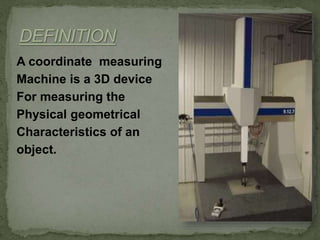
A coordinate measuring
Machine is a 3D device
For measuring the
Physical geometrical
Characteristics of an
object.
Description
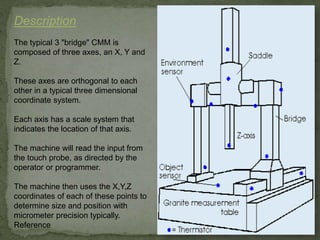
The typical 3 "bridge" CMM is
composed of three axes, an X, Y and
Z.
These axes are orthogonal to each
other in a typical three dimensional
coordinate system.
Each axis has a scale system that
indicates the location of that axis.
The machine will read the input from
the touch probe, as directed by the
operator or programmer.
The machine then uses the X,Y,Z
coordinates of each of these points to
determine size and position with
micrometer precision typically.
Reference
Coordinate-measuring machines include three main
components:
A. The main structure which include three axes of
motion
B. Probing system
C. Data collection and reduction system - typically
includes a machine controller, desktop computer and
application software
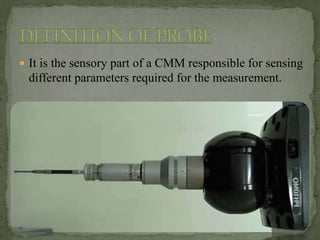
 It is the sensory part of a CMM responsible for sensing
different parameters required for the measurement.
After placing a workpiece on the machine
table, a probe is used to measure different
points on it by mapping the x, y, z
coordinates.
The probe operates either manually via an
operator or automatically via a control
system.
These points are then uploaded to a
computer interface where they can be
analyzed using modeling software (e.g.
CAD) and regression algorithms for further
development.
 How Do Coordinate
Measuring Machines
Work?
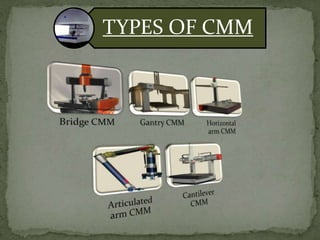
TYPES OF CMM
Mounting
Sometimes a CMM requires a specific mounting style when
incorporated into a system or method of operation. These
mounting options include benchtop, freestanding, handheld,
and portable.
A. Benchtop:- machines mount on a benchtop or desk.
This is typical of most CMMs.
B. Freestanding:- machines can support themselves and
do not require mounting.
C. Portable machines:- are devices that may be
moved freely and are not designed to be bolted or hardwired
in place. Handheld machines are a subset of portable devices
describing those designed to be operated by hand.
 Dimensional measurement
 Profile measurement
 Angularity or orientation
 Depth mapping
 Digitizing or imaging
 Shaft measurement
CMM - COORDINATE MEASURING MACHINE

CMM - COORDINATE MEASURING MACHINE

  • 1.
  • 2.
    A coordinate measuring Machineis a 3D device For measuring the Physical geometrical Characteristics of an object.
  • 3.
    Description The typical 3"bridge" CMM is composed of three axes, an X, Y and Z. These axes are orthogonal to each other in a typical three dimensional coordinate system. Each axis has a scale system that indicates the location of that axis. The machine will read the input from the touch probe, as directed by the operator or programmer. The machine then uses the X,Y,Z coordinates of each of these points to determine size and position with micrometer precision typically. Reference
  • 4.
    Coordinate-measuring machines includethree main components: A. The main structure which include three axes of motion B. Probing system C. Data collection and reduction system - typically includes a machine controller, desktop computer and application software
  • 5.
     It isthe sensory part of a CMM responsible for sensing different parameters required for the measurement.
  • 6.
    After placing aworkpiece on the machine table, a probe is used to measure different points on it by mapping the x, y, z coordinates. The probe operates either manually via an operator or automatically via a control system. These points are then uploaded to a computer interface where they can be analyzed using modeling software (e.g. CAD) and regression algorithms for further development.  How Do Coordinate Measuring Machines Work?
  • 7.
  • 8.
    Mounting Sometimes a CMMrequires a specific mounting style when incorporated into a system or method of operation. These mounting options include benchtop, freestanding, handheld, and portable. A. Benchtop:- machines mount on a benchtop or desk. This is typical of most CMMs. B. Freestanding:- machines can support themselves and do not require mounting. C. Portable machines:- are devices that may be moved freely and are not designed to be bolted or hardwired in place. Handheld machines are a subset of portable devices describing those designed to be operated by hand.
  • 9.
     Dimensional measurement Profile measurement  Angularity or orientation  Depth mapping  Digitizing or imaging  Shaft measurement