LARGE & SMALL SCALE INDUSTRIES IN
INDIA
BY
Dr.S.Subbalakshmi,Ma,MPhil,PhD
Chair, Business & Economics
FBS Business School
Vijayawada & Bangalore
LARGE SCALE INDUSTRIES IN INDIA
GROUPING OF INDUSTRIES
ON THE BASIS OF SIZE ON THE BASIS OF END USE
LARGE SCALE
MEDIUM SIZE
SMALL INDUSTRIES
MEDIUM SISE
SMALL SCALE
BASIC GOODS INDUSTRIES (MINERALS ,
FERTILIZERS, CEMENT ,IRON AND STEEL
,ELECTRICITY )
CAPITAL GOODS INDUSTRIES (MACHINARY ,
RAIL ROAD EQUIPMENT
CONSUMER GOODS INDUSTRIES (CONSUMER
DURABLES,NON DURABLES
LARGE SCALE INDUSTRIES
A) MINING, B) MANUFACTURING C)
ELECTRICITY , D) GAS & WATER SUPPLY
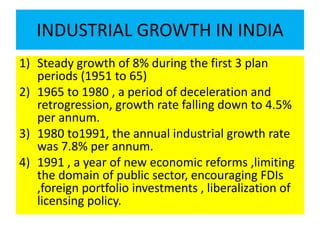
INDUSTRIAL GROWTH IN INDIA
1) Steady growth of 8% during the first 3 plan
periods (1951 to 65)
2) 1965 to 1980 , a period of deceleration and
retrogression, growth rate falling down to 4.5%
per annum.
3) 1980 to1991, the annual industrial growth rate
was 7.8% per annum.
4) 1991 , a year of new economic reforms ,limiting
the domain of public sector, encouraging FDIs
,foreign portfolio investments , liberalization of
licensing policy.
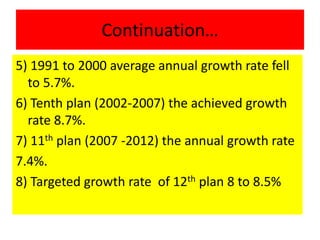
Continuation…
5) 1991 to 2000 average annual growth rate fell
to 5.7%.
6) Tenth plan (2002-2007) the achieved growth
rate 8.7%.
7) 11th plan (2007 -2012) the annual growth rate
7.4%.
8) Targeted growth rate of 12th plan 8 to 8.5%
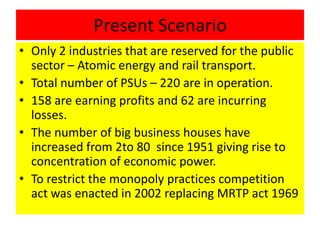
Present Scenario
• Only 2 industries that are reserved for the public
sector – Atomic energy and rail transport.
• Total number of PSUs – 220 are in operation.
• 158 are earning profits and 62 are incurring
losses.
• The number of big business houses have
increased from 2to 80 since 1951 giving rise to
concentration of economic power.
• To restrict the monopoly practices competition
act was enacted in 2002 replacing MRTP act 1969
Role of Large scale industries in India
1) Modernizing agriculture,
2) Providing Employment to 22% of population
3) Share in GDP 30 % (Data 2016-17)
4) Two thirds of export earnings are from industry.
5) Raising incomes of people by enhancing the economic
growth.
6) Industrial growth meets the ever increasing demand for
industrial goods which have high income elasticity.
7) Strengthening the economy by providing infrastructure like
railways dams which are not importable
Make in India
• An initiative launched by Government of India
to encourage national , multinational
companies to manufacture their products in
India.
• Launched by Prime Minister Narendra Modi
on 25th September 2014.
• It made India top destination globally for
foreign direct investment surpassing USA and
China receiving 63 US billion dollars in FDI.
Problems of Large scale Industries
1) Below targeted growth rate in all the five year
plans except the first five year plan.
2) Under utilisation of the plant’s capacity to the
extent of 40% to 50%.
3) Increasing capital output ratio from 2.95 in the
first five year plan to 4 during eighth, ninth,
tenth ,eleventh plans
4) Absence of world class infrastructure ex: lack of
transport facilities, frequent power failures.
Continuation
5)High cost industrial economy is attributed to out
dated technology, import substitution , government
protection to PSUs , low MPL, uneconomic size of
industrial units, monopolistic tendencies.
6) Poor performance of public sector units.
7) Sectoral imbalances implying inadequate support
from agriculture and service sectors.
8) Industrial development is lopsided region wise.
Large scale industries are concentrated in regions
like Tamilnadu, Andhra Pradesh, Maharashtra, and
Gujarat.These four states account for 50% of total
capital and 50% of total factories.
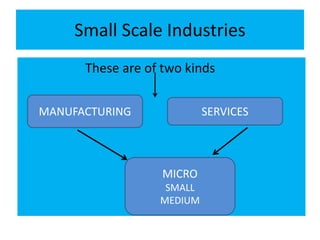
Small Scale Industries
These are of two kinds
MANUFACTURING SERVICES
MICRO
SMALL
MEDIUM
MANUFACTURING SECTOR –INVESTMENT LIMIT
• Micro Enterprises -- Up to Rs 25 lakhs
• Small Enterprises --- Rs 25 lakhs to 5 crores
• Medium enterprises -- 5 crores to 10 crores
• SERVICE SECTOR– INVESTMENT LIMIT
Micro Enterprises -- Up to Rs 10 lakhs
Smallenterprises ---Rs 10 lakhs to 2 crores
Medium Enterprises -- Rs 2 crores to 5 crores
Role of Small Scale Sector
1) Contributes 8% of country’s GDP,
2) 45% of manufactured output of India is from
this sector,
3) Contributes 45% to India’s total exports,
4) Produces 8000 value added products,
5) Employs 40 % of work force in India,
6) Maintains a consistent growth rate of 10 %
annually.
Start up India
• Aiming at promotion of bank financing for
start up ventures to encourage small scale
sector.
• Meant mainly for employment generation
• Under this Micro units are refinanced by new
institution MUDRA(Micro Unit Development &
Refinance Agency) Bank with a refinance fund
of Rs 200 billion US dollars
• It is named in rural version as Deen Dayal
Upadhyay Swaniyojan Yojana
Problems of Small scale sector
1) Finance : Entrepreneurs are forced to borrow
from money lenders at high rate of interest
as institutional finance is not available due to
their lack of creditworthiness.
2) In competition with large scale sector this
sector fails to corner adequate , qualitative
raw material.
3) Under utilization of capacity to the extent of
40 to 50%
continuation
4) Not having information about changing
technologies and consumer tastes.
5)Bottlenecks of infrastructure like power,
transportation, lack of network facility.
6) Lack of skilled man power.
7) Managerial inadequacies like demand vision ,
aptitude ,lack of training .
8) Poor project planning.
Support system
• Trade Fair Authority of India, State trading
Corporation, National Small Industries
Corporation help in selling the products of this
sector in domestic and export markets.
• Small Industries Development corporation of India
provides cheap finance.
• Nationalized commercial banks are supposed to
extend credit facility.
• Product Reservation
Product Reservation
1) Food and Allied industries : Pickles and
chutneys, Bread , Mustard oil ,ground nut oil
etc..
2) Wood and Wood products : Wooden
furniture and fixtures
3) Paper products :Stationary.
4) Thermo Plastic products :PVC pipes, Fittings
for PVC pipes ,
5) Chemical products :Wax candles, Safety
matches, Fire works , Agarbatties
Continuation….
• 6)Glass and Ceramics : Glass bangles
• 7) Mechanical Engineering :Steel Almirah,
Rolling shutters ,Steel chairs , Steel furniture
Domestic steel utensils
Skill India
• A campaign launched by Prime Minister Sri
Narendra Modi on July 15-2015 aiming to
train youth in different skills. It includes
initiatives like Pradhan Mantri Kousal Vikas
Yojana and the Skill loan Scheme through
National Skill Development Corporation.
• Creates a hall mark called “Rural India Skill” so
as to standardize and certify rural skills
beneficial for small scale sector
THANK YOU

Large scale& Small scale industries in India.

  • 1.
    LARGE & SMALLSCALE INDUSTRIES IN INDIA BY Dr.S.Subbalakshmi,Ma,MPhil,PhD Chair, Business & Economics FBS Business School Vijayawada & Bangalore
  • 2.
    LARGE SCALE INDUSTRIESIN INDIA GROUPING OF INDUSTRIES ON THE BASIS OF SIZE ON THE BASIS OF END USE LARGE SCALE MEDIUM SIZE SMALL INDUSTRIES MEDIUM SISE SMALL SCALE BASIC GOODS INDUSTRIES (MINERALS , FERTILIZERS, CEMENT ,IRON AND STEEL ,ELECTRICITY ) CAPITAL GOODS INDUSTRIES (MACHINARY , RAIL ROAD EQUIPMENT CONSUMER GOODS INDUSTRIES (CONSUMER DURABLES,NON DURABLES LARGE SCALE INDUSTRIES A) MINING, B) MANUFACTURING C) ELECTRICITY , D) GAS & WATER SUPPLY
  • 3.
    INDUSTRIAL GROWTH ININDIA 1) Steady growth of 8% during the first 3 plan periods (1951 to 65) 2) 1965 to 1980 , a period of deceleration and retrogression, growth rate falling down to 4.5% per annum. 3) 1980 to1991, the annual industrial growth rate was 7.8% per annum. 4) 1991 , a year of new economic reforms ,limiting the domain of public sector, encouraging FDIs ,foreign portfolio investments , liberalization of licensing policy.
  • 4.
    Continuation… 5) 1991 to2000 average annual growth rate fell to 5.7%. 6) Tenth plan (2002-2007) the achieved growth rate 8.7%. 7) 11th plan (2007 -2012) the annual growth rate 7.4%. 8) Targeted growth rate of 12th plan 8 to 8.5%
  • 5.
    Present Scenario • Only2 industries that are reserved for the public sector – Atomic energy and rail transport. • Total number of PSUs – 220 are in operation. • 158 are earning profits and 62 are incurring losses. • The number of big business houses have increased from 2to 80 since 1951 giving rise to concentration of economic power. • To restrict the monopoly practices competition act was enacted in 2002 replacing MRTP act 1969
  • 6.
    Role of Largescale industries in India 1) Modernizing agriculture, 2) Providing Employment to 22% of population 3) Share in GDP 30 % (Data 2016-17) 4) Two thirds of export earnings are from industry. 5) Raising incomes of people by enhancing the economic growth. 6) Industrial growth meets the ever increasing demand for industrial goods which have high income elasticity. 7) Strengthening the economy by providing infrastructure like railways dams which are not importable
  • 7.
    Make in India •An initiative launched by Government of India to encourage national , multinational companies to manufacture their products in India. • Launched by Prime Minister Narendra Modi on 25th September 2014. • It made India top destination globally for foreign direct investment surpassing USA and China receiving 63 US billion dollars in FDI.
  • 8.
    Problems of Largescale Industries 1) Below targeted growth rate in all the five year plans except the first five year plan. 2) Under utilisation of the plant’s capacity to the extent of 40% to 50%. 3) Increasing capital output ratio from 2.95 in the first five year plan to 4 during eighth, ninth, tenth ,eleventh plans 4) Absence of world class infrastructure ex: lack of transport facilities, frequent power failures.
  • 9.
    Continuation 5)High cost industrialeconomy is attributed to out dated technology, import substitution , government protection to PSUs , low MPL, uneconomic size of industrial units, monopolistic tendencies. 6) Poor performance of public sector units. 7) Sectoral imbalances implying inadequate support from agriculture and service sectors. 8) Industrial development is lopsided region wise. Large scale industries are concentrated in regions like Tamilnadu, Andhra Pradesh, Maharashtra, and Gujarat.These four states account for 50% of total capital and 50% of total factories.
  • 10.
    Small Scale Industries Theseare of two kinds MANUFACTURING SERVICES MICRO SMALL MEDIUM
  • 11.
    MANUFACTURING SECTOR –INVESTMENTLIMIT • Micro Enterprises -- Up to Rs 25 lakhs • Small Enterprises --- Rs 25 lakhs to 5 crores • Medium enterprises -- 5 crores to 10 crores • SERVICE SECTOR– INVESTMENT LIMIT Micro Enterprises -- Up to Rs 10 lakhs Smallenterprises ---Rs 10 lakhs to 2 crores Medium Enterprises -- Rs 2 crores to 5 crores
  • 12.
    Role of SmallScale Sector 1) Contributes 8% of country’s GDP, 2) 45% of manufactured output of India is from this sector, 3) Contributes 45% to India’s total exports, 4) Produces 8000 value added products, 5) Employs 40 % of work force in India, 6) Maintains a consistent growth rate of 10 % annually.
  • 13.
    Start up India •Aiming at promotion of bank financing for start up ventures to encourage small scale sector. • Meant mainly for employment generation • Under this Micro units are refinanced by new institution MUDRA(Micro Unit Development & Refinance Agency) Bank with a refinance fund of Rs 200 billion US dollars • It is named in rural version as Deen Dayal Upadhyay Swaniyojan Yojana
  • 14.
    Problems of Smallscale sector 1) Finance : Entrepreneurs are forced to borrow from money lenders at high rate of interest as institutional finance is not available due to their lack of creditworthiness. 2) In competition with large scale sector this sector fails to corner adequate , qualitative raw material. 3) Under utilization of capacity to the extent of 40 to 50%
  • 15.
    continuation 4) Not havinginformation about changing technologies and consumer tastes. 5)Bottlenecks of infrastructure like power, transportation, lack of network facility. 6) Lack of skilled man power. 7) Managerial inadequacies like demand vision , aptitude ,lack of training . 8) Poor project planning.
  • 16.
    Support system • TradeFair Authority of India, State trading Corporation, National Small Industries Corporation help in selling the products of this sector in domestic and export markets. • Small Industries Development corporation of India provides cheap finance. • Nationalized commercial banks are supposed to extend credit facility. • Product Reservation
  • 17.
    Product Reservation 1) Foodand Allied industries : Pickles and chutneys, Bread , Mustard oil ,ground nut oil etc.. 2) Wood and Wood products : Wooden furniture and fixtures 3) Paper products :Stationary. 4) Thermo Plastic products :PVC pipes, Fittings for PVC pipes , 5) Chemical products :Wax candles, Safety matches, Fire works , Agarbatties
  • 18.
    Continuation…. • 6)Glass andCeramics : Glass bangles • 7) Mechanical Engineering :Steel Almirah, Rolling shutters ,Steel chairs , Steel furniture Domestic steel utensils
  • 19.
    Skill India • Acampaign launched by Prime Minister Sri Narendra Modi on July 15-2015 aiming to train youth in different skills. It includes initiatives like Pradhan Mantri Kousal Vikas Yojana and the Skill loan Scheme through National Skill Development Corporation. • Creates a hall mark called “Rural India Skill” so as to standardize and certify rural skills beneficial for small scale sector
  • 20.