Introduction
o Stands for Micro Small and Medium Enterprises.
o Plays an important role in economic stability.
o The enterprise is regarded as BACKBONE of
industrial development.
o Contributing mainly 8% in GDP, 40% in
Manufacturing output & 45% in Exports.
o They have emerged as dynamic and vibrant sector of
economy.
Emergence of MSME
 Based on Gandhian Model.
 Encouraged by MSME Act 2006.
 During pre-liberalization period 1991, India accorded
high priority to small and medium enterprises.
 The scenario for small scale industry changed with
industrial policy establishment.
 Post liberalization era reflected growth of small scale
industries and it was almost 3 times of total
industrial sector .
Industries under MSME
 Food Processing
 Agriculture Inputs
 Chemicals & Pharmaceuticals
 Engineering
 Textiles & Garments
 Meat Products
 Sports Goods
 Plastic Products
 Computer Software
MSME in India
In Indian context, MSME is defined as
It is basically based on investment in plant,
machinery and equipments for providing services.
Meaning of micro small and Medium Undertakings
changed over years with the changing conditions and
squeezing issues of the Indian economy. Different
organizations, government offices, people had
characterized little modern units in various ways.
Criteria’s
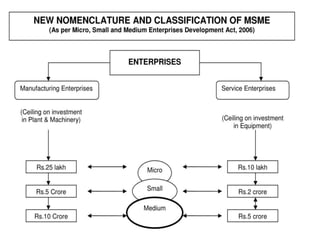
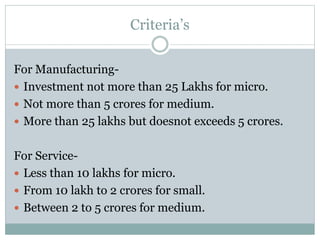
For Manufacturing-
 Investment not more than 25 Lakhs for micro.
 Not more than 5 crores for medium.
 More than 25 lakhs but doesnot exceeds 5 crores.
For Service-
 Less than 10 lakhs for micro.
 From 10 lakh to 2 crores for small.
 Between 2 to 5 crores for medium.
Leading banks providing loans
Contribution & Performance OF MSME’s
 45% Industrial Production
 10% Exports
 31 Million Employment
 13 Million MSME’s producing more than 800
products
Role & Functions of MSME
 Advising the Government in policy formulation.
 Providing techno-economic and managerial
consultancies
 Developing Human Resources
 Making available economic information services
 Maintaining a close liaison with the organizations
 Evolving and coordinating Policies and Programs
MSME in India
 Contribute nearly 45 percent of the manufacturing
output and 40 percent of the exports
 Contribute app. 8 percent of country’s GDP
 MSME sector provide the largest share of
employment
 Economic independence
 Growth of small sector plays an important role in
maintaining the overall social & cultural structure
Expectations
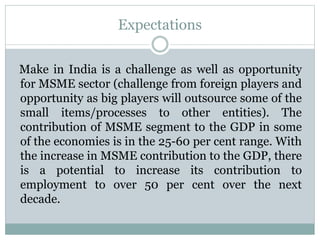
Make in India is a challenge as well as opportunity
for MSME sector (challenge from foreign players and
opportunity as big players will outsource some of the
small items/processes to other entities). The
contribution of MSME segment to the GDP in some
of the economies is in the 25-60 per cent range. With
the increase in MSME contribution to the GDP, there
is a potential to increase its contribution to
employment to over 50 per cent over the next
decade.
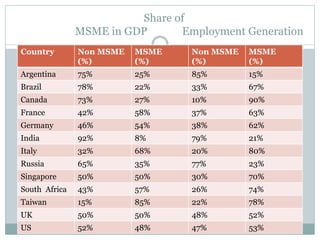
Share of
MSME in GDP Employment Generation
Country Non MSME
(%)
MSME
(%)
Non MSME
(%)
MSME
(%)
Argentina 75% 25% 85% 15%
Brazil 78% 22% 33% 67%
Canada 73% 27% 10% 90%
France 42% 58% 37% 63%
Germany 46% 54% 38% 62%
India 92% 8% 79% 21%
Italy 32% 68% 20% 80%
Russia 65% 35% 77% 23%
Singapore 50% 50% 30% 70%
South Africa 43% 57% 26% 74%
Taiwan 15% 85% 22% 78%
UK 50% 50% 48% 52%
US 52% 48% 47% 53%
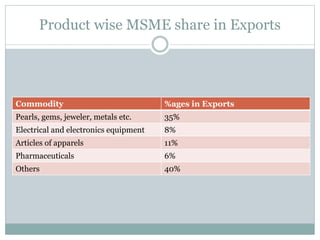
Product wise MSME share in Exports
Commodity %ages in Exports
Pearls, gems, jeweler, metals etc. 35%
Electrical and electronics equipment 8%
Articles of apparels 11%
Pharmaceuticals 6%
Others 40%
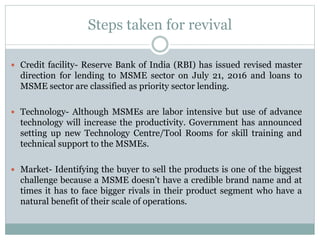
Steps taken for revival
 Credit facility- Reserve Bank of India (RBI) has issued revised master
direction for lending to MSME sector on July 21, 2016 and loans to
MSME sector are classified as priority sector lending.
 Technology- Although MSMEs are labor intensive but use of advance
technology will increase the productivity. Government has announced
setting up new Technology Centre/Tool Rooms for skill training and
technical support to the MSMEs.
 Market- Identifying the buyer to sell the products is one of the biggest
challenge because a MSME doesn’t have a credible brand name and at
times it has to face bigger rivals in their product segment who have a
natural benefit of their scale of operations.
Continued..
 MSME sector has to reach entrepreneurs & educate
them about the opportunities
 New bankruptcy law allow entrepreneurs to get a
fresh start and thereby facilitate restart
 Import of Chinese goods has become more
economical
 RBI extending loans upto 25 lakhs
MSEMED Act 2006
 MSMED Act was established to provide for
facilitating *the promotion and development* and
*enhancing competitiveness* of micro, small &
medium enterprises.
 Became operational on 2nd October 2016
 Prior to 2006 Act - all about small & village
industries
 After 2006 Act - Micro and Small Industries.
Salient Features
 Industries replaced by enterprises.
 Constitution of MSME board.
 Simplification of registration procedure.
 Progressive credit support.
 Penalty for delayed payments.
Objectives
 Strengthening competition by establishing an
appropriate legal and regulatory framework and
removing barriers to competition and trade.
 Facilitating investment and trade by strengthening
the framework for marketing assistance or
infrastructure facilities and cluster development of
enterprises.
Challenges to MSME
 Absence of adequate and timely banking finance.
 Limited capital and knowledge.
 Non-availability of suitable technology.
 Low production capacity.
 Ineffective marketing strategy.
 Non availability of skilled labor at affordable cost
MSME - Problems faced by finance
 Root cause for all the other problems faced by the
MSME sector.
 Exhibited rate of interest.
 Weak credit worthiness of micro and small
enterprises in the country.
 Difficult to take financial assistance from the
commercial banks and financial institutions.
MSME - Problems faced by Raw Material
 An absolute scarcity.
 Poor quality of raw materials.
 A high cost.
MSME - Problems faced by Marketing
One of the main problems faced by the micro and
small enterprises is in the field of marketing. These
units often do not possess any marketing
organization. In consequence, their products
compare unfavorably with the quality of the products
of the large-scale industries. Therefore, they suffer
from competitive disadvantages vis à vis large scale
units.
MSME - Problems faced by SME
 SME are often confronted with problems that is
uncommon to the larger companies and multi-
national corporations.
 Very difficult for SMEs to attract good IT personnel.
 Lack of Formal Procedure and Discipline.
 Uneven IT Awareness and Management Skill
 Lack of Experience of Using Consultants
 Lack of Human Resources
Measures taken by the government
 National Manufacturing Competitiveness Programme
(NMCP) Schemes Under XI Plan
 Micro & Small Enterprises Cluster Development
Programme (MSE-CDP)
 Credit Linked Capital Subsidy Scheme for Technology
Upgradation
 Credit Guarantee Scheme
 ISO 9000/ISO 14001 Certification Reimbursement
Scheme
 Scheme of Micro Finance Programme
 Scheme of National Award
Continued…
 Guidelines of Scheme for Assistance to Training
Institutions ( English/ Hindi)
 Scheme of Fund for Regeneration of Traditional
Industries (SFURTI)
 Rajiv Gandhi Udyami Mitra Yojana (RGUMY)
Implemented through NSIC
 Marketing Assistance Scheme
 Performance and Credit Rating Scheme
Conclusion
With this fast growing economy and vast opportunities
MSME are about to raise bar and challenges
international competition. We hope to see them in a
far better position in terms of growth as well as
manufacturing excellence. We could expect more
schemes from government to make MSME excellent.
MSME

MSME

  • 2.
    Introduction o Stands forMicro Small and Medium Enterprises. o Plays an important role in economic stability. o The enterprise is regarded as BACKBONE of industrial development. o Contributing mainly 8% in GDP, 40% in Manufacturing output & 45% in Exports. o They have emerged as dynamic and vibrant sector of economy.
  • 3.
    Emergence of MSME Based on Gandhian Model.  Encouraged by MSME Act 2006.  During pre-liberalization period 1991, India accorded high priority to small and medium enterprises.  The scenario for small scale industry changed with industrial policy establishment.  Post liberalization era reflected growth of small scale industries and it was almost 3 times of total industrial sector .
  • 5.
    Industries under MSME Food Processing  Agriculture Inputs  Chemicals & Pharmaceuticals  Engineering  Textiles & Garments  Meat Products  Sports Goods  Plastic Products  Computer Software
  • 6.
    MSME in India InIndian context, MSME is defined as It is basically based on investment in plant, machinery and equipments for providing services. Meaning of micro small and Medium Undertakings changed over years with the changing conditions and squeezing issues of the Indian economy. Different organizations, government offices, people had characterized little modern units in various ways.
  • 7.
    Criteria’s For Manufacturing-  Investmentnot more than 25 Lakhs for micro.  Not more than 5 crores for medium.  More than 25 lakhs but doesnot exceeds 5 crores. For Service-  Less than 10 lakhs for micro.  From 10 lakh to 2 crores for small.  Between 2 to 5 crores for medium.
  • 8.
  • 9.
    Contribution & PerformanceOF MSME’s  45% Industrial Production  10% Exports  31 Million Employment  13 Million MSME’s producing more than 800 products
  • 10.
    Role & Functionsof MSME  Advising the Government in policy formulation.  Providing techno-economic and managerial consultancies  Developing Human Resources  Making available economic information services  Maintaining a close liaison with the organizations  Evolving and coordinating Policies and Programs
  • 11.
    MSME in India Contribute nearly 45 percent of the manufacturing output and 40 percent of the exports  Contribute app. 8 percent of country’s GDP  MSME sector provide the largest share of employment  Economic independence  Growth of small sector plays an important role in maintaining the overall social & cultural structure
  • 12.
    Expectations Make in Indiais a challenge as well as opportunity for MSME sector (challenge from foreign players and opportunity as big players will outsource some of the small items/processes to other entities). The contribution of MSME segment to the GDP in some of the economies is in the 25-60 per cent range. With the increase in MSME contribution to the GDP, there is a potential to increase its contribution to employment to over 50 per cent over the next decade.
  • 13.
    Share of MSME inGDP Employment Generation Country Non MSME (%) MSME (%) Non MSME (%) MSME (%) Argentina 75% 25% 85% 15% Brazil 78% 22% 33% 67% Canada 73% 27% 10% 90% France 42% 58% 37% 63% Germany 46% 54% 38% 62% India 92% 8% 79% 21% Italy 32% 68% 20% 80% Russia 65% 35% 77% 23% Singapore 50% 50% 30% 70% South Africa 43% 57% 26% 74% Taiwan 15% 85% 22% 78% UK 50% 50% 48% 52% US 52% 48% 47% 53%
  • 14.
    Product wise MSMEshare in Exports Commodity %ages in Exports Pearls, gems, jeweler, metals etc. 35% Electrical and electronics equipment 8% Articles of apparels 11% Pharmaceuticals 6% Others 40%
  • 15.
    Steps taken forrevival  Credit facility- Reserve Bank of India (RBI) has issued revised master direction for lending to MSME sector on July 21, 2016 and loans to MSME sector are classified as priority sector lending.  Technology- Although MSMEs are labor intensive but use of advance technology will increase the productivity. Government has announced setting up new Technology Centre/Tool Rooms for skill training and technical support to the MSMEs.  Market- Identifying the buyer to sell the products is one of the biggest challenge because a MSME doesn’t have a credible brand name and at times it has to face bigger rivals in their product segment who have a natural benefit of their scale of operations.
  • 16.
    Continued..  MSME sectorhas to reach entrepreneurs & educate them about the opportunities  New bankruptcy law allow entrepreneurs to get a fresh start and thereby facilitate restart  Import of Chinese goods has become more economical  RBI extending loans upto 25 lakhs
  • 17.
    MSEMED Act 2006 MSMED Act was established to provide for facilitating *the promotion and development* and *enhancing competitiveness* of micro, small & medium enterprises.  Became operational on 2nd October 2016  Prior to 2006 Act - all about small & village industries  After 2006 Act - Micro and Small Industries.
  • 18.
    Salient Features  Industriesreplaced by enterprises.  Constitution of MSME board.  Simplification of registration procedure.  Progressive credit support.  Penalty for delayed payments.
  • 19.
    Objectives  Strengthening competitionby establishing an appropriate legal and regulatory framework and removing barriers to competition and trade.  Facilitating investment and trade by strengthening the framework for marketing assistance or infrastructure facilities and cluster development of enterprises.
  • 20.
    Challenges to MSME Absence of adequate and timely banking finance.  Limited capital and knowledge.  Non-availability of suitable technology.  Low production capacity.  Ineffective marketing strategy.  Non availability of skilled labor at affordable cost
  • 21.
    MSME - Problemsfaced by finance  Root cause for all the other problems faced by the MSME sector.  Exhibited rate of interest.  Weak credit worthiness of micro and small enterprises in the country.  Difficult to take financial assistance from the commercial banks and financial institutions.
  • 22.
    MSME - Problemsfaced by Raw Material  An absolute scarcity.  Poor quality of raw materials.  A high cost.
  • 23.
    MSME - Problemsfaced by Marketing One of the main problems faced by the micro and small enterprises is in the field of marketing. These units often do not possess any marketing organization. In consequence, their products compare unfavorably with the quality of the products of the large-scale industries. Therefore, they suffer from competitive disadvantages vis à vis large scale units.
  • 24.
    MSME - Problemsfaced by SME  SME are often confronted with problems that is uncommon to the larger companies and multi- national corporations.  Very difficult for SMEs to attract good IT personnel.  Lack of Formal Procedure and Discipline.  Uneven IT Awareness and Management Skill  Lack of Experience of Using Consultants  Lack of Human Resources
  • 25.
    Measures taken bythe government  National Manufacturing Competitiveness Programme (NMCP) Schemes Under XI Plan  Micro & Small Enterprises Cluster Development Programme (MSE-CDP)  Credit Linked Capital Subsidy Scheme for Technology Upgradation  Credit Guarantee Scheme  ISO 9000/ISO 14001 Certification Reimbursement Scheme  Scheme of Micro Finance Programme  Scheme of National Award
  • 26.
    Continued…  Guidelines ofScheme for Assistance to Training Institutions ( English/ Hindi)  Scheme of Fund for Regeneration of Traditional Industries (SFURTI)  Rajiv Gandhi Udyami Mitra Yojana (RGUMY) Implemented through NSIC  Marketing Assistance Scheme  Performance and Credit Rating Scheme
  • 27.
    Conclusion With this fastgrowing economy and vast opportunities MSME are about to raise bar and challenges international competition. We hope to see them in a far better position in terms of growth as well as manufacturing excellence. We could expect more schemes from government to make MSME excellent.