
CURRENT SCENARIO OF ENTREPRENEURSHIP IN INDIA
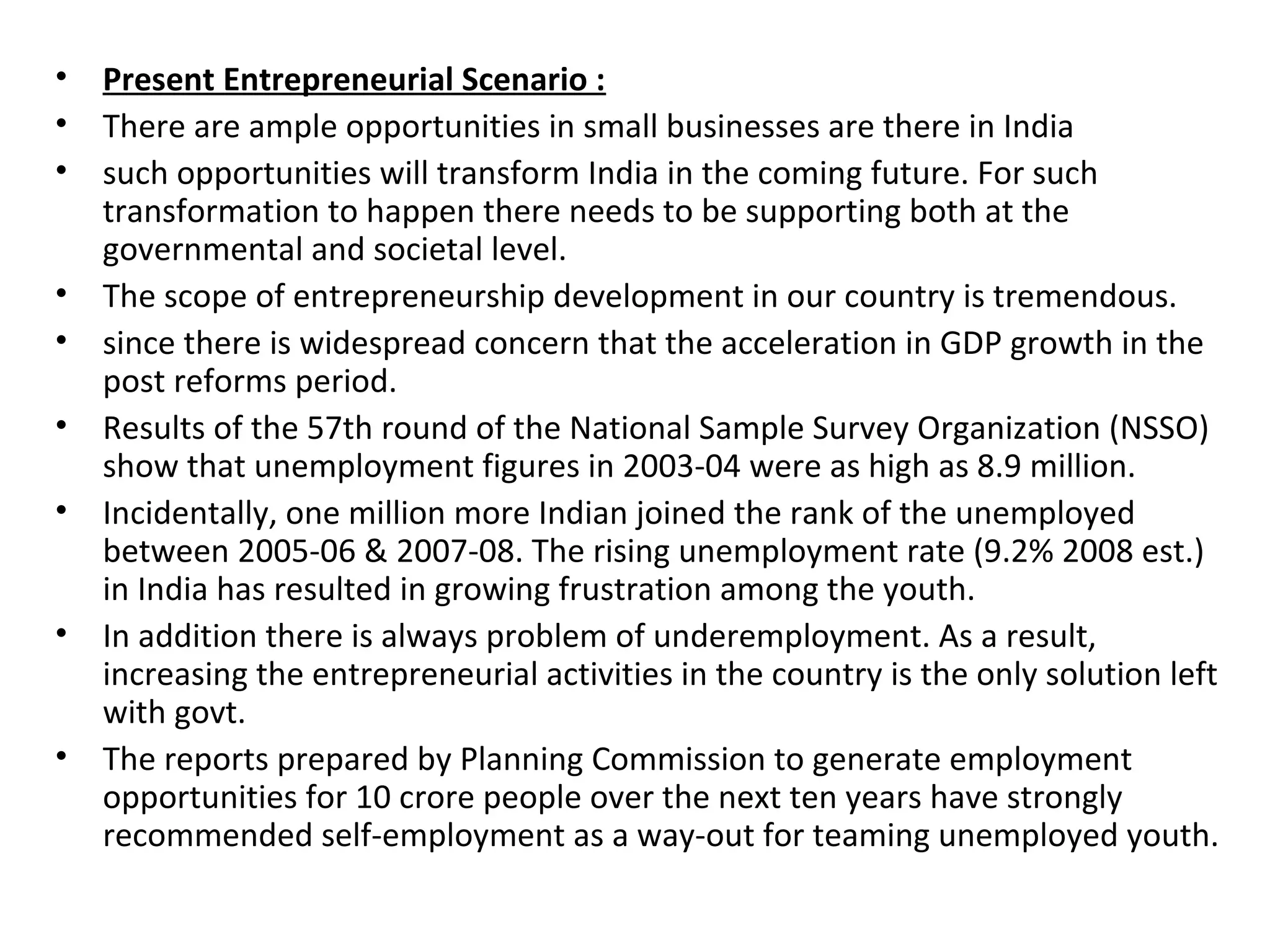
• Present Entrepreneurial Scenario :
• There are ample opportunities in small businesses are there in India
• such opportunities will transform India in the coming future. For such
transformation to happen there needs to be supporting both at the
governmental and societal level.
• The scope of entrepreneurship development in our country is tremendous.
• since there is widespread concern that the acceleration in GDP growth in the
post reforms period.
• Results of the 57th round of the National Sample Survey Organization (NSSO)
show that unemployment figures in 2003-04 were as high as 8.9 million.
• Incidentally, one million more Indian joined the rank of the unemployed
between 2005-06 & 2007-08. The rising unemployment rate (9.2% 2008 est.)
in India has resulted in growing frustration among the youth.
• In addition there is always problem of underemployment. As a result,
increasing the entrepreneurial activities in the country is the only solution left
with govt.
• The reports prepared by Planning Commission to generate employment
opportunities for 10 crore people over the next ten years have strongly
recommended self-employment as a way-out for teaming unemployed youth.
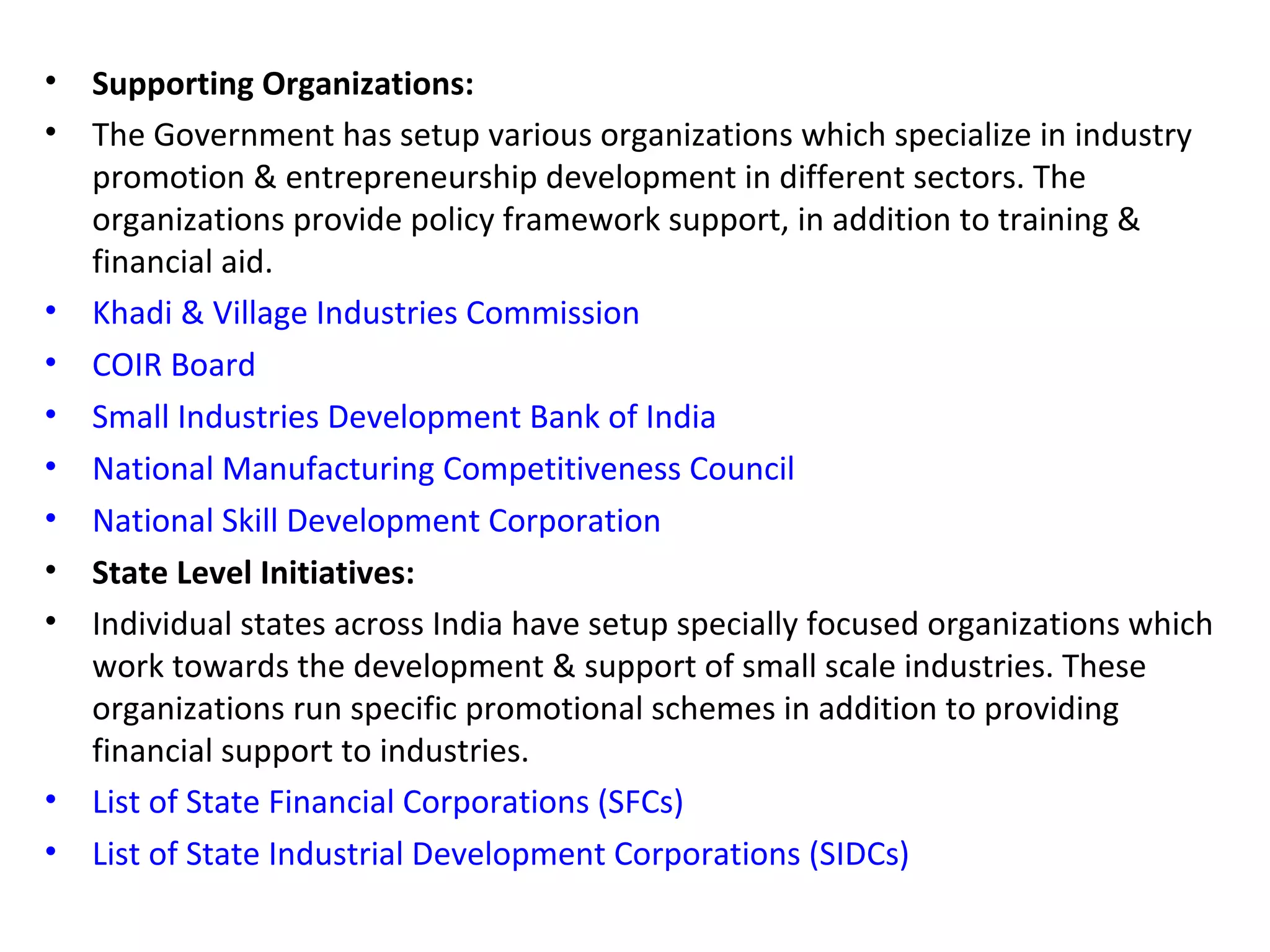
• Supporting Organizations:
• The Government has setup various organizations which specialize in industry
promotion & entrepreneurship development in different sectors. The
organizations provide policy framework support, in addition to training &
financial aid.
• Khadi & Village Industries Commission
• COIR Board
• Small Industries Development Bank of India
• National Manufacturing Competitiveness Council
• National Skill Development Corporation
• State Level Initiatives:
• Individual states across India have setup specially focused organizations which
work towards the development & support of small scale industries. These
organizations run specific promotional schemes in addition to providing
financial support to industries.
• List of State Financial Corporations (SFCs)
• List of State Industrial Development Corporations (SIDCs)
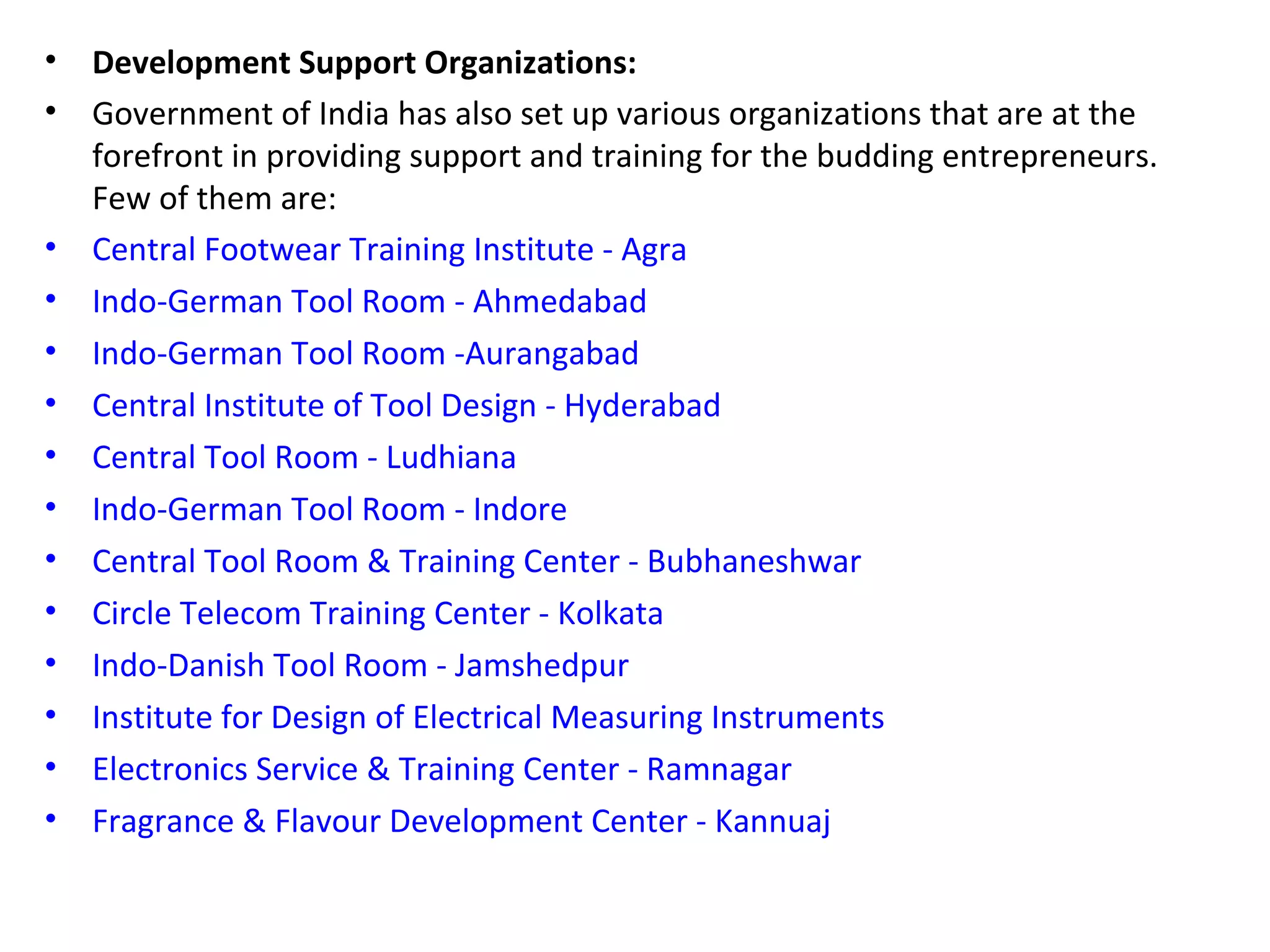
• Development Support Organizations:
• Government of India has also set up various organizations that are at the
forefront in providing support and training for the budding entrepreneurs.
Few of them are:
• Central Footwear Training Institute - Agra
• Indo-German Tool Room - Ahmedabad
• Indo-German Tool Room -Aurangabad
• Central Institute of Tool Design - Hyderabad
• Central Tool Room - Ludhiana
• Indo-German Tool Room - Indore
• Central Tool Room & Training Center - Bubhaneshwar
• Circle Telecom Training Center - Kolkata
• Indo-Danish Tool Room - Jamshedpur
• Institute for Design of Electrical Measuring Instruments
• Electronics Service & Training Center - Ramnagar
• Fragrance & Flavour Development Center - Kannuaj
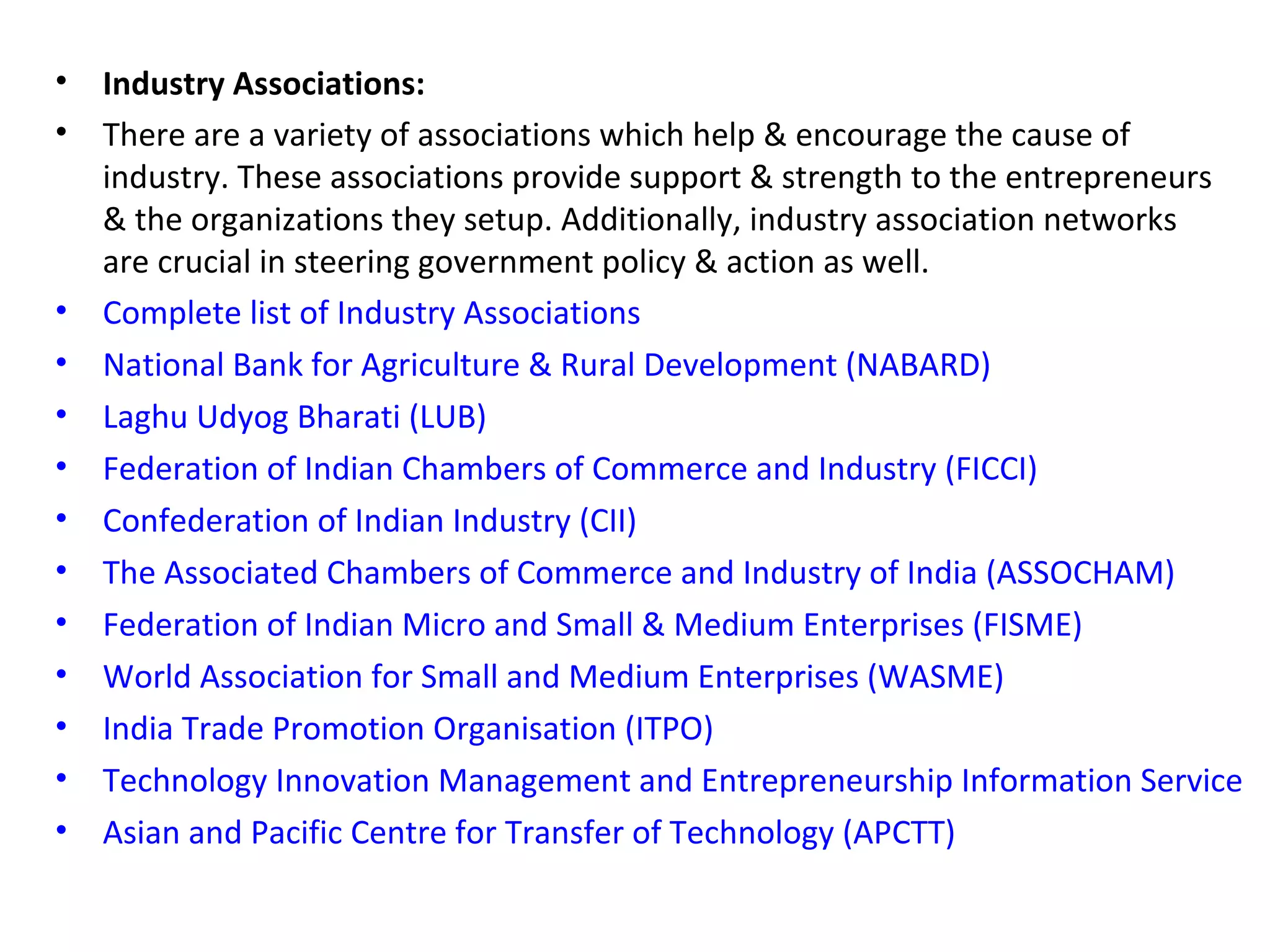
• Industry Associations:
• There are a variety of associations which help & encourage the cause of
industry. These associations provide support & strength to the entrepreneurs
& the organizations they setup. Additionally, industry association networks
are crucial in steering government policy & action as well.
• Complete list of Industry Associations
• National Bank for Agriculture & Rural Development (NABARD)
• Laghu Udyog Bharati (LUB)
• Federation of Indian Chambers of Commerce and Industry (FICCI)
• Confederation of Indian Industry (CII)
• The Associated Chambers of Commerce and Industry of India (ASSOCHAM)
• Federation of Indian Micro and Small & Medium Enterprises (FISME)
• World Association for Small and Medium Enterprises (WASME)
• India Trade Promotion Organisation (ITPO)
• Technology Innovation Management and Entrepreneurship Information Service
• Asian and Pacific Centre for Transfer of Technology (APCTT)
CONCLUSIONS:
• Entrepreneurship development is the key factor to fight against
unemployment, poverty and to prepare ourselves for globalization in order to
achieve overall Indian economic-progress.
INTRODUCTION
MSME
Msme stands for micro, small and medium enterprises.
It plays a important role for economic development of our
country.
 The major advantage of the sector is its employment
potential at low capital cost. The labor intensity of the
MSME sector is much higher than that of the large
enterprises.
it satisfies the demand of local customer.
Brief idea about MSME
• In India, the enterprises have been classified broadly
into two categories
1.Manufacturing
2. services.
• Both categories have been further classified into
micro, small and medium enterprises based on their
investment in plant and machinery or on equipment.
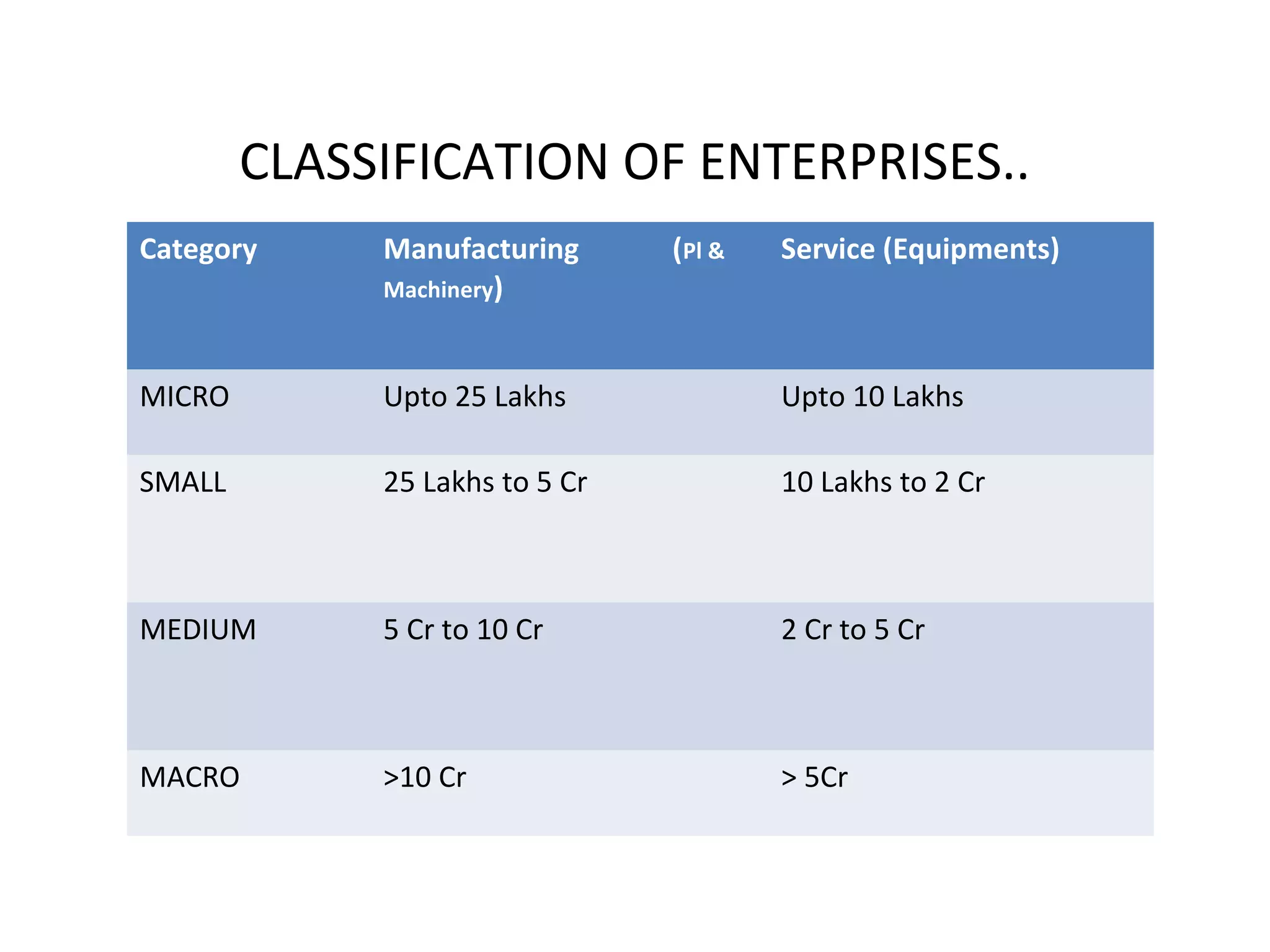
CLASSIFICATION OF ENTERPRISES..
Category Manufacturing (Pl &
Machinery)
Service (Equipments)
MICRO Upto 25 Lakhs Upto 10 Lakhs
SMALL 25 Lakhs to 5 Cr 10 Lakhs to 2 Cr
MEDIUM 5 Cr to 10 Cr 2 Cr to 5 Cr
MACRO >10 Cr > 5Cr
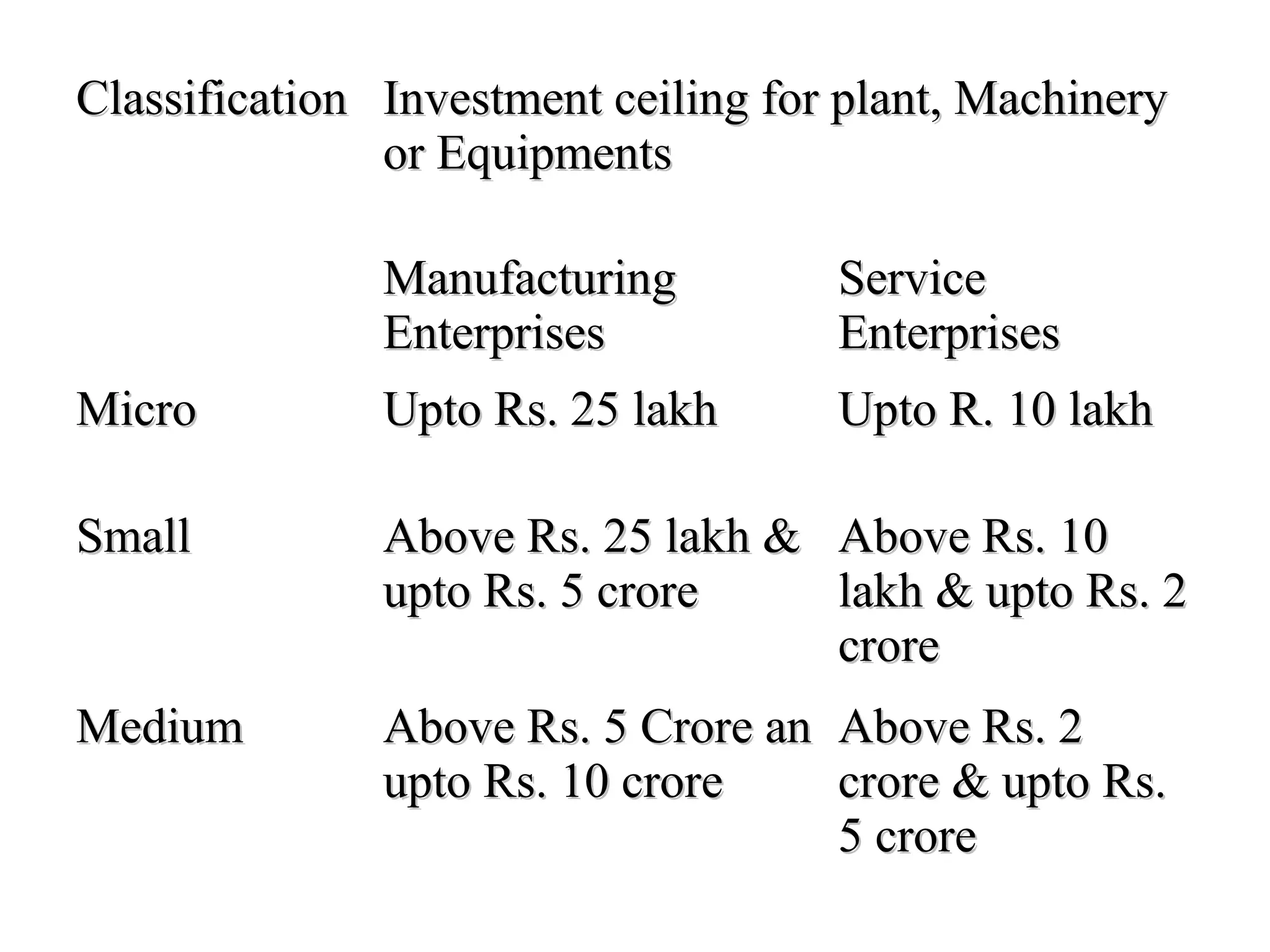
ClassificationClassification Investment ceiling for plant, MachineryInvestment ceiling for plant, Machinery
or Equipmentsor Equipments
ManufacturingManufacturing
EnterprisesEnterprises
ServiceService
EnterprisesEnterprises
MicroMicro Upto Rs. 25 lakhUpto Rs. 25 lakh Upto R. 10 lakhUpto R. 10 lakh
SmallSmall Above Rs. 25 lakh &Above Rs. 25 lakh &
upto Rs. 5 croreupto Rs. 5 crore
Above Rs. 10Above Rs. 10
lakh & upto Rs. 2lakh & upto Rs. 2
crorecrore
MediumMedium Above Rs. 5 Crore anAbove Rs. 5 Crore an
upto Rs. 10 croreupto Rs. 10 crore
Above Rs. 2Above Rs. 2
crore & upto Rs.crore & upto Rs.
5 crore5 crore
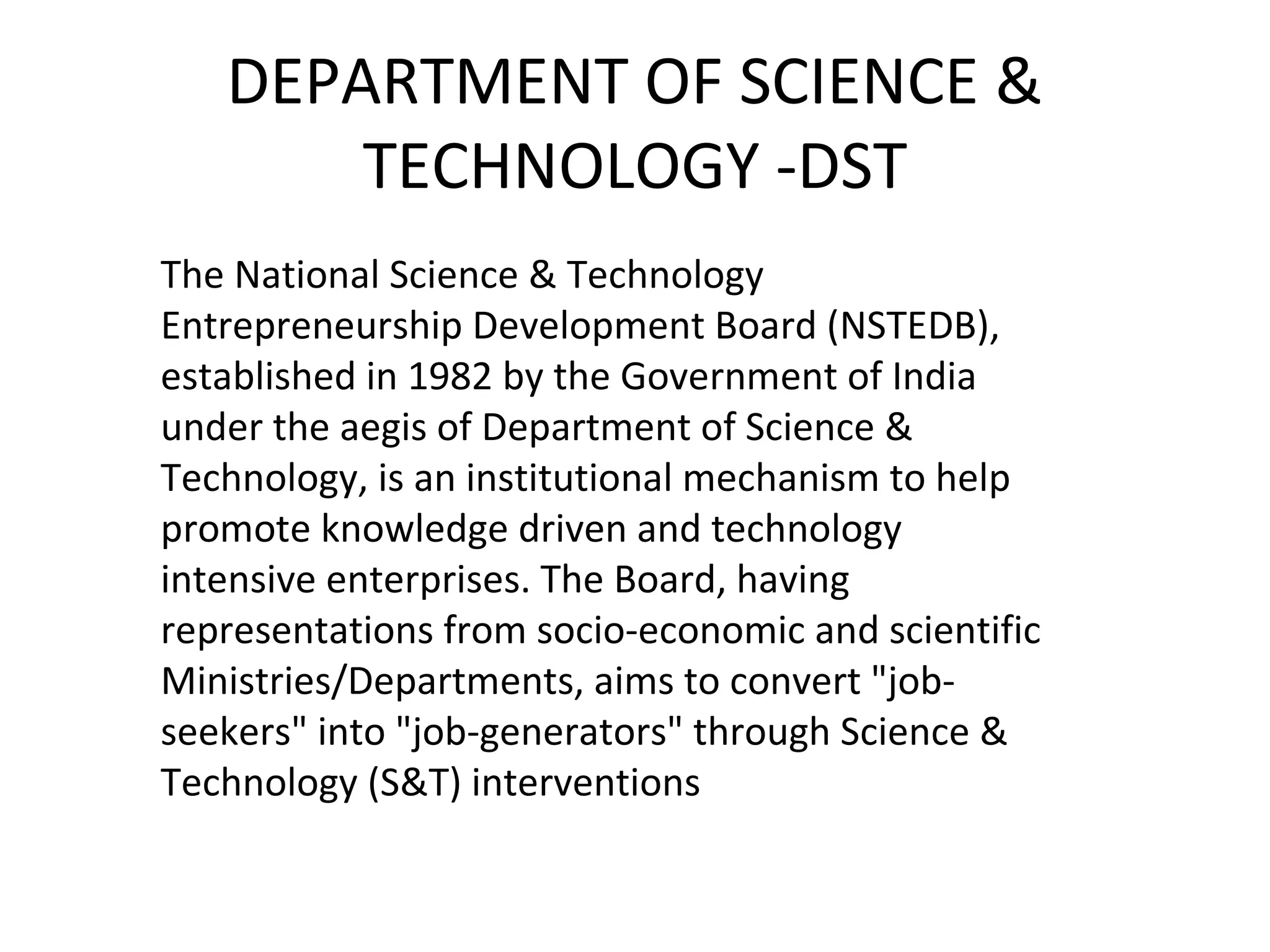
DEPARTMENT OF SCIENCE &
TECHNOLOGY -DST
The National Science & Technology
Entrepreneurship Development Board (NSTEDB),
established in 1982 by the Government of India
under the aegis of Department of Science &
Technology, is an institutional mechanism to help
promote knowledge driven and technology
intensive enterprises. The Board, having
representations from socio-economic and scientific
Ministries/Departments, aims to convert "job-
seekers" into "job-generators" through Science &
Technology (S&T) interventions
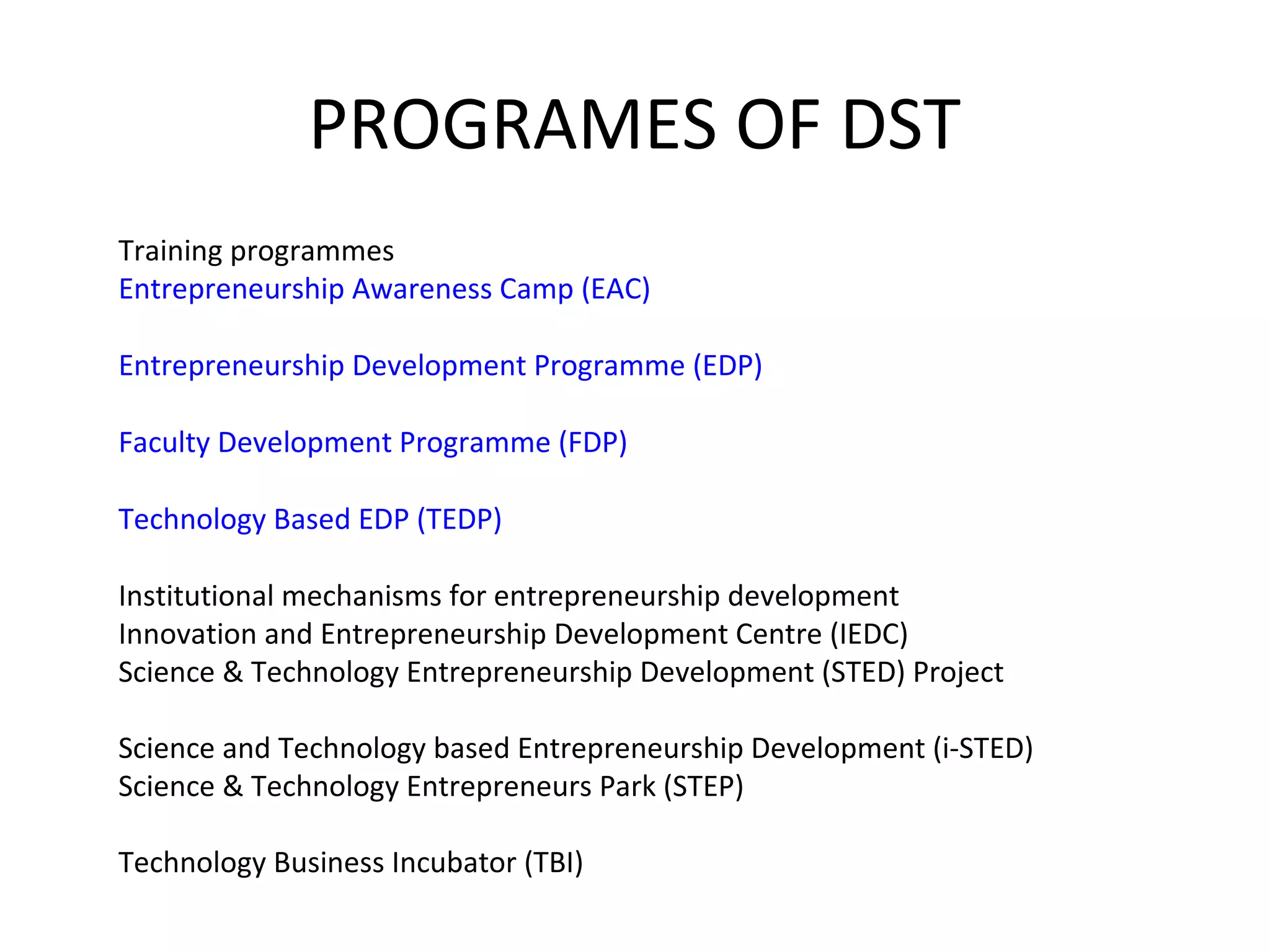
PROGRAMES OF DST
Training programmes
Entrepreneurship Awareness Camp (EAC)
Entrepreneurship Development Programme (EDP)
Faculty Development Programme (FDP)
Technology Based EDP (TEDP)
Institutional mechanisms for entrepreneurship development
Innovation and Entrepreneurship Development Centre (IEDC)
Science & Technology Entrepreneurship Development (STED) Project
Science and Technology based Entrepreneurship Development (i-STED)
Science & Technology Entrepreneurs Park (STEP)
Technology Business Incubator (TBI)

Current scenario

  • 1.
    CURRENT SCENARIO OFENTREPRENEURSHIP IN INDIA
  • 2.
    • Present EntrepreneurialScenario : • There are ample opportunities in small businesses are there in India • such opportunities will transform India in the coming future. For such transformation to happen there needs to be supporting both at the governmental and societal level. • The scope of entrepreneurship development in our country is tremendous. • since there is widespread concern that the acceleration in GDP growth in the post reforms period. • Results of the 57th round of the National Sample Survey Organization (NSSO) show that unemployment figures in 2003-04 were as high as 8.9 million. • Incidentally, one million more Indian joined the rank of the unemployed between 2005-06 & 2007-08. The rising unemployment rate (9.2% 2008 est.) in India has resulted in growing frustration among the youth. • In addition there is always problem of underemployment. As a result, increasing the entrepreneurial activities in the country is the only solution left with govt. • The reports prepared by Planning Commission to generate employment opportunities for 10 crore people over the next ten years have strongly recommended self-employment as a way-out for teaming unemployed youth.
  • 3.
    • Supporting Organizations: •The Government has setup various organizations which specialize in industry promotion & entrepreneurship development in different sectors. The organizations provide policy framework support, in addition to training & financial aid. • Khadi & Village Industries Commission • COIR Board • Small Industries Development Bank of India • National Manufacturing Competitiveness Council • National Skill Development Corporation • State Level Initiatives: • Individual states across India have setup specially focused organizations which work towards the development & support of small scale industries. These organizations run specific promotional schemes in addition to providing financial support to industries. • List of State Financial Corporations (SFCs) • List of State Industrial Development Corporations (SIDCs)
  • 4.
    • Development SupportOrganizations: • Government of India has also set up various organizations that are at the forefront in providing support and training for the budding entrepreneurs. Few of them are: • Central Footwear Training Institute - Agra • Indo-German Tool Room - Ahmedabad • Indo-German Tool Room -Aurangabad • Central Institute of Tool Design - Hyderabad • Central Tool Room - Ludhiana • Indo-German Tool Room - Indore • Central Tool Room & Training Center - Bubhaneshwar • Circle Telecom Training Center - Kolkata • Indo-Danish Tool Room - Jamshedpur • Institute for Design of Electrical Measuring Instruments • Electronics Service & Training Center - Ramnagar • Fragrance & Flavour Development Center - Kannuaj
  • 5.
    • Industry Associations: •There are a variety of associations which help & encourage the cause of industry. These associations provide support & strength to the entrepreneurs & the organizations they setup. Additionally, industry association networks are crucial in steering government policy & action as well. • Complete list of Industry Associations • National Bank for Agriculture & Rural Development (NABARD) • Laghu Udyog Bharati (LUB) • Federation of Indian Chambers of Commerce and Industry (FICCI) • Confederation of Indian Industry (CII) • The Associated Chambers of Commerce and Industry of India (ASSOCHAM) • Federation of Indian Micro and Small & Medium Enterprises (FISME) • World Association for Small and Medium Enterprises (WASME) • India Trade Promotion Organisation (ITPO) • Technology Innovation Management and Entrepreneurship Information Service • Asian and Pacific Centre for Transfer of Technology (APCTT)
  • 6.
    CONCLUSIONS: • Entrepreneurship developmentis the key factor to fight against unemployment, poverty and to prepare ourselves for globalization in order to achieve overall Indian economic-progress.
  • 8.
    INTRODUCTION MSME Msme stands formicro, small and medium enterprises. It plays a important role for economic development of our country.  The major advantage of the sector is its employment potential at low capital cost. The labor intensity of the MSME sector is much higher than that of the large enterprises. it satisfies the demand of local customer.
  • 9.
    Brief idea aboutMSME • In India, the enterprises have been classified broadly into two categories 1.Manufacturing 2. services. • Both categories have been further classified into micro, small and medium enterprises based on their investment in plant and machinery or on equipment.
  • 10.
    CLASSIFICATION OF ENTERPRISES.. CategoryManufacturing (Pl & Machinery) Service (Equipments) MICRO Upto 25 Lakhs Upto 10 Lakhs SMALL 25 Lakhs to 5 Cr 10 Lakhs to 2 Cr MEDIUM 5 Cr to 10 Cr 2 Cr to 5 Cr MACRO >10 Cr > 5Cr
  • 11.
    ClassificationClassification Investment ceilingfor plant, MachineryInvestment ceiling for plant, Machinery or Equipmentsor Equipments ManufacturingManufacturing EnterprisesEnterprises ServiceService EnterprisesEnterprises MicroMicro Upto Rs. 25 lakhUpto Rs. 25 lakh Upto R. 10 lakhUpto R. 10 lakh SmallSmall Above Rs. 25 lakh &Above Rs. 25 lakh & upto Rs. 5 croreupto Rs. 5 crore Above Rs. 10Above Rs. 10 lakh & upto Rs. 2lakh & upto Rs. 2 crorecrore MediumMedium Above Rs. 5 Crore anAbove Rs. 5 Crore an upto Rs. 10 croreupto Rs. 10 crore Above Rs. 2Above Rs. 2 crore & upto Rs.crore & upto Rs. 5 crore5 crore
  • 12.
    DEPARTMENT OF SCIENCE& TECHNOLOGY -DST The National Science & Technology Entrepreneurship Development Board (NSTEDB), established in 1982 by the Government of India under the aegis of Department of Science & Technology, is an institutional mechanism to help promote knowledge driven and technology intensive enterprises. The Board, having representations from socio-economic and scientific Ministries/Departments, aims to convert "job- seekers" into "job-generators" through Science & Technology (S&T) interventions
  • 13.
    PROGRAMES OF DST Trainingprogrammes Entrepreneurship Awareness Camp (EAC) Entrepreneurship Development Programme (EDP) Faculty Development Programme (FDP) Technology Based EDP (TEDP) Institutional mechanisms for entrepreneurship development Innovation and Entrepreneurship Development Centre (IEDC) Science & Technology Entrepreneurship Development (STED) Project Science and Technology based Entrepreneurship Development (i-STED) Science & Technology Entrepreneurs Park (STEP) Technology Business Incubator (TBI)