Micro, Small and Medium
Enterprises in India
An overview
What they actually are?
• The commonly used criteria at the
international level to define SMEs are
the number of employees, total net
assets, sales and investment level.
• The European Union makes a general
distinction between self-employment,
micro,small and medium sized
businesses based on the following
criteria:
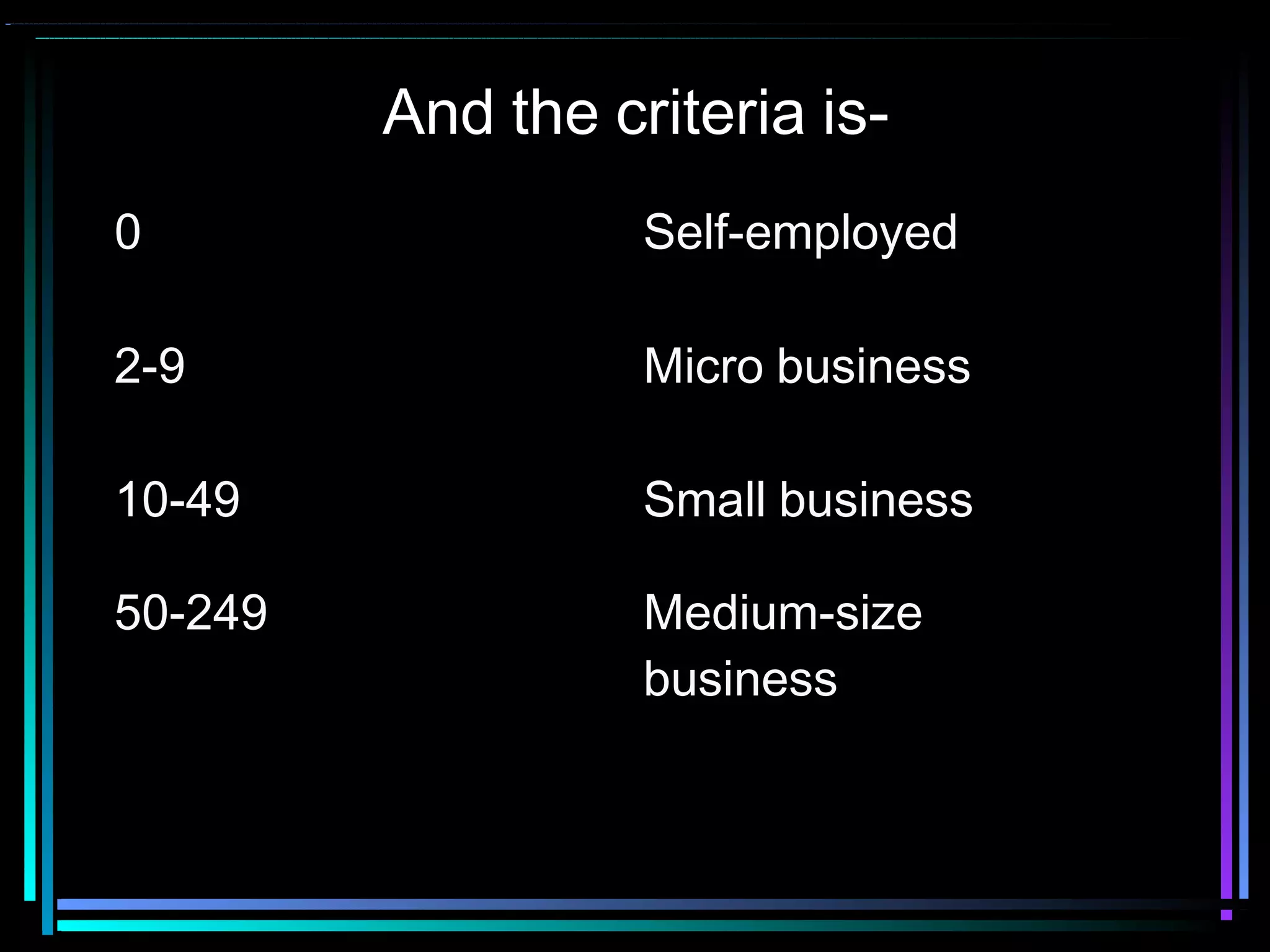
And the criteria is-
0
2-9
10-49
50-249
Self-employed
Micro business
Small business
Medium-size
business
In the Indian context, micro, small and
medium enterprises are defined as..
•It is based on the investment investment
in plant and machinery (for manufacturing
enterprise) and on equipments for
enterprises providing or rendering
services.
Criteria in India-
• Micro enterprise-investment does not
exceed 25 lakh rupees.
• Medium enterprise- more than five
crores but not upto ten crores.
• Small enterprise- more than 25 lakhs
rupees but doe not exceed 5 crores.
In case of services-
• a micro enterprise- not upto 10 lakh
rupees.
• a small enterprise- more than 10 lakh
but not upto 2 crore rupees.
• a medium enterprise- more than 2
crores but not upto 5 crores.
Importance of the MSME sector
• The contribution of micro, small and medium
enterprises (MSME) sector to
manufacturing output, employment and exports
of the country is quite significant.
• The MSME sector employs about 42 million
persons in over 13 million units throughout
the country.
• There are more than 6000 products, ranging
from traditional to high-tech items, which are
being manufactured by the Indian MSMEs.
Specific policy measures initiated for
boosting MSMES-
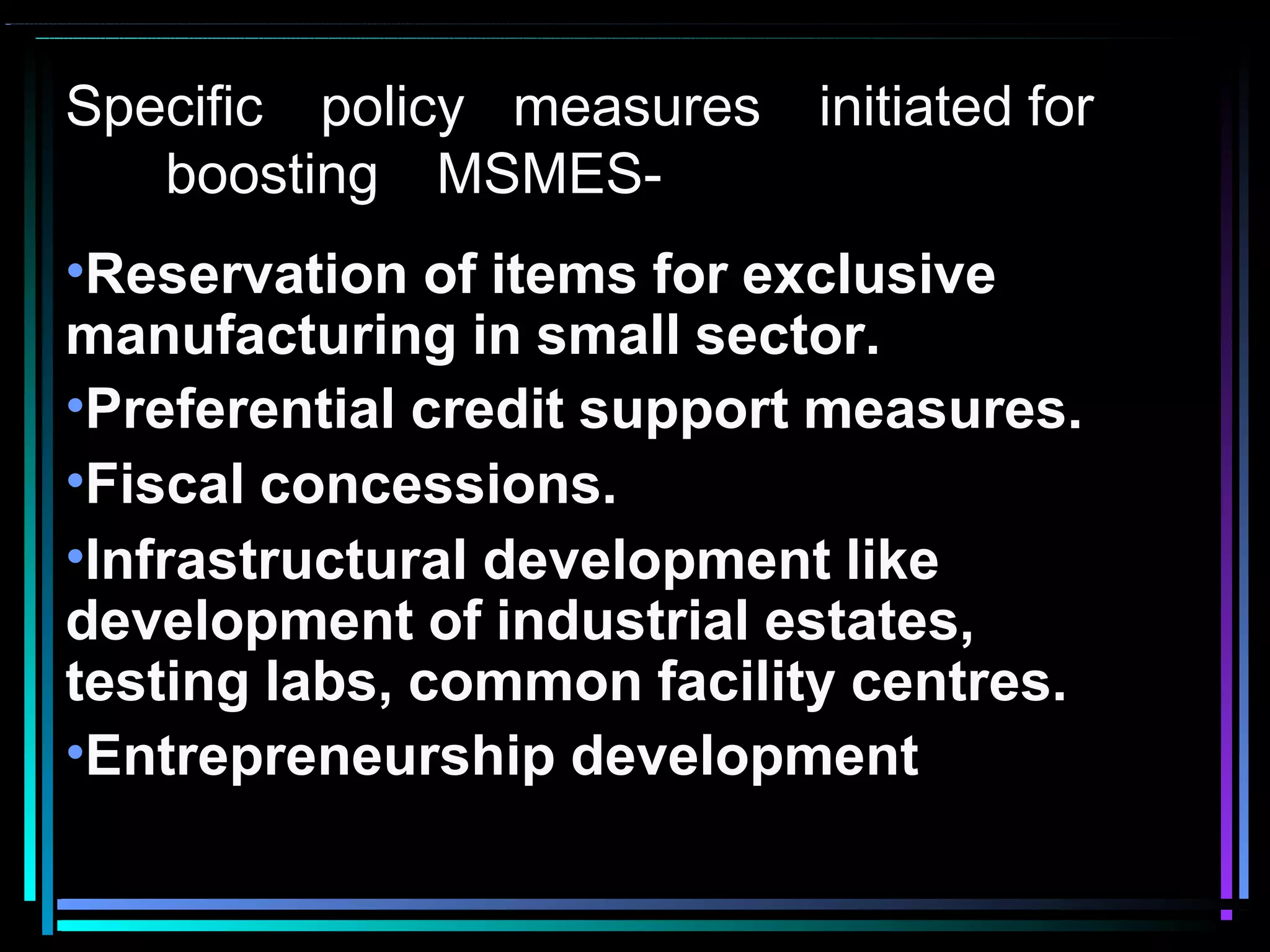
•Reservation of items for exclusive
manufacturing in small sector.
•Preferential credit support measures.
•Fiscal concessions.
•Infrastructural development like
development of industrial estates,
testing labs, common facility centres.
•Entrepreneurship development
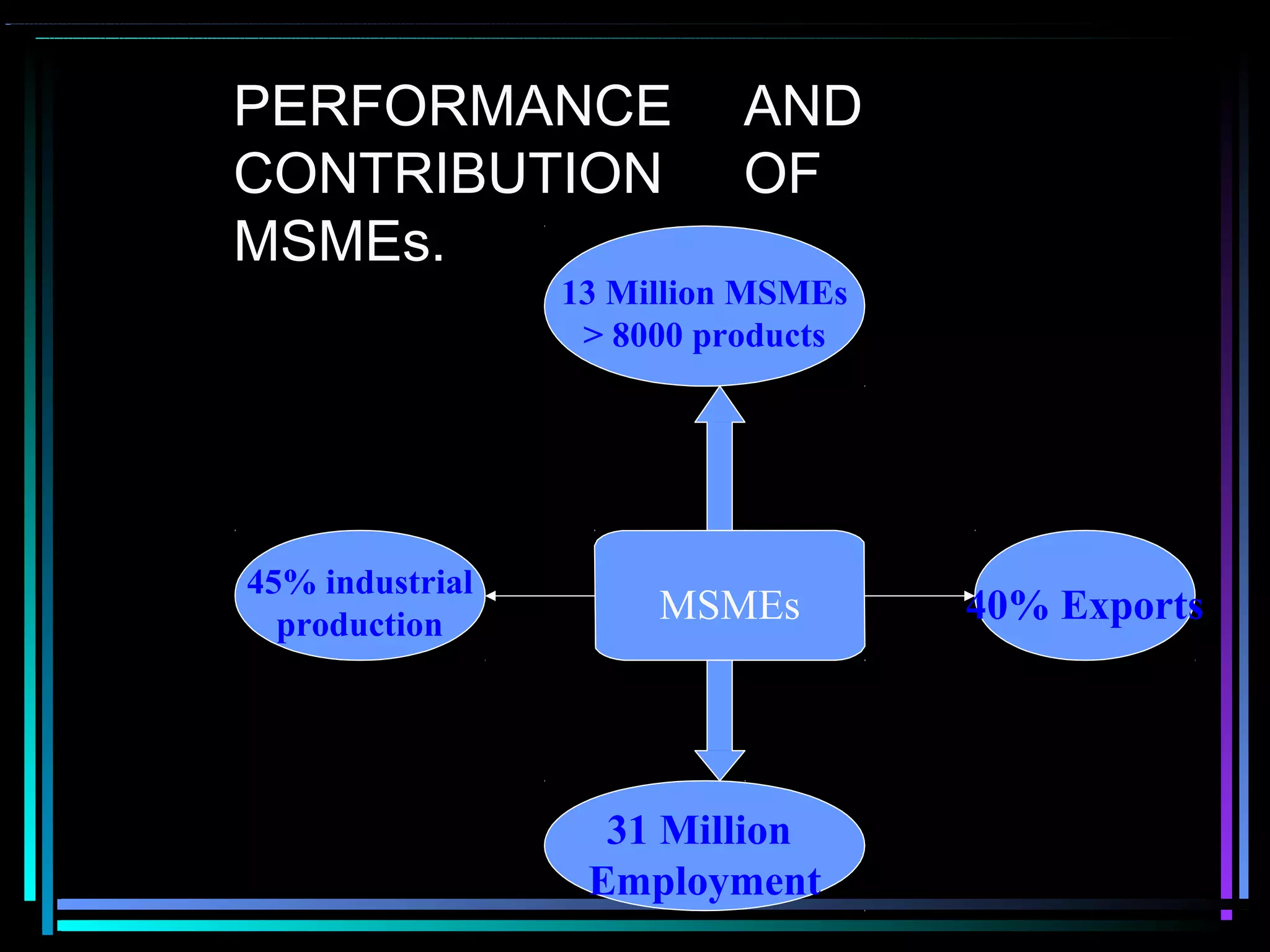
PERFORMANCE AND
CONTRIBUTION OF
MSMEs.
13 Million MSMEs
> 8000 products
MSMEs
31 Million
Employment
40% Exports
45% industrial
production
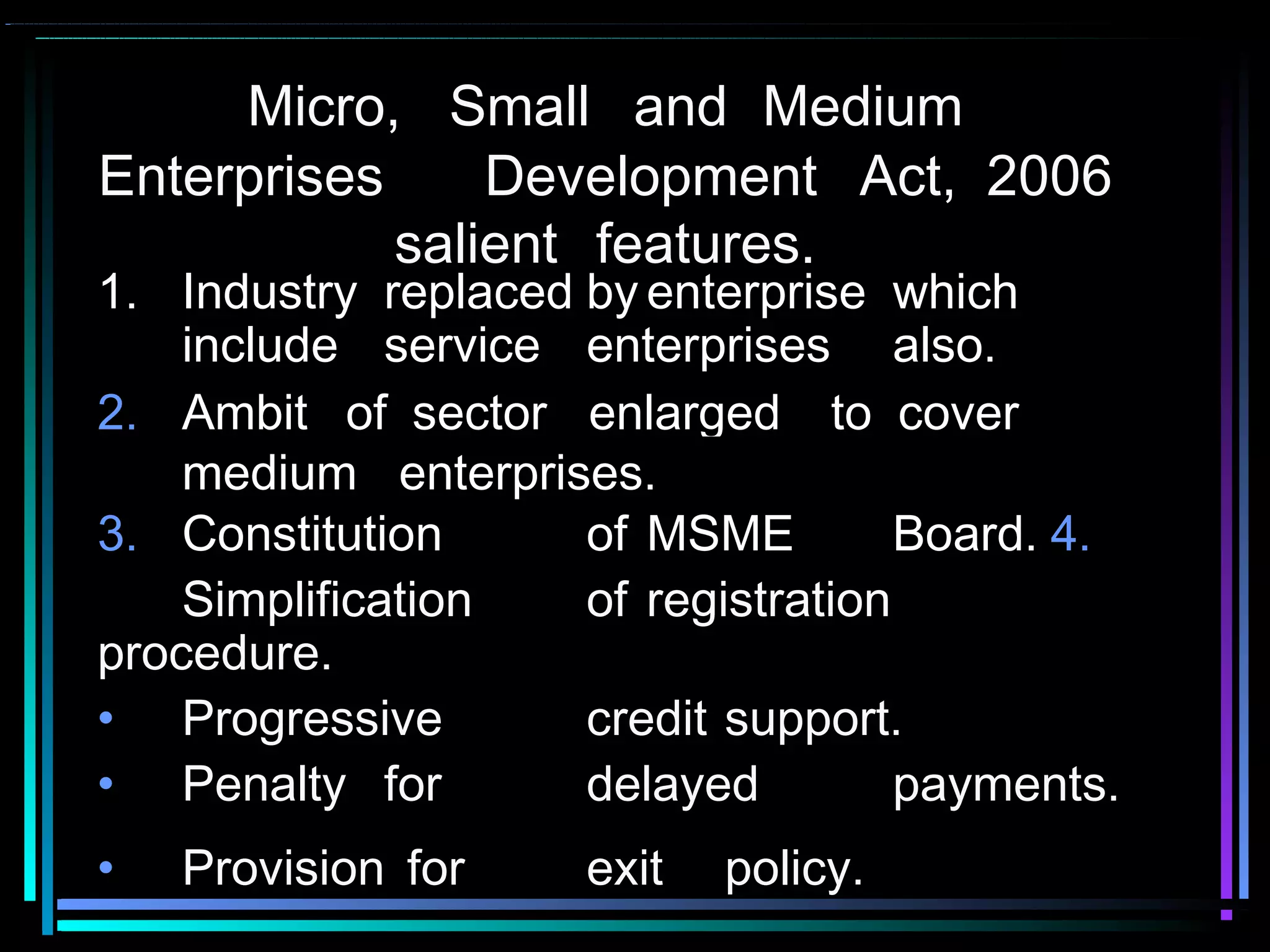
Micro, Small and Medium
Enterprises Development Act, 2006
salient features.
1. Industry replaced by enterprise which
include service enterprises also.
3. Constitution of MSME Board. 4.
Simplification of registration
procedure.
• Progressive credit support.
• Penalty for delayed payments.
• Provision for exit policy.
2. Ambit of sector enlarged to cover
medium enterprises.
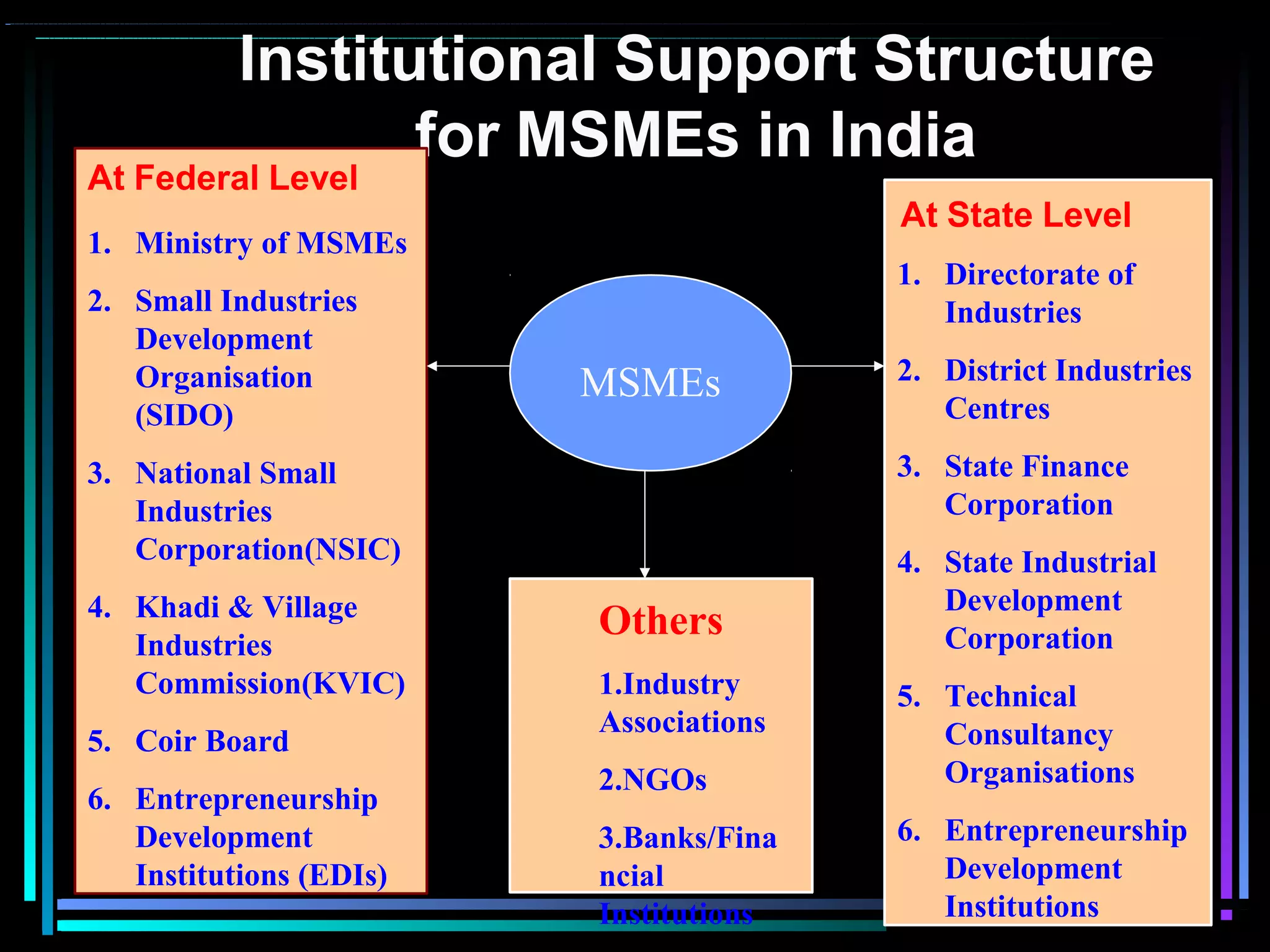
Institutional Support Structure
for MSMEs in India
At Federal Level
At State Level
1. Ministry of MSMEs
2. Small Industries
Development
Organisation
(SIDO)
3. National Small
Industries
Corporation(NSIC)
4. Khadi & Village
Industries
Commission(KVIC)
5. Coir Board
6. Entrepreneurship
Development
Institutions (EDIs)
MSMEs
1. Directorate of
Industries
2. District Industries
Centres
3. State Finance
Corporation
4. State Industrial
Development
Corporation
5. Technical
Consultancy
Organisations
6. Entrepreneurship
Development
Institutions
Others
1.Industry
Associations
2.NGOs
3.Banks/Fina
ncial
Institutions
MAJOR SCHEMES
FOR
MSME’s SUPPORT
Credit Support
1. Public sector banks advised to double the
flow of credit to MSMEs within 5 years (20%
annual growth)
2. A minimum of 40% of bank credit
earmarked for priority sector lending which
includes loans to MSEs
3. Specialised SME Bank branches in
industrial clusters for smooth flow of credit
to MSMEs
4. One Time Settlement (OTS) scheme for
settling NPAs of MSMEs
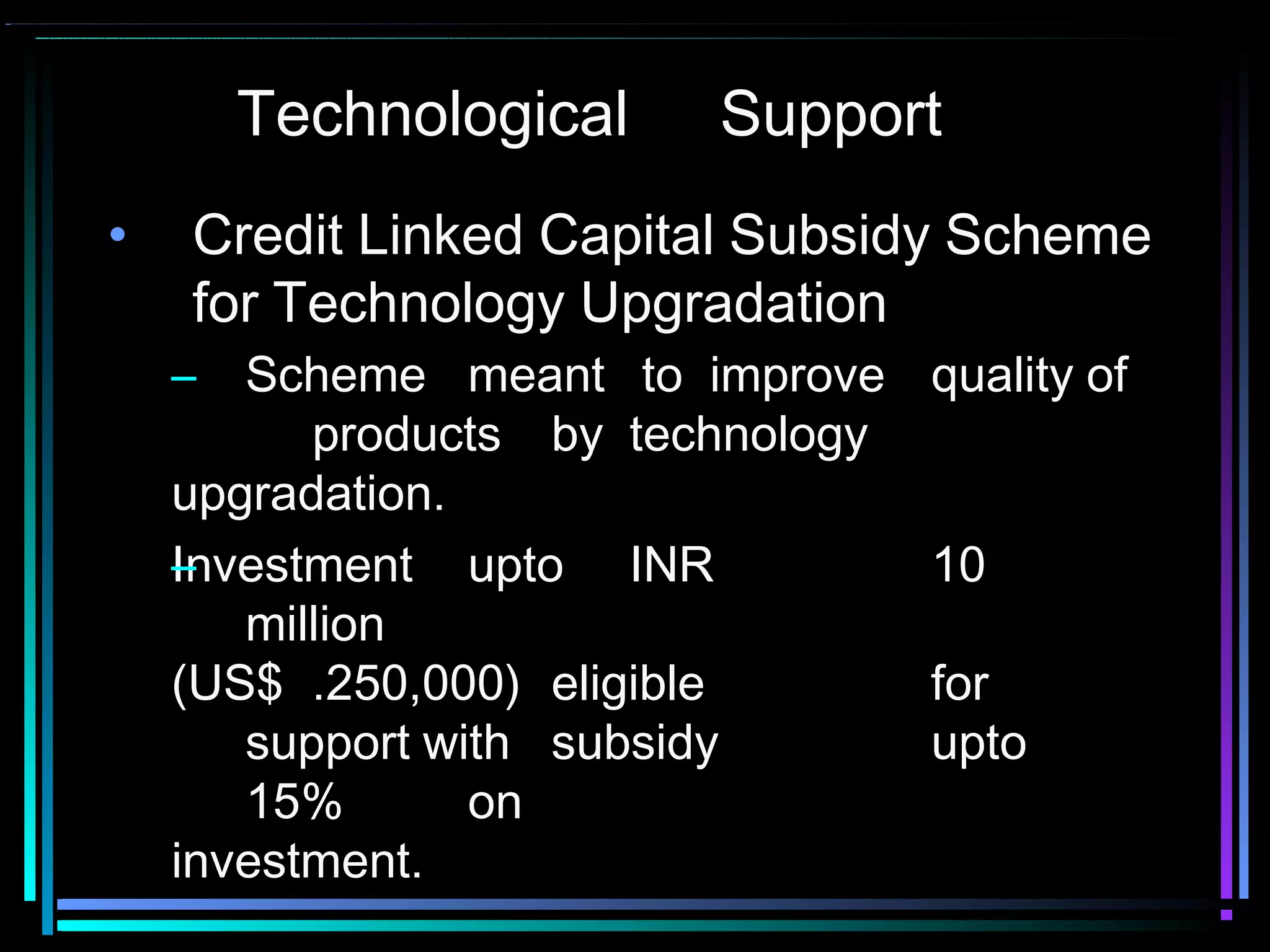
Technological Support
• Credit Linked Capital Subsidy Scheme
for Technology Upgradation
– Scheme meant to improve quality of
products by technology
upgradation.
Investment upto INR 10
million
(US$ .250,000) eligible for
support with subsidy upto
15% on
investment.
–
Contd.
• Testing Centres for Quality Certification
• Tool Rooms and Training Centres for
skill upgradation
• Incentive scheme for obtaining ISO
Certification by MSEs
Marketing Assistance and Export
Promotion
1. Support for participation in trade fairs and
exhibitions – national as well as
international.
2. Training programmes on packaging for
exports.
3. Purchase preference in Government
procurement.
4. Market Development Assistance Scheme
for publicity, market studies and adoption of
modern market practices
Cluster Development
Programme
• Cluster formation has been considered
important for MSME development. A
cluster may be defined as a local
agglomeration of enterprises (mainly
SMEs, but often also ncluding some
large enterprises), which are producing
and selling a range of relatedand
complementary products and services
International Cooperation Programme
•Provides exposure to MSMEs to the
latest technologies, manufacturing
practices prevalent in their fields in
different countries.
•Encourages their participation in
international exhibitions for exports.
Factors affecting MSMEs
• Accessing adequate and timely
financing on competitive terms,
particularly longer tenure loans.
• Accessing credit on easy terms has
become difficult in the backdrop of
current global financial crisis which has
held back the growth of SMEs and
impeded overall growth
andDevelopment.
Contd.
• factors that include policy,
legal/regulatory framework (in terms of
recovery,bankruptcy and contract
enforcement), institutional weaknesses
(absence ofgood credit appraisal and
risk management/ monitoring tools),
and lack ofreliable credit information on
SMEs
Contd.
• It has become difficult for lenders to be able
to assess risk premiums properly,creating
differences in the perceived versus real risk
profiles of SMEs.
Access to skilled manpower, R&D facilities
and marketing channels is limited
• Availability of finance at cheaper rates, skills
about decision-making and good
management and accounting practices, and
access to modern technology.
• Bribery,corruption,red tapism.
•
Challenges before MSMEs
• Problem of skilled manpower.
•Inadequate credit assistance.
•Irregular supply of raw material.
•Absence of organised marketing.
•Lack of machinery and equipment.
•Absence of adequate infrastructure.
•Competition from large-scale units and imported
articles.
•Other problems like poor project planning,
managerial inadequacies, old and orthodox
designs, high degree of obsolescence and huge
number of bogus concerns etc.
Thank you.
• A presentation
by- Raveena
kaushal
Bba 4th
sem

Medium, Small and Micro enterprises MSM

  • 1.
    Micro, Small andMedium Enterprises in India An overview
  • 2.
    What they actuallyare? • The commonly used criteria at the international level to define SMEs are the number of employees, total net assets, sales and investment level. • The European Union makes a general distinction between self-employment, micro,small and medium sized businesses based on the following criteria:
  • 3.
    And the criteriais- 0 2-9 10-49 50-249 Self-employed Micro business Small business Medium-size business
  • 4.
    In the Indiancontext, micro, small and medium enterprises are defined as.. •It is based on the investment investment in plant and machinery (for manufacturing enterprise) and on equipments for enterprises providing or rendering services.
  • 5.
    Criteria in India- •Micro enterprise-investment does not exceed 25 lakh rupees. • Medium enterprise- more than five crores but not upto ten crores. • Small enterprise- more than 25 lakhs rupees but doe not exceed 5 crores.
  • 6.
    In case ofservices- • a micro enterprise- not upto 10 lakh rupees. • a small enterprise- more than 10 lakh but not upto 2 crore rupees. • a medium enterprise- more than 2 crores but not upto 5 crores.
  • 7.
    Importance of theMSME sector • The contribution of micro, small and medium enterprises (MSME) sector to manufacturing output, employment and exports of the country is quite significant. • The MSME sector employs about 42 million persons in over 13 million units throughout the country. • There are more than 6000 products, ranging from traditional to high-tech items, which are being manufactured by the Indian MSMEs.
  • 8.
    Specific policy measuresinitiated for boosting MSMES- •Reservation of items for exclusive manufacturing in small sector. •Preferential credit support measures. •Fiscal concessions. •Infrastructural development like development of industrial estates, testing labs, common facility centres. •Entrepreneurship development
  • 9.
    PERFORMANCE AND CONTRIBUTION OF MSMEs. 13Million MSMEs > 8000 products MSMEs 31 Million Employment 40% Exports 45% industrial production
  • 10.
    Micro, Small andMedium Enterprises Development Act, 2006 salient features. 1. Industry replaced by enterprise which include service enterprises also. 3. Constitution of MSME Board. 4. Simplification of registration procedure. • Progressive credit support. • Penalty for delayed payments. • Provision for exit policy. 2. Ambit of sector enlarged to cover medium enterprises.
  • 11.
    Institutional Support Structure forMSMEs in India At Federal Level At State Level 1. Ministry of MSMEs 2. Small Industries Development Organisation (SIDO) 3. National Small Industries Corporation(NSIC) 4. Khadi & Village Industries Commission(KVIC) 5. Coir Board 6. Entrepreneurship Development Institutions (EDIs) MSMEs 1. Directorate of Industries 2. District Industries Centres 3. State Finance Corporation 4. State Industrial Development Corporation 5. Technical Consultancy Organisations 6. Entrepreneurship Development Institutions Others 1.Industry Associations 2.NGOs 3.Banks/Fina ncial Institutions
  • 12.
  • 13.
    Credit Support 1. Publicsector banks advised to double the flow of credit to MSMEs within 5 years (20% annual growth) 2. A minimum of 40% of bank credit earmarked for priority sector lending which includes loans to MSEs 3. Specialised SME Bank branches in industrial clusters for smooth flow of credit to MSMEs 4. One Time Settlement (OTS) scheme for settling NPAs of MSMEs
  • 14.
    Technological Support • CreditLinked Capital Subsidy Scheme for Technology Upgradation – Scheme meant to improve quality of products by technology upgradation. Investment upto INR 10 million (US$ .250,000) eligible for support with subsidy upto 15% on investment. –
  • 15.
    Contd. • Testing Centresfor Quality Certification • Tool Rooms and Training Centres for skill upgradation • Incentive scheme for obtaining ISO Certification by MSEs
  • 16.
    Marketing Assistance andExport Promotion 1. Support for participation in trade fairs and exhibitions – national as well as international. 2. Training programmes on packaging for exports. 3. Purchase preference in Government procurement. 4. Market Development Assistance Scheme for publicity, market studies and adoption of modern market practices
  • 17.
    Cluster Development Programme • Clusterformation has been considered important for MSME development. A cluster may be defined as a local agglomeration of enterprises (mainly SMEs, but often also ncluding some large enterprises), which are producing and selling a range of relatedand complementary products and services
  • 18.
    International Cooperation Programme •Providesexposure to MSMEs to the latest technologies, manufacturing practices prevalent in their fields in different countries. •Encourages their participation in international exhibitions for exports.
  • 19.
    Factors affecting MSMEs •Accessing adequate and timely financing on competitive terms, particularly longer tenure loans. • Accessing credit on easy terms has become difficult in the backdrop of current global financial crisis which has held back the growth of SMEs and impeded overall growth andDevelopment.
  • 20.
    Contd. • factors thatinclude policy, legal/regulatory framework (in terms of recovery,bankruptcy and contract enforcement), institutional weaknesses (absence ofgood credit appraisal and risk management/ monitoring tools), and lack ofreliable credit information on SMEs
  • 21.
    Contd. • It hasbecome difficult for lenders to be able to assess risk premiums properly,creating differences in the perceived versus real risk profiles of SMEs. Access to skilled manpower, R&D facilities and marketing channels is limited • Availability of finance at cheaper rates, skills about decision-making and good management and accounting practices, and access to modern technology. • Bribery,corruption,red tapism. •
  • 22.
    Challenges before MSMEs •Problem of skilled manpower. •Inadequate credit assistance. •Irregular supply of raw material. •Absence of organised marketing. •Lack of machinery and equipment. •Absence of adequate infrastructure. •Competition from large-scale units and imported articles. •Other problems like poor project planning, managerial inadequacies, old and orthodox designs, high degree of obsolescence and huge number of bogus concerns etc.
  • 23.
    Thank you. • Apresentation by- Raveena kaushal Bba 4th sem