1
2
Rajnish Goenka, Chairman
Tobu Cycles Group
3
4
MESSAGE FROM MD/CEO,
RESURGENT INDIA LIMITED
Indian Economy reported robust growth the period 2005-08. But the growth moderated
on the back of the global economic crisis thus, proving that the global economic condition
has its repercussions on the domestic economic outlook. The economy recovered during
2009-11, again to decline owing to weak global economic cues and other domestic factors.
Going ahead, Micro Small and Medium Enterprises (MSMEs) are considered to be the key
for economic growth as it promotes equitable development. Over the years, this segment
has been fuelling economic growth and has been a catalyst to industrialization of rural
and assuring more equitable distribution of national income and wealth. This segment is
labor intensive and it contributes for generation of employment.
Despite being a catalyst to the economic development and being beneficial to the economy
of the country in more than one ways, MSMEs still face numerous hindrances that are
obstructing the growth of the segment. The primary problem faced by the sector is access
to funds due to its high risk profile. Further, there is a huge demand-supply gap and
financial institutions need to exploit this opportunity and offer credit to the segment. Here
in this research paper, we discuss about alternate avenues of fund raising to minimise the
demand supply gap.
Jyoti P Gadia
Managing Director
Resurgent India Limited
5
TABLE OF CONTENTS
1 MSME Introduction 1
2 MSME Eligibility 10
3 MSME Charter 12
4 International Co-operation scheme 13
5 Market Development Assistance 47
6 Assistance to training institutions 64
7 Surveys, studies and policy research 75
8 Prime Ministers Employment Generation Programme 102
9 Marketing Assistance Scheme 128
10 Development of handicrafts 142
11 Mega Food Parks 148
12 Cold Chain 148
13 National Manufacturing Competitiveness Programme 149
14 Cluster Development Programme 149
15 Credit linked capital subsidy scheme for technology upgradation 149
16 Credit Guarantee Scheme 149
17 ISO 9000/ISO 14001 certification reimbursement scheme 149
18 Financial assistance for using global standards in bar coding 150
19 Purchase price preference policy 150
20 Scheme for national award 150
21 Modernization of abattoir 151
22 National mission on food processing 153
23 Scheme for support for entrepreneurial and managerial
development through incubators
154
24 Scheme for building awareness on intellectual property rights 155
25 Design clinic scheme for design enterprise 156
26 Technology and quality upgradation support 157
27 Setting up carbon credit aggregation centers for introduction and
popularizing clean development mechanism in MSME clusters
158
28 Scheme to acquire product certification/license from
National/International bodies
159
29 Scheme for promotion of information and communication
technology
159
30 Financial assistance for setting e-readiness centre for software
development
160
31 Financial assistance for procurement of hardware and software 160
32 Credit linked to capital subsidy scheme for technology
upgradation
160
33 Credit guarantee fund 161
34 Cluster development programme 162
6
The Micro, Small and Medium Enterprises (MSMEs) play a pivotal role in the economic
and social development of the country, often acting as a nursery of entrepreneurship.
They also play a pivotal role in the development of the economy with their effective,
efficient, flexible and innovative entrepreneurial spirit. The MSME sector has been a
significant contributor to the countries with generating the highest employment growth
as well as accounting for a major share of industrial production and exports.
MSMEs across the globe are fuelling economic growth and are the key instruments for
promoting equitable development. The primary attribute of the sector is its employment
potential at low capital cost. The labour intensity of space is much higher than that of
large enterprises. MSMEs account for about 90 per cent of total enterprises in most of
the economies and are credited with generating the highest rates of employment growth
and account for a major share of industrial production and exports. On the domestic
front, MSMEs play an essential role in the overall industrial economy of the country. In
recent years, the MSME sector has been consistent in registering a higher growth rate
compared with the overall industrial sector. Further with qualities such as agility and
dynamism, the sector has shown admirable innovativeness and adaptability to survive
the recent economic downturn and recession.
The Indian MSME sector space is immensely heterogeneous with regards to the size of
the enterprises, variety of products and services, and levels of technology. The sector not
only plays a crucial role in providing employment opportunities at comparatively lower
capital cost than large industries but also helps in industrialization of rural and
backward areas, reducing regional imbalances and assuring more equitable distribution
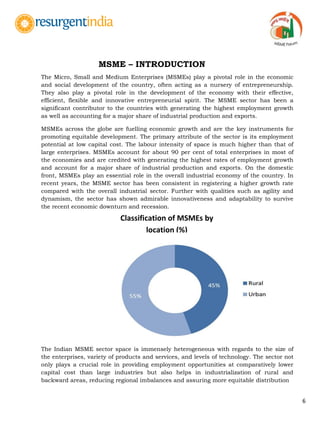
Classification of MSMEs by
location (%)
MSME – INTRODUCTION
7
of national income and wealth. MSMEs complement large industries as ancillary units
and contribute enormously to the socio economic development of the country.
Apart from providing the support to the large industries, MSMEs have played an
important role in the development of States in terms of the employment generation. More
than 55 per cent of these enterprises are located in six major States of the country,
namely, Uttar Pradesh, Maharashtra, Tamil Nadu, West Bengal, Andhra Pradesh and
Karnataka.
The MSME sector has slowly come into the limelight, with increased focus from the
government and other government institutions, corporate bodies and banks. Policy based
changes; investments into the sector; globalization and India‟s growth story have opened
up several latent business opportunities for this sector.
Recent Initiatives by the government: As the Government recognised the importance
of promoting the MSME sector in order to boost the overall growth of the economy, a
Task Force under the Chairmanship of the Principal Secretary to the Prime Minister was
constituted in 2009. The primary objective of the task force is to offer suggestions for the
development and promotion of MSMEs in the country and recommend an agenda for
immediate action to provide relief and incentives to the MSMEs, accompanied by
institutional changes and detailing of programme to be achieved in a time bound
manner. Further, it also recommends the setting up of appropriate legal and regulatory
structures to create a conducive environment for entrepreneurship and growth of MSMEs
in the country. The Task Force has laid emphasis on timely implementation of the
recommendations and has set up a system for its continuous monitoring in the Prime
Minister‟s Office. A Council on MSMEs under the chairmanship of Hon‟ble Prime Minister
has also been constituted to lay down the broad policy guidelines and review
development of the MSME sector.
Measures from within the sector to lobby for favourable policies and increasing credit
flow are convincing. Further, the sector has also realized the necessity of technological
and modernization initiatives. However, with economic liberalization and changes in the
trade policy, MSMEs are now facing increased competition from foreign companies.
Under intensive global competition, MSMEs are transforming to a new business
environment with emergence of global supply chains. MSMEs form an integral part of
almost every value chain and there is a symbiotic relationship between the large
corporations and their relatively smaller sized suppliers. However, in a liberalized world,
the relationships between the suppliers and buyers are undergoing dynamic changes
with the dissolution of existing relationships and formation of new trade linkages that
transcend the barriers of nationality and boundaries.
Even the domestic market is no more a protected zone in a controlled economy; the
competitive pressures of a free market economy are catching up in India and the
domestic market has been flooded with many low cost, reasonable quality, bulk produced
products giving tough competition to MSMEs. With the opening up of the economy,
8
MSMEs need to catch up with global standards in order to remain competitive and
profitable.
To gain the competitive edge, enhance efficiency and manage communication, this sector
is set to focus on Information and Communication Technology (ICT) enablement. Small
scale industries face limited needs for ICT given their organization and restructuring
themselves to accommodate these changes. Possibility of international trade has forced
many to build an online presence. E-commerce and enterprise management solutions are
also being considered by many.
The Government of India has developed key strategies to promote and support
competitiveness in the MSME sector, thus leading to have a positive impact on the
sector. The key attributes of the segment such as high contribution to domestic
production, significant export earnings, low investment requirements, operational
flexibility, location wise mobility, capacities to develop appropriate indigenous
technology, import substitution, contribution towards defence production, technology-
oriented industries, and competitiveness in domestic and export markets etc. help them
tap opportunities in various sectors.
Some of the key announcements for MSMEs in the Union Budget, 2014 are:
 It is proposed to set up a committee to examine the flow of funds to SMEs. The
proposed committee would have representatives of RBI, Finance Ministry & MSME
Ministry.
 It has been proposed to set up a Rs.10,000 crore fund to make risk capital investment
in start-ups and SMEs.
 It is proposed to have a nationwide incubation and acceleration infrastructure since
the existing incubators are located in start-up hubs mostly as part of colleges.
 To uplift the pashmina shawl industry in Kashmir a Rs. 50 Crore pashmina
promotion programme has been announced.
 A Rs. 50 Crore Trade Facilitation Centre to promote the handloom industry of
Varanasi is also proposed.
 Six mega textile clusters at Varanasi, Bareilly, Lucknow, Surat, Kutch, Bhagalpur,
Mysore and in Tamil Nadu are proposed to be set up with an allocation of Rs. 200
crores.
 Provide money for innovation and skills development.
 Cuts in excise duty on capital goods – it would give boost to the manufacturing sector
which has been down the past two years. It will enable more purchasing and thereby
revive the industry.
9
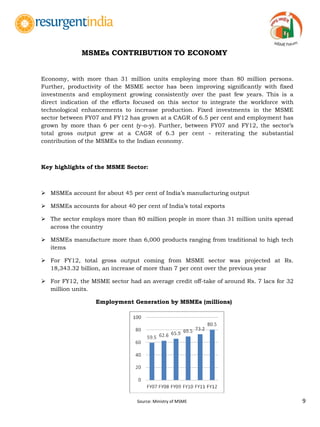
MSMEs have contributed significantly to the Indian
Economy, with more than 31 million units employing more than 80 million persons.
Further, productivity of the MSME sector has been improving significantly with fixed
investments and employment growing consistently over the past few years. This is a
direct indication of the efforts focused on this sector to integrate the workforce with
technological enhancements to increase production. Fixed investments in the MSME
sector between FY07 and FY12 has grown at a CAGR of 6.5 per cent and employment has
grown by more than 6 per cent (y-o-y). Further, between FY07 and FY12, the sector‟s
total gross output grew at a CAGR of 6.3 per cent - reiterating the substantial
contribution of the MSMEs to the Indian economy.
Key highlights of the MSME Sector:
 MSMEs account for about 45 per cent of India‟s manufacturing output
 MSMEs accounts for about 40 per cent of India‟s total exports
 The sector employs more than 80 million people in more than 31 million units spread
across the country
 MSMEs manufacture more than 6,000 products ranging from traditional to high tech
items
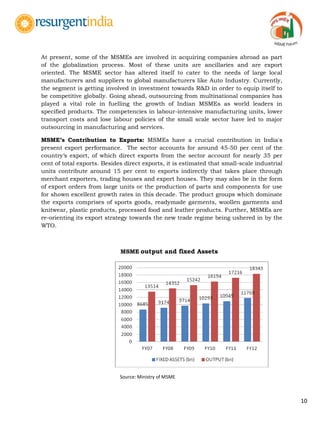
 For FY12, total gross output coming from MSME sector was projected at Rs.
18,343.32 billion, an increase of more than 7 per cent over the previous year
 For FY12, the MSME sector had an average credit off-take of around Rs. 7 lacs for 32
million units.
Employment Generation by MSMEs (millions)
MSMEs CONTRIBUTION TO ECONOMY
Source: Ministry of MSME
10
At present, some of the MSMEs are involved in acquiring companies abroad as part
of the globalization process. Most of these units are ancillaries and are export
oriented. The MSME sector has altered itself to cater to the needs of large local
manufacturers and suppliers to global manufacturers like Auto Industry. Currently,
the segment is getting involved in investment towards R&D in order to equip itself to
be competitive globally. Going ahead, outsourcing from multinational companies has
played a vital role in fuelling the growth of Indian MSMEs as world leaders in
specified products. The competencies in labour-intensive manufacturing units, lower
transport costs and lose labour policies of the small scale sector have led to major
outsourcing in manufacturing and services.
MSME‟s Contribution to Exports: MSMEs have a crucial contribution in India's
present export performance. The sector accounts for around 45-50 per cent of the
country‟s export, of which direct exports from the sector account for nearly 35 per
cent of total exports. Besides direct exports, it is estimated that small-scale industrial
units contribute around 15 per cent to exports indirectly that takes place through
merchant exporters, trading houses and export houses. They may also be in the form
of export orders from large units or the production of parts and components for use
for shown excellent growth rates in this decade. The product groups which dominate
the exports comprises of sports goods, readymade garments, woollen garments and
knitwear, plastic products, processed food and leather products. Further, MSMEs are
re-orienting its export strategy towards the new trade regime being ushered in by the
WTO.
Source: Ministry of MSME
MSME output and fixed Assets
11
Performance of this sector can be determined in terms of the following criteria:
Employment Generation: MSME in India creates largest employment opportunities,
next only to Agriculture. It has been estimated that a lakh rupee invested in fixed
assets in the sector results in generating employment for four persons. Some of the
interesting observations related to employment in MSMEs are related to generation of
employment according to the industry. For instance, food products industry ranked
first, followed by non-metallic mineral products and metal products. Additionally,
Chemicals & chemical products, Machinery parts except Electrical parts, Wood
products, Basic Metal Industries, Paper products & printing, Hosiery & garments,
Repair services and Rubber & plastic products also contributed to generate
employment.
Production: MSMEs play a crucial role in the growth of the country by accounting
for 40 per cent of the gross manufacturing output. As per estimation, a lakh rupee of
investment in fixed assets in the sector produces 4.62 lakh worth of goods or services
with an approximate value addition of ten percentage points. The space has
registered impressive growth over the past few years and the growth rate recorded
during the various plan periods have been very impressive. Further, the transition
period of the process of economic reforms was also affected for some period by
adverse factors such as foreign exchange constraints, credit squeeze, demand
recession, high interest rates, shortage of raw material etc. Further, when the
performance of this sector is compared with the growth in the manufacturing and the
industry sector as a whole, it instils confidence in the resilience of MSMEs.
Export Contribution: MSMEs plays a major role in India's export performance by
accounting for 45-50 per cent of total exports. The surprising fact is that non-
traditional products account for more than 95 per cent of the MSME exports. The
exports from the segment have registered enormous growth during the last decade.
Further, the growth in the segment has been mostly fuelled by the performance of
garment, leather and gems and jewellery units.
Opportunities: MSMEs has performed outstandingly well and enabled the country
to attain a wide measure of industrial growth and diversification. By its nature of
being less capital intensive and more labour intensive, the sector has made
significant contributions to employment generation and also to rural
industrialization. This sector is ideally suited to build on the strengths of traditional
skills and knowledge, by infusion of technologies, capital and innovative marketing
practices.
The opportunities of growth in the MSME sector are extensive due to the following
attributes, which makes it a more attractive investment option:
12
 Less Capital Intensive
 Extensive Promotion & Support by Government
 Project Profiles
 Funding - Finance & Subsidies
 Machinery Procurement
 Raw Material Procurement
 Manpower Training
 Technical & Managerial skills
 Tooling & Testing support
 Reservation for Exclusive Purchase by Government
 Export Promotion
 Growth in demand in the domestic market size due to overall economic growth
 Increasing Export Potential for Indian products
 Growth in requirements for ancillary units due to the increase in number of
green- field units coming up in the large scale sector.
Economic Indicators: MSME constitutes a very important segment of the Indian
economy. MSME sector acts as a catalyst in upholding and encouraging the creation
of the innovative spirit and entrepreneurship in the economy, thereby helping in
laying the foundation for rapid industrial development. Moreover, the sector also
boosts employment generation and balanced regional development. Globalization and
liberalization of the Indian economy have also brought a host of opportunities for the
industrial sector, particularly the MSME segment. MSMEs have responded to
competition satisfactorily, further there is scope for increasing their export potential,
domestic market share and developing them as serious players in the global value
chain.
MSME constitutes:
Manufacturing Sector
Services Sector
Manufacturing Sector
Manufacturing sector refers to enterprises engaged in manufacture or production,
processing or preservation of goods. The definition of Micro, Small and Medium
Enterprises under the manufacturing sector is as below:
i). A micro enterprise is an enterprise where investment in plant and machinery
[original cost excluding land and building and the items specified by the Ministry
of Small Scale Industries vide its notification No. S.O. 1722(E) dated October 5, 2006
does not exceed Rs. 25 lakh;
ii). A small enterprise is an enterprise where the investment in plant and machinery
[original cost excluding land and building and the items specified by the Ministry
of Small Scale Industries vide its notification No. S.O. 1722(E) dated October 5,
2006] is more than Rs.25 lakh but does not exceed Rs.5 crore; and
iii). A medium enterprise is an enterprise where the investment in plant and
machinery (original cost excluding land and building and the items specified by the
Ministry of Small Scale Industries vide its notification No. S.O. 1722(E) dated October
5, 2006) is more than Rs.5 crore but does not exceed Rs.10 crore.
13
Services Sector
Services sector refers to enterprises engaged in providing or rendering of services. These
will include small road & water transport operators (owning a fleet of vehicles not
exceeding ten vehicles), small business (whose original cost price of the equipment used
for the purpose of business does not exceed Rs.20 lakh) and professional & self employed
persons (whose borrowing limits do not exceed Rs.10 lakh of which not more than Rs.2
lakh should be for working capital requirements except in case of professionally qualified
medical practitioners setting up of practice in semi-urban and rural areas, the borrowing
limits should not exceed Rs.15 lakh with a sub-ceiling of Rs.3 lakh for working capital
requirements). The definition of Micro, Small and Medium Enterprises under the services
sector is as below:
i. A micro enterprise is an enterprise where the investment in equipment does not
exceed Rs.10 lakh;
ii. A small enterprise is an enterprise where the investment in equipment is more
than Rs.10 lakh but does not exceed Rs.2 crore; and
iii. A medium enterprise is an enterprise where the investment in equipment is
more than Rs.2 crore but does not exceed Rs.5 crore.
The Small and Micro (service) enterprises shall include small road & water transport
operators, small business, professional & self-employed persons, and all other service
enterprises engaged in activities, viz., consultancy services including management
services, composite broker services in risk and insurance management, third party
administration services (TPA) for medical insurance claim for policy holders, seed grading
services, training-cum-incubator centre, educational institutions, training institutes,
practice of law i.e. legal services, placement and management consultancy services,
advertising agency, trading in medical instruments, retail trade, training centres, etc and
which satisfy the definition of micro and small (service) enterprises in respect of
investment in equipment whose original cost price of the equipment used for the purpose
of business does not exceed Rs.10 lakh and Rs.2 crore respectively.
In Addition to above, the bank also selectively classifies certain business segments as
part of SME lending. The Channel funding/Vender financing is part of SME
irrespective of the obligor.
Micro and Small Enterprise Charter
- The branches would give acknowledgement (with date of receipt and running
serial number) on the duplicate of the application received.
- All loan applications for Micro and Small Enterprise up to a credit limit of Rs.
25,000 would be disposed of within 2 weeks and those up to Rs. 5 lacs within
4 weeks provided the loan applications are complete in all respects and
accompanied by a 'check list'. These time limits of 2 weeks /4 weeks are outer
limits only and branches would endeavor to dispose of loan applications at the
earliest.
- While no collateral will be required for limit upto Rs. 5 lacs in the case of
Micro and Small Enterprise units, collateral for limits above Rs 5 lacs and
upto Rs 25 lacs would be called for, if considered necessary.
14
- Credit Guarantee Fund Trust Scheme for Small Industries (CGTSI)
launched by SIDBI, which provides guarantee cover of 75 % of the amount of
default, in respect of facilities upto Rs 25 lacs, without collateral security
and/or third party guarantee.
- A composite loan limit of Rs 1 crore may be sanctioned to enable the Micro
and Small Enterprise entrepreneurs to avail of their working capital and term
loan requirement through Single Window.
- A unit is considered as sick when any of the borrowal accounts of the unit
remains substandard for more than 6 months or there is erosion in the net
worth due to accumulated cash losses to the extent of 50% of its net worth
during the previous accounting year and the unit has been in commercial
production for at least two years. The rehabilitation package should be fully
implemented within six months from the date the unit is declared as
potentially viable/viable. During this six months period of identifying and
implementing rehabilitation package branches may do "holding operation"
which will allow the sick unit to draw funds from the cash credit account at
least to the extent of deposit of sale proceeds.
- Repayment programme would be fixed taking into account the sustenance
requirements, surplus generating capacity, the break-even point, the life of the
asset, etc., and not in an "ad hoc" manner. In respect of composite loan up to
Rs. 50,000 to artisans, village and cottage industries, repayment schedule
may be fixed for term loan component only, subject to SIDBI's requirements
being fulfilled. In the case of other borrowers affected by natural calamities,
branches may convert drawings in excess of the value of security into a term
loan repayable over a reasonable period of time and provide further working
capital and extend/re-phase the installments due under term loans.
- While there will be no service charges/inspection charges on priority sector
loans upto Rs. 25,000, levy of such charges in other cases will be as per the
Bank's guidelines.
Guidelines of International Cooperation Scheme
1. INTRODUCTION
Technology infusion and/or upgradation of Indian micro, small and medium
enterprises (MSMEs), their modernisation and promotion of their exports are the
principal objectives of assistance under the International Cooperation Scheme. The
Scheme would cover the following activities:
(i) Deputation of MSME business delegations to other countries for exploring new
areas of technology infusion/upgradation, facilitating joint ventures,
improving market of MSMEs products, foreign collaborations, etc.
15
(ii) Participation by Indian MSMEs in international exhibitions, trade fairs and
buyer-seller meets in foreign countries as well as in India, in which there is
international participation.
(iii) Holding international conferences and seminars on topics and themes of
interest to the MSME.
2. ELIGIBLE ORGANISATIONS
Besides the Ministry of MSME, events under the Scheme can be organised by:
(a) State/Central Government Organisations;
(b) Industry/Enterprise Associations; and
(c) Registered Societies/Trusts and Organisations associated with the MSME.
3. ELIGIBILITY CONDITIONS
The eligibility conditions for financial assistance under the Scheme are:
(a) The organisation should be suitably registered (i.e., companies under the
Companies Act, societies under the Societies Act, etc.) with the primary
objective of promotion and development of MSME.
(b) The organisation must be engaged in such activities for at least last 3 years
and have a good track record.
(c) The organisation should have regular audited accounts for the past 3 years.
(d) Events, for which financial support under the Scheme is sought, must have
significant international participation.
4. OTHER CONDITIONS
(a) Financial assistance to one organisation would normally be restricted to two
events in a financial year. The Screening Committee may, however,
recommend relaxation of this condition for reasons to be recorded.
(b) The quantum of assistance shall only be supplemental in nature to the
contribution of organiser. The financial assistance under the scheme shall not
be a source of profit or earning for the applicant organisation and shall be
subject to a maximum of deficit incurred by the organisation in
participating in/organising the event.
16
(c) All publicity material/ banners relating to the event should indicate the
support of the Ministry.
(d) Wherever appropriate, the Ministry may nominate its representative(s) from
Ministry or any of its organisations, as its nominee(s) in the delegation.
(e) The organisation should not have any pending bills / reports / documents for
submission to the Ministry relating to any earlier event.
(f) Performance of the organisation in the past events, if any, should be
satisfactory.
(g) In the events where more than one organisation of the Ministry and / or
agencies sponsored under the scheme(s) of the Ministry are participating,
as far as possible, one of the organisation of the Ministry would act as lead
organisation to coordinate the joint participation.
(h) In order to make representation in such events more inclusive and equitable,
following guidelines must be followed:
(i) Adequate representation would be given to SC/ST/Minority/Women
entrepreneurs in such events, subject to condition that the best products
would be showcased.
(ii) While selecting entrepreneurs as well as representative(s) of the participating
organisation, priority should be given to persons who have not participated in
such events earlier.
5. ASSISTANCE UNDER THE SCHEME
5.1 Budget Estimate of the event
The applicant organisation will submit an application for assistance in the prescribed
proforma along with the relevant documents and the budget estimate of the
expenditure on the proposed event in the prescribed proforma, giving full details of
all sources/items of funding and expenditure. The admissible financial assistance
would be worked out on the basis of this budget estimate and in accordance with the
criteria/scale mentioned in paragraph 5.2.
5.2 Scales of Assistance and Eligible Items of Expenditure
Items of expenditure for which assistance may be considered under the scheme are
specified below:
17
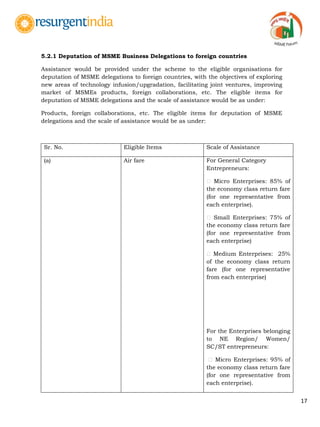
5.2.1 Deputation of MSME Business Delegations to foreign countries
Assistance would be provided under the scheme to the eligible organisations for
deputation of MSME delegations to foreign countries, with the objectives of exploring
new areas of technology infusion/upgradation, facilitating joint ventures, improving
market of MSMEs products, foreign collaborations, etc. The eligible items for
deputation of MSME delegations and the scale of assistance would be as under:
Products, foreign collaborations, etc. The eligible items for deputation of MSME
delegations and the scale of assistance would be as under:
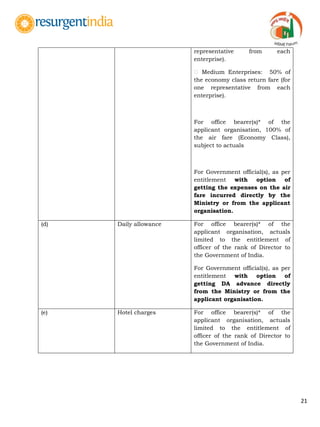
Sr. No. Eligible Items Scale of Assistance
(a) Air fare For General Category
Entrepreneurs:
Micro Enterprises: 85% of
the economy class return fare
(for one representative from
each enterprise).
Small Enterprises: 75% of
the economy class return fare
(for one representative from
each enterprise)
Medium Enterprises: 25%
of the economy class return
fare (for one representative
from each enterprise)
For the Enterprises belonging
to NE Region/ Women/
SC/ST entrepreneurs:
Micro Enterprises: 95% of
the economy class return fare
(for one representative from
each enterprise).
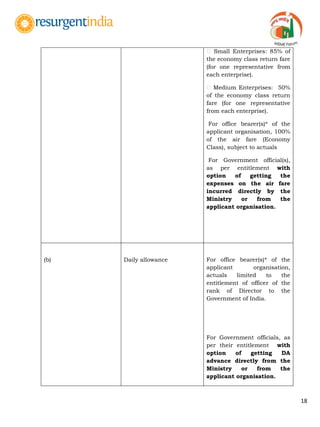
18
Small Enterprises: 85% of
the economy class return fare
(for one representative from
each enterprise).
Medium Enterprises: 50%
of the economy class return
fare (for one representative
from each enterprise).
For office bearer(s)* of the
applicant organisation, 100%
of the air fare (Economy
Class), subject to actuals
For Government official(s),
as per entitlement with
option of getting the
expenses on the air fare
incurred directly by the
Ministry or from the
applicant organisation.
(b) Daily allowance For office bearer(s)* of the
applicant organisation,
actuals limited to the
entitlement of officer of the
rank of Director to the
Government of India.
For Government officials, as
per their entitlement with
option of getting DA
advance directly from the
Ministry or from the
applicant organisation.
19
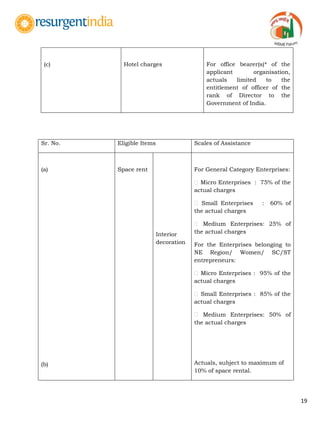
(c) Hotel charges For office bearer(s)* of the
applicant organisation,
actuals limited to the
entitlement of officer of the
rank of Director to the
Government of India.
Sr. No. Eligible Items Scales of Assistance
(a)
(b)
Space rent
Interior
decoration
For General Category Enterprises:
Micro Enterprises : 75% of the
actual charges
Small Enterprises : 60% of
the actual charges
Medium Enterprises: 25% of
the actual charges
For the Enterprises belonging to
NE Region/ Women/ SC/ST
entrepreneurs:
Micro Enterprises : 95% of the
actual charges
Small Enterprises : 85% of the
actual charges
Medium Enterprises: 50% of
the actual charges
Actuals, subject to maximum of
10% of space rental.
20
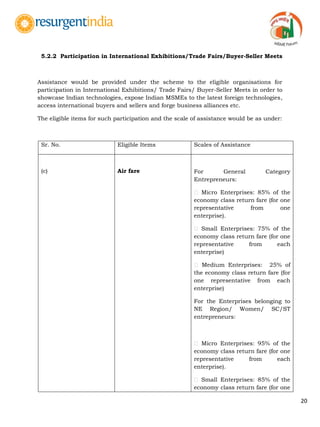
5.2.2 Participation in International Exhibitions/Trade Fairs/Buyer-Seller Meets
Assistance would be provided under the scheme to the eligible organisations for
participation in International Exhibitions/ Trade Fairs/ Buyer-Seller Meets in order to
showcase Indian technologies, expose Indian MSMEs to the latest foreign technologies,
access international buyers and sellers and forge business alliances etc.
The eligible items for such participation and the scale of assistance would be as under:
Sr. No. Eligible Items Scales of Assistance
(c) Air fare For General Category
Entrepreneurs:
Micro Enterprises: 85% of the
economy class return fare (for one
representative from one
enterprise).
Small Enterprises: 75% of the
economy class return fare (for one
representative from each
enterprise)
Medium Enterprises: 25% of
the economy class return fare (for
one representative from each
enterprise)
For the Enterprises belonging to
NE Region/ Women/ SC/ST
entrepreneurs:
Micro Enterprises: 95% of the
economy class return fare (for one
representative from each
enterprise).
Small Enterprises: 85% of the
economy class return fare (for one
21
representative from each
enterprise).
Medium Enterprises: 50% of
the economy class return fare (for
one representative from each
enterprise).
For office bearer(s)* of the
applicant organisation, 100% of
the air fare (Economy Class),
subject to actuals
For Government official(s), as per
entitlement with option of
getting the expenses on the air
fare incurred directly by the
Ministry or from the applicant
organisation.
(d) Daily allowance For office bearer(s)* of the
applicant organisation, actuals
limited to the entitlement of
officer of the rank of Director to
the Government of India.
For Government official(s), as per
entitlement with option of
getting DA advance directly
from the Ministry or from the
applicant organisation.
(e) Hotel charges For office bearer(s)* of the
applicant organisation, actuals
limited to the entitlement of
officer of the rank of Director to
the Government of India.
22
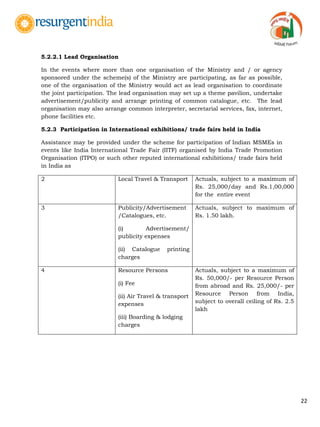
5.2.2.1 Lead Organisation
In the events where more than one organisation of the Ministry and / or agency
sponsored under the scheme(s) of the Ministry are participating, as far as possible,
one of the organisation of the Ministry would act as lead organisation to coordinate
the joint participation. The lead organisation may set up a theme pavilion, undertake
advertisement/publicity and arrange printing of common catalogue, etc. The lead
organisation may also arrange common interpreter, secretarial services, fax, internet,
phone facilities etc.
5.2.3 Participation in International exhibitions/ trade fairs held in India
Assistance may be provided under the scheme for participation of Indian MSMEs in
events like India International Trade Fair (IITF) organised by India Trade Promotion
Organisation (ITPO) or such other reputed international exhibitions/ trade fairs held
in India as
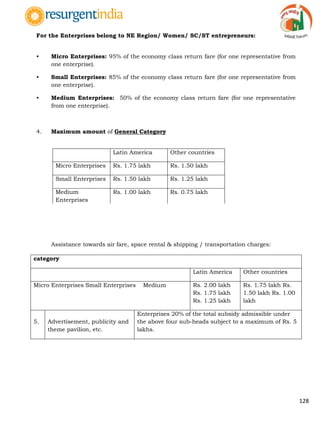
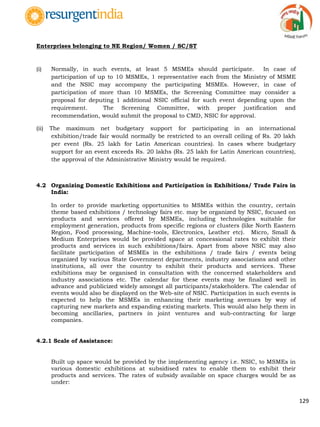
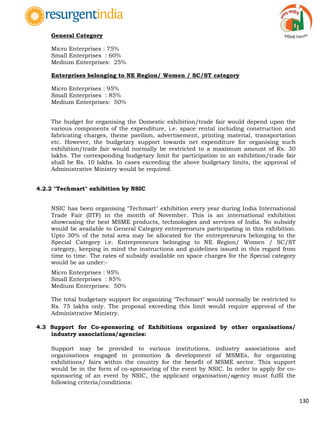
2 Local Travel & Transport Actuals, subject to a maximum of
Rs. 25,000/day and Rs.1,00,000
for the entire event
3 Publicity/Advertisement
/Catalogues, etc.
(i) Advertisement/
publicity expenses
(ii) Catalogue printing
charges
Actuals, subject to maximum of
Rs. 1.50 lakh.
4 Resource Persons
(i) Fee
(ii) Air Travel & transport
expenses
(iii) Boarding & lodging
charges
Actuals, subject to a maximum of
Rs. 50,000/- per Resource Person
from abroad and Rs. 25,000/- per
Resource Person from India,
subject to overall ceiling of Rs. 2.5
lakh
23
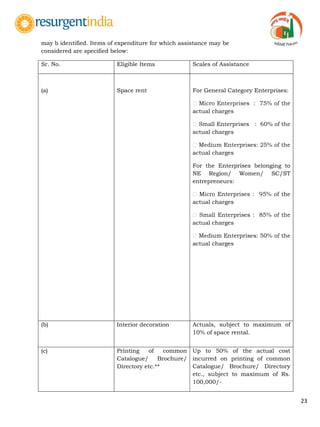
may b identified. Items of expenditure for which assistance may be
considered are specified below:
Sr. No. Eligible Items Scales of Assistance
(a) Space rent For General Category Enterprises:
actual charges
actual charges
actual charges
For the Enterprises belonging to
NE Region/ Women/ SC/ST
entrepreneurs:
the
actual charges
actual charges
actual charges
(b) Interior decoration Actuals, subject to maximum of
10% of space rental.
(c) Printing of common
Catalogue/ Brochure/
Directory etc.**
Up to 50% of the actual cost
incurred on printing of common
Catalogue/ Brochure/ Directory
etc., subject to maximum of Rs.
100,000/-
24
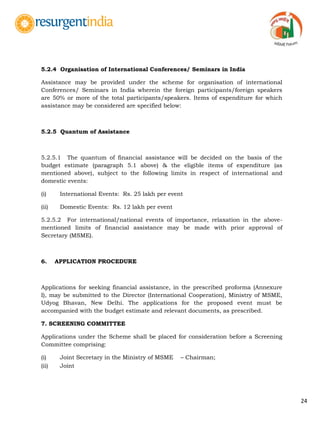
5.2.4 Organisation of International Conferences/ Seminars in India
Assistance may be provided under the scheme for organisation of international
Conferences/ Seminars in India wherein the foreign participants/foreign speakers
are 50% or more of the total participants/speakers. Items of expenditure for which
assistance may be considered are specified below:
5.2.5 Quantum of Assistance
5.2.5.1 The quantum of financial assistance will be decided on the basis of the
budget estimate (paragraph 5.1 above) & the eligible items of expenditure (as
mentioned above), subject to the following limits in respect of international and
domestic events:
(i) International Events: Rs. 25 lakh per event
(ii) Domestic Events: Rs. 12 lakh per event
5.2.5.2 For international/national events of importance, relaxation in the above-
mentioned limits of financial assistance may be made with prior approval of
Secretary (MSME).
6. APPLICATION PROCEDURE
Applications for seeking financial assistance, in the prescribed proforma (Annexure
I), may be submitted to the Director (International Cooperation), Ministry of MSME,
Udyog Bhavan, New Delhi. The applications for the proposed event must be
accompanied with the budget estimate and relevant documents, as prescribed.
7. SCREENING COMMITTEE
Applications under the Scheme shall be placed for consideration before a Screening
Committee comprising:
(i) Joint Secretary in the Ministry of MSME – Chairman;
(ii) Joint
25
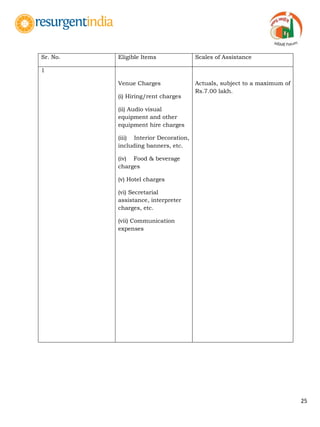
Sr. No. Eligible Items Scales of Assistance
1
Venue Charges
(i) Hiring/rent charges
(ii) Audio visual
equipment and other
equipment hire charges
(iii) Interior Decoration,
including banners, etc.
(iv) Food & beverage
charges
(v) Hotel charges
(vi) Secretarial
assistance, interpreter
charges, etc.
(vii) Communication
expenses
Actuals, subject to a maximum of
Rs.7.00 lakh.
26
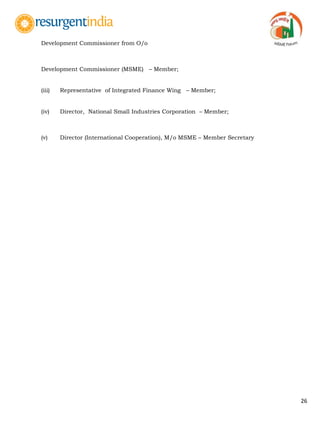
Development Commissioner from O/o
Development Commissioner (MSME) – Member;
(iii) Representative of Integrated Finance Wing – Member;
(iv) Director, National Small Industries Corporation – Member;
(v) Director (International Cooperation), M/o MSME – Member Secretary
27
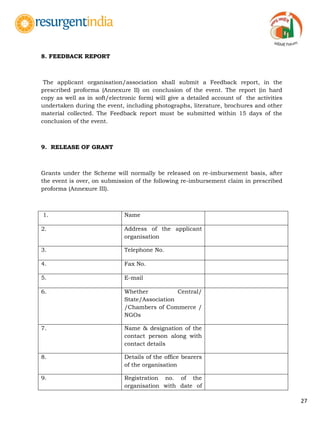
8. FEEDBACK REPORT
The applicant organisation/association shall submit a Feedback report, in the
prescribed proforma (Annexure II) on conclusion of the event. The report (in hard
copy as well as in soft/electronic form) will give a detailed account of the activities
undertaken during the event, including photographs, literature, brochures and other
material collected. The Feedback report must be submitted within 15 days of the
conclusion of the event.
9. RELEASE OF GRANT
Grants under the Scheme will normally be released on re-imbursement basis, after
the event is over, on submission of the following re-imbursement claim in prescribed
proforma (Annexure III).
1. Name
2. Address of the applicant
organisation
3. Telephone No.
4. Fax No.
5. E-mail
6. Whether Central/
State/Association
/Chambers of Commerce /
NGOs
7. Name & designation of the
contact person along with
contact details
8. Details of the office bearers
of the organisation
9. Registration no. of the
organisation with date of
28
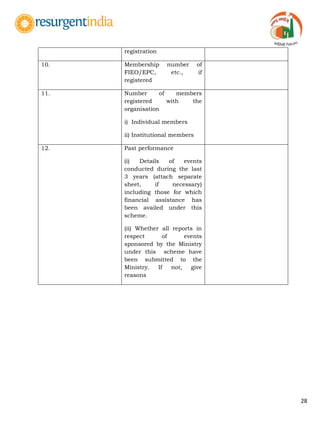
registration
10. Membership number of
FIEO/EPC, etc., if
registered
11. Number of members
registered with the
organisation
i) Individual members
ii) Institutional members
12. Past performance
(i) Details of events
conducted during the last
3 years (attach separate
sheet, if necessary)
including those for which
financial assistance has
been availed under this
scheme.
(ii) Whether all reports in
respect of events
sponsored by the Ministry
under this scheme have
been submitted to the
Ministry. If not, give
reasons
29
DOCUMENTS TO BE SUBMITTED ALONG WITH THE APPLICATION FORM
(1) Copy of Registration Certificate of the organisation (for first time applicant only).
(2) Copy of Membership Certificate of FIEO/EPC or other organisations, if applicable
(for first time applicant only) .
(3) Copies of Audited Balance Sheet, Profit & Loss A/c or Income & Expenditure A/c
of the Organisation for the last 3 years (to be submitted only once in a year).
(4) Documents/correspondence/brochures/invitation letters for the proposed event.
(5) Brief note on the objective(s) of the event and likely outcomes/benefits arising out
of the proposed participation in the event
(6) Budget Estimate for the proposed event in prescribed proforma [Annexure I-A].
(7) Details of the proposed visit/event, the proposed itinerary/programme including
the name of counterpart/host oragnisation(s), schedule and agenda of the
meetings, details of site visits etc. [Annexure I-B].
(8) Tentative List of Entrepreneurs participating in the event [Annexure I-C].
(9) Resolution from the Association/Organisation authorising its officials to apply/
deal with the Ministry of MSME under the scheme, to be furnished in prescribed
proforma [Annexure I-D].
30
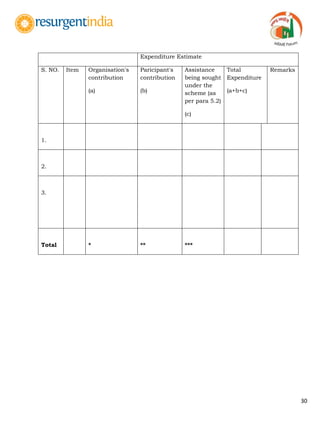
Expenditure Estimate
S. NO. Item Organisation's
contribution
(a)
Paricipant's
contribution
(b)
Assistance
being sought
under the
scheme (as
per para 5.2)
(c)
Total
Expenditure
(a+b+c)
Remarks
1.
2.
3.
Total * ** ***
31
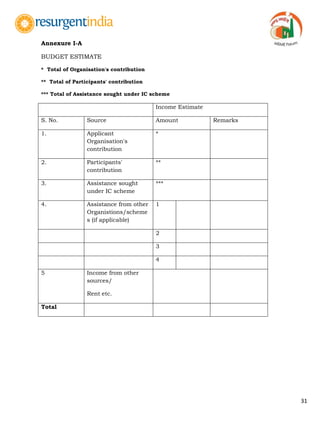
Annexure I-A
BUDGET ESTIMATE
* Total of Organisation's contribution
** Total of Participants' contribution
*** Total of Assistance sought under IC scheme
Income Estimate
S. No. Source Amount Remarks
1. Applicant
Organisation's
contribution
*
2. Participants'
contribution
**
3. Assistance sought
under IC scheme
***
4. Assistance from other
Organistions/scheme
s (if applicable)
1
2
3
4
5 Income from other
sources/
Rent etc.
Total
32
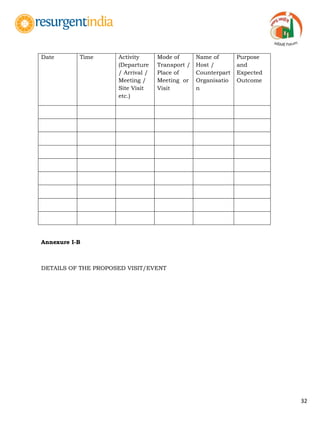
Date Time Activity
(Departure
/ Arrival /
Meeting /
Site Visit
etc.)
Mode of
Transport /
Place of
Meeting or
Visit
Name of
Host /
Counterpart
Organisatio
n
Purpose
and
Expected
Outcome
Annexure I-B
DETAILS OF THE PROPOSED VISIT/EVENT
33
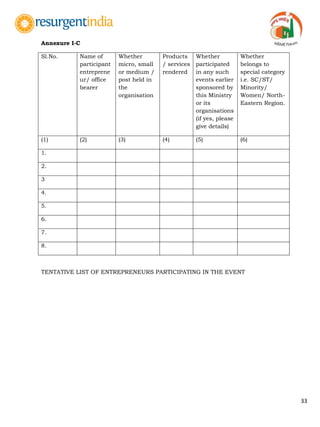
Annexure I-C
Sl.No. Name of
participant
entreprene
ur/ office
bearer
Whether
micro, small
or medium /
post held in
the
organisation
Products
/ services
rendered
Whether
participated
in any such
events earlier
sponsored by
this Ministry
or its
organisations
(if yes, please
give details)
Whether
belongs to
special category
i.e. SC/ST/
Minority/
Women/ North-
Eastern Region.
(1) (2) (3) (4) (5) (6)
1.
2.
3
4.
5.
6.
7.
8.
TENTATIVE LIST OF ENTREPRENEURS PARTICIPATING IN THE EVENT
34
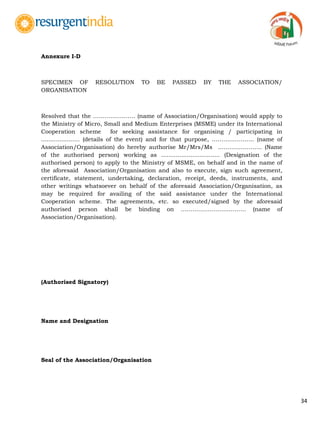
Annexure I-D
SPECIMEN OF RESOLUTION TO BE PASSED BY THE ASSOCIATION/
ORGANISATION
Resolved that the …………………. (name of Association/Organisation) would apply to
the Ministry of Micro, Small and Medium Enterprises (MSME) under its International
Cooperation scheme for seeking assistance for organising / participating in
..................... (details of the event) and for that purpose, …………………. (name of
Association/Organisation) do hereby authorise Mr/Mrs/Ms .…………………. (Name
of the authorised person) working as ................................ (Designation of the
authorised person) to apply to the Ministry of MSME, on behalf and in the name of
the aforesaid Association/Organisation and also to execute, sign such agreement,
certificate, statement, undertaking, declaration, receipt, deeds, instruments, and
other writings whatsoever on behalf of the aforesaid Association/Organisation, as
may be required for availing of the said assistance under the International
Cooperation scheme. The agreements, etc. so executed/signed by the aforesaid
authorised person shall be binding on ……………………………. (name of
Association/Organisation).
(Authorised Signatory)
Name and Designation
Seal of the Association/Organisation
35
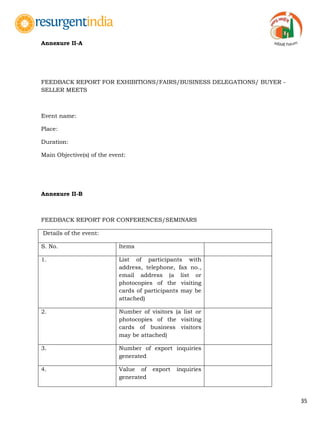
Annexure II-A
FEEDBACK REPORT FOR EXHIBITIONS/FAIRS/BUSINESS DELEGATIONS/ BUYER -
SELLER MEETS
Event name:
Place:
Duration:
Main Objective(s) of the event:
Annexure II-B
FEEDBACK REPORT FOR CONFERENCES/SEMINARS
Details of the event:
S. No. Items
1. List of participants with
address, telephone, fax no.,
email address (a list or
photocopies of the visiting
cards of participants may be
attached)
2. Number of visitors (a list or
photocopies of the visiting
cards of business visitors
may be attached)
3. Number of export inquiries
generated
4. Value of export inquiries
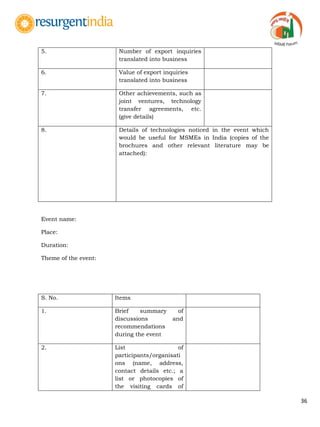
generated
36
5. Number of export inquiries
translated into business
6. Value of export inquiries
translated into business
7. Other achievements, such as
joint ventures, technology
transfer agreements, etc.
(give details)
8. Details of technologies noticed in the event which
would be useful for MSMEs in India (copies of the
brochures and other relevant literature may be
attached):
Event name:
Place:
Duration:
Theme of the event:
S. No. Items
1. Brief summary of
discussions and
recommendations
during the event
2. List of
participants/organisati
ons (name, address,
contact details etc.; a
list or photocopies of
the visiting cards of
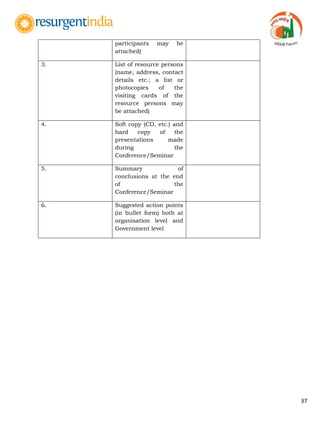
37
participants may be
attached)
3. List of resource persons
(name, address, contact
details etc.; a list or
photocopies of the
visiting cards of the
resource persons may
be attached)
4. Soft copy (CD, etc.) and
hard copy of the
presentations made
during the
Conference/Seminar
5. Summary of
conclusions at the end
of the
Conference/Seminar
6. Suggested action points
(in bullet form) both at
organisation level and
Government level
38
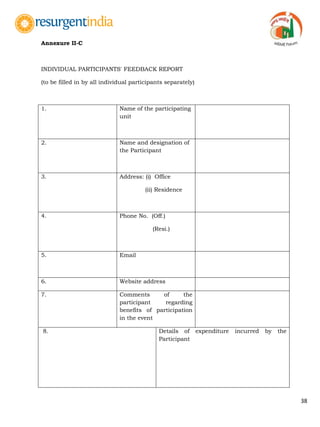
Annexure II-C
INDIVIDUAL PARTICIPANTS' FEEDBACK REPORT
(to be filled in by all individual participants separately)
1. Name of the participating
unit
2. Name and designation of
the Participant
3. Address: (i) Office
(ii) Residence
4. Phone No. (Off.)
(Resi.)
5. Email
6. Website address
7. Comments of the
participant regarding
benefits of participation
in the event
8. Details of expenditure incurred by the
Participant
39
The above said information is correct to the best of my knowledge.
Date: Signature of Participant
40
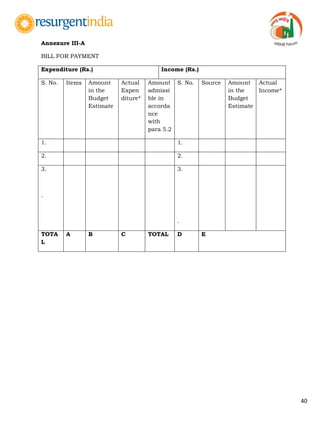
Annexure III-A
BILL FOR PAYMENT
Expenditure (Rs.) Income (Rs.)
S. No. Items Amount
in the
Budget
Estimate
Actual
Expen
diture*
Amount
admissi
ble in
accorda
nce
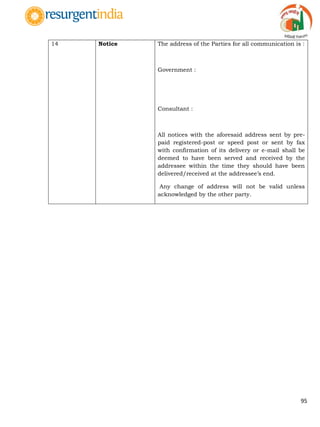
with
para 5.2
S. No. Source Amount
in the
Budget
Estimate
Actual
Income*
1. 1.
2. 2.
3.
.
3.
.
TOTA
L
A B C TOTAL D E
41
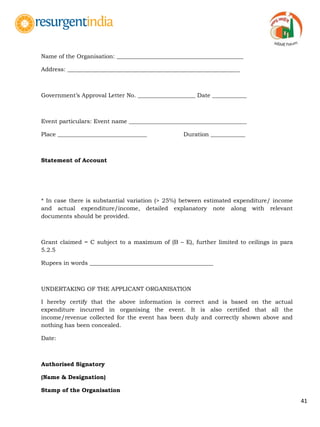
Name of the Organisation: ____________________________________________
Address: ____________________________________________________________
Government‟s Approval Letter No. ____________________ Date ____________
Event particulars: Event name _________________________________________
Place _______________________________ Duration ____________
Statement of Account
* In case there is substantial variation (> 25%) between estimated expenditure/ income
and actual expenditure/income, detailed explanatory note along with relevant
documents should be provided.
Grant claimed = C subject to a maximum of (B – E), further limited to ceilings in para
5.2.5
Rupees in words ___________________________________________
UNDERTAKING OF THE APPLICANT ORGANISATION
I hereby certify that the above information is correct and is based on the actual
expenditure incurred in organising the event. It is also certified that all the
income/revenue collected for the event has been duly and correctly shown above and
nothing has been concealed.
Date:
Authorised Signatory
(Name & Designation)
Stamp of the Organisation
42
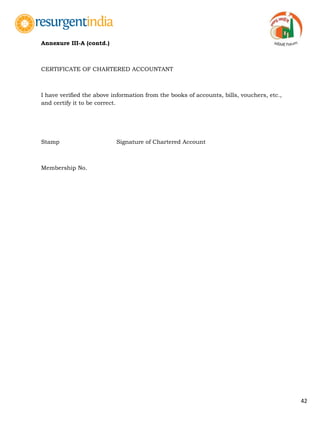
Annexure III-A (contd.)
CERTIFICATE OF CHARTERED ACCOUNTANT
I have verified the above information from the books of accounts, bills, vouchers, etc.,
and certify it to be correct.
Stamp Signature of Chartered Account
Membership No.
43
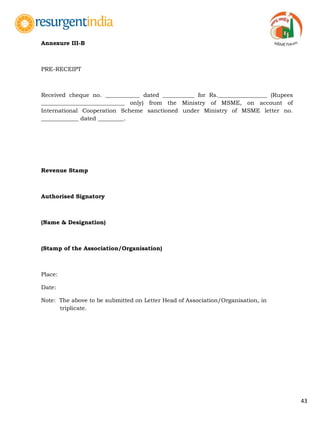
Annexure III-B
PRE-RECEIPT
Received cheque no. ____________ dated ___________ for Rs._________________ (Rupees
_____________________________ only) from the Ministry of MSME, on account of
International Cooperation Scheme sanctioned under Ministry of MSME letter no.
_____________ dated _________.
Revenue Stamp
Authorised Signatory
(Name & Designation)
(Stamp of the Association/Organisation)
Place:
Date:
Note: The above to be submitted on Letter Head of Association/Organisation, in
triplicate.
44
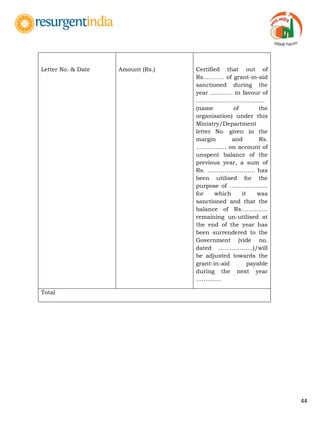
Letter No. & Date Amount (Rs.) Certified that out of
Rs……….. of grant-in-aid
sanctioned during the
year …...…… in favour of
….………………………..…
(name of the
organisation) under this
Ministry/Department
letter No. given in the
margin and Rs.
……………. on account of
unspent balance of the
previous year, a sum of
Rs. ..………………….. has
been utilised for the
purpose of ………………..
for which it was
sanctioned and that the
balance of Rs….……….
remaining un-utilised at
the end of the year has
been surrendered to the
Government (vide no.
dated ………………)/will
be adjusted towards the
grant-in-aid payable
during the next year
…….……
Total
45
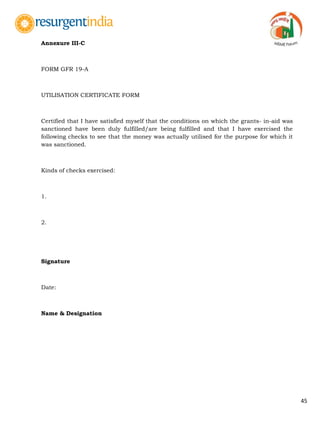
Annexure III-C
FORM GFR 19-A
UTILISATION CERTIFICATE FORM
Certified that I have satisfied myself that the conditions on which the grants- in-aid was
sanctioned have been duly fulfilled/are being fulfilled and that I have exercised the
following checks to see that the money was actually utilised for the purpose for which it
was sanctioned.
Kinds of checks exercised:
1.
2.
Signature
Date:
Name & Designation
46
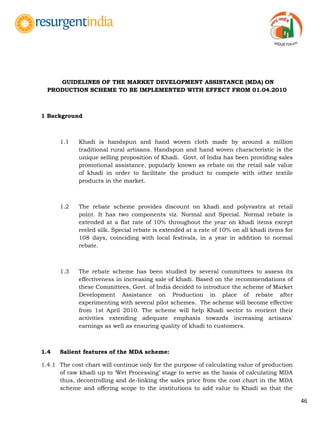
GUIDELINES OF THE MARKET DEVELOPMENT ASSISTANCE (MDA) ON
PRODUCTION SCHEME TO BE IMPLEMENTED WITH EFFECT FROM 01.04.2010
1 Background
1.1 Khadi is handspun and hand woven cloth made by around a million
traditional rural artisans. Handspun and hand woven characteristic is the
unique selling proposition of Khadi. Govt. of India has been providing sales
promotional assistance, popularly known as rebate on the retail sale value
of khadi in order to facilitate the product to compete with other textile
products in the market.
1.2 The rebate scheme provides discount on khadi and polyvastra at retail
point. It has two components viz. Normal and Special. Normal rebate is
extended at a flat rate of 10% throughout the year on khadi items except
reeled silk. Special rebate is extended at a rate of 10% on all khadi items for
108 days, coinciding with local festivals, in a year in addition to normal
rebate.
1.3 The rebate scheme has been studied by several committees to assess its
effectiveness in increasing sale of khadi. Based on the recommendations of
these Committees, Govt. of India decided to introduce the scheme of Market
Development Assistance on Production in place of rebate after
experimenting with several pilot schemes. The scheme will become effective
from 1st April 2010. The scheme will help Khadi sector to reorient their
activities extending adequate emphasis towards increasing artisans'
earnings as well as ensuring quality of khadi to customers.
1.4 Salient features of the MDA scheme:
1.4.1 The cost chart will continue only for the purpose of calculating value of production
of raw khadi up to „Wet Processing‟ stage to serve as the basis of calculating MDA
thus, decontrolling and de-linking the sales price from the cost chart in the MDA
scheme and offering scope to the institutions to add value to Khadi so that the
47
products can be sold at market determined price. In short, the
scheme offers scope for dynamic pricing for Khadi and Polyvastra products.
1.4.2 The scheme of MDA on Production aims at uniform distribution of sales
throughout the year unlike the existing rebate scheme where most of the sale
takes place during the special rebate season of 108 days.
1.4.3 A well-dispersed sale spread over the year would help Khadi Institutions to keep
inventory levels down, thereby offering greater scope for mobilization of required
working capital.
1.4.4 A fixed portion of MDA assistance will go directly to the artisans as special
incentive/bonus and increase their earnings.
1.4.5 Institution-wise target for production under MDA scheme will be decided through
a transparent system of State Level Budgeting exercise and sanctioned by
Standing Finance Committee of KVIC.
1.4.6 MDA will be released on quarterly basis against claims to be submitted by the
institutions.
1.4.7 MDA is being proposed only for the remaining two years ( 2010-11 and 2011-12) of
the XI Five Year Plan, after which two systems of incentives, namely, Production
Incentive to be worked out under the Khadi Reform and Development Programme
(KRDP) and MDA would be integrated based upon the impact study of Production
Incentive. MDA would not be biased towards high-value segment of the Khadi
market and the Khadi institutions would have the flexibility to produce what the
market wanted. An institution availing Production Incentive will not be eligible for
MDA at the same time.
48
2 Definition of MDA
MDA on Production is an assistance proposed to be provided on cost of production
of Khadi and Polyvastra achieved by the certified Khadi institutions. The Khadi
institutions, having valid Khadi certificate and categorized as A+, A, B and C only
are eligible to avail MDA from KVIC.
3 Rate of MDA
MDA shall be allowed @ 20% „on cost of production‟ of Khadi (Cotton, Silk,
Woollen) and Polyvastra to the extent of production target approved by the
Standing Finance Committee (SFC) of KVIC for the year.
4 Definition of Production
4.1 The Khadi production activity is a composite activity of spinning, weaving and wet
processing of khadi encompassing cost of raw material, hand spinning by
registered spinners and weaving on handloom by registered weavers including
spinners / reelers and weavers wages / conversion charges and provision for their
social security measures, wet processing (bleaching, dyeing, finishing, printing)
etc. Conversion of Khadi cloth into ready to wear and ready to use items will
not constitute cost of production.
49
4.2 Cost of Production
The Cost of production in the context of Khadi and Polyvastra for the purpose of
MDA includes the following:
Cost of raw material
+
Spinning/reeling and weaving charges including process wastage, artisan
incentive and Artisan Welfare Fund.
+
Wet processing viz. bleaching, dyeing, mercerizing, finishing and Printing Charges,
along with process waste
+
Permissible provisions such as trade expenses,
Bank interest , insurance *.
+
Allowable margin**
(to meet establishment expenditure)
50
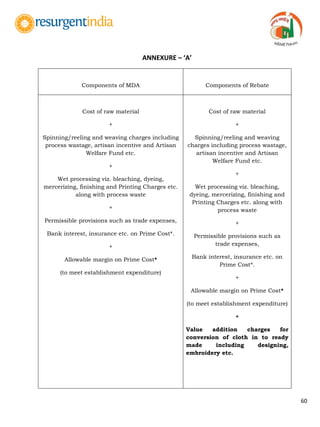
A comparison on the Component of Rebate and MDA is shown at
Annexure- „A‟
Note:
-The value addition charges for conversion of cloth into readymade, embroidery etc.,
shall not be included in the cost of production, as the market forces would
determine prices of such value added products.
-Producing Institution for the purpose of MDA will mean the institution engaged
in the activity of production of Khadi.
-Selling Institution or sales outlets including departmentally run units of KVIC
and KVIBs for the purpose of MDA will mean the institutions engaged in the activity
of selling of Khadi purchased from producing institutions.
-Composite Institutions will mean the institutions engaged in the activity of
producing and selling of Khadi.
-Composite institutions can also purchase Khadi from exclusive producing
institutions and they can also sell Khadi to Selling institutions.
- The formula for calculation of MDA based on production in the context of khadi will
also be applicable for polyvastra.
- * As regards the permissible provision, the existing guidelines of KVIC stipulates
provision @ 3%, 4% and 1% on the prime cost for trade expenses, bank interest,
insurance, respectively.
- ** The term allowable margin means the margin permitted by the Central
Certification Committee of KVIC to meet the establishment expenditure. As per the
existing guidelines, the establishment margin permitted for Cotton Khadi is 20%
on the prime cost. The same for Muslin, Wool and Silk is 25%. For polyvastra the
allowable margin is also 25% of the prime cost.
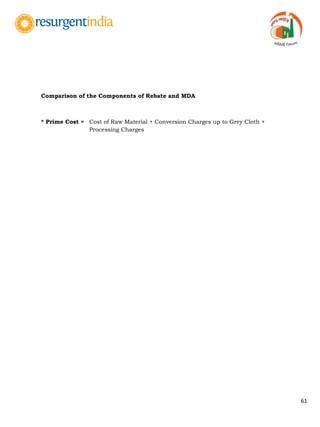
- The prime cost means the cost of raw material plus conversion charges upto grey
cloth plus processing charge but DOES NOT include provision for trade
expenses(3%), bank interest(4%), insurance(1%) and provision for establishment
expenditure as given costing structure of KVIC.
51
5 Mechanism and purposes for utilization of MDA Grant
5.1 The MDA on production scheme offers flexibility to Khadi institutions to go
for need based utilization of funds towards verifiable and tangible
interventions and measures for improving the earning of artisans and also
to improve the market for khadi and polyvastra. Accordingly, the proposed
MDA @ 20% of the cost of production of Khadi and Polyvastra shall be
apportioned among the artisans, khadi producing institution and selling
institution as detailed below:
5.2 The total amount of MDA on production will be claimed by the producing
institution from the KVIC and will be distributed amongst the stake holders
viz spinners and weavers, producing institutions and selling
institutions in the ratio 25%, 30% and 45% respectively.
5.3 25% of total MDA amount shall be passed on to the spinners and weavers
in the form incentive or „bonus‟ through their bank or post office accounts,
in addition to their normal earnings as prescribed in the cost chart. Such
additional wages out of MDA grant should not be included in the cost of
Khadi.
5.4 The above 25% of MDA amount cannot be used for extending assistance to
the workers who are employees of the institutions and engaged to oversee
the production activity and sales/marketing accounts etc.
5.5 30% of total MDA amount will be utilized by Khadi producing
institutions towards implements/training/capacity building.
5.6 The producing institution will transfer the 45% of total MDA amount,
earmarked for selling institution as per the scheme, to the selling
institution at the time of wholesale. The transfer should be through
invoice. This MDA amount will be utilized by the selling institution on
renovation / modification of sales outlets, training of salespersons,
computerization, development of designs, publicity, discounts (if required).
Khadi institutions selling khadi on wholesale will have to pass on the same
(45% of total MDA) to purchasing institutions.
52
5.7 Production of Khadi and Polyvastra products for the purpose of Govt.
supplies under Rate Contract ( RC ) of DGS & D to be made against the
whole sale target approved by Standing Finance Committee of KVIC is not
eligible fully for MDA , as these items are not sold through retail outlets.
Hence, such items are not qualified for the MDA support earmarked for
retail sales activity. Therefore, RC items will be eligible for 11% MDA
instead of 20% as applicable in normal khadi.
5.8 Any amendment to this formula will have to be approved by the Ministry of
MSME as and when required, on the basis of recommendations of KVIC
after the actual performance is monitored and any anomaly observed in the
scheme is removed.
6 Steps / Safeguards to enhanced wages of artisans
The following points will be adhered to in ensuring higher earnings of artisans:
a) While obtaining undertaking for utilization of the funds for specific
purposes clear indication will be made in the MDA claims format by the
institution to the effect that the institution will take steps to enhance
artisans‟ wages without compromising quality of cloth and designs.
b) The institution will have to pay artisans at regular intervals, preferably
fortnightly and no later than monthly, and through bank or post office
account and maintain a record for verification of payments made to each
artisan.
c) The institution will remit money to the State Level Artisans Welfare Fund to
the State Level Trusts and the receipt of remittance of fund should be
attached with the claim format.
d) The institutions have to cover all artisans within the ambit of Khadi Karigar
Janashree Bima Yojana introduced by KVIC and such other welfare
schemes to be introduced by KVIC with the approval of Ministry from time
to time.
53
e) While submitting claims for quarterly release of MDA, the
producing institution will also furnish a certificate to the effect that
the MDA portion of spinners and weavers and selling institutions in
the ratio 25% and 45% respectively, for the previous quarter, has been
released to their satisfaction. Any default in this regard will be taken into
account by KVIC while releasing the payment of MDA for the next quarter.
f) Compliance of all the above points will be ensured by KVIC while settling
the MDA claim of each institution.
g) KVIC will conduct random checks of at least 10% of the MDA claims which
will include physical verification of all transactions with particular reference
to the pass books, issued to artisans and other payments made to artisans
and expenditure made on capacity building etc.
7 Periodicity of MDA claim
7.1 Producing institutions shall submit quarterly claim of MDA based on the
actual production achieved during the preceding quarter of the financial
year. The difference, if any, would be adjusted in the last quarter of the
financial year on the basis of audited accounts by the Chartered
Accountants. MDA shall be preferably reimbursed electronically by State/
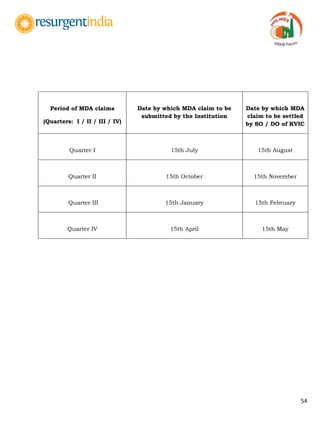
Divisional office of KVIC on quarterly basis as detailed under:
7.2 The settlement of MDA claim by SO / DO of KVIC includes actual release of
payment. Efforts will be made to introduce the system of payments
through „electronic transfer‟ within 6 (six) months, wherever possible.
7.3 The State / Divisional offices of KVIC will be responsible for ensuring the
timely settlement of MDA claim and submit a quarterly report on 1st
September, 1st December, 1st March and 1st June to Central Office, KVIC,
Mumbai indicating the claims received, claims settled and the reasons for
non-settlement of claims within the stipulated period during the previous
quarter.
54
Period of MDA claims
(Quarters: I / II / III / IV)
Date by which MDA claim to be
submitted by the Institution
Date by which MDA
claim to be settled
by SO / DO of KVIC
Quarter I 15th July 15th August
Quarter II 15th October 15th November
Quarter III 15th January 15th February
Quarter IV 15th April 15th May
55
7.4 The funds will be released to KVIC on quarterly basis in the
light of claim statement furnished by State/Divisional offices of KVIC. The
fund for the first quarter of first year of implementation will be released in
advance to KVIC in the month of July 2010 and thereafter, the funds will
released on quarterly basis on the basis of actual claims settled in previous
quarter.
7.5 KVIC will furnish a quarterly report to the Ministry of MSME indicating the
consolidated information on utilization and disbursement of MDA grant to
the institutions for all offices under KVIC by 15th of the month following
the prescribed dates for settlement of MDA claims for the quarter in
question. The release of funds for MDA will be dependent on the receipt of
the quarterly progress report from the KVIC.
7.6 Utilization of MDA grant will also be reviewed by the Ministry of MSME
during review of plan fund utilization by KVIC. The MDA claims will also be
open for „internal audit‟ by the Chief Controller of Accounts (CCA) of the
Ministry of MSME.
8. Closing Stock
8.1 The closing stock will be worked out as follows:
Closing Stock = Opening Stocks + Production + Purchases (–) Sales (Retail
Sales +Whole Sales)
8.2 The State/Divisional Directors will strictly follow the formula while
recommending the targets for Production, Retail Sales and Whole Sales for
the next year so as to avoid piling up of closing stocks during the previous
year.
8.3 The institutions will furnish the closing stock position as on 31.03.2010
immediately after completion of the financial year, to the State/Divisional
Director in the form of an Annual stock taking statement (center-wise) duly
signed by the authorized stock taking persons of the institution with
signatures of the authorized office bearers of the institutions.
56
8.4 The State/divisional Director shall ensure proper check / monitoring on
this aspect through audit wing / khadi wing to conduct random test check
while conducting the audit and technical monitoring inspection,
respectively.
8.5 The closing stock position shall also be authenticated from the audited
balance sheet duly certified by the Charted Accountant.
8.6 The State/Divisional Directors will ensure that the institutions have
submitted the Annual stock Statement in time to their respective offices
and it will also be recorded in the record note Budget discussions.
8.7 On the basis of the formula prescribed by KVIC for the budget
discussion for the year 2010-11, the closing stock position as on
31.03.2011 shall be reduced / controlled when compared to the
closing stock position as on 31.03.2010. KVIC will devise an
incentive/ disincentive plan to ensure control over the accumulation
of closing stock position either in the form of reduction of targets for
next year or withholding of certain percentage of MDA.
9. Period of utilization of MDA
Utilization of MDA for certain purposes such as modernization, renovation,
research and development, etc., will take a period of more than one year. In such
cases, the Khadi institutions will be allowed to spend MDA up to two years from
the date of actual receipt with specific sanction from the State Level Budget Team
( SLBT ) of KVIC. In order to manage the MDA amount effectively, it will be
mandatory on the part of the institutions to maintain a separate bank account
which will be subject to verification by KVIC.
10. Documentation for MDA claims
MDA shall be disbursed to eligible institutions on their submission of detailed
57
claims as per the prescribed format {Annexure – I, II, III, IV & V}. The
State / Divisional Directors of KVIC shall furnish the quarterly details of
settlement of MDA claims to the Programme Directorate and Directorate of
Accounts of KVIC within a period of one month after expiry of each quarter and a
consolidated statement for the whole financial year by 30 April of the following
year.
11. Furnishing of utilization certificate
11.1 The Khadi institutions availing MDA will be bound to furnish utilization
certificate annually as rendered by registered Chartered Accountants ( CA )
clearly indicating registration number, address etc. of the CA. The format of
utilization certificate, guidelines etc. will be circulated from time to time by
KVIC. KVIC, in turn, will furnish the utilization certificate to the
Government in Form 19A disclosing whether the specified, quantified and
qualitative targets that should have been reached against the amount
utilized were in fact reached and if not, the reasons there for.
11.2 CA while furnishing the utilization certificate of MDA, is expected to report
on financial propriety, compliance to Rules, Regulations, guidelines, etc.,
issued by KVIC, financial sanctions, recommendation of State Level Budget
Team of KVIC, etc., and to satisfy themselves as to existence of
infrastructure – charkhas, looms, artisans, availability of raw material,
appropriate application of utilization of MDA on areas agreed, etc., and only
after being satisfied on these points, will authenticate the utilization
certificates.
11.3 The CA concerned would issue the utilization certificate directly addressed
to State / Divisional office of KVIC, so that the accountability and
genuineness could be accounted.
12. Test Check / Test Audit and Monitoring of MDA on Production
12.1 KVIC shall conduct test audit / check of MDA claims through its Audit
Teams, in respect of all the institutions availing MDA. The KVIC will reserve
its right for such test audit / check and in case of any misutilization, it may
order for complete audit of accounts of the Khadi Institution/Khadi &
Village Industries Boards. The MDA claims will also be open for „internal
audit‟ by the Chief Controller of Accounts (CCA) of the Ministry of MSME.
58
12.2 As the funds for MDA would be extended from public funds, the Office of
Comptroller and Auditor General of India will have the right of conducting
audit / test check or otherwise as decided by that office.
13. State Government rebate / subsidy
13.1 The MDA is eligible uniformly to Khadi institutions both KVIC and State KVIBs
affiliated institutions throughout the country. Similarly, the State Governments
are also extending subsidies / rebate to the Khadi institutions located in the
State concerned. As such, the State Government rebates is extended to all
Khadi institutions, both KVIC and KVIB, in the State concerned on the
actual retail sales. Similarly, if the State Government is interested to switch
over to MDA on production subsidy, the production as defined for MDA by
KVIC may be reckoned for the purpose of extending State Government subsidy.
13.2 In order to settle the State Government rebate / subsidy, the State Boards
may satisfy themselves by obtaining a copy of utilization certificate of MDA
from the State / Divisional Offices concerned as per the prevailing practice.
14. Dispute settlement in transfer of MDA
14.1 In case of non transfer or improper transfer of MDA by the producing
institution to the other stake holders especially the selling institution, the
stake holder should bring such transactions immediately (within one
month of transaction) to the notice of State and Divisional Directors of KVIC
who will direct the producing institutions to transfer the eligible portion of
MDA forthwith. In case the khadi producing institution is not abiding by
the directives of State/Divisional Director, he (State/Divisional Director)
will deduct the amount from the claim of the Khadi producing institutions
and remit to the stake holders including the selling institutions.
14.2 No penalty will be charged for first transaction and for subsequent
transactions, the State / Divisional Director will arrange recovery of eligible
MDA amount alongwith 5% interest calculated from the date of transaction
59
and pay to artisans and weavers and the selling institution.
14.3 The Chief Executive Officer, KVIC shall be the appellate authority for all
disputes and all Khadi institutions will be bound by his decision.
*****
60
ANNEXURE – ‘A’
Components of MDA Components of Rebate
Cost of raw material
+
Spinning/reeling and weaving charges including
process wastage, artisan incentive and Artisan
Welfare Fund etc.
+
Wet processing viz. bleaching, dyeing,
mercerizing, finishing and Printing Charges etc.
along with process waste
+
Permissible provisions such as trade expenses,
Bank interest, insurance etc. on Prime Cost*.
+
Allowable margin on Prime Cost*
(to meet establishment expenditure)
Cost of raw material
+
Spinning/reeling and weaving
charges including process wastage,
artisan incentive and Artisan
Welfare Fund etc.
+
Wet processing viz. bleaching,
dyeing, mercerizing, finishing and
Printing Charges etc. along with
process waste
+
Permissible provisions such as
trade expenses,
Bank interest, insurance etc. on
Prime Cost*.
+
Allowable margin on Prime Cost*
(to meet establishment expenditure)
+
Value addition charges for
conversion of cloth in to ready
made including designing,
embroidery etc.
61
Comparison of the Components of Rebate and MDA
* Prime Cost = Cost of Raw Material + Conversion Charges up to Grey Cloth +
Processing Charges
62
GUIDELINES OF “SCHEME FOR ASSISTANCE TO TRAINING
INSTITUTIONS”
1. BACKGROUND
1.1.The Micro, Small and Medium Enterprises (MSMEs) sector has emerged as a
highly vibrant and dynamic sector of the Indian economy over the last five
decades. MSMEs not only play crucial role in providing large employment
opportunities at comparatively lower capital cost than large industries but also
help in industrialization of rural & backward areas, thereby, reducing regional
imbalances, assuring more equitable distribution of national income and wealth.
MSMEs are complementary to large industries as ancillary units and contribute
enormously to the socio-economic development of the country.
1.2.The Ministry of Micro, Small and Medium Enterprises (MoMSME) promotes the
development of micro and small enterprises in the country with the objective of
creating self-employment opportunities and upgrading the relevant skills of
existing and potential entrepreneurs. In order to promote establishment of new
enterprises and creation of new entrepreneurs MoMSME has been implementing
various schemes and programmes.
1.3.Entrepreneurship development is one of the key elements for promotion of micro
and small enterprises, particularly, the first generation entrepreneurs.
Entrepreneurship, and resultant creation of employment and wealth, is a major
means for inclusive development. Hence, entrepreneurship development has been
one of the priorities in countries the world over.
1.4.In order to ensure that young entrepreneurs are encouraged and suitably
equipped to go into new ventures, the Government has been providing assistance
for establishment of Training Institutions/ Entrepreneurship Development
Institutes (EDIs) for imparting entrepreneurship and skill development training.
These EDIs have been providing entrepreneurship and skill development training
to the first generation entrepreneurs and helping and supporting them in the
establishment of their enterprises. Government makes consistent and concerted
efforts to accelerate and promote entrepreneurship by providing support for
strengthening of training infrastructure as well as programme support.
1.5.MoMSME has set up three National level Entrepreneurship Development
Institutes namely National Institute for Micro, Small and Medium Enterprises
(NIMSME), Hyderabad; National Institute for Entrepreneurship and Small
Business Development (NIESBUD), Noida and Indian Institute of
Entrepreneurship (IIE), Guwahati to undertake the task of entrepreneurship and
skill development on a regular basis.
1.6.MoMSME has also been supporting the efforts of State Governments/ Union
Territories, Industry Associations, Financial Institutions, Technical/ Management
63
Institutions, other Non-Governmental Organisations (NGOs), etc. for
establishment of new training institutions as well as strengthening of the
infrastructure of existing training institutions.
2. SCHEME FOR ASSISTANCE TO TRAINING INSTITUTIONS
The Scheme envisages financial assistance for establishment of new institutions (EDIs),
strengthening the infrastructure of the existing EDIs and for supporting
entrepreneurship and skill development activities. The main objectives of the scheme are
development of indigenous entrepreneurship from all walks of life for developing new
micro and small enterprises, enlarging the entrepreneurial base and encouraging self-
employment in rural as well as urban areas, by providing training to first generation
entrepreneurs and assisting them in setting up of enterprises. The assistance shall be
provided to these training institutions in the form of capital grant for
creation/strengthening of infrastructure and programme support for conducting
entrepreneurship development and skill development programmes.
3. ASSISTANCE UNDER THE SCHEME
3.1 Assistance to National level EDIs
3.1.1 Eligibility
(i) Assistance may be provided under the scheme for creation or
strengthening/expansion of infrastructure, including opening of new branches/
centres and meeting revenue deficit, if any, to national level EDIs [presently 3
namely - National Institute for Micro, Small and Medium Enterprises (NiMSME),
Hyderabad; National Institute for Entrepreneurship and Small Business
Development (NIESBUD), Noida and Indian Institute of Entrepreneurship (IIE),
Guwahati].
3.1.2 Scale of assistance
64
(i) Amount of assistance will not exceed the actual amount required for creation or
strengthening/expansion of the infrastructure and meting the revenue deficit etc.
of the national level EDIs.
3.2 Assistance to Other EDIs (other than National level EDIs)
3.2.1 Eligibility
(i) Assistance may be provided under the scheme to proposed new EDIs or existing
EDIs for creation or strengthening/expansion of their infrastructure. The
central assistance under this scheme would be only catalytic and
supplementary to the contributions and efforts of the other stakeholders e.g.
the concerned Institute, States/UT Governments and other developmental
agencies/NGOs/Institutions etc.
(ii) The applicant Institution should possess clear title on the land required for
setting up of the proposed / existing institute. In case the land is obtained on
lease hold, the tenure of the lease deed should be for at least 30 years.
(iii) The financial assistance will be for specific needs of each case for construction
of building, purchase of training aids/equipments, office equipments,
computers and for providing other support services e.g. libraries/data bases
etc. The costs of land, construction of staff quarters etc. would not qualify for
calculation of matching grant from the Central Government.
3.2.2 Scale of assistance
(i) Maximum assistance under the scheme will be restricted to Rs. 150 lakh in each
case. However, for State level EDIs sponsored by the concerned State/UT
Government in the North Eastern region (including Sikkim) or Union Territories of
Andaman & Nicobar and Lakshadweep Islands, the maximum assistance would
be Rs. 270 lakhs or 90 percent of the project cost, whichever is less.
(ii) Institutions which have been earlier provided capital grant under the scheme, may
seek further grant for the purposes mentioned above. However, the maximum
65
assistance shall be limited to Rs 150 lakh [Rs. 270 lakhs for State
EDIs in NE Region (including Sikkim) or Union Territories of Andaman & Nicobar and
Lakshadweep Islands], including the grant released to them earlier.
(iii) Assistance under the scheme will be on matching basis, not exceeding 50 percent
[90 percent for State level EDIs in NE Region (including Sikkim) or Union
Territories of Andaman & Nicobar and Lakshadweep Islands] of the project cost
(excluding cost of land and working capital). The balance 50 percent of the
matching contribution (10 percent for State level EDIs in NE Region or Union
Territories of Andaman & Nicobar and Lakshadweep Islands) should come from
the concerned Institute, State/UT Government, public funded institution(s),
NGOs/Trusts/ Banks/Companies/ Societies/ Voluntary organizations etc.
(iv) The contribution of the State/UT Government/ other agencies should be in the
form of non refundable contribution/grant. The participation of the State
Government/other agencies by way of loan to the institution shall not be
admissible for the purpose of calculating assistance under this scheme.
3.2.3 Other Conditions
(i) All the proposals would be routed through the State/UT Government concerned
and would require recommendation of the State/UT Government concerned. The
State/UT Governments will examine the proposals, including the purpose,
requirement, suitability of the proposed location, possible linkages with nearby
industrial clusters and likely benefits etc., before recommending the proposals for
assistance under the scheme The State/UT Government would also examine the
financial estimates for the proposals and give its clear recommendation regarding
the amount of central assistance under the scheme.
(ii) Central government may nominate any officer, not below the rank of Under
Secretary of Govt of India, as its representative on the Board of Administration or
any other equivalent body, responsible for the management of the EDI. It would be
the responsibility of the concerned EDI to invite such nominated officer to all
meetings of the Board of Administration (or equivalent).
(iii) The assistance under the scheme shall be released, in full or part, only after the
66
applicant organization has either utilized its own part of matching
contribution or deposited its share/in the designated Bank account or issued
sanction order for release of the same in case of State/UT Government. In case, where
first installment (50%) of the assistance is released on the basis of sanction order of
State/UT Government, the second installment (50%) of the assistance under the
scheme shall be released only after the matching contribution from the State/UT
Government has been received.
(iv) The assisted EDI shall be required to complete the construction within the given
time-frame and shall have to furnish the utilization certificate of the assistance
sanctioned within the period prescribed in the sanction letter.
(v) The assisted EDI shall not dispose of or lease out or create any charge over the
assets created by utilizing the assistance provided under this scheme, without
written permission from the MoMSME.
(vi) The assisted EDI shall not change the form or the basic character of the EDI,
without prior approval of MoMSME. The charter of the assisted EDI indicating its
objects, shall not be amended without written permission of the Ministry of
MSME.
(vii) The assisted EDI shall be required to carry out a minimum set of activities and
programmes every year, as prescribed by the Government.
(viii) The financial assistance provided under this scheme would be of non-recurring
and capital nature. Under no circumstances grant funds provided under the
scheme would be used to pay salaries and allowances etc. for the institute‟s
faculty, staff or administrators.
(ix) The accounts of the assisted EDI shall be audited every year and the assisted EDI
shall be required to submit annual report along with financial statement to the
MoMSME, at least for a period of five years after receipt of the financial assistance.
The annual reports on implementation of the scheme would include the details of
construction activity, procurement of machinery/ equipment etc. during the
period under report. The annual reports must contain details of the activities
undertaken by the Institute during the period under report, along with the audited
accounts. The report would also include the details of participants/ trainees
undergoing training, as well as the details of successful entrepreneurs who have
set up their enterprises.
(x) The assisted EDI shall be required to maintain a fixed assets register of
67
equipments/assets procured by utilizing grant funds for verification by
Ministry of MSME at any time.
(xi) In case of failure to utilize the sanctioned funds within time or its misuse,
misappropriation or diversion or violation of any one or more of the conditions
mentioned above, the Government will be entitled to recover the entire assistance
amount with interest, in addition to taking such other legal and/or penal action,
as deemed necessary.
(xii) Central government may also prescribe such other conditions, as deemed
necessary, before sanction/release of assistance.
68
3.3 Assistance for Training Programmes
3.3.1 Eligibility
(i) Assistance may be provided under the scheme to following Training Institutions,
for conducting Entrepreneurship Development Programmes (EDPs) and
Entrepreneurship cum Skill Development Programmes (ESDPs) and Training of
Trainers (ToTs) programmes in the areas of Entrepreneurship and/or Skill
Development.
(a) National level EDIs (including branches),
(b Training Institutions established by Partner Institutions (PIs) of
national level EDIs,
(c) Training/Incubation centres of NSIC,
(d) Training cum Incubation Centres (TICs) set up by Franchisees of
NSIC and
(e) Other Training institutions with proven professional competency,
capacity and experience, approved under the scheme.
(ii) Assistance would normally be provided for short term courses/training programmes
(non residential) only, i.e. ESDPs for 1 to 3 months (100 to 300 hours of training
inputs), EDPs for 2 weeks (72 hours of training inputs) and ToT programmes (300
hours of training inputs). EDPs/ESDPs/TOTs of shorter/ longer duration may,
however, be considered/ sanctioned, with the approval of Secretary (MSME), after
recording justification for the same.
(iii) The financial assistance provided under this scheme would be of recurring and
revenue nature.
(iv) Central government may prescribe such other conditions, as necessary, before
sanction/release of assistance.
69
70
3.3.2 Scale of assistance
(i) The concerned training institution would be free to decide the training fee for
various training programmes viz. EDP/ESDP/ToT being conducted by it.
However, the assistance under the scheme would depend on the duration of the
training programme (number of hours of training inputs) and would be limited
to following rates or actual fee charged, whichever is less : -
(ii) Assistance for Training of Trainers (ToTs) programmes would be provided @ Rs
60 per trainee per hour.
(iii) The trainees would be expected to make their own arrangement for travel and
stay during the training period. In case the residential facility is provided by the
Training Institution, it may charge the same from the trainee. It would be
permissible to dovetail the assistance under this scheme with facilities/benefits
available under schemes of other Ministries/ Departments/ State/UT
Governments etc. for reimbursement of travel, boarding and lodging expenses
and stipend etc. However, it would be the responsibility of the Training
Institution to ensure that there is no duplication and assistance for the same
purpose is not claimed under more than one scheme.
3.3.3 Other conditions
(i) The proposals for seeking assistance under the scheme for organising training
programmes (EDPs/ESDPs/ToTs) will be submitted to the Screening Committee
through the concerned national level EDIs/NSIC by the PIs and Franchisees of
EDIs/NSIC and directly in other cases. In case the proposal is submitted through
EDIs/NSIC, they shall examine the proposal(s) and give their recommendations on
the same. The Screening Committee shall then consider the proposal(s), keeping
in mind suitability of the proposal, competency, capacity and experience/past
performance of the Training Institution, availability of funds etc. and forward the
proposals, along with its recommendations to Secretary (MSME) for approval.
(ii) After approval, the Ministry shall place the required funds with the national level
EDIs/ NSIC (in case training programme is organized by them or by their
PIs/franchisees). The concerned EDI/NSIC shall, in turn, release the funds to the
71
concerned PIs/franchisees, on successful completion of the training
programme(s) and furnish the Utilization Certificate to the Ministry. The concerned
EDI/NSIC
shall also be responsible for ensuring the quality of inputs as well as certifying the
actual participation of trainees in the training programme. Utilization certificate in
respect of training programmes conducted by the EDIs/NSIC shall be furnished
by them directly on successful completion of training programmes. In other cases
funds would be released to the concerned Training Institution on reimbursable
basis after successful completion of the training programme.
(iii) The Screening Committee shall also lay down the criteria for examining the
competency, capacity and experience of the applicant Training Institution.
(iv) Central Government and/or the concerned national level EDI/ NSIC may also
conduct such further checks or verifications through its own offices or through an
independent agency, as deemed necessary.
(v) In case it is found subsequently that assistance has been claimed falsely or
fraudulently or assistance for the same item/activity has been claimed under
some other scheme also, the Government will be entitled to recover the entire
assistance amount with interest, in addition to taking such other legal and/or
penal action, as deemed necessary.
4. APPLICATION PROCEDURE
The applications under the scheme shall be submitted to the Director, MoMSME
(Room No. 268, Udyog Bhawan, New Delhi 110 107) who shall process the
applications and submit them to the Screening Committee, set up under para 5
below, for consideration. The Screening Committee shall examine all the proposals
received under the scheme and submit its recommendations to Secretary (MSME).
After approval of Secretary (MSME), the admissible assistance shall be
released/approval shall be conveyed, to the applicant organisation.
72
5. SCREENING COMMITTEE
The composition of the Screening Committee will be as under:
i). Joint Secretary, Ministry of MSME - Chairman;
ii). Economic Adviser, MoMSME - Member
iii). Industrial Adviser/Joint Development Commissioner
from Office of Development Commissioner
(MoMSME) - Member;
iv). Director/Under Secretary, IF Wing (MoMSME) - Member;
v). Director, MoMSME - Member Secretary
6. MONITORING AND EVALUATION
The progress of the scheme shall be regularly monitored by the Screening Committee/
Secretary (MSME) from time to time. The overall impact of the scheme shall be got
evaluated by an independent agency at the end of XI plan period or earlier, if required.
73
Scheme of Surveys, Studies and Policy Research
Objectives
The objectives of the “Scheme of Surveys, Studies and Policy Research” are:
(i) To regularly/periodically collect, from primary, secondary and other sources,
relevant and reliable data on various aspects and features of micro, small and
medium enterprises (MSME) engaged in manufacturing and services (whether in
the category of tiny/small scale industries, khadi, village industries or coir) as a
composite group or specific segments thereof.
(ii) To study and analyse, on the basis of empirical data or otherwise, the constraints
and challenges faced by the MSME as well as the opportunities available to them,
in the context of liberalisation and globalisation of the economy.
(iii) To use the results of these surveys and analytical studies for policy research and
designing appropriate strategies and measures of intervention by the Government,
by itself or in public private partnership mode, to assist and enable these
enterprises in facing the challenges and availing of the opportunities with a view
to enhancing their efficiency and competitiveness and also expanding generation
of sustainable employment by them.
2. Scope
The scope of the Scheme includes (but is not limited to) the following areas of interest:
(i) Sector-wide issues like criteria for classification of enterprises, international
standards and norms for such classification, reservation/dereservation of
products for exclusive manufacture by any segment of MSME and statutory and
other forms of regulation of enterprises consistent with the objectives of (a) quick
entry and smooth exit, (b) operational ease and reduction of transaction costs of
compliance, (c) simplification and harmonisation of regulatory processes and
procedures, etc.
74
(ii) Concurrent/periodical evaluation/assessment of impact of the existing
policies, programmes and schemes of assistance on the target segments of MSME
with reference to the objectives of such policies, etc., and designing remedial measures
for improvement of impact.
(iii) Issues like credit flow, sickness, technological upgradation, infrastructure
support, marketing (including exports), enterprise management practices,
intellectual property rights, etc., in the context of specific segments or whole of
MSME and with a view to enhancing competitiveness in the global context.
(iv) Measures for capacity building of enterprises/associations of enterprises and their
empowerment, with particular emphasis on micro enterprises and enterprises
owned/operated by women and/or the scheduled castes/tribes and promotion
and development of enterprises in less developed regions/Sates of the country.
(v) Entrepreneurship development and problems of first-generation entrepreneurs.
(vi) Role and efficacy of the existing institutions of the Government in delivering the
services that they are mandated to and measures for improvement of their human
resources and operative practices.
(vii) Any other matter within the purview of the Ministry of Small Scale Industries and
Ministry of Agro and Rural Industries.
3. Operational Arrangements
(i) The operation of the Scheme will be overseen by a Steering Committee headed by
the Secretary, Ministry of Small Scale Industries (SSI) and Ministry of Agro and
Rural Industries (ARI). The Steering Committee will consist of following
members :-
1. AS & DC, SSI - Member
2. JS (ARI) - Member
3. JS(SSI) - Member Secretary
4. CEO, KVIC - Member
5. CMD, NSIC - Member
6. Secretary, Coir Board - Member
7. Two Outside Experts (to be - Members
75
nominated by M/o SSI)
(ii) Before the beginning of each financial year (preferably before the end of January of
the preceding financial year), the Steering Committee will decide the subjects of
surveys, studies, etc., to be undertaken/assigned during the following year,
consistent with the thrust areas of and important issues before the Ministries and
its Organisations. The Committee will also, as far as practicable, identify panels of
expert/academic/research/professional organisations/institutions (hereafter
referred to as “institution(s)”) of repute and associations/federations of MSME,
which may be invited to undertake the proposed surveys, studies, etc. For this
purpose, a suitable database of such institutions will be built up, based on
information available with the two Ministries and its Organisations and other
Ministries of the Central Government.
(iii) The Head of the Organisation or the Joint Secretary concerned will suggest the
draft Terms of Reference (TOR) for the survey/study proposed by him/her and, on
approval thereof by Secretary, send a formal proposal to the Joint Secretary,
Ministry of SSI who will be the Coordinating Joint Secretary for this Scheme.
(iv) Joint Secretary, Ministry of SSI will then invite, through a “Letter of Invitation”
(LOI) accompanied by a “Request for Proposal” (RFP), the selected institutions
(say, about two or three such institutions) in the panel to furnish their detailed
proposals for the assignment, in standard prescribed forms to be sent along with
the RFP, within the stipulated time limit.
(v) A Scrutiny Committee, headed by the Coordinating Joint Secretary and consisting
of Director/Deputy Secretary level officers concerned of the two Ministries and
similar representatives of the Integrated Finance Wing and the Organisation
concerned with the proposal will scrutinise each proposal with reference to the
TOR and financial parameters/norms and make recommendations on acceptance
to the Steering Committee. If necessary, suitable clarifications for this purpose will
be sought by the Scrutiny Committee from the invited institution.
(vi) The Steering Committee, shall keep in mind the capability, technical expertise
available with the Institutes and the financial bid offered by the Institutions while
taking a decision in the matter. There shall be no restrictions on award of more
than one study to a particular Institution. The decision of the Steering Committee
shall be final.
4. Terms of Payment
76
The terms of payment for each assignment under this Scheme will be as
under:
(i) First installment: 40 per cent of the fees on signing of the agreement.
(ii) Second installment: 35 per cent, subject to (a) submission of the draft report (5
copies of the draft report including executive summary) within the time frame
stipulated in the agreement and (b) a presentation on the draft report being made
before the Steering Committee at New Delhi and the draft report being found to be
generally acceptable.
(iii) Third and final installment: balance 25 per cent on submission of the final report
and its acceptance by the Government. Any delay in submission of report without
due approval by the Ministry will attract a penalty of 5% per week and the balance
25% will be forfeited on delay in submission of the report beyond 5 weeks from the
stipulated date.
The final payment will be made within 6 weeks on acceptance of the report and
submission of bills etc. by the agency.
5. Other General Terms and Conditions
The other general terms and conditions applicable to each assignment under this
Scheme will be:
(i) The assignment should be completed within the time stipulated in the agreement.
Delay in submission of the report beyond the stipulated time will attract penalty
as provided for in the agreement. For factors beyond the control of the institution
given the assignment, suitable extension in time may, however, be granted at the
request of the institution.
(ii) The Government shall not pay any extra amount for any escalation in the cost of
the assignment beyond the time period stipulated in the agreement.
(iii) The total fee for the study as agreed with the organisation will include service tax
and other tax, if any, and the liability of payment of the tax will be of the
Institution conducting the study.
(iv) 10 hard copies of the final report, 15 hard copies of the executive summary and
50 CDs containing the final report shall be submitted before releasing the final
77
installment of payment.
(v) During the currency of the assignment, Government may modify the TOR and
other terms and conditions of the assignment, if necessary, in order to
strengthen/deepen its scope/coverage. As far as possible, such modifications will
not be made more than once during currency of study and with the due
concurrence of the institution concerned. In case, there is cost escalation due to
substantial and major changes in the Terms of Reference, such cost escalation
shall be restricted to a maximum of 25% over and above the original cost subject
to the approval of Integrated Finance Wing.
(vi) The draft/final reports and the contents thereof would be the intellectual property
of the Government and would not be published by the institution concerned
without prior approval of the Government.
(vii) In case of change of consultant/team leader during the currency of study, the new
consultant/team leader may be appointed by the Institution with the prior
approval of the Ministry.
(viii) The Consultant will notify the Government of any material change in their status,
shareholding or that of any Guarantor of the Consultant, where such change
would impact on performance of obligations of the Consultant under the
Agreement.
(ix) If the performance of the Institution during the currency of the study is not found
to be satisfactory, the agreement can be terminated and the amount already paid
to the Institution will be recovered.
(x) The raw data/processed data/ findings should not be disclosed by the Institution
to any third party without prior approval of the Government.
6. Forms of TOR, RFP and Agreement
Copies of the standard forms of LOI, TOR and Agreement are enclosed at
Annexure-I, Annexure-II and Annexure-III respectively.
78
ANNEXURE I
Ministry of Small Scale Industries,
Government of India,
Udyog Bhawan,
New Delhi – 110011.
No.
Dated
To
[Insert: Name and Address of Institution/ Consultant]
Subject: Letter of Invitation for Assignment under Scheme of Survey, Studies and Policy
Research
Sir/Madam,
We invite proposal for the Assignment titled “………………………………….”. More details
of the Assignment are provided in the Terms of Reference (TOR).
2. This letter of Invitation has been addressed to the following short listed
institutions/ Consultants:
[insert: List of Short listed Consultants]
It is not permissible to transfer this invitation to any other Institution.
3. With this Letter of Invitation, the following documents are enclosed:
(i) Terms of Reference (TOR) of the Assignment.
(ii) Standard form of Certificates to be included in the proposal (Annexure-A,
Annexure-B and Annexure-C).
(iii) Standard Form of Agreement.
79
(iv) Copy of the Scheme of Surveys, Studies and Policy Research.
4. We will be happy to receive your proposal for undertaking this Assignment. The
evaluation of the proposal (s) received will be done by the Scrutiny Committee
referred to in paragraph 3(v) of the Scheme document and, on approval, the
decision will be communicated to you.
5. Your proposal may be sent in sealed cover so as to reach the undersigned
by……….(date).
Thanking you and looking forward to hearing from you,
Yours faithfully,
( )
[Designation: ]
80
81
ANNEXURE II
Terms of Reference
1. Background
2. Objectives of the Assignment
3. Scope of the Assignment
4. Reports and Time Schedule
5. Data and Facilities, if any, to be provided by Government
82
Annexure A
CONSULTANT‟S ORGANISATION AND EXPERIENCE
A – Consultant‟s Organisation
[Provide here a brief (note more than two pages) description of the background and
organisation of your entity and each associate, if any, for this assignment.]
B – Consultant‟s Experience
[Using the format below, provide information on each assignment for which your entity,
and each associate for this assignment, was contracted for carrying out consulting
services similar to the ones requested under this assignment.]
Firm‟s Name:__________________________________________________________________
Assignment name : Approx. value of the contract (in
Rupees) :
Country :
Location within country :
Duration of assignment (months) :
Name of client :
Address :
83
Start date (month/year) :
Completion date (month/year) :
Name of associated Consultants, if any: Name of senior professional staff of
your firm involved and functions
performed (indicate most significant
profiles such as Project
Director/Coordinator, Team
Leader):
Narrative description of Project:
Description of actual services provided by your staff within the assignment:
84
Annexure B
Sr. No. Name of Team Leader &
Staff
Position Input
(Staff-months)
1.
2.
3.
4.
5.
6.
7.
8.
I General Description of Team
Note: CV of the Team Members to be provided in the format given at Annexure B-I.
85
Annexure B-I
CURRICULUM VITAE (CV) OF PROPOSED PROFESSIONAL STAFF FOR THE
ASSIGNMENT
1. Proposed Position [only one candidate shall be nominated for each position]:-
2. Name of Entity [Insert name of entity proposing the staff]:
3. Name of Staff [Insert full name]:
4. Date of Birth:______________________Nationality:______________________
5.Education:[Indicate college/ university and other specialized education of staff
member, giving names of institutions, degrees obtained, and dates of obtainment]:
6. Membership of Professional Associations:
7. Publications (Indicate books, research papers and other articles published in
reputed journals).
8. Other Training(s) : [Indicate significant training since degrees under 5 –
Education were obtained]:
9. Countries of Work Experience : [List countries where staff has worked in the last
ten years]:
86
10. Employment Record:[Starting with present position, list in reverse order every
employment held by staff member since graduation, giving for each employment (see
format here below): dates of employment, name of employing organization, positions
held]:
From [Year]:________To [Year]:________
Employer:___________________________
Positions held:_______________________
11. Detailed Tasks Assigned
[List all tasks to be performed under this assignment]
12. Work Undertaken that Best Illustrates Capability to Handle the Tasks
Assigned
[Among the assignments in which the staff has been involved, indicate the
following information for those assignments that best illustrate staff capability
to handle the tasks listed under point 10].
Name of assignment or project________________
Year_________________________________________
Location_____________________________________
Client________________________________________
Main project features:________________________
Positions held:_______________________________
Activities performed:_________________________
87
13. Certification:
I, the undersigned, certify that to the best of my knowledge and belief, this CV
correctly describes myself, my qualifications, and my experience. I understand that
any willful misstatement described herein may lead to my disqualification or
dismissal, if engaged.
___________________________________________Date:_________________
[Signature of staff member or authorized representative of the staff]
Day/Month/Year
Full name of authorized representative:________________________________
88
Annexure C
CONSULTANT‟S FINANCIAL PROPOSAL
(a) Cost of the Study/Survey/Research Paper : Rs
(based on team and staff inputs and all necessary activities as per ToR)
(b) Service Tax : Rs.
(c) Total Cost (a+b) : Rs.
Note :
Note : No separate payment towards overheads, equipment, accommodation,
procurement of primary and /or secondary date, necessary travel (if any),
etc. shall be allowed.
89
ANNEXURE III
AGREEMENT FOR CONSULTING SERVICES
FOR SURVEYS, STUDIES AND RESEARCH PROJECTS
AGREEMENT
THIS AGREEMENT is entered into this [insert starting date of assignment] between the
President of India acting through Secretary, Ministry of Small Scale Industries,
Government of India, [the Government] having its principal place of business at [insert
Client‟s address], and [insert Consultant‟s name] (“the Consultant”) having its principal
office located at [insert Consultant‟s address] acting through ______.
WHEREAS, the Government wishes to have the Consultant perform the Assignment
hereinafter referred to, and
AND WHEREAS, the Consultant is willing to perform this Assignment,
NOW, THEREFORE, THE PARTIES hereby agree as follows:
90
1. Services (i) The Consultant shall perform the
assignment specified in Annex A,
“Terms of Reference and Scope of
Assignment,” which is an integral part
of this Agreement (the “Assignment”).
(ii) The Consultant shall provide the
personnel listed in Annex B,
“Consultant‟s Personnel,” to perform the
Assignment.
(iii) The Consultant shall submit to the
Government the reports in the form and
numbers and within the time periods
specified in Annex C, “Consultant‟s
Reporting Obligations.”
2. Term The Consultant shall perform the Assignment
[within ____ months from the date of this
Agreement], or any other period as may be
subsequently agreed by the parties in writing,
subject to liquidated damages for the delay
attributable to the Consultant.
3. Payment A. Ceiling
For the Assignment, the
Government shall pay the
Consultant the sum of [insert
amount]. This amount
includes all of the
Consultant's costs and
deliverables as well as any
tax obligation that may be
imposed on the Consultant.
B Schedule of Payments The
schedule of payments is
specified below:
91
[insert currency and amount]
upon the Government‟s
receipt of a copy of this
Agreement signed by the
Consultant;
[insert currency and amount]
upon the Government‟s
receipt of the draft report
from Consultant, acceptable
to the Government; and
[insert currency and amount]
upon the Government‟s
receipt of the final report
from Consultant and
acceptable to the
Government.
[insert currency and amount]
Total
C. Payment Conditions
(i) Payment on signature of
this Agreement shall be made
against a bank guarantee of
equivalent amount from a
Scheduled Bank in favour of
the Government _____ till
receipt of the draft report
from Consultant and
acceptable to the
Government.
(ii) Final payment shall be
made not later than 6 weeks,
following submission by the
Consultant of complete
invoices in duplicate to the
Coordinator designated in
paragraph 4 or acceptance of
the Report by the
Government whichever is
later.
92
4. Project
Administ-ration
A. Coordinator
The Government designates
Shri/ Smt. [insert name and
designation] as the
Government‟s Coordinator;
for this Assignment. The
Coordinator will be
responsible for the
coordination of activities
under this Agreement, for
acceptance and approval of
the reports and of other
deliverables by the
Government and for receiving
and approving invoices for
the payment.
B. Reports
The reports listed under Para
4 and 5 of the guidelines of
the Scheme shall be
submitted in the course of
the Assignment, and will
constitute the basis for the
payments to be made under
paragraph 3.
5. Perfor-mance
Standards
The Consultant undertakes to perform the
Assignment with the highest standards of
professional and ethical competence and integrity.
The Consultant shall promptly but not later than
___ days replace any employees assigned under this
Contract that the Government considers
unsatisfactory.
93
6. Confiden-tiality The Consultant shall not disclose any proprietary
or confidential information relating to the Services,
this Agreement or the Government's business or
operations without the prior written consent of the
Government.
7. Ownership of
Material
Any studies, reports or other material, graphic,
software or otherwise, prepared by the Consultant
for the Government under the Agreement shall
belong to and remain the property of the
Government. The Consultant may retain a copy of
such documents and software for the purpose of
this Agreement.
8. Insurance The Consultant will be responsible for taking out
any appropriate insurance coverage at its own cost.
9. Re-Assign-ment The Consultant shall not re-assign this Agreement
or sub-contract any portion of it without the
Government's prior written consent.
10 Dispute
Resolution
Any dispute arising out of the Agreement, which
cannot be amicably settled between the parties,
shall be referred for arbitration [in accordance with
the provisions of………………Act] to an arbitrator
nominated by the Secretary, Department of Legal
Affairs, Ministry of Law and Justice, Government of
India. Provisions of the Arbitration and Conciliation
Act, 1996, as amended from time to time, shall be
applicable. Courts in Delhi shall have jurisdiction
in the matter.
11 Events of Default (i) Delay in furnishing of any report within the
period mentioned for in Annex C. Provided that
there shall not be default for the period of Force
94
Majure and delays solely attributable to the
Government.
(ii) Any report being non-acceptable to the
Government for lack of professional quality.
(iii) Breach of any of the terms of this Agreement.
12 Consequences of
Default
(i) On the occurrence of any of the event of default
on the part of Consultant, the Government may
terminate this Agreement and claim refund of any
money paid or invoke the bank guarantee and
refuse to make any more payment.
(ii) In case of default being limited to delay only not
exceeding 5 weeks, the Government, may in the
alternative, claim the agreed liquidated damages @
5% of the amount of contract for every week of
delay, not exceeding in any case 25% of the amount
of contract. The amount of liquidated damages
shall be withheld and/or recovered from the
payment to be made to the Consultant.
13 Force Majure The Parties shall be entitled to excuse performance
of their respective obligations to the extent they are
unable to perform the contract by an event of Force
Majure. A party claiming relief on this account
shall immediately on becoming aware of Force
Majure event give notice to the other party
disclosing the manner in and the period during
which performance of its obligation is likely to be
affected.
For the purpose of the Agreement Force Majure
means Acts of God, wars or similar action affecting
India Civil Commotions or general strike (excluding
by its own employees) lying beyond the reasonable
control of the affected Party.
95
14 Notice The address of the Parties for all communication is :
Government :
Consultant :
All notices with the aforesaid address sent by pre-
paid registered-post or speed post or sent by fax
with confirmation of its delivery or e-mail shall be
deemed to have been served and received by the
addressee within the time they should have been
delivered/received at the addressee‟s end.
Any change of address will not be valid unless
acknowledged by the other party.
96
IN WITNESS WHEREOF, the representatives of the Parties to this Agreement being
duly authorized have hereunto set their hands and have executed those present this
____ day of _________
For and on behalf of the President
of India (THE GOVERNMENT) FOR THE CONSULTANT
Signed by _________________________ Signed by _______________________
Designation: ______________________ Designation:_____________________
In presence of _____________________ In presence of ___________________
97
GUIDELINES ON PRIME MINISTER‟S EMPLOYMENT GENERATION
PROGRAMME (PMEGP)
1. The Scheme
Government of India has approved the introduction of a new credit linked subsidy
programme called Prime Minister‟s Employment Generation Programme (PMEGP) by
merging the two schemes that were in operation till 31.03.2008 namely Prime Minister‟s
Rojgar Yojana (PMRY) and Rural Employment Generation Programme (REGP) for generation
of employment opportunities through establishment of micro enterprises in rural as well as
urban areas. PMEGP will be a central sector scheme to be administered by the Ministry of
Micro, Small and Medium Enterprises (MoMSME). The Scheme will be implemented by
Khadi and Village Industries Commission (KVIC), a statutory organization under the
administrative control of the Ministry of MSME as the single nodal agency at the National
level. At the State level, the Scheme will be implemented through State KVIC Directorates,
State Khadi and Village Industries Boards (KVIBs) and District Industries Centres (DICs)
and banks. The Government subsidy under the Scheme will be routed by KVIC through the
identified Banks for eventual distribution to the beneficiaries / entrepreneurs in their Bank
accounts. The Implementing Agencies, namely KVIC, KVIBs and DICs will associate reputed
Non Government Organization (NGOs)/reputed autonomous institutions/Self Help Groups
(SHGs)/ National Small Industries Corporation (NSIC) / Udyami Mitras empanelled under
Rajiv Gandhi Udyami Mitra Yojana (RGUMY), Panchayati Raj institutions and other relevant
bodies in the implementation of the Scheme, especially in the area of identification of
beneficiaries, of area specific viable projects, and providing training in entrepreneurship
development.
2. Objectives
(i) To generate employment opportunities in rural as well as urban areas of the country
through setting up of new self-employment ventures/projects/micro enterprises.
(ii) To bring together widely dispersed traditional artisans/ rural and urban unemployed
youth and give them self-employment opportunities to the extent possible, at their
place.
(iii) To provide continuous and sustainable employment to a large segment of traditional
and prospective artisans and rural and urban unemployed youth in the country, so as
to help arrest migration of rural youth to urban areas.
(iv) To increase the wage earning capacity of artisans and contribute to increase in the
growth rate of rural and urban employment.
98
3. Quantum and Nature of Financial Assistance Levels of funding under PMEGP
Categories of beneficiaries under
PMEGP
Beneficiary‟s
contribution (of
project cost)
Rate of Subsidy (of project
cost)
Area (location of project/unit) Urban Rural
General Category 10% 15% 25%
Special (including SC / ST / OBC
/Minorities/Women, Ex-servicemen,
Physically handicapped, NER, Hill
and Border areas etc.
05% 25% 35%
Note:
(1) The maximum cost of the project/unit admissible under manufacturing sector is Rs.
25 lakh.
(2) The maximum cost of the project/unit admissible under business/service sector is Rs.
10 lakh.
(3) The balance amount of the total project cost will be provided by Banks as term loan
4. Eligibility Conditions of Beneficiaries
(i) Any individual, above 18 years of age
(ii) There will be no income ceiling for assistance for setting up projects under PMEGP.
(iii) For setting up of project costing above Rs.10 lakh in the manufacturing sector and
above Rs. 5 lakh in the business /service sector, the beneficiaries should possess at
least VIII standard pass educational qualification.
(iv) Assistance under the Scheme is available only for new projects sanctioned specifically
under the PMEGP.
(v) Self Help Groups (including those belonging to BPL provided that they have not
availed benefits under any other Scheme) are also eligible for assistance under
PMEGP.
(vi) Institutions registered under Societies Registration Act,1860;
99
(vii) Production Co-operative Societies, and
(viii) Charitable Trusts.
(ix) Existing Units (under PMRY, REGP or any other scheme of Government of India or
State Government) and the units that have already availed Government Subsidy under
any other scheme of Government of India or State Government are not eligible.
4.1 Other eligibility conditions
(i) A certified copy of the caste/community certificate or relevant document issued by the
competent authority in the case of other special categories, is required to be produced
by the beneficiary to the concerned branch of the Banks along with the Margin Money
(subsidy) Claim.
(ii) A certified copy of the bye-laws of the institutions is required to be appended to the
Margin Money (subsidy) Claim, wherever necessary.
(iii) Project cost will include Capital Expenditure and one cycle of Working Capital.
Projects without Capital Expenditure are not eligible for financing under the Scheme.
Projects costing more than Rs.5 lakh, which do not require working capital, need
clearance from the Regional Office or Controller of the Bank‟s Branch and the claims
are required to be submitted with such certified copy of approval from Regional Office
or Controller, as the case may be.
(iv) Cost of the land should not be included in the Project cost. Cost of the ready built as
well as long lease or rental Work-shed/Workshop can be included in the project cost
subject to restricting such cost of ready built as well as long lease or rental work
shed/workshop to be included in the project cost calculated for a maximum period
of 3 years only.
(v) PMEGP is applicable to all new viable micro enterprises, including Village Industries
projects except activities indicated in the negative list of Village Industries.
Existing/old units are not eligible (Para 29 of the guidelines refers).
Note:
(1) The Institutions/Production Co-operative Societies/Trusts specifically registered as such
and SC/ ST/ OBC/ Women/ Physically Handicapped / Ex-Servicemen and Minority
Institutions with necessary provisions in the bye-laws to that effect are eligible for Margin
Money (subsidy) for the special categories. However, for Institutions /Production
Cooperative Societies/Trusts not registered as belonging to special categories, will be
eligible for Margin Money (Subsidy) for general category.
100
(2) Only one person from one family is eligible for obtaining financial assistance
for setting up of projects under PMEGP. The „family‟ includes self and spouse.
5. Implementing Agencies
5.1 The Scheme will be implemented by Khadi and Village Industries Commission (KVIC),
Mumbai, a statutory body created by the Khadi and Village Industries Commission
Act, 1956, which will be the single nodal agency at the national level. At the State
level, the scheme will be implemented through State Directorates of KVIC, State Khadi
and Village Industries Boards (KVIBs) and District Industries Centres in rural areas.
In urban areas, the Scheme will be implemented by the State District Industries
Centres (DICs) only. KVIC will coordinate with State KVIBs/State DICs and monitor
performance in rural and urban areas. KVIC and DICs will also involve NSIC, Udyami
Mitras empanelled under Rajiv Gandhi Udyami Mitra Yojana (RGUMY), Panchayati Raj
Institutions and other NGOs of repute in identification of beneficiaries under PMEGP.
5.2 Other Agencies
The details of other agencies to be associated by nodal agencies in the implementation
of PMEGP are as under:
i) Field Offices of KVIC and its State offices
ii) State KVI Boards
iii) District Industries Centre (DIC) of all State Governments/Union Territories
Administrations reporting to respective Commissioners /Secretaries (Industries).
iv) Banks/Financial Institutions.
v) KVI Federation
vi) Department of Women and Child Development (DWCD), Nehru Yuva Kendra
Sangathan (NYKS), The Army Wives Welfare Association of India (AWWA) and
Panchayati Raj Institutions
vii) NGOs having at least five years experience and expertise in Project Consultancy in
Small Agro & Rural Industrial Promotion and Technical Consultancy Services, Rural
Development, Social Welfare having requisite infrastructure and manpower and
capable of reaching Village and Taluk level in the State or Districts. NGOs should have
been funded by State or National Level Government Agency for any of its programmes
in the preceding 3 years period.
viii) Professional Institutions/Technical Colleges recognized by Government/University and
University Grants Commission (UGC)/ All India Council for Technical Education
(AICTE) having department for vocational guidance or technical courses providing skill
based training like ITI, Rural Polytechnic, Food Processing Training Institute, etc.
ix) Certified KVI institutions aided by KVIC / KVIB provided these are in category A+, A or
B and are having required infrastructure, manpower and expertise for the role.
x) Departmental and Non-Departmental Training Centres of KVIC / KVIBs.
xi) Micro, Small and Medium Enterprises Development Institutes (MSME-DIs), MSME
Tool Rooms and Technical Development Centres, under the administrative control of
Office of Development Commissioner, MSME.
101
xii) National Small Industries Corporation‟s (NSIC) offices, Technical Centres,
Training Centres, Incubators and Training cum Incubation Centres (TICs) set
up in PPP Mode.
xiii) National level Entrepreneurship Development Institutes like National Institute for
Entrepreneurship and Small Business Development (NIESBUD), National Institute for
Micro, Small and Medium Enterprises (NIMSME) and Indian Institute of
Entrepreneurship (IIE), Guwahati under the administrative control of Ministry of
MSME, their branches and the Entrepreneurship Development Centres (EDCs) set up
by their Partner Institutions (PIs).
xiv) Udyami Mitras empanelled under Rajiv Gandhi Udhyami Mitra Yojana of Ministry of
MSME.
xv) PMEGP Federation, whenever formed.
6. Financial Institutions
(i) 27 Public Sector Banks.
(ii) All Regional Rural Banks.
(iii) Co-operative Banks approved by State Level Task Force Committee headed by
Principal Secretary (Industries)/Commissioner (Industries)
(iv) Private Sector Scheduled Commercial Banks approved by State Level Task Force
Committee headed by Principal Secretary (Industries)/Commissioner (Industries).
(v) Small Industries Development Bank of India (SIDBI).
7. Identification of beneficiaries:
The identification of beneficiaries will be done at the district level by a Task Force
consisting of representatives from KVIC/State KVIB and State DICs and Banks. The
Task force would be headed by the District Magistrate / Deputy Commissioner /
Collector concerned. The Bankers should be involved right from the beginning to
ensure that bunching of applications is avoided. However, the applicants, who have
already undergone training of at least 2 weeks under Entrepreneurship Development
Programme (EDP) / Skill Development Programme (SDP) / Entrepreneurship cum Skill
Development Programme (ESDP) or Vocational Training (VT) will be allowed to submit
applications directly to Banks. However, the Banks will refer the application to the
Task Force for its consideration. Exaggeration in the cost of the project with a view
only to availing higher amount of subsidy should not be allowed. KVIC will devise a
score card in consultation with SBI and RBI, and forward it to the District Level Task
Force and other State/District functionaries. This score board will form the basis for
the selection of beneficiaries. This score card will also be displayed on the websites of
KVIC and Ministry. The selection process should be through a transparent, objective
and fair process and Panchayati Raj Institutions should be involved in the process of
selection (Para 11 (i)(b) of the guidelines refers).
8. Bank Finance
8.1 The Bank will sanction 90% of the project cost in case of General Category of
beneficiary/institution and 95% in case of special category of the
beneficiary/institution, and disburse full amount suitably for setting up of the project.
102
8.2 Bank will finance Capital Expenditure in the form of Term Loan and Working
Capital in the form of cash credit. Project can also be financed by the Bank in
the form of Composite Loan consisting of Capital Expenditure and Working Capital. The
amount of Bank Credit will be ranging between 60-75% of the total project cost after
deducting 15-35% of margin money (subsidy) and owner‟s contribution of 10% from
beneficiaries belonging to general category and 5% from beneficiaries belonging to
special categories. This scheme will thus require enhanced allocations and sanction of
loans from participating banks. This is expected to be achieved as Reserve Bank of
India (RBI) has already issued guidelines to the Public Sector Banks to ensure 20 %
year to year growth in credit to MSME Sector. SIDBI is also strengthening its credit
operations to micro enterprises so as to cover 50 lakh additional beneficiaries over five
years beginning 2006-07, and is recognized as a participating financial institution
under PMEGP besides other scheduled/ Commercial Banks.
8.3 Though Banks will claim Margin Money (subsidy) on the basis of projections of Capital
Expenditure in the project report and sanction thereof, Margin Money (subsidy) on the
actual availment of Capital Expenditure only will be retained and excess, if any, will be
refunded to KVIC, immediately after the project is ready for commencement of
production.
8.4 Working Capital component should be utilized in such a way that at one point of stage
it touches 100% limit of Cash Credit within three years of lock in period of Margin
Money and not less than 75% utilization of the sanctioned limit. If it does not touch
aforesaid limit, proportionate amount of the Margin Money (subsidy) is to be recovered
by the Bank/Financial Institution and refunded to the KVIC at the end of the third
year.
8.5 Rate of interest and repayment schedule
Normal rate of interest shall be charged. Repayment schedule may range between 3 to
7 years after an initial moratorium as may be prescribed by the concerned
bank/financial institution. It has been observed that banks have been routinely
insisting on credit guarantee coverage irrespective of the merits of the proposal. This
approach needs to be discouraged.
RBI will issue necessary guidelines to the Banks to accord priority in sanctioning
projects under PMEGP. RBI will also issue suitable guidelines as to which RRBs and
other banks will be excluded from implementing the Scheme.
9. Village Industry
Any Village Industry including Coir based projects (except those mentioned in the
negative list) located in the rural area which produces any goods or renders any
service with or without the use of power and in which the fixed capital investment per
head of a full time artisan or worker i.e. Capital Expenditure on workshop/ workshed,
machinery and furniture divided by full time employment created by the project does
not exceed Rs. 1 lakh in plain areas and Rs.1.50 lakh in hilly areas.
103
10. Rural Area
(i) Any area classified as Village as per the revenue record of the State/Union Territory,
irrespective of population.
(ii) It will also include any area even if classified as town, provided its population does not
exceed 20,000 persons.
11. Modalities of the operation of the Scheme
(i) Project proposals will be invited from potential beneficiaries at district level through
press, advertisement, radio and other multi-media by KVIC,KVIBs and DICs at
periodical intervals depending on the target allotted to that particular district. The
scheme will also be advertised /publicized through the Panchayati Raj Institutions
which will also assist in identification of beneficiaries.
(a) Sponsoring of project by any agency is not mandatory. The beneficiary can directly
approach Bank/Financial Institution along with his/her project proposal or it can be
sponsored by KVIC/ KVIBs / DIC/Panchayat Karyalayas etc. However, the
applications received directly by the Banks will be referred to the Task Force for its
consideration.
(b) A Task Force, consisting of the following members, will be set up to scrutinize the
applications received by it.
Dist Magistrate/Deputy Commissioner/Collector -Chairman Lead Bank Manager -
Member Representative of KVIC/KVIB -Member Representative of NYKS/SC/ST
Corporation -Special Invitee Representative of MSME-DI, ITI/Polytechnic -Special
Invitee Representatives from Panchayats -3 members (To be nominated by
Chairman/District Magistrate/Deputy Commissioner/ Collector by rotation) General
Manager, DIC or State Director of KVIC -Member Convenor
Note: Task Force may also co-opt representatives of other lending institutions.
(c) The Task Force will scrutinize the applications and based on the experience, technical
qualification, skill, viability of the project etc., the task force will shortlist the
applications and call for an interview of the applicants separately for rural and urban
areas to assess their knowledge about the proposed project, aptitude, interest, skill
and entrepreneurship abilities, market available, sincerity to repay and make the
proposed project success. The selected candidates will be provided project formulation
guidance and orientation by KVIC, KVIBs and DICs who will also assist and guide
them in project formulation and submission to the concerned Bank in the area. The
applicants may also approach any of the other agencies listed in para
5.2 of these guidelines for assistance in this regard.
(d) KVIC will identify the Nodal Banks at State level in consultation with State
Governments and will forward the list to all the implementing agencies.
104
(ii) The release of funds to the implementing agencies will be in the following manner:-
(a) Government will provide funds under PMEGP to the nodal implementing agency, i.e.
KVIC which will in turn, (within a period of 15 days of receipt of the money from the
Government), place the margin money (subsidy)funds with the implementing Banks at
the State level in their respective accounts in accordance with the targets allocated to
each implementing agency. CEO, KVIC will convey the margin money (subsidy) targets
allotted to each State to the Principal Secretaries/Secretaries (Industries)/
Commissioners (Industries) simultaneously. The target among the Districts in the
State will be assigned by the State Level Bankers Coordination Committee. SLBCC will
ensure that targets are evenly distributed within each district. The State-wise targets
in respect of KVIC/KVIBs will be made available by KVIC to SLBCC where overall
allocation of district-wise targets will be decided. Any modification of the targets for
which KVIC is directly responsible will be permitted only with the concurrence of the
Ministry.
(b) KVIC will place the margin money (subsidy) amount with the Banks involved in the
implementation of the scheme in accordance with the targets allocated to the
implementing Banks in the State/ District. DICs, in close coordination with Banks,
will ensure that at least 50 % of the total margin money (subsidy) allocated to them
will be utilized in setting up of projects in rural areas.
(c) KVIC being the single Nodal Agency at the National level, will coordinate with the
identified implementing agencies, i.e., KVIBs, DICs and others. KVIC will carry out
most of the important tasks envisaged in the forward and backward linkages,
including e-tracking, web management, publicity, physical verification of units,
organizing EDP training programmes, awareness camps, workshops and exhibitions
and therefore will require to utilize major share of the allocation under forward and
backward linkages. However, KVIC will ensure that it will reserve and allocate at least
25 % of the total allocation under Forward and Backward linkages, under the Scheme
to DICs of different participating States appropriately taking into account the demand
and extent of implementation. This money will be released to DICs, only after
obtaining an undertaking from the State Government that the funds already provided
under the erstwhile PMRY Scheme‟s Training and Pre motivational campaigns have
been fully utilized by the DICs. Any unspent balance available under the training and
contingencies of erstwhile PMRY Scheme will be utilized for training and relevant
expenditure under PMEGP. DICs will submit monthly utilization report to KVIC in this
regard.
105
(d) The Task Force, under the chairmanship of District Magistrate/Deputy
Commissioner / Collector will hold quarterly meeting with the Banks at district level to
review the status of the project proposals. Wherever the projects are rejected,
shortcomings/reasons will be furnished by the concerned Banks to the implementing
agencies concerned and the applicants concerned will be requested by KVIC/KVIBs /
DICs to provide additional information/documents if required and concerned
representatives of KVIC, KVIBs and DICs, will provide assistance to the applicants in
this process. Since the Bank‟s representative will also be a member of the Task Force,
it needs to be ensured that maximum number of projects, cleared by the Task Force,
is sanctioned by the Banks. Chairman of the District Task Force will review the
performance of Banks and the loan repayment / recovery status in the quarterly
review meetings.
(e) Banks will take their own credit decision on the basis of viability of each project. No
collateral security will be insisted upon by Banks in line with the guidelines of RBI for
projects involving loan upto Rs. 5 lakh in respect of the projects cleared by the Task
Force. However, they will appraise projects both technically and economically after
ensuring that each project fulfils inter alia the criteria of
(i) Industry
(ii) Per Capita Investment
(iii) Own Contribution
(iv) Rural Areas (projects sponsored by KVIC/ KVIBs/DICs) and
(v) Negative List (Para 29 of the guidelines refers) It is essential that the applications
cleared by the District Task Force also fulfil these requirements at that stage itself so
as to avoid delays in approval of loans in Banks.
(f) Once the project proposals are received by KVIC, KVIBs, DICs or Banks, the details of
such proposals are to be fed in the web based application tracking system with a
unique registration number for each beneficiary at the District level by the State
Offices of KVIC/State KVIBs/State DICs to enable the entrepreneurs to track their
application status at any point of time. Till such time the e-tracking system becomes
fully operational (for which detailed guidelines will be issued by KVIC separately to all
concerned) disaggregated data in respect of progress of each application, assistance
availed by beneficiaries belonging to special categories (category wise), employment
details, etc., will be maintained by KVIC/KVIBs/DICs and the data will be reconciled
every month with Director (PMEGP) in KVIC. The status of such reconciliation will be
reviewed by the District Magistrate / Deputy Commissioner / Collector, in the Task
Force meetings and by CEO, KVIC in the review meetings at KVIC. Separate colour
code will be given to application form as well as applications/claim forms of Margin
Money (subsidy) through KVIC/KVIBs/DICs, so as to help the beneficiaries and the
processing/sanctioning functionaries to identify and monitor the progress of
implementation.
106
(g) Once the project is sanctioned and before the first installment of the Bank
Finance is released to the beneficiary, Bank will inform the State/Regional Office of the
KVIC/KVIBs/State DICs, as the case may be, for arranging EDP training (Para 12(i) of
the guidelines refers) to the beneficiary, if he/she has not already undergone such
training. If he/she has already undergone such training of at least 2 weeks duration,
either with the training centre of KVIC/KVIB /State DICs or the institutions
recognized by or under the administrative control of Ministry of MSME or at any other
training centre of repute, such beneficiary need not undergo further EDP training.
(h) First installment of the loan will be released to the beneficiary only after completion of
EDP training of at least 2 weeks (Para 12 of the guidelines refers) specially designed
for the purpose, which will be organized by KVIC / KVIBs / DICs or the institutions
recognized by or under the administrative control of Ministry of MSME or at any other
training centre of repute. Those who have already undergone training from the
recognized institutions need not undergo further EDP training.
(i) After the successful completion of EDP training arranged by the KVIC/KVIBs/State
DICs, the beneficiary will deposit with the bank, the owner‟s contribution. Thereafter,
the bank will release first installment of the Bank Finance to the beneficiary.
(j) Projects sanctioned will be declared ineligible for Margin Money (subsidy) assistance if
the EDP training is not completed.
(k) After the release of Bank finance either partly or fully, Bank will submit Margin Money
(subsidy) claim in the prescribed format to the designated Nodal Branch of the
State/Region where KVIC has placed lump sum deposit of Margin Money (subsidy) in
advance in the Savings Bank Account in the name of KVIC, for release of Margin
Money (subsidy). In the case of projects financed by the branches of the Regional
Rural Banks, the financing branches of the RRBs will have to submit the Margin
Money (subsidy) Claim to their Head Office, which, in turn, will submit the
consolidated claims to the designated Nodal Branch of their sponsoring Bank. In the
case of projects financed by SIDBI, the guidelines issued by SIDBI for release of
loan/margin money (subsidy) will be followed. Though the margin money (subsidy) will
be released by the designated Nodal Branch of the Bank, KVIC/State DIC is the final
authority to either accept the project/claim or reject, based on the parameters of the
Scheme. Detailed grounds for rejections shall be maintained by KVIC/KVIBs/DICs. A
separate system of acknowledging grievances or complaints will be instituted by
KVIC/KVIBs and DICs and a monthly report with the details of grievances /
complaints received and the status / action taken for their redressal shall be
furnished to CEO, KVIC by KVIBs and DICs. A consolidated report will be forwarded to
the Ministry of MSME every quarter by CEO, KVIC.
(l) Once the Margin Money (subsidy) is released in favour of the loanee, it should be kept
in the Term Deposit Receipt of three years at branch level in the name of the
beneficiary/Institution. No interest will be paid on the TDR and no interest will be
charged on loan to the corresponding amount of TDR.
107
(m) Since “Margin Money” (subsidy) is to be provided in the form of subsidy
(Grant), it will be credited to the Borrowers loan account after three years from the date
of first disbursement to the borrower/institution, by the Bank.
(n) In case the Bank‟s advance goes “bad” before the three year period, due to reasons,
beyond the control of the beneficiary, the Margin Money (subsidy) will be adjusted by
the Bank to liquidate the loan liability of the borrower either in part or full.
(o) In case any recovery is effected subsequently by the Bank from any source
whatsoever, such recovery will be utilized by the Bank for liquidating their
outstanding dues first. Any surplus will be remitted to KVIC.
(p) Margin Money (subsidy) will be „one time assistance‟, from Government. For any
enhancement of credit limit or for expansion/modernization of the project, margin
money (subsidy) assistance is not available.
(q) Margin Money (subsidy) assistance is available only for new projects sanctioned
specifically under the PMEGP. Existing units are not eligible under the Scheme.
(r) Projects financed jointly i.e. financed from two different sources (Banks / Financial
institutions), are not eligible for Margin Money (subsidy) assistance.
(s) Bank has to obtain an undertaking from the beneficiary before the release of Bank
Finance that, in the event of objection (recorded and communicated in writing) by
KVIC /KVIB/State DIC, the beneficiary will refund the Margin Money (subsidy) kept in
the TDR or released to him after three years period.
(t) Banks / KVIC / KVIBs / DICs have to ensure that each beneficiary prominently
displays the following sign-board at the main entrance of his project site:-
………………………………..(Unit Name)
Financed By ……………… (Bank), District Name
Under Prime Minister‟s Employment Generation Programme (PMEGP) Khadi and
Village Industries Commission (Ministry of MSME, Govt. of India)
(u) Margin Money (subsidy) Claim will be submitted by the Financing Branch of the Bank
to the designated Nodal Branch at the earliest possible time.
12. Entrepreneurship Development Programme (EDP)
12.1 The objective of EDP is to provide orientation and awareness pertaining to various
managerial and operational functions like finance, production, marketing, enterprise
management, banking formalities, bookkeeping, etc. The duration for EDP under
REGP was only 3 days, whereas, under PMRY it was 10 days. During various
meetings, discussions and recommendations of Department Related Parliamentary
Standing Committee for Industry (DRPSCI) it was felt that 3 days were not adequate
108
for providing this inputs effectively and, hence two to three weeks period has
been provided under PMEGP which will include interaction with successful
rural entrepreneur, banks as well as orientation through field visits. The EDP will be
conducted through KVIC, KVIB Training Centers as well as Accredited Training
Centers run by Central Government, NSIC, the three national level Entrepreneurship
Development Institutes (EDIs), i.e., NIESBUD, NIMSME and IIE, and their partner
institutions under the administrative control of Ministry of MSME, State Governments,
Banks, Rural Development and Self Employment Training Institutes (RUDSETI)
reputed NGOs, and other organizations / institutions, identified by the Government
from time to time. EDP will be mandatory for all the PMEGP beneficiaries. However,
the beneficiaries who have undergone EDP earlier of duration not less than two weeks
through KVIC/KVIB or reputed training centers will be exempted from undergoing
fresh EDP. The training centres / institutes will be identified by KVIC and extensive
publicity will be provided about the training centres / institutes, content of courses
available, duration, etc. by circulating the same to all the Implementing Agencies.
12.2. Budget for EDP Charges to the Training Centers
An amount of Rs. 2500/-to Rs.4000/-per trainee for a period of two to three weeks
towards course material, honorarium to guest speakers, lodging, boarding expenses,
etc. is admissible under the Scheme. KVIC will reimburse the expenditure to the
training centres / institutes chosen for the purpose, in accordance with the
procedures to be separately devised by it and circulated to KVIBs and DICs.
13. Physical verification of PMEGP Units 100% physical verification of the actual
establishment and working status of each of the units, set up under PMEGP,
including those set up through KVIBs and DICs, will be done by KVIC, through the
agencies of State Government and/or, if necessary by outsourcing the work to
professional institutes having expertise in this area, following the prescribed
procedures as per General Financial Rules (GFR) of Government of India. Banks, DICs
and KVIBs will coordinate and assist KVIC in ensuring 100 % physical verification. A
suitable proforma will be designed by KVIC for such physical verification of units.
Quarterly reports, in the prescribed format will be submitted by KVIC to the Ministry
of MSME.
14. Awareness Camps
14.1 KVIC and State DICs will organize awareness camps, in close coordination with each
other and KVIBs, throughout the country to popularize PMEGP and to educate
potential beneficiaries in rural, semi rural and urban areas about the Scheme. The
awareness camps will involve participation from the unemployed men and women with
special focus on special category, i.e., SC, ST, OBC, Physically challenged, Ex-
servicemen, Minorities, Women, etc. The requisite information/details in this regard
will be obtained by KVIC/KVIBs/DICs from State level organizations like SC/ST
Corporations, AWWA, NYKS, reputed NGOs and Employment exchanges. There will be
two camps permissible for a district, one by KVIC in coordination with concerned KVIB
and another by DIC. KVIC and DIC should preferably consider organizing these camps
jointly for a specific district. A Committee consisting of Lead Bank, KVIC/KVIB/DIC
and Principal, Multi Disciplinary Training Centres (MDTC) of KVIC will shortlist the
beneficiaries and send them for training as well as RICS for project formulation and to
Bank for project sanction. The amount specified can be spent on publicity,
arrangement and other necessary expenses for organizing such camps, which will be
communicated by KVIC in their guidelines separately.
109
14.2 Mandatory activities to be undertaken in the awareness camps:
i. Publicity through banners, posters, hoardings and press advertisements in local
newspapers.
ii. Presentation on the scheme by KVIC/KVIB/DIC officials.
iii. Presentation by Lead Bank of the area.
iv. Presentation by successful PMEGP/REGP Entrepreneurs.
v. Distribution of sanction letters to PMEGP entrepreneurs who have been sanctioned
the project by Bank.
vi. Press conference
vii. Collection of data (in the prescribed format) from the potential beneficiaries, which will
include information like profile of beneficiaries, skills possessed, background and
qualifications, experience, project interested in, etc. For ascertaining the training (as
described in para 12 of the guidelines) a committee consisting of representatives of
Lead Bank, KVIC, KVIB, DIC and Principal, MDTC will shortlist the beneficiaries and
send them for orientation and training. They will also be sent to RICS and Banks for
project formulation and project sanction, respectively.
viii. A Shelf of Projects for consideration under PMEGP, prepared by KVIC has already
been circulated by KVIC/Ministry to some of the prominent State Industries
Secretaries and Banks including State Bank of India, Central Bank of India, Canara
Bank, Allahabad Bank and Union Bank of India. For any further inclusion of projects
in the shelf already prepared, KVIBs and DICs shall forward the details of such
projects to KVIC. KVIC will in turn, expand the Shelf of Projects, in due course, in
consultation with Banks, KVIBs and DICs, by utilizing the provisions in „Training and
Orientation‟ under forward and backward linkages.
ix. Marketing Support
(a) Marketing support for the products, produced by the units under PMEGP may
be provided through KVIC‟s Marketing Sales outlets, as far as possible. KVIC
will reserve the right to provide such a support based on quality, pricing and
other parameters to be separately circulated by KVIC to KVIBs/DICs.
(b) Besides the above, Exhibitions, Workshops at District/State Zonal/National
and International levels, Buyer-Seller Meets, etc., will be arranged for the
benefit of PMEGP beneficiaries by KVIC.
110
15. Workshops
a) Objectives
(i) To brief potential beneficiaries about benefits under the PMEGP Scheme and other
KVIC Schemes like PRODIP, SFURTI, etc.
(ii) To create a Data Bank of PMEGP units regarding products produced, services
/business activity details, production, supply capacity, present marketing set up
employment and project cost, etc.
(iii) To interact with PMEGP entrepreneurs to obtain feed back about the units, their
problems, support required, success stories etc.
(iv) To involve experts in marketing and export to support PMEGP units in these areas.
Note: (i). It should be ensured that a minimum number of 200 prospective entrepreneurs
participate in the Workshop.
(ii) One State level Workshop for KVIC and one for DIC are permissible.
(iii) KVIC and DIC may consider organizing these Workshops jointly in a specific
State
(iv) One representative of KVIC and DIC will participate in each Workshop.
b) The State Level Workshop will include the following activities:
(i) Presentation of PMEGP Scenario of the State.
(ii) Presentation of views of Banks on PMEGP by senior officials of lead Bank in the
State.
(iii) Sharing of experience and success stories by PMEGP/REGP entrepreneurs,
providing special emphasis to entrepreneurs belonging to special categories.
(iv) Briefing about support Schemes of KVIC like Product Development, Design
Intervention and Packaging (PRODIP), Rural Industrial Service Centres (RISC),
Scheme of Fund for Regeneration of Traditional Industries (SFURTI), Micro and
Small Enterprises Cluster Development Programme (MSECDP), Credit Linked
Capital Subsidy Scheme for Technology Upgradation (CLCSS), Credit
Guarantee Fund Trust for Micro and Small Enterprises (CGTSME), etc.
(v) Briefing about support schemes related to cluster and marketing by NABARD
and SIDBI.
(vi) Utilizing the services of NYKS, MWCD, AWWA for involving the rural youth,
weaker sections, women, minorities, ex-servicemen, physically challenged, war
widows in PMEGP.
(vii) Presentation on Domestic and Export Market Potential available, by Marketing
experts.
(viii) Open house discussion with PMEGP entrepreneurs on implementation issues,
constraints encountered, further supports required, etc., and arriving at
111
possible solutions.
(ix) Data collection of PMEGP entrepreneurs in the prescribed format.
(x) Arranging the exhibition cum sale of PMEGP products.
(xi) Formation of PMEGP Federation.
(xii) Press conference.
(c) KVIC will be co ordinating these workshops and will get the annual calendar of
workshops approved by the Ministry, in advance.
16. Exhibitions
PMEGP Exhibitions will be organized by KVIC at National, Zonal, State and District
Levels and special exhibitions for North Eastern Zone in co ordination with KVIBs and
DICs, to promote products produced by PMEGP units. KVIC will get the annual
calendar of exhibitions to be conducted at various parts of the country, approved by
the Ministry in advance. Separate pavilions will be provided for display of products
produced by units set up through KVIBs/DICs. Separate logos and nomenclature for
rural entrepreneurs and urban entrepreneurs will be worked out by
KVIC/KVIBs/DICs. For example, for rural PMEGP exhibitions nomenclatures like
GRAMEXPO, GRAMUSTAV, GRAM MELA, etc., may be used. KVIC, in coordination
with KVIBs and DICs will be organizing one district level exhibition (per district), one
State level exhibition and one Zonal level exhibition, annually.
17. Participation in International Exhibitions
Participation by PMEGP units is envisaged in International Exhibitions like India
International Trade Fair (IITF), etc., for developing their export market. KVIC will
organize participation in the international exhibitions in coordination with KVIBs and
DICs and will seek the list of willing units from KVIBs and DICs. KVIC will ensure that
the units desirous of participating in the fair, set up through KVIBs and DICs are
considered judiciously on the basis of merit, variety and quality of the products. A
maximum amount of Rs. 20 lakh will be provided to meet expenditure on rental
charges for pavilion, fabrication of stalls and towards display, demonstration etc. KVIC
may meet the rest of the expenditure out of its regular marketing budget provisions.
18. Bankers Review Meetings
PMEGP is a bank driven scheme and the final sanction of project and release of loan is
done at the level of concerned Bank. It is therefore imperative that KVIC, KVIBs and
DICs interact regularly with the higher officials of Bankers at District/ State/National
level to ensure that the bottle necks, if any, in implementation, are resolved, outcomes
are effectively achieved and targets are met. Bankers Review Meeting at following
levels shall be organized as below:
(i) Lead District Managers Meet (LDM): This will be organized by State Office and
Divisional Office of KVIC jointly with KVIB and DIC. The focus of the meeting
will be to inform and educate the bank officials at LDM level about PMEGP and
regularly monitor and review the implementation of the scheme. The meeting
will be held on quarterly basis.
112
(ii) Zonal review meeting: To review and monitor the PMEGP scheme,
zonal review will be conducted quarterly by KVIC in 6 zones where
representatives of KVIC, KVIB and DIC will participate in the review. Concerned
Bank officers will also be invited.
(iii) Top level Bankers Meeting: KVIC will organize the Top Level Bankers meeting
half yearly (in June and December) so that proper monitoring can be done at
the beginning and towards the end of the financial year. CMDs/Senior
Executives of nationalized Banks, representatives from Ministry of MSME, State
DICs and KVIBs will participate in the National level Bankers meeting which
will be chaired by CEO, KVIC. All the States/UTs will be invited in two groups
and KVIC will ensure that around half of the States/UTs‟ representatives (of
KVIBs and DICs) participate in each of these half yearly review meetings. The
meeting will focus on reviewing the targets and will examine the issues related
to policy decisions relating to banks for the implementation of PMEGP.
19. Orientation and Training under PMEGP
The staff and officers of KVIC, KVIB, DIC and concerned agencies have to be sensitized
on the operational modalities of PMEGP which can be imparted in the „one day
training workshops‟ to be conducted throughout the country at State / District levels
by KVIC (in coordination with KVIBs) and DICs. 40 such programmes per year will be
organized by KVIC and DICs (each). KVIC and DICs may organize such training
workshops jointly, wherever feasible, on the basis of guidelines to be issued by KVIC
separately, for this purpose.
20. TA/DA of Staff and Officers
The officers of KVIC, KVIBs and DICs will carry out relevant field visits and monitoring
activities of PMEGP. A provision of Rs. 1 crore per year is proposed towards TA/DA of
staff and officers for monitoring and reviewing PMEGP, which includes administrative
expenses like stationery, documentation, contingencies, etc., and around 40% of this
amount can be earmarked for DICs. KVIC will issue separate guidelines incorporating
the detailed modalities of certification of the expenditure, laying down the norms for
such field visits so as to optimally utilize the assistance and ensure economy in
expenditure.
21. Publicity and promotional activities
21.1 PMEGP should be popularized through aggressive publicity campaigns including
posters, banners, hoardings, radio jingles, television messages, advertisements in local
papers, press conferences, also involving VVIPs and distinguished guests in major
events of PMEGP.
21.2 Release of advertisement/publicity for PMEGP.
Advertisement will be issued /published in English, Hindi and local language
newspapers. For District level events, quarter page advertisement will be released and
for State level events, half a page advertisement will be released.
113
Keeping in view the significance of publicity and promotional activities
required to be undertaken for PMEGP, an amount of Rs.16 Crore will be
allocated during the four years period. 25 % of funds will be earmarked by KVIC to
DICs for release of advertisement/ publicity of the Scheme, in accordance with the
guidelines framed by KVIC while ensuring maximum coordination and synergy of
efforts with KVIBs and DICs.
22. MIS Package, Application Tracking System, E-Portal and other supporting packages
22.1 E-governance is a vital requirement for effective monitoring and reviewing of the
scheme. In addition, data base of existing REGP beneficiaries as well as PMRY have
also to be documented. A separate PMEGP website will be constructed by KVIC,
including all the relevant linkages with Ministry of MSME, State KVIBs, DICs, NIC and
Banks, providing all the necessary information. Application tracking system will also
be introduced by KVIC in coordination with KVIBs / DICs for PMEGP beneficiaries. In
addition Rural Industrial Consultancy Services (RICS)‟s software package for project
preparation of KVIC will be extended to all training centers in the country for assisting
potential beneficiaries to prepare project under PMEGP. A separate provision is
available under forward-backward linkages for the purposes for use by KVIC.
22.2.KVIC will issue further guidelines in regard to utilization of funds for the purposes
outlined in the backward and forward linkages by ensuring proper documentation
etc., from KVIBs and DICs. Proper account of the expenditure in this regard will be
maintained by State/KVIBs/DICs and monitored by KVIC regularly.
23. The annual allocation of targets would be issued State-wise to the implementing
agencies.
23.2 Criteria for distribution of targets under PMEGP
The following are the broad suggested criteria for distribution of state-wise targets:
(i) Extent of backwardness of State;
(ii) Extent of unemployment;
(iii) Extent of fulfillment of targets under PMRY and REGP in 2007-08;
(iv) Extent of recovery of loans under PMRY and REGP in 2007-08;
(v) Population of State/Union Territory; and
(vi) Availability of traditional skills and raw material.
23.3 KVIC will assign targets to State KVIC Directorates/ KVIBs and State Governments.
Target at District levels will be decided by State Level Bankers Coordination
Committee. SLBCC will ensure that targets are evenly distributed within each district.
The State-wise targets in respect of KVIC/KVIBs will be made available by KVIC to
SLBCC where overall allocation of district-wise targets will be decided. Any
modification of the targets for which KVIC is directly responsible will be permitted only
with the concurrence of the Ministry. KVIC will identify the Nodal Bank Branches in
consultation with State Governments and place the Margin Money (subsidy) with these
branches both for rural and urban areas. For assigning the targets of subsidy and
other parameters (number of units, employment opportunities, etc.) to KVIC
114
Directorates / KVIBs, KVIC will adopt the criteria of rural population of the
State, backwardness of the State (based on 250 backward districts identified
by Planning Commission) and past performance of the State under REGP Scheme for
deciding the targets as per weightages given below. Similarly, for assigning the targets
to DICs, KVIC will adopt the criteria of backwardness of the State (based on 250
backward districts identified by Planning Commission), urban unemployment level (as
reflected in the Planning Commission‟s report (2002) on „Special Group on targeting ten
million employment opportunities per year‟ and rural population of the State. From the
second year (i.e., 2009-10) onwards, the performance of PMEGP during the previous
year(s) will also be given appropriate weightage, for deciding the targets. The
approximate weightages to be assigned for determining the targets to the
implementing agencies are given below.
Criteria Weightage for determining targets
KVIC/KVIBs DICs
1. Rural Population of the State 40 % 30 %
2. Backwardness of the State 30 % 40 %
3. Urban Unemployment level - 30 %
4. Past performance of REGP 30 % -
115
24. Rehabilitation of Sick Units
Sick units under PMEGP for their rehabilitation will be linked with RBI‟s Guidelines
for rehabilitation of sick small scale industrial units issued to all Scheduled
Commercial Banks vide their letter RPCD.No.PLNFS.BC.57/06.04.01/2001-2002
dated 16
th
January, 2002.
25. Registration
Registration with the KVIC/KVIBs/State DICs under the Scheme is voluntary. No
registration fee will be charged from the beneficiaries and the funds available under
Forward and Backward linkage will be utilized to meet expenses on documentation
cost, etc.
Beneficiary will submit quarterly report about production, sales, employment, wages
paid etc. to the State/Regional Director of the KVIC/KVIB/State DIC, and KVIC will in
turn analyze and submit a consolidated report to the Ministry of MSME, every six
months.
26. Role of Private Sector (Scheduled, Commercial / Co-operative) Banks in the
implementation of PMEGP
The Scheme will also be implemented through the Private Sector Scheduled
Commercial Banks/Co-operative Banks on selective basis, after verification of
intending Banks‟ last 3 years‟ Balance Sheet and ascertaining quantum of lending
portfolio. Margin Money (subsidy) portion will be paid on actual reimbursement basis
to the Banks by KVIC.
27. Monitoring and evaluation of PMEGP
27.1 Role of Ministry of MSME
Ministry of MSME will be the controlling and monitoring agency for implementation of
the scheme. It will allocate target, sanction and release required funds to KVIC.
Quarterly review meeting will be held in the Ministry on the performance of PMEGP.
116
CEO, KVIC, Principal Secretaries / Commissioners (Industries) responsible
for implementation of the Scheme in States through DICs, Representatives of State
KVIBs and Senior officials of Banks will attend the meeting.
27.2 Role of KVIC
KVIC will be the single Nodal Implementing Agency of the Scheme at the National
level. CEO, KVIC will review the performance with State KVIBs, DICs and Banks every
month and submit a monthly performance report to the Ministry. The report will
include the component wise details of beneficiaries indicating the amount of the
Margin Money (subsidy) allotted, employment generated and the projects set up. KVIC
will ensure that the margin money (subsidy) is utilized as per the sub component
plans approved for SC, ST, Women, etc. The targets and achievement will also be
monitored at the Zonal, State and District levels by the Dy.CEOs, Directors of KVIC
and the Commissioner /Secretary of Industries (DIC), of the States concerned. The
existing REGP units will continue to be monitored by the KVIC as hitherto fore, and
separate monthly report submitted directly to Ministry of MSME.
27.3 Role of State Governments / Union Territories
The Scheme will be reviewed half yearly by Chief Secretary of the State.
Representatives KVIC, Ministry of MSME, State Director (KVIC) CEO, KVIB, Secretary
/ Commissioner (Industries) of the State, Senior Officials of the Banks and other
officials concerned will attend the meeting. State Governments {Commissioners /
Secretaries (Industries)} will forward their monthly reports to KVIC, specifying the
component wise details of beneficiaries indicating the amount of the Margin Money
(subsidy) allotted, employment generated and the projects set up, which will be
analyzed, compiled and consolidated by KVIC and a comprehensive report forwarded
to Ministry every month. The existing PMRY units will continue to be monitored by the
State DICs, as hitherto fore, and report submitted directly to Ministry of MSME.
117
28. Evaluation of the Scheme
A comprehensive, independent and rigorous evaluation of the scheme will be got done
after two years of its implementation. Based on the findings of the evaluation study
the scheme would be reviewed.
29. Negative List of Activities
The following list of activities will not be permitted under PMEGP for setting up of
micro enterprises/ projects /units.
a) Any industry/business connected with Meat(slaughtered),i.e. processing,
canning and/or serving items made of it as food, production/manufacturing or
sale of intoxicant items like Beedi/Pan/ Cigar/Cigarette etc., any Hotel or
Dhaba or sales outlet serving liquor, preparation/producing tobacco as raw
materials, tapping of toddy for sale.
b) Any industry/business connected with cultivation of crops/ plantation like Tea,
Coffee, Rubber etc. sericulture (Cocoon rearing), Horticulture, Floriculture,
Animal Husbandry like Pisciculture, Piggery, Poultry, Harvester machines etc.
c) Manufacturing of Polythene carry bags of less than 20 microns thickness and
manufacture of carry bags or containers made of recycled plastic for storing,
carrying, dispensing or packaging of food stuff and any other item which causes
environmental problems.
d) Industries such as processing of Pashmina Wool and such other products like
hand spinning and hand weaving, taking advantage of Khadi Programme under
the purview of Certification Rules and availing sales rebate.
e) Rural Transport (Except Auto Rickshaw in Andaman & Nicobar Islands, House
Boat, Shikara & Tourist Boats in J&K and Cycle Rickshaw).
118
APPLICANT ID:
(OFFICE USE)
APPLICATION FORM FOR FINANCIAL ASSISTANCE UNDER PRIME MINISTER'S
EMPLOYMENT GENERATION PROGRAMME (PMEGP)
Preference for sponsoring agency of the project to Bank : (mark)
TO
Details in blocks should be entered in CAPITAL LETTERS only
1 Name of the applicant/ Institution Name
2 Date of Birth
3 Sex
Male Female
119
3. Father's name /Spouse‟s Name/ Contact Person Name (if Institution):
4. Communication Address:
5. Address of proposed location of unit : Rural Urban
6. Name of the preferred Bank Name & Address in the area for Project sanction
7. Bank Name: Address: Taluk/Block District: Branch Code:
8. Qualification
Academic Technical
120
9. Whether Entrepreneur Development Programme (EDP)
Name &
Address of
Training
Institute
Period of
training
Certificate Issue
Date
From To
SC ST OBC PHC
Ex-
Servicem
an
Minority
Hill Boarder
Area
General
Yes
No
(at least 2 weeks) undergone: (mark )
10. Whether the applicant belongs to (mark
11. Whether the project for Manufacturing
Business/Service
12. Name of the project / business activity proposed:
13. Amount of loan required (in Rs.)
14. Details of earlier or current Loan/grant and subsidy availed from
I certify that all information furnished by me is true; and that I and any of my dependent
have not borrowed any money under Subsidy Linked Scheme from any central/State
Government or bank for establishing any such project.
121
NOTE:
A. Own contribution must be invested 5% for SC/ST/OBC/PHC/woman/ Ex-
serviceman/ North East Reason/Hill Boarder Area and 10% for General
B. Total Project Cost should not exceed 25 lakhs for Manufacturing unit and 10 lakhs for
Business/service unit.
Building
Capital Expenditure
Loan
Working
capital/cash
credit Limit
TotalType
(own/
leased/
Rented)
Work shed,
Building
etc
Machinery
&
equipment
Pre
operative
Cost
a. Applicant will not be entitled for additional Margin Money(Subsidy) in case of Own
Contribution over and above the prescribed limit.
b. VIIIth pass for Manufacturing Unit above Rs.10 lakhs project cost and under Service
Sector above Rs.5 lakhs
c. Application should be submitted complete in all respect along with attested copies of
the following documents:
1 Certificate of qualification-academic and technical (if project cost above 5 lakhs under
business/service industry or above 10 lakhs under Manufacturing industry)
2 Relevant Certificate for SC/ST/OBC/Minority/Ex-Servicemen/PHC
3 if Entrepreneur Development programme(EDP) training undergone (at least for two
weeks) then submit photocopy of the certificate
For Official Use only (Rejected/ to be placed before District Task force committee) Reasons
(if rejected): Place: Signature, Name and Designation of Officer Date: KVIC/ KVIB/DIC
122
MARKETING ASSISTANCE SCHEME
1. BACKGROUND
The Micro, Small and Medium Enterprises (MSMEs) sector has emerged as a highly
vibrant and dynamic sector of the Indian economy over the last five decades. MSMEs
not only play crucial role in providing large employment opportunities at
comparatively lower capital cost than large industries but also help in industrialization
of rural & backward areas, thereby, reducing regional imbalances, assuring more
equitable distribution of national income and wealth. MSMEs are complementary to
large industries as ancillary units and contribute enormously to the socio-economic
development of the country.
Fast changing global economic scenario has thrown up various opportunities and
challenges to the MSMEs in India. While on the one hand, many opportunities are
opened up for this sector to enhance productivity and look for new markets at national
and international level, it has also, on the other hand, put an obligation to upgrade
their competencies to meet the competition as new products are launched at an
astonishing pace and are available world wide in short time. Micro, Small & Medium
Enterprises do not have any strategic tools / means for their business/ market
development as available with large industries. In the present competitive age,
Marketing is one of the weakest areas wherein MSMEs face major problems.
2. MARKETING ASSISTANCE SCHEME
Marketing, a strategic tool for business development, is critical for the growth and
survival of micro, small & medium enterprises. Marketing is the most important factor
for the success of any enterprise. Large enterprises have enough resources at their
command to hire manpower to take care of marketing of their products and services.
MSME sector does not have these resources at their command and thus needs
institutional support for providing these inputs in the area of marketing.
Ministry of Micro, Small & Medium Enterprises, inter-alia, through National Small
Industries Corporation (NSIC), a Public Sector Enterprise of the Ministry, has been
providing marketing support to Micro & Small Enterprises (MSEs) under Marketing
Assistance Scheme.
Emergence of a large and diverse services sector in the past years had created a
situation in which it was no longer enough to address the concerns of the small scale
industries (SSI) alone but essential to include the entire gamut of enterprises, covering
both SSI Sector and related service entities, in a seamless web. There was a need to
provide space for the small enterprises to grow into medium scale enterprises, for that
is how they will be able to adopt better and higher levels of technology and remain
competitive in a fast globalizing world. Thus, as in most developed and developing
countries, it was necessary that in India too, the concerns of the entire range of
enterprises – micro, small and medium, were addressed and the sector was provided
with a single legal framework. The Micro, Small and Medium Enterprises Development
(MSMED) Act, 2006 addresses these issues and also other issues relating to credit,
123
marketing, technology upgradation etc concerning the micro, small and
medium enterprises. The enactment of MSMED Act 2006, w.e.f. from 2nd
October, 2006 has brought medium scale industries and service related enterprises
also under the purview of the Ministry, accordingly the name of Ministry has also been
changed.
The need of the hour presently is to provide sustenance and support to the whole
MSME sector (including service sector), with special emphasis on rural and micro
enterprises, through suitable measures to strengthen them for converting the
challenges into opportunities and scaling new heights. Thus although the medium
enterprises are also proposed to be included as the target beneficiaries in the scheme,
special attention would be given to marketing of products and services of micro and
small enterprises, in rural as well as urban areas.
3. OBJECTIVES:
The broad objectives of the scheme, inter-alia, include:
3.1 To enhance marketing capabilities & competitiveness of the MSMEs.
3.2 To showcase the competencies of MSMEs.
3.3 To update MSMEs about the prevalent market scenario and its impact on their
activities.
3.4 To facilitate the formation of consortia of MSMEs for marketing of their
products and services.
3.5 To provide platform to MSMEs for interaction with large institutional buyers.
3.6 To disseminate/ propagate various programmes of the Government.
3.7 To enrich the marketing skills of the micro, small & medium entrepreneurs.
4. MARKETING SUPPORT TO MSMEs
Under the Scheme, it is proposed to provide marketing support to Micro, Small &
Medium Enterprises through National Small Industries Corporation (NSIC) and
enhance competitiveness and marketability of their products, through following
activities:
4.1 Organizing International Technology Exhibitions in Foreign Countries by NSIC
and participation in International Exhibitions/Trade Fairs:
International Technology Expositions / exhibitions may be organized by NSIC with a
view to providing broader exposure to Indian micro, small & medium enterprises to
facilitate them in exploring new business opportunities in emerging and developing
markets. These exhibitions may be organised in consultation with the concerned
stakeholders and industry associations etc. The calendar for these events may be
finalised well in advance and publicised widely amongst all participants/stakeholders.
The calendar of events would also be displayed on the Web-site of NSIC. Such
expositions showcase the diverse technologies, products and services
produced/rendered by Indian MSMEs and provide them with excellent business
opportunities, besides promoting trade, establishing joint ventures, technology
124
transfers, marketing arrangements and image building of Indian MSMEs in
foreign countries. In addition to the organisation of the international
exhibitions, NSIC would also facilitate participation of Indian MSMEs in the select
international exhibitions and trade fairs. Participation in such events exposes MSMEs
to international practices and enhances their business prowess. These events provide
a platform to MSMEs where they meet, discuss, and conclude agreements on technical
and business collaborations.
125
4.1.1 Scale of Assistance: Enterprises belonging to NE Region/ Women /
SC/ST
126
5. Advertisement, publicity and 20% of the total subsidy admissible under the above
four sub-theme pavilion
Category
Latin America Other countries
Micro Enterprises Rs. 2.70 lakh Rs. 2.25 lakh
Small Enterprises Rs. 2.40 lakh Rs. 2.00 lakh
Medium Rs. 1.60 lakh Rs. 1.25 lakh
Enterprises
heads subject to a maximum of Rs. 20 lakhs. Normally, in such events, at least 20 or
more MSMEs should participate. However, the Screening Committee may also consider
proposals of organising international technology exhibitions, wherein less than 20 MSMEs
are participating, after recording reasons thereof. The Screening Committee shall also
recommend the number of representatives of NSIC to be deputed for organising such
events, keeping the number to the minimum possible. The Screening Committee would
submit the proposal, with proper justification and recommendation, to CMD NSIC for
approval. However, in case where budgetary support for an event exceeds Rs. 50 lakhs,
the approval of the Administrative Ministry would be required.
B.
Participation in International Exhibitions/Trade Fairs held in Foreign
Countries:
S.
No.
Eligible Items Scale of Assistance
1. Space rent (Built up
stall)
For General Category Enterprises: • Micro
Enterprises : 75% of the actual charges • Small
Enterprises : 60% of the actual charges •
Medium Enterprises: 25% of the actual charges
For the Enterprises belong to NE Region/
Women/ SC/ST entrepreneurs: • Micro
Enterprises : 95% of the actual charges • Small
Enterprises : 85% of the actual charges •
Medium Enterprises: 50% of the actual charges
2. Freight charges for the
goods transported to
the events
Actuals subject to maximum of Rs.15000/- (Rs.
20000/- for Latin American countries) per
entrepreneur.
127
3. Air fare: For General Category Enterprises: • Micro
Enterprises : -85% of the economy class return
fare (for one representative from one enterprise). •
Small Enterprises -75% of the economy class
return fare (for one representative from one
enterprise). • Medium Enterprises: -25% of the
economy class return fare (for one representative
from one enterprise).
128
For the Enterprises belong to NE Region/ Women/ SC/ST entrepreneurs:
• Micro Enterprises: 95% of the economy class return fare (for one representative from
one enterprise).
• Small Enterprises: 85% of the economy class return fare (for one representative from
one enterprise).
• Medium Enterprises: 50% of the economy class return fare (for one representative
from one enterprise).
4. Maximum amount of General Category
Assistance towards air fare, space rental & shipping / transportation charges:
Latin America Other countries
Micro Enterprises Rs. 1.75 lakh Rs. 1.50 lakh
Small Enterprises Rs. 1.50 lakh Rs. 1.25 lakh
Medium
Enterprises
Rs. 1.00 lakh Rs. 0.75 lakh
category
Latin America Other countries
Micro Enterprises Small Enterprises Medium Rs. 2.00 lakh
Rs. 1.75 lakh
Rs. 1.25 lakh
Rs. 1.75 lakh Rs.
1.50 lakh Rs. 1.00
lakh
5. Advertisement, publicity and
theme pavilion, etc.
Enterprises 20% of the total subsidy admissible under
the above four sub-heads subject to a maximum of Rs. 5
lakhs.
129
Enterprises belonging to NE Region/ Women / SC/ST
(i) Normally, in such events, at least 5 MSMEs should participate. In case of
participation of up to 10 MSMEs, 1 representative each from the Ministry of MSME
and the NSIC may accompany the participating MSMEs. However, in case of
participation of more than 10 MSMEs, the Screening Committee may consider a
proposal for deputing 1 additional NSIC official for such event depending upon the
requirement. The Screening Committee, with proper justification and
recommendation, would submit the proposal to CMD, NSIC for approval.
(ii) The maximum net budgetary support for participating in an international
exhibition/trade fair would normally be restricted to an overall ceiling of Rs. 20 lakh
per event (Rs. 25 lakh for Latin American countries). In cases where budgetary
support for an event exceeds Rs. 20 lakhs (Rs. 25 lakh for Latin American countries),
the approval of the Administrative Ministry would be required.
4.2 Organizing Domestic Exhibitions and Participation in Exhibitions/ Trade Fairs in
India:
In order to provide marketing opportunities to MSMEs within the country, certain
theme based exhibitions / technology fairs etc. may be organized by NSIC, focused on
products and services offered by MSMEs, including technologies suitable for
employment generation, products from specific regions or clusters (like North Eastern
Region, Food processing, Machine-tools, Electronics, Leather etc). Micro, Small &
Medium Enterprises would be provided space at concessional rates to exhibit their
products and services in such exhibitions/fairs. Apart from above NSIC may also
facilitate participation of MSMEs in the exhibitions / trade fairs / events being
organized by various State Government departments, industry associations and other
institutions, all over the country to exhibit their products and services. These
exhibitions may be organised in consultation with the concerned stakeholders and
industry associations etc. The calendar for these events may be finalized well in
advance and publicized widely amongst all participants/stakeholders. The calendar of
events would also be displayed on the Web-site of NSIC. Participation in such events is
expected to help the MSMEs in enhancing their marketing avenues by way of
capturing new markets and expanding existing markets. This would also help them in
becoming ancillaries, partners in joint ventures and sub-contracting for large
companies.
4.2.1 Scale of Assistance:
Built up space would be provided by the implementing agency i.e. NSIC, to MSMEs in
various domestic exhibitions at subsidised rates to enable them to exhibit their
products and services. The rates of subsidy available on space charges would be as
under:
130
General Category
Micro Enterprises : 75%
Small Enterprises : 60%
Medium Enterprises: 25%
Enterprises belonging to NE Region/ Women / SC/ST category
Micro Enterprises : 95%
Small Enterprises : 85%
Medium Enterprises: 50%
The budget for organising the Domestic exhibition/trade fair would depend upon the
various components of the expenditure, i.e. space rental including construction and
fabricating charges, theme pavilion, advertisement, printing material, transportation
etc. However, the budgetary support towards net expenditure for organising such
exhibition/trade fair would normally be restricted to a maximum amount of Rs. 30
lakhs. The corresponding budgetary limit for participation in an exhibition/trade fair
shall be Rs. 10 lakhs. In cases exceeding the above budgetary limits, the approval of
Administrative Ministry would be required.
4.2.2 "Techmart" exhibition by NSIC
NSIC has been organising "Techmart" exhibition every year during India International
Trade Fair (IITF) in the month of November. This is an international exhibition
showcasing the best MSME products, technologies and services of India. No subsidy
would be available to General Category entrepreneurs participating in this exhibition.
Upto 30% of the total area may be allocated for the entrepreneurs belonging to the
Special Category i.e. Entrepreneurs belonging to NE Region/ Women / SC/ST
category, keeping in mind the instructions and guidelines issued in this regard from
time to time. The rates of subsidy available on space charges for the Special category
would be as under:-
Micro Enterprises : 95%
Small Enterprises : 85%
Medium Enterprises: 50%
The total budgetary support for organizing "Techmart" would normally be restricted to
Rs. 75 lakhs only. The proposal exceeding this limit would require approval of the
Administrative Ministry.
4.3 Support for Co-sponsoring of Exhibitions organized by other organisations/
industry associations/agencies:
Support may be provided to various institutions, industry associations and
organisations engaged in promotion & development of MSMEs, for organizing
exhibitions/ fairs within the country for the benefit of MSME sector. This support
would be in the form of co-sponsoring of the event by NSIC. In order to apply for co-
sponsoring of an event by NSIC, the applicant organisation/agency must fulfil the
following criteria/conditions:
131
(a) The applicant organization / industry association / institution should be
engaged in the development of MSMEs for at least three years and should be able to
demonstrate sufficient experience and capability for holding such events.
(b) The event to be organized should have at least 5000 sq ft covered area exclusively for
stalls/shops and must have participation from at least 50 MSME units. The organizer
shall be required to submit a blueprint / layout of the proposed exhibition along with
his application.
(c) The organizer would provide a stall of at least 100 sq. ft. to NSIC, to disseminate
information about the promotional and other schemes of the Ministry and its
organisations.
(d) The name of event would be prefixed with ‘NSIC’ and also display prominently that the
event is for the „MSMEs‟ and supported by Ministry of MSME.
(e) The names of NSIC and Ministry of MSME would be prominently displayed in all
publications, literature, banners, hoardings etc. of the event.
4.3.1 Scale of Assistance:
The scale of assistance to the applicant organisation/agency for co-sponsoring of an
exhibition/trade fair would depend on the place of the event. The budgetary support
towards partially meeting the expenditure on hiring of exhibition ground/hall, erection
of stalls, publicity etc. for co-sponsoring the event and would be limited to 40 % of the
net expenditure (gross expenditure - total income), subject to maximum amount of -
Rs. 5 lakh in case of „A‟ class cities.
Rs. 3 lakh in case of „B‟ class cities.
Rs. 2 lakh in case of „C‟ class cities.
Rs. 1 lakh in case of rural areas.
The assistance towards co-sponsoring the event shall be provided to the applicant
organisation on reimbursement basis after the event, on submission of event report
and other relevant documents.
4.4 Buyer-Seller Meets:
Buyers-Sellers Meets are organized to bring bulk buyers / Government departments
and micro, small & medium enterprises together at one platform. Bulk and
departmental buyers such as the Railways, Defence, Communication departments and
large companies are invited to participate in buyer-seller meets to bring them closer to
the MSMEs for enhancing their marketing competitiveness. These programmes are
aimed at vendor developments from micro, small & medium enterprises for the bulk
manufactures. Participation in these programmes enables MSMEs to know the
requirements of bulk buyers on the one hand and help the bulk buyers to know the
capabilities of MSMEs for their purchases. These Buyers-Seller Meets may be
organised in consultation with the concerned stakeholders, including industry
associations and other agencies involved in industrial development, and the calendar
for these events may be finalised well in advance and publicised widely.
132
4.4.1 Scale of Assistance:
No subsidy would be available to General Category entrepreneurs participating in
such meets. However, the entrepreneurs belonging to North-East/women/SC/ST
category, would be provided space at subsidized rates for participation in Buyer-Seller
Meets as per the rates mentioned hereunder:-
Micro Enterprises : 95% Small Enterprises : 85% Medium Enterprises: 50%
Upto 30% of the total area in such Buyer-Seller Meets may be allocated for the
entrepreneurs belonging to the Special Category i.e. Entrepreneurs belonging to NE
Region/ Women / SC/ST category, keeping in mind the instructions and guidelines
issued in this regard from time to time.
The budget for organising the Buyer-Seller Meet would depend upon the various
components of the expenditure, i.e. space rental, interior decoration, advertisement,
printing material, transportation etc. However, the net budgetary support for the
Buyer-Seller Meet would be subject to the following limits:-
Rs. 5 lakh in case of the meet is held in „A‟ class cities.
Rs. 3 lakh in case of the meet is held in „B‟ class cities.
Rs. 2 lakh in case of the meet is held in „C‟ class cities.
Rs. 1 lakh in case of the meet is held in rural areas.
4.5 Intensive Campaigns and Marketing Promotion Events:
Intensive Campaigns and Marketing Promotion Events are conducted all over the
country to disseminate information about the various schemes for the benefit of the
micro, small & medium enterprises. They are also facilitated to enrich their knowledge
regarding latest developments, quality standards etc. and improve the marketing
potential of their products and services.
4.5.1 Scale of Assistance:
Expenditure incurred for organizing Intensive Campaigns and Marketing Promotion
Events would be met out of the budgetary support provided by the Government under
the Scheme, subject to a maximum limit of : -
Rs. 80,000 in case of „A‟ class cities.
Rs. 48,000 in case of „B‟ class cities.
Rs. 32,000 in case of „C‟ class cities.
Rs. 16,000 in case of rural areas.
No financial assistance would be given to the participating units for attending the
event. The participating MSMEs have to attend these programmes at their own cost.
4.6 Other Support Activities:
Under the Scheme, the following activities for supporting the marketing efforts of
MSMEs may be undertaken by NSIC:
133
• Development of Display Centres, Show windows and hoarding etc. for promoting
products and services of MSMEs.
• Printing of Literature, Brochures and Product-specific Catalogues and CDs etc. and
preparation of short films for disseminating information
• Development of website/portal for facilitating the marketing of MSME products and
services.
• Development and dissemination of Advertising and Publicity material about various
programmes / schemes for MSME sectors and events.
• Preparation and Upgradation of MSME Manufacturers/Suppliers /Exporters
Directory.
• Documentation of the success stories of MSMEs.
• Conducting studies to explore and assess new markets/businesses and product
ranges for both domestic & International markets.
• Hosting international delegations and networking events.
The maximum amount of budgetary support for such activities would be limited to 5%
of the total annual budget for the scheme and for an individual proposal, the
maximum permissible limit for any of the above event/activity would be Rs. 5.00 lakh
only.
5. PROCEDURE FOR IMPLEMENTAION OF THE SCHEME:
Ministry of MSME shall implement the scheme through National Small Industries
Corporation (NSIC), which shall carry out the various activities under the Scheme
through its offices located all over the country. Funds for implementing the scheme
shall be placed at the disposal of NSIC, which shall be wholly responsible for proper
utilisation of the same and submission of Utilisation Certificates and other reports as
required.
The applications/proposals for seeking assistance under the scheme shall be
submitted directly to NSIC, with full details and justification. The consolidated
proposal shall be put up before the Screening Committee, set up under para 6 of the
scheme, for consideration. The Screening Committee shall examine and consider the
proposals, keeping in view the eligibility conditions and other criteria laid down under
the scheme. While processing the proposals preference shall be given to
participants/units who have not availed of the benefits under this scheme or other
such schemes of the Ministry earlier. The proposals, after processing by the Screening
Committtee, shall be put up for approval by the Chairman-cum-Managing Director of
NSIC alongwith its recommendations. The proposals requiring approval of the
Administrative Ministry shall be forwarded by CMD, NSIC, with proper justification,
for consideration and approval of the Ministry, in consultation with IFD. The
assistance shall be released to the concerned applicant organisation on
reimbursement basis on receipt of the event report and other prescribed documents,
including feedback from the participants.
134
6. SCREENING COMMITTEE
The proposals received under the Marketing Assistance Scheme shall be examined by
a Screening Committee headed by Director (Planning & Marketing), NSIC which shall
also include representatives from Finance and Exhibitions divisions. The Screening
Committee shall meet at least once every month or as and when required.
7. ADMINISTRATIVE EXPENDITURE
NSIC is the nodal agency for implementing the Marketing Assistance Scheme of
Ministry of MSME. The administrative expenditure to the tune of 10% of the total
expenditure of the Marketing Assistance Scheme shall be reimbursed to NSIC for
implementing the scheme. The administrative expenditure includes overheads as well
as the cost of the manpower and efforts put in by the NSIC for implementation of the
scheme.
8. MONITORING AND EVALUATION
The progress of the scheme shall be reviewed and monitored by NSIC as well as
Ministry of MSME from time to time and periodic reports on the progress shall be
submitted to the Ministry. The impact and benefits of the scheme shall also be
evaluated through internal studies, sample surveys, feedback reports etc. as well as
study by an independent agency.
135
136
Schemes of Development Commissioner (Handicrafts)
Development Commissioner (Handicrafts) Ministry of Textiles, Govt. of India extends
various assistance through Apex/Primary Handicrafts Co-operatives/NGOs for
development of Handicrafts Industries in the State. The different schemes
implemented by development commissioner (Handicrafts) are highlighted.
C. Development of Cluster.
Name of the
Scheme
Objective Type of
assistance
and its limit
Eligibility Whom to apply
1 2 3 4 5
Baba Saheb
Ambedkar Hasta
Silpa Bikas
Yojana (AHVY)
Promotion of
Handicrafts by
developing
artisan
clusters in to
professional
managed and
self reliant-
cum-units
enterprises
under
principles of
effective
member
participation
and mutual
cooperation.
i)
Base line
survey &
mobilisation
of SHGG
Limit -as per
merit.
ii)
Skill up
Gradation
Limit -
Rs.1.00 lakh
to 2.50 lakh
per course.
iii)
Design
product
development
Limit -
1,82,400/-
per scheme.
iv)
Marketing
support up to
Rs.20.00 lakh
per cluster.
v)
Publicity-
Rs.4.00 lakh
to Rs.10 lakh
per cluster.
vi)
Export
promotion-
As per
permit.
Reputed and
experienced
NGOs/Voluntary
agencies/Cooperative
s/Apex
Cooperatives/Trusts/I
nstitutions working in
promotion and
development of
handicrafts and rural
poor. Central/State
Handicrafts
Development
Corporations
i) Asst.
Director, Office of
the Development
Commissioner
(Handicrafts),
Bhubaneswar /
Sambalpur.
ii)
Regional Director
(H), O/o D.C (H),
Estern Regional
Office, Kolkata.
137
vii)
Common
facility
centre- Up to
Rs.61.80 lakh
per cluster.
viii)
Margin
money
assistance-
@Rs.4000/-
per annum
with
maximum
ceiling of
R.5.00 lakh
per cluster.
ix)
Construction
of work shed-
Rs.7000/-
per unit in
rural area
and
Rs.10,000/-
per unit in
urban area.
x)
Work shed-
cum-housing-
Rs.18,000/-
per unit in
rural area
and
Rs.20,000/-
per unit in
urban area.
xi)
Health
Insurance-
Against
annual
premium of
Rs.200/- per
artisan.
Rs.150/- will
be
contributed
by D.C(H).
138
xii)
Group
Insurance-
Against
premium
Rs.100/- per
artisan.
Rs.60/- is
provided by
D.C. (H)
Design
Development
programme.
To develop
new designs
as per the
market
demand by
engaging
reputed
designers.
i)
Designers
fee-
Rs.60,000/-.
ii)
Cost of
rawmaterials-
Rs.30,000/-.
iii)
Cost of
documentatio
n-
Rs.10,000/-
State or Central
Handicrafts Dev.
Corpn./NGO deals in
handicraft.
Asst.Director
(Handicrafts),
O/o. D.C. (H),
Bhubaneswar
and Sambalpur.
Assistance for
Exhibition
To assist
organisation
engaged in
marketing of
handicrafts for
a promotion of
sales, increase
awareness,
launch new
product and
design.
75% of the
expenditure
with ceiling of
Rs.1.20 lakh
per
exhibition.
Central/State
Corpn./NGOs/Aapex/
Other C.S.
Asst.Director
(Handicrafts),
O/o D.C.(H),
Bhubaneswar
and Sambalpur.
Craft Bazar To facilitate
craft persons
to interact
with
consumer for
direct sale of
articles
produced by
them.
Infrastructur
e cost up to
Rs.10 lakh,
T.A & D.A-
Rs.12.00
lakh
Central/State
Handicrafts
Corpn./Handicrafts
Societies/NGOs.
Regional Director
(Handicrafts),
O/o D.C. (H),
Kolkata.
National and
Mini Handicrafts
Expos.
To provide
direct
marketing
out-let to
individual
craft persons
for sales
promotion.
For National
Expo
Infrastructur
e-Cost
Rs.21.50
lakh.
Publicity
Rs.0.50
lakh.For Mini
Central/State
Corpn./NGOs.
Development
Commissioner
(Handicrafts),
New Delhi.
139
Expo
Infrastructur
e-Rs.17 lakh.
Scheme for
organising craft
Bazar, Buyer-
Seller meet,
Fairs, Melas
under marketing
development
support.
To provide
marketing
facilities to
craft persons.
Maximum
assistance of
Rs.15.00
lakh
Central/State
Corpn./NGOs/Aapex/
Co-op. Societies
D.C. (H),
New Delhi.
Urban Hat To set up
urban hats at
strategic
locations of
the country
and give scope
to the craft
persons to sell
their products
directly to
customers and
to eliminate
middle
agencies.
Total project
cost-
Rs.196.70
lakh.
Funding
pattern.
a)
Ministry of
Textiles,
Govt. of
India-70%.
b)
State Govt.
share/Share
implementing
agency-30%
State
Handicraft/Handloom
Dev.Corpn./Tourism
Dev. Corpn.
Development
Commissioner
(Handicraft), New
Delhi.
Opening of
new/renovation/
expenses of
emporia/sales
out-lets.
To provide
facilities to
marketing
channels to
craft persons.
New
emporium in
own building.
a) Up
to Rs.20.00
lakh in A
Class cities
and Rs.15
lakh in other
capitals for
own and 50%
of the capital
cost
b)
New emporia
in rented
building- up
to 10 lakh,
50% of the
capital cost
subject to
maximum of
Rs.3 lakh.
i)
Central/State
Handicrafts Corpn.
ii)
ApexCooperative
Societies.
iii) Voluntary
organisation/HCS
Asst.Director
(Handicrafts)
O/o D.C(H),
Bhubaneswar or
Sambalpur
Regional Director
(Handicrafts),
O/o D.C(H)
Kolkata.
140
c)
Renovation /
expansion up
to Rs.5 lakh,
50% of the
capital
expenses.
Share capital
participation in
the State
Handicrafts
Corpn./Apex
Societies.
To increase
the capital
base of
Handicrafts
Corpn. And
apex Societies.
As per
demand on
merit basis.
State Handicrafts
Corpn./Apex
societies.
Asst.Director
(Handicrafts),
O/o D.C(H),
Bhubaneswar or
Sambalpur
Financial
assistance for
export promotion
activities.
For
participation
in
International
fair/exhibition
and to arrange
display of
special
categories of
handicrafts in
the show
rooms located
in Metro
Cities.
Maximum of
Rs.50,000/-
Central/State
Handicrafts
Corpn./Apex H.C.S.
engaged in export
marketing.
Asst.Director
O/o. D.C(H),
Bhubaneswar or
Sambalpur
Regional
Director(H),
O/o D.C(H),
Kolkata.
Scheme for
publicity of
Export
Promotion.
To launch a
systematic
publicity
through Audio
visual/Printed
publicity by
working video
films
preparing
brochures on
Indian
handicrafts as
per the
requirement in
foreign
market.
Limited to
75% of the
expenditure.
Central/State
Handicrafts
Corpn./Apex Bodies,
EPCH, CEPC engaged
in export marketing
activities.
Asst.Director,
O/o D.C. (H),
Bhubaneswar or
Sambalpur
Scheme for
publicity
(Internal &
Foreign)
To arrange
publicity of
Indian
Handicrafts
for boosting
the sales both
in India &
foreign
countries.
Limited to
75% of the
expenditure
Central/State
Handicrafts
Corpn./Cooperative
Societies/NGO.
Asst.Director,
O/o D.C. (H),
Bhubaneswar or
Sambalpur
Scheme for
survey and
To facilitate
formulation of
As per merit
of proposal.
Organisations
registered under
Asst.Director,
141
studies in
Handicrafts
sector
plan/schemes
and
implementatio
n thereof for
development
of handicrafts.
statutary Acts.,
Companies Act.1956,
societies registration
Act. 1860 Co-op. Act.
and registered with
D.C. (SSI), D.C. (H) or
recognised university,
Research institutions.
O/o D.C. (H),
Bhubaneswar or
Sambalpur
Spl.Programme
for revival of
languishing
crafts.
To revive
languishing
craft in terms
of preservation
of culture and
for economic
development.
On merit of
proposal
subject to
maximum
limit of
Rs.4.0 lakh.
Central/State
Handicrafts
Corpn./Apex
bodies/NGOs/Cooper
ative Societies.
Asst.Director,
O/o D.C. (H),
Bhubaneswar or
Sambalpur
Financial
assistance to
master craft
persons in
indigent
condition
To provide
financial
assistance to
old craft
persons for
their
sustenance.
Maximum
Rs.1000/-
per month
Master craft persons
who are recipient of
National award/State
award in Handicrafts
with annual income
not exceeding
Rs.12000/- per
annum.Age- Above 60
years.
Asst.Director,
D.C.
(Handicrafts)/D.
H.C.I, Orissa /
DIC
National Award To give
recognition to
master craft
persons and
weavers who
have made
outstanding
contribution
in terms of
excellence of
craftmanship
and
development
of crafts.
Cash prize
Rs.25,000/-,
Angabastra,
Copper
plaque.Nation
al Merit
certificate,
Cash prize
Rs.5000/-
and
certificate.
All craft persons and
weavers residing in
India.
Asst.Director,
O/o D.C.
(Handicrafts)/D.
H.C.I,
Orissa/D.C.I.O.,
DIC.
142
Mega Food Parks
The Scheme of Mega Food Park aims at providing a mechanism to link agricultural
production to the market by bringing together farmers, processors and retailers so as to
ensure maximizing value addition, minimizing wastages, increasing farmers‟ income and
creating employment opportunities particularly in rural sector. The Mega Food Park
Scheme is based on “Cluster” approach and envisages a well-defined agri/ horticultural-
processing zone containing state-of-the art processing facilities with support infrastructure
and well-established supply chain.
Cold Chain
The objective of the scheme of Cold Chain, Value Addition and Preservation
Infrastructure is to provide integrated cold chain and preservation infrastructure facilities
without any break from the farm gate to the consumer. It covers pre-cooling facilities at
production sites, reefer vans, mobile cooling units as well as value addition centres which
includes infrastructural facilities like Processing/Multi-line Processing/ Collection Centres,
etc. for horticulture, organic produce, marine, dairy, meat and poultry etc. Individual ,
Groups of Entrepreneurs,Cooperative Societies, Self Help Groups(SHGs), Farmers Producer
Organizations (FPOs),NGOs, Central/State PSUs etc. with business interest in Cold Chain
solutions are eligible to setup integrated cold chain and preservation infrastructure and
avail grant under the Scheme.
Cold Chain for Non-Horticulture Products is also being funded under National Mission on
Food Processing with effect from 01.04.2012
NABARD provides concessional finance for construction of warehouses, godowns, silos
and cold storage units designed to store agricultural produce, both in the public and the
private sectors.
143
OFFICE OF DEVELOPMENT COMMISSIONER SCHEMES
Office of Development Commissioner operates a number of schemes for the
MSME sector. At a glance these are:-
1. National Manufacturing Competitiveness Programme (NMCP) Schemes
Under XI Plan - The Government has announced formulation of National
Competitiveness Programme in 2005 with an objective to support the Small and
Medium Enterprises (SMEs) in their endeavor to become competitive and adjust
the competitive pressure caused by liberalization and moderation of tariff rates.
Para 59 of the Budget Speech 2005 are as follow.
2. Micro & Small Enterprises Cluster Development Programme (MSE-CDP) -
DC(MSME) launched MSE-CDP for holistic development of selected MSEs
clusters through value chain and supply chain management on co-operative
basis.
3. Credit Linked Capital Subsidy Scheme for Technology Upgradation - The
Scheme was launched in October, 2000 and revised w.e.f. 29.09.2005. The
revised scheme aims at facilitating Technology Upgradation of Micro and Small
Enterprises by providing 15% capital subsidy (12% prior to 2005) on
institutional finance availed by them for induction of well established and
improved technology in approved sub-sectors/products. The admissible capital
subsidy under the revised scheme is calculated with reference to purchase
price of Plant and Machinery. Maximum limit of eligible loan for calculation of
subsidy under the revised scheme is also been raised Rs. 40 lakhs to Rs. 100
lakh w.e.f. 29-09.2005.
4. Credit Guarantee Scheme - Collateral free loans upto a limit of Rs.50 lakhs -
for individual MSEs.
144
5. ISO 9000/ISO 14001 Certification Reimbursement Scheme - Incentive
Scheme of Reimbursement of expenses for acquiring Quality Management
System (QMS) ISO 9000 certification/environment management (EMS) ISO
14001 certification to the extent of 75% or Rs.75,000/- whichever is lower.
- For individual SISIs/Ancillary/tiny/SSSBE units.
6. MSME MDA - The scheme offers funding upto 75% in respect of to and fro air
fare for participation by MSME Entrepreneurs in overseas fairs/trade
delegations. The scheme also provide for funding for producing publicity material
(upto 25% of costs) Sector specific studies (upto Rs. 2 lakhs) and for contesting
anti-dumping cases (50% upto Rs. 1 lakh) - for individual MSMEs &
Associations.
7. Scheme of Micro Finance Programme - Creating self employment
opportunities is one way of attacking poverty and solving the problems of
unemployment. There are over 24 crore people below the poverty line in the
country.
8. Scheme of National Award - The Micro, Small &Medium Enterprises (MSMEs)
in India have seen a vast development in the last five decades. The MSMEs
have registered tremendous growth as also progress in terms of quality
production, exports, innovation, product development and import substitution,
very much beyond the expected objectives of setting up MSMEs by the planners
of industrial production base in the country.
» Participation in the International Exhibitions/ Fairs - For registered Small
& Micro manufacturing enterprises with DI/DIC.
» Financial Assistance for using Global Standards (GS1) in Barcoding -
Recognized the importance of barcoding and avail financial assistance through
Office of DC(MSME).
» Purchase and Price Preference Policy - This is administered through the Single
Point Registration Scheme of NSIC. Under this, 358 items are reserved for
exclusive purchase from MSME by Central Government. Other facilities include
tender documents free of cost, exemption from earnest money and security
deposit and 15% price preference in Central Government purchases - for
individualMSMEs
145
146
Modernization of Abattoirs
This is a comprehensive scheme, which includes establishment of modern abattoirs
and modernization of existing abattoirs. Modernisation of abattoirs will also include
upscaling of infrastructure of existing abattoirs. The scheme is implemented with the
involvement of local bodies (Municipal Corporations and Panchayats)/ Public Sector
Undertakings/Co-Operatives/Boards under Government and has flexibility for
involvement of private investors on PPP basis.
R&D,QA,Codex and Promotional Activities
Quality and Food Safety have become competitive edge in the global market for the
enterprises producing and marketing foods products. For a successful food processing
sector in the country, various aspect of Total Quality Management (TQM) such as
quality control, quality system and quality assurance should function in a horizontal
fashion for total success. Further, in the processed Food Sector, R & D is an important
area where focused attention is required as it is related to improvement of production,
quality, consumer safety and public health. There is need for R&D for development
and up-gradation of products, processes and technologies in the processed food
sector.
National Mission on Food Processing
Ministry of Food Processing Industries (MOFPI) launched a new Centrally Sponsored
Scheme (CSS) - National Mission- on Food Processing (NMFP) on 1st April 2012 for
implementation through State/ UT Governments. With the commissioning of NMFP, a
number of scheme which were implemented by MOFPI during XI Plan period were
subsumed with the Mission.The NMFP envisages establishment of a National Mission
as well as corresponding Missions in the State and District level. The basic objective of
NMFP is decentralization of implementation of food processing related schemes for
ensuring substantial participation of State/ UT Governments. The mission is expected
to improve the Ministry‟s outreach significantly in terms of planning, supervision,
monitoring of various schemes apart from playing a more meaningful role in policy
formation.
147
Snap shot - Schemes MSME
Scheme for marketing assistance and technology up gradation in MSMEs and
Financial Assistance on Bar Code
Target cluster
 surveying instruments,
 scientific instruments,
 rice milling,
 auto components,
 packaged foods,
 confectionery,
 leather goods,
 plastic components,
 electronic toys,
 readymade garments,
 agricultural implements,
 builders hardware,
 SS utensils,
 hand tools,
 ball bearing,
 electric mixer,
 glass laboratory wares
Coverage & eligibility
 available for the benefits of micro, small and medium enterprises in the manufacturing
segments as per the definition of the Micro, Small & Medium Enterprises Development
Act, 2006 (MSMED Act)
Funding:
 Awareness programme : 0.5 lakh (Govt : unit 80:20)
 Studies on packaging status : 10 lakhs (govt : unit 80:20)
 Specific packaging requirements : 9 lakhs (govt : unit 80:20)
 Skill development programme : 6 lakhs (govt : unit 80:20)
 Studies on threatened product : 8 lakhs (govt : unit 80:20)
 Exposure to national exhibition : 6 lakhs (govt : unit 80:20)
 Marketing platform to msme : 3 lakhs (govt: unit 80:20)
 Encourage msme to adapt good
corporate : 0.9 lakhs (Govt : unit 50:50)
148
Scheme for Support for Entrepreneurial and Managerial Development of
SMEs through Incubators
 Early stage funding for nurturing innovative business ideas
 To promote development of knowledge based innovative ventures
Financial assistance
 Rs 4 lakhs to Rs 8 lakhs per idea /unit overall ceiling of Rs 62.5 lakh per incubator
Eligibility
 The technical managerial (Host) institute is expected to make available necessary
laboratory/workshop facilities and other required to the young
innovators/entrepreneurs.
 Each BI will make efforts to maintain a ratio of 4:1 between the incubated units
catering to micro enterprises and small enterprises respectively.
 The Scheme is being implemented in a Public Private Partnership (PPP) mode with
expected private participation between 15% (in case of micro enterprises) to 25%
(for small enterprises).
Scheme for Building awareness on intellectual property rights for MSME
 To enable the MSME sector to face the present challenges of liberalization
Financial assistance (Rs. In lakhs)
(a) Awareness/Sensitisation Programmes on IPR 1.00
(b) Pilot Studies for Selected Clusters/Groups of Industries 2.50
(c) Interactive Seminars/Workshops 2.00
(d) Specialized Training
(i) Short term (ST) 6.00
(ii) Long term (LT) 45.00
(e) Assistance for Grant on Patent/GI Registration
(i) Domestic Patent (i) 0.25
(ii) Foreign Patent (ii) 2.00
(iii) GI Registration (iii) 1.00
(f) Setting up of „IP Facilitation Centre for MSME‟ 65.00
(g) Interaction with International Agencies
149
(i) Domestic Intervention (i) 5.00
(ii) International Exchange Programme (ii) 7.50
Eligibility:
MSME Units: Units with Registration or EM credentials
MSME Organization: Industry Association, Societies/Cooperatives/ Organizations
Firms/Trust and Other Bodies Including NGOs Representing or Working for MSMEs,
Research/Technical & Educational Institutions, Universities with a Track Record of
Assisting MSMEs etc.
Competent Agencies: Consultancy Organizations, Research Institutes, Agencies
Individual Experts or Agencies having Sound Technical and Financial Capabilities to
Conduct Pilot Studies with atleast Five Years of Previous Experience
Design clinic scheme for Design expertise to MSME sector
The scheme divided into two major parts Design Awareness & Design projects
Design awareness:
Eligibility:
Workshops connotes a more focused study on design, with a well defined take away
for the MSMEs
Financial assistance:
Govt contribution not exceeding Rs 60,000 for conduct of each seminar
Govt contribution for the conduct of a workshop will be to the extent of 75% of the
cost incurred, restricted to 4 lakhs
Design projects:
Applicability:
An individual MSME or a group of MSMEs
The schemes permits a group of MSMEs based in an industrial cluster to come
together and seek project funding for design improvement consultancy
150
Design project Funding for professionals
1) All applications for funding support for designprojects under
the Scheme must be in collaboration between a MSME
requiring assistance in designand designer /design company academic
institution which will provide that assistance.
2) The funding support will be given by way of a grant upto a maximum of 60% of
the total approved project cost or Rs.9.0 Lakh, whichever is less, in
case of individual MSME or a group of not more than three MSME applicants.
3) The funding support will be given by way of a grant upto a maximum of60%
of the total approved project cost or Rs.15Lakh, whichever is less,
in case of a group of four or more MSME applicants.
4) The applicant MSME(s) in the project is required to contribute at least 40% of the
approved project cost as a matching fund.
5) The matching fund for theproject contributed by the applicant MSME 5
should be traceable and verifiable, such as in the form of cheque
and/or bank pay-in slip.
6) The funding grant will be reimbursed in 4 stages in 4
equal amounts. It shall be done in the following manner:
* Stage 1 – Strategy - 25%
* Stage 2 – Concept - 25%
* Stage 3 – Detail Design - 25%
* Stage 4 – Successful Implementation
And completion report - 25%
Design Project Funding for Students
1) Most of the design education in the country being project based education, a
portion of funding is earmarked to sponsor /support the student design projects.
Each of these projects would result in detailed document including final
design specifications and a model/prototype.
2) The Design Clinic Scheme shall support design work by reimbursing 75% of
expenses incurred subject to maximum of Rs 1.5 lakh for final year student
projects done for MSMEs under the supervision ofparent Design Institutions.
MSMEunits contribution shall be 25 of the admissible cost.
151
3) The admissible cost (estimated to be Rs.2 lakh) would include student designer's
stipend (wherever applicable), conveyance related to the reject, documentation
and model making costs.
4) Students in the final year undergoing full-time under graduate or post
graduate program from institutions recognized by design clinic centre are
eligible to apply for this funding.
5) The funding shall only be available for final year dissertation
projects, for under-graduate/post graduate or diploma course.
Scheme for Technology and quality up gradation support to MSME
Capacity Building of MSME Clusters for Energy Efficiency/Clean Development
Interventions and other technologies mandated as per the global standards.
Financial Assistance
 The Government of India will provide financial support to the extent of 75% of the
actual expenditure, subject to maximum Rs. 75,000/- per programme (Average cost
of one programme is expected to be Rs. 80,000). The balance amount is to be
contributed by the participants, Cluster associations, etc.
 The maximum allowable expenditure for conducting the cluster level energy audits
and model DPRs (for three selected enterprises) will be Rs. 9.0 lakh per cluster
 Towards preparation of subsequent detailed project reports (DPRs) for individual
MSMEs on EET projects, the government grant will be 50% of the actual expenditure
subject to maximum Rs.1.5 lakh per DPR.
Eligibility:
d. Expert organizations like PCRA, BEE, TERI, IITs, NITs, etc, State Govt. agencies like
MITCON, GEDA, etc, Cluster/Industry based associations of MSMEs, NGOs and
Technical Institutions interested in application of Energy Efficient Technologies (EET)
are eligible to apply.
e. Tool Rooms and other autonomous bodies under Ministry of MSME can also apply
for participation.
f. Individual MSMEs of identified clusters/sectors can apply for seeking
support/subsidy in preparation of enterprise level EET DPRs.
152
Setting up of Carbon Credit Aggregation Centres (CCA) for introducing and
popularizing clean development mechanism (CDM) in MSME clusters.
Financial Assistance
 The Govt. of India will provide financial support to the extent of 75% of the actual
expenditure, subject to a maximum Rs.15 lakh for establishing each of these centres.
 The remaining expenditure will have to be met by the implementing agency/SPV
through collection of users‟charges.
 While setting up of these centres, no liability will be created for the GoI.
Eligibility
 Cluster-based MSME associations, Technical Institutions and ESCOs engaged in
implementation of EET and other renewable energy projects, which can be registered
under National Manufacturing Competitiveness Programme 16 CDM, are eligible to
apply.
Encouraging MSMEs to acquire product certification/licences from
National/International bodies and adopt other technologies mandated as per the
global standards.
Financial assistance
 MSME manufacturing units will be provided subsidy to the extent of 75% of the actual
expenditure, towards licensing of product to National/International Standards.
 The maximum GoI assistance allowed per MSME is Rs.1.5 lakh (Average Rs. 0.75 lakh)
for obtaining product licensing/Marking to National Standards and Rs. 2.0 lakh
(Average Rs. 1.50 lakh) for obtaining product licensing/Marking to International
standards.
 Towards organizing the awareness programmes, the Government of India will provide
financial support to the extent of 75% of the actual expenditure subject to maximum of
Rs. 45,000 per programme
Eligibility
 All the Micro, Small & Medium Enterprises in the manufacturing sector who have
submitted valid Entrepreneur Memoranda (EM) and who are first time applicants for
National/International Product Standard Licenses are eligible to apply.
Scheme for promotion of information and communication technology in MSME Sector
Eligibility:
 The potential MSME manufacturing cluster across the country from different sectors
which has quality production and export potential will be identified for scheme
implementation.
 The agency should have a comprehensive set of technology platform
153
 Multiple solutions that cover operating systems, productivity software,
business solutions and web technologies, Specific editions designed for MSMEs, A mix
of self-hosted, partner hosted and on-premise versions to provide flexibility to MSMEs.
 The agency has worked on clusters to demonstrate commitment and experience, and
 The agency has an MSME focus area in its organization.
Financial assistance for awareness programme and feasibility report
 This activity will be funded by the Government of India, which will be upto Rs.1.0 lakh
per cluster.
 The total budget provision for this activity is Rs.100 lakh for 100 clusters. The actual
amount payable to the TP for each cluster will be finalised by inviting EOI & RFP
(Request for Proposals)
Financial assistance for DPR
 The activity will be funded by the Government of India, which will be upto Rs.2.0 lakh
per cluster. The total budget provision for the activity is Rs.200 lakh for 100 clusters.
Financial assistance for setting up of e-readiness centre and software deployment
 40% of project cost
Financial assistance to MSME units for the procurement of hardware & software
 This activity will be supported by GoI subsidy upto 25% of the total expenditure
claimed (subject to a maximum subsidy of Rs. 0.75 lakh per unit) by the MSME for the
procurement of Hardware / software from any recognized vendor.
 The total budget ceiling for this activity is Rs.750 lakh.
Financial assistance for establishing national portal for MSMEs
 Total budget is 100 lakhs
Financial assistance for impact assessment /mid term evaluation
 This activity is fully supported by Government of India grant.
 The total budget under this item is Rs.50 lakh
Credit linked Capital subsidy scheme for technology gradation
Eligibility:
 All Scheduled Commercial Banks , Scheduled Cooperative Banks [including the urban
cooperative banks co-opted by the SIDBI under the Technological Upgradation Fund
Scheme(TUFS) of the Ministry of Textiles], Regional Rural Banks (RRBs), State
Financial Corporations (SFCs) and North Eastern Development Financial Institution
(NEDFi) are eligible as PLI under this scheme after they execute a General Agreement
(GA) with any of the nodal agencies, i.e., the Small Industries Development Bank of
India (SIDBI) and National Bank for Agriculture and Rural Development (NABARD).
154
 Details of eligible Scheduled Commercial Banks, SFC, Cooperative Banks
[including urban cooperative banks co-opted by the SIDBI under the Technological
Upgradation Fund Scheme(TUFS) of the Ministry of Textiles]/ and RRBs under this
scheme
 The eligible beneficiaries include sole Proprietorships, Partnerships, Co-operative
societies, Private and Public limited companies in the SSI sector. Priority shall be given
to Women entrepreneurs.
 Capital subsidy at the revised rate of 15 per cent of the eligible investment in plant
and machinery under the Scheme shall be available only for such projects, where
terms loans have been sanctioned by the eligible PLI on or after September 29, 2005
. Machinery purchased under Hire Purchase Scheme of the NSIC are also eligible for
subsidy under this Scheme
 Industry graduating from small scale to medium scale on account of sanction of
additional loan under CLCSS shall be eligible for assistance.
 Eligibility for capital subsidy under the Scheme is not linked to any refinance Scheme
of the Nodal Agency (ies). Hence, it is not necessary that the PLI will have to seek
refinance in respect of the term loans sanctioned by them from any of the refinancing
Nodal Agencies.
 Labour intensive and/or export oriented new sectors/ activities will be considered for
inclusion under the scheme.
Financial assistance
The maximum limit of eligible loan under the revised scheme is Rs. 100 lakh. Accordingly,
the ceiling on subsidy would be Rs.15 lakh or 15 per cent of the investment in eligible plant
and machinery, whichever is lower.
The amendments to the existing CLCSS are applicable with effect from 29.9.2005. The
revised rates are applicable only in cases where the loans have been sanctioned/
approved on or after September 29, 2005 . Cases where the loans were sanctioned/
approved prior to September 29, 2005 will be governed by the pre-revised guidelines
regarding ceiling on subsidy (Rs.4.80 lakh), method of calculation of subsidy, etc.
Credit guarantee fund scheme for MSME:
Eligibility:
 The institutions, which are eligible under the scheme, are scheduled commercial
banks (Public Sector Banks/Private Sector Banks/Foreign Banks) and select Regional
Rural Banks (which have been classified under 'Sustainable Viable' category by
NABARD).
 National Small Industries Corporation Ltd. (NSIC), North Eastern Development
Finance Corporation Ltd. (NEDFi) and SIDBI have also been made eligible institutions.
 As on March 31, 2010, there were 112 eligible Lending Institutions registered as
(MLIs) of the Trust, comprising of 27 Public Sector Banks, 16 Private Sector Banks, 61
155
Regional Rural Banks, 2 Foreign Bank and 6 other Institutions viz., NSIC,
NEDFI, SIDBI and The Tamil Nadu Industrial Investment Corporation(TNIIC).
Financial assistance
 The guarantee cover available under the scheme is to the extent of 75 per cent of the
sanctioned amount of the credit facility. The extent of guarantee cover is 80 per cent
for (i) micro enterprises for loans up to Rs.5 lakh; (ii) MSEs operated and/or owned by
women; and (iii) all loans in the North-East Region.
 In case of default, Trust settles the claim up to 75% (or 80% wherever applicable) of
the amount in default of the credit facility extended by the lending institution.
 For this purpose the amount in default is reckoned as the principal amount
outstanding in the account of the borrower, in respect of term loan, and amount of
outstanding working capital facilities, including interest, as on the date of the account
turning Non-Performing Asset (NPA).
Scheme of micro finance programme
 The Government of India provide funds for Micro-Finnance Programme to SIDBI,
which is called 'Portfolio Risk Fund'(PRF).
 At present SIDBI takes fixed deposit equal to 10% of the loan amount.The share of
MFIs/NGOs is 2.5% of the loan amount (i.e. 25% of security deposit) and balance
7.5%(i.e. 7.5% of security deposite) is adjusted from the funds provided by the
Government of India.
 As on 31st March 2010, the Government has released an amount of Rs.80.00 crore
towards 'Portfolio Risk Fund'(PRF).
An amount of Rs .6.00 crore has been released during 2009-10. As on 31st march
2010,cumulative loan amount of Rs.1299.68 crore has been provided to MFIs/NGOs
under the Scheme benefiting approximately 20.21 lakh persons. Of this,more than
80% are estimated to be women beneficiaries.

MICRO & SMALL ENTERPRISES - CLUSTER DEVELOPMENT PROGRAMME
(MSE-CDP)
Financial assistance:
 Diagnostic Study - Maximum cost Rs. 2.50 lakhs.
 Soft interventions - Maximum cost of project Rs. 25.00 lakh, with GoI contribution of
75% (90% for Special Category States and for clusters with more than 50%
women/micro/village/SC/ST units).
 Hard interventions i.e setting up of CFCs – maximum eligible project cost of Rs. 15.00
crore with GoI contribution of 70% (90% for Special Category States and for clusters
with more than 50% women/micro/village/SC/ST units) .
156
 Infrastructure Development in the new/ existing industrial estates/areas.Maximum
eligible project cost Rs.10.00 crore, with GoI contribution of 60% (80% for Special
Category States and for clusters with more than 50% women/micro/SC/ST units).
Scheme of Micro Finance Programme
g. Arranging Fixed Deposits for MFIs/NGOs:
The SIDBI is already running a Micro-Credit Programme with a network of capacity
assessed rated MFIs/NGOs. The scheme of Micro-Finance Programme has been tied-up
with SIDBI by way of contributing towards security deposits required from the MFIs/NGOs
to get loans from SIDBI as per details given under:
h. The GOI will provide funds for Micro-Finance Program to SIDBI, which shall be called
„Portfolio Risk Fund‟ (PRF). This fund would be used for security deposit requirement of the
loan amount from the MFIs/NGOs and to meet the cost of interest loss. At present, SIDBI
takes fixed deposit equal to 10% of the loan amount. The share of MFIs/NGOs would be
2.5% of the loan amount (i.e. 25% of security deposit) and balance 7.5% (i.e. 75% of
security deposit) would be adjusted from the funds provided by the Government of India.
The MFIs/NGOs may avail the loan from the SIDBI for further on lending on the support of
the security deposit.
i. The Government would provide the needed fund in four years of the Xth Plan and release
the fund on half-yearly basis based on demands for security deposit. By contributing an
amount of Rs.6 crore during the Xth Plan under Micro-Finance Programme, SIDBI can
provide loan of Rs.80.00 crore to MFIs/NGOs. This would benefit approximately 1.60 lakhs
beneficiaries, assuming an average loan of Rs. 5,000/- per beneficiary.
j. The SIDBI will pay interest to the Govt. on the fixed deposit made available by the
Government at the same rate as allowed to NGOs. Other terms and conditions will be fixed
mutually by SIDBI and GOI.
k. The recovery of loan/interests will be the sole responsibility of the SIDBI. In case of non
recovery of loan, SIDBI would first adjust fixed deposit and interest accrued thereon for
2.5% security deposit of the loan pledged by the MFIs / NGOs and thereafter adjust 7.5%
security deposit of the loan amount provided by the Government of India and the interest
accrued thereon with the approval of Committee of Govt. of India.
l. After full recovery of loan from the MFIs/NGOs, the 7.5% security deposit of the loan
amount provided by Govt. of India and interest accrued thereon would be rotated further as
a security deposit for MFIs/NGOs with the approval of Committee of the Govt. of India or
the same will be returned to the Govt. of India.
m. As SIDBI is already running the Micro-Credit Programme, they will monitor the scheme.
They would also provide the monthly/ quarterly progress report along with details of
157
n. beneficiaries, utilization of funds provided by Government of India and loan sanctioned/
utilized by the beneficiaries.
o.The activities covered under the scheme are manufacturing, service sector and non-farming
activities
Quality Upgradation/Environment management for small scale sector through
incentive for ISO 9000 /ISO 14001 /HACCP Certifications
In order to enhance the competitive strength of the small scale sector, the Government
introduced an incentive scheme for their technological upgradation/quality improvement
and environment management. The scheme provides incentive to those small scale/
ancillary undertaking who have acquired ISO 9000/ISO 14001/HACCP certifications.
The Salient features of the Scheme
p. The Scheme envisages reimbursement of charges of acquiring ISO-9000/ISO-
14001/HACCP certifications to the extent of 75% of the expenditure subject to a
maximum of Rs. 75,000/- in each case.
q. The Permanent Registered Micro Small Enterprises (MSEs) units are eligible to avail the
Incentive Scheme.
r. The Scheme is applicable to those MSEs/ancillary/Tiny/SSSBE units who have already
acquired ISO-9000/ISO-14001/HACCP certification.
s. It is an all India Scheme administered by Development Commissioner (MSME), Ministry
of SSI, Government of India. With effect from 30.8.2006 procedure of the Screening
Committee to decide the reimbursement has been discontinued and the Screening
Committee has been dismantled to reduce delay in the sanctioning of reimbursement to
the applicants.
t. The Scheme shall provide one time reimbursement only against a
Entreperneurship Memorandum Number. The amount of incentive/subsidy/grant
already availed for acquiring ISO 9000 or ISO 14001/HACCP Certification under any
Central Govt. (including DC(MSME) Incentive Scheme)/State Govt. /Financial
Institution shall be adjusted against the entitlement of reimbursement.
It means the total entitlement of reimbursement of acquiring one or more than on
certifications shall be up to the maximum limit of Rs. 75,000/- only. In case a unit
has received reimbursement/subsidy/grant from Central Govt./State Govt./Financial
Institution against any one of the certifications for an amount less than maximum limit
of Rs. 75,000/-, the unit shall be eligible to receive the balance amount only.
u. (a) Only one time reimbursement is allowed against a E.M.Number for acquiring
ISO-9000/ISO-14001/HACCP certification; irrespective of the fact whether the
concerned SSI has one or more than one Unit(s) within the same
premises/location or outside.
(b) In case an ISO-9000/ISO-14001/HACCP certificate is obtained jointly by MSEs
158
units (even having a separate Permanent E.M.Number) under the
corporate/ group of Industries category, the total reimbursement
shall be limited to 75% of
the total expenditure incurred by the concerned units or Rs.75,000/- whichever
is less; and each SSI unit shall get the amount on pro-rata basis.
Market Development Assistance Scheme for Micro/ Small manufacturing enterprises/
Small & Micro exporters (SSI-MDA)
The scheme offers funding for:
v. Participation by manufacturing Small & Micro Enterprises in International Trade Fairs
/ Exhibitions under MSME India stall.
w. Sector specific market studies by Industry Associations/ Export Promotion Councils/
Federation of Indian Export Organisation.
x. Initiating/ contesting anti‐dumping cases by SSI Associations and
y. Reimbursement of 75% of one time registration fee (w.e.f. 1st January2002) (Under
MDA Scheme) and 75% of annual fees (recurring) (w.e.f. 1st June 2007) (Under NMCP
Scheme) paid to GSI (formerly EAN India) by Small & Micro units for the first three
years for bar code.
Objective:
z. To encourage Small & Micro exporters in their efforts at tapping and developing overs
eas markets.
aa. To increase participation of representatives of small/ micro manufacturing
enterprises under MSME India stall at International Trade Fairs/ Exhibitions.
bb.To enhance export from the small/ micro manufacturing enterprises
cc. To popularise the adoption of Bar Coding on a large scale.
Eligibility criteria
dd. Unit having valid permanent registration with Directorate of Industries/ District Indus
tries Center
ee. The selection of small/ micro manufacturing units would be done by MSME‐DIs as per
display product profile, theme of the fair and space availability.
ff. Micro & Small manufacturing enterprise can avail this facility only once a year
gg. Only one person of the participating unit would be eligible for subsidy on air fare.
hh. The participating units under MSME India stall at International Trade Fairs/ Exhibiti
ons has to pay 50% of space rental charges of booked space (min. 6 sq.mtr.) by enterp
rises of General categories through MSME‐DIs by a DD favouring PAO (MSME), New D
elhi at least one month
advance of the commencement of the event. In addition to this, selected units can boo
k more space in multiple of 1x3 sq.mtr. on pro‐rata basis and make payment accordin
gly.
However, Women, SC&ST entrepreneurs & entrepreneurs from North Eastern Region
need not to pay space rental charges.
159
ii. The representatives of the participating units are required to carry and manage the
samples (to and fro including custom clearance etc.) for display under MSME India
stall atthe International Trade Fairs/ Exhibitions
Permissible subsidy:
jj. The Govt. of India will reimburse 75% of air fare by economy class and 50% space rent
al charges for Micro & Small manufacturing enterprises of General category entrepren
eurs.
kk.For Women/SC/ST Entrepreneurs & Entrepreneurs from North Eastern Region Govt.
of India will reimburse 100% of space rent and economy class air fare.
ll. The total subsidy on air fare & space rental charges will be restricted to Rs.1.25 lakhs
per unit.
Other conditions:
(i)Assistance shall be available for travel by one permanent employee/ Director/ partner/
proprietor of the MSE unit in economy class.
(ii) Space allocation will be made by O/o DC (MSME) at its discretion and the decision
will be final and binding.
(iii) The offer is available on first come first served basis till space is available.
Scheme for using global standards in bar coding
ELIGIBILITY:
mm. Those MSEs who have Entrepreneurial Memorandum Part- II acknowledgement
number from Directorate of Industries/ District Industries Centers and also have
registration with GS1 India for use of Bar Codes are eligible for 75% reimbursement of
one-time registration fee and annual recurring fee (for first three years) paid by them to
GS1 India.
FINANCIAL ASSISTANCE:
nn. Under SSI-MDA scheme, the financial assistance is provided towards 75%
reimbursement of only one-time registration fee paid by MSEs w.e.f. Ist January,
2002.
oo. Considering the difficulty of MSEs to meet the liability of the payment of annual
recurring fee, 75% annual recurring fee (for first three years) is also reimbursed to
MSEs under NMCP scheme -st Marketing Assistance/ Support to MSMEs (Bar Code)
w.e.f. 1 June, 2007.
pp. Fee structure for one-time registration/ annual recurring to be paid by MSEs for using
of Bar Codes are revised by GS1 India from time to time. As and when, fee is revised
by the GS1 India, the revised fee structure will be applicable.
160
qq. The revised fee structure is available on the website www.gs1india.org However,
reimbursement will be restricted to 75% of the fee paid by MSEs. Any other charges
like service taxes, etc. are not reimbursable.
rr. Further, 75% reimbursement of one-time registration fee paid by MSEs to GS1 India is
provided to those MSEs st who have got registration from GS1 India for use of Bar-
codes on or after 1 January, 2002. In addition, 75% reimbursement of annual
recurring fee paid by
ss. MSEs to GS1 India is provided to only those MSEs who have paid above fee for st
theperiod from 1 June, 2007 and thereafter.

MSME Schemes

  • 1.
  • 2.
  • 3.
  • 4.
    4 MESSAGE FROM MD/CEO, RESURGENTINDIA LIMITED Indian Economy reported robust growth the period 2005-08. But the growth moderated on the back of the global economic crisis thus, proving that the global economic condition has its repercussions on the domestic economic outlook. The economy recovered during 2009-11, again to decline owing to weak global economic cues and other domestic factors. Going ahead, Micro Small and Medium Enterprises (MSMEs) are considered to be the key for economic growth as it promotes equitable development. Over the years, this segment has been fuelling economic growth and has been a catalyst to industrialization of rural and assuring more equitable distribution of national income and wealth. This segment is labor intensive and it contributes for generation of employment. Despite being a catalyst to the economic development and being beneficial to the economy of the country in more than one ways, MSMEs still face numerous hindrances that are obstructing the growth of the segment. The primary problem faced by the sector is access to funds due to its high risk profile. Further, there is a huge demand-supply gap and financial institutions need to exploit this opportunity and offer credit to the segment. Here in this research paper, we discuss about alternate avenues of fund raising to minimise the demand supply gap. Jyoti P Gadia Managing Director Resurgent India Limited
  • 5.
    5 TABLE OF CONTENTS 1MSME Introduction 1 2 MSME Eligibility 10 3 MSME Charter 12 4 International Co-operation scheme 13 5 Market Development Assistance 47 6 Assistance to training institutions 64 7 Surveys, studies and policy research 75 8 Prime Ministers Employment Generation Programme 102 9 Marketing Assistance Scheme 128 10 Development of handicrafts 142 11 Mega Food Parks 148 12 Cold Chain 148 13 National Manufacturing Competitiveness Programme 149 14 Cluster Development Programme 149 15 Credit linked capital subsidy scheme for technology upgradation 149 16 Credit Guarantee Scheme 149 17 ISO 9000/ISO 14001 certification reimbursement scheme 149 18 Financial assistance for using global standards in bar coding 150 19 Purchase price preference policy 150 20 Scheme for national award 150 21 Modernization of abattoir 151 22 National mission on food processing 153 23 Scheme for support for entrepreneurial and managerial development through incubators 154 24 Scheme for building awareness on intellectual property rights 155 25 Design clinic scheme for design enterprise 156 26 Technology and quality upgradation support 157 27 Setting up carbon credit aggregation centers for introduction and popularizing clean development mechanism in MSME clusters 158 28 Scheme to acquire product certification/license from National/International bodies 159 29 Scheme for promotion of information and communication technology 159 30 Financial assistance for setting e-readiness centre for software development 160 31 Financial assistance for procurement of hardware and software 160 32 Credit linked to capital subsidy scheme for technology upgradation 160 33 Credit guarantee fund 161 34 Cluster development programme 162
  • 6.
    6 The Micro, Smalland Medium Enterprises (MSMEs) play a pivotal role in the economic and social development of the country, often acting as a nursery of entrepreneurship. They also play a pivotal role in the development of the economy with their effective, efficient, flexible and innovative entrepreneurial spirit. The MSME sector has been a significant contributor to the countries with generating the highest employment growth as well as accounting for a major share of industrial production and exports. MSMEs across the globe are fuelling economic growth and are the key instruments for promoting equitable development. The primary attribute of the sector is its employment potential at low capital cost. The labour intensity of space is much higher than that of large enterprises. MSMEs account for about 90 per cent of total enterprises in most of the economies and are credited with generating the highest rates of employment growth and account for a major share of industrial production and exports. On the domestic front, MSMEs play an essential role in the overall industrial economy of the country. In recent years, the MSME sector has been consistent in registering a higher growth rate compared with the overall industrial sector. Further with qualities such as agility and dynamism, the sector has shown admirable innovativeness and adaptability to survive the recent economic downturn and recession. The Indian MSME sector space is immensely heterogeneous with regards to the size of the enterprises, variety of products and services, and levels of technology. The sector not only plays a crucial role in providing employment opportunities at comparatively lower capital cost than large industries but also helps in industrialization of rural and backward areas, reducing regional imbalances and assuring more equitable distribution Classification of MSMEs by location (%) MSME – INTRODUCTION
  • 7.
    7 of national incomeand wealth. MSMEs complement large industries as ancillary units and contribute enormously to the socio economic development of the country. Apart from providing the support to the large industries, MSMEs have played an important role in the development of States in terms of the employment generation. More than 55 per cent of these enterprises are located in six major States of the country, namely, Uttar Pradesh, Maharashtra, Tamil Nadu, West Bengal, Andhra Pradesh and Karnataka. The MSME sector has slowly come into the limelight, with increased focus from the government and other government institutions, corporate bodies and banks. Policy based changes; investments into the sector; globalization and India‟s growth story have opened up several latent business opportunities for this sector. Recent Initiatives by the government: As the Government recognised the importance of promoting the MSME sector in order to boost the overall growth of the economy, a Task Force under the Chairmanship of the Principal Secretary to the Prime Minister was constituted in 2009. The primary objective of the task force is to offer suggestions for the development and promotion of MSMEs in the country and recommend an agenda for immediate action to provide relief and incentives to the MSMEs, accompanied by institutional changes and detailing of programme to be achieved in a time bound manner. Further, it also recommends the setting up of appropriate legal and regulatory structures to create a conducive environment for entrepreneurship and growth of MSMEs in the country. The Task Force has laid emphasis on timely implementation of the recommendations and has set up a system for its continuous monitoring in the Prime Minister‟s Office. A Council on MSMEs under the chairmanship of Hon‟ble Prime Minister has also been constituted to lay down the broad policy guidelines and review development of the MSME sector. Measures from within the sector to lobby for favourable policies and increasing credit flow are convincing. Further, the sector has also realized the necessity of technological and modernization initiatives. However, with economic liberalization and changes in the trade policy, MSMEs are now facing increased competition from foreign companies. Under intensive global competition, MSMEs are transforming to a new business environment with emergence of global supply chains. MSMEs form an integral part of almost every value chain and there is a symbiotic relationship between the large corporations and their relatively smaller sized suppliers. However, in a liberalized world, the relationships between the suppliers and buyers are undergoing dynamic changes with the dissolution of existing relationships and formation of new trade linkages that transcend the barriers of nationality and boundaries. Even the domestic market is no more a protected zone in a controlled economy; the competitive pressures of a free market economy are catching up in India and the domestic market has been flooded with many low cost, reasonable quality, bulk produced products giving tough competition to MSMEs. With the opening up of the economy,
  • 8.
    8 MSMEs need tocatch up with global standards in order to remain competitive and profitable. To gain the competitive edge, enhance efficiency and manage communication, this sector is set to focus on Information and Communication Technology (ICT) enablement. Small scale industries face limited needs for ICT given their organization and restructuring themselves to accommodate these changes. Possibility of international trade has forced many to build an online presence. E-commerce and enterprise management solutions are also being considered by many. The Government of India has developed key strategies to promote and support competitiveness in the MSME sector, thus leading to have a positive impact on the sector. The key attributes of the segment such as high contribution to domestic production, significant export earnings, low investment requirements, operational flexibility, location wise mobility, capacities to develop appropriate indigenous technology, import substitution, contribution towards defence production, technology- oriented industries, and competitiveness in domestic and export markets etc. help them tap opportunities in various sectors. Some of the key announcements for MSMEs in the Union Budget, 2014 are:  It is proposed to set up a committee to examine the flow of funds to SMEs. The proposed committee would have representatives of RBI, Finance Ministry & MSME Ministry.  It has been proposed to set up a Rs.10,000 crore fund to make risk capital investment in start-ups and SMEs.  It is proposed to have a nationwide incubation and acceleration infrastructure since the existing incubators are located in start-up hubs mostly as part of colleges.  To uplift the pashmina shawl industry in Kashmir a Rs. 50 Crore pashmina promotion programme has been announced.  A Rs. 50 Crore Trade Facilitation Centre to promote the handloom industry of Varanasi is also proposed.  Six mega textile clusters at Varanasi, Bareilly, Lucknow, Surat, Kutch, Bhagalpur, Mysore and in Tamil Nadu are proposed to be set up with an allocation of Rs. 200 crores.  Provide money for innovation and skills development.  Cuts in excise duty on capital goods – it would give boost to the manufacturing sector which has been down the past two years. It will enable more purchasing and thereby revive the industry.
  • 9.
    9 MSMEs have contributedsignificantly to the Indian Economy, with more than 31 million units employing more than 80 million persons. Further, productivity of the MSME sector has been improving significantly with fixed investments and employment growing consistently over the past few years. This is a direct indication of the efforts focused on this sector to integrate the workforce with technological enhancements to increase production. Fixed investments in the MSME sector between FY07 and FY12 has grown at a CAGR of 6.5 per cent and employment has grown by more than 6 per cent (y-o-y). Further, between FY07 and FY12, the sector‟s total gross output grew at a CAGR of 6.3 per cent - reiterating the substantial contribution of the MSMEs to the Indian economy. Key highlights of the MSME Sector:  MSMEs account for about 45 per cent of India‟s manufacturing output  MSMEs accounts for about 40 per cent of India‟s total exports  The sector employs more than 80 million people in more than 31 million units spread across the country  MSMEs manufacture more than 6,000 products ranging from traditional to high tech items  For FY12, total gross output coming from MSME sector was projected at Rs. 18,343.32 billion, an increase of more than 7 per cent over the previous year  For FY12, the MSME sector had an average credit off-take of around Rs. 7 lacs for 32 million units. Employment Generation by MSMEs (millions) MSMEs CONTRIBUTION TO ECONOMY Source: Ministry of MSME
  • 10.
    10 At present, someof the MSMEs are involved in acquiring companies abroad as part of the globalization process. Most of these units are ancillaries and are export oriented. The MSME sector has altered itself to cater to the needs of large local manufacturers and suppliers to global manufacturers like Auto Industry. Currently, the segment is getting involved in investment towards R&D in order to equip itself to be competitive globally. Going ahead, outsourcing from multinational companies has played a vital role in fuelling the growth of Indian MSMEs as world leaders in specified products. The competencies in labour-intensive manufacturing units, lower transport costs and lose labour policies of the small scale sector have led to major outsourcing in manufacturing and services. MSME‟s Contribution to Exports: MSMEs have a crucial contribution in India's present export performance. The sector accounts for around 45-50 per cent of the country‟s export, of which direct exports from the sector account for nearly 35 per cent of total exports. Besides direct exports, it is estimated that small-scale industrial units contribute around 15 per cent to exports indirectly that takes place through merchant exporters, trading houses and export houses. They may also be in the form of export orders from large units or the production of parts and components for use for shown excellent growth rates in this decade. The product groups which dominate the exports comprises of sports goods, readymade garments, woollen garments and knitwear, plastic products, processed food and leather products. Further, MSMEs are re-orienting its export strategy towards the new trade regime being ushered in by the WTO. Source: Ministry of MSME MSME output and fixed Assets
  • 11.
    11 Performance of thissector can be determined in terms of the following criteria: Employment Generation: MSME in India creates largest employment opportunities, next only to Agriculture. It has been estimated that a lakh rupee invested in fixed assets in the sector results in generating employment for four persons. Some of the interesting observations related to employment in MSMEs are related to generation of employment according to the industry. For instance, food products industry ranked first, followed by non-metallic mineral products and metal products. Additionally, Chemicals & chemical products, Machinery parts except Electrical parts, Wood products, Basic Metal Industries, Paper products & printing, Hosiery & garments, Repair services and Rubber & plastic products also contributed to generate employment. Production: MSMEs play a crucial role in the growth of the country by accounting for 40 per cent of the gross manufacturing output. As per estimation, a lakh rupee of investment in fixed assets in the sector produces 4.62 lakh worth of goods or services with an approximate value addition of ten percentage points. The space has registered impressive growth over the past few years and the growth rate recorded during the various plan periods have been very impressive. Further, the transition period of the process of economic reforms was also affected for some period by adverse factors such as foreign exchange constraints, credit squeeze, demand recession, high interest rates, shortage of raw material etc. Further, when the performance of this sector is compared with the growth in the manufacturing and the industry sector as a whole, it instils confidence in the resilience of MSMEs. Export Contribution: MSMEs plays a major role in India's export performance by accounting for 45-50 per cent of total exports. The surprising fact is that non- traditional products account for more than 95 per cent of the MSME exports. The exports from the segment have registered enormous growth during the last decade. Further, the growth in the segment has been mostly fuelled by the performance of garment, leather and gems and jewellery units. Opportunities: MSMEs has performed outstandingly well and enabled the country to attain a wide measure of industrial growth and diversification. By its nature of being less capital intensive and more labour intensive, the sector has made significant contributions to employment generation and also to rural industrialization. This sector is ideally suited to build on the strengths of traditional skills and knowledge, by infusion of technologies, capital and innovative marketing practices. The opportunities of growth in the MSME sector are extensive due to the following attributes, which makes it a more attractive investment option:
  • 12.
    12  Less CapitalIntensive  Extensive Promotion & Support by Government  Project Profiles  Funding - Finance & Subsidies  Machinery Procurement  Raw Material Procurement  Manpower Training  Technical & Managerial skills  Tooling & Testing support  Reservation for Exclusive Purchase by Government  Export Promotion  Growth in demand in the domestic market size due to overall economic growth  Increasing Export Potential for Indian products  Growth in requirements for ancillary units due to the increase in number of green- field units coming up in the large scale sector. Economic Indicators: MSME constitutes a very important segment of the Indian economy. MSME sector acts as a catalyst in upholding and encouraging the creation of the innovative spirit and entrepreneurship in the economy, thereby helping in laying the foundation for rapid industrial development. Moreover, the sector also boosts employment generation and balanced regional development. Globalization and liberalization of the Indian economy have also brought a host of opportunities for the industrial sector, particularly the MSME segment. MSMEs have responded to competition satisfactorily, further there is scope for increasing their export potential, domestic market share and developing them as serious players in the global value chain. MSME constitutes: Manufacturing Sector Services Sector Manufacturing Sector Manufacturing sector refers to enterprises engaged in manufacture or production, processing or preservation of goods. The definition of Micro, Small and Medium Enterprises under the manufacturing sector is as below: i). A micro enterprise is an enterprise where investment in plant and machinery [original cost excluding land and building and the items specified by the Ministry of Small Scale Industries vide its notification No. S.O. 1722(E) dated October 5, 2006 does not exceed Rs. 25 lakh; ii). A small enterprise is an enterprise where the investment in plant and machinery [original cost excluding land and building and the items specified by the Ministry of Small Scale Industries vide its notification No. S.O. 1722(E) dated October 5, 2006] is more than Rs.25 lakh but does not exceed Rs.5 crore; and iii). A medium enterprise is an enterprise where the investment in plant and machinery (original cost excluding land and building and the items specified by the Ministry of Small Scale Industries vide its notification No. S.O. 1722(E) dated October 5, 2006) is more than Rs.5 crore but does not exceed Rs.10 crore.
  • 13.
    13 Services Sector Services sectorrefers to enterprises engaged in providing or rendering of services. These will include small road & water transport operators (owning a fleet of vehicles not exceeding ten vehicles), small business (whose original cost price of the equipment used for the purpose of business does not exceed Rs.20 lakh) and professional & self employed persons (whose borrowing limits do not exceed Rs.10 lakh of which not more than Rs.2 lakh should be for working capital requirements except in case of professionally qualified medical practitioners setting up of practice in semi-urban and rural areas, the borrowing limits should not exceed Rs.15 lakh with a sub-ceiling of Rs.3 lakh for working capital requirements). The definition of Micro, Small and Medium Enterprises under the services sector is as below: i. A micro enterprise is an enterprise where the investment in equipment does not exceed Rs.10 lakh; ii. A small enterprise is an enterprise where the investment in equipment is more than Rs.10 lakh but does not exceed Rs.2 crore; and iii. A medium enterprise is an enterprise where the investment in equipment is more than Rs.2 crore but does not exceed Rs.5 crore. The Small and Micro (service) enterprises shall include small road & water transport operators, small business, professional & self-employed persons, and all other service enterprises engaged in activities, viz., consultancy services including management services, composite broker services in risk and insurance management, third party administration services (TPA) for medical insurance claim for policy holders, seed grading services, training-cum-incubator centre, educational institutions, training institutes, practice of law i.e. legal services, placement and management consultancy services, advertising agency, trading in medical instruments, retail trade, training centres, etc and which satisfy the definition of micro and small (service) enterprises in respect of investment in equipment whose original cost price of the equipment used for the purpose of business does not exceed Rs.10 lakh and Rs.2 crore respectively. In Addition to above, the bank also selectively classifies certain business segments as part of SME lending. The Channel funding/Vender financing is part of SME irrespective of the obligor. Micro and Small Enterprise Charter - The branches would give acknowledgement (with date of receipt and running serial number) on the duplicate of the application received. - All loan applications for Micro and Small Enterprise up to a credit limit of Rs. 25,000 would be disposed of within 2 weeks and those up to Rs. 5 lacs within 4 weeks provided the loan applications are complete in all respects and accompanied by a 'check list'. These time limits of 2 weeks /4 weeks are outer limits only and branches would endeavor to dispose of loan applications at the earliest. - While no collateral will be required for limit upto Rs. 5 lacs in the case of Micro and Small Enterprise units, collateral for limits above Rs 5 lacs and upto Rs 25 lacs would be called for, if considered necessary.
  • 14.
    14 - Credit GuaranteeFund Trust Scheme for Small Industries (CGTSI) launched by SIDBI, which provides guarantee cover of 75 % of the amount of default, in respect of facilities upto Rs 25 lacs, without collateral security and/or third party guarantee. - A composite loan limit of Rs 1 crore may be sanctioned to enable the Micro and Small Enterprise entrepreneurs to avail of their working capital and term loan requirement through Single Window. - A unit is considered as sick when any of the borrowal accounts of the unit remains substandard for more than 6 months or there is erosion in the net worth due to accumulated cash losses to the extent of 50% of its net worth during the previous accounting year and the unit has been in commercial production for at least two years. The rehabilitation package should be fully implemented within six months from the date the unit is declared as potentially viable/viable. During this six months period of identifying and implementing rehabilitation package branches may do "holding operation" which will allow the sick unit to draw funds from the cash credit account at least to the extent of deposit of sale proceeds. - Repayment programme would be fixed taking into account the sustenance requirements, surplus generating capacity, the break-even point, the life of the asset, etc., and not in an "ad hoc" manner. In respect of composite loan up to Rs. 50,000 to artisans, village and cottage industries, repayment schedule may be fixed for term loan component only, subject to SIDBI's requirements being fulfilled. In the case of other borrowers affected by natural calamities, branches may convert drawings in excess of the value of security into a term loan repayable over a reasonable period of time and provide further working capital and extend/re-phase the installments due under term loans. - While there will be no service charges/inspection charges on priority sector loans upto Rs. 25,000, levy of such charges in other cases will be as per the Bank's guidelines. Guidelines of International Cooperation Scheme 1. INTRODUCTION Technology infusion and/or upgradation of Indian micro, small and medium enterprises (MSMEs), their modernisation and promotion of their exports are the principal objectives of assistance under the International Cooperation Scheme. The Scheme would cover the following activities: (i) Deputation of MSME business delegations to other countries for exploring new areas of technology infusion/upgradation, facilitating joint ventures, improving market of MSMEs products, foreign collaborations, etc.
  • 15.
    15 (ii) Participation byIndian MSMEs in international exhibitions, trade fairs and buyer-seller meets in foreign countries as well as in India, in which there is international participation. (iii) Holding international conferences and seminars on topics and themes of interest to the MSME. 2. ELIGIBLE ORGANISATIONS Besides the Ministry of MSME, events under the Scheme can be organised by: (a) State/Central Government Organisations; (b) Industry/Enterprise Associations; and (c) Registered Societies/Trusts and Organisations associated with the MSME. 3. ELIGIBILITY CONDITIONS The eligibility conditions for financial assistance under the Scheme are: (a) The organisation should be suitably registered (i.e., companies under the Companies Act, societies under the Societies Act, etc.) with the primary objective of promotion and development of MSME. (b) The organisation must be engaged in such activities for at least last 3 years and have a good track record. (c) The organisation should have regular audited accounts for the past 3 years. (d) Events, for which financial support under the Scheme is sought, must have significant international participation. 4. OTHER CONDITIONS (a) Financial assistance to one organisation would normally be restricted to two events in a financial year. The Screening Committee may, however, recommend relaxation of this condition for reasons to be recorded. (b) The quantum of assistance shall only be supplemental in nature to the contribution of organiser. The financial assistance under the scheme shall not be a source of profit or earning for the applicant organisation and shall be subject to a maximum of deficit incurred by the organisation in participating in/organising the event.
  • 16.
    16 (c) All publicitymaterial/ banners relating to the event should indicate the support of the Ministry. (d) Wherever appropriate, the Ministry may nominate its representative(s) from Ministry or any of its organisations, as its nominee(s) in the delegation. (e) The organisation should not have any pending bills / reports / documents for submission to the Ministry relating to any earlier event. (f) Performance of the organisation in the past events, if any, should be satisfactory. (g) In the events where more than one organisation of the Ministry and / or agencies sponsored under the scheme(s) of the Ministry are participating, as far as possible, one of the organisation of the Ministry would act as lead organisation to coordinate the joint participation. (h) In order to make representation in such events more inclusive and equitable, following guidelines must be followed: (i) Adequate representation would be given to SC/ST/Minority/Women entrepreneurs in such events, subject to condition that the best products would be showcased. (ii) While selecting entrepreneurs as well as representative(s) of the participating organisation, priority should be given to persons who have not participated in such events earlier. 5. ASSISTANCE UNDER THE SCHEME 5.1 Budget Estimate of the event The applicant organisation will submit an application for assistance in the prescribed proforma along with the relevant documents and the budget estimate of the expenditure on the proposed event in the prescribed proforma, giving full details of all sources/items of funding and expenditure. The admissible financial assistance would be worked out on the basis of this budget estimate and in accordance with the criteria/scale mentioned in paragraph 5.2. 5.2 Scales of Assistance and Eligible Items of Expenditure Items of expenditure for which assistance may be considered under the scheme are specified below:
  • 17.
    17 5.2.1 Deputation ofMSME Business Delegations to foreign countries Assistance would be provided under the scheme to the eligible organisations for deputation of MSME delegations to foreign countries, with the objectives of exploring new areas of technology infusion/upgradation, facilitating joint ventures, improving market of MSMEs products, foreign collaborations, etc. The eligible items for deputation of MSME delegations and the scale of assistance would be as under: Products, foreign collaborations, etc. The eligible items for deputation of MSME delegations and the scale of assistance would be as under: Sr. No. Eligible Items Scale of Assistance (a) Air fare For General Category Entrepreneurs: Micro Enterprises: 85% of the economy class return fare (for one representative from each enterprise). Small Enterprises: 75% of the economy class return fare (for one representative from each enterprise) Medium Enterprises: 25% of the economy class return fare (for one representative from each enterprise) For the Enterprises belonging to NE Region/ Women/ SC/ST entrepreneurs: Micro Enterprises: 95% of the economy class return fare (for one representative from each enterprise).
  • 18.
    18 Small Enterprises: 85%of the economy class return fare (for one representative from each enterprise). Medium Enterprises: 50% of the economy class return fare (for one representative from each enterprise). For office bearer(s)* of the applicant organisation, 100% of the air fare (Economy Class), subject to actuals For Government official(s), as per entitlement with option of getting the expenses on the air fare incurred directly by the Ministry or from the applicant organisation. (b) Daily allowance For office bearer(s)* of the applicant organisation, actuals limited to the entitlement of officer of the rank of Director to the Government of India. For Government officials, as per their entitlement with option of getting DA advance directly from the Ministry or from the applicant organisation.
  • 19.
    19 (c) Hotel chargesFor office bearer(s)* of the applicant organisation, actuals limited to the entitlement of officer of the rank of Director to the Government of India. Sr. No. Eligible Items Scales of Assistance (a) (b) Space rent Interior decoration For General Category Enterprises: Micro Enterprises : 75% of the actual charges Small Enterprises : 60% of the actual charges Medium Enterprises: 25% of the actual charges For the Enterprises belonging to NE Region/ Women/ SC/ST entrepreneurs: Micro Enterprises : 95% of the actual charges Small Enterprises : 85% of the actual charges Medium Enterprises: 50% of the actual charges Actuals, subject to maximum of 10% of space rental.
  • 20.
    20 5.2.2 Participation inInternational Exhibitions/Trade Fairs/Buyer-Seller Meets Assistance would be provided under the scheme to the eligible organisations for participation in International Exhibitions/ Trade Fairs/ Buyer-Seller Meets in order to showcase Indian technologies, expose Indian MSMEs to the latest foreign technologies, access international buyers and sellers and forge business alliances etc. The eligible items for such participation and the scale of assistance would be as under: Sr. No. Eligible Items Scales of Assistance (c) Air fare For General Category Entrepreneurs: Micro Enterprises: 85% of the economy class return fare (for one representative from one enterprise). Small Enterprises: 75% of the economy class return fare (for one representative from each enterprise) Medium Enterprises: 25% of the economy class return fare (for one representative from each enterprise) For the Enterprises belonging to NE Region/ Women/ SC/ST entrepreneurs: Micro Enterprises: 95% of the economy class return fare (for one representative from each enterprise). Small Enterprises: 85% of the economy class return fare (for one
  • 21.
    21 representative from each enterprise). MediumEnterprises: 50% of the economy class return fare (for one representative from each enterprise). For office bearer(s)* of the applicant organisation, 100% of the air fare (Economy Class), subject to actuals For Government official(s), as per entitlement with option of getting the expenses on the air fare incurred directly by the Ministry or from the applicant organisation. (d) Daily allowance For office bearer(s)* of the applicant organisation, actuals limited to the entitlement of officer of the rank of Director to the Government of India. For Government official(s), as per entitlement with option of getting DA advance directly from the Ministry or from the applicant organisation. (e) Hotel charges For office bearer(s)* of the applicant organisation, actuals limited to the entitlement of officer of the rank of Director to the Government of India.
  • 22.
    22 5.2.2.1 Lead Organisation Inthe events where more than one organisation of the Ministry and / or agency sponsored under the scheme(s) of the Ministry are participating, as far as possible, one of the organisation of the Ministry would act as lead organisation to coordinate the joint participation. The lead organisation may set up a theme pavilion, undertake advertisement/publicity and arrange printing of common catalogue, etc. The lead organisation may also arrange common interpreter, secretarial services, fax, internet, phone facilities etc. 5.2.3 Participation in International exhibitions/ trade fairs held in India Assistance may be provided under the scheme for participation of Indian MSMEs in events like India International Trade Fair (IITF) organised by India Trade Promotion Organisation (ITPO) or such other reputed international exhibitions/ trade fairs held in India as 2 Local Travel & Transport Actuals, subject to a maximum of Rs. 25,000/day and Rs.1,00,000 for the entire event 3 Publicity/Advertisement /Catalogues, etc. (i) Advertisement/ publicity expenses (ii) Catalogue printing charges Actuals, subject to maximum of Rs. 1.50 lakh. 4 Resource Persons (i) Fee (ii) Air Travel & transport expenses (iii) Boarding & lodging charges Actuals, subject to a maximum of Rs. 50,000/- per Resource Person from abroad and Rs. 25,000/- per Resource Person from India, subject to overall ceiling of Rs. 2.5 lakh
  • 23.
    23 may b identified.Items of expenditure for which assistance may be considered are specified below: Sr. No. Eligible Items Scales of Assistance (a) Space rent For General Category Enterprises: actual charges actual charges actual charges For the Enterprises belonging to NE Region/ Women/ SC/ST entrepreneurs: the actual charges actual charges actual charges (b) Interior decoration Actuals, subject to maximum of 10% of space rental. (c) Printing of common Catalogue/ Brochure/ Directory etc.** Up to 50% of the actual cost incurred on printing of common Catalogue/ Brochure/ Directory etc., subject to maximum of Rs. 100,000/-
  • 24.
    24 5.2.4 Organisation ofInternational Conferences/ Seminars in India Assistance may be provided under the scheme for organisation of international Conferences/ Seminars in India wherein the foreign participants/foreign speakers are 50% or more of the total participants/speakers. Items of expenditure for which assistance may be considered are specified below: 5.2.5 Quantum of Assistance 5.2.5.1 The quantum of financial assistance will be decided on the basis of the budget estimate (paragraph 5.1 above) & the eligible items of expenditure (as mentioned above), subject to the following limits in respect of international and domestic events: (i) International Events: Rs. 25 lakh per event (ii) Domestic Events: Rs. 12 lakh per event 5.2.5.2 For international/national events of importance, relaxation in the above- mentioned limits of financial assistance may be made with prior approval of Secretary (MSME). 6. APPLICATION PROCEDURE Applications for seeking financial assistance, in the prescribed proforma (Annexure I), may be submitted to the Director (International Cooperation), Ministry of MSME, Udyog Bhavan, New Delhi. The applications for the proposed event must be accompanied with the budget estimate and relevant documents, as prescribed. 7. SCREENING COMMITTEE Applications under the Scheme shall be placed for consideration before a Screening Committee comprising: (i) Joint Secretary in the Ministry of MSME – Chairman; (ii) Joint
  • 25.
    25 Sr. No. EligibleItems Scales of Assistance 1 Venue Charges (i) Hiring/rent charges (ii) Audio visual equipment and other equipment hire charges (iii) Interior Decoration, including banners, etc. (iv) Food & beverage charges (v) Hotel charges (vi) Secretarial assistance, interpreter charges, etc. (vii) Communication expenses Actuals, subject to a maximum of Rs.7.00 lakh.
  • 26.
    26 Development Commissioner fromO/o Development Commissioner (MSME) – Member; (iii) Representative of Integrated Finance Wing – Member; (iv) Director, National Small Industries Corporation – Member; (v) Director (International Cooperation), M/o MSME – Member Secretary
  • 27.
    27 8. FEEDBACK REPORT Theapplicant organisation/association shall submit a Feedback report, in the prescribed proforma (Annexure II) on conclusion of the event. The report (in hard copy as well as in soft/electronic form) will give a detailed account of the activities undertaken during the event, including photographs, literature, brochures and other material collected. The Feedback report must be submitted within 15 days of the conclusion of the event. 9. RELEASE OF GRANT Grants under the Scheme will normally be released on re-imbursement basis, after the event is over, on submission of the following re-imbursement claim in prescribed proforma (Annexure III). 1. Name 2. Address of the applicant organisation 3. Telephone No. 4. Fax No. 5. E-mail 6. Whether Central/ State/Association /Chambers of Commerce / NGOs 7. Name & designation of the contact person along with contact details 8. Details of the office bearers of the organisation 9. Registration no. of the organisation with date of
  • 28.
    28 registration 10. Membership numberof FIEO/EPC, etc., if registered 11. Number of members registered with the organisation i) Individual members ii) Institutional members 12. Past performance (i) Details of events conducted during the last 3 years (attach separate sheet, if necessary) including those for which financial assistance has been availed under this scheme. (ii) Whether all reports in respect of events sponsored by the Ministry under this scheme have been submitted to the Ministry. If not, give reasons
  • 29.
    29 DOCUMENTS TO BESUBMITTED ALONG WITH THE APPLICATION FORM (1) Copy of Registration Certificate of the organisation (for first time applicant only). (2) Copy of Membership Certificate of FIEO/EPC or other organisations, if applicable (for first time applicant only) . (3) Copies of Audited Balance Sheet, Profit & Loss A/c or Income & Expenditure A/c of the Organisation for the last 3 years (to be submitted only once in a year). (4) Documents/correspondence/brochures/invitation letters for the proposed event. (5) Brief note on the objective(s) of the event and likely outcomes/benefits arising out of the proposed participation in the event (6) Budget Estimate for the proposed event in prescribed proforma [Annexure I-A]. (7) Details of the proposed visit/event, the proposed itinerary/programme including the name of counterpart/host oragnisation(s), schedule and agenda of the meetings, details of site visits etc. [Annexure I-B]. (8) Tentative List of Entrepreneurs participating in the event [Annexure I-C]. (9) Resolution from the Association/Organisation authorising its officials to apply/ deal with the Ministry of MSME under the scheme, to be furnished in prescribed proforma [Annexure I-D].
  • 30.
    30 Expenditure Estimate S. NO.Item Organisation's contribution (a) Paricipant's contribution (b) Assistance being sought under the scheme (as per para 5.2) (c) Total Expenditure (a+b+c) Remarks 1. 2. 3. Total * ** ***
  • 31.
    31 Annexure I-A BUDGET ESTIMATE *Total of Organisation's contribution ** Total of Participants' contribution *** Total of Assistance sought under IC scheme Income Estimate S. No. Source Amount Remarks 1. Applicant Organisation's contribution * 2. Participants' contribution ** 3. Assistance sought under IC scheme *** 4. Assistance from other Organistions/scheme s (if applicable) 1 2 3 4 5 Income from other sources/ Rent etc. Total
  • 32.
    32 Date Time Activity (Departure /Arrival / Meeting / Site Visit etc.) Mode of Transport / Place of Meeting or Visit Name of Host / Counterpart Organisatio n Purpose and Expected Outcome Annexure I-B DETAILS OF THE PROPOSED VISIT/EVENT
  • 33.
    33 Annexure I-C Sl.No. Nameof participant entreprene ur/ office bearer Whether micro, small or medium / post held in the organisation Products / services rendered Whether participated in any such events earlier sponsored by this Ministry or its organisations (if yes, please give details) Whether belongs to special category i.e. SC/ST/ Minority/ Women/ North- Eastern Region. (1) (2) (3) (4) (5) (6) 1. 2. 3 4. 5. 6. 7. 8. TENTATIVE LIST OF ENTREPRENEURS PARTICIPATING IN THE EVENT
  • 34.
    34 Annexure I-D SPECIMEN OFRESOLUTION TO BE PASSED BY THE ASSOCIATION/ ORGANISATION Resolved that the …………………. (name of Association/Organisation) would apply to the Ministry of Micro, Small and Medium Enterprises (MSME) under its International Cooperation scheme for seeking assistance for organising / participating in ..................... (details of the event) and for that purpose, …………………. (name of Association/Organisation) do hereby authorise Mr/Mrs/Ms .…………………. (Name of the authorised person) working as ................................ (Designation of the authorised person) to apply to the Ministry of MSME, on behalf and in the name of the aforesaid Association/Organisation and also to execute, sign such agreement, certificate, statement, undertaking, declaration, receipt, deeds, instruments, and other writings whatsoever on behalf of the aforesaid Association/Organisation, as may be required for availing of the said assistance under the International Cooperation scheme. The agreements, etc. so executed/signed by the aforesaid authorised person shall be binding on ……………………………. (name of Association/Organisation). (Authorised Signatory) Name and Designation Seal of the Association/Organisation
  • 35.
    35 Annexure II-A FEEDBACK REPORTFOR EXHIBITIONS/FAIRS/BUSINESS DELEGATIONS/ BUYER - SELLER MEETS Event name: Place: Duration: Main Objective(s) of the event: Annexure II-B FEEDBACK REPORT FOR CONFERENCES/SEMINARS Details of the event: S. No. Items 1. List of participants with address, telephone, fax no., email address (a list or photocopies of the visiting cards of participants may be attached) 2. Number of visitors (a list or photocopies of the visiting cards of business visitors may be attached) 3. Number of export inquiries generated 4. Value of export inquiries generated
  • 36.
    36 5. Number ofexport inquiries translated into business 6. Value of export inquiries translated into business 7. Other achievements, such as joint ventures, technology transfer agreements, etc. (give details) 8. Details of technologies noticed in the event which would be useful for MSMEs in India (copies of the brochures and other relevant literature may be attached): Event name: Place: Duration: Theme of the event: S. No. Items 1. Brief summary of discussions and recommendations during the event 2. List of participants/organisati ons (name, address, contact details etc.; a list or photocopies of the visiting cards of
  • 37.
    37 participants may be attached) 3.List of resource persons (name, address, contact details etc.; a list or photocopies of the visiting cards of the resource persons may be attached) 4. Soft copy (CD, etc.) and hard copy of the presentations made during the Conference/Seminar 5. Summary of conclusions at the end of the Conference/Seminar 6. Suggested action points (in bullet form) both at organisation level and Government level
  • 38.
    38 Annexure II-C INDIVIDUAL PARTICIPANTS'FEEDBACK REPORT (to be filled in by all individual participants separately) 1. Name of the participating unit 2. Name and designation of the Participant 3. Address: (i) Office (ii) Residence 4. Phone No. (Off.) (Resi.) 5. Email 6. Website address 7. Comments of the participant regarding benefits of participation in the event 8. Details of expenditure incurred by the Participant
  • 39.
    39 The above saidinformation is correct to the best of my knowledge. Date: Signature of Participant
  • 40.
    40 Annexure III-A BILL FORPAYMENT Expenditure (Rs.) Income (Rs.) S. No. Items Amount in the Budget Estimate Actual Expen diture* Amount admissi ble in accorda nce with para 5.2 S. No. Source Amount in the Budget Estimate Actual Income* 1. 1. 2. 2. 3. . 3. . TOTA L A B C TOTAL D E
  • 41.
    41 Name of theOrganisation: ____________________________________________ Address: ____________________________________________________________ Government‟s Approval Letter No. ____________________ Date ____________ Event particulars: Event name _________________________________________ Place _______________________________ Duration ____________ Statement of Account * In case there is substantial variation (> 25%) between estimated expenditure/ income and actual expenditure/income, detailed explanatory note along with relevant documents should be provided. Grant claimed = C subject to a maximum of (B – E), further limited to ceilings in para 5.2.5 Rupees in words ___________________________________________ UNDERTAKING OF THE APPLICANT ORGANISATION I hereby certify that the above information is correct and is based on the actual expenditure incurred in organising the event. It is also certified that all the income/revenue collected for the event has been duly and correctly shown above and nothing has been concealed. Date: Authorised Signatory (Name & Designation) Stamp of the Organisation
  • 42.
    42 Annexure III-A (contd.) CERTIFICATEOF CHARTERED ACCOUNTANT I have verified the above information from the books of accounts, bills, vouchers, etc., and certify it to be correct. Stamp Signature of Chartered Account Membership No.
  • 43.
    43 Annexure III-B PRE-RECEIPT Received chequeno. ____________ dated ___________ for Rs._________________ (Rupees _____________________________ only) from the Ministry of MSME, on account of International Cooperation Scheme sanctioned under Ministry of MSME letter no. _____________ dated _________. Revenue Stamp Authorised Signatory (Name & Designation) (Stamp of the Association/Organisation) Place: Date: Note: The above to be submitted on Letter Head of Association/Organisation, in triplicate.
  • 44.
    44 Letter No. &Date Amount (Rs.) Certified that out of Rs……….. of grant-in-aid sanctioned during the year …...…… in favour of ….………………………..… (name of the organisation) under this Ministry/Department letter No. given in the margin and Rs. ……………. on account of unspent balance of the previous year, a sum of Rs. ..………………….. has been utilised for the purpose of ……………….. for which it was sanctioned and that the balance of Rs….………. remaining un-utilised at the end of the year has been surrendered to the Government (vide no. dated ………………)/will be adjusted towards the grant-in-aid payable during the next year …….…… Total
  • 45.
    45 Annexure III-C FORM GFR19-A UTILISATION CERTIFICATE FORM Certified that I have satisfied myself that the conditions on which the grants- in-aid was sanctioned have been duly fulfilled/are being fulfilled and that I have exercised the following checks to see that the money was actually utilised for the purpose for which it was sanctioned. Kinds of checks exercised: 1. 2. Signature Date: Name & Designation
  • 46.
    46 GUIDELINES OF THEMARKET DEVELOPMENT ASSISTANCE (MDA) ON PRODUCTION SCHEME TO BE IMPLEMENTED WITH EFFECT FROM 01.04.2010 1 Background 1.1 Khadi is handspun and hand woven cloth made by around a million traditional rural artisans. Handspun and hand woven characteristic is the unique selling proposition of Khadi. Govt. of India has been providing sales promotional assistance, popularly known as rebate on the retail sale value of khadi in order to facilitate the product to compete with other textile products in the market. 1.2 The rebate scheme provides discount on khadi and polyvastra at retail point. It has two components viz. Normal and Special. Normal rebate is extended at a flat rate of 10% throughout the year on khadi items except reeled silk. Special rebate is extended at a rate of 10% on all khadi items for 108 days, coinciding with local festivals, in a year in addition to normal rebate. 1.3 The rebate scheme has been studied by several committees to assess its effectiveness in increasing sale of khadi. Based on the recommendations of these Committees, Govt. of India decided to introduce the scheme of Market Development Assistance on Production in place of rebate after experimenting with several pilot schemes. The scheme will become effective from 1st April 2010. The scheme will help Khadi sector to reorient their activities extending adequate emphasis towards increasing artisans' earnings as well as ensuring quality of khadi to customers. 1.4 Salient features of the MDA scheme: 1.4.1 The cost chart will continue only for the purpose of calculating value of production of raw khadi up to „Wet Processing‟ stage to serve as the basis of calculating MDA thus, decontrolling and de-linking the sales price from the cost chart in the MDA scheme and offering scope to the institutions to add value to Khadi so that the
  • 47.
    47 products can besold at market determined price. In short, the scheme offers scope for dynamic pricing for Khadi and Polyvastra products. 1.4.2 The scheme of MDA on Production aims at uniform distribution of sales throughout the year unlike the existing rebate scheme where most of the sale takes place during the special rebate season of 108 days. 1.4.3 A well-dispersed sale spread over the year would help Khadi Institutions to keep inventory levels down, thereby offering greater scope for mobilization of required working capital. 1.4.4 A fixed portion of MDA assistance will go directly to the artisans as special incentive/bonus and increase their earnings. 1.4.5 Institution-wise target for production under MDA scheme will be decided through a transparent system of State Level Budgeting exercise and sanctioned by Standing Finance Committee of KVIC. 1.4.6 MDA will be released on quarterly basis against claims to be submitted by the institutions. 1.4.7 MDA is being proposed only for the remaining two years ( 2010-11 and 2011-12) of the XI Five Year Plan, after which two systems of incentives, namely, Production Incentive to be worked out under the Khadi Reform and Development Programme (KRDP) and MDA would be integrated based upon the impact study of Production Incentive. MDA would not be biased towards high-value segment of the Khadi market and the Khadi institutions would have the flexibility to produce what the market wanted. An institution availing Production Incentive will not be eligible for MDA at the same time.
  • 48.
    48 2 Definition ofMDA MDA on Production is an assistance proposed to be provided on cost of production of Khadi and Polyvastra achieved by the certified Khadi institutions. The Khadi institutions, having valid Khadi certificate and categorized as A+, A, B and C only are eligible to avail MDA from KVIC. 3 Rate of MDA MDA shall be allowed @ 20% „on cost of production‟ of Khadi (Cotton, Silk, Woollen) and Polyvastra to the extent of production target approved by the Standing Finance Committee (SFC) of KVIC for the year. 4 Definition of Production 4.1 The Khadi production activity is a composite activity of spinning, weaving and wet processing of khadi encompassing cost of raw material, hand spinning by registered spinners and weaving on handloom by registered weavers including spinners / reelers and weavers wages / conversion charges and provision for their social security measures, wet processing (bleaching, dyeing, finishing, printing) etc. Conversion of Khadi cloth into ready to wear and ready to use items will not constitute cost of production.
  • 49.
    49 4.2 Cost ofProduction The Cost of production in the context of Khadi and Polyvastra for the purpose of MDA includes the following: Cost of raw material + Spinning/reeling and weaving charges including process wastage, artisan incentive and Artisan Welfare Fund. + Wet processing viz. bleaching, dyeing, mercerizing, finishing and Printing Charges, along with process waste + Permissible provisions such as trade expenses, Bank interest , insurance *. + Allowable margin** (to meet establishment expenditure)
  • 50.
    50 A comparison onthe Component of Rebate and MDA is shown at Annexure- „A‟ Note: -The value addition charges for conversion of cloth into readymade, embroidery etc., shall not be included in the cost of production, as the market forces would determine prices of such value added products. -Producing Institution for the purpose of MDA will mean the institution engaged in the activity of production of Khadi. -Selling Institution or sales outlets including departmentally run units of KVIC and KVIBs for the purpose of MDA will mean the institutions engaged in the activity of selling of Khadi purchased from producing institutions. -Composite Institutions will mean the institutions engaged in the activity of producing and selling of Khadi. -Composite institutions can also purchase Khadi from exclusive producing institutions and they can also sell Khadi to Selling institutions. - The formula for calculation of MDA based on production in the context of khadi will also be applicable for polyvastra. - * As regards the permissible provision, the existing guidelines of KVIC stipulates provision @ 3%, 4% and 1% on the prime cost for trade expenses, bank interest, insurance, respectively. - ** The term allowable margin means the margin permitted by the Central Certification Committee of KVIC to meet the establishment expenditure. As per the existing guidelines, the establishment margin permitted for Cotton Khadi is 20% on the prime cost. The same for Muslin, Wool and Silk is 25%. For polyvastra the allowable margin is also 25% of the prime cost. - The prime cost means the cost of raw material plus conversion charges upto grey cloth plus processing charge but DOES NOT include provision for trade expenses(3%), bank interest(4%), insurance(1%) and provision for establishment expenditure as given costing structure of KVIC.
  • 51.
    51 5 Mechanism andpurposes for utilization of MDA Grant 5.1 The MDA on production scheme offers flexibility to Khadi institutions to go for need based utilization of funds towards verifiable and tangible interventions and measures for improving the earning of artisans and also to improve the market for khadi and polyvastra. Accordingly, the proposed MDA @ 20% of the cost of production of Khadi and Polyvastra shall be apportioned among the artisans, khadi producing institution and selling institution as detailed below: 5.2 The total amount of MDA on production will be claimed by the producing institution from the KVIC and will be distributed amongst the stake holders viz spinners and weavers, producing institutions and selling institutions in the ratio 25%, 30% and 45% respectively. 5.3 25% of total MDA amount shall be passed on to the spinners and weavers in the form incentive or „bonus‟ through their bank or post office accounts, in addition to their normal earnings as prescribed in the cost chart. Such additional wages out of MDA grant should not be included in the cost of Khadi. 5.4 The above 25% of MDA amount cannot be used for extending assistance to the workers who are employees of the institutions and engaged to oversee the production activity and sales/marketing accounts etc. 5.5 30% of total MDA amount will be utilized by Khadi producing institutions towards implements/training/capacity building. 5.6 The producing institution will transfer the 45% of total MDA amount, earmarked for selling institution as per the scheme, to the selling institution at the time of wholesale. The transfer should be through invoice. This MDA amount will be utilized by the selling institution on renovation / modification of sales outlets, training of salespersons, computerization, development of designs, publicity, discounts (if required). Khadi institutions selling khadi on wholesale will have to pass on the same (45% of total MDA) to purchasing institutions.
  • 52.
    52 5.7 Production ofKhadi and Polyvastra products for the purpose of Govt. supplies under Rate Contract ( RC ) of DGS & D to be made against the whole sale target approved by Standing Finance Committee of KVIC is not eligible fully for MDA , as these items are not sold through retail outlets. Hence, such items are not qualified for the MDA support earmarked for retail sales activity. Therefore, RC items will be eligible for 11% MDA instead of 20% as applicable in normal khadi. 5.8 Any amendment to this formula will have to be approved by the Ministry of MSME as and when required, on the basis of recommendations of KVIC after the actual performance is monitored and any anomaly observed in the scheme is removed. 6 Steps / Safeguards to enhanced wages of artisans The following points will be adhered to in ensuring higher earnings of artisans: a) While obtaining undertaking for utilization of the funds for specific purposes clear indication will be made in the MDA claims format by the institution to the effect that the institution will take steps to enhance artisans‟ wages without compromising quality of cloth and designs. b) The institution will have to pay artisans at regular intervals, preferably fortnightly and no later than monthly, and through bank or post office account and maintain a record for verification of payments made to each artisan. c) The institution will remit money to the State Level Artisans Welfare Fund to the State Level Trusts and the receipt of remittance of fund should be attached with the claim format. d) The institutions have to cover all artisans within the ambit of Khadi Karigar Janashree Bima Yojana introduced by KVIC and such other welfare schemes to be introduced by KVIC with the approval of Ministry from time to time.
  • 53.
    53 e) While submittingclaims for quarterly release of MDA, the producing institution will also furnish a certificate to the effect that the MDA portion of spinners and weavers and selling institutions in the ratio 25% and 45% respectively, for the previous quarter, has been released to their satisfaction. Any default in this regard will be taken into account by KVIC while releasing the payment of MDA for the next quarter. f) Compliance of all the above points will be ensured by KVIC while settling the MDA claim of each institution. g) KVIC will conduct random checks of at least 10% of the MDA claims which will include physical verification of all transactions with particular reference to the pass books, issued to artisans and other payments made to artisans and expenditure made on capacity building etc. 7 Periodicity of MDA claim 7.1 Producing institutions shall submit quarterly claim of MDA based on the actual production achieved during the preceding quarter of the financial year. The difference, if any, would be adjusted in the last quarter of the financial year on the basis of audited accounts by the Chartered Accountants. MDA shall be preferably reimbursed electronically by State/ Divisional office of KVIC on quarterly basis as detailed under: 7.2 The settlement of MDA claim by SO / DO of KVIC includes actual release of payment. Efforts will be made to introduce the system of payments through „electronic transfer‟ within 6 (six) months, wherever possible. 7.3 The State / Divisional offices of KVIC will be responsible for ensuring the timely settlement of MDA claim and submit a quarterly report on 1st September, 1st December, 1st March and 1st June to Central Office, KVIC, Mumbai indicating the claims received, claims settled and the reasons for non-settlement of claims within the stipulated period during the previous quarter.
  • 54.
    54 Period of MDAclaims (Quarters: I / II / III / IV) Date by which MDA claim to be submitted by the Institution Date by which MDA claim to be settled by SO / DO of KVIC Quarter I 15th July 15th August Quarter II 15th October 15th November Quarter III 15th January 15th February Quarter IV 15th April 15th May
  • 55.
    55 7.4 The fundswill be released to KVIC on quarterly basis in the light of claim statement furnished by State/Divisional offices of KVIC. The fund for the first quarter of first year of implementation will be released in advance to KVIC in the month of July 2010 and thereafter, the funds will released on quarterly basis on the basis of actual claims settled in previous quarter. 7.5 KVIC will furnish a quarterly report to the Ministry of MSME indicating the consolidated information on utilization and disbursement of MDA grant to the institutions for all offices under KVIC by 15th of the month following the prescribed dates for settlement of MDA claims for the quarter in question. The release of funds for MDA will be dependent on the receipt of the quarterly progress report from the KVIC. 7.6 Utilization of MDA grant will also be reviewed by the Ministry of MSME during review of plan fund utilization by KVIC. The MDA claims will also be open for „internal audit‟ by the Chief Controller of Accounts (CCA) of the Ministry of MSME. 8. Closing Stock 8.1 The closing stock will be worked out as follows: Closing Stock = Opening Stocks + Production + Purchases (–) Sales (Retail Sales +Whole Sales) 8.2 The State/Divisional Directors will strictly follow the formula while recommending the targets for Production, Retail Sales and Whole Sales for the next year so as to avoid piling up of closing stocks during the previous year. 8.3 The institutions will furnish the closing stock position as on 31.03.2010 immediately after completion of the financial year, to the State/Divisional Director in the form of an Annual stock taking statement (center-wise) duly signed by the authorized stock taking persons of the institution with signatures of the authorized office bearers of the institutions.
  • 56.
    56 8.4 The State/divisionalDirector shall ensure proper check / monitoring on this aspect through audit wing / khadi wing to conduct random test check while conducting the audit and technical monitoring inspection, respectively. 8.5 The closing stock position shall also be authenticated from the audited balance sheet duly certified by the Charted Accountant. 8.6 The State/Divisional Directors will ensure that the institutions have submitted the Annual stock Statement in time to their respective offices and it will also be recorded in the record note Budget discussions. 8.7 On the basis of the formula prescribed by KVIC for the budget discussion for the year 2010-11, the closing stock position as on 31.03.2011 shall be reduced / controlled when compared to the closing stock position as on 31.03.2010. KVIC will devise an incentive/ disincentive plan to ensure control over the accumulation of closing stock position either in the form of reduction of targets for next year or withholding of certain percentage of MDA. 9. Period of utilization of MDA Utilization of MDA for certain purposes such as modernization, renovation, research and development, etc., will take a period of more than one year. In such cases, the Khadi institutions will be allowed to spend MDA up to two years from the date of actual receipt with specific sanction from the State Level Budget Team ( SLBT ) of KVIC. In order to manage the MDA amount effectively, it will be mandatory on the part of the institutions to maintain a separate bank account which will be subject to verification by KVIC. 10. Documentation for MDA claims MDA shall be disbursed to eligible institutions on their submission of detailed
  • 57.
    57 claims as perthe prescribed format {Annexure – I, II, III, IV & V}. The State / Divisional Directors of KVIC shall furnish the quarterly details of settlement of MDA claims to the Programme Directorate and Directorate of Accounts of KVIC within a period of one month after expiry of each quarter and a consolidated statement for the whole financial year by 30 April of the following year. 11. Furnishing of utilization certificate 11.1 The Khadi institutions availing MDA will be bound to furnish utilization certificate annually as rendered by registered Chartered Accountants ( CA ) clearly indicating registration number, address etc. of the CA. The format of utilization certificate, guidelines etc. will be circulated from time to time by KVIC. KVIC, in turn, will furnish the utilization certificate to the Government in Form 19A disclosing whether the specified, quantified and qualitative targets that should have been reached against the amount utilized were in fact reached and if not, the reasons there for. 11.2 CA while furnishing the utilization certificate of MDA, is expected to report on financial propriety, compliance to Rules, Regulations, guidelines, etc., issued by KVIC, financial sanctions, recommendation of State Level Budget Team of KVIC, etc., and to satisfy themselves as to existence of infrastructure – charkhas, looms, artisans, availability of raw material, appropriate application of utilization of MDA on areas agreed, etc., and only after being satisfied on these points, will authenticate the utilization certificates. 11.3 The CA concerned would issue the utilization certificate directly addressed to State / Divisional office of KVIC, so that the accountability and genuineness could be accounted. 12. Test Check / Test Audit and Monitoring of MDA on Production 12.1 KVIC shall conduct test audit / check of MDA claims through its Audit Teams, in respect of all the institutions availing MDA. The KVIC will reserve its right for such test audit / check and in case of any misutilization, it may order for complete audit of accounts of the Khadi Institution/Khadi & Village Industries Boards. The MDA claims will also be open for „internal audit‟ by the Chief Controller of Accounts (CCA) of the Ministry of MSME.
  • 58.
    58 12.2 As thefunds for MDA would be extended from public funds, the Office of Comptroller and Auditor General of India will have the right of conducting audit / test check or otherwise as decided by that office. 13. State Government rebate / subsidy 13.1 The MDA is eligible uniformly to Khadi institutions both KVIC and State KVIBs affiliated institutions throughout the country. Similarly, the State Governments are also extending subsidies / rebate to the Khadi institutions located in the State concerned. As such, the State Government rebates is extended to all Khadi institutions, both KVIC and KVIB, in the State concerned on the actual retail sales. Similarly, if the State Government is interested to switch over to MDA on production subsidy, the production as defined for MDA by KVIC may be reckoned for the purpose of extending State Government subsidy. 13.2 In order to settle the State Government rebate / subsidy, the State Boards may satisfy themselves by obtaining a copy of utilization certificate of MDA from the State / Divisional Offices concerned as per the prevailing practice. 14. Dispute settlement in transfer of MDA 14.1 In case of non transfer or improper transfer of MDA by the producing institution to the other stake holders especially the selling institution, the stake holder should bring such transactions immediately (within one month of transaction) to the notice of State and Divisional Directors of KVIC who will direct the producing institutions to transfer the eligible portion of MDA forthwith. In case the khadi producing institution is not abiding by the directives of State/Divisional Director, he (State/Divisional Director) will deduct the amount from the claim of the Khadi producing institutions and remit to the stake holders including the selling institutions. 14.2 No penalty will be charged for first transaction and for subsequent transactions, the State / Divisional Director will arrange recovery of eligible MDA amount alongwith 5% interest calculated from the date of transaction
  • 59.
    59 and pay toartisans and weavers and the selling institution. 14.3 The Chief Executive Officer, KVIC shall be the appellate authority for all disputes and all Khadi institutions will be bound by his decision. *****
  • 60.
    60 ANNEXURE – ‘A’ Componentsof MDA Components of Rebate Cost of raw material + Spinning/reeling and weaving charges including process wastage, artisan incentive and Artisan Welfare Fund etc. + Wet processing viz. bleaching, dyeing, mercerizing, finishing and Printing Charges etc. along with process waste + Permissible provisions such as trade expenses, Bank interest, insurance etc. on Prime Cost*. + Allowable margin on Prime Cost* (to meet establishment expenditure) Cost of raw material + Spinning/reeling and weaving charges including process wastage, artisan incentive and Artisan Welfare Fund etc. + Wet processing viz. bleaching, dyeing, mercerizing, finishing and Printing Charges etc. along with process waste + Permissible provisions such as trade expenses, Bank interest, insurance etc. on Prime Cost*. + Allowable margin on Prime Cost* (to meet establishment expenditure) + Value addition charges for conversion of cloth in to ready made including designing, embroidery etc.
  • 61.
    61 Comparison of theComponents of Rebate and MDA * Prime Cost = Cost of Raw Material + Conversion Charges up to Grey Cloth + Processing Charges
  • 62.
    62 GUIDELINES OF “SCHEMEFOR ASSISTANCE TO TRAINING INSTITUTIONS” 1. BACKGROUND 1.1.The Micro, Small and Medium Enterprises (MSMEs) sector has emerged as a highly vibrant and dynamic sector of the Indian economy over the last five decades. MSMEs not only play crucial role in providing large employment opportunities at comparatively lower capital cost than large industries but also help in industrialization of rural & backward areas, thereby, reducing regional imbalances, assuring more equitable distribution of national income and wealth. MSMEs are complementary to large industries as ancillary units and contribute enormously to the socio-economic development of the country. 1.2.The Ministry of Micro, Small and Medium Enterprises (MoMSME) promotes the development of micro and small enterprises in the country with the objective of creating self-employment opportunities and upgrading the relevant skills of existing and potential entrepreneurs. In order to promote establishment of new enterprises and creation of new entrepreneurs MoMSME has been implementing various schemes and programmes. 1.3.Entrepreneurship development is one of the key elements for promotion of micro and small enterprises, particularly, the first generation entrepreneurs. Entrepreneurship, and resultant creation of employment and wealth, is a major means for inclusive development. Hence, entrepreneurship development has been one of the priorities in countries the world over. 1.4.In order to ensure that young entrepreneurs are encouraged and suitably equipped to go into new ventures, the Government has been providing assistance for establishment of Training Institutions/ Entrepreneurship Development Institutes (EDIs) for imparting entrepreneurship and skill development training. These EDIs have been providing entrepreneurship and skill development training to the first generation entrepreneurs and helping and supporting them in the establishment of their enterprises. Government makes consistent and concerted efforts to accelerate and promote entrepreneurship by providing support for strengthening of training infrastructure as well as programme support. 1.5.MoMSME has set up three National level Entrepreneurship Development Institutes namely National Institute for Micro, Small and Medium Enterprises (NIMSME), Hyderabad; National Institute for Entrepreneurship and Small Business Development (NIESBUD), Noida and Indian Institute of Entrepreneurship (IIE), Guwahati to undertake the task of entrepreneurship and skill development on a regular basis. 1.6.MoMSME has also been supporting the efforts of State Governments/ Union Territories, Industry Associations, Financial Institutions, Technical/ Management
  • 63.
    63 Institutions, other Non-GovernmentalOrganisations (NGOs), etc. for establishment of new training institutions as well as strengthening of the infrastructure of existing training institutions. 2. SCHEME FOR ASSISTANCE TO TRAINING INSTITUTIONS The Scheme envisages financial assistance for establishment of new institutions (EDIs), strengthening the infrastructure of the existing EDIs and for supporting entrepreneurship and skill development activities. The main objectives of the scheme are development of indigenous entrepreneurship from all walks of life for developing new micro and small enterprises, enlarging the entrepreneurial base and encouraging self- employment in rural as well as urban areas, by providing training to first generation entrepreneurs and assisting them in setting up of enterprises. The assistance shall be provided to these training institutions in the form of capital grant for creation/strengthening of infrastructure and programme support for conducting entrepreneurship development and skill development programmes. 3. ASSISTANCE UNDER THE SCHEME 3.1 Assistance to National level EDIs 3.1.1 Eligibility (i) Assistance may be provided under the scheme for creation or strengthening/expansion of infrastructure, including opening of new branches/ centres and meeting revenue deficit, if any, to national level EDIs [presently 3 namely - National Institute for Micro, Small and Medium Enterprises (NiMSME), Hyderabad; National Institute for Entrepreneurship and Small Business Development (NIESBUD), Noida and Indian Institute of Entrepreneurship (IIE), Guwahati]. 3.1.2 Scale of assistance
  • 64.
    64 (i) Amount ofassistance will not exceed the actual amount required for creation or strengthening/expansion of the infrastructure and meting the revenue deficit etc. of the national level EDIs. 3.2 Assistance to Other EDIs (other than National level EDIs) 3.2.1 Eligibility (i) Assistance may be provided under the scheme to proposed new EDIs or existing EDIs for creation or strengthening/expansion of their infrastructure. The central assistance under this scheme would be only catalytic and supplementary to the contributions and efforts of the other stakeholders e.g. the concerned Institute, States/UT Governments and other developmental agencies/NGOs/Institutions etc. (ii) The applicant Institution should possess clear title on the land required for setting up of the proposed / existing institute. In case the land is obtained on lease hold, the tenure of the lease deed should be for at least 30 years. (iii) The financial assistance will be for specific needs of each case for construction of building, purchase of training aids/equipments, office equipments, computers and for providing other support services e.g. libraries/data bases etc. The costs of land, construction of staff quarters etc. would not qualify for calculation of matching grant from the Central Government. 3.2.2 Scale of assistance (i) Maximum assistance under the scheme will be restricted to Rs. 150 lakh in each case. However, for State level EDIs sponsored by the concerned State/UT Government in the North Eastern region (including Sikkim) or Union Territories of Andaman & Nicobar and Lakshadweep Islands, the maximum assistance would be Rs. 270 lakhs or 90 percent of the project cost, whichever is less. (ii) Institutions which have been earlier provided capital grant under the scheme, may seek further grant for the purposes mentioned above. However, the maximum
  • 65.
    65 assistance shall belimited to Rs 150 lakh [Rs. 270 lakhs for State EDIs in NE Region (including Sikkim) or Union Territories of Andaman & Nicobar and Lakshadweep Islands], including the grant released to them earlier. (iii) Assistance under the scheme will be on matching basis, not exceeding 50 percent [90 percent for State level EDIs in NE Region (including Sikkim) or Union Territories of Andaman & Nicobar and Lakshadweep Islands] of the project cost (excluding cost of land and working capital). The balance 50 percent of the matching contribution (10 percent for State level EDIs in NE Region or Union Territories of Andaman & Nicobar and Lakshadweep Islands) should come from the concerned Institute, State/UT Government, public funded institution(s), NGOs/Trusts/ Banks/Companies/ Societies/ Voluntary organizations etc. (iv) The contribution of the State/UT Government/ other agencies should be in the form of non refundable contribution/grant. The participation of the State Government/other agencies by way of loan to the institution shall not be admissible for the purpose of calculating assistance under this scheme. 3.2.3 Other Conditions (i) All the proposals would be routed through the State/UT Government concerned and would require recommendation of the State/UT Government concerned. The State/UT Governments will examine the proposals, including the purpose, requirement, suitability of the proposed location, possible linkages with nearby industrial clusters and likely benefits etc., before recommending the proposals for assistance under the scheme The State/UT Government would also examine the financial estimates for the proposals and give its clear recommendation regarding the amount of central assistance under the scheme. (ii) Central government may nominate any officer, not below the rank of Under Secretary of Govt of India, as its representative on the Board of Administration or any other equivalent body, responsible for the management of the EDI. It would be the responsibility of the concerned EDI to invite such nominated officer to all meetings of the Board of Administration (or equivalent). (iii) The assistance under the scheme shall be released, in full or part, only after the
  • 66.
    66 applicant organization haseither utilized its own part of matching contribution or deposited its share/in the designated Bank account or issued sanction order for release of the same in case of State/UT Government. In case, where first installment (50%) of the assistance is released on the basis of sanction order of State/UT Government, the second installment (50%) of the assistance under the scheme shall be released only after the matching contribution from the State/UT Government has been received. (iv) The assisted EDI shall be required to complete the construction within the given time-frame and shall have to furnish the utilization certificate of the assistance sanctioned within the period prescribed in the sanction letter. (v) The assisted EDI shall not dispose of or lease out or create any charge over the assets created by utilizing the assistance provided under this scheme, without written permission from the MoMSME. (vi) The assisted EDI shall not change the form or the basic character of the EDI, without prior approval of MoMSME. The charter of the assisted EDI indicating its objects, shall not be amended without written permission of the Ministry of MSME. (vii) The assisted EDI shall be required to carry out a minimum set of activities and programmes every year, as prescribed by the Government. (viii) The financial assistance provided under this scheme would be of non-recurring and capital nature. Under no circumstances grant funds provided under the scheme would be used to pay salaries and allowances etc. for the institute‟s faculty, staff or administrators. (ix) The accounts of the assisted EDI shall be audited every year and the assisted EDI shall be required to submit annual report along with financial statement to the MoMSME, at least for a period of five years after receipt of the financial assistance. The annual reports on implementation of the scheme would include the details of construction activity, procurement of machinery/ equipment etc. during the period under report. The annual reports must contain details of the activities undertaken by the Institute during the period under report, along with the audited accounts. The report would also include the details of participants/ trainees undergoing training, as well as the details of successful entrepreneurs who have set up their enterprises. (x) The assisted EDI shall be required to maintain a fixed assets register of
  • 67.
    67 equipments/assets procured byutilizing grant funds for verification by Ministry of MSME at any time. (xi) In case of failure to utilize the sanctioned funds within time or its misuse, misappropriation or diversion or violation of any one or more of the conditions mentioned above, the Government will be entitled to recover the entire assistance amount with interest, in addition to taking such other legal and/or penal action, as deemed necessary. (xii) Central government may also prescribe such other conditions, as deemed necessary, before sanction/release of assistance.
  • 68.
    68 3.3 Assistance forTraining Programmes 3.3.1 Eligibility (i) Assistance may be provided under the scheme to following Training Institutions, for conducting Entrepreneurship Development Programmes (EDPs) and Entrepreneurship cum Skill Development Programmes (ESDPs) and Training of Trainers (ToTs) programmes in the areas of Entrepreneurship and/or Skill Development. (a) National level EDIs (including branches), (b Training Institutions established by Partner Institutions (PIs) of national level EDIs, (c) Training/Incubation centres of NSIC, (d) Training cum Incubation Centres (TICs) set up by Franchisees of NSIC and (e) Other Training institutions with proven professional competency, capacity and experience, approved under the scheme. (ii) Assistance would normally be provided for short term courses/training programmes (non residential) only, i.e. ESDPs for 1 to 3 months (100 to 300 hours of training inputs), EDPs for 2 weeks (72 hours of training inputs) and ToT programmes (300 hours of training inputs). EDPs/ESDPs/TOTs of shorter/ longer duration may, however, be considered/ sanctioned, with the approval of Secretary (MSME), after recording justification for the same. (iii) The financial assistance provided under this scheme would be of recurring and revenue nature. (iv) Central government may prescribe such other conditions, as necessary, before sanction/release of assistance.
  • 69.
  • 70.
    70 3.3.2 Scale ofassistance (i) The concerned training institution would be free to decide the training fee for various training programmes viz. EDP/ESDP/ToT being conducted by it. However, the assistance under the scheme would depend on the duration of the training programme (number of hours of training inputs) and would be limited to following rates or actual fee charged, whichever is less : - (ii) Assistance for Training of Trainers (ToTs) programmes would be provided @ Rs 60 per trainee per hour. (iii) The trainees would be expected to make their own arrangement for travel and stay during the training period. In case the residential facility is provided by the Training Institution, it may charge the same from the trainee. It would be permissible to dovetail the assistance under this scheme with facilities/benefits available under schemes of other Ministries/ Departments/ State/UT Governments etc. for reimbursement of travel, boarding and lodging expenses and stipend etc. However, it would be the responsibility of the Training Institution to ensure that there is no duplication and assistance for the same purpose is not claimed under more than one scheme. 3.3.3 Other conditions (i) The proposals for seeking assistance under the scheme for organising training programmes (EDPs/ESDPs/ToTs) will be submitted to the Screening Committee through the concerned national level EDIs/NSIC by the PIs and Franchisees of EDIs/NSIC and directly in other cases. In case the proposal is submitted through EDIs/NSIC, they shall examine the proposal(s) and give their recommendations on the same. The Screening Committee shall then consider the proposal(s), keeping in mind suitability of the proposal, competency, capacity and experience/past performance of the Training Institution, availability of funds etc. and forward the proposals, along with its recommendations to Secretary (MSME) for approval. (ii) After approval, the Ministry shall place the required funds with the national level EDIs/ NSIC (in case training programme is organized by them or by their PIs/franchisees). The concerned EDI/NSIC shall, in turn, release the funds to the
  • 71.
    71 concerned PIs/franchisees, onsuccessful completion of the training programme(s) and furnish the Utilization Certificate to the Ministry. The concerned EDI/NSIC shall also be responsible for ensuring the quality of inputs as well as certifying the actual participation of trainees in the training programme. Utilization certificate in respect of training programmes conducted by the EDIs/NSIC shall be furnished by them directly on successful completion of training programmes. In other cases funds would be released to the concerned Training Institution on reimbursable basis after successful completion of the training programme. (iii) The Screening Committee shall also lay down the criteria for examining the competency, capacity and experience of the applicant Training Institution. (iv) Central Government and/or the concerned national level EDI/ NSIC may also conduct such further checks or verifications through its own offices or through an independent agency, as deemed necessary. (v) In case it is found subsequently that assistance has been claimed falsely or fraudulently or assistance for the same item/activity has been claimed under some other scheme also, the Government will be entitled to recover the entire assistance amount with interest, in addition to taking such other legal and/or penal action, as deemed necessary. 4. APPLICATION PROCEDURE The applications under the scheme shall be submitted to the Director, MoMSME (Room No. 268, Udyog Bhawan, New Delhi 110 107) who shall process the applications and submit them to the Screening Committee, set up under para 5 below, for consideration. The Screening Committee shall examine all the proposals received under the scheme and submit its recommendations to Secretary (MSME). After approval of Secretary (MSME), the admissible assistance shall be released/approval shall be conveyed, to the applicant organisation.
  • 72.
    72 5. SCREENING COMMITTEE Thecomposition of the Screening Committee will be as under: i). Joint Secretary, Ministry of MSME - Chairman; ii). Economic Adviser, MoMSME - Member iii). Industrial Adviser/Joint Development Commissioner from Office of Development Commissioner (MoMSME) - Member; iv). Director/Under Secretary, IF Wing (MoMSME) - Member; v). Director, MoMSME - Member Secretary 6. MONITORING AND EVALUATION The progress of the scheme shall be regularly monitored by the Screening Committee/ Secretary (MSME) from time to time. The overall impact of the scheme shall be got evaluated by an independent agency at the end of XI plan period or earlier, if required.
  • 73.
    73 Scheme of Surveys,Studies and Policy Research Objectives The objectives of the “Scheme of Surveys, Studies and Policy Research” are: (i) To regularly/periodically collect, from primary, secondary and other sources, relevant and reliable data on various aspects and features of micro, small and medium enterprises (MSME) engaged in manufacturing and services (whether in the category of tiny/small scale industries, khadi, village industries or coir) as a composite group or specific segments thereof. (ii) To study and analyse, on the basis of empirical data or otherwise, the constraints and challenges faced by the MSME as well as the opportunities available to them, in the context of liberalisation and globalisation of the economy. (iii) To use the results of these surveys and analytical studies for policy research and designing appropriate strategies and measures of intervention by the Government, by itself or in public private partnership mode, to assist and enable these enterprises in facing the challenges and availing of the opportunities with a view to enhancing their efficiency and competitiveness and also expanding generation of sustainable employment by them. 2. Scope The scope of the Scheme includes (but is not limited to) the following areas of interest: (i) Sector-wide issues like criteria for classification of enterprises, international standards and norms for such classification, reservation/dereservation of products for exclusive manufacture by any segment of MSME and statutory and other forms of regulation of enterprises consistent with the objectives of (a) quick entry and smooth exit, (b) operational ease and reduction of transaction costs of compliance, (c) simplification and harmonisation of regulatory processes and procedures, etc.
  • 74.
    74 (ii) Concurrent/periodical evaluation/assessmentof impact of the existing policies, programmes and schemes of assistance on the target segments of MSME with reference to the objectives of such policies, etc., and designing remedial measures for improvement of impact. (iii) Issues like credit flow, sickness, technological upgradation, infrastructure support, marketing (including exports), enterprise management practices, intellectual property rights, etc., in the context of specific segments or whole of MSME and with a view to enhancing competitiveness in the global context. (iv) Measures for capacity building of enterprises/associations of enterprises and their empowerment, with particular emphasis on micro enterprises and enterprises owned/operated by women and/or the scheduled castes/tribes and promotion and development of enterprises in less developed regions/Sates of the country. (v) Entrepreneurship development and problems of first-generation entrepreneurs. (vi) Role and efficacy of the existing institutions of the Government in delivering the services that they are mandated to and measures for improvement of their human resources and operative practices. (vii) Any other matter within the purview of the Ministry of Small Scale Industries and Ministry of Agro and Rural Industries. 3. Operational Arrangements (i) The operation of the Scheme will be overseen by a Steering Committee headed by the Secretary, Ministry of Small Scale Industries (SSI) and Ministry of Agro and Rural Industries (ARI). The Steering Committee will consist of following members :- 1. AS & DC, SSI - Member 2. JS (ARI) - Member 3. JS(SSI) - Member Secretary 4. CEO, KVIC - Member 5. CMD, NSIC - Member 6. Secretary, Coir Board - Member 7. Two Outside Experts (to be - Members
  • 75.
    75 nominated by M/oSSI) (ii) Before the beginning of each financial year (preferably before the end of January of the preceding financial year), the Steering Committee will decide the subjects of surveys, studies, etc., to be undertaken/assigned during the following year, consistent with the thrust areas of and important issues before the Ministries and its Organisations. The Committee will also, as far as practicable, identify panels of expert/academic/research/professional organisations/institutions (hereafter referred to as “institution(s)”) of repute and associations/federations of MSME, which may be invited to undertake the proposed surveys, studies, etc. For this purpose, a suitable database of such institutions will be built up, based on information available with the two Ministries and its Organisations and other Ministries of the Central Government. (iii) The Head of the Organisation or the Joint Secretary concerned will suggest the draft Terms of Reference (TOR) for the survey/study proposed by him/her and, on approval thereof by Secretary, send a formal proposal to the Joint Secretary, Ministry of SSI who will be the Coordinating Joint Secretary for this Scheme. (iv) Joint Secretary, Ministry of SSI will then invite, through a “Letter of Invitation” (LOI) accompanied by a “Request for Proposal” (RFP), the selected institutions (say, about two or three such institutions) in the panel to furnish their detailed proposals for the assignment, in standard prescribed forms to be sent along with the RFP, within the stipulated time limit. (v) A Scrutiny Committee, headed by the Coordinating Joint Secretary and consisting of Director/Deputy Secretary level officers concerned of the two Ministries and similar representatives of the Integrated Finance Wing and the Organisation concerned with the proposal will scrutinise each proposal with reference to the TOR and financial parameters/norms and make recommendations on acceptance to the Steering Committee. If necessary, suitable clarifications for this purpose will be sought by the Scrutiny Committee from the invited institution. (vi) The Steering Committee, shall keep in mind the capability, technical expertise available with the Institutes and the financial bid offered by the Institutions while taking a decision in the matter. There shall be no restrictions on award of more than one study to a particular Institution. The decision of the Steering Committee shall be final. 4. Terms of Payment
  • 76.
    76 The terms ofpayment for each assignment under this Scheme will be as under: (i) First installment: 40 per cent of the fees on signing of the agreement. (ii) Second installment: 35 per cent, subject to (a) submission of the draft report (5 copies of the draft report including executive summary) within the time frame stipulated in the agreement and (b) a presentation on the draft report being made before the Steering Committee at New Delhi and the draft report being found to be generally acceptable. (iii) Third and final installment: balance 25 per cent on submission of the final report and its acceptance by the Government. Any delay in submission of report without due approval by the Ministry will attract a penalty of 5% per week and the balance 25% will be forfeited on delay in submission of the report beyond 5 weeks from the stipulated date. The final payment will be made within 6 weeks on acceptance of the report and submission of bills etc. by the agency. 5. Other General Terms and Conditions The other general terms and conditions applicable to each assignment under this Scheme will be: (i) The assignment should be completed within the time stipulated in the agreement. Delay in submission of the report beyond the stipulated time will attract penalty as provided for in the agreement. For factors beyond the control of the institution given the assignment, suitable extension in time may, however, be granted at the request of the institution. (ii) The Government shall not pay any extra amount for any escalation in the cost of the assignment beyond the time period stipulated in the agreement. (iii) The total fee for the study as agreed with the organisation will include service tax and other tax, if any, and the liability of payment of the tax will be of the Institution conducting the study. (iv) 10 hard copies of the final report, 15 hard copies of the executive summary and 50 CDs containing the final report shall be submitted before releasing the final
  • 77.
    77 installment of payment. (v)During the currency of the assignment, Government may modify the TOR and other terms and conditions of the assignment, if necessary, in order to strengthen/deepen its scope/coverage. As far as possible, such modifications will not be made more than once during currency of study and with the due concurrence of the institution concerned. In case, there is cost escalation due to substantial and major changes in the Terms of Reference, such cost escalation shall be restricted to a maximum of 25% over and above the original cost subject to the approval of Integrated Finance Wing. (vi) The draft/final reports and the contents thereof would be the intellectual property of the Government and would not be published by the institution concerned without prior approval of the Government. (vii) In case of change of consultant/team leader during the currency of study, the new consultant/team leader may be appointed by the Institution with the prior approval of the Ministry. (viii) The Consultant will notify the Government of any material change in their status, shareholding or that of any Guarantor of the Consultant, where such change would impact on performance of obligations of the Consultant under the Agreement. (ix) If the performance of the Institution during the currency of the study is not found to be satisfactory, the agreement can be terminated and the amount already paid to the Institution will be recovered. (x) The raw data/processed data/ findings should not be disclosed by the Institution to any third party without prior approval of the Government. 6. Forms of TOR, RFP and Agreement Copies of the standard forms of LOI, TOR and Agreement are enclosed at Annexure-I, Annexure-II and Annexure-III respectively.
  • 78.
    78 ANNEXURE I Ministry ofSmall Scale Industries, Government of India, Udyog Bhawan, New Delhi – 110011. No. Dated To [Insert: Name and Address of Institution/ Consultant] Subject: Letter of Invitation for Assignment under Scheme of Survey, Studies and Policy Research Sir/Madam, We invite proposal for the Assignment titled “………………………………….”. More details of the Assignment are provided in the Terms of Reference (TOR). 2. This letter of Invitation has been addressed to the following short listed institutions/ Consultants: [insert: List of Short listed Consultants] It is not permissible to transfer this invitation to any other Institution. 3. With this Letter of Invitation, the following documents are enclosed: (i) Terms of Reference (TOR) of the Assignment. (ii) Standard form of Certificates to be included in the proposal (Annexure-A, Annexure-B and Annexure-C). (iii) Standard Form of Agreement.
  • 79.
    79 (iv) Copy ofthe Scheme of Surveys, Studies and Policy Research. 4. We will be happy to receive your proposal for undertaking this Assignment. The evaluation of the proposal (s) received will be done by the Scrutiny Committee referred to in paragraph 3(v) of the Scheme document and, on approval, the decision will be communicated to you. 5. Your proposal may be sent in sealed cover so as to reach the undersigned by……….(date). Thanking you and looking forward to hearing from you, Yours faithfully, ( ) [Designation: ]
  • 80.
  • 81.
    81 ANNEXURE II Terms ofReference 1. Background 2. Objectives of the Assignment 3. Scope of the Assignment 4. Reports and Time Schedule 5. Data and Facilities, if any, to be provided by Government
  • 82.
    82 Annexure A CONSULTANT‟S ORGANISATIONAND EXPERIENCE A – Consultant‟s Organisation [Provide here a brief (note more than two pages) description of the background and organisation of your entity and each associate, if any, for this assignment.] B – Consultant‟s Experience [Using the format below, provide information on each assignment for which your entity, and each associate for this assignment, was contracted for carrying out consulting services similar to the ones requested under this assignment.] Firm‟s Name:__________________________________________________________________ Assignment name : Approx. value of the contract (in Rupees) : Country : Location within country : Duration of assignment (months) : Name of client : Address :
  • 83.
    83 Start date (month/year): Completion date (month/year) : Name of associated Consultants, if any: Name of senior professional staff of your firm involved and functions performed (indicate most significant profiles such as Project Director/Coordinator, Team Leader): Narrative description of Project: Description of actual services provided by your staff within the assignment:
  • 84.
    84 Annexure B Sr. No.Name of Team Leader & Staff Position Input (Staff-months) 1. 2. 3. 4. 5. 6. 7. 8. I General Description of Team Note: CV of the Team Members to be provided in the format given at Annexure B-I.
  • 85.
    85 Annexure B-I CURRICULUM VITAE(CV) OF PROPOSED PROFESSIONAL STAFF FOR THE ASSIGNMENT 1. Proposed Position [only one candidate shall be nominated for each position]:- 2. Name of Entity [Insert name of entity proposing the staff]: 3. Name of Staff [Insert full name]: 4. Date of Birth:______________________Nationality:______________________ 5.Education:[Indicate college/ university and other specialized education of staff member, giving names of institutions, degrees obtained, and dates of obtainment]: 6. Membership of Professional Associations: 7. Publications (Indicate books, research papers and other articles published in reputed journals). 8. Other Training(s) : [Indicate significant training since degrees under 5 – Education were obtained]: 9. Countries of Work Experience : [List countries where staff has worked in the last ten years]:
  • 86.
    86 10. Employment Record:[Startingwith present position, list in reverse order every employment held by staff member since graduation, giving for each employment (see format here below): dates of employment, name of employing organization, positions held]: From [Year]:________To [Year]:________ Employer:___________________________ Positions held:_______________________ 11. Detailed Tasks Assigned [List all tasks to be performed under this assignment] 12. Work Undertaken that Best Illustrates Capability to Handle the Tasks Assigned [Among the assignments in which the staff has been involved, indicate the following information for those assignments that best illustrate staff capability to handle the tasks listed under point 10]. Name of assignment or project________________ Year_________________________________________ Location_____________________________________ Client________________________________________ Main project features:________________________ Positions held:_______________________________ Activities performed:_________________________
  • 87.
    87 13. Certification: I, theundersigned, certify that to the best of my knowledge and belief, this CV correctly describes myself, my qualifications, and my experience. I understand that any willful misstatement described herein may lead to my disqualification or dismissal, if engaged. ___________________________________________Date:_________________ [Signature of staff member or authorized representative of the staff] Day/Month/Year Full name of authorized representative:________________________________
  • 88.
    88 Annexure C CONSULTANT‟S FINANCIALPROPOSAL (a) Cost of the Study/Survey/Research Paper : Rs (based on team and staff inputs and all necessary activities as per ToR) (b) Service Tax : Rs. (c) Total Cost (a+b) : Rs. Note : Note : No separate payment towards overheads, equipment, accommodation, procurement of primary and /or secondary date, necessary travel (if any), etc. shall be allowed.
  • 89.
    89 ANNEXURE III AGREEMENT FORCONSULTING SERVICES FOR SURVEYS, STUDIES AND RESEARCH PROJECTS AGREEMENT THIS AGREEMENT is entered into this [insert starting date of assignment] between the President of India acting through Secretary, Ministry of Small Scale Industries, Government of India, [the Government] having its principal place of business at [insert Client‟s address], and [insert Consultant‟s name] (“the Consultant”) having its principal office located at [insert Consultant‟s address] acting through ______. WHEREAS, the Government wishes to have the Consultant perform the Assignment hereinafter referred to, and AND WHEREAS, the Consultant is willing to perform this Assignment, NOW, THEREFORE, THE PARTIES hereby agree as follows:
  • 90.
    90 1. Services (i)The Consultant shall perform the assignment specified in Annex A, “Terms of Reference and Scope of Assignment,” which is an integral part of this Agreement (the “Assignment”). (ii) The Consultant shall provide the personnel listed in Annex B, “Consultant‟s Personnel,” to perform the Assignment. (iii) The Consultant shall submit to the Government the reports in the form and numbers and within the time periods specified in Annex C, “Consultant‟s Reporting Obligations.” 2. Term The Consultant shall perform the Assignment [within ____ months from the date of this Agreement], or any other period as may be subsequently agreed by the parties in writing, subject to liquidated damages for the delay attributable to the Consultant. 3. Payment A. Ceiling For the Assignment, the Government shall pay the Consultant the sum of [insert amount]. This amount includes all of the Consultant's costs and deliverables as well as any tax obligation that may be imposed on the Consultant. B Schedule of Payments The schedule of payments is specified below:
  • 91.
    91 [insert currency andamount] upon the Government‟s receipt of a copy of this Agreement signed by the Consultant; [insert currency and amount] upon the Government‟s receipt of the draft report from Consultant, acceptable to the Government; and [insert currency and amount] upon the Government‟s receipt of the final report from Consultant and acceptable to the Government. [insert currency and amount] Total C. Payment Conditions (i) Payment on signature of this Agreement shall be made against a bank guarantee of equivalent amount from a Scheduled Bank in favour of the Government _____ till receipt of the draft report from Consultant and acceptable to the Government. (ii) Final payment shall be made not later than 6 weeks, following submission by the Consultant of complete invoices in duplicate to the Coordinator designated in paragraph 4 or acceptance of the Report by the Government whichever is later.
  • 92.
    92 4. Project Administ-ration A. Coordinator TheGovernment designates Shri/ Smt. [insert name and designation] as the Government‟s Coordinator; for this Assignment. The Coordinator will be responsible for the coordination of activities under this Agreement, for acceptance and approval of the reports and of other deliverables by the Government and for receiving and approving invoices for the payment. B. Reports The reports listed under Para 4 and 5 of the guidelines of the Scheme shall be submitted in the course of the Assignment, and will constitute the basis for the payments to be made under paragraph 3. 5. Perfor-mance Standards The Consultant undertakes to perform the Assignment with the highest standards of professional and ethical competence and integrity. The Consultant shall promptly but not later than ___ days replace any employees assigned under this Contract that the Government considers unsatisfactory.
  • 93.
    93 6. Confiden-tiality TheConsultant shall not disclose any proprietary or confidential information relating to the Services, this Agreement or the Government's business or operations without the prior written consent of the Government. 7. Ownership of Material Any studies, reports or other material, graphic, software or otherwise, prepared by the Consultant for the Government under the Agreement shall belong to and remain the property of the Government. The Consultant may retain a copy of such documents and software for the purpose of this Agreement. 8. Insurance The Consultant will be responsible for taking out any appropriate insurance coverage at its own cost. 9. Re-Assign-ment The Consultant shall not re-assign this Agreement or sub-contract any portion of it without the Government's prior written consent. 10 Dispute Resolution Any dispute arising out of the Agreement, which cannot be amicably settled between the parties, shall be referred for arbitration [in accordance with the provisions of………………Act] to an arbitrator nominated by the Secretary, Department of Legal Affairs, Ministry of Law and Justice, Government of India. Provisions of the Arbitration and Conciliation Act, 1996, as amended from time to time, shall be applicable. Courts in Delhi shall have jurisdiction in the matter. 11 Events of Default (i) Delay in furnishing of any report within the period mentioned for in Annex C. Provided that there shall not be default for the period of Force
  • 94.
    94 Majure and delayssolely attributable to the Government. (ii) Any report being non-acceptable to the Government for lack of professional quality. (iii) Breach of any of the terms of this Agreement. 12 Consequences of Default (i) On the occurrence of any of the event of default on the part of Consultant, the Government may terminate this Agreement and claim refund of any money paid or invoke the bank guarantee and refuse to make any more payment. (ii) In case of default being limited to delay only not exceeding 5 weeks, the Government, may in the alternative, claim the agreed liquidated damages @ 5% of the amount of contract for every week of delay, not exceeding in any case 25% of the amount of contract. The amount of liquidated damages shall be withheld and/or recovered from the payment to be made to the Consultant. 13 Force Majure The Parties shall be entitled to excuse performance of their respective obligations to the extent they are unable to perform the contract by an event of Force Majure. A party claiming relief on this account shall immediately on becoming aware of Force Majure event give notice to the other party disclosing the manner in and the period during which performance of its obligation is likely to be affected. For the purpose of the Agreement Force Majure means Acts of God, wars or similar action affecting India Civil Commotions or general strike (excluding by its own employees) lying beyond the reasonable control of the affected Party.
  • 95.
    95 14 Notice Theaddress of the Parties for all communication is : Government : Consultant : All notices with the aforesaid address sent by pre- paid registered-post or speed post or sent by fax with confirmation of its delivery or e-mail shall be deemed to have been served and received by the addressee within the time they should have been delivered/received at the addressee‟s end. Any change of address will not be valid unless acknowledged by the other party.
  • 96.
    96 IN WITNESS WHEREOF,the representatives of the Parties to this Agreement being duly authorized have hereunto set their hands and have executed those present this ____ day of _________ For and on behalf of the President of India (THE GOVERNMENT) FOR THE CONSULTANT Signed by _________________________ Signed by _______________________ Designation: ______________________ Designation:_____________________ In presence of _____________________ In presence of ___________________
  • 97.
    97 GUIDELINES ON PRIMEMINISTER‟S EMPLOYMENT GENERATION PROGRAMME (PMEGP) 1. The Scheme Government of India has approved the introduction of a new credit linked subsidy programme called Prime Minister‟s Employment Generation Programme (PMEGP) by merging the two schemes that were in operation till 31.03.2008 namely Prime Minister‟s Rojgar Yojana (PMRY) and Rural Employment Generation Programme (REGP) for generation of employment opportunities through establishment of micro enterprises in rural as well as urban areas. PMEGP will be a central sector scheme to be administered by the Ministry of Micro, Small and Medium Enterprises (MoMSME). The Scheme will be implemented by Khadi and Village Industries Commission (KVIC), a statutory organization under the administrative control of the Ministry of MSME as the single nodal agency at the National level. At the State level, the Scheme will be implemented through State KVIC Directorates, State Khadi and Village Industries Boards (KVIBs) and District Industries Centres (DICs) and banks. The Government subsidy under the Scheme will be routed by KVIC through the identified Banks for eventual distribution to the beneficiaries / entrepreneurs in their Bank accounts. The Implementing Agencies, namely KVIC, KVIBs and DICs will associate reputed Non Government Organization (NGOs)/reputed autonomous institutions/Self Help Groups (SHGs)/ National Small Industries Corporation (NSIC) / Udyami Mitras empanelled under Rajiv Gandhi Udyami Mitra Yojana (RGUMY), Panchayati Raj institutions and other relevant bodies in the implementation of the Scheme, especially in the area of identification of beneficiaries, of area specific viable projects, and providing training in entrepreneurship development. 2. Objectives (i) To generate employment opportunities in rural as well as urban areas of the country through setting up of new self-employment ventures/projects/micro enterprises. (ii) To bring together widely dispersed traditional artisans/ rural and urban unemployed youth and give them self-employment opportunities to the extent possible, at their place. (iii) To provide continuous and sustainable employment to a large segment of traditional and prospective artisans and rural and urban unemployed youth in the country, so as to help arrest migration of rural youth to urban areas. (iv) To increase the wage earning capacity of artisans and contribute to increase in the growth rate of rural and urban employment.
  • 98.
    98 3. Quantum andNature of Financial Assistance Levels of funding under PMEGP Categories of beneficiaries under PMEGP Beneficiary‟s contribution (of project cost) Rate of Subsidy (of project cost) Area (location of project/unit) Urban Rural General Category 10% 15% 25% Special (including SC / ST / OBC /Minorities/Women, Ex-servicemen, Physically handicapped, NER, Hill and Border areas etc. 05% 25% 35% Note: (1) The maximum cost of the project/unit admissible under manufacturing sector is Rs. 25 lakh. (2) The maximum cost of the project/unit admissible under business/service sector is Rs. 10 lakh. (3) The balance amount of the total project cost will be provided by Banks as term loan 4. Eligibility Conditions of Beneficiaries (i) Any individual, above 18 years of age (ii) There will be no income ceiling for assistance for setting up projects under PMEGP. (iii) For setting up of project costing above Rs.10 lakh in the manufacturing sector and above Rs. 5 lakh in the business /service sector, the beneficiaries should possess at least VIII standard pass educational qualification. (iv) Assistance under the Scheme is available only for new projects sanctioned specifically under the PMEGP. (v) Self Help Groups (including those belonging to BPL provided that they have not availed benefits under any other Scheme) are also eligible for assistance under PMEGP. (vi) Institutions registered under Societies Registration Act,1860;
  • 99.
    99 (vii) Production Co-operativeSocieties, and (viii) Charitable Trusts. (ix) Existing Units (under PMRY, REGP or any other scheme of Government of India or State Government) and the units that have already availed Government Subsidy under any other scheme of Government of India or State Government are not eligible. 4.1 Other eligibility conditions (i) A certified copy of the caste/community certificate or relevant document issued by the competent authority in the case of other special categories, is required to be produced by the beneficiary to the concerned branch of the Banks along with the Margin Money (subsidy) Claim. (ii) A certified copy of the bye-laws of the institutions is required to be appended to the Margin Money (subsidy) Claim, wherever necessary. (iii) Project cost will include Capital Expenditure and one cycle of Working Capital. Projects without Capital Expenditure are not eligible for financing under the Scheme. Projects costing more than Rs.5 lakh, which do not require working capital, need clearance from the Regional Office or Controller of the Bank‟s Branch and the claims are required to be submitted with such certified copy of approval from Regional Office or Controller, as the case may be. (iv) Cost of the land should not be included in the Project cost. Cost of the ready built as well as long lease or rental Work-shed/Workshop can be included in the project cost subject to restricting such cost of ready built as well as long lease or rental work shed/workshop to be included in the project cost calculated for a maximum period of 3 years only. (v) PMEGP is applicable to all new viable micro enterprises, including Village Industries projects except activities indicated in the negative list of Village Industries. Existing/old units are not eligible (Para 29 of the guidelines refers). Note: (1) The Institutions/Production Co-operative Societies/Trusts specifically registered as such and SC/ ST/ OBC/ Women/ Physically Handicapped / Ex-Servicemen and Minority Institutions with necessary provisions in the bye-laws to that effect are eligible for Margin Money (subsidy) for the special categories. However, for Institutions /Production Cooperative Societies/Trusts not registered as belonging to special categories, will be eligible for Margin Money (Subsidy) for general category.
  • 100.
    100 (2) Only oneperson from one family is eligible for obtaining financial assistance for setting up of projects under PMEGP. The „family‟ includes self and spouse. 5. Implementing Agencies 5.1 The Scheme will be implemented by Khadi and Village Industries Commission (KVIC), Mumbai, a statutory body created by the Khadi and Village Industries Commission Act, 1956, which will be the single nodal agency at the national level. At the State level, the scheme will be implemented through State Directorates of KVIC, State Khadi and Village Industries Boards (KVIBs) and District Industries Centres in rural areas. In urban areas, the Scheme will be implemented by the State District Industries Centres (DICs) only. KVIC will coordinate with State KVIBs/State DICs and monitor performance in rural and urban areas. KVIC and DICs will also involve NSIC, Udyami Mitras empanelled under Rajiv Gandhi Udyami Mitra Yojana (RGUMY), Panchayati Raj Institutions and other NGOs of repute in identification of beneficiaries under PMEGP. 5.2 Other Agencies The details of other agencies to be associated by nodal agencies in the implementation of PMEGP are as under: i) Field Offices of KVIC and its State offices ii) State KVI Boards iii) District Industries Centre (DIC) of all State Governments/Union Territories Administrations reporting to respective Commissioners /Secretaries (Industries). iv) Banks/Financial Institutions. v) KVI Federation vi) Department of Women and Child Development (DWCD), Nehru Yuva Kendra Sangathan (NYKS), The Army Wives Welfare Association of India (AWWA) and Panchayati Raj Institutions vii) NGOs having at least five years experience and expertise in Project Consultancy in Small Agro & Rural Industrial Promotion and Technical Consultancy Services, Rural Development, Social Welfare having requisite infrastructure and manpower and capable of reaching Village and Taluk level in the State or Districts. NGOs should have been funded by State or National Level Government Agency for any of its programmes in the preceding 3 years period. viii) Professional Institutions/Technical Colleges recognized by Government/University and University Grants Commission (UGC)/ All India Council for Technical Education (AICTE) having department for vocational guidance or technical courses providing skill based training like ITI, Rural Polytechnic, Food Processing Training Institute, etc. ix) Certified KVI institutions aided by KVIC / KVIB provided these are in category A+, A or B and are having required infrastructure, manpower and expertise for the role. x) Departmental and Non-Departmental Training Centres of KVIC / KVIBs. xi) Micro, Small and Medium Enterprises Development Institutes (MSME-DIs), MSME Tool Rooms and Technical Development Centres, under the administrative control of Office of Development Commissioner, MSME.
  • 101.
    101 xii) National SmallIndustries Corporation‟s (NSIC) offices, Technical Centres, Training Centres, Incubators and Training cum Incubation Centres (TICs) set up in PPP Mode. xiii) National level Entrepreneurship Development Institutes like National Institute for Entrepreneurship and Small Business Development (NIESBUD), National Institute for Micro, Small and Medium Enterprises (NIMSME) and Indian Institute of Entrepreneurship (IIE), Guwahati under the administrative control of Ministry of MSME, their branches and the Entrepreneurship Development Centres (EDCs) set up by their Partner Institutions (PIs). xiv) Udyami Mitras empanelled under Rajiv Gandhi Udhyami Mitra Yojana of Ministry of MSME. xv) PMEGP Federation, whenever formed. 6. Financial Institutions (i) 27 Public Sector Banks. (ii) All Regional Rural Banks. (iii) Co-operative Banks approved by State Level Task Force Committee headed by Principal Secretary (Industries)/Commissioner (Industries) (iv) Private Sector Scheduled Commercial Banks approved by State Level Task Force Committee headed by Principal Secretary (Industries)/Commissioner (Industries). (v) Small Industries Development Bank of India (SIDBI). 7. Identification of beneficiaries: The identification of beneficiaries will be done at the district level by a Task Force consisting of representatives from KVIC/State KVIB and State DICs and Banks. The Task force would be headed by the District Magistrate / Deputy Commissioner / Collector concerned. The Bankers should be involved right from the beginning to ensure that bunching of applications is avoided. However, the applicants, who have already undergone training of at least 2 weeks under Entrepreneurship Development Programme (EDP) / Skill Development Programme (SDP) / Entrepreneurship cum Skill Development Programme (ESDP) or Vocational Training (VT) will be allowed to submit applications directly to Banks. However, the Banks will refer the application to the Task Force for its consideration. Exaggeration in the cost of the project with a view only to availing higher amount of subsidy should not be allowed. KVIC will devise a score card in consultation with SBI and RBI, and forward it to the District Level Task Force and other State/District functionaries. This score board will form the basis for the selection of beneficiaries. This score card will also be displayed on the websites of KVIC and Ministry. The selection process should be through a transparent, objective and fair process and Panchayati Raj Institutions should be involved in the process of selection (Para 11 (i)(b) of the guidelines refers). 8. Bank Finance 8.1 The Bank will sanction 90% of the project cost in case of General Category of beneficiary/institution and 95% in case of special category of the beneficiary/institution, and disburse full amount suitably for setting up of the project.
  • 102.
    102 8.2 Bank willfinance Capital Expenditure in the form of Term Loan and Working Capital in the form of cash credit. Project can also be financed by the Bank in the form of Composite Loan consisting of Capital Expenditure and Working Capital. The amount of Bank Credit will be ranging between 60-75% of the total project cost after deducting 15-35% of margin money (subsidy) and owner‟s contribution of 10% from beneficiaries belonging to general category and 5% from beneficiaries belonging to special categories. This scheme will thus require enhanced allocations and sanction of loans from participating banks. This is expected to be achieved as Reserve Bank of India (RBI) has already issued guidelines to the Public Sector Banks to ensure 20 % year to year growth in credit to MSME Sector. SIDBI is also strengthening its credit operations to micro enterprises so as to cover 50 lakh additional beneficiaries over five years beginning 2006-07, and is recognized as a participating financial institution under PMEGP besides other scheduled/ Commercial Banks. 8.3 Though Banks will claim Margin Money (subsidy) on the basis of projections of Capital Expenditure in the project report and sanction thereof, Margin Money (subsidy) on the actual availment of Capital Expenditure only will be retained and excess, if any, will be refunded to KVIC, immediately after the project is ready for commencement of production. 8.4 Working Capital component should be utilized in such a way that at one point of stage it touches 100% limit of Cash Credit within three years of lock in period of Margin Money and not less than 75% utilization of the sanctioned limit. If it does not touch aforesaid limit, proportionate amount of the Margin Money (subsidy) is to be recovered by the Bank/Financial Institution and refunded to the KVIC at the end of the third year. 8.5 Rate of interest and repayment schedule Normal rate of interest shall be charged. Repayment schedule may range between 3 to 7 years after an initial moratorium as may be prescribed by the concerned bank/financial institution. It has been observed that banks have been routinely insisting on credit guarantee coverage irrespective of the merits of the proposal. This approach needs to be discouraged. RBI will issue necessary guidelines to the Banks to accord priority in sanctioning projects under PMEGP. RBI will also issue suitable guidelines as to which RRBs and other banks will be excluded from implementing the Scheme. 9. Village Industry Any Village Industry including Coir based projects (except those mentioned in the negative list) located in the rural area which produces any goods or renders any service with or without the use of power and in which the fixed capital investment per head of a full time artisan or worker i.e. Capital Expenditure on workshop/ workshed, machinery and furniture divided by full time employment created by the project does not exceed Rs. 1 lakh in plain areas and Rs.1.50 lakh in hilly areas.
  • 103.
    103 10. Rural Area (i)Any area classified as Village as per the revenue record of the State/Union Territory, irrespective of population. (ii) It will also include any area even if classified as town, provided its population does not exceed 20,000 persons. 11. Modalities of the operation of the Scheme (i) Project proposals will be invited from potential beneficiaries at district level through press, advertisement, radio and other multi-media by KVIC,KVIBs and DICs at periodical intervals depending on the target allotted to that particular district. The scheme will also be advertised /publicized through the Panchayati Raj Institutions which will also assist in identification of beneficiaries. (a) Sponsoring of project by any agency is not mandatory. The beneficiary can directly approach Bank/Financial Institution along with his/her project proposal or it can be sponsored by KVIC/ KVIBs / DIC/Panchayat Karyalayas etc. However, the applications received directly by the Banks will be referred to the Task Force for its consideration. (b) A Task Force, consisting of the following members, will be set up to scrutinize the applications received by it. Dist Magistrate/Deputy Commissioner/Collector -Chairman Lead Bank Manager - Member Representative of KVIC/KVIB -Member Representative of NYKS/SC/ST Corporation -Special Invitee Representative of MSME-DI, ITI/Polytechnic -Special Invitee Representatives from Panchayats -3 members (To be nominated by Chairman/District Magistrate/Deputy Commissioner/ Collector by rotation) General Manager, DIC or State Director of KVIC -Member Convenor Note: Task Force may also co-opt representatives of other lending institutions. (c) The Task Force will scrutinize the applications and based on the experience, technical qualification, skill, viability of the project etc., the task force will shortlist the applications and call for an interview of the applicants separately for rural and urban areas to assess their knowledge about the proposed project, aptitude, interest, skill and entrepreneurship abilities, market available, sincerity to repay and make the proposed project success. The selected candidates will be provided project formulation guidance and orientation by KVIC, KVIBs and DICs who will also assist and guide them in project formulation and submission to the concerned Bank in the area. The applicants may also approach any of the other agencies listed in para 5.2 of these guidelines for assistance in this regard. (d) KVIC will identify the Nodal Banks at State level in consultation with State Governments and will forward the list to all the implementing agencies.
  • 104.
    104 (ii) The releaseof funds to the implementing agencies will be in the following manner:- (a) Government will provide funds under PMEGP to the nodal implementing agency, i.e. KVIC which will in turn, (within a period of 15 days of receipt of the money from the Government), place the margin money (subsidy)funds with the implementing Banks at the State level in their respective accounts in accordance with the targets allocated to each implementing agency. CEO, KVIC will convey the margin money (subsidy) targets allotted to each State to the Principal Secretaries/Secretaries (Industries)/ Commissioners (Industries) simultaneously. The target among the Districts in the State will be assigned by the State Level Bankers Coordination Committee. SLBCC will ensure that targets are evenly distributed within each district. The State-wise targets in respect of KVIC/KVIBs will be made available by KVIC to SLBCC where overall allocation of district-wise targets will be decided. Any modification of the targets for which KVIC is directly responsible will be permitted only with the concurrence of the Ministry. (b) KVIC will place the margin money (subsidy) amount with the Banks involved in the implementation of the scheme in accordance with the targets allocated to the implementing Banks in the State/ District. DICs, in close coordination with Banks, will ensure that at least 50 % of the total margin money (subsidy) allocated to them will be utilized in setting up of projects in rural areas. (c) KVIC being the single Nodal Agency at the National level, will coordinate with the identified implementing agencies, i.e., KVIBs, DICs and others. KVIC will carry out most of the important tasks envisaged in the forward and backward linkages, including e-tracking, web management, publicity, physical verification of units, organizing EDP training programmes, awareness camps, workshops and exhibitions and therefore will require to utilize major share of the allocation under forward and backward linkages. However, KVIC will ensure that it will reserve and allocate at least 25 % of the total allocation under Forward and Backward linkages, under the Scheme to DICs of different participating States appropriately taking into account the demand and extent of implementation. This money will be released to DICs, only after obtaining an undertaking from the State Government that the funds already provided under the erstwhile PMRY Scheme‟s Training and Pre motivational campaigns have been fully utilized by the DICs. Any unspent balance available under the training and contingencies of erstwhile PMRY Scheme will be utilized for training and relevant expenditure under PMEGP. DICs will submit monthly utilization report to KVIC in this regard.
  • 105.
    105 (d) The TaskForce, under the chairmanship of District Magistrate/Deputy Commissioner / Collector will hold quarterly meeting with the Banks at district level to review the status of the project proposals. Wherever the projects are rejected, shortcomings/reasons will be furnished by the concerned Banks to the implementing agencies concerned and the applicants concerned will be requested by KVIC/KVIBs / DICs to provide additional information/documents if required and concerned representatives of KVIC, KVIBs and DICs, will provide assistance to the applicants in this process. Since the Bank‟s representative will also be a member of the Task Force, it needs to be ensured that maximum number of projects, cleared by the Task Force, is sanctioned by the Banks. Chairman of the District Task Force will review the performance of Banks and the loan repayment / recovery status in the quarterly review meetings. (e) Banks will take their own credit decision on the basis of viability of each project. No collateral security will be insisted upon by Banks in line with the guidelines of RBI for projects involving loan upto Rs. 5 lakh in respect of the projects cleared by the Task Force. However, they will appraise projects both technically and economically after ensuring that each project fulfils inter alia the criteria of (i) Industry (ii) Per Capita Investment (iii) Own Contribution (iv) Rural Areas (projects sponsored by KVIC/ KVIBs/DICs) and (v) Negative List (Para 29 of the guidelines refers) It is essential that the applications cleared by the District Task Force also fulfil these requirements at that stage itself so as to avoid delays in approval of loans in Banks. (f) Once the project proposals are received by KVIC, KVIBs, DICs or Banks, the details of such proposals are to be fed in the web based application tracking system with a unique registration number for each beneficiary at the District level by the State Offices of KVIC/State KVIBs/State DICs to enable the entrepreneurs to track their application status at any point of time. Till such time the e-tracking system becomes fully operational (for which detailed guidelines will be issued by KVIC separately to all concerned) disaggregated data in respect of progress of each application, assistance availed by beneficiaries belonging to special categories (category wise), employment details, etc., will be maintained by KVIC/KVIBs/DICs and the data will be reconciled every month with Director (PMEGP) in KVIC. The status of such reconciliation will be reviewed by the District Magistrate / Deputy Commissioner / Collector, in the Task Force meetings and by CEO, KVIC in the review meetings at KVIC. Separate colour code will be given to application form as well as applications/claim forms of Margin Money (subsidy) through KVIC/KVIBs/DICs, so as to help the beneficiaries and the processing/sanctioning functionaries to identify and monitor the progress of implementation.
  • 106.
    106 (g) Once theproject is sanctioned and before the first installment of the Bank Finance is released to the beneficiary, Bank will inform the State/Regional Office of the KVIC/KVIBs/State DICs, as the case may be, for arranging EDP training (Para 12(i) of the guidelines refers) to the beneficiary, if he/she has not already undergone such training. If he/she has already undergone such training of at least 2 weeks duration, either with the training centre of KVIC/KVIB /State DICs or the institutions recognized by or under the administrative control of Ministry of MSME or at any other training centre of repute, such beneficiary need not undergo further EDP training. (h) First installment of the loan will be released to the beneficiary only after completion of EDP training of at least 2 weeks (Para 12 of the guidelines refers) specially designed for the purpose, which will be organized by KVIC / KVIBs / DICs or the institutions recognized by or under the administrative control of Ministry of MSME or at any other training centre of repute. Those who have already undergone training from the recognized institutions need not undergo further EDP training. (i) After the successful completion of EDP training arranged by the KVIC/KVIBs/State DICs, the beneficiary will deposit with the bank, the owner‟s contribution. Thereafter, the bank will release first installment of the Bank Finance to the beneficiary. (j) Projects sanctioned will be declared ineligible for Margin Money (subsidy) assistance if the EDP training is not completed. (k) After the release of Bank finance either partly or fully, Bank will submit Margin Money (subsidy) claim in the prescribed format to the designated Nodal Branch of the State/Region where KVIC has placed lump sum deposit of Margin Money (subsidy) in advance in the Savings Bank Account in the name of KVIC, for release of Margin Money (subsidy). In the case of projects financed by the branches of the Regional Rural Banks, the financing branches of the RRBs will have to submit the Margin Money (subsidy) Claim to their Head Office, which, in turn, will submit the consolidated claims to the designated Nodal Branch of their sponsoring Bank. In the case of projects financed by SIDBI, the guidelines issued by SIDBI for release of loan/margin money (subsidy) will be followed. Though the margin money (subsidy) will be released by the designated Nodal Branch of the Bank, KVIC/State DIC is the final authority to either accept the project/claim or reject, based on the parameters of the Scheme. Detailed grounds for rejections shall be maintained by KVIC/KVIBs/DICs. A separate system of acknowledging grievances or complaints will be instituted by KVIC/KVIBs and DICs and a monthly report with the details of grievances / complaints received and the status / action taken for their redressal shall be furnished to CEO, KVIC by KVIBs and DICs. A consolidated report will be forwarded to the Ministry of MSME every quarter by CEO, KVIC. (l) Once the Margin Money (subsidy) is released in favour of the loanee, it should be kept in the Term Deposit Receipt of three years at branch level in the name of the beneficiary/Institution. No interest will be paid on the TDR and no interest will be charged on loan to the corresponding amount of TDR.
  • 107.
    107 (m) Since “MarginMoney” (subsidy) is to be provided in the form of subsidy (Grant), it will be credited to the Borrowers loan account after three years from the date of first disbursement to the borrower/institution, by the Bank. (n) In case the Bank‟s advance goes “bad” before the three year period, due to reasons, beyond the control of the beneficiary, the Margin Money (subsidy) will be adjusted by the Bank to liquidate the loan liability of the borrower either in part or full. (o) In case any recovery is effected subsequently by the Bank from any source whatsoever, such recovery will be utilized by the Bank for liquidating their outstanding dues first. Any surplus will be remitted to KVIC. (p) Margin Money (subsidy) will be „one time assistance‟, from Government. For any enhancement of credit limit or for expansion/modernization of the project, margin money (subsidy) assistance is not available. (q) Margin Money (subsidy) assistance is available only for new projects sanctioned specifically under the PMEGP. Existing units are not eligible under the Scheme. (r) Projects financed jointly i.e. financed from two different sources (Banks / Financial institutions), are not eligible for Margin Money (subsidy) assistance. (s) Bank has to obtain an undertaking from the beneficiary before the release of Bank Finance that, in the event of objection (recorded and communicated in writing) by KVIC /KVIB/State DIC, the beneficiary will refund the Margin Money (subsidy) kept in the TDR or released to him after three years period. (t) Banks / KVIC / KVIBs / DICs have to ensure that each beneficiary prominently displays the following sign-board at the main entrance of his project site:- ………………………………..(Unit Name) Financed By ……………… (Bank), District Name Under Prime Minister‟s Employment Generation Programme (PMEGP) Khadi and Village Industries Commission (Ministry of MSME, Govt. of India) (u) Margin Money (subsidy) Claim will be submitted by the Financing Branch of the Bank to the designated Nodal Branch at the earliest possible time. 12. Entrepreneurship Development Programme (EDP) 12.1 The objective of EDP is to provide orientation and awareness pertaining to various managerial and operational functions like finance, production, marketing, enterprise management, banking formalities, bookkeeping, etc. The duration for EDP under REGP was only 3 days, whereas, under PMRY it was 10 days. During various meetings, discussions and recommendations of Department Related Parliamentary Standing Committee for Industry (DRPSCI) it was felt that 3 days were not adequate
  • 108.
    108 for providing thisinputs effectively and, hence two to three weeks period has been provided under PMEGP which will include interaction with successful rural entrepreneur, banks as well as orientation through field visits. The EDP will be conducted through KVIC, KVIB Training Centers as well as Accredited Training Centers run by Central Government, NSIC, the three national level Entrepreneurship Development Institutes (EDIs), i.e., NIESBUD, NIMSME and IIE, and their partner institutions under the administrative control of Ministry of MSME, State Governments, Banks, Rural Development and Self Employment Training Institutes (RUDSETI) reputed NGOs, and other organizations / institutions, identified by the Government from time to time. EDP will be mandatory for all the PMEGP beneficiaries. However, the beneficiaries who have undergone EDP earlier of duration not less than two weeks through KVIC/KVIB or reputed training centers will be exempted from undergoing fresh EDP. The training centres / institutes will be identified by KVIC and extensive publicity will be provided about the training centres / institutes, content of courses available, duration, etc. by circulating the same to all the Implementing Agencies. 12.2. Budget for EDP Charges to the Training Centers An amount of Rs. 2500/-to Rs.4000/-per trainee for a period of two to three weeks towards course material, honorarium to guest speakers, lodging, boarding expenses, etc. is admissible under the Scheme. KVIC will reimburse the expenditure to the training centres / institutes chosen for the purpose, in accordance with the procedures to be separately devised by it and circulated to KVIBs and DICs. 13. Physical verification of PMEGP Units 100% physical verification of the actual establishment and working status of each of the units, set up under PMEGP, including those set up through KVIBs and DICs, will be done by KVIC, through the agencies of State Government and/or, if necessary by outsourcing the work to professional institutes having expertise in this area, following the prescribed procedures as per General Financial Rules (GFR) of Government of India. Banks, DICs and KVIBs will coordinate and assist KVIC in ensuring 100 % physical verification. A suitable proforma will be designed by KVIC for such physical verification of units. Quarterly reports, in the prescribed format will be submitted by KVIC to the Ministry of MSME. 14. Awareness Camps 14.1 KVIC and State DICs will organize awareness camps, in close coordination with each other and KVIBs, throughout the country to popularize PMEGP and to educate potential beneficiaries in rural, semi rural and urban areas about the Scheme. The awareness camps will involve participation from the unemployed men and women with special focus on special category, i.e., SC, ST, OBC, Physically challenged, Ex- servicemen, Minorities, Women, etc. The requisite information/details in this regard will be obtained by KVIC/KVIBs/DICs from State level organizations like SC/ST Corporations, AWWA, NYKS, reputed NGOs and Employment exchanges. There will be two camps permissible for a district, one by KVIC in coordination with concerned KVIB and another by DIC. KVIC and DIC should preferably consider organizing these camps jointly for a specific district. A Committee consisting of Lead Bank, KVIC/KVIB/DIC and Principal, Multi Disciplinary Training Centres (MDTC) of KVIC will shortlist the beneficiaries and send them for training as well as RICS for project formulation and to Bank for project sanction. The amount specified can be spent on publicity, arrangement and other necessary expenses for organizing such camps, which will be communicated by KVIC in their guidelines separately.
  • 109.
    109 14.2 Mandatory activitiesto be undertaken in the awareness camps: i. Publicity through banners, posters, hoardings and press advertisements in local newspapers. ii. Presentation on the scheme by KVIC/KVIB/DIC officials. iii. Presentation by Lead Bank of the area. iv. Presentation by successful PMEGP/REGP Entrepreneurs. v. Distribution of sanction letters to PMEGP entrepreneurs who have been sanctioned the project by Bank. vi. Press conference vii. Collection of data (in the prescribed format) from the potential beneficiaries, which will include information like profile of beneficiaries, skills possessed, background and qualifications, experience, project interested in, etc. For ascertaining the training (as described in para 12 of the guidelines) a committee consisting of representatives of Lead Bank, KVIC, KVIB, DIC and Principal, MDTC will shortlist the beneficiaries and send them for orientation and training. They will also be sent to RICS and Banks for project formulation and project sanction, respectively. viii. A Shelf of Projects for consideration under PMEGP, prepared by KVIC has already been circulated by KVIC/Ministry to some of the prominent State Industries Secretaries and Banks including State Bank of India, Central Bank of India, Canara Bank, Allahabad Bank and Union Bank of India. For any further inclusion of projects in the shelf already prepared, KVIBs and DICs shall forward the details of such projects to KVIC. KVIC will in turn, expand the Shelf of Projects, in due course, in consultation with Banks, KVIBs and DICs, by utilizing the provisions in „Training and Orientation‟ under forward and backward linkages. ix. Marketing Support (a) Marketing support for the products, produced by the units under PMEGP may be provided through KVIC‟s Marketing Sales outlets, as far as possible. KVIC will reserve the right to provide such a support based on quality, pricing and other parameters to be separately circulated by KVIC to KVIBs/DICs. (b) Besides the above, Exhibitions, Workshops at District/State Zonal/National and International levels, Buyer-Seller Meets, etc., will be arranged for the benefit of PMEGP beneficiaries by KVIC.
  • 110.
    110 15. Workshops a) Objectives (i)To brief potential beneficiaries about benefits under the PMEGP Scheme and other KVIC Schemes like PRODIP, SFURTI, etc. (ii) To create a Data Bank of PMEGP units regarding products produced, services /business activity details, production, supply capacity, present marketing set up employment and project cost, etc. (iii) To interact with PMEGP entrepreneurs to obtain feed back about the units, their problems, support required, success stories etc. (iv) To involve experts in marketing and export to support PMEGP units in these areas. Note: (i). It should be ensured that a minimum number of 200 prospective entrepreneurs participate in the Workshop. (ii) One State level Workshop for KVIC and one for DIC are permissible. (iii) KVIC and DIC may consider organizing these Workshops jointly in a specific State (iv) One representative of KVIC and DIC will participate in each Workshop. b) The State Level Workshop will include the following activities: (i) Presentation of PMEGP Scenario of the State. (ii) Presentation of views of Banks on PMEGP by senior officials of lead Bank in the State. (iii) Sharing of experience and success stories by PMEGP/REGP entrepreneurs, providing special emphasis to entrepreneurs belonging to special categories. (iv) Briefing about support Schemes of KVIC like Product Development, Design Intervention and Packaging (PRODIP), Rural Industrial Service Centres (RISC), Scheme of Fund for Regeneration of Traditional Industries (SFURTI), Micro and Small Enterprises Cluster Development Programme (MSECDP), Credit Linked Capital Subsidy Scheme for Technology Upgradation (CLCSS), Credit Guarantee Fund Trust for Micro and Small Enterprises (CGTSME), etc. (v) Briefing about support schemes related to cluster and marketing by NABARD and SIDBI. (vi) Utilizing the services of NYKS, MWCD, AWWA for involving the rural youth, weaker sections, women, minorities, ex-servicemen, physically challenged, war widows in PMEGP. (vii) Presentation on Domestic and Export Market Potential available, by Marketing experts. (viii) Open house discussion with PMEGP entrepreneurs on implementation issues, constraints encountered, further supports required, etc., and arriving at
  • 111.
    111 possible solutions. (ix) Datacollection of PMEGP entrepreneurs in the prescribed format. (x) Arranging the exhibition cum sale of PMEGP products. (xi) Formation of PMEGP Federation. (xii) Press conference. (c) KVIC will be co ordinating these workshops and will get the annual calendar of workshops approved by the Ministry, in advance. 16. Exhibitions PMEGP Exhibitions will be organized by KVIC at National, Zonal, State and District Levels and special exhibitions for North Eastern Zone in co ordination with KVIBs and DICs, to promote products produced by PMEGP units. KVIC will get the annual calendar of exhibitions to be conducted at various parts of the country, approved by the Ministry in advance. Separate pavilions will be provided for display of products produced by units set up through KVIBs/DICs. Separate logos and nomenclature for rural entrepreneurs and urban entrepreneurs will be worked out by KVIC/KVIBs/DICs. For example, for rural PMEGP exhibitions nomenclatures like GRAMEXPO, GRAMUSTAV, GRAM MELA, etc., may be used. KVIC, in coordination with KVIBs and DICs will be organizing one district level exhibition (per district), one State level exhibition and one Zonal level exhibition, annually. 17. Participation in International Exhibitions Participation by PMEGP units is envisaged in International Exhibitions like India International Trade Fair (IITF), etc., for developing their export market. KVIC will organize participation in the international exhibitions in coordination with KVIBs and DICs and will seek the list of willing units from KVIBs and DICs. KVIC will ensure that the units desirous of participating in the fair, set up through KVIBs and DICs are considered judiciously on the basis of merit, variety and quality of the products. A maximum amount of Rs. 20 lakh will be provided to meet expenditure on rental charges for pavilion, fabrication of stalls and towards display, demonstration etc. KVIC may meet the rest of the expenditure out of its regular marketing budget provisions. 18. Bankers Review Meetings PMEGP is a bank driven scheme and the final sanction of project and release of loan is done at the level of concerned Bank. It is therefore imperative that KVIC, KVIBs and DICs interact regularly with the higher officials of Bankers at District/ State/National level to ensure that the bottle necks, if any, in implementation, are resolved, outcomes are effectively achieved and targets are met. Bankers Review Meeting at following levels shall be organized as below: (i) Lead District Managers Meet (LDM): This will be organized by State Office and Divisional Office of KVIC jointly with KVIB and DIC. The focus of the meeting will be to inform and educate the bank officials at LDM level about PMEGP and regularly monitor and review the implementation of the scheme. The meeting will be held on quarterly basis.
  • 112.
    112 (ii) Zonal reviewmeeting: To review and monitor the PMEGP scheme, zonal review will be conducted quarterly by KVIC in 6 zones where representatives of KVIC, KVIB and DIC will participate in the review. Concerned Bank officers will also be invited. (iii) Top level Bankers Meeting: KVIC will organize the Top Level Bankers meeting half yearly (in June and December) so that proper monitoring can be done at the beginning and towards the end of the financial year. CMDs/Senior Executives of nationalized Banks, representatives from Ministry of MSME, State DICs and KVIBs will participate in the National level Bankers meeting which will be chaired by CEO, KVIC. All the States/UTs will be invited in two groups and KVIC will ensure that around half of the States/UTs‟ representatives (of KVIBs and DICs) participate in each of these half yearly review meetings. The meeting will focus on reviewing the targets and will examine the issues related to policy decisions relating to banks for the implementation of PMEGP. 19. Orientation and Training under PMEGP The staff and officers of KVIC, KVIB, DIC and concerned agencies have to be sensitized on the operational modalities of PMEGP which can be imparted in the „one day training workshops‟ to be conducted throughout the country at State / District levels by KVIC (in coordination with KVIBs) and DICs. 40 such programmes per year will be organized by KVIC and DICs (each). KVIC and DICs may organize such training workshops jointly, wherever feasible, on the basis of guidelines to be issued by KVIC separately, for this purpose. 20. TA/DA of Staff and Officers The officers of KVIC, KVIBs and DICs will carry out relevant field visits and monitoring activities of PMEGP. A provision of Rs. 1 crore per year is proposed towards TA/DA of staff and officers for monitoring and reviewing PMEGP, which includes administrative expenses like stationery, documentation, contingencies, etc., and around 40% of this amount can be earmarked for DICs. KVIC will issue separate guidelines incorporating the detailed modalities of certification of the expenditure, laying down the norms for such field visits so as to optimally utilize the assistance and ensure economy in expenditure. 21. Publicity and promotional activities 21.1 PMEGP should be popularized through aggressive publicity campaigns including posters, banners, hoardings, radio jingles, television messages, advertisements in local papers, press conferences, also involving VVIPs and distinguished guests in major events of PMEGP. 21.2 Release of advertisement/publicity for PMEGP. Advertisement will be issued /published in English, Hindi and local language newspapers. For District level events, quarter page advertisement will be released and for State level events, half a page advertisement will be released.
  • 113.
    113 Keeping in viewthe significance of publicity and promotional activities required to be undertaken for PMEGP, an amount of Rs.16 Crore will be allocated during the four years period. 25 % of funds will be earmarked by KVIC to DICs for release of advertisement/ publicity of the Scheme, in accordance with the guidelines framed by KVIC while ensuring maximum coordination and synergy of efforts with KVIBs and DICs. 22. MIS Package, Application Tracking System, E-Portal and other supporting packages 22.1 E-governance is a vital requirement for effective monitoring and reviewing of the scheme. In addition, data base of existing REGP beneficiaries as well as PMRY have also to be documented. A separate PMEGP website will be constructed by KVIC, including all the relevant linkages with Ministry of MSME, State KVIBs, DICs, NIC and Banks, providing all the necessary information. Application tracking system will also be introduced by KVIC in coordination with KVIBs / DICs for PMEGP beneficiaries. In addition Rural Industrial Consultancy Services (RICS)‟s software package for project preparation of KVIC will be extended to all training centers in the country for assisting potential beneficiaries to prepare project under PMEGP. A separate provision is available under forward-backward linkages for the purposes for use by KVIC. 22.2.KVIC will issue further guidelines in regard to utilization of funds for the purposes outlined in the backward and forward linkages by ensuring proper documentation etc., from KVIBs and DICs. Proper account of the expenditure in this regard will be maintained by State/KVIBs/DICs and monitored by KVIC regularly. 23. The annual allocation of targets would be issued State-wise to the implementing agencies. 23.2 Criteria for distribution of targets under PMEGP The following are the broad suggested criteria for distribution of state-wise targets: (i) Extent of backwardness of State; (ii) Extent of unemployment; (iii) Extent of fulfillment of targets under PMRY and REGP in 2007-08; (iv) Extent of recovery of loans under PMRY and REGP in 2007-08; (v) Population of State/Union Territory; and (vi) Availability of traditional skills and raw material. 23.3 KVIC will assign targets to State KVIC Directorates/ KVIBs and State Governments. Target at District levels will be decided by State Level Bankers Coordination Committee. SLBCC will ensure that targets are evenly distributed within each district. The State-wise targets in respect of KVIC/KVIBs will be made available by KVIC to SLBCC where overall allocation of district-wise targets will be decided. Any modification of the targets for which KVIC is directly responsible will be permitted only with the concurrence of the Ministry. KVIC will identify the Nodal Bank Branches in consultation with State Governments and place the Margin Money (subsidy) with these branches both for rural and urban areas. For assigning the targets of subsidy and other parameters (number of units, employment opportunities, etc.) to KVIC
  • 114.
    114 Directorates / KVIBs,KVIC will adopt the criteria of rural population of the State, backwardness of the State (based on 250 backward districts identified by Planning Commission) and past performance of the State under REGP Scheme for deciding the targets as per weightages given below. Similarly, for assigning the targets to DICs, KVIC will adopt the criteria of backwardness of the State (based on 250 backward districts identified by Planning Commission), urban unemployment level (as reflected in the Planning Commission‟s report (2002) on „Special Group on targeting ten million employment opportunities per year‟ and rural population of the State. From the second year (i.e., 2009-10) onwards, the performance of PMEGP during the previous year(s) will also be given appropriate weightage, for deciding the targets. The approximate weightages to be assigned for determining the targets to the implementing agencies are given below. Criteria Weightage for determining targets KVIC/KVIBs DICs 1. Rural Population of the State 40 % 30 % 2. Backwardness of the State 30 % 40 % 3. Urban Unemployment level - 30 % 4. Past performance of REGP 30 % -
  • 115.
    115 24. Rehabilitation ofSick Units Sick units under PMEGP for their rehabilitation will be linked with RBI‟s Guidelines for rehabilitation of sick small scale industrial units issued to all Scheduled Commercial Banks vide their letter RPCD.No.PLNFS.BC.57/06.04.01/2001-2002 dated 16 th January, 2002. 25. Registration Registration with the KVIC/KVIBs/State DICs under the Scheme is voluntary. No registration fee will be charged from the beneficiaries and the funds available under Forward and Backward linkage will be utilized to meet expenses on documentation cost, etc. Beneficiary will submit quarterly report about production, sales, employment, wages paid etc. to the State/Regional Director of the KVIC/KVIB/State DIC, and KVIC will in turn analyze and submit a consolidated report to the Ministry of MSME, every six months. 26. Role of Private Sector (Scheduled, Commercial / Co-operative) Banks in the implementation of PMEGP The Scheme will also be implemented through the Private Sector Scheduled Commercial Banks/Co-operative Banks on selective basis, after verification of intending Banks‟ last 3 years‟ Balance Sheet and ascertaining quantum of lending portfolio. Margin Money (subsidy) portion will be paid on actual reimbursement basis to the Banks by KVIC. 27. Monitoring and evaluation of PMEGP 27.1 Role of Ministry of MSME Ministry of MSME will be the controlling and monitoring agency for implementation of the scheme. It will allocate target, sanction and release required funds to KVIC. Quarterly review meeting will be held in the Ministry on the performance of PMEGP.
  • 116.
    116 CEO, KVIC, PrincipalSecretaries / Commissioners (Industries) responsible for implementation of the Scheme in States through DICs, Representatives of State KVIBs and Senior officials of Banks will attend the meeting. 27.2 Role of KVIC KVIC will be the single Nodal Implementing Agency of the Scheme at the National level. CEO, KVIC will review the performance with State KVIBs, DICs and Banks every month and submit a monthly performance report to the Ministry. The report will include the component wise details of beneficiaries indicating the amount of the Margin Money (subsidy) allotted, employment generated and the projects set up. KVIC will ensure that the margin money (subsidy) is utilized as per the sub component plans approved for SC, ST, Women, etc. The targets and achievement will also be monitored at the Zonal, State and District levels by the Dy.CEOs, Directors of KVIC and the Commissioner /Secretary of Industries (DIC), of the States concerned. The existing REGP units will continue to be monitored by the KVIC as hitherto fore, and separate monthly report submitted directly to Ministry of MSME. 27.3 Role of State Governments / Union Territories The Scheme will be reviewed half yearly by Chief Secretary of the State. Representatives KVIC, Ministry of MSME, State Director (KVIC) CEO, KVIB, Secretary / Commissioner (Industries) of the State, Senior Officials of the Banks and other officials concerned will attend the meeting. State Governments {Commissioners / Secretaries (Industries)} will forward their monthly reports to KVIC, specifying the component wise details of beneficiaries indicating the amount of the Margin Money (subsidy) allotted, employment generated and the projects set up, which will be analyzed, compiled and consolidated by KVIC and a comprehensive report forwarded to Ministry every month. The existing PMRY units will continue to be monitored by the State DICs, as hitherto fore, and report submitted directly to Ministry of MSME.
  • 117.
    117 28. Evaluation ofthe Scheme A comprehensive, independent and rigorous evaluation of the scheme will be got done after two years of its implementation. Based on the findings of the evaluation study the scheme would be reviewed. 29. Negative List of Activities The following list of activities will not be permitted under PMEGP for setting up of micro enterprises/ projects /units. a) Any industry/business connected with Meat(slaughtered),i.e. processing, canning and/or serving items made of it as food, production/manufacturing or sale of intoxicant items like Beedi/Pan/ Cigar/Cigarette etc., any Hotel or Dhaba or sales outlet serving liquor, preparation/producing tobacco as raw materials, tapping of toddy for sale. b) Any industry/business connected with cultivation of crops/ plantation like Tea, Coffee, Rubber etc. sericulture (Cocoon rearing), Horticulture, Floriculture, Animal Husbandry like Pisciculture, Piggery, Poultry, Harvester machines etc. c) Manufacturing of Polythene carry bags of less than 20 microns thickness and manufacture of carry bags or containers made of recycled plastic for storing, carrying, dispensing or packaging of food stuff and any other item which causes environmental problems. d) Industries such as processing of Pashmina Wool and such other products like hand spinning and hand weaving, taking advantage of Khadi Programme under the purview of Certification Rules and availing sales rebate. e) Rural Transport (Except Auto Rickshaw in Andaman & Nicobar Islands, House Boat, Shikara & Tourist Boats in J&K and Cycle Rickshaw).
  • 118.
    118 APPLICANT ID: (OFFICE USE) APPLICATIONFORM FOR FINANCIAL ASSISTANCE UNDER PRIME MINISTER'S EMPLOYMENT GENERATION PROGRAMME (PMEGP) Preference for sponsoring agency of the project to Bank : (mark) TO Details in blocks should be entered in CAPITAL LETTERS only 1 Name of the applicant/ Institution Name 2 Date of Birth 3 Sex Male Female
  • 119.
    119 3. Father's name/Spouse‟s Name/ Contact Person Name (if Institution): 4. Communication Address: 5. Address of proposed location of unit : Rural Urban 6. Name of the preferred Bank Name & Address in the area for Project sanction 7. Bank Name: Address: Taluk/Block District: Branch Code: 8. Qualification Academic Technical
  • 120.
    120 9. Whether EntrepreneurDevelopment Programme (EDP) Name & Address of Training Institute Period of training Certificate Issue Date From To SC ST OBC PHC Ex- Servicem an Minority Hill Boarder Area General Yes No (at least 2 weeks) undergone: (mark ) 10. Whether the applicant belongs to (mark 11. Whether the project for Manufacturing Business/Service 12. Name of the project / business activity proposed: 13. Amount of loan required (in Rs.) 14. Details of earlier or current Loan/grant and subsidy availed from I certify that all information furnished by me is true; and that I and any of my dependent have not borrowed any money under Subsidy Linked Scheme from any central/State Government or bank for establishing any such project.
  • 121.
    121 NOTE: A. Own contributionmust be invested 5% for SC/ST/OBC/PHC/woman/ Ex- serviceman/ North East Reason/Hill Boarder Area and 10% for General B. Total Project Cost should not exceed 25 lakhs for Manufacturing unit and 10 lakhs for Business/service unit. Building Capital Expenditure Loan Working capital/cash credit Limit TotalType (own/ leased/ Rented) Work shed, Building etc Machinery & equipment Pre operative Cost a. Applicant will not be entitled for additional Margin Money(Subsidy) in case of Own Contribution over and above the prescribed limit. b. VIIIth pass for Manufacturing Unit above Rs.10 lakhs project cost and under Service Sector above Rs.5 lakhs c. Application should be submitted complete in all respect along with attested copies of the following documents: 1 Certificate of qualification-academic and technical (if project cost above 5 lakhs under business/service industry or above 10 lakhs under Manufacturing industry) 2 Relevant Certificate for SC/ST/OBC/Minority/Ex-Servicemen/PHC 3 if Entrepreneur Development programme(EDP) training undergone (at least for two weeks) then submit photocopy of the certificate For Official Use only (Rejected/ to be placed before District Task force committee) Reasons (if rejected): Place: Signature, Name and Designation of Officer Date: KVIC/ KVIB/DIC
  • 122.
    122 MARKETING ASSISTANCE SCHEME 1.BACKGROUND The Micro, Small and Medium Enterprises (MSMEs) sector has emerged as a highly vibrant and dynamic sector of the Indian economy over the last five decades. MSMEs not only play crucial role in providing large employment opportunities at comparatively lower capital cost than large industries but also help in industrialization of rural & backward areas, thereby, reducing regional imbalances, assuring more equitable distribution of national income and wealth. MSMEs are complementary to large industries as ancillary units and contribute enormously to the socio-economic development of the country. Fast changing global economic scenario has thrown up various opportunities and challenges to the MSMEs in India. While on the one hand, many opportunities are opened up for this sector to enhance productivity and look for new markets at national and international level, it has also, on the other hand, put an obligation to upgrade their competencies to meet the competition as new products are launched at an astonishing pace and are available world wide in short time. Micro, Small & Medium Enterprises do not have any strategic tools / means for their business/ market development as available with large industries. In the present competitive age, Marketing is one of the weakest areas wherein MSMEs face major problems. 2. MARKETING ASSISTANCE SCHEME Marketing, a strategic tool for business development, is critical for the growth and survival of micro, small & medium enterprises. Marketing is the most important factor for the success of any enterprise. Large enterprises have enough resources at their command to hire manpower to take care of marketing of their products and services. MSME sector does not have these resources at their command and thus needs institutional support for providing these inputs in the area of marketing. Ministry of Micro, Small & Medium Enterprises, inter-alia, through National Small Industries Corporation (NSIC), a Public Sector Enterprise of the Ministry, has been providing marketing support to Micro & Small Enterprises (MSEs) under Marketing Assistance Scheme. Emergence of a large and diverse services sector in the past years had created a situation in which it was no longer enough to address the concerns of the small scale industries (SSI) alone but essential to include the entire gamut of enterprises, covering both SSI Sector and related service entities, in a seamless web. There was a need to provide space for the small enterprises to grow into medium scale enterprises, for that is how they will be able to adopt better and higher levels of technology and remain competitive in a fast globalizing world. Thus, as in most developed and developing countries, it was necessary that in India too, the concerns of the entire range of enterprises – micro, small and medium, were addressed and the sector was provided with a single legal framework. The Micro, Small and Medium Enterprises Development (MSMED) Act, 2006 addresses these issues and also other issues relating to credit,
  • 123.
    123 marketing, technology upgradationetc concerning the micro, small and medium enterprises. The enactment of MSMED Act 2006, w.e.f. from 2nd October, 2006 has brought medium scale industries and service related enterprises also under the purview of the Ministry, accordingly the name of Ministry has also been changed. The need of the hour presently is to provide sustenance and support to the whole MSME sector (including service sector), with special emphasis on rural and micro enterprises, through suitable measures to strengthen them for converting the challenges into opportunities and scaling new heights. Thus although the medium enterprises are also proposed to be included as the target beneficiaries in the scheme, special attention would be given to marketing of products and services of micro and small enterprises, in rural as well as urban areas. 3. OBJECTIVES: The broad objectives of the scheme, inter-alia, include: 3.1 To enhance marketing capabilities & competitiveness of the MSMEs. 3.2 To showcase the competencies of MSMEs. 3.3 To update MSMEs about the prevalent market scenario and its impact on their activities. 3.4 To facilitate the formation of consortia of MSMEs for marketing of their products and services. 3.5 To provide platform to MSMEs for interaction with large institutional buyers. 3.6 To disseminate/ propagate various programmes of the Government. 3.7 To enrich the marketing skills of the micro, small & medium entrepreneurs. 4. MARKETING SUPPORT TO MSMEs Under the Scheme, it is proposed to provide marketing support to Micro, Small & Medium Enterprises through National Small Industries Corporation (NSIC) and enhance competitiveness and marketability of their products, through following activities: 4.1 Organizing International Technology Exhibitions in Foreign Countries by NSIC and participation in International Exhibitions/Trade Fairs: International Technology Expositions / exhibitions may be organized by NSIC with a view to providing broader exposure to Indian micro, small & medium enterprises to facilitate them in exploring new business opportunities in emerging and developing markets. These exhibitions may be organised in consultation with the concerned stakeholders and industry associations etc. The calendar for these events may be finalised well in advance and publicised widely amongst all participants/stakeholders. The calendar of events would also be displayed on the Web-site of NSIC. Such expositions showcase the diverse technologies, products and services produced/rendered by Indian MSMEs and provide them with excellent business opportunities, besides promoting trade, establishing joint ventures, technology
  • 124.
    124 transfers, marketing arrangementsand image building of Indian MSMEs in foreign countries. In addition to the organisation of the international exhibitions, NSIC would also facilitate participation of Indian MSMEs in the select international exhibitions and trade fairs. Participation in such events exposes MSMEs to international practices and enhances their business prowess. These events provide a platform to MSMEs where they meet, discuss, and conclude agreements on technical and business collaborations.
  • 125.
    125 4.1.1 Scale ofAssistance: Enterprises belonging to NE Region/ Women / SC/ST
  • 126.
    126 5. Advertisement, publicityand 20% of the total subsidy admissible under the above four sub-theme pavilion Category Latin America Other countries Micro Enterprises Rs. 2.70 lakh Rs. 2.25 lakh Small Enterprises Rs. 2.40 lakh Rs. 2.00 lakh Medium Rs. 1.60 lakh Rs. 1.25 lakh Enterprises heads subject to a maximum of Rs. 20 lakhs. Normally, in such events, at least 20 or more MSMEs should participate. However, the Screening Committee may also consider proposals of organising international technology exhibitions, wherein less than 20 MSMEs are participating, after recording reasons thereof. The Screening Committee shall also recommend the number of representatives of NSIC to be deputed for organising such events, keeping the number to the minimum possible. The Screening Committee would submit the proposal, with proper justification and recommendation, to CMD NSIC for approval. However, in case where budgetary support for an event exceeds Rs. 50 lakhs, the approval of the Administrative Ministry would be required. B. Participation in International Exhibitions/Trade Fairs held in Foreign Countries: S. No. Eligible Items Scale of Assistance 1. Space rent (Built up stall) For General Category Enterprises: • Micro Enterprises : 75% of the actual charges • Small Enterprises : 60% of the actual charges • Medium Enterprises: 25% of the actual charges For the Enterprises belong to NE Region/ Women/ SC/ST entrepreneurs: • Micro Enterprises : 95% of the actual charges • Small Enterprises : 85% of the actual charges • Medium Enterprises: 50% of the actual charges 2. Freight charges for the goods transported to the events Actuals subject to maximum of Rs.15000/- (Rs. 20000/- for Latin American countries) per entrepreneur.
  • 127.
    127 3. Air fare:For General Category Enterprises: • Micro Enterprises : -85% of the economy class return fare (for one representative from one enterprise). • Small Enterprises -75% of the economy class return fare (for one representative from one enterprise). • Medium Enterprises: -25% of the economy class return fare (for one representative from one enterprise).
  • 128.
    128 For the Enterprisesbelong to NE Region/ Women/ SC/ST entrepreneurs: • Micro Enterprises: 95% of the economy class return fare (for one representative from one enterprise). • Small Enterprises: 85% of the economy class return fare (for one representative from one enterprise). • Medium Enterprises: 50% of the economy class return fare (for one representative from one enterprise). 4. Maximum amount of General Category Assistance towards air fare, space rental & shipping / transportation charges: Latin America Other countries Micro Enterprises Rs. 1.75 lakh Rs. 1.50 lakh Small Enterprises Rs. 1.50 lakh Rs. 1.25 lakh Medium Enterprises Rs. 1.00 lakh Rs. 0.75 lakh category Latin America Other countries Micro Enterprises Small Enterprises Medium Rs. 2.00 lakh Rs. 1.75 lakh Rs. 1.25 lakh Rs. 1.75 lakh Rs. 1.50 lakh Rs. 1.00 lakh 5. Advertisement, publicity and theme pavilion, etc. Enterprises 20% of the total subsidy admissible under the above four sub-heads subject to a maximum of Rs. 5 lakhs.
  • 129.
    129 Enterprises belonging toNE Region/ Women / SC/ST (i) Normally, in such events, at least 5 MSMEs should participate. In case of participation of up to 10 MSMEs, 1 representative each from the Ministry of MSME and the NSIC may accompany the participating MSMEs. However, in case of participation of more than 10 MSMEs, the Screening Committee may consider a proposal for deputing 1 additional NSIC official for such event depending upon the requirement. The Screening Committee, with proper justification and recommendation, would submit the proposal to CMD, NSIC for approval. (ii) The maximum net budgetary support for participating in an international exhibition/trade fair would normally be restricted to an overall ceiling of Rs. 20 lakh per event (Rs. 25 lakh for Latin American countries). In cases where budgetary support for an event exceeds Rs. 20 lakhs (Rs. 25 lakh for Latin American countries), the approval of the Administrative Ministry would be required. 4.2 Organizing Domestic Exhibitions and Participation in Exhibitions/ Trade Fairs in India: In order to provide marketing opportunities to MSMEs within the country, certain theme based exhibitions / technology fairs etc. may be organized by NSIC, focused on products and services offered by MSMEs, including technologies suitable for employment generation, products from specific regions or clusters (like North Eastern Region, Food processing, Machine-tools, Electronics, Leather etc). Micro, Small & Medium Enterprises would be provided space at concessional rates to exhibit their products and services in such exhibitions/fairs. Apart from above NSIC may also facilitate participation of MSMEs in the exhibitions / trade fairs / events being organized by various State Government departments, industry associations and other institutions, all over the country to exhibit their products and services. These exhibitions may be organised in consultation with the concerned stakeholders and industry associations etc. The calendar for these events may be finalized well in advance and publicized widely amongst all participants/stakeholders. The calendar of events would also be displayed on the Web-site of NSIC. Participation in such events is expected to help the MSMEs in enhancing their marketing avenues by way of capturing new markets and expanding existing markets. This would also help them in becoming ancillaries, partners in joint ventures and sub-contracting for large companies. 4.2.1 Scale of Assistance: Built up space would be provided by the implementing agency i.e. NSIC, to MSMEs in various domestic exhibitions at subsidised rates to enable them to exhibit their products and services. The rates of subsidy available on space charges would be as under:
  • 130.
    130 General Category Micro Enterprises: 75% Small Enterprises : 60% Medium Enterprises: 25% Enterprises belonging to NE Region/ Women / SC/ST category Micro Enterprises : 95% Small Enterprises : 85% Medium Enterprises: 50% The budget for organising the Domestic exhibition/trade fair would depend upon the various components of the expenditure, i.e. space rental including construction and fabricating charges, theme pavilion, advertisement, printing material, transportation etc. However, the budgetary support towards net expenditure for organising such exhibition/trade fair would normally be restricted to a maximum amount of Rs. 30 lakhs. The corresponding budgetary limit for participation in an exhibition/trade fair shall be Rs. 10 lakhs. In cases exceeding the above budgetary limits, the approval of Administrative Ministry would be required. 4.2.2 "Techmart" exhibition by NSIC NSIC has been organising "Techmart" exhibition every year during India International Trade Fair (IITF) in the month of November. This is an international exhibition showcasing the best MSME products, technologies and services of India. No subsidy would be available to General Category entrepreneurs participating in this exhibition. Upto 30% of the total area may be allocated for the entrepreneurs belonging to the Special Category i.e. Entrepreneurs belonging to NE Region/ Women / SC/ST category, keeping in mind the instructions and guidelines issued in this regard from time to time. The rates of subsidy available on space charges for the Special category would be as under:- Micro Enterprises : 95% Small Enterprises : 85% Medium Enterprises: 50% The total budgetary support for organizing "Techmart" would normally be restricted to Rs. 75 lakhs only. The proposal exceeding this limit would require approval of the Administrative Ministry. 4.3 Support for Co-sponsoring of Exhibitions organized by other organisations/ industry associations/agencies: Support may be provided to various institutions, industry associations and organisations engaged in promotion & development of MSMEs, for organizing exhibitions/ fairs within the country for the benefit of MSME sector. This support would be in the form of co-sponsoring of the event by NSIC. In order to apply for co- sponsoring of an event by NSIC, the applicant organisation/agency must fulfil the following criteria/conditions:
  • 131.
    131 (a) The applicantorganization / industry association / institution should be engaged in the development of MSMEs for at least three years and should be able to demonstrate sufficient experience and capability for holding such events. (b) The event to be organized should have at least 5000 sq ft covered area exclusively for stalls/shops and must have participation from at least 50 MSME units. The organizer shall be required to submit a blueprint / layout of the proposed exhibition along with his application. (c) The organizer would provide a stall of at least 100 sq. ft. to NSIC, to disseminate information about the promotional and other schemes of the Ministry and its organisations. (d) The name of event would be prefixed with ‘NSIC’ and also display prominently that the event is for the „MSMEs‟ and supported by Ministry of MSME. (e) The names of NSIC and Ministry of MSME would be prominently displayed in all publications, literature, banners, hoardings etc. of the event. 4.3.1 Scale of Assistance: The scale of assistance to the applicant organisation/agency for co-sponsoring of an exhibition/trade fair would depend on the place of the event. The budgetary support towards partially meeting the expenditure on hiring of exhibition ground/hall, erection of stalls, publicity etc. for co-sponsoring the event and would be limited to 40 % of the net expenditure (gross expenditure - total income), subject to maximum amount of - Rs. 5 lakh in case of „A‟ class cities. Rs. 3 lakh in case of „B‟ class cities. Rs. 2 lakh in case of „C‟ class cities. Rs. 1 lakh in case of rural areas. The assistance towards co-sponsoring the event shall be provided to the applicant organisation on reimbursement basis after the event, on submission of event report and other relevant documents. 4.4 Buyer-Seller Meets: Buyers-Sellers Meets are organized to bring bulk buyers / Government departments and micro, small & medium enterprises together at one platform. Bulk and departmental buyers such as the Railways, Defence, Communication departments and large companies are invited to participate in buyer-seller meets to bring them closer to the MSMEs for enhancing their marketing competitiveness. These programmes are aimed at vendor developments from micro, small & medium enterprises for the bulk manufactures. Participation in these programmes enables MSMEs to know the requirements of bulk buyers on the one hand and help the bulk buyers to know the capabilities of MSMEs for their purchases. These Buyers-Seller Meets may be organised in consultation with the concerned stakeholders, including industry associations and other agencies involved in industrial development, and the calendar for these events may be finalised well in advance and publicised widely.
  • 132.
    132 4.4.1 Scale ofAssistance: No subsidy would be available to General Category entrepreneurs participating in such meets. However, the entrepreneurs belonging to North-East/women/SC/ST category, would be provided space at subsidized rates for participation in Buyer-Seller Meets as per the rates mentioned hereunder:- Micro Enterprises : 95% Small Enterprises : 85% Medium Enterprises: 50% Upto 30% of the total area in such Buyer-Seller Meets may be allocated for the entrepreneurs belonging to the Special Category i.e. Entrepreneurs belonging to NE Region/ Women / SC/ST category, keeping in mind the instructions and guidelines issued in this regard from time to time. The budget for organising the Buyer-Seller Meet would depend upon the various components of the expenditure, i.e. space rental, interior decoration, advertisement, printing material, transportation etc. However, the net budgetary support for the Buyer-Seller Meet would be subject to the following limits:- Rs. 5 lakh in case of the meet is held in „A‟ class cities. Rs. 3 lakh in case of the meet is held in „B‟ class cities. Rs. 2 lakh in case of the meet is held in „C‟ class cities. Rs. 1 lakh in case of the meet is held in rural areas. 4.5 Intensive Campaigns and Marketing Promotion Events: Intensive Campaigns and Marketing Promotion Events are conducted all over the country to disseminate information about the various schemes for the benefit of the micro, small & medium enterprises. They are also facilitated to enrich their knowledge regarding latest developments, quality standards etc. and improve the marketing potential of their products and services. 4.5.1 Scale of Assistance: Expenditure incurred for organizing Intensive Campaigns and Marketing Promotion Events would be met out of the budgetary support provided by the Government under the Scheme, subject to a maximum limit of : - Rs. 80,000 in case of „A‟ class cities. Rs. 48,000 in case of „B‟ class cities. Rs. 32,000 in case of „C‟ class cities. Rs. 16,000 in case of rural areas. No financial assistance would be given to the participating units for attending the event. The participating MSMEs have to attend these programmes at their own cost. 4.6 Other Support Activities: Under the Scheme, the following activities for supporting the marketing efforts of MSMEs may be undertaken by NSIC:
  • 133.
    133 • Development ofDisplay Centres, Show windows and hoarding etc. for promoting products and services of MSMEs. • Printing of Literature, Brochures and Product-specific Catalogues and CDs etc. and preparation of short films for disseminating information • Development of website/portal for facilitating the marketing of MSME products and services. • Development and dissemination of Advertising and Publicity material about various programmes / schemes for MSME sectors and events. • Preparation and Upgradation of MSME Manufacturers/Suppliers /Exporters Directory. • Documentation of the success stories of MSMEs. • Conducting studies to explore and assess new markets/businesses and product ranges for both domestic & International markets. • Hosting international delegations and networking events. The maximum amount of budgetary support for such activities would be limited to 5% of the total annual budget for the scheme and for an individual proposal, the maximum permissible limit for any of the above event/activity would be Rs. 5.00 lakh only. 5. PROCEDURE FOR IMPLEMENTAION OF THE SCHEME: Ministry of MSME shall implement the scheme through National Small Industries Corporation (NSIC), which shall carry out the various activities under the Scheme through its offices located all over the country. Funds for implementing the scheme shall be placed at the disposal of NSIC, which shall be wholly responsible for proper utilisation of the same and submission of Utilisation Certificates and other reports as required. The applications/proposals for seeking assistance under the scheme shall be submitted directly to NSIC, with full details and justification. The consolidated proposal shall be put up before the Screening Committee, set up under para 6 of the scheme, for consideration. The Screening Committee shall examine and consider the proposals, keeping in view the eligibility conditions and other criteria laid down under the scheme. While processing the proposals preference shall be given to participants/units who have not availed of the benefits under this scheme or other such schemes of the Ministry earlier. The proposals, after processing by the Screening Committtee, shall be put up for approval by the Chairman-cum-Managing Director of NSIC alongwith its recommendations. The proposals requiring approval of the Administrative Ministry shall be forwarded by CMD, NSIC, with proper justification, for consideration and approval of the Ministry, in consultation with IFD. The assistance shall be released to the concerned applicant organisation on reimbursement basis on receipt of the event report and other prescribed documents, including feedback from the participants.
  • 134.
    134 6. SCREENING COMMITTEE Theproposals received under the Marketing Assistance Scheme shall be examined by a Screening Committee headed by Director (Planning & Marketing), NSIC which shall also include representatives from Finance and Exhibitions divisions. The Screening Committee shall meet at least once every month or as and when required. 7. ADMINISTRATIVE EXPENDITURE NSIC is the nodal agency for implementing the Marketing Assistance Scheme of Ministry of MSME. The administrative expenditure to the tune of 10% of the total expenditure of the Marketing Assistance Scheme shall be reimbursed to NSIC for implementing the scheme. The administrative expenditure includes overheads as well as the cost of the manpower and efforts put in by the NSIC for implementation of the scheme. 8. MONITORING AND EVALUATION The progress of the scheme shall be reviewed and monitored by NSIC as well as Ministry of MSME from time to time and periodic reports on the progress shall be submitted to the Ministry. The impact and benefits of the scheme shall also be evaluated through internal studies, sample surveys, feedback reports etc. as well as study by an independent agency.
  • 135.
  • 136.
    136 Schemes of DevelopmentCommissioner (Handicrafts) Development Commissioner (Handicrafts) Ministry of Textiles, Govt. of India extends various assistance through Apex/Primary Handicrafts Co-operatives/NGOs for development of Handicrafts Industries in the State. The different schemes implemented by development commissioner (Handicrafts) are highlighted. C. Development of Cluster. Name of the Scheme Objective Type of assistance and its limit Eligibility Whom to apply 1 2 3 4 5 Baba Saheb Ambedkar Hasta Silpa Bikas Yojana (AHVY) Promotion of Handicrafts by developing artisan clusters in to professional managed and self reliant- cum-units enterprises under principles of effective member participation and mutual cooperation. i) Base line survey & mobilisation of SHGG Limit -as per merit. ii) Skill up Gradation Limit - Rs.1.00 lakh to 2.50 lakh per course. iii) Design product development Limit - 1,82,400/- per scheme. iv) Marketing support up to Rs.20.00 lakh per cluster. v) Publicity- Rs.4.00 lakh to Rs.10 lakh per cluster. vi) Export promotion- As per permit. Reputed and experienced NGOs/Voluntary agencies/Cooperative s/Apex Cooperatives/Trusts/I nstitutions working in promotion and development of handicrafts and rural poor. Central/State Handicrafts Development Corporations i) Asst. Director, Office of the Development Commissioner (Handicrafts), Bhubaneswar / Sambalpur. ii) Regional Director (H), O/o D.C (H), Estern Regional Office, Kolkata.
  • 137.
    137 vii) Common facility centre- Up to Rs.61.80lakh per cluster. viii) Margin money assistance- @Rs.4000/- per annum with maximum ceiling of R.5.00 lakh per cluster. ix) Construction of work shed- Rs.7000/- per unit in rural area and Rs.10,000/- per unit in urban area. x) Work shed- cum-housing- Rs.18,000/- per unit in rural area and Rs.20,000/- per unit in urban area. xi) Health Insurance- Against annual premium of Rs.200/- per artisan. Rs.150/- will be contributed by D.C(H).
  • 138.
    138 xii) Group Insurance- Against premium Rs.100/- per artisan. Rs.60/- is providedby D.C. (H) Design Development programme. To develop new designs as per the market demand by engaging reputed designers. i) Designers fee- Rs.60,000/-. ii) Cost of rawmaterials- Rs.30,000/-. iii) Cost of documentatio n- Rs.10,000/- State or Central Handicrafts Dev. Corpn./NGO deals in handicraft. Asst.Director (Handicrafts), O/o. D.C. (H), Bhubaneswar and Sambalpur. Assistance for Exhibition To assist organisation engaged in marketing of handicrafts for a promotion of sales, increase awareness, launch new product and design. 75% of the expenditure with ceiling of Rs.1.20 lakh per exhibition. Central/State Corpn./NGOs/Aapex/ Other C.S. Asst.Director (Handicrafts), O/o D.C.(H), Bhubaneswar and Sambalpur. Craft Bazar To facilitate craft persons to interact with consumer for direct sale of articles produced by them. Infrastructur e cost up to Rs.10 lakh, T.A & D.A- Rs.12.00 lakh Central/State Handicrafts Corpn./Handicrafts Societies/NGOs. Regional Director (Handicrafts), O/o D.C. (H), Kolkata. National and Mini Handicrafts Expos. To provide direct marketing out-let to individual craft persons for sales promotion. For National Expo Infrastructur e-Cost Rs.21.50 lakh. Publicity Rs.0.50 lakh.For Mini Central/State Corpn./NGOs. Development Commissioner (Handicrafts), New Delhi.
  • 139.
    139 Expo Infrastructur e-Rs.17 lakh. Scheme for organisingcraft Bazar, Buyer- Seller meet, Fairs, Melas under marketing development support. To provide marketing facilities to craft persons. Maximum assistance of Rs.15.00 lakh Central/State Corpn./NGOs/Aapex/ Co-op. Societies D.C. (H), New Delhi. Urban Hat To set up urban hats at strategic locations of the country and give scope to the craft persons to sell their products directly to customers and to eliminate middle agencies. Total project cost- Rs.196.70 lakh. Funding pattern. a) Ministry of Textiles, Govt. of India-70%. b) State Govt. share/Share implementing agency-30% State Handicraft/Handloom Dev.Corpn./Tourism Dev. Corpn. Development Commissioner (Handicraft), New Delhi. Opening of new/renovation/ expenses of emporia/sales out-lets. To provide facilities to marketing channels to craft persons. New emporium in own building. a) Up to Rs.20.00 lakh in A Class cities and Rs.15 lakh in other capitals for own and 50% of the capital cost b) New emporia in rented building- up to 10 lakh, 50% of the capital cost subject to maximum of Rs.3 lakh. i) Central/State Handicrafts Corpn. ii) ApexCooperative Societies. iii) Voluntary organisation/HCS Asst.Director (Handicrafts) O/o D.C(H), Bhubaneswar or Sambalpur Regional Director (Handicrafts), O/o D.C(H) Kolkata.
  • 140.
    140 c) Renovation / expansion up toRs.5 lakh, 50% of the capital expenses. Share capital participation in the State Handicrafts Corpn./Apex Societies. To increase the capital base of Handicrafts Corpn. And apex Societies. As per demand on merit basis. State Handicrafts Corpn./Apex societies. Asst.Director (Handicrafts), O/o D.C(H), Bhubaneswar or Sambalpur Financial assistance for export promotion activities. For participation in International fair/exhibition and to arrange display of special categories of handicrafts in the show rooms located in Metro Cities. Maximum of Rs.50,000/- Central/State Handicrafts Corpn./Apex H.C.S. engaged in export marketing. Asst.Director O/o. D.C(H), Bhubaneswar or Sambalpur Regional Director(H), O/o D.C(H), Kolkata. Scheme for publicity of Export Promotion. To launch a systematic publicity through Audio visual/Printed publicity by working video films preparing brochures on Indian handicrafts as per the requirement in foreign market. Limited to 75% of the expenditure. Central/State Handicrafts Corpn./Apex Bodies, EPCH, CEPC engaged in export marketing activities. Asst.Director, O/o D.C. (H), Bhubaneswar or Sambalpur Scheme for publicity (Internal & Foreign) To arrange publicity of Indian Handicrafts for boosting the sales both in India & foreign countries. Limited to 75% of the expenditure Central/State Handicrafts Corpn./Cooperative Societies/NGO. Asst.Director, O/o D.C. (H), Bhubaneswar or Sambalpur Scheme for survey and To facilitate formulation of As per merit of proposal. Organisations registered under Asst.Director,
  • 141.
    141 studies in Handicrafts sector plan/schemes and implementatio n thereoffor development of handicrafts. statutary Acts., Companies Act.1956, societies registration Act. 1860 Co-op. Act. and registered with D.C. (SSI), D.C. (H) or recognised university, Research institutions. O/o D.C. (H), Bhubaneswar or Sambalpur Spl.Programme for revival of languishing crafts. To revive languishing craft in terms of preservation of culture and for economic development. On merit of proposal subject to maximum limit of Rs.4.0 lakh. Central/State Handicrafts Corpn./Apex bodies/NGOs/Cooper ative Societies. Asst.Director, O/o D.C. (H), Bhubaneswar or Sambalpur Financial assistance to master craft persons in indigent condition To provide financial assistance to old craft persons for their sustenance. Maximum Rs.1000/- per month Master craft persons who are recipient of National award/State award in Handicrafts with annual income not exceeding Rs.12000/- per annum.Age- Above 60 years. Asst.Director, D.C. (Handicrafts)/D. H.C.I, Orissa / DIC National Award To give recognition to master craft persons and weavers who have made outstanding contribution in terms of excellence of craftmanship and development of crafts. Cash prize Rs.25,000/-, Angabastra, Copper plaque.Nation al Merit certificate, Cash prize Rs.5000/- and certificate. All craft persons and weavers residing in India. Asst.Director, O/o D.C. (Handicrafts)/D. H.C.I, Orissa/D.C.I.O., DIC.
  • 142.
    142 Mega Food Parks TheScheme of Mega Food Park aims at providing a mechanism to link agricultural production to the market by bringing together farmers, processors and retailers so as to ensure maximizing value addition, minimizing wastages, increasing farmers‟ income and creating employment opportunities particularly in rural sector. The Mega Food Park Scheme is based on “Cluster” approach and envisages a well-defined agri/ horticultural- processing zone containing state-of-the art processing facilities with support infrastructure and well-established supply chain. Cold Chain The objective of the scheme of Cold Chain, Value Addition and Preservation Infrastructure is to provide integrated cold chain and preservation infrastructure facilities without any break from the farm gate to the consumer. It covers pre-cooling facilities at production sites, reefer vans, mobile cooling units as well as value addition centres which includes infrastructural facilities like Processing/Multi-line Processing/ Collection Centres, etc. for horticulture, organic produce, marine, dairy, meat and poultry etc. Individual , Groups of Entrepreneurs,Cooperative Societies, Self Help Groups(SHGs), Farmers Producer Organizations (FPOs),NGOs, Central/State PSUs etc. with business interest in Cold Chain solutions are eligible to setup integrated cold chain and preservation infrastructure and avail grant under the Scheme. Cold Chain for Non-Horticulture Products is also being funded under National Mission on Food Processing with effect from 01.04.2012 NABARD provides concessional finance for construction of warehouses, godowns, silos and cold storage units designed to store agricultural produce, both in the public and the private sectors.
  • 143.
    143 OFFICE OF DEVELOPMENTCOMMISSIONER SCHEMES Office of Development Commissioner operates a number of schemes for the MSME sector. At a glance these are:- 1. National Manufacturing Competitiveness Programme (NMCP) Schemes Under XI Plan - The Government has announced formulation of National Competitiveness Programme in 2005 with an objective to support the Small and Medium Enterprises (SMEs) in their endeavor to become competitive and adjust the competitive pressure caused by liberalization and moderation of tariff rates. Para 59 of the Budget Speech 2005 are as follow. 2. Micro & Small Enterprises Cluster Development Programme (MSE-CDP) - DC(MSME) launched MSE-CDP for holistic development of selected MSEs clusters through value chain and supply chain management on co-operative basis. 3. Credit Linked Capital Subsidy Scheme for Technology Upgradation - The Scheme was launched in October, 2000 and revised w.e.f. 29.09.2005. The revised scheme aims at facilitating Technology Upgradation of Micro and Small Enterprises by providing 15% capital subsidy (12% prior to 2005) on institutional finance availed by them for induction of well established and improved technology in approved sub-sectors/products. The admissible capital subsidy under the revised scheme is calculated with reference to purchase price of Plant and Machinery. Maximum limit of eligible loan for calculation of subsidy under the revised scheme is also been raised Rs. 40 lakhs to Rs. 100 lakh w.e.f. 29-09.2005. 4. Credit Guarantee Scheme - Collateral free loans upto a limit of Rs.50 lakhs - for individual MSEs.
  • 144.
    144 5. ISO 9000/ISO14001 Certification Reimbursement Scheme - Incentive Scheme of Reimbursement of expenses for acquiring Quality Management System (QMS) ISO 9000 certification/environment management (EMS) ISO 14001 certification to the extent of 75% or Rs.75,000/- whichever is lower. - For individual SISIs/Ancillary/tiny/SSSBE units. 6. MSME MDA - The scheme offers funding upto 75% in respect of to and fro air fare for participation by MSME Entrepreneurs in overseas fairs/trade delegations. The scheme also provide for funding for producing publicity material (upto 25% of costs) Sector specific studies (upto Rs. 2 lakhs) and for contesting anti-dumping cases (50% upto Rs. 1 lakh) - for individual MSMEs & Associations. 7. Scheme of Micro Finance Programme - Creating self employment opportunities is one way of attacking poverty and solving the problems of unemployment. There are over 24 crore people below the poverty line in the country. 8. Scheme of National Award - The Micro, Small &Medium Enterprises (MSMEs) in India have seen a vast development in the last five decades. The MSMEs have registered tremendous growth as also progress in terms of quality production, exports, innovation, product development and import substitution, very much beyond the expected objectives of setting up MSMEs by the planners of industrial production base in the country. » Participation in the International Exhibitions/ Fairs - For registered Small & Micro manufacturing enterprises with DI/DIC. » Financial Assistance for using Global Standards (GS1) in Barcoding - Recognized the importance of barcoding and avail financial assistance through Office of DC(MSME). » Purchase and Price Preference Policy - This is administered through the Single Point Registration Scheme of NSIC. Under this, 358 items are reserved for exclusive purchase from MSME by Central Government. Other facilities include tender documents free of cost, exemption from earnest money and security deposit and 15% price preference in Central Government purchases - for individualMSMEs
  • 145.
  • 146.
    146 Modernization of Abattoirs Thisis a comprehensive scheme, which includes establishment of modern abattoirs and modernization of existing abattoirs. Modernisation of abattoirs will also include upscaling of infrastructure of existing abattoirs. The scheme is implemented with the involvement of local bodies (Municipal Corporations and Panchayats)/ Public Sector Undertakings/Co-Operatives/Boards under Government and has flexibility for involvement of private investors on PPP basis. R&D,QA,Codex and Promotional Activities Quality and Food Safety have become competitive edge in the global market for the enterprises producing and marketing foods products. For a successful food processing sector in the country, various aspect of Total Quality Management (TQM) such as quality control, quality system and quality assurance should function in a horizontal fashion for total success. Further, in the processed Food Sector, R & D is an important area where focused attention is required as it is related to improvement of production, quality, consumer safety and public health. There is need for R&D for development and up-gradation of products, processes and technologies in the processed food sector. National Mission on Food Processing Ministry of Food Processing Industries (MOFPI) launched a new Centrally Sponsored Scheme (CSS) - National Mission- on Food Processing (NMFP) on 1st April 2012 for implementation through State/ UT Governments. With the commissioning of NMFP, a number of scheme which were implemented by MOFPI during XI Plan period were subsumed with the Mission.The NMFP envisages establishment of a National Mission as well as corresponding Missions in the State and District level. The basic objective of NMFP is decentralization of implementation of food processing related schemes for ensuring substantial participation of State/ UT Governments. The mission is expected to improve the Ministry‟s outreach significantly in terms of planning, supervision, monitoring of various schemes apart from playing a more meaningful role in policy formation.
  • 147.
    147 Snap shot -Schemes MSME Scheme for marketing assistance and technology up gradation in MSMEs and Financial Assistance on Bar Code Target cluster  surveying instruments,  scientific instruments,  rice milling,  auto components,  packaged foods,  confectionery,  leather goods,  plastic components,  electronic toys,  readymade garments,  agricultural implements,  builders hardware,  SS utensils,  hand tools,  ball bearing,  electric mixer,  glass laboratory wares Coverage & eligibility  available for the benefits of micro, small and medium enterprises in the manufacturing segments as per the definition of the Micro, Small & Medium Enterprises Development Act, 2006 (MSMED Act) Funding:  Awareness programme : 0.5 lakh (Govt : unit 80:20)  Studies on packaging status : 10 lakhs (govt : unit 80:20)  Specific packaging requirements : 9 lakhs (govt : unit 80:20)  Skill development programme : 6 lakhs (govt : unit 80:20)  Studies on threatened product : 8 lakhs (govt : unit 80:20)  Exposure to national exhibition : 6 lakhs (govt : unit 80:20)  Marketing platform to msme : 3 lakhs (govt: unit 80:20)  Encourage msme to adapt good corporate : 0.9 lakhs (Govt : unit 50:50)
  • 148.
    148 Scheme for Supportfor Entrepreneurial and Managerial Development of SMEs through Incubators  Early stage funding for nurturing innovative business ideas  To promote development of knowledge based innovative ventures Financial assistance  Rs 4 lakhs to Rs 8 lakhs per idea /unit overall ceiling of Rs 62.5 lakh per incubator Eligibility  The technical managerial (Host) institute is expected to make available necessary laboratory/workshop facilities and other required to the young innovators/entrepreneurs.  Each BI will make efforts to maintain a ratio of 4:1 between the incubated units catering to micro enterprises and small enterprises respectively.  The Scheme is being implemented in a Public Private Partnership (PPP) mode with expected private participation between 15% (in case of micro enterprises) to 25% (for small enterprises). Scheme for Building awareness on intellectual property rights for MSME  To enable the MSME sector to face the present challenges of liberalization Financial assistance (Rs. In lakhs) (a) Awareness/Sensitisation Programmes on IPR 1.00 (b) Pilot Studies for Selected Clusters/Groups of Industries 2.50 (c) Interactive Seminars/Workshops 2.00 (d) Specialized Training (i) Short term (ST) 6.00 (ii) Long term (LT) 45.00 (e) Assistance for Grant on Patent/GI Registration (i) Domestic Patent (i) 0.25 (ii) Foreign Patent (ii) 2.00 (iii) GI Registration (iii) 1.00 (f) Setting up of „IP Facilitation Centre for MSME‟ 65.00 (g) Interaction with International Agencies
  • 149.
    149 (i) Domestic Intervention(i) 5.00 (ii) International Exchange Programme (ii) 7.50 Eligibility: MSME Units: Units with Registration or EM credentials MSME Organization: Industry Association, Societies/Cooperatives/ Organizations Firms/Trust and Other Bodies Including NGOs Representing or Working for MSMEs, Research/Technical & Educational Institutions, Universities with a Track Record of Assisting MSMEs etc. Competent Agencies: Consultancy Organizations, Research Institutes, Agencies Individual Experts or Agencies having Sound Technical and Financial Capabilities to Conduct Pilot Studies with atleast Five Years of Previous Experience Design clinic scheme for Design expertise to MSME sector The scheme divided into two major parts Design Awareness & Design projects Design awareness: Eligibility: Workshops connotes a more focused study on design, with a well defined take away for the MSMEs Financial assistance: Govt contribution not exceeding Rs 60,000 for conduct of each seminar Govt contribution for the conduct of a workshop will be to the extent of 75% of the cost incurred, restricted to 4 lakhs Design projects: Applicability: An individual MSME or a group of MSMEs The schemes permits a group of MSMEs based in an industrial cluster to come together and seek project funding for design improvement consultancy
  • 150.
    150 Design project Fundingfor professionals 1) All applications for funding support for designprojects under the Scheme must be in collaboration between a MSME requiring assistance in designand designer /design company academic institution which will provide that assistance. 2) The funding support will be given by way of a grant upto a maximum of 60% of the total approved project cost or Rs.9.0 Lakh, whichever is less, in case of individual MSME or a group of not more than three MSME applicants. 3) The funding support will be given by way of a grant upto a maximum of60% of the total approved project cost or Rs.15Lakh, whichever is less, in case of a group of four or more MSME applicants. 4) The applicant MSME(s) in the project is required to contribute at least 40% of the approved project cost as a matching fund. 5) The matching fund for theproject contributed by the applicant MSME 5 should be traceable and verifiable, such as in the form of cheque and/or bank pay-in slip. 6) The funding grant will be reimbursed in 4 stages in 4 equal amounts. It shall be done in the following manner: * Stage 1 – Strategy - 25% * Stage 2 – Concept - 25% * Stage 3 – Detail Design - 25% * Stage 4 – Successful Implementation And completion report - 25% Design Project Funding for Students 1) Most of the design education in the country being project based education, a portion of funding is earmarked to sponsor /support the student design projects. Each of these projects would result in detailed document including final design specifications and a model/prototype. 2) The Design Clinic Scheme shall support design work by reimbursing 75% of expenses incurred subject to maximum of Rs 1.5 lakh for final year student projects done for MSMEs under the supervision ofparent Design Institutions. MSMEunits contribution shall be 25 of the admissible cost.
  • 151.
    151 3) The admissiblecost (estimated to be Rs.2 lakh) would include student designer's stipend (wherever applicable), conveyance related to the reject, documentation and model making costs. 4) Students in the final year undergoing full-time under graduate or post graduate program from institutions recognized by design clinic centre are eligible to apply for this funding. 5) The funding shall only be available for final year dissertation projects, for under-graduate/post graduate or diploma course. Scheme for Technology and quality up gradation support to MSME Capacity Building of MSME Clusters for Energy Efficiency/Clean Development Interventions and other technologies mandated as per the global standards. Financial Assistance  The Government of India will provide financial support to the extent of 75% of the actual expenditure, subject to maximum Rs. 75,000/- per programme (Average cost of one programme is expected to be Rs. 80,000). The balance amount is to be contributed by the participants, Cluster associations, etc.  The maximum allowable expenditure for conducting the cluster level energy audits and model DPRs (for three selected enterprises) will be Rs. 9.0 lakh per cluster  Towards preparation of subsequent detailed project reports (DPRs) for individual MSMEs on EET projects, the government grant will be 50% of the actual expenditure subject to maximum Rs.1.5 lakh per DPR. Eligibility: d. Expert organizations like PCRA, BEE, TERI, IITs, NITs, etc, State Govt. agencies like MITCON, GEDA, etc, Cluster/Industry based associations of MSMEs, NGOs and Technical Institutions interested in application of Energy Efficient Technologies (EET) are eligible to apply. e. Tool Rooms and other autonomous bodies under Ministry of MSME can also apply for participation. f. Individual MSMEs of identified clusters/sectors can apply for seeking support/subsidy in preparation of enterprise level EET DPRs.
  • 152.
    152 Setting up ofCarbon Credit Aggregation Centres (CCA) for introducing and popularizing clean development mechanism (CDM) in MSME clusters. Financial Assistance  The Govt. of India will provide financial support to the extent of 75% of the actual expenditure, subject to a maximum Rs.15 lakh for establishing each of these centres.  The remaining expenditure will have to be met by the implementing agency/SPV through collection of users‟charges.  While setting up of these centres, no liability will be created for the GoI. Eligibility  Cluster-based MSME associations, Technical Institutions and ESCOs engaged in implementation of EET and other renewable energy projects, which can be registered under National Manufacturing Competitiveness Programme 16 CDM, are eligible to apply. Encouraging MSMEs to acquire product certification/licences from National/International bodies and adopt other technologies mandated as per the global standards. Financial assistance  MSME manufacturing units will be provided subsidy to the extent of 75% of the actual expenditure, towards licensing of product to National/International Standards.  The maximum GoI assistance allowed per MSME is Rs.1.5 lakh (Average Rs. 0.75 lakh) for obtaining product licensing/Marking to National Standards and Rs. 2.0 lakh (Average Rs. 1.50 lakh) for obtaining product licensing/Marking to International standards.  Towards organizing the awareness programmes, the Government of India will provide financial support to the extent of 75% of the actual expenditure subject to maximum of Rs. 45,000 per programme Eligibility  All the Micro, Small & Medium Enterprises in the manufacturing sector who have submitted valid Entrepreneur Memoranda (EM) and who are first time applicants for National/International Product Standard Licenses are eligible to apply. Scheme for promotion of information and communication technology in MSME Sector Eligibility:  The potential MSME manufacturing cluster across the country from different sectors which has quality production and export potential will be identified for scheme implementation.  The agency should have a comprehensive set of technology platform
  • 153.
    153  Multiple solutionsthat cover operating systems, productivity software, business solutions and web technologies, Specific editions designed for MSMEs, A mix of self-hosted, partner hosted and on-premise versions to provide flexibility to MSMEs.  The agency has worked on clusters to demonstrate commitment and experience, and  The agency has an MSME focus area in its organization. Financial assistance for awareness programme and feasibility report  This activity will be funded by the Government of India, which will be upto Rs.1.0 lakh per cluster.  The total budget provision for this activity is Rs.100 lakh for 100 clusters. The actual amount payable to the TP for each cluster will be finalised by inviting EOI & RFP (Request for Proposals) Financial assistance for DPR  The activity will be funded by the Government of India, which will be upto Rs.2.0 lakh per cluster. The total budget provision for the activity is Rs.200 lakh for 100 clusters. Financial assistance for setting up of e-readiness centre and software deployment  40% of project cost Financial assistance to MSME units for the procurement of hardware & software  This activity will be supported by GoI subsidy upto 25% of the total expenditure claimed (subject to a maximum subsidy of Rs. 0.75 lakh per unit) by the MSME for the procurement of Hardware / software from any recognized vendor.  The total budget ceiling for this activity is Rs.750 lakh. Financial assistance for establishing national portal for MSMEs  Total budget is 100 lakhs Financial assistance for impact assessment /mid term evaluation  This activity is fully supported by Government of India grant.  The total budget under this item is Rs.50 lakh Credit linked Capital subsidy scheme for technology gradation Eligibility:  All Scheduled Commercial Banks , Scheduled Cooperative Banks [including the urban cooperative banks co-opted by the SIDBI under the Technological Upgradation Fund Scheme(TUFS) of the Ministry of Textiles], Regional Rural Banks (RRBs), State Financial Corporations (SFCs) and North Eastern Development Financial Institution (NEDFi) are eligible as PLI under this scheme after they execute a General Agreement (GA) with any of the nodal agencies, i.e., the Small Industries Development Bank of India (SIDBI) and National Bank for Agriculture and Rural Development (NABARD).
  • 154.
    154  Details ofeligible Scheduled Commercial Banks, SFC, Cooperative Banks [including urban cooperative banks co-opted by the SIDBI under the Technological Upgradation Fund Scheme(TUFS) of the Ministry of Textiles]/ and RRBs under this scheme  The eligible beneficiaries include sole Proprietorships, Partnerships, Co-operative societies, Private and Public limited companies in the SSI sector. Priority shall be given to Women entrepreneurs.  Capital subsidy at the revised rate of 15 per cent of the eligible investment in plant and machinery under the Scheme shall be available only for such projects, where terms loans have been sanctioned by the eligible PLI on or after September 29, 2005 . Machinery purchased under Hire Purchase Scheme of the NSIC are also eligible for subsidy under this Scheme  Industry graduating from small scale to medium scale on account of sanction of additional loan under CLCSS shall be eligible for assistance.  Eligibility for capital subsidy under the Scheme is not linked to any refinance Scheme of the Nodal Agency (ies). Hence, it is not necessary that the PLI will have to seek refinance in respect of the term loans sanctioned by them from any of the refinancing Nodal Agencies.  Labour intensive and/or export oriented new sectors/ activities will be considered for inclusion under the scheme. Financial assistance The maximum limit of eligible loan under the revised scheme is Rs. 100 lakh. Accordingly, the ceiling on subsidy would be Rs.15 lakh or 15 per cent of the investment in eligible plant and machinery, whichever is lower. The amendments to the existing CLCSS are applicable with effect from 29.9.2005. The revised rates are applicable only in cases where the loans have been sanctioned/ approved on or after September 29, 2005 . Cases where the loans were sanctioned/ approved prior to September 29, 2005 will be governed by the pre-revised guidelines regarding ceiling on subsidy (Rs.4.80 lakh), method of calculation of subsidy, etc. Credit guarantee fund scheme for MSME: Eligibility:  The institutions, which are eligible under the scheme, are scheduled commercial banks (Public Sector Banks/Private Sector Banks/Foreign Banks) and select Regional Rural Banks (which have been classified under 'Sustainable Viable' category by NABARD).  National Small Industries Corporation Ltd. (NSIC), North Eastern Development Finance Corporation Ltd. (NEDFi) and SIDBI have also been made eligible institutions.  As on March 31, 2010, there were 112 eligible Lending Institutions registered as (MLIs) of the Trust, comprising of 27 Public Sector Banks, 16 Private Sector Banks, 61
  • 155.
    155 Regional Rural Banks,2 Foreign Bank and 6 other Institutions viz., NSIC, NEDFI, SIDBI and The Tamil Nadu Industrial Investment Corporation(TNIIC). Financial assistance  The guarantee cover available under the scheme is to the extent of 75 per cent of the sanctioned amount of the credit facility. The extent of guarantee cover is 80 per cent for (i) micro enterprises for loans up to Rs.5 lakh; (ii) MSEs operated and/or owned by women; and (iii) all loans in the North-East Region.  In case of default, Trust settles the claim up to 75% (or 80% wherever applicable) of the amount in default of the credit facility extended by the lending institution.  For this purpose the amount in default is reckoned as the principal amount outstanding in the account of the borrower, in respect of term loan, and amount of outstanding working capital facilities, including interest, as on the date of the account turning Non-Performing Asset (NPA). Scheme of micro finance programme  The Government of India provide funds for Micro-Finnance Programme to SIDBI, which is called 'Portfolio Risk Fund'(PRF).  At present SIDBI takes fixed deposit equal to 10% of the loan amount.The share of MFIs/NGOs is 2.5% of the loan amount (i.e. 25% of security deposit) and balance 7.5%(i.e. 7.5% of security deposite) is adjusted from the funds provided by the Government of India.  As on 31st March 2010, the Government has released an amount of Rs.80.00 crore towards 'Portfolio Risk Fund'(PRF). An amount of Rs .6.00 crore has been released during 2009-10. As on 31st march 2010,cumulative loan amount of Rs.1299.68 crore has been provided to MFIs/NGOs under the Scheme benefiting approximately 20.21 lakh persons. Of this,more than 80% are estimated to be women beneficiaries.  MICRO & SMALL ENTERPRISES - CLUSTER DEVELOPMENT PROGRAMME (MSE-CDP) Financial assistance:  Diagnostic Study - Maximum cost Rs. 2.50 lakhs.  Soft interventions - Maximum cost of project Rs. 25.00 lakh, with GoI contribution of 75% (90% for Special Category States and for clusters with more than 50% women/micro/village/SC/ST units).  Hard interventions i.e setting up of CFCs – maximum eligible project cost of Rs. 15.00 crore with GoI contribution of 70% (90% for Special Category States and for clusters with more than 50% women/micro/village/SC/ST units) .
  • 156.
    156  Infrastructure Developmentin the new/ existing industrial estates/areas.Maximum eligible project cost Rs.10.00 crore, with GoI contribution of 60% (80% for Special Category States and for clusters with more than 50% women/micro/SC/ST units). Scheme of Micro Finance Programme g. Arranging Fixed Deposits for MFIs/NGOs: The SIDBI is already running a Micro-Credit Programme with a network of capacity assessed rated MFIs/NGOs. The scheme of Micro-Finance Programme has been tied-up with SIDBI by way of contributing towards security deposits required from the MFIs/NGOs to get loans from SIDBI as per details given under: h. The GOI will provide funds for Micro-Finance Program to SIDBI, which shall be called „Portfolio Risk Fund‟ (PRF). This fund would be used for security deposit requirement of the loan amount from the MFIs/NGOs and to meet the cost of interest loss. At present, SIDBI takes fixed deposit equal to 10% of the loan amount. The share of MFIs/NGOs would be 2.5% of the loan amount (i.e. 25% of security deposit) and balance 7.5% (i.e. 75% of security deposit) would be adjusted from the funds provided by the Government of India. The MFIs/NGOs may avail the loan from the SIDBI for further on lending on the support of the security deposit. i. The Government would provide the needed fund in four years of the Xth Plan and release the fund on half-yearly basis based on demands for security deposit. By contributing an amount of Rs.6 crore during the Xth Plan under Micro-Finance Programme, SIDBI can provide loan of Rs.80.00 crore to MFIs/NGOs. This would benefit approximately 1.60 lakhs beneficiaries, assuming an average loan of Rs. 5,000/- per beneficiary. j. The SIDBI will pay interest to the Govt. on the fixed deposit made available by the Government at the same rate as allowed to NGOs. Other terms and conditions will be fixed mutually by SIDBI and GOI. k. The recovery of loan/interests will be the sole responsibility of the SIDBI. In case of non recovery of loan, SIDBI would first adjust fixed deposit and interest accrued thereon for 2.5% security deposit of the loan pledged by the MFIs / NGOs and thereafter adjust 7.5% security deposit of the loan amount provided by the Government of India and the interest accrued thereon with the approval of Committee of Govt. of India. l. After full recovery of loan from the MFIs/NGOs, the 7.5% security deposit of the loan amount provided by Govt. of India and interest accrued thereon would be rotated further as a security deposit for MFIs/NGOs with the approval of Committee of the Govt. of India or the same will be returned to the Govt. of India. m. As SIDBI is already running the Micro-Credit Programme, they will monitor the scheme. They would also provide the monthly/ quarterly progress report along with details of
  • 157.
    157 n. beneficiaries, utilizationof funds provided by Government of India and loan sanctioned/ utilized by the beneficiaries. o.The activities covered under the scheme are manufacturing, service sector and non-farming activities Quality Upgradation/Environment management for small scale sector through incentive for ISO 9000 /ISO 14001 /HACCP Certifications In order to enhance the competitive strength of the small scale sector, the Government introduced an incentive scheme for their technological upgradation/quality improvement and environment management. The scheme provides incentive to those small scale/ ancillary undertaking who have acquired ISO 9000/ISO 14001/HACCP certifications. The Salient features of the Scheme p. The Scheme envisages reimbursement of charges of acquiring ISO-9000/ISO- 14001/HACCP certifications to the extent of 75% of the expenditure subject to a maximum of Rs. 75,000/- in each case. q. The Permanent Registered Micro Small Enterprises (MSEs) units are eligible to avail the Incentive Scheme. r. The Scheme is applicable to those MSEs/ancillary/Tiny/SSSBE units who have already acquired ISO-9000/ISO-14001/HACCP certification. s. It is an all India Scheme administered by Development Commissioner (MSME), Ministry of SSI, Government of India. With effect from 30.8.2006 procedure of the Screening Committee to decide the reimbursement has been discontinued and the Screening Committee has been dismantled to reduce delay in the sanctioning of reimbursement to the applicants. t. The Scheme shall provide one time reimbursement only against a Entreperneurship Memorandum Number. The amount of incentive/subsidy/grant already availed for acquiring ISO 9000 or ISO 14001/HACCP Certification under any Central Govt. (including DC(MSME) Incentive Scheme)/State Govt. /Financial Institution shall be adjusted against the entitlement of reimbursement. It means the total entitlement of reimbursement of acquiring one or more than on certifications shall be up to the maximum limit of Rs. 75,000/- only. In case a unit has received reimbursement/subsidy/grant from Central Govt./State Govt./Financial Institution against any one of the certifications for an amount less than maximum limit of Rs. 75,000/-, the unit shall be eligible to receive the balance amount only. u. (a) Only one time reimbursement is allowed against a E.M.Number for acquiring ISO-9000/ISO-14001/HACCP certification; irrespective of the fact whether the concerned SSI has one or more than one Unit(s) within the same premises/location or outside. (b) In case an ISO-9000/ISO-14001/HACCP certificate is obtained jointly by MSEs
  • 158.
    158 units (even havinga separate Permanent E.M.Number) under the corporate/ group of Industries category, the total reimbursement shall be limited to 75% of the total expenditure incurred by the concerned units or Rs.75,000/- whichever is less; and each SSI unit shall get the amount on pro-rata basis. Market Development Assistance Scheme for Micro/ Small manufacturing enterprises/ Small & Micro exporters (SSI-MDA) The scheme offers funding for: v. Participation by manufacturing Small & Micro Enterprises in International Trade Fairs / Exhibitions under MSME India stall. w. Sector specific market studies by Industry Associations/ Export Promotion Councils/ Federation of Indian Export Organisation. x. Initiating/ contesting anti‐dumping cases by SSI Associations and y. Reimbursement of 75% of one time registration fee (w.e.f. 1st January2002) (Under MDA Scheme) and 75% of annual fees (recurring) (w.e.f. 1st June 2007) (Under NMCP Scheme) paid to GSI (formerly EAN India) by Small & Micro units for the first three years for bar code. Objective: z. To encourage Small & Micro exporters in their efforts at tapping and developing overs eas markets. aa. To increase participation of representatives of small/ micro manufacturing enterprises under MSME India stall at International Trade Fairs/ Exhibitions. bb.To enhance export from the small/ micro manufacturing enterprises cc. To popularise the adoption of Bar Coding on a large scale. Eligibility criteria dd. Unit having valid permanent registration with Directorate of Industries/ District Indus tries Center ee. The selection of small/ micro manufacturing units would be done by MSME‐DIs as per display product profile, theme of the fair and space availability. ff. Micro & Small manufacturing enterprise can avail this facility only once a year gg. Only one person of the participating unit would be eligible for subsidy on air fare. hh. The participating units under MSME India stall at International Trade Fairs/ Exhibiti ons has to pay 50% of space rental charges of booked space (min. 6 sq.mtr.) by enterp rises of General categories through MSME‐DIs by a DD favouring PAO (MSME), New D elhi at least one month advance of the commencement of the event. In addition to this, selected units can boo k more space in multiple of 1x3 sq.mtr. on pro‐rata basis and make payment accordin gly. However, Women, SC&ST entrepreneurs & entrepreneurs from North Eastern Region need not to pay space rental charges.
  • 159.
    159 ii. The representativesof the participating units are required to carry and manage the samples (to and fro including custom clearance etc.) for display under MSME India stall atthe International Trade Fairs/ Exhibitions Permissible subsidy: jj. The Govt. of India will reimburse 75% of air fare by economy class and 50% space rent al charges for Micro & Small manufacturing enterprises of General category entrepren eurs. kk.For Women/SC/ST Entrepreneurs & Entrepreneurs from North Eastern Region Govt. of India will reimburse 100% of space rent and economy class air fare. ll. The total subsidy on air fare & space rental charges will be restricted to Rs.1.25 lakhs per unit. Other conditions: (i)Assistance shall be available for travel by one permanent employee/ Director/ partner/ proprietor of the MSE unit in economy class. (ii) Space allocation will be made by O/o DC (MSME) at its discretion and the decision will be final and binding. (iii) The offer is available on first come first served basis till space is available. Scheme for using global standards in bar coding ELIGIBILITY: mm. Those MSEs who have Entrepreneurial Memorandum Part- II acknowledgement number from Directorate of Industries/ District Industries Centers and also have registration with GS1 India for use of Bar Codes are eligible for 75% reimbursement of one-time registration fee and annual recurring fee (for first three years) paid by them to GS1 India. FINANCIAL ASSISTANCE: nn. Under SSI-MDA scheme, the financial assistance is provided towards 75% reimbursement of only one-time registration fee paid by MSEs w.e.f. Ist January, 2002. oo. Considering the difficulty of MSEs to meet the liability of the payment of annual recurring fee, 75% annual recurring fee (for first three years) is also reimbursed to MSEs under NMCP scheme -st Marketing Assistance/ Support to MSMEs (Bar Code) w.e.f. 1 June, 2007. pp. Fee structure for one-time registration/ annual recurring to be paid by MSEs for using of Bar Codes are revised by GS1 India from time to time. As and when, fee is revised by the GS1 India, the revised fee structure will be applicable.
  • 160.
    160 qq. The revisedfee structure is available on the website www.gs1india.org However, reimbursement will be restricted to 75% of the fee paid by MSEs. Any other charges like service taxes, etc. are not reimbursable. rr. Further, 75% reimbursement of one-time registration fee paid by MSEs to GS1 India is provided to those MSEs st who have got registration from GS1 India for use of Bar- codes on or after 1 January, 2002. In addition, 75% reimbursement of annual recurring fee paid by ss. MSEs to GS1 India is provided to only those MSEs who have paid above fee for st theperiod from 1 June, 2007 and thereafter.