CONTENTS
1.MODELS
Joint Liability Group
Credit Unions Model
 Co-operative Model
Community Bank Model
Bank guarantee Model
Non-governmental Organization Model
Village Banking Model
2.Channels of micro finance
SHG-Bank Linkage programme
Micro finance institution
JOINT LIABILITY GROUP
 It was formed on 24-2-14.
 Aimed to provide institutional credit to small farmers
 It is beneficial for states like Punjab and Haryana
 Informal group comprising 4-10 individuals.
 For the purpose of availing bank loan against mutual guarantee.
 JLG members to engage in similar type of economic activities
either in farm and non farm sector.
 Weekly group meetings
 One time membership fee
Group Formation Procedures
Primarily this can be done in two stages:
 Introductory meeting: For starting up of formation of
group the field staff will move in the specified areas and will
conduct introductory meetings in the areas. These meetings
are important, as these meetings will create an understanding
about the organization in the new areas.
 Then the training session starts
Community Banking Model
Community banking model essentially treats the whole
community as one unit and establishes semi-formal or formal
institutions through which microfinance is dispensed. Such
institutions are usually formed by extensive help from non-
governmental organizations and other organizations, who also
train the community members in various financial activities of
the community bank.
Bank Guarantee Model
It is used to obtain a loan from a commercial bank.
It may be arranged externally or internally.
Loans obtained may be given directly to an
individual, or they may be given to a self-formed
group.
Credit union Model
 Credit union are not-for-profit organization.
 Require membership eligibility.
 Serve members rather than to maximize corporate profits.
 Accept deposits and make loans.
 Offer savings and loans at reasonable rates.
 Return surplus income to their members in the form of
dividends.
 Regulated by the NCUA a federal agency.
Advantages and Disadvantages
Advantages:
Customers are owners
Credit unions are non-profit
Lower fees and higher saving rates
Interest rates on loans and credit are often lower.
Disadvantages:
Limited branch locations and ATMs.
Most are insured, but not all.
Fewer services.
Cooperative Model
 A cooperative is an autonomous association of persons
united voluntarily to meet their common economic ,social
,and cultural needs and aspirations through a jointly –owned
and democratically –controlled enterprise.
 Some cooperatives include member –financing and savings
activities in their mandate.
What does a Cooperative Model Look Like?
 Students work cooperatively compared with individual models
where individuals are only looking out for themselves.
 Team members are responsible for their own individual
learning as well as for their teammates learning.
 Team members contribute their knowledge, experience, skills
and resources to the group.
 Team members cooperate and collaborate.
 Team members benefit from the contribution of the individual
team members.
Non-governmental Organization Model
The term non-governmental organization was first
used in 1945.
A non-governmental organization is a citizen-based
association that operates independently of
government.
Usually to deliver resources or serve some social
purpose.
Features
Function on no profit basis
Non political character
Clearly defined objectives
Voluntary character
Wide operational area
Positive contribution
Need financial support
Advantages and disadvantages
Advantages
Flexible in adapting to local needs
Enjoy good rapport with people
Ability to communicate at all levels
Less restrictions from the government
Disadvantages
Lack of funds
Lack of coordination
Misuse of funds
Village banking model
 Village banks are community –based credit and savings
association .
 They consist of 25-50 low-income individuals who are seeking
to improve their lives through self-employment activities .
 Initial loan capital for the village bank may come from an
external source ,but the members themselves run the bank.
 Their loans are backed ,not by goods or property ,but by moral
collateral.
 It is widely adopted and implemented by Foundation for
International Community Assistance (FINCA)
Channels of Microfinance
• SHG-Bank linkage programme (SBLP)
• Microfinance Institutions (MFIs)
SBLP
• This is the Bank –led microfinance channel which
was initiated by NABARD in 1992 .
• Under the SHG Model the members , usually
women in villages are encouraged to form group
of around 10-15 .
• NGO acts as intermediary in between the bank
and the SHG.
• NGO helps the SHG members is filling up the
forms and other formalities
• NGO generally provides training to the SHG
members for 6 months.
• After 6 months the SHG members starts working
themselves.
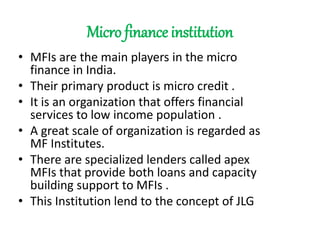
Micro finance institution
• MFIs are the main players in the micro
finance in India.
• Their primary product is micro credit .
• It is an organization that offers financial
services to low income population .
• A great scale of organization is regarded as
MF Institutes.
• There are specialized lenders called apex
MFIs that provide both loans and capacity
building support to MFIs .
• This Institution lend to the concept of JLG
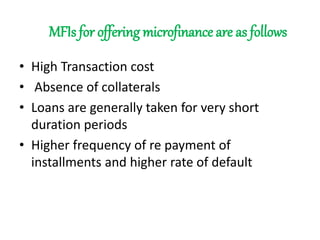
MFIs for offering microfinance are as follows
• High Transaction cost
• Absence of collaterals
• Loans are generally taken for very short
duration periods
• Higher frequency of re payment of
installments and higher rate of default
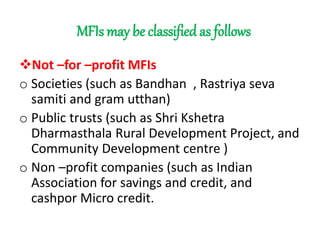
MFIs may be classified as follows
Not –for –profit MFIs
o Societies (such as Bandhan , Rastriya seva
samiti and gram utthan)
o Public trusts (such as Shri Kshetra
Dharmasthala Rural Development Project, and
Community Development centre )
o Non –profit companies (such as Indian
Association for savings and credit, and
cashpor Micro credit.
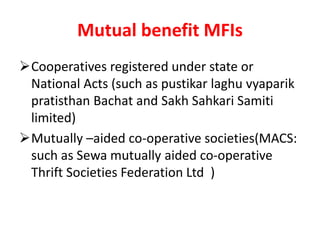
Mutual benefit MFIs
Cooperatives registered under state or
National Acts (such as pustikar laghu vyaparik
pratisthan Bachat and Sakh Sahkari Samiti
limited)
Mutually –aided co-operative societies(MACS:
such as Sewa mutually aided co-operative
Thrift Societies Federation Ltd )
For –profit MFIs
• Non banking financial companies (NBFCs; such
as Bharatiya Samruddhi Finance Ltd.Share
Micro fin ltd.SKS Microfinance Ltd.and
spandana sphoorthy financials Ltd.
• Producer companies (such as Sri vijaya vishaka
milk Producers Co Ltd .)
• Local area banks (the only such MFI is Krishna
Bhima Samruddhi Local Area Bank)

microfinance models

  • 2.
    CONTENTS 1.MODELS Joint Liability Group CreditUnions Model  Co-operative Model Community Bank Model Bank guarantee Model Non-governmental Organization Model Village Banking Model 2.Channels of micro finance SHG-Bank Linkage programme Micro finance institution
  • 3.
    JOINT LIABILITY GROUP It was formed on 24-2-14.  Aimed to provide institutional credit to small farmers  It is beneficial for states like Punjab and Haryana  Informal group comprising 4-10 individuals.  For the purpose of availing bank loan against mutual guarantee.  JLG members to engage in similar type of economic activities either in farm and non farm sector.  Weekly group meetings  One time membership fee
  • 4.
    Group Formation Procedures Primarilythis can be done in two stages:  Introductory meeting: For starting up of formation of group the field staff will move in the specified areas and will conduct introductory meetings in the areas. These meetings are important, as these meetings will create an understanding about the organization in the new areas.  Then the training session starts
  • 5.
    Community Banking Model Communitybanking model essentially treats the whole community as one unit and establishes semi-formal or formal institutions through which microfinance is dispensed. Such institutions are usually formed by extensive help from non- governmental organizations and other organizations, who also train the community members in various financial activities of the community bank.
  • 6.
    Bank Guarantee Model Itis used to obtain a loan from a commercial bank. It may be arranged externally or internally. Loans obtained may be given directly to an individual, or they may be given to a self-formed group.
  • 7.
    Credit union Model Credit union are not-for-profit organization.  Require membership eligibility.  Serve members rather than to maximize corporate profits.  Accept deposits and make loans.  Offer savings and loans at reasonable rates.  Return surplus income to their members in the form of dividends.  Regulated by the NCUA a federal agency.
  • 8.
    Advantages and Disadvantages Advantages: Customersare owners Credit unions are non-profit Lower fees and higher saving rates Interest rates on loans and credit are often lower. Disadvantages: Limited branch locations and ATMs. Most are insured, but not all. Fewer services.
  • 9.
    Cooperative Model  Acooperative is an autonomous association of persons united voluntarily to meet their common economic ,social ,and cultural needs and aspirations through a jointly –owned and democratically –controlled enterprise.  Some cooperatives include member –financing and savings activities in their mandate.
  • 10.
    What does aCooperative Model Look Like?  Students work cooperatively compared with individual models where individuals are only looking out for themselves.  Team members are responsible for their own individual learning as well as for their teammates learning.  Team members contribute their knowledge, experience, skills and resources to the group.  Team members cooperate and collaborate.  Team members benefit from the contribution of the individual team members.
  • 11.
    Non-governmental Organization Model Theterm non-governmental organization was first used in 1945. A non-governmental organization is a citizen-based association that operates independently of government. Usually to deliver resources or serve some social purpose.
  • 12.
    Features Function on noprofit basis Non political character Clearly defined objectives Voluntary character Wide operational area Positive contribution Need financial support
  • 13.
    Advantages and disadvantages Advantages Flexiblein adapting to local needs Enjoy good rapport with people Ability to communicate at all levels Less restrictions from the government Disadvantages Lack of funds Lack of coordination Misuse of funds
  • 14.
    Village banking model Village banks are community –based credit and savings association .  They consist of 25-50 low-income individuals who are seeking to improve their lives through self-employment activities .  Initial loan capital for the village bank may come from an external source ,but the members themselves run the bank.  Their loans are backed ,not by goods or property ,but by moral collateral.  It is widely adopted and implemented by Foundation for International Community Assistance (FINCA)
  • 15.
    Channels of Microfinance •SHG-Bank linkage programme (SBLP) • Microfinance Institutions (MFIs)
  • 16.
    SBLP • This isthe Bank –led microfinance channel which was initiated by NABARD in 1992 . • Under the SHG Model the members , usually women in villages are encouraged to form group of around 10-15 . • NGO acts as intermediary in between the bank and the SHG. • NGO helps the SHG members is filling up the forms and other formalities • NGO generally provides training to the SHG members for 6 months. • After 6 months the SHG members starts working themselves.
  • 17.
    Micro finance institution •MFIs are the main players in the micro finance in India. • Their primary product is micro credit . • It is an organization that offers financial services to low income population . • A great scale of organization is regarded as MF Institutes. • There are specialized lenders called apex MFIs that provide both loans and capacity building support to MFIs . • This Institution lend to the concept of JLG
  • 18.
    MFIs for offeringmicrofinance are as follows • High Transaction cost • Absence of collaterals • Loans are generally taken for very short duration periods • Higher frequency of re payment of installments and higher rate of default
  • 19.
    MFIs may beclassified as follows Not –for –profit MFIs o Societies (such as Bandhan , Rastriya seva samiti and gram utthan) o Public trusts (such as Shri Kshetra Dharmasthala Rural Development Project, and Community Development centre ) o Non –profit companies (such as Indian Association for savings and credit, and cashpor Micro credit.
  • 20.
    Mutual benefit MFIs Cooperativesregistered under state or National Acts (such as pustikar laghu vyaparik pratisthan Bachat and Sakh Sahkari Samiti limited) Mutually –aided co-operative societies(MACS: such as Sewa mutually aided co-operative Thrift Societies Federation Ltd )
  • 21.
    For –profit MFIs •Non banking financial companies (NBFCs; such as Bharatiya Samruddhi Finance Ltd.Share Micro fin ltd.SKS Microfinance Ltd.and spandana sphoorthy financials Ltd. • Producer companies (such as Sri vijaya vishaka milk Producers Co Ltd .) • Local area banks (the only such MFI is Krishna Bhima Samruddhi Local Area Bank)