Advanced Textiles
Academic report on
Matteo Carbone
Louise Guiot
Gaia Salizzoni
Agenda
01
03
05
02
04
History and
evolution
Ecosystem &
innovation process
Definition and
applications
Industry
characteristics
Focus:
MedTech
01 History and evolution
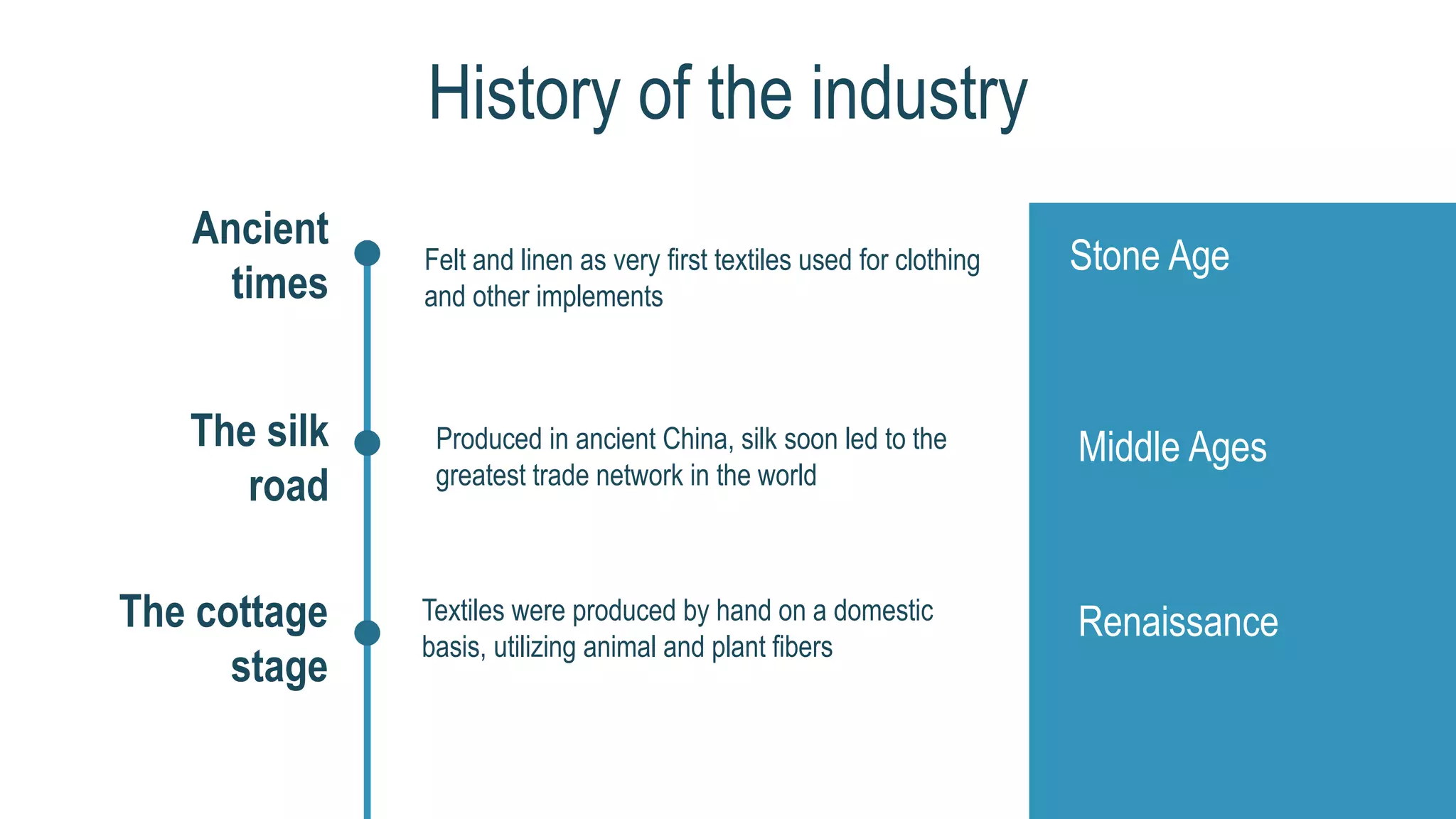
History of the industry
Felt and linen as very first textiles used for clothing
and other implements
Ancient
times
Produced in ancient China, silk soon led to the
greatest trade network in the world
The silk
road
Textiles were produced by hand on a domestic
basis, utilizing animal and plant fibers
The cottage
stage
Stone Age
Middle Ages
Renaissance
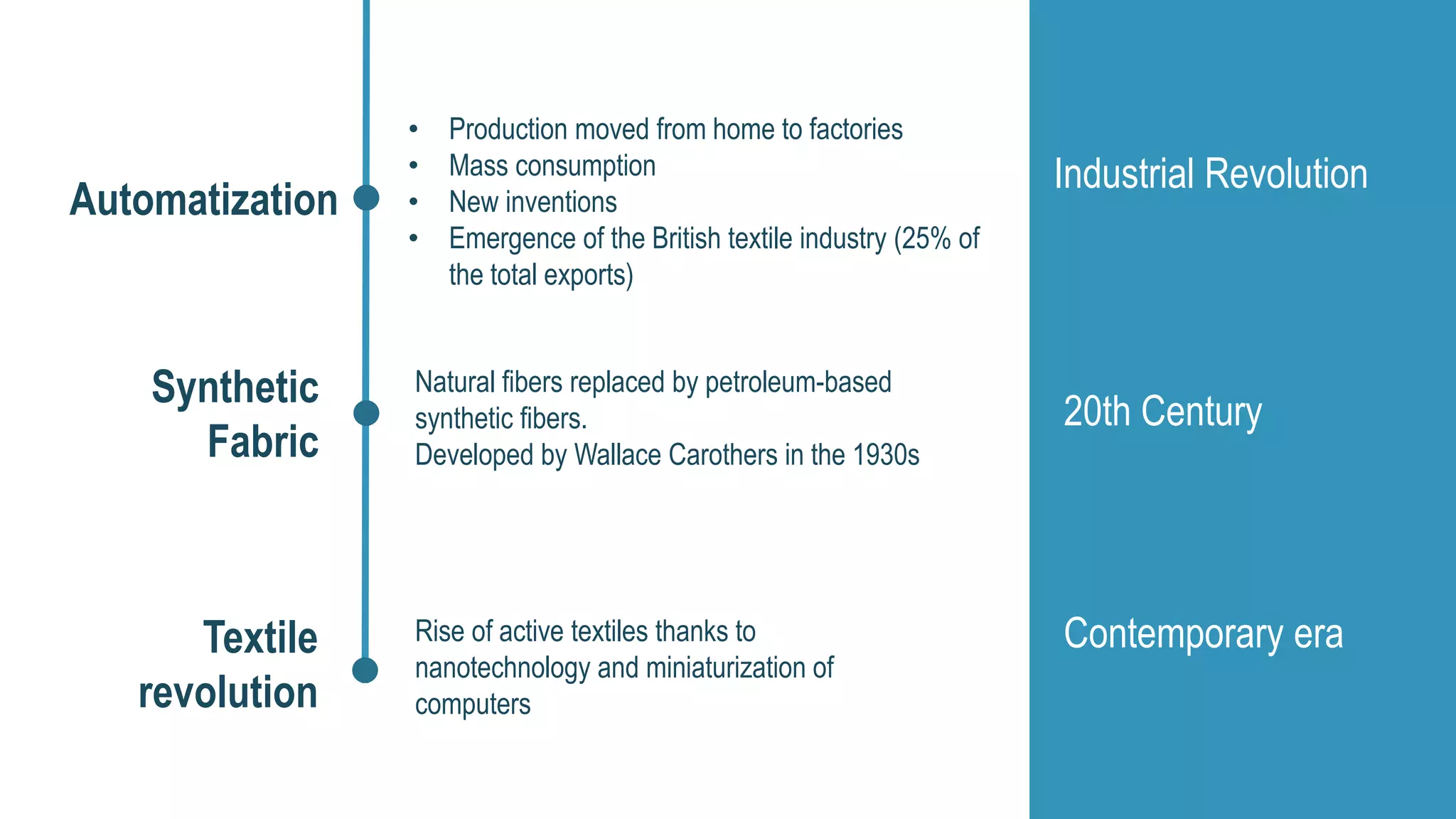
Natural fibers replaced by petroleum-based
synthetic fibers.
Developed by Wallace Carothers in the 1930s
Synthetic
Fabric
Rise of active textiles thanks to
nanotechnology and miniaturization of
computers
Textile
revolution
20th Century
Contemporary era
• Production moved from home to factories
• Mass consumption
• New inventions
• Emergence of the British textile industry (25% of
the total exports)
Automatization
Industrial Revolution
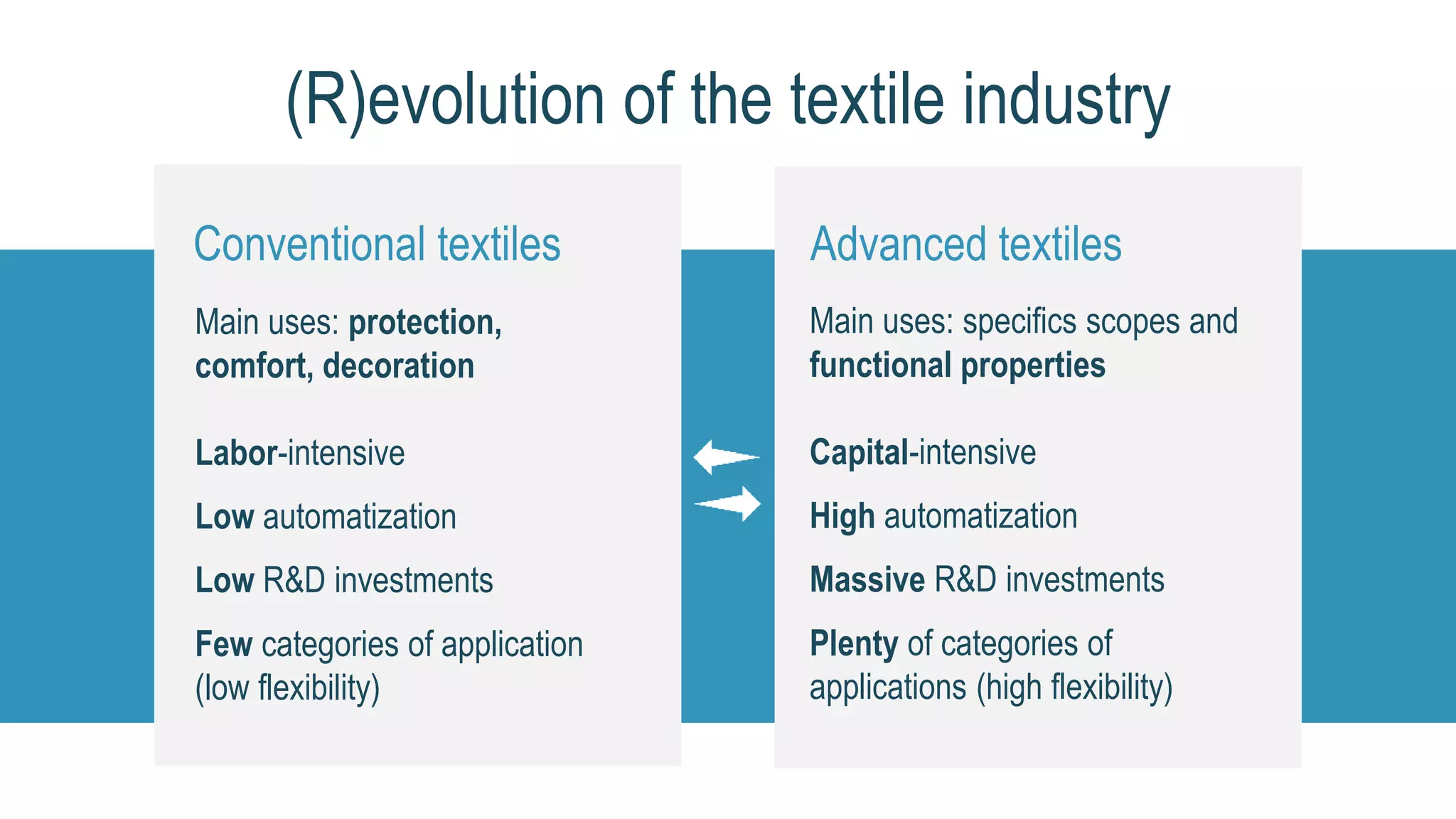
(R)evolution of the textile industry
Conventional textiles
Main uses: protection,
comfort, decoration
Labor-intensive
Low automatization
Low R&D investments
Few categories of application
(low flexibility)
Advanced textiles
Main uses: specifics scopes and
functional properties
Capital-intensive
High automatization
Massive R&D investments
Plenty of categories of
applications (high flexibility)
02 Definition and
applications
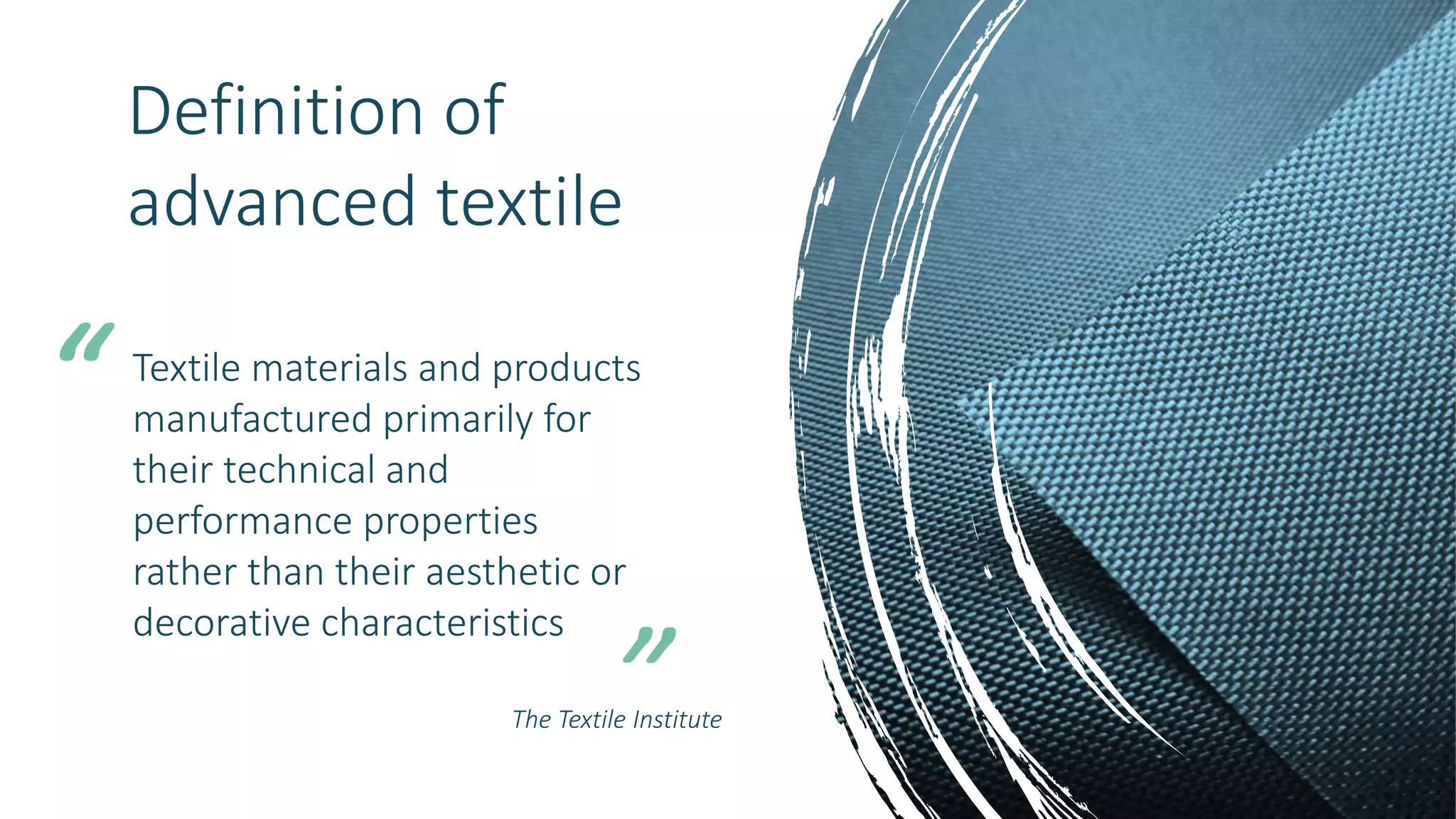
Textile materials and products
manufactured primarily for
their technical and
performance properties
rather than their aesthetic or
decorative characteristics
“
The Textile Institute
Definition of
advanced textile
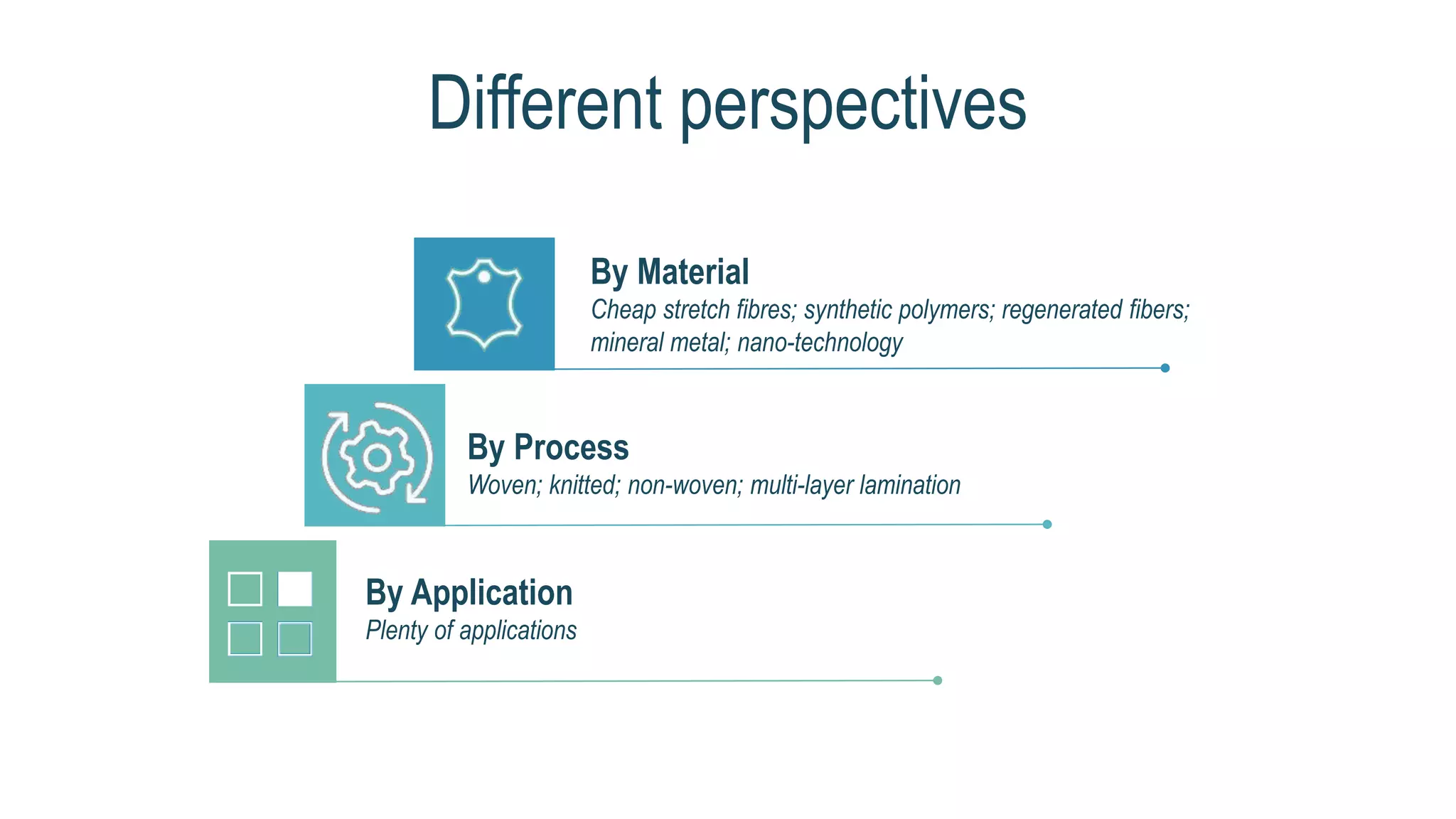
Different perspectives
By Material
Cheap stretch fibres; synthetic polymers; regenerated fibers;
mineral metal; nano-technology
By Process
Woven; knitted; non-woven; multi-layer lamination
By Application
Plenty of applications
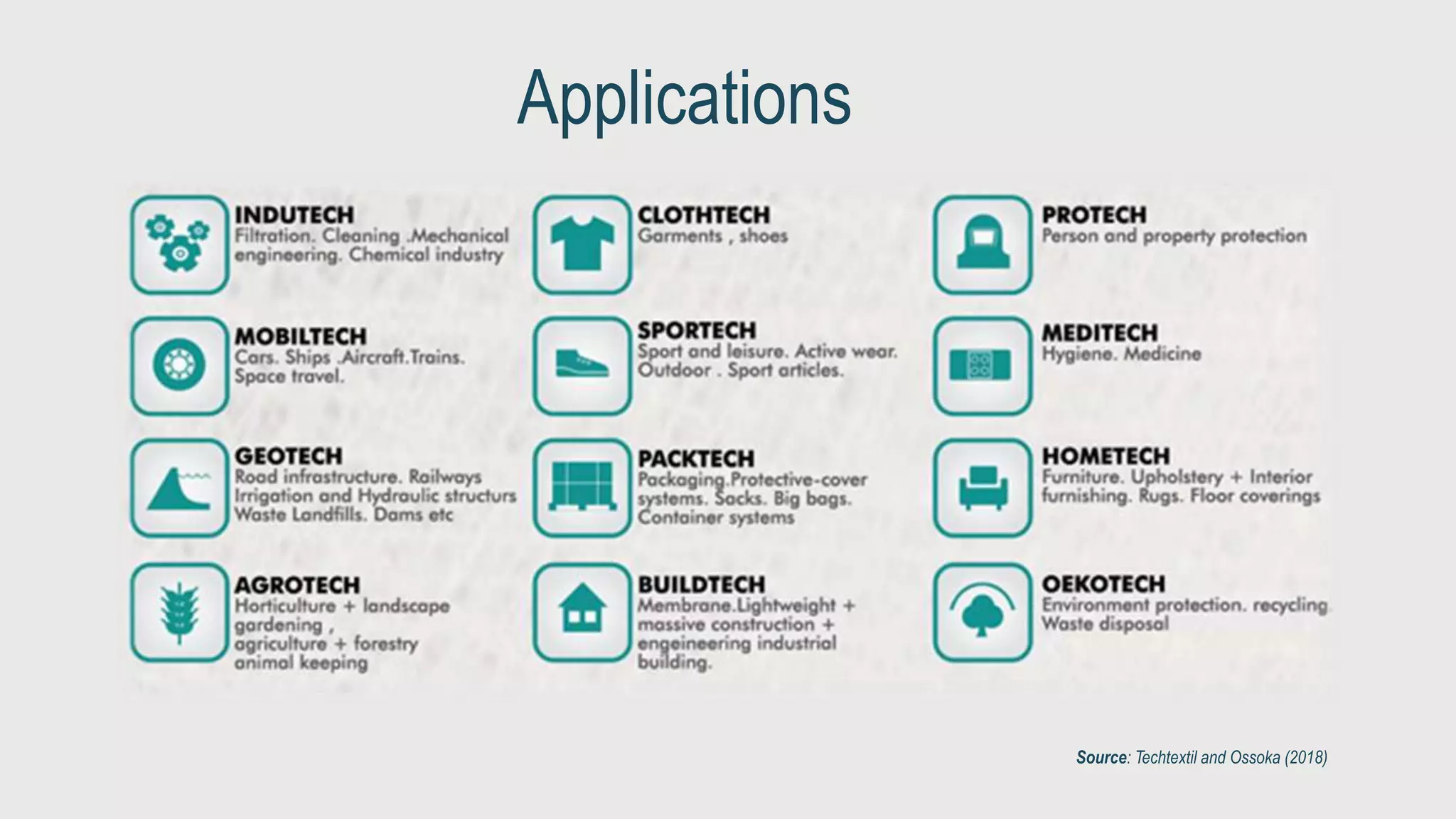
Applications
Source: Techtextil and Ossoka (2018)
InduTech ClothTech ProTech
MobilTech SportTech MedTech
GeoTech PackTech HomeTech
AgroTech BuildTech Oekotech
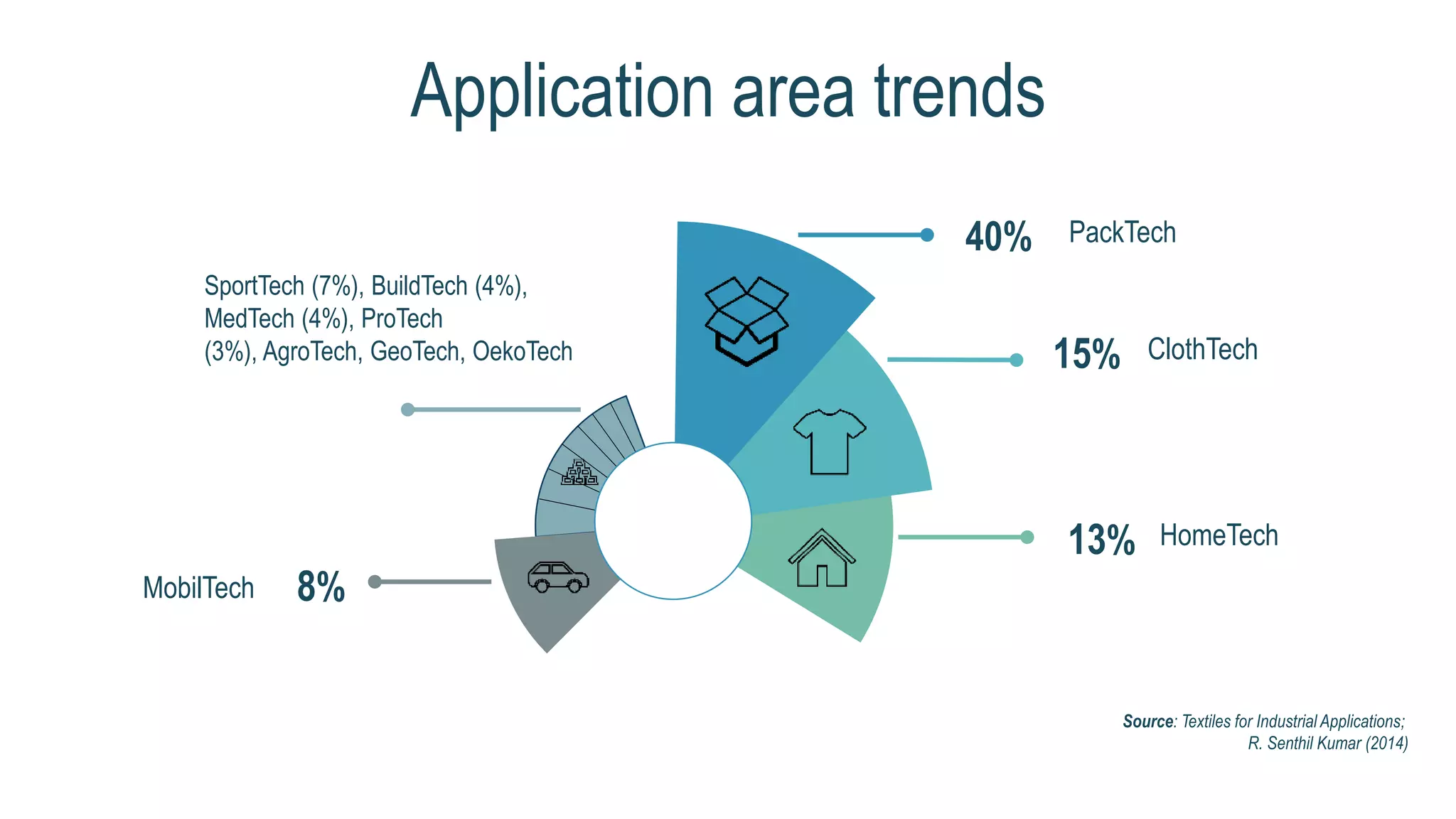
Application area trends
40% PackTech
15% ClothTech
13% HomeTech
SportTech (7%), BuildTech (4%),
MedTech (4%), ProTech
(3%), AgroTech, GeoTech, OekoTech
8%MobilTech
Source: Textiles for Industrial Applications;
R. Senthil Kumar (2014)
E-Textile
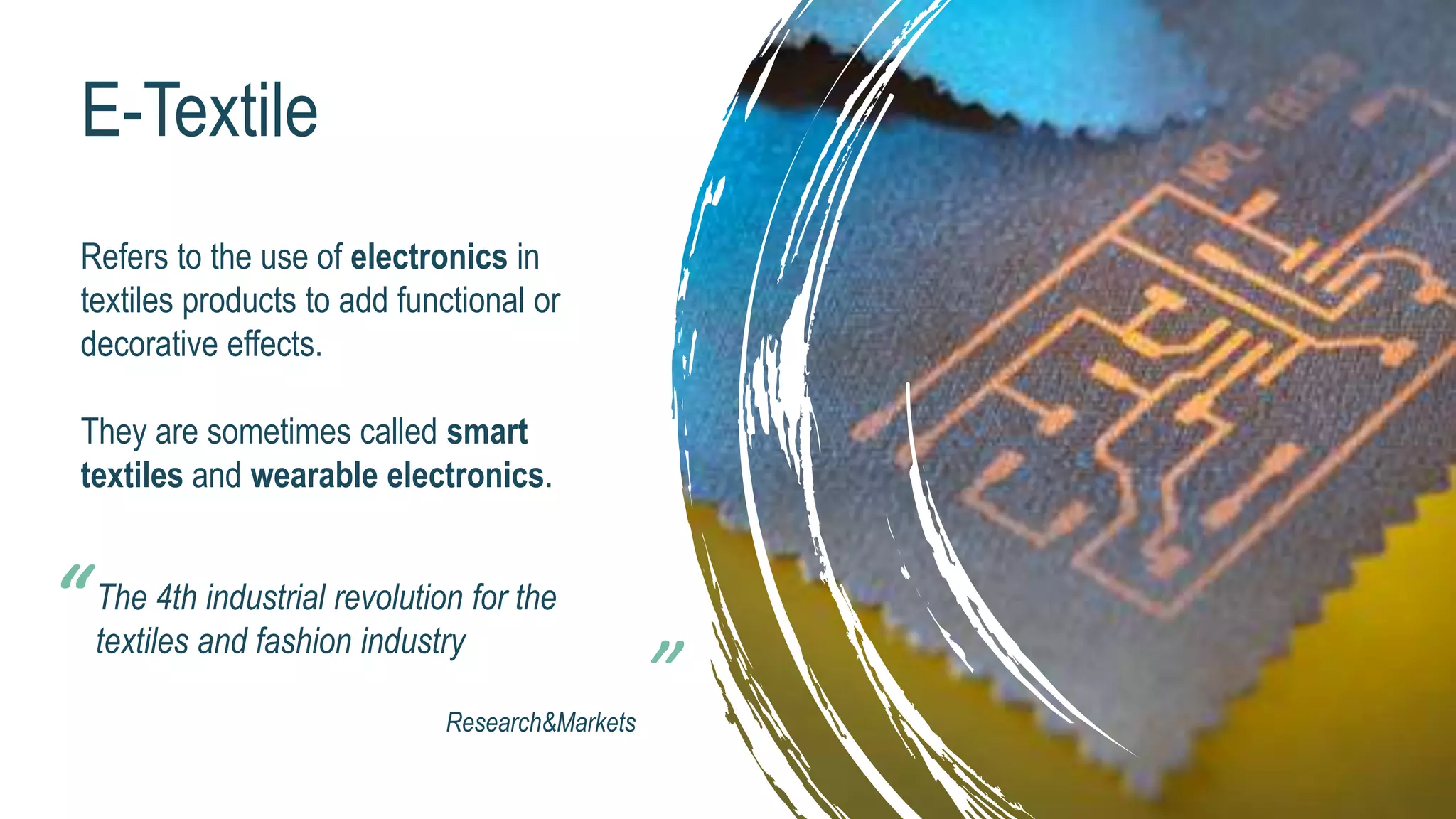
Refers to the use of electronics in
textiles products to add functional or
decorative effects.
They are sometimes called smart
textiles and wearable electronics.
The 4th industrial revolution for the
textiles and fashion industry
Research&Markets
“
4
14
130
0
20
40
60
80
100
120
140
2012 2018 2025
Billiondollar
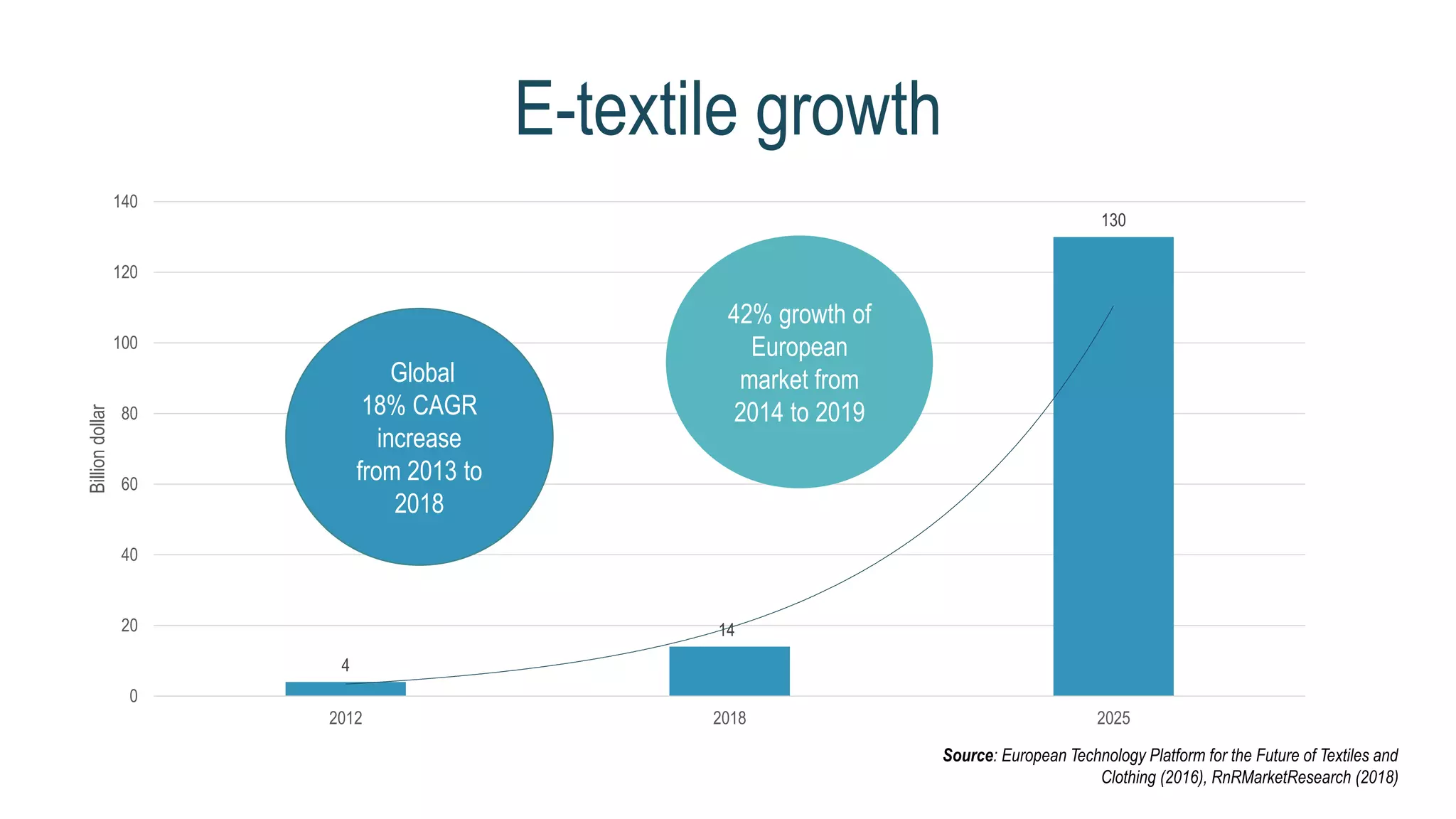
Global
18% CAGR
increase
from 2013 to
2018
42% growth of
European
market from
2014 to 2019
Source: European Technology Platform for the Future of Textiles and
Clothing (2016), RnRMarketResearch (2018)
E-textile growth
Characteristics of E-Textile
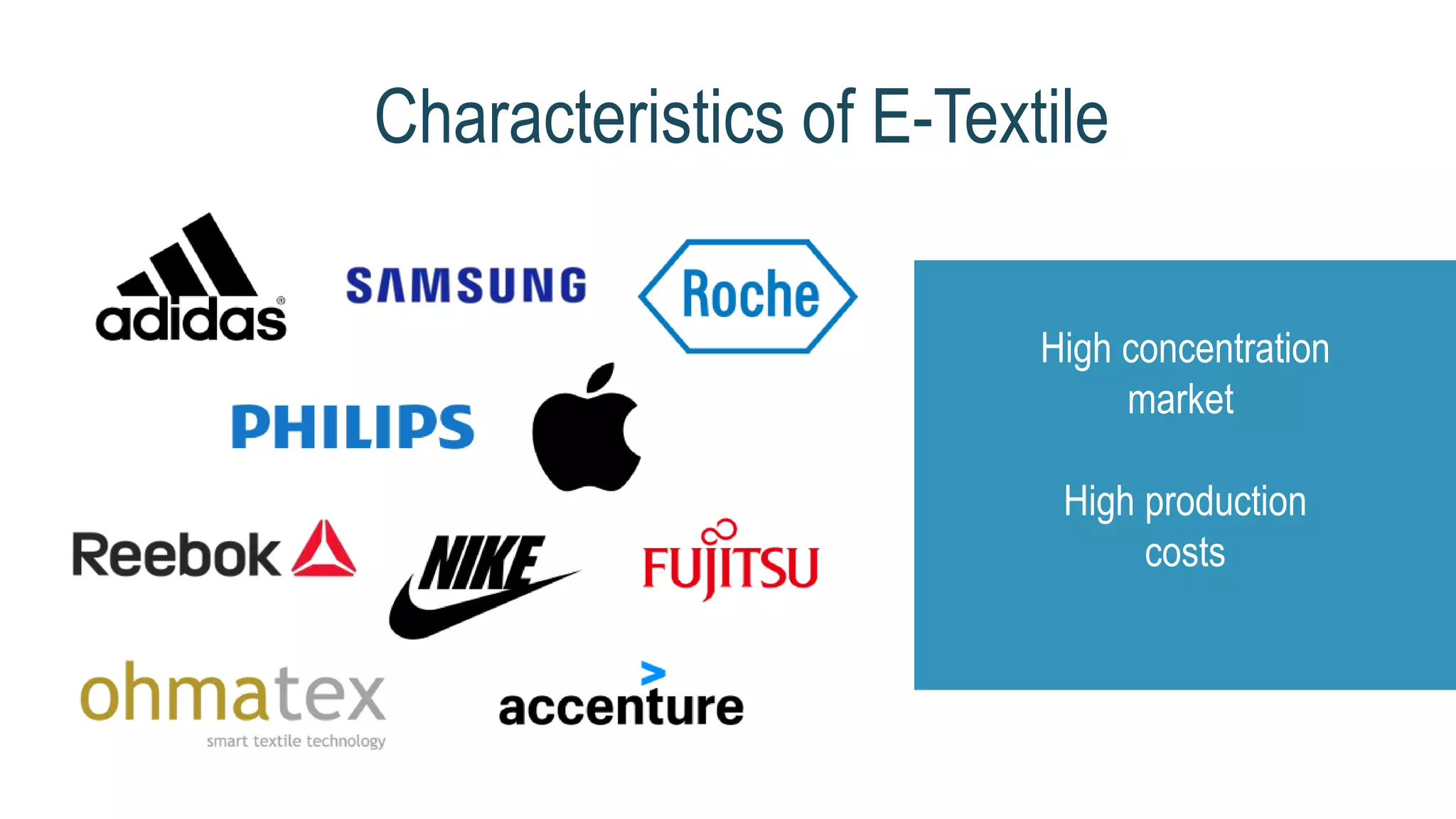
High concentration
market
High production
costs
03 Ecosystem and
innovation process
Main stakeholders
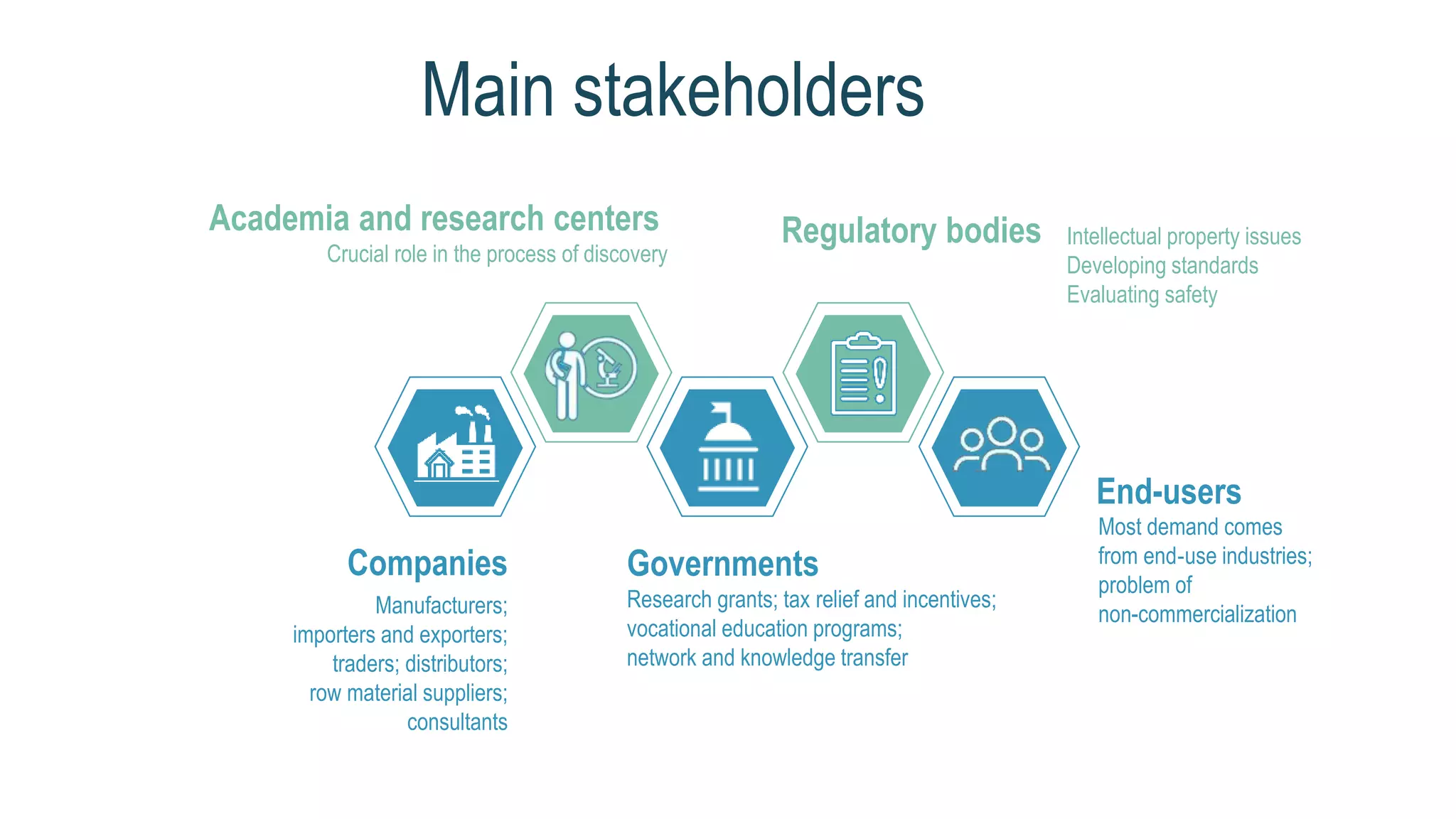
Manufacturers;
importers and exporters;
traders; distributors;
row material suppliers;
consultants
Companies
Most demand comes
from end‐use industries;
problem of
non-commercialization
End-users
Governments
Research grants; tax relief and incentives;
vocational education programs;
network and knowledge transfer
Intellectual property issues
Developing standards
Evaluating safety
Regulatory bodiesAcademia and research centers
Crucial role in the process of discovery
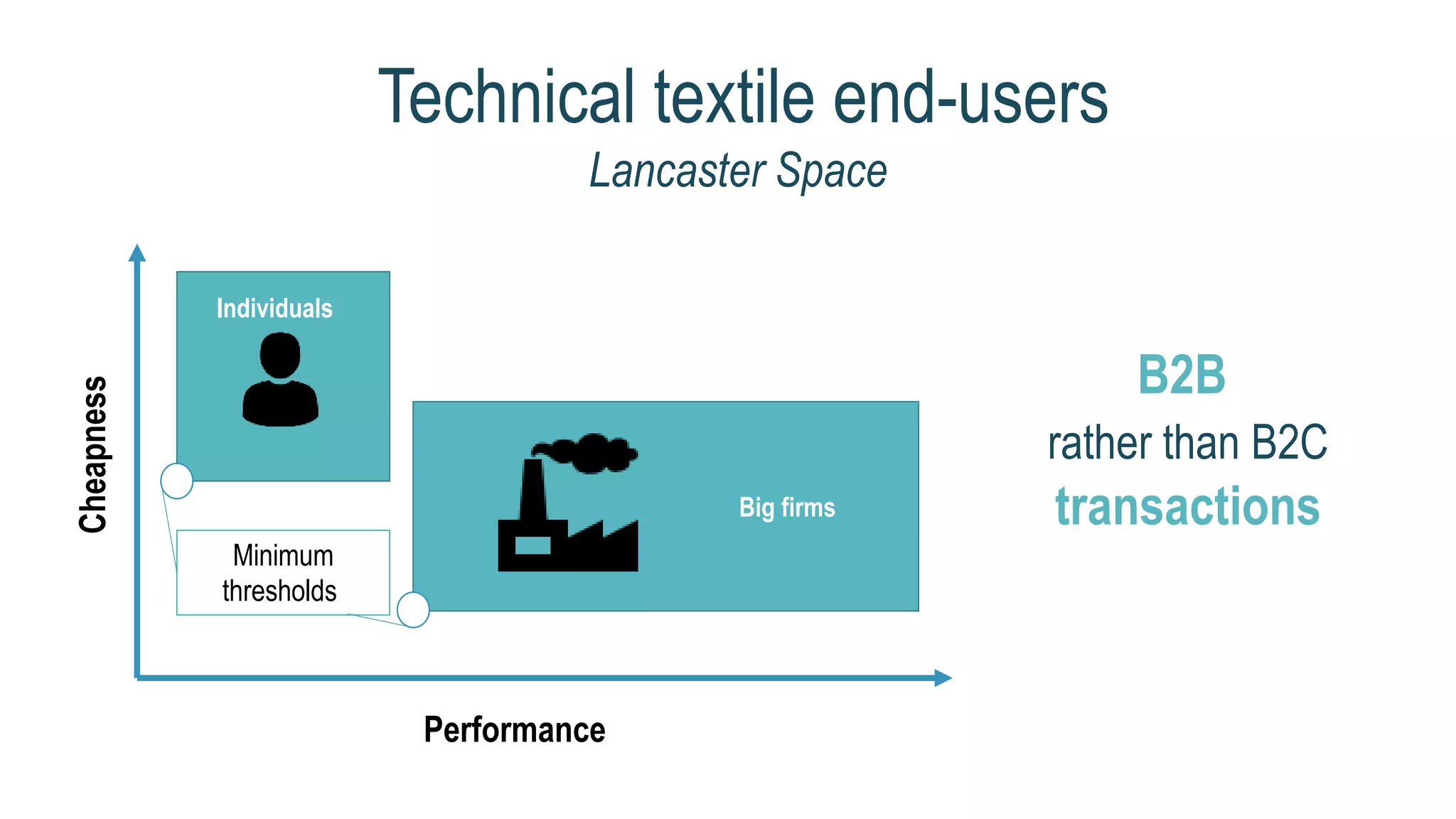
Technical textile end-users
Lancaster Space
Cheapness
Performance
Minimum
thresholds
Individuals
Big firms
B2B
rather than B2C
transactions
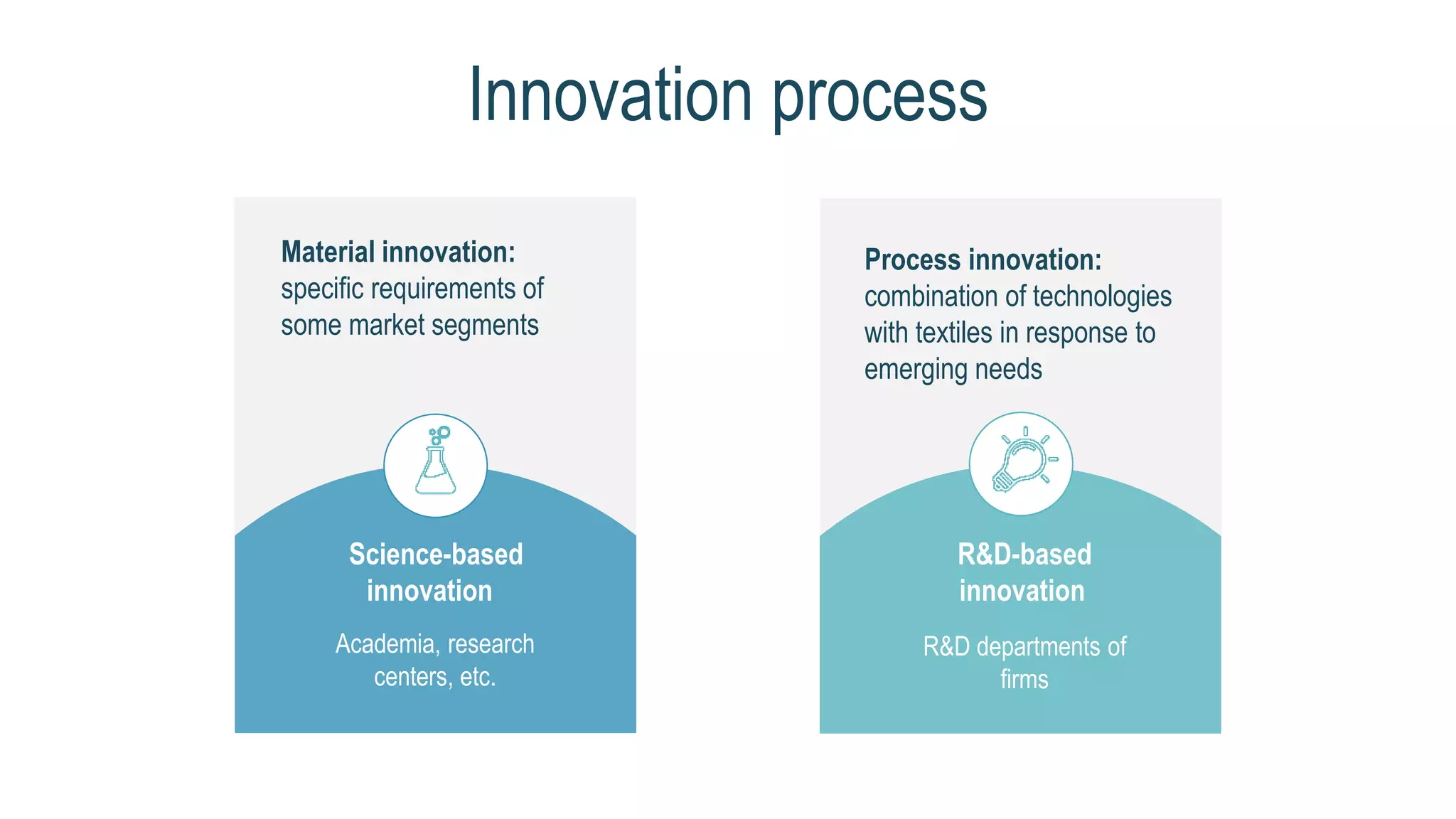
Innovation process
Academia, research
centers, etc.
Science-based
innovation
R&D departments of
firms
R&D-based
innovation
Material innovation:
specific requirements of
some market segments
Process innovation:
combination of technologies
with textiles in response to
emerging needs
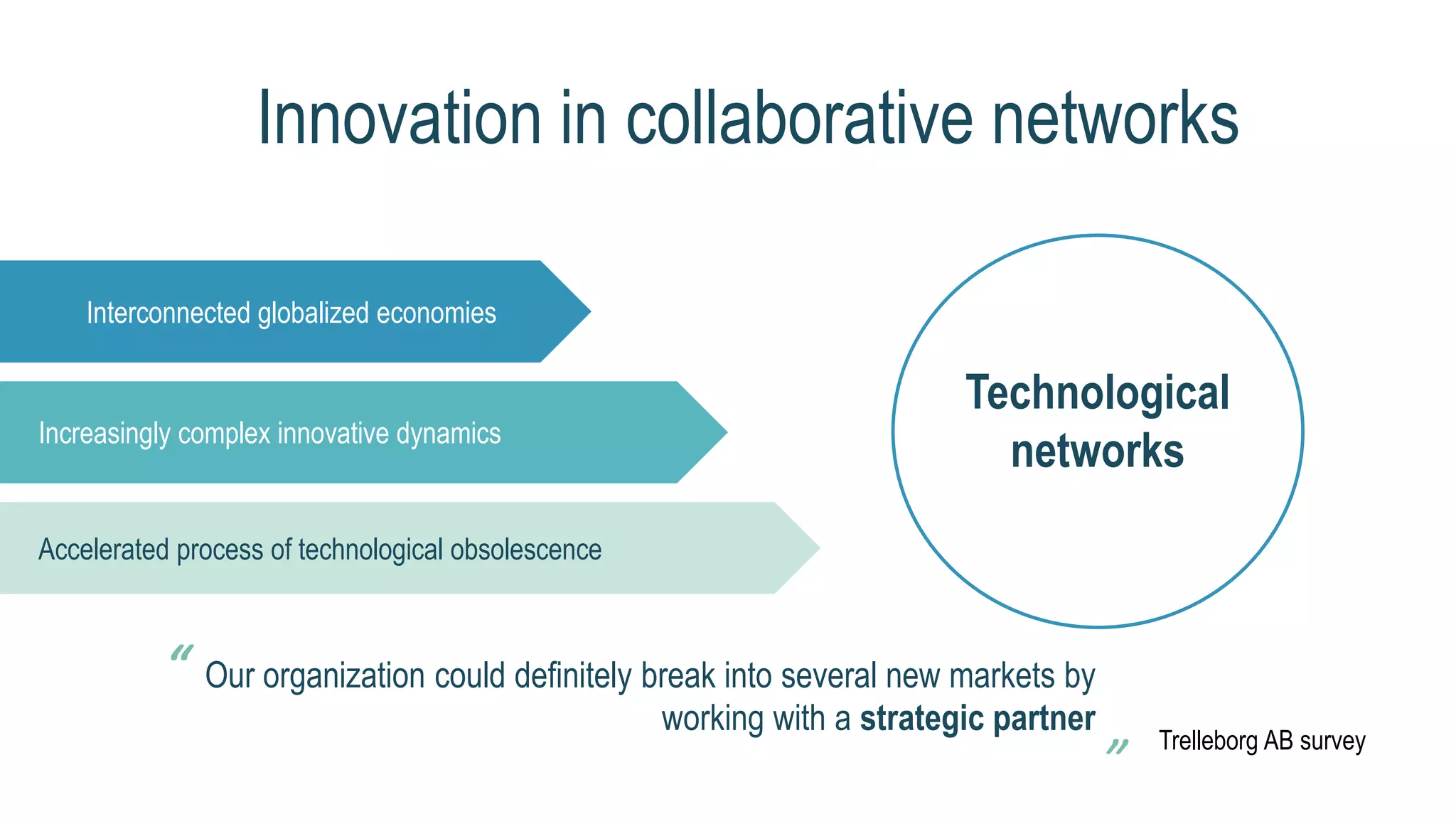
Innovation in collaborative networks
Interconnected globalized economies
Increasingly complex innovative dynamics
Accelerated process of technological obsolescence
Our organization could definitely break into several new markets by
working with a strategic partner
Trelleborg AB survey
“
Technological
networks
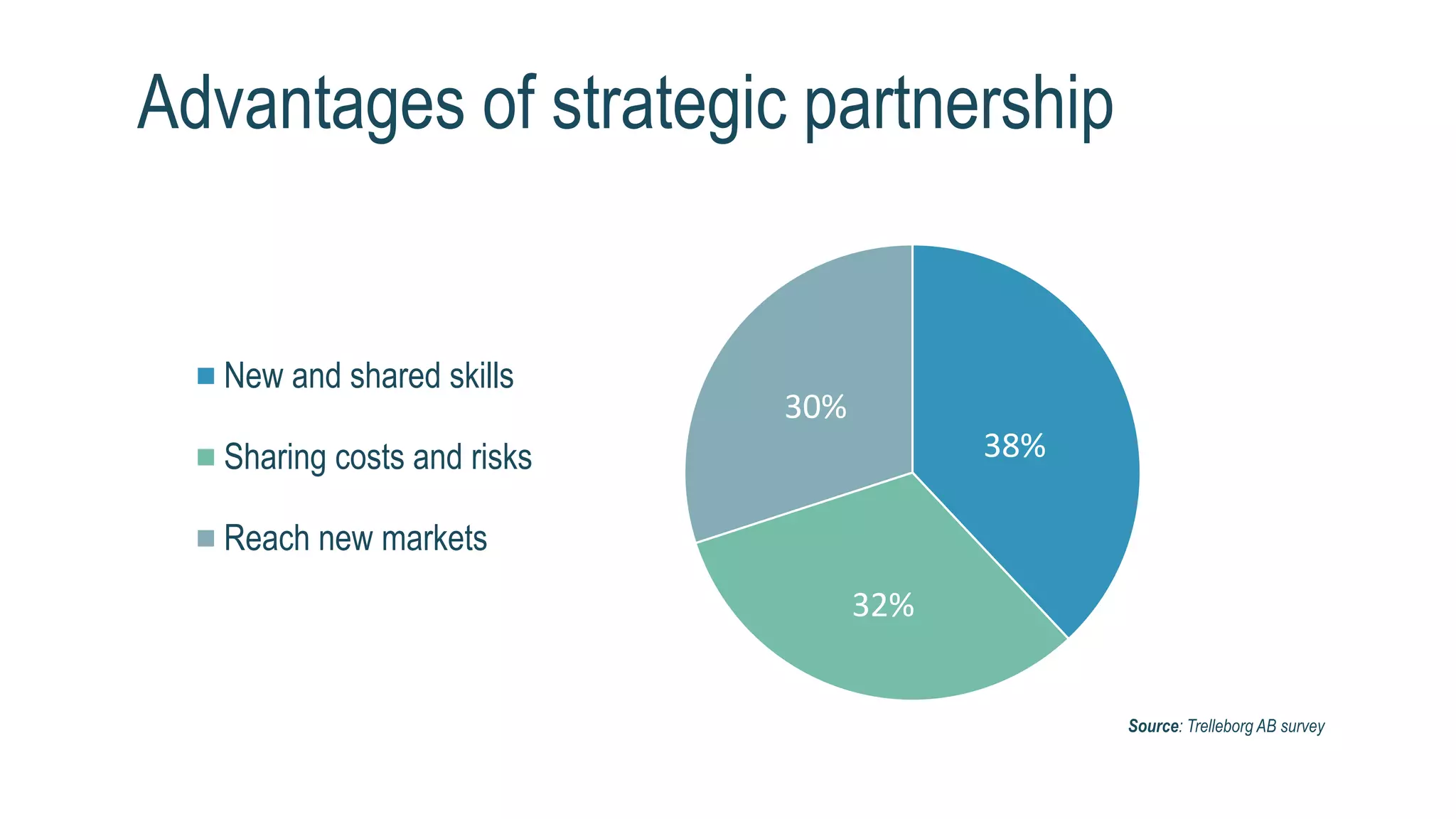
Advantages of strategic partnership
38%
32%
30%
New and shared skills
Sharing costs and risks
Reach new markets
Source: Trelleborg AB survey
• Acquisition of technology license
• Sharing R&D laboratories
• Joint exploitation of innovation
• Technology clusters
• Division from parent company
Types of partnership
04 Industrial characteristics
Total market
size
60
125
134
158 160
244
0
50
100
150
200
250
300
1997 2007 2012 2015 2018 2022
Billiondollar
The global demand
for technical textiles
has increased
as a result of their
rising base of applications in
end‐use industries
Sources: Handbook of technical textiles (2018)
USA
13%
-5%
India
16%
-6%
Europe
28%
+1%
China
37%
-3%
World exports
Share of world exports
Annual percentage change from 2015 to 2016
Source: Gherzi (2016)
Value of the leading exporters
110
69
17
14
11
10
9
8
8
7
0 20 40 60 80 100 120
China
European Union
India
United States
Turkey
Republic of Korea
Chinese Taipei
Pakistan
Honk Kong
Vietnam
Billion dollar, 2017
Source: Statista (2018)
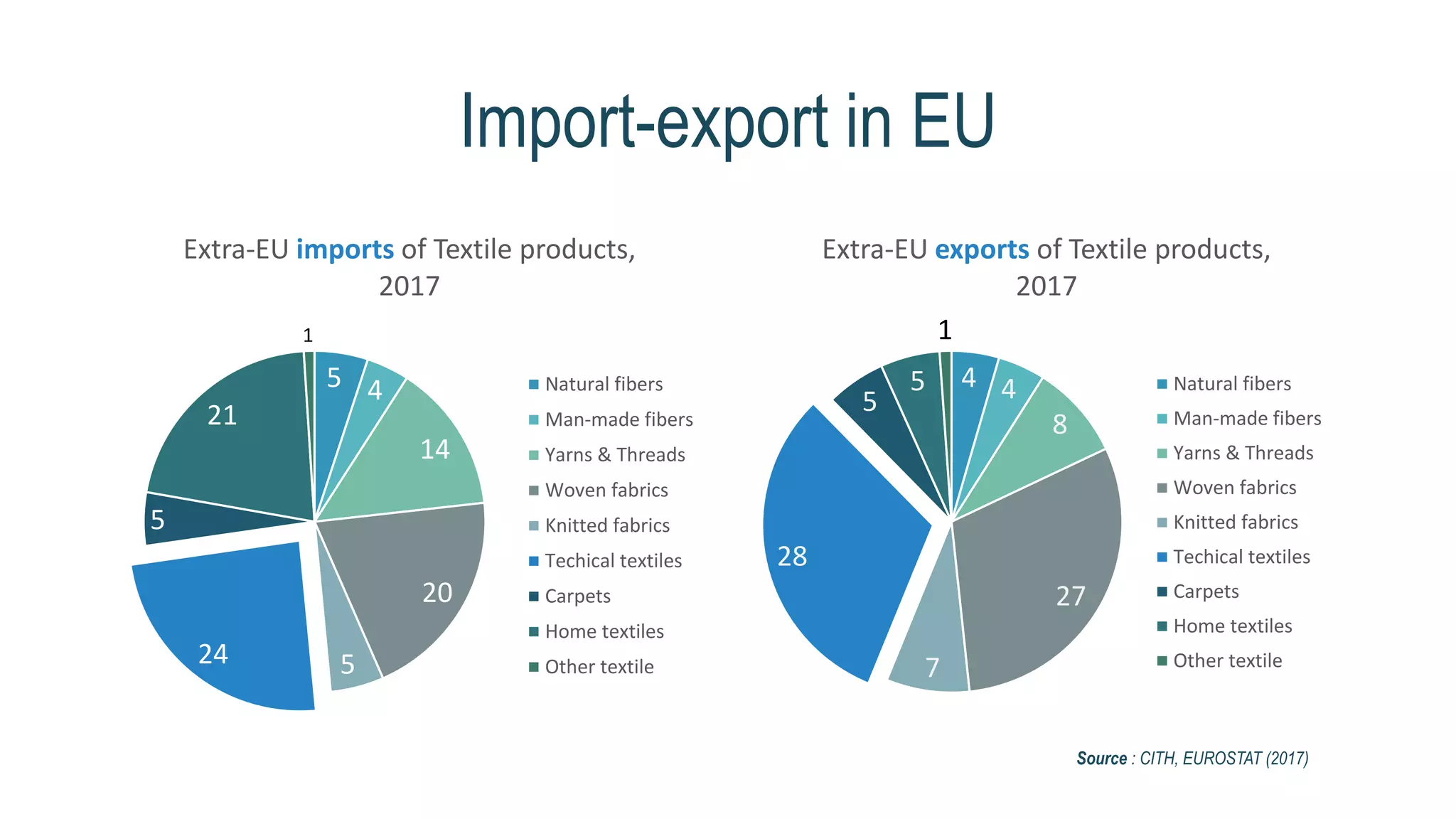
Import-export in EU
5 4
14
20
524
5
21
1
Extra-EU imports of Textile products,
2017
Natural fibers
Man-made fibers
Yarns & Threads
Woven fabrics
Knitted fabrics
Techical textiles
Carpets
Home textiles
Other textile
4 4
8
27
7
28
5
5
1
Extra-EU exports of Textile products,
2017
Natural fibers
Man-made fibers
Yarns & Threads
Woven fabrics
Knitted fabrics
Techical textiles
Carpets
Home textiles
Other textile
Source : CITH, EUROSTAT (2017)
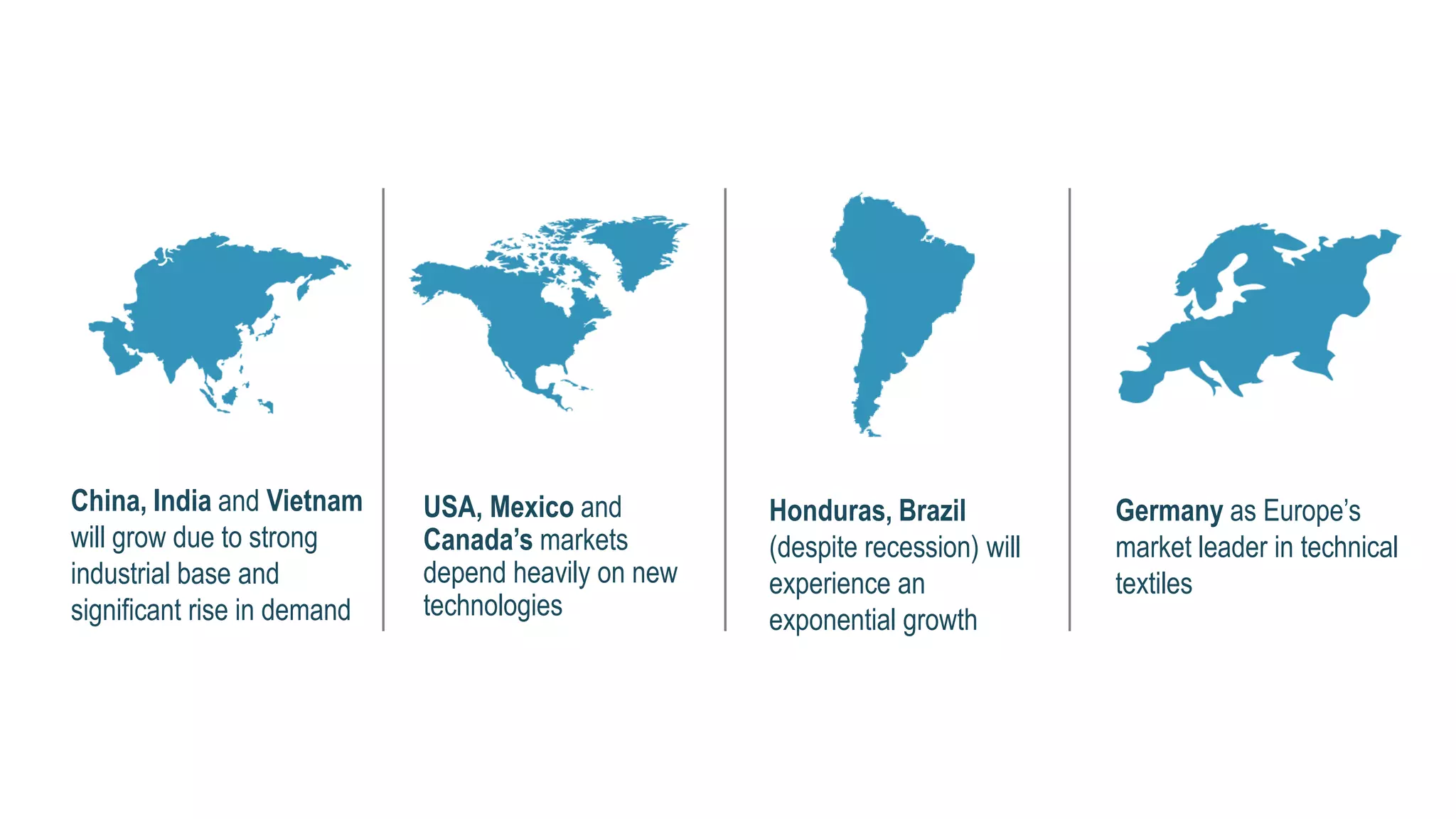
USA, Mexico and
Canada’s markets
depend heavily on new
technologies
Germany as Europe’s
market leader in technical
textiles
China, India and Vietnam
will grow due to strong
industrial base and
significant rise in demand
Honduras, Brazil
(despite recession) will
experience an
exponential growth
05 Focus:
MedTech
The need for long-term,
unobtrusive monitoring of patients
at home will stimulate quick
development (of the industry).
In five years' time, I believe we'll
get to see many innovative textile
solutions in healthcare.
“
Luciano Boesel, Empa (2018)
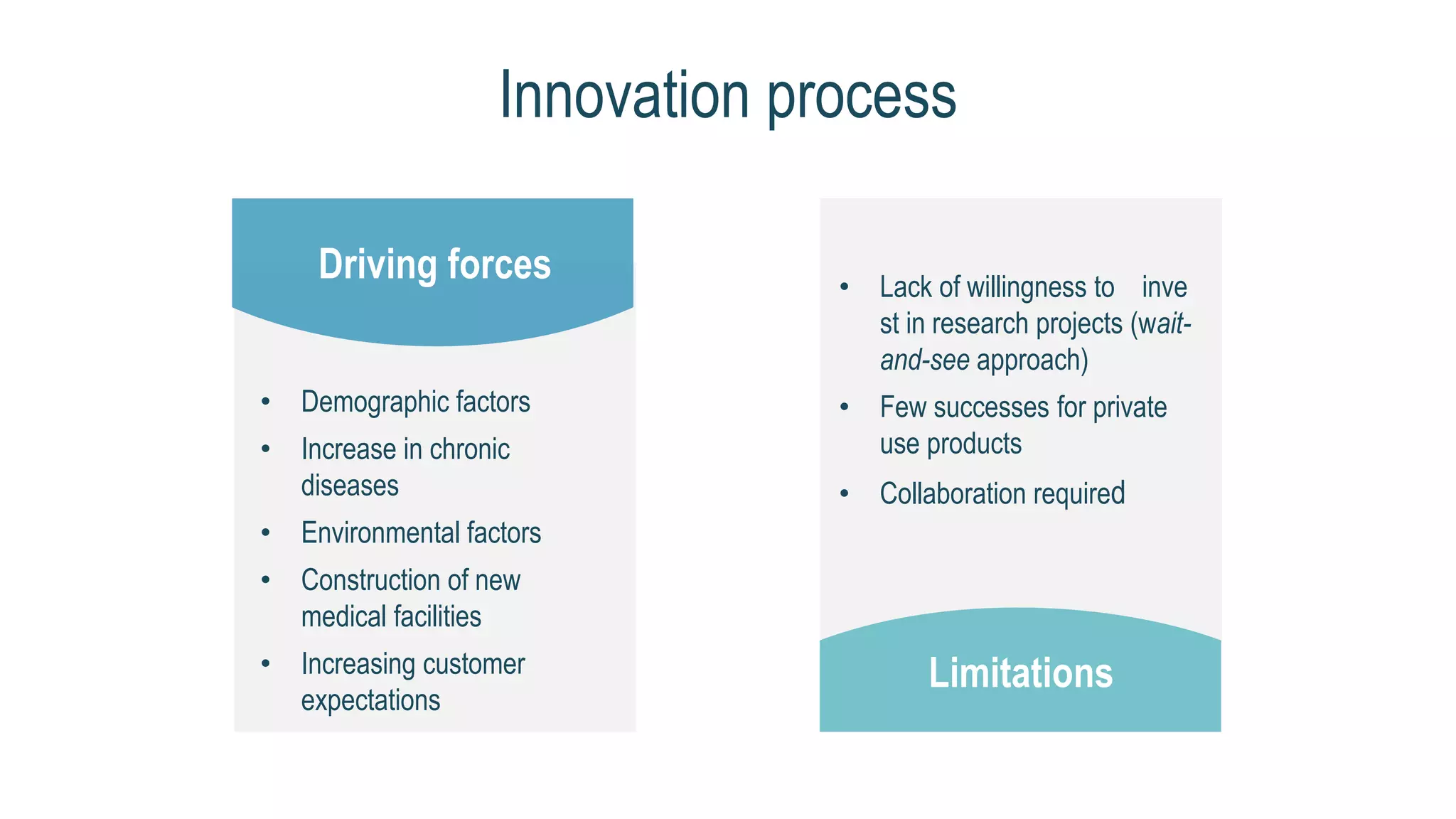
Innovation process
Driving forces
Limitations
• Lack of willingness to inve
st in research projects (wait-
and-see approach)
• Few successes for private
use products
• Collaboration required
• Demographic factors
• Increase in chronic
diseases
• Environmental factors
• Construction of new
medical facilities
• Increasing customer
expectations
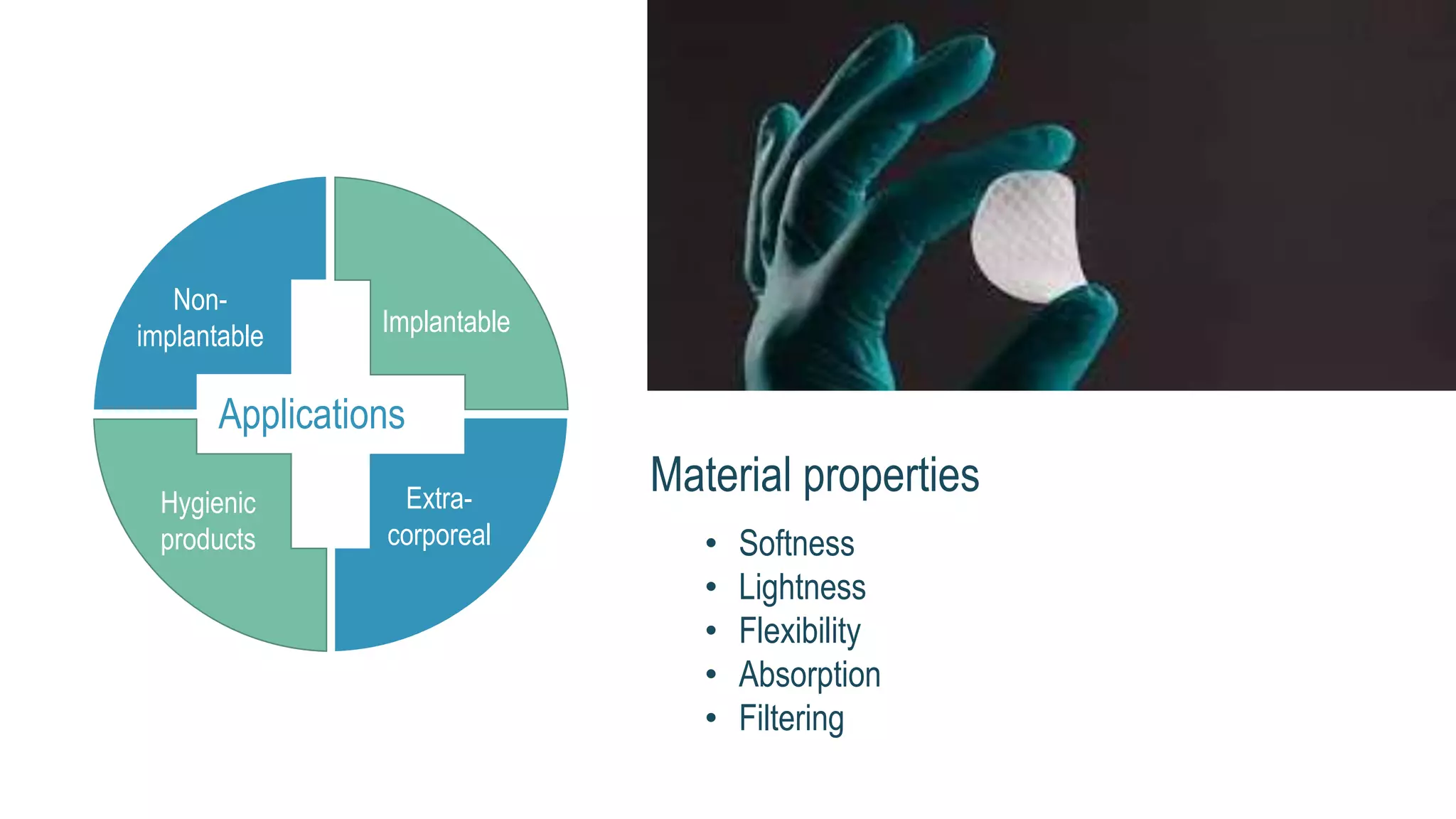
Applications
Non-
implantable Implantable
Extra-
corporeal
Hygienic
products
Material properties
• Softness
• Lightness
• Flexibility
• Absorption
• Filtering
Applications
Non-
implantable Implantable
Extra-
corporeal
Hygienic
products
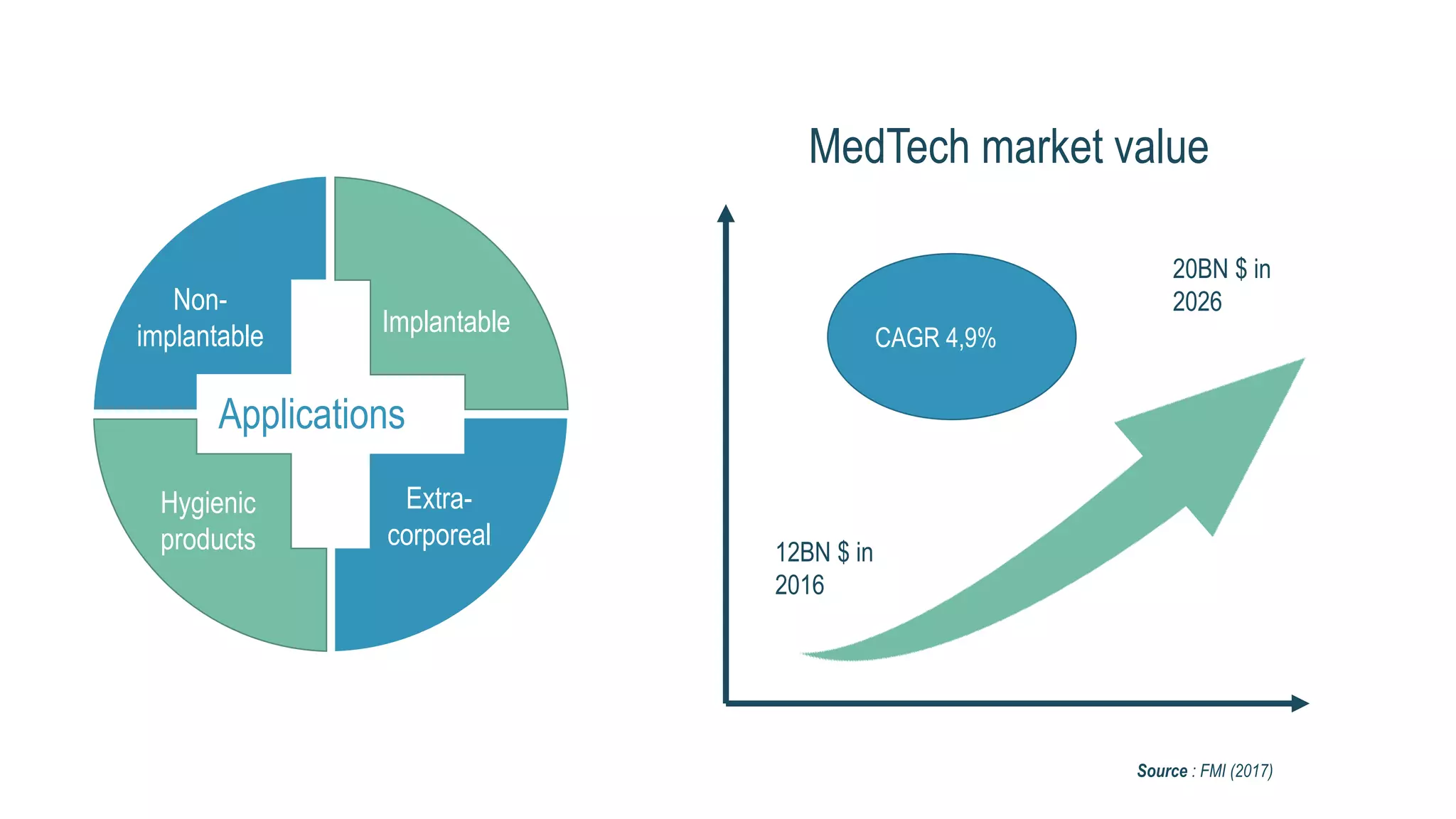
CAGR 4,9%
12BN $ in
2016
20BN $ in
2026
MedTech market value
Source : FMI (2017)
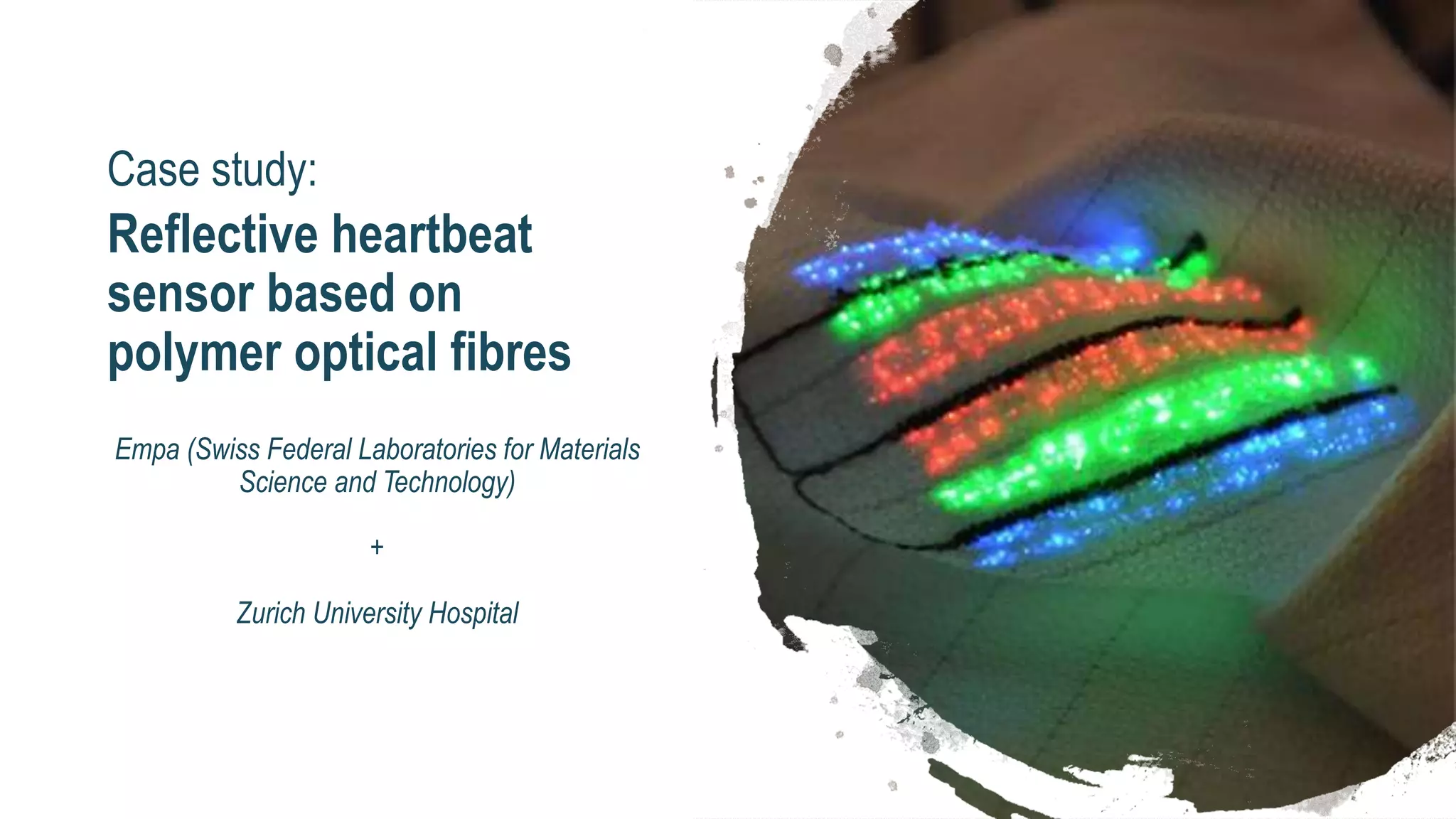
Case study:
Reflective heartbeat
sensor based on
polymer optical fibres
Empa (Swiss Federal Laboratories for Materials
Science and Technology)
+
Zurich University Hospital
Customer
• Hospitals
• Patients with complex
health conditions
Problem
• No capacity to monitor patients
at all times
• Current monitoring systems
that detect developing wounds
are often obtrusive and can
lead to additional injuries
(pressure ulcer)
Solution
Flexible, individualized,
and wearable sensors
for long-term measurement
of heart rate.
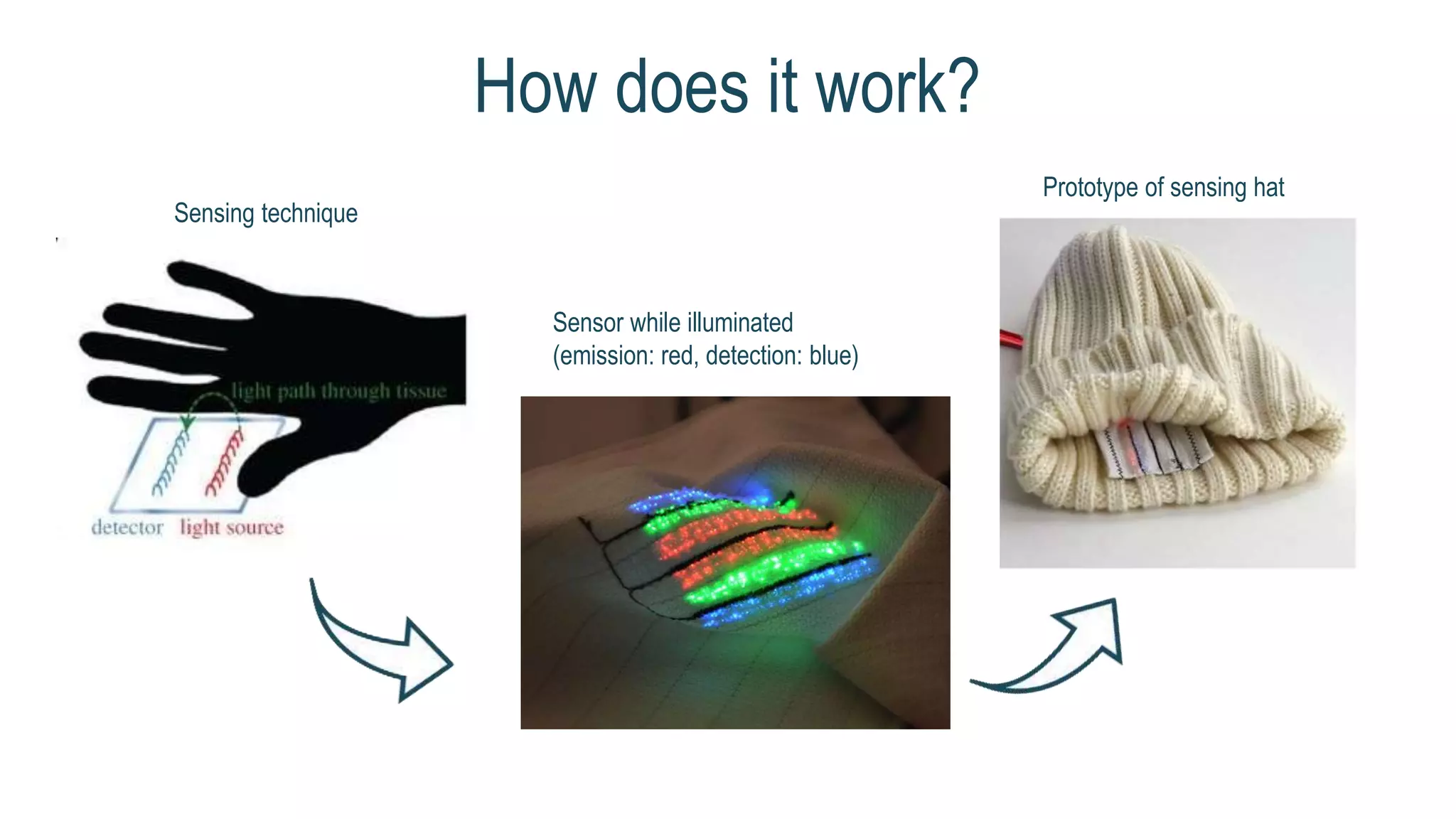
How does it work?
Sensing technique
Sensor while illuminated
(emission: red, detection: blue)
Prototype of sensing hat
Back to Advanced Textiles
What to expect in the nearest future?
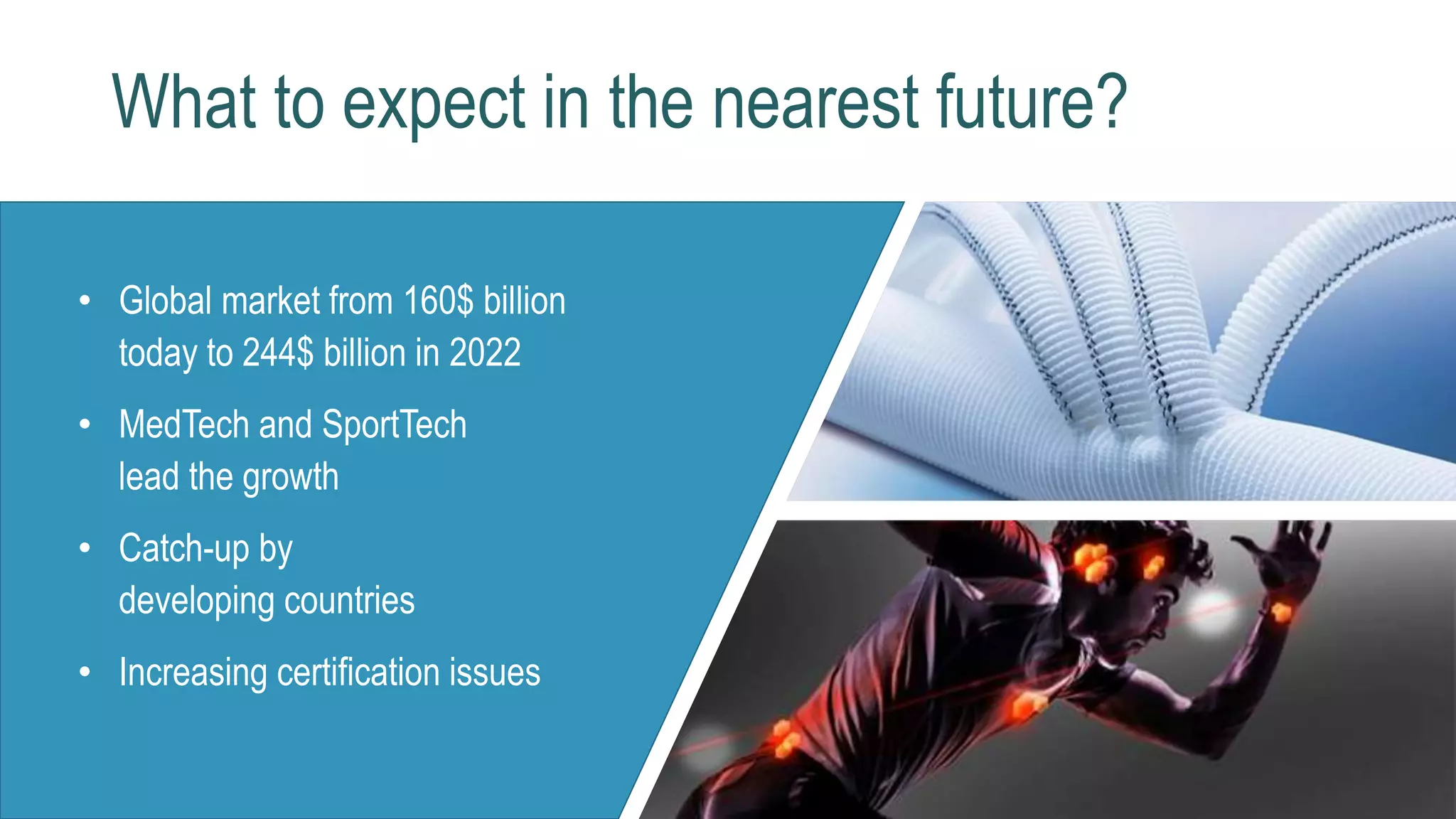
• Global market from 160$ billion
today to 244$ billion in 2022
• MedTech and SportTech
lead the growth
• Catch-up by
developing countries
• Increasing certification issues
Thank you
for your attention!

Advanced Textiles

  • 1.
    Advanced Textiles Academic reporton Matteo Carbone Louise Guiot Gaia Salizzoni
  • 2.
    Agenda 01 03 05 02 04 History and evolution Ecosystem & innovationprocess Definition and applications Industry characteristics Focus: MedTech
  • 3.
    01 History andevolution
  • 4.
    History of theindustry Felt and linen as very first textiles used for clothing and other implements Ancient times Produced in ancient China, silk soon led to the greatest trade network in the world The silk road Textiles were produced by hand on a domestic basis, utilizing animal and plant fibers The cottage stage Stone Age Middle Ages Renaissance
  • 5.
    Natural fibers replacedby petroleum-based synthetic fibers. Developed by Wallace Carothers in the 1930s Synthetic Fabric Rise of active textiles thanks to nanotechnology and miniaturization of computers Textile revolution 20th Century Contemporary era • Production moved from home to factories • Mass consumption • New inventions • Emergence of the British textile industry (25% of the total exports) Automatization Industrial Revolution
  • 6.
    (R)evolution of thetextile industry Conventional textiles Main uses: protection, comfort, decoration Labor-intensive Low automatization Low R&D investments Few categories of application (low flexibility) Advanced textiles Main uses: specifics scopes and functional properties Capital-intensive High automatization Massive R&D investments Plenty of categories of applications (high flexibility)
  • 8.
  • 9.
    Textile materials andproducts manufactured primarily for their technical and performance properties rather than their aesthetic or decorative characteristics “ The Textile Institute Definition of advanced textile
  • 10.
    Different perspectives By Material Cheapstretch fibres; synthetic polymers; regenerated fibers; mineral metal; nano-technology By Process Woven; knitted; non-woven; multi-layer lamination By Application Plenty of applications
  • 11.
  • 12.
    InduTech ClothTech ProTech MobilTechSportTech MedTech GeoTech PackTech HomeTech AgroTech BuildTech Oekotech
  • 13.
    Application area trends 40%PackTech 15% ClothTech 13% HomeTech SportTech (7%), BuildTech (4%), MedTech (4%), ProTech (3%), AgroTech, GeoTech, OekoTech 8%MobilTech Source: Textiles for Industrial Applications; R. Senthil Kumar (2014)
  • 14.
    E-Textile Refers to theuse of electronics in textiles products to add functional or decorative effects. They are sometimes called smart textiles and wearable electronics. The 4th industrial revolution for the textiles and fashion industry Research&Markets “
  • 15.
    4 14 130 0 20 40 60 80 100 120 140 2012 2018 2025 Billiondollar Global 18%CAGR increase from 2013 to 2018 42% growth of European market from 2014 to 2019 Source: European Technology Platform for the Future of Textiles and Clothing (2016), RnRMarketResearch (2018) E-textile growth
  • 16.
    Characteristics of E-Textile Highconcentration market High production costs
  • 17.
  • 18.
    Main stakeholders Manufacturers; importers andexporters; traders; distributors; row material suppliers; consultants Companies Most demand comes from end‐use industries; problem of non-commercialization End-users Governments Research grants; tax relief and incentives; vocational education programs; network and knowledge transfer Intellectual property issues Developing standards Evaluating safety Regulatory bodiesAcademia and research centers Crucial role in the process of discovery
  • 19.
    Technical textile end-users LancasterSpace Cheapness Performance Minimum thresholds Individuals Big firms B2B rather than B2C transactions
  • 20.
    Innovation process Academia, research centers,etc. Science-based innovation R&D departments of firms R&D-based innovation Material innovation: specific requirements of some market segments Process innovation: combination of technologies with textiles in response to emerging needs
  • 21.
    Innovation in collaborativenetworks Interconnected globalized economies Increasingly complex innovative dynamics Accelerated process of technological obsolescence Our organization could definitely break into several new markets by working with a strategic partner Trelleborg AB survey “ Technological networks
  • 22.
    Advantages of strategicpartnership 38% 32% 30% New and shared skills Sharing costs and risks Reach new markets Source: Trelleborg AB survey
  • 23.
    • Acquisition oftechnology license • Sharing R&D laboratories • Joint exploitation of innovation • Technology clusters • Division from parent company Types of partnership
  • 24.
  • 25.
    Total market size 60 125 134 158 160 244 0 50 100 150 200 250 300 19972007 2012 2015 2018 2022 Billiondollar The global demand for technical textiles has increased as a result of their rising base of applications in end‐use industries Sources: Handbook of technical textiles (2018)
  • 26.
    USA 13% -5% India 16% -6% Europe 28% +1% China 37% -3% World exports Share ofworld exports Annual percentage change from 2015 to 2016 Source: Gherzi (2016)
  • 27.
    Value of theleading exporters 110 69 17 14 11 10 9 8 8 7 0 20 40 60 80 100 120 China European Union India United States Turkey Republic of Korea Chinese Taipei Pakistan Honk Kong Vietnam Billion dollar, 2017 Source: Statista (2018)
  • 28.
    Import-export in EU 54 14 20 524 5 21 1 Extra-EU imports of Textile products, 2017 Natural fibers Man-made fibers Yarns & Threads Woven fabrics Knitted fabrics Techical textiles Carpets Home textiles Other textile 4 4 8 27 7 28 5 5 1 Extra-EU exports of Textile products, 2017 Natural fibers Man-made fibers Yarns & Threads Woven fabrics Knitted fabrics Techical textiles Carpets Home textiles Other textile Source : CITH, EUROSTAT (2017)
  • 29.
    USA, Mexico and Canada’smarkets depend heavily on new technologies Germany as Europe’s market leader in technical textiles China, India and Vietnam will grow due to strong industrial base and significant rise in demand Honduras, Brazil (despite recession) will experience an exponential growth
  • 30.
  • 31.
    The need forlong-term, unobtrusive monitoring of patients at home will stimulate quick development (of the industry). In five years' time, I believe we'll get to see many innovative textile solutions in healthcare. “ Luciano Boesel, Empa (2018)
  • 32.
    Innovation process Driving forces Limitations •Lack of willingness to inve st in research projects (wait- and-see approach) • Few successes for private use products • Collaboration required • Demographic factors • Increase in chronic diseases • Environmental factors • Construction of new medical facilities • Increasing customer expectations
  • 33.
    Applications Non- implantable Implantable Extra- corporeal Hygienic products Material properties •Softness • Lightness • Flexibility • Absorption • Filtering
  • 34.
    Applications Non- implantable Implantable Extra- corporeal Hygienic products CAGR 4,9% 12BN$ in 2016 20BN $ in 2026 MedTech market value Source : FMI (2017)
  • 35.
    Case study: Reflective heartbeat sensorbased on polymer optical fibres Empa (Swiss Federal Laboratories for Materials Science and Technology) + Zurich University Hospital
  • 36.
    Customer • Hospitals • Patientswith complex health conditions Problem • No capacity to monitor patients at all times • Current monitoring systems that detect developing wounds are often obtrusive and can lead to additional injuries (pressure ulcer) Solution Flexible, individualized, and wearable sensors for long-term measurement of heart rate.
  • 37.
    How does itwork? Sensing technique Sensor while illuminated (emission: red, detection: blue) Prototype of sensing hat
  • 39.
  • 40.
    What to expectin the nearest future? • Global market from 160$ billion today to 244$ billion in 2022 • MedTech and SportTech lead the growth • Catch-up by developing countries • Increasing certification issues
  • 41.

Editor's Notes

  • #5 What is textile in its original meaning Ancient times: very first textile was probably felt, created nearly 100,000 years ago. Around 5000 B.C. ancient Egyptian artifacts provide the best-known evidence for the use of linens as clothing and other implements. The silk road: 5,000 to 3,000 B.C. ancient China started cultivating one of the most luxurious textiles in the world: silk. During the Middle Ages, the famous Silk Road was considered the greatest trade network in the world stretching from Western Europe to the Far East. The ‘cottage stage’ was the first stage in its history where textiles were produced on a domestic basis. Textiles continued to be produced mainly by hand throughout the Medieval and Renaissance eras. 
  • #6 During the Industrial Revolution between 1750 and 1850, textile production moved from home to factories where they were produced on assembly lines for mass consumption. Production was automatized and machines began significantly reduced the labor required. New inventions like steam engines, spinning wheels and sewing machines made it easier for individuals and companies to create their goods. Also, they led to the emergence of the British textile industry, which accounted for almost 25% of the total exports made at that time. 20th century and rise of Synthetic Fabric: science entered the textile industry with the creation of petroleum-based synthetic fibers. Nylon, polyester and other fibers came on the scene as a way to replace or improve natural fibers. Developed by Wallace Carothers in the 1930s, synthetic fibers constitute the basis for the development of technical textiles. Synt fabris are the base for Textile revolution in contemporary era: advanced textiles were further developed in the 20th century thanks to nanotechnology and the miniaturization of computers – among others. This led to an evolutionary leap in the historical development of textiles. Clothing and other items no longer consist exclusively of passive textiles, but they will be the active performer of various tasks.
  • #7 Until the contemporary era, textiles served three basic purposes: decoration, comfort, and safety. While demand for these basic uses is unlikely to reduce in the future, the increasing consumer and regulatory requirements of human construction, environment protection, and way of living have started to provide significant potential for the growing of textiles in terms of applications and functionality. The defense sector has been a vanguardist in integrating high-performance and functional properties into textiles. By 2010, technical textiles were expected to grow faster than any other relevant segment, reaching even a growth rate of 35 percent in 5 years. As we could see from the historical overview, production of technical textile is characterized by high automatization and capital-intensive processes. This is especially true as regards R&D investments, which we wil see are at the basis of the industry's development. Contrarily to conventional textile, advanced textile found application in a vast range of fields, as they are relevant for their funcitonal properties in addition to their protective and decorative effects. 
  • #8 The video shows how an ancient material (silk) can be innovated through technology in contemporary times, finding a wider range of applications. https://drive.google.com/file/d/1CorefRzf0QtFXEdNRZC6gmCXbRFrJlto/view?usp=sharing
  • #10 We have just heard about the great potential hidden behind technical (or advanced) textiles. But what are these? They are defined as materials meeting high technical and quality requirements to provide high performance. Therefore, they are not used for their aesthetic or decorative characteristics but for their functional properties. This can be either a standalone product, or just a component of another product to improve its performance.
  • #11 The technical textile market can be analyzed from three different perspectives: by material (Natural fiber; Synthetic polymer; Regenerated fiber; Mineral Metal; Specialty fiber) by process (Woven, Knitted, Non-woven) by application
  • #12 The sector opens up to a broad range of application fields. According to the categorization put in place by Techtextil, the biggest worldwide international organization who arrange yearly exhibitions, there are 12 categories.
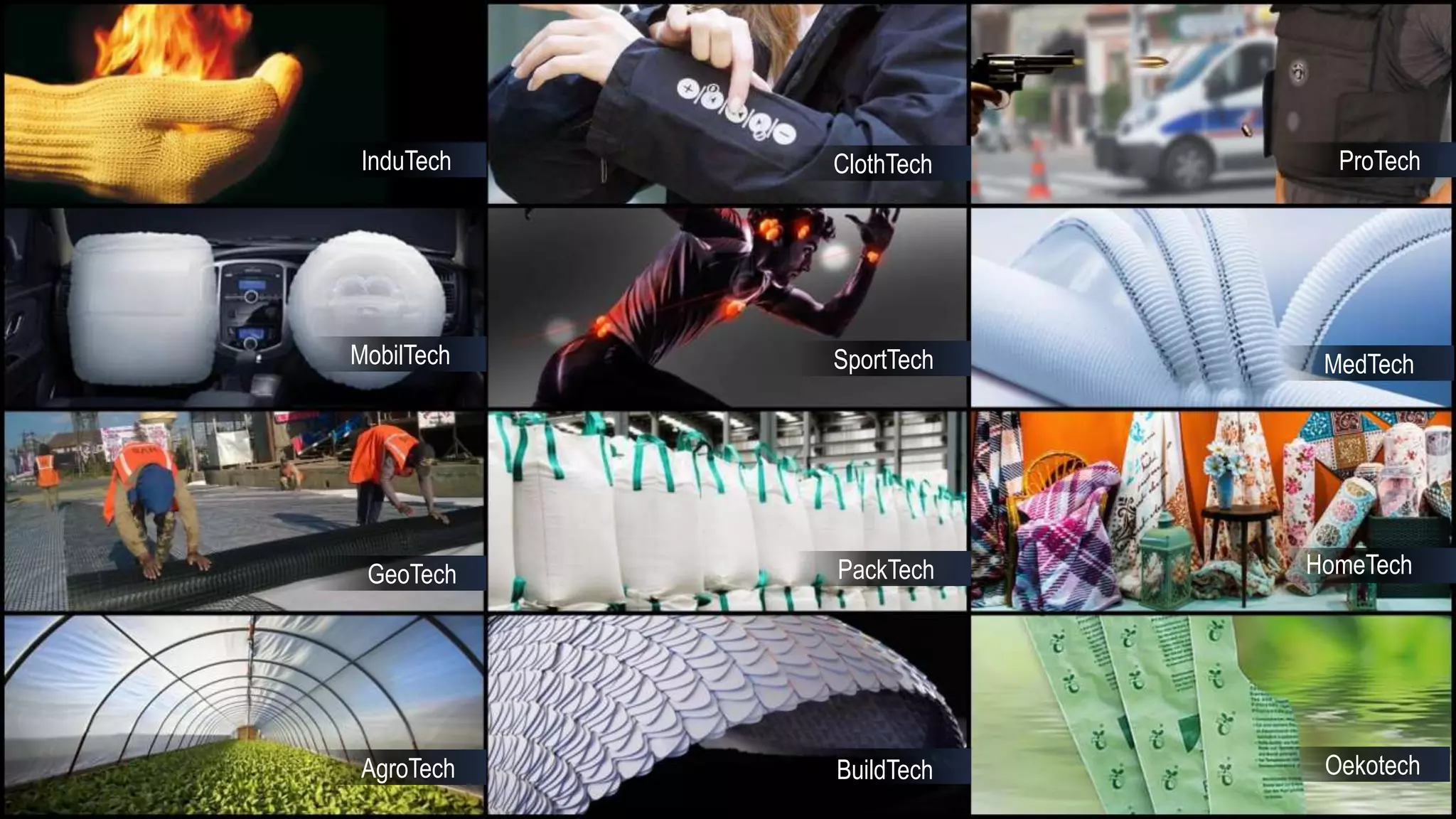
  • #13 They range from BuildTech (where carbon fibers are used as reinforced fibers for the earthquake-prone building) to SportTech (where glass fibers are used to reinforce F1 cars panels).
  • #14 As regards their relative positive shares in the market and importance, PackTech appears to hold dominance with a 40% on total production, followed by clottech, hometch and mobiltech ranging between 8 and 15%. Other fields of application, despite having a relatively low market share at the moment, are considered to have the greatest potential of growth in the next few years. This is particularly true for Sport tech and Med tech.
  • #15 In addition to this, one further specification has to be made about the latest developments of technical Textile. As a matter of fact, experts in the field have started considering the emergence of E-textile as a 4th industrial revolution for the textiles and fashion industry. The term “E-textile”, also known as smart textiles or wearable electronics, refers to the use of electronics in textiles products to add functional or decorative effects. With advances in fields such as nanotechnology, it has become possible to create a range of textile–based technologies that have the ability to sense and react to the world around them. One of the major features of wearable technology is its ability to connect to the Internet, enabling data to be exchanged between a network and the device.
  • #16 The global wearable electronic textiles market is expected to grow faster than that of the overall wearable electronics market with increasing demand for wearable smart textiles. The value of the global wearable technology ecosystem was estimated to be more than $4 billion in 2012 and has reached more than $14 billion by 2018. According to the European Technology Platform for the Future of Textiles and Clothing, the European market for wearable technology has been growing steadily by 42.1% annually from 2014. The value of the global wearable technology ecosystem was estimated to be more than $4 billion as of 2012 and has reached more than $14 billion by 2018, growing at a CAGR of more than 18% in that time period. The total addressable market (TAM) is predicted to experience a growth up to $130 billion by 2025. According to the European Technology Platform for the Future of Textiles and Clothing, the European market for wearable technology has been growing steadily by 42.1% annually from 2014, and will reach a total value of $2545.51 million in 2019. 
  • #17 With advances in fields such as nanotechnology, organic electronics and conducting polymers it has become possible to create a range of textile–based technologies which have the ability to sense and react to the world around them.  Wearables are electronics that can be worn on the body, either as an accessory or as part of material used in clothing. One of the major features of wearable technology is its ability to connect to the Internet, enabling data to be exchanged between a network and the device. Current e-textile market is characterized by continuously evolving technologies and it is still dominated by few predominant players, which means the price of products is high, especially for commercial spin-offs. 
  • #18 The market is currently characterized by few, dominant players, which means market is highly concentrated and so is the price of products. These are few of the leading companies in the E-textile sector in 2018.
  • #20 As we can imagine, advanced textile encompasses a complex and rather long process: starting from the natural or synthetic fibers we obtain yarns, which are in turn woven into fabric. This is processed until it becomes a finished fabric: at this point, fabric can address clothing industry, home textile sector or can be further combined with technological complementary elements to obtain the so-called technical textile that can go to market. This means going from procurement of raw materials, research & development, and manufacturing to marketing & sales through an efficient distribution channel.
  • #21 Companies and end users are not the only players. Between design and production of technical textiles by companies and the actual commercialization of such product, there are many additional stakeholders involved in the supply chain. First of all, academia and research centers that play an essential role in the discovery process. (For instance, the textile industry and universities in the area of Ghent, Belgium, have established strong connections). Secondly, dialogue between government and industry has become essential in determining key areas of funding. Involvement of the public sector includes: tariff codes; research grants and tax relief; traceability of materials; and fund initiatives for knowledge transfer (**European union focused heavily on collaboration to build strong industry sectors in Horizon 2020). At the same time, regulatory bodies are also important. Because in the textile industry a significant proportion of products can be reverse engineered by competitors and copied, businesses make use of intellectual property rights. Therefore, these bodies help developing standards and assessing quality of products.
  • #22 Being the technical textile ecosystem still at an initial level of discovery and production, applicability is very sector-specific, and prices are high. As a result, much of the demand for technical textiles comes from various end‐use industries, such as automotive, construction and agriculture, since they can overcome price constraints and prioritize performance over costs. Contrarily, there is very low market-commercialization, as individuals of course allocate more value on cheapness.
  • #23 As regards technical textiles field, innovation process could be considered two-fold. With respect to Materials, innovation is science-based, brought by academia and research centers. On the other hand, however, processes are also innovated by R&D departments of firms, which adapt new technologies to emerging needs: one technical textile firm can produce products for more than 10 different markets.
  • #24 Great focus on market diversification: some companies saw the potential of this new industry and decided to explore it. Interconnected globalized economies + accelerated process of technological obsolescence + increasingly complex innovative dynamics = more opportunities for cooperation. Technological cooperation as an alternative between pure market transactions (decentralization and hiring external experts) and vertical integration within the company (full centralization and coordination of the learning process). 
  • #25 This great focus on market diversification, together with the increasingly interconnected globalized economies and innovative dynamics brought to more opportunities for cooperation among actors. The so-called technological networks are considered to be an alternative between pure market transactions (hiring external experts) and vertical integration within the company (full centralization and coordination of the learning process). According to recent surveys, managers and CEOs see strategic partnerships as building blocks of current developments. Specifically, networks help: Obtaining a wider pool of knowledge and resources (especially in high-tech), matching with other firms’ complementary skills Sharing risks and costs, avoid inefficiencies related to complete integration A third of respondents expressed a belief their organization could be helped to break into new markets by working with a strategic partner
  • #26 Acquisition of technology license   Sharing R&D laboratories Coordinated management of research programs Joint exploitation of innovation Technological clusters, which connect different firms focusing on a common technology Some companies are therefore opting for creating a new division evolving from parent company, which can draw from the company’s budget and advertising capabilities. **DNA Textile Group, traditionally producing denim, recently opened a specific DNA Technical Fabrics which aims at bringing its woven textile expertise to the technical and industrial markets. The company is branching out into textiles for transportation, medical and the military. Joint ventures aimed at the research activity (RJV) Intellectual property rights (IPR) licensing agreements: licenser gives the IPR license to the Licensee, who in turn returns fees and/or royalties.
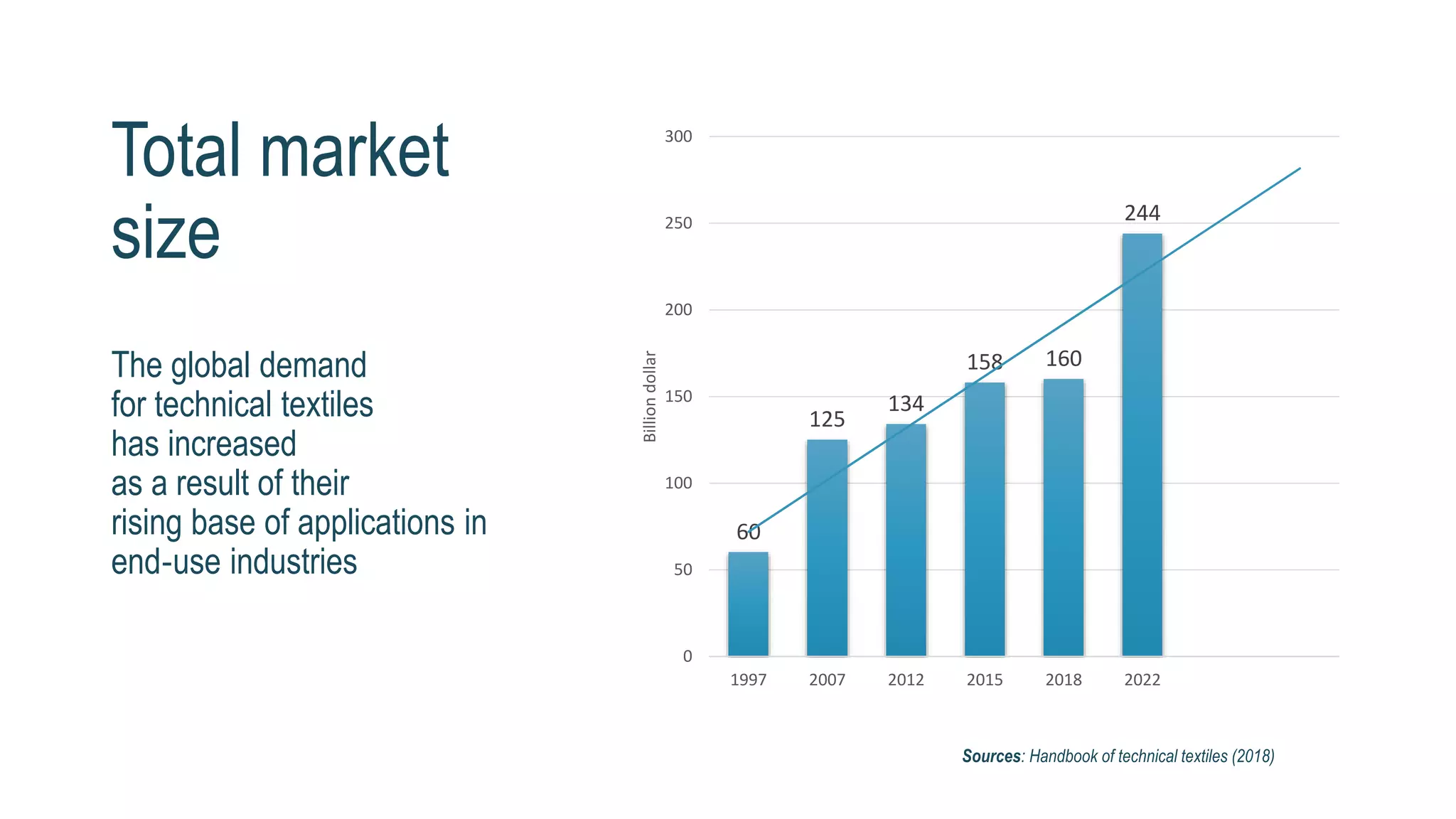
  • #28 Growth in the past years, and an even higher increase by 2022, where ..-244. CAGR of 6.4% from 2016 to 2022. This happen thanks to the increasing numb of applic of TT This is true for both developed and developing countries
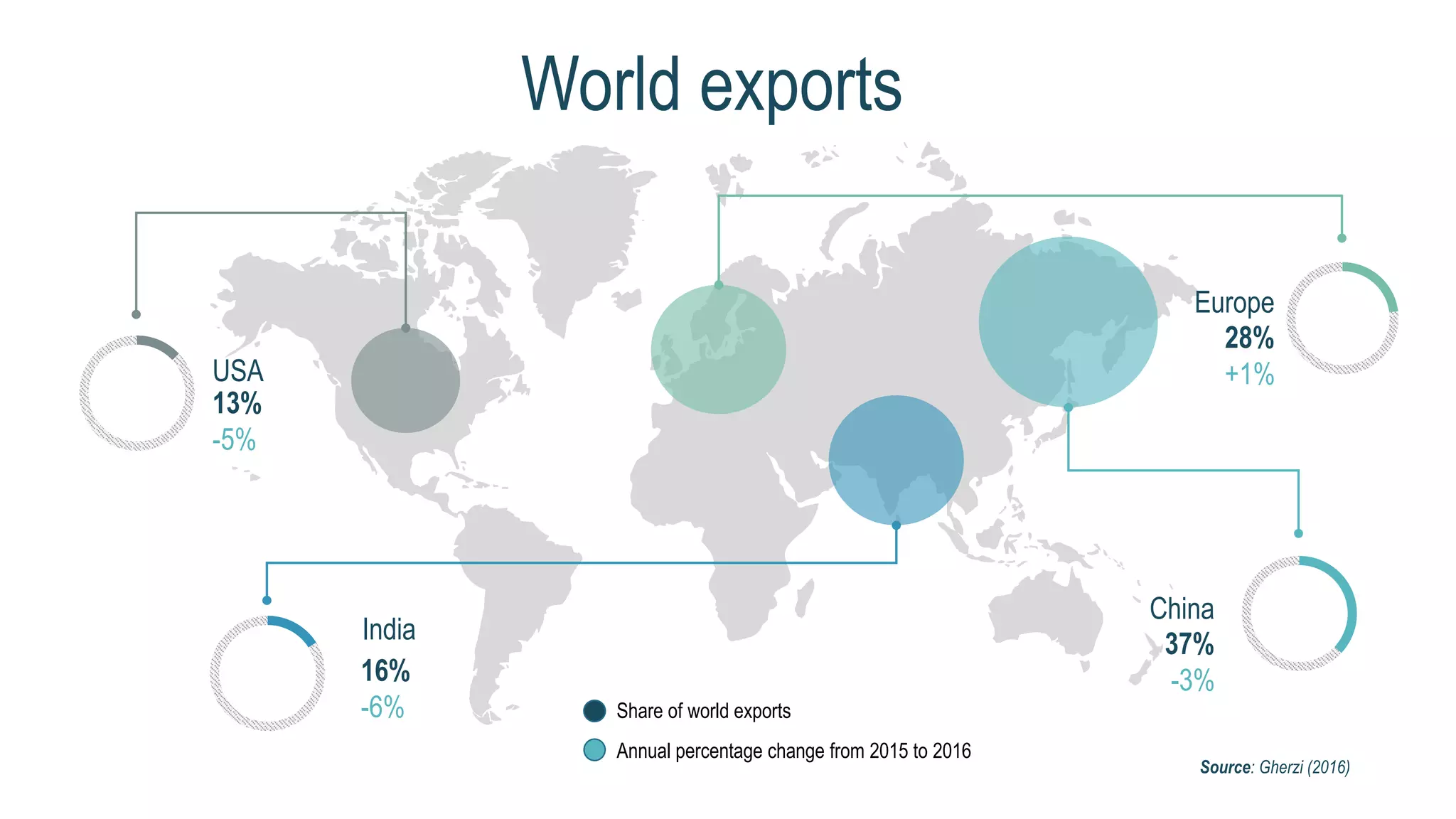
  • #29 First percentage is the share of world exports Second one is the annual percentage change from 2015 to 2016
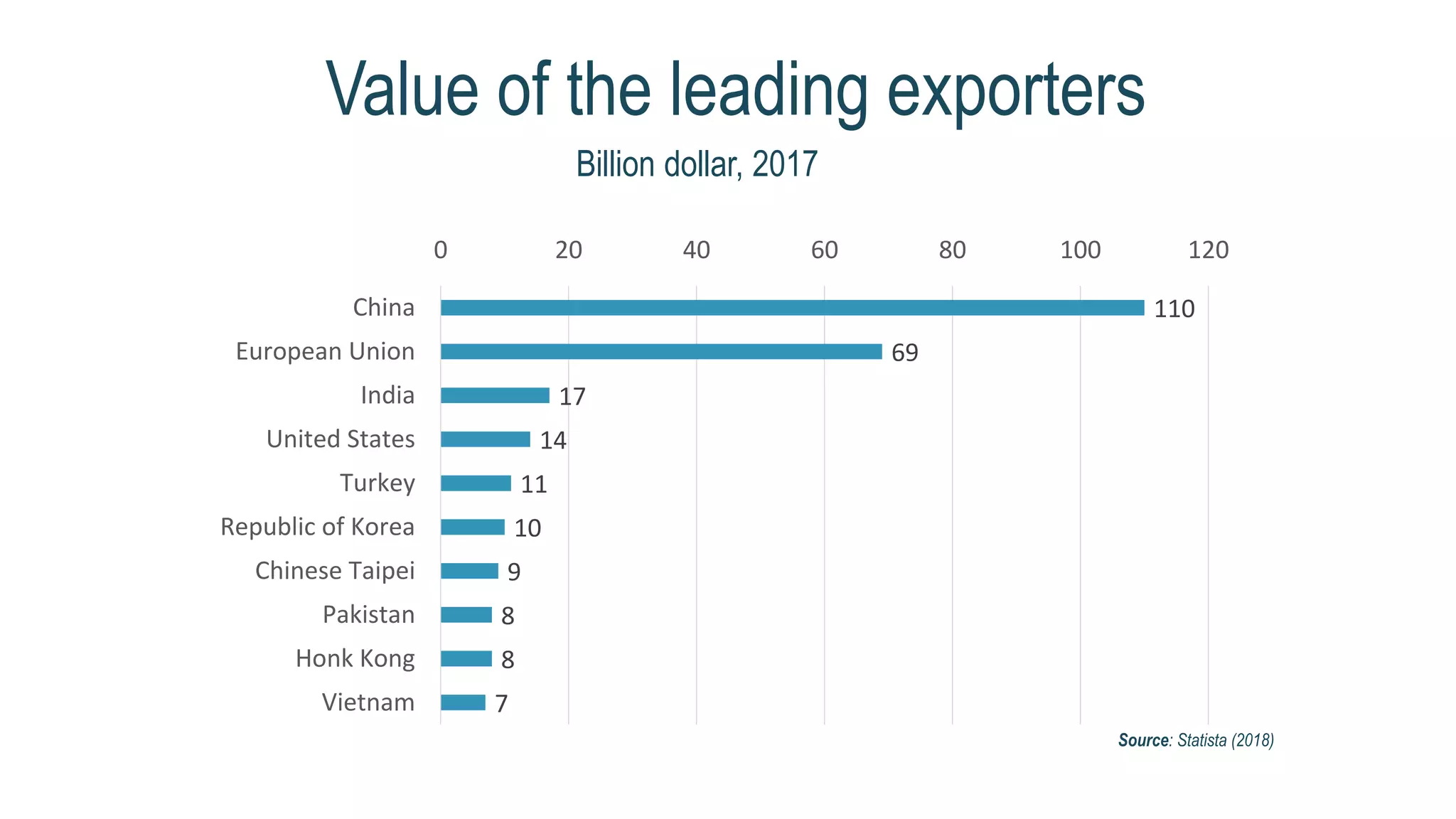
  • #30 Asia leads the way Although EU holds a very high share of global mkt, definitely Asia leads the way in the TT export. Impressive how Chine almost doubled EU in export.
  • #31 Advanced textile constitutes about 25% of total global fiber consumption. In western countries consumption is up to 75% Instead of competing with Asia on a price based mechanism in the general textile market, Europe specializes in a niche market of technical textile,. Almost 30% of our textile export are technical textile.
  • #32 Germany leads with 50% of the textile output; it’s the fourth largest market for U.S.-produced technical textiles. Mexico and Canada account for 55% of the total trade Boom in Mexican car manufactoring industry impact in industriual fabrics Huge application of new technology in textile Ample opportunities for growth and development in this region Brazil and Honduras can expect to witness growth in the technical textiles market Despite Brazil recession, the country still leads this region in demand for U.S. produced technical textiles Expected to be a major markets in the future because of the significant rise in demand and thanks to the strong industrual base China, India and Vietnam continue to play a key role in the technical textile market
  • #33 Focus on one of the categories we have presented
  • #34 We chose this because it is considered to be one of the most promising fields in the nearest future CEO of EMPA (Swiss Laboratories for Materials Technology)
  • #35 As consequences of demographic (growth of the population, increasing of life-expectancy) and environmental factors (sedentarisation of the populations, air pollution) there is an increased interest in the sector. There is also an increase in the number of surgeries performed in key healthcare markets such as Europe and the US. However, limits: an iImportant amount of collaboration needed between stakeholders, technology companies, payers and providers.
  • #36 Technical textile, contrarily to other materials, can provide peculiar qualities: softness, etc. Therefore, many applications that can be divided into four categories: 1- Non implantable medical textiles : external application on the body with or without skin contact 2- Implantable medical textiles : those which can be implanted in the human body 3- Extracorporeal medical textiles : textile materials used in a mechanical organ 4- Healthcare and hygienic medical textiles : to protect health care professionals from contamination by blood and other infection fluids Examples:  surgical gowns, drapes, sutures, sanitary napkins, diapers, woven, knit, non woven wound care, sterile packaging etc.
  • #37 The Meditech segment was valued close to US$ 12 Bn in 2016 and is expected to reach US$ 20 Bn by the end of 2026. This incremental opportunity is mainly due to increasing surgical equipment, dressings and clothing designed for patient comfort.
  • #39 *injuries to skin as a result of prolonged pressure on it (e.g. old person constantly lying in bed). Customers: hospitals and patients Problem: complex health conditions require unobtrusive long-term monitoring to register developing wounds early  hospitals often do not have the capacity to monitor these patients at all times most existing sensing options (e.g. incorporated printed circuit boards) create additionnal risks for the patients by creating further pressure or chafting on the skin Solution: textile sensors for long-term measurements Researches led by Empa (Swiss Federal Laboratories for Materials Science and Technology), in collaboration with the research institute CSEM, Zurich University Hospital and the Swiss Paraplegic Center in Nottwil have conduct to develop a way of integrating optic fibers into clothing. Flexible, individualized, and fully textile-integrated wearable sensors for sensitive skin conditions and general long-term monitoring of patients with risk for pressure ulcer.
  • #40 The last one is «in the future»
  • #41 Schematic of the sensing technique of the sensor (left), the sensor in integrated into textile while illuminated (emission: red, detection: blue) (center), and prototype of the sensing hat (right)
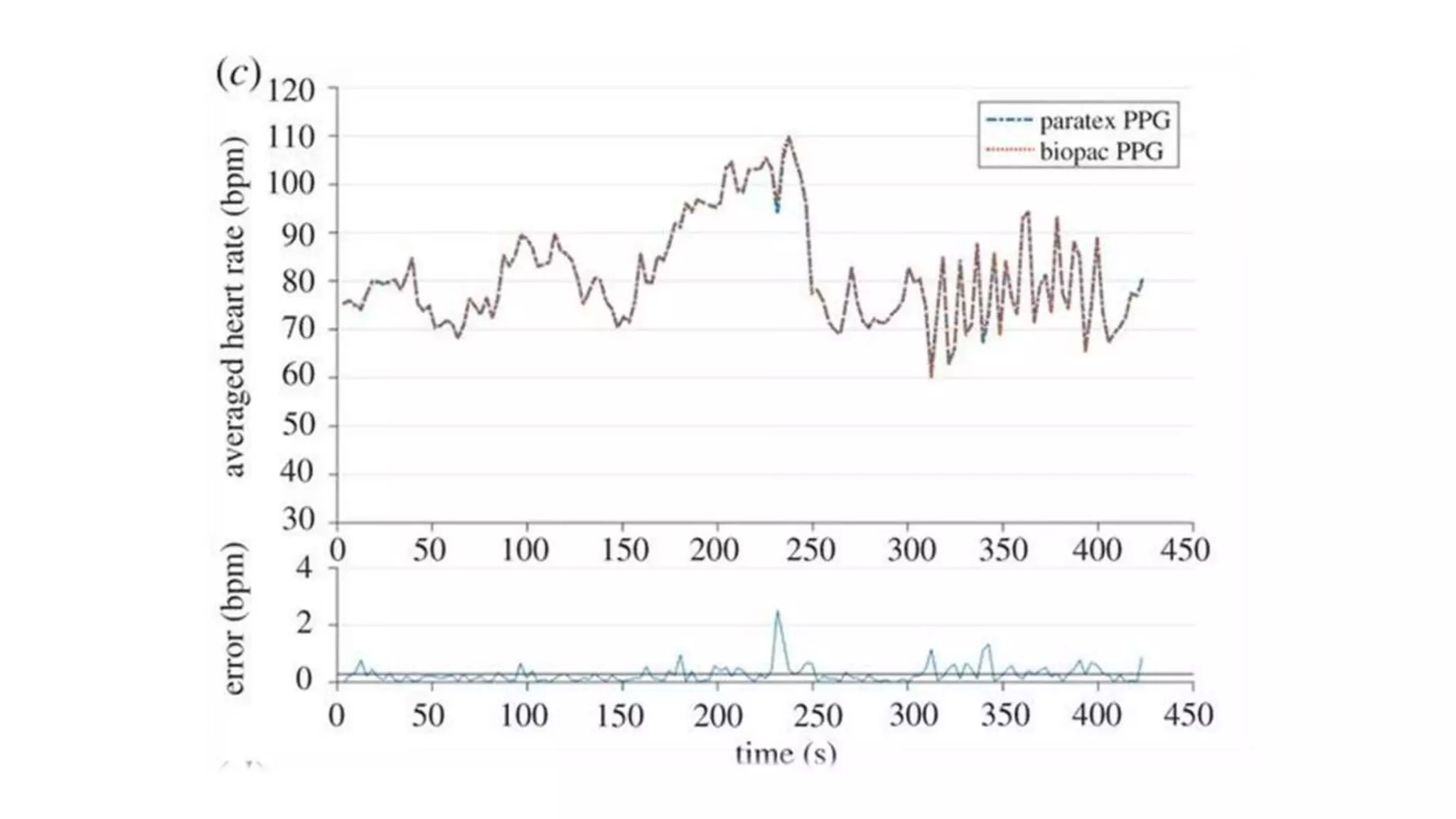
  • #42 calculation of the heartrate averaged over 4 s from both, the sensor at the forehead and the BIOPAC finger clip