Technical textiles
MD. TARIKUL ISLAM
TECHNICAL TEXTILES
 Technical textiles are defined as:
“Those textile-based products which are used principally for
their performance or functional characteristics rather than
for their aesthetics, or are used for non-consumer (i.e.
industrial) applications.”
7/24/2023
2
7/24/2023
3
7/24/2023
4
7/24/2023
5
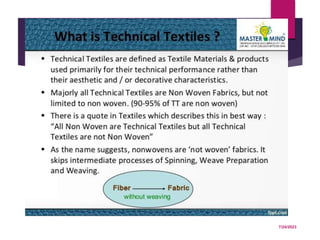
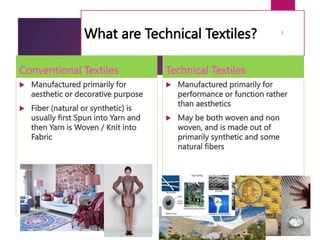
What are Technical Textiles?
Conventional Textiles
 Manufactured primarily for
aesthetic or decorative purpose
 Fiber (natural or synthetic) is
usually first Spun into Yarn and
then Yarn is Woven / Knit into
Fabric
Technical Textiles
 Manufactured primarily for
performance or function rather
than aesthetics
 May be both woven and non
woven, and is made out of
primarily synthetic and some
natural fibers
6
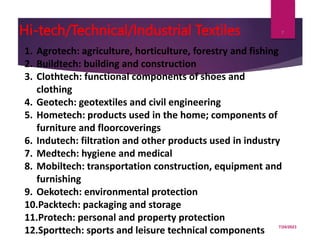
Hi-tech/Technical/Industrial Textiles
7/24/2023
7
1. Agrotech: agriculture, horticulture, forestry and fishing
2. Buildtech: building and construction
3. Clothtech: functional components of shoes and
clothing
4. Geotech: geotextiles and civil engineering
5. Hometech: products used in the home; components of
furniture and floorcoverings
6. Indutech: filtration and other products used in industry
7. Medtech: hygiene and medical
8. Mobiltech: transportation construction, equipment and
furnishing
9. Oekotech: environmental protection
10.Packtech: packaging and storage
11.Protech: personal and property protection
12.Sporttech: sports and leisure technical components
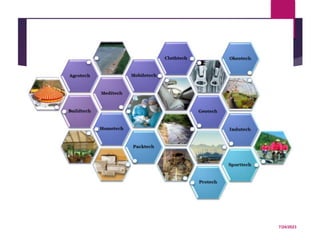
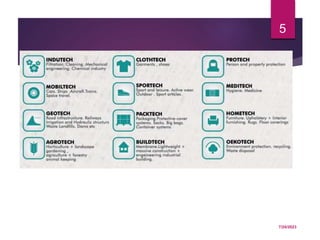
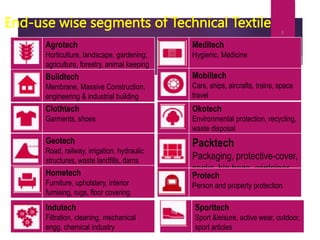
End-use wise segments of Technical Textile
Agrotech
Horticulture, landscape, gardening,
agriculture, forestry, animal keeping
7/24/2023
8
Meditech
Hygienic, Medicine
Okotech
Environmental protection, recycling,
waste disposal
Clothtech
Garments, shoes
Buildtech
Membrane, Massive Construction,
engineering & industrial building
Mobiltech
Cars, ships, aircrafts, trains, space
travel
Geotech
Road, railway, irrigation, hydraulic
structures, waste landfills, dams
Hometech
Furniture, upholstery, interior
furnising, rugs, floor covering
Packtech
Packaging, protective-cover,
sacks, big bags, container
systems
Indutech
Filtration, cleaning, mechanical
engg, chemical industry
Protech
Person and property protection
Sporttech
Sport &leisure, active wear, outdoor,
sport articles
7/24/2023
9
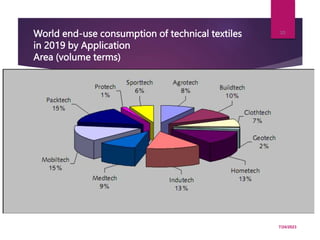
World end-use consumption of technical textiles
in 2019 by Application
Area (volume terms)
7/24/2023
10
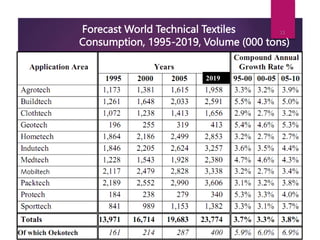
Forecast World Technical Textiles
Consumption, 1995-2019, Volume (000 tons)
7/24/2023
11
2019
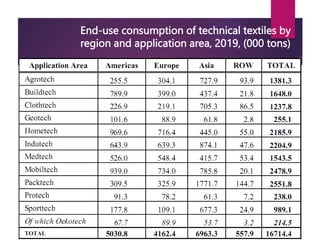
End-use consumption of technical textiles by
region and application area, 2019, (000 tons)
7/24/2023
12
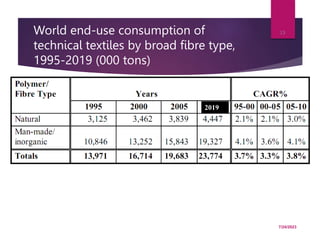
World end-use consumption of
technical textiles by broad fibre type,
1995-2019 (000 tons)
7/24/2023
13
2019
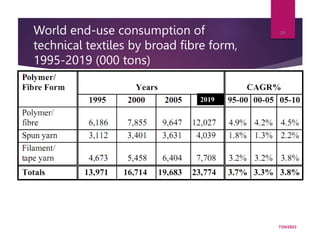
World end-use consumption of
technical textiles by broad fibre form,
1995-2019 (000 tons)
7/24/2023
14
2019
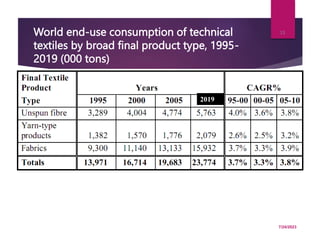
World end-use consumption of technical
textiles by broad final product type, 1995-
2019 (000 tons)
7/24/2023
15
2019
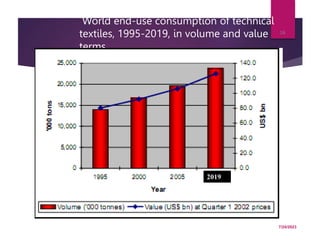
World end-use consumption of technical
textiles, 1995-2019, in volume and value
terms
7/24/2023
16
2019
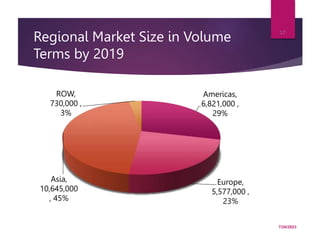
Regional Market Size in Volume
Terms by 2019
Americas,
6,821,000 ,
29%
Europe,
5,577,000 ,
23%
Asia,
10,645,000
, 45%
ROW,
730,000 ,
3%
7/24/2023
17
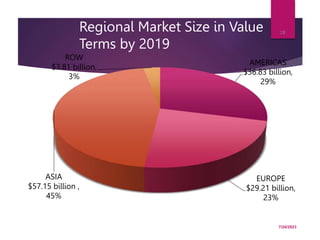
Regional Market Size in Value
Terms by 2019
AMERICAS
$36.83 billion,
29%
EUROPE
$29.21 billion,
23%
ASIA
$57.15 billion ,
45%
ROW
$3.81 billion,
3%
7/24/2023
18
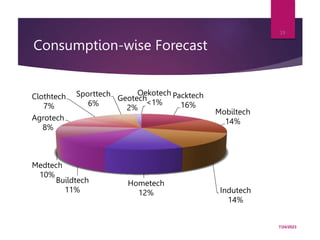
Consumption-wise Forecast
Oekotech
<1%
Packtech
16%
Mobiltech
14%
Indutech
14%
Hometech
12%
Buildtech
11%
Medtech
10%
Agrotech
8%
Clothtech
7%
Sporttech
6%
Geotech
2%
7/24/2023
19
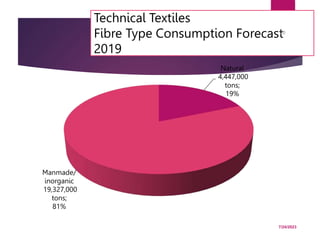
Technical Textiles
Fibre Type Consumption Forecast
2019
7/24/2023
20
Natural
4,447,000
tons;
19%
Manmade/
inorganic
19,327,000
tons;
81%
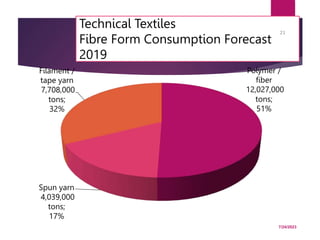
Technical Textiles
Fibre Form Consumption Forecast
2019
7/24/2023
21
Polymer /
fiber
12,027,000
tons;
51%
Spun yarn
4,039,000
tons;
17%
Filament /
tape yarn
7,708,000
tons;
32%
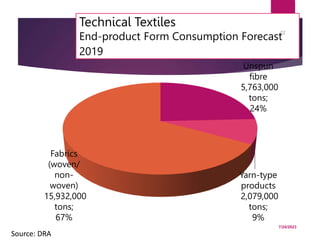
Technical Textiles
End-product Form Consumption Forecast
2019
7/24/2023
22
Unspun
fibre
5,763,000
tons;
24%
Yarn-type
products
2,079,000
tons;
9%
Fabrics
(woven/
non-
woven)
15,932,000
tons;
67%
Source: DRA
1. Agrotech
7/24/2023
23
Agriculture has been amongst the most primal occupations of the
humankind and is still a major industry, globally. In this era of
modernization and high technological advancements, it has spread its
horizons and started using man-made, non-conventional textiles, called
“technical textiles”.
Tapping the potential of technical textiles and putting their vital
properties to an advantage; agriculture, horticulture, forestry and
fishing segments (all the four sectors combined together are popularly
called as “Agrotech” sector) are increasingly using them for equipment
development and other applications.
This textile sector comprises of all textiles that are used in growing,
harvesting, protection and storage of either crops or animals. It includes
diverse items such as fishing nets and fish-lines, ropes, shade fabrics,
mulch mats, woven and non-woven covers for crops, bird protection
nests, etc. These textiles are driving the sector profitably by improving
the productivity and reducing the need for chemicals.
1. Agrotech
7/24/2023
24
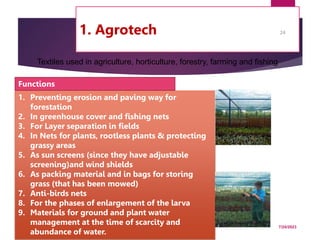
1. Preventing erosion and paving way for
forestation
2. In greenhouse cover and fishing nets
3. For Layer separation in fields
4. In Nets for plants, rootless plants & protecting
grassy areas
5. As sun screens (since they have adjustable
screening)and wind shields
6. As packing material and in bags for storing
grass (that has been mowed)
7. Anti-birds nets
8. For the phases of enlargement of the larva
9. Materials for ground and plant water
management at the time of scarcity and
abundance of water.
Functions
Textiles used in agriculture, horticulture, forestry, farming and fishing
1. Agrotech
7/24/2023
Compiled by: Dewan Murshed Ahmed (DMA)
25
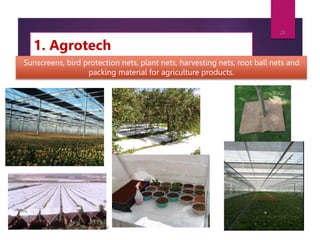
Sunscreens, bird protection nets, plant nets, harvesting nets, root ball nets and
packing material for agriculture products.
2. Buildtech
7/24/2023
26
• Civil engineering and building industry are an integral part of the
development of human society as they involve the planning, design,
building, operation and maintenance of infrastructure.
• The venturing of technical textiles or high-performance textiles in this
sector has given a great impetus to the quality of construction.
• These textiles are used in the construction of buildings, dams, bridges,
tunnels and roads and collectively comprise the “Buildtech” sector.
• They offer mechanical properties such as lightness, strength and resilience
as well as resistance to many factors such as creep, degradation by
chemicals and pollutants in the air or rain and other construction material
as well as the effects of sunlight and acid.
• These textiles play an important role in the modernization of infrastructure.
Applications
2. Buildtech
7/24/2023
27
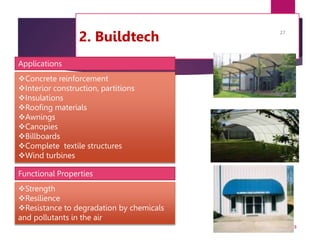
Strength
Resilience
Resistance to degradation by chemicals
and pollutants in the air
Concrete reinforcement
Interior construction, partitions
Insulations
Roofing materials
Awnings
Canopies
Billboards
Complete textile structures
Wind turbines
Applications
Functional Properties
3. Clothtech
7/24/2023
28
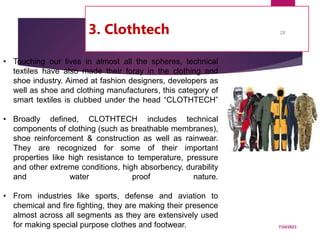
• Touching our lives in almost all the spheres, technical
textiles have also made their foray in the clothing and
shoe industry. Aimed at fashion designers, developers as
well as shoe and clothing manufacturers, this category of
smart textiles is clubbed under the head “CLOTHTECH”
• Broadly defined, CLOTHTECH includes technical
components of clothing (such as breathable membranes),
shoe reinforcement & construction as well as rainwear.
They are recognized for some of their important
properties like high resistance to temperature, pressure
and other extreme conditions, high absorbency, durability
and water proof nature.
• From industries like sports, defense and aviation to
chemical and fire fighting, they are making their presence
almost across all segments as they are extensively used
for making special purpose clothes and footwear.
3. Clothtech
7/24/2023
29
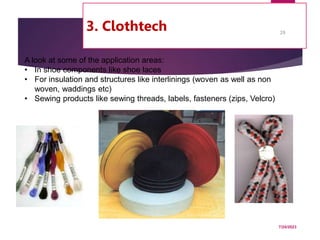
A look at some of the application areas:
• In shoe components like shoe laces
• For insulation and structures like interlinings (woven as well as non
woven, waddings etc)
• Sewing products like sewing threads, labels, fasteners (zips, Velcro)
4. Geotech
7/24/2023
30
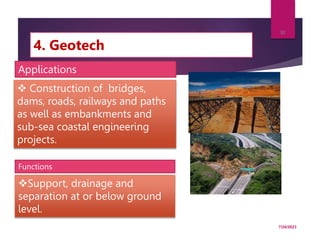
Support, drainage and
separation at or below ground
level.
 Construction of bridges,
dams, roads, railways and paths
as well as embankments and
sub-sea coastal engineering
projects.
Applications
Functions
5. Hometech
7/24/2023
Compiled by: Dewan Murshed Ahmed (DMA)
31
• Seen as a mightily expanding and changing sector in the global
textile industry, the presence of technical textiles is not merely
confined to industrial applications and is becoming a ubiquitous
phenomenon in our day to day activities as well.
• The new promise of technical textiles is generation of products (by
combining the latest developments in advanced flexible materials
with advances in process technologies) that eventually have a direct
impact upon all sorts of consumer textile markets, including both
clothing and furnishings. These are called “HOMETECH”.
One of the largest technical textile markets, this sector comprises
household textiles, furnishings (used in contract applications) and
upholstered furniture industry (including fiberfill and wadding
applications in bedding, cushions, sleeping bags and furniture
backings).
5. Hometech
7/24/2023
32
Applications
•Woven & knit wipes (cleaning wipes for domestic applications)
•Nonwoven wipes (floor mops)
•Tickings (for filled products like pillows, duvets, cushions)
•Mattress components (Flanging and quilt backing, spring wrap)
•Spring insulators Flat fabrics ( used to cover springs in beds or
upholstery)
•Platform cloth (fabrics used as a base for cushions on upholstered
furniture)
•Dust cloths Fabrics attached to base of furniture
•Skirt linings and other fabrics for use in upholstered furniture, bedding
etc
•Carpet backings (used as primary as well as secondary backing for
tufted carpets)
5. Hometech
7/24/2023
33
Applications
6. Indutech
7/24/2023
34
Providing an impetus to the progressive industrial and
technological front, technical textiles are proving their forte in yet
another field. The smart characteristics of technical textiles make
them an ideal resource for use in various industrial applications.
INDUTECH is the name given to textiles that are used for diverse
industrial applications like filtration, conveying, cleaning etc. This
arena of technical textiles contains solutions and products for
mechanical engineering and for varieties of industries, e.g.
conductive textiles and 3-D textile products.
Widely used in woven, non-woven and knitted form, INDUTECH are
increasingly being used in almost all the major industries, like paper,
carbon, metal, ceramic, glass fiber, plastic etc, across the globe.
6. Indutech
7/24/2023
35
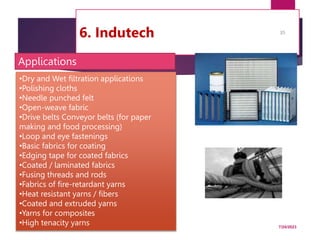
•Dry and Wet filtration applications
•Polishing cloths
•Needle punched felt
•Open-weave fabric
•Drive belts Conveyor belts (for paper
making and food processing)
•Loop and eye fastenings
•Basic fabrics for coating
•Edging tape for coated fabrics
•Coated / laminated fabrics
•Fusing threads and rods
•Fabrics of fire-retardant yarns
•Heat resistant yarns / fibers
•Coated and extruded yarns
•Yarns for composites
•High tenacity yarns
Applications
7. Medtech
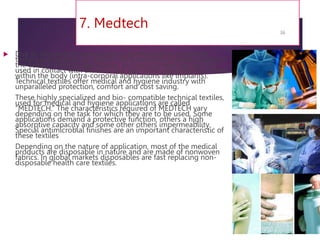
 Due to astounding technological developments, techincal
textiles are extensively used in the healthcare industry today. In
the field of medical application, technical textiles are not just
used in contact with the skin, but also fulfill important functions
within the body (intra-corporal applications like implants).
Technical textiles offer medical and hygiene industry with
unparalleled protection, comfort and cost saving.
These highly specialized and bio- compatible technical textiles,
used for medical and hygiene applications are called
“MEDTECH.” The characteristics required of MEDTECH vary
depending on the task for which they are to be used. Some
applications demand a protective function, others a high
absorptive capacity and some other others impermeability.
Special antimicrobial finishes are an important characteristic of
these textiles
Depending on the nature of application, most of the medical
products are disposable in nature and are made of nonwoven
fabrics. In global markets disposables are fast replacing non-
disposable health care textiles.
7/24/2023
36
7. Medtech
Some areas of usage are:
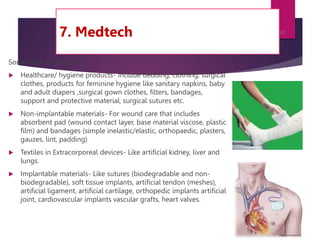
 Healthcare/ hygiene products- Include bedding, clothing, surgical
clothes, products for feminine hygiene like sanitary napkins, baby
and adult diapers ,surgical gown clothes, filters, bandages,
support and protective material, surgical sutures etc.
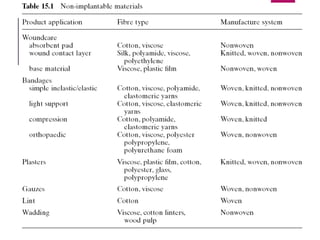
 Non-implantable materials- For wound care that includes
absorbent pad (wound contact layer, base material viscose, plastic
film) and bandages (simple inelastic/elastic, orthopaedic, plasters,
gauzes, lint, padding)
 Textiles in Extracorporeal devices- Like artificial kidney, liver and
lungs.
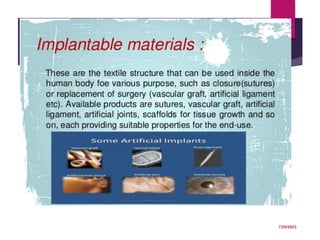
 Implantable materials- Like sutures (biodegradable and non-
biodegradable), soft tissue implants, artificial tendon (meshes),
artificial ligament, artificial cartilage, orthopedic implants artificial
joint, cardiovascular implants vascular grafts, heart valves.
7/24/2023
37
7. Medtech
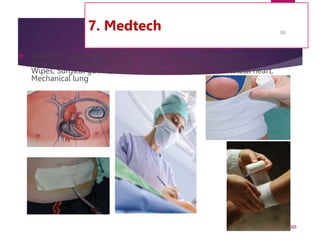
 Absorbents, Bandages: Plaster of Paris Bandage, orthopedics
bandage, crepe Bandage, etc. Protective eye pads, Adhesive tapes,
Wipes, Surgical gowns, Artificial kidney, Artificial liver, Artificial heart,
Mechanical lung
7/24/2023
38
Medical Textiles
 Definition: A general term which describes a textile structure which has been
designed and produced for use in any of a variety of medical applications, including
implantable applications.
 An important and growing part of the textile industry is medical, hygene and health
sector. The extent of growth is due to the development and improvement of
knowledge in both textile as well as medical sector.
 The engineering approach to develop textile products that will be suitable for
medical and surgical application should possess a combination of the following
properties
 e.g. strength, flexibility, and sometimes moisture and air permeability.
 Materials include natural fibre, monofilament as well as multifilament yarns.
 The number of application is huge and diverse, ranging from a single thread suture to the
complex composite structures for bone replacement, and from the simple cleaning wipe to
advanced barrier fabrics used in operation rooms. Thus the textiles used in medical and surgical
purposes can be classified as follows;
 Nonplantable materials-Wound dressing, bandages, plasters etc.
 Extracorporeal devices- artificial kidney, liver, and lung
 Implantable materials-suture, vascular grafts, artificial ligaments, artificial joints, etc.
 Healthcare/hygine products-bedding, clothing, surgical gowns, cloths, wipes etc.
 The majority of the healthcare products are disposable while some are reused. The medical
7/24/2023
39
Medical Textiles
 Fibres used
 Fibres used in medical application may be classified as follows;
1. According to source of origin
 Natural- Cotton and silk most widely used
 Synthetic- Viscose, polyester, polyamide, polytetrafluoroethylene (PTFE), polypropylene,
carbon, glass, and so on.
2. According to biological resistance
 Biodegradable- Fibres which are absorbed by the body within 2-3 months time after implantation
and include Cotton, Viscose rayon, polyamide, polyurathene, collagen, and alginate,
polycaprolactone, polypropiolactone.
 Non biodegradable-Fibres that are absorbed by the body slowly and take more than six months
time to degrade are considered as non biodegradable. Non-biodegradable fibres and include
polyester (e.g. Dacron), polypropylene,PTFE and carbon.
Fibre used in medical textiles must fullfill the following criterion
 the fibres must be nontoxic
 must be non-allergenic
 must be non-carcinogenic
 must be able to be sterilised without imparing any change in their physical or chemical
characteristics.
 where necessary biodegradable
7/24/2023
40
Medical Textiles
Fibre used:
 Traditionally cotton, silk and viscose have long been used for medical and surgical
purposes. One such area of application is wound care, where moisture and liquid exude
from the wound is absorbed by the fibrous structure to promote healing in relatively dry
conditions.
 However upon healing small fibrous elements protruding from the wound dressing are
usually trapped in the pores of the newly formed tissues which make their removal
distressing to the patients.
 Research show that wound under moist condition would in fact heal better and faster,
which would also remove the problem of fibres being trapped in the healing wound.
 The concept of moist healing has since been responsible for the development of many
fibres which have vastly improved wound management techniques and patient care.
 A variety of polymers such as collagen, alginate, chitin, chitosan have been used to be
essential materials for modern wound dressings.
 Collagen which has been obtained from bovine skin is used to produce biodegradable
fibres used as suture which is as strong as silk.
 The fibre can also be converted to transparent gel like film structure used as contact lens
which has very good oxygen permeability.
 Alginate (obtained from sea weeds) and chitin (obtained from shrimp shells) are widely
used for treatment of wound healing. Chitin nonwoven fabric is used as artificial skin.
7/24/2023
41
Non-implantable materials
7/24/2023
Compiled by: Dewan Murshed Ahmed (DMA)
42
A. Nonplantable materials
 These materials are used for external application on the body and may or may
not make contact with skin.
 The following table illustrates a range of materials used as non-implantable
madical textiles.
 (i) Wound care products– The purpose of these products are to provide
protection against infection, absorb blood and exudates, promote healing and in
some instances apply medication into the wound.
 Common wound dressings are composite materials consisting of an absorbent
layer held between a wound contact layer and a flexible base material.
 The absorbent pad absorbs blood or liquids and provides cushioning effect
to protect the wound.
 The wound contact layer should prevent adherence of the dressing to the
wound and be easily removed without disturbing new tissue growth. The
base materials are normally coated with acrylic adhesive to provide the
means by which the dressing is applied to the wound.
 The use of collagen, alginate, and chitin fibres contribute significantly to
the healing process.
 When alginate fiber is used as wound contact layer the interaction between
the alginate and the exuding wound creates a sodium alginate gel which is
hydrophilic and permeable to oxygen and impermeable to the bacteria and
contribute to the formation pf new tissue.
7/24/2023
43
7/24/2023
44
A. Nonplantable materials
(ii) Gauze- It is an open weave absorbent fabric, when coated with paraffin wax is used
for the treatment of burns and scalds. In surgical application gauze serves as an
absorbent material.
(iii) Lint- It is a plain weave cotton fabric that is used as protective dressing for first aid
and mild burn application.
(iv) Wadding-It is a highly absorbent material that is covered with a nonwoven fabric to
prevent wound adhesion or fibre loss.
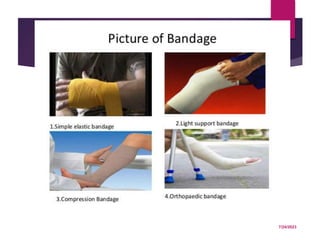
(v) Bandages- Bandages are designed to perform a whole variety of specific functions
depending upon the final medical requirements.
They can be -woven,
-knitted,
-or nonwoven and are
-either elastic or nonelastic.
7/24/2023
45
A. Nonplantable materials
the most common application of bandages is to hold the dressing in place over wound.
These are light weight knitted or woven fabrics made of cotton or viscose –scoured, bleached and sterilized.
Elasticized yarns are incorporated to the structure to impart support and conforming characteristics.
Knitted bandages are produced either in weft knitting machine to produce tubular fabric of varying
diameter or in warp knitting machine.
 Woven light support fabrics are used in the management of sprains or strains and the elasticated
properties are obtained by weaving crepe yarns having a very high twist.
 Similar properties can also be obtained by weaving fabric from two warp beam one in low
tension and the other in high tension.
 Compression bandages are used for the treatment and prevention of deep vein thrombosis, leg
ulceration, and varicose veins and are designed to exert a required amount of compression on
leg when applied at a constant tension.
 Compression bandages are classified by the amount of compression they can exert at the ankle
and include extra –high, high, moderate and light compression can be either woven and contain
cotton and elastomeric yarns or warp and weft knitted in both tubular or fully fashioned forms.
 Orthopaedic cushion bandages are used under plaster casts and compression bandages to provide
padding and prevent discomfort.
 Nonwoven orthopedic cushion bandages are produced from polyurathene foam, polyester, or
ploypropylenefibres and contain blends of natural or synthetic fibres.
 Non woven bandages are lightly needle punched to maintain bulk and loft.
7/24/2023
46
B. Extracorporeal devices-
 These are mechanical organs that are used for blood purification and include the
artificial kidney (dialyser), the artificial liver, mechanical lung. The function and
performances of these devices benefit from fibre and textile.
 The function of artificial kidney is achieved by circulating the blood through a
membrane, which may be either a flat sheet or a bundle of hollow regenerated
cellulose fibres in the form of cellophane that retain the unwanted waste materials.
 Multilayred filters composed of numerous layers of needle punched fabrics with
varying densities may also be used and are designed to remove the waste materials
rapidly and efficiently.
 The artificial liver utilizes hollow fibres or membranes similar to those used in artificial
kidney to perform high permeability to gases but low permeability to liquids and
function in the same manner as in the natural lung allowing oxygen to come into
contact with the patient’s blood.
7/24/2023
47
B. Extracorporeal devices-
7/24/2023
48
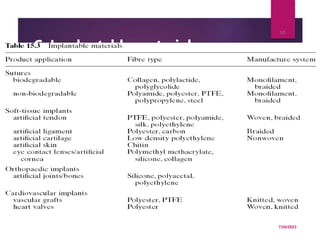
C. Implantable materials-
These materials are used in effecting repair to the body whether it be wound closure
(Sutures) or replacement surgery (Vascular grafts, artificial ligaments etc.). Table
15.3 show the list of implantable materials.
 Biocompatibility is of prime importance if the textile materials are to be accepted by the
body and four key factors will determine how the body reacts to the implant, these are as
follows
1. The most important factor is porosity which determines the rate at which human tissue will
grow and encapsulate the implant.
2. Small circular fibres are better encapsulated with human tissue than larger fibres with
irregular cross section.
3. Toxic substances must not be released by the fibre polymer, and the fibres should be free
from surface contaminations such as lubricants and sizing agents.
4. The properties of the polymer will influence the success of the implantation in terms of its
biodegradability.
Polyamide is the most reactive material losing its overall strength after only two years as a
result of biodegradation. PTFE is the least reactive with polypropylene and polyester is in
between
7/24/2023
49
C. Implantable materials-
7/24/2023
50
C. Implantable materials-
These materials are used in effecting repair to the body whether it be wound closure
(Sutures) or replacement surgery (Vascular grafts, artificial ligaments etc.). Table
15.3 show the list of implantable materials.
 Biocompatibility is of prime importance if the textile materials are to be accepted by the
body and four key factors will determine how the body reacts to the implant, these are as
follows
1. The most important factor is porosity which determines the rate at which human tissue will
grow and encapsulate the implant.
2. Small circular fibres are better encapsulated with human tissue than larger fibres with
irregular cross section.
3. Toxic substances must not be released by the fibre polymer, and the fibres should be free
from surface contaminations such as lubricants and sizing agents.
4. The properties of the polymer will influence the success of the implantation in terms of its
biodegradability.
Polyamide is the most reactive material losing its overall strength after only two years as a
result of biodegradation. PTFE is the least reactive with polypropylene and polyester is in
between
7/24/2023
51
7/24/2023
52
8. Mobiltech
7/24/2023
53
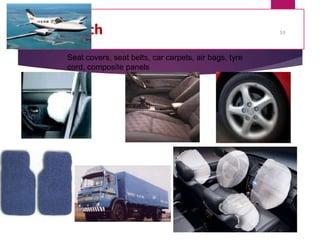
Seat covers, seat belts, car carpets, air bags, tyre
cord, composite panels
8. Mobiltech
7/24/2023
54
Among other sectors, the automotive industry is one of the largest single
markets for technical textiles and one of the most diverse as well. This market
comprises of automobiles, trains, marine vehicles and planes.
Technical textiles that are used in this automotive or transport sector are
called “MOBILTECH.” The latest developments in aircraft, ship building as
well as motor vehicle and train manufacture, all can be largely attributed to
MOBILTECH, a non apparel textile.
Mobiltech today covers not only isolation and safety aspect but also focuses
on comfort and style. The customers look for aesthetically pleasing interiors,
great comfort and fuel economy.
Textile components in automobiles consist of either visible components like
upholstery, carpets, seat belts, headliners etc. or concealed components like
tyre cords, hoses, belts, airbags etc.
8. Mobiltech
7/24/2023
55
Some of the applications in this industry are:
Air bag fabrics
Fabric used as a basis for reduction in weight of body parts
Tyre cord fabrics (including hose and drive belt reinforcements)
Automotive upholstery and other textile fabrics used inside the vehicle
Tyres (for cord reinforcement material, side and thread walls, carcass piles
etc)
Engine (radiator hoses, power steering, hydraulic lines, filters etc)
Composites for body and suspension parts (bumpers, wheel covers, door
handles etc)
Comfort and decoration (seating, carpets, interior decoration)
Safety (seat belts, air bags, seat fire barriers etc)
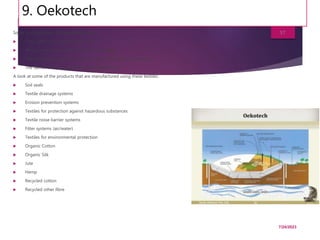
9. Oekotech
 Environmental threats loom large on almost every nation in the world
today. With this threat gaining its stature day by day, Eco Textiles gain
utmost importance as one of the most useful resources that help promote
new innovations, in an eco-friendly manner.
OEKTECH is the term used for technical textiles that are used for
environmental protection. It stands for new ideas and interesting
concepts in the area of environmental protection, waste disposal
(including innovative filtration media) and new recycling technologies. It
is opening up new avenues for environmental engineers, safety engineers
and personnel in environmental protection agencies.
These eco- friendly textiles provide a range of environmentally
responsible alternatives to other resource hungry materials. They tap into
both post-consumer and post-industrial waste streams & scrap and reuse
them for manufacturing an extremely durable and eco-friendly textile.
They not only lead to reduction of waste but also more importantly, save
the rapidly depleting natural resources.
7/24/2023
56
9. Oekotech
Some of the features of these textiles are:
 They utilize ecologically grown fibers.
 They are processed with less damaging inputs.
 The processing units are equipped with good sewage treatment.
 The fabrics are of good quality and long lasting.
A look at some of the products that are manufactured using these textiles:
 Soil seals
 Textile drainage systems
 Erosion prevention systems
 Textiles for protection against hazardous substances
 Textile noise barrier systems
 Filter systems (air/water)
 Textiles for environmental protection
 Organic Cotton
 Organic Silk
 Jute
 Hemp
 Recycled cotton
 Recycled other fibre
7/24/2023
57
10. Packtech
7/24/2023
58
• Packaging textiles include all textile packing material for industrial, agricultural
and other goods. The demand for packing material is directly proportional to
economic growth, industrial production and trade as goods are produced and
then distributed both locally and internationally.
• The growing (environmental) need for reusable packages and containers is
opening new opportunities for textile products in this market.
Sacks and bags made of traditional jute, cotton or natural fiber are gradually
casting way for modern synthetic fibers. These technical textiles, used in
packaging and subsequent transportation are called “PACKTECH.”
It is well known that these fabrics are ideal for many kinds of packaging.
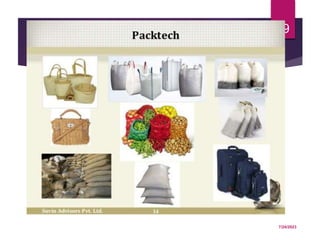
• At one end, PACKTECH includes heavyweight, dense woven fabrics (used for
bags, sacks, flexible intermediate bulk carriers and wrappings for textile bales
and carpets) and on the other end, it includes lightweight non wovens used as
durable papers, tea bags and other food and industrial product wrappings. ations
7/24/2023
59
10. Packtech
7/24/2023
60
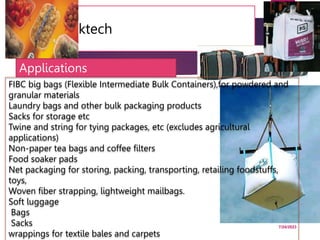
FIBC big bags (Flexible Intermediate Bulk Containers),for powdered and
granular materials
Laundry bags and other bulk packaging products
Sacks for storage etc
Twine and string for tying packages, etc (excludes agricultural
applications)
Non-paper tea bags and coffee filters
Food soaker pads
Net packaging for storing, packing, transporting, retailing foodstuffs,
toys,
Woven fiber strapping, lightweight mailbags.
Soft luggage
Bags
Sacks
wrappings for textile bales and carpets
Applications
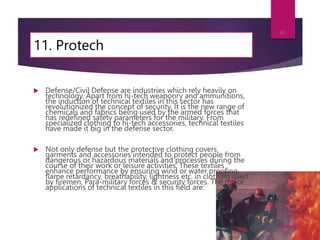
11. Protech
 Defense/Civil Defense are industries which rely heavily on
technology. Apart from hi-tech weaponry and ammunitions,
the induction of technical textiles in this sector has
revolutionized the concept of security. It is the new range of
chemicals and fabrics being used by the armed forces that
has redefined safety parameters for the military. From
specialized clothing to hi-tech accessories, technical textiles
have made it big in the defense sector.
 Not only defense but the protective clothing covers
garments and accessories intended to protect people from
dangerous or hazardous materials and processes during the
course of their work or leisure activities. These textiles
enhance performance by ensuring wind or water proofing,
flame retardancy, breathability, lightness etc. in clothing used
by firemen, Para-military forces & security forces. The major
applications of technical textiles in this field are:
7/24/2023
61
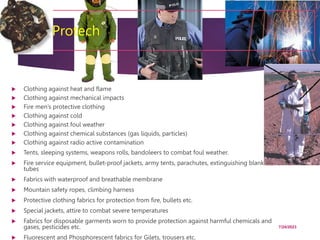
11. Protech
 Clothing against heat and flame
 Clothing against mechanical impacts
 Fire men’s protective clothing
 Clothing against cold
 Clothing against foul weather
 Clothing against chemical substances (gas liquids, particles)
 Clothing against radio active contamination
 Tents, sleeping systems, weapons rolls, bandoleers to combat foul weather.
 Fire service equipment, bullet-proof jackets, army tents, parachutes, extinguishing blankets,
tubes
 Fabrics with waterproof and breathable membrane
 Mountain safety ropes, climbing harness
 Protective clothing fabrics for protection from fire, bullets etc.
 Special jackets, attire to combat severe temperatures
 Fabrics for disposable garments worn to provide protection against harmful chemicals and
gases, pesticides etc.
 Fluorescent and Phosphorescent fabrics for Gilets, trousers etc.
7/24/2023
62
12. Sporttech
7/24/2023
63
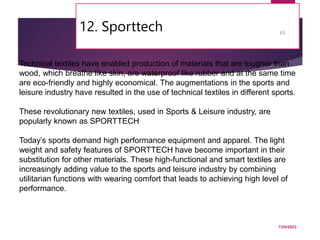
Technical textiles have enabled production of materials that are tougher than
wood, which breathe like skin, are waterproof like rubber and at the same time
are eco-friendly and highly economical. The augmentations in the sports and
leisure industry have resulted in the use of technical textiles in different sports.
These revolutionary new textiles, used in Sports & Leisure industry, are
popularly known as SPORTTECH
Today’s sports demand high performance equipment and apparel. The light
weight and safety features of SPORTTECH have become important in their
substitution for other materials. These high-functional and smart textiles are
increasingly adding value to the sports and leisure industry by combining
utilitarian functions with wearing comfort that leads to achieving high level of
performance.
12. Sporttech
7/24/2023
64
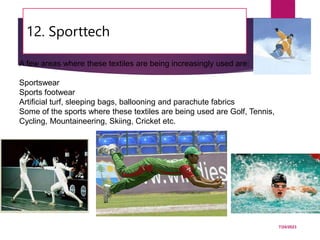
A few areas where these textiles are being increasingly used are:
Sportswear
Sports footwear
Artificial turf, sleeping bags, ballooning and parachute fabrics
Some of the sports where these textiles are being used are Golf, Tennis,
Cycling, Mountaineering, Skiing, Cricket etc.

Technical-textiles_introduction.ppt

  • 1.
  • 2.
    TECHNICAL TEXTILES  Technicaltextiles are defined as: “Those textile-based products which are used principally for their performance or functional characteristics rather than for their aesthetics, or are used for non-consumer (i.e. industrial) applications.” 7/24/2023 2
  • 3.
  • 4.
  • 5.
  • 6.
    What are TechnicalTextiles? Conventional Textiles  Manufactured primarily for aesthetic or decorative purpose  Fiber (natural or synthetic) is usually first Spun into Yarn and then Yarn is Woven / Knit into Fabric Technical Textiles  Manufactured primarily for performance or function rather than aesthetics  May be both woven and non woven, and is made out of primarily synthetic and some natural fibers 6
  • 7.
    Hi-tech/Technical/Industrial Textiles 7/24/2023 7 1. Agrotech:agriculture, horticulture, forestry and fishing 2. Buildtech: building and construction 3. Clothtech: functional components of shoes and clothing 4. Geotech: geotextiles and civil engineering 5. Hometech: products used in the home; components of furniture and floorcoverings 6. Indutech: filtration and other products used in industry 7. Medtech: hygiene and medical 8. Mobiltech: transportation construction, equipment and furnishing 9. Oekotech: environmental protection 10.Packtech: packaging and storage 11.Protech: personal and property protection 12.Sporttech: sports and leisure technical components
  • 8.
    End-use wise segmentsof Technical Textile Agrotech Horticulture, landscape, gardening, agriculture, forestry, animal keeping 7/24/2023 8 Meditech Hygienic, Medicine Okotech Environmental protection, recycling, waste disposal Clothtech Garments, shoes Buildtech Membrane, Massive Construction, engineering & industrial building Mobiltech Cars, ships, aircrafts, trains, space travel Geotech Road, railway, irrigation, hydraulic structures, waste landfills, dams Hometech Furniture, upholstery, interior furnising, rugs, floor covering Packtech Packaging, protective-cover, sacks, big bags, container systems Indutech Filtration, cleaning, mechanical engg, chemical industry Protech Person and property protection Sporttech Sport &leisure, active wear, outdoor, sport articles
  • 9.
  • 10.
    World end-use consumptionof technical textiles in 2019 by Application Area (volume terms) 7/24/2023 10
  • 11.
    Forecast World TechnicalTextiles Consumption, 1995-2019, Volume (000 tons) 7/24/2023 11 2019
  • 12.
    End-use consumption oftechnical textiles by region and application area, 2019, (000 tons) 7/24/2023 12
  • 13.
    World end-use consumptionof technical textiles by broad fibre type, 1995-2019 (000 tons) 7/24/2023 13 2019
  • 14.
    World end-use consumptionof technical textiles by broad fibre form, 1995-2019 (000 tons) 7/24/2023 14 2019
  • 15.
    World end-use consumptionof technical textiles by broad final product type, 1995- 2019 (000 tons) 7/24/2023 15 2019
  • 16.
    World end-use consumptionof technical textiles, 1995-2019, in volume and value terms 7/24/2023 16 2019
  • 17.
    Regional Market Sizein Volume Terms by 2019 Americas, 6,821,000 , 29% Europe, 5,577,000 , 23% Asia, 10,645,000 , 45% ROW, 730,000 , 3% 7/24/2023 17
  • 18.
    Regional Market Sizein Value Terms by 2019 AMERICAS $36.83 billion, 29% EUROPE $29.21 billion, 23% ASIA $57.15 billion , 45% ROW $3.81 billion, 3% 7/24/2023 18
  • 19.
  • 20.
    Technical Textiles Fibre TypeConsumption Forecast 2019 7/24/2023 20 Natural 4,447,000 tons; 19% Manmade/ inorganic 19,327,000 tons; 81%
  • 21.
    Technical Textiles Fibre FormConsumption Forecast 2019 7/24/2023 21 Polymer / fiber 12,027,000 tons; 51% Spun yarn 4,039,000 tons; 17% Filament / tape yarn 7,708,000 tons; 32%
  • 22.
    Technical Textiles End-product FormConsumption Forecast 2019 7/24/2023 22 Unspun fibre 5,763,000 tons; 24% Yarn-type products 2,079,000 tons; 9% Fabrics (woven/ non- woven) 15,932,000 tons; 67% Source: DRA
  • 23.
    1. Agrotech 7/24/2023 23 Agriculture hasbeen amongst the most primal occupations of the humankind and is still a major industry, globally. In this era of modernization and high technological advancements, it has spread its horizons and started using man-made, non-conventional textiles, called “technical textiles”. Tapping the potential of technical textiles and putting their vital properties to an advantage; agriculture, horticulture, forestry and fishing segments (all the four sectors combined together are popularly called as “Agrotech” sector) are increasingly using them for equipment development and other applications. This textile sector comprises of all textiles that are used in growing, harvesting, protection and storage of either crops or animals. It includes diverse items such as fishing nets and fish-lines, ropes, shade fabrics, mulch mats, woven and non-woven covers for crops, bird protection nests, etc. These textiles are driving the sector profitably by improving the productivity and reducing the need for chemicals.
  • 24.
    1. Agrotech 7/24/2023 24 1. Preventingerosion and paving way for forestation 2. In greenhouse cover and fishing nets 3. For Layer separation in fields 4. In Nets for plants, rootless plants & protecting grassy areas 5. As sun screens (since they have adjustable screening)and wind shields 6. As packing material and in bags for storing grass (that has been mowed) 7. Anti-birds nets 8. For the phases of enlargement of the larva 9. Materials for ground and plant water management at the time of scarcity and abundance of water. Functions Textiles used in agriculture, horticulture, forestry, farming and fishing
  • 25.
    1. Agrotech 7/24/2023 Compiled by:Dewan Murshed Ahmed (DMA) 25 Sunscreens, bird protection nets, plant nets, harvesting nets, root ball nets and packing material for agriculture products.
  • 26.
    2. Buildtech 7/24/2023 26 • Civilengineering and building industry are an integral part of the development of human society as they involve the planning, design, building, operation and maintenance of infrastructure. • The venturing of technical textiles or high-performance textiles in this sector has given a great impetus to the quality of construction. • These textiles are used in the construction of buildings, dams, bridges, tunnels and roads and collectively comprise the “Buildtech” sector. • They offer mechanical properties such as lightness, strength and resilience as well as resistance to many factors such as creep, degradation by chemicals and pollutants in the air or rain and other construction material as well as the effects of sunlight and acid. • These textiles play an important role in the modernization of infrastructure. Applications
  • 27.
    2. Buildtech 7/24/2023 27 Strength Resilience Resistance todegradation by chemicals and pollutants in the air Concrete reinforcement Interior construction, partitions Insulations Roofing materials Awnings Canopies Billboards Complete textile structures Wind turbines Applications Functional Properties
  • 28.
    3. Clothtech 7/24/2023 28 • Touchingour lives in almost all the spheres, technical textiles have also made their foray in the clothing and shoe industry. Aimed at fashion designers, developers as well as shoe and clothing manufacturers, this category of smart textiles is clubbed under the head “CLOTHTECH” • Broadly defined, CLOTHTECH includes technical components of clothing (such as breathable membranes), shoe reinforcement & construction as well as rainwear. They are recognized for some of their important properties like high resistance to temperature, pressure and other extreme conditions, high absorbency, durability and water proof nature. • From industries like sports, defense and aviation to chemical and fire fighting, they are making their presence almost across all segments as they are extensively used for making special purpose clothes and footwear.
  • 29.
    3. Clothtech 7/24/2023 29 A lookat some of the application areas: • In shoe components like shoe laces • For insulation and structures like interlinings (woven as well as non woven, waddings etc) • Sewing products like sewing threads, labels, fasteners (zips, Velcro)
  • 30.
    4. Geotech 7/24/2023 30 Support, drainageand separation at or below ground level.  Construction of bridges, dams, roads, railways and paths as well as embankments and sub-sea coastal engineering projects. Applications Functions
  • 31.
    5. Hometech 7/24/2023 Compiled by:Dewan Murshed Ahmed (DMA) 31 • Seen as a mightily expanding and changing sector in the global textile industry, the presence of technical textiles is not merely confined to industrial applications and is becoming a ubiquitous phenomenon in our day to day activities as well. • The new promise of technical textiles is generation of products (by combining the latest developments in advanced flexible materials with advances in process technologies) that eventually have a direct impact upon all sorts of consumer textile markets, including both clothing and furnishings. These are called “HOMETECH”. One of the largest technical textile markets, this sector comprises household textiles, furnishings (used in contract applications) and upholstered furniture industry (including fiberfill and wadding applications in bedding, cushions, sleeping bags and furniture backings).
  • 32.
    5. Hometech 7/24/2023 32 Applications •Woven &knit wipes (cleaning wipes for domestic applications) •Nonwoven wipes (floor mops) •Tickings (for filled products like pillows, duvets, cushions) •Mattress components (Flanging and quilt backing, spring wrap) •Spring insulators Flat fabrics ( used to cover springs in beds or upholstery) •Platform cloth (fabrics used as a base for cushions on upholstered furniture) •Dust cloths Fabrics attached to base of furniture •Skirt linings and other fabrics for use in upholstered furniture, bedding etc •Carpet backings (used as primary as well as secondary backing for tufted carpets)
  • 33.
  • 34.
    6. Indutech 7/24/2023 34 Providing animpetus to the progressive industrial and technological front, technical textiles are proving their forte in yet another field. The smart characteristics of technical textiles make them an ideal resource for use in various industrial applications. INDUTECH is the name given to textiles that are used for diverse industrial applications like filtration, conveying, cleaning etc. This arena of technical textiles contains solutions and products for mechanical engineering and for varieties of industries, e.g. conductive textiles and 3-D textile products. Widely used in woven, non-woven and knitted form, INDUTECH are increasingly being used in almost all the major industries, like paper, carbon, metal, ceramic, glass fiber, plastic etc, across the globe.
  • 35.
    6. Indutech 7/24/2023 35 •Dry andWet filtration applications •Polishing cloths •Needle punched felt •Open-weave fabric •Drive belts Conveyor belts (for paper making and food processing) •Loop and eye fastenings •Basic fabrics for coating •Edging tape for coated fabrics •Coated / laminated fabrics •Fusing threads and rods •Fabrics of fire-retardant yarns •Heat resistant yarns / fibers •Coated and extruded yarns •Yarns for composites •High tenacity yarns Applications
  • 36.
    7. Medtech  Dueto astounding technological developments, techincal textiles are extensively used in the healthcare industry today. In the field of medical application, technical textiles are not just used in contact with the skin, but also fulfill important functions within the body (intra-corporal applications like implants). Technical textiles offer medical and hygiene industry with unparalleled protection, comfort and cost saving. These highly specialized and bio- compatible technical textiles, used for medical and hygiene applications are called “MEDTECH.” The characteristics required of MEDTECH vary depending on the task for which they are to be used. Some applications demand a protective function, others a high absorptive capacity and some other others impermeability. Special antimicrobial finishes are an important characteristic of these textiles Depending on the nature of application, most of the medical products are disposable in nature and are made of nonwoven fabrics. In global markets disposables are fast replacing non- disposable health care textiles. 7/24/2023 36
  • 37.
    7. Medtech Some areasof usage are:  Healthcare/ hygiene products- Include bedding, clothing, surgical clothes, products for feminine hygiene like sanitary napkins, baby and adult diapers ,surgical gown clothes, filters, bandages, support and protective material, surgical sutures etc.  Non-implantable materials- For wound care that includes absorbent pad (wound contact layer, base material viscose, plastic film) and bandages (simple inelastic/elastic, orthopaedic, plasters, gauzes, lint, padding)  Textiles in Extracorporeal devices- Like artificial kidney, liver and lungs.  Implantable materials- Like sutures (biodegradable and non- biodegradable), soft tissue implants, artificial tendon (meshes), artificial ligament, artificial cartilage, orthopedic implants artificial joint, cardiovascular implants vascular grafts, heart valves. 7/24/2023 37
  • 38.
    7. Medtech  Absorbents,Bandages: Plaster of Paris Bandage, orthopedics bandage, crepe Bandage, etc. Protective eye pads, Adhesive tapes, Wipes, Surgical gowns, Artificial kidney, Artificial liver, Artificial heart, Mechanical lung 7/24/2023 38
  • 39.
    Medical Textiles  Definition:A general term which describes a textile structure which has been designed and produced for use in any of a variety of medical applications, including implantable applications.  An important and growing part of the textile industry is medical, hygene and health sector. The extent of growth is due to the development and improvement of knowledge in both textile as well as medical sector.  The engineering approach to develop textile products that will be suitable for medical and surgical application should possess a combination of the following properties  e.g. strength, flexibility, and sometimes moisture and air permeability.  Materials include natural fibre, monofilament as well as multifilament yarns.  The number of application is huge and diverse, ranging from a single thread suture to the complex composite structures for bone replacement, and from the simple cleaning wipe to advanced barrier fabrics used in operation rooms. Thus the textiles used in medical and surgical purposes can be classified as follows;  Nonplantable materials-Wound dressing, bandages, plasters etc.  Extracorporeal devices- artificial kidney, liver, and lung  Implantable materials-suture, vascular grafts, artificial ligaments, artificial joints, etc.  Healthcare/hygine products-bedding, clothing, surgical gowns, cloths, wipes etc.  The majority of the healthcare products are disposable while some are reused. The medical 7/24/2023 39
  • 40.
    Medical Textiles  Fibresused  Fibres used in medical application may be classified as follows; 1. According to source of origin  Natural- Cotton and silk most widely used  Synthetic- Viscose, polyester, polyamide, polytetrafluoroethylene (PTFE), polypropylene, carbon, glass, and so on. 2. According to biological resistance  Biodegradable- Fibres which are absorbed by the body within 2-3 months time after implantation and include Cotton, Viscose rayon, polyamide, polyurathene, collagen, and alginate, polycaprolactone, polypropiolactone.  Non biodegradable-Fibres that are absorbed by the body slowly and take more than six months time to degrade are considered as non biodegradable. Non-biodegradable fibres and include polyester (e.g. Dacron), polypropylene,PTFE and carbon. Fibre used in medical textiles must fullfill the following criterion  the fibres must be nontoxic  must be non-allergenic  must be non-carcinogenic  must be able to be sterilised without imparing any change in their physical or chemical characteristics.  where necessary biodegradable 7/24/2023 40
  • 41.
    Medical Textiles Fibre used: Traditionally cotton, silk and viscose have long been used for medical and surgical purposes. One such area of application is wound care, where moisture and liquid exude from the wound is absorbed by the fibrous structure to promote healing in relatively dry conditions.  However upon healing small fibrous elements protruding from the wound dressing are usually trapped in the pores of the newly formed tissues which make their removal distressing to the patients.  Research show that wound under moist condition would in fact heal better and faster, which would also remove the problem of fibres being trapped in the healing wound.  The concept of moist healing has since been responsible for the development of many fibres which have vastly improved wound management techniques and patient care.  A variety of polymers such as collagen, alginate, chitin, chitosan have been used to be essential materials for modern wound dressings.  Collagen which has been obtained from bovine skin is used to produce biodegradable fibres used as suture which is as strong as silk.  The fibre can also be converted to transparent gel like film structure used as contact lens which has very good oxygen permeability.  Alginate (obtained from sea weeds) and chitin (obtained from shrimp shells) are widely used for treatment of wound healing. Chitin nonwoven fabric is used as artificial skin. 7/24/2023 41
  • 42.
  • 43.
    A. Nonplantable materials These materials are used for external application on the body and may or may not make contact with skin.  The following table illustrates a range of materials used as non-implantable madical textiles.  (i) Wound care products– The purpose of these products are to provide protection against infection, absorb blood and exudates, promote healing and in some instances apply medication into the wound.  Common wound dressings are composite materials consisting of an absorbent layer held between a wound contact layer and a flexible base material.  The absorbent pad absorbs blood or liquids and provides cushioning effect to protect the wound.  The wound contact layer should prevent adherence of the dressing to the wound and be easily removed without disturbing new tissue growth. The base materials are normally coated with acrylic adhesive to provide the means by which the dressing is applied to the wound.  The use of collagen, alginate, and chitin fibres contribute significantly to the healing process.  When alginate fiber is used as wound contact layer the interaction between the alginate and the exuding wound creates a sodium alginate gel which is hydrophilic and permeable to oxygen and impermeable to the bacteria and contribute to the formation pf new tissue. 7/24/2023 43
  • 44.
  • 45.
    A. Nonplantable materials (ii)Gauze- It is an open weave absorbent fabric, when coated with paraffin wax is used for the treatment of burns and scalds. In surgical application gauze serves as an absorbent material. (iii) Lint- It is a plain weave cotton fabric that is used as protective dressing for first aid and mild burn application. (iv) Wadding-It is a highly absorbent material that is covered with a nonwoven fabric to prevent wound adhesion or fibre loss. (v) Bandages- Bandages are designed to perform a whole variety of specific functions depending upon the final medical requirements. They can be -woven, -knitted, -or nonwoven and are -either elastic or nonelastic. 7/24/2023 45
  • 46.
    A. Nonplantable materials themost common application of bandages is to hold the dressing in place over wound. These are light weight knitted or woven fabrics made of cotton or viscose –scoured, bleached and sterilized. Elasticized yarns are incorporated to the structure to impart support and conforming characteristics. Knitted bandages are produced either in weft knitting machine to produce tubular fabric of varying diameter or in warp knitting machine.  Woven light support fabrics are used in the management of sprains or strains and the elasticated properties are obtained by weaving crepe yarns having a very high twist.  Similar properties can also be obtained by weaving fabric from two warp beam one in low tension and the other in high tension.  Compression bandages are used for the treatment and prevention of deep vein thrombosis, leg ulceration, and varicose veins and are designed to exert a required amount of compression on leg when applied at a constant tension.  Compression bandages are classified by the amount of compression they can exert at the ankle and include extra –high, high, moderate and light compression can be either woven and contain cotton and elastomeric yarns or warp and weft knitted in both tubular or fully fashioned forms.  Orthopaedic cushion bandages are used under plaster casts and compression bandages to provide padding and prevent discomfort.  Nonwoven orthopedic cushion bandages are produced from polyurathene foam, polyester, or ploypropylenefibres and contain blends of natural or synthetic fibres.  Non woven bandages are lightly needle punched to maintain bulk and loft. 7/24/2023 46
  • 47.
    B. Extracorporeal devices- These are mechanical organs that are used for blood purification and include the artificial kidney (dialyser), the artificial liver, mechanical lung. The function and performances of these devices benefit from fibre and textile.  The function of artificial kidney is achieved by circulating the blood through a membrane, which may be either a flat sheet or a bundle of hollow regenerated cellulose fibres in the form of cellophane that retain the unwanted waste materials.  Multilayred filters composed of numerous layers of needle punched fabrics with varying densities may also be used and are designed to remove the waste materials rapidly and efficiently.  The artificial liver utilizes hollow fibres or membranes similar to those used in artificial kidney to perform high permeability to gases but low permeability to liquids and function in the same manner as in the natural lung allowing oxygen to come into contact with the patient’s blood. 7/24/2023 47
  • 48.
  • 49.
    C. Implantable materials- Thesematerials are used in effecting repair to the body whether it be wound closure (Sutures) or replacement surgery (Vascular grafts, artificial ligaments etc.). Table 15.3 show the list of implantable materials.  Biocompatibility is of prime importance if the textile materials are to be accepted by the body and four key factors will determine how the body reacts to the implant, these are as follows 1. The most important factor is porosity which determines the rate at which human tissue will grow and encapsulate the implant. 2. Small circular fibres are better encapsulated with human tissue than larger fibres with irregular cross section. 3. Toxic substances must not be released by the fibre polymer, and the fibres should be free from surface contaminations such as lubricants and sizing agents. 4. The properties of the polymer will influence the success of the implantation in terms of its biodegradability. Polyamide is the most reactive material losing its overall strength after only two years as a result of biodegradation. PTFE is the least reactive with polypropylene and polyester is in between 7/24/2023 49
  • 50.
  • 51.
    C. Implantable materials- Thesematerials are used in effecting repair to the body whether it be wound closure (Sutures) or replacement surgery (Vascular grafts, artificial ligaments etc.). Table 15.3 show the list of implantable materials.  Biocompatibility is of prime importance if the textile materials are to be accepted by the body and four key factors will determine how the body reacts to the implant, these are as follows 1. The most important factor is porosity which determines the rate at which human tissue will grow and encapsulate the implant. 2. Small circular fibres are better encapsulated with human tissue than larger fibres with irregular cross section. 3. Toxic substances must not be released by the fibre polymer, and the fibres should be free from surface contaminations such as lubricants and sizing agents. 4. The properties of the polymer will influence the success of the implantation in terms of its biodegradability. Polyamide is the most reactive material losing its overall strength after only two years as a result of biodegradation. PTFE is the least reactive with polypropylene and polyester is in between 7/24/2023 51
  • 52.
  • 53.
    8. Mobiltech 7/24/2023 53 Seat covers,seat belts, car carpets, air bags, tyre cord, composite panels
  • 54.
    8. Mobiltech 7/24/2023 54 Among othersectors, the automotive industry is one of the largest single markets for technical textiles and one of the most diverse as well. This market comprises of automobiles, trains, marine vehicles and planes. Technical textiles that are used in this automotive or transport sector are called “MOBILTECH.” The latest developments in aircraft, ship building as well as motor vehicle and train manufacture, all can be largely attributed to MOBILTECH, a non apparel textile. Mobiltech today covers not only isolation and safety aspect but also focuses on comfort and style. The customers look for aesthetically pleasing interiors, great comfort and fuel economy. Textile components in automobiles consist of either visible components like upholstery, carpets, seat belts, headliners etc. or concealed components like tyre cords, hoses, belts, airbags etc.
  • 55.
    8. Mobiltech 7/24/2023 55 Some ofthe applications in this industry are: Air bag fabrics Fabric used as a basis for reduction in weight of body parts Tyre cord fabrics (including hose and drive belt reinforcements) Automotive upholstery and other textile fabrics used inside the vehicle Tyres (for cord reinforcement material, side and thread walls, carcass piles etc) Engine (radiator hoses, power steering, hydraulic lines, filters etc) Composites for body and suspension parts (bumpers, wheel covers, door handles etc) Comfort and decoration (seating, carpets, interior decoration) Safety (seat belts, air bags, seat fire barriers etc)
  • 56.
    9. Oekotech  Environmentalthreats loom large on almost every nation in the world today. With this threat gaining its stature day by day, Eco Textiles gain utmost importance as one of the most useful resources that help promote new innovations, in an eco-friendly manner. OEKTECH is the term used for technical textiles that are used for environmental protection. It stands for new ideas and interesting concepts in the area of environmental protection, waste disposal (including innovative filtration media) and new recycling technologies. It is opening up new avenues for environmental engineers, safety engineers and personnel in environmental protection agencies. These eco- friendly textiles provide a range of environmentally responsible alternatives to other resource hungry materials. They tap into both post-consumer and post-industrial waste streams & scrap and reuse them for manufacturing an extremely durable and eco-friendly textile. They not only lead to reduction of waste but also more importantly, save the rapidly depleting natural resources. 7/24/2023 56
  • 57.
    9. Oekotech Some ofthe features of these textiles are:  They utilize ecologically grown fibers.  They are processed with less damaging inputs.  The processing units are equipped with good sewage treatment.  The fabrics are of good quality and long lasting. A look at some of the products that are manufactured using these textiles:  Soil seals  Textile drainage systems  Erosion prevention systems  Textiles for protection against hazardous substances  Textile noise barrier systems  Filter systems (air/water)  Textiles for environmental protection  Organic Cotton  Organic Silk  Jute  Hemp  Recycled cotton  Recycled other fibre 7/24/2023 57
  • 58.
    10. Packtech 7/24/2023 58 • Packagingtextiles include all textile packing material for industrial, agricultural and other goods. The demand for packing material is directly proportional to economic growth, industrial production and trade as goods are produced and then distributed both locally and internationally. • The growing (environmental) need for reusable packages and containers is opening new opportunities for textile products in this market. Sacks and bags made of traditional jute, cotton or natural fiber are gradually casting way for modern synthetic fibers. These technical textiles, used in packaging and subsequent transportation are called “PACKTECH.” It is well known that these fabrics are ideal for many kinds of packaging. • At one end, PACKTECH includes heavyweight, dense woven fabrics (used for bags, sacks, flexible intermediate bulk carriers and wrappings for textile bales and carpets) and on the other end, it includes lightweight non wovens used as durable papers, tea bags and other food and industrial product wrappings. ations
  • 59.
  • 60.
    10. Packtech 7/24/2023 60 FIBC bigbags (Flexible Intermediate Bulk Containers),for powdered and granular materials Laundry bags and other bulk packaging products Sacks for storage etc Twine and string for tying packages, etc (excludes agricultural applications) Non-paper tea bags and coffee filters Food soaker pads Net packaging for storing, packing, transporting, retailing foodstuffs, toys, Woven fiber strapping, lightweight mailbags. Soft luggage Bags Sacks wrappings for textile bales and carpets Applications
  • 61.
    11. Protech  Defense/CivilDefense are industries which rely heavily on technology. Apart from hi-tech weaponry and ammunitions, the induction of technical textiles in this sector has revolutionized the concept of security. It is the new range of chemicals and fabrics being used by the armed forces that has redefined safety parameters for the military. From specialized clothing to hi-tech accessories, technical textiles have made it big in the defense sector.  Not only defense but the protective clothing covers garments and accessories intended to protect people from dangerous or hazardous materials and processes during the course of their work or leisure activities. These textiles enhance performance by ensuring wind or water proofing, flame retardancy, breathability, lightness etc. in clothing used by firemen, Para-military forces & security forces. The major applications of technical textiles in this field are: 7/24/2023 61
  • 62.
    11. Protech  Clothingagainst heat and flame  Clothing against mechanical impacts  Fire men’s protective clothing  Clothing against cold  Clothing against foul weather  Clothing against chemical substances (gas liquids, particles)  Clothing against radio active contamination  Tents, sleeping systems, weapons rolls, bandoleers to combat foul weather.  Fire service equipment, bullet-proof jackets, army tents, parachutes, extinguishing blankets, tubes  Fabrics with waterproof and breathable membrane  Mountain safety ropes, climbing harness  Protective clothing fabrics for protection from fire, bullets etc.  Special jackets, attire to combat severe temperatures  Fabrics for disposable garments worn to provide protection against harmful chemicals and gases, pesticides etc.  Fluorescent and Phosphorescent fabrics for Gilets, trousers etc. 7/24/2023 62
  • 63.
    12. Sporttech 7/24/2023 63 Technical textileshave enabled production of materials that are tougher than wood, which breathe like skin, are waterproof like rubber and at the same time are eco-friendly and highly economical. The augmentations in the sports and leisure industry have resulted in the use of technical textiles in different sports. These revolutionary new textiles, used in Sports & Leisure industry, are popularly known as SPORTTECH Today’s sports demand high performance equipment and apparel. The light weight and safety features of SPORTTECH have become important in their substitution for other materials. These high-functional and smart textiles are increasingly adding value to the sports and leisure industry by combining utilitarian functions with wearing comfort that leads to achieving high level of performance.
  • 64.
    12. Sporttech 7/24/2023 64 A fewareas where these textiles are being increasingly used are: Sportswear Sports footwear Artificial turf, sleeping bags, ballooning and parachute fabrics Some of the sports where these textiles are being used are Golf, Tennis, Cycling, Mountaineering, Skiing, Cricket etc.