Dr. Subhankar Maity
Assistant Professor
Uttar Pradesh Textile Technology Institute, Kanpur
 Technical textiles are the textile
materials and products primarily
manufactured for their technical
performance and functional properties
rather than aesthetics.
 Thus function and performance are
important characteristics of technical
textiles.
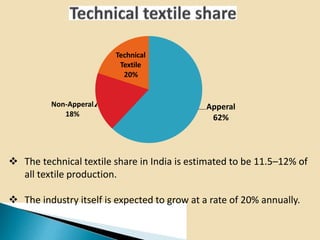
Technical
Textile
20%
Non-Apperal
18%
Apperal
62%
 The technical textile share in India is estimated to be 11.5–12% of
all textile production.
 The industry itself is expected to grow at a rate of 20% annually.
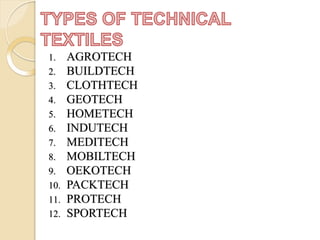
1. AGROTECH
2. BUILDTECH
3. CLOTHTECH
4. GEOTECH
5. HOMETECH
6. INDUTECH
7. MEDITECH
8. MOBILTECH
9. OEKOTECH
10. PACKTECH
11. PROTECH
12. SPORTECH
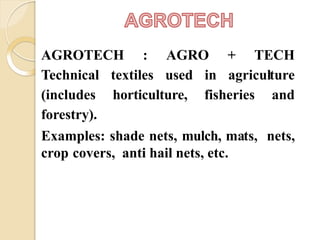
AGROTECH : AGRO + TECH
Technical textiles used in agriculture
(includes horticulture, fisheries and
forestry).
Examples: shade nets, mulch, mats, nets,
crop covers, anti hail nets, etc.
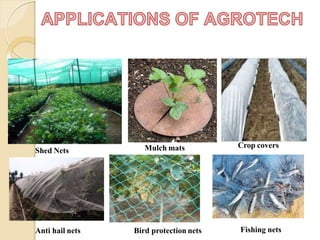
Shed Nets Mulch mats Crop covers
Anti hail nets Bird protection nets Fishing nets
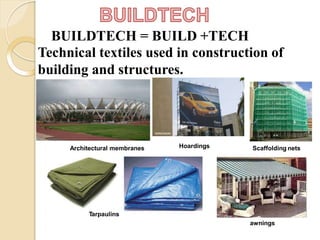
BUILDTECH = BUILD +TECH
Technical textiles used in construction of
building and structures.
Tarpaulins
awnings
Architectural membranes Hoardings Scaffolding nets
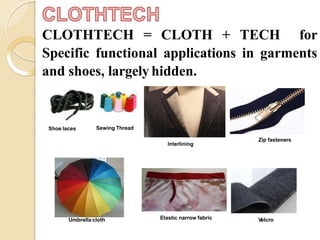
CLOTHTECH = CLOTH + TECH for
Specific functional applications in garments
and shoes, largely hidden.
Shoe laces
Zip fasteners
Elastic narrow fabric VelcroUmbrella cloth
Sewing Thread
Interlining
GEOTECH= GEO + TECH
Technical textile used in soil for specific application
to improve load bearing capacity, filtration,
drainage, reinforcement or prevent intermixing of
two adjoining of materials.
Examples: geotextiles, geogrids, geonets,
geomembranes, geocomposites, geodrains etc.
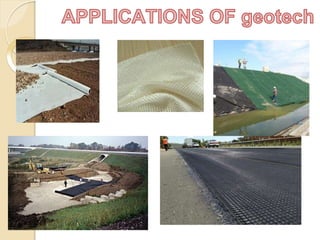
ROADS
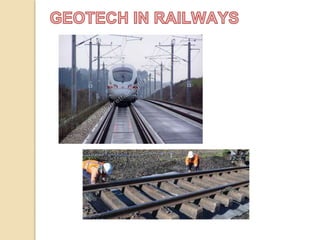
RAILWAYS
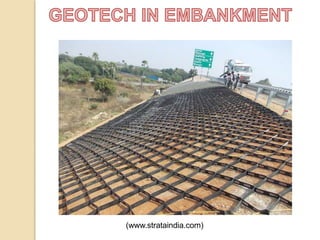
EMBANKMENTS
DRAINS
RETAINING WALLS
TUNNELS
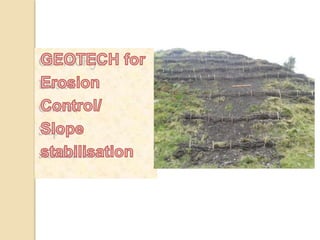
SLOPE STABILISATION
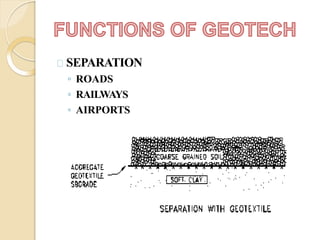
SEPARATION
REINFORCEMENT
FILTERATION
DRAINAGE
BARRIER
PROTECTION
SEPARATION
◦ ROADS
◦ RAILWAYS
◦ AIRPORTS
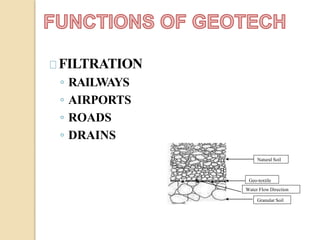
FILTRATION
◦ RAILWAYS
◦ AIRPORTS
◦ ROADS
◦ DRAINS
Natural Soil
Geo-textile
Water Flow Direction
Granular Soil
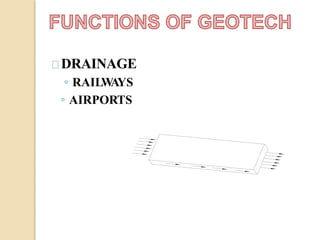
DRAINAGE
◦ RAILWAYS
◦ AIRPORTS
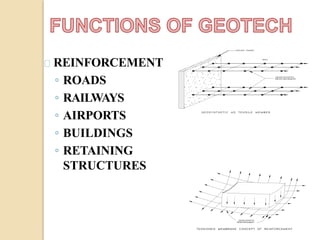
REINFORCEMENT
◦ ROADS
◦ RAILWAYS
◦ AIRPORTS
◦ BUILDINGS
◦ RETAINING
STRUCTURES
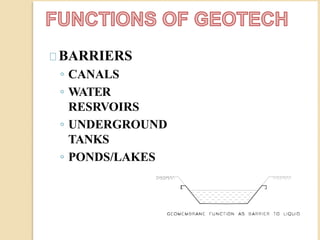
BARRIERS
◦ CANALS
◦ WATER
RESRVOIRS
◦ UNDERGROUND
TANKS
◦ PONDS/LAKES
(www.strataindia.com)
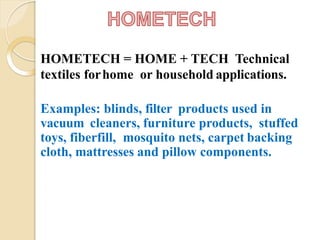
HOMETECH = HOME + TECH Technical
textiles forhome or household applications.
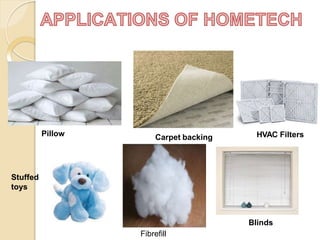
Examples: blinds, filter products used in
vacuum cleaners, furniture products, stuffed
toys, fiberfill, mosquito nets, carpet backing
cloth, mattresses and pillow components.
Pillow Carpet backing
Stuffed
toys
HVAC Filters
Fibrefill
Blinds
INDUTECH = INDU + TECH TECHNICAL
Textiles used in the Industrial (manufacturing)
sector.
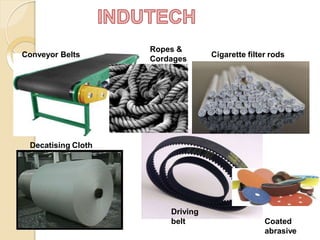
Examples: conveyor belts, driving belts, cigarette
filter, decatising cloth, bolting cloth, absorption glass
mats, glass battery separators, ropes and cordages,
composites, filtration products, industrial brushes
etc.
Conveyor Belts
Ropes &
Cordages
Decatising Cloth
Cigarette filter rods
Coated
abrasive
Driving
belt
MEDITECH = MEDI + TECH Technical
textiles used in Medical applications (hygiene,
health, personal care, surgicalapplications).
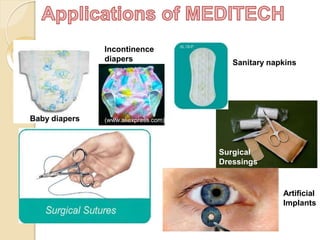
Examples: baby diapers, incontinence diapers,
sanitary napkins, surgical sutures, disposables,
surgical dressings, artificial implants, Maks,
PPE etc.
Baby diapers
Incontinence
diapers
Artificial
Implants
(www.aliexpress.com)
Sanitary napkins
Surgical
Dressings
MOBILTECH = MOBIL + TECH
Technical textiles used in automobiles
and their components (railways and
aircrafts).
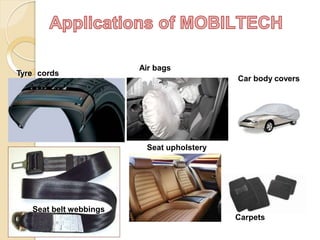
Examples: nylon tyre cord, seat belt webbing,
airbags, car body covers, seat upholstery,
automative carpets, headliners, insulation
felts, sunblinds.
Tyre cords
Air bags
Car body covers
Seat belt webbings
Seat upholstery
Carpets
OEKOTECH = ECO + TECH
Technical textiles used for
ecological/environmental functions.
Examples: membranes/composites/clay
liners used for landfill/chemical waste
management/ hazardous waste.
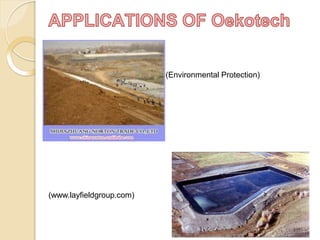
(Environmental Protection)
(www.layfieldgroup.com)
PACKTECH = PACK + TECH
Technical textiles used for packaging.
Examples: woven sacks, leno bags, jute
hessian sacks, soft luggage products,
teabags, etc.
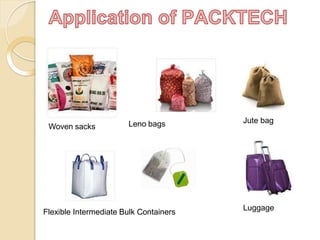
Leno bagsWoven sacks
Jute bag
Flexible Intermediate Bulk Containers
Luggage
PROTECH = PRO + TECH
Technical textiles used for protective
fabrics under hazardous conditions
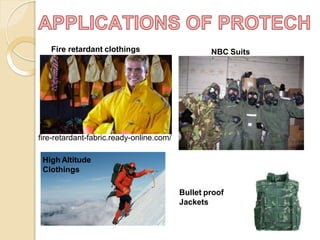
Examples: bullet proof jackets, nuclear
biological & chemical (nbc) suits, high
altitude clothing, fire retardant clothing
Fire retardant clothings NBC Suits
fire-retardant-fabric.ready-online.com/
High Altitude
Clothings
Bullet proof
Jackets
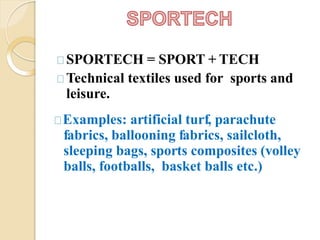
SPORTECH = SPORT + TECH
Technical textiles used for sports and
leisure.
Examples: artificial turf, parachute
fabrics, ballooning fabrics, sailcloth,
sleeping bags, sports composites (volley
balls, footballs, basket balls etc.)
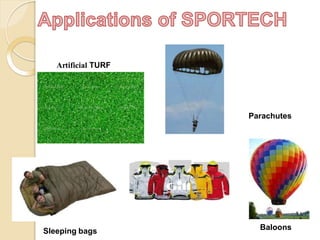
Artificial TURF
Parachutes
Sleeping bags Baloons
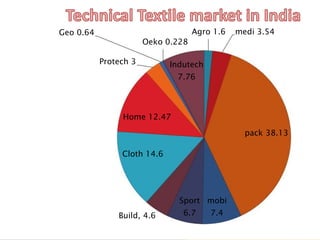
Geo 0.64
Protech 3
Agro 1.6 medi 3.54
Oeko 0.228
Indutech
7.76
Home 12.47
pack 38.13
Cloth 14.6
Sport mobi
Build, 4.6 6.7 7.4
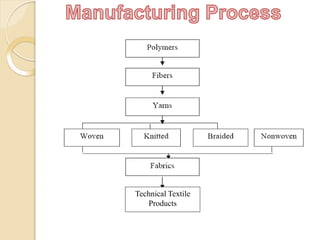
Technical Textile
Products
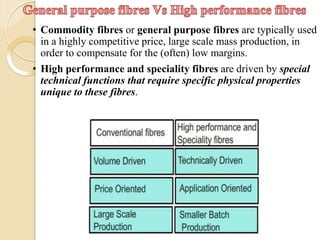
• Commodity fibres or general purpose fibres are typically used
in a highly competitive price, large scale mass production, in
order to compensate for the (often) low margins.
• High performance and speciality fibres are driven by special
technical functions that require specific physical properties
unique to these fibres.
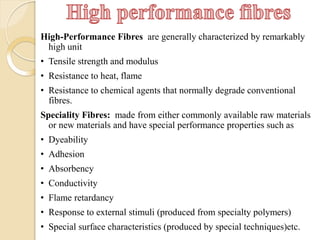
High-Performance Fibres are generally characterized by remarkably
high unit
• Tensile strength and modulus
• Resistance to heat, flame
• Resistance to chemical agents that normally degrade conventional
fibres.
Speciality Fibres: made from either commonly available raw materials
or new materials and have special performance properties such as
• Dyeability
• Adhesion
• Absorbency
• Conductivity
• Flame retardancy
• Response to external stimuli (produced from specialty polymers)
• Special surface characteristics (produced by special techniques)etc.
These can be obtained by using different approaches such as :
• Using Additives such as colorants, flame retardants,
conducting fillers, antistatic compounds, etc. during the
spinning process.
• Surface Modification using chemical finishes for specific
properties, such as hydrophilicity, high absorbency, low
friction, etc.
• Special Spinning Processes are used to produce different
cross-section, bicomponent micro or nanofibres.
• Advanced or Special Polymeric Materials are used for
making smart or responsive fibres. These can be shape
memory fibres (responsive to pH, temperature or electric
field), fibres that can store heat or chemicals and self
adaptive fibres (i.e. self tightening sutures, self-fitting shoes
and medical devices).
Nanofibres: Diameters of less than 100 nm.
• Processing techniques including drawing, template synthesis,
phase separation, self-assembly, and electrospinning.
• Synthetic and natural polymers have been electrospun including
polylactic acid (PLA), polyurethane (PU), polycaprolactone
(PCL), etc.
• Amongst natural polymers, collagen, chitosan, hyaluronic acid,
and silk fibrion have been successfully electrospun into
nanofibres.
• Many technical applications; in medicine, tissue engineering (2D
and 3D scaffolds), drug delivery, and implants to wound healing
and wound dressings.
• Nanofibres in engineering applications include filtration,
photovoltaic cells, membrane fuel cells, dye-sensitised solar cells
to carrier materials for various catalysts and photocatalytic
air/water purifiers.
• In apparel form, cover clothing, shoes, sportswear, diapers, and
napkins.
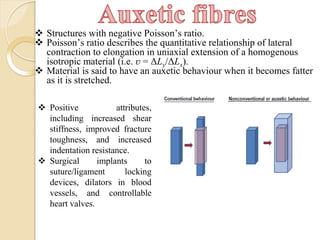
 Structures with negative Poisson’s ratio.
 Poisson’s ratio describes the quantitative relationship of lateral
contraction to elongation in uniaxial extension of a homogenous
isotropic material (i.e. ʋ = ΔLy/ΔLx).
 Material is said to have an auxetic behaviour when it becomes fatter
as it is stretched.
 Positive attributes,
including increased shear
stiffness, improved fracture
toughness, and increased
indentation resistance.
 Surgical implants to
suture/ligament locking
devices, dilators in blood
vessels, and controllable
heart valves.
• Fibres that can generate electricity due to the application of
force.
• Such materials include crystals, certain ceramics, some
biological matters (e.g. bones, proteins, and DNA).
• These fibres have a number of application potentials in
textile sensors, actuators, and energy absorption.
• These fibres can subsequently be woven or knitted into
textile-based garments or serve as the main textile
garments.
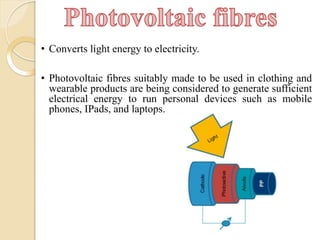
• Converts light energy to electricity.
• Photovoltaic fibres suitably made to be used in clothing and
wearable products are being considered to generate sufficient
electrical energy to run personal devices such as mobile
phones, IPads, and laptops.
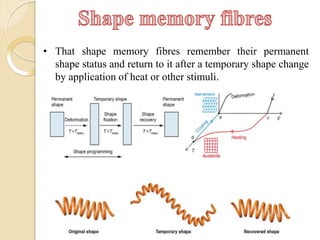
• That shape memory fibres remember their permanent
shape status and return to it after a temporary shape change
by application of heat or other stimuli.
• Naturally antimicrobial fibres include bamboo, alginate, and
chitosan.
• Alginate, originating from seaweed, is an anionic
polysaccharide that can absorb up to 200–300 times of water
on its own weight.
• Chitosan, which is derived from chitin by a chemical
deacetylation process, is found in the hard shell of
crustaceans such as crabs, lobsters, and shrimp.
• Collagen (the most abundant protein in the human body)
fibres have increasingly become more popular because of
their high strength and resilience, often matching fibres
found in human skin, blood vessels, teeth, and tendons.
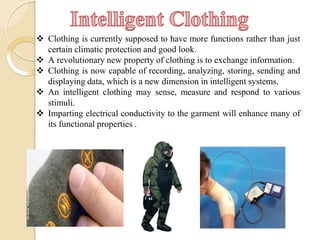
 Clothing is currently supposed to have more functions rather than just
certain climatic protection and good look.
 A revolutionary new property of clothing is to exchange information.
 Clothing is now capable of recording, analyzing, storing, sending and
displaying data, which is a new dimension in intelligent systems.
 An intelligent clothing may sense, measure and respond to various
stimuli.
 Imparting electrical conductivity to the garment will enhance many of
its functional properties .
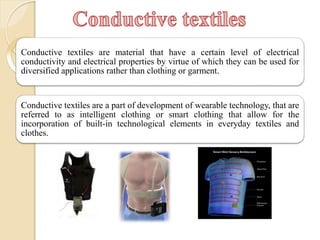
Conductive textiles
Conductive textiles are material that have a certain level of electrical
conductivity and electrical properties by virtue of which they can be used for
diversified applications rather than clothing or garment.
Conductive textiles are a part of development of wearable technology, that are
referred to as intelligent clothing or smart clothing that allow for the
incorporation of built-in technological elements in everyday textiles and
clothes.
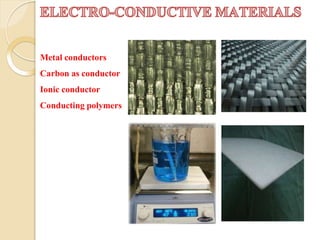
Metal conductors
Carbon as conductor
Ionic conductor
Conducting polymers
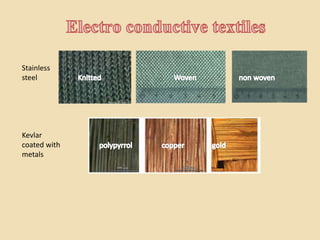
Stainless
steel
Kevlar
coated with
metals
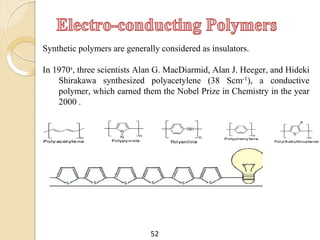
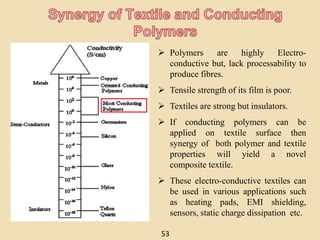
Synthetic polymers are generally considered as insulators.
In 1970s, three scientists Alan G. MacDiarmid, Alan J. Heeger, and Hideki
Shirakawa synthesized polyacetylene (38 Scm-1), a conductive
polymer, which earned them the Nobel Prize in Chemistry in the year
2000 .
52
 Polymers are highly Electro-
conductive but, lack processability to
produce fibres.
 Tensile strength of its film is poor.
 Textiles are strong but insulators.
 If conducting polymers can be
applied on textile surface then
synergy of both polymer and textile
properties will yield a novel
composite textile.
 These electro-conductive textiles can
be used in various applications such
as heating pads, EMI shielding,
sensors, static charge dissipation etc.
53
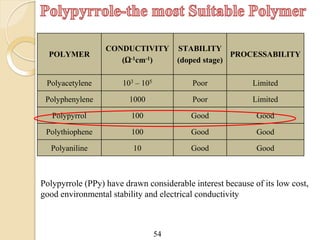
POLYMER
CONDUCTIVITY
(Ω-1cm-1)
STABILITY
(doped stage)
PROCESSABILITY
Polyacetylene 103 – 105 Poor Limited
Polyphenylene 1000 Poor Limited
Polypyrrol 100 Good Good
Polythiophene 100 Good Good
Polyaniline 10 Good Good
Polypyrrole (PPy) have drawn considerable interest because of its low cost,
good environmental stability and electrical conductivity
54
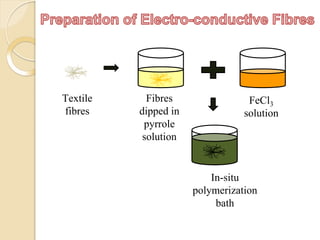
Textile
fibres
Fibres
dipped in
pyrrole
solution
FeCl3
solution
In-situ
polymerization
bath
56
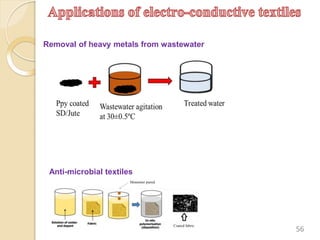
Removal of heavy metals from wastewater
Anti-microbial textiles
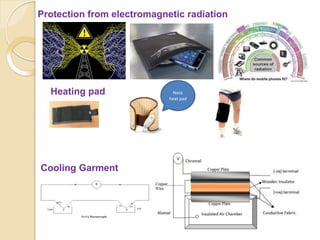
Protection from electromagnetic radiation
Heating pad
Cooling Garment
Neck
heat pad
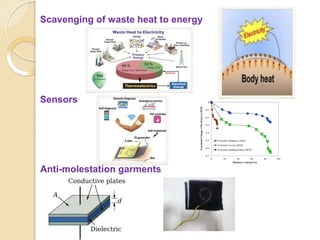
Scavenging of waste heat to energy
Sensors
Anti-molestation garments
THANK YOU FOR YOUR ATTENTION

Technicaltextile

  • 1.
    Dr. Subhankar Maity AssistantProfessor Uttar Pradesh Textile Technology Institute, Kanpur
  • 2.
     Technical textilesare the textile materials and products primarily manufactured for their technical performance and functional properties rather than aesthetics.  Thus function and performance are important characteristics of technical textiles.
  • 3.
    Technical Textile 20% Non-Apperal 18% Apperal 62%  The technicaltextile share in India is estimated to be 11.5–12% of all textile production.  The industry itself is expected to grow at a rate of 20% annually.
  • 4.
    1. AGROTECH 2. BUILDTECH 3.CLOTHTECH 4. GEOTECH 5. HOMETECH 6. INDUTECH 7. MEDITECH 8. MOBILTECH 9. OEKOTECH 10. PACKTECH 11. PROTECH 12. SPORTECH
  • 5.
    AGROTECH : AGRO+ TECH Technical textiles used in agriculture (includes horticulture, fisheries and forestry). Examples: shade nets, mulch, mats, nets, crop covers, anti hail nets, etc.
  • 6.
    Shed Nets Mulchmats Crop covers Anti hail nets Bird protection nets Fishing nets
  • 7.
    BUILDTECH = BUILD+TECH Technical textiles used in construction of building and structures. Tarpaulins awnings Architectural membranes Hoardings Scaffolding nets
  • 8.
    CLOTHTECH = CLOTH+ TECH for Specific functional applications in garments and shoes, largely hidden. Shoe laces Zip fasteners Elastic narrow fabric VelcroUmbrella cloth Sewing Thread Interlining
  • 9.
    GEOTECH= GEO +TECH Technical textile used in soil for specific application to improve load bearing capacity, filtration, drainage, reinforcement or prevent intermixing of two adjoining of materials. Examples: geotextiles, geogrids, geonets, geomembranes, geocomposites, geodrains etc.
  • 11.
  • 12.
  • 13.
  • 14.
    FILTRATION ◦ RAILWAYS ◦ AIRPORTS ◦ROADS ◦ DRAINS Natural Soil Geo-textile Water Flow Direction Granular Soil
  • 15.
  • 16.
    REINFORCEMENT ◦ ROADS ◦ RAILWAYS ◦AIRPORTS ◦ BUILDINGS ◦ RETAINING STRUCTURES
  • 17.
    BARRIERS ◦ CANALS ◦ WATER RESRVOIRS ◦UNDERGROUND TANKS ◦ PONDS/LAKES
  • 19.
  • 21.
    HOMETECH = HOME+ TECH Technical textiles forhome or household applications. Examples: blinds, filter products used in vacuum cleaners, furniture products, stuffed toys, fiberfill, mosquito nets, carpet backing cloth, mattresses and pillow components.
  • 22.
  • 23.
    INDUTECH = INDU+ TECH TECHNICAL Textiles used in the Industrial (manufacturing) sector. Examples: conveyor belts, driving belts, cigarette filter, decatising cloth, bolting cloth, absorption glass mats, glass battery separators, ropes and cordages, composites, filtration products, industrial brushes etc.
  • 24.
    Conveyor Belts Ropes & Cordages DecatisingCloth Cigarette filter rods Coated abrasive Driving belt
  • 25.
    MEDITECH = MEDI+ TECH Technical textiles used in Medical applications (hygiene, health, personal care, surgicalapplications). Examples: baby diapers, incontinence diapers, sanitary napkins, surgical sutures, disposables, surgical dressings, artificial implants, Maks, PPE etc.
  • 26.
  • 27.
    MOBILTECH = MOBIL+ TECH Technical textiles used in automobiles and their components (railways and aircrafts). Examples: nylon tyre cord, seat belt webbing, airbags, car body covers, seat upholstery, automative carpets, headliners, insulation felts, sunblinds.
  • 28.
    Tyre cords Air bags Carbody covers Seat belt webbings Seat upholstery Carpets
  • 29.
    OEKOTECH = ECO+ TECH Technical textiles used for ecological/environmental functions. Examples: membranes/composites/clay liners used for landfill/chemical waste management/ hazardous waste.
  • 30.
  • 31.
    PACKTECH = PACK+ TECH Technical textiles used for packaging. Examples: woven sacks, leno bags, jute hessian sacks, soft luggage products, teabags, etc.
  • 32.
    Leno bagsWoven sacks Jutebag Flexible Intermediate Bulk Containers Luggage
  • 33.
    PROTECH = PRO+ TECH Technical textiles used for protective fabrics under hazardous conditions Examples: bullet proof jackets, nuclear biological & chemical (nbc) suits, high altitude clothing, fire retardant clothing
  • 34.
    Fire retardant clothingsNBC Suits fire-retardant-fabric.ready-online.com/ High Altitude Clothings Bullet proof Jackets
  • 35.
    SPORTECH = SPORT+ TECH Technical textiles used for sports and leisure. Examples: artificial turf, parachute fabrics, ballooning fabrics, sailcloth, sleeping bags, sports composites (volley balls, footballs, basket balls etc.)
  • 36.
  • 37.
    Geo 0.64 Protech 3 Agro1.6 medi 3.54 Oeko 0.228 Indutech 7.76 Home 12.47 pack 38.13 Cloth 14.6 Sport mobi Build, 4.6 6.7 7.4
  • 38.
  • 39.
    • Commodity fibresor general purpose fibres are typically used in a highly competitive price, large scale mass production, in order to compensate for the (often) low margins. • High performance and speciality fibres are driven by special technical functions that require specific physical properties unique to these fibres.
  • 40.
    High-Performance Fibres aregenerally characterized by remarkably high unit • Tensile strength and modulus • Resistance to heat, flame • Resistance to chemical agents that normally degrade conventional fibres. Speciality Fibres: made from either commonly available raw materials or new materials and have special performance properties such as • Dyeability • Adhesion • Absorbency • Conductivity • Flame retardancy • Response to external stimuli (produced from specialty polymers) • Special surface characteristics (produced by special techniques)etc.
  • 41.
    These can beobtained by using different approaches such as : • Using Additives such as colorants, flame retardants, conducting fillers, antistatic compounds, etc. during the spinning process. • Surface Modification using chemical finishes for specific properties, such as hydrophilicity, high absorbency, low friction, etc. • Special Spinning Processes are used to produce different cross-section, bicomponent micro or nanofibres. • Advanced or Special Polymeric Materials are used for making smart or responsive fibres. These can be shape memory fibres (responsive to pH, temperature or electric field), fibres that can store heat or chemicals and self adaptive fibres (i.e. self tightening sutures, self-fitting shoes and medical devices).
  • 42.
    Nanofibres: Diameters ofless than 100 nm. • Processing techniques including drawing, template synthesis, phase separation, self-assembly, and electrospinning. • Synthetic and natural polymers have been electrospun including polylactic acid (PLA), polyurethane (PU), polycaprolactone (PCL), etc. • Amongst natural polymers, collagen, chitosan, hyaluronic acid, and silk fibrion have been successfully electrospun into nanofibres. • Many technical applications; in medicine, tissue engineering (2D and 3D scaffolds), drug delivery, and implants to wound healing and wound dressings. • Nanofibres in engineering applications include filtration, photovoltaic cells, membrane fuel cells, dye-sensitised solar cells to carrier materials for various catalysts and photocatalytic air/water purifiers. • In apparel form, cover clothing, shoes, sportswear, diapers, and napkins.
  • 43.
     Structures withnegative Poisson’s ratio.  Poisson’s ratio describes the quantitative relationship of lateral contraction to elongation in uniaxial extension of a homogenous isotropic material (i.e. ʋ = ΔLy/ΔLx).  Material is said to have an auxetic behaviour when it becomes fatter as it is stretched.  Positive attributes, including increased shear stiffness, improved fracture toughness, and increased indentation resistance.  Surgical implants to suture/ligament locking devices, dilators in blood vessels, and controllable heart valves.
  • 44.
    • Fibres thatcan generate electricity due to the application of force. • Such materials include crystals, certain ceramics, some biological matters (e.g. bones, proteins, and DNA). • These fibres have a number of application potentials in textile sensors, actuators, and energy absorption. • These fibres can subsequently be woven or knitted into textile-based garments or serve as the main textile garments.
  • 45.
    • Converts lightenergy to electricity. • Photovoltaic fibres suitably made to be used in clothing and wearable products are being considered to generate sufficient electrical energy to run personal devices such as mobile phones, IPads, and laptops.
  • 46.
    • That shapememory fibres remember their permanent shape status and return to it after a temporary shape change by application of heat or other stimuli.
  • 47.
    • Naturally antimicrobialfibres include bamboo, alginate, and chitosan. • Alginate, originating from seaweed, is an anionic polysaccharide that can absorb up to 200–300 times of water on its own weight. • Chitosan, which is derived from chitin by a chemical deacetylation process, is found in the hard shell of crustaceans such as crabs, lobsters, and shrimp. • Collagen (the most abundant protein in the human body) fibres have increasingly become more popular because of their high strength and resilience, often matching fibres found in human skin, blood vessels, teeth, and tendons.
  • 48.
     Clothing iscurrently supposed to have more functions rather than just certain climatic protection and good look.  A revolutionary new property of clothing is to exchange information.  Clothing is now capable of recording, analyzing, storing, sending and displaying data, which is a new dimension in intelligent systems.  An intelligent clothing may sense, measure and respond to various stimuli.  Imparting electrical conductivity to the garment will enhance many of its functional properties .
  • 49.
    Conductive textiles Conductive textilesare material that have a certain level of electrical conductivity and electrical properties by virtue of which they can be used for diversified applications rather than clothing or garment. Conductive textiles are a part of development of wearable technology, that are referred to as intelligent clothing or smart clothing that allow for the incorporation of built-in technological elements in everyday textiles and clothes.
  • 50.
    Metal conductors Carbon asconductor Ionic conductor Conducting polymers
  • 51.
  • 52.
    Synthetic polymers aregenerally considered as insulators. In 1970s, three scientists Alan G. MacDiarmid, Alan J. Heeger, and Hideki Shirakawa synthesized polyacetylene (38 Scm-1), a conductive polymer, which earned them the Nobel Prize in Chemistry in the year 2000 . 52
  • 53.
     Polymers arehighly Electro- conductive but, lack processability to produce fibres.  Tensile strength of its film is poor.  Textiles are strong but insulators.  If conducting polymers can be applied on textile surface then synergy of both polymer and textile properties will yield a novel composite textile.  These electro-conductive textiles can be used in various applications such as heating pads, EMI shielding, sensors, static charge dissipation etc. 53
  • 54.
    POLYMER CONDUCTIVITY (Ω-1cm-1) STABILITY (doped stage) PROCESSABILITY Polyacetylene 103– 105 Poor Limited Polyphenylene 1000 Poor Limited Polypyrrol 100 Good Good Polythiophene 100 Good Good Polyaniline 10 Good Good Polypyrrole (PPy) have drawn considerable interest because of its low cost, good environmental stability and electrical conductivity 54
  • 55.
  • 56.
    56 Removal of heavymetals from wastewater Anti-microbial textiles
  • 57.
    Protection from electromagneticradiation Heating pad Cooling Garment Neck heat pad
  • 58.
    Scavenging of wasteheat to energy Sensors Anti-molestation garments
  • 59.
    THANK YOU FORYOUR ATTENTION

Editor's Notes

  • #52 The basis of smart textiles are electroconductive materials. Several materials are in use. Metal fibres such as stainless steel and copper are readily available. The have a fair to excellent conductivity level. Their properties being very much different from polymer fibres they may be hard to process and show some particular problems of long term stability. Alternatively polylmer fibres may be coated with a conductive layer such as polypyrol, copper or gold. The conductivity will be maintained as long as the layer is intact and still adhering to the fibre.