

CLINICAL TEACHING ON
HEMODYNAMIC
MONITORING.
Presented by
Anvin Thomas
II MSC nursing
DEFINITION
 Hemodynamic monitoring refers to the
measurement of pressure ,flow and oxygenation of
blood with in the cardio vascular system
PURPOSES
 Early detection , identification and treatment of life
threatening conditions such as heart failure ,
cardiac tamponate.
 Evaluate patients immediate response to treatment
such as drugs and mechanical support.
 Evaluate the effectiveness of cardio vascular
functions such as cardiac output.
INDICATIONS
 Any deficits or loss of cardiac function such as MI,
congestive heart failure.
 All types of shock:
 Decreased urine output from dehydration,
haemorrhage ,GI bleed, burns or surgery.
CLASSIFIFICATION OF HAEMODYNAMIC
MONITORING
 Arterial blood pressure
 Pulmonary artery
wedge pressure
 CVP
 Thermodilution method
 Pulse oximetry
 Ecg
 Sphygmomanometer
 Doppler
echocardiography
 Fullness ofexternal
vein
 Pulse
INVASIVE NON INVASIVE
FACTORS INFLUENCING
HAEMODYNAMIC MONITORING
 Intravascular volume or amount of fluid circulating
 Strength of myocardial contraction
 Expanding and contracting of blood vessels(vaso activity)
 Rate of heart contraction
ARTERIAL BLOOD PRESSURE
Arterial blood pressure is the primary force driving
blood into the tissues.
Intra arterial pressure monitoring is a continuous and
direct method of monitoring blood pressure by
passing a catheter into an artery and connecting it
to an electronic pressure sensor called transducer.
CONTINUE…..
 This transducer converts the mechanical pressure
of the arterial pulse into electrical impulse and is
transmitted to a monitor.
INDICATIONS
 Patient with very high or very low blood pressure.
 Patients with fluctuating blood pressure like shock
 During the administration of drugs that alter the blood
pressure considerably.
 Extensive burns with limited intact skin surface.
 To obtain arterial blood for laboratory examination like
ABG
COMPONENTS
 Intra arterial catheter
 Transducer
 Bedside monitor
 Fluid source
PULMONARY ARTERY WEDGE
PRESSURE MONITORING
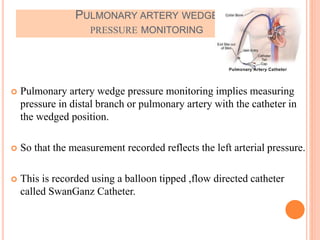
 Pulmonary artery wedge pressure monitoring implies measuring
pressure in distal branch or pulmonary artery with the catheter in
the wedged position.
 So that the measurement recorded reflects the left arterial pressure.
 This is recorded using a balloon tipped ,flow directed catheter
called SwanGanz Catheter.
PRINCIPLES
 The pulmonary artery wedge pressure is closely related to left
aerial pressure since are no valves in the pulmonary veins.
 Left arterial pressure is closely related to the left ventricular
end diastolic pressure
 Inflation of the balloon of the pulmonary artery stops blood
flow at that site, therefore pressure from left atria is
transmitted back to the catheter tip.
PURPOSES
 To measure direct pressure in the right atrium , right
ventricle, pulmonary artery and distal branches of
pulmonary artery.
 To infer the pressure in the left atrium and the filling
pressure of the left ventricle
 To measure the cardiac output by thermodilution
method
CONTINUE….
 To obtain blood samples from heart and
pulmonary artery.
 To serve as a guide for fluid management.
 To evaluate the success of a drug therapy.
DATA INTERPRETATION
 Elevated pulmonary capillary pressure is seen in
left ventricular failure.
 Low pulmonary capillary pressure indicates
decreased cardiac output.
CENTRAL VENOUS PRESSURE OR
RIGHT ATRIAL PRESSURE MEASUREMENT
 CVP reflects the pressure under which the blood is returned
to the right atrium.
 CVP is a measurement of right ventricular preload, which
measures the pressure in the right atrium or within vena
cava.
 It represents the filling pressure of the right ventricle and
indicates the ability of right side of the heart to manage the
fluid load in the circulatory system.
AIM/PURPOSES
 To evaluate the adequacy of circulating blood volume and
assess the degree of hypovolemia.
 To serve as a guide in fluid replacement in seriously ill
patients.
 To provide access to central veins for fluid replacement
in case of emergency.
 To administer long term chemotherapy.
SITES OF CATHETER PLACEMENT
 Sub clavian vein
 Internal or external jugular veins
 Median basilic vein
 Femoral (as a last resort)
DATA INTERPRETATION
 Normally CVP may range from 5 to 12 cm of water.
 Elevated CVP occurs in congestive heart failure
and in conditions of circulatory overload as in
excessive fluid infusion.
 A low CVP occurs in hypovolemic state due to fluid
loss.
THERMO DILUTION METHOD OF CARDIAC
OUT PUT MEASUREMENT
 This method uses a special thermistor (temperature
probe) swan Ganz Catheter inserted from a central
vein into the pulmonary artery.
 A cold solution example NS temperature at zero
degree celsius is injected into the right atrium from
the proximal cardiac port.
CONTINUE…
 The cooler solution causes a decrease in blood
temperature which is sensed by a thermistor placed in the
pulmonary artery catheter and are calculated by a
computerised monitor.
 The fluctuation in temperature (y- axis)produces a
graphed curve over time(x -axis)on the computerised
monitoring system .
 The cardiac output can be derived from the modified
Stewart-Hamilton conservation of heat equation.
CONTINUE…
 The pulmonary artery catheter is attached to the cardiac
output computer which calculate the output automatically.
 According to the research conducted by mr.Nirav in the
year 2008. they found that there is no significant
difference between thermo dilution invasive method and
non invasive cardiac output measurements.
GENERAL COMPLICATIONS AND NURSES
RESPONSIBILITY
 Air embolism
• Always use a closed IV fluid system connected to
CVP to prevent entry of air into veins.
• Always expel the air from the syringes before giving
each injection of medicine into the veins.
• All connections should be secured to prevent
accidental dislodging of the tube and entry of air
into veins.
CONTINUE….
 Clot formation and pulmonary embolism
• The CVP line should always be connected to an i.v
infusion to prevent clot formation in the intravenous
catheter.
• If a continuous IV drip is not used, flush the tubing
frequently with heparinised solution.
CONTINUE…
 Infection
• Use strict aspect techniques while preparing the tubing
• Inspect the catheter insertion site daily for pain, swelling
or exudates.
• Always maintain a closed system
CONTINUE…
 Arrhythmias
• Maintain an ECG monitoring to detect any arrhythmias
caused by the passage of catheter into the right ventricle.
• A chest X ray may be taken to check the position of
catheter.
CONTINUE…
 Fluid overload
• Carefully monitor intake output
• carefully monitor the CVP readings.
• Watch the other signs of fluid overload such as
pulmonary oedema, respiratory distress and frothy
sputum.
REFERENCE
• Woods,Erika,Sandra.Cardiac nursig.6ed.kluwer
publishers;page 460 to 492.
• Sister Nancy.Coronary care nursing.Delhi:kumar
publishing house;page 81 to 85.
• Chintamani, Asha ‘atal’.Lewis medical surgical
nursing.Elsevier;page 1686 to 1696.
Clinicalteaching [autosaved]

Clinicalteaching [autosaved]

  • 1.
  • 2.
    DEFINITION  Hemodynamic monitoringrefers to the measurement of pressure ,flow and oxygenation of blood with in the cardio vascular system
  • 3.
    PURPOSES  Early detection, identification and treatment of life threatening conditions such as heart failure , cardiac tamponate.  Evaluate patients immediate response to treatment such as drugs and mechanical support.  Evaluate the effectiveness of cardio vascular functions such as cardiac output.
  • 4.
    INDICATIONS  Any deficitsor loss of cardiac function such as MI, congestive heart failure.  All types of shock:  Decreased urine output from dehydration, haemorrhage ,GI bleed, burns or surgery.
  • 5.
    CLASSIFIFICATION OF HAEMODYNAMIC MONITORING Arterial blood pressure  Pulmonary artery wedge pressure  CVP  Thermodilution method  Pulse oximetry  Ecg  Sphygmomanometer  Doppler echocardiography  Fullness ofexternal vein  Pulse INVASIVE NON INVASIVE
  • 6.
    FACTORS INFLUENCING HAEMODYNAMIC MONITORING Intravascular volume or amount of fluid circulating  Strength of myocardial contraction  Expanding and contracting of blood vessels(vaso activity)  Rate of heart contraction
  • 7.
    ARTERIAL BLOOD PRESSURE Arterialblood pressure is the primary force driving blood into the tissues. Intra arterial pressure monitoring is a continuous and direct method of monitoring blood pressure by passing a catheter into an artery and connecting it to an electronic pressure sensor called transducer.
  • 8.
    CONTINUE…..  This transducerconverts the mechanical pressure of the arterial pulse into electrical impulse and is transmitted to a monitor.
  • 9.
    INDICATIONS  Patient withvery high or very low blood pressure.  Patients with fluctuating blood pressure like shock  During the administration of drugs that alter the blood pressure considerably.  Extensive burns with limited intact skin surface.  To obtain arterial blood for laboratory examination like ABG
  • 10.
    COMPONENTS  Intra arterialcatheter  Transducer  Bedside monitor  Fluid source
  • 11.
    PULMONARY ARTERY WEDGE PRESSUREMONITORING  Pulmonary artery wedge pressure monitoring implies measuring pressure in distal branch or pulmonary artery with the catheter in the wedged position.  So that the measurement recorded reflects the left arterial pressure.  This is recorded using a balloon tipped ,flow directed catheter called SwanGanz Catheter.
  • 12.
    PRINCIPLES  The pulmonaryartery wedge pressure is closely related to left aerial pressure since are no valves in the pulmonary veins.  Left arterial pressure is closely related to the left ventricular end diastolic pressure  Inflation of the balloon of the pulmonary artery stops blood flow at that site, therefore pressure from left atria is transmitted back to the catheter tip.
  • 13.
    PURPOSES  To measuredirect pressure in the right atrium , right ventricle, pulmonary artery and distal branches of pulmonary artery.  To infer the pressure in the left atrium and the filling pressure of the left ventricle  To measure the cardiac output by thermodilution method
  • 14.
    CONTINUE….  To obtainblood samples from heart and pulmonary artery.  To serve as a guide for fluid management.  To evaluate the success of a drug therapy.
  • 15.
    DATA INTERPRETATION  Elevatedpulmonary capillary pressure is seen in left ventricular failure.  Low pulmonary capillary pressure indicates decreased cardiac output.
  • 16.
    CENTRAL VENOUS PRESSUREOR RIGHT ATRIAL PRESSURE MEASUREMENT  CVP reflects the pressure under which the blood is returned to the right atrium.  CVP is a measurement of right ventricular preload, which measures the pressure in the right atrium or within vena cava.  It represents the filling pressure of the right ventricle and indicates the ability of right side of the heart to manage the fluid load in the circulatory system.
  • 17.
    AIM/PURPOSES  To evaluatethe adequacy of circulating blood volume and assess the degree of hypovolemia.  To serve as a guide in fluid replacement in seriously ill patients.  To provide access to central veins for fluid replacement in case of emergency.  To administer long term chemotherapy.
  • 18.
    SITES OF CATHETERPLACEMENT  Sub clavian vein  Internal or external jugular veins  Median basilic vein  Femoral (as a last resort)
  • 19.
    DATA INTERPRETATION  NormallyCVP may range from 5 to 12 cm of water.  Elevated CVP occurs in congestive heart failure and in conditions of circulatory overload as in excessive fluid infusion.  A low CVP occurs in hypovolemic state due to fluid loss.
  • 20.
    THERMO DILUTION METHODOF CARDIAC OUT PUT MEASUREMENT  This method uses a special thermistor (temperature probe) swan Ganz Catheter inserted from a central vein into the pulmonary artery.  A cold solution example NS temperature at zero degree celsius is injected into the right atrium from the proximal cardiac port.
  • 21.
    CONTINUE…  The coolersolution causes a decrease in blood temperature which is sensed by a thermistor placed in the pulmonary artery catheter and are calculated by a computerised monitor.  The fluctuation in temperature (y- axis)produces a graphed curve over time(x -axis)on the computerised monitoring system .  The cardiac output can be derived from the modified Stewart-Hamilton conservation of heat equation.
  • 22.
    CONTINUE…  The pulmonaryartery catheter is attached to the cardiac output computer which calculate the output automatically.  According to the research conducted by mr.Nirav in the year 2008. they found that there is no significant difference between thermo dilution invasive method and non invasive cardiac output measurements.
  • 23.
    GENERAL COMPLICATIONS ANDNURSES RESPONSIBILITY  Air embolism • Always use a closed IV fluid system connected to CVP to prevent entry of air into veins. • Always expel the air from the syringes before giving each injection of medicine into the veins. • All connections should be secured to prevent accidental dislodging of the tube and entry of air into veins.
  • 24.
    CONTINUE….  Clot formationand pulmonary embolism • The CVP line should always be connected to an i.v infusion to prevent clot formation in the intravenous catheter. • If a continuous IV drip is not used, flush the tubing frequently with heparinised solution.
  • 25.
    CONTINUE…  Infection • Usestrict aspect techniques while preparing the tubing • Inspect the catheter insertion site daily for pain, swelling or exudates. • Always maintain a closed system
  • 26.
    CONTINUE…  Arrhythmias • Maintainan ECG monitoring to detect any arrhythmias caused by the passage of catheter into the right ventricle. • A chest X ray may be taken to check the position of catheter.
  • 27.
    CONTINUE…  Fluid overload •Carefully monitor intake output • carefully monitor the CVP readings. • Watch the other signs of fluid overload such as pulmonary oedema, respiratory distress and frothy sputum.
  • 28.
    REFERENCE • Woods,Erika,Sandra.Cardiac nursig.6ed.kluwer publishers;page460 to 492. • Sister Nancy.Coronary care nursing.Delhi:kumar publishing house;page 81 to 85. • Chintamani, Asha ‘atal’.Lewis medical surgical nursing.Elsevier;page 1686 to 1696.