VALVE REPLACEMENT /REPAIR
SURGERY
ANVIN THOMAS
MSC NURSING
INTRODUCTION
 Blood that flows between different chambers of your
heart must flow through a heart valve. Blood that
flows out of your heart into large arteries must also
flow through a heart valve.
 These valves open up enough so that blood can flow
through. They then close, keeping blood from flowing
backward.
 The introduction of valve replacement surgery in the
early 1960s has dramatically improved the outcome of
patients with valvular heart disease
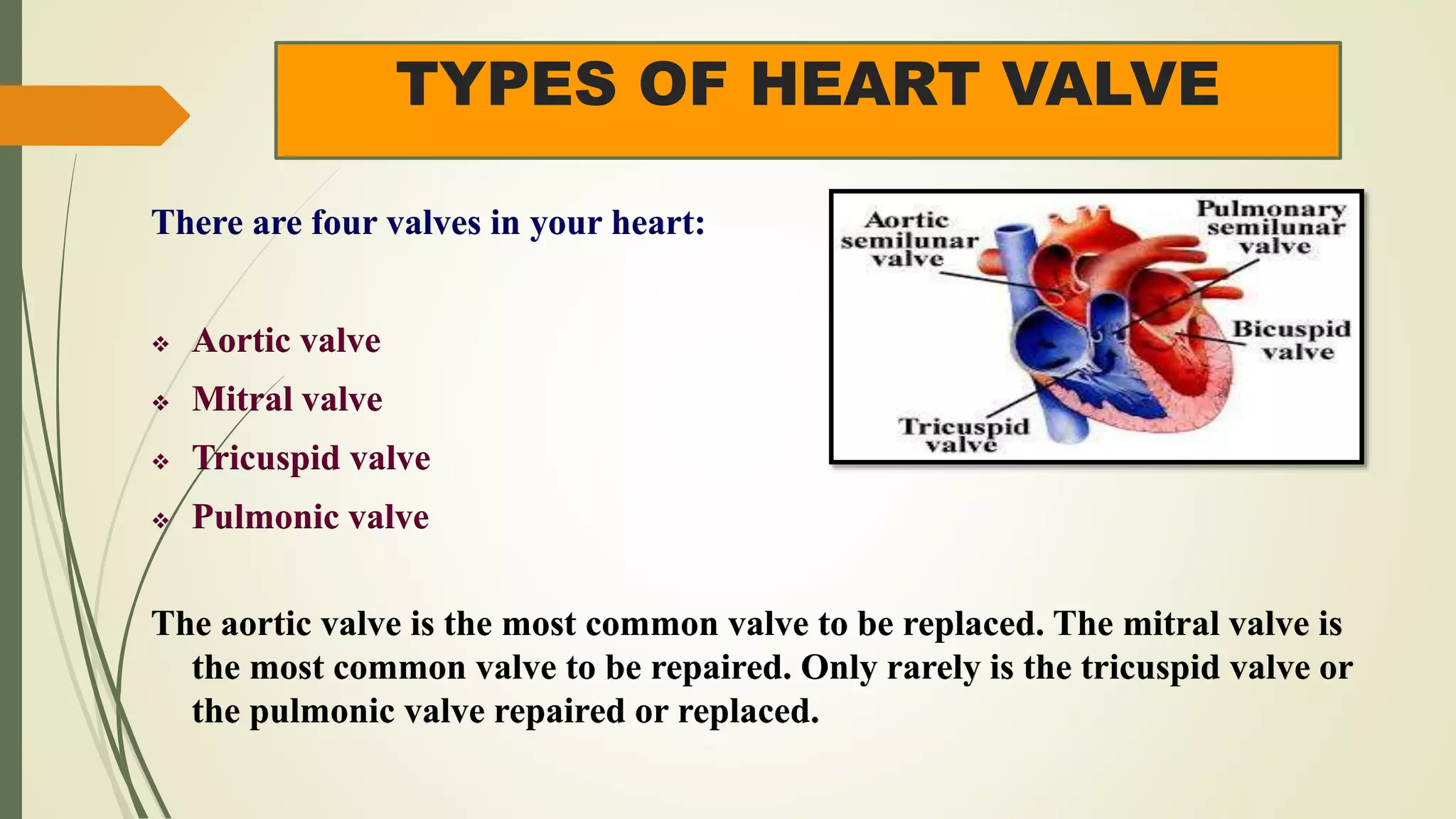
TYPES OF HEART VALVE
There are four valves in your heart:
 Aortic valve
 Mitral valve
 Tricuspid valve
 Pulmonic valve
The aortic valve is the most common valve to be replaced. The mitral valve is
the most common valve to be repaired. Only rarely is the tricuspid valve or
the pulmonic valve repaired or replaced.
VALVE REPLACEMENT SURGERY
 Valve replacement surgery is the replacement
of one or more of the heart valves with either
an artificial heart valve or a bioprosthesis.
(Homograft from human tissue or xenograft
eg pig. )
PROSTHETIC HEART VALVE
 Despite the improvements in prosthetic valve design and surgical procedures ,
valve replacement does not provide a definitive cure.
 Prosthetic Valves are classified as tissue or mechanical
1. Tissue:(homograft,autograft,xenograft)
Made of biologic tissue from an animal (bio prosthesis or heterograft) or
human (homograft or auto graft) source
2.Mechanical(cageball,tilting disk,bileaflets)
Made of non biologic material (pyrolitic carbon, polymeric silicone substances, or
titanium)
Blood flow characteristics, hemodynamic, durability, and thromboembolic
tendency vary depending on the type and size of the prosthesis and
characteristics of the patient
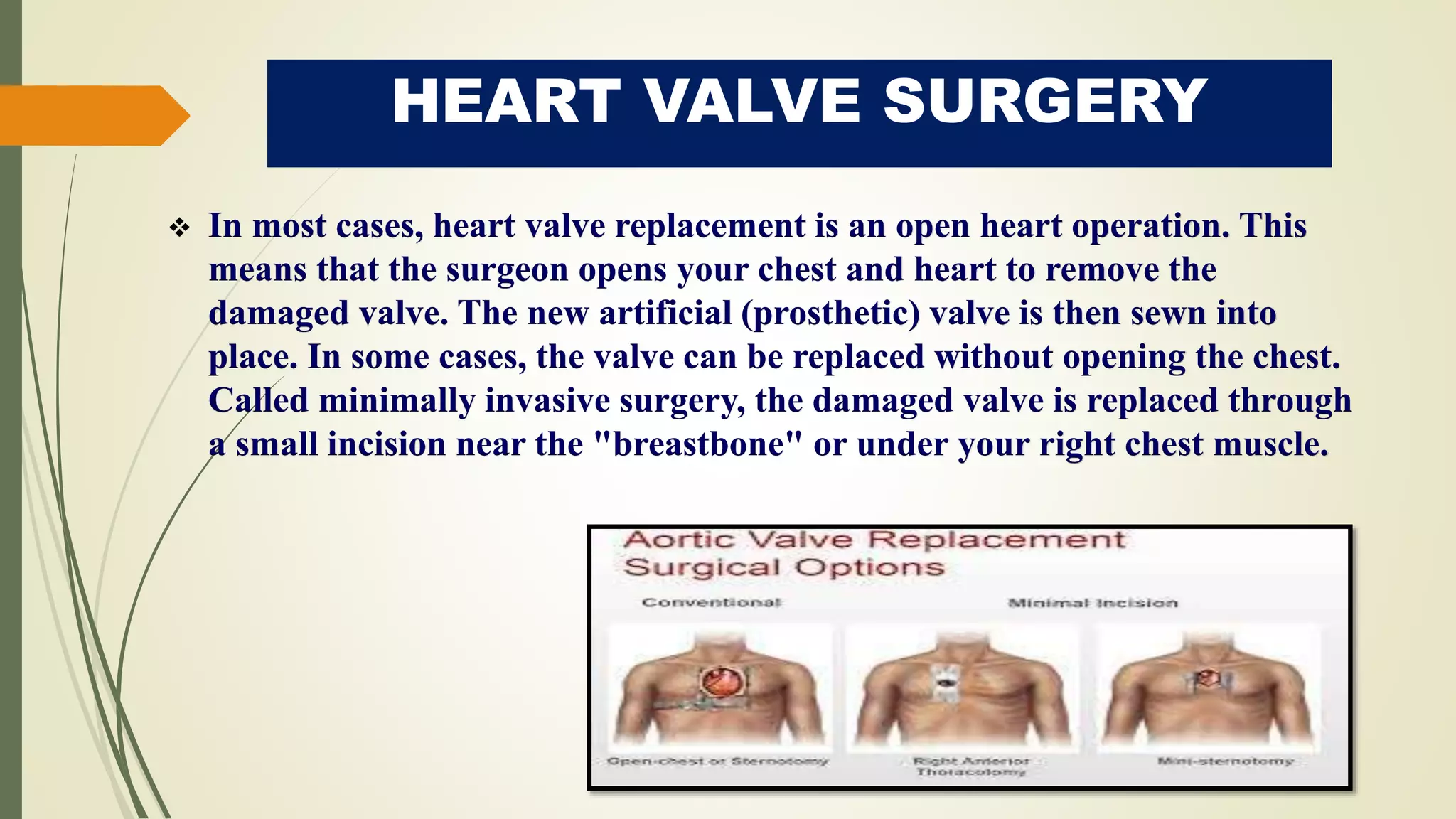
HEART VALVE SURGERY
 In most cases, heart valve replacement is an open heart operation. This
means that the surgeon opens your chest and heart to remove the
damaged valve. The new artificial (prosthetic) valve is then sewn into
place. In some cases, the valve can be replaced without opening the chest.
Called minimally invasive surgery, the damaged valve is replaced through
a small incision near the "breastbone" or under your right chest muscle.
MINIMALLY INVASIVE SURGERY
 In which the surgeon replaces the valve
through small incision between two and four
inches in length rather than cutting a six to
ten inch incision down the center of sternum.
 Minimally invasive surgery involves shorter
recovery time and more attractive cosmetic
results.
THERE ARE FOUR PROCEDURES
AORTIC VALVE REPLACEMENT
The aortic valve is between the left ventricle and the aorta
Aortic stenosis and aortic regurgitation probably makes the need for
aortic valve replacement.
The aortic valve is the most common valve to be replaced.
PERCUTANEOUS AORTIC CATHETER
BALLOON VALVULOPLASTY
 In which the balloon is inflated fracturing
calcified nodes and increasing the size of the
aortic valve orifice.
 But restenosis can occur approximately half of
the patient with in 6 months and balloon
valvuloplasty has been largely abandoned and is
reserved for only those candidates unstable for
surgery.
TRANS CATHETER AORTIC VALVE
REPLACEMENT (TAVR)
 It is an alternative for high risk and older
patients (age about 75 years).
 The catheter may be inserted through the
femoral artery or through a small incision in
the chest and then through a large artery
 In TAVR which deliver a new valve to the site of
the diseased valve through a catheter.
 Replacement valve is packaged in a way similar
to a stent.
AORTIC VALVE REPLACEMENT
PROCEDURE(OPEN HEART SURGERY)
Its carried under general anaestic
Aortic valve replacement is done through median sternotomy.
Once the pericardium has been opened the patient is put on a heart lung machine.
Once the patient is on bypass the surgeon removes the patient’s aortic valve and a mechanical or
tissue valve is put in its place.
Then the aorta will be closed , followed by taken off the heart lung machine.
Trasnsesophageal echocardiogram can be used to verify that the new valve is functioning
properly.
MITRAL VALVE
 Mitral valve also known as the bicuspid valve or left atrio
ventricular valve. Which lies between the left atrium and
left ventricle.
 Valve stenosis or valve regurgitation makes the valve to be
replaced.
 Many mitral valves can be repaired instead of replaced,
especially for minimally damaged values.
 According to American heart association, the aortic valve
and the mitral valve are the most commonly replaced
valves. Pulmonary and tricuspid valve replacements are
fairly uncommon in adults.
MITRAL VALVE REPLACEMENT
 Mitral valve replacement is a surgical procedure in which a
patient’s diseased mitral valve is replaced by either a
mechanical or bio prosthetic valve.
MITRAL VALVE REPLACEMENT PROCEDURE
Patient receiving general anaesthesia.
Incision is made vertically through sternum
Heart is exposed , reroute blood to a heart lung machine
An incision is made in the left atrium to expose the mitral valve
The valve is then replaced with either a biological or mechanical valve.
Left atrium is then closed and the patient weaned from cardiopulmonary bypass.
After two days the patient may be taken out of intensive care unit.
TRANS CATHETER MITRAL VALVE
REPLACEMENT
 Trans catheter mitral valve replacement devices are in development.
 Mitral valve anatomy is much more complex than the aortic which is
why it has taken more time to develop a trans catheter valve and
deployment system.
 Mitral valve repair can be done by minimum invasive surgeries or by
robotic surgeries.
TRICUSPID VALVE
 The tricuspid or right atrio ventricular valve lies between the right atrium
and the right ventricle.
 If the valve is not functioning properly it can affect the blood flow to the
lungs(pulmonary artery) and rest of the body.
 Tricuspid valve can be affected by rheumatic fever, congenital abnormalities
etc.
 Operations on the tricuspid valve are usually performed in conjuction with
treatment of some other valvular heart disease.
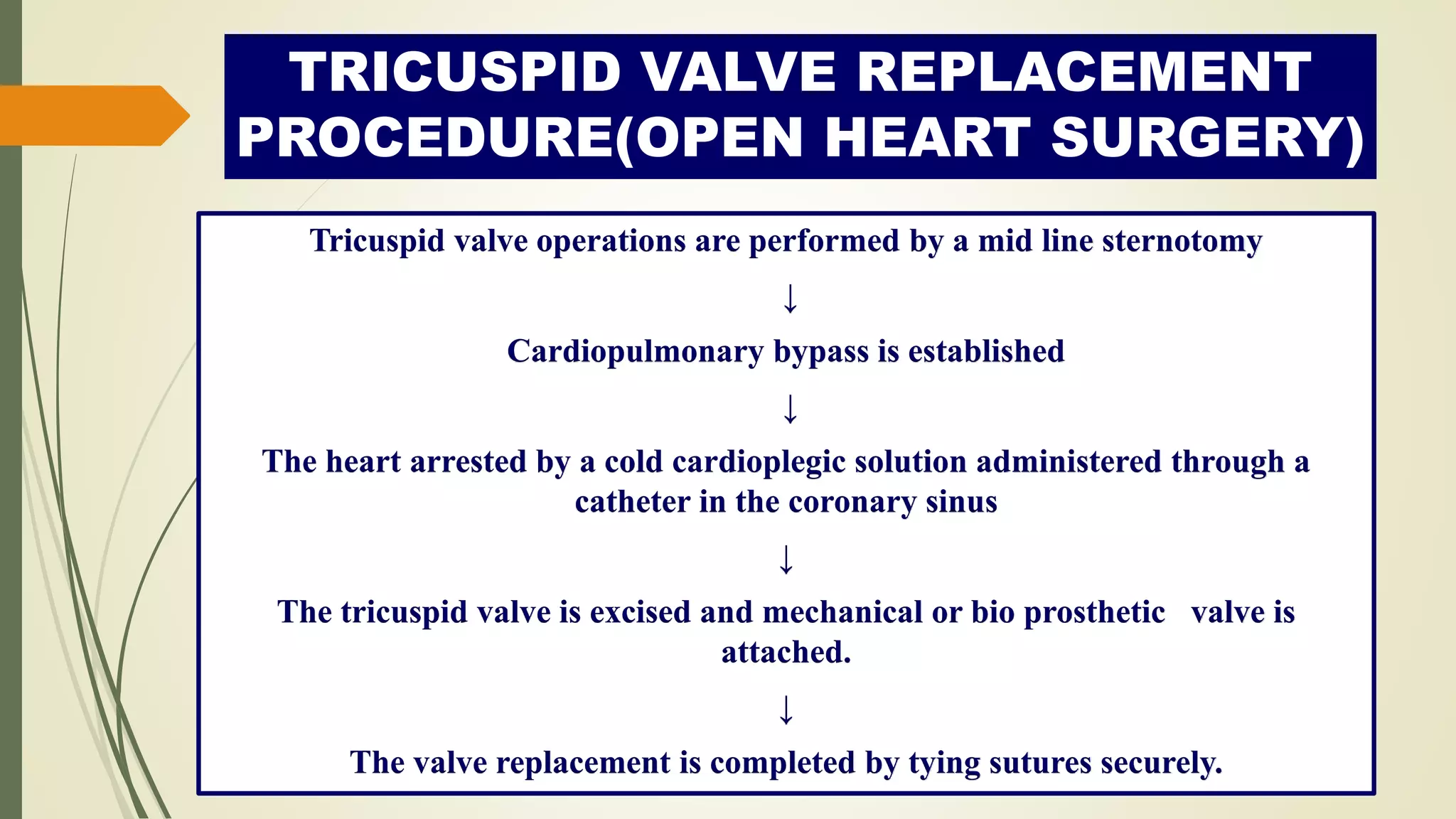
TRICUSPID VALVE REPLACEMENT
PROCEDURE(OPEN HEART SURGERY)
Tricuspid valve operations are performed by a mid line sternotomy
↓
Cardiopulmonary bypass is established
↓
The heart arrested by a cold cardioplegic solution administered through a
catheter in the coronary sinus
↓
The tricuspid valve is excised and mechanical or bio prosthetic valve is
attached.
↓
The valve replacement is completed by tying sutures securely.
RESEARCH EVIDENCE
 According to the article published by Khaled in European journal of cardio
thoracic surgery he stated that the tricuspid valve replacement on a beating heart
has good outcome or reduces the morbidity and mortality rates.
22/01/18
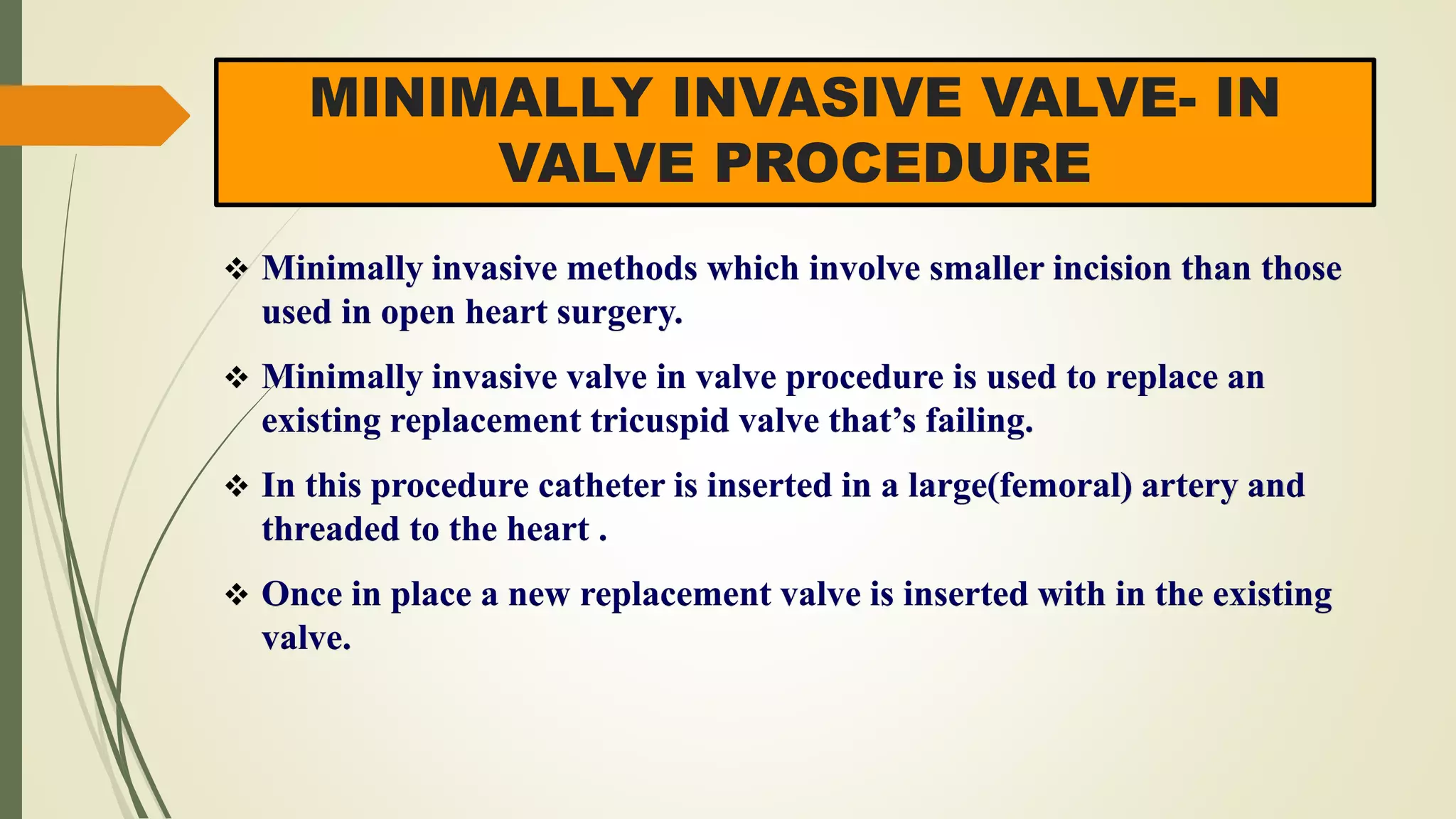
MINIMALLY INVASIVE VALVE- IN
VALVE PROCEDURE
 Minimally invasive methods which involve smaller incision than those
used in open heart surgery.
 Minimally invasive valve in valve procedure is used to replace an
existing replacement tricuspid valve that’s failing.
 In this procedure catheter is inserted in a large(femoral) artery and
threaded to the heart .
 Once in place a new replacement valve is inserted with in the existing
valve.
RESEARCH EVIDENCE
 According to the research conducted by kick sung, they found that in tricuspid valve
replacement a low operative mortality can be achieved through optimum perioperative
management in the current area.
22/01/18
PULMONARY VALVE
 Pulmonary valve is the semilunar valve of the heart that lies between the
right ventricle and pulmonary artery.
 Pulmonary valve replacement may be needed in case of pulmonary
regurgitation ,TOF and pulmonary stenosis.
 Surgery on the pulmonary valve is always performed in conjunction
with another cardiac procedure usually a repair of mitral valve.
PULMONARY VALVE REPLACEMENT
PROCEDURE(ROSSPROCEDURE)(OPEN HEART
SURGERY)
 Incision is made in the sternum and allowing the access to sternum.
 Heart lung bypass is used.
 It is necessary to stop your heart from beating during the procedure and
valve repair or replacement is done on a motionless, blood less field.
TRANSCATHETER PULMONARY VALVE
(ROSS PROCEDURE)THERAPY(TPV)
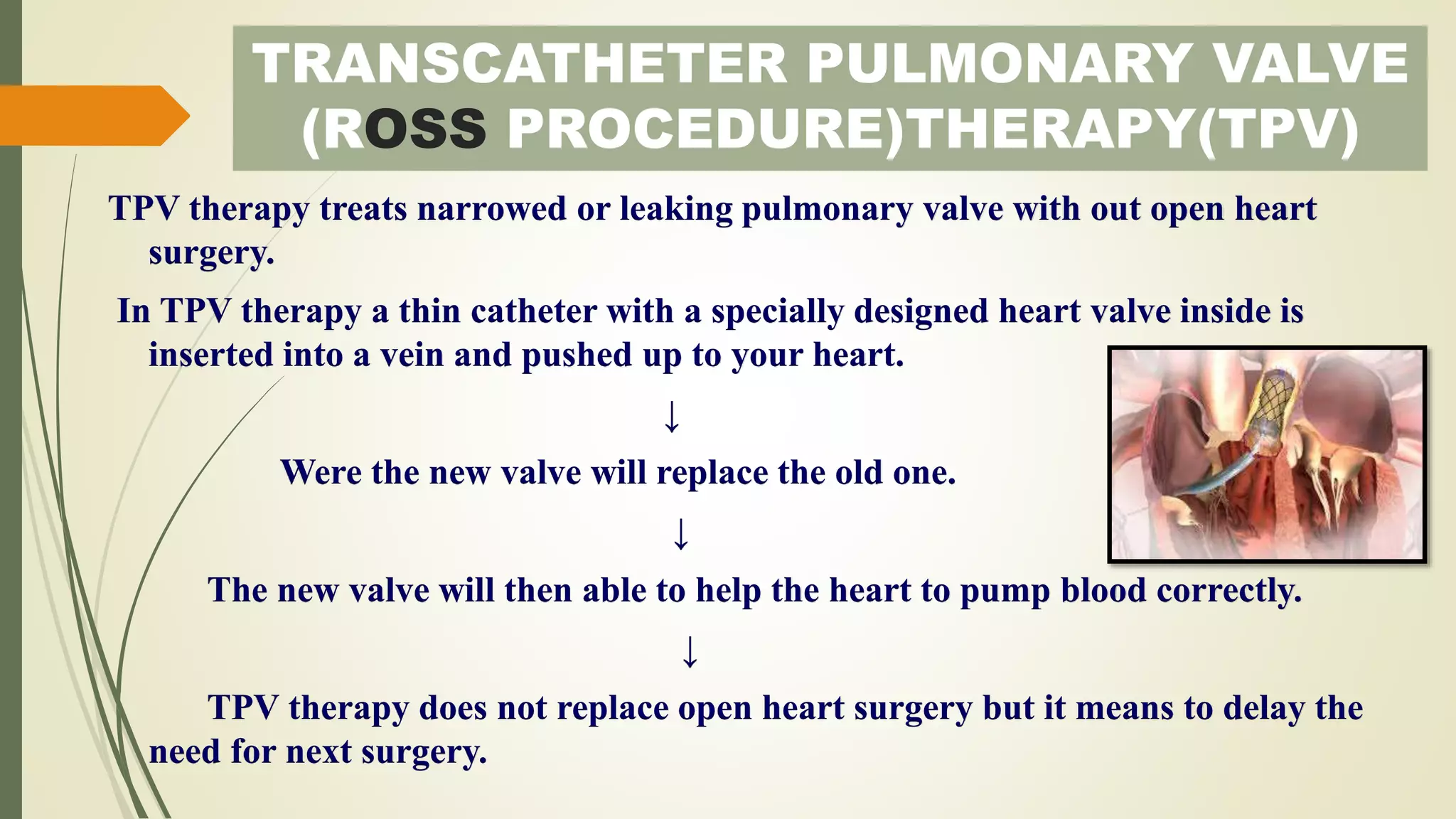
TPV therapy treats narrowed or leaking pulmonary valve with out open heart
surgery.
In TPV therapy a thin catheter with a specially designed heart valve inside is
inserted into a vein and pushed up to your heart.
↓
Were the new valve will replace the old one.
↓
The new valve will then able to help the heart to pump blood correctly.
↓
TPV therapy does not replace open heart surgery but it means to delay the
need for next surgery.
WHICH VALVE IS BEST MECHANICAL
OR BIOLOGICAL VALVE?
 Made from man made material.
Example
starr-Edwards ,cromie,sutter.
 More durable and last longer than
biologic valves.
 Increased risk of thrombo embolism,
necessitating long term anticoagulation
therapy.
 The main complication is haemorrhage
from the use of anticoagulants.
BIOLOGIC VALVES
 Constructed from bovine, porcine
and human cardiac tissues and
usually contain some man made
materials. Examples cadaver valve.
 Less durable due to the tendency for
early calcification, tissue
degeneration and stiffening of the
leaflets
 Does not require anticoagulation
therapy due to their low
thrombogenecity.
PROSTATIC VALVE
COMPLICATIONS/COMPLICATIONS OF
SURGERY
 Paravalvular leaks
 bleeding
 Thrombosis
 Infective endocarditis and other infections
 Valve dysfunction in replacement valves.
 Heart attacks
 Heart rhythm problems
 Rejection
CONTRA INDICATIONS
 ARRITHMIAS
 CVA
 BLEEDING DISORDER
 LV DISFUNCTION
22/01/18
VALVE REPAIR OR REPLACE
 When possible its generally best to repair a valve and preserve a
persons own tissue in the heart.
 How ever when the tissue is too damaged a replacement valve may be
used from another human heart an animal or a mechanical valve.
TECHNIQUES OF HEART VALVE REPAIR
1.Percutaneous trans luminal balloon valvuloplasty.
PTBV procedure is generally indicated for older adult patients and for
patients who are poor surgery candidates.
Balloon valvuloplasty is used for mitral, tricuspid and pulmonic stenosis
and less often for aortic stenosis.
2.Mitral valve annuloplasty.
PERCUTANEOUS TRANSLUMINAL
BALLOON VALVULOPLASTY
 The procedure is usually performed in cath LAB.
 Involves threading a balloon tipped catheter from the
femoral artery or vein to the stenotic valve.
 Balloon may be inflated in an attempt to separate the
valve leaflets.
MITRAL VALVE ANNULOPLASTY
 Mitral valve annuloplasty is a surgical technique for the
repair of leaking mitral valves.
 Due to various factors the two leaflets normally involved in
sealing the mitral valve to retrograde flow may not coapt
properly.
 Surgical repair typically involves the implantation of a
device surrounding the mitral valve, called annuloplasty
device, which pulls the leaflets together to facilitate
coaptation and aids to re-establish mitral valve function
ADVANTAGES OF VALVE REPAIR
V/S REPLACEMENT
1.Preservation of heart function by retaining hearts natural shape and
function.
2. Freedom from life long medication.
3.Longer durability ;studies have shown that 15 years after surgery 82 to 87
percent of repaired valves compared with 72 to 82 percent of replacement
valves.
NURSES RESPONSIBILITY
 Enquire whether patient is pregnant.
 Ask the patient to stop smoking(if any)
 For one week period before surgery the patient may be
asked to stop taking medicines that make it harder for
patients blood to clot eg aspirin.
 Conform with physician/ surgeon which drug patient has
to still take on the day of surgery.
 Prophylactic antibiotics may be initiated before surgery.
 Periodic monitoring of all vital signs are necessary after
surgery.
BIBLIOGRAPHY
 Woods ‘etal’.cardiac nursing.6th ed.wolters Kluwer;2010.p 707-713.
 Lewis’s medical surgical nursing.elsevier;2011.page 876-877.
 Internet
Heart valve

Heart valve

  • 1.
  • 2.
    INTRODUCTION  Blood thatflows between different chambers of your heart must flow through a heart valve. Blood that flows out of your heart into large arteries must also flow through a heart valve.  These valves open up enough so that blood can flow through. They then close, keeping blood from flowing backward.  The introduction of valve replacement surgery in the early 1960s has dramatically improved the outcome of patients with valvular heart disease
  • 3.
    TYPES OF HEARTVALVE There are four valves in your heart:  Aortic valve  Mitral valve  Tricuspid valve  Pulmonic valve The aortic valve is the most common valve to be replaced. The mitral valve is the most common valve to be repaired. Only rarely is the tricuspid valve or the pulmonic valve repaired or replaced.
  • 4.
    VALVE REPLACEMENT SURGERY Valve replacement surgery is the replacement of one or more of the heart valves with either an artificial heart valve or a bioprosthesis. (Homograft from human tissue or xenograft eg pig. )
  • 5.
    PROSTHETIC HEART VALVE Despite the improvements in prosthetic valve design and surgical procedures , valve replacement does not provide a definitive cure.  Prosthetic Valves are classified as tissue or mechanical 1. Tissue:(homograft,autograft,xenograft) Made of biologic tissue from an animal (bio prosthesis or heterograft) or human (homograft or auto graft) source 2.Mechanical(cageball,tilting disk,bileaflets) Made of non biologic material (pyrolitic carbon, polymeric silicone substances, or titanium) Blood flow characteristics, hemodynamic, durability, and thromboembolic tendency vary depending on the type and size of the prosthesis and characteristics of the patient
  • 6.
    HEART VALVE SURGERY In most cases, heart valve replacement is an open heart operation. This means that the surgeon opens your chest and heart to remove the damaged valve. The new artificial (prosthetic) valve is then sewn into place. In some cases, the valve can be replaced without opening the chest. Called minimally invasive surgery, the damaged valve is replaced through a small incision near the "breastbone" or under your right chest muscle.
  • 7.
    MINIMALLY INVASIVE SURGERY In which the surgeon replaces the valve through small incision between two and four inches in length rather than cutting a six to ten inch incision down the center of sternum.  Minimally invasive surgery involves shorter recovery time and more attractive cosmetic results.
  • 8.
    THERE ARE FOURPROCEDURES
  • 9.
    AORTIC VALVE REPLACEMENT Theaortic valve is between the left ventricle and the aorta Aortic stenosis and aortic regurgitation probably makes the need for aortic valve replacement. The aortic valve is the most common valve to be replaced.
  • 10.
    PERCUTANEOUS AORTIC CATHETER BALLOONVALVULOPLASTY  In which the balloon is inflated fracturing calcified nodes and increasing the size of the aortic valve orifice.  But restenosis can occur approximately half of the patient with in 6 months and balloon valvuloplasty has been largely abandoned and is reserved for only those candidates unstable for surgery.
  • 11.
    TRANS CATHETER AORTICVALVE REPLACEMENT (TAVR)  It is an alternative for high risk and older patients (age about 75 years).  The catheter may be inserted through the femoral artery or through a small incision in the chest and then through a large artery  In TAVR which deliver a new valve to the site of the diseased valve through a catheter.  Replacement valve is packaged in a way similar to a stent.
  • 12.
    AORTIC VALVE REPLACEMENT PROCEDURE(OPENHEART SURGERY) Its carried under general anaestic Aortic valve replacement is done through median sternotomy. Once the pericardium has been opened the patient is put on a heart lung machine. Once the patient is on bypass the surgeon removes the patient’s aortic valve and a mechanical or tissue valve is put in its place. Then the aorta will be closed , followed by taken off the heart lung machine. Trasnsesophageal echocardiogram can be used to verify that the new valve is functioning properly.
  • 13.
    MITRAL VALVE  Mitralvalve also known as the bicuspid valve or left atrio ventricular valve. Which lies between the left atrium and left ventricle.  Valve stenosis or valve regurgitation makes the valve to be replaced.  Many mitral valves can be repaired instead of replaced, especially for minimally damaged values.  According to American heart association, the aortic valve and the mitral valve are the most commonly replaced valves. Pulmonary and tricuspid valve replacements are fairly uncommon in adults.
  • 14.
    MITRAL VALVE REPLACEMENT Mitral valve replacement is a surgical procedure in which a patient’s diseased mitral valve is replaced by either a mechanical or bio prosthetic valve.
  • 15.
    MITRAL VALVE REPLACEMENTPROCEDURE Patient receiving general anaesthesia. Incision is made vertically through sternum Heart is exposed , reroute blood to a heart lung machine An incision is made in the left atrium to expose the mitral valve The valve is then replaced with either a biological or mechanical valve. Left atrium is then closed and the patient weaned from cardiopulmonary bypass. After two days the patient may be taken out of intensive care unit.
  • 16.
    TRANS CATHETER MITRALVALVE REPLACEMENT  Trans catheter mitral valve replacement devices are in development.  Mitral valve anatomy is much more complex than the aortic which is why it has taken more time to develop a trans catheter valve and deployment system.  Mitral valve repair can be done by minimum invasive surgeries or by robotic surgeries.
  • 17.
    TRICUSPID VALVE  Thetricuspid or right atrio ventricular valve lies between the right atrium and the right ventricle.  If the valve is not functioning properly it can affect the blood flow to the lungs(pulmonary artery) and rest of the body.  Tricuspid valve can be affected by rheumatic fever, congenital abnormalities etc.  Operations on the tricuspid valve are usually performed in conjuction with treatment of some other valvular heart disease.
  • 18.
    TRICUSPID VALVE REPLACEMENT PROCEDURE(OPENHEART SURGERY) Tricuspid valve operations are performed by a mid line sternotomy ↓ Cardiopulmonary bypass is established ↓ The heart arrested by a cold cardioplegic solution administered through a catheter in the coronary sinus ↓ The tricuspid valve is excised and mechanical or bio prosthetic valve is attached. ↓ The valve replacement is completed by tying sutures securely.
  • 19.
    RESEARCH EVIDENCE  Accordingto the article published by Khaled in European journal of cardio thoracic surgery he stated that the tricuspid valve replacement on a beating heart has good outcome or reduces the morbidity and mortality rates. 22/01/18
  • 20.
    MINIMALLY INVASIVE VALVE-IN VALVE PROCEDURE  Minimally invasive methods which involve smaller incision than those used in open heart surgery.  Minimally invasive valve in valve procedure is used to replace an existing replacement tricuspid valve that’s failing.  In this procedure catheter is inserted in a large(femoral) artery and threaded to the heart .  Once in place a new replacement valve is inserted with in the existing valve.
  • 21.
    RESEARCH EVIDENCE  Accordingto the research conducted by kick sung, they found that in tricuspid valve replacement a low operative mortality can be achieved through optimum perioperative management in the current area. 22/01/18
  • 22.
    PULMONARY VALVE  Pulmonaryvalve is the semilunar valve of the heart that lies between the right ventricle and pulmonary artery.  Pulmonary valve replacement may be needed in case of pulmonary regurgitation ,TOF and pulmonary stenosis.  Surgery on the pulmonary valve is always performed in conjunction with another cardiac procedure usually a repair of mitral valve.
  • 23.
    PULMONARY VALVE REPLACEMENT PROCEDURE(ROSSPROCEDURE)(OPENHEART SURGERY)  Incision is made in the sternum and allowing the access to sternum.  Heart lung bypass is used.  It is necessary to stop your heart from beating during the procedure and valve repair or replacement is done on a motionless, blood less field.
  • 24.
    TRANSCATHETER PULMONARY VALVE (ROSSPROCEDURE)THERAPY(TPV) TPV therapy treats narrowed or leaking pulmonary valve with out open heart surgery. In TPV therapy a thin catheter with a specially designed heart valve inside is inserted into a vein and pushed up to your heart. ↓ Were the new valve will replace the old one. ↓ The new valve will then able to help the heart to pump blood correctly. ↓ TPV therapy does not replace open heart surgery but it means to delay the need for next surgery.
  • 25.
    WHICH VALVE ISBEST MECHANICAL OR BIOLOGICAL VALVE?  Made from man made material. Example starr-Edwards ,cromie,sutter.  More durable and last longer than biologic valves.  Increased risk of thrombo embolism, necessitating long term anticoagulation therapy.  The main complication is haemorrhage from the use of anticoagulants. BIOLOGIC VALVES  Constructed from bovine, porcine and human cardiac tissues and usually contain some man made materials. Examples cadaver valve.  Less durable due to the tendency for early calcification, tissue degeneration and stiffening of the leaflets  Does not require anticoagulation therapy due to their low thrombogenecity.
  • 26.
    PROSTATIC VALVE COMPLICATIONS/COMPLICATIONS OF SURGERY Paravalvular leaks  bleeding  Thrombosis  Infective endocarditis and other infections  Valve dysfunction in replacement valves.  Heart attacks  Heart rhythm problems  Rejection
  • 27.
    CONTRA INDICATIONS  ARRITHMIAS CVA  BLEEDING DISORDER  LV DISFUNCTION 22/01/18
  • 28.
    VALVE REPAIR ORREPLACE  When possible its generally best to repair a valve and preserve a persons own tissue in the heart.  How ever when the tissue is too damaged a replacement valve may be used from another human heart an animal or a mechanical valve.
  • 29.
    TECHNIQUES OF HEARTVALVE REPAIR 1.Percutaneous trans luminal balloon valvuloplasty. PTBV procedure is generally indicated for older adult patients and for patients who are poor surgery candidates. Balloon valvuloplasty is used for mitral, tricuspid and pulmonic stenosis and less often for aortic stenosis. 2.Mitral valve annuloplasty.
  • 30.
    PERCUTANEOUS TRANSLUMINAL BALLOON VALVULOPLASTY The procedure is usually performed in cath LAB.  Involves threading a balloon tipped catheter from the femoral artery or vein to the stenotic valve.  Balloon may be inflated in an attempt to separate the valve leaflets.
  • 31.
    MITRAL VALVE ANNULOPLASTY Mitral valve annuloplasty is a surgical technique for the repair of leaking mitral valves.  Due to various factors the two leaflets normally involved in sealing the mitral valve to retrograde flow may not coapt properly.  Surgical repair typically involves the implantation of a device surrounding the mitral valve, called annuloplasty device, which pulls the leaflets together to facilitate coaptation and aids to re-establish mitral valve function
  • 32.
    ADVANTAGES OF VALVEREPAIR V/S REPLACEMENT 1.Preservation of heart function by retaining hearts natural shape and function. 2. Freedom from life long medication. 3.Longer durability ;studies have shown that 15 years after surgery 82 to 87 percent of repaired valves compared with 72 to 82 percent of replacement valves.
  • 33.
    NURSES RESPONSIBILITY  Enquirewhether patient is pregnant.  Ask the patient to stop smoking(if any)  For one week period before surgery the patient may be asked to stop taking medicines that make it harder for patients blood to clot eg aspirin.  Conform with physician/ surgeon which drug patient has to still take on the day of surgery.  Prophylactic antibiotics may be initiated before surgery.  Periodic monitoring of all vital signs are necessary after surgery.
  • 34.
    BIBLIOGRAPHY  Woods ‘etal’.cardiacnursing.6th ed.wolters Kluwer;2010.p 707-713.  Lewis’s medical surgical nursing.elsevier;2011.page 876-877.  Internet