JOURNAL CLUB
PRESENTATION
Presented by
Anvin Thomas
1 yr M.Sc (N)
Effect Of Structured Nursing Care Strategies
Regarding Home Based Care Of Patients With
Parkinson's Disease
 Parkinson’s disease is the second most common
neurodegenerative disorder
 It is a chronic slow progressive disorder caused by loss of
dompaminergic neurons in the substantia nigra .
 Patients with Parkinson's disease are confronting with
many physical, psychological and psychosocial issues that
impact quality of life.
1. To assess baseline knowledge, attitude and practice regarding
home based care of patients with Parkinson's disease.
2. To evaluate the effect of structured nursing care strategies
regarding home based care on knowledge attitude and practice
of patients with Parkinson's disease.
3. To find out the association between knowledge regarding
home based care among patients with Parkinson's
disease and selected socio demographic variables.
 H1:There is significant difference in pretest and
post test scores of knowledge regarding home
based care in patients with Parkinson's disease.
 H2:There is significant difference in pretest and
posttest scores of attitude regarding home based
care in patients with Parkinson's disease
 H3:There is significant difference in pretest and post test
scores of practice regarding home based care in patients
with Parkinson's disease
 H4 :There is significant association between knowledge
regarding home based care of patients with Parkinson's
disease and selected demographic variables.
Research
Approach
Quantitative Approach
Research design Quasi experimental design
- One group pre test post test design.
Setting
Neurology OPD in KIMS hospital
Trivandrum
Population Patients diagnosed as
Parkinson's disease
Sampling technique
Non- probability sampling
(Purposive Sampling)
Sampling Size 40 Parkinson’s patients
Inclusion
criteria
•Patients diagnosed as Parkinson's
disease who were able to read and write
Malayalam or English
EXCLUSI
ON
CRITERIA
• Patients who were not able to read and
write Malayalam or English
• Health care professionals
Instruments
used
•Structured questionnaire
To assess socio demographic data and clinical
variables
•Knowledge questionnaire
To assess knowledge towards home care of Parkinson's
disease
• self reported practise questionnaire and attitude
scale
To access practice and attitude towards home care of
Parkinson's disease
Data
collectio
n
Method
•A brief introduction about researcher himself and the study
were given to study subjects and obtained informed
consent for participation.
•Pre-test was conducted among 40 samples and assessed
their knowledge, attitude and practice.
•On the same day the investigator administered structured
nursing care strategies individually to each samples for 45
mints and an instructional module on home based care
regarding Parkinson's disease was given to the samples for
reference
 Four weeks after the intervention, post test was
conducted on the samples using the same tool
 Data obtained was analysed using descriptive and
inferential statics
RESULTS
 Majority of patients with Parkinson's disease 37.5% belonged to the
age group 60-69yrs.
 Males were the predominant category 70% among the sample
 Most of the patients 60 % had high school education.
 Majority 40% of patients with Parkinson's disease
were retired employees.
 Majority 50% of patients had monthly income of rs
500-15000.
 Most 72.5% of patients belongs to nuclear family.
Pretest
• 70% had poor
knowledge
• 30% had satisfactory
knowledge
Post test
• 52.5% of patients had
good knowledge
• 47.5% had satisfactory
knowledge
Pretest
• 92.5%of patients had
negative attitude
• 7.5%had positive
attitude regarding
home based care of
patients with
Parkinson's disease
Post test
• 90.% had positive
attitude regarding
home based care of
patients with
Parkinson's disease
Pretest
• 67.5% were following
poor practice
• 27.5% were following
satisfactory practice
regarding home based
care
Post test
• 92.5% had good
practice
• 7.5%had satisfactory
practice regarding
home based care of
Parkinson's disease
 A study was done to estimate the prevalence of Parkinson's
disease in Egypt. The study concluded that prevalence of
parkinsonism was found to increase steadily with age and
majority of them were above 60 years
Parkinson’s disease is increasing globally and patients
with Parkinson's disease are facing many debilitating
symptoms which have a significant impact on their
quality of life.
CRITIQUE
Title of the Paper:
Effect of structured nursing care strategies regarding
home based care of patients with Parkinson's disease
Name of the Journal Kerala nursing forum
Volume 11
Issue 45
Page No 28-33
Year 2016
PARTICULARS OBSERVATIONS
Type of Journal Academic Journal
Publisher Professional organization
Under what section of journal the
article is Published
Original research
ISSN 12248-907X
Mesh Representation Not mentioned
DOI Not mentioned
Peer reviewed No
Impact Factor Not mentioned
Eigen factor Not Mentioned
ABOUT THE AUTHORS:
Sl. NO ITEMS RESPONSE
1.
Designation /
Institutional
attachments
Aswathy Asokan A.N
Second year MSC nursing student at the
time of submitting the article
Graceamma Joseph
Vice principal, KIMS college of nursing
Thiruvananthapuram
ABOUT THE AUTHORS:
Sl. NO ITEMS RESPONSE
2a.
2b.
Work / Publications
in same area
H-index
Department of medicine
Not mentioned
TITLE OF THE ARTICLE:
Sl. NO ITEMS RESPONSE
3a
Indicates topic and focus
of the study
Effect of structured nursing care strategies
regarding home based care of patients with
Parkinson's disease
3b
Indicates the research
question Effect of structured nursing care strategies
3c Title meaningful and
complete
yes
TITLE OF THE ARTICLE:
Sl. NO ITEMS RESPONSE
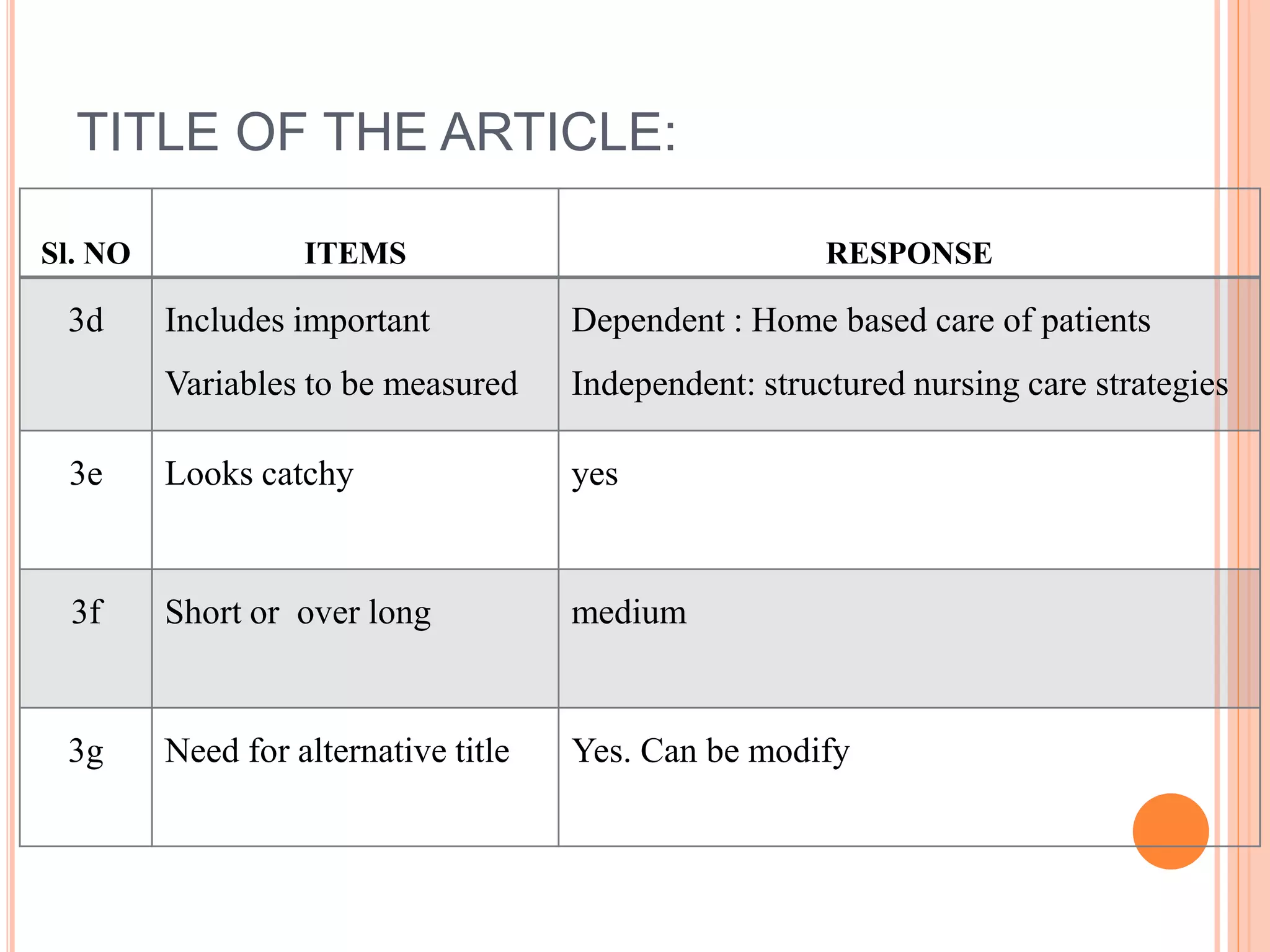
3d Includes important
Variables to be measured
Dependent : Home based care of patients
Independent: structured nursing care strategies
3e Looks catchy yes
3f Short or over long medium
3g Need for alternative title Yes. Can be modify
ABSTRACT:
Sl. NO ITEMS RESPONSE
4a Structured
Yes
It is structured under following headings;
With proper introduction, purpose of study,
objectives and hypothesis are stated well
4b Informative Yes. Structured nursing care strategy was
effective , post test scores on knowledge,
attitude and practice is higher than pre-test
score.
ABSTRACT:
Sl. NO ITEMS RESPONSE
4c Indicative Yes,
Methodology and the results were
clearly mentioned.
4d Reflects contents Yes
4e Provides entire gist of
entire study
Yes
KEY WORDS:
Sl. NO ITEMS RESPONSE
5a Present Yes
Structured nursing care strategies, home based
care, Parkinson's disease, knowledge, attitude,
practice
5b Appropriate Yes
INTRODUCTION:
Sl. NO ITEMS RESPONSE
6a Stock opening Alarmist approach
6b Meaningful and
concise
Yes
6c Built on existing
literature
Yes
6d Logically presented Yes
CONTINUE.
Sl. NO ITEMS RESPONSE
6e Omission of some
important studies
Yes
6f Citation relevant and
pertinent
Yes
6g Presented the Need for
the study
Yes
6h Stated research objective Yes
METHODOLOGY:
Sl. NO ITEMS RESPONSE
7a Study design One group pre-test post test design
7b Study setting Neurology OPD clinics in KIMS
hospital Trivandrum
7c Study Population 40 Patients diagnosed as parkinsonism
disease. Confusing . Not mentioned
whether they are able to understand the
researcher.
7d Variables Independent- structured nursing care strategies
Dependent – Home based care of patients
CONTINUE…
Sl. NO ITEMS RESPONSE
7e Bias Present
7f Study/ Sample size 40
7g Sampling Purposive
7h Ethical Review Board
consent
Not mentioned
7i Informed Consent Yes
STATISTICAL METHODS:
Sl. NO ITEMS RESPONSE
8a Describes all
statistical methods
Yes
8b Describes other
analyses?
no
RESULTS:
Sl. NO ITEMS RESPONSE
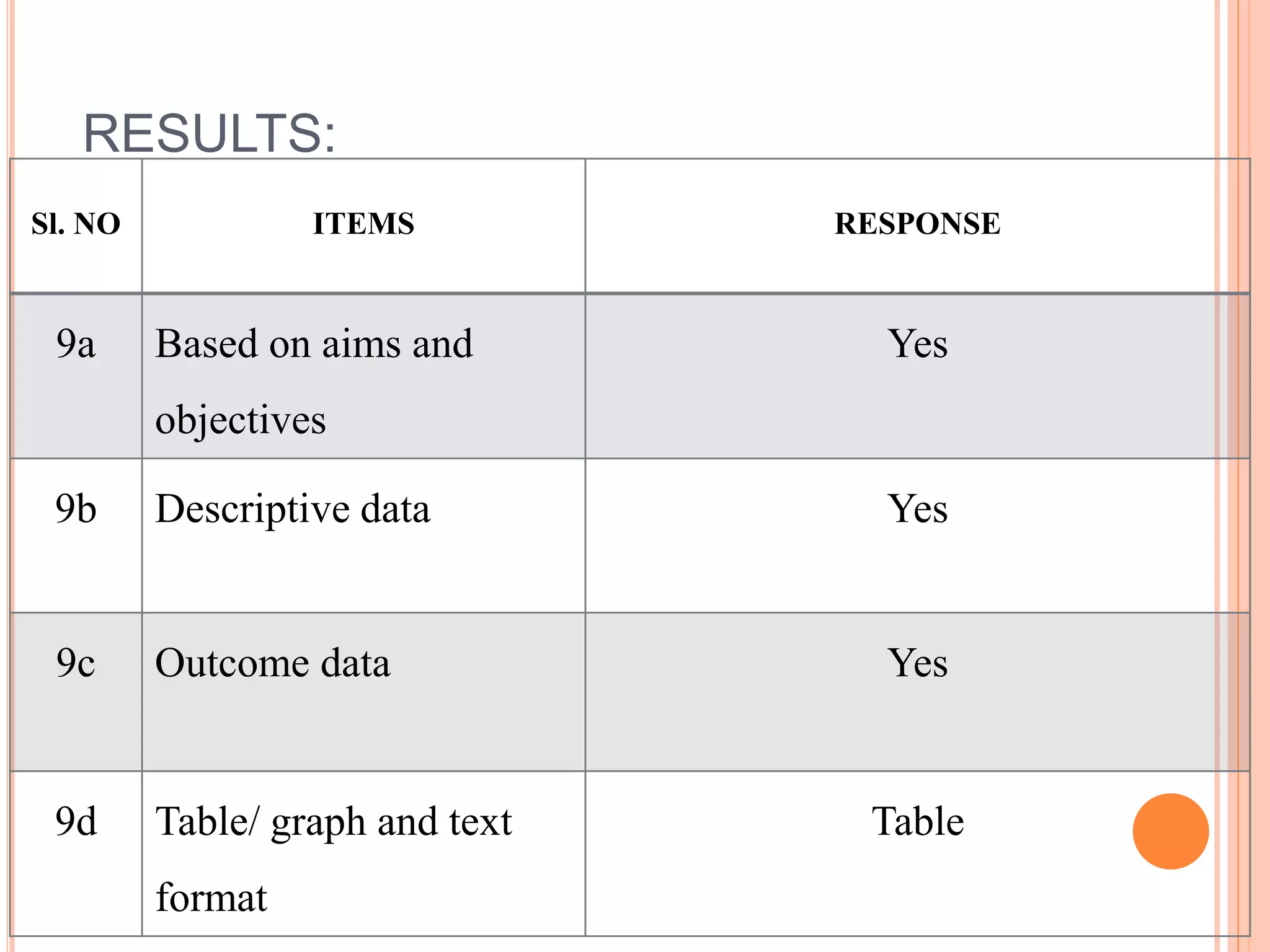
9a Based on aims and
objectives
Yes
9b Descriptive data Yes
9c Outcome data Yes
9d Table/ graph and text
format
Table
DISCUSSION:
Sl. NO ITEMS RESPONSE
10a Explain Key results Yes
10b Compared with existing
Literature
Yes
10c Limitation No
10d Remedy for Limitation No
10e Generalizability No
CONCLUSION:
Sl. NO ITEMS RESPONSE
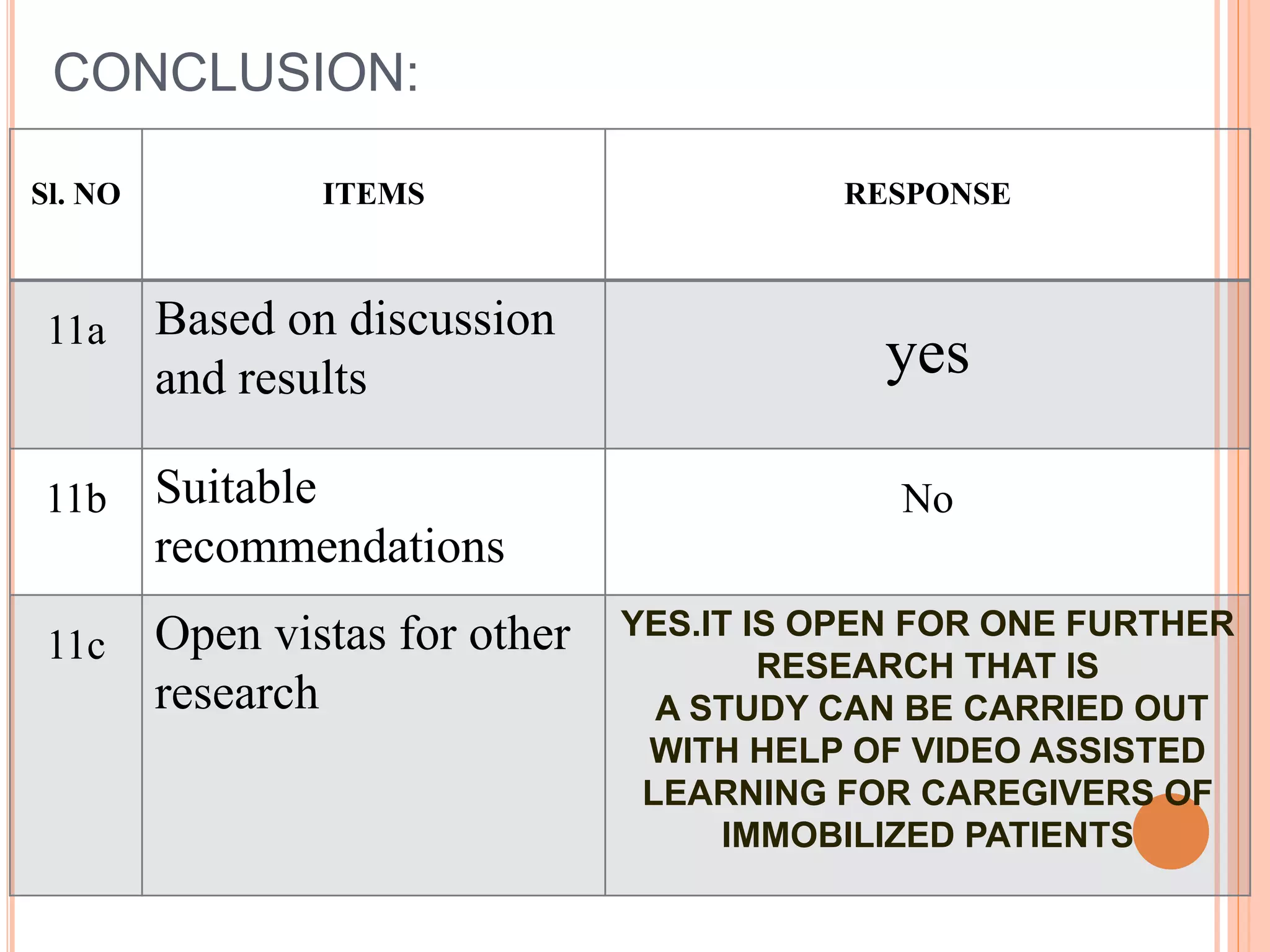
11a Based on discussion
and results yes
11b Suitable
recommendations
No
11c Open vistas for other
research
YES.IT IS OPEN FOR ONE FURTHER
RESEARCH THAT IS
A STUDY CAN BE CARRIED OUT
WITH HELP OF VIDEO ASSISTED
LEARNING FOR CAREGIVERS OF
IMMOBILIZED PATIENTS
OTHERS:
Sl. NO ITEMS RESPONSE
12a Trial registered N/A
12b Funding Not mentioned
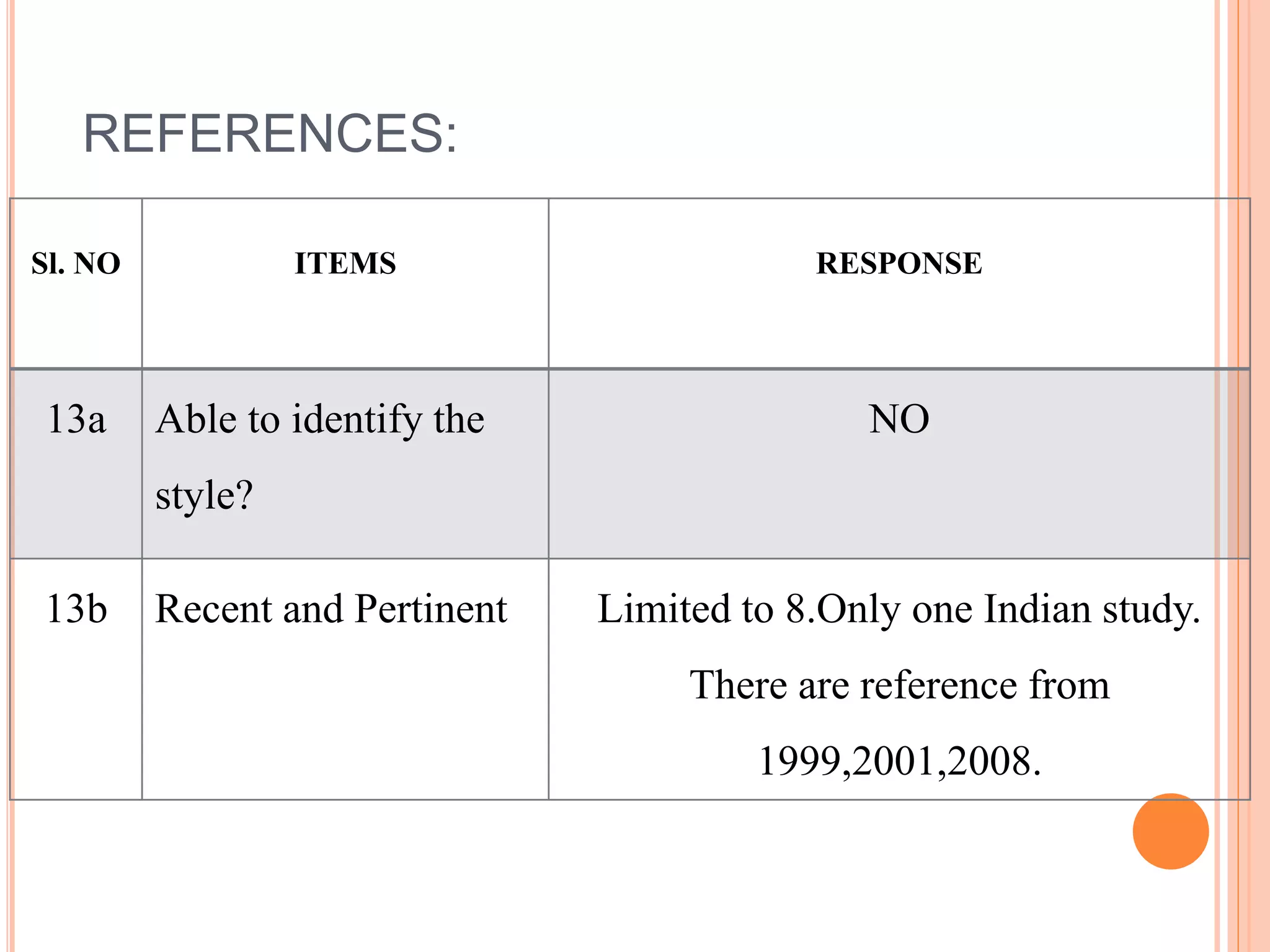
REFERENCES:
Sl. NO ITEMS RESPONSE
13a Able to identify the
style?
NO
13b Recent and Pertinent Limited to 8.Only one Indian study.
There are reference from
1999,2001,2008.
CRITICAL REFLECTION:
Sl. NO ITEMS RESPONSE
14a Internal Validity Yes
14b Generalizability No
14c Clinical Practice significance Applied to routine practice
14d Public Health significance Health education
14e Cost effective Yes
JOURNAL CLUB PRESENTATION

JOURNAL CLUB PRESENTATION

  • 1.
  • 2.
    Effect Of StructuredNursing Care Strategies Regarding Home Based Care Of Patients With Parkinson's Disease
  • 3.
     Parkinson’s diseaseis the second most common neurodegenerative disorder  It is a chronic slow progressive disorder caused by loss of dompaminergic neurons in the substantia nigra .
  • 4.
     Patients withParkinson's disease are confronting with many physical, psychological and psychosocial issues that impact quality of life.
  • 5.
    1. To assessbaseline knowledge, attitude and practice regarding home based care of patients with Parkinson's disease. 2. To evaluate the effect of structured nursing care strategies regarding home based care on knowledge attitude and practice of patients with Parkinson's disease.
  • 6.
    3. To findout the association between knowledge regarding home based care among patients with Parkinson's disease and selected socio demographic variables.
  • 7.
     H1:There issignificant difference in pretest and post test scores of knowledge regarding home based care in patients with Parkinson's disease.  H2:There is significant difference in pretest and posttest scores of attitude regarding home based care in patients with Parkinson's disease
  • 8.
     H3:There issignificant difference in pretest and post test scores of practice regarding home based care in patients with Parkinson's disease  H4 :There is significant association between knowledge regarding home based care of patients with Parkinson's disease and selected demographic variables.
  • 9.
    Research Approach Quantitative Approach Research designQuasi experimental design - One group pre test post test design. Setting Neurology OPD in KIMS hospital Trivandrum
  • 10.
    Population Patients diagnosedas Parkinson's disease Sampling technique Non- probability sampling (Purposive Sampling) Sampling Size 40 Parkinson’s patients
  • 11.
    Inclusion criteria •Patients diagnosed asParkinson's disease who were able to read and write Malayalam or English
  • 12.
    EXCLUSI ON CRITERIA • Patients whowere not able to read and write Malayalam or English • Health care professionals
  • 13.
    Instruments used •Structured questionnaire To assesssocio demographic data and clinical variables •Knowledge questionnaire To assess knowledge towards home care of Parkinson's disease • self reported practise questionnaire and attitude scale To access practice and attitude towards home care of Parkinson's disease
  • 14.
    Data collectio n Method •A brief introductionabout researcher himself and the study were given to study subjects and obtained informed consent for participation. •Pre-test was conducted among 40 samples and assessed their knowledge, attitude and practice. •On the same day the investigator administered structured nursing care strategies individually to each samples for 45 mints and an instructional module on home based care regarding Parkinson's disease was given to the samples for reference
  • 15.
     Four weeksafter the intervention, post test was conducted on the samples using the same tool  Data obtained was analysed using descriptive and inferential statics
  • 16.
  • 17.
     Majority ofpatients with Parkinson's disease 37.5% belonged to the age group 60-69yrs.  Males were the predominant category 70% among the sample  Most of the patients 60 % had high school education.
  • 18.
     Majority 40%of patients with Parkinson's disease were retired employees.  Majority 50% of patients had monthly income of rs 500-15000.  Most 72.5% of patients belongs to nuclear family.
  • 19.
    Pretest • 70% hadpoor knowledge • 30% had satisfactory knowledge Post test • 52.5% of patients had good knowledge • 47.5% had satisfactory knowledge
  • 20.
    Pretest • 92.5%of patientshad negative attitude • 7.5%had positive attitude regarding home based care of patients with Parkinson's disease Post test • 90.% had positive attitude regarding home based care of patients with Parkinson's disease
  • 21.
    Pretest • 67.5% werefollowing poor practice • 27.5% were following satisfactory practice regarding home based care Post test • 92.5% had good practice • 7.5%had satisfactory practice regarding home based care of Parkinson's disease
  • 22.
     A studywas done to estimate the prevalence of Parkinson's disease in Egypt. The study concluded that prevalence of parkinsonism was found to increase steadily with age and majority of them were above 60 years
  • 23.
    Parkinson’s disease isincreasing globally and patients with Parkinson's disease are facing many debilitating symptoms which have a significant impact on their quality of life.
  • 24.
  • 25.
    Title of thePaper: Effect of structured nursing care strategies regarding home based care of patients with Parkinson's disease
  • 26.
    Name of theJournal Kerala nursing forum Volume 11 Issue 45 Page No 28-33 Year 2016
  • 27.
    PARTICULARS OBSERVATIONS Type ofJournal Academic Journal Publisher Professional organization Under what section of journal the article is Published Original research ISSN 12248-907X
  • 28.
    Mesh Representation Notmentioned DOI Not mentioned Peer reviewed No Impact Factor Not mentioned Eigen factor Not Mentioned
  • 29.
    ABOUT THE AUTHORS: Sl.NO ITEMS RESPONSE 1. Designation / Institutional attachments Aswathy Asokan A.N Second year MSC nursing student at the time of submitting the article Graceamma Joseph Vice principal, KIMS college of nursing Thiruvananthapuram
  • 30.
    ABOUT THE AUTHORS: Sl.NO ITEMS RESPONSE 2a. 2b. Work / Publications in same area H-index Department of medicine Not mentioned
  • 31.
    TITLE OF THEARTICLE: Sl. NO ITEMS RESPONSE 3a Indicates topic and focus of the study Effect of structured nursing care strategies regarding home based care of patients with Parkinson's disease 3b Indicates the research question Effect of structured nursing care strategies 3c Title meaningful and complete yes
  • 32.
    TITLE OF THEARTICLE: Sl. NO ITEMS RESPONSE 3d Includes important Variables to be measured Dependent : Home based care of patients Independent: structured nursing care strategies 3e Looks catchy yes 3f Short or over long medium 3g Need for alternative title Yes. Can be modify
  • 33.
    ABSTRACT: Sl. NO ITEMSRESPONSE 4a Structured Yes It is structured under following headings; With proper introduction, purpose of study, objectives and hypothesis are stated well 4b Informative Yes. Structured nursing care strategy was effective , post test scores on knowledge, attitude and practice is higher than pre-test score.
  • 34.
    ABSTRACT: Sl. NO ITEMSRESPONSE 4c Indicative Yes, Methodology and the results were clearly mentioned. 4d Reflects contents Yes 4e Provides entire gist of entire study Yes
  • 35.
    KEY WORDS: Sl. NOITEMS RESPONSE 5a Present Yes Structured nursing care strategies, home based care, Parkinson's disease, knowledge, attitude, practice 5b Appropriate Yes
  • 36.
    INTRODUCTION: Sl. NO ITEMSRESPONSE 6a Stock opening Alarmist approach 6b Meaningful and concise Yes 6c Built on existing literature Yes 6d Logically presented Yes
  • 37.
    CONTINUE. Sl. NO ITEMSRESPONSE 6e Omission of some important studies Yes 6f Citation relevant and pertinent Yes 6g Presented the Need for the study Yes 6h Stated research objective Yes
  • 38.
    METHODOLOGY: Sl. NO ITEMSRESPONSE 7a Study design One group pre-test post test design 7b Study setting Neurology OPD clinics in KIMS hospital Trivandrum 7c Study Population 40 Patients diagnosed as parkinsonism disease. Confusing . Not mentioned whether they are able to understand the researcher. 7d Variables Independent- structured nursing care strategies Dependent – Home based care of patients
  • 39.
    CONTINUE… Sl. NO ITEMSRESPONSE 7e Bias Present 7f Study/ Sample size 40 7g Sampling Purposive 7h Ethical Review Board consent Not mentioned 7i Informed Consent Yes
  • 40.
    STATISTICAL METHODS: Sl. NOITEMS RESPONSE 8a Describes all statistical methods Yes 8b Describes other analyses? no
  • 41.
    RESULTS: Sl. NO ITEMSRESPONSE 9a Based on aims and objectives Yes 9b Descriptive data Yes 9c Outcome data Yes 9d Table/ graph and text format Table
  • 42.
    DISCUSSION: Sl. NO ITEMSRESPONSE 10a Explain Key results Yes 10b Compared with existing Literature Yes 10c Limitation No 10d Remedy for Limitation No 10e Generalizability No
  • 43.
    CONCLUSION: Sl. NO ITEMSRESPONSE 11a Based on discussion and results yes 11b Suitable recommendations No 11c Open vistas for other research YES.IT IS OPEN FOR ONE FURTHER RESEARCH THAT IS A STUDY CAN BE CARRIED OUT WITH HELP OF VIDEO ASSISTED LEARNING FOR CAREGIVERS OF IMMOBILIZED PATIENTS
  • 44.
    OTHERS: Sl. NO ITEMSRESPONSE 12a Trial registered N/A 12b Funding Not mentioned
  • 45.
    REFERENCES: Sl. NO ITEMSRESPONSE 13a Able to identify the style? NO 13b Recent and Pertinent Limited to 8.Only one Indian study. There are reference from 1999,2001,2008.
  • 46.
    CRITICAL REFLECTION: Sl. NOITEMS RESPONSE 14a Internal Validity Yes 14b Generalizability No 14c Clinical Practice significance Applied to routine practice 14d Public Health significance Health education 14e Cost effective Yes