TITLE
HOW TO ANALYZE
RESEARCH DATA
1
CLINICAL DATA MANGEMENT
(CDM)
SOURABH KOSEY
ASSOCIATE PROFESSOR
DEPT. OF PHARMACY PRACTICE
ISF COLLEGE OF PHARMACY
MOBILE: 9501305664
WEBSITE: - www.isfcp.org
EMAIL: sourabhkosey@gmail.com
ISF College of Pharmacy, Moga
Ghal Kalan, GT Road, Moga- 142001, Punjab, INDIA
SOURCE DATA
• RECORDS
• ORIGINAL RECORDS OF CLINICAL FINDING
• OBSERVATIONS IN CLINCAL TRIALS
• RECONSRTUCTION AND EVALUATION OF THE TRIAL
• SOURCE DATA ARE CONTAINED IN SOURCE
DOCUMENTS
•
3
4
SOURCE DOCUMENTS
•ORIGINAL DOCUMENTS,DATA,RECORDS
•HOSPITAL RECORDS,CLINICAL & OFFICE CHARTS
•LABORATORY NOTES & FINDINGS,MEMORANDA
•SUBJECT’S DIARIES OR EVALUATION CHECKLISTS
•PHARMACY DISPENSING RECORDS
•RECORDED DATA FROM AUTOMATEDINSTRUMENTS
•COPIES OR TRANSCRIPTIONS CERTIFIED AFTER
•VERIFICATION AS BEING ACCURATE COPIES
5
Source Document: The electronic record to used to keep together a
collection of eSource data items for capture, transmission, storage,
and/or display; and serving as a source document for a clinical
investigation.
Raw Data: Data as originally collected. Distinct from derived. Raw
Data includes original observations, measurements and activities
6INTRODUCTION
•CRO’s
• DATA GENERATION & PRESENTATION
• ACCURACY OF TRAILS & REGULATORS
• INFORMATION TECHNOLOGY (IT)
• COMPUTERIZED SYSTEM (REMOVAL OF TRADITIONAL SYSTEM
PAPER WASTAGE )
• GROWTH & REQUIREMENTS OF GOOD DATA MANAGEMENT
SYSTEMS THAT COMPANIES WHICH ARE OTHERWISE IT-BASED
7
• Have full fleged clinical trial data management systems which bring
them a good amount of business and revenue.
• CDM is a fundamental process which controls data accuracy of each
trial besides helping the timelessness to be achieved.
• It helps in linking clinical research co-ordinator = who monitor all the
sites & collects the data.
• it Links with biostatisticians = who analyze, interpret and report data in
clinically meaningful way.
8
Good Clinical Data Management Practice
(GCDMP)
• The objective of GCDMP is to generate high quality database devoid of
errors and omissions
• ICH GUIDELINES.
• US FDA REGULATIONS.
DRUG AND DEVICE DEVELOPMENT PROCESS
The Society of Clinical Data Management (SCDM) has created a
comprehensive document- Good Clinical Data Management Practices
(GCDMP) (Version 4.0 is the most recently updated version published in May
2007)- that provides guidance on accepted practices of Clinical Data
Management (CDM)
9
SYSTEMIC APPROACH FOR CDM
INITIAL PLANNING
SPONSOR or INVSTIGATOR or CRO.
Standardized database management system.
CRF CASE RECORD FORMAT.
CRF as per database need, setting realistic dates for receipt, verification,
query resolution, corrections, Final editing and release of data and finally
resource mobilization
10
• Preparing for Incoming Data Data management study master
file SOP’s should be established to ensure operational
documentation for computers.
• System reliability, Validation and accuracy.
• System security for hardware software and data from theft
and sabogate.
• Adequate access code and back up of the data.
• Indexes & Checklists for CRF’s Designing data entry screens
11
• Establishing systems for tracking of CRF;s like Barcodes, deciding
which CRF copy to be working copy (usually second copy)
• Validating CRF and other data transfer procedures.
• Data Transfer may be on Paper or Electronic
12INCOMING DATA
• Data received continuously and in a timely manner.
• Helps in data testing methodology, validates data base
management system (DBMS), helps in checking accuracy and
completeness of CRF.
• Timely clarification of errors and omissions with the
investigators.
• It is also important to decide on unambiguous
Codes for subject identification that allow identification of all the
data of any subject.
13INITIAL DATA REVIEW AND VERIFICATION
• DATA REVIEW COMMITTEE MEMBERS.
• MAINTAINING BLINDING DURING REVIEW AND ENTRY OF THE DATA.
• ERROR DETECTION IS AN IMPORTANT STEP TO BE DONE BEFORE AND
DURING DATA REVIEW AND VERIFICATION.
• THE VARIOUS ERRORS THAT ONE CAN EXPECT DURING THIS STAGE
CAN RANGE FROM MISSING DATA, FAULTY COMPLETION OF
FORMS,QUESTIONABLE VALUES (E.G. HEIGHT 20 FEETS), TREND TESTS
TO GROSS PROTOCOL VIOLATIONS
14
• SUBSEQUENT ERRORS CAN ALSO BE DETECTED AT VARIOUS
STAGES LIKE DURING COMPUTER ENTRY, ERRONEOUS CODING OR
INVESTIGATOR’S CORRECTIONS NOT BEING TAKEN INTO ACCOUNT.
• DATA MONITORING COMMITTEE HELPS IN ASSESSING THE
PROGRESS OF TRIALS AT INTERVALS TO RECOMMEND WHETHER TO
CONTINUE, MODIFY OR STOP THE TRIALS.
• IT ALSO EVALUATES SAFETY DATA AND CRITICAL EFFICIACY END
POINTS.
• THERE SHOULD BE WRITTEN OPERATION PROCEDURES AND
MAINTENANACE OF ALL MEETING RECORDS
15DATA ENTRY, VERIFICATION AND VALIDATION
The Data entry person should be defined for the specific trial &
specified in a data management plan.
For transcription from paper CRF to electronic CRF different
procedures are used:
Double Data Entry form (one person)
Double Data Entry form (two persons)
Single entry with second look
Single data entry with reading aloud
Single data entry with source verification
 Double data entry is not required by regulation by good
practice.
 Data entry process should be chosen based on the skills
of the personnel, this will give good impact on to the
resources in the project and the reflected evaluation of
key variables.
 Only authorized persons should be entitled to do entry
and corrections on the data entry screens.
 Verification and Validation is done by Data Reviewers,
automated computer checks (an error message like when
a value is outside the acceptable norms) and during audit
 It has been that errors in entry is 1 % by good operator.
 This Decreases to 0.1% by double entry of data by two
different operators.
16
CODING
 FOR Adverse Events
 COSTART (Coding Symbols for Thesaurus of Adverse
Reaction Terms)
 WHO-ART (Adverse Reaction Terminology)
 SNOMED (Systematized Nomenclature of Medicine)
 MedDRA (Medical Dictionary for Regulatory Activities)
 In House Codes
17
 FOR concomitant diseases: international classification of
diseases version 10 (ICD-10)
 FOR concomitant medications: WHO Drug Dictionary
 Medical Term ----- Preferred term(s)----- Code
ERRORS IN CODING
 Misunderstanding about medical terms, misinterpretation
of hand writing, defective translation, foreign Language of
CRF, wrong choice of preferred terms and difficulties in
transcoding.
This errors leads to inconsistencies in final
report, decreased credibility of report, delay in report
writing and represent evidence of negligence
18
 To minimize errors only qualified and trained staffs
should be employed in the process the data entry
operators should insist on legible filling of CRFs.
 It can also be minimized by keeping a log book of difficult
coding cases, doing translation-retranslation and
centralizing of the final coding
19
DATA QUERIES
Problems faced by data entry operators
 Subject has to go back to investigator
 Operators are failure to check the inclusion and exclusion criteria
 Inconsistent Calendar Dates
 Illegible entries
 Unfamiliar Drugs Names
 Text in unfamiliar Language
 Entries in incorrect place at CRFs
 Failure to specify indication for concomitant medication
 Lack of reason for change in medication
 Inconsistencies in physical examination at start and finish
 Incomplete information on Adverse Events
 Varying Units & Normal ranges in case of Laboratory Data.
20
Query Tracking and Resolution
 A proper SOP has to be made in place of query tracking
and solving
 Operator should draw a list of QUERIES
 This List should be sent to investigators who verifies,
corrects, signs and corrects the dates the query
 Three copies should be send to the same format then
 To the data entry operator who operates the same
21
 At the end a validation program is done and run to follow
the program and check the editing done.
 Any change or correction must be readily spottable and is
called as AUDIT TRIAL.
 This Trial may be given in the computers where
computers saves the date and time of correction, new
value along with old value and access code used to make
changes or on paper
22
DATA OUTPUT, REVIEW & FREEZING
 As the data comes the manager and stastician finalizes
the data and queries are resolved.
 Thereafter a final audit is performed, data is frozen and
sent to the statistician.
 Goal of perfectly accurate database is usually unrealistic.
 It is preferable to set acceptable limits of error that do not
alter the validity of statistical analysis and results and
conclusions drawn from the study
23
ARCHIVING
 Data mangers and statistician are responsible for
archiving the electronic database, associated computer
programs, Data monitoring conventions, audit trials and
final report.
 They also maintain also all sponsor-specific essential
documents as per regulatory requirements.
24
REQUIREMENTS FOR ACQUIRING/
CAPTURING/ COPYING SOURCE DATA
 In general data & documents containing source data must first be
specified in the trial protocol.
 Source Data are the original data, the recordings and all information
regarding Clinical Investigations, Laboratory findings, anamnesis,
interviews, patient diaries and other sources.
 The original documents have to be archived.
 Copies have to be dated and signed by a responsible person
(Certified copies)
 If the original data is stored electronically, a printout has to be made or
a list of dates and versions of stored documents signed/dated by
Principal Investigator.
25
 In the case of eSource data, of course, this is not possible.
 A copy of eSource data shall be accepted in place of eSource
data, if the copy hass been produced and verified against the
eSource data based on procedures defined in a SOP for
acquiring data duplication and verification.
 Appropriate handling is also required for scanning source
documents.
 The Scanning process has to be validated prior to
implementation in a trial to ensure the integrity of the generated
record
26
 In the CRF is the source document (e.g., in psychiatric instruments
like psychometric scales ) this has to be defined in the protocol.
 If work has been used as a transcription instrument (e.g.,
Transitional documentation prior to electronic data entry), these are
to be considered as informal source data sheets and have to be filed
and quality checked appropriately.
 In general, source data must be accessible and verifiable and the
quality of digitization must be carefully controlled using
appropriately defined SOPs.
27
pCRF to eCRF Transfer
 In this scenario, clinical data are at first collected with a
pCRF.
 Investigator has less time or has to move between
locations. (e.g. emergency ward, operation theatre)
 In a remote data entry scenario, it is often not the
investigator, but special assistance personnel who enters
data from the pCRF into the eCRF.
 This transcription step must be quality assured.
28
 Type of personnel needed (i.e., for data entry, for data
review, etc.)
 Criteria chosen to qualify them must be clearly defined.
 For using eCRF, specific training programs for
investigators and assistance personnel must be included.
 Appropriate quality control steps have to be implemented
and double data entry may be performed.
 pCRF transfer as well as status (arrived, re-viewed, non-
correct, requested queries, correct, closed) must be
clearly tracked.
29
 Personnel responsible for different phases of pCRF entry
must be tracked as well as all the changes.
 Because the investigator’s signature is required, he is
responsible for the correct transcription of the data.
 Appropriate workflow support should be implemented in
the Electronic Data Capture (EDC) system.
30
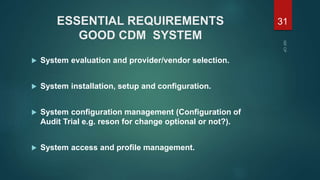
ESSENTIAL REQUIREMENTS
GOOD CDM SYSTEM
 System evaluation and provider/vendor selection.
 System installation, setup and configuration.
 System configuration management (Configuration of
Audit Trial e.g. reson for change optional or not?).
 System access and profile management.
31
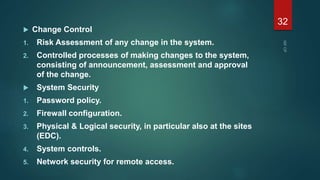
 Change Control
1. Risk Assessment of any change in the system.
2. Controlled processes of making changes to the system,
consisting of announcement, assessment and approval
of the change.
 System Security
1. Password policy.
2. Firewall configuration.
3. Physical & Logical security, in particular also at the sites
(EDC).
4. System controls.
5. Network security for remote access.
32
 Database and communication security
1. Encryption of data storage, data Transfer.
2. Electronic signature has to comply also with national
regulations [EDC].
 Data protection
1. Handling of personally identifiable data (e.g., blinding of
additionally submitted identifying data; sites should
eliminate personal identifiers from source documents
prior to submission).
2. Specification of minimum subject identifiers.
3. Safeguarding that (future) use of data is in accordance
with informed consent.
33
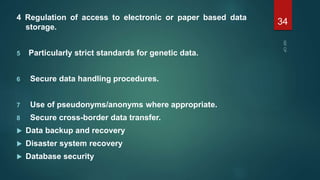
4 Regulation of access to electronic or paper based data
storage.
5 Particularly strict standards for genetic data.
6 Secure data handling procedures.
7 Use of pseudonyms/anonyms where appropriate.
8 Secure cross-border data transfer.
 Data backup and recovery
 Disaster system recovery
 Database security
34
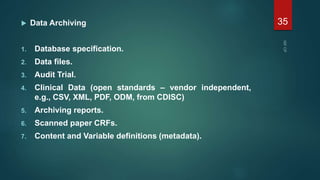
 Data Archiving
1. Database specification.
2. Data files.
3. Audit Trial.
4. Clinical Data (open standards – vendor independent,
e.g., CSV, XML, PDF, ODM, from CDISC)
5. Archiving reports.
6. Scanned paper CRFs.
7. Content and Variable definitions (metadata).
35
8 Report on data completeness at respondent and variable
level.
9 Secure Storage and access control.
 Business continuity
 Migration of data/meta-data (in case of system retirement)
 System Validation.
 Risk management.
1. All components of the system have to be judged according
to their risk to violate GCP.
2. GCP-compliance has to be guaranteed especially for high-
risk components.
3. Maintenance of GCP-compliance even after updates or other
changes to the system.
36
CONCLUSION
 The importance of CDM can be realized from the fact a lot
of pure IT companies are involved in CDM activities and
this contributes a big share in their revenue. Some of the
advances in CDM are:
 New hardware's like PCs, Electronic notebooks
 Remote data entry.
 Optical mark recognition like bar codes.
 Optical character recognition like fingerprints.
 Facsimile.
 Smart cards for each patient.
 Computer assisted new drug application [CANDA] by
FDA.
37

clinical data management

  • 1.
  • 2.
    CLINICAL DATA MANGEMENT (CDM) SOURABHKOSEY ASSOCIATE PROFESSOR DEPT. OF PHARMACY PRACTICE ISF COLLEGE OF PHARMACY MOBILE: 9501305664 WEBSITE: - www.isfcp.org EMAIL: sourabhkosey@gmail.com ISF College of Pharmacy, Moga Ghal Kalan, GT Road, Moga- 142001, Punjab, INDIA
  • 3.
    SOURCE DATA • RECORDS •ORIGINAL RECORDS OF CLINICAL FINDING • OBSERVATIONS IN CLINCAL TRIALS • RECONSRTUCTION AND EVALUATION OF THE TRIAL • SOURCE DATA ARE CONTAINED IN SOURCE DOCUMENTS • 3
  • 4.
    4 SOURCE DOCUMENTS •ORIGINAL DOCUMENTS,DATA,RECORDS •HOSPITALRECORDS,CLINICAL & OFFICE CHARTS •LABORATORY NOTES & FINDINGS,MEMORANDA •SUBJECT’S DIARIES OR EVALUATION CHECKLISTS •PHARMACY DISPENSING RECORDS •RECORDED DATA FROM AUTOMATEDINSTRUMENTS •COPIES OR TRANSCRIPTIONS CERTIFIED AFTER •VERIFICATION AS BEING ACCURATE COPIES
  • 5.
    5 Source Document: Theelectronic record to used to keep together a collection of eSource data items for capture, transmission, storage, and/or display; and serving as a source document for a clinical investigation. Raw Data: Data as originally collected. Distinct from derived. Raw Data includes original observations, measurements and activities
  • 6.
    6INTRODUCTION •CRO’s • DATA GENERATION& PRESENTATION • ACCURACY OF TRAILS & REGULATORS • INFORMATION TECHNOLOGY (IT) • COMPUTERIZED SYSTEM (REMOVAL OF TRADITIONAL SYSTEM PAPER WASTAGE ) • GROWTH & REQUIREMENTS OF GOOD DATA MANAGEMENT SYSTEMS THAT COMPANIES WHICH ARE OTHERWISE IT-BASED
  • 7.
    7 • Have fullfleged clinical trial data management systems which bring them a good amount of business and revenue. • CDM is a fundamental process which controls data accuracy of each trial besides helping the timelessness to be achieved. • It helps in linking clinical research co-ordinator = who monitor all the sites & collects the data. • it Links with biostatisticians = who analyze, interpret and report data in clinically meaningful way.
  • 8.
    8 Good Clinical DataManagement Practice (GCDMP) • The objective of GCDMP is to generate high quality database devoid of errors and omissions • ICH GUIDELINES. • US FDA REGULATIONS. DRUG AND DEVICE DEVELOPMENT PROCESS The Society of Clinical Data Management (SCDM) has created a comprehensive document- Good Clinical Data Management Practices (GCDMP) (Version 4.0 is the most recently updated version published in May 2007)- that provides guidance on accepted practices of Clinical Data Management (CDM)
  • 9.
    9 SYSTEMIC APPROACH FORCDM INITIAL PLANNING SPONSOR or INVSTIGATOR or CRO. Standardized database management system. CRF CASE RECORD FORMAT. CRF as per database need, setting realistic dates for receipt, verification, query resolution, corrections, Final editing and release of data and finally resource mobilization
  • 10.
    10 • Preparing forIncoming Data Data management study master file SOP’s should be established to ensure operational documentation for computers. • System reliability, Validation and accuracy. • System security for hardware software and data from theft and sabogate. • Adequate access code and back up of the data. • Indexes & Checklists for CRF’s Designing data entry screens
  • 11.
    11 • Establishing systemsfor tracking of CRF;s like Barcodes, deciding which CRF copy to be working copy (usually second copy) • Validating CRF and other data transfer procedures. • Data Transfer may be on Paper or Electronic
  • 12.
    12INCOMING DATA • Datareceived continuously and in a timely manner. • Helps in data testing methodology, validates data base management system (DBMS), helps in checking accuracy and completeness of CRF. • Timely clarification of errors and omissions with the investigators. • It is also important to decide on unambiguous Codes for subject identification that allow identification of all the data of any subject.
  • 13.
    13INITIAL DATA REVIEWAND VERIFICATION • DATA REVIEW COMMITTEE MEMBERS. • MAINTAINING BLINDING DURING REVIEW AND ENTRY OF THE DATA. • ERROR DETECTION IS AN IMPORTANT STEP TO BE DONE BEFORE AND DURING DATA REVIEW AND VERIFICATION. • THE VARIOUS ERRORS THAT ONE CAN EXPECT DURING THIS STAGE CAN RANGE FROM MISSING DATA, FAULTY COMPLETION OF FORMS,QUESTIONABLE VALUES (E.G. HEIGHT 20 FEETS), TREND TESTS TO GROSS PROTOCOL VIOLATIONS
  • 14.
    14 • SUBSEQUENT ERRORSCAN ALSO BE DETECTED AT VARIOUS STAGES LIKE DURING COMPUTER ENTRY, ERRONEOUS CODING OR INVESTIGATOR’S CORRECTIONS NOT BEING TAKEN INTO ACCOUNT. • DATA MONITORING COMMITTEE HELPS IN ASSESSING THE PROGRESS OF TRIALS AT INTERVALS TO RECOMMEND WHETHER TO CONTINUE, MODIFY OR STOP THE TRIALS. • IT ALSO EVALUATES SAFETY DATA AND CRITICAL EFFICIACY END POINTS. • THERE SHOULD BE WRITTEN OPERATION PROCEDURES AND MAINTENANACE OF ALL MEETING RECORDS
  • 15.
    15DATA ENTRY, VERIFICATIONAND VALIDATION The Data entry person should be defined for the specific trial & specified in a data management plan. For transcription from paper CRF to electronic CRF different procedures are used: Double Data Entry form (one person) Double Data Entry form (two persons) Single entry with second look Single data entry with reading aloud Single data entry with source verification
  • 16.
     Double dataentry is not required by regulation by good practice.  Data entry process should be chosen based on the skills of the personnel, this will give good impact on to the resources in the project and the reflected evaluation of key variables.  Only authorized persons should be entitled to do entry and corrections on the data entry screens.  Verification and Validation is done by Data Reviewers, automated computer checks (an error message like when a value is outside the acceptable norms) and during audit  It has been that errors in entry is 1 % by good operator.  This Decreases to 0.1% by double entry of data by two different operators. 16
  • 17.
    CODING  FOR AdverseEvents  COSTART (Coding Symbols for Thesaurus of Adverse Reaction Terms)  WHO-ART (Adverse Reaction Terminology)  SNOMED (Systematized Nomenclature of Medicine)  MedDRA (Medical Dictionary for Regulatory Activities)  In House Codes 17
  • 18.
     FOR concomitantdiseases: international classification of diseases version 10 (ICD-10)  FOR concomitant medications: WHO Drug Dictionary  Medical Term ----- Preferred term(s)----- Code ERRORS IN CODING  Misunderstanding about medical terms, misinterpretation of hand writing, defective translation, foreign Language of CRF, wrong choice of preferred terms and difficulties in transcoding. This errors leads to inconsistencies in final report, decreased credibility of report, delay in report writing and represent evidence of negligence 18
  • 19.
     To minimizeerrors only qualified and trained staffs should be employed in the process the data entry operators should insist on legible filling of CRFs.  It can also be minimized by keeping a log book of difficult coding cases, doing translation-retranslation and centralizing of the final coding 19
  • 20.
    DATA QUERIES Problems facedby data entry operators  Subject has to go back to investigator  Operators are failure to check the inclusion and exclusion criteria  Inconsistent Calendar Dates  Illegible entries  Unfamiliar Drugs Names  Text in unfamiliar Language  Entries in incorrect place at CRFs  Failure to specify indication for concomitant medication  Lack of reason for change in medication  Inconsistencies in physical examination at start and finish  Incomplete information on Adverse Events  Varying Units & Normal ranges in case of Laboratory Data. 20
  • 21.
    Query Tracking andResolution  A proper SOP has to be made in place of query tracking and solving  Operator should draw a list of QUERIES  This List should be sent to investigators who verifies, corrects, signs and corrects the dates the query  Three copies should be send to the same format then  To the data entry operator who operates the same 21
  • 22.
     At theend a validation program is done and run to follow the program and check the editing done.  Any change or correction must be readily spottable and is called as AUDIT TRIAL.  This Trial may be given in the computers where computers saves the date and time of correction, new value along with old value and access code used to make changes or on paper 22
  • 23.
    DATA OUTPUT, REVIEW& FREEZING  As the data comes the manager and stastician finalizes the data and queries are resolved.  Thereafter a final audit is performed, data is frozen and sent to the statistician.  Goal of perfectly accurate database is usually unrealistic.  It is preferable to set acceptable limits of error that do not alter the validity of statistical analysis and results and conclusions drawn from the study 23
  • 24.
    ARCHIVING  Data mangersand statistician are responsible for archiving the electronic database, associated computer programs, Data monitoring conventions, audit trials and final report.  They also maintain also all sponsor-specific essential documents as per regulatory requirements. 24
  • 25.
    REQUIREMENTS FOR ACQUIRING/ CAPTURING/COPYING SOURCE DATA  In general data & documents containing source data must first be specified in the trial protocol.  Source Data are the original data, the recordings and all information regarding Clinical Investigations, Laboratory findings, anamnesis, interviews, patient diaries and other sources.  The original documents have to be archived.  Copies have to be dated and signed by a responsible person (Certified copies)  If the original data is stored electronically, a printout has to be made or a list of dates and versions of stored documents signed/dated by Principal Investigator. 25
  • 26.
     In thecase of eSource data, of course, this is not possible.  A copy of eSource data shall be accepted in place of eSource data, if the copy hass been produced and verified against the eSource data based on procedures defined in a SOP for acquiring data duplication and verification.  Appropriate handling is also required for scanning source documents.  The Scanning process has to be validated prior to implementation in a trial to ensure the integrity of the generated record 26
  • 27.
     In theCRF is the source document (e.g., in psychiatric instruments like psychometric scales ) this has to be defined in the protocol.  If work has been used as a transcription instrument (e.g., Transitional documentation prior to electronic data entry), these are to be considered as informal source data sheets and have to be filed and quality checked appropriately.  In general, source data must be accessible and verifiable and the quality of digitization must be carefully controlled using appropriately defined SOPs. 27
  • 28.
    pCRF to eCRFTransfer  In this scenario, clinical data are at first collected with a pCRF.  Investigator has less time or has to move between locations. (e.g. emergency ward, operation theatre)  In a remote data entry scenario, it is often not the investigator, but special assistance personnel who enters data from the pCRF into the eCRF.  This transcription step must be quality assured. 28
  • 29.
     Type ofpersonnel needed (i.e., for data entry, for data review, etc.)  Criteria chosen to qualify them must be clearly defined.  For using eCRF, specific training programs for investigators and assistance personnel must be included.  Appropriate quality control steps have to be implemented and double data entry may be performed.  pCRF transfer as well as status (arrived, re-viewed, non- correct, requested queries, correct, closed) must be clearly tracked. 29
  • 30.
     Personnel responsiblefor different phases of pCRF entry must be tracked as well as all the changes.  Because the investigator’s signature is required, he is responsible for the correct transcription of the data.  Appropriate workflow support should be implemented in the Electronic Data Capture (EDC) system. 30
  • 31.
    ESSENTIAL REQUIREMENTS GOOD CDMSYSTEM  System evaluation and provider/vendor selection.  System installation, setup and configuration.  System configuration management (Configuration of Audit Trial e.g. reson for change optional or not?).  System access and profile management. 31
  • 32.
     Change Control 1.Risk Assessment of any change in the system. 2. Controlled processes of making changes to the system, consisting of announcement, assessment and approval of the change.  System Security 1. Password policy. 2. Firewall configuration. 3. Physical & Logical security, in particular also at the sites (EDC). 4. System controls. 5. Network security for remote access. 32
  • 33.
     Database andcommunication security 1. Encryption of data storage, data Transfer. 2. Electronic signature has to comply also with national regulations [EDC].  Data protection 1. Handling of personally identifiable data (e.g., blinding of additionally submitted identifying data; sites should eliminate personal identifiers from source documents prior to submission). 2. Specification of minimum subject identifiers. 3. Safeguarding that (future) use of data is in accordance with informed consent. 33
  • 34.
    4 Regulation ofaccess to electronic or paper based data storage. 5 Particularly strict standards for genetic data. 6 Secure data handling procedures. 7 Use of pseudonyms/anonyms where appropriate. 8 Secure cross-border data transfer.  Data backup and recovery  Disaster system recovery  Database security 34
  • 35.
     Data Archiving 1.Database specification. 2. Data files. 3. Audit Trial. 4. Clinical Data (open standards – vendor independent, e.g., CSV, XML, PDF, ODM, from CDISC) 5. Archiving reports. 6. Scanned paper CRFs. 7. Content and Variable definitions (metadata). 35
  • 36.
    8 Report ondata completeness at respondent and variable level. 9 Secure Storage and access control.  Business continuity  Migration of data/meta-data (in case of system retirement)  System Validation.  Risk management. 1. All components of the system have to be judged according to their risk to violate GCP. 2. GCP-compliance has to be guaranteed especially for high- risk components. 3. Maintenance of GCP-compliance even after updates or other changes to the system. 36
  • 37.
    CONCLUSION  The importanceof CDM can be realized from the fact a lot of pure IT companies are involved in CDM activities and this contributes a big share in their revenue. Some of the advances in CDM are:  New hardware's like PCs, Electronic notebooks  Remote data entry.  Optical mark recognition like bar codes.  Optical character recognition like fingerprints.  Facsimile.  Smart cards for each patient.  Computer assisted new drug application [CANDA] by FDA. 37