CLIL
Content and Language Integrated Learning
What is CLIL?
■ Integrating teaching content from a curriculum subject
with the Teaching of a non-native Language.
■ A flexible approach
■ 4 guiding principles underlying CLIL
STAGE ONE
TO BUILD UP A SHARE VISION
 Ideal CLIL classroom
 What do learners and teachers have
to achieve?
 Global goals
Increase engagement
Develop confidence
STAGE TWO
CLIL programme
should reflect
THE CONTEXT
Regional/national policies
Environment
School type and size
Teacher supply
Different contexts
Share aims and goals
4
Cs
Content
Communication
Cognition
Culture
Theory of Language
Functional
Used to learn as
well as to
communicate
Its focus in a
lesson does not
consider structural
grading
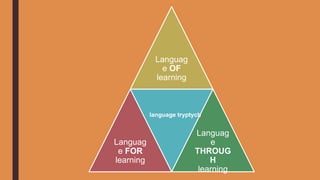
Languag
e OF
learning
Languag
e FOR
learning
Languag
e
THROUG
H
learning
language tryptych
What students need in order to
Access language
Languag
e
OF
learning
Language
THROUG
H learning
Languag
e FOR
learning
The new Language that will emerge
The language that students will need
during the lessons
STAGE FOUR: RESOURCES
 Professional learning
communities

 CLIL digital networks
 Teacher support
 Material banks
 Repositories
USE OF QUESTIONS
NO display questions: they limit
communication.
YES referential questions: they
encourage learners questioning:

 higher-order thinking skills

 Creativity

 lingusitic progression
Core features of CLIL methodology
■ Multiple focus approach
■ Safe and enriching environment
■ Authenticity
■ Active learning
■ Scaffolding
■ Cooperation
Roles
 Facilitator
 Engaging students
 Providing support
 Providing authentic input
Teacher
 Peer cooperative work
 Using both new and
background knowledge
 Active participation
Student
s
Typical class procedures
Warm-up
 Previous knowledge
Input
 Practice content in language
 Expand vocabulary
 Consolidation of knowledge
Consolidatio
n
 Summarizing skills
 Apply new knowledge
 Check and correct error
STAGE 5: MONITORING AND EVALUATING
 Understanding classroom processes and outcomes
 Creating an environment linguistically accessible and cognitively
demanding
 Analysing and measuring the relation between linguistic and
cognitive levels throuhg the CLIL Matrix
 Giving formative and summative feedback tasks

CLIL

  • 1.
    CLIL Content and LanguageIntegrated Learning
  • 2.
    What is CLIL? ■Integrating teaching content from a curriculum subject with the Teaching of a non-native Language. ■ A flexible approach ■ 4 guiding principles underlying CLIL
  • 3.
    STAGE ONE TO BUILDUP A SHARE VISION  Ideal CLIL classroom  What do learners and teachers have to achieve?  Global goals Increase engagement Develop confidence
  • 4.
    STAGE TWO CLIL programme shouldreflect THE CONTEXT Regional/national policies Environment School type and size Teacher supply Different contexts Share aims and goals
  • 5.
  • 6.
    Theory of Language Functional Usedto learn as well as to communicate Its focus in a lesson does not consider structural grading
  • 7.
  • 8.
    What students needin order to Access language Languag e OF learning Language THROUG H learning Languag e FOR learning The new Language that will emerge The language that students will need during the lessons
  • 9.
    STAGE FOUR: RESOURCES Professional learning communities   CLIL digital networks  Teacher support  Material banks  Repositories USE OF QUESTIONS NO display questions: they limit communication. YES referential questions: they encourage learners questioning:   higher-order thinking skills   Creativity   lingusitic progression
  • 10.
    Core features ofCLIL methodology ■ Multiple focus approach ■ Safe and enriching environment ■ Authenticity ■ Active learning ■ Scaffolding ■ Cooperation
  • 11.
    Roles  Facilitator  Engagingstudents  Providing support  Providing authentic input Teacher  Peer cooperative work  Using both new and background knowledge  Active participation Student s
  • 12.
    Typical class procedures Warm-up Previous knowledge Input  Practice content in language  Expand vocabulary  Consolidation of knowledge Consolidatio n  Summarizing skills  Apply new knowledge  Check and correct error
  • 13.
    STAGE 5: MONITORINGAND EVALUATING  Understanding classroom processes and outcomes  Creating an environment linguistically accessible and cognitively demanding  Analysing and measuring the relation between linguistic and cognitive levels throuhg the CLIL Matrix  Giving formative and summative feedback tasks