“Using language to learn, learning to use language"
CLIL METHODOLOGY
CONTENT AND LANGUAGE INTEGRATED LEARNING
'CLIL refers to situations where subjects, or parts of subjects,
are taught through a foreign language with dual-focussed
aims, namely the learning of content, and the simultaneous
learning of a foreign language'. (Marsh, 1994)
What is and what isn’t CLIL ?
Neither ‘translation’ of first language teaching into
another language,
nor ‘disguised’ systematic grammar.
There is NO SINGLE MODEL for CLIL:
the context is to be taken into account.
GROUP OF RULES
PHILOSOPHY OF TEACHING
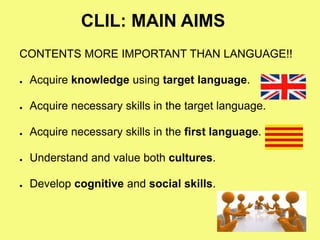
CLIL: MAIN AIMS
CONTENTS MORE IMPORTANT THAN LANGUAGE!!
● Acquire knowledge using target language.
● Acquire necessary skills in the target language.
● Acquire necessary skills in the first language.
● Understand and value both cultures.
● Develop cognitive and social skills.
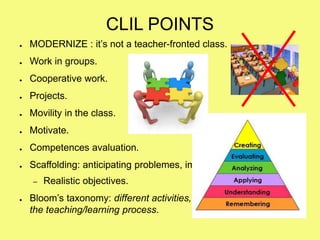
CLIL POINTS
● MODERNIZE : it’s not a teacher-fronted class.
● Work in groups.
● Cooperative work.
● Projects.
● Movility in the class.
● Motivate.
● Competences avaluation.
● Scaffolding: anticipating problemes, imagine the class.
– Realistic objectives.
● Bloom’s taxonomy: different activities, questions, situations on
the teaching/learning process.
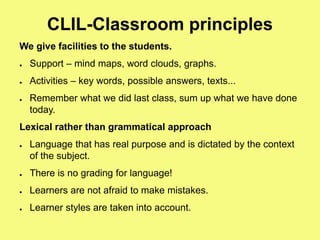
CLIL-Classroom principles
We give facilities to the students.
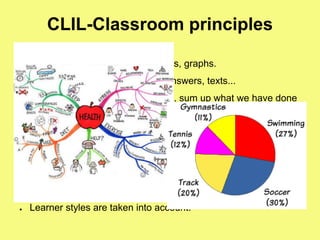
● Support – mind maps, word clouds, graphs.
● Activities – key words, possible answers, texts...
● Remember what we did last class, sum up what we have done
today.
Lexical rather than grammatical approach
● Language that has real purpose and is dictated by the context
of the subject.
● There is no grading for language!
● Learners are not afraid to make mistakes.
● Learner styles are taken into account.
CLIL-Classroom principles
We give facilities to the students.
● Support – mind maps, word clouds, graphs.
● Activities – key words, possible answers, texts...
● Remember what we did last class, sum up what we have done
today.
Lexical rather than grammatical approach
● Language that has real purpose and is dictated by the context
of the subject.
● There is no grading for language!
● Learners are not afraid to make mistakes.
● Learner styles are taken into account.
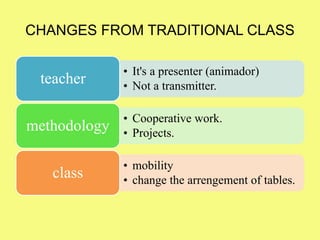
CHANGES FROM TRADITIONAL CLASS
• It's a presenter (animador)
• Not a transmitter.
teacher
• Cooperative work.
• Projects.
methodology
• mobility
• change the arrengement of tables.
class
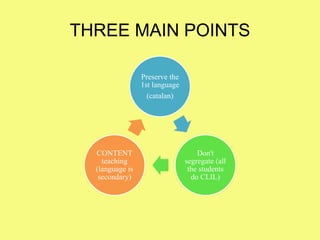
THREE MAIN POINTS
Preserve the
1st language
(catalan)
Don't
segregate (all
the students
do CLIL)
CONTENT
teaching
(language is
secondary)
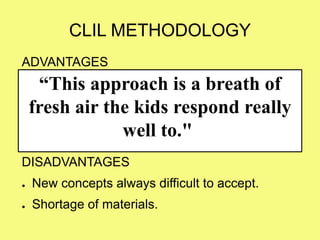
CLIL METHODOLOGY
ADVANTAGES
● Use other language it’s a challenge, so you will
prepare better the classes.
● Coordination with english teachers.
DISADVANTAGES
● New concepts always difficult to accept.
● Shortage of materials.
“This approach is a breath of
fresh air the kids respond really
well to."

What's CLIL?

  • 1.
    “Using language tolearn, learning to use language" CLIL METHODOLOGY CONTENT AND LANGUAGE INTEGRATED LEARNING 'CLIL refers to situations where subjects, or parts of subjects, are taught through a foreign language with dual-focussed aims, namely the learning of content, and the simultaneous learning of a foreign language'. (Marsh, 1994)
  • 2.
    What is andwhat isn’t CLIL ? Neither ‘translation’ of first language teaching into another language, nor ‘disguised’ systematic grammar. There is NO SINGLE MODEL for CLIL: the context is to be taken into account. GROUP OF RULES PHILOSOPHY OF TEACHING
  • 3.
    CLIL: MAIN AIMS CONTENTSMORE IMPORTANT THAN LANGUAGE!! ● Acquire knowledge using target language. ● Acquire necessary skills in the target language. ● Acquire necessary skills in the first language. ● Understand and value both cultures. ● Develop cognitive and social skills.
  • 4.
    CLIL POINTS ● MODERNIZE: it’s not a teacher-fronted class. ● Work in groups. ● Cooperative work. ● Projects. ● Movility in the class. ● Motivate. ● Competences avaluation. ● Scaffolding: anticipating problemes, imagine the class. – Realistic objectives. ● Bloom’s taxonomy: different activities, questions, situations on the teaching/learning process.
  • 5.
    CLIL-Classroom principles We givefacilities to the students. ● Support – mind maps, word clouds, graphs. ● Activities – key words, possible answers, texts... ● Remember what we did last class, sum up what we have done today. Lexical rather than grammatical approach ● Language that has real purpose and is dictated by the context of the subject. ● There is no grading for language! ● Learners are not afraid to make mistakes. ● Learner styles are taken into account.
  • 6.
    CLIL-Classroom principles We givefacilities to the students. ● Support – mind maps, word clouds, graphs. ● Activities – key words, possible answers, texts... ● Remember what we did last class, sum up what we have done today. Lexical rather than grammatical approach ● Language that has real purpose and is dictated by the context of the subject. ● There is no grading for language! ● Learners are not afraid to make mistakes. ● Learner styles are taken into account.
  • 7.
    CHANGES FROM TRADITIONALCLASS • It's a presenter (animador) • Not a transmitter. teacher • Cooperative work. • Projects. methodology • mobility • change the arrengement of tables. class
  • 8.
    THREE MAIN POINTS Preservethe 1st language (catalan) Don't segregate (all the students do CLIL) CONTENT teaching (language is secondary)
  • 9.
    CLIL METHODOLOGY ADVANTAGES ● Useother language it’s a challenge, so you will prepare better the classes. ● Coordination with english teachers. DISADVANTAGES ● New concepts always difficult to accept. ● Shortage of materials. “This approach is a breath of fresh air the kids respond really well to."