Three influential learning hypotheses
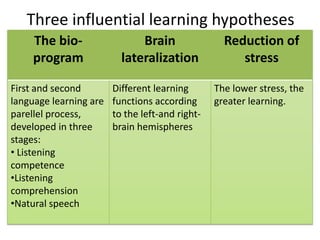
     The bio-                 Brain                Reduction of
     program              lateralization              stress

First and second        Different learning       The lower stress, the
language learning are   functions according      greater learning.
parellel process,       to the left-and right-
developed in three      brain hemispheres
stages:
• Listening
competence
•Listening
comprehension
•Natural speech
Advantages                        Disadvantages
• There is no pressure to speak.   • It does not emphasise the
• It reduces learning stress.        visual learning style.
• It takes into account            • It is difficult to apply in large
  emotions and enviroment.           classrooms
• It emphasises two learning       • Activities by rote repetition.
  styles: the auditory and the
  kinaesthetic.
• It respects the natural order
  to acquire language: learning
  before speaking.
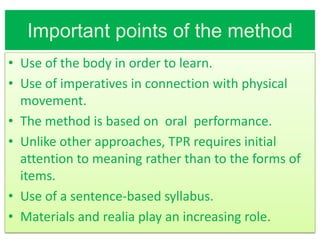
Important points of the method
• Use of the body in order to learn.
• Use of imperatives in connection with physical
  movement.
• The method is based on oral performance.
• Unlike other approaches, TPR requires initial
  attention to meaning rather than to the forms of
  items.
• Use of a sentence-based syllabus.
• Materials and realia play an increasing role.
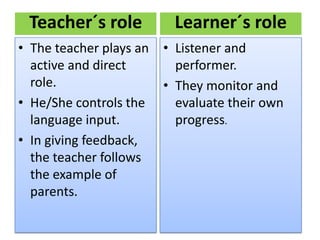
Teacher´s role           Learner´s role
• The teacher plays an   • Listener and
  active and direct        performer.
  role.                  • They monitor and
• He/She controls the      evaluate their own
  language input.          progress.
• In giving feedback,
  the teacher follows
  the example of
  parents.
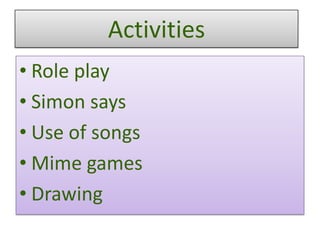
Activities
• Role play
• Simon says
• Use of songs
• Mime games
• Drawing

Total physical response

  • 1.
    Three influential learninghypotheses The bio- Brain Reduction of program lateralization stress First and second Different learning The lower stress, the language learning are functions according greater learning. parellel process, to the left-and right- developed in three brain hemispheres stages: • Listening competence •Listening comprehension •Natural speech
  • 2.
    Advantages Disadvantages • There is no pressure to speak. • It does not emphasise the • It reduces learning stress. visual learning style. • It takes into account • It is difficult to apply in large emotions and enviroment. classrooms • It emphasises two learning • Activities by rote repetition. styles: the auditory and the kinaesthetic. • It respects the natural order to acquire language: learning before speaking.
  • 3.
    Important points ofthe method • Use of the body in order to learn. • Use of imperatives in connection with physical movement. • The method is based on oral performance. • Unlike other approaches, TPR requires initial attention to meaning rather than to the forms of items. • Use of a sentence-based syllabus. • Materials and realia play an increasing role.
  • 4.
    Teacher´s role Learner´s role • The teacher plays an • Listener and active and direct performer. role. • They monitor and • He/She controls the evaluate their own language input. progress. • In giving feedback, the teacher follows the example of parents.
  • 5.
    Activities • Role play •Simon says • Use of songs • Mime games • Drawing