Cassandra Drivers
instaclustr.com
@Instaclustr
Who am I and what do I do?
• Ben Bromhead
• Co-founder and CTO of Instaclustr -> www.instaclustr.com
• Instaclustr provides Cassandra-as-a-Service in the cloud
• Currently in AWS, Azure and IBM Softlayer
• We currently manage 400+ nodes
What this talk will cover
• Driver basics
• Sync vs Async
• Driver connection policies and tuning
The driver
• The Cassandra driver contains the logic for connecting to
Cassandra and running queries in a fast and efficient manner
• Focus on the Datastax Open Source drivers:
The driver
• Java
• .NET (C#)
• C/C++
• Python
• Node.js
• Ruby
• PHP
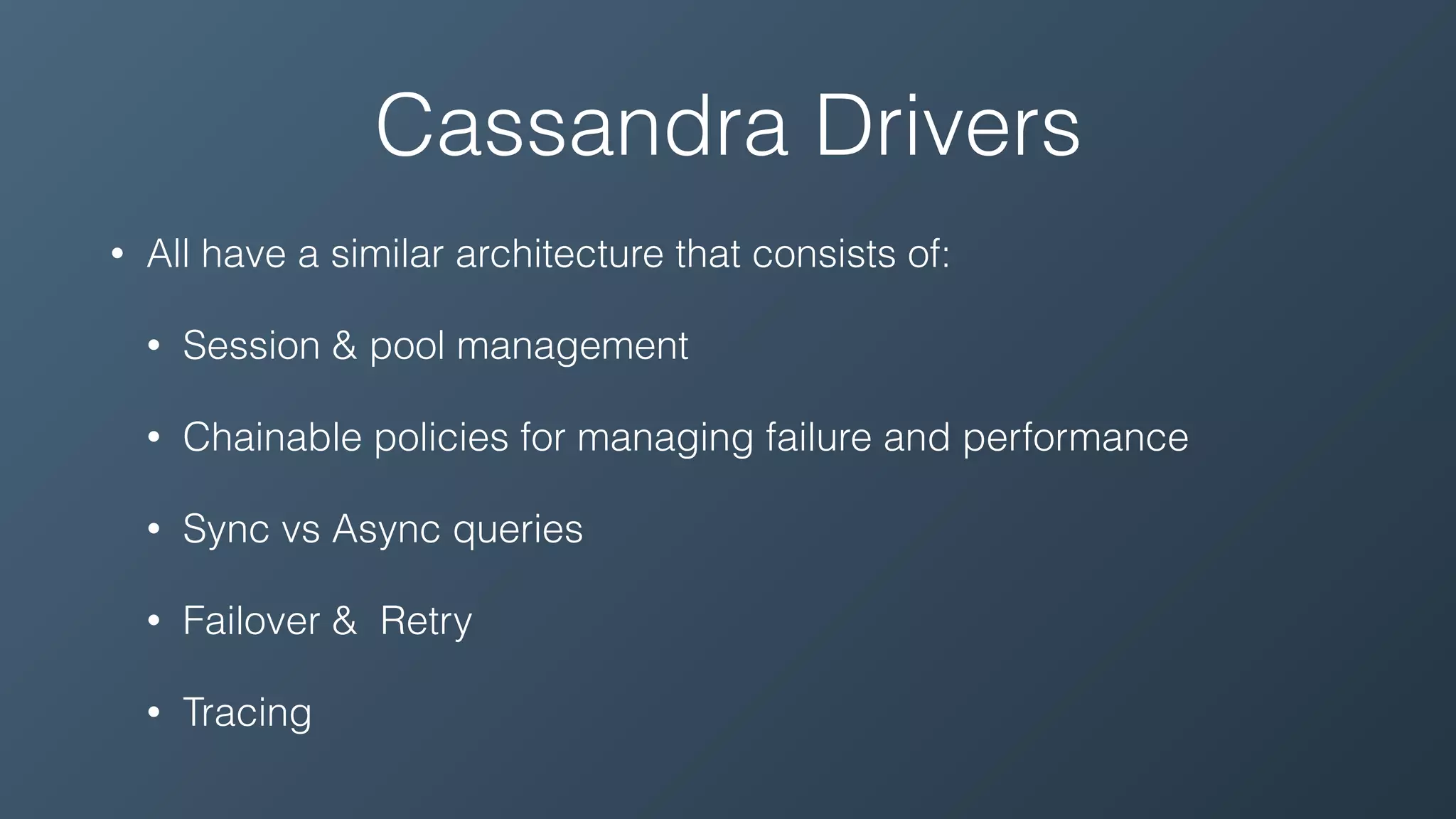
Cassandra Drivers
• All have a similar architecture that consists of:
• Session & pool management
• Chainable policies for managing failure and performance
• Sync vs Async queries
• Failover & Retry
• Tracing
Cassandra Drivers
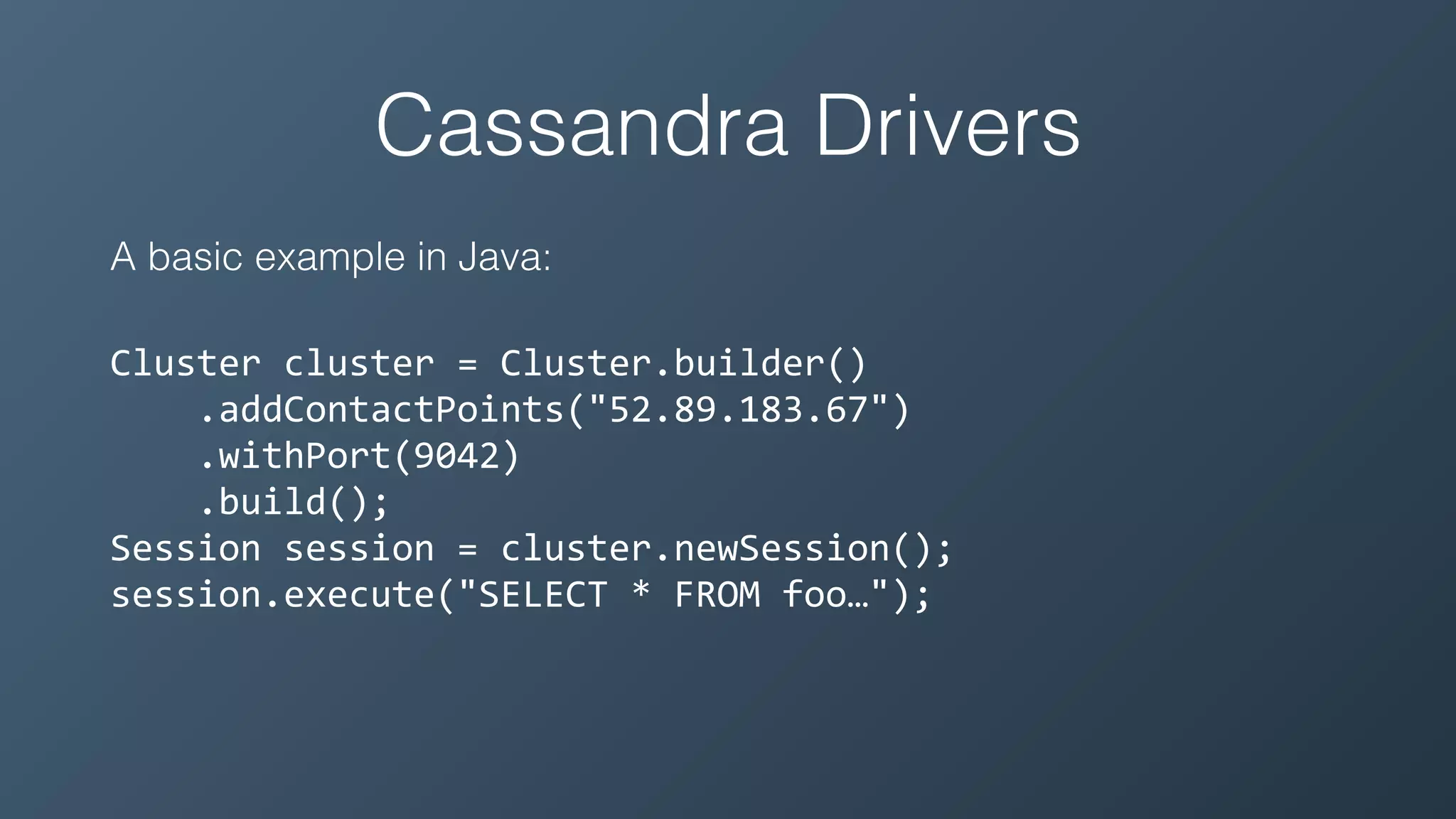
A basic example in Java:
Cluster	cluster	=	Cluster.builder()	
				.addContactPoints("52.89.183.67")	
				.withPort(9042)	
				.build();	
Session	session	=	cluster.newSession();	
session.execute("SELECT	*	FROM	foo…");
Cassandra Drivers
A basic example in Python:
cluster	=	Cluster(contact_points=["52.89.183.67"],	port=9042)	
session	=	cluster.connect()	
rows	=	session.execute("SELECT	name,	age,	email	FROM	users")
Cassandra Drivers
A basic example in Ruby:
cluster	=	Cassandra.cluster(	
				:hosts	=>	["52.89.183.67",	"52.89.99.88",	"54.69.217.141"],
				:datacenter	=>	'AWS_VPC_US_WEST_2'	
)	
session	=	cluster.connect()	
rows	=	session.execute("SELECT	name,	age,	email	FROM	users")
Cassandra Drivers
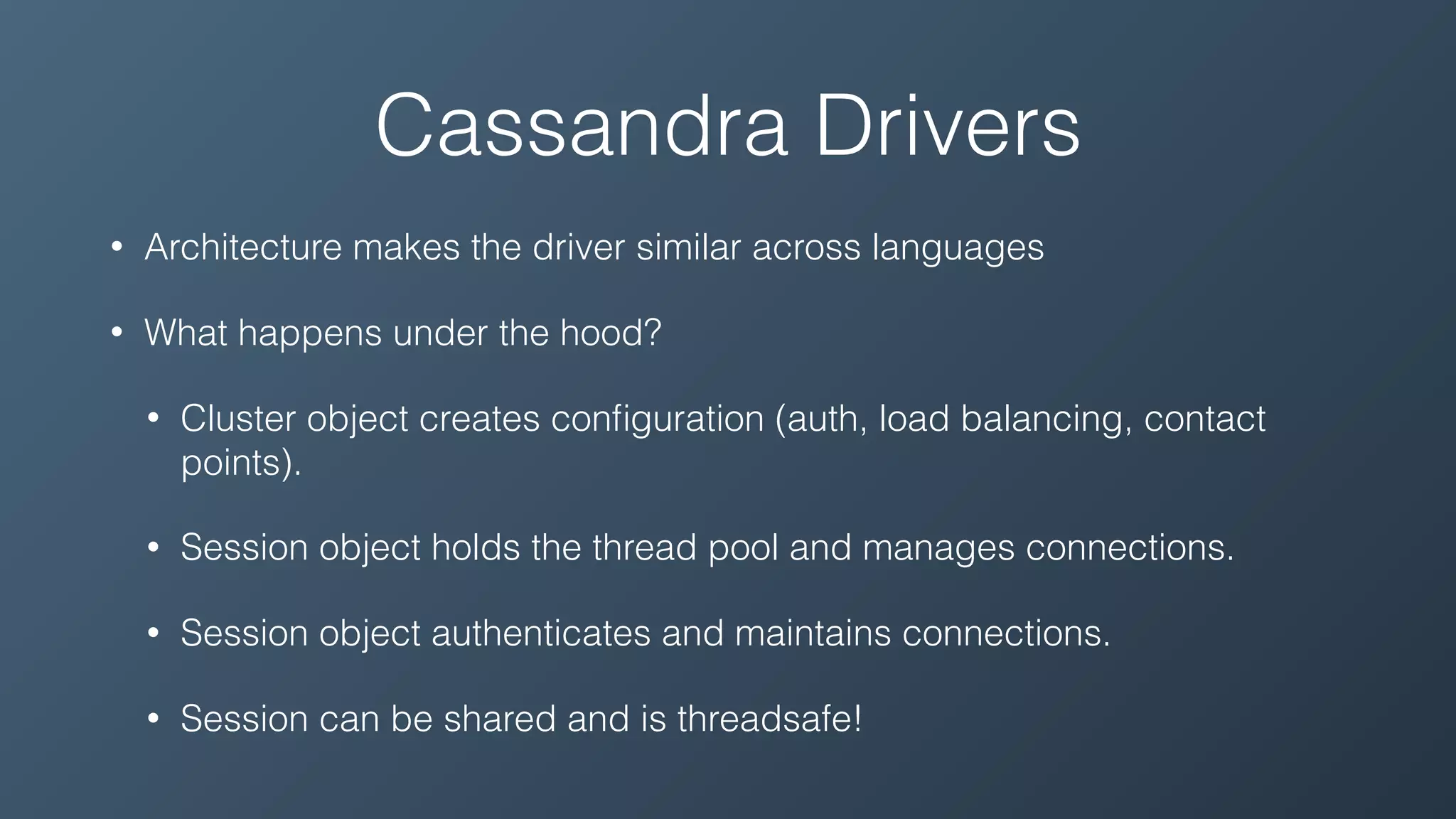
• Architecture makes the driver similar across languages
• What happens under the hood?
• Cluster object creates configuration (auth, load balancing, contact
points).
• Session object holds the thread pool and manages connections.
• Session object authenticates and maintains connections.
• Session can be shared and is threadsafe!
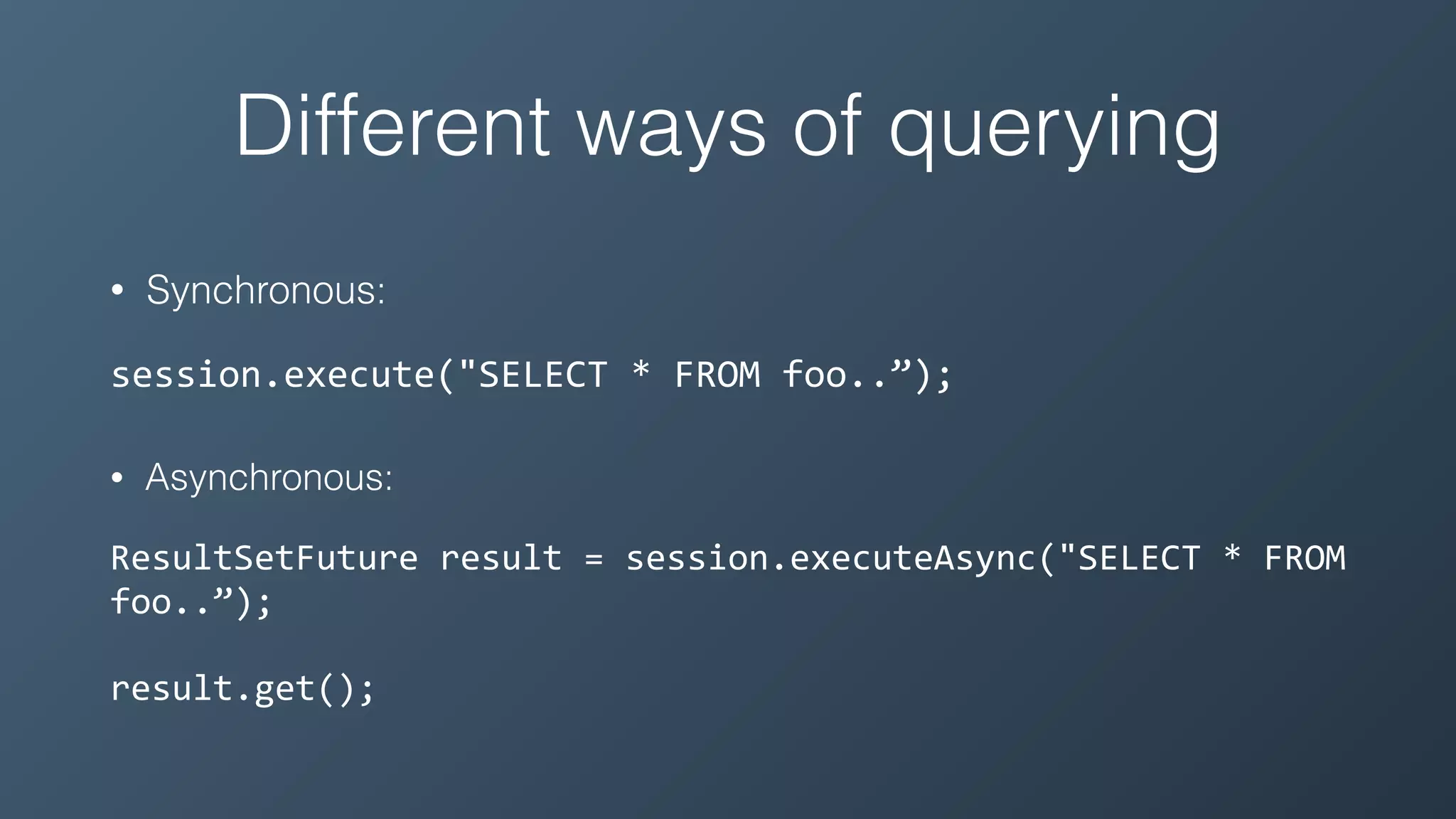
Different ways of querying
• Synchronous:
session.execute("SELECT	*	FROM	foo..”);
• Asynchronous:
ResultSetFuture	result	=	session.executeAsync("SELECT	*	FROM	
foo..”);	
result.get();
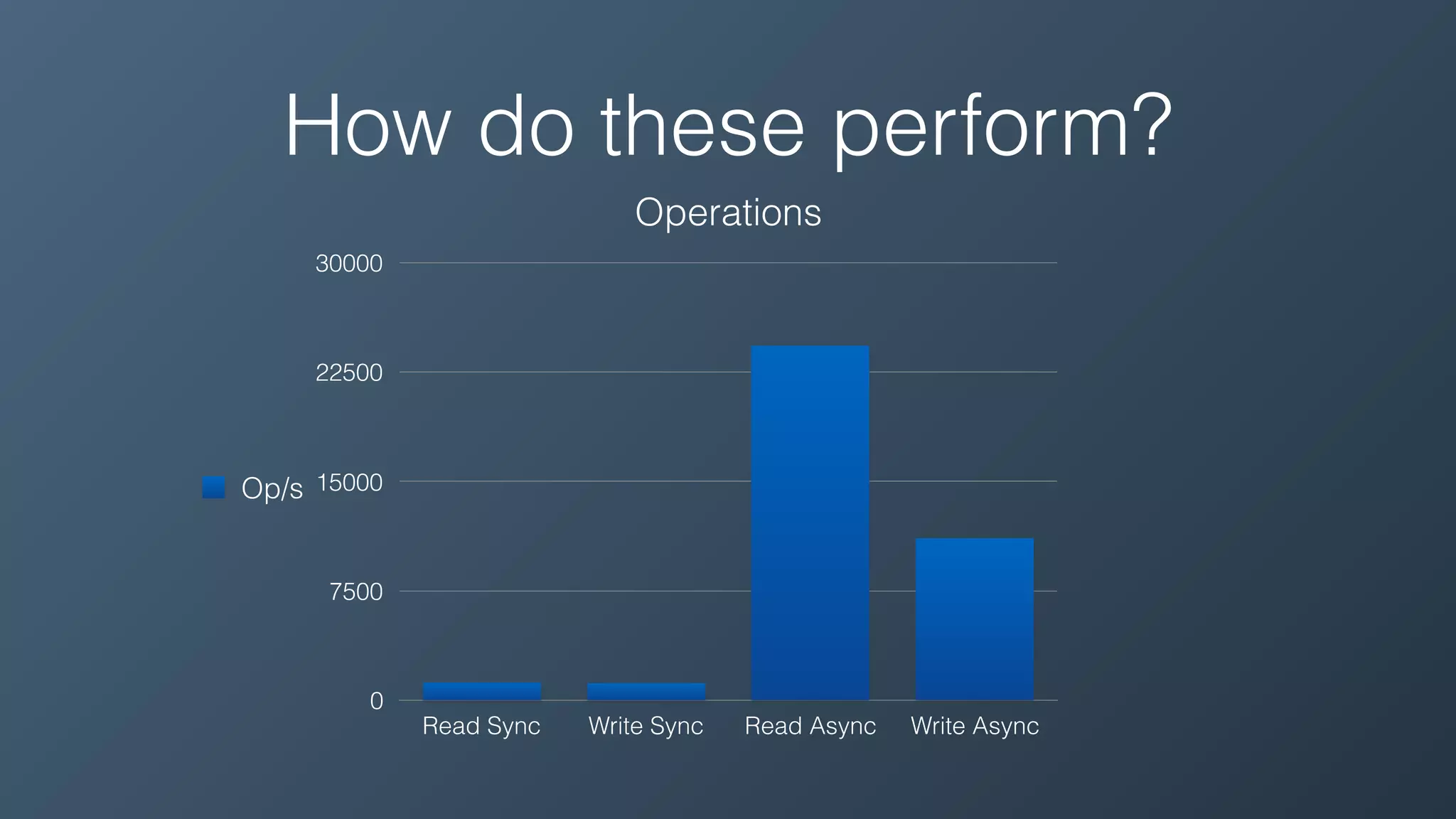
How do these perform?
Operations
0
7500
15000
22500
30000
Read Sync Write Sync Read Async Write Async
Op/s
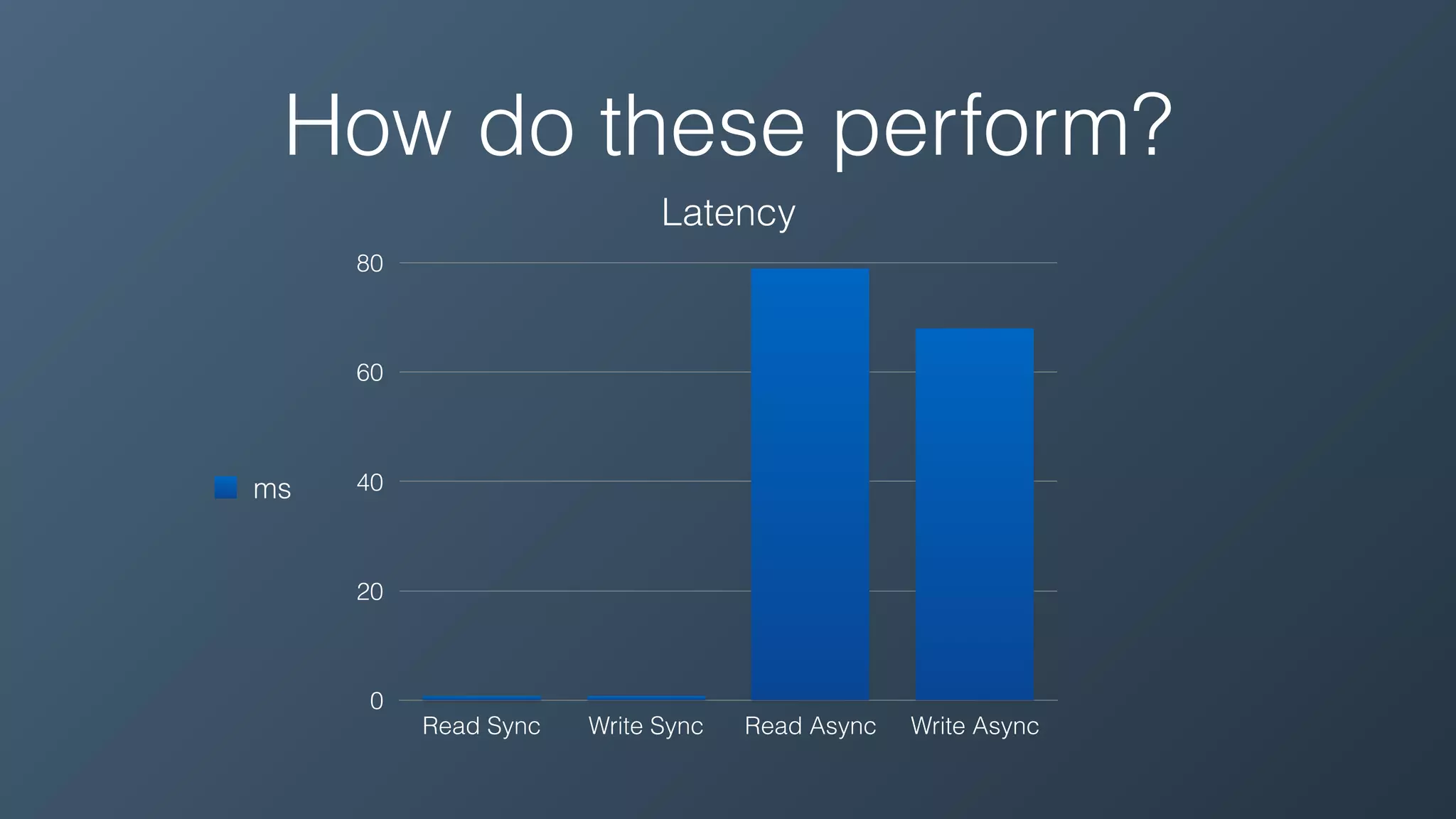
How do these perform?
Latency
0
20
40
60
80
Read Sync Write Sync Read Async Write Async
ms
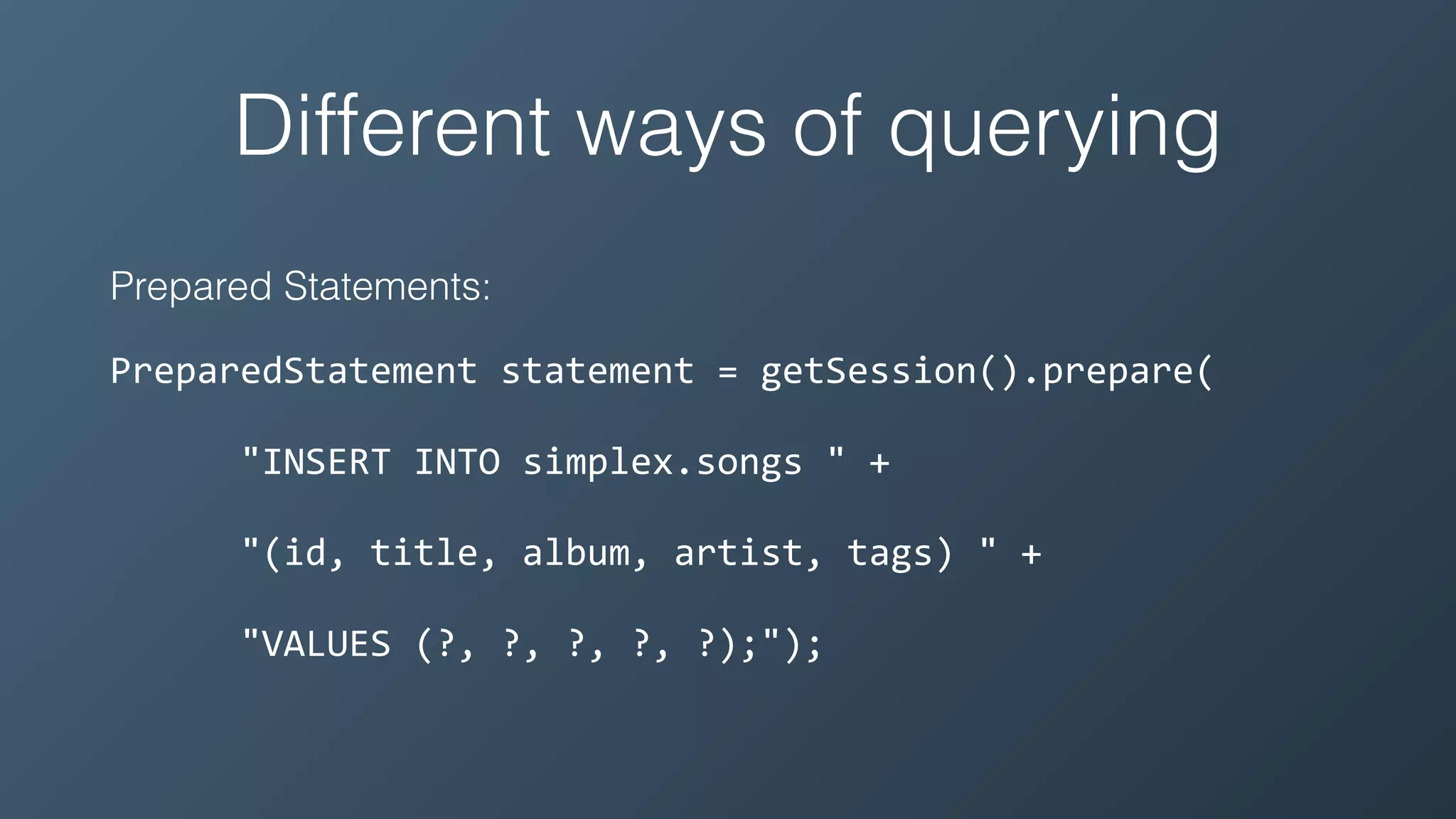
Different ways of querying
Prepared Statements:
PreparedStatement	statement	=	getSession().prepare(	
						"INSERT	INTO	simplex.songs	"	+	
						"(id,	title,	album,	artist,	tags)	"	+	
						"VALUES	(?,	?,	?,	?,	?);");
Different ways of querying
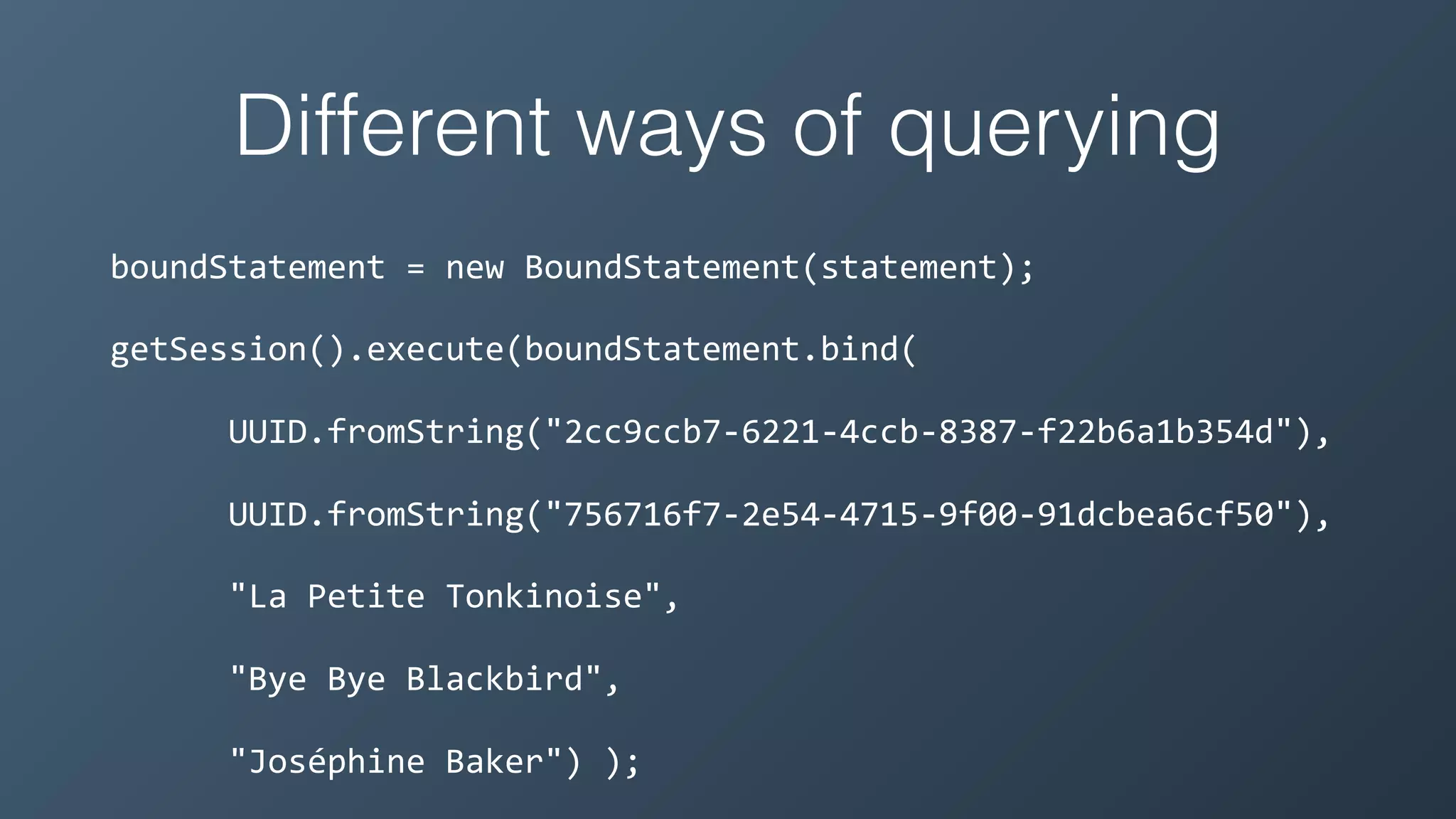
boundStatement	=	new	BoundStatement(statement);	
getSession().execute(boundStatement.bind(	
						UUID.fromString("2cc9ccb7-6221-4ccb-8387-f22b6a1b354d"),	
						UUID.fromString("756716f7-2e54-4715-9f00-91dcbea6cf50"),	
						"La	Petite	Tonkinoise",	
						"Bye	Bye	Blackbird",	
						"Joséphine	Baker")	);
Drivers and consistency
• Within the different ways of querying Cassandra you can also adjust
the consistency level per query.
• Lets have a quick consistency refresh
A brief intro to tuneable consistency
• Cassandra is considered to be a db that favours Availability and
Partition Tolerance.
• Let’s you change those characteristics per query to suit your
application requirement
Two consistency levers
• Consistency level - How many acknowledgements/responses from
replicas before a query is considered a success.
• Replication Factor (RF) - How many copies of a record do I store.
Two consistency levers
• Consistency level - Chosen by the client at query time
• Replication Factor (RF) - Determined client on schema definition
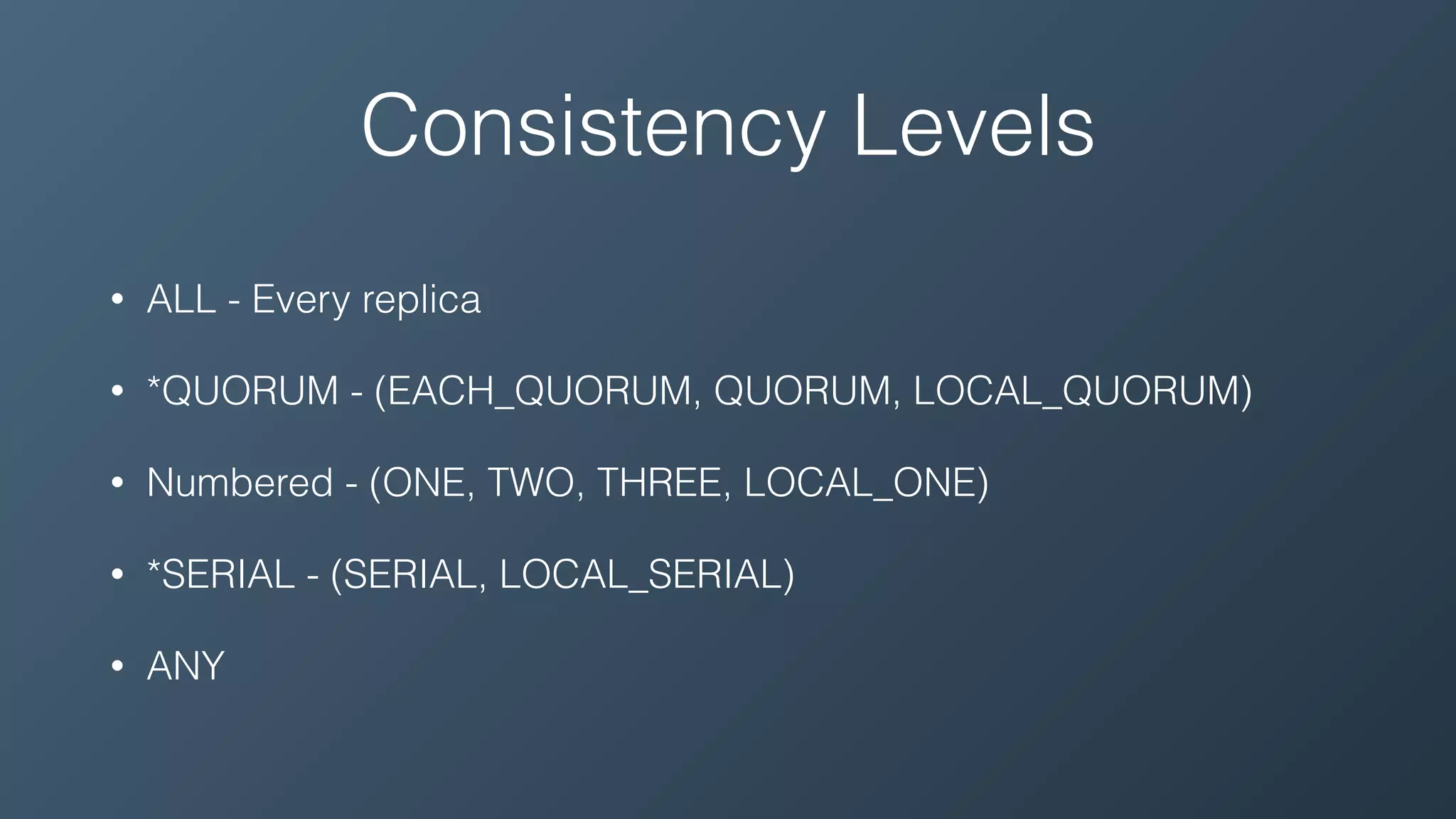
Consistency Levels
• ALL - Every replica
• *QUORUM - (EACH_QUORUM, QUORUM, LOCAL_QUORUM)
• Numbered - (ONE, TWO, THREE, LOCAL_ONE)
• *SERIAL - (SERIAL, LOCAL_SERIAL)
• ANY
What does it all mean
• At the client level (your application) you have total control
• Define implicit and explicit failure handling
• Isolate queries to a single geography
• Trade consistency for latency (a decision is better than no
decision)
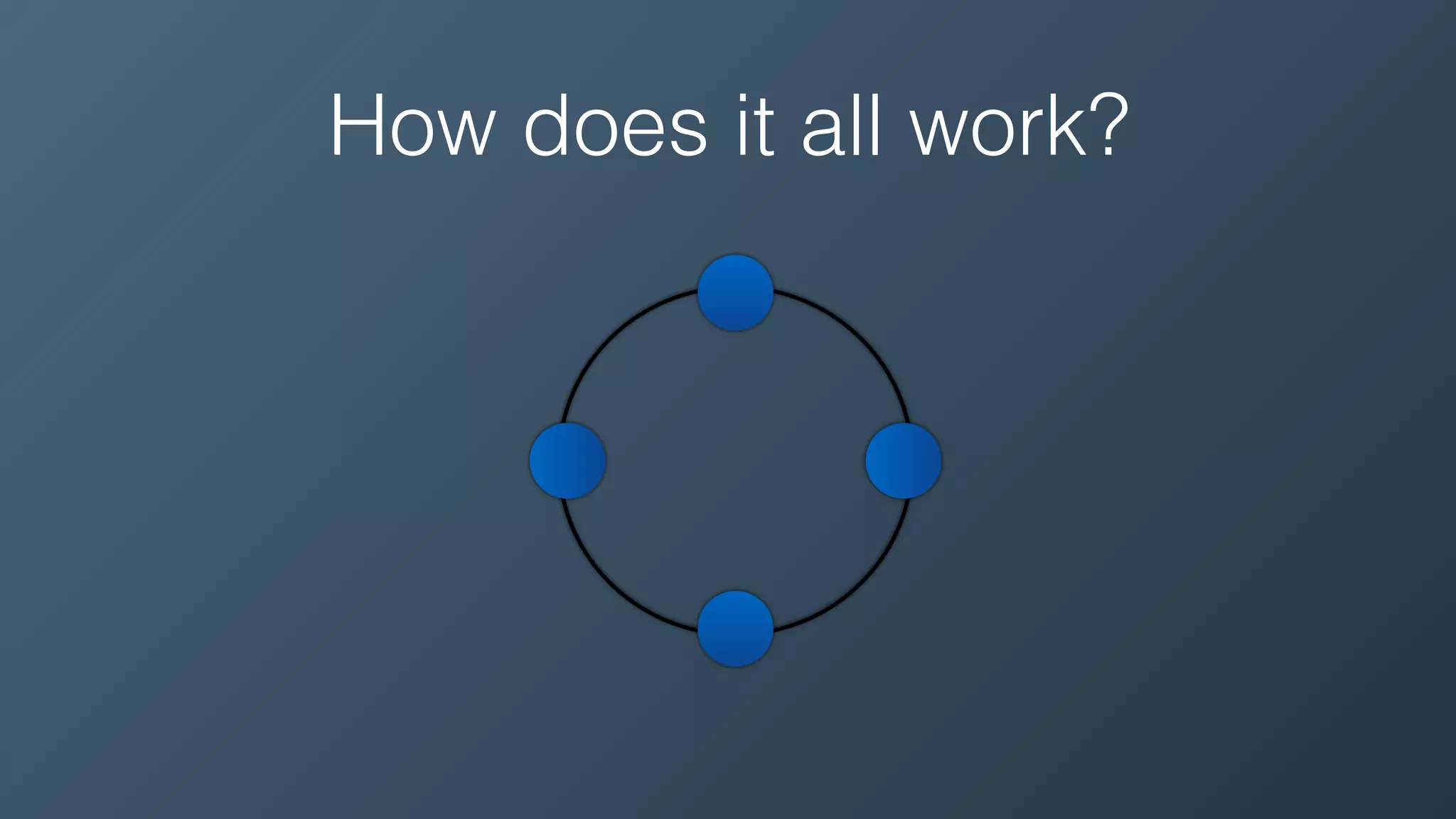
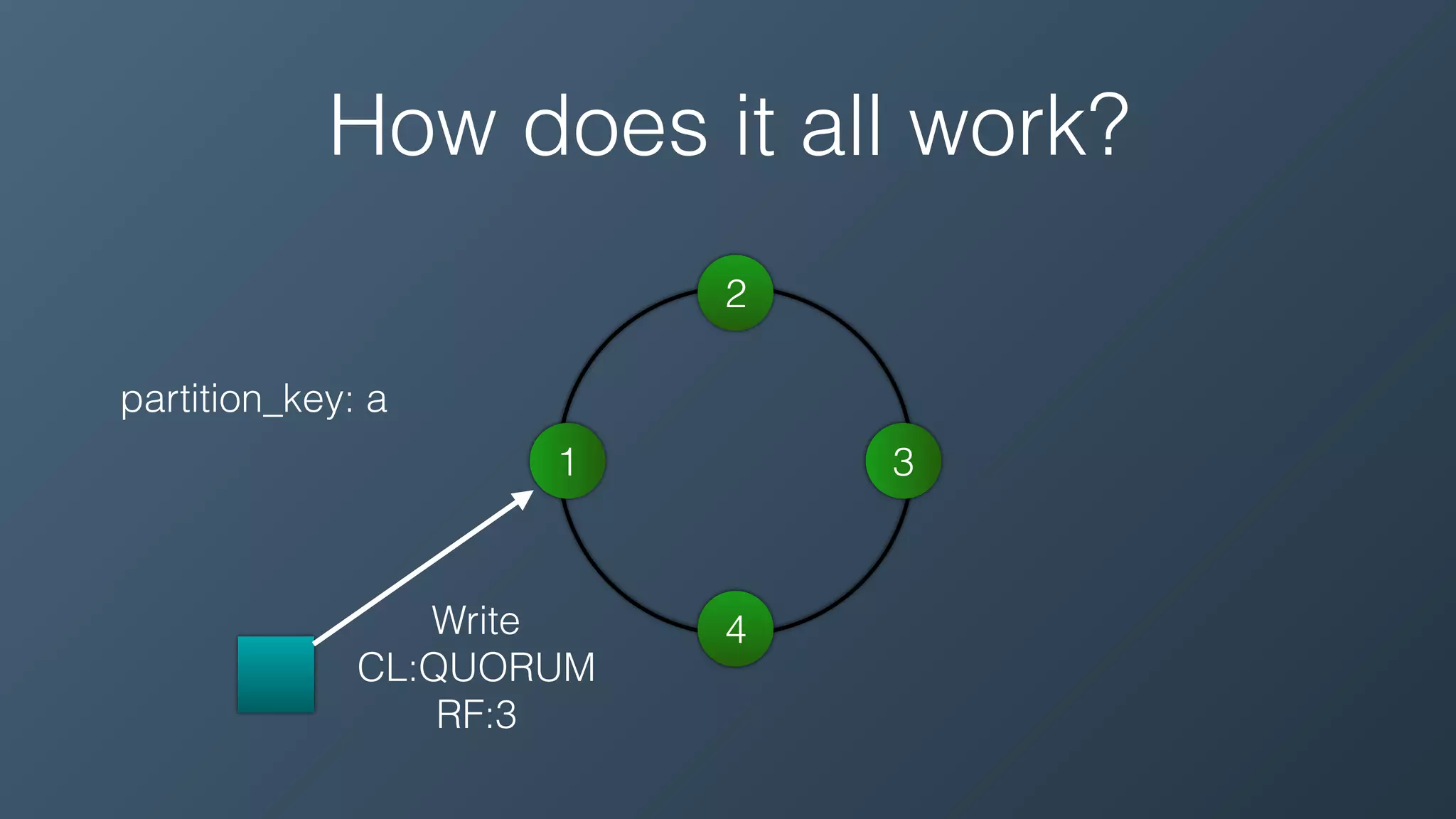
How does it all work?
Write
CL:QUORUM
RF:3
1
2
3
4
partition_key: a
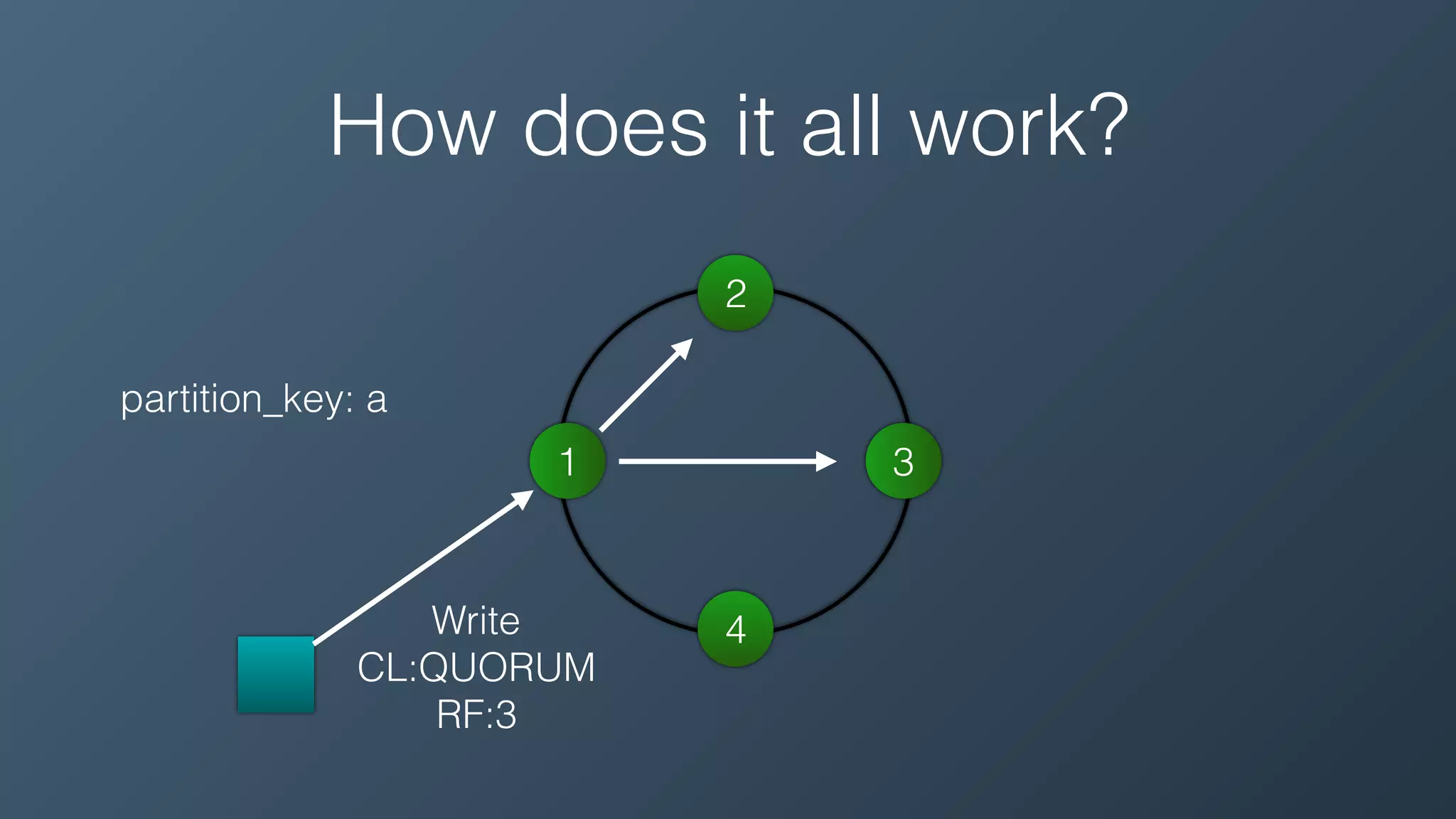
How does it all work?
Write
CL:QUORUM
RF:3
1
2
3
4
partition_key: a
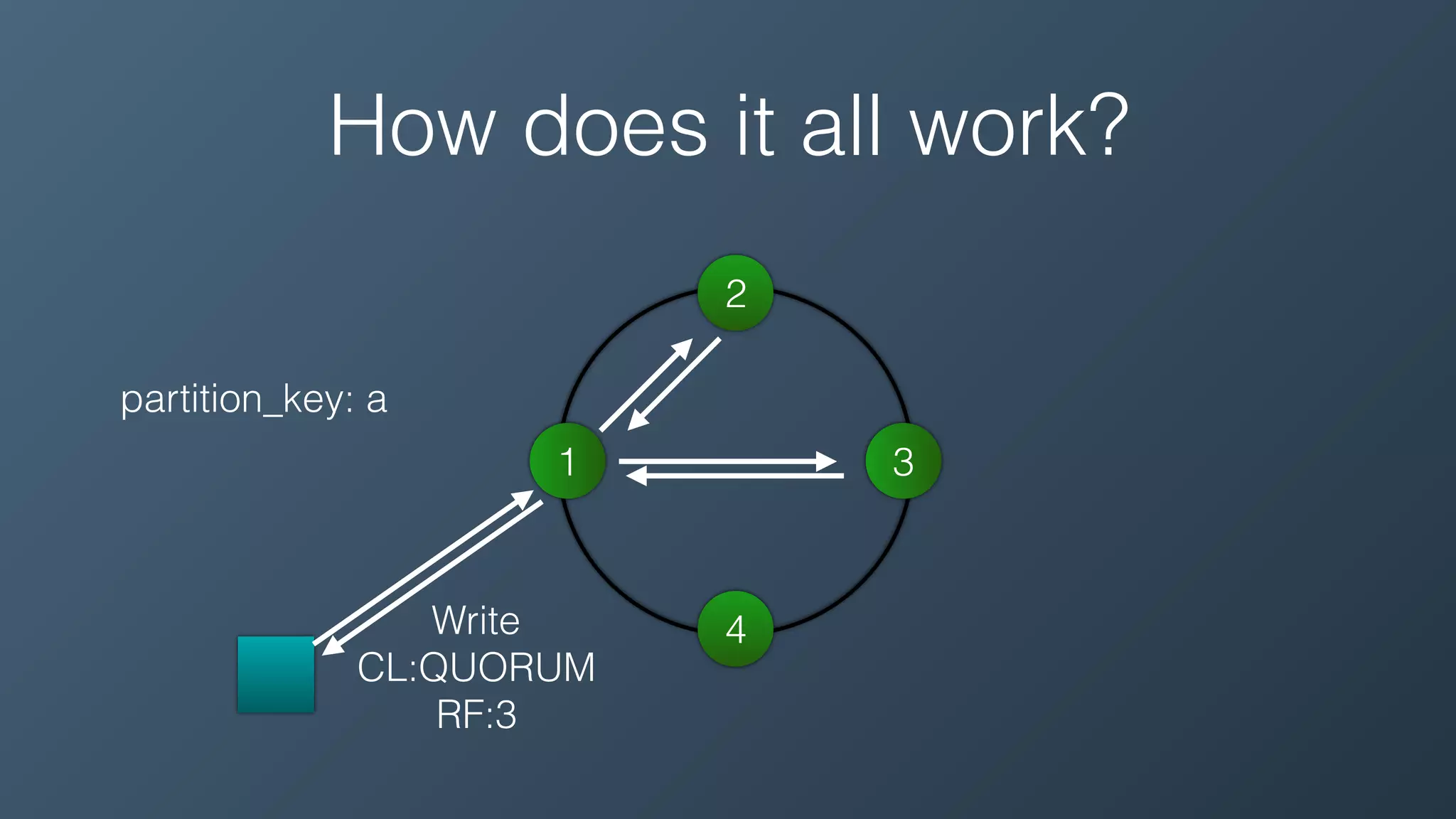
How does it all work?
Write
CL:QUORUM
RF:3
1
2
3
4
partition_key: a
How does it all work?
Write
CL:QUORUM
RF:3
1
2
3
4
partition_key: a
How does it all work?
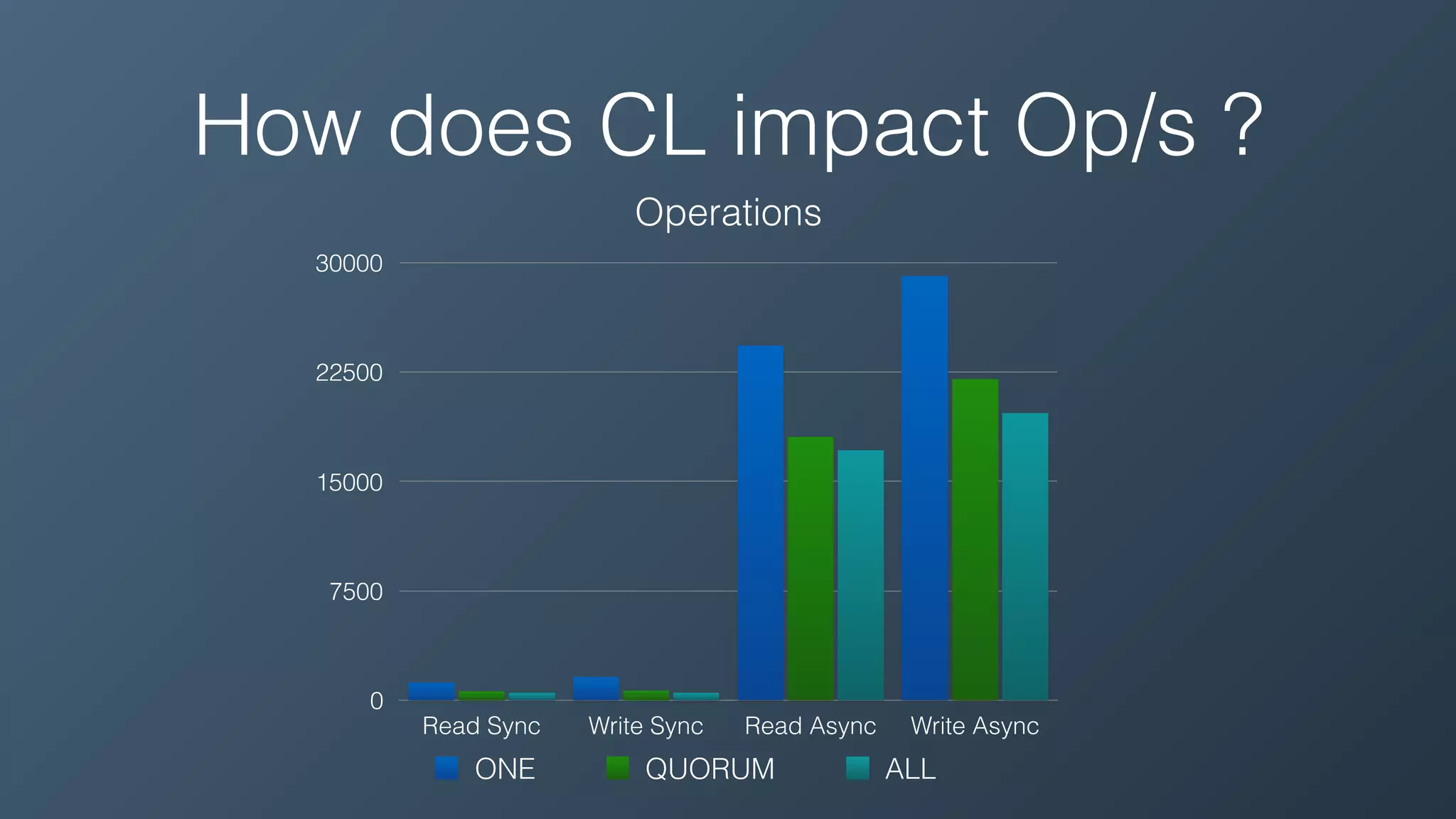
How does CL impact Op/s ?
Operations
0
7500
15000
22500
30000
Read Sync Write Sync Read Async Write Async
ONE QUORUM ALL
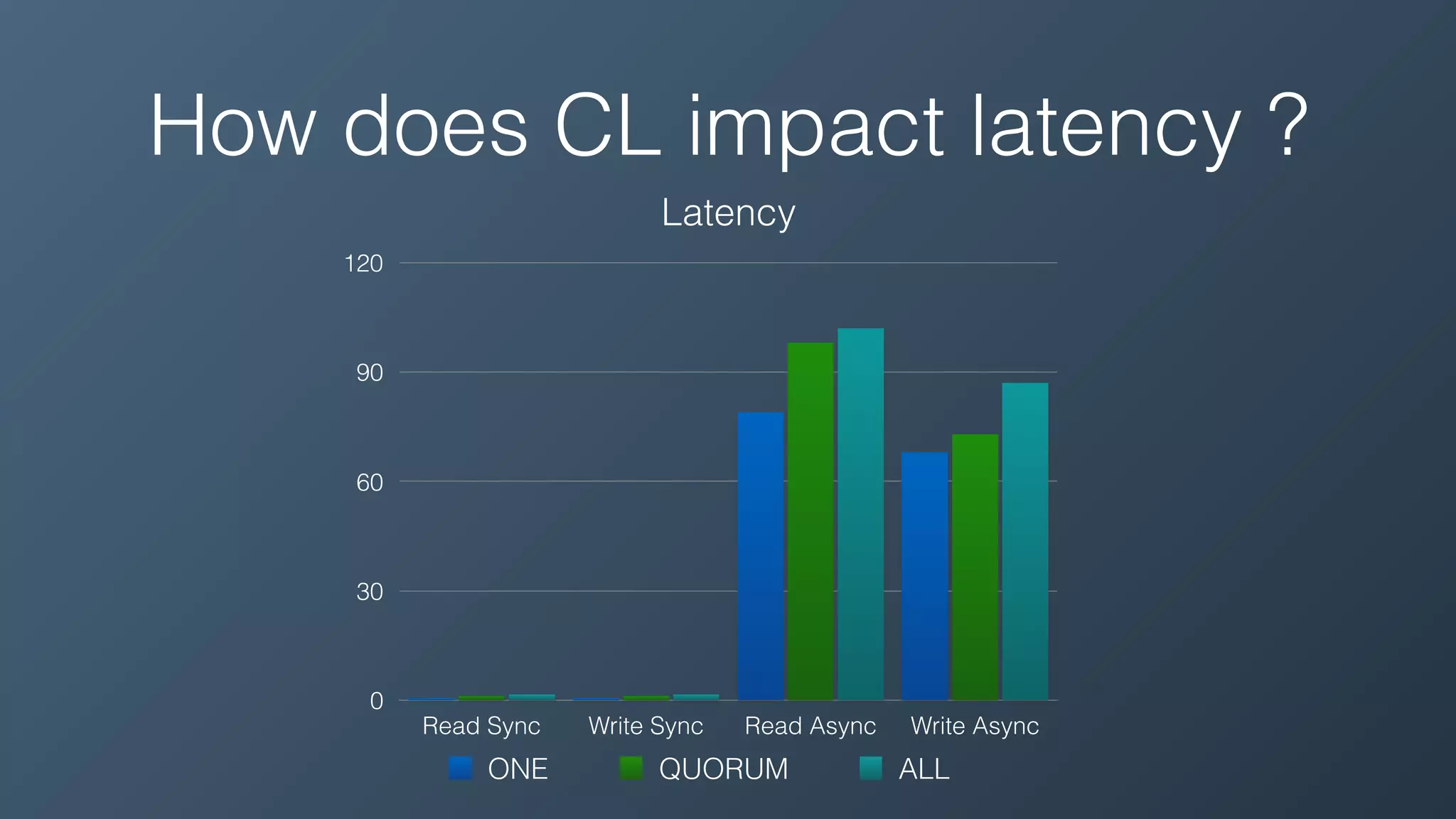
How does CL impact latency ?
Latency
0
30
60
90
120
Read Sync Write Sync Read Async Write Async
ONE QUORUM ALL
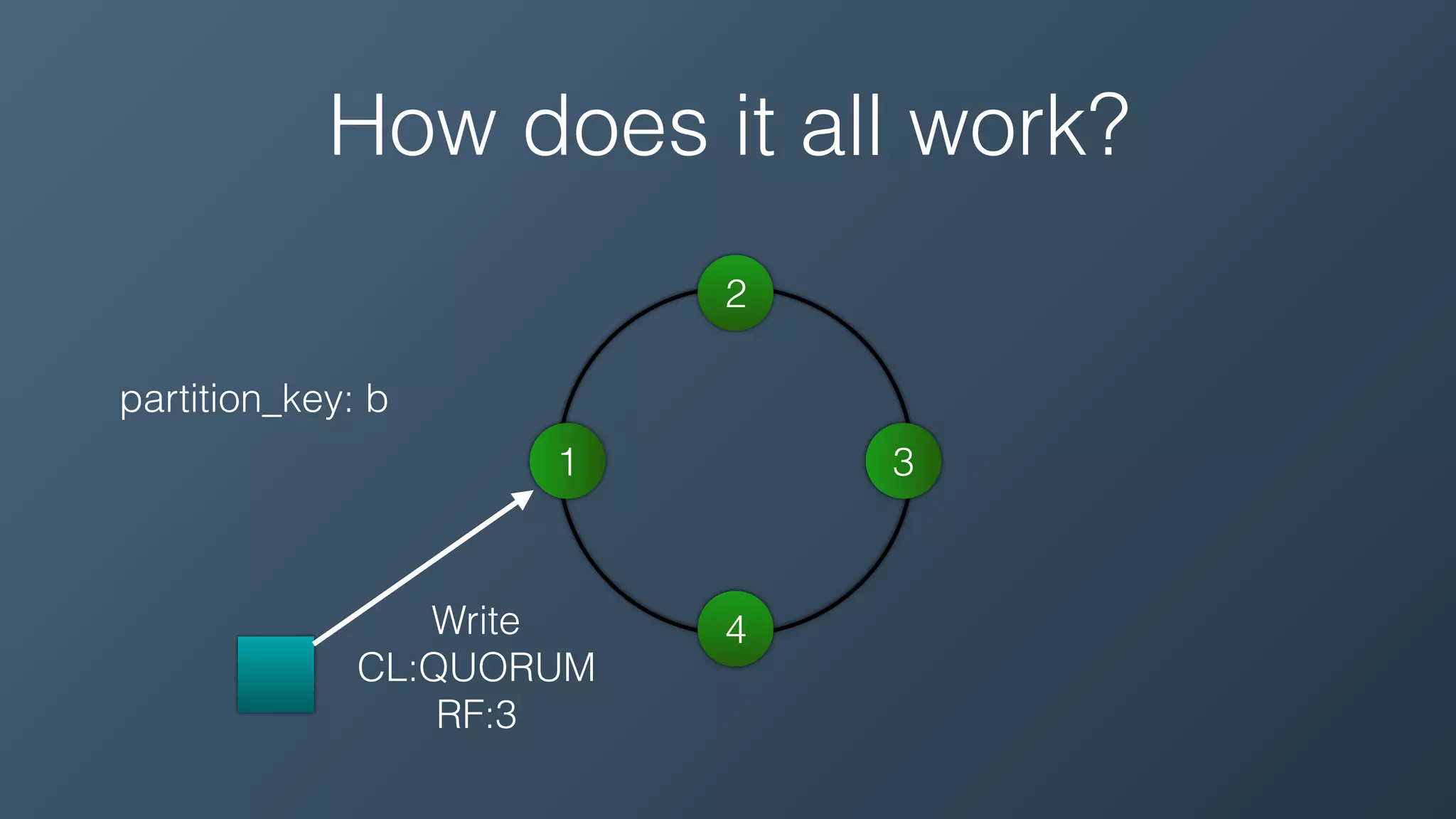
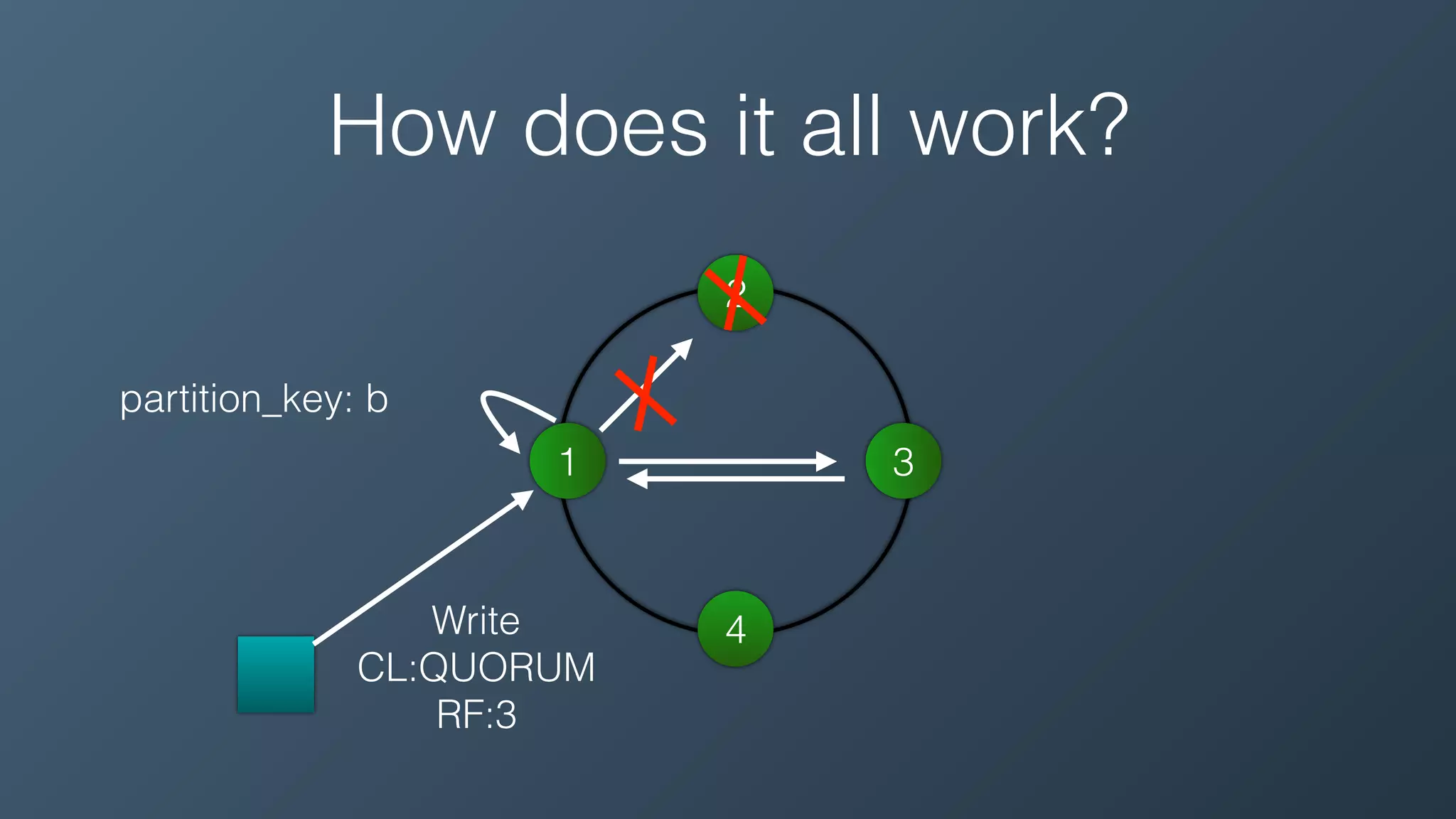
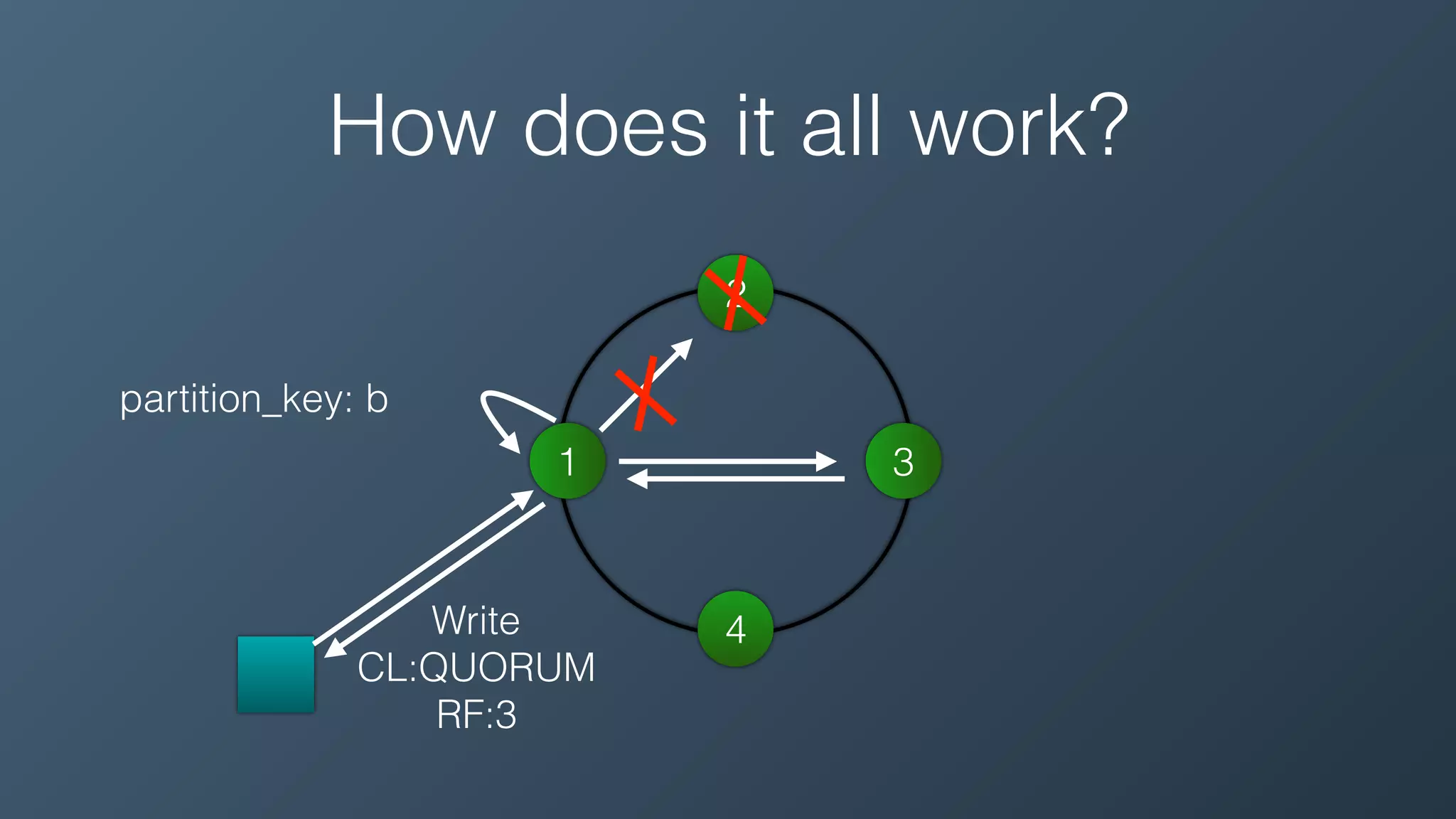
What happens when something goes wrong?
Write
CL:QUORUM
RF:3
1
2
3
4
partition_key: b
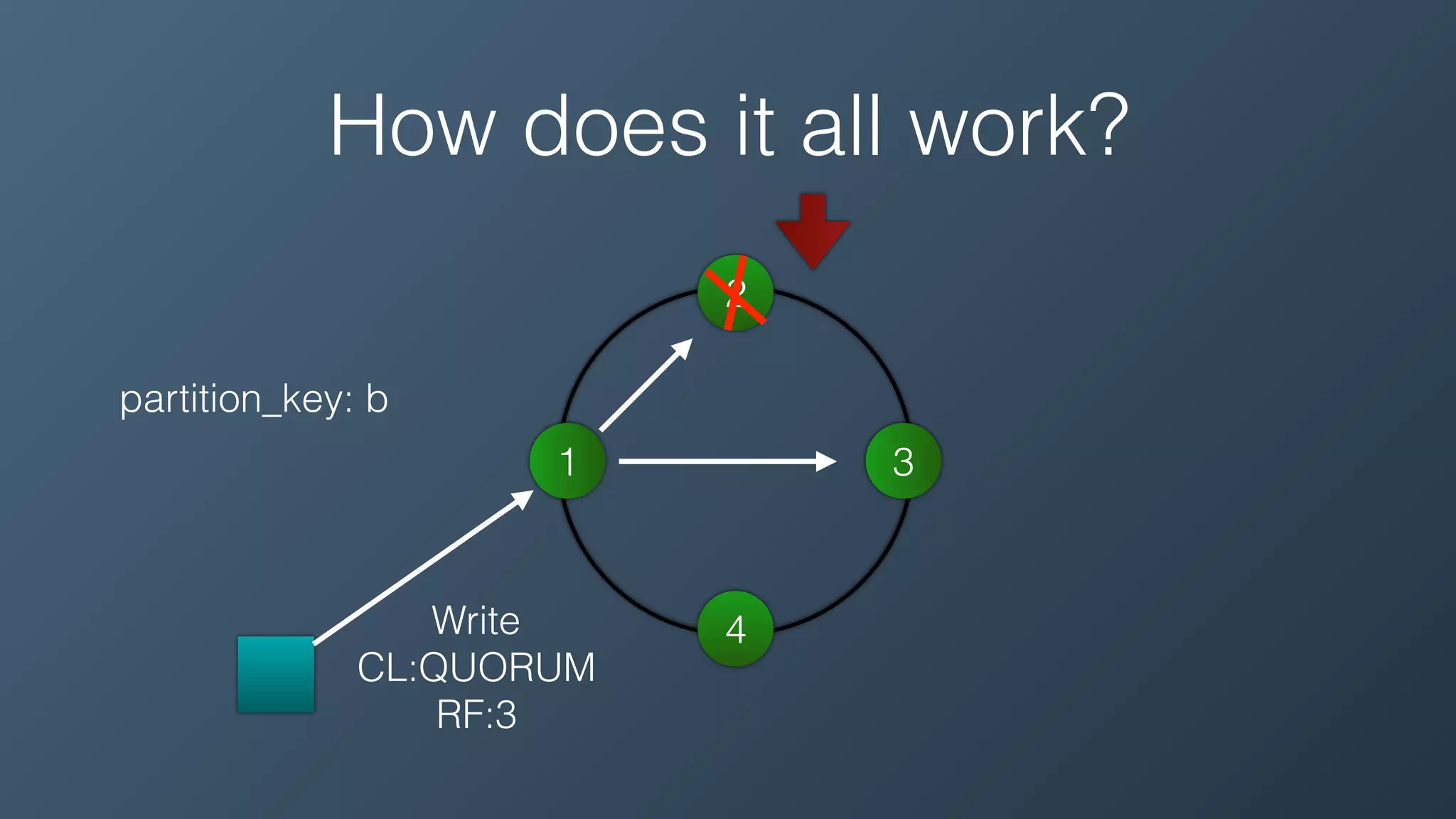
How does it all work?
Write
CL:QUORUM
RF:3
1
2
3
4
partition_key: b
How does it all work?
Write
CL:QUORUM
RF:3
1
2
3
4
partition_key: b
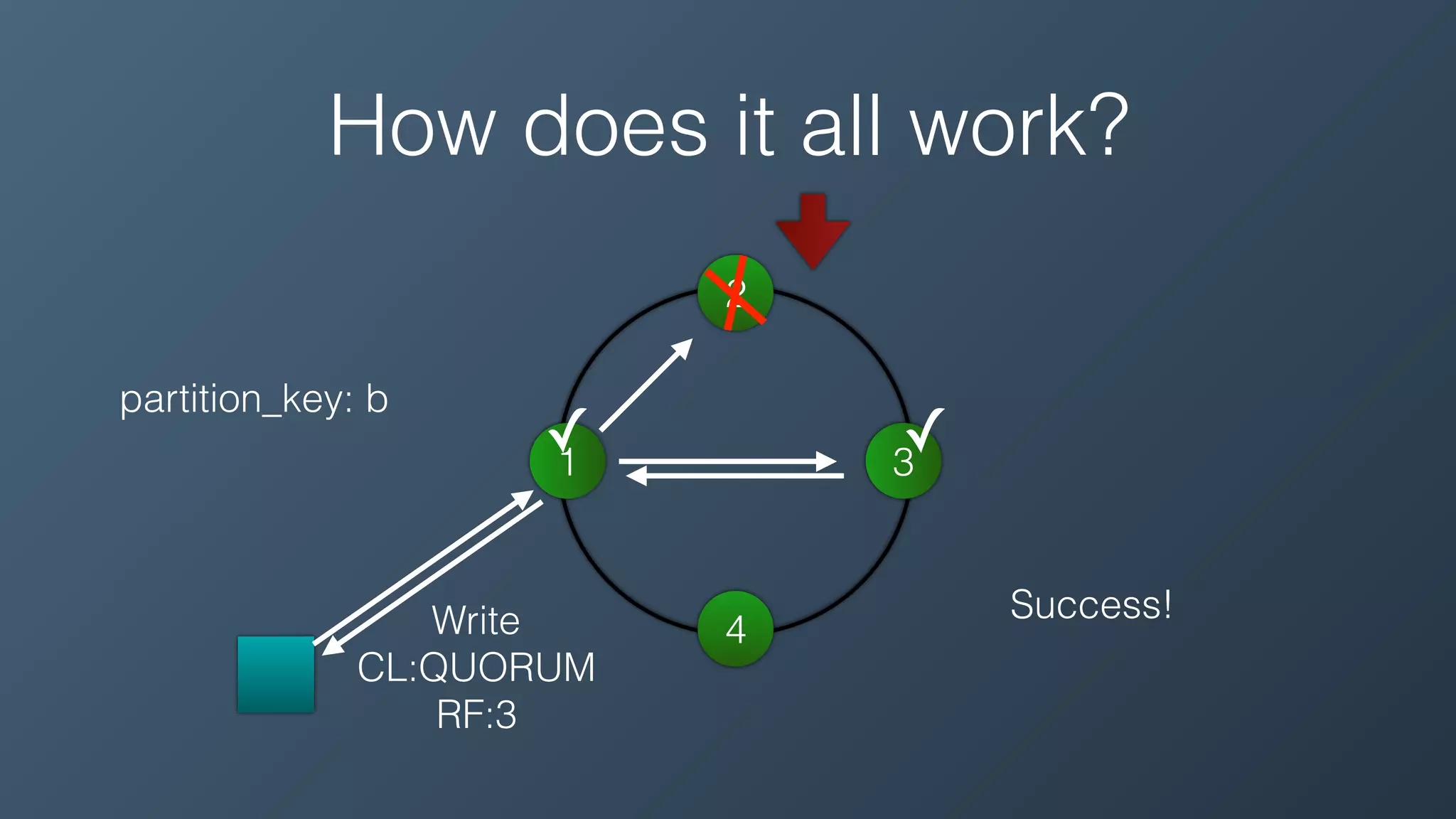
How does it all work?
Write
CL:QUORUM
RF:3
1
2
3
4
partition_key: b
How does it all work?
✓✓
Required responses:
floor(3 * 0.5) + 1 = 2
Write
CL:QUORUM
RF:3
1
2
3
4
partition_key: b
How does it all work?
✓✓
Success!
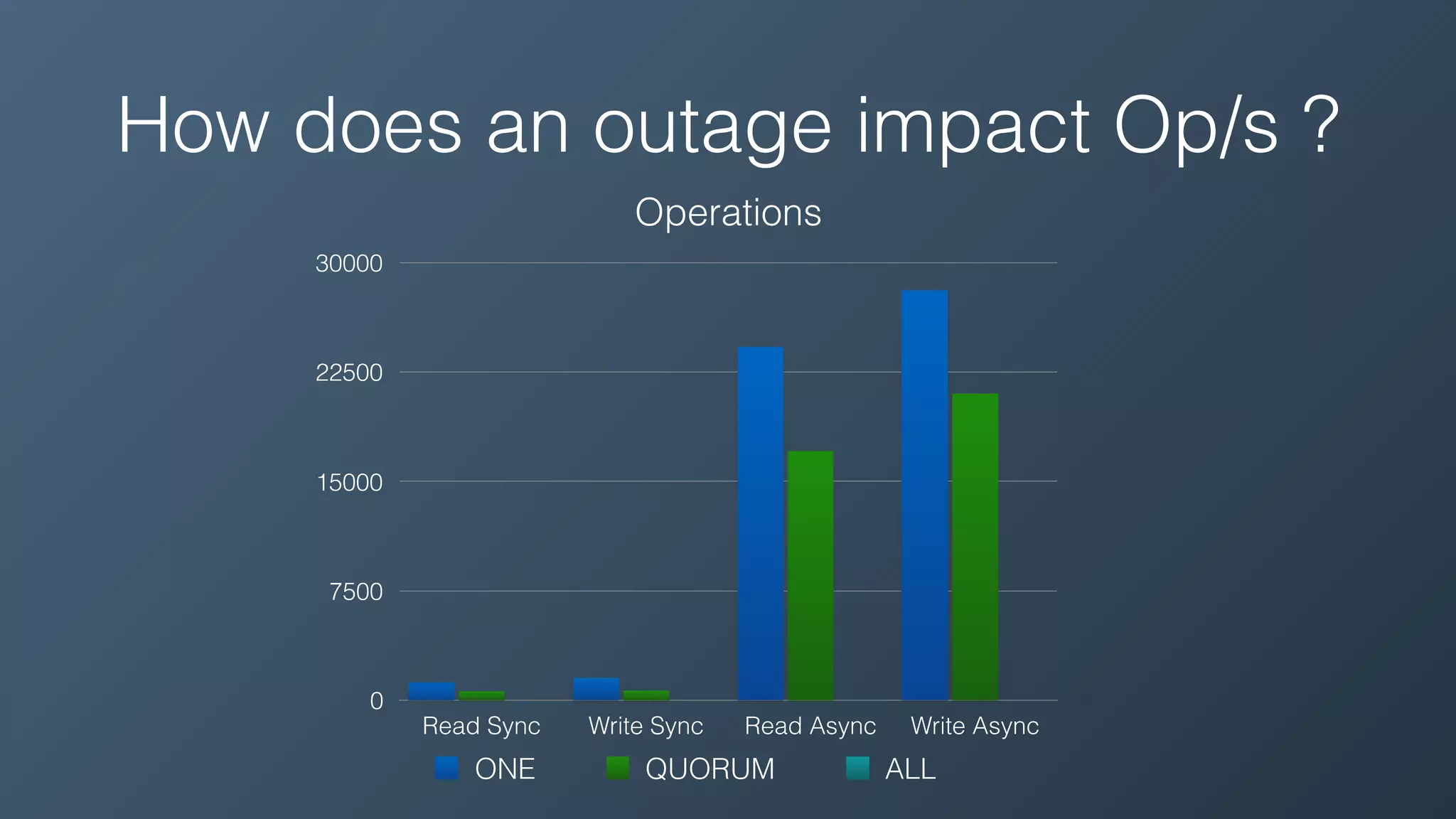
How does an outage impact Op/s ?
Operations
0
7500
15000
22500
30000
Read Sync Write Sync Read Async Write Async
ONE QUORUM ALL
How does an outage impact latency ?
Latency
0
25
50
75
100
Read Sync Write Sync Read Async Write Async
ONE QUORUM ALL
We are now have a replica that is not
consistent
• Anti-entropy repair (only guaranteed way to make things consistent)
• Hinted handoff
• Read repair
We are now have a replica that is not
consistent
• Anti-entropy repair (only guaranteed way to make things consistent)
• Hinted handoff - lets cover this quickly
• Read repair
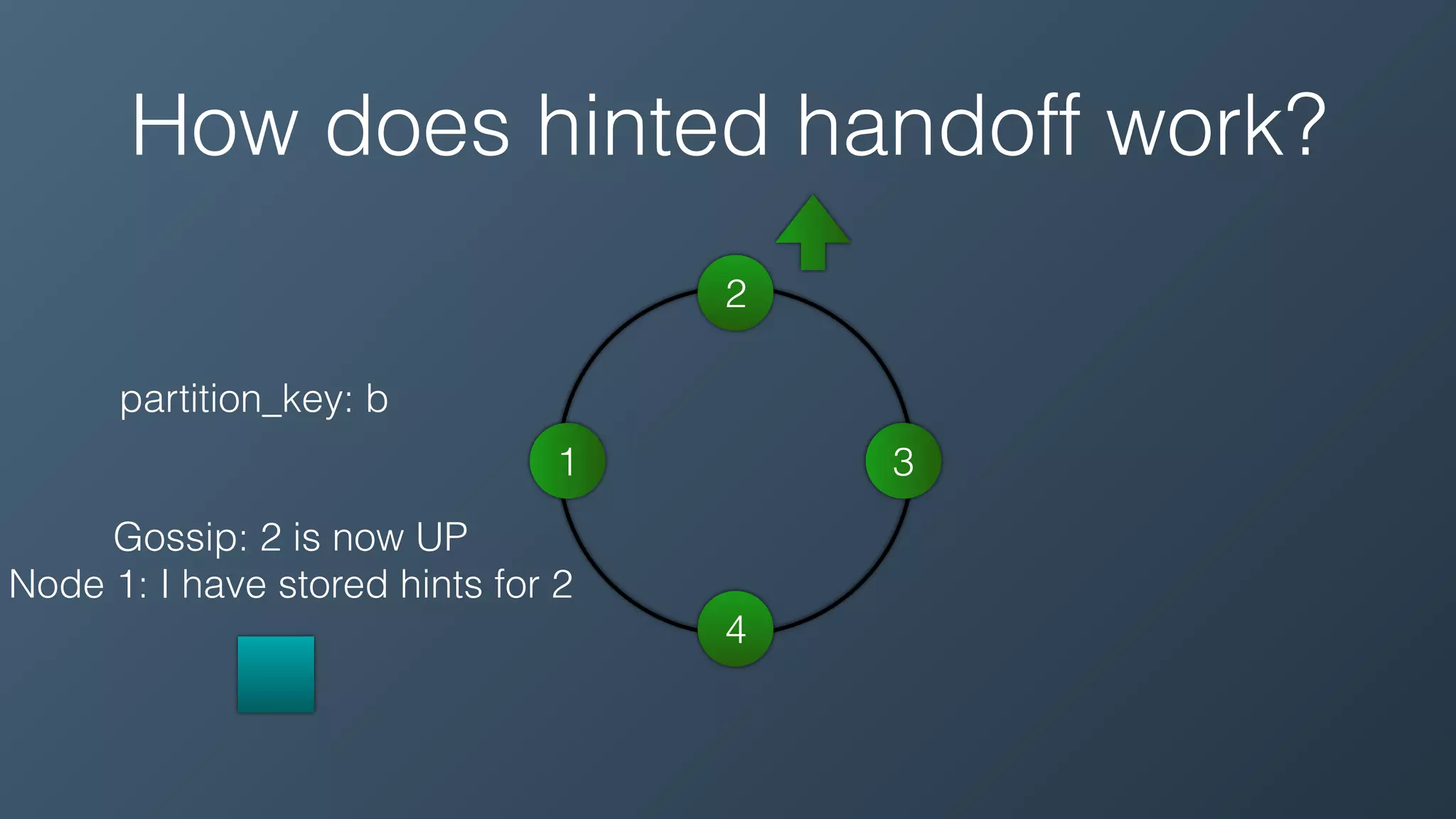
What is hinted handoff ?
• A performance optimisation for “catching up” nodes who missed
writes.
What isn’t hinted handoff ?
• A consistent distribution mechanism
Write
CL:QUORUM
RF:3
partition_key: b
1
2
3
4
How does it all work?
Write
CL:QUORUM
RF:3
partition_key: b
1
2
3
4
How does it all work?
How does hinted handoff work?
1
2
3
4
host / key A B
1 ✔ ✔
2 ?
3 ✔ ✔
…
✔
How does hinted handoff work?
partition_key: b
1
2
3
4
How does hinted handoff work?
partition_key: b
1
2
3
4
Gossip: 2 is now UP
Node 1: I have stored hints for 2
How does hinted handoff work?
partition_key: b
1
2
3
4
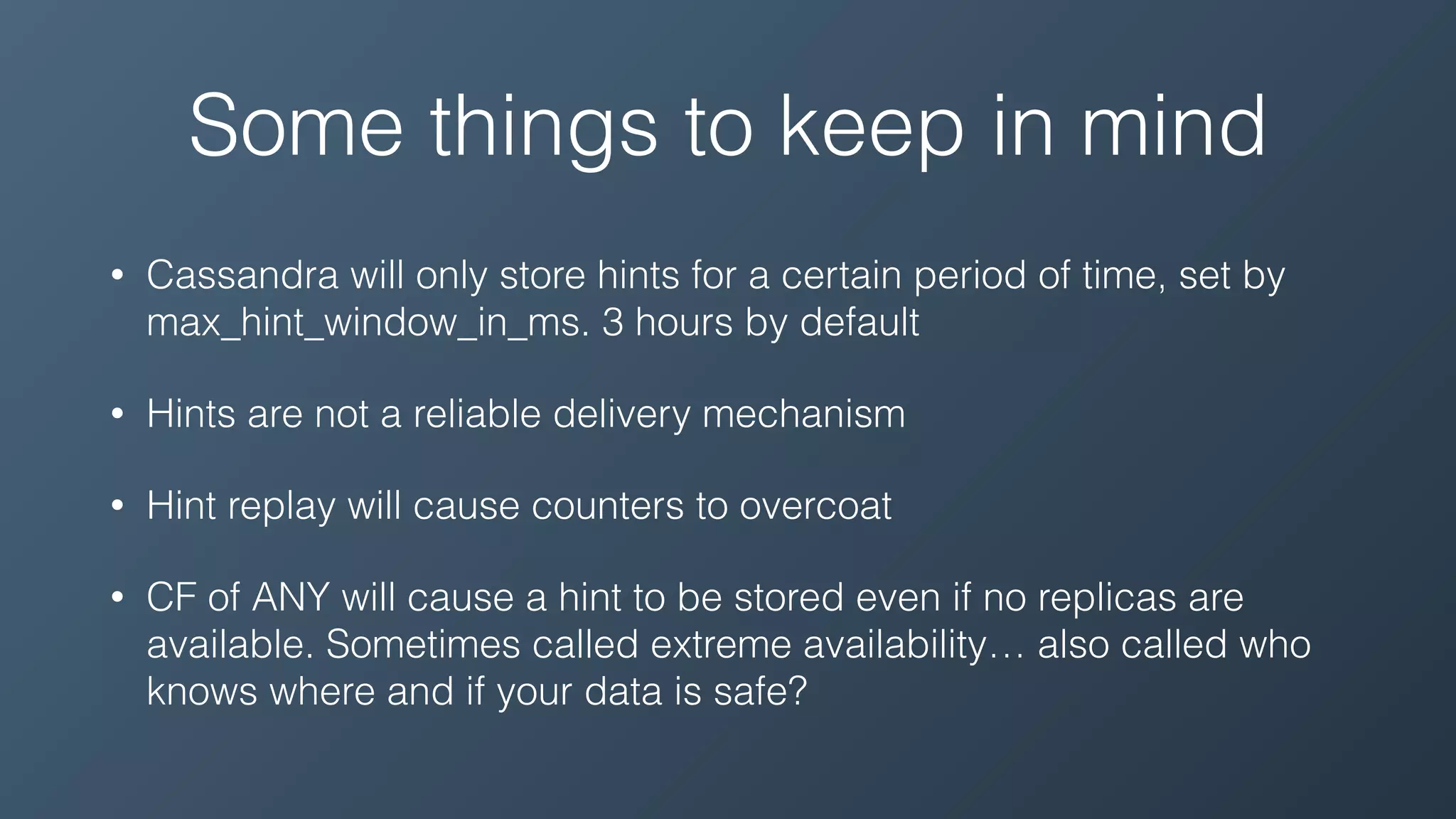
Some things to keep in mind
• Cassandra will only store hints for a certain period of time, set by
max_hint_window_in_ms. 3 hours by default
• Hints are not a reliable delivery mechanism
• Hint replay will cause counters to overcoat
• CF of ANY will cause a hint to be stored even if no replicas are
available. Sometimes called extreme availability… also called who
knows where and if your data is safe?
Hinted handoff performance
• Causes the same volume of writes to occur in a cluster with
reduced capacity (local write amplification on the co-ordinator
node)
• Hints are written to system.hints, each replica has hints stored in a
single partition.
• Hints use TTLs and tombstones.. the hint table is actually a queue!
• When cassandra starts compacting or throwing tombstone
warnings on the system.hints table… things are bad
Hinted handoff performance
• Rewritten in Cassandra 3.0 (in beta now)
• Takes a commitlog approach:
• No compaction
• no TTL
• no tombstones
• no memtables
How does this relate to the driver?
• With a node outage the “latency” on the down node becomes
hours/days until it becomes consistent
• Cassandra itself takes over the client portion of ensuring the write
makes it to the node that was down.
• You can control whether C* handles this (via repair, HH etc) or
whether your application controls this (have your client receive an
exception instead).
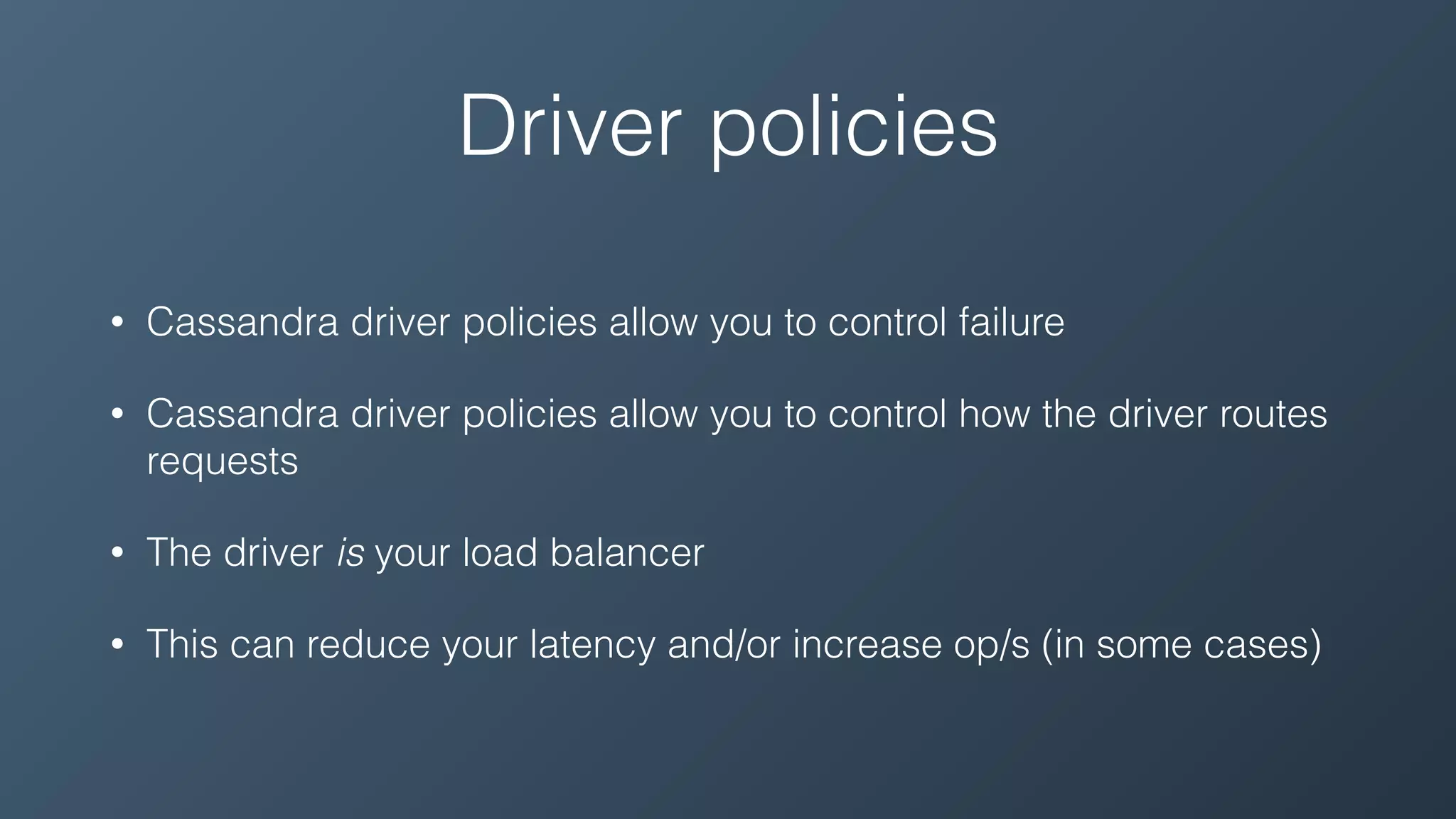
Driver policies
• Cassandra driver policies allow you to control failure
• Cassandra driver policies allow you to control how the driver routes
requests
• The driver is your load balancer
• This can reduce your latency and/or increase op/s (in some cases)
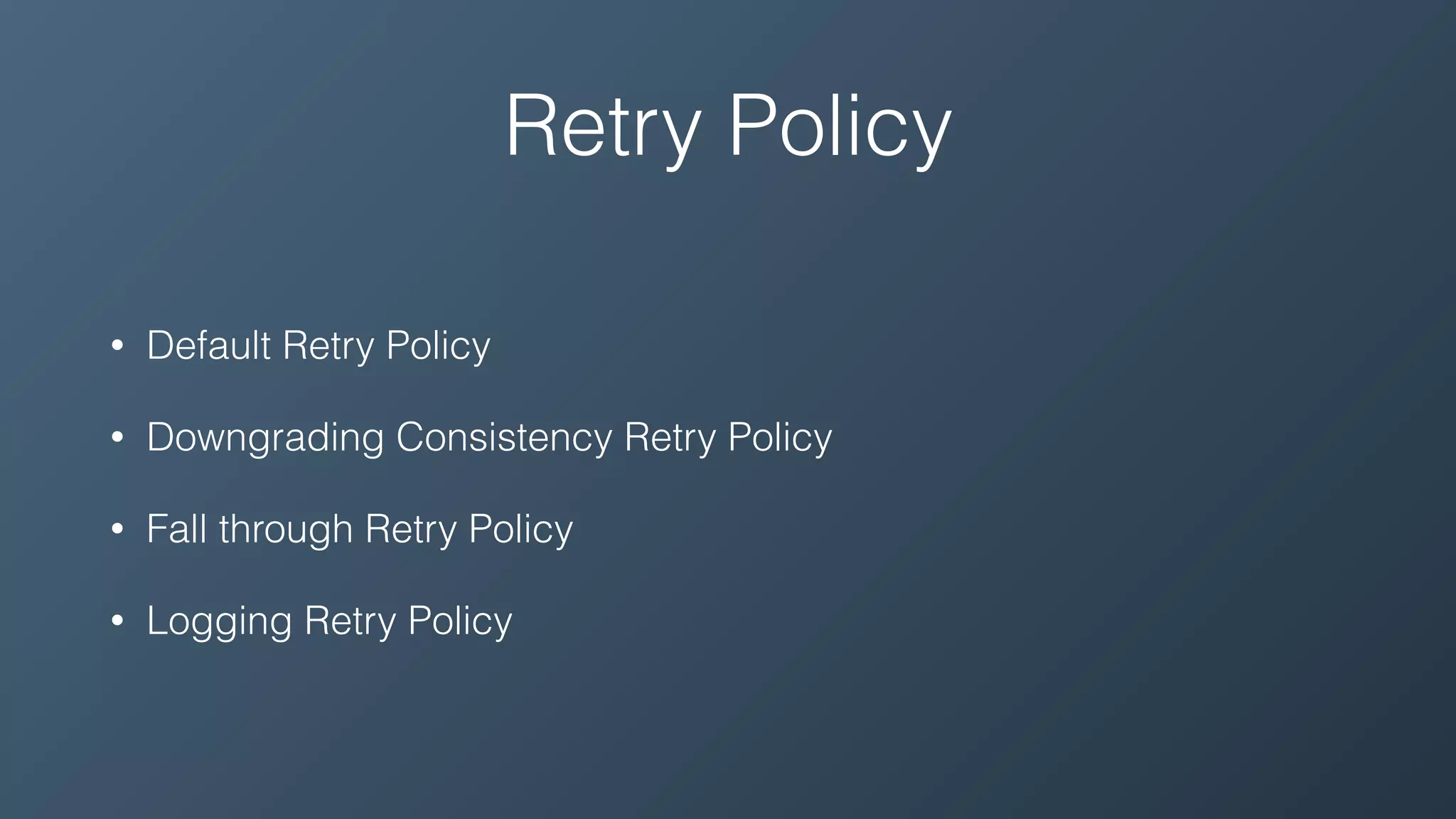
Retry Policy
• Default Retry Policy
• Downgrading Consistency Retry Policy
• Fall through Retry Policy
• Logging Retry Policy
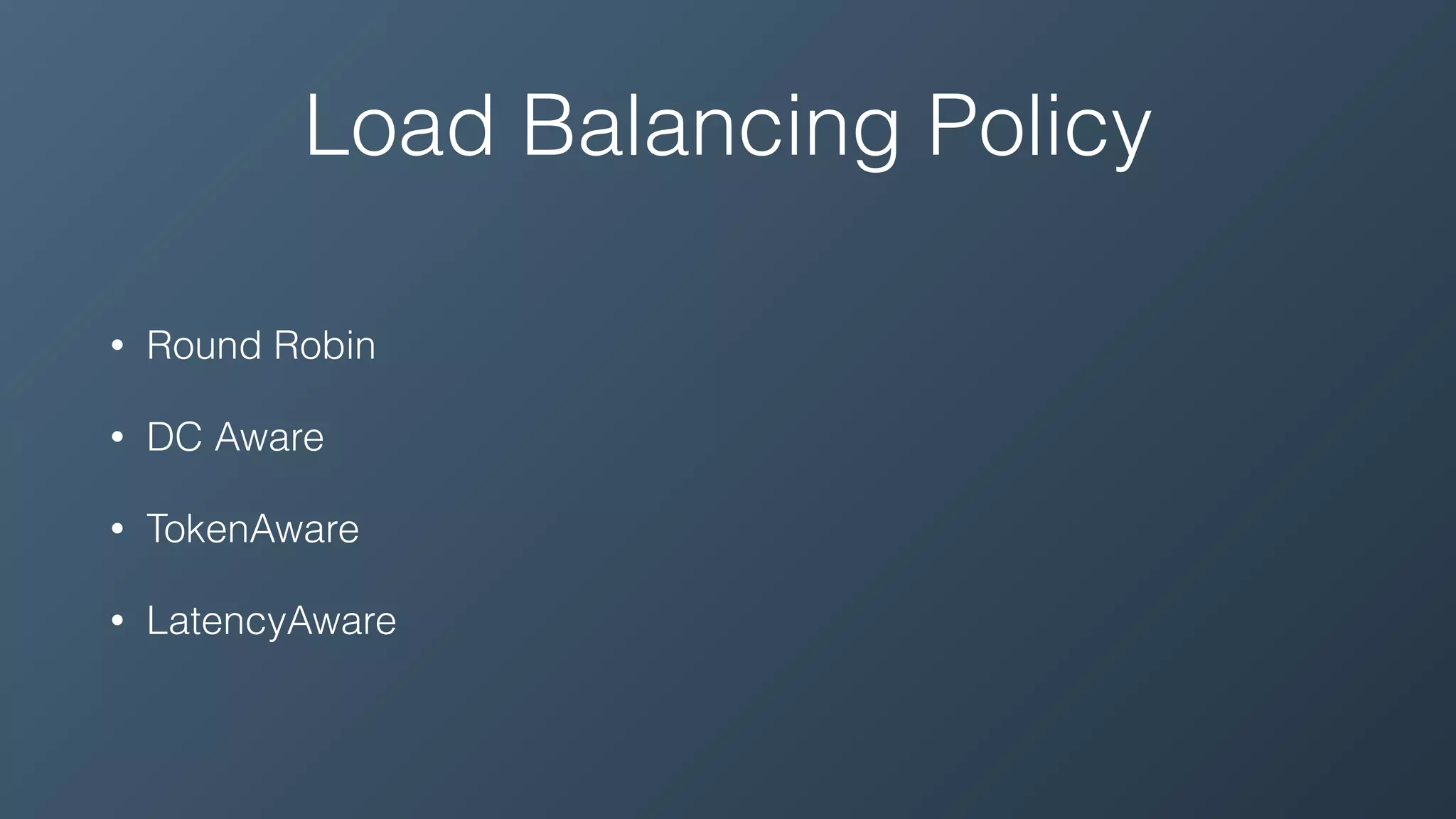
Load Balancing Policy
• Round Robin
• DC Aware
• TokenAware
• LatencyAware
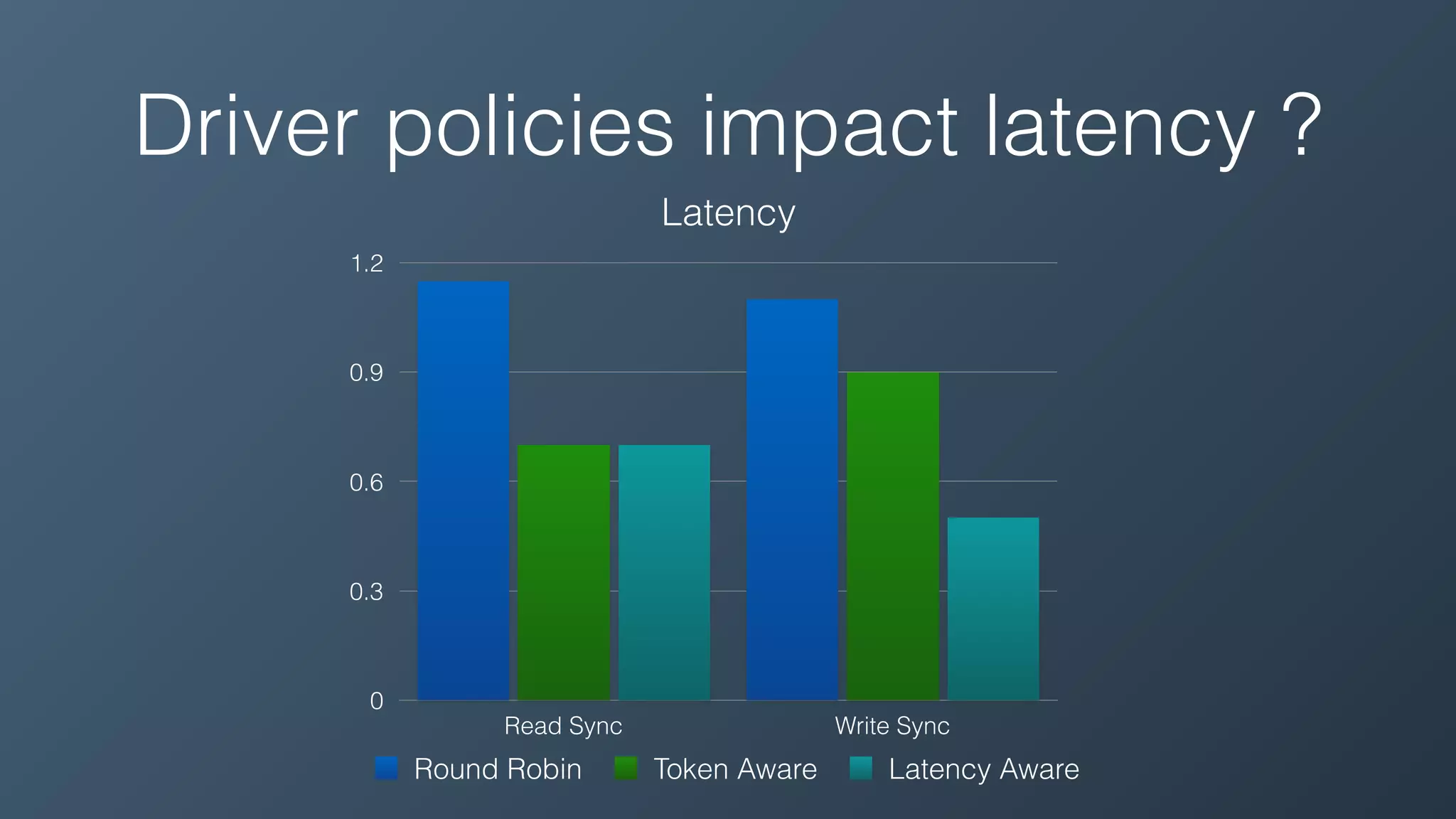
Driver policies impact latency ?
Latency
0
0.3
0.6
0.9
1.2
Read Sync Write Sync
Round Robin Token Aware Latency Aware
Last but not least
• Use one Cluster instance per (physical) cluster (per application
lifetime)
• Use at most one Session per keyspace, or use a single Session and
explicitly specify the keyspace in your queries
• If you execute a statement more than once, consider using a
PreparedStatement
• You can reduce the number of network roundtrips and also have
atomic operations by using Batches
Thank you!
Questions?

Client Drivers and Cassandra, the Right Way

  • 1.
  • 2.
    Who am Iand what do I do? • Ben Bromhead • Co-founder and CTO of Instaclustr -> www.instaclustr.com • Instaclustr provides Cassandra-as-a-Service in the cloud • Currently in AWS, Azure and IBM Softlayer • We currently manage 400+ nodes
  • 3.
    What this talkwill cover • Driver basics • Sync vs Async • Driver connection policies and tuning
  • 4.
    The driver • TheCassandra driver contains the logic for connecting to Cassandra and running queries in a fast and efficient manner • Focus on the Datastax Open Source drivers:
  • 5.
    The driver • Java •.NET (C#) • C/C++ • Python • Node.js • Ruby • PHP
  • 6.
    Cassandra Drivers • Allhave a similar architecture that consists of: • Session & pool management • Chainable policies for managing failure and performance • Sync vs Async queries • Failover & Retry • Tracing
  • 7.
    Cassandra Drivers A basicexample in Java: Cluster cluster = Cluster.builder() .addContactPoints("52.89.183.67") .withPort(9042) .build(); Session session = cluster.newSession(); session.execute("SELECT * FROM foo…");
  • 8.
    Cassandra Drivers A basicexample in Python: cluster = Cluster(contact_points=["52.89.183.67"], port=9042) session = cluster.connect() rows = session.execute("SELECT name, age, email FROM users")
  • 9.
    Cassandra Drivers A basicexample in Ruby: cluster = Cassandra.cluster( :hosts => ["52.89.183.67", "52.89.99.88", "54.69.217.141"], :datacenter => 'AWS_VPC_US_WEST_2' ) session = cluster.connect() rows = session.execute("SELECT name, age, email FROM users")
  • 10.
    Cassandra Drivers • Architecturemakes the driver similar across languages • What happens under the hood? • Cluster object creates configuration (auth, load balancing, contact points). • Session object holds the thread pool and manages connections. • Session object authenticates and maintains connections. • Session can be shared and is threadsafe!
  • 11.
    Different ways ofquerying • Synchronous: session.execute("SELECT * FROM foo..”); • Asynchronous: ResultSetFuture result = session.executeAsync("SELECT * FROM foo..”); result.get();
  • 12.
    How do theseperform? Operations 0 7500 15000 22500 30000 Read Sync Write Sync Read Async Write Async Op/s
  • 13.
    How do theseperform? Latency 0 20 40 60 80 Read Sync Write Sync Read Async Write Async ms
  • 14.
    Different ways ofquerying Prepared Statements: PreparedStatement statement = getSession().prepare( "INSERT INTO simplex.songs " + "(id, title, album, artist, tags) " + "VALUES (?, ?, ?, ?, ?);");
  • 15.
    Different ways ofquerying boundStatement = new BoundStatement(statement); getSession().execute(boundStatement.bind( UUID.fromString("2cc9ccb7-6221-4ccb-8387-f22b6a1b354d"), UUID.fromString("756716f7-2e54-4715-9f00-91dcbea6cf50"), "La Petite Tonkinoise", "Bye Bye Blackbird", "Joséphine Baker") );
  • 16.
    Drivers and consistency •Within the different ways of querying Cassandra you can also adjust the consistency level per query. • Lets have a quick consistency refresh
  • 17.
    A brief introto tuneable consistency • Cassandra is considered to be a db that favours Availability and Partition Tolerance. • Let’s you change those characteristics per query to suit your application requirement
  • 18.
    Two consistency levers •Consistency level - How many acknowledgements/responses from replicas before a query is considered a success. • Replication Factor (RF) - How many copies of a record do I store.
  • 19.
    Two consistency levers •Consistency level - Chosen by the client at query time • Replication Factor (RF) - Determined client on schema definition
  • 20.
    Consistency Levels • ALL- Every replica • *QUORUM - (EACH_QUORUM, QUORUM, LOCAL_QUORUM) • Numbered - (ONE, TWO, THREE, LOCAL_ONE) • *SERIAL - (SERIAL, LOCAL_SERIAL) • ANY
  • 21.
    What does itall mean • At the client level (your application) you have total control • Define implicit and explicit failure handling • Isolate queries to a single geography • Trade consistency for latency (a decision is better than no decision)
  • 22.
    How does itall work?
  • 23.
  • 24.
  • 25.
  • 26.
  • 27.
    How does CLimpact Op/s ? Operations 0 7500 15000 22500 30000 Read Sync Write Sync Read Async Write Async ONE QUORUM ALL
  • 28.
    How does CLimpact latency ? Latency 0 30 60 90 120 Read Sync Write Sync Read Async Write Async ONE QUORUM ALL
  • 29.
    What happens whensomething goes wrong?
  • 30.
  • 31.
  • 32.
  • 33.
    Write CL:QUORUM RF:3 1 2 3 4 partition_key: b How doesit all work? ✓✓ Required responses: floor(3 * 0.5) + 1 = 2
  • 34.
  • 35.
    How does anoutage impact Op/s ? Operations 0 7500 15000 22500 30000 Read Sync Write Sync Read Async Write Async ONE QUORUM ALL
  • 36.
    How does anoutage impact latency ? Latency 0 25 50 75 100 Read Sync Write Sync Read Async Write Async ONE QUORUM ALL
  • 37.
    We are nowhave a replica that is not consistent • Anti-entropy repair (only guaranteed way to make things consistent) • Hinted handoff • Read repair
  • 38.
    We are nowhave a replica that is not consistent • Anti-entropy repair (only guaranteed way to make things consistent) • Hinted handoff - lets cover this quickly • Read repair
  • 39.
    What is hintedhandoff ? • A performance optimisation for “catching up” nodes who missed writes.
  • 40.
    What isn’t hintedhandoff ? • A consistent distribution mechanism
  • 41.
  • 42.
  • 43.
    How does hintedhandoff work? 1 2 3 4 host / key A B 1 ✔ ✔ 2 ? 3 ✔ ✔ … ✔
  • 44.
    How does hintedhandoff work? partition_key: b 1 2 3 4
  • 45.
    How does hintedhandoff work? partition_key: b 1 2 3 4 Gossip: 2 is now UP Node 1: I have stored hints for 2
  • 46.
    How does hintedhandoff work? partition_key: b 1 2 3 4
  • 47.
    Some things tokeep in mind • Cassandra will only store hints for a certain period of time, set by max_hint_window_in_ms. 3 hours by default • Hints are not a reliable delivery mechanism • Hint replay will cause counters to overcoat • CF of ANY will cause a hint to be stored even if no replicas are available. Sometimes called extreme availability… also called who knows where and if your data is safe?
  • 48.
    Hinted handoff performance •Causes the same volume of writes to occur in a cluster with reduced capacity (local write amplification on the co-ordinator node) • Hints are written to system.hints, each replica has hints stored in a single partition. • Hints use TTLs and tombstones.. the hint table is actually a queue! • When cassandra starts compacting or throwing tombstone warnings on the system.hints table… things are bad
  • 49.
    Hinted handoff performance •Rewritten in Cassandra 3.0 (in beta now) • Takes a commitlog approach: • No compaction • no TTL • no tombstones • no memtables
  • 50.
    How does thisrelate to the driver? • With a node outage the “latency” on the down node becomes hours/days until it becomes consistent • Cassandra itself takes over the client portion of ensuring the write makes it to the node that was down. • You can control whether C* handles this (via repair, HH etc) or whether your application controls this (have your client receive an exception instead).
  • 51.
    Driver policies • Cassandradriver policies allow you to control failure • Cassandra driver policies allow you to control how the driver routes requests • The driver is your load balancer • This can reduce your latency and/or increase op/s (in some cases)
  • 52.
    Retry Policy • DefaultRetry Policy • Downgrading Consistency Retry Policy • Fall through Retry Policy • Logging Retry Policy
  • 53.
    Load Balancing Policy •Round Robin • DC Aware • TokenAware • LatencyAware
  • 54.
    Driver policies impactlatency ? Latency 0 0.3 0.6 0.9 1.2 Read Sync Write Sync Round Robin Token Aware Latency Aware
  • 55.
    Last but notleast • Use one Cluster instance per (physical) cluster (per application lifetime) • Use at most one Session per keyspace, or use a single Session and explicitly specify the keyspace in your queries • If you execute a statement more than once, consider using a PreparedStatement • You can reduce the number of network roundtrips and also have atomic operations by using Batches
  • 56.