Cassandra 101
Introduction to Apache Cassandra
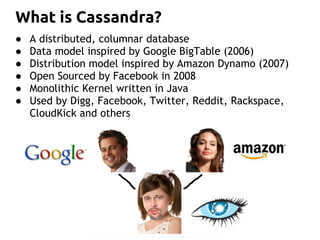
What is Cassandra?
● A distributed, columnar database
● Data model inspired by Google BigTable (2006)
● Distribution model inspired by Amazon Dynamo (2007)
● Open Sourced by Facebook in 2008
● Monolithic Kernel written in Java
● Used by Digg, Facebook, Twitter, Reddit, Rackspace,
CloudKick and others
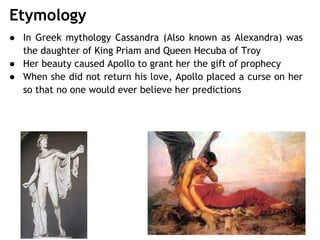
Etymology
● In Greek mythology Cassandra (Also known as Alexandra) was
the daughter of King Priam and Queen Hecuba of Troy
● Her beauty caused Apollo to grant her the gift of prophecy
● When she did not return his love, Apollo placed a curse on her
so that no one would ever believe her predictions
Why Cassandra ?
● Minimal Administration
● No Single Point of Failure
● Scale Horizontally
● Writes are durable
● Optimized for writes
● Consistency is flexible, can be updated
online
● Schema is flexible, can be updated online
● Handles failure gracefully
● Replication is easy, Rack and DC aware
Commercial Support
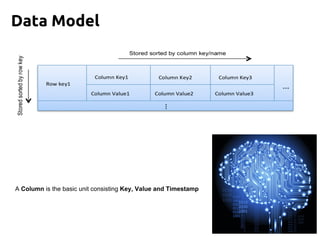
Data Model
A Column is the basic unit consisting Key, Value and Timestamp
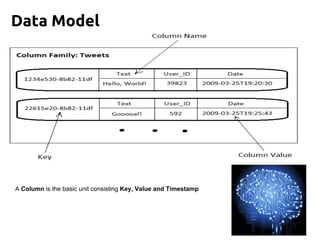
Data Model
A Column is the basic unit consisting Key, Value and Timestamp
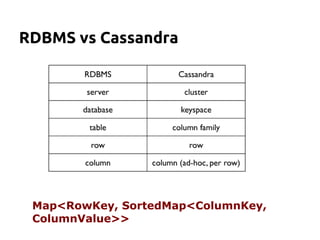
RDBMS vs Cassandra
Map<RowKey, SortedMap<ColumnKey,
ColumnValue>>
Cassandra is good at
Reading data from a row in
the order it is stored, i.e. by
Column Name!
Understand the queries you
application requires before
building the data model
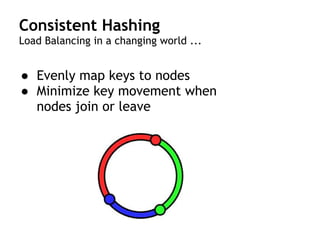
Consistent Hashing
Load Balancing in a changing world ...
● Evenly map keys to nodes
● Minimize key movement when
nodes join or leave
The Partitioner:
● RandomPartitioner transforms
Keys to Tokens using MD5
● In C* 1.2 the default hashing is
Murmur3 algorithm
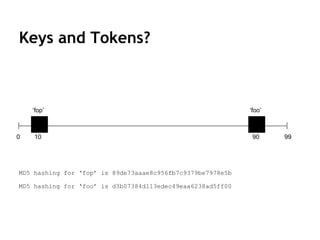
Keys and Tokens?
0 999010
‘fop’ ‘foo’
MD5 hashing for ‘fop’ is 89de73aaae8c956fb7c9379be7978e5b
MD5 hashing for ‘foo’ is d3b07384d113edec49eaa6238ad5ff00
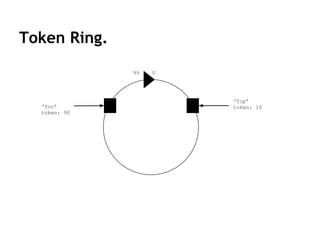
Token Ring.
99 0
‘fop’
token: 10‘foo’
token: 90
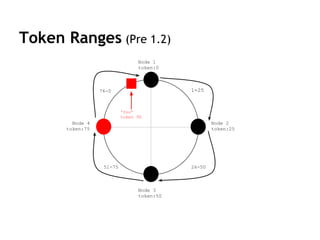
Token Ranges (Pre 1.2)
Node 1
token:0
76-0 1-25
26-5051-75
Node 2
token:25
Node 3
token:50
Node 4
token:75
‘foo’
token 90
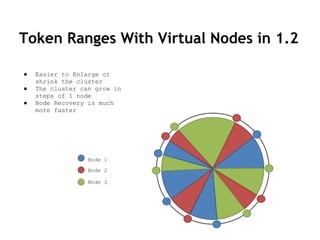
Token Ranges With Virtual Nodes in 1.2
Node 1
Node 2
Node 3
● Easier to Enlarge or
shrink the cluster
● The cluster can grow in
steps of 1 node
● Node Recovery is much
more faster
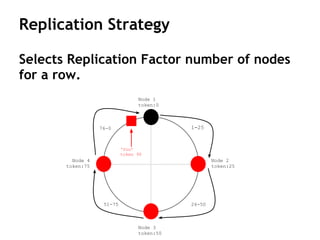
Replication Strategy
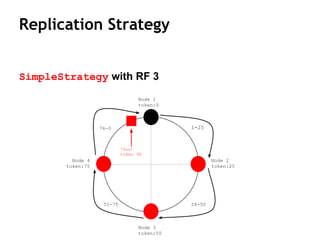
Node 1
token:0
76-0 1-25
26-5051-75
Node 2
token:25
Node 3
token:50
Node 4
token:75
‘foo’
token 90
Selects Replication Factor number of nodes
for a row.
Replication Strategy
Node 1
token:0
76-0 1-25
26-5051-75
Node 2
token:25
Node 3
token:50
Node 4
token:75
‘foo’
token 90
SimpleStrategy with RF 3
Replication Strategy
Node 1
token:0
76-0 1-25
26-5051-75
Node 2
token:25
Node 3
token:50
Node 4
token:75
‘foo’
token 90
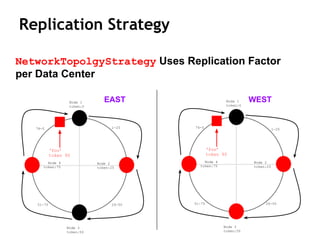
NetworkTopolgyStrategy Uses Replication Factor
per Data Center
Node 1
token:0
76-0 1-25
26-5051-75
Node 2
token:25
Node 3
token:50
Node 4
token:75
‘foo’
token 90
EAST WEST
SimpleSnitch
Places all nodes in the same DC & RACK
(Default)
EC2Snitch/EC2MultiRegionSnitch
DC is set to AWS Region and a Rack to
Availability Zone
PropertyFileSnitch
Nodes DC and Racks are maintained in a
property file
GossipPropertyFileSnitch
Uses GOSSIP as first source for node info and
if not available it uses the property file
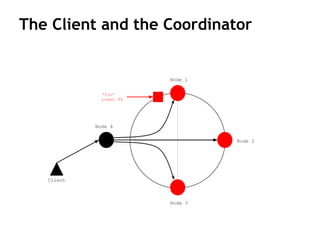
The Client and the Coordinator
Node 1
Node 3
Node 4
Node 2
‘foo’
token 90
Client
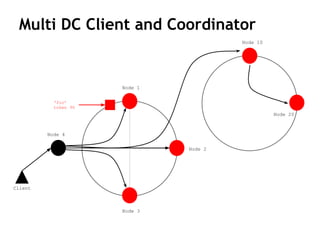
Multi DC Client and Coordinator
Node 1
Node 3
Node 4
Node 2
‘foo’
token 90
Client
Node 10
Node 20
Gossip
Nodes share information with
small number of neighbours,
who share information with
other small number of
neighbours …
● Used for intra-cluster
communication
● Routes client requests
● Detects nodes failure
● Peers are called by seeds in
config file.
Cassandra Objects
● CommitLog
● MemTable
● SSTable
● Index
● Bloom Filter
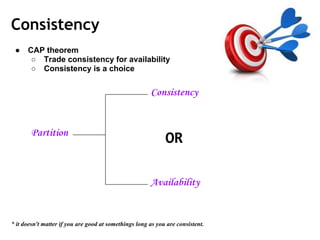
Consistency
● CAP theorem
○ Trade consistency for availability
○ Consistency is a choice
* it doesn't matter if you are good at somethings long as you are consistent.
Partition
Consistency
Availability
OR
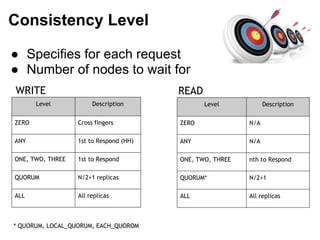
Level Description
ZERO Cross fingers
ANY 1st to Respond (HH)
ONE, TWO, THREE 1st to Respond
QUORUM N/2+1 replicas
ALL All replicas
WRITE
Level Description
ZERO N/A
ANY N/A
ONE, TWO, THREE nth to Respond
QUORUM* N/2+1
ALL All replicas
READ
Consistency Level
● Specifies for each request
● Number of nodes to wait for
* QUORUM, LOCAL_QUORUM, EACH_QUOROM
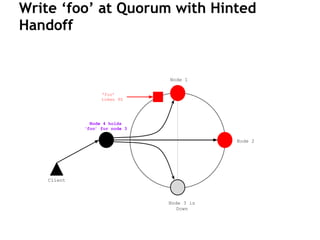
Write ‘foo’ at Quorum with Hinted
Handoff
Node 1
Node 3 is
Down
Node 4 holds
‘foo’ for node 3
Node 2
‘foo’
token 90
Client
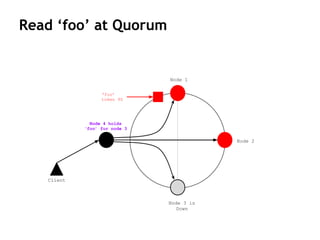
Read ‘foo’ at Quorum
Node 1
Node 3 is
Down
Node 4 holds
‘foo’ for node 3
Node 2
‘foo’
token 90
Client
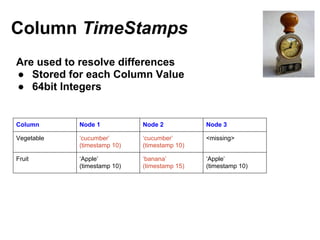
Are used to resolve differences
● Stored for each Column Value
● 64bit Integers
Column Node 1 Node 2 Node 3
Vegetable ‘cucumber’
(timestamp 10)
‘cucumber’
(timestamp 10)
<missing>
Fruit ‘Apple’
(timestamp 10)
‘banana’
(timestamp 15)
‘Apple’
(timestamp 10)
Column TimeStamps
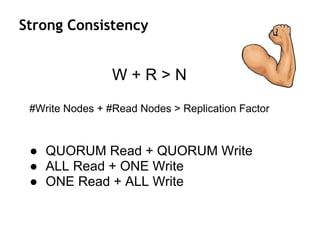
Strong Consistency
W + R > N
#Write Nodes + #Read Nodes > Replication Factor
● QUORUM Read + QUORUM Write
● ALL Read + ONE Write
● ONE Read + ALL Write
Achieving Consistency
● Consistency Level
● Hinted Handoff
● Read Repair
● Anti Entropy (User triggered Repairs)
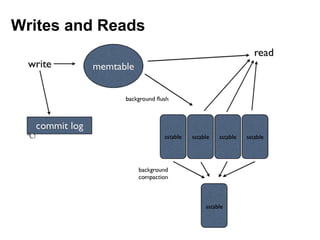
Write Path
● Append to Commit Log File
● Merge Columns into Memtable
● Asynchronously flush Memtabe to a
new file (Never update existing files)
● Data is stored in immutable files called
SSTables (Sorted String Tables)
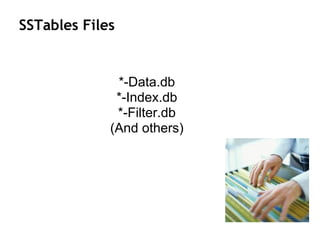
SSTables Files
*-Data.db
*-Index.db
*-Filter.db
(And others)
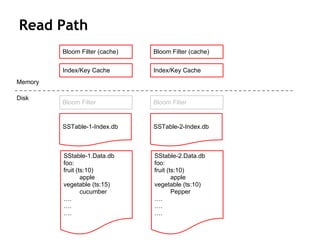
Read Path
Bloom Filter (cache)
Index/Key Cache
Memory
SStable-1.Data.db
foo:
fruit (ts:10)
apple
vegetable (ts:15)
cucumber
….
….
….
SSTable-1-Index.db
Disk
Bloom Filter (cache)
Index/Key Cache
SStable-2.Data.db
foo:
fruit (ts:10)
apple
vegetable (ts:10)
Pepper
….
….
….
SSTable-2-Index.db
Bloom Filter Bloom Filter
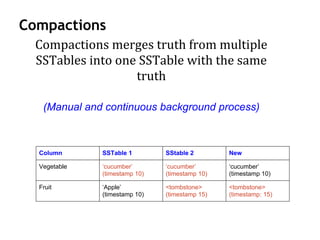
Compactions
Compactions merges truth from multiple
SSTables into one SSTable with the same
truth
(Manual and continuous background process)
Column SSTable 1 SStable 2 New
Vegetable ‘cucumber’
(timestamp 10)
‘cucumber’
(timestamp 10)
‘cucumber’
(timestamp 10)
Fruit ‘Apple’
(timestamp 10)
<tombstone>
(timestamp 15)
<tombstone>
(timestamp: 15)
Writes and Reads
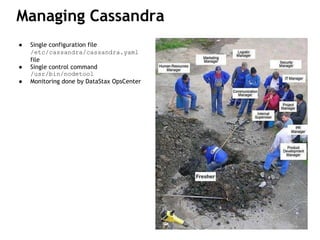
Managing Cassandra
● Single configuration file
/etc/cassandra/cassandra.yaml
file
● Single control command
/usr/bin/nodetool
● Monitoring done by DataStax OpsCenter
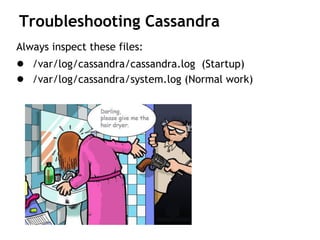
Troubleshooting Cassandra
Always inspect these files:
● /var/log/cassandra/cassandra.log (Startup)
● /var/log/cassandra/system.log (Normal work)
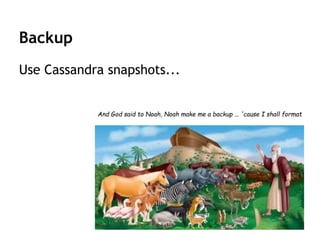
Backup
Use Cassandra snapshots...
And God said to Noah, Noah make me a backup ... 'cause I shall format
Client (API) Choices
● Thrift, original and still fully supported API:
○ JAVA: Thrift, Hector, Astyanax, DataStax Driver, Cundera…
○ Python: Pycassa, Telephus, …
○ Ruby: Fauna
○ PHP: PHP Client Library
○ C#
○ Node.JS
○ GO
○ SImba ODBC
○ C++: LibQtCassandra
○ ORM
○ ….
● CQL3: A Table oriented, Schema Driven, Data Model and Similar to SQL
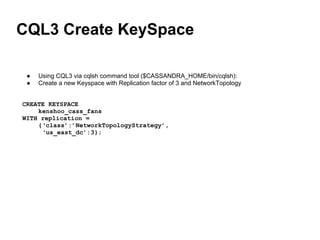
CQL3 Create KeySpace
● Using CQL3 via cqlsh command tool ($CASSANDRA_HOME/bin/cqlsh):
● Create a new Keyspace with Replication factor of 3 and NetworkTopology
CREATE KEYSPACE
kenshoo_cass_fans
WITH replication =
{‘class’:’NetworkTopologyStrategy’,
‘us_east_dc’:3};
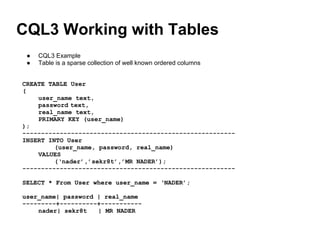
CQL3 Working with Tables
● CQL3 Example
● Table is a sparse collection of well known ordered columns
CREATE TABLE User
(
user_name text,
password text,
real_name text,
PRIMARY KEY (user_name)
);
---------------------------------------------------------
INSERT INTO User
(user_name, password, real_name)
VALUES
(‘nader’,’sekr8t’,’MR NADER’);
---------------------------------------------------------
SELECT * From User where user_name = ‘NADER’;
user_name| password | real_name
---------+----------+-----------
nader| sekr8t | MR NADER

Cassandra 101

  • 1.
  • 2.
    What is Cassandra? ●A distributed, columnar database ● Data model inspired by Google BigTable (2006) ● Distribution model inspired by Amazon Dynamo (2007) ● Open Sourced by Facebook in 2008 ● Monolithic Kernel written in Java ● Used by Digg, Facebook, Twitter, Reddit, Rackspace, CloudKick and others
  • 3.
    Etymology ● In Greekmythology Cassandra (Also known as Alexandra) was the daughter of King Priam and Queen Hecuba of Troy ● Her beauty caused Apollo to grant her the gift of prophecy ● When she did not return his love, Apollo placed a curse on her so that no one would ever believe her predictions
  • 4.
    Why Cassandra ? ●Minimal Administration ● No Single Point of Failure ● Scale Horizontally ● Writes are durable ● Optimized for writes ● Consistency is flexible, can be updated online ● Schema is flexible, can be updated online ● Handles failure gracefully ● Replication is easy, Rack and DC aware
  • 5.
  • 6.
    Data Model A Columnis the basic unit consisting Key, Value and Timestamp
  • 7.
    Data Model A Columnis the basic unit consisting Key, Value and Timestamp
  • 8.
    RDBMS vs Cassandra Map<RowKey,SortedMap<ColumnKey, ColumnValue>>
  • 9.
    Cassandra is goodat Reading data from a row in the order it is stored, i.e. by Column Name! Understand the queries you application requires before building the data model
  • 10.
    Consistent Hashing Load Balancingin a changing world ... ● Evenly map keys to nodes ● Minimize key movement when nodes join or leave
  • 11.
    The Partitioner: ● RandomPartitionertransforms Keys to Tokens using MD5 ● In C* 1.2 the default hashing is Murmur3 algorithm
  • 12.
    Keys and Tokens? 0999010 ‘fop’ ‘foo’ MD5 hashing for ‘fop’ is 89de73aaae8c956fb7c9379be7978e5b MD5 hashing for ‘foo’ is d3b07384d113edec49eaa6238ad5ff00
  • 13.
    Token Ring. 99 0 ‘fop’ token:10‘foo’ token: 90
  • 14.
    Token Ranges (Pre1.2) Node 1 token:0 76-0 1-25 26-5051-75 Node 2 token:25 Node 3 token:50 Node 4 token:75 ‘foo’ token 90
  • 15.
    Token Ranges WithVirtual Nodes in 1.2 Node 1 Node 2 Node 3 ● Easier to Enlarge or shrink the cluster ● The cluster can grow in steps of 1 node ● Node Recovery is much more faster
  • 16.
    Replication Strategy Node 1 token:0 76-01-25 26-5051-75 Node 2 token:25 Node 3 token:50 Node 4 token:75 ‘foo’ token 90 Selects Replication Factor number of nodes for a row.
  • 17.
    Replication Strategy Node 1 token:0 76-01-25 26-5051-75 Node 2 token:25 Node 3 token:50 Node 4 token:75 ‘foo’ token 90 SimpleStrategy with RF 3
  • 18.
    Replication Strategy Node 1 token:0 76-01-25 26-5051-75 Node 2 token:25 Node 3 token:50 Node 4 token:75 ‘foo’ token 90 NetworkTopolgyStrategy Uses Replication Factor per Data Center Node 1 token:0 76-0 1-25 26-5051-75 Node 2 token:25 Node 3 token:50 Node 4 token:75 ‘foo’ token 90 EAST WEST
  • 19.
    SimpleSnitch Places all nodesin the same DC & RACK (Default)
  • 20.
    EC2Snitch/EC2MultiRegionSnitch DC is setto AWS Region and a Rack to Availability Zone
  • 21.
    PropertyFileSnitch Nodes DC andRacks are maintained in a property file
  • 22.
    GossipPropertyFileSnitch Uses GOSSIP asfirst source for node info and if not available it uses the property file
  • 23.
    The Client andthe Coordinator Node 1 Node 3 Node 4 Node 2 ‘foo’ token 90 Client
  • 24.
    Multi DC Clientand Coordinator Node 1 Node 3 Node 4 Node 2 ‘foo’ token 90 Client Node 10 Node 20
  • 25.
    Gossip Nodes share informationwith small number of neighbours, who share information with other small number of neighbours … ● Used for intra-cluster communication ● Routes client requests ● Detects nodes failure ● Peers are called by seeds in config file.
  • 26.
    Cassandra Objects ● CommitLog ●MemTable ● SSTable ● Index ● Bloom Filter
  • 27.
    Consistency ● CAP theorem ○Trade consistency for availability ○ Consistency is a choice * it doesn't matter if you are good at somethings long as you are consistent. Partition Consistency Availability OR
  • 28.
    Level Description ZERO Crossfingers ANY 1st to Respond (HH) ONE, TWO, THREE 1st to Respond QUORUM N/2+1 replicas ALL All replicas WRITE Level Description ZERO N/A ANY N/A ONE, TWO, THREE nth to Respond QUORUM* N/2+1 ALL All replicas READ Consistency Level ● Specifies for each request ● Number of nodes to wait for * QUORUM, LOCAL_QUORUM, EACH_QUOROM
  • 29.
    Write ‘foo’ atQuorum with Hinted Handoff Node 1 Node 3 is Down Node 4 holds ‘foo’ for node 3 Node 2 ‘foo’ token 90 Client
  • 30.
    Read ‘foo’ atQuorum Node 1 Node 3 is Down Node 4 holds ‘foo’ for node 3 Node 2 ‘foo’ token 90 Client
  • 31.
    Are used toresolve differences ● Stored for each Column Value ● 64bit Integers Column Node 1 Node 2 Node 3 Vegetable ‘cucumber’ (timestamp 10) ‘cucumber’ (timestamp 10) <missing> Fruit ‘Apple’ (timestamp 10) ‘banana’ (timestamp 15) ‘Apple’ (timestamp 10) Column TimeStamps
  • 32.
    Strong Consistency W +R > N #Write Nodes + #Read Nodes > Replication Factor ● QUORUM Read + QUORUM Write ● ALL Read + ONE Write ● ONE Read + ALL Write
  • 33.
    Achieving Consistency ● ConsistencyLevel ● Hinted Handoff ● Read Repair ● Anti Entropy (User triggered Repairs)
  • 34.
    Write Path ● Appendto Commit Log File ● Merge Columns into Memtable ● Asynchronously flush Memtabe to a new file (Never update existing files) ● Data is stored in immutable files called SSTables (Sorted String Tables)
  • 35.
  • 36.
    Read Path Bloom Filter(cache) Index/Key Cache Memory SStable-1.Data.db foo: fruit (ts:10) apple vegetable (ts:15) cucumber …. …. …. SSTable-1-Index.db Disk Bloom Filter (cache) Index/Key Cache SStable-2.Data.db foo: fruit (ts:10) apple vegetable (ts:10) Pepper …. …. …. SSTable-2-Index.db Bloom Filter Bloom Filter
  • 37.
    Compactions Compactions merges truthfrom multiple SSTables into one SSTable with the same truth (Manual and continuous background process) Column SSTable 1 SStable 2 New Vegetable ‘cucumber’ (timestamp 10) ‘cucumber’ (timestamp 10) ‘cucumber’ (timestamp 10) Fruit ‘Apple’ (timestamp 10) <tombstone> (timestamp 15) <tombstone> (timestamp: 15)
  • 38.
  • 39.
    Managing Cassandra ● Singleconfiguration file /etc/cassandra/cassandra.yaml file ● Single control command /usr/bin/nodetool ● Monitoring done by DataStax OpsCenter
  • 40.
    Troubleshooting Cassandra Always inspectthese files: ● /var/log/cassandra/cassandra.log (Startup) ● /var/log/cassandra/system.log (Normal work)
  • 41.
    Backup Use Cassandra snapshots... AndGod said to Noah, Noah make me a backup ... 'cause I shall format
  • 42.
    Client (API) Choices ●Thrift, original and still fully supported API: ○ JAVA: Thrift, Hector, Astyanax, DataStax Driver, Cundera… ○ Python: Pycassa, Telephus, … ○ Ruby: Fauna ○ PHP: PHP Client Library ○ C# ○ Node.JS ○ GO ○ SImba ODBC ○ C++: LibQtCassandra ○ ORM ○ …. ● CQL3: A Table oriented, Schema Driven, Data Model and Similar to SQL
  • 43.
    CQL3 Create KeySpace ●Using CQL3 via cqlsh command tool ($CASSANDRA_HOME/bin/cqlsh): ● Create a new Keyspace with Replication factor of 3 and NetworkTopology CREATE KEYSPACE kenshoo_cass_fans WITH replication = {‘class’:’NetworkTopologyStrategy’, ‘us_east_dc’:3};
  • 44.
    CQL3 Working withTables ● CQL3 Example ● Table is a sparse collection of well known ordered columns CREATE TABLE User ( user_name text, password text, real_name text, PRIMARY KEY (user_name) ); --------------------------------------------------------- INSERT INTO User (user_name, password, real_name) VALUES (‘nader’,’sekr8t’,’MR NADER’); --------------------------------------------------------- SELECT * From User where user_name = ‘NADER’; user_name| password | real_name ---------+----------+----------- nader| sekr8t | MR NADER