Christopher Batey
@chbatey
LJC: Building fault tolerant Java applications with
Apache Cassandra
@chbatey
Who am I?
• Technical Evangelist for Apache Cassandra
• Founder of Stubbed Cassandra
• Help out Apache Cassandra users
• DataStax
• Builds enterprise ready version of Apache
Cassandra
• Previous: Cassandra backed apps at BSkyB
@chbatey
Overview
• ‘Building fault tolerant Java applications with Apache
Cassandra’
-Fault tolerance?
-Building an ‘always on’ (HA) service
-Cassandra architecture overview
-Cassandra failure scenarios
-Cassandra Java Driver
@chbatey
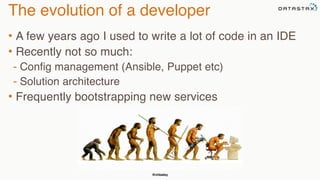
The evolution of a developer
• A few years ago I used to write a lot of code in an IDE
• Recently not so much:
- Config management (Ansible, Puppet etc)
- Solution architecture
• Frequently bootstrapping new services
@chbatey
@chbatey
Faults?
• Infrastructure failure
- Node
- Rack
- Data center
• Dependency failure
- HTTP services
- Databases
@chbatey
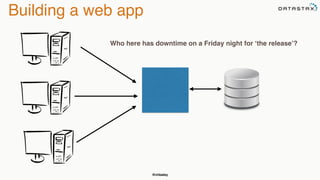
Building a web app
Who here has downtime on a Friday night for ‘the release’?
@chbatey
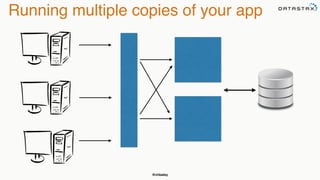
Running multiple copies of your app
@chbatey
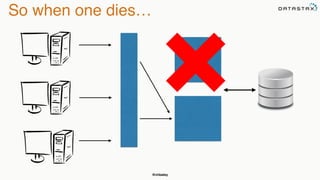
So when one dies…
@chbatey
Thou shalt be stateless…
• Using container session store = 1/nth of your customers
unhappy if a server dies
@chbatey
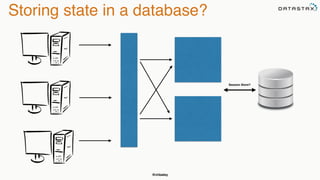
Storing state in a database?
Session Store?
@chbatey
The drawbacks
• Latency :(
• Tricky to setup
• New DB/Cache = new component in your architecture to
scale and make HA
• Tightly coupled to your container now
• Move to embedded container in executable jars :(
@chbatey
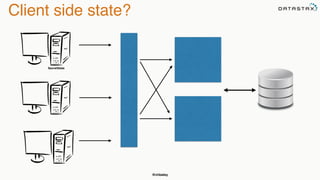
Client side state?
SecretState
@chbatey
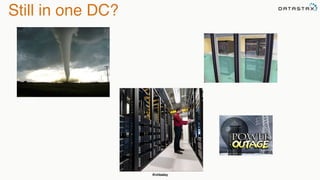
Still in one DC?
@chbatey
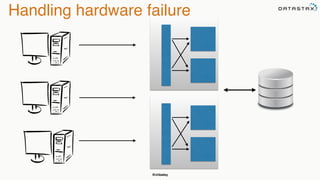
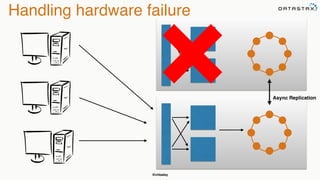
Handling hardware failure
@chbatey
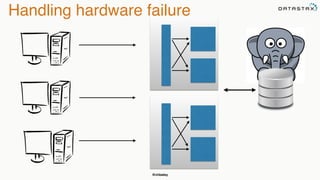
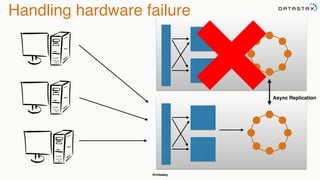
Handling hardware failure
@chbatey
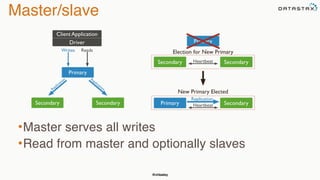
Master/slave
•Master serves all writes
•Read from master and optionally slaves
@chbatey
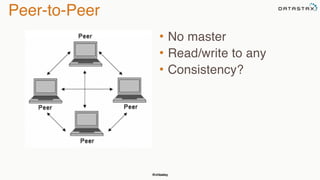
Peer-to-Peer
• No master
• Read/write to any
• Consistency?
@chbatey
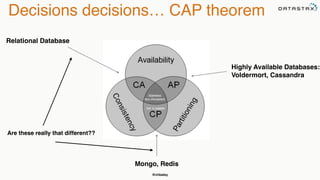
Decisions decisions… CAP theorem
Are these really that different??
Relational Database
Mongo, Redis
Highly Available Databases:
Voldermort, Cassandra
@chbatey
PAC-ELC
• If Partition: Trade off Availability vs Consistency
• Else: Trade off Latency vs Consistency
• http://dbmsmusings.blogspot.co.uk/2010/04/problems-
with-cap-and-yahoos-little.html
@chbatey
Cassandra
@chbatey
Cassandra
Cassandra
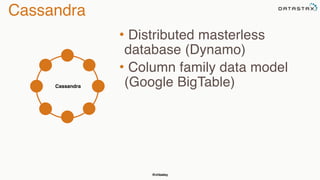
• Distributed masterless
database (Dynamo)
• Column family data model
(Google BigTable)
@chbatey
Datacenter and rack aware
Europe
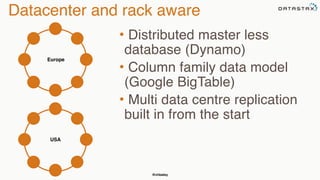
• Distributed master less
database (Dynamo)
• Column family data model
(Google BigTable)
• Multi data centre replication
built in from the start
USA
@chbatey
Cassandra
Online
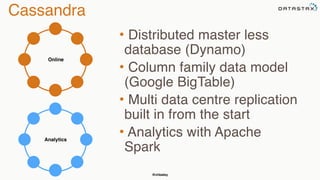
• Distributed master less
database (Dynamo)
• Column family data model
(Google BigTable)
• Multi data centre replication
built in from the start
• Analytics with Apache
Spark
Analytics
@chbatey
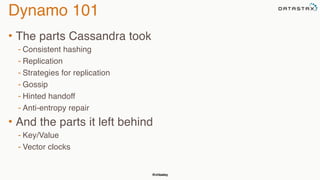
Dynamo 101
• The parts Cassandra took
- Consistent hashing
- Replication
- Strategies for replication
- Gossip
- Hinted handoff
- Anti-entropy repair
• And the parts it left behind
- Key/Value
- Vector clocks
@chbatey
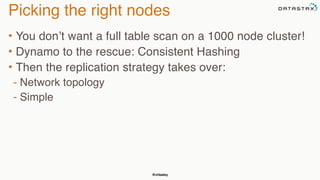
Picking the right nodes
• You don’t want a full table scan on a 1000 node cluster!
• Dynamo to the rescue: Consistent Hashing
• Then the replication strategy takes over:
- Network topology
- Simple
@chbatey
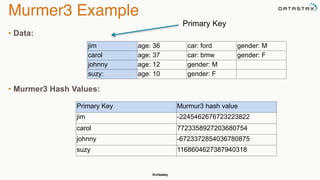
Murmer3 Example
• Data:
• Murmer3 Hash Values:
jim age: 36 car: ford gender: M
carol age: 37 car: bmw gender: F
johnny age: 12 gender: M
suzy: age: 10 gender: F
Primary Key Murmur3 hash value
jim -2245462676723223822
carol 7723358927203680754
johnny -6723372854036780875
suzy 1168604627387940318
Primary Key
@chbatey
Company Confidential
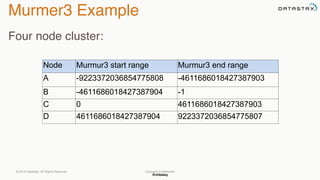
Murmer3 Example
Four node cluster:
© 2014 DataStax, All Rights Reserved.
Node Murmur3 start range Murmur3 end range
A -9223372036854775808 -4611686018427387903
B -4611686018427387904 -1
C 0 4611686018427387903
D 4611686018427387904 9223372036854775807
@chbatey
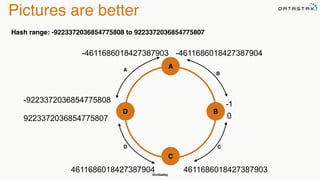
Pictures are better
Hash range: -9223372036854775808 to 9223372036854775807
A
B
C
D
-4611686018427387903
-1
4611686018427387903
-9223372036854775808
9223372036854775807
-4611686018427387904
0
4611686018427387904
B
CD
A
@chbatey
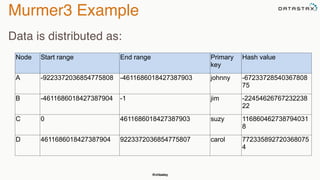
Murmer3 Example
Data is distributed as:
Node Start range End range Primary
key
Hash value
A -9223372036854775808 -4611686018427387903 johnny -67233728540367808
75
B -4611686018427387904 -1 jim -22454626767232238
22
C 0 4611686018427387903 suzy 116860462738794031
8
D 4611686018427387904 9223372036854775807 carol 772335892720368075
4
@chbatey
Replication
@chbatey
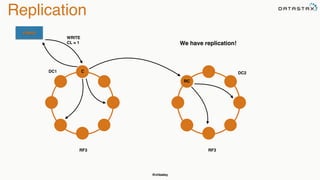
Replication
DC1 DC2
client
RF3 RF3
C
RC
WRITE
CL = 1 We have replication!
@chbatey
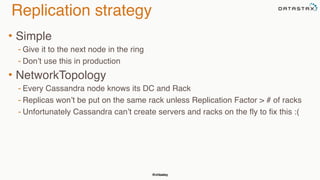
Replication strategy
• Simple
- Give it to the next node in the ring
- Don’t use this in production
• NetworkTopology
- Every Cassandra node knows its DC and Rack
- Replicas won’t be put on the same rack unless Replication Factor > # of racks
- Unfortunately Cassandra can’t create servers and racks on the fly to fix this :(
@chbatey
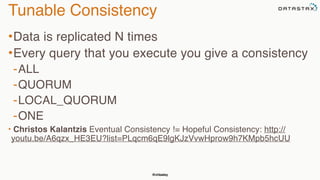
Tunable Consistency
•Data is replicated N times
•Every query that you execute you give a consistency
-ALL
-QUORUM
-LOCAL_QUORUM
-ONE
• Christos Kalantzis Eventual Consistency != Hopeful Consistency: http://
youtu.be/A6qzx_HE3EU?list=PLqcm6qE9lgKJzVvwHprow9h7KMpb5hcUU
@chbatey
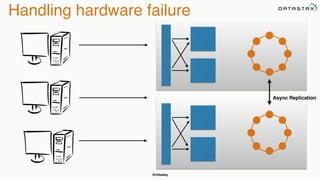
Handling hardware failure
Async Replication
@chbatey
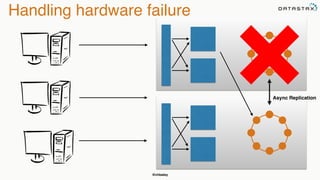
Handling hardware failure
Async Replication
@chbatey
Handling hardware failure
Async Replication
@chbatey
Handling hardware failure
Async Replication
@chbatey
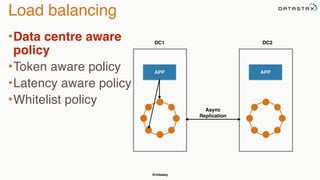
Load balancing
•Data centre aware
policy
•Token aware policy
•Latency aware policy
•Whitelist policy
APP APP
Async
Replication
DC1 DC2
@chbatey
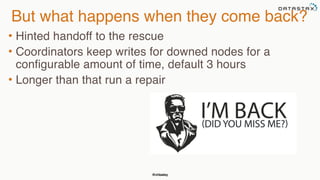
But what happens when they come back?
• Hinted handoff to the rescue
• Coordinators keep writes for downed nodes for a
configurable amount of time, default 3 hours
• Longer than that run a repair
@chbatey
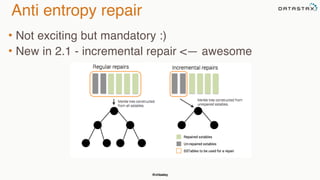
Anti entropy repair
• Not exciting but mandatory :)
• New in 2.1 - incremental repair <— awesome
@chbatey
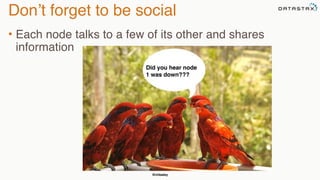
Don’t forget to be social
• Each node talks to a few of its other and shares
information
Did you hear node
1 was down???
@chbatey
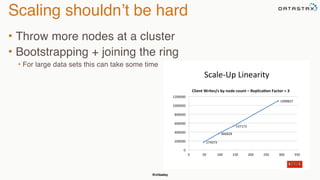
Scaling shouldn’t be hard
• Throw more nodes at a cluster
• Bootstrapping + joining the ring
• For large data sets this can take some time
@chbatey
Cassandra failure modes
@chbatey
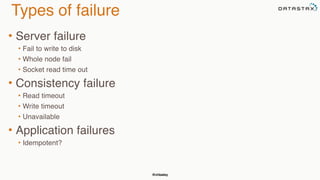
Types of failure
• Server failure
• Fail to write to disk
• Whole node fail
• Socket read time out
• Consistency failure
• Read timeout
• Write timeout
• Unavailable
• Application failures
• Idempotent?
@chbatey
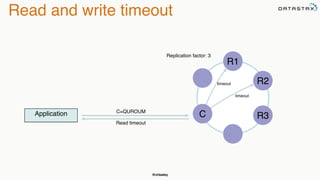
Read and write timeout
Application C
R1
R2
R3
C=QUROUM
Replication factor: 3
timeout
timeout
Read timeout
@chbatey
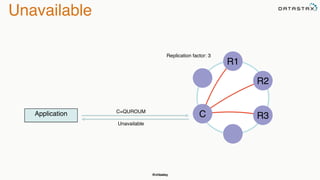
Unavailable
Application C
R1
R2
R3
C=QUROUM
Replication factor: 3
Unavailable
@chbatey
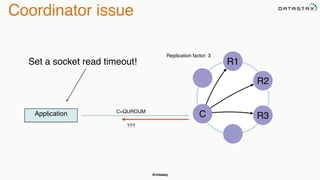
Coordinator issue
Application C
R1
R2
R3
C=QUROUM
Replication factor: 3
???
Set a socket read timeout!
@chbatey
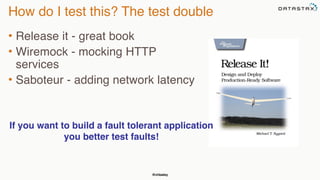
How do I test this? The test double
• Release it - great book
• Wiremock - mocking HTTP
services
• Saboteur - adding network latency
If you want to build a fault tolerant application
you better test faults!
@chbatey
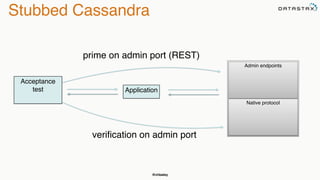
Stubbed Cassandra
Application
Acceptance
test
prime on admin port (REST)
verification on admin port
Admin endpoints
Native protocol
@chbatey
Test with a real Cassandra
• Reduced throughput / increased latency
- Nodes down
- Racks down
- DC down
@chbatey
Test with a real Cassandra
• Reduced throughput / increased latency
- Nodes down
- Racks down
- DC down
• Automate this if possible
• Load test your schema
- Cassandra stress
- JMeter Cassandra plugin
@chbatey
Summary
•Don’t build services with a single point of failure
•Cassandra deployed correctly means you can handle
node, rack and entire DC failure
•Know when to pick availability over consistency
•Accessing Cassandra from Java is boringly easy so I left
it out
@chbatey
Thanks for listening
• Follow me on twitter @chbatey
• Cassandra + Fault tolerance posts a plenty:
- http://christopher-batey.blogspot.co.uk/
@chbatey
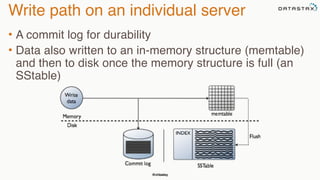
Write path on an individual server
• A commit log for durability
• Data also written to an in-memory structure (memtable)
and then to disk once the memory structure is full (an
SStable)
@chbatey
Cassandra + Java
@chbatey
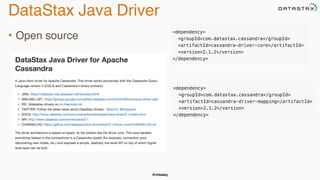
DataStax Java Driver
• Open source
@chbatey
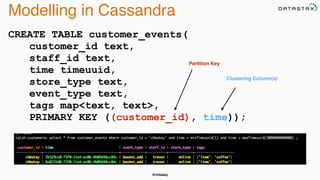
Modelling in Cassandra
CREATE TABLE customer_events(
customer_id text,
staff_id text,
time timeuuid,
store_type text,
event_type text,
tags map<text, text>,
PRIMARY KEY ((customer_id), time));
Partition Key
Clustering Column(s)
@chbatey
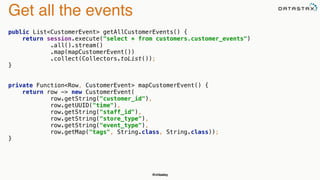
Get all the events
public List<CustomerEvent> getAllCustomerEvents() {

return session.execute("select * from customers.customer_events")

.all().stream()

.map(mapCustomerEvent())

.collect(Collectors.toList());

}
private Function<Row, CustomerEvent> mapCustomerEvent() {

return row -> new CustomerEvent(

row.getString("customer_id"),

row.getUUID("time"),

row.getString("staff_id"),

row.getString("store_type"),

row.getString("event_type"),

row.getMap("tags", String.class, String.class));

}
@chbatey
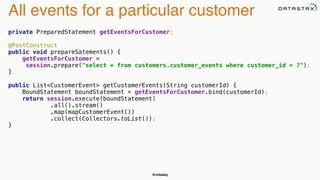
All events for a particular customer
private PreparedStatement getEventsForCustomer;


@PostConstruct

public void prepareSatements() {

getEventsForCustomer =
session.prepare("select * from customers.customer_events where customer_id = ?");

}


public List<CustomerEvent> getCustomerEvents(String customerId) {

BoundStatement boundStatement = getEventsForCustomer.bind(customerId);

return session.execute(boundStatement)
.all().stream()

.map(mapCustomerEvent())

.collect(Collectors.toList());

}
@chbatey
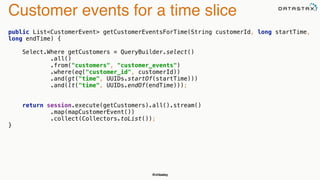
Customer events for a time slice
public List<CustomerEvent> getCustomerEventsForTime(String customerId, long startTime,
long endTime) {


Select.Where getCustomers = QueryBuilder.select()

.all()

.from("customers", "customer_events")

.where(eq("customer_id", customerId))

.and(gt("time", UUIDs.startOf(startTime)))

.and(lt("time", UUIDs.endOf(endTime)));


return session.execute(getCustomers).all().stream()

.map(mapCustomerEvent())

.collect(Collectors.toList());

}
@chbatey
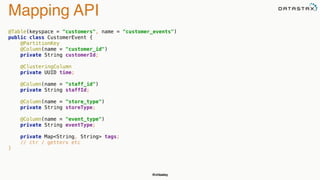
Mapping API
@Table(keyspace = "customers", name = "customer_events")

public class CustomerEvent {

@PartitionKey

@Column(name = "customer_id")

private String customerId;


@ClusteringColumn

private UUID time;


@Column(name = "staff_id")

private String staffId;


@Column(name = "store_type")

private String storeType;


@Column(name = "event_type")

private String eventType;


private Map<String, String> tags;
// ctr / getters etc
}

@chbatey
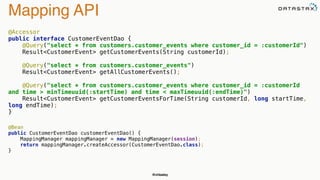
Mapping API
@Accessor

public interface CustomerEventDao {

@Query("select * from customers.customer_events where customer_id = :customerId")

Result<CustomerEvent> getCustomerEvents(String customerId);


@Query("select * from customers.customer_events")

Result<CustomerEvent> getAllCustomerEvents();


@Query("select * from customers.customer_events where customer_id = :customerId
and time > minTimeuuid(:startTime) and time < maxTimeuuid(:endTime)")

Result<CustomerEvent> getCustomerEventsForTime(String customerId, long startTime,
long endTime);

}


@Bean

public CustomerEventDao customerEventDao() {

MappingManager mappingManager = new MappingManager(session);

return mappingManager.createAccessor(CustomerEventDao.class);

}
@chbatey
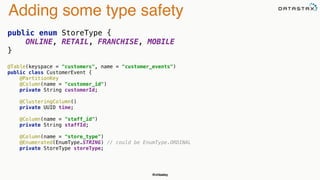
Adding some type safety
public enum StoreType {

ONLINE, RETAIL, FRANCHISE, MOBILE

}
@Table(keyspace = "customers", name = "customer_events")

public class CustomerEvent {

@PartitionKey

@Column(name = "customer_id")

private String customerId;


@ClusteringColumn()

private UUID time;


@Column(name = "staff_id")

private String staffId;


@Column(name = "store_type")

@Enumerated(EnumType.STRING) // could be EnumType.ORDINAL

private StoreType storeType;

@chbatey
User defined types
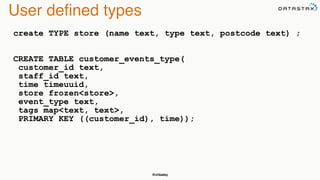
create TYPE store (name text, type text, postcode text) ;


CREATE TABLE customer_events_type(
customer_id text,
staff_id text,
time timeuuid,
store frozen<store>,
event_type text,
tags map<text, text>,
PRIMARY KEY ((customer_id), time));

@chbatey
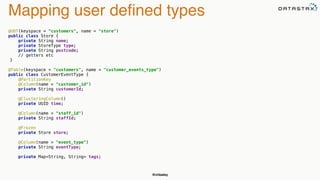
Mapping user defined types
@UDT(keyspace = "customers", name = "store")

public class Store {

private String name;

private StoreType type;

private String postcode;
// getters etc
}
@Table(keyspace = "customers", name = "customer_events_type")

public class CustomerEventType {

@PartitionKey

@Column(name = "customer_id")

private String customerId;


@ClusteringColumn()

private UUID time;


@Column(name = "staff_id")

private String staffId;


@Frozen

private Store store;


@Column(name = "event_type")

private String eventType;


private Map<String, String> tags;

@chbatey
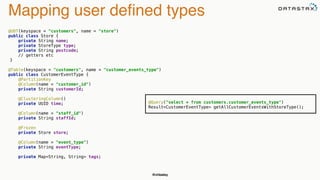
Mapping user defined types
@UDT(keyspace = "customers", name = "store")

public class Store {

private String name;

private StoreType type;

private String postcode;
// getters etc
}
@Table(keyspace = "customers", name = "customer_events_type")

public class CustomerEventType {

@PartitionKey

@Column(name = "customer_id")

private String customerId;


@ClusteringColumn()

private UUID time;


@Column(name = "staff_id")

private String staffId;


@Frozen

private Store store;


@Column(name = "event_type")

private String eventType;


private Map<String, String> tags;

@Query("select * from customers.customer_events_type")

Result<CustomerEventType> getAllCustomerEventsWithStoreType();
@chbatey
Snooze…
@chbatey
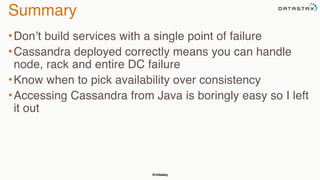
Summary
•Don’t build services with a single point of failure
•Cassandra deployed correctly means you can handle
node, rack and entire DC failure
•Know when to pick availability over consistency
•Accessing Cassandra from Java is boringly easy so I left
it out
@chbatey
Thanks for listening
• Follow me on twitter @chbatey
• Cassandra + Fault tolerance posts a plenty:
- http://christopher-batey.blogspot.co.uk/

LJC: Fault tolerance with Apache Cassandra

  • 1.
    Christopher Batey @chbatey LJC: Buildingfault tolerant Java applications with Apache Cassandra
  • 2.
    @chbatey Who am I? •Technical Evangelist for Apache Cassandra • Founder of Stubbed Cassandra • Help out Apache Cassandra users • DataStax • Builds enterprise ready version of Apache Cassandra • Previous: Cassandra backed apps at BSkyB
  • 3.
    @chbatey Overview • ‘Building faulttolerant Java applications with Apache Cassandra’ -Fault tolerance? -Building an ‘always on’ (HA) service -Cassandra architecture overview -Cassandra failure scenarios -Cassandra Java Driver
  • 4.
    @chbatey The evolution ofa developer • A few years ago I used to write a lot of code in an IDE • Recently not so much: - Config management (Ansible, Puppet etc) - Solution architecture • Frequently bootstrapping new services
  • 5.
  • 6.
    @chbatey Faults? • Infrastructure failure -Node - Rack - Data center • Dependency failure - HTTP services - Databases
  • 7.
    @chbatey Building a webapp Who here has downtime on a Friday night for ‘the release’?
  • 8.
  • 9.
  • 10.
    @chbatey Thou shalt bestateless… • Using container session store = 1/nth of your customers unhappy if a server dies
  • 11.
    @chbatey Storing state ina database? Session Store?
  • 12.
    @chbatey The drawbacks • Latency:( • Tricky to setup • New DB/Cache = new component in your architecture to scale and make HA • Tightly coupled to your container now • Move to embedded container in executable jars :(
  • 13.
  • 14.
  • 15.
  • 16.
  • 17.
    @chbatey Master/slave •Master serves allwrites •Read from master and optionally slaves
  • 18.
    @chbatey Peer-to-Peer • No master •Read/write to any • Consistency?
  • 19.
    @chbatey Decisions decisions… CAPtheorem Are these really that different?? Relational Database Mongo, Redis Highly Available Databases: Voldermort, Cassandra
  • 20.
    @chbatey PAC-ELC • If Partition:Trade off Availability vs Consistency • Else: Trade off Latency vs Consistency • http://dbmsmusings.blogspot.co.uk/2010/04/problems- with-cap-and-yahoos-little.html
  • 21.
  • 22.
    @chbatey Cassandra Cassandra • Distributed masterless database(Dynamo) • Column family data model (Google BigTable)
  • 23.
    @chbatey Datacenter and rackaware Europe • Distributed master less database (Dynamo) • Column family data model (Google BigTable) • Multi data centre replication built in from the start USA
  • 24.
    @chbatey Cassandra Online • Distributed masterless database (Dynamo) • Column family data model (Google BigTable) • Multi data centre replication built in from the start • Analytics with Apache Spark Analytics
  • 25.
    @chbatey Dynamo 101 • Theparts Cassandra took - Consistent hashing - Replication - Strategies for replication - Gossip - Hinted handoff - Anti-entropy repair • And the parts it left behind - Key/Value - Vector clocks
  • 26.
    @chbatey Picking the rightnodes • You don’t want a full table scan on a 1000 node cluster! • Dynamo to the rescue: Consistent Hashing • Then the replication strategy takes over: - Network topology - Simple
  • 27.
    @chbatey Murmer3 Example • Data: •Murmer3 Hash Values: jim age: 36 car: ford gender: M carol age: 37 car: bmw gender: F johnny age: 12 gender: M suzy: age: 10 gender: F Primary Key Murmur3 hash value jim -2245462676723223822 carol 7723358927203680754 johnny -6723372854036780875 suzy 1168604627387940318 Primary Key
  • 28.
    @chbatey Company Confidential Murmer3 Example Fournode cluster: © 2014 DataStax, All Rights Reserved. Node Murmur3 start range Murmur3 end range A -9223372036854775808 -4611686018427387903 B -4611686018427387904 -1 C 0 4611686018427387903 D 4611686018427387904 9223372036854775807
  • 29.
    @chbatey Pictures are better Hashrange: -9223372036854775808 to 9223372036854775807 A B C D -4611686018427387903 -1 4611686018427387903 -9223372036854775808 9223372036854775807 -4611686018427387904 0 4611686018427387904 B CD A
  • 30.
    @chbatey Murmer3 Example Data isdistributed as: Node Start range End range Primary key Hash value A -9223372036854775808 -4611686018427387903 johnny -67233728540367808 75 B -4611686018427387904 -1 jim -22454626767232238 22 C 0 4611686018427387903 suzy 116860462738794031 8 D 4611686018427387904 9223372036854775807 carol 772335892720368075 4
  • 31.
  • 32.
  • 33.
    @chbatey Replication strategy • Simple -Give it to the next node in the ring - Don’t use this in production • NetworkTopology - Every Cassandra node knows its DC and Rack - Replicas won’t be put on the same rack unless Replication Factor > # of racks - Unfortunately Cassandra can’t create servers and racks on the fly to fix this :(
  • 34.
    @chbatey Tunable Consistency •Data isreplicated N times •Every query that you execute you give a consistency -ALL -QUORUM -LOCAL_QUORUM -ONE • Christos Kalantzis Eventual Consistency != Hopeful Consistency: http:// youtu.be/A6qzx_HE3EU?list=PLqcm6qE9lgKJzVvwHprow9h7KMpb5hcUU
  • 35.
  • 36.
  • 37.
  • 38.
  • 39.
    @chbatey Load balancing •Data centreaware policy •Token aware policy •Latency aware policy •Whitelist policy APP APP Async Replication DC1 DC2
  • 40.
    @chbatey But what happenswhen they come back? • Hinted handoff to the rescue • Coordinators keep writes for downed nodes for a configurable amount of time, default 3 hours • Longer than that run a repair
  • 41.
    @chbatey Anti entropy repair •Not exciting but mandatory :) • New in 2.1 - incremental repair <— awesome
  • 42.
    @chbatey Don’t forget tobe social • Each node talks to a few of its other and shares information Did you hear node 1 was down???
  • 43.
    @chbatey Scaling shouldn’t behard • Throw more nodes at a cluster • Bootstrapping + joining the ring • For large data sets this can take some time
  • 44.
  • 45.
    @chbatey Types of failure •Server failure • Fail to write to disk • Whole node fail • Socket read time out • Consistency failure • Read timeout • Write timeout • Unavailable • Application failures • Idempotent?
  • 46.
    @chbatey Read and writetimeout Application C R1 R2 R3 C=QUROUM Replication factor: 3 timeout timeout Read timeout
  • 47.
  • 48.
  • 49.
    @chbatey How do Itest this? The test double • Release it - great book • Wiremock - mocking HTTP services • Saboteur - adding network latency If you want to build a fault tolerant application you better test faults!
  • 50.
    @chbatey Stubbed Cassandra Application Acceptance test prime onadmin port (REST) verification on admin port Admin endpoints Native protocol
  • 51.
    @chbatey Test with areal Cassandra • Reduced throughput / increased latency - Nodes down - Racks down - DC down
  • 52.
    @chbatey Test with areal Cassandra • Reduced throughput / increased latency - Nodes down - Racks down - DC down • Automate this if possible • Load test your schema - Cassandra stress - JMeter Cassandra plugin
  • 53.
    @chbatey Summary •Don’t build serviceswith a single point of failure •Cassandra deployed correctly means you can handle node, rack and entire DC failure •Know when to pick availability over consistency •Accessing Cassandra from Java is boringly easy so I left it out
  • 54.
    @chbatey Thanks for listening •Follow me on twitter @chbatey • Cassandra + Fault tolerance posts a plenty: - http://christopher-batey.blogspot.co.uk/
  • 55.
    @chbatey Write path onan individual server • A commit log for durability • Data also written to an in-memory structure (memtable) and then to disk once the memory structure is full (an SStable)
  • 56.
  • 57.
  • 58.
    @chbatey Modelling in Cassandra CREATETABLE customer_events( customer_id text, staff_id text, time timeuuid, store_type text, event_type text, tags map<text, text>, PRIMARY KEY ((customer_id), time)); Partition Key Clustering Column(s)
  • 59.
    @chbatey Get all theevents public List<CustomerEvent> getAllCustomerEvents() {
 return session.execute("select * from customers.customer_events")
 .all().stream()
 .map(mapCustomerEvent())
 .collect(Collectors.toList());
 } private Function<Row, CustomerEvent> mapCustomerEvent() {
 return row -> new CustomerEvent(
 row.getString("customer_id"),
 row.getUUID("time"),
 row.getString("staff_id"),
 row.getString("store_type"),
 row.getString("event_type"),
 row.getMap("tags", String.class, String.class));
 }
  • 60.
    @chbatey All events fora particular customer private PreparedStatement getEventsForCustomer;
 
 @PostConstruct
 public void prepareSatements() {
 getEventsForCustomer = session.prepare("select * from customers.customer_events where customer_id = ?");
 }
 
 public List<CustomerEvent> getCustomerEvents(String customerId) {
 BoundStatement boundStatement = getEventsForCustomer.bind(customerId);
 return session.execute(boundStatement) .all().stream()
 .map(mapCustomerEvent())
 .collect(Collectors.toList());
 }
  • 61.
    @chbatey Customer events fora time slice public List<CustomerEvent> getCustomerEventsForTime(String customerId, long startTime, long endTime) { 
 Select.Where getCustomers = QueryBuilder.select()
 .all()
 .from("customers", "customer_events")
 .where(eq("customer_id", customerId))
 .and(gt("time", UUIDs.startOf(startTime)))
 .and(lt("time", UUIDs.endOf(endTime)));
 
 
 return session.execute(getCustomers).all().stream()
 .map(mapCustomerEvent())
 .collect(Collectors.toList());
 }
  • 62.
    @chbatey Mapping API @Table(keyspace ="customers", name = "customer_events")
 public class CustomerEvent {
 @PartitionKey
 @Column(name = "customer_id")
 private String customerId;
 
 @ClusteringColumn
 private UUID time;
 
 @Column(name = "staff_id")
 private String staffId;
 
 @Column(name = "store_type")
 private String storeType;
 
 @Column(name = "event_type")
 private String eventType;
 
 private Map<String, String> tags; // ctr / getters etc }

  • 63.
    @chbatey Mapping API @Accessor
 public interfaceCustomerEventDao {
 @Query("select * from customers.customer_events where customer_id = :customerId")
 Result<CustomerEvent> getCustomerEvents(String customerId);
 
 @Query("select * from customers.customer_events")
 Result<CustomerEvent> getAllCustomerEvents();
 
 @Query("select * from customers.customer_events where customer_id = :customerId and time > minTimeuuid(:startTime) and time < maxTimeuuid(:endTime)")
 Result<CustomerEvent> getCustomerEventsForTime(String customerId, long startTime, long endTime);
 } 
 @Bean
 public CustomerEventDao customerEventDao() {
 MappingManager mappingManager = new MappingManager(session);
 return mappingManager.createAccessor(CustomerEventDao.class);
 }
  • 64.
    @chbatey Adding some typesafety public enum StoreType {
 ONLINE, RETAIL, FRANCHISE, MOBILE
 } @Table(keyspace = "customers", name = "customer_events")
 public class CustomerEvent {
 @PartitionKey
 @Column(name = "customer_id")
 private String customerId;
 
 @ClusteringColumn()
 private UUID time;
 
 @Column(name = "staff_id")
 private String staffId;
 
 @Column(name = "store_type")
 @Enumerated(EnumType.STRING) // could be EnumType.ORDINAL
 private StoreType storeType;

  • 65.
    @chbatey User defined types createTYPE store (name text, type text, postcode text) ;
 
 
 CREATE TABLE customer_events_type( customer_id text, staff_id text, time timeuuid, store frozen<store>, event_type text, tags map<text, text>, PRIMARY KEY ((customer_id), time));

  • 66.
    @chbatey Mapping user definedtypes @UDT(keyspace = "customers", name = "store")
 public class Store {
 private String name;
 private StoreType type;
 private String postcode; // getters etc } @Table(keyspace = "customers", name = "customer_events_type")
 public class CustomerEventType {
 @PartitionKey
 @Column(name = "customer_id")
 private String customerId;
 
 @ClusteringColumn()
 private UUID time;
 
 @Column(name = "staff_id")
 private String staffId;
 
 @Frozen
 private Store store;
 
 @Column(name = "event_type")
 private String eventType;
 
 private Map<String, String> tags;

  • 67.
    @chbatey Mapping user definedtypes @UDT(keyspace = "customers", name = "store")
 public class Store {
 private String name;
 private StoreType type;
 private String postcode; // getters etc } @Table(keyspace = "customers", name = "customer_events_type")
 public class CustomerEventType {
 @PartitionKey
 @Column(name = "customer_id")
 private String customerId;
 
 @ClusteringColumn()
 private UUID time;
 
 @Column(name = "staff_id")
 private String staffId;
 
 @Frozen
 private Store store;
 
 @Column(name = "event_type")
 private String eventType;
 
 private Map<String, String> tags;
 @Query("select * from customers.customer_events_type")
 Result<CustomerEventType> getAllCustomerEventsWithStoreType();
  • 68.
  • 69.
    @chbatey Summary •Don’t build serviceswith a single point of failure •Cassandra deployed correctly means you can handle node, rack and entire DC failure •Know when to pick availability over consistency •Accessing Cassandra from Java is boringly easy so I left it out
  • 70.
    @chbatey Thanks for listening •Follow me on twitter @chbatey • Cassandra + Fault tolerance posts a plenty: - http://christopher-batey.blogspot.co.uk/