









Cassandra
Architecture
FTW!
Cassandra
Architecture
FTW!
Cassandra won because it solved a
problem that hadn’t yet been solved
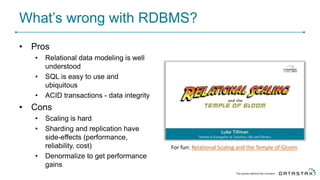
What’s wrong with RDBMS?
• Pros
• Relational data modeling is well
understood
• SQL is easy to use and
ubiquitous
• ACID transactions - data integrity
• Cons
• Scaling is hard
• Sharding and replication have
side-effects (performance,
reliability, cost)
• Denormalize to get performance
gains
For fun: Relational Scaling and the Temple of Gloom
The NoSQL Revolution (~2009)
• Key-value – Dynamo, Riak, Voldemort, Redis,
Memcached
• Column-oriented – BigTable, Hbase
• Document – Mongo DB, Document DB, CouchDB
• Graph – Neo4J, DSE Graph
• Multi-model – DataStax Enterprise, CosmosDB
• Relational counter-revolution – AWS Aurora, Google
Spanner
Apache Cassandra Architecture Qualities
• Distributed,
decentralized
• Elastic scalability
• Commodity hardware?
• High performance
• High availability / fault
tolerant
• Tuneable consistency Apache Cassandra ® Apache Software Foundation
Two lies and a truth
• Cassandra is column-oriented
• Cassandra is a schemaless database
• Cassandra is eventually consistent
They’re all lies, in a way
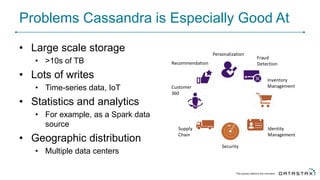
Problems Cassandra is Especially Good At
• Large scale storage
• >10s of TB
• Lots of writes
• Time-series data, IoT
• Statistics and analytics
• For example, as a Spark data
source
• Geographic distribution
• Multiple data centers
Personalization
Customer
360
Recommendation
Fraud
Detection
Inventory
Management
Identity
Management
Security
Supply
Chain
A system must be designed for distribution
from the beginning in order to scale the most
effectively
© DataStax, All Rights Reserved.10
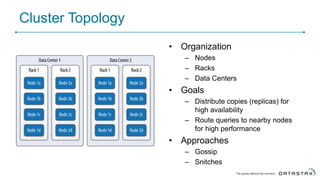
Cluster Topology
• Organization
– Nodes
– Racks
– Data Centers
• Goals
– Distribute copies (replicas) for
high availability
– Route queries to nearby nodes
for high performance
• Approaches
– Gossip
– Snitches
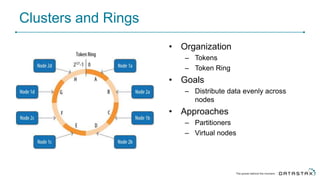
Clusters and Rings
• Organization
– Tokens
– Token Ring
• Goals
– Distribute data evenly across
nodes
• Approaches
– Partitioners
– Virtual nodes
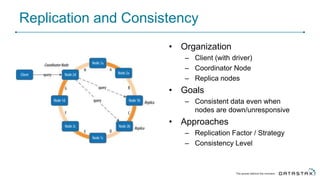
Replication and Consistency
• Organization
– Client (with driver)
– Coordinator Node
– Replica nodes
• Goals
– Consistent data even when
nodes are down/unresponsive
• Approaches
– Replication Factor / Strategy
– Consistency Level
Cassandra works because it leverages
proven distributed system design patterns
Wait, who is this guy?
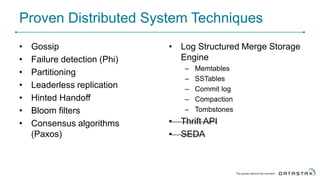
Proven Distributed System Techniques
• Gossip
• Failure detection (Phi)
• Partitioning
• Leaderless replication
• Hinted Handoff
• Bloom filters
• Consensus algorithms
(Paxos)
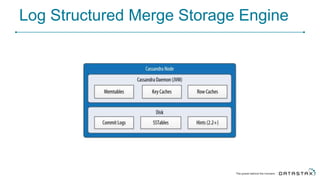
• Log Structured Merge Storage
Engine
– Memtables
– SSTables
– Commit log
– Compaction
– Tombstones
• Thrift API
• SEDA
Log Structured Merge Storage Engine
Cassandra’s data model is the key enabler
of its high performance and scalability
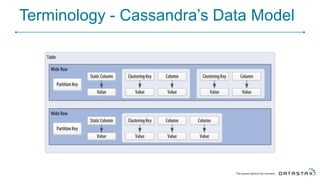
Terminology - Cassandra’s Data Model
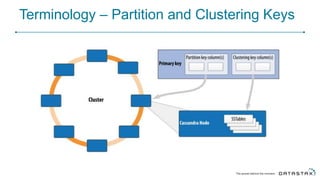
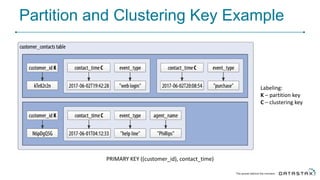
Terminology – Partition and Clustering Keys
Partition and Clustering Key Example
Labeling:
K – partition key
C – clustering key
PRIMARY KEY ((customer_id), contact_time)
Cassandra survived because it didn’t
over-extend itself
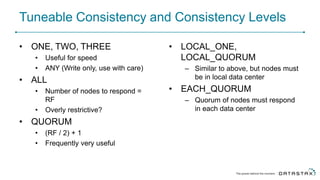
Tuneable Consistency and Consistency Levels
• ONE, TWO, THREE
• Useful for speed
• ANY (Write only, use with care)
• ALL
• Number of nodes to respond =
RF
• Overly restrictive?
• QUORUM
• (RF / 2) + 1
• Frequently very useful
• LOCAL_ONE,
LOCAL_QUORUM
– Similar to above, but nodes must
be in local data center
• EACH_QUORUM
– Quorum of nodes must respond
in each data center
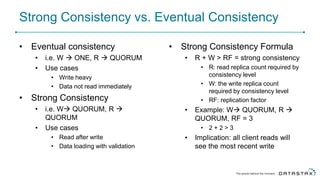
Strong Consistency vs. Eventual Consistency
• Eventual consistency
• i.e. W  ONE, R  QUORUM
• Use cases
• Write heavy
• Data not read immediately
• Strong Consistency
• i.e. W QUORUM, R 
QUORUM
• Use cases
• Read after write
• Data loading with validation
• Strong Consistency Formula
• R + W > RF = strong consistency
• R: read replica count required by
consistency level
• W: the write replica count
required by consistency level
• RF: replication factor
• Example: W QUORUM, R 
QUORUM, RF = 3
• 2 + 2 > 3
• Implication: all client reads will
see the most recent write
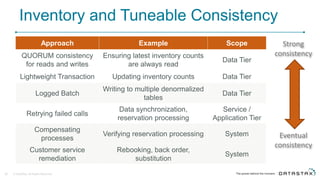
Inventory and Tuneable Consistency
© DataStax, All Rights Reserved.28
Approach Example Scope
QUORUM consistency
for reads and writes
Ensuring latest inventory counts
are always read
Data Tier
Lightweight Transaction Updating inventory counts Data Tier
Logged Batch
Writing to multiple denormalized
tables
Data Tier
Retrying failed calls
Data synchronization,
reservation processing
Service /
Application Tier
Compensating
processes
Verifying reservation processing System
Customer service
remediation
Rebooking, back order,
substitution
System
Eventual
consistency
Strong
consistency
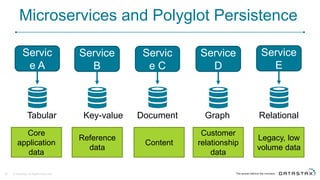
Core
application
data
Microservices and Polyglot Persistence
© DataStax, All Rights Reserved.29
Servic
e A
Service
B
Tabular Key-value
Servic
e C
RelationalDocument Graph
Service
D
Service
E
Reference
data
Content
Customer
relationship
data
Legacy, low
volume data
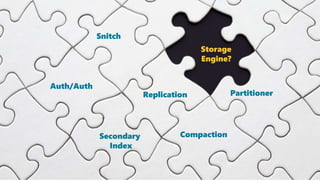
Cassandra will remain viable for many years
because of its extensibility and pluggability
Snitch
Partitioner
Compaction
Replication
Secondary
Index
Storage
Engine?
Auth/Auth
Cassandra’s deployment flexibility can’t be
matched by cloud vendor database offerings
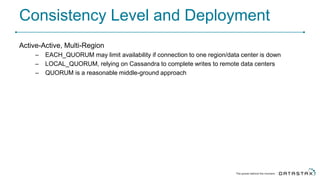
Consistency Level and Deployment
Active-Active, Multi-Region
– EACH_QUORUM may limit availability if connection to one region/data center is down
– LOCAL_QUORUM, relying on Cassandra to complete writes to remote data centers
– QUORUM is a reasonable middle-ground approach
Consistency Level and Deployment
Separate data center for analytics
– Writes in ”online DC” – LOCAL_QUORUM
• Writes to analytics DC in background
• Analytic DC availability/performance decoupled from online DC
• EACH_QUORUM, QUORUM overkill, unless “real-time” analytics required
– Reads in “analytics DC” – LOCAL_QUORUM
• Or even LOCAL_ONE
Cassandra is most powerful when combined
with complementary technologies to form a
data platform
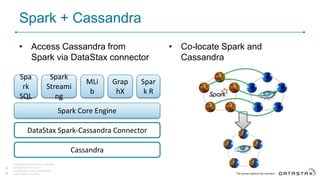
Spark + Cassandra
• Access Cassandra from
Spark via DataStax connector
DataStax is a registered trademark
of DataStax, Inc. and its
subsidiaries in the United States
and/or other countries.
3
6
• Co-locate Spark and
Cassandra
Spa
rk
SQL
Spark
Streami
ng
MLi
b
Grap
hX
Spar
k R
Spark Core Engine
DataStax Spark-Cassandra Connector
Cassandra
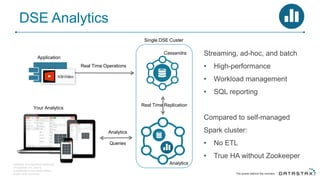
DSE Analytics
DataStax is a registered trademark
of DataStax, Inc. and its
subsidiaries in the United States
and/or other countries.
Application
Real Time Operations
Cassandra
Analytics
Analytics
Queries
Your Analytics
Real Time Replication
Single DSE Custer
Streaming, ad-hoc, and batch
• High-performance
• Workload management
• SQL reporting
Compared to self-managed
Spark cluster:
• No ETL
• True HA without Zookeeper
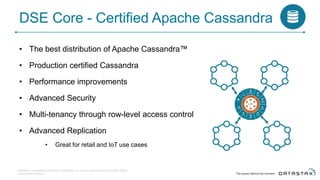
DSE Core - Certified Apache Cassandra
• The best distribution of Apache Cassandra™
• Production certified Cassandra
• Performance improvements
• Advanced Security
• Multi-tenancy through row-level access control
• Advanced Replication
• Great for retail and IoT use cases
DataStax is a registered trademark of DataStax, Inc. and its subsidiaries in the United States
and/or other countries.
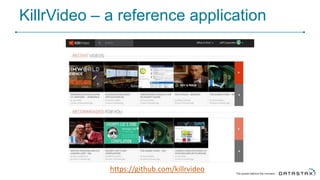
https://github.com/killrvideo
KillrVideo – a reference application
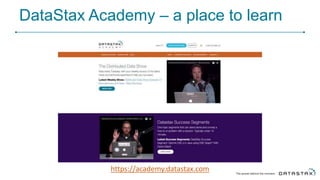
https://academy.datastax.com
DataStax Academy – a place to learn
41
Contact
jeff.carpenter@
datastax.com
@jscarp
jeffreyscarpenter
medium.com/@jscarp

Cassandra Architecture FTW

  • 1.
  • 3.
  • 4.
    Cassandra won becauseit solved a problem that hadn’t yet been solved
  • 5.
    What’s wrong withRDBMS? • Pros • Relational data modeling is well understood • SQL is easy to use and ubiquitous • ACID transactions - data integrity • Cons • Scaling is hard • Sharding and replication have side-effects (performance, reliability, cost) • Denormalize to get performance gains For fun: Relational Scaling and the Temple of Gloom
  • 6.
    The NoSQL Revolution(~2009) • Key-value – Dynamo, Riak, Voldemort, Redis, Memcached • Column-oriented – BigTable, Hbase • Document – Mongo DB, Document DB, CouchDB • Graph – Neo4J, DSE Graph • Multi-model – DataStax Enterprise, CosmosDB • Relational counter-revolution – AWS Aurora, Google Spanner
  • 7.
    Apache Cassandra ArchitectureQualities • Distributed, decentralized • Elastic scalability • Commodity hardware? • High performance • High availability / fault tolerant • Tuneable consistency Apache Cassandra ® Apache Software Foundation
  • 8.
    Two lies anda truth • Cassandra is column-oriented • Cassandra is a schemaless database • Cassandra is eventually consistent They’re all lies, in a way
  • 9.
    Problems Cassandra isEspecially Good At • Large scale storage • >10s of TB • Lots of writes • Time-series data, IoT • Statistics and analytics • For example, as a Spark data source • Geographic distribution • Multiple data centers Personalization Customer 360 Recommendation Fraud Detection Inventory Management Identity Management Security Supply Chain
  • 10.
    A system mustbe designed for distribution from the beginning in order to scale the most effectively © DataStax, All Rights Reserved.10
  • 11.
    Cluster Topology • Organization –Nodes – Racks – Data Centers • Goals – Distribute copies (replicas) for high availability – Route queries to nearby nodes for high performance • Approaches – Gossip – Snitches
  • 12.
    Clusters and Rings •Organization – Tokens – Token Ring • Goals – Distribute data evenly across nodes • Approaches – Partitioners – Virtual nodes
  • 13.
    Replication and Consistency •Organization – Client (with driver) – Coordinator Node – Replica nodes • Goals – Consistent data even when nodes are down/unresponsive • Approaches – Replication Factor / Strategy – Consistency Level
  • 14.
    Cassandra works becauseit leverages proven distributed system design patterns
  • 17.
    Wait, who isthis guy?
  • 18.
    Proven Distributed SystemTechniques • Gossip • Failure detection (Phi) • Partitioning • Leaderless replication • Hinted Handoff • Bloom filters • Consensus algorithms (Paxos) • Log Structured Merge Storage Engine – Memtables – SSTables – Commit log – Compaction – Tombstones • Thrift API • SEDA
  • 19.
    Log Structured MergeStorage Engine
  • 20.
    Cassandra’s data modelis the key enabler of its high performance and scalability
  • 21.
  • 22.
    Terminology – Partitionand Clustering Keys
  • 23.
    Partition and ClusteringKey Example Labeling: K – partition key C – clustering key PRIMARY KEY ((customer_id), contact_time)
  • 24.
    Cassandra survived becauseit didn’t over-extend itself
  • 25.
    Tuneable Consistency andConsistency Levels • ONE, TWO, THREE • Useful for speed • ANY (Write only, use with care) • ALL • Number of nodes to respond = RF • Overly restrictive? • QUORUM • (RF / 2) + 1 • Frequently very useful • LOCAL_ONE, LOCAL_QUORUM – Similar to above, but nodes must be in local data center • EACH_QUORUM – Quorum of nodes must respond in each data center
  • 26.
    Strong Consistency vs.Eventual Consistency • Eventual consistency • i.e. W  ONE, R  QUORUM • Use cases • Write heavy • Data not read immediately • Strong Consistency • i.e. W QUORUM, R  QUORUM • Use cases • Read after write • Data loading with validation • Strong Consistency Formula • R + W > RF = strong consistency • R: read replica count required by consistency level • W: the write replica count required by consistency level • RF: replication factor • Example: W QUORUM, R  QUORUM, RF = 3 • 2 + 2 > 3 • Implication: all client reads will see the most recent write
  • 27.
    Inventory and TuneableConsistency © DataStax, All Rights Reserved.28 Approach Example Scope QUORUM consistency for reads and writes Ensuring latest inventory counts are always read Data Tier Lightweight Transaction Updating inventory counts Data Tier Logged Batch Writing to multiple denormalized tables Data Tier Retrying failed calls Data synchronization, reservation processing Service / Application Tier Compensating processes Verifying reservation processing System Customer service remediation Rebooking, back order, substitution System Eventual consistency Strong consistency
  • 28.
    Core application data Microservices and PolyglotPersistence © DataStax, All Rights Reserved.29 Servic e A Service B Tabular Key-value Servic e C RelationalDocument Graph Service D Service E Reference data Content Customer relationship data Legacy, low volume data
  • 29.
    Cassandra will remainviable for many years because of its extensibility and pluggability
  • 30.
  • 31.
    Cassandra’s deployment flexibilitycan’t be matched by cloud vendor database offerings
  • 32.
    Consistency Level andDeployment Active-Active, Multi-Region – EACH_QUORUM may limit availability if connection to one region/data center is down – LOCAL_QUORUM, relying on Cassandra to complete writes to remote data centers – QUORUM is a reasonable middle-ground approach
  • 33.
    Consistency Level andDeployment Separate data center for analytics – Writes in ”online DC” – LOCAL_QUORUM • Writes to analytics DC in background • Analytic DC availability/performance decoupled from online DC • EACH_QUORUM, QUORUM overkill, unless “real-time” analytics required – Reads in “analytics DC” – LOCAL_QUORUM • Or even LOCAL_ONE
  • 34.
    Cassandra is mostpowerful when combined with complementary technologies to form a data platform
  • 35.
    Spark + Cassandra •Access Cassandra from Spark via DataStax connector DataStax is a registered trademark of DataStax, Inc. and its subsidiaries in the United States and/or other countries. 3 6 • Co-locate Spark and Cassandra Spa rk SQL Spark Streami ng MLi b Grap hX Spar k R Spark Core Engine DataStax Spark-Cassandra Connector Cassandra
  • 36.
    DSE Analytics DataStax isa registered trademark of DataStax, Inc. and its subsidiaries in the United States and/or other countries. Application Real Time Operations Cassandra Analytics Analytics Queries Your Analytics Real Time Replication Single DSE Custer Streaming, ad-hoc, and batch • High-performance • Workload management • SQL reporting Compared to self-managed Spark cluster: • No ETL • True HA without Zookeeper
  • 37.
    DSE Core -Certified Apache Cassandra • The best distribution of Apache Cassandra™ • Production certified Cassandra • Performance improvements • Advanced Security • Multi-tenancy through row-level access control • Advanced Replication • Great for retail and IoT use cases DataStax is a registered trademark of DataStax, Inc. and its subsidiaries in the United States and/or other countries.
  • 38.
  • 39.
  • 40.