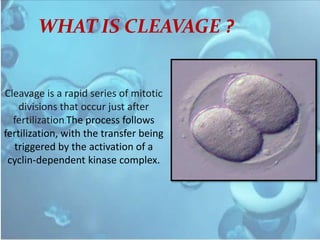
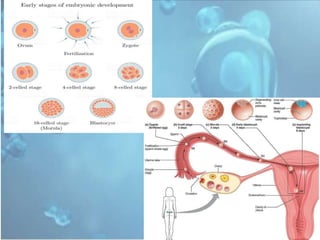
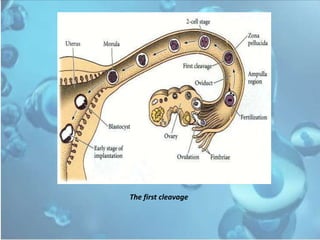
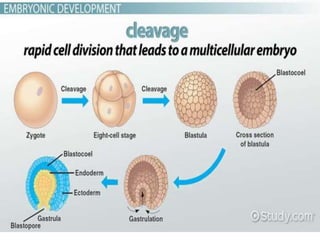
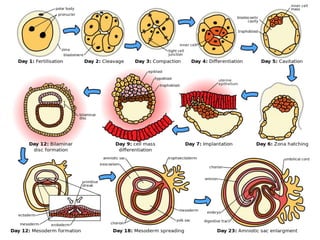
This document summarizes key aspects of mammalian cleavage. It begins by defining cleavage as the rapid cell divisions that occur after fertilization. It then describes different patterns of mammalian cleavage based on cleavage furrows, fate of germ layers, and cell arrangement. The importance of cleavage in generating cells for differentiation and increasing the nucleus to cytoplasm ratio is highlighted. Key stages of early embryonic development including fertilization, cleavage, gastrulation and organogenesis are outlined. The document concludes by detailing the specific cell divisions and structures that arise during cleavage and blastula formation in mammals.