Cleaner Production
Career
Industrial engineer
Subject
Sustainable development
Unit 4
Modified Scenarios
Professor
Segundo Alberto Rodríguez Rivero
Student
Héctor Uriel Oropeza Almanza
#17051251
Technological Institute of Saltillo
Long distance education
March 21, 2019
Saltillo, Coahuila
Introduction
The world's population every day consumes more than our planet
can generate, as the world's largest companies grow each day
more, the disproportionate consumption of products in the
population increasingly generate more waste, by taking natural
resources every faster and more volume and generate more waste
causes the planet to wear out because it can not regenerate as
quickly as we consume it.
All this has led the world population to take natural prevention
measures based on sustainable development, which has several
tools, one of which is cleaner production which helps us to have a
more sustainable process without so much waste.
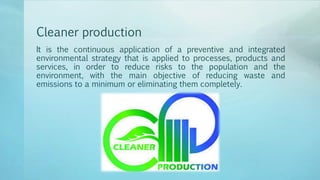
Cleaner production
It is the continuous application of a preventive and integrated
environmental strategy that is applied to processes, products and
services, in order to reduce risks to the population and the
environment, with the main objective of reducing waste and
emissions to a minimum or eliminating them completely.
A cleaner production program is more than just a management plan to
reduce emissions, it is a tool that helps us identify deficiencies in
production processes, training deficiencies, deficiencies in the
management of company information, waste of raw material /
resources, poor working conditions, risks of work accidents and lack of
adequate technology, among others.
After identifying the deficiencies in the aforementioned processes,
corrective measures are proposed and a plan is developed aimed at
preventing environmental damage and maintaining the sustainability of
the company.
Benefits of cleaner production
The cleanest production, like all the improvements, apart from the
better management of the products and the improvement of the
environment, brings with it some additional benefits such as:
• Reduction of the consumption of raw materials.
• Reduction of waste and emissions.
• Reduction of operational costs.
• Less pollution to the environment.
• Improvement in the working conditions of the company.
Benefits of cleaner production
• Reduction of accident risks.
• Access to new markets through "green" businesses.
• Compliance with environmental regulations.
• Improvement of the image of the company.
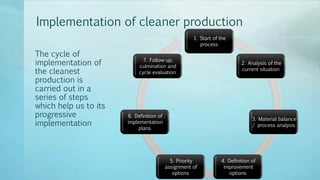
The cycle of
implementation of
the cleanest
production is
carried out in a
series of steps
which help us to its
progressive
implementation
Implementation of cleaner production
1. Start of the
process
2. Analysis of the
current situation
3. Material balance
/ process analysis
4. Definition of
improvement
options
5. Priority
assignment of
options
6. Definition of
implementation
plans
7. Follow-up,
culmination and
cycle evaluation
1. Start of the process
In this first stage the objectives of the program are reviewed, the
people who are going to form the monitoring team are defined, it is
recommended that they be
Conformed by different people from the areas or departments of
accounting, plant management, maintenance, process line and
general management, this helps that opinions and improvements are
solved more quickly.
1. Start of the process
It should give a preliminary tour to the company to become familiar
with the whole process and find some opportunities for improvement
in it, some of the most important points that should be reviewed in
the first round are:
• Sites where water or electricity is
consumed.
• Health risk sites, whether due to
noise, gaseous emissions or
unsafe conditions.
• Sites where spills occur.
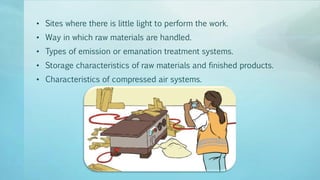
• Sites where there is little light to perform the work.
• Way in which raw materials are handled.
• Types of emission or emanation treatment systems.
• Storage characteristics of raw materials and finished products.
• Characteristics of compressed air systems.
2. Analysis of the current situation
In this stage, the previously gathered information is gathered to review
in what conditions the company is located and thus be able to observe
the changes based on what was collected and prioritize the changes of
interest.
Once defined the most important
processes, we proceed to make
the flow diagrams for a better
understanding of each process,
helping us to define the
improvement options, so that they
are practical and of benefit for the
company.
The steps involved in the schematization of production processes
are:
• Definition of unit operations: We divide the entire process into
subprocesses.
• Generation of flow diagrams: the realization of the flow diagram
with previously defined unit processes.
• Identification of inputs to the process: identify the most important
entries of each operation.
• Identification of process outputs: define the outputs of each
operation.
3. Material balance / process analysis
In this stage we define the resources that we are going to quantify
in the activities of interest that we define in point 2.
The material balance analysis is to establish the relationship
between the raw material that enters a process and the amount of
waste that comes out of it.
To carry out the analysis, it is important to have a methodology, in
which you must answer the following questions:
• Why is it going to be quantified?
• What will be quantified?
• How is it going to be quantified?
• Where will it be quantified?
• When will it be quantified?
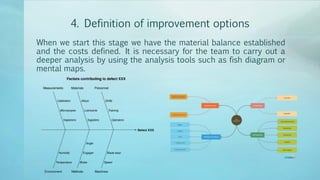
4. Definition of improvement options
When we start this stage we have the material balance established
and the costs defined. It is necessary for the team to carry out a
deeper analysis by using the analysis tools such as fish diagram or
mental maps.
Subsequently, the improvement options are defined, which must be
identified by priority from highest to lowest, these options can be
oriented to the prevention of pollution, which is mainly
concentrated in 5 points:
• Changes in raw materials
• Changes in technology
• Good manufacturing practices
• Product changes
• Reuse programs
5. Priority assignment of options
In this stage, the priority of each option is analyzed in depth with
the following three points, with which we must categorize each
option.
Easy deployment options
Do not require investment and be related to changes in
manufacturing practices.
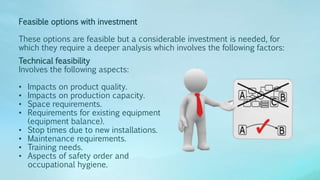
Feasible options with investment
These options are feasible but a considerable investment is needed, for
which they require a deeper analysis which involves the following factors:
Technical feasibility
Involves the following aspects:
• Impacts on product quality.
• Impacts on production capacity.
• Space requirements.
• Requirements for existing equipment
(equipment balance).
• Stop times due to new installations.
• Maintenance requirements.
• Training needs.
• Aspects of safety order and
occupational hygiene.
Economic feasibility
At this point we calculate the simple recovery period, which allows us to measure the
period of time required for the net cash flows of an investment to recover its initial cost
or investment with the following formula:
𝑃𝑅𝑆 =
𝐼
𝐴 − 𝐶
• PRS = Simple recovery period.
• I = Investment (includes cost of
equipment, construction or modification of
existing infrastructure).
• A = Estimated savings (due to the
implementation of the improvement
option, per unit of time).
• C = Additional cost of the operation (which
can be generated with the measure, per
unit of time).
Environmental feasibility
If the option is feasible in terms of the technical part and the costs, then
we must perform the environmental analysis which takes into account
the benefits and disadvantages of the options.
If our technical and environmental
conditions are feasible then the
economic condition is the one that
decides the priority of the option based
on the periods of cost recovery:
Short term (less than 4 months).
Medium term (from 5 to 10 months).
Long term (more than 10 months).
6. Definition of implementation plans
In this stage the options are established according to their previous
feasibility in the previous point the implementation times will be
taken into account. The easy to implement will be carried out
within a short period of time, the options that require investment will
be implemented in the medium term and in the long term. The
times depend on the companies, not all the companies carry out
the same implementation times.
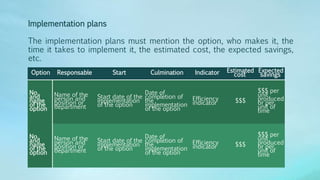
Implementation plans
The implementation plans must mention the option, who makes it, the
time it takes to implement it, the estimated cost, the expected savings,
etc.
Option Responsable Start Culmination Indicator Estimated
cost
Expected
savings
No.
and
name
of the
option
Name of the
person and
position or
department
Start date of the
implementation
of the option
Date of
completion of
the
implementation
of the option
Efficiency
indicator $$$
$$$ per
unit
produced
or per
unit of
time
No.
and
name
of the
option
Name of the
person and
position or
department
Start date of the
implementation
of the option
Date of
completion of
the
implementation
of the option
Efficiency
indicator $$$
$$$ per
unit
produced
or per
unit of
time
7. Follow-up, culmination and cycle evaluation
This is the last stage to finish the cycle of the cleaner production
plan, which consists of monitoring the completion of the selected
plan. To achieve the follow-up, a plan must be implemented that
consists of the following points:
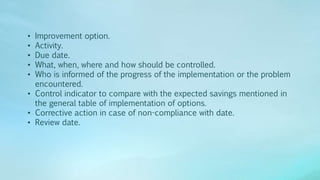
• Improvement option.
• Activity.
• Due date.
• What, when, where and how should be controlled.
• Who is informed of the progress of the implementation or the problem
encountered.
• Control indicator to compare with the expected savings mentioned in
the general table of implementation of options.
• Corrective action in case of non-compliance with date.
• Review date.
Conclusion
The process plan helps us improve step by step the performance of
the company, this leads to a sustainable company which generates
less waste and promotes the reuse and recycling of them that helps
us to a greater regeneration of nature and helps the company to
obtain more profits.
Bibliography
José Pablo Rojas. (2010). Cleaner Production Manual. March 20,
2019, de CEGESTI Centro de Gestión Tecnológica e Informática
Industrial Website:
http://www.cegesti.org/manuales/download_produccion_mas_lim
pia/manual_produccion_mas_limpia.pdf
Cleaner production

Cleaner production

  • 1.
    Cleaner Production Career Industrial engineer Subject Sustainabledevelopment Unit 4 Modified Scenarios Professor Segundo Alberto Rodríguez Rivero Student Héctor Uriel Oropeza Almanza #17051251 Technological Institute of Saltillo Long distance education March 21, 2019 Saltillo, Coahuila
  • 2.
    Introduction The world's populationevery day consumes more than our planet can generate, as the world's largest companies grow each day more, the disproportionate consumption of products in the population increasingly generate more waste, by taking natural resources every faster and more volume and generate more waste causes the planet to wear out because it can not regenerate as quickly as we consume it. All this has led the world population to take natural prevention measures based on sustainable development, which has several tools, one of which is cleaner production which helps us to have a more sustainable process without so much waste.
  • 3.
    Cleaner production It isthe continuous application of a preventive and integrated environmental strategy that is applied to processes, products and services, in order to reduce risks to the population and the environment, with the main objective of reducing waste and emissions to a minimum or eliminating them completely.
  • 4.
    A cleaner productionprogram is more than just a management plan to reduce emissions, it is a tool that helps us identify deficiencies in production processes, training deficiencies, deficiencies in the management of company information, waste of raw material / resources, poor working conditions, risks of work accidents and lack of adequate technology, among others. After identifying the deficiencies in the aforementioned processes, corrective measures are proposed and a plan is developed aimed at preventing environmental damage and maintaining the sustainability of the company.
  • 5.
    Benefits of cleanerproduction The cleanest production, like all the improvements, apart from the better management of the products and the improvement of the environment, brings with it some additional benefits such as: • Reduction of the consumption of raw materials. • Reduction of waste and emissions. • Reduction of operational costs. • Less pollution to the environment. • Improvement in the working conditions of the company.
  • 6.
    Benefits of cleanerproduction • Reduction of accident risks. • Access to new markets through "green" businesses. • Compliance with environmental regulations. • Improvement of the image of the company.
  • 7.
    The cycle of implementationof the cleanest production is carried out in a series of steps which help us to its progressive implementation Implementation of cleaner production 1. Start of the process 2. Analysis of the current situation 3. Material balance / process analysis 4. Definition of improvement options 5. Priority assignment of options 6. Definition of implementation plans 7. Follow-up, culmination and cycle evaluation
  • 8.
    1. Start ofthe process In this first stage the objectives of the program are reviewed, the people who are going to form the monitoring team are defined, it is recommended that they be Conformed by different people from the areas or departments of accounting, plant management, maintenance, process line and general management, this helps that opinions and improvements are solved more quickly.
  • 9.
    1. Start ofthe process It should give a preliminary tour to the company to become familiar with the whole process and find some opportunities for improvement in it, some of the most important points that should be reviewed in the first round are: • Sites where water or electricity is consumed. • Health risk sites, whether due to noise, gaseous emissions or unsafe conditions. • Sites where spills occur.
  • 10.
    • Sites wherethere is little light to perform the work. • Way in which raw materials are handled. • Types of emission or emanation treatment systems. • Storage characteristics of raw materials and finished products. • Characteristics of compressed air systems.
  • 11.
    2. Analysis ofthe current situation In this stage, the previously gathered information is gathered to review in what conditions the company is located and thus be able to observe the changes based on what was collected and prioritize the changes of interest. Once defined the most important processes, we proceed to make the flow diagrams for a better understanding of each process, helping us to define the improvement options, so that they are practical and of benefit for the company.
  • 12.
    The steps involvedin the schematization of production processes are: • Definition of unit operations: We divide the entire process into subprocesses. • Generation of flow diagrams: the realization of the flow diagram with previously defined unit processes. • Identification of inputs to the process: identify the most important entries of each operation. • Identification of process outputs: define the outputs of each operation.
  • 13.
    3. Material balance/ process analysis In this stage we define the resources that we are going to quantify in the activities of interest that we define in point 2. The material balance analysis is to establish the relationship between the raw material that enters a process and the amount of waste that comes out of it. To carry out the analysis, it is important to have a methodology, in which you must answer the following questions: • Why is it going to be quantified? • What will be quantified? • How is it going to be quantified? • Where will it be quantified? • When will it be quantified?
  • 14.
    4. Definition ofimprovement options When we start this stage we have the material balance established and the costs defined. It is necessary for the team to carry out a deeper analysis by using the analysis tools such as fish diagram or mental maps.
  • 15.
    Subsequently, the improvementoptions are defined, which must be identified by priority from highest to lowest, these options can be oriented to the prevention of pollution, which is mainly concentrated in 5 points: • Changes in raw materials • Changes in technology • Good manufacturing practices • Product changes • Reuse programs
  • 16.
    5. Priority assignmentof options In this stage, the priority of each option is analyzed in depth with the following three points, with which we must categorize each option. Easy deployment options Do not require investment and be related to changes in manufacturing practices.
  • 17.
    Feasible options withinvestment These options are feasible but a considerable investment is needed, for which they require a deeper analysis which involves the following factors: Technical feasibility Involves the following aspects: • Impacts on product quality. • Impacts on production capacity. • Space requirements. • Requirements for existing equipment (equipment balance). • Stop times due to new installations. • Maintenance requirements. • Training needs. • Aspects of safety order and occupational hygiene.
  • 18.
    Economic feasibility At thispoint we calculate the simple recovery period, which allows us to measure the period of time required for the net cash flows of an investment to recover its initial cost or investment with the following formula: 𝑃𝑅𝑆 = 𝐼 𝐴 − 𝐶 • PRS = Simple recovery period. • I = Investment (includes cost of equipment, construction or modification of existing infrastructure). • A = Estimated savings (due to the implementation of the improvement option, per unit of time). • C = Additional cost of the operation (which can be generated with the measure, per unit of time).
  • 19.
    Environmental feasibility If theoption is feasible in terms of the technical part and the costs, then we must perform the environmental analysis which takes into account the benefits and disadvantages of the options. If our technical and environmental conditions are feasible then the economic condition is the one that decides the priority of the option based on the periods of cost recovery: Short term (less than 4 months). Medium term (from 5 to 10 months). Long term (more than 10 months).
  • 20.
    6. Definition ofimplementation plans In this stage the options are established according to their previous feasibility in the previous point the implementation times will be taken into account. The easy to implement will be carried out within a short period of time, the options that require investment will be implemented in the medium term and in the long term. The times depend on the companies, not all the companies carry out the same implementation times.
  • 21.
    Implementation plans The implementationplans must mention the option, who makes it, the time it takes to implement it, the estimated cost, the expected savings, etc. Option Responsable Start Culmination Indicator Estimated cost Expected savings No. and name of the option Name of the person and position or department Start date of the implementation of the option Date of completion of the implementation of the option Efficiency indicator $$$ $$$ per unit produced or per unit of time No. and name of the option Name of the person and position or department Start date of the implementation of the option Date of completion of the implementation of the option Efficiency indicator $$$ $$$ per unit produced or per unit of time
  • 22.
    7. Follow-up, culminationand cycle evaluation This is the last stage to finish the cycle of the cleaner production plan, which consists of monitoring the completion of the selected plan. To achieve the follow-up, a plan must be implemented that consists of the following points:
  • 23.
    • Improvement option. •Activity. • Due date. • What, when, where and how should be controlled. • Who is informed of the progress of the implementation or the problem encountered. • Control indicator to compare with the expected savings mentioned in the general table of implementation of options. • Corrective action in case of non-compliance with date. • Review date.
  • 24.
    Conclusion The process planhelps us improve step by step the performance of the company, this leads to a sustainable company which generates less waste and promotes the reuse and recycling of them that helps us to a greater regeneration of nature and helps the company to obtain more profits.
  • 25.
    Bibliography José Pablo Rojas.(2010). Cleaner Production Manual. March 20, 2019, de CEGESTI Centro de Gestión Tecnológica e Informática Industrial Website: http://www.cegesti.org/manuales/download_produccion_mas_lim pia/manual_produccion_mas_limpia.pdf