Professor: Carlos Loyola
Cleaner Production
concept
Cleaner Production is a strategy for
environmental and business management,
applicable to both products and processes. It
aims at the efficient use of raw materials,
reducing emissions, wastewater discharge,
reduced risks to human health and the
environment, simultaneously raising the
efficiency and profitability of companies.
CP represents for businesses, particularly for
those who are unable to make large
investments in new technologies, grow and at
the same time comply with national
environmental requirements and standards
governing international markets.
Production more cleaning
 Seeks the development and involvement of the industrial
sector regulatory framework to encourage and facilitate
cleaner production.
 Tries to implement national actions to achieve
international support to strengthen the technical and
financial support for the implementation of cleaner
production in the country.
 Seeks to develop incentive instrument cleaner
production with the support of the Dominican State,
creating the National Cleaner Production Award and
leave in place a national eco-label on an industrial level
to ensure the competitiveness of our products.
 Create the method of certification cleaner production in
the Dominican companies and seeks to develop a
professional technical program on the subject of cleaner
production in universities and technical training centers.
 Creates the National Cleaner Production Network, to
encourage companies to by implementing CP
occupational risks and at the same time establishes a
register of qualified service delivery in cleaner
production consultants are reduced.
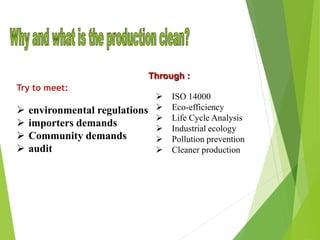
 environmental regulations
 importers demands
 Community demands
 audit
 ISO 14000
 Eco-efficiency
 Life Cycle Analysis
 Industrial ecology
 Pollution prevention
 Cleaner production
Try to meet:
Through :
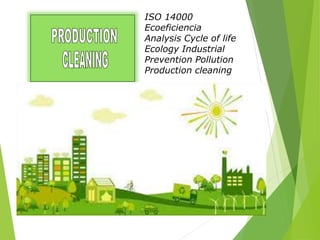
ISO 14000
Ecoeficiencia
Analysis Cycle of life
Ecology Industrial
Prevention Pollution
Production cleaning
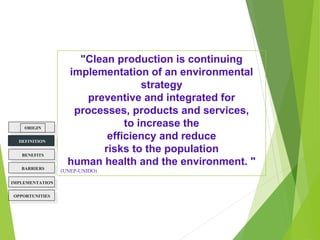
"Clean production is continuing
implementation of an environmental
strategy
preventive and integrated for
processes, products and services,
to increase the
efficiency and reduce
risks to the population
human health and the environment. "
(UNEP-UNIDO)
ORIGIN
BENEFITS
BARRIERS
DEFINITION
OPPORTUNITIES
IMPLEMENTATION
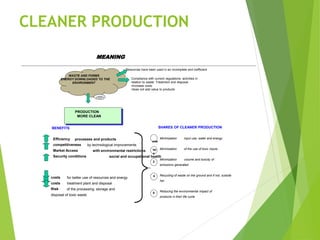
CLEANER PRODUCTION
Compliance with current regulations: activities in
relation to waste: Treatment and disposal
•increase costs
•does not add value to products
WASTE AND FORMS
ENERGY DOWNLOADED TO THE
ENVIRONMENT
PRODUCTION
MORE CLEAN
PRODUCTION
MORE CLEAN
Resources have been used in an incomplete and inefficient
Efficiency processes and products
competitiveness by technological improvements
Market Access with environmental restrictions
Security conditions social and occupational health
costs for better use of resources and energy
costs treatment plant and disposal
Risk of the processing, storage and
disposal of toxic waste
SHARES OF CLEANER PRODUCTION
Minimization input use, water and energy
Minimization of the use of toxic inputs
Minimization volume and toxicity of
emissions generated
Recycling of waste on the ground and if not, outside
her
Reducing the environmental impact of
products in their life cycle
5
4
3
tw
o
one
BENEFITS
MEANING
ORIGIN
BENEFITS
BARRIERS
DEFINITION
OPPORTUNITIES
IMPLEMENTATION
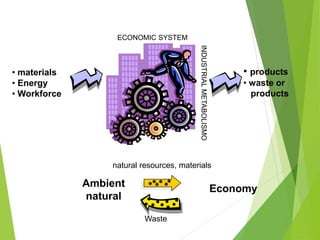
Ambient
natural
Economy
INDUSTRIALMETABOLISMO
• materials
• Energy
• Workforce
• products
• waste or
products
Waste
natural resources, materials
ECONOMIC SYSTEM
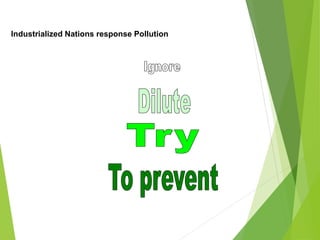
Industrialized Nations response Pollution
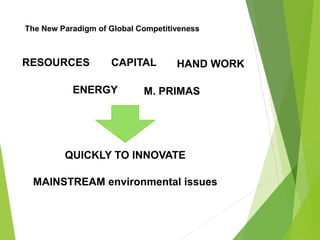
The New Paradigm of Global Competitiveness
RESOURCES CAPITAL HAND WORK
ENERGY M. PRIMAS
QUICKLY TO INNOVATE
MAINSTREAM environmental issues
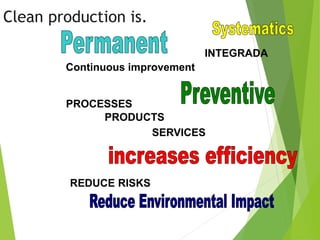
INTEGRADA
PROCESSES
PRODUCTS
SERVICES
REDUCE RISKS
Continuous improvement
Clean production is.
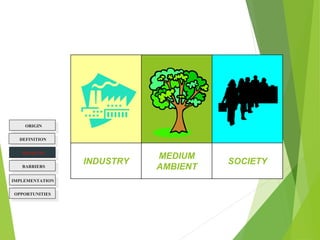
MEDIUM
AMBIENT
SOCIETYINDUSTRY
ORIGIN
BENEFITS
BARRIERS
DEFINITION
OPPORTUNITIES
IMPLEMENTATION
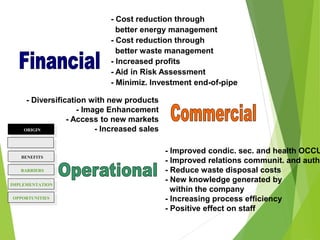
- Cost reduction through
better energy management
- Cost reduction through
better waste management
- Increased profits
- Aid in Risk Assessment
- Minimiz. Investment end-of-pipe
- Improved condic. sec. and health OCCU
- Improved relations communit. and autho
- Reduce waste disposal costs
- New knowledge generated by
within the company
- Increasing process efficiency
- Positive effect on staff
- Diversification with new products
- Image Enhancement
- Access to new markets
- Increased salesORIGIN
BENEFITS
BARRIERS
DEFINITION
OPPORTUNITIES
IMPLEMENTATION
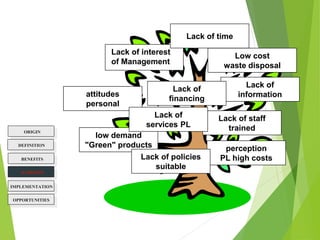
Lack of interest
of Management
attitudes
personal
low demand
"Green" products perception
PL high costs
Lack of staff
trained
Lack of
information
Low cost
waste disposal
Lack of time
Lack of
financing
Lack of
services PL
Lack of policies
suitable
ORIGIN
BENEFITS
BARRIERS
DEFINITION
OPPORTUNITIES
IMPLEMENTATION
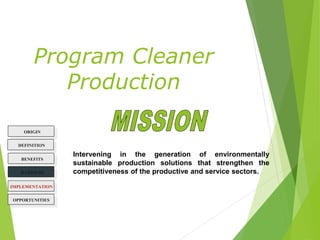
Intervening in the generation of environmentally
sustainable production solutions that strengthen the
competitiveness of the productive and service sectors.
Program Cleaner
Production
ORIGIN
BENEFITS
BARRIERS
DEFINITION
OPPORTUNITIES
IMPLEMENTATION
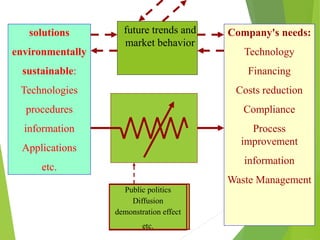
solutions
environmentally
sustainable:
Technologies
procedures
information
Applications
etc.
Company's needs:
Technology
Financing
Costs reduction
Compliance
Process
improvement
information
Waste Management
Public politics
Diffusion
demonstration effect
etc.
future trends and
market behavior
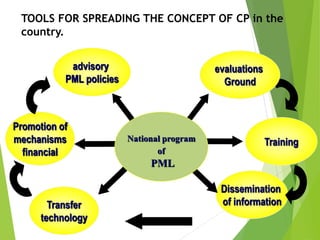
TOOLS FOR SPREADING THE CONCEPT OF CP in the
country.
Dissemination
of information
Training
evaluations
Ground
advisory
PML policies
Promotion of
mechanisms
financial
Transfer
technology
National program
of
PML
OPPORTUNITIES
 The implementation of Cleaner Production
programs is seen as an essential and indispensable
strategies for the competitiveness of domestic
business, especially with regard to global markets
element.
 In addition, cost is the most effective for
achieving the goals of environmental quality and
sustainable use of natural resources, which form
the basis of national environmental legislation,
and numerous international agreements signed by
the country option.
 64-00 law establishes a comprehensive framework
for the application of incentives to send that
"Investments to protect or improve the
environment and make sustainable use of natural
resources" hean incentive object, Including
"exemption, partial or total, taxes and import
duties, value added taxes, and shorter
depreciation periods".
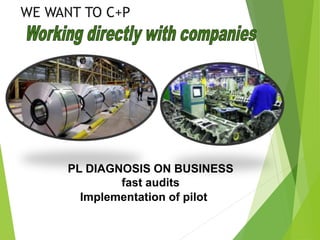
PL DIAGNOSIS ON BUSINESS
fast audits
Implementation of pilot
WE WANT TO C+P
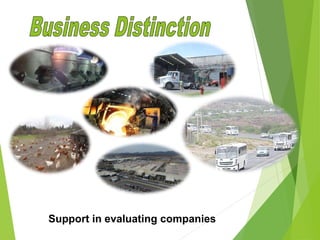
Support in evaluating companies
 Provide specific technical information products
 Provide training and training
 accredit consultants
 Provide basic technical assistance to companies
 Develop technical documents and tools
 support for
Challenges for Implementation
 1. Policy
It must be incorporated explicitly in Dominican State
policies related to support business competitiveness,
objectives and indicators associated with cleaner
production.
This policy must be expressed in an institutional
framework to support a National Cleaner Production
Program.
 two.- Legal framework
Although our law dates only from 2000, it was developed
considering models that emphasize command and control
mechanisms.
You need to develop simpler and better adapted to
preventive model of clean production regulatory
instruments and procedures.
 3.- incentives
The general mandate given by the Act must be translated
into concrete instruments consistent with public policy
development and fiscal goals of the state.
In addition, it is necessary to develop instruments to
stimulate research and development of cleaner
technologies and processes, private investment in
productive modernization and training.
 4. Education and awareness
 Foster a cultural change, both at the producer and
consumer.
 Development of outreach and awareness campaigns at
all levels of Dominican society.
 Promote the systematization and dissemination of
successful experiences, both national and
international, and exchange of information.
 5. Capabilities.
 Human Resources.
 Technological resources.
 Financial resources.
 public-private cooperation.
 International support.
 institutional strengthening for support and monitoring.
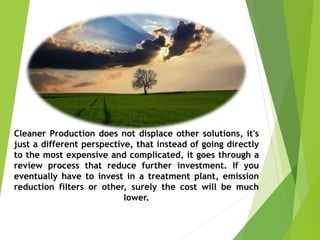
Cleaner Production does not displace other solutions, it's
just a different perspective, that instead of going directly
to the most expensive and complicated, it goes through a
review process that reduce further investment. If you
eventually have to invest in a treatment plant, emission
reduction filters or other, surely the cost will be much
lower.
Nacional, S. (2019). Producción más Limpia. Retrieved from
http://www.cmpl.ipn.mx/produccionmaslimpia/Paginas/Produc
cion.aspx
Producción más Limpia. (2017). Retrieved from
http://www.gds.uson.mx/pl/
Cleaner Production - an overview | ScienceDirect Topics. (2019).
Retrieved from https://www.sciencedirect.com/topics/earth-and-
planetary-sciences/cleaner-production
Cleaner Production. (2018). Retrieved from
http://www.oas.org/usde/fida/cleaner.htm
National Cleaner Production Centres (NCPCs) & Networks | UNIDO.
(2019). Retrieved from https://www.unido.org/our-focus/cross-cutting-
services/partnerships-prosperity/networks-centres-forums-and-
platforms/national-cleaner-production-centres-ncpcs-networks
Sustainability Concepts: Cleaner Production. (2019).
Retrieved from http://www.gdrc.org/sustdev/concepts/02-c-
prod.html

Cleaner Production

  • 1.
  • 2.
    Cleaner Production concept Cleaner Productionis a strategy for environmental and business management, applicable to both products and processes. It aims at the efficient use of raw materials, reducing emissions, wastewater discharge, reduced risks to human health and the environment, simultaneously raising the efficiency and profitability of companies. CP represents for businesses, particularly for those who are unable to make large investments in new technologies, grow and at the same time comply with national environmental requirements and standards governing international markets.
  • 3.
    Production more cleaning Seeks the development and involvement of the industrial sector regulatory framework to encourage and facilitate cleaner production.  Tries to implement national actions to achieve international support to strengthen the technical and financial support for the implementation of cleaner production in the country.  Seeks to develop incentive instrument cleaner production with the support of the Dominican State, creating the National Cleaner Production Award and leave in place a national eco-label on an industrial level to ensure the competitiveness of our products.  Create the method of certification cleaner production in the Dominican companies and seeks to develop a professional technical program on the subject of cleaner production in universities and technical training centers.  Creates the National Cleaner Production Network, to encourage companies to by implementing CP occupational risks and at the same time establishes a register of qualified service delivery in cleaner production consultants are reduced.
  • 5.
     environmental regulations importers demands  Community demands  audit  ISO 14000  Eco-efficiency  Life Cycle Analysis  Industrial ecology  Pollution prevention  Cleaner production Try to meet: Through :
  • 6.
    ISO 14000 Ecoeficiencia Analysis Cycleof life Ecology Industrial Prevention Pollution Production cleaning
  • 7.
    "Clean production iscontinuing implementation of an environmental strategy preventive and integrated for processes, products and services, to increase the efficiency and reduce risks to the population human health and the environment. " (UNEP-UNIDO) ORIGIN BENEFITS BARRIERS DEFINITION OPPORTUNITIES IMPLEMENTATION
  • 8.
    CLEANER PRODUCTION Compliance withcurrent regulations: activities in relation to waste: Treatment and disposal •increase costs •does not add value to products WASTE AND FORMS ENERGY DOWNLOADED TO THE ENVIRONMENT PRODUCTION MORE CLEAN PRODUCTION MORE CLEAN Resources have been used in an incomplete and inefficient Efficiency processes and products competitiveness by technological improvements Market Access with environmental restrictions Security conditions social and occupational health costs for better use of resources and energy costs treatment plant and disposal Risk of the processing, storage and disposal of toxic waste SHARES OF CLEANER PRODUCTION Minimization input use, water and energy Minimization of the use of toxic inputs Minimization volume and toxicity of emissions generated Recycling of waste on the ground and if not, outside her Reducing the environmental impact of products in their life cycle 5 4 3 tw o one BENEFITS MEANING
  • 9.
  • 10.
    Ambient natural Economy INDUSTRIALMETABOLISMO • materials • Energy •Workforce • products • waste or products Waste natural resources, materials ECONOMIC SYSTEM
  • 11.
  • 12.
    The New Paradigmof Global Competitiveness RESOURCES CAPITAL HAND WORK ENERGY M. PRIMAS QUICKLY TO INNOVATE MAINSTREAM environmental issues
  • 13.
  • 15.
  • 16.
    - Cost reductionthrough better energy management - Cost reduction through better waste management - Increased profits - Aid in Risk Assessment - Minimiz. Investment end-of-pipe - Improved condic. sec. and health OCCU - Improved relations communit. and autho - Reduce waste disposal costs - New knowledge generated by within the company - Increasing process efficiency - Positive effect on staff - Diversification with new products - Image Enhancement - Access to new markets - Increased salesORIGIN BENEFITS BARRIERS DEFINITION OPPORTUNITIES IMPLEMENTATION
  • 17.
    Lack of interest ofManagement attitudes personal low demand "Green" products perception PL high costs Lack of staff trained Lack of information Low cost waste disposal Lack of time Lack of financing Lack of services PL Lack of policies suitable ORIGIN BENEFITS BARRIERS DEFINITION OPPORTUNITIES IMPLEMENTATION
  • 18.
    Intervening in thegeneration of environmentally sustainable production solutions that strengthen the competitiveness of the productive and service sectors. Program Cleaner Production ORIGIN BENEFITS BARRIERS DEFINITION OPPORTUNITIES IMPLEMENTATION
  • 19.
  • 20.
    TOOLS FOR SPREADINGTHE CONCEPT OF CP in the country. Dissemination of information Training evaluations Ground advisory PML policies Promotion of mechanisms financial Transfer technology National program of PML
  • 21.
    OPPORTUNITIES  The implementationof Cleaner Production programs is seen as an essential and indispensable strategies for the competitiveness of domestic business, especially with regard to global markets element.  In addition, cost is the most effective for achieving the goals of environmental quality and sustainable use of natural resources, which form the basis of national environmental legislation, and numerous international agreements signed by the country option.  64-00 law establishes a comprehensive framework for the application of incentives to send that "Investments to protect or improve the environment and make sustainable use of natural resources" hean incentive object, Including "exemption, partial or total, taxes and import duties, value added taxes, and shorter depreciation periods".
  • 22.
    PL DIAGNOSIS ONBUSINESS fast audits Implementation of pilot WE WANT TO C+P
  • 23.
  • 24.
     Provide specifictechnical information products  Provide training and training  accredit consultants  Provide basic technical assistance to companies  Develop technical documents and tools  support for
  • 25.
    Challenges for Implementation 1. Policy It must be incorporated explicitly in Dominican State policies related to support business competitiveness, objectives and indicators associated with cleaner production. This policy must be expressed in an institutional framework to support a National Cleaner Production Program.
  • 26.
     two.- Legalframework Although our law dates only from 2000, it was developed considering models that emphasize command and control mechanisms. You need to develop simpler and better adapted to preventive model of clean production regulatory instruments and procedures.  3.- incentives The general mandate given by the Act must be translated into concrete instruments consistent with public policy development and fiscal goals of the state. In addition, it is necessary to develop instruments to stimulate research and development of cleaner technologies and processes, private investment in productive modernization and training.
  • 27.
     4. Educationand awareness  Foster a cultural change, both at the producer and consumer.  Development of outreach and awareness campaigns at all levels of Dominican society.  Promote the systematization and dissemination of successful experiences, both national and international, and exchange of information.  5. Capabilities.  Human Resources.  Technological resources.  Financial resources.  public-private cooperation.  International support.  institutional strengthening for support and monitoring.
  • 28.
    Cleaner Production doesnot displace other solutions, it's just a different perspective, that instead of going directly to the most expensive and complicated, it goes through a review process that reduce further investment. If you eventually have to invest in a treatment plant, emission reduction filters or other, surely the cost will be much lower.
  • 30.
    Nacional, S. (2019).Producción más Limpia. Retrieved from http://www.cmpl.ipn.mx/produccionmaslimpia/Paginas/Produc cion.aspx Producción más Limpia. (2017). Retrieved from http://www.gds.uson.mx/pl/ Cleaner Production - an overview | ScienceDirect Topics. (2019). Retrieved from https://www.sciencedirect.com/topics/earth-and- planetary-sciences/cleaner-production Cleaner Production. (2018). Retrieved from http://www.oas.org/usde/fida/cleaner.htm National Cleaner Production Centres (NCPCs) & Networks | UNIDO. (2019). Retrieved from https://www.unido.org/our-focus/cross-cutting- services/partnerships-prosperity/networks-centres-forums-and- platforms/national-cleaner-production-centres-ncpcs-networks Sustainability Concepts: Cleaner Production. (2019). Retrieved from http://www.gdrc.org/sustdev/concepts/02-c- prod.html