Uniting agriculture and nature for poverty reduction
Climate change impacts on water quantity and quality:
Implications for agriculture
Claudia Ringler, IFPRI
(with Tingju Zhu, Hua Xie & Mark Rosegrant and
the IMPACT Food model team)
Water Policy for Food Security
UC Davis, October 5-6
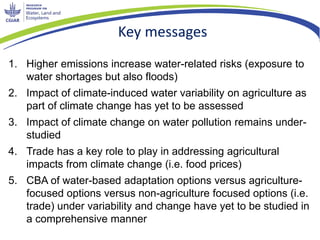
1. Higher emissions increase water-related risks (exposure to
water shortages but also floods)
2. Impact of climate-induced water variability on agriculture as
part of climate change has yet to be assessed
3. Impact of climate change on water pollution remains under-
studied
4. Trade has a key role to play in addressing agricultural
impacts from climate change (i.e. food prices)
5. CBA of water-based adaptation options versus agriculture-
focused options versus non-agriculture focused options (i.e.
trade) under variability and change have yet to be studied in
a comprehensive manner
Key messages
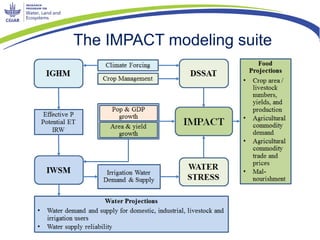
The IMPACT modeling suite
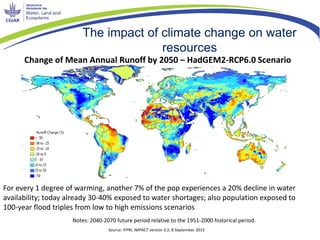
Change of Mean Annual Runoff by 2050 – HadGEM2-RCP6.0 Scenario
Notes: 2040-2070 future period relative to the 1951-2000 historical period.
The impact of climate change on water
resources
Source: IFPRI, IMPACT version 3.2, 8 September 2015
For every 1 degree of warming, another 7% of the pop experiences a 20% decline in water
availability; today already 30-40% exposed to water shortages; also population exposed to
100-year flood triples from low to high emissions scenarios
0.58
0.6
0.62
0.64
0.66
0.68
0.7
0.72
0.74
0.76
0.78
2000 2030 2050
base
CSI_a1
CSI_b1
MIR_a1
MIR_b1
0.5
0.6
0.7
0.8
0.9
1
2000 2030 2050
NAE
0.5
0.6
0.7
0.8
0.9
1
2000 2030 2050
ESAP
0.5
0.6
0.7
0.8
0.9
1
2000 2030 2050
SSA
0.5
0.6
0.7
0.8
0.9
1
2000 2030 2050
CWANA
World Average
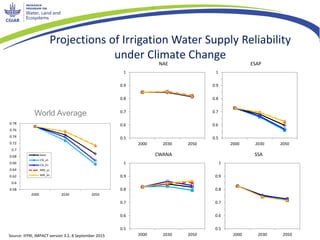
Projections of Irrigation Water Supply Reliability
under Climate Change
Source: IFPRI, IMPACT version 3.2, 8 September 2015
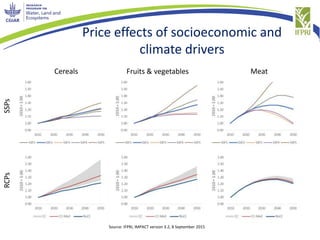
Price effects of socioeconomic and
climate drivers
Source: IFPRI, IMPACT version 3.2, 8 September 2015
Cereals Fruits & vegetables Meat
SSPsRCPs
Yield effects of climate change, by region (SSP2)
Source: IFPRI, IMPACT version 3.2, 8 September 2015
Cereals Maize
Wheat
WLD = World; EAP = East Asia and Pacific; EUR = Europe; FSU = Former Soviet Union; LAC = Latin America and Caribbean;
MEN = Middle East and North Africa; NAM = North America; SAS = South Asia; SSA = Sub-Saharan Africa;
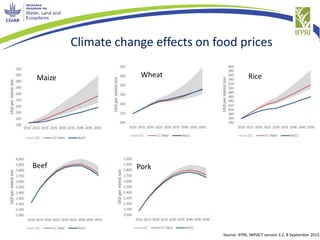
Climate change effects on food prices
Source: IFPRI, IMPACT version 3.2, 8 September 2015
Maize Wheat Rice
Beef Pork
DVG = Developing Countries; EAP = East Asia and Pacific; SAS = South Asia; FSU = Former Soviet Union;
MEN = Middle East and North Africa; SSA = Sub-Saharan Africa; LAC = Latin America and Caribbean; NAM: North America
Source: IFPRI, IMPACT version 3.2, 8 September 2015
Rice
Wheat
Maize
Impact of CC
on net cereal
trade (SSP2,
RCP 8.5)
Population at risk of hunger (SSP2, RCP8.5)
Source: IFPRI, IMPACT version 3.2, 8 September 2015
EAP = East Asia and Pacific; SAS = South Asia; FSU = Former Soviet Union;
MEN = Middle East and North Africa; SSA = Sub-Saharan Africa; LAC = Latin America and Caribbean
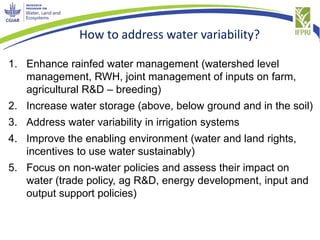
How to address water variability?
1. Enhance rainfed water management (watershed level
management, RWH, joint management of inputs on farm,
agricultural R&D – breeding)
2. Increase water storage (above, below ground and in the soil)
3. Address water variability in irrigation systems
4. Improve the enabling environment (water and land rights,
incentives to use water sustainably)
5. Focus on non-water policies and assess their impact on
water (trade policy, ag R&D, energy development, input and
output support policies)
Uniting agriculture and nature for poverty reduction
GlobalProduction andPriceEffects
ofRemovingEconomicWaterScarcitythroughInfrastructureInvestment
 Simulated 2010 production and
prices under baseline and
infrastructure scenario
 INFRA: adequate investment in
surface water infrastructure
 INFRA retains GW withdrawal
limits
 In SSA, irrigated maize yield
increases by 32% on average,
and more in bad years, under
INFRA
 Probability that rice price could
exceed US$400 reduced from
21% to 0.7%
Source: Sadoff et al. (2015)
0
100
200
300
400
500
600
Maize Rice Wheat
2005 No-CC 2050 CC 2050 CC INFRA 2050
INFRA – 2050 w/o VAR: Food prices
(US$/mt, SSP2, RCP6.0)
Source: IFPRI, IMPACT version 3.2, 8 September 2015
0
20
40
60
80
100
120
140
East Asia South Asia SSA LAC MENA
No-CC 2050 CC 2050 CC INFRA 2050
INFRA 2050 w/o Var: Population at risk of
hunger (millions, SSP2, RCP6.0)
Source: IFPRI, IMPACT version 3.2, 8 September 2015
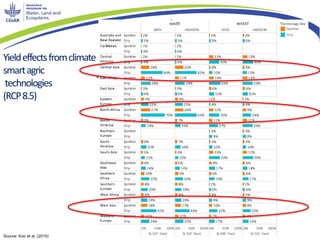
Yieldeffectsfromclimate
smartagric
technologies
(RCP8.5)
Source: Koo et al. (2015)
Uniting agriculture and nature for poverty reduction
Climate change impacts and trade
Impacts of climate change and trade policy on yields, area, production, exports and prices of five
commodities, (% deviation from baseline values in 2050 without climate change)
SSP1, RCP4.5 SSP3, RCP8.5
Source: Wiebe et al. (ERL 2015)
Impact of growing water pollution
Source: IFPRI-Veolia (2015).
Estimated global loadings of BOD, N
and P in base period (2000-2005)
Source: IFPRI-Veolia (2015).
(a) BOD (b) Nitrogen (N)
(c) Phosphorus (P)
Loading
(million ton/yr)
Population at risk
BOD 209 1 in 8 people or 651 million
N 131 1 in 6 people or 973 million
P 10 1 in 4 people or 1,287 million
CSIRO-
medium
CSIRO-
optimistic
CSIRO-
pessimistic
MIROC-
medium
MIROC-
optimistic
MIROC-
pessimistic
Population in 2050 9.3 billion 8.1 billion 10.6 billion 9.3 billion 8.1 billion 10.6 billion
Annual, average
rate of GDP growth 3.2% 3.6% 1.9% 3.2% 3.6% 1.9%
Crop harv. area +17.5% +14.7% 18.4% +20.0% +17.2% 20.9%
Crop nutrient use
efficiency +20% +40% No change +20% +40% No change
Livestock numbers +26% +28% +14% +25% +27% +16%
Improvement in
municipal
wastewater
treatment levels
+15% +30% No change +15% +30% No change
Socioeconomic development and climate
change scenarios ─ AR4 2050
Source: IFPRI-Veolia (2015).
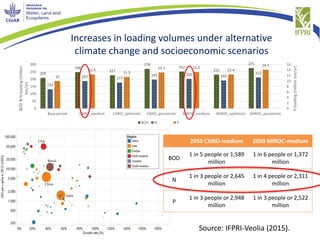
Increases in loading volumes under alternative
climate change and socioeconomic scenarios
Source: IFPRI-Veolia (2015).
209
248
227
270
252
231
275
131
187 177
197 202 191
212
10
12.4
11.5
13.1 13.3
12.4
14.1
0
2
4
6
8
10
12
14
16
0
50
100
150
200
250
300
Base period CSIRO_medium CSIRO_optimistic CSIRO_pessimistic MIROC_medium MIROC_optimistic MIROC_pessimistic
Ploading(millionton/yr)
BOD&Nloading(million
ton/yr)
BOD N Pad4 P
USA
Brazil
China
India
2050 CSIRO-medium 2050 MIROC-medium
BOD
1 in 5 people or 1,589
million
1 in 6 people or 1,372
million
N
1 in 3 people or 2,645
million
1 in 4 people or 2,311
million
P
1 in 3 people or 2,948
million
1 in 3 people or 2,522
million
Source: IFPRI-Veolia (2015).
How to address water degradation?
For consumers, cities and industrial sectors, solutions include:
1) More aggressive investment in wastewater treatment
2) Adoption of innovative and alternative approaches, such as the use of Green Infrastructure
3) Improved home and industrial design to minimize pollution
4) Enhanced management of stormwater runoff to avoid contamination of treated water supplies
5) Close nutrient cycles: Recovery of effluents and sewage and safe reuse in agriculture
For the agricultural sector:
1) Enhanced nutrient use efficiency
2) Phased out fertilizer subsidies
3) No-till or reduced tillage and other conservation measures
4) Manure management
Cross-sectoral measures:
1) Water quality trading
2) Increased implementation of the polluter-pays-principle
3) Enhanced monitoring of both point and non-point sources
4) Enforcement of existing regulations on water pollution
1. Climate change increases a host of water and related
impacts: wetter wet seasons and drier dry seasons;
increased crop water demand; increased reliance on storage
2. Climate smart practices can increase or reduce adverse
water [energy] impacts (neg: biofuel development; pos:
manure management)
3. Water-based [storage/drip]; water-related [nitrogen-use
efficiency, no till, DT/HT, reforestation, WUAs, water
markets]; non-water measures [trade, pop/econ growth, ag
input and output support policies, PHL] are all important
pieces in addressing growing water variability, shortages and
degradation
Concluding thoughts

Claudia Ringler, IFPRI

  • 1.
    Uniting agriculture andnature for poverty reduction Climate change impacts on water quantity and quality: Implications for agriculture Claudia Ringler, IFPRI (with Tingju Zhu, Hua Xie & Mark Rosegrant and the IMPACT Food model team) Water Policy for Food Security UC Davis, October 5-6
  • 2.
    1. Higher emissionsincrease water-related risks (exposure to water shortages but also floods) 2. Impact of climate-induced water variability on agriculture as part of climate change has yet to be assessed 3. Impact of climate change on water pollution remains under- studied 4. Trade has a key role to play in addressing agricultural impacts from climate change (i.e. food prices) 5. CBA of water-based adaptation options versus agriculture- focused options versus non-agriculture focused options (i.e. trade) under variability and change have yet to be studied in a comprehensive manner Key messages
  • 3.
  • 4.
    Change of MeanAnnual Runoff by 2050 – HadGEM2-RCP6.0 Scenario Notes: 2040-2070 future period relative to the 1951-2000 historical period. The impact of climate change on water resources Source: IFPRI, IMPACT version 3.2, 8 September 2015 For every 1 degree of warming, another 7% of the pop experiences a 20% decline in water availability; today already 30-40% exposed to water shortages; also population exposed to 100-year flood triples from low to high emissions scenarios
  • 5.
    0.58 0.6 0.62 0.64 0.66 0.68 0.7 0.72 0.74 0.76 0.78 2000 2030 2050 base CSI_a1 CSI_b1 MIR_a1 MIR_b1 0.5 0.6 0.7 0.8 0.9 1 20002030 2050 NAE 0.5 0.6 0.7 0.8 0.9 1 2000 2030 2050 ESAP 0.5 0.6 0.7 0.8 0.9 1 2000 2030 2050 SSA 0.5 0.6 0.7 0.8 0.9 1 2000 2030 2050 CWANA World Average Projections of Irrigation Water Supply Reliability under Climate Change Source: IFPRI, IMPACT version 3.2, 8 September 2015
  • 6.
    Price effects ofsocioeconomic and climate drivers Source: IFPRI, IMPACT version 3.2, 8 September 2015 Cereals Fruits & vegetables Meat SSPsRCPs
  • 7.
    Yield effects ofclimate change, by region (SSP2) Source: IFPRI, IMPACT version 3.2, 8 September 2015 Cereals Maize Wheat WLD = World; EAP = East Asia and Pacific; EUR = Europe; FSU = Former Soviet Union; LAC = Latin America and Caribbean; MEN = Middle East and North Africa; NAM = North America; SAS = South Asia; SSA = Sub-Saharan Africa;
  • 8.
    Climate change effectson food prices Source: IFPRI, IMPACT version 3.2, 8 September 2015 Maize Wheat Rice Beef Pork
  • 9.
    DVG = DevelopingCountries; EAP = East Asia and Pacific; SAS = South Asia; FSU = Former Soviet Union; MEN = Middle East and North Africa; SSA = Sub-Saharan Africa; LAC = Latin America and Caribbean; NAM: North America Source: IFPRI, IMPACT version 3.2, 8 September 2015 Rice Wheat Maize Impact of CC on net cereal trade (SSP2, RCP 8.5)
  • 10.
    Population at riskof hunger (SSP2, RCP8.5) Source: IFPRI, IMPACT version 3.2, 8 September 2015 EAP = East Asia and Pacific; SAS = South Asia; FSU = Former Soviet Union; MEN = Middle East and North Africa; SSA = Sub-Saharan Africa; LAC = Latin America and Caribbean
  • 11.
    How to addresswater variability? 1. Enhance rainfed water management (watershed level management, RWH, joint management of inputs on farm, agricultural R&D – breeding) 2. Increase water storage (above, below ground and in the soil) 3. Address water variability in irrigation systems 4. Improve the enabling environment (water and land rights, incentives to use water sustainably) 5. Focus on non-water policies and assess their impact on water (trade policy, ag R&D, energy development, input and output support policies)
  • 12.
    Uniting agriculture andnature for poverty reduction GlobalProduction andPriceEffects ofRemovingEconomicWaterScarcitythroughInfrastructureInvestment  Simulated 2010 production and prices under baseline and infrastructure scenario  INFRA: adequate investment in surface water infrastructure  INFRA retains GW withdrawal limits  In SSA, irrigated maize yield increases by 32% on average, and more in bad years, under INFRA  Probability that rice price could exceed US$400 reduced from 21% to 0.7% Source: Sadoff et al. (2015)
  • 13.
    0 100 200 300 400 500 600 Maize Rice Wheat 2005No-CC 2050 CC 2050 CC INFRA 2050 INFRA – 2050 w/o VAR: Food prices (US$/mt, SSP2, RCP6.0) Source: IFPRI, IMPACT version 3.2, 8 September 2015
  • 14.
    0 20 40 60 80 100 120 140 East Asia SouthAsia SSA LAC MENA No-CC 2050 CC 2050 CC INFRA 2050 INFRA 2050 w/o Var: Population at risk of hunger (millions, SSP2, RCP6.0) Source: IFPRI, IMPACT version 3.2, 8 September 2015
  • 15.
  • 16.
    Uniting agriculture andnature for poverty reduction Climate change impacts and trade Impacts of climate change and trade policy on yields, area, production, exports and prices of five commodities, (% deviation from baseline values in 2050 without climate change) SSP1, RCP4.5 SSP3, RCP8.5 Source: Wiebe et al. (ERL 2015)
  • 17.
    Impact of growingwater pollution Source: IFPRI-Veolia (2015).
  • 18.
    Estimated global loadingsof BOD, N and P in base period (2000-2005) Source: IFPRI-Veolia (2015). (a) BOD (b) Nitrogen (N) (c) Phosphorus (P) Loading (million ton/yr) Population at risk BOD 209 1 in 8 people or 651 million N 131 1 in 6 people or 973 million P 10 1 in 4 people or 1,287 million
  • 19.
    CSIRO- medium CSIRO- optimistic CSIRO- pessimistic MIROC- medium MIROC- optimistic MIROC- pessimistic Population in 20509.3 billion 8.1 billion 10.6 billion 9.3 billion 8.1 billion 10.6 billion Annual, average rate of GDP growth 3.2% 3.6% 1.9% 3.2% 3.6% 1.9% Crop harv. area +17.5% +14.7% 18.4% +20.0% +17.2% 20.9% Crop nutrient use efficiency +20% +40% No change +20% +40% No change Livestock numbers +26% +28% +14% +25% +27% +16% Improvement in municipal wastewater treatment levels +15% +30% No change +15% +30% No change Socioeconomic development and climate change scenarios ─ AR4 2050 Source: IFPRI-Veolia (2015).
  • 20.
    Increases in loadingvolumes under alternative climate change and socioeconomic scenarios Source: IFPRI-Veolia (2015). 209 248 227 270 252 231 275 131 187 177 197 202 191 212 10 12.4 11.5 13.1 13.3 12.4 14.1 0 2 4 6 8 10 12 14 16 0 50 100 150 200 250 300 Base period CSIRO_medium CSIRO_optimistic CSIRO_pessimistic MIROC_medium MIROC_optimistic MIROC_pessimistic Ploading(millionton/yr) BOD&Nloading(million ton/yr) BOD N Pad4 P USA Brazil China India 2050 CSIRO-medium 2050 MIROC-medium BOD 1 in 5 people or 1,589 million 1 in 6 people or 1,372 million N 1 in 3 people or 2,645 million 1 in 4 people or 2,311 million P 1 in 3 people or 2,948 million 1 in 3 people or 2,522 million
  • 21.
    Source: IFPRI-Veolia (2015). Howto address water degradation? For consumers, cities and industrial sectors, solutions include: 1) More aggressive investment in wastewater treatment 2) Adoption of innovative and alternative approaches, such as the use of Green Infrastructure 3) Improved home and industrial design to minimize pollution 4) Enhanced management of stormwater runoff to avoid contamination of treated water supplies 5) Close nutrient cycles: Recovery of effluents and sewage and safe reuse in agriculture For the agricultural sector: 1) Enhanced nutrient use efficiency 2) Phased out fertilizer subsidies 3) No-till or reduced tillage and other conservation measures 4) Manure management Cross-sectoral measures: 1) Water quality trading 2) Increased implementation of the polluter-pays-principle 3) Enhanced monitoring of both point and non-point sources 4) Enforcement of existing regulations on water pollution
  • 22.
    1. Climate changeincreases a host of water and related impacts: wetter wet seasons and drier dry seasons; increased crop water demand; increased reliance on storage 2. Climate smart practices can increase or reduce adverse water [energy] impacts (neg: biofuel development; pos: manure management) 3. Water-based [storage/drip]; water-related [nitrogen-use efficiency, no till, DT/HT, reforestation, WUAs, water markets]; non-water measures [trade, pop/econ growth, ag input and output support policies, PHL] are all important pieces in addressing growing water variability, shortages and degradation Concluding thoughts

Editor's Notes

  • #4 With this integrated modeling suite, we can generate forecasts to 2050 and beyond on Crop area, yield, and production Demand for specific agricultural commodities Prices and trade volumes for specific agricultural commodities Levels of poverty, hunger, and malnutrition