
INTERNATIONAL FOOD POLICY
            RESE ARCH INSTITUTE
            sustainable solutions for ending hunger and poverty

IFPRI   ®
            Supported by the CGIAR


                                                                                          June 2011


                HOW CAN AFRICAN
            AGRICULTURE ADAPT TO
                 CLIMATE CHANGE?
 INSIGHTS FROM ETHIOPIA AND SOUTH AFRICA


            Edited by Claudia Ringler, Elizabeth Bryan, Rashid M. Hassan,
                                       Tekie Alemu, and Marya Hillesland


                                                                  Research Brief Series   15
Introduction

During the coming decades, global change will impact food and water security in significant but highly uncertain ways.
There are strong indications that developing countries will bear the brunt of the consequences, particularly from climate
change. In Sub-Saharan Africa, agriculture—the mainstay of rural livelihoods—is particularly vulnerable to the adverse
impacts of climate change, and the adaptive capacity of rural smallholders is extremely low. Consequently, it is important
to understand the impacts of global change on agriculture and natural resources in Sub-Saharan Africa and to identify
informed and effective adaptation measures and investment priorities to alleviate the harmful impacts of global change.

This set of briefs assesses these issues with a focus on the Nile Basin in Ethiopia and the Limpopo Basin in South Africa.
Authors identify climate change impacts on agricultural productivity and food production; assess the vulnerability of the
farming sector and farm households to climate variability and change; examine climate change perceptions; and suggest
adaptation strategies at the farm, basin, and national levels alongside the associated investments needed to implement
such strategies.

We are grateful to the authors for their research and analyses, to the reviewers for their constructive comments, and to
Mary Jane Banks and Ashley St. Thomas for their editorial assistance. We gratefully acknowledge financial support from
the Federal Ministry for Economic Cooperation and Development, Germany. We hope that the insights on climate
change impacts and adaptation options presented here will contribute to policy changes that profoundly increase the
capacity of the rural poor in Sub-Saharan Africa to adapt to climate change.

Claudia Ringler                                                Tekie Alemu
Senior Research Fellow, International Food Policy              Dean, School of Economics, Addis Ababa University,
Research Institute, Washington, DC                             Ethiopia
Elizabeth Bryan                                                Marya Hillesland
Research Analyst, International Food Policy Research           PhD candidate, American University, Washington, DC
Institute, Washington, DC
Rashid M. Hassan
Director, Centre for Environmental Economics and Policy
in Africa, University of Pretoria, South Africa


              International Food Policy Research Institute     Copyright © 2011 International Food Policy Research Institute. All
              2033 K Street, NW                                rights reserved. For permission to republish, contact ifpri-copy-
              Washington, DC 20006-1002 USA                    right@cgiar.org.
              Phone: +1-202-862-5600                           These research briefs are based on previously reviewed material. Any
              Fax: +1-202-467-4439                             opinions stated herein are those of the authors and do not necessar-
              Email: ifpri@cgiar.org                           ily reflect the policies or opinions of IFPRI.
              Skype: ifprihomeoffice

www.ifpri.org
INTERNATIONAL FOOD
                POLICY RESEARCH INSTITUTE
                sustainable solutions for ending hunger and poverty

                Supported by the CGIAR


                                                                                                                     IFPRI Research Brief              15–1
HOW CAN AFRICAN AGRICULTURE ADAPT TO CLIMATE CHANGE? INSIGHTS FROM ETHIOPIA AND SOUTH AFRICA

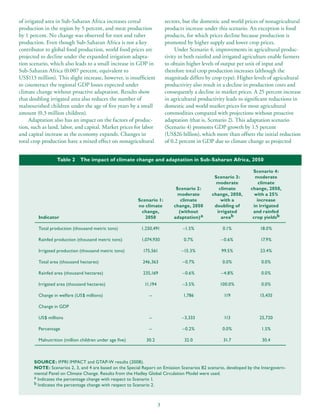
the impact of climate variability and climate change
on water and Food Outcomes
A Framework for Analysis
Claudia Ringler


O      ver the coming decades, global change will have an impact
       on food and water security in significant and highly uncer-
tain ways, and there are strong indications that developing countries
                                                                         security must take into account relevant hydrologic, agronomic,
                                                                         economic, social, and environmental processes at global, regional,
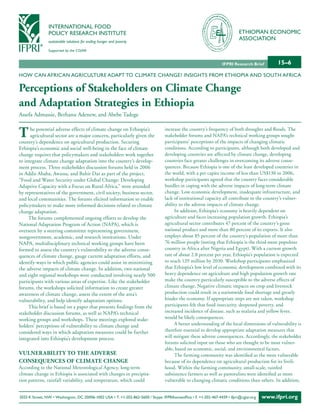
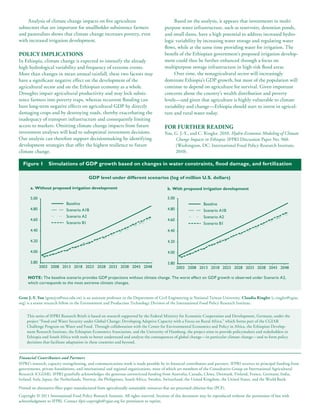
                                                                         national, basin, and local levels (Figure 1). This could be done
will bear the brunt of the adverse consequences, particularly from       following the paradigm of “strategic cyclical scaling” devised by
climate change. This is largely because poverty levels are high, and     Root and Schneider (see further reading), which incorporates
developing-country capacity to adapt to global change is weak.           large- and small-scale research studies to improve our under-
Furthermore, the rural populations of developing countries—for           standing of complex environmental systems and allow more reliable
whom agricultural production is the primary source of direct and         projections of the ecological, economic, and social consequences of
indirect employment and income—will be most affected due                 global change. Process-based, bottom-up relationships are used to
agriculture’s vulnerability to global change processes. The agricul-     predict larger scale behavior, which is then tested against large-scale
tural sector is the largest consumer of water resources, and             data for a top-down evaluation. Cycling between large and small
variability in water supply has a major influence on health and          scales should thus produce more credible overall results.
welfare in poor areas. With water scarcity and extreme weather
events expected to increase under climate change, water security      Figure 1 Global change, Spatial Scales, and Adaptation Strategies
could decline significantly in rural areas. Consequently, it is
important to understand the impacts of global change (in terms                                                                 Farm level
                                                                            Climate       • Crop and livestock selection
of climate, demography, technology, and so on) on agriculture               change        • Cropping and grazing patterns
and natural resources in developing countries and to develop                              • Irrigation/watering technology
adaptive capacity to respond to these impacts. Moreover, there is                                                              Basin level
                                                                           Extreme        • Water allocation policy
a need to develop informed and effective adaptation measures               weather        • Infrastructure investment
and investment options that can be taken now to alleviate                   events        • Land use change
adverse impacts of global change in the future.                                                                               National level
                                                                                                     • Agriculture and water price policies
                                                                                  Demographic        • Investment, subsidy, and tax policies
FramewOrk FOr analysis                                                              change           • Trade policies
                                                                                                                                                Regional level
While food and water security are largely determined by actions
                                                                                                     • Regional trade policies
taken at the local or national levels, global factors—such as
                                                                                     Conflict        • Global climate policies
world food trade, global climate and climate change, and                            and crises       • Global trading patterns                  Global level
competition for water—also affect food and water security
locally. Moreover, human alteration of land use patterns,
                                                                                GLOBAL CHANGE               ADAPTATION STRATEGIES              SPATIAL SCALES
urbanization, elimination of wetlands, nutrient overloading in
water systems, and other biophysical changes could dramatically                SouRce: C. Ringler, The impact of climate variability and climate change on
affect the ability of the global water cycle to support needed food            water and food outcomes: A framework for analysis, in C. van Bers, D. Petry,
production. The development of policies that mitigate adverse                  and C. Pahl-Wostl, eds., Global assessments: Bridging scales and linking to policy,
                                                                               GWSP Issues in Global Water System Research No. 2, http://www.gwsp.org/
impacts, enhance positive impacts, and support adaptation to                   downloads/gwsp_issues_no2.pdf, 2007.
climate and global change, together with enhancing local food
and water security, therefore requires an understanding of the
interactions among local, basin-level, national, and global factors.              research activities
     Thus, analysis of strategies for increased food and water                    A project supported by Germany’s Federal Ministry for Economic
                                                                                  Cooperation and Development, entitled “Food and Water Security


2033 K Street, NW • Washington, DC 20006-1002 USA • T. +1-202-862-5600 / Skype: IFPRIhomeoffice • F. +1-202-467-4439 • ifpri@cgiar.org         www.ifpri.org
under Global Change: Developing Adaptive Capacity with a                                        These sets of analyses were complemented with papers on the
Focus on Rural Africa,” has conducted research on adaptation to                            role of climate change mitigation for the region, the importance of
climate change at various scales. This project, which is associated                        taking risk into account in devising adaptation options, and the role
with the Challenge Program on Water and Food under the                                     of collective action and property rights in community adaptation.
Consultative Group on International Agricultural Research                                  The outcomes of the analyses can be used to guide appropriate
(CGIAR), involved close collaboration with researchers at the                              response options to reduce rural vulnerability to global change.
Center for Environmental Economics and Policy in Africa, the
Ethiopian Development Research Institute, the Ethiopian
                                                                                           cOnclusiOns
Economics Association, and the University of Hamburg.
                                                                                           The development of adaptive capacity to reduce adverse impacts of
     At the local level, farm household surveys were implemented
                                                                                           global change in rural areas of developing countries requires analyses
in the Nile River Basin of Ethiopia and the Limpopo River Basin
                                                                                           at various spatial scales and an understanding of the linkages across
of South Africa to examine vulnerability to shocks, perceptions of
                                                                                           the various scales. At the farm level, households adjust to global
long-term changes in climate (precipitation and temperature), and
                                                                                           change by changing farm practices or abandoning farming. These
the determinants of adaptation to long-term global warming.
Policymakers are generally more interested in the development of                           local actions, in turn, influence climate and global change. At the
adaptation measures following political rather than hydrologic                             basin level, basin authorities influence both land and water alloca-
boundaries. Consequently, vulnerability and adaptation measures                            tion, and carry out purposeful adaptations to global change.
were also developed at the province and state levels for these two                         Purposeful adaptation can be either tactical, in response to climate or
countries. In parallel, stakeholder forums were held in Ethiopia                           other global changes, or strategic, in anticipation of future global
and South Africa to discuss measures of vulnerability, adaptation                          change. At the national level, governments and authorities influence
options and constraints, and the role of information and various                           ecosystem services and human well-being. They also carry out
actors—that is, the State, private sector, and civil society—in                            purposeful adaptations, including changes in price, trade, and
shaping adaptation to climate change. Finally, the impact of                               investment policies to anticipate or respond to global change. At the
climate change on crop production in the survey sites was simu-                            regional level, organizations and institutions have the potential to
lated based on crop yield and production function models to assess                         mitigate global change impacts through changes in trading regimes,
the implications of climate change for local food security.                                and the development of regional transportation and communications
     At the basin level, the impact of climate change on water                             infrastructure. Important global factors also affect water and food
availability, water demands, and irrigation was simulated to                               security at the local level, such as world food trade and competition
identify basin-level adaptation strategies. Moreover, alternative                          for water generated by the world economy.
investment strategies at the basin level were identified for Ethiopia                           This series of briefs describes the results of research in all
taking into account climate variability and change, and broader                            these areas. While these results reflect only one round of research
impacts on the economy. A different but similar approach was                               using the “strategic cyclical scaling” framework, it is hoped that
used to study the impact of climate change and adaptation                                  future research will lead to even greater integration of bottom-up
strategies on river basin units in South Africa. To capture the                            and top-down approaches.
interactions of climate change and adaptation at the national and
regional (Sub-Saharan Africa) levels, a water and food projections                         FOr Further reaDinG
model was updated to take into account the impacts of climate                              Ringler, C., The impact of climate variability and climate change on
change in addition to other drivers of global change. Using the                                 water and food outcomes: A framework for analysis, in C. van Bers,
integrated analysis tool, the impact of global change on poverty                                D. Petry, and C. Pahl-Wostl, eds., Global assessments: Bridging
and water and food security was assessed for case study countries                               scales and linking to policy, GWSP Issues in Global Water System
and Sub-Saharan Africa. Alternative adaptation strategies                                       Research No. 2, http://www.gwsp.org/downloads/gwsp_issues_no2.
developed at workshops were assessed using the modeling                                         pdf, 2007.
framework, taking into account the local-level constraints and                             Root, T. L., and S. H. Schneider, Ecology and climate: Research
basin-level challenges identified.                                                               strategies and implications. Science 269 (5222: 334–341, 1995).

c. ringler (c.ringler@cgiar.org) is a senior research fellow at the International Food Policy Research Institute, Washington, DC.


     This series of IFPRI Research Briefs is based on research supported by the Federal Ministry for Economic Cooperation and Development, Germany, under the
     project “Food and Water Security under Global Change: Developing Adaptive Capacity with a Focus on Rural Africa,” which forms part of the CGIAR
     Challenge Program on Water and Food. Through collaboration with the Center for Environmental Economics and Policy in Africa, the Ethiopian Develop-
     ment Research Institute, the Ethiopian Economics Association, and the University of Hamburg, the project aims to provide policymakers and stakeholders in
     Ethiopia and South Africa with tools to better understand and analyze the consequences of global change—in particular climate change—and to form policy
     decisions that facilitate adaptation in these countries and beyond.


Financial Contributors and Partners
IFPRI’s research, capacity strengthening, and communications work is made possible by its financial contributors and partners. IFPRI receives its principal funding from
governments, private foundations, and international and regional organizations, most of which are members of the Consultative Group on International Agricultural
Research (CGIAR). IFPRI gratefully acknowledges the generous unrestricted funding from Australia, Canada, China, Finland, France, Germany, India, Ireland, Italy,
Japan, Netherlands, Norway, South Africa, Sweden, Switzerland, United Kingdom, United States, and World Bank.

Printed on alternative-fiber paper manufactured from agriculturally sustainable resources that are processed chlorine-free (PCF).
Copyright © 2008 International Food Policy Research Institute. All rights reserved. Sections of this document may be reproduced without the permission of but with
acknowledgment to IFPRI. Contact ifpri-copyright@cgiar.org for permission to reprint.
INTERNATIONAL FOOD                                                                            Center for Environmental Economics
                POLICY RESEARCH INSTITUTE                                                                     and Policy in Africa
                sustainable solutions for ending hunger and poverty

                Supported by the CGIAR


                                                                                                                  IFPRI Research Brief        15–2
HOW CAN AFRICAN AGRICULTURE ADAPT TO CLIMATE CHANGE? INSIGHTS FROM ETHIOPIA AND SOUTH AFRICA

Vulnerability and the Impact of Climate Change in South
Africa’s Limpopo River Basin
Sharon Shewmake


W        ith likely long-term changes in rainfall patterns and shifting
         temperature zones, climate change is expected to increase the
frequency of climate-related shocks, such as floods and droughts in
                                                                                  who did report droughts. This may be because the rainfall variable
                                                                                  examined is an average over the entire growing season and, as a
                                                                                  result, may not capture a run of rainless days or other important
Sub-Saharan Africa. For farm households, an increase in the                       microclimate dynamics.
frequency of climate-related income shocks could lead not only to                       In order to cope with shocks, the survey asked whether or not
lower expected income, but also to higher income variance, which in               households sold livestock, borrowed from relatives or the bank,
turn can cause them to pursue costly risk-coping strategies and to fall           accepted aid, migrated to another area, sought off-farm employ-
below poverty trap thresholds. For this reason, it is important to                ment, or ate less. The majority of the households, however, said they
understand how a changing distribution of risk will lead to increased             did nothing in response to droughts, and a corresponding regression
vulnerability, not just decreased expected income.                                analysis finds the impact of droughts on income to be insignificant.
     This brief is based on a paper that uses farm households’                          This result is puzzling because, at the very least, households
responses to climate-related shocks in South Africa’s Limpopo River               must have used their available assets or reduced their consumption
Basin to gauge how farmers are likely to respond to future climate                in response to the decrease in income caused by climate-related
change shocks. The increased frequency and severity of droughts                   shocks. There are two explanations for this. First, there could be
associated with global warming may induce farmers to change their                 problems with the data. Income may not have been accurately
behavior to reduce their risk of negative impacts from future climate-            measured or the reports of no response could indicate that house-
related shocks. While it is difficult to predict farmers’ behavior and            holds reported many types of droughts, not just those that were
how it will affect welfare, coping strategies used in response to shocks          severe and required coping strategies. Treating inconsequential
today can be used to predict whether and how rural South Africans                 droughts in the same way as severe droughts would dilute the signal
will cope in the future. The study examines household responses to                of severe droughts on income. The second possible explanation is
droughts in 2005 and household vulnerability to future climate                    that households had already adapted to living in a drought-prone
change by assessing their probability of falling below an income                  environment. Droughts are common in South Africa and house-
threshold as a result of future climate-related shocks.                           holds may already use drought-resistant crop varieties or other
     Assessing household vulnerability is important because efficient             coping mechanisms that lessen their impact. This does not mean
social policy needs to go beyond poverty alleviation in the present to            the presence of droughts does not affect household wealth (that is,
prevent poverty in the future. A poverty reduction strategy that does             their asset position). The coping strategies used by farmers in the
not distinguish between transient and structural poverty leads to                 presence of drought could be very costly and a reduction in income
inefficient use of resources, in that it focuses on those who are                 variance could increase overall income by allowing farmers to spend
temporarily poor but may be able to escape poverty on their own, at               less time on low-yield, low-risk activities.
the expense of those who have a high probability of becoming
chronically poor.                                                                 eStImAtIon of VuLneRABILIty
                                                                                  Vulnerability is defined as the probability that a household will fall
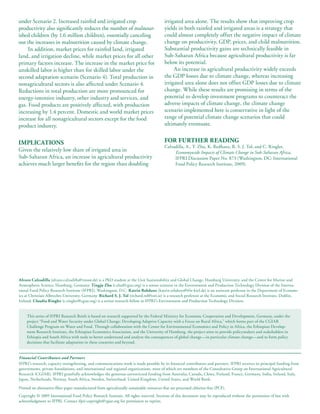
ImpACt of dRoughtS on InCome                                                      below some income threshold at some future point in time. Using
Using cross-sectional data from a 2005 survey of nearly 800                       median household income (16,000 Rand, equivalent to US$2,508
farmers in 20 districts in South Africa’s Limpopo River Basin that                in 2005) and bottom quartile income (7,800 Rand) as the two
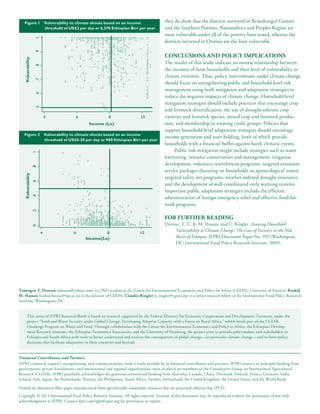
was augmented with rainfall data, the study finds that droughts                   thresholds, the study assesses which households are more vulnerable
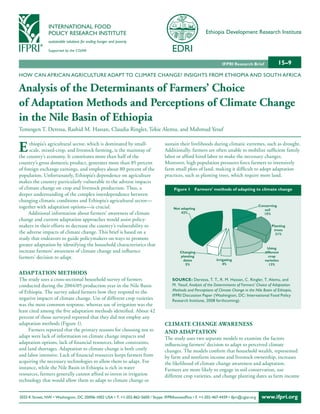
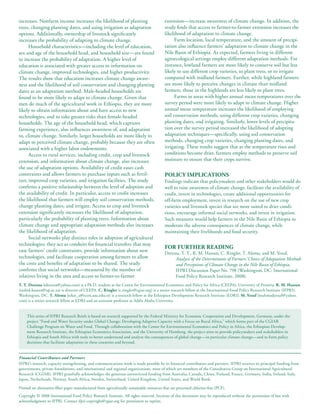
were the most prevalent climate-related shock reported: 41                        to future climatic shocks. The results are plotted in four quadrants
instances of droughts were reported in 2005. No apparent                          in Figures 1 and 2. Households in the upper-left quadrant are
relationship was found, however, between those who would have                     currently below the income threshold and will likely continue to be
been expected to report droughts based on rainfall data and those                 below the threshold in the future. Households in the bottom-left


2033 K Street, NW • Washington, DC 20006-1002 USA • T. +1-202-862-5600 / Skype: IFPRIhomeoffice • F. +1-202-467-4439 • ifpri@cgiar.org   www.ifpri.org
quadrant are currently below the threshold but have characteristics                           the income threshold and are likely to remain so in the future.
suggesting they have less than a 50 percent chance of being below                                   The results suggest that most households are not vulnerable to
the threshold in the future. Those in the upper-right corner are                              falling below the 7,800 rand threshold (Figure 1). However, when
above the income threshold at present but are likely to fall below it                         the poverty line is set at 16,000 Rand (the second income quartile),
in the future, whereas those in the bottom-right quadrant are above                           vulnerability increases significantly (Figure 2).
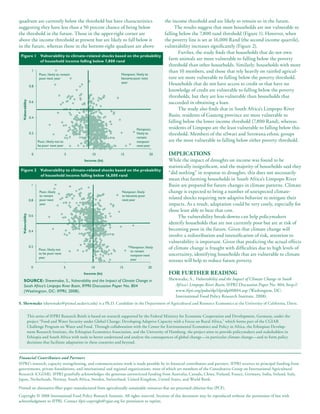
                                                                                                      Further, the study finds that households that do not own
 Figure 1                Vulnerability to climate-related shocks based on the probability
                         of household income falling below 7,800 rand
                                                                                                farm animals are more vulnerable to falling below the poverty
                                                                                                threshold than other households. Similarly, households with more
                   1                                                                            than 10 members, and those that rely heavily on rainfed agricul-
                         Poor, likely to remain                     Nonpoor, likely to
                         poor next year                             become poor next            ture are more vulnerable to falling below the poverty threshold.
                                                                    year                        Households that do not have access to credit or that have no
                  0.8
                                                                                                knowledge of credit are vulnerable to falling below the poverty
                                                                                                thresholds, but they are less vulnerable than households that
  Vulnerability


                  0.6                                                                           succeeded in obtaining a loan.
                                                                                                      The study also finds that in South Africa’s Limpopo River
                  0.4
                                                                                                Basin, residents of Gauteng province are most vulnerable to
                                                                                                falling below the lower income threshold (7,800 Rand), whereas
                                                                              Nonpoor,          residents of Limpopo are the least vulnerable to falling below this
                  0.2                                                         likely to         threshold. Members of the siSwati and Setswana ethnic groups
                                                                              remain
                        Poor, likely not to                                   nonpoor           are the most vulnerable to falling below either poverty threshold.
                        be poor next year                                     next year

                   0                          5       10            15                   20     ImpLICAtIonS
                                                  Income (ln)                                   While the impact of droughts on income was found to be
                                                                                                statistically insignificant, and the majority of households said they
 Figure 2                Vulnerability to climate-related shocks based on the probability
                         of household income falling below 16,000 rand
                                                                                                “did nothing” in response to droughts, this does not necessarily
                                                                                                mean that farming households in South Africa’s Limpopo River
                   1                                                                            Basin are prepared for future changes in climate patterns. Climate
                         Poor, likely                                Nonpoor, likely            change is expected to bring a number of unexpected climate-
                         to remain                                   to become poor
                  0.8    poor next                                   next year
                                                                                                related shocks requiring new adaptive behavior to mitigate their
                         year                                                                   impacts. As a result, adaptation could be very costly, especially for
                                                                                                those least able to bear that cost.
  Vulnerability


                  0.6                                                                                 The vulnerability break-downs can help policymakers
                                                                                                identify households that are not currently poor but are at risk of
                  0.4                                                                           becoming poor in the future. Given that climate change will
                                                                                                involve a redistribution and intensification of risk, attention to
                                                                                                vulnerability is important. Given that predicting the actual effects
                  0.2                                                     Nonpoor, likely       of climate change is fraught with difficulties due to high levels of
                        Poor, likely not                                  to remain
                        to be poor next
                                                                          nonpoor next          uncertainty, identifying households that are vulnerable to climate
                        year
                                                                          year                  stresses will help to reduce future poverty.
                   0                          5       10            15                   20
                                                  Income (ln)                                   foR fuRtheR ReAdIng
     SouRce: Shewmake, S., Vulnerability and the Impact of Climate Change in                    Shewmake, S., Vulnerability and the Impact of Climate Change in South
     South Africa’s Limpopo River Basin, IFPRI Discussion Paper No. 804                            Africa’s Limpopo River Basin, IFPRI Discussion Paper No. 804, http://
     (Washington, DC: IFPRI, 2008).                                                                www.ifpri.org/pubs/dp/ifpridp00804.asp (Washington, DC:
                                                                                                   International Food Policy Research Institute, 2008).
S. Shewmake (shewmake@primal.ucdavis.edu) is a Ph.D. Candidate in the Department of Agricultural and Resource Economics at the University of California, Davis.


              This series of IFPRI Research Briefs is based on research supported by the Federal Ministry for Economic Cooperation and Development, Germany, under the
              project “Food and Water Security under Global Change: Developing Adaptive Capacity with a Focus on Rural Africa,” which forms part of the CGIAR
              Challenge Program on Water and Food. Through collaboration with the Center for Environmental Economics and Policy in Africa, the Ethiopian Develop-
              ment Research Institute, the Ethiopian Economics Association, and the University of Hamburg, the project aims to provide policymakers and stakeholders in
              Ethiopia and South Africa with tools to better understand and analyze the consequences of global change—in particular climate change—and to form policy
              decisions that facilitate adaptation in these countries and beyond.


Financial Contributors and Partners
IFPRI’s research, capacity strengthening, and communications work is made possible by its financial contributors and partners. IFPRI receives its principal funding from
governments, private foundations, and international and regional organizations, most of which are members of the Consultative Group on International Agricultural
Research (CGIAR). IFPRI gratefully acknowledges the generous unrestricted funding from Australia, Canada, China, Finland, France, Germany, India, Ireland, Italy,
Japan, Netherlands, Norway, South Africa, Sweden, Switzerland, United Kingdom, United States, and World Bank.

Printed on alternative-fiber paper manufactured from agriculturally sustainable resources that are processed chlorine-free (PCF).
Copyright © 2008 International Food Policy Research Institute. All rights reserved. Sections of this document may be reproduced without the permission of but with
acknowledgment to IFPRI. Contact ifpri-copyright@cgiar.org for permission to reprint.
INTERNATIONAL FOOD                                                                             Center for Environmental Economics
                POLICY RESEARCH INSTITUTE                                                                      and Policy in Africa
                sustainable solutions for ending hunger and poverty

                Supported by the CGIAR


                                                                                                                  IFPRI Research Brief                15–3
HOW CAN AFRICAN AGRICULTURE ADAPT TO CLIMATE CHANGE? INSIGHTS FROM ETHIOPIA AND SOUTH AFRICA

Mapping the South African Farming Sector’s Vulnerability
to Climate Change and Variability
A Subnational Assessment
Glwadys Aymone Gbetibouo and Claudia Ringler


I   n southern Africa, by the middle of the 21st century climate change
    is expected to cause temperature increases of 1–3°C, broad summer
rainfall reductions of 5–10 percent, and an increase in the incidence of
                                                                                       The most sensitive provinces—mainly due to their high propor-
                                                                                  tion of smallholder subsistence farmers—are the Eastern Cape,
                                                                                  KwaZulu-Natal, and Limpopo. Smallholder farmers constitute
both droughts and floods. Consequently, climate change has significant            70 percent of the farming population in the Eastern Cape, KwaZulu-
potential to negatively affect crop production in South Africa, and in            Natal, Mpumalanga, and the North West province, and inappropriate
turn the well-being of the country’s farmers.                                     land uses in these regions have severely degraded land and reduced
      This brief is based on a study that examines the level of vulner-           production capacity. The Eastern Cape and Limpopo provinces have
ability to climate change in South Africa’s farming sector by                     the highest shares of agricultural GDP, the lowest average farm-asset
developing a nationwide provincial-level vulnerability profile.                   values, the lowest literacy rates, and the highest unemployment rates.
Particular attention is paid to the underlying socioeconomic and                       The least-sensitive provinces are the Western Cape, Gauteng, and
institutional factors that determine how farmers respond to and cope              Free State. A common feature of these regions is that they have a low
with climate hazards.                                                             percentage of subsistence farmers and the least-populated rural areas.
                                                                                  Gauteng and the Western Cape have greater infrastructure develop-
CONCEPTUAL FRAMEWORK                                                              ment, high levels of literacy, and lower unemployment rates. The
In this study, vulnerability to climate change is conceptualized as a             Western Cape is the least sensitive province, largely due to a high
function of three factors: exposure, sensitivity, and adaptive capacity.          degree of crop diversification, low levels of land degradation, and high
Exposure can be interpreted as the direct danger (the stressor) together          reliance on irrigation.
with the nature and extent of changes in a region’s climate variables                  Combining the indicators for sensitivity and exposure,
(temperature, precipitation, and extreme weather events). Sensitivity             KwaZulu-Natal, Limpopo, and the Eastern Cape are predicted to
describes the human–environmental conditions that exacerbate or                   suffer the largest impacts of climate change and variability. With the
ameliorate the hazard, or trigger an impact. Exposure and sensitivity             exception of Limpopo, these provinces have both the largest exposure
are intrinsically linked and mutually influence potential impacts.
Adaptive capacity represents the potential to implement adaptation                              Figure 1       Vulnerability framework
measures in efforts to avert potential impacts (Figure 1). Several
indicators representing these three components were selected to
facilitate the study’s examination of vulnerability in South Africa. The                  EXPOSURE                          ADAPTIVE CAPACITY
selected indicators—drawn from an extensive review of the litera-                                                                Determinants:
                                                                                         Characteristics:
ture—represent both the biophysical conditions of the farming                         Frequency, magnitude,                 Coping strategies, social
regions and the socioeconomic conditions of the farmers.                                    duration                        networks, resource use,
                                                                                                                             diversity, and flexibility
RESULTS OF VULNERABILITY ASSESSMENT
Analysis of vulnerability indicators shows that provinces in South
Africa demonstrate vast diversity in environmental and socioeconomic                        IMPACTS
conditions. The coastal provinces of the Eastern Cape, KwaZulu-                                                                VULNERABILITY
Natal, and the Western Cape exhibit the highest frequency of extreme
events (droughts and floods) over the past century, whereas the desert
                                                                                          SENSITIVITY
region of the Northern Cape and the steppe arid regions of the North
West and Free State provinces exhibit the lowest frequency. The                         Characteristics:                       ADAPTATION
highest incremental temperature increase by 2050 is found in the                       Assets, entitlements,                 (AND MITIGATION)
                                                                                      economic structures,                      RESPONSES
desert region of the Northern Cape and the steppe arid regions of Free
                                                                                          human capital
State and Mpumalanga, and rainfall changes are predicted to be
greatest in the Gauteng and North West provinces.

2033 K Street, NW • Washington, DC 20006-1002 USA • T. +1-202-862-5600 / Skype: IFPRIhomeoffice • F. +1-202-467-4439 • ifpri@cgiar.org     www.ifpri.org
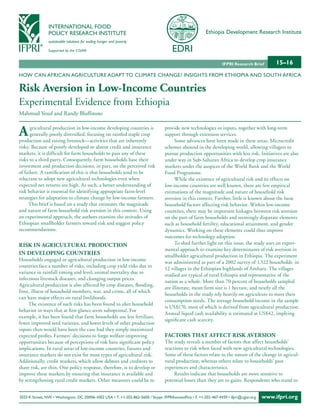
and the highest sensitivity. The Mpumalanga and North                 Figure 2 Vulnerability ranking in South Africa by province
West provinces fall within the mid range of vulnerability
based on these two indicators, whereas the Northern                     4
Cape, Western Cape, Free State, and Gauteng have the                                                           Limpopo
lowest risk of negative impacts because of the prevalence                 Eastern
                                                                        3
                                                                           Cape                      KwaZulu-
of commercial farming and the lack of land degradation.                                                 Natal
      Indicators of adaptive capacity differ considerably               2
across the nine provinces. Capacity is greatest in the                                                                             North
                                                                                                                                    West


                                                                             Vulnerability index
Western Cape due to the combined effects of well-                       1
                                                                                    Free                              Mpumalanga           Northern Western
developed infrastructure, high literacy rates and income
                                                                                    State Gauteng                                           Cape        Cape
levels, low unemployment rates and HIV prevalence,                      0
and relatively high capital wealth. Gauteng and the
Northern Cape fall within the mid-range for this                       -1
indicator, whereas adaptive capacity is low in KwaZulu-
Natal, the Eastern Cape, Free State, Limpopo, and                      -2
North West due to high dependence on agriculture,
high unemployment rates and HIV prevalence, and low                    -3
levels infrastructure development.
      Assessing results based on all three components of               -4
vulnerability, Limpopo, the Eastern Cape and KwaZulu-
Natal are the most vulnerable provinces; Mpumalanga,                   -5
the North West, Gauteng, and the Northern Cape fall
within the mid range of vulnerability; and the Western
                                                                                    In light of large spatial differences in vulnerability, policymakers
Cape has the lowest level of vulnerability. The vulnerability of Free
                                                                               should tailor policies to local conditions. In highly vulnerable regions,
State is considered indeterminate because it exhibits both low
                                                                               such as Limpopo, KwaZulu-Natal, and the Eastern Cape, policy-
exposure and low adaptive capacity.
                                                                               makers should enact measures (1) to support the effective
      Figure 2 presents the results of a quantitative vulnerability index
                                                                               management of environmental resources (for example, soil, vegetation,
based on 19 indicators. As expected, the Western Cape and Gauteng
                                                                               and water resources); (2) to promote increased market participation,
have low vulnerability scores; the Free State, Northern Cape,
                                                                               especially within the large subsistence-farming sector; (3) to stimulate
Mpumalanga, and North West provinces fall within the mid range of
                                                                               both agricultural intensification and livelihood diversification away
vulnerability; and the most vulnerable provinces are the Eastern
                                                                               from risky agriculture; and (4) to enact social programs and spending
Cape, KwaZulu-Natal and Limpopo.
                                                                               on health, education, and welfare to help maintain and augment both
POLICY IMPLICATIONS                                                            physical and intangible human capital. Policymakers should also
In examining vulnerability at the province level, caution must be              invest in rural infrastructure development. In areas of high exposure,
taken given enormous heterogeneity in household-level resource                 such as the coastal zones, priority should be given to the development
access, poverty levels, and adaptive capacity. Ideally, future household-      of accurate early warning systems, as well as appropriate relief
level research will facilitate improved targeting of policies to reduce        programs and agricultural insurance.
climate change vulnerability. That said, the results of this study show
that the provinces deemed most vulnerable to the effects of climate
                                                                               FOR FURTHER READING
change and variability do not always equate with the most vulnerable
populations. Rather, results suggest that the overall vulnerability of         Gbetibouo, G.A. and C. Ringler. Mapping South African farming sector
the South African farming sector is characterized by a combination of                vulnerability to climate change and variability: A subnational assessment.
medium-level exposure risk coupled with medium to high levels of                     IFPRI Discussion Paper No. 885 (Washington, DC: International
                                                                                     Food Policy Research Institute, 2009).
social vulnerability.
Glwadys Aymone Gbetibouo (gbetibouo@yahoo.fr) is a PhD student at the Center for Environmental Economics and Policy Analysis (CEEPA) of the University of
Pretoria, South Africa. Claudia Ringler (c.ringler@cgiar.org) is a senior research fellow in the Environment and Production Technology Division (EPTD) of the
International Food Policy Research Institute (IFPRI), Washington, DC.


     This series of IFPRI Research Briefs is based on research supported by the Federal Ministry for Economic Cooperation and Development, Germany, under the
     project “Food and Water Security under Global Change: Developing Adaptive Capacity with a Focus on Rural Africa,” which forms part of the CGIAR
     Challenge Program on Water and Food. Through collaboration with the Center for Environmental Economics and Policy in Africa, the Ethiopian Develop-
     ment Research Institute, the Ethiopian Economics Association, and the University of Hamburg, the project aims to provide policymakers and stakeholders in
     Ethiopia and South Africa with tools to better understand and analyze the consequences of global change—in particular climate change—and to form policy
     decisions that facilitate adaptation in these countries and beyond.


Financial Contributors and Partners
IFPRI’s research, capacity strengthening, and communications work is made possible by its financial contributors and partners. IFPRI receives its principal funding from
governments, private foundations, and international and regional organizations, most of which are members of the Consultative Group on International Agricultural
Research (CGIAR). IFPRI gratefully acknowledges the generous unrestricted funding from Australia, Canada, China, Finland, France, Germany, India, Ireland, Italy,
Japan, Netherlands, Norway, South Africa, Sweden, Switzerland, United Kingdom, United States, and World Bank.

Printed on alternative-fiber paper manufactured from agriculturally sustainable resources that are processed chlorine-free (PCF).
Copyright © 2009 International Food Policy Research Institute. All rights reserved. Sections of this document may be reproduced without the permission of but with
acknowledgment to IFPRI. Contact ifpri-copyright@cgiar.org for permission to reprint.
INTERNATIONAL FOOD
                POLICY RESEARCH INSTITUTE                                                                Ethiopia Development Research Institute
                sustainable solutions for ending hunger and poverty

                Supported by the CGIAR


                                                                                                                  IFPRI Research Brief        15–4
HOW CAN AFRICAN AGRICULTURE ADAPT TO CLIMATE CHANGE? INSIGHTS FROM ETHIOPIA AND SOUTH AFRICA

Assessing Household Vulnerability to Climate Change
The Case of Farmers in the Nile Basin of Ethiopia
Temesgen T. Deressa, Rashid M. Hassan, and Claudia Ringler


E     thiopia remains one of the least-developed countries in the
      world: 50 percent of the population lives in abject poverty,
and average life expectancy is only 43 years. Agriculture—the
                                                                                  poverty line of US$1.25 per day, the average income of the
                                                                                  surveyed households, and arbitrary values above and below the
                                                                                  average income of the surveyed households.
main sector of the Ethiopian economy—employs about 80 percent                           Results for income thresholds of US$0.3 and US$2 per day
of the population and is dominated by small-scale, mixed crop and                 are provided in Figures 1 and 2, respectively. The x-axis shows
livestock production with very low productivity, which can be                     current income, while the y-axis shows estimates of vulnerability.
attributed to obsolete farming techniques; soil degradation caused                Each figure is divided into four quadrants. Farm households in the
by overgrazing and deforestation; poor complementary services,                    upper left quadrant fall below the relevant poverty line and are
such as extension, credit, markets, and infrastructure; and                       likely to remain there in the future; those in the bottom left
frequent droughts and floods. Climate change is expected to                       quadrant fall below the poverty threshold today but have charac-
increase the frequency, intensity, and spatial coverage of droughts               teristics suggesting less than a 50 percent likelihood of their
and floods. Assessing Ethiopian farmers’ vulnerability to climate                 remaining there in the future; those in the upper right quadrant
change can help identify groups in particular need of support                     are currently above the specified income threshold but are likely to
under a changing climate. This brief is based on a study that                     fall below it in the future; and those in the bottom left quadrant
measures the vulnerability of farmers to climatic extremes, such as               are currently above the income threshold and are likely to remain
droughts, floods, and hailstorms.                                                 there in the future.
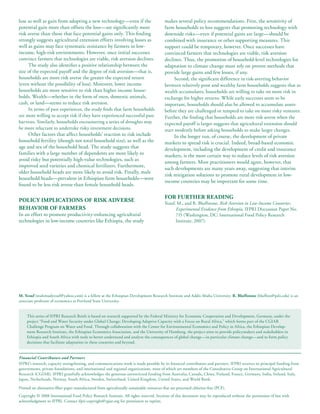
                                                                                        Unsurprisingly, farmers’ vulnerability to climate shocks is
THE IMPACT OF DROUGHT ON HOUSEHOLDS                                               highly sensitive to the choice of poverty threshold. The number of
                                                                                  households that are considered poor today and likely to remain
The study found that of the 1,000 households surveyed across 5
                                                                                  poor in the future increases as the income level used to determine
regional states and 20 districts of Ethiopia, 31 percent reported
                                                                                  the poverty threshold increases. When the poverty line is fixed at
droughts, 12 percent reported floods, and 18 percent reported
                                                                                  an income level of US$2 per day, 99 percent of farmers are
hailstorms over the previous five years. These shocks resulted in a
                                                                                  considered vulnerable and, hence, fall into the upper right
variety of reported losses, primarily in the form of crop yield
                                                                                  quadrant (Figure 1). Similarly, when the poverty line is reduced to
declines and asset/income losses. The majority of farmers did
                                                                                  US$1.50 and to US$1.25 per day, most households remain poor
nothing in response to these shocks, mainly due to abject poverty.
                                                                                  and vulnerable today, but the number of nonvulnerable house-
Among those farmers who did respond, the most common coping
                                                                                  holds increases slightly. When the poverty threshold is set at a
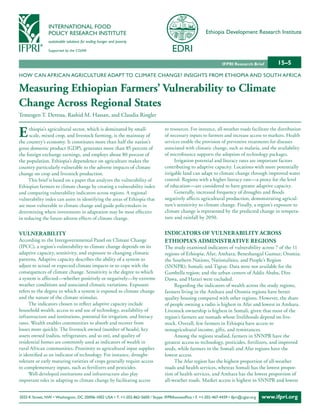
strategy was to sell livestock, suggesting that—in addition to                    daily minimum income of US$0.30, only 12 percent of farmers
providing animal draft power and manure—livestock also serves                     are considered vulnerable to climate extremes (Figure 2). At this
as an asset and hence provides insurance against shocks. Other                    threshold, most households fall within the bottom left quadrant,
important coping strategies reported were borrowing from                          indicating that they are not considered poor and are likely to
relatives, reducing food consumption, depending on food aid and                   remain nonpoor in the future.
food-for-work programs, and seeking off-farm employment.                                Analysis of vulnerability across different agroecological zones
                                                                                  indicates that farmers in the warm, semi-arid Kola zone are most
ESTIMATION OF VULNERABILITY                                                       vulnerable to extreme climatic events: of all the households
Vulnerability is defined as the probability that climate shocks will              surveyed in Kola, 99 percent are either already vulnerable or will
shift household income below a given minimum level (such as a                     become vulnerable in the future. Farmers in the cool, subhumid
poverty line) or cause income levels to remain below the minimum                  Weynadega zone and the cool, humid Dega zone are also highly
level if the household is already poor. To analyze the sensitivity of             vulnerable to future climate shocks: 94 and 89 percent, respectively,
vulnerability to a chosen threshold, the study examined different                 are considered vulnerable based on the US$1.25 per day poverty
minimum income levels/poverty lines, such as the international                    line. While these results are not representative at the regional level,


2033 K Street, NW • Washington, DC 20006-1002 USA • T. +1-202-862-5600 / Skype: IFPRIhomeoffice • F. +1-202-467-4439 • ifpri@cgiar.org   www.ifpri.org
Figure 1 Vulnerability to climate shocks based on an income                             they do show that the districts surveyed in Beneshangul Gumuz
            threshold of US$2 per day or 6,570 Ethiopian Birr per year                     and the Southern Nations, Nationalities and Peoples Region are
                                                                                           most vulnerable under all of the poverty lines tested, whereas the
                    1
                                                                                           districts surveyed in Oromia are the least vulnerable.
                    .9


                                                                                           CONCLUSIONS AND POLICY IMPLICATIONS
   Vulnerability


                                                                                           The results of this study indicate an inverse relationship between
                    .8


                                                                                           the incomes of farm households and their level of vulnerability to
                                                                                           climate extremes. Thus, policy interventions under climate change
                    .7


                                                                                           should focus on strengthening public and household-level risk
                                                                                           management using both mitigation and adaptation strategies to
                    .6


                                                                                           reduce the negative impacts of climate change. Household-level
                                                                                           mitigation strategies should include practices that encourage crop
                    .5


                                                                                           and livestock diversification, the use of drought-tolerant crop
                             4                  6             8                10          varieties and livestock species, mixed crop and livestock produc-
                                                     Income (Ln)                           tion, and membership in rotating credit groups. Policies that
                                                                                           support household-level adaptation strategies should encourage
   Figure 2                  Vulnerability to climate shocks based on an income
                                                                                           income generation and asset holding, both of which provide
                             threshold of US$0.30 per day or 900 Ethiopian Birr per year
                                                                                           households with a financial buffer against harsh climatic events.
                                                                                                Public risk mitigation might include strategies such as water
                   1


                                                                                           harvesting, resource conservation and management, irrigation
                                                                                           development, voluntary resettlement programs, targeted extension
                   .8


                                                                                           service packages (focusing on households or agroecological zones),
   Vulnerability


                                                                                           targeted safety net programs, weather-indexed drought insurance,
                   .6


                                                                                           and the development of well-coordinated early warning systems.
                                                                                           Important public adaptation strategies include the efficient
                   .4


                                                                                           administration of foreign emergency relief and effective food-for-
                                                                                           work programs.
                   .2


                                                                                           FOR FURTHER READING
                                                                                           Deressa, T. T., R. M. Hassan, and C. Ringler. Assessing Household
                   0


                                                                                                Vulnerability to Climate Change: The Case of Farmers in the Nile
                         4                  6                8                10
                                                    Income(Ln)                                  Basin of Ethiopia. IFPRI Discussion Paper No. 935 (Washington,
                                                                                                DC: International Food Policy Research Institute, 2009).


Temesgen T. Deressa (tderessa@yahoo.com) is a PhD student at the Centre for Environmental Economics and Policy for Africa (CEEPA), University of Pretoria. Rashid
M. Hassan (rashid.hassan@up.ac.za) is the director of CEEPA. Claudia Ringler (c.ringler@cgiar.org) is a senior research fellow at the International Food Policy Research
Institute, Washington, DC.


       This series of IFPRI Research Briefs is based on research supported by the Federal Ministry for Economic Cooperation and Development, Germany, under the
       project “Food and Water Security under Global Change: Developing Adaptive Capacity with a Focus on Rural Africa,” which forms part of the CGIAR
       Challenge Program on Water and Food. Through collaboration with the Center for Environmental Economics and Policy in Africa, the Ethiopian Develop-
       ment Research Institute, the Ethiopian Economics Association, and the University of Hamburg, the project aims to provide policymakers and stakeholders in
       Ethiopia and South Africa with tools to better understand and analyze the consequences of global change—in particular climate change—and to form policy
       decisions that facilitate adaptation in these countries and beyond.


Financial Contributors and Partners
IFPRI’s research, capacity strengthening, and communications work is made possible by its financial contributors and partners. IFPRI receives its principal funding from
governments, private foundations, and international and regional organizations, most of which are members of the Consultative Group on International Agricultural
Research (CGIAR). IFPRI gratefully acknowledges the generous unrestricted funding from Australia, Canada, China, Denmark, Finland, France, Germany, India,
Ireland, Italy, Japan, the Netherlands, Norway, the Philippines, South Africa, Sweden, Switzerland, the United Kingdom, the United States, and the World Bank.

Printed on alternative-fiber paper manufactured from agriculturally sustainable resources that are processed chlorine-free (PCF).
Copyright © 2011 International Food Policy Research Institute. All rights reserved. Sections of this document may be reproduced without the permission of but with
acknowledgment to IFPRI. Contact ifpri-copyright@cgiar.org for permission to reprint.
INTERNATIONAL FOOD
                POLICY RESEARCH INSTITUTE                                                                Ethiopia Development Research Institute
                sustainable solutions for ending hunger and poverty

                Supported by the CGIAR


                                                                                                                  IFPRI Research Brief        15–5
HOW CAN AFRICAN AGRICULTURE ADAPT TO CLIMATE CHANGE? INSIGHTS FROM ETHIOPIA AND SOUTH AFRICA

Measuring Ethiopian Farmers’ Vulnerability to Climate
Change Across Regional States
Temesgen T. Deressa, Rashid M. Hassan, and Claudia Ringler


E     thiopia’s agricultural sector, which is dominated by small-
      scale, mixed crop, and livestock farming, is the mainstay of
the country’s economy. It constitutes more than half the nation’s
                                                                                  to resources. For instance, all-weather roads facilitate the distribution
                                                                                  of necessary inputs to farmers and increase access to markets. Health
                                                                                  services enable the provision of preventive treatments for diseases
gross domestic product (GDP), generates more than 85 percent of                   associated with climatic change, such as malaria, and the availability
the foreign exchange earnings, and employs about 80 percent of                    of microfinance supports the adoption of technology packages.
the population. Ethiopia’s dependence on agriculture makes the                         Irrigation potential and literacy rates are important factors
country particularly vulnerable to the adverse impacts of climate                 contributing to adaptive capacity. Locations with more potentially
change on crop and livestock production.                                          irrigable land can adapt to climate change through improved water
     This brief is based on a paper that analyzes the vulnerability of            control. Regions with a higher literacy rate—a proxy for the level
Ethiopian farmers to climate change by creating a vulnerability index             of education—are considered to have greater adaptive capacity.
and comparing vulnerability indicators across regions. A regional                      Generally, increased frequency of droughts and floods
vulnerability index can assist in identifying the areas of Ethiopia that          negatively affects agricultural production, demonstrating agricul-
are most vulnerable to climate change and guide policymakers in                   ture’s sensitivity to climate change. Finally, a region’s exposure to
determining where investments in adaptation may be most effective                 climate change is represented by the predicted change in tempera-
in reducing the future adverse effects of climate change.                         ture and rainfall by 2050.


VulnERAbility                                                                     indiCAtoRS oF VulnERAbility ACRoSS
According to the Intergovernmental Panel on Climate Change                        EthiopiA’S AdMiniStRAtiVE REgionS
(IPCC), a region’s vulnerability to climate change depends on its                 The study examined indicators of vulnerability across 7 of the 11
adaptive capacity, sensitivity, and exposure to changing climatic                 regions of Ethiopia: Afar; Amhara; Beneshangul Gumuz; Oromia;
patterns. Adaptive capacity describes the ability of a system to                  the Southern Nations, Nationalities, and People’s Region
adjust to actual or expected climate impacts or to cope with the                  (SNNPR); Somali; and Tigray. Data were not available for the
consequences of climate change. Sensitivity is the degree to which                Gambella region; and the urban centers of Addis Ababa, Dire
a system is affected—whether positively or negatively—by extreme                  Dawa, and Harari were excluded.
weather conditions and associated climatic variations. Exposure                        Regarding the indicators of wealth across the study regions,
refers to the degree to which a system is exposed to climate change               farmers living in the Amhara and Oromia regions have better
and the nature of the climate stimulus.                                           quality housing compared with other regions. However, the share
      The indicators chosen to reflect adaptive capacity include                  of people owning a radio is highest in Afar and lowest in Amhara.
household wealth, access to and use of technology, availability of                Livestock ownership is highest in Somali, given that most of the
infrastructure and institutions, potential for irrigation, and literacy           region’s farmers are nomads whose livelihoods depend on live-
rates. Wealth enables communities to absorb and recover from                      stock. Overall, few farmers in Ethiopia have access to
losses more quickly. The livestock owned (number of heads), key                   nonagricultural income, gifts, and remittances.
assets owned (radios, refrigerators, and so on), and quality of                        Among the regions studied, farmers in SNNPR have the
residential homes are commonly used as indicators of wealth in                    greatest access to technology, pesticides, fertilizers, and improved
rural African communities. Proximity to agricultural input supplies               seeds, while farmers in the Somali and Afar regions have the
is identified as an indicator of technology. For instance, drought-               lowest access.
tolerant or early maturing varieties of crops generally require access                 The Afar region has the highest proportion of all-weather
to complementary inputs, such as fertilizers and pesticides.                      roads and health services, whereas Somali has the lowest propor-
      Well-developed institutions and infrastructure also play                    tion of health services, and Amhara has the lowest proportion of
important roles in adapting to climate change by facilitating access              all-weather roads. Market access is highest in SNNPR and lowest


2033 K Street, NW • Washington, DC 20006-1002 USA • T. +1-202-862-5600 / Skype: IFPRIhomeoffice • F. +1-202-467-4439 • ifpri@cgiar.org   www.ifpri.org
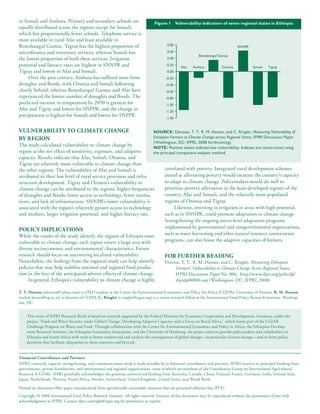
in Somali and Amhara. Primary and secondary schools are                             Figure 1 Vulnerability indicators of seven regional states in ethiopia
equally distributed across the regions except for Somali,
which has proportionally fewer schools. Telephone service is
most available in rural Afar and least available in
Beneshangul Gumuz. Tigray has the highest proportion of                                     0.80                                       SNNPR
microfinance and veterinary services, whereas Somali has                                    0.60
                                                                                                                Beneshangul Gumuz
the lowest proportion of both these services. Irrigation                                    0.40
potential and literacy rates are highest in SNNPR and                                       0.20
                                                                                                     Afar   Amhara            Oromia           Somali   Tigray
Tigray and lowest in Afar and Somali.                                                       0.00
     Over the past century, Amhara has suffered most from                                  -0.20
droughts and floods, with Oromia and Somali following                                      -0.40
closely behind, whereas Beneshangul Gumuz and Afar have                                    -0.60
experienced the lowest number of droughts and floods. The                                  -0.80
predicted increase in temperature by 2050 is greatest for                                  -1.00
Afar and Tigray and lowest for SNPPR, and the change in                                    -1.20
precipitation is highest for Somali and lowest for SNPPR.
                                                                                           -1.40


VulnERAbility to CliMAtE ChAngE                                                     SouRce: Deressa, T. T., R. M. Hassan, and C. Ringler, Measuring Vulnerability of
by REgion                                                                           Ethiopian Farmers to Climate Change across Regional States, IFPRI Discussion Paper
                                                                                    (Washington, DC: IFPRI, 2008 forthcoming).
The study calculated vulnerability to climate change by                             Note: Positive values indicate low vulnerability. Indexes are constructed using
region as the net effect of sensitivity, exposure, and adaptive                     the principal component analysis method.
capacity. Results indicate that Afar, Somali, Oromia, and
Tigray are relatively more vulnerable to climate change than
the other regions. The vulnerability of Afar and Somali is                                 correlated with poverty. Integrated rural development schemes
attributed to their low level of rural service provision and infra-                        aimed at alleviating poverty would increase the country’s capacity
structure development. Tigray and Oromia’s vulnerability to                                to adapt to climate change. Policymakers would do well to
climate change can be attributed to the regions’ higher frequencies                        prioritize poverty alleviation in the least-developed regions of the
of droughts and floods, lower access to technology, fewer institu-                         country, Afar and Somali, and the relatively more populated
tions, and lack of infrastructure. SNNPR’s lower vulnerability is                          regions of Oromia and Tigray.
associated with the region’s relatively greater access to technology                            Likewise, investing in irrigation in areas with high potential,
and markets, larger irrigation potential, and higher literacy rate.                        such as in SNNPR, could promote adaptation to climate change.
                                                                                           Strengthening the ongoing micro-level adaptation programs
                                                                                           implemented by governmental and nongovernmental organizations,
poliCy iMpliCAtionS
While the results of the study identify the regions of Ethiopia most                       such as water harvesting and other natural resource conservation
vulnerable to climate change, each region covers a large area with                         programs, can also boost the adaptive capacities of farmers.
diverse socioeconomic and environmental characteristics. Future
research should focus on uncovering localized vulnerability.                               FoR FuRthER REAding
Nonetheless, the findings from the regional study can help identify                        Deressa, T. T., R. M. Hassan, and C. Ringler, Measuring Ethiopian
policies that may help stabilize national and regional food produc-                             Farmers’ Vulnerability to Climate Change Across Regional States,
tion in the face of the anticipated adverse effects of climate change.                          IFPRI Discussion Paper No. 806, http://www.ifpri.org/pubs/dp/
     In general, Ethiopia’s vulnerability to climate change is highly                           ifpridp00806.asp (Washington, DC: IFPRI, 2008).

t. t. deressa (tderessa@yahoo.com) is a PhD student at the Centre for Environmental Economics and Policy for Africa (CEEPA), University of Pretoria. R. M. hassan
(rashid.hassan@up.ac.za) is director of CEEPA. C. Ringler (c.ringler@cgiar.org) is a senior research fellow at the International Food Policy Research Institute, Washing-
ton, DC.


     This series of IFPRI Research Briefs is based on research supported by the Federal Ministry for Economic Cooperation and Development, Germany, under the
     project “Food and Water Security under Global Change: Developing Adaptive Capacity with a Focus on Rural Africa,” which forms part of the CGIAR
     Challenge Program on Water and Food. Through collaboration with the Center for Environmental Economics and Policy in Africa, the Ethiopian Develop-
     ment Research Institute, the Ethiopian Economics Association, and the University of Hamburg, the project aims to provide policymakers and stakeholders in
     Ethiopia and South Africa with tools to better understand and analyze the consequences of global change—in particular climate change—and to form policy
     decisions that facilitate adaptation in these countries and beyond.


Financial Contributors and Partners
IFPRI’s research, capacity strengthening, and communications work is made possible by its financial contributors and partners. IFPRI receives its principal funding from
governments, private foundations, and international and regional organizations, most of which are members of the Consultative Group on International Agricultural
Research (CGIAR). IFPRI gratefully acknowledges the generous unrestricted funding from Australia, Canada, China, Finland, France, Germany, India, Ireland, Italy,
Japan, Netherlands, Norway, South Africa, Sweden, Switzerland, United Kingdom, United States, and World Bank.

Printed on alternative-fiber paper manufactured from agriculturally sustainable resources that are processed chlorine-free (PCF).
Copyright © 2008 International Food Policy Research Institute. All rights reserved. Sections of this document may be reproduced without the permission of but with
acknowledgment to IFPRI. Contact ifpri-copyright@cgiar.org for permission to reprint.
INTERNATIONAL FOOD
                POLICY RESEARCH INSTITUTE                                                                                   ETHIOPIAN ECONOMIC
                sustainable solutions for ending hunger and poverty
                                                                                                                            ASSOCIATION
                Supported by the CGIAR


                                                                                                                  IFPRI Research Brief        15–6
HOW CAN AFRICAN AGRICULTURE ADAPT TO CLIMATE CHANGE? INSIGHTS FROM ETHIOPIA AND SOUTH AFRICA

Perceptions of Stakeholders on Climate Change
and Adaptation Strategies in Ethiopia
Assefa Admassie, Berhanu Adenew, and Abebe Tadege


T     he potential adverse effects of climate change on Ethiopia’s
      agricultural sector are a major concern, particularly given the
country’s dependence on agricultural production. Securing
                                                                                  increase the country’s frequency of both droughts and floods. The
                                                                                  stakeholder forums and NAPA’s technical working groups sought
                                                                                  participants’ perceptions of the impacts of changing climatic
Ethiopia’s economic and social well-being in the face of climate                  conditions. According to participants, although both developed and
change requires that policymakers and stakeholders work together                  developing countries are affected by climate change, developing
to integrate climate change adaptation into the country’s develop-                countries face greater challenges in overcoming its adverse conse-
ment process. Three stakeholder discussion forums held in 2006                    quences. Because Ethiopia is one of the least developed countries in
in Addis Ababa, Awassa, and Bahir Dar as part of the project,                     the world, with a per capita income of less than US$130 in 2006,
“Food and Water Security under Global Change: Developing                          workshop participants agreed that the country faces considerable
Adaptive Capacity with a Focus on Rural Africa,” were attended                    hurdles in coping with the adverse impacts of long-term climate
by representatives of the government, civil society, business sector,             change. Low economic development, inadequate infrastructure, and
and local communities. The forums elicited information to enable                  lack of institutional capacity all contribute to the country’s vulner-
policymakers to make more informed decisions related to climate                   ability to the adverse impacts of climate change.
change adaptation.                                                                     In addition, Ethiopia’s economy is heavily dependent on
     The forums complemented ongoing efforts to develop the                       agriculture and faces increasing population growth. Ethiopia’s
National Adaptation Program of Action (NAPA), which is                            agricultural sector contributes 47 percent of the country’s gross
overseen by a steering committee representing government,                         national product and more than 80 percent of its exports. It also
nongovernment, academic, and research institutions. Under                         employs about 85 percent of the country’s population of more than
NAPA, multidisciplinary technical working groups have been                        76 million people (noting that Ethiopia is the third-most populous
formed to assess the country’s vulnerability to the adverse conse-                country in Africa after Nigeria and Egypt). With a current growth
quences of climate change, gauge current adaptation efforts, and                  rate of about 2.8 percent per year, Ethiopia’s population is expected
identify ways in which public agencies could assist in minimizing                 to reach 129 million by 2030. Workshop participants emphasized
the adverse impacts of climate change. In addition, two national                  that Ethiopia’s low level of economic development combined with its
and eight regional workshops were conducted involving nearly 500                  heavy dependence on agriculture and high population growth rate
participants with various areas of expertise. Like the stakeholder                make the country particularly susceptible to the adverse effects of
forums, the workshops solicited information to create greater                     climate change. Negative climatic impacts on crop and livestock
awareness of climate change, assess the extent of the area’s                      production could result in a nationwide food shortage and greatly
vulnerability, and help identify adaptation options.                              hinder the economy. If appropriate steps are not taken, workshop
     This brief is based on a paper that presents findings from the               participants felt that food insecurity, deepened poverty, and
stakeholder discussion forums, as well as NAPA’s technical                        increased incidence of disease, such as malaria and yellow fever,
working groups and workshops. These meetings explored stake-                      would be likely consequences.
holders’ perceptions of vulnerability to climate change and                            A better understanding of the local dimensions of vulnerability is
considered ways in which adaptation measures could be further                     therefore essential to develop appropriate adaptation measures that
integrated into Ethiopia’s development process.                                   will mitigate these adverse consequences. Accordingly, the stakeholder
                                                                                  forums solicited input on those who are thought to be most vulner-
                                                                                  able, based on economic, social, and environmental factors.
VulnErAbiliTy To ThE AdVErSE                                                           The farming community was identified as the most vulnerable
ConSEquEnCES of ClimATE ChAngE                                                    because of its dependence on agricultural production for its liveli-
According to the National Meteorological Agency, long-term                        hood. Within the farming community, small-scale, rainfed
climate change in Ethiopia is associated with changes in precipita-               subsistence farmers as well as pastoralists were identified as more
tion patterns, rainfall variability, and temperature, which could                 vulnerable to changing climatic conditions than others. In addition,


2033 K Street, NW • Washington, DC 20006-1002 USA • T. +1-202-862-5600 / Skype: IFPRIhomeoffice • F. +1-202-467-4439 • ifpri@cgiar.org   www.ifpri.org
farm households without assets and financial resources were                                adaptive capacity. In addition, workshop participants suggested
identified as especially vulnerable, as their limited resources restrict                   implementing improved water resource development, land manage-
them from easily adapting to the changing climate.                                         ment, food security, health, and education programs. There is also
     Participants noted that throughout society those who are                              a need to expand nonagricultural employment opportunities and
marginalized based on their sex, age, education, ethnicity, or                             provide skills training, particularly in rural areas.
economic status are more vulnerable to negative climate change                                  Another recommendation is greater investment in data
impacts than others. Female-headed households in Ethiopia, for                             collection and research on climate change and extreme weather
instance, were identified as particularly vulnerable to climate change                     conditions in Ethiopia. Environmental and drought monitoring
given greater constraints to adaptation than male-headed house-                            systems should be introduced at national and regional levels to
holds. Likewise, participants argued that those with low levels of                         monitor climate changes. Such systems would provide early
education are more vulnerable to the adverse effects of climate                            warnings on predicted weather extremes, enabling stakeholders to
change because they are less likely to be aware of long-term climate                       take corrective measures in advance to minimize potential
change and tend to be more averse to the risks associated with some                        damages. Additionally, in-depth studies on vulnerability and
adaption measures.                                                                         adaptation should continue.
     In addition, certain regions of the country were identified as                             Participants also recommended expanding awareness of global
being more susceptible to the negative effects of changing climatic                        warming and its potential impacts by providing reliable and
conditions. In particular, participants identified those in the arid,                      up-to-date information to the public. Information about the
semi-arid, and dry subhumid lowlands as being more vulnerable to                           appropriate adaptive measures should be made available to the
the adverse effects of climate change than those living in the                             entire national community. As part of this effort, communication
highlands. Lowland households with fewer and less diversified assets                       between policymakers, nongovernmental organizations, research
than highland households are less able to invest in adaptation                             institutions, and the media, among other actors, should be
measures and to meet their basic needs when faced with the adverse                         strengthened in order to ensure accurate information is available
consequences of climate change. In addition, the lowlands have                             and widely disseminated.
become increasingly depleted and, as a result, many pastoralists                                Finally, workshop participants recommended that all stake-
from the lowlands have migrated to highland areas, leading to social                       holders be included in the development process. When considering
conflicts over land.
                                                                                           measures to reduce vulnerability to the adverse effects of climate
                                                                                           change, government, civil society, the private sector, and local
AdAPTATion mEASurES And PoliCy                                                             communities should all participate in the discussion. In particular,
rECommEndATionS                                                                            policymakers should be sure to draw on knowledge and experience
Workshop participants identified the adaptation measures                                   from local communities. By overlooking local knowledge, policies
communities adopt when confronted with climate-related shocks.                             can constrain rather than enhance the adaptive capacity of
These include diversification of livelihood sources, migration,                            communities. Furthermore, knowledge of the environment is
participation in nonfarm activities, sale of assets, settlement and                        passed down through generations of experience of working on the
resettlement activities, and the adoption of improved water                                land and, thus, local farm communities offer invaluable informa-
management systems. To further mitigate the adverse effects of                             tion regarding adaptation to changing climatic conditions that
climate change, participants considered ways in which adaptation                           would not likely be acquired through other channels.
measures could be better integrated into Ethiopia’s development
process and offered policy recommendations.                                                for furThEr rEAding
     As part of the development process, participants recom-                               Admassie, A., and B. Adenew, Stakeholders’ Perceptions of Climate
mended that social and physical infrastructure be improved and                                 Change and Adaptation Strategies in Ethiopia, EEA Research Report
institutions dealing with climate-related issues including the                                 (Addis Ababa: Ethiopian Economic Association, 2008) Available at:
meteorology agency be strengthened to increase the country’s                                   http://www.eeaecon.org/Research%20Materials.htm.

A. Admassie (aadmassie@yahoo.com) is director of the Ethiopian Economic Association (EEA)/Ethiopian Economic Policy Research Institute (EEPRI) in Ethiopia.
b. Adenew (berhanuad@yahoo.com) is a senior researcher at EEA/EEPRI in Ethiopia. A. Tadege (a_tadege@yahoo.com) is head of the Research and Studies Depart-
ment at the National Meteorological Agency (NMA) in Ethiopia.


     This series of IFPRI Research Briefs is based on research supported by the Federal Ministry for Economic Cooperation and Development, Germany, under the
     project “Food and Water Security under Global Change: Developing Adaptive Capacity with a Focus on Rural Africa,” which forms part of the CGIAR
     Challenge Program on Water and Food. Through collaboration with the Center for Environmental Economics and Policy in Africa, the Ethiopian Develop-
     ment Research Institute, the Ethiopian Economics Association, and the University of Hamburg, the project aims to provide policymakers and stakeholders in
     Ethiopia and South Africa with tools to better understand and analyze the consequences of global change—in particular climate change—and to form policy
     decisions that facilitate adaptation in these countries and beyond.


Financial Contributors and Partners
IFPRI’s research, capacity strengthening, and communications work is made possible by its financial contributors and partners. IFPRI receives its principal funding from
governments, private foundations, and international and regional organizations, most of which are members of the Consultative Group on International Agricultural
Research (CGIAR). IFPRI gratefully acknowledges the generous unrestricted funding from Australia, Canada, China, Finland, France, Germany, India, Ireland, Italy,
Japan, Netherlands, Norway, South Africa, Sweden, Switzerland, United Kingdom, United States, and World Bank.

Printed on alternative-fiber paper manufactured from agriculturally sustainable resources that are processed chlorine-free (PCF).
Copyright © 2008 International Food Policy Research Institute. All rights reserved. Sections of this document may be reproduced without the permission of but with
acknowledgment to IFPRI. Contact ifpri-copyright@cgiar.org for permission to reprint.
INTERNATIONAL FOOD                                                                            Center for Environmental Economics
                POLICY RESEARCH INSTITUTE                                                                     and Policy in Africa
                sustainable solutions for ending hunger and poverty

                Supported by the CGIAR


                                                                                                                  IFPRI Research Brief        15–7
HOW CAN AFRICAN AGRICULTURE ADAPT TO CLIMATE CHANGE? INSIGHTS FROM ETHIOPIA AND SOUTH AFRICA

Micro-Level Analysis of Farmers’ Adaptation to Climate
Change in Southern Africa
Charles Nhemachena and Rashid M. Hassan


A      gricultural production remains the main source of livelihood
       for rural communities in Sub-Saharan Africa, providing
employment to more than 60 percent of the population and contrib-
                                                                                  that awareness of climate change is an important determinant of
                                                                                  farm-level adaptation. Access to credit, markets, and free extension
                                                                                  services also significantly increase the likelihood of farmers adopting
uting about 30 percent of gross domestic product. With likely                     adaptation measures. In addition, households with access to elec-
long-term changes in rainfall patterns and shifting temperature                   tricity and technology such as tractors, heavy machines, and animal
zones, climate change is expected to significantly affect agricultural            power are more likely to adapt to changes in climatic conditions.
production, which could be detrimental to the region’s food security              With access to electricity and technology, farmers are able to vary
and economic growth. An assessment of the factors influencing                     their planting dates, switch to new crops, diversify their crop options,
farm-level adaptation can facilitate the formation of policies and                use more irrigation, and apply water conservation techniques.
investment strategies that help moderate potential adverse conse-                 Farmers with access to technology are also more likely to diversify
quences of long-term climate change. Because smallholder farmers                  into nonfarming activities, although households with large invest-
tend to have a low capacity to adapt to changes in climatic condi-                ments in farm equipment and machinery may find such
tions, policies that help these farmers adapt to global warming and               diversification to be costly.
associated climatic extremes are particularly important.                                Another important determinant of farm-level adaptation is land
      This brief is based on a study that assesses smallholder farmers’           ownership. Farmers who own their land are more likely to invest in
adaptation to climate change in southern Africa. The study identi-                adaptation options, including crop and livestock management
fies farmers’ perceptions of climate change and the determinants of               practices and water conservation. The type of farming system also
farm-level adaptation strategies, and recommends policies that could              determines farmers’ use of adaptation strategies: those engaged in
help stabilize national and regional food production given the                    mixed crop and livestock farming, as well as those engaged in
anticipated adverse effects of climate change.                                    subsistence farming, are more likely to adapt to changes in climatic
                                                                                  conditions than are farmers in specialized farming systems.
Survey oF FArMerS’ PerCePtionS                                                          Finally, the study finds that female-headed households are more
Using cross-sectional survey data for South Africa, Zambia, and                   likely to take up adaptation options than male-headed households. In
Zimbabwe, the study finds that most farmers detect a rise in                      most rural smallholder farming communities in South Africa,
temperature over the past 20 years, drier conditions, and pronounced              women do much of the agricultural work and therefore tend to have
changes in the timing of rains and frequency of droughts. In                      more farming experience and information on various management
response to these perceived changes in climate, 67 percent of survey              practices. Farming experience increases the probability of uptake of
respondents are adopting some form of adaptation. Common                          all adaptation options.
adaptation measures include diversifying crops, planting different
crops or crop varieties, replacing farm activities with nonfarm                   PoLiCy iMPLiCAtionS
activities, changing planting and harvesting dates, increasing the use            Providing smallholder farmers with necessary resources increases
of irrigation, and increasing the use of water and soil conservation              farmers’ productivity and helps them adapt to the adverse conse-
techniques. In assessing farmers’ perceptions of barriers to using                quences of changing climatic conditions. For instance, policies that
various adaptation measures, the authors find that lack of credit, lack           ensure access to affordable credit increase farmers’ financial
of information on climate, and insufficient access to inputs are key              resources, allowing them to make better use of available information
obstacles to adaptation (Figure 1).                                               on climate change and to meet the costs associated with the various
                                                                                  adaptation options. Likewise, policies that ensure farmer access to
DeterMinAntS oF FArMerS’ uSe oF                                                   free extension services have the potential to significantly increase
ADAPtAtion StrAtegieS                                                             farmers’ awareness of changing climatic conditions and their
The study uses an econometric model to identify the factors that                  knowledge of appropriate adaptation measures.
affect farmers’ use of adaptation strategies. Modeling results confirm                 Because property owners are more likely to invest in adaptation


2033 K Street, NW • Washington, DC 20006-1002 USA • T. +1-202-862-5600 / Skype: IFPRIhomeoffice • F. +1-202-467-4439 • ifpri@cgiar.org   www.ifpri.org
measures, governments should also ensure that tenure arrangements                                       dissemination of climate information, and promoting farm-level
are safeguarded, even in the communal systems that characterize                                         adaptation measures such as the use of irrigation technologies.
most of the region’s smallholder farming systems. Similarly, policies                                   Government policies designed to promote adaptation at the farm
targeting women’s groups and associations in smallholder rural                                          level will lead to greater food and livelihood security in the face of
communities could further promote adaptation given that women do
                                                                                                        climate change.
much of the agricultural work in many rural smallholder farming
communities in the region.
      Finally, governments need to support research and development                                     For Further reADing
in the agricultural sector, disseminate appropriate technologies, and                                   Nhemachena, C., and R. Hassan, Micro-Level Analysis of Farmers’
ensure that cheap technologies are available to smallholder farmers.                                        Adaptation to Climate Change in Southern Africa, IFPRI Discussion
Examples of these policy measures include developing drought-                                               Paper No. 714 (Washington, DC: International Food Policy
resistant crop technologies, improving the forecasting and                                                  Research Institute, 2007).


                                                                       Figure 1       Perceived barriers to adaptation


                                35


                                30                                                                                                            29


                                25
     Share of respondents (%)


                                                                                                                                                                     21
                                                                                                                                                        20
                                20
                                                                                                                                 17

                                15
                                                                                                                     12

                                10                                                                      8
                                                                                            6
                                                                               6
                                 5                                3
                                                     3
                                         2

                                 0
                                     Changes are   Lack of   No access to Lack of     Lack of seed Rationing of     Lack of     Lack of     Lack of    Other     No barriers
                                      expensive    markets      water    knowledge of                inputs      information information     credit   barriers
                                                                           adaption                             on long-term on short-
                                                                            options                                 climate  term climate
                                                                                                                    change     variations


            SouRce: Nhemachena, C., and R. Hassan, Micro-Level Analysis of Farmers’ Adaptation to Climate Change in Southern Africa, IFPRI Discussion Paper No.
            714 (Washington, DC: International Food Policy Research Institute, 2007).


C. nhemachena (nhemachenacharles@yahoo.co.uk) is a former Ph.D. student at the Centre for Environmental Economics and Policy in Africa (CEEPA). r. M. hassan
(rashid.hassan@up.ac.za) is the Director of CEEPA.


     This series of IFPRI Research Briefs is based on research supported by the Federal Ministry for Economic Cooperation and Development, Germany, under the
     project “Food and Water Security under Global Change: Developing Adaptive Capacity with a Focus on Rural Africa,” which forms part of the CGIAR
     Challenge Program on Water and Food. Through collaboration with the Center for Environmental Economics and Policy in Africa, the Ethiopian Develop-
     ment Research Institute, the Ethiopian Economics Association, and the University of Hamburg, the project aims to provide policymakers and stakeholders in
     Ethiopia and South Africa with tools to better understand and analyze the consequences of global change—in particular climate change—and to form policy
     decisions that facilitate adaptation in these countries and beyond.


Financial Contributors and Partners
IFPRI’s research, capacity strengthening, and communications work is made possible by its financial contributors and partners. IFPRI receives its principal funding from
governments, private foundations, and international and regional organizations, most of which are members of the Consultative Group on International Agricultural
Research (CGIAR). IFPRI gratefully acknowledges the generous unrestricted funding from Australia, Canada, China, Finland, France, Germany, India, Ireland, Italy,
Japan, Netherlands, Norway, South Africa, Sweden, Switzerland, United Kingdom, United States, and World Bank.

Printed on alternative-fiber paper manufactured from agriculturally sustainable resources that are processed chlorine-free (PCF).
Copyright © 2008 International Food Policy Research Institute. All rights reserved. Sections of this document may be reproduced without the permission of but with
acknowledgment to IFPRI. Contact ifpri-copyright@cgiar.org for permission to reprint.
INTERNATIONAL FOOD                                                                            Center for Environmental Economics
                POLICY RESEARCH INSTITUTE                                                                     and Policy in Africa
                sustainable solutions for ending hunger and poverty

                Supported by the CGIAR


                                                                                                                  IFPRI Research Brief        15–8
HOW CAN AFRICAN AGRICULTURE ADAPT TO CLIMATE CHANGE? INSIGHTS FROM ETHIOPIA AND SOUTH AFRICA

Understanding Farmers’ Perceptions and adaptations to
Climate Change and Variability
The Case of the Limpopo Basin, South Africa
Glwadys Aymone Gbetibouo


C    limate change is expected to have serious environmental,
     economic, and social impacts on South Africa. In particular,
rural farmers, whose livelihoods depend on the use of natural
                                                                                  decreasing trend—the climate record shows no statistically signifi-
                                                                                  cant trend over the past 40 years. Overall the climate record shows
                                                                                  large variability in the amount of precipitation from year to year, and
resources, are likely to bear the brunt of adverse impacts. The extent            the same pattern was observed in each province. The high proportion
to which these impacts are felt depends in large part on the extent of            of farmers noticing a decrease in precipitation could be due to the
adaptation in response to climate change. Adaptation is widely                    substantial decline in rainfall during 2001–03. Thus, farmer reports
recognized as a vital component of any policy response to climate                 of a reduction in rainfall over the past 20 years may indicate that
change. Without adaptation, climate change would be detrimental                   their perceptions are influenced by more recent climate trends.
to the agricultural sector, but with adaptation, vulnerability can be                   A number of factors influence the likelihood that farmers will
significantly reduced.                                                            perceive climate change. Having fertile soil and access to water for
     This brief is based on a study that examines farmers’ percep-                irrigation decreases the likelihood that farmers will perceive climate
tions of climate change and analyzes their adaptation responses to                changes, whereas education, experience, and access to extension
climate change and variability using household survey data from the               services increase the likelihood that farmers will perceive climate
Limpopo River Basin in South Africa.                                              changes. This suggests that perceptions are not based entirely on
                                                                                  actual climate conditions and changes but are also influenced by
Farmers’ PerCePtions oF Climate Change                                            other factors.
Farmers’ ability to perceive climate change is a key precondition for
their choice to adapt. The accuracy of farmers’ perceptions of                    adaPtation to Climate Change
climate change was assessed by comparing their perceptions of                     Even though a large number of farmers interviewed noticed changes in
long-term changes in temperature and precipitation with climate                   climate, almost two-thirds chose not to undertake any remedial action.
trends recorded at nearby meteorological stations. About 91 percent               Among those farmers who did adapt, common responses included
of the farmers surveyed perceived an increase in temperature over                 planting different crops, changing crop varieties, changing planting
the past 20 years. This perception was confirmed by the statistical               dates, increasing irrigation, diversifying crops, changing the amount of
record for the Limpopo River Basin between 1960 and 2003, which                   land grazed or under cultivation, and supplementing livestock feed.
showed the increase occurring mostly in the summer months                         While adopting a new crop variety was the main strategy used to adapt
(October to March). An analysis of climate data at the provincial                 to increasing temperature, building water-harvesting schemes was a
level shows the same general trend of increasing temperature with                 popular strategy for coping with decreased precipitation.
some minor variations in terms of the severity of the increase and its                 Farmers cited a number of barriers to adaptation including
timing (warming occurred mostly during the winter months in                       poverty, lack of access to credit, and lack of savings. Insecure
Limpopo, Gauteng, and Mpumalanga). Thus, farmers’ perceptions                     property rights and lack of markets were also cited as significant
are supported by the statistical record.                                          barriers to adaptation. A few farmers also reported lack of informa-
     In terms of precipitation, 81 percent of respondents reported a              tion and knowledge of appropriate adaptation measures as barriers
decrease in rainfall over the past 20 years. Approximately 12 percent             to adaptation (Table 1).
of farmers reported a change in the timing of rains, and many of these                 Results from mathematical models indicate that experienced
respondents observed a delayed and shorter rainfall season (summer).              farmers are more likely to adapt to perceived climate change. In
     The recorded rainfall data for 1960–2003 show that about                     particular, the likelihood of diversifying portfolios (that is, adopting
85 percent of rainfall occurs during summer months. However,                      new crops or crop varieties, or using mixed farming systems),
despite a majority perception that rainfall had decreased—and with                changing planting dates, and changing the amount of land under
the exception of the winter season where the data do show a                       production increases with farm experience. This suggests that


2033 K Street, NW • Washington, DC 20006-1002 USA • T. +1-202-862-5600 / Skype: IFPRIhomeoffice • F. +1-202-467-4439 • ifpri@cgiar.org   www.ifpri.org
supplement livestock
         Table 1       Barriers to adaptation in the Limpopo River Basin (% of the respondents)
                                                                                                                               feed. This suggests
                     Lack of       Lack of                                               Poor                                  that expanding
                                                Poverty or                                                                     smallholder farmers’
                  information knowledge                                 Insecure      transport
                                                  lack of    No access                                             No
                      about      concerning
                                                 credit or   to water
                                                                        property links or lack Others
                                                                                                                 barriers
                                                                                                                               access to off-farm
                     climate     appropriate                              rights      of market                                income sources
                                                  savings
                     change      adaptations                                            access
                                                                                                                               increases the
  Total Basin           6              2            54           21         10             6            11          1          probability that they
  Limpopo               4              3            24           33         14             10            8          8          will be able to afford
  Northwest             10             0            55            3          3              1            9          22         adaptation measures.
  Gauteng                0             0            32           12          0              4           20          10              The results show
  Mpumalanga             9             2            48            9          6              1           13          23         important regional
                                                                                                                               variation. In the
farmers with greater management and technical skills are better able                                                           Limpopo province,
to cope with climate variability and change, and to spread risk by          which has a large rural population dependent on agriculture, farmers
exploiting strategic complementarities among activities, such as            were more likely to adapt to climate changes compared with those in
crop–livestock integration.                                                 the others provinces. Similarly, households located in regions with
      Large households were more likely to adapt, indicating that           high temperatures were more likely to adapt their farming practices,
additional household labor may facilitate the adoption of more              particularly by diversifying their portfolios, using irrigation, and
labor-intensive adaptation options. Large-scale farmers were also           changing planting dates.
more likely to adapt as a result of greater financial resources and
access to capital, which enable them to invest in more costly               ConClUsions and PoliCy imPliCations
technologies, such as irrigation. Likewise, wealthier households were       Given that few farmers adjusted their farming practices despite
more likely to change their planting dates in response to perceived         perceiving changes in climate, governments should facilitate
climate change.                                                             adaptation by enabling farmers to overcome the barriers reported in
      Access to rural services such as extension and credit also            this study. Specifically, policies should ensure that farmers have
increases the likelihood of adaptation. Farmers with access to              access to affordable credit, which would give them greater flexibility
extension services—and who are therefore more likely to have                to modify their production strategies in response to climate change.
knowledge of management practices to address climate changes—               Because access to water for irrigation increases farmers’ resilience to
were more likely to diversify their portfolios in an effort to reduce       climate variability, greater investments in smart irrigation are
risk. Access to credit also increases the likelihood that farmers will      needed. Reforming pricing, clearly defining property rights, and
diversify their portfolios and buy feed supplements for their               strengthening farm-level managerial capacity should also be
livestock. Given that lack of financial resources is one of the major       emphasized to promote efficient water use. More importantly, given
constraints to adaptation, access to credit enables farmers with            that land reform has increased the number of less experienced and
limited financial resources to purchase the necessary inputs and            unskilled farmers, extension services need to be expanded with
equipment associated with many adaptation options.                          highly qualified personnel. Additional measures required are
      Having secure property rights also increases the probability of       improving off-farm income-earning opportunities, and facilitating a
adaptation. With clear property rights farmers are able to make             smooth transition from subsistence to commercial farming.
adaptation decisions involving their land, such as changing the
amount of land under cultivation. Access to fertile soil also increases
the likelihood that farmers will increase the amount of land under          For FUrther reading
cultivation in response to climate change.                                  Gbetibouo, G. A., Understanding Farmers’ Perceptions and Adaptations to
                                                                                  Climate Change and Variability: The Case of the Limpopo Basin,
      While off-farm employment could present a constraint to
                                                                                  South Africa, IFPRI Discussion Paper (Washington, DC:
adaptation by reducing time spent managing farms, the results show
                                                                                  International Food Policy Research Institute, forthcoming 2009).
that farmers who engage in off-farm activities are more likely to
g. a. gbetibouo (gbetibouo@yahoo.fr) is a Ph.D. student at the Center for Environmental Economics and Policy in Africa at the University of Pretoria, South Africa.


     This series of IFPRI Research Briefs is based on research supported by the Federal Ministry for Economic Cooperation and Development, Germany, under the
     project “Food and Water Security under Global Change: Developing Adaptive Capacity with a Focus on Rural Africa,” which forms part of the CGIAR
     Challenge Program on Water and Food. Through collaboration with the Center for Environmental Economics and Policy in Africa, the Ethiopian Develop-
     ment Research Institute, the Ethiopian Economics Association, and the University of Hamburg, the project aims to provide policymakers and stakeholders in
     Ethiopia and South Africa with tools to better understand and analyze the consequences of global change—in particular climate change—and to form policy
     decisions that facilitate adaptation in these countries and beyond.


Financial Contributors and Partners
IFPRI’s research, capacity strengthening, and communications work is made possible by its financial contributors and partners. IFPRI receives its principal funding from
governments, private foundations, and international and regional organizations, most of which are members of the Consultative Group on International Agricultural
Research (CGIAR). IFPRI gratefully acknowledges the generous unrestricted funding from Australia, Canada, China, Finland, France, Germany, India, Ireland, Italy,
Japan, Netherlands, Norway, South Africa, Sweden, Switzerland, United Kingdom, United States, and World Bank.

Printed on alternative-fiber paper manufactured from agriculturally sustainable resources that are processed chlorine-free (PCF).
Copyright © 2008 International Food Policy Research Institute. All rights reserved. Sections of this document may be reproduced without the permission of but with
acknowledgment to IFPRI. Contact ifpri-copyright@cgiar.org for permission to reprint.
INTERNATIONAL FOOD
                POLICY RESEARCH INSTITUTE                                                                 Ethiopia Development Research Institute
                sustainable solutions for ending hunger and poverty

                Supported by the CGIAR


                                                                                                                    IFPrI research Brief              15–9
HOW CAN AFRICAN AGRICULTURE ADAPT TO CLIMATE CHANGE? INSIGHTS FROM ETHIOPIA AND SOUTH AFRICA

Analysis of the Determinants of Farmers’ Choice
of Adaptation Methods and Perceptions of Climate Change
in the Nile Basin of Ethiopia
Temesgen T. Deressa, Rashid M. Hassan, Claudia Ringler, Tekie Alemu, and Mahmud Yesuf


E     thiopia’s agricultural sector, which is dominated by small-
      scale, mixed-crop, and livestock farming, is the mainstay of
the country’s economy. It constitutes more than half of the
                                                                                  sustain their livelihoods during climatic extremes, such as drought.
                                                                                  Additionally, farmers are often unable to mobilize sufficient family
                                                                                  labor or afford hired labor to make the necessary changes.
country’s gross domestic product, generates more than 85 percent                  Moreover, high population pressures force farmers to intensively
of foreign exchange earnings, and employs about 80 percent of the                 farm small plots of land, making it difficult to adopt adaptation
population. Unfortunately, Ethiopia’s dependence on agriculture                   practices, such as planting trees, which require more land.
makes the country particularly vulnerable to the adverse impacts
of climate change on crop and livestock production. Thus, a                            Figure 1    Farmers’ methods of adapting to climate change
deeper understanding of the complex interdependence between
changing climatic conditions and Ethiopia’s agricultural sector—
together with adaptation options—is crucial.                                                                                             Conserving
                                                                                       Not adapting                                         soil
     Additional information about farmers’ awareness of climate                            42%                                              15%
change and current adaptation approaches would assist policy-
makers in their efforts to decrease the country’s vulnerability to                                                                               Planting
                                                                                                                                                  trees
the adverse impacts of climate change. This brief is based on a                                                                                    21%
study that endeavors to guide policymakers on ways to promote
greater adaptation by identifying the household characteristics that
                                                                                                                                              Using
increase farmers’ awareness of climate change and influence                               Changing                                           different
farmers’ decision to adapt.                                                               planting                                             crop
                                                                                           dates                Irrigating                   varieties
                                                                                             5%                     4%                          13%

ADAPtAtioN MEthoDs
The study uses a cross-sectional household survey of farmers                          Source: Deressa, T. T., R. M. Hassan, C. Ringler, T. Alemu, and
conducted during the 2004/05 production year in the Nile Basin                        M. Yesuf, Analysis of the Determinants of Farmers’ Choice of Adaptation
of Ethiopia. The survey asked farmers how they respond to the                         Methods and Perceptions of Climate Change in the Nile Basin of Ethiopia,
                                                                                      IFPRI Discussion Paper (Washington, DC: International Food Policy
negative impacts of climate change. Use of different crop varieties                   Research Institute, 2008 forthcoming).
was the most common response, whereas use of irrigation was the
least cited among the five adaptation methods identified. About 42
percent of those surveyed reported that they did not employ any
adaptation methods (Figure 1).                                                    CliMAtE ChANgE AwArENEss
     Farmers reported that the primary reasons for choosing not to                AND ADAPtAtioN
adapt were lack of information on climate change impacts and                      The study uses two separate models to examine the factors
adaptation options, lack of financial resources, labor constraints,               influencing farmers’ decision to adapt to perceived climate
and land shortages. Adaptation to climate change is both costly                   changes. The models confirm that household wealth, represented
and labor intensive. Lack of financial resources keeps farmers from               by farm and nonfarm income and livestock ownership, increases
acquiring the necessary technologies to allow them to adapt. For                  the likelihood of climate change awareness and adaptation.
instance, while the Nile Basin in Ethiopia is rich in water                       Farmers are more likely to engage in soil conservation, use
resources, farmers generally cannot afford to invest in irrigation                different crop varieties, and change planting dates as farm income
technology that would allow them to adapt to climate change or


2033 K Street, NW • Washington, DC 20006-1002 USA • T. +1-202-862-5600 / Skype: IFPRIhomeoffice • F. +1-202-467-4439 • ifpri@cgiar.org     www.ifpri.org
increases. Nonfarm income increases the likelihood of planting                             extension—increase awareness of climate change. In addition, the
trees, changing planting dates, and using irrigation as adaptation                         study finds that access to farmer-to-farmer extension increases the
options. Additionally, ownership of livestock significantly                                likelihood of adaptation to climate change.
increases the probability of adapting to climate change.                                         Farm location, local temperature, and the amount of precipi-
      Household characteristics—including the level of education,                          tation also influence farmers’ adaptation to climate change in the
sex and age of the household head, and household size—are found                            Nile Basin of Ethiopia. As expected, farmers living in different
to increase the probability of adaptation. A higher level of                               agroecological settings employ different adaptation methods. For
education is associated with greater access to information on                              instance, lowland farmers are more likely to conserve soil but less
climate change, improved technologies, and higher productivity.                            likely to use different crop varieties, to plant tress, or to irrigate
The results show that education increases climate change aware-                            compared with midland farmers. Further, while highland farmers
ness and the likelihood of soil conservation and changing planting                         are more likely to perceive changes in climate than midland
dates as an adaptation method. Male-headed households are                                  farmers, those in the highlands are less likely to plant trees.
found to be more likely to adapt to climate change. Given that                                   Farms in areas with higher annual mean temperatures over the
men do much of the agricultural work in Ethiopia, they are more                            survey period were more likely to adapt to climate change. Higher
likely to obtain information about and have access to new                                  annual mean temperature increases the likelihood of employing
technologies, and to take greater risks than female-headed                                 soil conservation methods, using different crop varieties, changing
households. The age of the household head, which captures                                  planting dates, and irrigating. Similarly, lower levels of precipita-
farming experience, also influences awareness of, and adaptation                           tion over the survey period increased the likelihood of adopting
to, climate change. Similarly, larger households are more likely to                        adaptation techniques—specifically, using soil conservation
adapt to perceived climate change, probably because they are often                         methods, changing crop varieties, changing planting dates, and
associated with a higher labor endowments.                                                 irrigating. These results suggest that as the temperature rises and
      Access to rural services, including credit, crop and livestock                       conditions become drier, farmers employ methods to preserve soil
extension, and information about climate change, also increases                            moisture to ensure that their crops survive.
the use of adaptation options. Availability of credit eases cash
constraints and allows farmers to purchase inputs such as fertil-                          PoliCy iMPliCAtioNs
izer, improved crop varieties, and irrigation facilities. The study                        Findings indicate that policymakers and other stakeholders would do
confirms a positive relationship between the level of adoption and                         well to raise awareness of climate change, facilitate the availability of
the availability of credit. In particular, access to credit increases                      credit, invest in technologies, create additional opportunities for
the likelihood that farmers will employ soil conservation methods,                         off-farm employment, invest in research on the use of new crop
change planting dates, and irrigate. Access to crop and livestock                          varieties and livestock species that are more suited to drier condi-
extension significantly increases the likelihood of adaptation,                            tions, encourage informal social networks, and invest in irrigation.
particularly the probability of planting trees. Information about                          Such measures would help farmers in the Nile Basin of Ethiopia to
climate change and appropriate adaptation methods also increases                           moderate the adverse consequences of climate change, while
the likelihood of adaptation.                                                              maintaining their livelihoods and food security.
      Social networks play distinct roles in adoption of agricultural
technologies: they act as conduits for financial transfers that may
                                                                                           For FurthEr rEADiNg
ease farmers’ credit constraints, provide information about new                            Deressa, T. T., R. M. Hassan, C. Ringler, T. Alemu, and M. Yesuf,
technologies, and facilitate cooperation among farmers to allow                                 Analysis of the Determinants of Farmers’ Choice of Adaptation Methods
the costs and benefits of adaptation to be shared. The study                                    and Perceptions of Climate Change in the Nile Basin of Ethiopia,
confirms that social networks—measured by the number of                                         IFPRI Discussion Paper No. 798 (Washington, DC: International
relatives living in the area and access to farmer-to-farmer                                     Food Policy Research Institute, 2008).
t. t. Deressa (tderessa@yahoo.com) is a Ph.D. student at the Centre for Environmental Economics and Policy for Africa (CEEPA), University of Pretoria. r. M. hassan
(rashid.hassan@up.ac.za) is director of CEEPA. C. ringler (c.ringler@cgiar.org) is a senior research fellow at the International Food Policy Research Institute (IFPRI),
Washington, DC. t. Alemu (tekie_a@econ.aau.edu.et) is a research fellow at the Ethiopian Development Research Institute (EDRI). M. yesuf (mahmudyesuf@yahoo.
com) is a senior research fellow at EDRI and an assistant professor at Addis Ababa University.


     This series of IFPRI Research Briefs is based on research supported by the Federal Ministry for Economic Cooperation and Development, Germany, under the
     project “Food and Water Security under Global Change: Developing Adaptive Capacity with a Focus on Rural Africa,” which forms part of the CGIAR
     Challenge Program on Water and Food. Through collaboration with the Center for Environmental Economics and Policy in Africa, the Ethiopian Develop-
     ment Research Institute, the Ethiopian Economics Association, and the University of Hamburg, the project aims to provide policymakers and stakeholders in
     Ethiopia and South Africa with tools to better understand and analyze the consequences of global change—in particular climate change—and to form policy
     decisions that facilitate adaptation in these countries and beyond.


Financial Contributors and Partners
IFPRI’s research, capacity strengthening, and communications work is made possible by its financial contributors and partners. IFPRI receives its principal funding from
governments, private foundations, and international and regional organizations, most of which are members of the Consultative Group on International Agricultural
Research (CGIAR). IFPRI gratefully acknowledges the generous unrestricted funding from Australia, Canada, China, Finland, France, Germany, India, Ireland, Italy,
Japan, Netherlands, Norway, South Africa, Sweden, Switzerland, United Kingdom, United States, and World Bank.

Printed on alternative-fiber paper manufactured from agriculturally sustainable resources that are processed chlorine-free (PCF).
Copyright © 2008 International Food Policy Research Institute. All rights reserved. Sections of this document may be reproduced without the permission of but with
acknowledgment to IFPRI. Contact ifpri-copyright@cgiar.org for permission to reprint.
INTERNATIONAL FOOD                                                                           Center for Environmental Economics
                 POLICY RESEARCH INSTITUTE                                                                    and Policy in Africa
                 sustainable solutions for ending hunger and poverty

                 Supported by the CGIAR


                                                                                                                  IFPRI Research Brief        15–10
HOW CAN AFRICAN AGRICULTURE ADAPT TO CLIMATE CHANGE? INSIGHTS FROM ETHIOPIA AND SOUTH AFRICA

Climate Variability and Maize Yield in South Africa
Wisdom Akpalu, Rashid M. Hassan, and Claudia Ringler


M       aize is the primary food staple in southern Africa, and
        50 percent of the total maize output in the area is produced
in South Africa, where maize constitutes approximately 70 percent
                                                                                  of labor per hectare, 26 kilograms of seed per hectare, and
                                                                                  159 kilograms of fertilizer per hectare during the 2004/05 growing
                                                                                  season. A majority of the farms were rainfed; only 7 of the 25 farms
of grain production and covers 60 percent of the country’s                        in the survey sample (28 percent) used supplementary irrigation
cropping area. Climate change could have a significant impact on                  during the 2004/05 growing period (Table 1). Temperature and
South African maize production. The scientific community has                      precipitation data were obtained from weather services in South
established that the temperature in South Africa increased                        Africa and were matched with farms within the neighborhood of
significantly between 1960 and 2003 (by 0.13 degrees Celsius),                    each climate station. The mean temperature for the months of the
and further temperature increases and changes in the quantity and                 2004/05 farming season was 21.4 degrees Celsius, and the mean
pattern of rainfall are expected despite any attempts by the                      monthly precipitation was 71 millimeters (Table 1).
international community to reduce greenhouse gas emissions.
Although the maize plant is quite hardy and adaptable to harsh
                                                                                  the iMPACt of CLiMAte VAriABiLitY
conditions, warmer temperatures and lower levels of precipitation
could have detrimental effects on yields, thereby increasing food                 And ChAnGe on MAize ProduCtion
insecurity in the region.                                                         in South AfriCA
     This brief is based on a paper that uses household survey data               Under the study on which this brief is based, mathematical models
to explore the direct impact of climate variability, measured by                  were applied to estimate the direct impact of climate variability on
changes in temperature and precipitation, on maize yields in the                  maize yields. As was expected, an increase in production inputs—
Limpopo Basin of South Africa.                                                    including labor, seed, fertilizer, and irrigation—raises maize yields
                                                                                  substantially. Consistent with previous findings on the impact of
MAize ProduCtion in South AfriCA                                                  climate change and crops in South Africa, the results suggest that
Sampled farms in the Limpopo Basin of South Africa produced                       a change in the amount of precipitation is the most important
1,237 kilograms per hectare of maize using an average of 449 hours                driver of maize yields. A 10 percent reduction in mean precipita-
                                                                                  tion reduces the mean maize yield by approximately 4 percent.
                                                                                  Correspondingly, an increase in mean precipitation increases mean
   Table 1       Maize Production in the Limpopo Basin
                                                                                  maize yields; however, as rainfall continues to increase, the
                 of South Africa, October 2004–May 2005
                                                                                  additional gain in maize yield begins to diminish (Figure 1). Also
                                                                                  consistent with previous studies, the results suggest that changes
     Indicator                                                         Mean       in temperature affect maize yields. As the mean temperature
                                                                                  increases from 21.4 to 21.6 degrees Celsius, the average maize
     Yield (kg/ha)                                                     1,237      yield increases by 0.4 percent. However, like increased precipita-
                                                                                  tion, the gain in maize yields prompted by increased temperature
     Labor (hrs/ha)                                                     449
                                                                                  begins to diminish as temperature increases further.
     Seed (kg/ha)                                                        26            Figures 1 and 2 show that an increase in either precipitation
                                                                                  or temperature from the 2004/05 mean values would increase
     Fertilizer (kg/ha)                                                 159       maize yields at a decreasing rate. The combined effect of changes
                                                                                  in temperature and rainfall on maize yields depends on the
     Mean temperature (ºC/month, October–May)                            21
                                                                                  magnitude and direction of each of the changes. As predicted by
     Mean precipitation (mm/month, October–May)                          71       climate models, the overall impact on yields of a marginal decrease
                                                                                  in mean precipitation simultaneous with a marginal increase in
     Irrigation (=1)                                                      0.28    mean temperature will be negative because the effect of reduced
                                                                                  precipitation on maize yields is stronger than the effect of
                                                                                  increased temperature. The figures also show that yields from


2033 K Street, NW • Washington, DC 20006-1002 USA • T. +1-202-862-5600 / Skype: IFPRIhomeoffice • F. +1-202-467-4439 • ifpri@cgiar.org   www.ifpri.org
irrigated farms are higher than from non-irrigated farms, irrespec-
                                    Figure 1   Diminishing Marginal Yield Benefit
                                                                                                 tive of the temperature and level of precipitation.
                                               from Increasing Monthly Precipitation

                                     4                                                           PoLiCY iMPLiCAtionS
                                                                   MB with irrigation            The scientific evidence shows that mean temperature in South
                                    3.5
                                                                   MB without irrigation         Africa has increased and is expected to increase further in the
                                                                                                 future. At the same time, mean rainfall is expected to decrease by
    Marginal yield benefit (t/ha)


                                                                                                 5 to 10 percent, and rainfall variability is expected to increase over
                                     3
                                                                                                 the next 50 years. The results of this study indicate that such
                                                                                                 effects would have a significant negative impact on maize yields
                                    2.5                                                          and consequently pose a serious threat to food security in South
                                                                                                 Africa as well as other countries in the southern African region
                                     2                                                           that depend on maize imports from South Africa.
                                                                                                      The results also suggest that one way to mitigate potential
                                    1.5                                                          yield loss due to climate change is to encourage irrigation. The
                                                                                                 findings show that irrigated farms had higher maize yields than
                                                                                                 did dryland farms; however, maize yields are determined more by
                                     1
                                          40           60                  80              100   the level of precipitation than by the presence of irrigation,
                                                      Precipitation (mm)                         indicating that irrigation practices partially mitigate the impact of
                                                                                                 decreased precipitation on yields.
                                    Figure 2   Diminishing Marginal Yield Benefit                     Additional observations and data on temperature and
                                               from Rising Temperature                           precipitation at the farm level, rather than from nearby climate
                                                                                                 stations, would increase the robustness of these results.
                                                                  MB with irrigation             Nevertheless, while the study on which this brief is based could be
                                                                  MB without irrigation          improved with better data, this research provides an important
                                     9
                                                                                                 starting point for further studies in South Africa and other
                                                                                                 developing countries on the impact of climate variability and
    Marginal yield benefit (t/ha)


                                                                                                 climate change on crop yields and the resulting implications for
                                     8                                                           food security.

                                                                                                 for further reAdinG
                                     7                                                           Akpalu, W., R. M. Hassan, and C. Ringler, Climate Variability and Maize
                                                                                                      Yield in South Africa: Results from GME and MELE Methods, IFPRI
                                                                                                      Discussion Paper No. 843 (Washington, DC, 2009).

                                     6


                                     5
                                               18      21          23           24         27
                                                      Temperature (°C)


W. Akpalu (akpaluw@farmingdale.edu) is an assistant professor at the State University of New York–Farmingdale. r. M. hassan (rashid.hassan@up.ac.za) is the
director of the Center for Environmental Economics and Policy in Africa (CEEPA) at the University of Pretoria, South Africa. C. ringler (c.ringler@cgiar.org) is a senior
research fellow in the Environment and Production Technology Division of the International Food Policy Research Institute.


       This series of IFPRI Research Briefs is based on research supported by the Federal Ministry for Economic Cooperation and Development, Germany, under the
       project “Food and Water Security under Global Change: Developing Adaptive Capacity with a Focus on Rural Africa,” which forms part of the CGIAR
       Challenge Program on Water and Food. Through collaboration with the Center for Environmental Economics and Policy in Africa, the Ethiopian Develop-
       ment Research Institute, the Ethiopian Economics Association, and the University of Hamburg, the project aims to provide policymakers and stakeholders in
       Ethiopia and South Africa with tools to better understand and analyze the consequences of global change—in particular climate change—and to form policy
       decisions that facilitate adaptation in these countries and beyond.


Financial Contributors and Partners
IFPRI’s research, capacity strengthening, and communications work is made possible by its financial contributors and partners. IFPRI receives its principal funding from
governments, private foundations, and international and regional organizations, most of which are members of the Consultative Group on International Agricultural
Research (CGIAR). IFPRI gratefully acknowledges the generous unrestricted funding from Australia, Canada, China, Finland, France, Germany, India, Ireland, Italy,
Japan, Netherlands, Norway, South Africa, Sweden, Switzerland, United Kingdom, United States, and World Bank.

Printed on alternative-fiber paper manufactured from agriculturally sustainable resources that are processed chlorine-free (PCF).
Copyright © 2008 International Food Policy Research Institute. All rights reserved. Sections of this document may be reproduced without the permission of but with
acknowledgment to IFPRI. Contact ifpri-copyright@cgiar.org for permission to reprint.
INTERNATIONAL FOOD
                POLICY RESEARCH INSTITUTE                                                                Ethiopia Development Research Institute
                sustainable solutions for ending hunger and poverty

                Supported by the CGIAR


                                                                                                                  IFPRI Research Brief        15–11
HOW CAN AFRICAN AGRICULTURE ADAPT TO CLIMATE CHANGE? INSIGHTS FROM ETHIOPIA AND SOUTH AFRICA

The Impact of Climate Change and Adaptation on Food
Production in Low-Income Countries
Evidence from the Nile Basin, Ethiopia
Mahmud Yesuf, Salvatore Di Falco, Temesgen Deressa, Claudia Ringler, and Gunnar Kohlin


G      rowing consensus in the scientific community indicates that
       higher temperatures and changing precipitation levels
resulting from climate change will depress crop yields in many
                                                                                  adapt to climate change and the impact of those decisions on
                                                                                  yields. This information is particularly important for the design of
                                                                                  effective adaptation strategies for coping with the negative impacts
countries over the coming decades. This is particularly true in                   of climate change.
low-income countries, where adaptive capacity is low. Many
African countries are particularly vulnerable to climate change                   CLImATe ChAnGe And AdAPTATIon
because their economies largely depend on climate-sensitive                       In The nILe BAsIn oF eThIoPIA
agricultural production. This brief is based on a study that used                 The survey underlying the study on which this brief is based was
household survey data to analyze the impact of climate change on                  designed to capture farmers’ perceptions and understanding of
food production in the Nile Basin of Ethiopia. The study also                     climate change, as well as their approaches to adaptation. Data
examined the factors influencing adaptation and the implications                  show that 68 percent of farmers perceived that mean temperatures
of various adaptation strategies for farm productivity.                           had increased over the previous 20 years, whereas 4 percent
                                                                                  perceived they had decreased, and 28 percent perceived that there
CLImATe ChAnGe And AGrICuLTurAL                                                   had been no change. In terms of mean annual rainfall over the
ProduCTIon In eThIoPIA                                                            same timeframe, 62 percent of farmers reported a decrease,
With a population of more than 70 million people and a gross                      18 percent reported an increase, and 20 percent reported no
domestic product (GDP) of slightly more than US$10 billion,                       change. Overall, increased temperature and declining precipitation
Ethiopia is one of the world’s least developed countries. The                     were the predominant perceptions in the study sites.
agricultural sector, which is dominated by small-scale, subsistence                    In response to perceived long-term changes, farm households
farming, forms the foundation of the national economy and                         implemented a number of adaptation measures, including
constitutes the primary source of livelihood for the overwhelming                 changing crop varieties, adopting soil and water conservation
majority of the population. In 2003, the sector employed more than                measures, harvesting water, planting trees, and changing planting
80 percent of the labor force and contributed 45 percent of GDP and               and harvesting periods. The remaining adaptation measures,
85 percent of total export revenues. Ethiopian agriculture is almost              which accounted for less than 5 percent of all measures, were
exclusively dependent on rainfall, given that irrigated agriculture               nonyield related and included migration and a shift in farming
accounts for less than 1 percent of the country’s total cultivated land.          practices from crop production to livestock herding or other
Thus, the amount and temporal distribution of rainfall and other                  sectors. However, about 58 percent of farmers took no action to
climatic factors are key determinants of crop yields, and poor or                 adapt to long-term shifts in temperatures, and 42 percent took no
excessive rainfall can induce food shortages and famine.                          action to respond to long-term shifts in precipitation. More than
      A recent mapping of vulnerability and poverty in Africa                     90 percent of those respondents who took no action to adapt cited
determined that, in terms of climate change, Ethiopia was one of                  lack of information and shortages of labor, land, and money as the
the most vulnerable countries given its low adaptive capacity.                    major reasons. In fact, lack of information was the predominant
Rainfall variability and associated drought have been major causes                reason cited by 40–50 percent of households.
of the country’s food shortages and famine. Nationally, the link
between drought and crop production is widely recognized, but                     deTermInAnTs oF AdAPTATIon
little is known about how climate change affects crop yields and                  Results suggest that information about future changes in climate
what strategies households are using to adapt. Furthermore, few                   and access to formal and informal institutions strongly govern
studies have analyzed the factors governing farmers’ decisions to                 household decisions about adaptation. Households with access to


2033 K Street, NW • Washington, DC 20006-1002 USA • T. +1-202-862-5600 / Skype: IFPRIhomeoffice • F. +1-202-467-4439 • ifpri@cgiar.org   www.ifpri.org
formal agricultural extension, farmer-to-farmer extension, credit,                         rainfall seemed to increase food production (controlling for
and information about future climate change are more likely to                             agroecological and other major factors of production), but too
adjust their farming practices in response to climate change.                              much or too little rainfall during these seasons appeared to have a
Likewise, households in areas that experienced higher rainfall                             negative effect on food production in the study sites.
than average in the Belg (fall) season were also more likely to                                 As expected, the use of improved seeds, fertilizers, manure,
adopt adaptation strategies compared with households in areas                              and additional labor tended to increase food production.
receiving less rainfall. Nevertheless, households with higher than                         Significant differences in yields were also observed across agroeco-
average rainfall during the key Mehere (summer) rainfall season                            logical zones, with the highlands (Dega) producing the most food
were not more likely to adapt to climate change.                                           per hectare, followed by the lowlands (Kolla), and finally the
      Significant differences were also observed across the country’s                      midlands (WeynaDega).
various agroecological zones when it came to the likelihood that
households would undertake measures to adapt to climate change:                            ConCLudInG remArks
households in the highlands (Dega) and midlands (WeynaDega)                                The above results indicate that farmers’ decisions to adopt
were less likely to adopt adaptation measures compared with                                yield-enhancing adaptation strategies are influenced by informal
households in the lowlands (Kolla). Significant differences in                             and formal institutional support, the availability of information on
responses were also observed based on household size and age and                           future climate changes, the amount of rainfall during the Belg
literacy levels of household heads. Larger households and those                            season, and the agroecological setting, as well as household-
whose heads were older and more literate were more likely to adopt                         specific characteristics of size and age and literacy levels of the
adaptation measures, indicating the importance of available labor on                       household head. This suggests that farmers need appropriate and
the one hand and experience and access to information on the other.
                                                                                           timely information on predicted changes in climate to empower
                                                                                           them to take appropriate steps to adjust their farming practices.
The ImPACT oF CLImATe ChAnGe                                                               Moreover, given that access to credit markets and government and
And AdAPTATIon on Food ProduCTIon                                                          farmer-to-farmer extension services was shown to facilitate
Although the survey returned information on a total of 48 annual                           adaptation, more effort should be made to extend these services to
crops grown in the Nile Basin of Ethiopia, the first 5 major annual                        farmers in poor communities.
crops (teff, maize, wheat, barley, and beans) cover 65 percent of                               Averting the negative effects of climate change and achieving
plots. The estimation of the production function that follows is                           food security have become major priorities for development
limited to these crops.                                                                    agencies, policymakers, and related stakeholders. Given that
     Results show that farmers who adopted measures to adapt to                            adaptation measures have a positive effect on crop yields, the
climate change had higher levels of food production than those                             adoption of yield-related adaptation strategies could significantly
who did not: households that adopted adaptation measures tended                            support these goals. Consequently, adaptation not only enables
to produce about 95–300 kilograms more food per hectare than                               farmers to cope with the adverse effects of climate change and
those who chose not to adapt, which accounts for a 10–29 percent                           variability, but also increases the agricultural productivity of poor
difference in output. In other words, adaptation measures                                  farm households.
substantially mitigated the effect of climate change on crop yields.
     Farm-level climatic variation is a significant factor in                              For FurTher reAdInG
explaining fluctuations in food production across farm house-                              Yesuf, M., S. Di Falco, T. Deressa, C. Ringler, and G. Kohlin, The Impact
holds. Variations in household yield levels could not be explained                               of Climate Change and Adaptation on Food Production in
by temperature. Variations in precipitation during the Mehere                                    Low-Income Countries: Evidence from the Nile Basin, Ethiopia,
season did explain yield differences, although the effects of such                               IFPRI Discussion Paper No. 828 (Washington, DC: International
differences were nonlinear. An increase in both Belg and Mehere                                  Food Policy Research Institute, 2008).

m. Yesuf (mahmudyesuf@yahoo.com) is a fellow at the Ethiopian Development Research Institute and Addis Ababa University. s. di Falco (s.difalco@uea.ac.uk) is a lecturer
in Applied Economics at the University of Kent, U.K. T. deressa (ttderessa@yahoo.com) is a PhD student at the Center for Environmental Economics and Policy in Africa
(CEEPA) at the University of Pretoria, South Africa. C. ringler (c.ringler@cgiar.org) is a senior research fellow in the Environment and Production Technology Division of the
International Food Policy Research Institute. G. kohlin (gunnar.kohlin@economics.gu.se) is an associate professor in Economics at Gothenburg University, Sweden.


     This series of IFPRI Research Briefs is based on research supported by the Federal Ministry for Economic Cooperation and Development, Germany, under the
     project “Food and Water Security under Global Change: Developing Adaptive Capacity with a Focus on Rural Africa,” which forms part of the CGIAR
     Challenge Program on Water and Food. Through collaboration with the Center for Environmental Economics and Policy in Africa, the Ethiopian Develop-
     ment Research Institute, the Ethiopian Economics Association, and the University of Hamburg, the project aims to provide policymakers and stakeholders in
     Ethiopia and South Africa with tools to better understand and analyze the consequences of global change—in particular climate change—and to form policy
     decisions that facilitate adaptation in these countries and beyond.


Financial Contributors and Partners
IFPRI’s research, capacity strengthening, and communications work is made possible by its financial contributors and partners. IFPRI receives its principal funding from
governments, private foundations, and international and regional organizations, most of which are members of the Consultative Group on International Agricultural
Research (CGIAR). IFPRI gratefully acknowledges the generous unrestricted funding from Australia, Canada, China, Finland, France, Germany, India, Ireland, Italy,
Japan, Netherlands, Norway, South Africa, Sweden, Switzerland, United Kingdom, United States, and World Bank.

Printed on alternative-fiber paper manufactured from agriculturally sustainable resources that are processed chlorine-free (PCF).
Copyright © 2008 International Food Policy Research Institute. All rights reserved. Sections of this document may be reproduced without the permission of but with
acknowledgment to IFPRI. Contact ifpri-copyright@cgiar.org for permission to reprint.
INTERNATIONAL FOOD
                POLICY RESEARCH INSTITUTE
                sustainable solutions for ending hunger and poverty

                Supported by the CGIAR


                                                                                                                  IFPRI Research Brief        15–12
HOW CAN AFRICAN AGRICULTURE ADAPT TO CLIMATE CHANGE? INSIGHTS FROM ETHIOPIA AND SOUTH AFRICA

Impacts of Considering Climate Variability on Investment
Decisions in Ethiopia
Paul J. Block, Kenneth Strzepek, Mark Rosegrant, and Xinshen Diao


N     umerous studies indicate that agricultural production is
      sensitive to climate variability, and lack of infrastructure in
developing countries increases vulnerability to extreme climate
                                                                                  hectares of crop area are currently being irrigated in Ethiopia,
                                                                                  accounting for just over 2 percent of all cropland. The new
                                                                                  program details the addition of 274,000 hectares of irrigated
events. In Ethiopia, the historical climate record indicates frequent             cropland, more than doubling the current irrigated area. For
droughts and floods, which can devastate agricultural production                  roads, the model simulates the effects of investment based on
and existing infrastructure. Too much precipitation can flood                     Ethiopia’s 10-year Road Sector Development Program (RSDP
crops, rot or suffocate roots, and wash out roads, creating similar               1997–2007). Prior to the implementation of RSDP, Ethiopia’s road
economic conditions to those resulting from drought. With                         network consisted of approximately 3,800 kilometers of paved
85 percent of the population living in rural areas, and most people               roads and 29,000 kilometers of unpaved roads. The first half of
depending on rainfed agriculture, Ethiopia’s social and economic                  the program (1997–2002) focused on rehabilitating the existing
welfare depends heavily on climatic conditions.                                   roadways, while the second half aimed both to continue rehabilita-
     This brief is based on a paper that uses an economywide,                     tion and to increase the network of all types of roads by 5,000 to
multi-sector, and multi-regional model to assess the impact of                    8,000 kilometers.
climate variability on the outcomes of prospective investment                          The results of the three simulations are compared against a
strategies for Ethiopia, as well as on the country’s gross domestic               baseline simulation, which predicts future conditions if current
product growth rates and poverty rates.                                           practices remain unchanged—that is, with no infrastructure
                                                                                  investments or major policy changes. The baseline scenario stays
                                                                                  within the confines of historical growth rates under mean climate
INVEstmENt stratEgIEs aND sImulatIoNs                                             conditions for each year, resulting in a smooth growth trend.
The model brings agricultural supply, demand, and market
opportunity issues together to assess different investment strate-
gies. The analysis gives a broad picture of agricultural growth and               thE EffECts of moDElINg ClImatE
poverty reduction and reveals some important economic linkages                    VarIabIlIty
among agricultural sectors and between demand and supply,                         The economic and poverty-reducing effects of investing in
exports and domestic markets, and production and farmer income.                   irrigation and roads under average climate conditions for a single
Additionally, the analysis reveals the complexity of economic                     model run (a deterministic model) are compared with the effects
linkages and trade-offs among different investment goals. Model                   of variable climate conditions for numerous model runs (a
results are limited to four economic indicators: the poverty rate                 stochastic model), including year-to-year changes and extreme
and growth rates for gross domestic product (GDP), agricultural                   climate events. In the deterministic model, the effects of drought
GDP, and nonagricultural GDP.                                                     and flood are ignored through the use of average climate param-
     Two major investment strategies are simulated in the model:                  eters, whereas the effects of both drought and flood are included
investments in irrigation, which focus on providing sufficient                    in the stochastic model.
water to crops, and investments in road construction and mainte-                       The analysis suggests that climate variability results in lower
nance, which focus on ensuring that farmers are able to transport                 economic welfare; in particular, it highlights the difficulty of
their agricultural products to local markets and for export. A third              returning to a state of constant growth after a shock. Average
simulation simultaneously incorporates investments in both                        climate parameters, as used in the deterministic model, can
irrigation and roads.                                                             underestimate the negative effects of climate variability and do not
     For irrigation, the model simulates the effects of investment                clearly represent the difficulties of recovering from extreme climate
by incorporating the country’s Irrigation Development Program                     events. The inclusion of drought and flood impacts in this study
under the Ethiopian Ministry of Water Resources’ Water Sector                     results not only in expected declines in agricultural yields, but also
Development Plan (WSDP 2002). Approximately 200,000                               in potential damage to roads and infrastructure, which exacerbates


2033 K Street, NW • Washington, DC 20006-1002 USA • T. +1-202-862-5600 / Skype: IFPRIhomeoffice • F. +1-202-467-4439 • ifpri@cgiar.org   www.ifpri.org
declines in agricultural production, trade, and other nonagricul-                          investments in roads, in part because additional irrigation
tural activities. Failure to include these factors may well result in                      ameliorates the negative effects of drought and therefore has a
misleading insights and an overestimation of the welfare benefits                          particularly strong impact on production and farm income.
to the economy (Table 1). Stochastic modeling, including climate                           Because drought has a persistent impact on income and food
variability, thus appears to be essential and warranted when                               security, preventing or reducing the severity of drought has
modeling investment in sectors that are responsive to climate                              long-term benefits. As expected, the welfare of the country is best
extremes. Including climate variability in the model offers more                           under the combined investment strategy.
prudent predictions based on realistic ranges of economic values                                Finally, considering climate variability when predicting the
from which Ethiopian planners may make strategic decisions.                                outcome of investment decisions can also provide some sense of
     The simulations of increased investment in irrigated agricul-                         probabilistic risk. No investment strategy can ensure economic
ture, roads, and a combination of the two showed improved                                  success, so planners need to know the probability that the
economic outcomes compared with the baseline case. The results                             economy will fall within some acceptable range of economic values
of the simulations indicate that benefits from investments in                              for a given investment strategy.
irrigation and roads are manifested differently; investments in
irrigation provide benefits within the agricultural sector, while                          for furthEr rEaDINg
investments in roads predominantly benefit the nonagricultural                             Block, P. J., K. Strzepek, M. Rosegrant, and X. Diao, Impacts of
sector, but they allow for some agricultural feedbacks. The results                             Considering Climate Variability on Investment Decisions in Ethiopia,
also show that investments in irrigation are slightly more effective                            Environment and Production Technology Division Discussion
in boosting the Ethiopian economy and reducing poverty than are                                 Paper No. 150 (Washington, DC: IFPRI, 2006).


                            Table 1        Simulated effects of investments on poverty and GDP growth rates
                                                                  GDP growth rate                                                     Poverty rate 2015
                                                                                                                                                 Range for variable
                                                        Average                   Range for variable                  Average climate
                                                                                                                                                 climate conditions
                                                  climate conditions            climate conditions for             conditions for a single
                                                                                                                                                    for numerous
                                                for a single model run          numerous model runs                     model run
                                                                                                                                                     model runs
                                                (deterministic model)             (stochastic model)               (deterministic model)
   Simulation                                                                                                                                    (stochastic model)
   Baseline                                                2.82                         2.34–3.03                             42.98                  40.59–52.22

   Irrigation                                              3.68                         2.25–3.22                             39.27                  42.70–61.36
   Roads                                                   3.58                         2.00–3.08                             39.82                  43.37–62.96
   Combination of irrigation and roads                     4.40                         2.95–3.92                             36.15                  39.77–58.77

  SouRce: Block, P. J., Kenneth Strzepek, Mark Rosegrant, and Xinshen Diao, Impacts of Considering Climate Variability on Investment Decisions in Ethiopia,
  Environment and Production Technology Division Discussion Paper No. 150 (Washington, DC: IFPRI, 2006).


P. J. block (pblock@iri.columbia.edu) is a postdoctoral research scientist at the International Research Institute for Climate and Society of Columbia University, New
York. K. strzepek (Kenneth.Strzepek@Colorado.edu) is professor of civil, environmental, and architectural engineering at the University of Colorado, Boulder.
m. rosegrant (m.rosegrant@cgiar.org) is director of the Environment and Production Technology Division of the International Food Policy Research Institute (IFPRI).
X. Diao (x.diao@cgiar.org) is a senior research fellow in the Development Strategy and Governance Division at IFPRI.


     This series of IFPRI Research Briefs is based on research supported by the Federal Ministry for Economic Cooperation and Development, Germany, under the
     project “Food and Water Security under Global Change: Developing Adaptive Capacity with a Focus on Rural Africa,” which forms part of the CGIAR
     Challenge Program on Water and Food. Through collaboration with the Center for Environmental Economics and Policy in Africa, the Ethiopian Develop-
     ment Research Institute, the Ethiopian Economics Association, and the University of Hamburg, the project aims to provide policymakers and stakeholders in
     Ethiopia and South Africa with tools to better understand and analyze the consequences of global change—in particular climate change—and to form policy
     decisions that facilitate adaptation in these countries and beyond.


Financial Contributors and Partners
IFPRI’s research, capacity strengthening, and communications work is made possible by its financial contributors and partners. IFPRI receives its principal funding from
governments, private foundations, and international and regional organizations, most of which are members of the Consultative Group on International Agricultural
Research (CGIAR). IFPRI gratefully acknowledges the generous unrestricted funding from Australia, Canada, China, Finland, France, Germany, India, Ireland, Italy,
Japan, Netherlands, Norway, South Africa, Sweden, Switzerland, United Kingdom, United States, and World Bank.

Printed on alternative-fiber paper manufactured from agriculturally sustainable resources that are processed chlorine-free (PCF).
Copyright © 2008 International Food Policy Research Institute. All rights reserved. Sections of this document may be reproduced without the permission of but with
acknowledgment to IFPRI. Contact ifpri-copyright@cgiar.org for permission to reprint.
INTERNATIONAL FOOD
                POLICY RESEARCH INSTITUTE
                sustainable solutions for ending hunger and poverty

                Supported by the CGIAR


                                                                                                                  IFPRI Research Brief        15–13
HOW CAN AFRICAN AGRICULTURE ADAPT TO CLIMATE CHANGE? INSIGHTS FROM ETHIOPIA AND SOUTH AFRICA

Global Carbon Markets
Are There Opportunities for Sub-Saharan Africa?
Elizabeth Bryan, Wisdom Akpalu, Claudia Ringler, and Mahmud Yesuf


H      uman activities such as fossil fuel burning and deforestation
       have significantly increased the atmospheric concentration of
greenhouse gases (GHG) leading to global climate change. Global
                                                                            Sub-Saharan Africa’s share of the CDM market is nine times smaller
                                                                            than its global share of GHG emissions, including emissions from
                                                                            land use and land-use change.
climate change and its associated weather extremes pose considerable              This brief is based on a paper that examines Sub-Saharan Africa’s
challenges worldwide, and mitigating the adverse impacts of climate         current involvement in carbon markets, potential for GHG emission
change is a high priority for the international community.                  reductions, constraints to further participation in carbon markets, and
     To reduce global emissions and curb the threat of climate              opportunities for expanding Sub-Saharan Africa’s market share.
change, many countries are participating in carbon trading. Carbon
trading includes allowance-based agreements that impose national            Sub-SaHaran afriCa’S Market SHare
caps on emissions and allow participating countries to engage in            and potential
emission trading as well as project-based transactions (for example,        As the largest project-based market aimed at developing countries, the
through the CDM or Clean Development Mechanism). The CDM                    CDM provides the largest outlet for carbon offset projects in Sub-
allows industrialized countries with greenhouse gas reduction               Saharan Africa. As of October 2008, Sub-Saharan Africa accounted
commitments to invest in emission-reducing projects in developing           for only 1.4 percent of all registered CDM projects—only 17 out of
countries as an alternative to generally more costly emission               1,186 projects—and most of these projects (14 out of 17) were located
reductions in their own countries. Funds made available by the              in just one country, South Africa. Thus, African projects still represent
CDM for carbon offsets provide an opportunity for cash-strapped             a small fraction of the entire CDM market. China dominates the
developing countries to fund much needed adaptation measures.               CDM market with about 73 percent of volumes transacted (in 2007).
The potential annual value stream for Sub-Saharan Africa from                     While Sub-Saharan Africa’s contribution to global emissions is
mitigating GHG emissions is estimated to be US$4.8 billion at               relatively small—5 percent of the global total—there is significant
carbon prices of US$0–20/tCO2e. Moreover, agricultural mitigation           potential for the region to contribute to climate change mitigation,
measures, including soil and water conservation and agroforestry            particularly in the forestry and agriculture sectors, which together
practices, also enhance ecosystem functioning, providing resilience         accounted for 73 percent of emissions from the region (and 13 percent
against droughts, pests, and climate-related shocks.                        of the global total emissions from these sectors). Moreover, Africa’s
     Yet the potential for Africa to contribute to global reductions in     emissions from agriculture and land-use change and deforestation are
GHG emissions is quite substantial.
Estimates suggest Africa could              Table 1 Estimated Economic Mitigation Potential by Management Practice and Region
potentially contribute to GHG
                                                                   Economic Mitigation Potential by 2030 at US$0–20/tCO2e (MtCO2e/yr)
reductions of 265 MtCO2e (million
tons of carbon dioxide or equivalent)                                                          Restoration Restoration
per year at carbon prices of up to                             Cropland      Grazing land       of organic     of degraded      Other
                                                             management management                 soils            land      practices     Total
US$20 through agricultural
measures and 1,925 MtCO2e/yr at              East Africa           28             27               25               13            15         109
carbon prices of up to                       Central Africa        13             12                11               6             7          49
US$100/tCO2e by 2030 through                 North Africa           6              6                 6               3             3          25
changes in the forestry sector. These        South Africa           6              5                 5               3             3          22
amounts constitute 17 and                    West Africa           16             15                14               7             8          60
14 percent, respectively, of the global                            69             65                61              33            37         265
total potential for mitigation in these      Total               (26%)          (25%)            (23%)            (12%)         (14%)      (100%)
sectors. However, countries in
Sub-Saharan Africa are marginalized           SOURCE: Smith et al. 2008.
in global carbon markets.


2033 K Street, NW • Washington, DC 20006-1002 USA • T. +1-202-862-5600 / Skype: IFPRIhomeoffice • F. +1-202-467-4439 • ifpri@cgiar.org   www.ifpri.org
expected to grow in the future due to projected intensification of                         opportunitieS for inteGratinG
agricultural production and the expansion of unexploited areas.                            Sub-SaHaran afriCa into tHe Global
     The mitigation potential from agricultural production is greatest                     Carbon Market
in East, West, and Central Africa, with mitigation potentials of                           There are several opportunities for further integrating Sub-Saharan
109, 60, and 49 MtCO2e/yr, respectively, at prices of US$0–20/tCO2e                        African and other developing countries into global carbon markets.
(see Table 1). The agricultural practices that appear to be the most                       Simplifying the CDM rules for determining baselines, monitoring
promising include cropland management, grazing/land management,                            carbon emissions, and enforcing offsets and broadening the range of
and restoration of organic soils.                                                          eligible projects to include avoided deforestation and soil carbon
     Moreover, Africa contributes 18 percent of the total global GHG                       sequestration would facilitate the participation of Sub-Saharan African
emissions from land use, land-use change, and forestry. As such, soil                      countries. These countries should also explore opportunities to
carbon sequestration, fire management, and avoided deforestation                           increase participation in voluntary carbon markets. In order to take
offer additional opportunities for mitigating GHG emissions and                            full advantage of the opportunities provided by carbon markets,
promoting sustainability in Africa. Africa has the potential to mitigate                   Sub-Saharan African countries will also need to strengthen their
1,160 MtCO2e/yr from avoided deforestation by 2030, 29 percent of                          institutional capacity and engage both private and public sectors in
the global total, as well as 665 MtCO2e/yr from afforestation and                          project development and implementation. International advisory
100 MtCO2e/yr from forest management at carbon prices of                                   services could be established to assist potential investors, project
US$0–100/tCO2e.                                                                            designers and managers, national policymakers, and leaders of local
                                                                                           organizations and federations in negotiating deals and complying with
ConStraintS to Sub-SaHaran afriCa’S                                                        measurement and monitoring requirements.
partiCipation in Global Carbon MarketS                                                           Policymakers should take care to ensure that the needs of the poor
While Sub-Saharan Africa could contribute considerably to global                           are taken into consideration. Reducing the transaction costs associated
reductions in GHG emissions, numerous barriers would have to be                            with small-scale carbon offset projects would allow the poor within
overcome. For instance, to be considered eligible to engage in carbon                      these countries to benefit from carbon trading. Working with interme-
trading under the CDM, a clear baseline for a project must be                              diary organizations that are accountable to local producers, building
established, and it must be demonstrated that emission reductions                          community-management capacity, strengthening property rights, and
would not have occurred in the absence of the project (additionality                       improving regulation of offset projects would also help ensure that
rule). For many developing countries, lack of technical training and                       social and environmental goals are met and that the poor benefit from
support on setting benchmarks, as well as poor availability and                            the carbon trading system. Thus, expanding pro-poor mitigation
quality of data, are major obstacles to defining an adequate baseline                      through linking Sub-Saharan Africa to global carbon markets is both
and demonstrating additionality.                                                           feasible and desirable for the region in terms of conserving its natural
     Africa’s participation in the CDM is also constrained by high                         resources, contributing to the good of the global environment, and
transaction costs. The costs of carbon projects include the cost of                        generating income to finance its development activities.
providing information about carbon benefits to potential buyers,
communicating with project partners, and ensuring parties fulfill their                    for furtHer readinG
contractual obligations. Measurement and monitoring costs are also                         Bryan, E., W. Akpalu, C. Ringler, and M. Yesuf, 2008. Global Carbon
often considerable. Likewise, the costs of negotiating land-use                                 Markets: Are There Opportunities for Sub-Saharan Africa? IFPRI
decisions for carbon projects involving large numbers of geographically                         Discussion Paper (Washington, DC: International Food Policy
dispersed people with different land-use objectives can be prohibitive.                         Research Institute, 2008 forthcoming).
      In addition, the CDM targets energy and power sources, overlooking                   Smith, P., D. Martino, Z. Cai, D. Gwary, H. Janzen, P. Kumar, B.
soil carbon sequestration and avoided deforestation projects, which are                         McCarl, S. Ogle, F. O’Mara, C. Rice, B. Scholes, O. Sirotenko, M.
highly important for climate change mitigation in many African                                  Howden, T. McAllister, G. Pan, V. Romanenkov, U. Schneider, S.
countries. The exclusion of these activities limits CDM participation by                        Towprayoon, M. Wattenbach, and J. Smith, “Greenhouse-Gas
African countries and hinders their mitigation opportunities.                                   Mitigation in Agriculture,” Philosophical Transactions of the Royal
                                                                                                Society B 363 (2008).
e. bryan (e.bryan@cgiar.org) is a senior research assistant in the Environment and Production Technology Division (EPTD) of the International Food Policy Research
Institute. W. akpalu (akpaluw@farmingdale.edu) is a professor at the State University of New York-Farmingdale. C. ringler (c.ringler@cgiar.org) is a is a senior research
fellow with EPTD at IFPRI. M. Yesuf (mahmudyesuf@yahoo.com) is a fellow at the Ethiopian Development Research Institute and Addis Ababa University.

     This series of IFPRI Research Briefs is based on research supported by the Federal Ministry for Economic Cooperation and Development, Germany, under the
     project “Food and Water Security under Global Change: Developing Adaptive Capacity with a Focus on Rural Africa,” which forms part of the CGIAR
     Challenge Program on Water and Food. Through collaboration with the Center for Environmental Economics and Policy in Africa, the Ethiopian Develop-
     ment Research Institute, the Ethiopian Economics Association, and the University of Hamburg, the project aims to provide policymakers and stakeholders in
     Ethiopia and South Africa with tools to better understand and analyze the consequences of global change—in particular climate change—and to form policy
     decisions that facilitate adaptation in these countries and beyond.


Financial Contributors and Partners
IFPRI’s research, capacity strengthening, and communications work is made possible by its financial contributors and partners. IFPRI receives its principal funding from
governments, private foundations, and international and regional organizations, most of which are members of the Consultative Group on International Agricultural
Research (CGIAR). IFPRI gratefully acknowledges the generous unrestricted funding from Australia, Canada, China, Finland, France, Germany, India, Ireland, Italy,
Japan, Netherlands, Norway, South Africa, Sweden, Switzerland, United Kingdom, United States, and World Bank.

Printed on alternative-fiber paper manufactured from agriculturally sustainable resources that are processed chlorine-free (PCF).
Copyright © 2008 International Food Policy Research Institute. All rights reserved. Sections of this document may be reproduced without the permission of but with
acknowledgment to IFPRI. Contact ifpri-copyright@cgiar.org for permission to reprint.
INTERNATIONAL FOOD
                POLICY RESEARCH INSTITUTE
                sustainable solutions for ending hunger and poverty

                Supported by the CGIAR


                                                                                                                  IFPRI Research Brief        15–14

HOW CAN AFRICAN AGRICULTURE ADAPT TO CLIMATE CHANGE? INSIGHTS FROM ETHIOPIA AND SOUTH AFRICA

Integrated Management of the Blue Nile Basin in Ethiopia
under Climate Variability and Climate Change
Hydropower and Irrigation Modeling
Paul J. Block, Kenneth Strzepek, and Balaji Rajagopalan


 E     thiopia possesses abundant water resources and hydropower
       potential, yet less than 5 percent of irrigable land in the Blue
 Nile basin has been developed for food production, and more than
                                                                                  5-percent policy) passing the Sudano-Ethiopian border. The second
                                                                                  only allows Ethiopia to retain water in years within which the annual
                                                                                  border flow exceeds 50 percent of historical flows (the 50-percent
 80 percent of Ethiopians lack access to electricity. Consequently, the           policy), and in that event the entire excess may be withheld. The
 Ethiopian government is pursuing plans to develop hydropower and                 model provides a benefit–cost analysis of the implementation of this
 irrigation along the Blue Nile River in an effort to tap into this               project, including both hydropower generation and irrigation
 underused potential.                                                             development for the two flow policies under three different climate
      Although approximately 84 percent of the inflow to Lake Nasser              scenarios. One scenario projects future climate variability based on
at Aswan, Egypt, initiates from Ethiopia through the Blue Nile and                historical data (1961–90), whereas the other two scenarios project
Atbara Rivers, Ethiopia has limited rights to use these resources. Egypt          potential climate variability based on increased frequency of El Niño
and Sudan, through the Agreement of 1959, are allotted 55.5 and 18.5              or La Niña events due to climate change.
billion cubic meters each year, respectively, with no allotment to                      Costs and benefits of project implementation are assessed over a
Ethiopia. In 1998 the Nile Basin Initiative was created to stimulate              100-year period, 2000–99, which includes a construction phase of
cooperation among all countries in the Nile basin and work toward                 seven years (2000–06) for the first dam and three years (2004–06)
amicable alternatives and solutions for water resources benefits.                 for the irrigation system before any benefits are realized. Additional
      This brief is based on a paper that analyzes potential hydro-               dams are constructed in subsequent seven-year periods. The transient
power generation and irrigation supply for four large-scale dams and              (filling) phase of the model begins in 2007 when water may first be
reservoirs along the Blue Nile River within Ethiopia—Karadobi,                    impounded in the initial dam. Postconstruction benefits (beyond
Mabil, Mendaia, and Border—as proposed by the United States                       2036) are assumed to be constant at the design level.
Bureau of Reclamation in 1964. The total installed hydropower
capacity would be 5,570 megawatts of power, about 2.5 times the                   HIstoRICal aNd ClIMatE CHaNgE
potential of the Aswan High Dam in Egypt. Irrigation associated                   sCENaRIo REsults
with the Mendaia and Border reservoirs could expand by 250,000                    Table 1 presents benefit–cost ratios for the three potential climate
hectares or 35 percent of the estimated total irrigable land in the Blue          conditions and two flow policies. The expected benefit–cost ratios for
Nile basin.                                                                       an increased frequency of La Niña events are approximately equal to
      The challenges of implementation, however, are not inconse-                 those of the historical scenario under the 5-percent flow retention
quential. The proposed reservoirs not only raise financing,                       policy. Under the 50-percent policy, the La Niña benefit–cost ratios
investment, political, and institutional challenges, but may also                 are slightly greater than the historical scenario, owing to generally
require many years to fill, which will affect downstream flows                    wetter conditions.
depending on variable climate and climate change conditions. Using                      In contrast, the expected benefit–cost ratios for an increased
a model for hydropower and irrigation analysis, the paper explores                frequency of El Niño events produce noticeably lower benefit–cost
dam implementation viability under various policy options.                        ratios compared with the historical scenario. This outcome is a direct
                                                                                  result of generally drier conditions, particularly during the transient
PlausIBlE Flow REtENtIoN PolICIEs                                                 phase, and clearly represents conditions under which construction of
aNd ClIMatE sCENaRIos                                                             the hydropower and irrigation projects may not prove worthwhile.
The model simulates two different flow policies, both of which                    Moreover, the benefit–cost ratios for the increased frequency of El
represent plausible scenarios for retaining water within Ethiopia                 Niño events may well be an overestimation because the likelihood of
(neither of which is acceptable under current agreements). The first              achieving full benefits for irrigation and hydropower beyond the
allows for Ethiopia to retain 5 percent of the annual flow (the                   transient stage is small.


2033 K Street, NW • Washington, DC 20006-1002 USA • T. +1-202-862-5600 / Skype: IFPRIhomeoffice • F. +1-202-467-4439 • ifpri@cgiar.org   www.ifpri.org
IRRIgatIoN VERsus HydRoPowER                                                               benefit–cost ratios as low as 1.0, with numerous runs producing
In the historical and La Niña scenarios, hydropower and irrigation                         potentially infeasible hydropower and irrigation projects due to a
are almost always both maximized. Irrigation benefit–cost ratios                           lack of timely water. Overall, the 5-percent flow policy appears to
are generally close to 1.0. For drier conditions, however, such as the                     be more robust to modeled climate changes than the 50-percent
El Niño scenario, the model reserves water for hydropower                                  flow policy. It consistently outperforms the 50-percent flow policy
generation and forgoes crop irrigation in order to meet downstream                         in drier conditions and is nearly on par with it in wetter conditions.
flow requirements.                                                                              Although considerable effort has been devoted to creating as
     For the El Niño 5-percent flow policy, the number of hectares                         comprehensive and accurate a model as possible, the Blue Nile
irrigated in the early years may be lower than for other climatic                          within Ethiopia remains largely ungauged, and some degree of
conditions given the generally drier conditions. However, the                              uncertainty must be factored into the use of specific hydrologic and
number of hectares irrigated may grow quickly thereafter, reaching                         climatic conditions. Undoubtedly, site-specific testing and modern
the maximum level within a two- to four-year period. For the El                            technology will alter earlier reservoir plans, possibly changing the
Niño 50-percent flow policy, however, little or no irrigation may                          potential or overall scope for hydropower and irrigation develop-
take place during the transient stage, which is not helpful for                            ment. Nonetheless, the results of this study are thought to be
cropland management and planning and, consequently, contributes                            representative of prospective future hydropower and irrigation
to benefit–cost ratios below 1.0. Understandably, a surge in crop                          development scenarios and at least give an indication of feasibility
yields or commodity prices associated with a decrease in demand                            under varying conditions.
for energy may reverse these trends. Other political decisions—                                 Coordinating plans with downstream riparian countries is vital
related to national food security, for example—might also favor                            to the success of the hydropower and irrigation development
irrigation over the energy development strategy.                                           projects. Potential benefits of collaboration for the countries
                                                                                           involved include increased energy and food production, regulated
CoNClusIoN                                                                                 streamflow, increased water conservation through reduced evapora-
Climate change could play a major role in determining the success                          tion losses, and redistributed water rights through a renegotiation of
or failure of proposed large-scale hydropower and irrigation projects                      the 1959 Agreement.
in Ethiopia’s Blue Nile Basin. Climate change scenarios, repre-
sented by changes in the frequency of El Niño and La Niña events,                          FoR FuRtHER REadINg
indicate potential for small benefit–cost increases, but they also                         Block, P. J., K. Strzepek, and B. Rajagopalan, Integrated Management of
reflect the potential for notable decreases relative to historical                              the Blue Nile Basin in Ethiopia: Hydropower and Irrigation Modeling,
climate conditions. Stochastic modeling of scenarios representing a                             IFPRI Discussion Paper No. 700 (Washington, DC: International
doubling of the historical frequency of El Niño events indicates                                Food Policy Research Institute, 2007).


                Table 1        Benefit–cost ratios for two flow policies for historical and climate change scenarios

                                                                                               Increased frequency (2x)             Increased frequency (2x)
                                                                                                      of La Niña                            of el Niño
     Type of flow policy                                Historical conditions                     (wetter conditions)                   (drier conditions)

    5-percent policy                                            1.48–1.72                                1.49–1.76                           1.43–1.66
    50-percent policy                                           1.18–1.82                                1.41–1.91                            1.07–1.63

    SouRce: Block, P. J., K. Strzepek, and B. Rajagopalan, Integrated Management of the Blue Nile Basin in Ethiopia: Hydropower and Irrigation Modeling,
    IFPRI Discussion Paper No. 700 (Washington, DC: International Food Policy Research Institute, 2007).
    NoTe: The interest rate is 10 percent.


P. J. Block (pblock@iri.columbia.edu) is a postdoctoral research scientist at the International Research Institute for Climate and Society of Columbia University, New
York. K. strzepek (Kenneth.Strzepek@Colorado.edu) is professor of civil, environmental, and architectural engineering at the University of Colorado, Boulder.
B. Rajagopalan (rajagopalan.balaji@colorado.edu) is assistant professor of civil, environmental, and architectural engineering at the University of Colorado, Boulder.


     This series of IFPRI Research Briefs is based on research supported by the Federal Ministry for Economic Cooperation and Development, Germany, under the
     project “Food and Water Security under Global Change: Developing Adaptive Capacity with a Focus on Rural Africa,” which forms part of the CGIAR
     Challenge Program on Water and Food. Through collaboration with the Center for Environmental Economics and Policy in Africa, the Ethiopian Develop-
     ment Research Institute, the Ethiopian Economics Association, and the University of Hamburg, the project aims to provide policymakers and stakeholders in
     Ethiopia and South Africa with tools to better understand and analyze the consequences of global change—in particular climate change—and to form policy
     decisions that facilitate adaptation in these countries and beyond.


Financial Contributors and Partners
IFPRI’s research, capacity strengthening, and communications work is made possible by its financial contributors and partners. IFPRI receives its principal funding from
governments, private foundations, and international and regional organizations, most of which are members of the Consultative Group on International Agricultural
Research (CGIAR). IFPRI gratefully acknowledges the generous unrestricted funding from Australia, Canada, China, Finland, France, Germany, India, Ireland, Italy,
Japan, Netherlands, Norway, South Africa, Sweden, Switzerland, United Kingdom, United States, and World Bank.

Printed on alternative-fiber paper manufactured from agriculturally sustainable resources that are processed chlorine-free (PCF).
Copyright © 2008 International Food Policy Research Institute. All rights reserved. Sections of this document may be reproduced without the permission of but with
acknowledgment to IFPRI. Contact ifpri-copyright@cgiar.org for permission to reprint.
INTERNATIONAL FOOD
                POLICY RESEARCH INSTITUTE                                                                               UNIVERSITY OF HAMBURG
                sustainable solutions for ending hunger and poverty

                Supported by the CGIAR


                                                                                                                  IFPRI Research Brief        15–15
HOW CAN AFRICAN AGRICULTURE ADAPT TO CLIMATE CHANGE? INSIGHTS FROM ETHIOPIA AND SOUTH AFRICA

Economywide Impacts of Climate Change on Agriculture
in Sub-Saharan Africa
Alvaro Calzadilla , Tingju Zhu, Katrin Rehdanz, Richard S. J. Tol, and Claudia Ringler


A     pproximately 80 percent of poor people in Sub-Saharan
      Africa continue to depend on the agricultural sector for
their livelihoods, but—unlike in other regions of the
                                                                                  complementary inputs, poor market access, unfavorable
                                                                                  topography, low-quality soils, and low incentives for agricul-
                                                                                  tural intensification.
world—agriculture in Sub-Saharan Africa is characterized                              Despite these constraints, Sub-Saharan Africa has the
by very low yields due to agroecological features, poor access                    potential to expand irrigation and increase agricultural
to services, lack of knowledge and inputs, and low levels of                      productivity. A new generation of better designed irrigation
investment in infrastructure and irrigation. In addition, high                    projects and large, untapped water resources generate
population growth rates, especially in rural areas, intensify                     opportunities for irrigation investment in the region. In
pressure on agricultural production and natural resources                         addition, with observed yields of less than one-third of the
and further complicate the challenge of reducing poverty.                         maximum attainable, the potential for productivity enhance-
Against this background, potential climate change poses a                         ment is significant. Finally, new investments in irrigation
significant additional challenge to the future of agriculture                     and improvements in agricultural productivity need comple-
in the region. Climate change could cause serious deteriora-                      mentary investments in roads, extension services, and access
tion of rural livelihoods and increase food insecurity in                         to markets.
Sub-Saharan Africa. Given these multiple challenges, the                              This brief describes the results of a modeling exercise to
region’s smallholders and pastoralists must adapt, in partic-                     forecast the economywide impacts of expanding irrigation
ular by adopting technologies to increase productivity and                        and increasing agricultural productivity in Sub-Saharan
the stability and resilience of their production systems.                         Africa modeled under a relatively moderate SRES (Special
     Improvements to agricultural productivity, often                             Report on Emission Scenario) B2 climate change scenario,
involving irrigation development, promote economic growth                         which was developed by the Intergovernmental Panel on
and provide a pathway out of poverty. Irrigation increases                        Climate Change. The results were generated using a combi-
returns to poor households in terms of their physical,                            nation of economic models capable of assessing the security
human, and social capital and enables smallholders to                             implications of a variety of development pathways under
achieve higher yields and revenues from crop production.                          climate change for the period 2000–50.
Irrigated farms also generate new employment opportunities
through higher demand for farm labor. Poor consumers
                                                                                  THE IMPACT OF CLIMATE CHANGE
outside the agricultural sector also benefit from lower food
prices because irrigation enables farmers to obtain more                          ON AGRICULTURAL PRODUCTION,
output per unit of input. Gains in agricultural productivity                      THE ECONOMY, AND WELFARE
through irrigation can also stimulate national and interna-                       The results of a scenario assuming no climate change
tional markets, improving economic growth. Nevertheless,                          (Scenario 1) project increased crop harvested area and crop
rainfed farming continues to dominate agricultural produc-                        production to the year 2050. Under this scenario, harvested
tion in Sub-Saharan Africa, covering around 97 percent of                         area increases globally by about 3 percent between 2000 and
total cropland, which exposes agricultural production to                          2050, which is equivalent to a total area of 1.35 billion
high seasonal rainfall variability. Although irrigation systems                   hectares in 2050, 36 percent of which would be under
have been promoted in the region, irrigation infrastructure                       irrigation. In Sub-Saharan Africa, irrigated area is projected
has not expanded as expected mainly due to lack of demand                         to grow more than twice as fast as rainfed area over the same
for irrigated products, lack of access to affordable                              period, (79 compared with 34 percent), but the share of

2033 K Street, NW • Washington, DC 20006-1002 USA • T. +1-202-862-5600 / Skype: IFPRIhomeoffice • F. +1-202-467-4439 • ifpri@cgiar.org   www.ifpri.org
irrigated area is still only 4.5 percent in 2050 compared with         five years old increases by almost 2 million in the region
3.4 percent in 2000. Total agricultural production in                  under this scenario.
Sub-Saharan Africa is projected to increase by 158 percent                  In addition to the negative impacts described above,
between 2000 and 2050, whereas the share of irrigated                  under a moderate climate change scenario without appropriate
production is projected to increase from 9 to only 14 percent          adaptation, the prices of agricultural commodities are
over the same 50-year period.                                          projected to increase in both domestic and world markets.
     By comparison, a scenario of moderate climate change              Real commodity prices for all cereals are projected to rise by
(Scenario 2) indicates that the world’s crop harvested area            2050 due to increased land and water scarcity, as well as the
and food production would decrease by 0.3 and 2.7 percent,             impacts of climate change, biofuel development, increased
respectively, by 2050. Under this second scenario, both                population, and income- and growth-driven demand for food
irrigated area and irrigated production decrease, whereas              diversification. Meat prices are also expected to increase as a
rainfed production declines despite an increase in rainfed             result of increased demand and higher animal feed prices.
area. Hence, without proactive adaptation, climate change
has a significant negative impact on agriculture. Both rainfed
and irrigated harvested areas decrease in Sub-Saharan Africa           STRATEGIES FOR ADAPTATION
under climate change, whereas rainfed production increases             TO CLIMATE CHANGE
by 0.7 percent, and irrigated production drops by                      Adaptation by the agricultural sector can form a buffer
15.3 percent. This sharp decrease in irrigated productivity            against the negative impacts of climate change. Two
occurs because some irrigated crops, such as wheat and                 different adaptation scenarios were used to evaluate the
sugarcane, are more susceptible to heat stress and reduced             impact of adaptation on production and income. The first of
availability of water for irrigation. Under climate change,            these additional scenarios (Scenario 3) assumes expanded
only 4.4 percent of the total crop harvested area is expected          irrigated capacity, doubling the irrigated area in Sub-Saharan
to be under irrigation by 2050, whereas irrigated production           Africa, whereas the second of these adaptation scenarios
is expected to constitute 12.1 percent of total agricultural           (Scenario 4) considers productivity improvements in both
production in the region by 2050.                                      rainfed and irrigated agriculture without expanded irrigated
     Climate change also has negative implications for gross           area, increasing Sub-Saharan African yields by 25 percent
domestic product (GDP) and child malnutrition. At the                  through investments in agricultural research and develop-
global level, GDP is expected to decrease by US$87 billion             ment and enhanced farm management practices.
under a scenario of moderate climate change, which is                       Under Scenario 3, the expansion of irrigated area in the
equivalent to 0.09 percent of global GDP. For Sub-Saharan              region from a very small base helps farmers achieve higher
Africa, GDP losses due to climate change are estimated to be           yields per hectare. This is followed by an increase in total
US$3.3 billion, equivalent to 0.2 percent of regional GDP.             crop production and a small decrease in the price of some
Furthermore, the number of malnourished children under                 agricultural commodities. Under this scenario, the expansion

                      Table 1    The impact of climate change on agriculture in Sub-Saharan Africa

                                                                                   Scenario 1:             Scenario 2:
                                                                               no climate change,        moderate climate
       Indicator                                        2000 baseline                 2050                change, 2050

       Harvested area (thousand hectares)                   181,618                  246,363                   244,585

       Irrigated area (thousand hectares)                    6,243                    11,194                   10,801

       Rainfed area (thousand hectares)                     175,375                   235,169                  233,784

       Production (thousand metric tons)                    484,199                  1,250,491                1,231,158

       Irrigated production (thousand metric tons)           43,398                   175,561                  148,701

       Rainfed production (thousand metric tons)            440,800                  1,074,930                1,082,457

       Share of irrigated production (%)                       9                        14                       12

     SOURCE: IFPRI IMPACT model (2008).
     NOTE: Scenario 2 is based on the Special Report on Emission Scenarios B2 scenario, developed by the Intergovernmental Panel
     on Climate Change. Results from the Hadley Global Circulation Model were used.


                                                                   2
of irrigated area in Sub-Saharan Africa increases cereal                  sectors, but the domestic and world prices of nonagricultural
production in the region by 5 percent, and meat production                products increase under this scenario. An exception is food
by 1 percent. No change was observed for root and tuber                   products, for which prices decline because production is
production. Even though Sub-Saharan Africa is not a key                   promoted by higher supply and lower crop prices.
contributor to global food production, world food prices are                   Under Scenario 4, improvements in agricultural produc-
projected to decline under the expanded irrigation adapta-                tivity in both rainfed and irrigated agriculture enable farmers
tion scenario, which also leads to a small increase in GDP in             to obtain higher levels of output per unit of input and
Sub-Saharan Africa (0.007 percent, equivalent to                          therefore total crop production increases (although the
US$113 million). This slight increase, however, is insufficient           magnitude differs by crop type). Higher levels of agricultural
to counteract the regional GDP losses expected under                      productivity also result in a decline in production costs and
climate change without proactive adaptation. Results show                 consequently a decline in market prices. A 25 percent increase
that doubling irrigated area also reduces the number of                   in agricultural productivity leads to significant reductions in
malnourished children under the age of five years by a small              domestic and world market prices for most agricultural
amount (0.3 million children).                                            commodities compared with projections without proactive
     Adaptation also has an impact on the factors of produc-              adaptation (that is, Scenario 2). This adaptation scenario
tion, such as land, labor, and capital. Market prices for labor           (Scenario 4) promotes GDP growth by 1.5 percent
and capital increase as the economy expands. Changes in                   (US$26 billion), which more than offsets the initial reduction
total crop production have a mixed effect on nonagricultural              of 0.2 percent in GDP due to climate change as projected


                  Table 2     The impact of climate change and adaptation in Sub-Saharan Africa, 2050

                                                                                                                  Scenario 4:
                                                                                                Scenario 3:        moderate
                                                                                                 moderate            climate
                                                                               Scenario 2:        climate        change, 2050,
                                                                                moderate       change, 2050,       with a 25%
                                                          Scenario 1:            climate           with a           increase
                                                          no climate          change, 2050      doubling of       in irrigated
                                                           change,              (without         irrigated        and rainfed
         Indicator                                           2050             adaptation) a        areab          crop yieldsb

         Total production (thousand metric tons)           1,250,491              –1.5%             0.1%              18.0%

         Rainfed production (thousand metric tons)         1,074,930              0.7%              –0.6%             17.9%

         Irrigated production (thousand metric tons)        175,561              –15.3%             99.5%             23.4%

         Total area (thousand hectares)                     246,363               –0.7%             0.0%               0.0%

         Rainfed area (thousand hectares)                   235,169               –0.6%             –4.8%              0.0%

         Irrigated area (thousand hectares)                  11,194               –3.5%            100.0%              0.0%

         Change in welfare (US$ millions)                      --                 1,786              119              15,435

         Change in GDP

         US$ millions                                          --                 –3,333             113              25,720

         Percentage                                            --                 –0.2%             0.0%               1.5%

         Malnutrition (million children under age five)       30.2                 32.0              31.7              30.4


       SOURCE: IFPRI IMPACT and GTAP-W results (2008).
       NOTE: Scenarios 2, 3, and 4 are based on the Special Report on Emission Scenarios B2 scenario, developed by the Intergovern-
       mental Panel on Climate Change. Results from the Hadley Global Circulation Model were used.
       a Indicates the percentage change with respect to Scenario 1.
       b Indicates the percentage change with respect to Scenario 2.


                                                                      3
under Scenario 2. Increased rainfed and irrigated crop                                     irrigated area alone. The results show that improving crop
productivity also significantly reduces the number of malnour-                             yields in both rainfed and irrigated areas is a strategy that
ished children (by 1.6 million children), essentially canceling                            could almost completely offset the negative impact of climate
out the increases in malnutrition caused by climate change.                                change on productivity, GDP, prices, and child malnutrition.
     In addition, market prices for rainfed land, irrigated                                Substantial productivity gains are technically feasible in
land, and irrigation decline, while market prices for all other                            Sub-Saharan Africa because agricultural productivity is far
primary factors increase. The increase in the market price for                             below its potential.
unskilled labor is higher than for skilled labor under the                                      An increase in agricultural productivity widely exceeds
second adaptation scenario (Scenario 4). Total production in                               the GDP losses due to climate change, whereas increasing
nonagricultural sectors is also affected under Scenario 4.                                 irrigated area alone does not offset GDP losses due to climate
Reductions in total production are more pronounced for                                     change. While these results are promising in terms of the
energy-intensive industry, other industry and services, and                                potential to develop investment programs to counteract the
gas. Food products are positively affected, with production                                adverse impacts of climate change, the climate change
increasing by 1.4 percent. Domestic and world market prices                                scenario implemented here is conservative in light of the
increase for all nonagricultural sectors except for the food                               range of potential climate change scenarios that could
product industry.                                                                          ultimately eventuate.


IMPLICATIONS                                                                               FOR FURTHER READING
                                                                                           Calzadilla, A., T. Zhu, K. Redhanz, R. S. J. Tol, and C. Ringler,
Given the relatively low share of irrigated area in                                             Economywide Impacts of Climate Change in Sub-Saharan Africa,
Sub-Saharan Africa, an increase in agricultural productivity                                    IFPRI Discussion Paper No. 873 (Washington, DC: International
achieves much larger benefits for the region than doubling                                      Food Policy Research Institute, 2009).


Alvaro Calzadilla (alvaro.calzadilla@zmaw.de) is a PhD student at the Unit Sustainability and Global Change, Hamburg University, and the Centre for Marine and
Atmospheric Science, Hamburg, Germany. Tingju Zhu (t.zhu@cgiar.org) is a senior scientist in the Environment and Production Technology Division of the Interna-
tional Food Policy Research Institute (IFPRI), Washington, D.C. Katrin Rehdanz (katrin.rehdanz@ifw-kiel.de) is an assistant professor in the Department of Econom-
ics at Christian-Albrechts-University, Germany. Richard S. J. Tol (richard.tol@esri.ie) is a research professor at the Economic and Social Research Institute, Dublin,
Ireland. Claudia Ringler (c.ringler@cgiar.org) is a senior research fellow in IFPRI’s Environment and Production Technology Division.


     This series of IFPRI Research Briefs is based on research supported by the Federal Ministry for Economic Cooperation and Development, Germany, under the
     project “Food and Water Security under Global Change: Developing Adaptive Capacity with a Focus on Rural Africa,” which forms part of the CGIAR
     Challenge Program on Water and Food. Through collaboration with the Center for Environmental Economics and Policy in Africa, the Ethiopian Develop-
     ment Research Institute, the Ethiopian Economics Association, and the University of Hamburg, the project aims to provide policymakers and stakeholders in
     Ethiopia and South Africa with tools to better understand and analyze the consequences of global change—in particular climate change—and to form policy
     decisions that facilitate adaptation in these countries and beyond.


Financial Contributors and Partners
IFPRI’s research, capacity strengthening, and communications work is made possible by its financial contributors and partners. IFPRI receives its principal funding from
governments, private foundations, and international and regional organizations, most of which are members of the Consultative Group on International Agricultural
Research (CGIAR). IFPRI gratefully acknowledges the generous unrestricted funding from Australia, Canada, China, Finland, France, Germany, India, Ireland, Italy,
Japan, Netherlands, Norway, South Africa, Sweden, Switzerland, United Kingdom, United States, and World Bank.

Printed on alternative-fiber paper manufactured from agriculturally sustainable resources that are processed chlorine-free (PCF).
Copyright © 2009 International Food Policy Research Institute. All rights reserved. Sections of this document may be reproduced without the permission of but with
acknowledgment to IFPRI. Contact ifpri-copyright@cgiar.org for permission to reprint.
INTERNATIONAL FOOD
                POLICY RESEARCH INSTITUTE                                                                Ethiopia Development Research Institute
                sustainable solutions for ending hunger and poverty

                Supported by the CGIAR


                                                                                                                  IFPRI Research Brief        15–16
HOW CAN AFRICAN AGRICULTURE ADAPT TO CLIMATE CHANGE? INSIGHTS FROM ETHIOPIA AND SOUTH AFRICA

Risk Aversion in Low-Income Countries
Experimental Evidence from Ethiopia
Mahmud Yesuf and Randy Bluffstone


A     gricultural production in low-income developing countries is
      generally poorly diversified, focusing on rainfed staple crop
production and raising livestock—activities that are inherently
                                                                                  provide new technologies or inputs, together with long-term
                                                                                  support through extension services.
                                                                                       Some advances have been made in these areas. Microcredit
risky. Because of poorly developed or absent credit and insurance                 schemes abound in the developing world, allowing villagers to
markets, it is difficult for farm households to pass any of these                 pursue production opportunities with less risk. Initiatives are also
risks to a third party. Consequently, farm households base their                  under way in Sub-Saharan Africa to develop crop insurance
investment and production decisions, in part, on the perceived risk               markets under the auspices of the World Bank and the World
of failure. A ramification of this is that households tend to be                  Food Programme.
reluctant to adopt new agricultural technologies even when                             While the existence of agricultural risk and its effects on
expected net returns are high. As such, a better understanding of                 low-income countries are well known, there are few empirical
risk behavior is essential for identifying appropriate farm-level                 estimations of the magnitude and nature of household risk
strategies for adaptation to climate change by low-income farmers.                aversion in this context. Further, little is known about the basic
     This brief is based on a study that estimates the magnitude                  household factors affecting risk behavior. Within low-income
and nature of farm household risk aversion in this context. Using                 countries, there may be important linkages between risk aversion
an experimental approach, the authors examine the attitudes of                    on the part of farm households and seemingly disparate elements
Ethiopian smallholder farmers toward risk and suggest policy                      such as household fertility, educational attainment, and gender
recommendations.                                                                  dynamics. Working on these elements could thus improve
                                                                                  outcomes for technology adoption.
RIsk In AgRICuLtuRAL PRoduCtIon                                                        To shed further light on this issue, the study uses an experi-
                                                                                  mental approach to examine key determinants of risk aversion in
In deveLoPIng CountRIes                                                           smallholder agricultural production in Ethiopia. The experiment
Households engaged in agricultural production in low-income
                                                                                  was administered as part of a 2002 survey of 1,522 households in
countries face a number of risks, including crop yield risks due to
                                                                                  12 villages in the Ethiopian highlands of Amhara. The villages
variance in rainfall timing and level, animal mortality due to
                                                                                  studied are typical of rural Ethiopia and representative of the
infectious livestock diseases, and changing output prices.
                                                                                  nation as a whole. More than 70 percent of households sampled
Agricultural production is also affected by crop diseases, flooding,
                                                                                  are illiterate, mean farm size is 1 hectare, and nearly all the
frost, illness of household members, war, and crime, all of which
                                                                                  households in the study rely heavily on agriculture to meet their
can have major effects on rural livelihoods.
                                                                                  consumption needs. The average household income in the sample
     The existence of such risks has been found to alter household
                                                                                  is US$170, most of which is derived from agricultural production.
behavior in ways that at first glance seem suboptimal. For
                                                                                  Annual liquid cash availability is estimated at US$42, implying
example, it has been found that farm households use less fertilizer,
                                                                                  significant cash scarcity.
fewer improved seed varieties, and lower levels of other production
inputs than would have been the case had they simply maximized
expected profits. Farmers’ decisions to forgo welfare-improving                   FACtoRs thAt AFFeCt RIsk AveRsIon
opportunities because of perceptions of risk have significant policy              The study reveals a number of factors that affect households’
implications. In rural areas of low-income countries, futures and                 reactions to risk when faced with new agricultural technologies.
insurance markets do not exist for most types of agricultural risk.               Some of these factors relate to the nature of the change in agricul-
Additionally, credit markets, which allow debtors and creditors to                tural production, whereas others relate to households’ past
share risk, are thin. One policy response, therefore, is to develop or            experiences and characteristics.
improve these markets by ensuring that insurance is available and                      Results indicate that households are more sensitive to
by strengthening rural credit markets. Other measures could be to                 potential losses than they are to gains. Respondents who stand to


2033 K Street, NW • Washington, DC 20006-1002 USA • T. +1-202-862-5600 / Skype: IFPRIhomeoffice • F. +1-202-467-4439 • ifpri@cgiar.org   www.ifpri.org
lose as well as gain from adopting a new technology—even if the                            makes several policy recommendations. First, the sensitivity of
potential gain more than offsets the loss—are significantly more                           farm households to loss suggests that promoting technology with
risk averse than those that face potential gains only. This finding                        downside risks—even if potential gains are large—should be
strongly suggests agricultural extension efforts involving losses as                       combined with insurance or other supporting measures. This
well as gains may face systematic resistance by farmers in low-                            support could be temporary, however. Once successes have
income, high-risk environments. However, once initial successes                            convinced farmers that technologies are viable, risk aversion
convince farmers that technologies are viable, risk aversion declines.                     declines. Thus, the promotion of household-level technologies for
     The study also identifies a positive relationship between the                         adaptation to climate change must rely on proven methods that
size of the expected payoff and the degree of risk aversion—that is,                       provide large gains and few losses, if any.
households are more risk averse the greater the expected return                                 Second, the significant difference in risk-averting behavior
(even without the possibility of loss). Moreover, lower income                             between relatively poor and wealthy farm households suggests that as
households are more sensitive to risk than higher income house-                            wealth accumulates, households are willing to take on more risk in
holds. Wealth—whether in the form of oxen, domestic animals,                               exchange for higher returns. While early successes seem to be
cash, or land—seems to reduce risk aversion.                                               important, households should also be allowed to accumulate assets
     In terms of past experiences, the study finds that farm households                    before they are challenged or tempted to take on more risky ventures.
are more willing to accept risk if they have experienced successful past                   Further, the finding that households are more risk averse when the
harvests. Similarly, households encountering a series of droughts may                      expected payoff is larger suggests that agricultural extension should
be more reluctant to undertake risky investment decisions.                                 start modestly before asking households to make larger changes.
     Other factors that affect households’ reaction to risk include                             In the longer run, of course, the development of private
household fertility (though not total household size), as well as the                      markets to spread risk is crucial. Indeed, broad-based economic
age and sex of the household head. The study suggests that                                 development, including the development of credit and insurance
families with a large number of dependents are more likely to                              markets, is the most certain way to reduce levels of risk aversion
avoid risky but potentially high-value technologies, such as                               among farmers. Most practitioners would agree, however, that
improved seed varieties and chemical fertilizers. Furthermore,
                                                                                           such developments are many years away, suggesting that interim
older household heads are more likely to avoid risk. Finally, male
                                                                                           risk mitigation solutions to promote rural development in low-
household heads—prevalent in Ethiopian farm households—were
                                                                                           income countries may be important for some time.
found to be less risk averse than female household heads.

                                                                                           FoR FuRtheR ReAdIng
PoLICy ImPLICAtIons oF RIsk AdveRse                                                        Yesuf, M., and R. Bluffstone, Risk Aversion in Low-Income Countries:
BehAvIoR oF FARmeRs                                                                              Experimental Evidence from Ethiopia, IFPRI Discussion Paper No.
In an effort to promote productivity-enhancing agricultural                                      715 (Washington, DC: International Food Policy Research
technologies in low-income countries like Ethiopia, the study                                    Institute, 2007).


m. yesuf (mahmudyesuf@yahoo.com) is a fellow at the Ethiopian Development Research Institute and Addis Ababa University. R. Bluffstone (bluffsto@pdx.edu) is an
associate professor of economics at Portland State University.


     This series of IFPRI Research Briefs is based on research supported by the Federal Ministry for Economic Cooperation and Development, Germany, under the
     project “Food and Water Security under Global Change: Developing Adaptive Capacity with a Focus on Rural Africa,” which forms part of the CGIAR
     Challenge Program on Water and Food. Through collaboration with the Center for Environmental Economics and Policy in Africa, the Ethiopian Develop-
     ment Research Institute, the Ethiopian Economics Association, and the University of Hamburg, the project aims to provide policymakers and stakeholders in
     Ethiopia and South Africa with tools to better understand and analyze the consequences of global change—in particular climate change—and to form policy
     decisions that facilitate adaptation in these countries and beyond.


Financial Contributors and Partners
IFPRI’s research, capacity strengthening, and communications work is made possible by its financial contributors and partners. IFPRI receives its principal funding from
governments, private foundations, and international and regional organizations, most of which are members of the Consultative Group on International Agricultural
Research (CGIAR). IFPRI gratefully acknowledges the generous unrestricted funding from Australia, Canada, China, Finland, France, Germany, India, Ireland, Italy,
Japan, Netherlands, Norway, South Africa, Sweden, Switzerland, United Kingdom, United States, and World Bank.

Printed on alternative-fiber paper manufactured from agriculturally sustainable resources that are processed chlorine-free (PCF).
Copyright © 2008 International Food Policy Research Institute. All rights reserved. Sections of this document may be reproduced without the permission of but with
acknowledgment to IFPRI. Contact ifpri-copyright@cgiar.org for permission to reprint.
INTERNATIONAL FOOD
                POLICY RESEARCH INSTITUTE                                                                Ethiopia Development Research Institute
                sustainable solutions for ending hunger and poverty

                Supported by the CGIAR


                                                                                                                  IFPRI Research Brief        15–17
HOW CAN AFRICAN AGRICULTURE ADAPT TO CLIMATE CHANGE? INSIGHTS FROM ETHIOPIA AND SOUTH AFRICA

Are Soil and Water Conservation Technologies a Buffer
Against Production Risk in the Face of Climate Change?
Insights from Ethiopia’s Nile Basin
Edward Kato, Claudia Ringler, Mahmud Yesuf, and Elizabeth Bryan


T     he agricultural sector in developing countries is particularly
      vulnerable to the adverse impacts of climate change. Given
Ethiopia’s dependence on agriculture and natural resources, any
                                                                                  rainfall. All of the woredas in Tigray and the Southern Nations,
                                                                                  Nationalities and Peoples Region (SNNPR) fell into the low-rainfall
                                                                                  category, whereas those in the Amhara, Oromiya, and Benishangul-
adverse agricultural effects will pose serious risks to economic growth           Gumuz regions fell into a combination of both categories. Tigray
and livelihoods across the country. Soil and water conservation                   appears to be the driest region of the five, and Oromiya had the
technologies have been suggested as a key adaptation strategy for                 highest average rainfall during 1951–2000.
developing countries, particularly those in Sub-Saharan Africa, in                     Overall, the most commonly used soil and water conservation
light of increased water shortages, drought, desertification, and                 technologies by region are: soil bunds and stone bunds in Tigray,
worsening soil conditions. According to a survey of 1,000 households              waterways and stone bunds in Amhara, soil bunds and waterways in
in the Nile Basin of Ethiopia, more than 30 percent of farmers                    Oromiya, waterways in Benishangul-Gumuz, and shade trees in
adopted soil and water conservation measures in response to perceived             SNNPR. Plots in low-rainfall areas have disproportionately more
long-term changes in temperature and rainfall. Although soil and                  stone and soil bunds than plots in high-rainfall areas, and plots in
water conservation technologies are generally considered low-cost,                high-rainfall areas have more waterways and irrigation. The results
they still engender risk for very low-income, risk-averse households,             show clear spatial heterogeneity in the use of soil and water conserva-
which are prevalent in rural Ethiopia. Thus, it is important to                   tion technologies, suggesting that such technologies perform
consider the impacts not only on crop yields, but also on risk levels.            differently according to region and agroecological zone.
     This brief is based on a study that investigates the risk implica-
tions of various soil and water conservation technologies for crop                THE EFFECTS OF SOIL AND WATER
production in Ethiopia’s Nile River Basin. The analysis identifies                CONSERVATION TECHNOLOGIES ON CROP
technologies that increase and decrease crop production risk—with                 YIELDS AND PRODUCTION RISK IN AREAS OF
risk defined as the degree of yield variability—for the purpose of                LOW AND HIGH RAINFALL
isolating which technologies are best suited to particular regions and            All soil and water conservation technologies considered in this study
agroecological zones. These results could be used to improve the                  (that is, stone and soil bunds, grass strips, waterways, trees, and
geographical targeting of soil conservation techniques as part of                 contours) show positive and highly significant impacts on crop output
efforts to promote farm-level adaptation to climate change.                       in the low-rainfall areas, but only waterways and trees show strong
                                                                                  and significant positive effects in high-rainfall areas. Grass strips
THE USE OF SOIL AND WATER CONSERVATION                                            show the largest effect on crop yields among the technologies used in
TECHNOLOGIES IN ETHIOPIA                                                          low-rainfall areas.
Soil and stone bunds are structures commonly built to control runoff                   Although most of the technologies show significant positive
and thus increase soil moisture and reduce soil erosion. However,                 effects on crop yields in low-rainfall areas, surprisingly, only soil
constructing continuous bunds to protect broad tracts of land is                  bunds have a risk-reducing effect. This explains why almost
costly and often difficult, so alternative methods of erosion control             30 percent of the plots employ these techniques, and why other
are also employed. These include grass strips and contour leveling,               interventions that also have high positive impacts on yields are less
sometimes incorporating trees or hedgerows, to reduce runoff velocity             common. In areas of high rainfall and high agricultural potential,
and allow water to infiltrate and trap sediments. In addition,                    most of the technologies considered in this study have risk-reducing
waterways help direct precipitation flows along specified pathways in             effects, including soil and stone bunds, grass strips, waterways, and
farm fields; and water-harvesting structures, including dams, ponds,              contours. Although both traditional and improved seeds increase
and diversions, ensure water availability in the dry season.                      average crop production in both low- and high-rainfall areas, they
     Using historical rainfall data from 1951 to 2000, Ethiopia’s                 have different effects on production risk. Traditional seed is risk-
woredas (districts) were categorized as having either high or low                 reducing in both low- and high-rainfall areas, whereas improved seed


2033 K Street, NW • Washington, DC 20006-1002 USA • T. +1-202-862-5600 / Skype: IFPRIhomeoffice • F. +1-202-467-4439 • ifpri@cgiar.org   www.ifpri.org
Table 1       Risk effects of soil and water conservation technologies                                        low-rainfall areas of Tigray. The
                            on crop production by region and category of rainfall                                           risk-increasing aspect of irrigation in
                                                                                                                            low-rainfall areas seems counterin-
                                                                                                            Southern
                                                                                                            Nations,
                                                                                                                            tuitive considering irrigation is
                                                                                                          Nationalities     intended to mitigate the adverse
                                                                                      Benishangul-        and Peoples       effects of low rainfall. Nevertheless,
                           Tigray           Amhara                 Oromiya                Gumuz              Region         other studies have suggested reasons
    Technology              Low         Low          High        Low      High        Low       High                         for failure of irrigation and water
    employed               rainfall rainfall rainfall rainfall rainfall rainfall rainfall Low rainfall                       harvesting structures including poor
    Soil bunds                             –                      –          –                    –                          technical design; lack of water,
    Stone bunds                                        –                     –                                  –            which could be stored in dry years;
    Grass strips                                       –                     –          +         –             –            inappropriate and costly placement;
    Waterway                                           –                                          –             –            and lack of community sensitization.
    Shade trees               +                        –                                          –             –                  The results show that all
    Contour                                            –                                                                     technologies tend to reduce produc-
    Traditional seed          –                        –          –          –                    –                          tion risk in high-rainfall areas. Soil
    Improved seed                                      –                     –                                               bunds are risk-reducing in Oromiya
    Irrigation                +                                                                   –                          and Benishangul-Gumuz; stone
    A combination of          –                                                                                              bunds are risk-reducing in Amhara
    fertilizer, improved                                                                                                     and Oromiya; grass strips are
    seed, and irrigation                                                                                                     risk-reducing in Amhara, Oromiya,
                                                                                                                             and Benishangul-Gumuz; water-
   NOTE: A plus sign indicates significantly increased risk, whereas a minus sign indicates significantly reduced            ways are risk-reducing in Amhara
   risk. Only results that are statistically significant at the 10 percent level are reported.
                                                                                                                             and Benishangul-Gumuz; trees are
                                                                                                                             risk-reducing in Amhara and
is only significantly risk-reducing in high-rainfall areas. These results                 Benishangul-Gumuz; contours are risk-reducing in Amhara; and
suggest that, in attempting to adapt to climate change in low-rainfall                    irrigation is risk-reducing in Benishangul-Gumuz.”
areas, the choices of soil bunds and traditional seed are appropriate.
Improved and traditional seed, stone and soil bunds, grass strips,                         CONCLUSIONS AND POLICY IMPLICATIONS
waterways, and contours all appear to be promising adaptation                              The results show that soil and water conservation technologies have
strategies in high-rainfall areas.                                                         significant impacts in reducing production risk in Ethiopia and could
                                                                                           be part of the country’s climate-proofing strategy. The results also
THE EFFECTS OF SOIL AND WATER                                                              show that one-size-fits-all recommendations are inappropriate given
CONSERVATION TECHNOLOGIES ON CROP                                                          the differences in agroecologies and other factors. The performance of
                                                                                           these technologies is location specific; therefore, programs aimed at
YIELDS AND PRODUCTION RISK BY REGION                                                       promoting soil and water conservation measures as part of a climate
The effects of soil and water conservation technologies within                             change adaptation strategy should take these important differences
Ethiopia’s Nile Basin vary not only by high- and low-rainfall area,                        into account.
but also by region (Table 1). The results for low-rainfall areas show
that soil bunds are risk-reducing in Amhara and Oromiya, and that                          FOR FURTHER READING
stone bunds are risk-reducing in the low-rainfall areas of SNNPR.                          Kato, E., C. Ringler, M. Yesuf, and E. Bryan. 2009. Soil and Water
Grass strips, waterways, and trees are only risk-reducing in SNNPR.                              Conservation Technologies: A Buffer against Production Risk in the
Irrigation has no significant risk-reducing effect in any of the                                 Face of Climate Change? Insights from the Nile Basin in Ethiopia.
low-rainfall areas but shows a significant risk-increasing effect in the                         Washington, DC: IFPRI Discussion Paper No. 871.

Edward Kato (e.kato@cgiar.org) and Elizabeth Bryan (e.bryan@cgiar.org) are research analysts and Claudia Ringler (c.ringler@cgiar.org) is a senior research fellow in
the Environment and Production Technology Division (EPTD) of the International Food Policy Research Institute (IFPRI). Mahmud Yesuf (mahmudyesuf@yahoo.
com) is a resident advisor and research fellow at the Kenya Institute for Public Policy Research and Analysis (KIPPRA), Nairobi, Kenya.

     This series of IFPRI Research Briefs is based on research supported by the Federal Ministry for Economic Cooperation and Development, Germany, under the
     project “Food and Water Security under Global Change: Developing Adaptive Capacity with a Focus on Rural Africa,” which forms part of the CGIAR
     Challenge Program on Water and Food. Through collaboration with the Center for Environmental Economics and Policy in Africa, the Ethiopian Develop-
     ment Research Institute, the Ethiopian Economics Association, and the University of Hamburg, the project aims to provide policymakers and stakeholders in
     Ethiopia and South Africa with tools to better understand and analyze the consequences of global change—in particular climate change—and to form policy
     decisions that facilitate adaptation in these countries and beyond.


Financial Contributors and Partners
IFPRI’s research, capacity strengthening, and communications work is made possible by its financial contributors and partners. IFPRI receives its principal funding from
governments, private foundations, and international and regional organizations, most of which are members of the Consultative Group on International Agricultural
Research (CGIAR). IFPRI gratefully acknowledges the generous unrestricted funding from Australia, Canada, China, Finland, France, Germany, India, Ireland, Italy,
Japan, Netherlands, Norway, South Africa, Sweden, Switzerland, United Kingdom, United States, and World Bank.

Printed on alternative-fiber paper manufactured from agriculturally sustainable resources that are processed chlorine-free (PCF).
Copyright © 2009 International Food Policy Research Institute. All rights reserved. Sections of this document may be reproduced without the permission of but with
acknowledgment to IFPRI. Contact ifpri-copyright@cgiar.org for permission to reprint.
INTERNATIONAL FOOD
                POLICY RESEARCH INSTITUTE
                sustainable solutions for ending hunger and poverty

                Supported by the CGIAR


                                                                                                                  IFPRI Research Brief        15–18
HOW CAN AFRICAN AGRICULTURE ADAPT TO CLIMATE CHANGE? INSIGHTS FROM ETHIOPIA AND SOUTH AFRICA

Green and Blue Water Accounting in the Limpopo
and Nile Basins
Implications for Food and Agricultural Policy
Timothy B. Sulser, Claudia Ringler, Tingju Zhu, Siwa Msangi, Elizabeth Bryan, and Mark W. Rosegrant


W       ater scarcity is an increasingly critical issue for food produc-
        tion around the world. This is particularly true for the
world’s poorest region, Sub-Saharan Africa, due to its growing
                                                                                  is also expected to contract, while water productivity is expected to
                                                                                  increase; total crop area in the basin is expected to remain roughly
                                                                                  constant by 2050.
malnutrition and almost complete dependence on rainfed agricul-                         Water productivity for crops—defined as the amount of
ture. Given that agriculture is the primary consumer of freshwater                harvested commodity per unit of consumptive water used—is a key
around the globe and the demand for domestic, industrial, and                     metric of water-use efficiency for different agricultural production
environmental water uses is steadily rising, strategies for the                   systems around the world. Current water-productivity levels in the
sustainable use of water in agriculture are urgently required.                    Limpopo and Nile basins are below the global average. In both
     Globally, most of the water used for food production is derived              African basins, however, water productivity is projected to increase
from precipitation or “green” water, and most of the water that                   over time because of technological change and growing competition
reaches plants in irrigated systems also stems from precipitation.                with other uses.
Irrigation water only dominates in dry seasons or in systems                            Although food security is projected to improve nominally in
located in arid areas. At the same time, many production systems                  the countries of the Limpopo and Nile river basins by 2050,
classified as rainfed involve small-scale applications of supplemental            projected changes in calorie availability and the number of
water intended to alleviate plant stress at critical stages of produc-            malnourished children indicate that these improvements are not
tion (for example, via rainwater harvesting schemes). Thus, water                 likely to occur until after 2025 in most countries. Only a handful
applications for crop production follow a continuum, from purely                  of the 10 countries of the Nile River Basin are projected to achieve
rainfed to purely irrigated, but the majority of crops are produced               the 2015 hunger reduction target of the Millennium Development
from rainwater.                                                                   Goals by the year 2050.
     This brief is based on a paper that analyzes the changing
contribution of both green and blue water for food production                     SCENARIOS OF INVESTMENT IN AGRICULTURAL
under various scenarios in the Limpopo and Nile river basins in
                                                                                  TECHNOLOGY AND R&D
Africa in order to inform the development of appropriate policy and
                                                                                  The outcomes of three scenarios of investment in agricultural
investment responses.
                                                                                  technology and research and development (R&D) were compared
                                                                                  with those of the baseline scenario to shed light on possible policy
BASELINE RESULTS                                                                  interventions to improve food and water security in the Limpopo
Under a “business-as-usual” or baseline scenario, agricultural water              and Nile basins. Scenario A, a low-investment scenario, presents a
use in the Nile River Basin is expected to increase significantly,                fairly pessimistic view of future agricultural production and
whereas agricultural water use development in the water-scarce                    includes a further reduction in the already slowing rates of invest-
Limpopo basin is very limited. In the Nile basin, irrigation water                ment in agricultural R&D. Scenario B, a higher investment
depletion is expected to grow by 2050, and crop water use from                    scenario, presents an optimistic outlook, assuming that policy-
precipitation is projected to grow even more rapidly. As a result,                makers will prioritize investment in agricultural productivity,
irrigation is projected to account for a declining share in total crop            particularly in the developing world. Scenario C supposes even
water consumption despite a projected expansion of irrigated area.                greater investment in yield improvements and the intensification of
In the Limpopo basin in southern Africa, on the other hand,                       existing agricultural systems. Under this scenario, agricultural
increased non-irrigation water demand and a relative lack of                      productivity investments are further enhanced with investments in
opportunities to further develop water sources are projected to                   irrigation infrastructure and other critical areas that promote
cause a decline in irrigation water growth. Rainfed crop production               reduced poverty and malnutrition.


2033 K Street, NW • Washington, DC 20006-1002 USA • T. +1-202-862-5600 / Skype: IFPRIhomeoffice • F. +1-202-467-4439 • ifpri@cgiar.org   www.ifpri.org
Food and water security outcomes differ markedly across the                                In the Nile River Basin, the patterns of total production, area,
future scenarios, indicating the importance of appropriate policy                          and water consumption across the various scenarios are similar for
choices and investments. Under Scenario A, calorie availability is                         the major crops, but area expansion for both irrigated and rainfed
strongly reduced such that the number of malnourished children                             production under Scenario A is driven higher than baseline levels
significantly increases, both in absolute numbers and in terms of                          due to the suppression of yield growth. Water consumption
prevalence. Under this scenario, the number of malnourished                                increases due to the expanded area, and production levels remain
children in the countries of the Limpopo and Nile basins increases                         below those forecast under the baseline scenario. Scenarios B and C
by 0.8 and 7.7 million compared with baseline levels, respectively,                        result in higher output levels on less land and with lower water
in 2050 (8.5 million in total). Under scenarios B and C, on the                            consumption. Compared with the Limpopo basin, changes in water
other hand, the number of malnourished children decreases by 5.8                           productivity are much lower in the Nile basin. Under Scenario C,
and 13.2 million, respectively, due to per capita calorie availability                     water productivity declines for irrigated cereals as lower food prices
increases across the Limpopo and Nile basin countries averaging                            and resulting higher food demand induce rapid crop area expansion
800 kilocalories under Scenario B and 1,600 kilocalories under                             that cannot be fully met with the available resources.
Scenario C.
     In the Limpopo River Basin, slowing yield growth under                                POLICY IMPLICATIONS AND CONCLUSION
Scenario A leads to increases in both irrigated and rainfed harvested
                                                                 The results of this study emphasize the importance of more
areas to meet future food demand (Table 1). Consequently, for alldisaggregated analyses, given opposing trends for consumptive water
crops except rice, consumptive water use increases to 2050       use in the Limpopo and Nile river basins. In the Limpopo River
compared with baseline levels. In contrast, the productivity     Basin, growing water scarcity suggests the need for investment in
increases under scenarios B and C require less expansion in irrigated
                                                                 technologies that enhance irrigated and rainfed crop yields. In the
and rainfed areas and consumptive water use compared with the    Nile River Basin, on the other hand, irrigated crop productivities
baseline scenario. The expanded irrigation infrastructure positedare fairly high and are achieved with little complementary precipita-
under Scenario C displaces some of the rainfed area compared withtion (chiefly in Egypt), so the focus needs to be on expanding
the other scenarios, but total consumptive water use remains below
                                                                 irrigated areas elsewhere and improving rainfed crop productivity.
the levels forecast under the other scenarios.                                                         Based on our analysis, we find
                                                                                                  that an approach that combines
  Table 1        Projected percentage change in consumptive water-use productivity                strategies targeting both blue and
                 for cereals compared with baseline levels, 2025 and 2050                         green water management with other
                                                                                                  complementary investments in rural
                                     Scenario A:    Scenario B:         Scenario C:               agricultural development has the
                                     Pessimistic/   Optimistic/       Very optimistic/
                                   low investment high investment very high investment
                                                                                                  potential to improve the lives of many
                                                                                                  poor people.
    Region                Water source          2025       2050        2025       2050         2025           2050
    Limpopo basin        Irrigated cereals      –12.7      –12.9        13.9        19.2       20.6            18.2
                         Rainfed cereals        –12.7      –10.6        14.2        17.6       27.3            27.5             FOR FURTHER READING
    Nile basin           Irrigated cereals       –2.7        –3.2        2.4         8.1       –1.5             5.5             Sulser, T. B., C. Ringler, T. Zhu, S.
                                                                                                                                Msangi, E. Bryan, and M.W. Rosegrant;
                         Rainfed cereals        –11.4       –17.2       12.6        25.8        17.7          38.3
                                                                                                                                Green and Blue Water Accounting in the
    Global               Irrigated cereals       –6.0        –9.3        6.0        14.1         5.7           17.3             Limpopo and Nile Basins: Implications for
                         Rainfed cereals         –5.6        –8.5        5.8        14.4         7.5          20.8              Food and Agricultural Policy. IFPRI
                                                                                                                                Discussion Paper No. 907 (Washington,
  NOTE: Projections are based on kilograms of harvested cereal per cubic meter of consumptive water use.                        DC: International Food Policy Research
                                                                                                                                Institute, 2009).

Timothy B. Sulser (t.sulser@cgiar.org) is a scientist; Claudia Ringler (c.ringler@cgiar.org) and Siwa Msangi (s.msangi@cgiar.org), senior research fellows; Tingju Zhu
(t.zhu@cgiar.org), a senior scientist; and Elizabeth Bryan (e.bryan@cgiar.org), a research analyst in the Environment and Production Technology Division (EPTD) of
the International Food Policy Research Institute. Mark W. Rosegrant (m.rosegrant@cgiar.org) is EPTD’s division director.

     This series of IFPRI Research Briefs is based on research supported by the Federal Ministry for Economic Cooperation and Development, Germany, under the
     project “Food and Water Security under Global Change: Developing Adaptive Capacity with a Focus on Rural Africa,” which forms part of the CGIAR
     Challenge Program on Water and Food. Through collaboration with the Center for Environmental Economics and Policy in Africa, the Ethiopian Develop-
     ment Research Institute, the Ethiopian Economics Association, and the University of Hamburg, the project aims to provide policymakers and stakeholders in
     Ethiopia and South Africa with tools to better understand and analyze the consequences of global change—in particular climate change—and to form policy
     decisions that facilitate adaptation in these countries and beyond.


Financial Contributors and Partners
IFPRI’s research, capacity strengthening, and communications work is made possible by its financial contributors and partners. IFPRI receives its principal funding from
governments, private foundations, and international and regional organizations, most of which are members of the Consultative Group on International Agricultural
Research (CGIAR). IFPRI gratefully acknowledges the generous unrestricted funding from Australia, Canada, China, Denmark, Finland, France, Germany, India,
Ireland, Italy, Japan, the Netherlands, Norway, the Philippines, South Africa, Sweden, Switzerland, the United Kingdom, the United States, and the World Bank.

Printed on alternative-fiber paper manufactured from agriculturally sustainable resources that are processed chlorine-free (PCF).
Copyright © 2011 International Food Policy Research Institute. All rights reserved. Sections of this document may be reproduced without the permission of but with
acknowledgment to IFPRI. Contact ifpri-copyright@cgiar.org for permission to reprint.
INTERNATIONAL FOOD
                POLICY RESEARCH INSTITUTE
                sustainable solutions for ending hunger and poverty

                Supported by the CGIAR


                                                                                                                  IFPRI Research Brief        15–19
HOW CAN AFRICAN AGRICULTURE ADAPT TO CLIMATE CHANGE? INSIGHTS FROM ETHIOPIA AND SOUTH AFRICA

Climate Change Impacts in Ethiopia
Hydro-Economic Modeling Projections
Gene J.-Y. You and Claudia Ringler


T     wo factors critical to assuring food security, whether at the
      local or the global level, are increasing crop productivity and
increasing access to sustainable water supplies. These factors are
                                                                                       In order to compare projections with baseline conditions in the
                                                                                  absence of climate change, the model incorporates new economic
                                                                                  parameters for projected population growth and baseline economic
also vital to the economic success of agriculture, which is particu-              growth to reflect recently updated observations. Importantly, the
larly important in Ethiopia given that the sector accounts for about              study examines the potential of the irrigation expansion recently
41 percent of the country’s gross domestic product (GDP), produces                proposed by the Ethiopian Ministry of Water Resources to buffer
80 percent of its exports, employs 80 percent of the labor force, and             the effects of climate change.
is a major source of income and subsistence for the nation’s poor.
      Extreme hydrological variability and seasonality have                       NEGATIVE EFFECT ON GDP GROWTH
constrained Ethiopia’s past economic development by negatively                    Although CO2 can increase vegetative growth and biomass, a number
affecting crop production—chiefly through droughts—and by                         of other factors like fertilizer availability must be in place for this
destroying roads and other infrastructure due to flooding. As                     potential to be realized. Results using the multimarket model show
climate change unfolds, average climatic variables will shift, and                that CO2 fertilization is expected to increase the rate of agricultural
weather variability will intensify, exposing Ethiopian agriculture to             GDP growth and that this may be further enhanced by the Ethiopian
higher levels of risk and jeopardizing economic growth, food                      Ministry of Water Resources’ proposed irrigation development.
security, and poverty reduction. Most of the studies that have                         Projections from the global circulation modeling show
helped clarify the strong relationship between climate variability                increased annual mean rainfall and an increase in evapotranspira-
and Ethiopia’s GDP have been based on historical data, but future                 tion to the year 2050, although the magnitude of the variability in
projections of climatic changes are critical to our understanding of              these parameters is larger than the change in mean values. The
the evolution of hydrological conditions in Ethiopia and our ability              incremental variability of precipitation, which translates as fluctu-
to extrapolate their associated effects on economic growth.                       ating rainfall, reduces the availability of a stable water supply and
      This brief is based on a paper that models the effects of three             increases the risk of floods. The frequency of low-probability
climate change–driven factors on the Ethiopian agricultural sector and            extreme events is expected to increase as well. When these projec-
overall economy. The model investigates the economic impact of water              tions are translated into impacts on crop yields due to water
constraints on rainfed food production, changes in CO2 fertilization              constraints and flood damage, results from multimarket modeling
due to increased atmospheric CO2, and losses due to floods.                       indicate that flood damage—mainly influenced by weather
                                                                                  variability rather than changes in the means—has a larger
OVERVIEW OF THE MODEL                                                             depressing effect on agricultural and overall GDP growth.
The study assesses selected global circulation models from the                         These results demonstrate that the negative impact on GDP
Fourth Assessment Report of the Intergovernmental Panel on                        growth actually stems from hydrological variability rather than
Climate Change (2007) to project changes in water stress and flood                water supply constraints. When the effects of all three climate
events to 2050, together with changes in CO2 concentration. The                   factors are evaluated together, flood damage still drives the overall
projections are compared with a 1990–2000 baseline period for                     impacts. The difference between the three climate scenarios is
three different emission scenarios. Outputs from the projections are              minimal, with the worst conditions occurring for the scenario that
then translated into impacts on crop yield due to water constraints,              embodies the most extreme climatic changes (Scenario A2).
flood damage, and fertilization effects. The study then uses a                    Implementation of the proposed irrigation development has a
multimarket model simulating the period 2003–50 to analyze the                    positive, but limited, buffering effect on agriculture GDP growth
effects of changes in water constraints, flood damage, and fertiliza-             under climate change conditions for all three scenarios. The
tion on economic indicators such as agricultural GDP growth,                      improvement is visible, but it does not change the main adverse
overall GDP growth, and the poverty rate.                                         impact of climate change on growth (Figure 1).


2033 K Street, NW • Washington, DC 20006-1002 USA • T. +1-202-862-5600 / Skype: IFPRIhomeoffice • F. +1-202-467-4439 • ifpri@cgiar.org   www.ifpri.org
Analysis of climate change impacts on five agriculture                                      Based on the analysis, it appears that investments in multi-
subsectors that are important for smallholder subsistence farmers                          purpose water infrastructure, such as reservoirs, detention ponds,
and pastoralists shows that climate change increases poverty, even                         and small dams, have a high potential to address increased hydro-
with increased irrigation development.                                                     logic variability by increasing water storage and regulating water
                                                                                           flows, while at the same time providing water for irrigation. The
POLICY IMPLICATIONS                                                                        benefit of the Ethiopian government’s proposed irrigation develop-
In Ethiopia, climate change is expected to intensify the already                           ment could thus be further enhanced through a focus on
high hydrological variability and frequency of extreme events.                             multipurpose storage infrastructure in high-risk flood areas.
More than changes in mean annual rainfall, these two factors may                                Over time, the nonagricultural sector will increasingly
have a significant negative effect on the development of the                               dominate Ethiopia’s GDP growth, but most of the population will
agricultural sector and on the Ethiopian economy as a whole.                               continue to depend on agriculture for survival. Given important
Droughts impair agricultural productivity and may lock subsis-                             concerns about the country’s wealth distribution and poverty
tence farmers into poverty traps, whereas recurrent flooding can                           levels—and given that agriculture is highly vulnerable to climate
have long-term negative effects on agricultural GDP by directly                            variability and change—Ethiopia should start to invest in agricul-
damaging crops and by destroying roads, thereby exacerbating the                           ture and rural water today.
inadequacy of transport infrastructure and consequently limiting
access to markets. Omitting climate change impacts from future                             FOR FURTHER READING
investment analyses will lead to suboptimal investment decisions.                          You, G. J.-Y., and C. Ringler. 2010. Hydro-Economic Modeling of Climate
Our analysis can therefore support decisionmaking by identifying                                Change Impacts in Ethiopia. IFPRI Discussion Paper No. 960.
development strategies that offer the highest resilience to future                              (Washington, DC: International Food Policy Research Institute,
climate change.                                                                                 2010).

  Figure 1        Simulations of GDP growth based on changes in water constraints, flood damage, and fertilization

                                           GDP level under different scenarios (log of million U.S. dollars)

       a. Without proposed irrigation development                                           b. With proposed irrigation development

       5.00                                                                                 5.00
                             Baseline                                                                              Baseline
       4.80                  Scenario A1B                                                   4.80                   Scenario A1B
                             Scenario A2                                                                           Scenario A2
       4.60                                                                                 4.60
                             Scenario B1                                                                           Scenario B1
       4.40                                                                                 4.40

       4.20                                                                                 4.20

       4.00                                                                                 4.00

       3.80                                                                                 3.80
              2003 2008 2013 2018 2023 2028 2033 2038 2043 2048                                    2003 2008 2013 2018 2023 2028 2033 2038 2043 2048

     NOTE: The baseline scenario provides GDP projections without climate change. The worst effect on GDP growth is observed under Scenario A2,
     which corresponds to the most extreme climatic changes.


Gene J.-Y. You (genejyu@ntu.edu.tw) is an assistant professor in the Department of Civil Engineering at National Taiwan University. Claudia Ringler (c.ringler@cgiar.
org) is a senior research fellow in the Environment and Production Technology Division of the International Food Policy Research Institute.


     This series of IFPRI Research Briefs is based on research supported by the Federal Ministry for Economic Cooperation and Development, Germany, under the
     project “Food and Water Security under Global Change: Developing Adaptive Capacity with a Focus on Rural Africa,” which forms part of the CGIAR
     Challenge Program on Water and Food. Through collaboration with the Center for Environmental Economics and Policy in Africa, the Ethiopian Develop-
     ment Research Institute, the Ethiopian Economics Association, and the University of Hamburg, the project aims to provide policymakers and stakeholders in
     Ethiopia and South Africa with tools to better understand and analyze the consequences of global change—in particular climate change—and to form policy
     decisions that facilitate adaptation in these countries and beyond.


Financial Contributors and Partners
IFPRI’s research, capacity strengthening, and communications work is made possible by its financial contributors and partners. IFPRI receives its principal funding from
governments, private foundations, and international and regional organizations, most of which are members of the Consultative Group on International Agricultural
Research (CGIAR). IFPRI gratefully acknowledges the generous unrestricted funding from Australia, Canada, China, Denmark, Finland, France, Germany, India,
Ireland, Italy, Japan, the Netherlands, Norway, the Philippines, South Africa, Sweden, Switzerland, the United Kingdom, the United States, and the World Bank.

Printed on alternative-fiber paper manufactured from agriculturally sustainable resources that are processed chlorine-free (PCF).
Copyright © 2011 International Food Policy Research Institute. All rights reserved. Sections of this document may be reproduced without the permission of but with
acknowledgment to IFPRI. Contact ifpri-copyright@cgiar.org for permission to reprint.
INTERNATIONAL FOOD
                            POLICY RESEARCH INSTITUTE
                            sustainable solutions for ending hunger and poverty

                            Supported by the CGIAR


                                                                                                                               IFPRI Research Brief        15-20 n
HOW CAN AFRICAN AGRICULTURE ADAPT TO CLIMATE CHANGE? INSIGHTS FROM ETHIOPIA AND SOUTH AFRICA

Climate Change Impacts on Food Security
in Sub-Saharan Africa
Insights from Comprehensive Climate Change Modeling
Claudia Ringler, Tingju Zhu, Ximing Cai, Jawoo Koo, and Dingbao Wang


A     ccording to the Fourth Assessment Report of the Intergovern-
      mental Panel on Climate Change, warming in Sub-Saharan
Africa (SSA) is expected to be greater than the global average, and
                                                                                                Model for Policy Analysis of Agricultural Commodities and Trade
                                                                                                (IMPACT) to assess climate change outcomes for SSA. The
                                                                                                modeling approach employed for the study considered three
rainfall will decline in certain areas. Global circulation models                               possible climate change impacts on crop production: (1) direct
(GCMs), which provide an understanding of climate and project                                   effects on rainfed yields through changes in temperature and
climate change, tend to agree that temperatures are increasing                                  precipitation, (2) indirect effects on irrigated yields from changes
across the region, but models vary widely regarding predicted                                   in temperature and available irrigation water (including precipita-
changes in precipitation—with the exception of some agreement                                   tion), and (3) autonomous adjustments to area and yield due to
that precipitation decreases from June to August in southern Africa                             price effects and changes in trade flows. Overall, results indicate
and increases from December to February in eastern Africa.                                      that climate change impacts, as evidenced by declining crop yields,
Whether the Sahel will be more or less wet in the future remains                                are less severe in SSA compared with other regions like Asia
uncertain. Given the limited agreement of GCMs, the University                                  because yield levels are much lower to start with, and fertilizer
of Illinois and the International Food Policy Research Institute                                application is limited. These same conditions make SSA much
(IFPRI) developed a global comprehensive climate change scenario                                more vulnerable to climate change, particularly because low yield
combining 17 models selected for their past performance in                                      levels and limited agricultural inputs are combined with a high
predicting temperature and precipitation.                                                       dependence on rainfed agriculture and high poverty levels.
     This brief is based on a study that integrates these results with
a process-based crop simulation model and IFPRI’s International                                 THE IMPACT OF CLIMATE CHANGE ON
                                                                                                FOOD OUTCOMES
                                                                                                Cereal production growth for a range of crops in SSA is projected
     Figure 1 Projected changes in Sub-Saharan African crop                                     to decline by a net 3.2 percent in 2050 as a result of climate change.
     yields due to climate change, 2050                                                         Increased area expansion of 2.1 percent partially compensates for
                                                                                                an overall yield growth decline of 4.6 percent. The largest negative
                                                     es
                                                s to


                                                                                                yield impacts are projected for wheat—of which the region grows
                                             m ta
                                          ya o
                                        d tp


                                                                          e
                                                                         an


                                                                                            m


                                                                                                very little—followed by sweet potatoes. Overall, millet and
                                     a n we e


                                              a


                                                                                        hu
                                           av


                                                                       rc
                                at


                       5
                                                          ze


                                                                                  et
                                                                     ga
                            he


                                                                                       rg
                                        ss


                                                               ce
                                        S


                                                          ai


                                                                              ill
                                     Ca


                                                                                       So
                                                                    Su
                            W


                                                          M


                                                                              M
                                                               Ri


                                                                                                sorghum yields are projected to be slightly higher under climate
                       0
                                                                                                change, probably given their higher tolerance to higher tempera-
   Yield Change (%)


                       -5                                                                       tures and drought stress (see Figure 1).
                      -10                                                                            World prices are a key indicator of the effects of climate
                                                                                                change on agriculture and, even more importantly, on food
                      -15
                                                                                                affordability and security. Food prices increase for all staple crops
                      -20
                                                                                                because climate change acts as an additional stressor on the already
                      -25                                                                       tightening price outlook. Under climate change, maize, rice, and
                                                                                                wheat prices in 2050 are projected to be 4, 7, and 15 percent
     Source: Compiled by authors based on IFPRI IMPACT modeling
     projections.                                                                               higher than under the historic climate scenario. Moreover, prices of
                                                                                                other important crops in the region also increase—for sweet

 2033 K Street, NW • Washington, DC 20006-1002 USA • T. +1-202-862-5600 • F. +1-202-467-4439 • ifpri@cgiar.org                                     www.ifpri.org
potatoes and yams by 26 percent, cassava by 20 percent, millet by                        because small increases and decreases in net cereal imports of
5 percent, and sorghum by 4 percent.                                                     particular countries effectively balance each other out. At the
     Higher food prices are projected to dampen demand for food,                         subregional level, eastern Africa is projected to experience the
as the affordability of nearly all agricultural commodities, includ-                     largest increase in net cereal imports due to climate change
ing basic staples and livestock products, declines under climate                         (15 percent) as a result of declining maize yields. For the Sudano–
change. As a result, per capita calorie availability across SSA is                       Sahelian zone, a steep decline in net cereal imports is also projected
projected to decline by 1.3 percent, or 37 kilocalories per capita                       (6 percent), again driven by local changes in maize yields.
per day. While this change appears comparatively small, distribu-
tional effects are likely to be significant, and those who can least                     POLICY CONCLUSIONS
afford to reduce caloric intake are likely to be hit the hardest. The                    Even without climate change, SSA remains the most food-deprived
largest drop in calorie availability, at 2.6 percent, is projected for                   region worldwide and the only one with projected increases in
the central zone, which already had the lowest per capita calorie                        childhood malnutrition over the next two decades despite recent
availability to begin with. Under these conditions, on average, the                      increases in economic prosperity and gross domestic product,
central zone would be close to the minimum per capita daily                              which were generated through agriculture. Compared with historic
calorie availability of 2,000 kilocalories recommended for a healthy                     climate records, climate change will cause shifts in yield and area
and productive life.                                                                     growth and increased food prices, thereby lowering food affordabil-
     Climate change increases the number of malnourished                                 ity, reducing calorie availability, and increasing childhood malnutri-
children in both 2030 and 2050. Without climate change, child                            tion. Cereal production growth in the region is projected to decline
malnutrition levels in SSA are projected to decline from 28 percent                      by 3.2 percent as a result of climate change, with increased area
in 2000 to 24 percent in 2030 and 19 percent in 2050, while the                          expansion of 2.1 percent partially compensating declines in yield
absolute number of malnourished children would still increase                            growth of 4.6 percent. The most potent force for reducing malnu-
from 30 million children in 2000, to 38 million in 2030, before                          trition—particularly in SSA—is raising food availability and rural
reverting to 30 million in 2050, given the continued rapid increase                      incomes through increased agricultural productivity. Agricultural
in population growth in the region. Under climate change, child                          productivity enhancements will thus be critical in counteracting
malnutrition would increase by an additional 0.5 million children                        the adverse impacts of climate change in the region.
in 2010, would be higher by 1 million children in 2030, and
would still be higher by 0.6 million children by 2050.                                   FOR FURTHER READING
     Changes in agricultural trade flows as a result of climate                          Ringler, C., T. Zhu, X. Cai, J. Koo, and D. Wang. 2010. Climate
change are driven by changes in the local biophysical and socioeco-                          Change Impacts on Food Security in Sub-Saharan Africa: Insights
nomic environment, as well as a wide-ranging set of local, regional,                         from Comprehensive Climate Change Scenarios. IFPRI Discus-
national, and international trade policies. Across SSA, little change                        sion Paper No. 1042. (Washington, DC: International Food
in net cereal imports is expected as a result of climate change                              Policy Research Institute, 2010).


Claudia Ringler (c.ringler@cgiar.org) is a senior research fellow, Tingju Zhu (t.zhu@cgiar.org) a senior scientist, and Jawoo Koo (j.koo@cgiar.org) a research
fellow in the Environment and Production Technology Division of the International Food Policy Research Institute, Washington, DC. Ximing Cai (xmcai@
illinois.edu) is an associate professor in the Department of Civil and Environmental Engineering at the University of Illinois, Urbana-Champaign, and, at the
time this study was conducted, Dingbao Wang (diwang@mail.ucf.edu) was a PhD student at the University of Illinois, Urbana-Champaign.


   This series of IFPRI Research Briefs is based on research supported by the Federal Ministry for Economic Cooperation and Development, Germany, under the
   project “Food and Water Security under Global Change: Developing Adaptive Capacity with a Focus on Rural Africa,” which forms part of the CGIAR
   Challenge Program on Water and Food. Through collaboration with the Center for Environmental Economics and Policy in Africa, the Ethiopian Development
   Research Institute, the Ethiopian Economics Association, and the University of Hamburg, the project aims to provide policymakers and stakeholders in Ethiopia
   and South Africa with tools to better understand and analyze the consequences of global change—in particular climate change—and to form policy decisions that
   facilitate adaptation in these countries and beyond.


Financial Contributors and Partners
IFPRI’s research, capacity strengthening, and communications work is made possible by its financial contributors and partners. IFPRI receives its principal funding from
governments, private foundations, and international and regional organizations, most of which are members of the Consultative Group on International Agricultural
Research (CGIAR). IFPRI gratefully acknowledges the generous unrestricted funding from Australia, Canada, China, Denmark, Finland, France, Germany, India,
Ireland, Italy, Japan, the Netherlands, Norway, the Philippines, South Africa, Sweden, Switzerland, the United Kingdom, the United States, and the World Bank.
Printed on alternative-fiber paper manufactured from agriculturally sustainable resources that are processed chlorine-free (PCF).
Copyright © 2011 International Food Policy Research Institute. All rights reserved. Sections of this document may be reproduced without the permission of but with
acknowledgment to IFPRI. Contact ifpri-copyright@cgiar.org for permission to reprint.

                                                                                     2
R E S E A RC H B R I E F S E R I E S 15


How Can African Agriculture Adapt to Climate Change?
Insights from Ethiopia and South Africa


Edited by Claudia Ringler, Elizabeth Bryan, Rashid M. Hassan, Tekie Alemu, and Marya Hillesland


 1. The Impact of Climate Variability and Climate Change on Wa-      13. Global Carbon Markets: Are There Opportunities for Sub-
    ter and Food Outcomes: A Framework for Analysis • Claudia            Saharan Africa? • Elizabeth Bryan, Wisdom Akpalu, Claudia
    Ringler                                                              Ringler, and Mahmud Yesuf
 2. Vulnerability and the Impact of Climate Change in South Af-      14. Integrated Management of the Blue Nile Basin in Ethiopia under
    rica’s Limpopo River Basin • Sharon Shewmake                         Climate Variability and Climate Change: Hydropower and Ir-
                                                                         rigation Modeling • Paul J. Block, Kenneth Strzepek, and Balaji
 3. Mapping the South African Farming Sector’s Vulnerability to
                                                                         Rajagopalan
    Climate Change and Variability • Glwadys Aymone Gbetibouo
    and Claudia Ringler                                              15. Economywide Impacts of Climate Change on Agriculture in
                                                                         Sub-Saharan Africa •Alvaro Calzadilla, Tingju Zhu, Katrin Re-
 4. Assessing Household Vulnerability to Climate Change: The
                                                                         hdanz, Richard S. J. Tol, and Claudia Ringler
    Case of Farmers in the Nile Basin of Ethiopia • Temesgen T.
    Deressa, Rashid M. Hassan, and Claudia Ringler                   16. Risk Aversion in Low-Income Countries: Experimental Evi-
                                                                         dence from Ethiopia • Mahmud Yesuf and Randy Bluffstone
 5. Measuring Ethiopian Farmers’ Vulnerability to Climate Change
    Across Regional States • Temesgen T. Deressa, Rashid M. Has-     17. Are Soil and Water Conservation Technologies a Buffer
    san, and Claudia Ringler                                             Against Production Risk in the Face of Climate Change? Insights
                                                                         from Ethiopia’s Nile Basin • Edward Kato, Claudia Ringler,
 6. Perceptions of Stakeholders on Climate Change and Adapta-
                                                                         Mahmud Yesuf, and Elizabeth Bryan
    tion Strategies in Ethiopia • Assefa Admassie, Berhanu Adenew,
    and Abebe Tadege                                                 18. Green and Blue Water Accounting in the Limpopo and Nile
                                                                         Basins Implications for Food and Agricultural Policy • Timothy
 7. Micro-Level Analysis of Farmers’ Adaptation to Climate
                                                                         B. Sulser, Claudia Ringler, Tingju Zhu, Siwa Msangi, Elizabeth
    Change in Southern Africa • Charles Nhemachena and Rashid
                                                                         Bryan, and Mark W. Rosegrant
    M. Hassan
                                                                     19. Climate Change Impacts in Ethiopia: Hydro-Economic Modeling
 8. Understanding Farmers’ Perceptions and Adaptations to Cli-
                                                                         Projection • Gene J.-Y. You and Claudia Ringler
    mate Change and Variability: The Case of the Limpopo Basin,
    South Africa • Glwadys Aymone Gbetibouo                          20. Climate Change Impacts on Food Security in Sub-Saharan
                                                                         Africa: Insights from Comprehensive Climate Change Model-
 9. Analysis of the Determinants of Farmers’ Choice of Adaptation
                                                                         ing • Claudia Ringler, Tingju Zhu, Ximing Cai, Jawoo Koo, and
    Methods and Perceptions of Climate Change in the Nile Basin
                                                                         Dingbao Wang
    of Ethiopia • Temesgen T. Deressa, Rashid M. Hassan, Claudia
    Ringler, Tekie Alemu, and Mahmud Yesuf
10. Climate Variability and Maize Yield in South Africa • Wisdom
    Akpalu, Rashid M. Hassan, and Claudia Ringler
11. The Impact of Climate Change and Adaptation on Food
    Production in Low-Income Countries: Evidence from the Nile
    Basin, Ethiopia • Mahmud Yesuf, Salvatore Di Falco, Temesgen
    T. Deressa, Claudia Ringler, and Gunnar Kohlin
12. Impacts of Considering Climate Variability on Investment Deci-
    sions in Ethiopia • Paul J. Block, Kenneth Strzepek, Mark W.                                                 African Agriculture Adapt
                                                                                                                 Climate Change en
    Rosegrant, and Xinshen Diao


                                                                                                    ISBN 978-0-89629-790-6


                                                                                                 9 780896 297906

IFPRI Briefs

  • 1.
    INTERNATIONAL FOOD POLICY RESE ARCH INSTITUTE sustainable solutions for ending hunger and poverty IFPRI ® Supported by the CGIAR June 2011 HOW CAN AFRICAN AGRICULTURE ADAPT TO CLIMATE CHANGE? INSIGHTS FROM ETHIOPIA AND SOUTH AFRICA Edited by Claudia Ringler, Elizabeth Bryan, Rashid M. Hassan, Tekie Alemu, and Marya Hillesland Research Brief Series 15
  • 2.
    Introduction During the comingdecades, global change will impact food and water security in significant but highly uncertain ways. There are strong indications that developing countries will bear the brunt of the consequences, particularly from climate change. In Sub-Saharan Africa, agriculture—the mainstay of rural livelihoods—is particularly vulnerable to the adverse impacts of climate change, and the adaptive capacity of rural smallholders is extremely low. Consequently, it is important to understand the impacts of global change on agriculture and natural resources in Sub-Saharan Africa and to identify informed and effective adaptation measures and investment priorities to alleviate the harmful impacts of global change. This set of briefs assesses these issues with a focus on the Nile Basin in Ethiopia and the Limpopo Basin in South Africa. Authors identify climate change impacts on agricultural productivity and food production; assess the vulnerability of the farming sector and farm households to climate variability and change; examine climate change perceptions; and suggest adaptation strategies at the farm, basin, and national levels alongside the associated investments needed to implement such strategies. We are grateful to the authors for their research and analyses, to the reviewers for their constructive comments, and to Mary Jane Banks and Ashley St. Thomas for their editorial assistance. We gratefully acknowledge financial support from the Federal Ministry for Economic Cooperation and Development, Germany. We hope that the insights on climate change impacts and adaptation options presented here will contribute to policy changes that profoundly increase the capacity of the rural poor in Sub-Saharan Africa to adapt to climate change. Claudia Ringler Tekie Alemu Senior Research Fellow, International Food Policy Dean, School of Economics, Addis Ababa University, Research Institute, Washington, DC Ethiopia Elizabeth Bryan Marya Hillesland Research Analyst, International Food Policy Research PhD candidate, American University, Washington, DC Institute, Washington, DC Rashid M. Hassan Director, Centre for Environmental Economics and Policy in Africa, University of Pretoria, South Africa International Food Policy Research Institute Copyright © 2011 International Food Policy Research Institute. All 2033 K Street, NW rights reserved. For permission to republish, contact ifpri-copy- Washington, DC 20006-1002 USA right@cgiar.org. Phone: +1-202-862-5600 These research briefs are based on previously reviewed material. Any Fax: +1-202-467-4439 opinions stated herein are those of the authors and do not necessar- Email: ifpri@cgiar.org ily reflect the policies or opinions of IFPRI. Skype: ifprihomeoffice www.ifpri.org
  • 4.
    INTERNATIONAL FOOD POLICY RESEARCH INSTITUTE sustainable solutions for ending hunger and poverty Supported by the CGIAR IFPRI Research Brief 15–1 HOW CAN AFRICAN AGRICULTURE ADAPT TO CLIMATE CHANGE? INSIGHTS FROM ETHIOPIA AND SOUTH AFRICA the impact of climate variability and climate change on water and Food Outcomes A Framework for Analysis Claudia Ringler O ver the coming decades, global change will have an impact on food and water security in significant and highly uncer- tain ways, and there are strong indications that developing countries security must take into account relevant hydrologic, agronomic, economic, social, and environmental processes at global, regional, national, basin, and local levels (Figure 1). This could be done will bear the brunt of the adverse consequences, particularly from following the paradigm of “strategic cyclical scaling” devised by climate change. This is largely because poverty levels are high, and Root and Schneider (see further reading), which incorporates developing-country capacity to adapt to global change is weak. large- and small-scale research studies to improve our under- Furthermore, the rural populations of developing countries—for standing of complex environmental systems and allow more reliable whom agricultural production is the primary source of direct and projections of the ecological, economic, and social consequences of indirect employment and income—will be most affected due global change. Process-based, bottom-up relationships are used to agriculture’s vulnerability to global change processes. The agricul- predict larger scale behavior, which is then tested against large-scale tural sector is the largest consumer of water resources, and data for a top-down evaluation. Cycling between large and small variability in water supply has a major influence on health and scales should thus produce more credible overall results. welfare in poor areas. With water scarcity and extreme weather events expected to increase under climate change, water security Figure 1 Global change, Spatial Scales, and Adaptation Strategies could decline significantly in rural areas. Consequently, it is important to understand the impacts of global change (in terms Farm level Climate • Crop and livestock selection of climate, demography, technology, and so on) on agriculture change • Cropping and grazing patterns and natural resources in developing countries and to develop • Irrigation/watering technology adaptive capacity to respond to these impacts. Moreover, there is Basin level Extreme • Water allocation policy a need to develop informed and effective adaptation measures weather • Infrastructure investment and investment options that can be taken now to alleviate events • Land use change adverse impacts of global change in the future. National level • Agriculture and water price policies Demographic • Investment, subsidy, and tax policies FramewOrk FOr analysis change • Trade policies Regional level While food and water security are largely determined by actions • Regional trade policies taken at the local or national levels, global factors—such as Conflict • Global climate policies world food trade, global climate and climate change, and and crises • Global trading patterns Global level competition for water—also affect food and water security locally. Moreover, human alteration of land use patterns, GLOBAL CHANGE ADAPTATION STRATEGIES SPATIAL SCALES urbanization, elimination of wetlands, nutrient overloading in water systems, and other biophysical changes could dramatically SouRce: C. Ringler, The impact of climate variability and climate change on affect the ability of the global water cycle to support needed food water and food outcomes: A framework for analysis, in C. van Bers, D. Petry, production. The development of policies that mitigate adverse and C. Pahl-Wostl, eds., Global assessments: Bridging scales and linking to policy, GWSP Issues in Global Water System Research No. 2, http://www.gwsp.org/ impacts, enhance positive impacts, and support adaptation to downloads/gwsp_issues_no2.pdf, 2007. climate and global change, together with enhancing local food and water security, therefore requires an understanding of the interactions among local, basin-level, national, and global factors. research activities Thus, analysis of strategies for increased food and water A project supported by Germany’s Federal Ministry for Economic Cooperation and Development, entitled “Food and Water Security 2033 K Street, NW • Washington, DC 20006-1002 USA • T. +1-202-862-5600 / Skype: IFPRIhomeoffice • F. +1-202-467-4439 • ifpri@cgiar.org www.ifpri.org
  • 5.
    under Global Change:Developing Adaptive Capacity with a These sets of analyses were complemented with papers on the Focus on Rural Africa,” has conducted research on adaptation to role of climate change mitigation for the region, the importance of climate change at various scales. This project, which is associated taking risk into account in devising adaptation options, and the role with the Challenge Program on Water and Food under the of collective action and property rights in community adaptation. Consultative Group on International Agricultural Research The outcomes of the analyses can be used to guide appropriate (CGIAR), involved close collaboration with researchers at the response options to reduce rural vulnerability to global change. Center for Environmental Economics and Policy in Africa, the Ethiopian Development Research Institute, the Ethiopian cOnclusiOns Economics Association, and the University of Hamburg. The development of adaptive capacity to reduce adverse impacts of At the local level, farm household surveys were implemented global change in rural areas of developing countries requires analyses in the Nile River Basin of Ethiopia and the Limpopo River Basin at various spatial scales and an understanding of the linkages across of South Africa to examine vulnerability to shocks, perceptions of the various scales. At the farm level, households adjust to global long-term changes in climate (precipitation and temperature), and change by changing farm practices or abandoning farming. These the determinants of adaptation to long-term global warming. Policymakers are generally more interested in the development of local actions, in turn, influence climate and global change. At the adaptation measures following political rather than hydrologic basin level, basin authorities influence both land and water alloca- boundaries. Consequently, vulnerability and adaptation measures tion, and carry out purposeful adaptations to global change. were also developed at the province and state levels for these two Purposeful adaptation can be either tactical, in response to climate or countries. In parallel, stakeholder forums were held in Ethiopia other global changes, or strategic, in anticipation of future global and South Africa to discuss measures of vulnerability, adaptation change. At the national level, governments and authorities influence options and constraints, and the role of information and various ecosystem services and human well-being. They also carry out actors—that is, the State, private sector, and civil society—in purposeful adaptations, including changes in price, trade, and shaping adaptation to climate change. Finally, the impact of investment policies to anticipate or respond to global change. At the climate change on crop production in the survey sites was simu- regional level, organizations and institutions have the potential to lated based on crop yield and production function models to assess mitigate global change impacts through changes in trading regimes, the implications of climate change for local food security. and the development of regional transportation and communications At the basin level, the impact of climate change on water infrastructure. Important global factors also affect water and food availability, water demands, and irrigation was simulated to security at the local level, such as world food trade and competition identify basin-level adaptation strategies. Moreover, alternative for water generated by the world economy. investment strategies at the basin level were identified for Ethiopia This series of briefs describes the results of research in all taking into account climate variability and change, and broader these areas. While these results reflect only one round of research impacts on the economy. A different but similar approach was using the “strategic cyclical scaling” framework, it is hoped that used to study the impact of climate change and adaptation future research will lead to even greater integration of bottom-up strategies on river basin units in South Africa. To capture the and top-down approaches. interactions of climate change and adaptation at the national and regional (Sub-Saharan Africa) levels, a water and food projections FOr Further reaDinG model was updated to take into account the impacts of climate Ringler, C., The impact of climate variability and climate change on change in addition to other drivers of global change. Using the water and food outcomes: A framework for analysis, in C. van Bers, integrated analysis tool, the impact of global change on poverty D. Petry, and C. Pahl-Wostl, eds., Global assessments: Bridging and water and food security was assessed for case study countries scales and linking to policy, GWSP Issues in Global Water System and Sub-Saharan Africa. Alternative adaptation strategies Research No. 2, http://www.gwsp.org/downloads/gwsp_issues_no2. developed at workshops were assessed using the modeling pdf, 2007. framework, taking into account the local-level constraints and Root, T. L., and S. H. Schneider, Ecology and climate: Research basin-level challenges identified. strategies and implications. Science 269 (5222: 334–341, 1995). c. ringler (c.ringler@cgiar.org) is a senior research fellow at the International Food Policy Research Institute, Washington, DC. This series of IFPRI Research Briefs is based on research supported by the Federal Ministry for Economic Cooperation and Development, Germany, under the project “Food and Water Security under Global Change: Developing Adaptive Capacity with a Focus on Rural Africa,” which forms part of the CGIAR Challenge Program on Water and Food. Through collaboration with the Center for Environmental Economics and Policy in Africa, the Ethiopian Develop- ment Research Institute, the Ethiopian Economics Association, and the University of Hamburg, the project aims to provide policymakers and stakeholders in Ethiopia and South Africa with tools to better understand and analyze the consequences of global change—in particular climate change—and to form policy decisions that facilitate adaptation in these countries and beyond. Financial Contributors and Partners IFPRI’s research, capacity strengthening, and communications work is made possible by its financial contributors and partners. IFPRI receives its principal funding from governments, private foundations, and international and regional organizations, most of which are members of the Consultative Group on International Agricultural Research (CGIAR). IFPRI gratefully acknowledges the generous unrestricted funding from Australia, Canada, China, Finland, France, Germany, India, Ireland, Italy, Japan, Netherlands, Norway, South Africa, Sweden, Switzerland, United Kingdom, United States, and World Bank. Printed on alternative-fiber paper manufactured from agriculturally sustainable resources that are processed chlorine-free (PCF). Copyright © 2008 International Food Policy Research Institute. All rights reserved. Sections of this document may be reproduced without the permission of but with acknowledgment to IFPRI. Contact ifpri-copyright@cgiar.org for permission to reprint.
  • 6.
    INTERNATIONAL FOOD Center for Environmental Economics POLICY RESEARCH INSTITUTE and Policy in Africa sustainable solutions for ending hunger and poverty Supported by the CGIAR IFPRI Research Brief 15–2 HOW CAN AFRICAN AGRICULTURE ADAPT TO CLIMATE CHANGE? INSIGHTS FROM ETHIOPIA AND SOUTH AFRICA Vulnerability and the Impact of Climate Change in South Africa’s Limpopo River Basin Sharon Shewmake W ith likely long-term changes in rainfall patterns and shifting temperature zones, climate change is expected to increase the frequency of climate-related shocks, such as floods and droughts in who did report droughts. This may be because the rainfall variable examined is an average over the entire growing season and, as a result, may not capture a run of rainless days or other important Sub-Saharan Africa. For farm households, an increase in the microclimate dynamics. frequency of climate-related income shocks could lead not only to In order to cope with shocks, the survey asked whether or not lower expected income, but also to higher income variance, which in households sold livestock, borrowed from relatives or the bank, turn can cause them to pursue costly risk-coping strategies and to fall accepted aid, migrated to another area, sought off-farm employ- below poverty trap thresholds. For this reason, it is important to ment, or ate less. The majority of the households, however, said they understand how a changing distribution of risk will lead to increased did nothing in response to droughts, and a corresponding regression vulnerability, not just decreased expected income. analysis finds the impact of droughts on income to be insignificant. This brief is based on a paper that uses farm households’ This result is puzzling because, at the very least, households responses to climate-related shocks in South Africa’s Limpopo River must have used their available assets or reduced their consumption Basin to gauge how farmers are likely to respond to future climate in response to the decrease in income caused by climate-related change shocks. The increased frequency and severity of droughts shocks. There are two explanations for this. First, there could be associated with global warming may induce farmers to change their problems with the data. Income may not have been accurately behavior to reduce their risk of negative impacts from future climate- measured or the reports of no response could indicate that house- related shocks. While it is difficult to predict farmers’ behavior and holds reported many types of droughts, not just those that were how it will affect welfare, coping strategies used in response to shocks severe and required coping strategies. Treating inconsequential today can be used to predict whether and how rural South Africans droughts in the same way as severe droughts would dilute the signal will cope in the future. The study examines household responses to of severe droughts on income. The second possible explanation is droughts in 2005 and household vulnerability to future climate that households had already adapted to living in a drought-prone change by assessing their probability of falling below an income environment. Droughts are common in South Africa and house- threshold as a result of future climate-related shocks. holds may already use drought-resistant crop varieties or other Assessing household vulnerability is important because efficient coping mechanisms that lessen their impact. This does not mean social policy needs to go beyond poverty alleviation in the present to the presence of droughts does not affect household wealth (that is, prevent poverty in the future. A poverty reduction strategy that does their asset position). The coping strategies used by farmers in the not distinguish between transient and structural poverty leads to presence of drought could be very costly and a reduction in income inefficient use of resources, in that it focuses on those who are variance could increase overall income by allowing farmers to spend temporarily poor but may be able to escape poverty on their own, at less time on low-yield, low-risk activities. the expense of those who have a high probability of becoming chronically poor. eStImAtIon of VuLneRABILIty Vulnerability is defined as the probability that a household will fall ImpACt of dRoughtS on InCome below some income threshold at some future point in time. Using Using cross-sectional data from a 2005 survey of nearly 800 median household income (16,000 Rand, equivalent to US$2,508 farmers in 20 districts in South Africa’s Limpopo River Basin that in 2005) and bottom quartile income (7,800 Rand) as the two was augmented with rainfall data, the study finds that droughts thresholds, the study assesses which households are more vulnerable were the most prevalent climate-related shock reported: 41 to future climatic shocks. The results are plotted in four quadrants instances of droughts were reported in 2005. No apparent in Figures 1 and 2. Households in the upper-left quadrant are relationship was found, however, between those who would have currently below the income threshold and will likely continue to be been expected to report droughts based on rainfall data and those below the threshold in the future. Households in the bottom-left 2033 K Street, NW • Washington, DC 20006-1002 USA • T. +1-202-862-5600 / Skype: IFPRIhomeoffice • F. +1-202-467-4439 • ifpri@cgiar.org www.ifpri.org
  • 7.
    quadrant are currentlybelow the threshold but have characteristics the income threshold and are likely to remain so in the future. suggesting they have less than a 50 percent chance of being below The results suggest that most households are not vulnerable to the threshold in the future. Those in the upper-right corner are falling below the 7,800 rand threshold (Figure 1). However, when above the income threshold at present but are likely to fall below it the poverty line is set at 16,000 Rand (the second income quartile), in the future, whereas those in the bottom-right quadrant are above vulnerability increases significantly (Figure 2). Further, the study finds that households that do not own Figure 1 Vulnerability to climate-related shocks based on the probability of household income falling below 7,800 rand farm animals are more vulnerable to falling below the poverty threshold than other households. Similarly, households with more 1 than 10 members, and those that rely heavily on rainfed agricul- Poor, likely to remain Nonpoor, likely to poor next year become poor next ture are more vulnerable to falling below the poverty threshold. year Households that do not have access to credit or that have no 0.8 knowledge of credit are vulnerable to falling below the poverty thresholds, but they are less vulnerable than households that Vulnerability 0.6 succeeded in obtaining a loan. The study also finds that in South Africa’s Limpopo River 0.4 Basin, residents of Gauteng province are most vulnerable to falling below the lower income threshold (7,800 Rand), whereas Nonpoor, residents of Limpopo are the least vulnerable to falling below this 0.2 likely to threshold. Members of the siSwati and Setswana ethnic groups remain Poor, likely not to nonpoor are the most vulnerable to falling below either poverty threshold. be poor next year next year 0 5 10 15 20 ImpLICAtIonS Income (ln) While the impact of droughts on income was found to be statistically insignificant, and the majority of households said they Figure 2 Vulnerability to climate-related shocks based on the probability of household income falling below 16,000 rand “did nothing” in response to droughts, this does not necessarily mean that farming households in South Africa’s Limpopo River 1 Basin are prepared for future changes in climate patterns. Climate Poor, likely Nonpoor, likely change is expected to bring a number of unexpected climate- to remain to become poor 0.8 poor next next year related shocks requiring new adaptive behavior to mitigate their year impacts. As a result, adaptation could be very costly, especially for those least able to bear that cost. Vulnerability 0.6 The vulnerability break-downs can help policymakers identify households that are not currently poor but are at risk of 0.4 becoming poor in the future. Given that climate change will involve a redistribution and intensification of risk, attention to vulnerability is important. Given that predicting the actual effects 0.2 Nonpoor, likely of climate change is fraught with difficulties due to high levels of Poor, likely not to remain to be poor next nonpoor next uncertainty, identifying households that are vulnerable to climate year year stresses will help to reduce future poverty. 0 5 10 15 20 Income (ln) foR fuRtheR ReAdIng SouRce: Shewmake, S., Vulnerability and the Impact of Climate Change in Shewmake, S., Vulnerability and the Impact of Climate Change in South South Africa’s Limpopo River Basin, IFPRI Discussion Paper No. 804 Africa’s Limpopo River Basin, IFPRI Discussion Paper No. 804, http:// (Washington, DC: IFPRI, 2008). www.ifpri.org/pubs/dp/ifpridp00804.asp (Washington, DC: International Food Policy Research Institute, 2008). S. Shewmake (shewmake@primal.ucdavis.edu) is a Ph.D. Candidate in the Department of Agricultural and Resource Economics at the University of California, Davis. This series of IFPRI Research Briefs is based on research supported by the Federal Ministry for Economic Cooperation and Development, Germany, under the project “Food and Water Security under Global Change: Developing Adaptive Capacity with a Focus on Rural Africa,” which forms part of the CGIAR Challenge Program on Water and Food. Through collaboration with the Center for Environmental Economics and Policy in Africa, the Ethiopian Develop- ment Research Institute, the Ethiopian Economics Association, and the University of Hamburg, the project aims to provide policymakers and stakeholders in Ethiopia and South Africa with tools to better understand and analyze the consequences of global change—in particular climate change—and to form policy decisions that facilitate adaptation in these countries and beyond. Financial Contributors and Partners IFPRI’s research, capacity strengthening, and communications work is made possible by its financial contributors and partners. IFPRI receives its principal funding from governments, private foundations, and international and regional organizations, most of which are members of the Consultative Group on International Agricultural Research (CGIAR). IFPRI gratefully acknowledges the generous unrestricted funding from Australia, Canada, China, Finland, France, Germany, India, Ireland, Italy, Japan, Netherlands, Norway, South Africa, Sweden, Switzerland, United Kingdom, United States, and World Bank. Printed on alternative-fiber paper manufactured from agriculturally sustainable resources that are processed chlorine-free (PCF). Copyright © 2008 International Food Policy Research Institute. All rights reserved. Sections of this document may be reproduced without the permission of but with acknowledgment to IFPRI. Contact ifpri-copyright@cgiar.org for permission to reprint.
  • 8.
    INTERNATIONAL FOOD Center for Environmental Economics POLICY RESEARCH INSTITUTE and Policy in Africa sustainable solutions for ending hunger and poverty Supported by the CGIAR IFPRI Research Brief 15–3 HOW CAN AFRICAN AGRICULTURE ADAPT TO CLIMATE CHANGE? INSIGHTS FROM ETHIOPIA AND SOUTH AFRICA Mapping the South African Farming Sector’s Vulnerability to Climate Change and Variability A Subnational Assessment Glwadys Aymone Gbetibouo and Claudia Ringler I n southern Africa, by the middle of the 21st century climate change is expected to cause temperature increases of 1–3°C, broad summer rainfall reductions of 5–10 percent, and an increase in the incidence of The most sensitive provinces—mainly due to their high propor- tion of smallholder subsistence farmers—are the Eastern Cape, KwaZulu-Natal, and Limpopo. Smallholder farmers constitute both droughts and floods. Consequently, climate change has significant 70 percent of the farming population in the Eastern Cape, KwaZulu- potential to negatively affect crop production in South Africa, and in Natal, Mpumalanga, and the North West province, and inappropriate turn the well-being of the country’s farmers. land uses in these regions have severely degraded land and reduced This brief is based on a study that examines the level of vulner- production capacity. The Eastern Cape and Limpopo provinces have ability to climate change in South Africa’s farming sector by the highest shares of agricultural GDP, the lowest average farm-asset developing a nationwide provincial-level vulnerability profile. values, the lowest literacy rates, and the highest unemployment rates. Particular attention is paid to the underlying socioeconomic and The least-sensitive provinces are the Western Cape, Gauteng, and institutional factors that determine how farmers respond to and cope Free State. A common feature of these regions is that they have a low with climate hazards. percentage of subsistence farmers and the least-populated rural areas. Gauteng and the Western Cape have greater infrastructure develop- CONCEPTUAL FRAMEWORK ment, high levels of literacy, and lower unemployment rates. The In this study, vulnerability to climate change is conceptualized as a Western Cape is the least sensitive province, largely due to a high function of three factors: exposure, sensitivity, and adaptive capacity. degree of crop diversification, low levels of land degradation, and high Exposure can be interpreted as the direct danger (the stressor) together reliance on irrigation. with the nature and extent of changes in a region’s climate variables Combining the indicators for sensitivity and exposure, (temperature, precipitation, and extreme weather events). Sensitivity KwaZulu-Natal, Limpopo, and the Eastern Cape are predicted to describes the human–environmental conditions that exacerbate or suffer the largest impacts of climate change and variability. With the ameliorate the hazard, or trigger an impact. Exposure and sensitivity exception of Limpopo, these provinces have both the largest exposure are intrinsically linked and mutually influence potential impacts. Adaptive capacity represents the potential to implement adaptation Figure 1 Vulnerability framework measures in efforts to avert potential impacts (Figure 1). Several indicators representing these three components were selected to facilitate the study’s examination of vulnerability in South Africa. The EXPOSURE ADAPTIVE CAPACITY selected indicators—drawn from an extensive review of the litera- Determinants: Characteristics: ture—represent both the biophysical conditions of the farming Frequency, magnitude, Coping strategies, social regions and the socioeconomic conditions of the farmers. duration networks, resource use, diversity, and flexibility RESULTS OF VULNERABILITY ASSESSMENT Analysis of vulnerability indicators shows that provinces in South Africa demonstrate vast diversity in environmental and socioeconomic IMPACTS conditions. The coastal provinces of the Eastern Cape, KwaZulu- VULNERABILITY Natal, and the Western Cape exhibit the highest frequency of extreme events (droughts and floods) over the past century, whereas the desert SENSITIVITY region of the Northern Cape and the steppe arid regions of the North West and Free State provinces exhibit the lowest frequency. The Characteristics: ADAPTATION highest incremental temperature increase by 2050 is found in the Assets, entitlements, (AND MITIGATION) economic structures, RESPONSES desert region of the Northern Cape and the steppe arid regions of Free human capital State and Mpumalanga, and rainfall changes are predicted to be greatest in the Gauteng and North West provinces. 2033 K Street, NW • Washington, DC 20006-1002 USA • T. +1-202-862-5600 / Skype: IFPRIhomeoffice • F. +1-202-467-4439 • ifpri@cgiar.org www.ifpri.org
  • 9.
    and the highestsensitivity. The Mpumalanga and North Figure 2 Vulnerability ranking in South Africa by province West provinces fall within the mid range of vulnerability based on these two indicators, whereas the Northern 4 Cape, Western Cape, Free State, and Gauteng have the Limpopo lowest risk of negative impacts because of the prevalence Eastern 3 Cape KwaZulu- of commercial farming and the lack of land degradation. Natal Indicators of adaptive capacity differ considerably 2 across the nine provinces. Capacity is greatest in the North West Vulnerability index Western Cape due to the combined effects of well- 1 Free Mpumalanga Northern Western developed infrastructure, high literacy rates and income State Gauteng Cape Cape levels, low unemployment rates and HIV prevalence, 0 and relatively high capital wealth. Gauteng and the Northern Cape fall within the mid-range for this -1 indicator, whereas adaptive capacity is low in KwaZulu- Natal, the Eastern Cape, Free State, Limpopo, and -2 North West due to high dependence on agriculture, high unemployment rates and HIV prevalence, and low -3 levels infrastructure development. Assessing results based on all three components of -4 vulnerability, Limpopo, the Eastern Cape and KwaZulu- Natal are the most vulnerable provinces; Mpumalanga, -5 the North West, Gauteng, and the Northern Cape fall within the mid range of vulnerability; and the Western In light of large spatial differences in vulnerability, policymakers Cape has the lowest level of vulnerability. The vulnerability of Free should tailor policies to local conditions. In highly vulnerable regions, State is considered indeterminate because it exhibits both low such as Limpopo, KwaZulu-Natal, and the Eastern Cape, policy- exposure and low adaptive capacity. makers should enact measures (1) to support the effective Figure 2 presents the results of a quantitative vulnerability index management of environmental resources (for example, soil, vegetation, based on 19 indicators. As expected, the Western Cape and Gauteng and water resources); (2) to promote increased market participation, have low vulnerability scores; the Free State, Northern Cape, especially within the large subsistence-farming sector; (3) to stimulate Mpumalanga, and North West provinces fall within the mid range of both agricultural intensification and livelihood diversification away vulnerability; and the most vulnerable provinces are the Eastern from risky agriculture; and (4) to enact social programs and spending Cape, KwaZulu-Natal and Limpopo. on health, education, and welfare to help maintain and augment both POLICY IMPLICATIONS physical and intangible human capital. Policymakers should also In examining vulnerability at the province level, caution must be invest in rural infrastructure development. In areas of high exposure, taken given enormous heterogeneity in household-level resource such as the coastal zones, priority should be given to the development access, poverty levels, and adaptive capacity. Ideally, future household- of accurate early warning systems, as well as appropriate relief level research will facilitate improved targeting of policies to reduce programs and agricultural insurance. climate change vulnerability. That said, the results of this study show that the provinces deemed most vulnerable to the effects of climate FOR FURTHER READING change and variability do not always equate with the most vulnerable populations. Rather, results suggest that the overall vulnerability of Gbetibouo, G.A. and C. Ringler. Mapping South African farming sector the South African farming sector is characterized by a combination of vulnerability to climate change and variability: A subnational assessment. medium-level exposure risk coupled with medium to high levels of IFPRI Discussion Paper No. 885 (Washington, DC: International Food Policy Research Institute, 2009). social vulnerability. Glwadys Aymone Gbetibouo (gbetibouo@yahoo.fr) is a PhD student at the Center for Environmental Economics and Policy Analysis (CEEPA) of the University of Pretoria, South Africa. Claudia Ringler (c.ringler@cgiar.org) is a senior research fellow in the Environment and Production Technology Division (EPTD) of the International Food Policy Research Institute (IFPRI), Washington, DC. This series of IFPRI Research Briefs is based on research supported by the Federal Ministry for Economic Cooperation and Development, Germany, under the project “Food and Water Security under Global Change: Developing Adaptive Capacity with a Focus on Rural Africa,” which forms part of the CGIAR Challenge Program on Water and Food. Through collaboration with the Center for Environmental Economics and Policy in Africa, the Ethiopian Develop- ment Research Institute, the Ethiopian Economics Association, and the University of Hamburg, the project aims to provide policymakers and stakeholders in Ethiopia and South Africa with tools to better understand and analyze the consequences of global change—in particular climate change—and to form policy decisions that facilitate adaptation in these countries and beyond. Financial Contributors and Partners IFPRI’s research, capacity strengthening, and communications work is made possible by its financial contributors and partners. IFPRI receives its principal funding from governments, private foundations, and international and regional organizations, most of which are members of the Consultative Group on International Agricultural Research (CGIAR). IFPRI gratefully acknowledges the generous unrestricted funding from Australia, Canada, China, Finland, France, Germany, India, Ireland, Italy, Japan, Netherlands, Norway, South Africa, Sweden, Switzerland, United Kingdom, United States, and World Bank. Printed on alternative-fiber paper manufactured from agriculturally sustainable resources that are processed chlorine-free (PCF). Copyright © 2009 International Food Policy Research Institute. All rights reserved. Sections of this document may be reproduced without the permission of but with acknowledgment to IFPRI. Contact ifpri-copyright@cgiar.org for permission to reprint.
  • 10.
    INTERNATIONAL FOOD POLICY RESEARCH INSTITUTE Ethiopia Development Research Institute sustainable solutions for ending hunger and poverty Supported by the CGIAR IFPRI Research Brief 15–4 HOW CAN AFRICAN AGRICULTURE ADAPT TO CLIMATE CHANGE? INSIGHTS FROM ETHIOPIA AND SOUTH AFRICA Assessing Household Vulnerability to Climate Change The Case of Farmers in the Nile Basin of Ethiopia Temesgen T. Deressa, Rashid M. Hassan, and Claudia Ringler E thiopia remains one of the least-developed countries in the world: 50 percent of the population lives in abject poverty, and average life expectancy is only 43 years. Agriculture—the poverty line of US$1.25 per day, the average income of the surveyed households, and arbitrary values above and below the average income of the surveyed households. main sector of the Ethiopian economy—employs about 80 percent Results for income thresholds of US$0.3 and US$2 per day of the population and is dominated by small-scale, mixed crop and are provided in Figures 1 and 2, respectively. The x-axis shows livestock production with very low productivity, which can be current income, while the y-axis shows estimates of vulnerability. attributed to obsolete farming techniques; soil degradation caused Each figure is divided into four quadrants. Farm households in the by overgrazing and deforestation; poor complementary services, upper left quadrant fall below the relevant poverty line and are such as extension, credit, markets, and infrastructure; and likely to remain there in the future; those in the bottom left frequent droughts and floods. Climate change is expected to quadrant fall below the poverty threshold today but have charac- increase the frequency, intensity, and spatial coverage of droughts teristics suggesting less than a 50 percent likelihood of their and floods. Assessing Ethiopian farmers’ vulnerability to climate remaining there in the future; those in the upper right quadrant change can help identify groups in particular need of support are currently above the specified income threshold but are likely to under a changing climate. This brief is based on a study that fall below it in the future; and those in the bottom left quadrant measures the vulnerability of farmers to climatic extremes, such as are currently above the income threshold and are likely to remain droughts, floods, and hailstorms. there in the future. Unsurprisingly, farmers’ vulnerability to climate shocks is THE IMPACT OF DROUGHT ON HOUSEHOLDS highly sensitive to the choice of poverty threshold. The number of households that are considered poor today and likely to remain The study found that of the 1,000 households surveyed across 5 poor in the future increases as the income level used to determine regional states and 20 districts of Ethiopia, 31 percent reported the poverty threshold increases. When the poverty line is fixed at droughts, 12 percent reported floods, and 18 percent reported an income level of US$2 per day, 99 percent of farmers are hailstorms over the previous five years. These shocks resulted in a considered vulnerable and, hence, fall into the upper right variety of reported losses, primarily in the form of crop yield quadrant (Figure 1). Similarly, when the poverty line is reduced to declines and asset/income losses. The majority of farmers did US$1.50 and to US$1.25 per day, most households remain poor nothing in response to these shocks, mainly due to abject poverty. and vulnerable today, but the number of nonvulnerable house- Among those farmers who did respond, the most common coping holds increases slightly. When the poverty threshold is set at a strategy was to sell livestock, suggesting that—in addition to daily minimum income of US$0.30, only 12 percent of farmers providing animal draft power and manure—livestock also serves are considered vulnerable to climate extremes (Figure 2). At this as an asset and hence provides insurance against shocks. Other threshold, most households fall within the bottom left quadrant, important coping strategies reported were borrowing from indicating that they are not considered poor and are likely to relatives, reducing food consumption, depending on food aid and remain nonpoor in the future. food-for-work programs, and seeking off-farm employment. Analysis of vulnerability across different agroecological zones indicates that farmers in the warm, semi-arid Kola zone are most ESTIMATION OF VULNERABILITY vulnerable to extreme climatic events: of all the households Vulnerability is defined as the probability that climate shocks will surveyed in Kola, 99 percent are either already vulnerable or will shift household income below a given minimum level (such as a become vulnerable in the future. Farmers in the cool, subhumid poverty line) or cause income levels to remain below the minimum Weynadega zone and the cool, humid Dega zone are also highly level if the household is already poor. To analyze the sensitivity of vulnerable to future climate shocks: 94 and 89 percent, respectively, vulnerability to a chosen threshold, the study examined different are considered vulnerable based on the US$1.25 per day poverty minimum income levels/poverty lines, such as the international line. While these results are not representative at the regional level, 2033 K Street, NW • Washington, DC 20006-1002 USA • T. +1-202-862-5600 / Skype: IFPRIhomeoffice • F. +1-202-467-4439 • ifpri@cgiar.org www.ifpri.org
  • 11.
    Figure 1 Vulnerabilityto climate shocks based on an income they do show that the districts surveyed in Beneshangul Gumuz threshold of US$2 per day or 6,570 Ethiopian Birr per year and the Southern Nations, Nationalities and Peoples Region are most vulnerable under all of the poverty lines tested, whereas the 1 districts surveyed in Oromia are the least vulnerable. .9 CONCLUSIONS AND POLICY IMPLICATIONS Vulnerability The results of this study indicate an inverse relationship between .8 the incomes of farm households and their level of vulnerability to climate extremes. Thus, policy interventions under climate change .7 should focus on strengthening public and household-level risk management using both mitigation and adaptation strategies to .6 reduce the negative impacts of climate change. Household-level mitigation strategies should include practices that encourage crop .5 and livestock diversification, the use of drought-tolerant crop 4 6 8 10 varieties and livestock species, mixed crop and livestock produc- Income (Ln) tion, and membership in rotating credit groups. Policies that support household-level adaptation strategies should encourage Figure 2 Vulnerability to climate shocks based on an income income generation and asset holding, both of which provide threshold of US$0.30 per day or 900 Ethiopian Birr per year households with a financial buffer against harsh climatic events. Public risk mitigation might include strategies such as water 1 harvesting, resource conservation and management, irrigation development, voluntary resettlement programs, targeted extension .8 service packages (focusing on households or agroecological zones), Vulnerability targeted safety net programs, weather-indexed drought insurance, .6 and the development of well-coordinated early warning systems. Important public adaptation strategies include the efficient .4 administration of foreign emergency relief and effective food-for- work programs. .2 FOR FURTHER READING Deressa, T. T., R. M. Hassan, and C. Ringler. Assessing Household 0 Vulnerability to Climate Change: The Case of Farmers in the Nile 4 6 8 10 Income(Ln) Basin of Ethiopia. IFPRI Discussion Paper No. 935 (Washington, DC: International Food Policy Research Institute, 2009). Temesgen T. Deressa (tderessa@yahoo.com) is a PhD student at the Centre for Environmental Economics and Policy for Africa (CEEPA), University of Pretoria. Rashid M. Hassan (rashid.hassan@up.ac.za) is the director of CEEPA. Claudia Ringler (c.ringler@cgiar.org) is a senior research fellow at the International Food Policy Research Institute, Washington, DC. This series of IFPRI Research Briefs is based on research supported by the Federal Ministry for Economic Cooperation and Development, Germany, under the project “Food and Water Security under Global Change: Developing Adaptive Capacity with a Focus on Rural Africa,” which forms part of the CGIAR Challenge Program on Water and Food. Through collaboration with the Center for Environmental Economics and Policy in Africa, the Ethiopian Develop- ment Research Institute, the Ethiopian Economics Association, and the University of Hamburg, the project aims to provide policymakers and stakeholders in Ethiopia and South Africa with tools to better understand and analyze the consequences of global change—in particular climate change—and to form policy decisions that facilitate adaptation in these countries and beyond. Financial Contributors and Partners IFPRI’s research, capacity strengthening, and communications work is made possible by its financial contributors and partners. IFPRI receives its principal funding from governments, private foundations, and international and regional organizations, most of which are members of the Consultative Group on International Agricultural Research (CGIAR). IFPRI gratefully acknowledges the generous unrestricted funding from Australia, Canada, China, Denmark, Finland, France, Germany, India, Ireland, Italy, Japan, the Netherlands, Norway, the Philippines, South Africa, Sweden, Switzerland, the United Kingdom, the United States, and the World Bank. Printed on alternative-fiber paper manufactured from agriculturally sustainable resources that are processed chlorine-free (PCF). Copyright © 2011 International Food Policy Research Institute. All rights reserved. Sections of this document may be reproduced without the permission of but with acknowledgment to IFPRI. Contact ifpri-copyright@cgiar.org for permission to reprint.
  • 12.
    INTERNATIONAL FOOD POLICY RESEARCH INSTITUTE Ethiopia Development Research Institute sustainable solutions for ending hunger and poverty Supported by the CGIAR IFPRI Research Brief 15–5 HOW CAN AFRICAN AGRICULTURE ADAPT TO CLIMATE CHANGE? INSIGHTS FROM ETHIOPIA AND SOUTH AFRICA Measuring Ethiopian Farmers’ Vulnerability to Climate Change Across Regional States Temesgen T. Deressa, Rashid M. Hassan, and Claudia Ringler E thiopia’s agricultural sector, which is dominated by small- scale, mixed crop, and livestock farming, is the mainstay of the country’s economy. It constitutes more than half the nation’s to resources. For instance, all-weather roads facilitate the distribution of necessary inputs to farmers and increase access to markets. Health services enable the provision of preventive treatments for diseases gross domestic product (GDP), generates more than 85 percent of associated with climatic change, such as malaria, and the availability the foreign exchange earnings, and employs about 80 percent of of microfinance supports the adoption of technology packages. the population. Ethiopia’s dependence on agriculture makes the Irrigation potential and literacy rates are important factors country particularly vulnerable to the adverse impacts of climate contributing to adaptive capacity. Locations with more potentially change on crop and livestock production. irrigable land can adapt to climate change through improved water This brief is based on a paper that analyzes the vulnerability of control. Regions with a higher literacy rate—a proxy for the level Ethiopian farmers to climate change by creating a vulnerability index of education—are considered to have greater adaptive capacity. and comparing vulnerability indicators across regions. A regional Generally, increased frequency of droughts and floods vulnerability index can assist in identifying the areas of Ethiopia that negatively affects agricultural production, demonstrating agricul- are most vulnerable to climate change and guide policymakers in ture’s sensitivity to climate change. Finally, a region’s exposure to determining where investments in adaptation may be most effective climate change is represented by the predicted change in tempera- in reducing the future adverse effects of climate change. ture and rainfall by 2050. VulnERAbility indiCAtoRS oF VulnERAbility ACRoSS According to the Intergovernmental Panel on Climate Change EthiopiA’S AdMiniStRAtiVE REgionS (IPCC), a region’s vulnerability to climate change depends on its The study examined indicators of vulnerability across 7 of the 11 adaptive capacity, sensitivity, and exposure to changing climatic regions of Ethiopia: Afar; Amhara; Beneshangul Gumuz; Oromia; patterns. Adaptive capacity describes the ability of a system to the Southern Nations, Nationalities, and People’s Region adjust to actual or expected climate impacts or to cope with the (SNNPR); Somali; and Tigray. Data were not available for the consequences of climate change. Sensitivity is the degree to which Gambella region; and the urban centers of Addis Ababa, Dire a system is affected—whether positively or negatively—by extreme Dawa, and Harari were excluded. weather conditions and associated climatic variations. Exposure Regarding the indicators of wealth across the study regions, refers to the degree to which a system is exposed to climate change farmers living in the Amhara and Oromia regions have better and the nature of the climate stimulus. quality housing compared with other regions. However, the share The indicators chosen to reflect adaptive capacity include of people owning a radio is highest in Afar and lowest in Amhara. household wealth, access to and use of technology, availability of Livestock ownership is highest in Somali, given that most of the infrastructure and institutions, potential for irrigation, and literacy region’s farmers are nomads whose livelihoods depend on live- rates. Wealth enables communities to absorb and recover from stock. Overall, few farmers in Ethiopia have access to losses more quickly. The livestock owned (number of heads), key nonagricultural income, gifts, and remittances. assets owned (radios, refrigerators, and so on), and quality of Among the regions studied, farmers in SNNPR have the residential homes are commonly used as indicators of wealth in greatest access to technology, pesticides, fertilizers, and improved rural African communities. Proximity to agricultural input supplies seeds, while farmers in the Somali and Afar regions have the is identified as an indicator of technology. For instance, drought- lowest access. tolerant or early maturing varieties of crops generally require access The Afar region has the highest proportion of all-weather to complementary inputs, such as fertilizers and pesticides. roads and health services, whereas Somali has the lowest propor- Well-developed institutions and infrastructure also play tion of health services, and Amhara has the lowest proportion of important roles in adapting to climate change by facilitating access all-weather roads. Market access is highest in SNNPR and lowest 2033 K Street, NW • Washington, DC 20006-1002 USA • T. +1-202-862-5600 / Skype: IFPRIhomeoffice • F. +1-202-467-4439 • ifpri@cgiar.org www.ifpri.org
  • 13.
    in Somali andAmhara. Primary and secondary schools are Figure 1 Vulnerability indicators of seven regional states in ethiopia equally distributed across the regions except for Somali, which has proportionally fewer schools. Telephone service is most available in rural Afar and least available in Beneshangul Gumuz. Tigray has the highest proportion of 0.80 SNNPR microfinance and veterinary services, whereas Somali has 0.60 Beneshangul Gumuz the lowest proportion of both these services. Irrigation 0.40 potential and literacy rates are highest in SNNPR and 0.20 Afar Amhara Oromia Somali Tigray Tigray and lowest in Afar and Somali. 0.00 Over the past century, Amhara has suffered most from -0.20 droughts and floods, with Oromia and Somali following -0.40 closely behind, whereas Beneshangul Gumuz and Afar have -0.60 experienced the lowest number of droughts and floods. The -0.80 predicted increase in temperature by 2050 is greatest for -1.00 Afar and Tigray and lowest for SNPPR, and the change in -1.20 precipitation is highest for Somali and lowest for SNPPR. -1.40 VulnERAbility to CliMAtE ChAngE SouRce: Deressa, T. T., R. M. Hassan, and C. Ringler, Measuring Vulnerability of by REgion Ethiopian Farmers to Climate Change across Regional States, IFPRI Discussion Paper (Washington, DC: IFPRI, 2008 forthcoming). The study calculated vulnerability to climate change by Note: Positive values indicate low vulnerability. Indexes are constructed using region as the net effect of sensitivity, exposure, and adaptive the principal component analysis method. capacity. Results indicate that Afar, Somali, Oromia, and Tigray are relatively more vulnerable to climate change than the other regions. The vulnerability of Afar and Somali is correlated with poverty. Integrated rural development schemes attributed to their low level of rural service provision and infra- aimed at alleviating poverty would increase the country’s capacity structure development. Tigray and Oromia’s vulnerability to to adapt to climate change. Policymakers would do well to climate change can be attributed to the regions’ higher frequencies prioritize poverty alleviation in the least-developed regions of the of droughts and floods, lower access to technology, fewer institu- country, Afar and Somali, and the relatively more populated tions, and lack of infrastructure. SNNPR’s lower vulnerability is regions of Oromia and Tigray. associated with the region’s relatively greater access to technology Likewise, investing in irrigation in areas with high potential, and markets, larger irrigation potential, and higher literacy rate. such as in SNNPR, could promote adaptation to climate change. Strengthening the ongoing micro-level adaptation programs implemented by governmental and nongovernmental organizations, poliCy iMpliCAtionS While the results of the study identify the regions of Ethiopia most such as water harvesting and other natural resource conservation vulnerable to climate change, each region covers a large area with programs, can also boost the adaptive capacities of farmers. diverse socioeconomic and environmental characteristics. Future research should focus on uncovering localized vulnerability. FoR FuRthER REAding Nonetheless, the findings from the regional study can help identify Deressa, T. T., R. M. Hassan, and C. Ringler, Measuring Ethiopian policies that may help stabilize national and regional food produc- Farmers’ Vulnerability to Climate Change Across Regional States, tion in the face of the anticipated adverse effects of climate change. IFPRI Discussion Paper No. 806, http://www.ifpri.org/pubs/dp/ In general, Ethiopia’s vulnerability to climate change is highly ifpridp00806.asp (Washington, DC: IFPRI, 2008). t. t. deressa (tderessa@yahoo.com) is a PhD student at the Centre for Environmental Economics and Policy for Africa (CEEPA), University of Pretoria. R. M. hassan (rashid.hassan@up.ac.za) is director of CEEPA. C. Ringler (c.ringler@cgiar.org) is a senior research fellow at the International Food Policy Research Institute, Washing- ton, DC. This series of IFPRI Research Briefs is based on research supported by the Federal Ministry for Economic Cooperation and Development, Germany, under the project “Food and Water Security under Global Change: Developing Adaptive Capacity with a Focus on Rural Africa,” which forms part of the CGIAR Challenge Program on Water and Food. Through collaboration with the Center for Environmental Economics and Policy in Africa, the Ethiopian Develop- ment Research Institute, the Ethiopian Economics Association, and the University of Hamburg, the project aims to provide policymakers and stakeholders in Ethiopia and South Africa with tools to better understand and analyze the consequences of global change—in particular climate change—and to form policy decisions that facilitate adaptation in these countries and beyond. Financial Contributors and Partners IFPRI’s research, capacity strengthening, and communications work is made possible by its financial contributors and partners. IFPRI receives its principal funding from governments, private foundations, and international and regional organizations, most of which are members of the Consultative Group on International Agricultural Research (CGIAR). IFPRI gratefully acknowledges the generous unrestricted funding from Australia, Canada, China, Finland, France, Germany, India, Ireland, Italy, Japan, Netherlands, Norway, South Africa, Sweden, Switzerland, United Kingdom, United States, and World Bank. Printed on alternative-fiber paper manufactured from agriculturally sustainable resources that are processed chlorine-free (PCF). Copyright © 2008 International Food Policy Research Institute. All rights reserved. Sections of this document may be reproduced without the permission of but with acknowledgment to IFPRI. Contact ifpri-copyright@cgiar.org for permission to reprint.
  • 14.
    INTERNATIONAL FOOD POLICY RESEARCH INSTITUTE ETHIOPIAN ECONOMIC sustainable solutions for ending hunger and poverty ASSOCIATION Supported by the CGIAR IFPRI Research Brief 15–6 HOW CAN AFRICAN AGRICULTURE ADAPT TO CLIMATE CHANGE? INSIGHTS FROM ETHIOPIA AND SOUTH AFRICA Perceptions of Stakeholders on Climate Change and Adaptation Strategies in Ethiopia Assefa Admassie, Berhanu Adenew, and Abebe Tadege T he potential adverse effects of climate change on Ethiopia’s agricultural sector are a major concern, particularly given the country’s dependence on agricultural production. Securing increase the country’s frequency of both droughts and floods. The stakeholder forums and NAPA’s technical working groups sought participants’ perceptions of the impacts of changing climatic Ethiopia’s economic and social well-being in the face of climate conditions. According to participants, although both developed and change requires that policymakers and stakeholders work together developing countries are affected by climate change, developing to integrate climate change adaptation into the country’s develop- countries face greater challenges in overcoming its adverse conse- ment process. Three stakeholder discussion forums held in 2006 quences. Because Ethiopia is one of the least developed countries in in Addis Ababa, Awassa, and Bahir Dar as part of the project, the world, with a per capita income of less than US$130 in 2006, “Food and Water Security under Global Change: Developing workshop participants agreed that the country faces considerable Adaptive Capacity with a Focus on Rural Africa,” were attended hurdles in coping with the adverse impacts of long-term climate by representatives of the government, civil society, business sector, change. Low economic development, inadequate infrastructure, and and local communities. The forums elicited information to enable lack of institutional capacity all contribute to the country’s vulner- policymakers to make more informed decisions related to climate ability to the adverse impacts of climate change. change adaptation. In addition, Ethiopia’s economy is heavily dependent on The forums complemented ongoing efforts to develop the agriculture and faces increasing population growth. Ethiopia’s National Adaptation Program of Action (NAPA), which is agricultural sector contributes 47 percent of the country’s gross overseen by a steering committee representing government, national product and more than 80 percent of its exports. It also nongovernment, academic, and research institutions. Under employs about 85 percent of the country’s population of more than NAPA, multidisciplinary technical working groups have been 76 million people (noting that Ethiopia is the third-most populous formed to assess the country’s vulnerability to the adverse conse- country in Africa after Nigeria and Egypt). With a current growth quences of climate change, gauge current adaptation efforts, and rate of about 2.8 percent per year, Ethiopia’s population is expected identify ways in which public agencies could assist in minimizing to reach 129 million by 2030. Workshop participants emphasized the adverse impacts of climate change. In addition, two national that Ethiopia’s low level of economic development combined with its and eight regional workshops were conducted involving nearly 500 heavy dependence on agriculture and high population growth rate participants with various areas of expertise. Like the stakeholder make the country particularly susceptible to the adverse effects of forums, the workshops solicited information to create greater climate change. Negative climatic impacts on crop and livestock awareness of climate change, assess the extent of the area’s production could result in a nationwide food shortage and greatly vulnerability, and help identify adaptation options. hinder the economy. If appropriate steps are not taken, workshop This brief is based on a paper that presents findings from the participants felt that food insecurity, deepened poverty, and stakeholder discussion forums, as well as NAPA’s technical increased incidence of disease, such as malaria and yellow fever, working groups and workshops. These meetings explored stake- would be likely consequences. holders’ perceptions of vulnerability to climate change and A better understanding of the local dimensions of vulnerability is considered ways in which adaptation measures could be further therefore essential to develop appropriate adaptation measures that integrated into Ethiopia’s development process. will mitigate these adverse consequences. Accordingly, the stakeholder forums solicited input on those who are thought to be most vulner- able, based on economic, social, and environmental factors. VulnErAbiliTy To ThE AdVErSE The farming community was identified as the most vulnerable ConSEquEnCES of ClimATE ChAngE because of its dependence on agricultural production for its liveli- According to the National Meteorological Agency, long-term hood. Within the farming community, small-scale, rainfed climate change in Ethiopia is associated with changes in precipita- subsistence farmers as well as pastoralists were identified as more tion patterns, rainfall variability, and temperature, which could vulnerable to changing climatic conditions than others. In addition, 2033 K Street, NW • Washington, DC 20006-1002 USA • T. +1-202-862-5600 / Skype: IFPRIhomeoffice • F. +1-202-467-4439 • ifpri@cgiar.org www.ifpri.org
  • 15.
    farm households withoutassets and financial resources were adaptive capacity. In addition, workshop participants suggested identified as especially vulnerable, as their limited resources restrict implementing improved water resource development, land manage- them from easily adapting to the changing climate. ment, food security, health, and education programs. There is also Participants noted that throughout society those who are a need to expand nonagricultural employment opportunities and marginalized based on their sex, age, education, ethnicity, or provide skills training, particularly in rural areas. economic status are more vulnerable to negative climate change Another recommendation is greater investment in data impacts than others. Female-headed households in Ethiopia, for collection and research on climate change and extreme weather instance, were identified as particularly vulnerable to climate change conditions in Ethiopia. Environmental and drought monitoring given greater constraints to adaptation than male-headed house- systems should be introduced at national and regional levels to holds. Likewise, participants argued that those with low levels of monitor climate changes. Such systems would provide early education are more vulnerable to the adverse effects of climate warnings on predicted weather extremes, enabling stakeholders to change because they are less likely to be aware of long-term climate take corrective measures in advance to minimize potential change and tend to be more averse to the risks associated with some damages. Additionally, in-depth studies on vulnerability and adaption measures. adaptation should continue. In addition, certain regions of the country were identified as Participants also recommended expanding awareness of global being more susceptible to the negative effects of changing climatic warming and its potential impacts by providing reliable and conditions. In particular, participants identified those in the arid, up-to-date information to the public. Information about the semi-arid, and dry subhumid lowlands as being more vulnerable to appropriate adaptive measures should be made available to the the adverse effects of climate change than those living in the entire national community. As part of this effort, communication highlands. Lowland households with fewer and less diversified assets between policymakers, nongovernmental organizations, research than highland households are less able to invest in adaptation institutions, and the media, among other actors, should be measures and to meet their basic needs when faced with the adverse strengthened in order to ensure accurate information is available consequences of climate change. In addition, the lowlands have and widely disseminated. become increasingly depleted and, as a result, many pastoralists Finally, workshop participants recommended that all stake- from the lowlands have migrated to highland areas, leading to social holders be included in the development process. When considering conflicts over land. measures to reduce vulnerability to the adverse effects of climate change, government, civil society, the private sector, and local AdAPTATion mEASurES And PoliCy communities should all participate in the discussion. In particular, rECommEndATionS policymakers should be sure to draw on knowledge and experience Workshop participants identified the adaptation measures from local communities. By overlooking local knowledge, policies communities adopt when confronted with climate-related shocks. can constrain rather than enhance the adaptive capacity of These include diversification of livelihood sources, migration, communities. Furthermore, knowledge of the environment is participation in nonfarm activities, sale of assets, settlement and passed down through generations of experience of working on the resettlement activities, and the adoption of improved water land and, thus, local farm communities offer invaluable informa- management systems. To further mitigate the adverse effects of tion regarding adaptation to changing climatic conditions that climate change, participants considered ways in which adaptation would not likely be acquired through other channels. measures could be better integrated into Ethiopia’s development process and offered policy recommendations. for furThEr rEAding As part of the development process, participants recom- Admassie, A., and B. Adenew, Stakeholders’ Perceptions of Climate mended that social and physical infrastructure be improved and Change and Adaptation Strategies in Ethiopia, EEA Research Report institutions dealing with climate-related issues including the (Addis Ababa: Ethiopian Economic Association, 2008) Available at: meteorology agency be strengthened to increase the country’s http://www.eeaecon.org/Research%20Materials.htm. A. Admassie (aadmassie@yahoo.com) is director of the Ethiopian Economic Association (EEA)/Ethiopian Economic Policy Research Institute (EEPRI) in Ethiopia. b. Adenew (berhanuad@yahoo.com) is a senior researcher at EEA/EEPRI in Ethiopia. A. Tadege (a_tadege@yahoo.com) is head of the Research and Studies Depart- ment at the National Meteorological Agency (NMA) in Ethiopia. This series of IFPRI Research Briefs is based on research supported by the Federal Ministry for Economic Cooperation and Development, Germany, under the project “Food and Water Security under Global Change: Developing Adaptive Capacity with a Focus on Rural Africa,” which forms part of the CGIAR Challenge Program on Water and Food. Through collaboration with the Center for Environmental Economics and Policy in Africa, the Ethiopian Develop- ment Research Institute, the Ethiopian Economics Association, and the University of Hamburg, the project aims to provide policymakers and stakeholders in Ethiopia and South Africa with tools to better understand and analyze the consequences of global change—in particular climate change—and to form policy decisions that facilitate adaptation in these countries and beyond. Financial Contributors and Partners IFPRI’s research, capacity strengthening, and communications work is made possible by its financial contributors and partners. IFPRI receives its principal funding from governments, private foundations, and international and regional organizations, most of which are members of the Consultative Group on International Agricultural Research (CGIAR). IFPRI gratefully acknowledges the generous unrestricted funding from Australia, Canada, China, Finland, France, Germany, India, Ireland, Italy, Japan, Netherlands, Norway, South Africa, Sweden, Switzerland, United Kingdom, United States, and World Bank. Printed on alternative-fiber paper manufactured from agriculturally sustainable resources that are processed chlorine-free (PCF). Copyright © 2008 International Food Policy Research Institute. All rights reserved. Sections of this document may be reproduced without the permission of but with acknowledgment to IFPRI. Contact ifpri-copyright@cgiar.org for permission to reprint.
  • 16.
    INTERNATIONAL FOOD Center for Environmental Economics POLICY RESEARCH INSTITUTE and Policy in Africa sustainable solutions for ending hunger and poverty Supported by the CGIAR IFPRI Research Brief 15–7 HOW CAN AFRICAN AGRICULTURE ADAPT TO CLIMATE CHANGE? INSIGHTS FROM ETHIOPIA AND SOUTH AFRICA Micro-Level Analysis of Farmers’ Adaptation to Climate Change in Southern Africa Charles Nhemachena and Rashid M. Hassan A gricultural production remains the main source of livelihood for rural communities in Sub-Saharan Africa, providing employment to more than 60 percent of the population and contrib- that awareness of climate change is an important determinant of farm-level adaptation. Access to credit, markets, and free extension services also significantly increase the likelihood of farmers adopting uting about 30 percent of gross domestic product. With likely adaptation measures. In addition, households with access to elec- long-term changes in rainfall patterns and shifting temperature tricity and technology such as tractors, heavy machines, and animal zones, climate change is expected to significantly affect agricultural power are more likely to adapt to changes in climatic conditions. production, which could be detrimental to the region’s food security With access to electricity and technology, farmers are able to vary and economic growth. An assessment of the factors influencing their planting dates, switch to new crops, diversify their crop options, farm-level adaptation can facilitate the formation of policies and use more irrigation, and apply water conservation techniques. investment strategies that help moderate potential adverse conse- Farmers with access to technology are also more likely to diversify quences of long-term climate change. Because smallholder farmers into nonfarming activities, although households with large invest- tend to have a low capacity to adapt to changes in climatic condi- ments in farm equipment and machinery may find such tions, policies that help these farmers adapt to global warming and diversification to be costly. associated climatic extremes are particularly important. Another important determinant of farm-level adaptation is land This brief is based on a study that assesses smallholder farmers’ ownership. Farmers who own their land are more likely to invest in adaptation to climate change in southern Africa. The study identi- adaptation options, including crop and livestock management fies farmers’ perceptions of climate change and the determinants of practices and water conservation. The type of farming system also farm-level adaptation strategies, and recommends policies that could determines farmers’ use of adaptation strategies: those engaged in help stabilize national and regional food production given the mixed crop and livestock farming, as well as those engaged in anticipated adverse effects of climate change. subsistence farming, are more likely to adapt to changes in climatic conditions than are farmers in specialized farming systems. Survey oF FArMerS’ PerCePtionS Finally, the study finds that female-headed households are more Using cross-sectional survey data for South Africa, Zambia, and likely to take up adaptation options than male-headed households. In Zimbabwe, the study finds that most farmers detect a rise in most rural smallholder farming communities in South Africa, temperature over the past 20 years, drier conditions, and pronounced women do much of the agricultural work and therefore tend to have changes in the timing of rains and frequency of droughts. In more farming experience and information on various management response to these perceived changes in climate, 67 percent of survey practices. Farming experience increases the probability of uptake of respondents are adopting some form of adaptation. Common all adaptation options. adaptation measures include diversifying crops, planting different crops or crop varieties, replacing farm activities with nonfarm PoLiCy iMPLiCAtionS activities, changing planting and harvesting dates, increasing the use Providing smallholder farmers with necessary resources increases of irrigation, and increasing the use of water and soil conservation farmers’ productivity and helps them adapt to the adverse conse- techniques. In assessing farmers’ perceptions of barriers to using quences of changing climatic conditions. For instance, policies that various adaptation measures, the authors find that lack of credit, lack ensure access to affordable credit increase farmers’ financial of information on climate, and insufficient access to inputs are key resources, allowing them to make better use of available information obstacles to adaptation (Figure 1). on climate change and to meet the costs associated with the various adaptation options. Likewise, policies that ensure farmer access to DeterMinAntS oF FArMerS’ uSe oF free extension services have the potential to significantly increase ADAPtAtion StrAtegieS farmers’ awareness of changing climatic conditions and their The study uses an econometric model to identify the factors that knowledge of appropriate adaptation measures. affect farmers’ use of adaptation strategies. Modeling results confirm Because property owners are more likely to invest in adaptation 2033 K Street, NW • Washington, DC 20006-1002 USA • T. +1-202-862-5600 / Skype: IFPRIhomeoffice • F. +1-202-467-4439 • ifpri@cgiar.org www.ifpri.org
  • 17.
    measures, governments shouldalso ensure that tenure arrangements dissemination of climate information, and promoting farm-level are safeguarded, even in the communal systems that characterize adaptation measures such as the use of irrigation technologies. most of the region’s smallholder farming systems. Similarly, policies Government policies designed to promote adaptation at the farm targeting women’s groups and associations in smallholder rural level will lead to greater food and livelihood security in the face of communities could further promote adaptation given that women do climate change. much of the agricultural work in many rural smallholder farming communities in the region. Finally, governments need to support research and development For Further reADing in the agricultural sector, disseminate appropriate technologies, and Nhemachena, C., and R. Hassan, Micro-Level Analysis of Farmers’ ensure that cheap technologies are available to smallholder farmers. Adaptation to Climate Change in Southern Africa, IFPRI Discussion Examples of these policy measures include developing drought- Paper No. 714 (Washington, DC: International Food Policy resistant crop technologies, improving the forecasting and Research Institute, 2007). Figure 1 Perceived barriers to adaptation 35 30 29 25 Share of respondents (%) 21 20 20 17 15 12 10 8 6 6 5 3 3 2 0 Changes are Lack of No access to Lack of Lack of seed Rationing of Lack of Lack of Lack of Other No barriers expensive markets water knowledge of inputs information information credit barriers adaption on long-term on short- options climate term climate change variations SouRce: Nhemachena, C., and R. Hassan, Micro-Level Analysis of Farmers’ Adaptation to Climate Change in Southern Africa, IFPRI Discussion Paper No. 714 (Washington, DC: International Food Policy Research Institute, 2007). C. nhemachena (nhemachenacharles@yahoo.co.uk) is a former Ph.D. student at the Centre for Environmental Economics and Policy in Africa (CEEPA). r. M. hassan (rashid.hassan@up.ac.za) is the Director of CEEPA. This series of IFPRI Research Briefs is based on research supported by the Federal Ministry for Economic Cooperation and Development, Germany, under the project “Food and Water Security under Global Change: Developing Adaptive Capacity with a Focus on Rural Africa,” which forms part of the CGIAR Challenge Program on Water and Food. Through collaboration with the Center for Environmental Economics and Policy in Africa, the Ethiopian Develop- ment Research Institute, the Ethiopian Economics Association, and the University of Hamburg, the project aims to provide policymakers and stakeholders in Ethiopia and South Africa with tools to better understand and analyze the consequences of global change—in particular climate change—and to form policy decisions that facilitate adaptation in these countries and beyond. Financial Contributors and Partners IFPRI’s research, capacity strengthening, and communications work is made possible by its financial contributors and partners. IFPRI receives its principal funding from governments, private foundations, and international and regional organizations, most of which are members of the Consultative Group on International Agricultural Research (CGIAR). IFPRI gratefully acknowledges the generous unrestricted funding from Australia, Canada, China, Finland, France, Germany, India, Ireland, Italy, Japan, Netherlands, Norway, South Africa, Sweden, Switzerland, United Kingdom, United States, and World Bank. Printed on alternative-fiber paper manufactured from agriculturally sustainable resources that are processed chlorine-free (PCF). Copyright © 2008 International Food Policy Research Institute. All rights reserved. Sections of this document may be reproduced without the permission of but with acknowledgment to IFPRI. Contact ifpri-copyright@cgiar.org for permission to reprint.
  • 18.
    INTERNATIONAL FOOD Center for Environmental Economics POLICY RESEARCH INSTITUTE and Policy in Africa sustainable solutions for ending hunger and poverty Supported by the CGIAR IFPRI Research Brief 15–8 HOW CAN AFRICAN AGRICULTURE ADAPT TO CLIMATE CHANGE? INSIGHTS FROM ETHIOPIA AND SOUTH AFRICA Understanding Farmers’ Perceptions and adaptations to Climate Change and Variability The Case of the Limpopo Basin, South Africa Glwadys Aymone Gbetibouo C limate change is expected to have serious environmental, economic, and social impacts on South Africa. In particular, rural farmers, whose livelihoods depend on the use of natural decreasing trend—the climate record shows no statistically signifi- cant trend over the past 40 years. Overall the climate record shows large variability in the amount of precipitation from year to year, and resources, are likely to bear the brunt of adverse impacts. The extent the same pattern was observed in each province. The high proportion to which these impacts are felt depends in large part on the extent of of farmers noticing a decrease in precipitation could be due to the adaptation in response to climate change. Adaptation is widely substantial decline in rainfall during 2001–03. Thus, farmer reports recognized as a vital component of any policy response to climate of a reduction in rainfall over the past 20 years may indicate that change. Without adaptation, climate change would be detrimental their perceptions are influenced by more recent climate trends. to the agricultural sector, but with adaptation, vulnerability can be A number of factors influence the likelihood that farmers will significantly reduced. perceive climate change. Having fertile soil and access to water for This brief is based on a study that examines farmers’ percep- irrigation decreases the likelihood that farmers will perceive climate tions of climate change and analyzes their adaptation responses to changes, whereas education, experience, and access to extension climate change and variability using household survey data from the services increase the likelihood that farmers will perceive climate Limpopo River Basin in South Africa. changes. This suggests that perceptions are not based entirely on actual climate conditions and changes but are also influenced by Farmers’ PerCePtions oF Climate Change other factors. Farmers’ ability to perceive climate change is a key precondition for their choice to adapt. The accuracy of farmers’ perceptions of adaPtation to Climate Change climate change was assessed by comparing their perceptions of Even though a large number of farmers interviewed noticed changes in long-term changes in temperature and precipitation with climate climate, almost two-thirds chose not to undertake any remedial action. trends recorded at nearby meteorological stations. About 91 percent Among those farmers who did adapt, common responses included of the farmers surveyed perceived an increase in temperature over planting different crops, changing crop varieties, changing planting the past 20 years. This perception was confirmed by the statistical dates, increasing irrigation, diversifying crops, changing the amount of record for the Limpopo River Basin between 1960 and 2003, which land grazed or under cultivation, and supplementing livestock feed. showed the increase occurring mostly in the summer months While adopting a new crop variety was the main strategy used to adapt (October to March). An analysis of climate data at the provincial to increasing temperature, building water-harvesting schemes was a level shows the same general trend of increasing temperature with popular strategy for coping with decreased precipitation. some minor variations in terms of the severity of the increase and its Farmers cited a number of barriers to adaptation including timing (warming occurred mostly during the winter months in poverty, lack of access to credit, and lack of savings. Insecure Limpopo, Gauteng, and Mpumalanga). Thus, farmers’ perceptions property rights and lack of markets were also cited as significant are supported by the statistical record. barriers to adaptation. A few farmers also reported lack of informa- In terms of precipitation, 81 percent of respondents reported a tion and knowledge of appropriate adaptation measures as barriers decrease in rainfall over the past 20 years. Approximately 12 percent to adaptation (Table 1). of farmers reported a change in the timing of rains, and many of these Results from mathematical models indicate that experienced respondents observed a delayed and shorter rainfall season (summer). farmers are more likely to adapt to perceived climate change. In The recorded rainfall data for 1960–2003 show that about particular, the likelihood of diversifying portfolios (that is, adopting 85 percent of rainfall occurs during summer months. However, new crops or crop varieties, or using mixed farming systems), despite a majority perception that rainfall had decreased—and with changing planting dates, and changing the amount of land under the exception of the winter season where the data do show a production increases with farm experience. This suggests that 2033 K Street, NW • Washington, DC 20006-1002 USA • T. +1-202-862-5600 / Skype: IFPRIhomeoffice • F. +1-202-467-4439 • ifpri@cgiar.org www.ifpri.org
  • 19.
    supplement livestock Table 1 Barriers to adaptation in the Limpopo River Basin (% of the respondents) feed. This suggests Lack of Lack of Poor that expanding Poverty or smallholder farmers’ information knowledge Insecure transport lack of No access No about concerning credit or to water property links or lack Others barriers access to off-farm climate appropriate rights of market income sources savings change adaptations access increases the Total Basin 6 2 54 21 10 6 11 1 probability that they Limpopo 4 3 24 33 14 10 8 8 will be able to afford Northwest 10 0 55 3 3 1 9 22 adaptation measures. Gauteng 0 0 32 12 0 4 20 10 The results show Mpumalanga 9 2 48 9 6 1 13 23 important regional variation. In the farmers with greater management and technical skills are better able Limpopo province, to cope with climate variability and change, and to spread risk by which has a large rural population dependent on agriculture, farmers exploiting strategic complementarities among activities, such as were more likely to adapt to climate changes compared with those in crop–livestock integration. the others provinces. Similarly, households located in regions with Large households were more likely to adapt, indicating that high temperatures were more likely to adapt their farming practices, additional household labor may facilitate the adoption of more particularly by diversifying their portfolios, using irrigation, and labor-intensive adaptation options. Large-scale farmers were also changing planting dates. more likely to adapt as a result of greater financial resources and access to capital, which enable them to invest in more costly ConClUsions and PoliCy imPliCations technologies, such as irrigation. Likewise, wealthier households were Given that few farmers adjusted their farming practices despite more likely to change their planting dates in response to perceived perceiving changes in climate, governments should facilitate climate change. adaptation by enabling farmers to overcome the barriers reported in Access to rural services such as extension and credit also this study. Specifically, policies should ensure that farmers have increases the likelihood of adaptation. Farmers with access to access to affordable credit, which would give them greater flexibility extension services—and who are therefore more likely to have to modify their production strategies in response to climate change. knowledge of management practices to address climate changes— Because access to water for irrigation increases farmers’ resilience to were more likely to diversify their portfolios in an effort to reduce climate variability, greater investments in smart irrigation are risk. Access to credit also increases the likelihood that farmers will needed. Reforming pricing, clearly defining property rights, and diversify their portfolios and buy feed supplements for their strengthening farm-level managerial capacity should also be livestock. Given that lack of financial resources is one of the major emphasized to promote efficient water use. More importantly, given constraints to adaptation, access to credit enables farmers with that land reform has increased the number of less experienced and limited financial resources to purchase the necessary inputs and unskilled farmers, extension services need to be expanded with equipment associated with many adaptation options. highly qualified personnel. Additional measures required are Having secure property rights also increases the probability of improving off-farm income-earning opportunities, and facilitating a adaptation. With clear property rights farmers are able to make smooth transition from subsistence to commercial farming. adaptation decisions involving their land, such as changing the amount of land under cultivation. Access to fertile soil also increases the likelihood that farmers will increase the amount of land under For FUrther reading cultivation in response to climate change. Gbetibouo, G. A., Understanding Farmers’ Perceptions and Adaptations to Climate Change and Variability: The Case of the Limpopo Basin, While off-farm employment could present a constraint to South Africa, IFPRI Discussion Paper (Washington, DC: adaptation by reducing time spent managing farms, the results show International Food Policy Research Institute, forthcoming 2009). that farmers who engage in off-farm activities are more likely to g. a. gbetibouo (gbetibouo@yahoo.fr) is a Ph.D. student at the Center for Environmental Economics and Policy in Africa at the University of Pretoria, South Africa. This series of IFPRI Research Briefs is based on research supported by the Federal Ministry for Economic Cooperation and Development, Germany, under the project “Food and Water Security under Global Change: Developing Adaptive Capacity with a Focus on Rural Africa,” which forms part of the CGIAR Challenge Program on Water and Food. Through collaboration with the Center for Environmental Economics and Policy in Africa, the Ethiopian Develop- ment Research Institute, the Ethiopian Economics Association, and the University of Hamburg, the project aims to provide policymakers and stakeholders in Ethiopia and South Africa with tools to better understand and analyze the consequences of global change—in particular climate change—and to form policy decisions that facilitate adaptation in these countries and beyond. Financial Contributors and Partners IFPRI’s research, capacity strengthening, and communications work is made possible by its financial contributors and partners. IFPRI receives its principal funding from governments, private foundations, and international and regional organizations, most of which are members of the Consultative Group on International Agricultural Research (CGIAR). IFPRI gratefully acknowledges the generous unrestricted funding from Australia, Canada, China, Finland, France, Germany, India, Ireland, Italy, Japan, Netherlands, Norway, South Africa, Sweden, Switzerland, United Kingdom, United States, and World Bank. Printed on alternative-fiber paper manufactured from agriculturally sustainable resources that are processed chlorine-free (PCF). Copyright © 2008 International Food Policy Research Institute. All rights reserved. Sections of this document may be reproduced without the permission of but with acknowledgment to IFPRI. Contact ifpri-copyright@cgiar.org for permission to reprint.
  • 20.
    INTERNATIONAL FOOD POLICY RESEARCH INSTITUTE Ethiopia Development Research Institute sustainable solutions for ending hunger and poverty Supported by the CGIAR IFPrI research Brief 15–9 HOW CAN AFRICAN AGRICULTURE ADAPT TO CLIMATE CHANGE? INSIGHTS FROM ETHIOPIA AND SOUTH AFRICA Analysis of the Determinants of Farmers’ Choice of Adaptation Methods and Perceptions of Climate Change in the Nile Basin of Ethiopia Temesgen T. Deressa, Rashid M. Hassan, Claudia Ringler, Tekie Alemu, and Mahmud Yesuf E thiopia’s agricultural sector, which is dominated by small- scale, mixed-crop, and livestock farming, is the mainstay of the country’s economy. It constitutes more than half of the sustain their livelihoods during climatic extremes, such as drought. Additionally, farmers are often unable to mobilize sufficient family labor or afford hired labor to make the necessary changes. country’s gross domestic product, generates more than 85 percent Moreover, high population pressures force farmers to intensively of foreign exchange earnings, and employs about 80 percent of the farm small plots of land, making it difficult to adopt adaptation population. Unfortunately, Ethiopia’s dependence on agriculture practices, such as planting trees, which require more land. makes the country particularly vulnerable to the adverse impacts of climate change on crop and livestock production. Thus, a Figure 1 Farmers’ methods of adapting to climate change deeper understanding of the complex interdependence between changing climatic conditions and Ethiopia’s agricultural sector— together with adaptation options—is crucial. Conserving Not adapting soil Additional information about farmers’ awareness of climate 42% 15% change and current adaptation approaches would assist policy- makers in their efforts to decrease the country’s vulnerability to Planting trees the adverse impacts of climate change. This brief is based on a 21% study that endeavors to guide policymakers on ways to promote greater adaptation by identifying the household characteristics that Using increase farmers’ awareness of climate change and influence Changing different farmers’ decision to adapt. planting crop dates Irrigating varieties 5% 4% 13% ADAPtAtioN MEthoDs The study uses a cross-sectional household survey of farmers Source: Deressa, T. T., R. M. Hassan, C. Ringler, T. Alemu, and conducted during the 2004/05 production year in the Nile Basin M. Yesuf, Analysis of the Determinants of Farmers’ Choice of Adaptation of Ethiopia. The survey asked farmers how they respond to the Methods and Perceptions of Climate Change in the Nile Basin of Ethiopia, IFPRI Discussion Paper (Washington, DC: International Food Policy negative impacts of climate change. Use of different crop varieties Research Institute, 2008 forthcoming). was the most common response, whereas use of irrigation was the least cited among the five adaptation methods identified. About 42 percent of those surveyed reported that they did not employ any adaptation methods (Figure 1). CliMAtE ChANgE AwArENEss Farmers reported that the primary reasons for choosing not to AND ADAPtAtioN adapt were lack of information on climate change impacts and The study uses two separate models to examine the factors adaptation options, lack of financial resources, labor constraints, influencing farmers’ decision to adapt to perceived climate and land shortages. Adaptation to climate change is both costly changes. The models confirm that household wealth, represented and labor intensive. Lack of financial resources keeps farmers from by farm and nonfarm income and livestock ownership, increases acquiring the necessary technologies to allow them to adapt. For the likelihood of climate change awareness and adaptation. instance, while the Nile Basin in Ethiopia is rich in water Farmers are more likely to engage in soil conservation, use resources, farmers generally cannot afford to invest in irrigation different crop varieties, and change planting dates as farm income technology that would allow them to adapt to climate change or 2033 K Street, NW • Washington, DC 20006-1002 USA • T. +1-202-862-5600 / Skype: IFPRIhomeoffice • F. +1-202-467-4439 • ifpri@cgiar.org www.ifpri.org
  • 21.
    increases. Nonfarm incomeincreases the likelihood of planting extension—increase awareness of climate change. In addition, the trees, changing planting dates, and using irrigation as adaptation study finds that access to farmer-to-farmer extension increases the options. Additionally, ownership of livestock significantly likelihood of adaptation to climate change. increases the probability of adapting to climate change. Farm location, local temperature, and the amount of precipi- Household characteristics—including the level of education, tation also influence farmers’ adaptation to climate change in the sex and age of the household head, and household size—are found Nile Basin of Ethiopia. As expected, farmers living in different to increase the probability of adaptation. A higher level of agroecological settings employ different adaptation methods. For education is associated with greater access to information on instance, lowland farmers are more likely to conserve soil but less climate change, improved technologies, and higher productivity. likely to use different crop varieties, to plant tress, or to irrigate The results show that education increases climate change aware- compared with midland farmers. Further, while highland farmers ness and the likelihood of soil conservation and changing planting are more likely to perceive changes in climate than midland dates as an adaptation method. Male-headed households are farmers, those in the highlands are less likely to plant trees. found to be more likely to adapt to climate change. Given that Farms in areas with higher annual mean temperatures over the men do much of the agricultural work in Ethiopia, they are more survey period were more likely to adapt to climate change. Higher likely to obtain information about and have access to new annual mean temperature increases the likelihood of employing technologies, and to take greater risks than female-headed soil conservation methods, using different crop varieties, changing households. The age of the household head, which captures planting dates, and irrigating. Similarly, lower levels of precipita- farming experience, also influences awareness of, and adaptation tion over the survey period increased the likelihood of adopting to, climate change. Similarly, larger households are more likely to adaptation techniques—specifically, using soil conservation adapt to perceived climate change, probably because they are often methods, changing crop varieties, changing planting dates, and associated with a higher labor endowments. irrigating. These results suggest that as the temperature rises and Access to rural services, including credit, crop and livestock conditions become drier, farmers employ methods to preserve soil extension, and information about climate change, also increases moisture to ensure that their crops survive. the use of adaptation options. Availability of credit eases cash constraints and allows farmers to purchase inputs such as fertil- PoliCy iMPliCAtioNs izer, improved crop varieties, and irrigation facilities. The study Findings indicate that policymakers and other stakeholders would do confirms a positive relationship between the level of adoption and well to raise awareness of climate change, facilitate the availability of the availability of credit. In particular, access to credit increases credit, invest in technologies, create additional opportunities for the likelihood that farmers will employ soil conservation methods, off-farm employment, invest in research on the use of new crop change planting dates, and irrigate. Access to crop and livestock varieties and livestock species that are more suited to drier condi- extension significantly increases the likelihood of adaptation, tions, encourage informal social networks, and invest in irrigation. particularly the probability of planting trees. Information about Such measures would help farmers in the Nile Basin of Ethiopia to climate change and appropriate adaptation methods also increases moderate the adverse consequences of climate change, while the likelihood of adaptation. maintaining their livelihoods and food security. Social networks play distinct roles in adoption of agricultural technologies: they act as conduits for financial transfers that may For FurthEr rEADiNg ease farmers’ credit constraints, provide information about new Deressa, T. T., R. M. Hassan, C. Ringler, T. Alemu, and M. Yesuf, technologies, and facilitate cooperation among farmers to allow Analysis of the Determinants of Farmers’ Choice of Adaptation Methods the costs and benefits of adaptation to be shared. The study and Perceptions of Climate Change in the Nile Basin of Ethiopia, confirms that social networks—measured by the number of IFPRI Discussion Paper No. 798 (Washington, DC: International relatives living in the area and access to farmer-to-farmer Food Policy Research Institute, 2008). t. t. Deressa (tderessa@yahoo.com) is a Ph.D. student at the Centre for Environmental Economics and Policy for Africa (CEEPA), University of Pretoria. r. M. hassan (rashid.hassan@up.ac.za) is director of CEEPA. C. ringler (c.ringler@cgiar.org) is a senior research fellow at the International Food Policy Research Institute (IFPRI), Washington, DC. t. Alemu (tekie_a@econ.aau.edu.et) is a research fellow at the Ethiopian Development Research Institute (EDRI). M. yesuf (mahmudyesuf@yahoo. com) is a senior research fellow at EDRI and an assistant professor at Addis Ababa University. This series of IFPRI Research Briefs is based on research supported by the Federal Ministry for Economic Cooperation and Development, Germany, under the project “Food and Water Security under Global Change: Developing Adaptive Capacity with a Focus on Rural Africa,” which forms part of the CGIAR Challenge Program on Water and Food. Through collaboration with the Center for Environmental Economics and Policy in Africa, the Ethiopian Develop- ment Research Institute, the Ethiopian Economics Association, and the University of Hamburg, the project aims to provide policymakers and stakeholders in Ethiopia and South Africa with tools to better understand and analyze the consequences of global change—in particular climate change—and to form policy decisions that facilitate adaptation in these countries and beyond. Financial Contributors and Partners IFPRI’s research, capacity strengthening, and communications work is made possible by its financial contributors and partners. IFPRI receives its principal funding from governments, private foundations, and international and regional organizations, most of which are members of the Consultative Group on International Agricultural Research (CGIAR). IFPRI gratefully acknowledges the generous unrestricted funding from Australia, Canada, China, Finland, France, Germany, India, Ireland, Italy, Japan, Netherlands, Norway, South Africa, Sweden, Switzerland, United Kingdom, United States, and World Bank. Printed on alternative-fiber paper manufactured from agriculturally sustainable resources that are processed chlorine-free (PCF). Copyright © 2008 International Food Policy Research Institute. All rights reserved. Sections of this document may be reproduced without the permission of but with acknowledgment to IFPRI. Contact ifpri-copyright@cgiar.org for permission to reprint.
  • 22.
    INTERNATIONAL FOOD Center for Environmental Economics POLICY RESEARCH INSTITUTE and Policy in Africa sustainable solutions for ending hunger and poverty Supported by the CGIAR IFPRI Research Brief 15–10 HOW CAN AFRICAN AGRICULTURE ADAPT TO CLIMATE CHANGE? INSIGHTS FROM ETHIOPIA AND SOUTH AFRICA Climate Variability and Maize Yield in South Africa Wisdom Akpalu, Rashid M. Hassan, and Claudia Ringler M aize is the primary food staple in southern Africa, and 50 percent of the total maize output in the area is produced in South Africa, where maize constitutes approximately 70 percent of labor per hectare, 26 kilograms of seed per hectare, and 159 kilograms of fertilizer per hectare during the 2004/05 growing season. A majority of the farms were rainfed; only 7 of the 25 farms of grain production and covers 60 percent of the country’s in the survey sample (28 percent) used supplementary irrigation cropping area. Climate change could have a significant impact on during the 2004/05 growing period (Table 1). Temperature and South African maize production. The scientific community has precipitation data were obtained from weather services in South established that the temperature in South Africa increased Africa and were matched with farms within the neighborhood of significantly between 1960 and 2003 (by 0.13 degrees Celsius), each climate station. The mean temperature for the months of the and further temperature increases and changes in the quantity and 2004/05 farming season was 21.4 degrees Celsius, and the mean pattern of rainfall are expected despite any attempts by the monthly precipitation was 71 millimeters (Table 1). international community to reduce greenhouse gas emissions. Although the maize plant is quite hardy and adaptable to harsh the iMPACt of CLiMAte VAriABiLitY conditions, warmer temperatures and lower levels of precipitation could have detrimental effects on yields, thereby increasing food And ChAnGe on MAize ProduCtion insecurity in the region. in South AfriCA This brief is based on a paper that uses household survey data Under the study on which this brief is based, mathematical models to explore the direct impact of climate variability, measured by were applied to estimate the direct impact of climate variability on changes in temperature and precipitation, on maize yields in the maize yields. As was expected, an increase in production inputs— Limpopo Basin of South Africa. including labor, seed, fertilizer, and irrigation—raises maize yields substantially. Consistent with previous findings on the impact of MAize ProduCtion in South AfriCA climate change and crops in South Africa, the results suggest that Sampled farms in the Limpopo Basin of South Africa produced a change in the amount of precipitation is the most important 1,237 kilograms per hectare of maize using an average of 449 hours driver of maize yields. A 10 percent reduction in mean precipita- tion reduces the mean maize yield by approximately 4 percent. Correspondingly, an increase in mean precipitation increases mean Table 1 Maize Production in the Limpopo Basin maize yields; however, as rainfall continues to increase, the of South Africa, October 2004–May 2005 additional gain in maize yield begins to diminish (Figure 1). Also consistent with previous studies, the results suggest that changes Indicator Mean in temperature affect maize yields. As the mean temperature increases from 21.4 to 21.6 degrees Celsius, the average maize Yield (kg/ha) 1,237 yield increases by 0.4 percent. However, like increased precipita- tion, the gain in maize yields prompted by increased temperature Labor (hrs/ha) 449 begins to diminish as temperature increases further. Seed (kg/ha) 26 Figures 1 and 2 show that an increase in either precipitation or temperature from the 2004/05 mean values would increase Fertilizer (kg/ha) 159 maize yields at a decreasing rate. The combined effect of changes in temperature and rainfall on maize yields depends on the Mean temperature (ºC/month, October–May) 21 magnitude and direction of each of the changes. As predicted by Mean precipitation (mm/month, October–May) 71 climate models, the overall impact on yields of a marginal decrease in mean precipitation simultaneous with a marginal increase in Irrigation (=1) 0.28 mean temperature will be negative because the effect of reduced precipitation on maize yields is stronger than the effect of increased temperature. The figures also show that yields from 2033 K Street, NW • Washington, DC 20006-1002 USA • T. +1-202-862-5600 / Skype: IFPRIhomeoffice • F. +1-202-467-4439 • ifpri@cgiar.org www.ifpri.org
  • 23.
    irrigated farms arehigher than from non-irrigated farms, irrespec- Figure 1 Diminishing Marginal Yield Benefit tive of the temperature and level of precipitation. from Increasing Monthly Precipitation 4 PoLiCY iMPLiCAtionS MB with irrigation The scientific evidence shows that mean temperature in South 3.5 MB without irrigation Africa has increased and is expected to increase further in the future. At the same time, mean rainfall is expected to decrease by Marginal yield benefit (t/ha) 5 to 10 percent, and rainfall variability is expected to increase over 3 the next 50 years. The results of this study indicate that such effects would have a significant negative impact on maize yields 2.5 and consequently pose a serious threat to food security in South Africa as well as other countries in the southern African region 2 that depend on maize imports from South Africa. The results also suggest that one way to mitigate potential 1.5 yield loss due to climate change is to encourage irrigation. The findings show that irrigated farms had higher maize yields than did dryland farms; however, maize yields are determined more by 1 40 60 80 100 the level of precipitation than by the presence of irrigation, Precipitation (mm) indicating that irrigation practices partially mitigate the impact of decreased precipitation on yields. Figure 2 Diminishing Marginal Yield Benefit Additional observations and data on temperature and from Rising Temperature precipitation at the farm level, rather than from nearby climate stations, would increase the robustness of these results. MB with irrigation Nevertheless, while the study on which this brief is based could be MB without irrigation improved with better data, this research provides an important 9 starting point for further studies in South Africa and other developing countries on the impact of climate variability and Marginal yield benefit (t/ha) climate change on crop yields and the resulting implications for 8 food security. for further reAdinG 7 Akpalu, W., R. M. Hassan, and C. Ringler, Climate Variability and Maize Yield in South Africa: Results from GME and MELE Methods, IFPRI Discussion Paper No. 843 (Washington, DC, 2009). 6 5 18 21 23 24 27 Temperature (°C) W. Akpalu (akpaluw@farmingdale.edu) is an assistant professor at the State University of New York–Farmingdale. r. M. hassan (rashid.hassan@up.ac.za) is the director of the Center for Environmental Economics and Policy in Africa (CEEPA) at the University of Pretoria, South Africa. C. ringler (c.ringler@cgiar.org) is a senior research fellow in the Environment and Production Technology Division of the International Food Policy Research Institute. This series of IFPRI Research Briefs is based on research supported by the Federal Ministry for Economic Cooperation and Development, Germany, under the project “Food and Water Security under Global Change: Developing Adaptive Capacity with a Focus on Rural Africa,” which forms part of the CGIAR Challenge Program on Water and Food. Through collaboration with the Center for Environmental Economics and Policy in Africa, the Ethiopian Develop- ment Research Institute, the Ethiopian Economics Association, and the University of Hamburg, the project aims to provide policymakers and stakeholders in Ethiopia and South Africa with tools to better understand and analyze the consequences of global change—in particular climate change—and to form policy decisions that facilitate adaptation in these countries and beyond. Financial Contributors and Partners IFPRI’s research, capacity strengthening, and communications work is made possible by its financial contributors and partners. IFPRI receives its principal funding from governments, private foundations, and international and regional organizations, most of which are members of the Consultative Group on International Agricultural Research (CGIAR). IFPRI gratefully acknowledges the generous unrestricted funding from Australia, Canada, China, Finland, France, Germany, India, Ireland, Italy, Japan, Netherlands, Norway, South Africa, Sweden, Switzerland, United Kingdom, United States, and World Bank. Printed on alternative-fiber paper manufactured from agriculturally sustainable resources that are processed chlorine-free (PCF). Copyright © 2008 International Food Policy Research Institute. All rights reserved. Sections of this document may be reproduced without the permission of but with acknowledgment to IFPRI. Contact ifpri-copyright@cgiar.org for permission to reprint.
  • 24.
    INTERNATIONAL FOOD POLICY RESEARCH INSTITUTE Ethiopia Development Research Institute sustainable solutions for ending hunger and poverty Supported by the CGIAR IFPRI Research Brief 15–11 HOW CAN AFRICAN AGRICULTURE ADAPT TO CLIMATE CHANGE? INSIGHTS FROM ETHIOPIA AND SOUTH AFRICA The Impact of Climate Change and Adaptation on Food Production in Low-Income Countries Evidence from the Nile Basin, Ethiopia Mahmud Yesuf, Salvatore Di Falco, Temesgen Deressa, Claudia Ringler, and Gunnar Kohlin G rowing consensus in the scientific community indicates that higher temperatures and changing precipitation levels resulting from climate change will depress crop yields in many adapt to climate change and the impact of those decisions on yields. This information is particularly important for the design of effective adaptation strategies for coping with the negative impacts countries over the coming decades. This is particularly true in of climate change. low-income countries, where adaptive capacity is low. Many African countries are particularly vulnerable to climate change CLImATe ChAnGe And AdAPTATIon because their economies largely depend on climate-sensitive In The nILe BAsIn oF eThIoPIA agricultural production. This brief is based on a study that used The survey underlying the study on which this brief is based was household survey data to analyze the impact of climate change on designed to capture farmers’ perceptions and understanding of food production in the Nile Basin of Ethiopia. The study also climate change, as well as their approaches to adaptation. Data examined the factors influencing adaptation and the implications show that 68 percent of farmers perceived that mean temperatures of various adaptation strategies for farm productivity. had increased over the previous 20 years, whereas 4 percent perceived they had decreased, and 28 percent perceived that there CLImATe ChAnGe And AGrICuLTurAL had been no change. In terms of mean annual rainfall over the ProduCTIon In eThIoPIA same timeframe, 62 percent of farmers reported a decrease, With a population of more than 70 million people and a gross 18 percent reported an increase, and 20 percent reported no domestic product (GDP) of slightly more than US$10 billion, change. Overall, increased temperature and declining precipitation Ethiopia is one of the world’s least developed countries. The were the predominant perceptions in the study sites. agricultural sector, which is dominated by small-scale, subsistence In response to perceived long-term changes, farm households farming, forms the foundation of the national economy and implemented a number of adaptation measures, including constitutes the primary source of livelihood for the overwhelming changing crop varieties, adopting soil and water conservation majority of the population. In 2003, the sector employed more than measures, harvesting water, planting trees, and changing planting 80 percent of the labor force and contributed 45 percent of GDP and and harvesting periods. The remaining adaptation measures, 85 percent of total export revenues. Ethiopian agriculture is almost which accounted for less than 5 percent of all measures, were exclusively dependent on rainfall, given that irrigated agriculture nonyield related and included migration and a shift in farming accounts for less than 1 percent of the country’s total cultivated land. practices from crop production to livestock herding or other Thus, the amount and temporal distribution of rainfall and other sectors. However, about 58 percent of farmers took no action to climatic factors are key determinants of crop yields, and poor or adapt to long-term shifts in temperatures, and 42 percent took no excessive rainfall can induce food shortages and famine. action to respond to long-term shifts in precipitation. More than A recent mapping of vulnerability and poverty in Africa 90 percent of those respondents who took no action to adapt cited determined that, in terms of climate change, Ethiopia was one of lack of information and shortages of labor, land, and money as the the most vulnerable countries given its low adaptive capacity. major reasons. In fact, lack of information was the predominant Rainfall variability and associated drought have been major causes reason cited by 40–50 percent of households. of the country’s food shortages and famine. Nationally, the link between drought and crop production is widely recognized, but deTermInAnTs oF AdAPTATIon little is known about how climate change affects crop yields and Results suggest that information about future changes in climate what strategies households are using to adapt. Furthermore, few and access to formal and informal institutions strongly govern studies have analyzed the factors governing farmers’ decisions to household decisions about adaptation. Households with access to 2033 K Street, NW • Washington, DC 20006-1002 USA • T. +1-202-862-5600 / Skype: IFPRIhomeoffice • F. +1-202-467-4439 • ifpri@cgiar.org www.ifpri.org
  • 25.
    formal agricultural extension,farmer-to-farmer extension, credit, rainfall seemed to increase food production (controlling for and information about future climate change are more likely to agroecological and other major factors of production), but too adjust their farming practices in response to climate change. much or too little rainfall during these seasons appeared to have a Likewise, households in areas that experienced higher rainfall negative effect on food production in the study sites. than average in the Belg (fall) season were also more likely to As expected, the use of improved seeds, fertilizers, manure, adopt adaptation strategies compared with households in areas and additional labor tended to increase food production. receiving less rainfall. Nevertheless, households with higher than Significant differences in yields were also observed across agroeco- average rainfall during the key Mehere (summer) rainfall season logical zones, with the highlands (Dega) producing the most food were not more likely to adapt to climate change. per hectare, followed by the lowlands (Kolla), and finally the Significant differences were also observed across the country’s midlands (WeynaDega). various agroecological zones when it came to the likelihood that households would undertake measures to adapt to climate change: ConCLudInG remArks households in the highlands (Dega) and midlands (WeynaDega) The above results indicate that farmers’ decisions to adopt were less likely to adopt adaptation measures compared with yield-enhancing adaptation strategies are influenced by informal households in the lowlands (Kolla). Significant differences in and formal institutional support, the availability of information on responses were also observed based on household size and age and future climate changes, the amount of rainfall during the Belg literacy levels of household heads. Larger households and those season, and the agroecological setting, as well as household- whose heads were older and more literate were more likely to adopt specific characteristics of size and age and literacy levels of the adaptation measures, indicating the importance of available labor on household head. This suggests that farmers need appropriate and the one hand and experience and access to information on the other. timely information on predicted changes in climate to empower them to take appropriate steps to adjust their farming practices. The ImPACT oF CLImATe ChAnGe Moreover, given that access to credit markets and government and And AdAPTATIon on Food ProduCTIon farmer-to-farmer extension services was shown to facilitate Although the survey returned information on a total of 48 annual adaptation, more effort should be made to extend these services to crops grown in the Nile Basin of Ethiopia, the first 5 major annual farmers in poor communities. crops (teff, maize, wheat, barley, and beans) cover 65 percent of Averting the negative effects of climate change and achieving plots. The estimation of the production function that follows is food security have become major priorities for development limited to these crops. agencies, policymakers, and related stakeholders. Given that Results show that farmers who adopted measures to adapt to adaptation measures have a positive effect on crop yields, the climate change had higher levels of food production than those adoption of yield-related adaptation strategies could significantly who did not: households that adopted adaptation measures tended support these goals. Consequently, adaptation not only enables to produce about 95–300 kilograms more food per hectare than farmers to cope with the adverse effects of climate change and those who chose not to adapt, which accounts for a 10–29 percent variability, but also increases the agricultural productivity of poor difference in output. In other words, adaptation measures farm households. substantially mitigated the effect of climate change on crop yields. Farm-level climatic variation is a significant factor in For FurTher reAdInG explaining fluctuations in food production across farm house- Yesuf, M., S. Di Falco, T. Deressa, C. Ringler, and G. Kohlin, The Impact holds. Variations in household yield levels could not be explained of Climate Change and Adaptation on Food Production in by temperature. Variations in precipitation during the Mehere Low-Income Countries: Evidence from the Nile Basin, Ethiopia, season did explain yield differences, although the effects of such IFPRI Discussion Paper No. 828 (Washington, DC: International differences were nonlinear. An increase in both Belg and Mehere Food Policy Research Institute, 2008). m. Yesuf (mahmudyesuf@yahoo.com) is a fellow at the Ethiopian Development Research Institute and Addis Ababa University. s. di Falco (s.difalco@uea.ac.uk) is a lecturer in Applied Economics at the University of Kent, U.K. T. deressa (ttderessa@yahoo.com) is a PhD student at the Center for Environmental Economics and Policy in Africa (CEEPA) at the University of Pretoria, South Africa. C. ringler (c.ringler@cgiar.org) is a senior research fellow in the Environment and Production Technology Division of the International Food Policy Research Institute. G. kohlin (gunnar.kohlin@economics.gu.se) is an associate professor in Economics at Gothenburg University, Sweden. This series of IFPRI Research Briefs is based on research supported by the Federal Ministry for Economic Cooperation and Development, Germany, under the project “Food and Water Security under Global Change: Developing Adaptive Capacity with a Focus on Rural Africa,” which forms part of the CGIAR Challenge Program on Water and Food. Through collaboration with the Center for Environmental Economics and Policy in Africa, the Ethiopian Develop- ment Research Institute, the Ethiopian Economics Association, and the University of Hamburg, the project aims to provide policymakers and stakeholders in Ethiopia and South Africa with tools to better understand and analyze the consequences of global change—in particular climate change—and to form policy decisions that facilitate adaptation in these countries and beyond. Financial Contributors and Partners IFPRI’s research, capacity strengthening, and communications work is made possible by its financial contributors and partners. IFPRI receives its principal funding from governments, private foundations, and international and regional organizations, most of which are members of the Consultative Group on International Agricultural Research (CGIAR). IFPRI gratefully acknowledges the generous unrestricted funding from Australia, Canada, China, Finland, France, Germany, India, Ireland, Italy, Japan, Netherlands, Norway, South Africa, Sweden, Switzerland, United Kingdom, United States, and World Bank. Printed on alternative-fiber paper manufactured from agriculturally sustainable resources that are processed chlorine-free (PCF). Copyright © 2008 International Food Policy Research Institute. All rights reserved. Sections of this document may be reproduced without the permission of but with acknowledgment to IFPRI. Contact ifpri-copyright@cgiar.org for permission to reprint.
  • 26.
    INTERNATIONAL FOOD POLICY RESEARCH INSTITUTE sustainable solutions for ending hunger and poverty Supported by the CGIAR IFPRI Research Brief 15–12 HOW CAN AFRICAN AGRICULTURE ADAPT TO CLIMATE CHANGE? INSIGHTS FROM ETHIOPIA AND SOUTH AFRICA Impacts of Considering Climate Variability on Investment Decisions in Ethiopia Paul J. Block, Kenneth Strzepek, Mark Rosegrant, and Xinshen Diao N umerous studies indicate that agricultural production is sensitive to climate variability, and lack of infrastructure in developing countries increases vulnerability to extreme climate hectares of crop area are currently being irrigated in Ethiopia, accounting for just over 2 percent of all cropland. The new program details the addition of 274,000 hectares of irrigated events. In Ethiopia, the historical climate record indicates frequent cropland, more than doubling the current irrigated area. For droughts and floods, which can devastate agricultural production roads, the model simulates the effects of investment based on and existing infrastructure. Too much precipitation can flood Ethiopia’s 10-year Road Sector Development Program (RSDP crops, rot or suffocate roots, and wash out roads, creating similar 1997–2007). Prior to the implementation of RSDP, Ethiopia’s road economic conditions to those resulting from drought. With network consisted of approximately 3,800 kilometers of paved 85 percent of the population living in rural areas, and most people roads and 29,000 kilometers of unpaved roads. The first half of depending on rainfed agriculture, Ethiopia’s social and economic the program (1997–2002) focused on rehabilitating the existing welfare depends heavily on climatic conditions. roadways, while the second half aimed both to continue rehabilita- This brief is based on a paper that uses an economywide, tion and to increase the network of all types of roads by 5,000 to multi-sector, and multi-regional model to assess the impact of 8,000 kilometers. climate variability on the outcomes of prospective investment The results of the three simulations are compared against a strategies for Ethiopia, as well as on the country’s gross domestic baseline simulation, which predicts future conditions if current product growth rates and poverty rates. practices remain unchanged—that is, with no infrastructure investments or major policy changes. The baseline scenario stays within the confines of historical growth rates under mean climate INVEstmENt stratEgIEs aND sImulatIoNs conditions for each year, resulting in a smooth growth trend. The model brings agricultural supply, demand, and market opportunity issues together to assess different investment strate- gies. The analysis gives a broad picture of agricultural growth and thE EffECts of moDElINg ClImatE poverty reduction and reveals some important economic linkages VarIabIlIty among agricultural sectors and between demand and supply, The economic and poverty-reducing effects of investing in exports and domestic markets, and production and farmer income. irrigation and roads under average climate conditions for a single Additionally, the analysis reveals the complexity of economic model run (a deterministic model) are compared with the effects linkages and trade-offs among different investment goals. Model of variable climate conditions for numerous model runs (a results are limited to four economic indicators: the poverty rate stochastic model), including year-to-year changes and extreme and growth rates for gross domestic product (GDP), agricultural climate events. In the deterministic model, the effects of drought GDP, and nonagricultural GDP. and flood are ignored through the use of average climate param- Two major investment strategies are simulated in the model: eters, whereas the effects of both drought and flood are included investments in irrigation, which focus on providing sufficient in the stochastic model. water to crops, and investments in road construction and mainte- The analysis suggests that climate variability results in lower nance, which focus on ensuring that farmers are able to transport economic welfare; in particular, it highlights the difficulty of their agricultural products to local markets and for export. A third returning to a state of constant growth after a shock. Average simulation simultaneously incorporates investments in both climate parameters, as used in the deterministic model, can irrigation and roads. underestimate the negative effects of climate variability and do not For irrigation, the model simulates the effects of investment clearly represent the difficulties of recovering from extreme climate by incorporating the country’s Irrigation Development Program events. The inclusion of drought and flood impacts in this study under the Ethiopian Ministry of Water Resources’ Water Sector results not only in expected declines in agricultural yields, but also Development Plan (WSDP 2002). Approximately 200,000 in potential damage to roads and infrastructure, which exacerbates 2033 K Street, NW • Washington, DC 20006-1002 USA • T. +1-202-862-5600 / Skype: IFPRIhomeoffice • F. +1-202-467-4439 • ifpri@cgiar.org www.ifpri.org
  • 27.
    declines in agriculturalproduction, trade, and other nonagricul- investments in roads, in part because additional irrigation tural activities. Failure to include these factors may well result in ameliorates the negative effects of drought and therefore has a misleading insights and an overestimation of the welfare benefits particularly strong impact on production and farm income. to the economy (Table 1). Stochastic modeling, including climate Because drought has a persistent impact on income and food variability, thus appears to be essential and warranted when security, preventing or reducing the severity of drought has modeling investment in sectors that are responsive to climate long-term benefits. As expected, the welfare of the country is best extremes. Including climate variability in the model offers more under the combined investment strategy. prudent predictions based on realistic ranges of economic values Finally, considering climate variability when predicting the from which Ethiopian planners may make strategic decisions. outcome of investment decisions can also provide some sense of The simulations of increased investment in irrigated agricul- probabilistic risk. No investment strategy can ensure economic ture, roads, and a combination of the two showed improved success, so planners need to know the probability that the economic outcomes compared with the baseline case. The results economy will fall within some acceptable range of economic values of the simulations indicate that benefits from investments in for a given investment strategy. irrigation and roads are manifested differently; investments in irrigation provide benefits within the agricultural sector, while for furthEr rEaDINg investments in roads predominantly benefit the nonagricultural Block, P. J., K. Strzepek, M. Rosegrant, and X. Diao, Impacts of sector, but they allow for some agricultural feedbacks. The results Considering Climate Variability on Investment Decisions in Ethiopia, also show that investments in irrigation are slightly more effective Environment and Production Technology Division Discussion in boosting the Ethiopian economy and reducing poverty than are Paper No. 150 (Washington, DC: IFPRI, 2006). Table 1 Simulated effects of investments on poverty and GDP growth rates GDP growth rate Poverty rate 2015 Range for variable Average Range for variable Average climate climate conditions climate conditions climate conditions for conditions for a single for numerous for a single model run numerous model runs model run model runs (deterministic model) (stochastic model) (deterministic model) Simulation (stochastic model) Baseline 2.82 2.34–3.03 42.98 40.59–52.22 Irrigation 3.68 2.25–3.22 39.27 42.70–61.36 Roads 3.58 2.00–3.08 39.82 43.37–62.96 Combination of irrigation and roads 4.40 2.95–3.92 36.15 39.77–58.77 SouRce: Block, P. J., Kenneth Strzepek, Mark Rosegrant, and Xinshen Diao, Impacts of Considering Climate Variability on Investment Decisions in Ethiopia, Environment and Production Technology Division Discussion Paper No. 150 (Washington, DC: IFPRI, 2006). P. J. block (pblock@iri.columbia.edu) is a postdoctoral research scientist at the International Research Institute for Climate and Society of Columbia University, New York. K. strzepek (Kenneth.Strzepek@Colorado.edu) is professor of civil, environmental, and architectural engineering at the University of Colorado, Boulder. m. rosegrant (m.rosegrant@cgiar.org) is director of the Environment and Production Technology Division of the International Food Policy Research Institute (IFPRI). X. Diao (x.diao@cgiar.org) is a senior research fellow in the Development Strategy and Governance Division at IFPRI. This series of IFPRI Research Briefs is based on research supported by the Federal Ministry for Economic Cooperation and Development, Germany, under the project “Food and Water Security under Global Change: Developing Adaptive Capacity with a Focus on Rural Africa,” which forms part of the CGIAR Challenge Program on Water and Food. Through collaboration with the Center for Environmental Economics and Policy in Africa, the Ethiopian Develop- ment Research Institute, the Ethiopian Economics Association, and the University of Hamburg, the project aims to provide policymakers and stakeholders in Ethiopia and South Africa with tools to better understand and analyze the consequences of global change—in particular climate change—and to form policy decisions that facilitate adaptation in these countries and beyond. Financial Contributors and Partners IFPRI’s research, capacity strengthening, and communications work is made possible by its financial contributors and partners. IFPRI receives its principal funding from governments, private foundations, and international and regional organizations, most of which are members of the Consultative Group on International Agricultural Research (CGIAR). IFPRI gratefully acknowledges the generous unrestricted funding from Australia, Canada, China, Finland, France, Germany, India, Ireland, Italy, Japan, Netherlands, Norway, South Africa, Sweden, Switzerland, United Kingdom, United States, and World Bank. Printed on alternative-fiber paper manufactured from agriculturally sustainable resources that are processed chlorine-free (PCF). Copyright © 2008 International Food Policy Research Institute. All rights reserved. Sections of this document may be reproduced without the permission of but with acknowledgment to IFPRI. Contact ifpri-copyright@cgiar.org for permission to reprint.
  • 28.
    INTERNATIONAL FOOD POLICY RESEARCH INSTITUTE sustainable solutions for ending hunger and poverty Supported by the CGIAR IFPRI Research Brief 15–13 HOW CAN AFRICAN AGRICULTURE ADAPT TO CLIMATE CHANGE? INSIGHTS FROM ETHIOPIA AND SOUTH AFRICA Global Carbon Markets Are There Opportunities for Sub-Saharan Africa? Elizabeth Bryan, Wisdom Akpalu, Claudia Ringler, and Mahmud Yesuf H uman activities such as fossil fuel burning and deforestation have significantly increased the atmospheric concentration of greenhouse gases (GHG) leading to global climate change. Global Sub-Saharan Africa’s share of the CDM market is nine times smaller than its global share of GHG emissions, including emissions from land use and land-use change. climate change and its associated weather extremes pose considerable This brief is based on a paper that examines Sub-Saharan Africa’s challenges worldwide, and mitigating the adverse impacts of climate current involvement in carbon markets, potential for GHG emission change is a high priority for the international community. reductions, constraints to further participation in carbon markets, and To reduce global emissions and curb the threat of climate opportunities for expanding Sub-Saharan Africa’s market share. change, many countries are participating in carbon trading. Carbon trading includes allowance-based agreements that impose national Sub-SaHaran afriCa’S Market SHare caps on emissions and allow participating countries to engage in and potential emission trading as well as project-based transactions (for example, As the largest project-based market aimed at developing countries, the through the CDM or Clean Development Mechanism). The CDM CDM provides the largest outlet for carbon offset projects in Sub- allows industrialized countries with greenhouse gas reduction Saharan Africa. As of October 2008, Sub-Saharan Africa accounted commitments to invest in emission-reducing projects in developing for only 1.4 percent of all registered CDM projects—only 17 out of countries as an alternative to generally more costly emission 1,186 projects—and most of these projects (14 out of 17) were located reductions in their own countries. Funds made available by the in just one country, South Africa. Thus, African projects still represent CDM for carbon offsets provide an opportunity for cash-strapped a small fraction of the entire CDM market. China dominates the developing countries to fund much needed adaptation measures. CDM market with about 73 percent of volumes transacted (in 2007). The potential annual value stream for Sub-Saharan Africa from While Sub-Saharan Africa’s contribution to global emissions is mitigating GHG emissions is estimated to be US$4.8 billion at relatively small—5 percent of the global total—there is significant carbon prices of US$0–20/tCO2e. Moreover, agricultural mitigation potential for the region to contribute to climate change mitigation, measures, including soil and water conservation and agroforestry particularly in the forestry and agriculture sectors, which together practices, also enhance ecosystem functioning, providing resilience accounted for 73 percent of emissions from the region (and 13 percent against droughts, pests, and climate-related shocks. of the global total emissions from these sectors). Moreover, Africa’s Yet the potential for Africa to contribute to global reductions in emissions from agriculture and land-use change and deforestation are GHG emissions is quite substantial. Estimates suggest Africa could Table 1 Estimated Economic Mitigation Potential by Management Practice and Region potentially contribute to GHG Economic Mitigation Potential by 2030 at US$0–20/tCO2e (MtCO2e/yr) reductions of 265 MtCO2e (million tons of carbon dioxide or equivalent) Restoration Restoration per year at carbon prices of up to Cropland Grazing land of organic of degraded Other management management soils land practices Total US$20 through agricultural measures and 1,925 MtCO2e/yr at East Africa 28 27 25 13 15 109 carbon prices of up to Central Africa 13 12 11 6 7 49 US$100/tCO2e by 2030 through North Africa 6 6 6 3 3 25 changes in the forestry sector. These South Africa 6 5 5 3 3 22 amounts constitute 17 and West Africa 16 15 14 7 8 60 14 percent, respectively, of the global 69 65 61 33 37 265 total potential for mitigation in these Total (26%) (25%) (23%) (12%) (14%) (100%) sectors. However, countries in Sub-Saharan Africa are marginalized SOURCE: Smith et al. 2008. in global carbon markets. 2033 K Street, NW • Washington, DC 20006-1002 USA • T. +1-202-862-5600 / Skype: IFPRIhomeoffice • F. +1-202-467-4439 • ifpri@cgiar.org www.ifpri.org
  • 29.
    expected to growin the future due to projected intensification of opportunitieS for inteGratinG agricultural production and the expansion of unexploited areas. Sub-SaHaran afriCa into tHe Global The mitigation potential from agricultural production is greatest Carbon Market in East, West, and Central Africa, with mitigation potentials of There are several opportunities for further integrating Sub-Saharan 109, 60, and 49 MtCO2e/yr, respectively, at prices of US$0–20/tCO2e African and other developing countries into global carbon markets. (see Table 1). The agricultural practices that appear to be the most Simplifying the CDM rules for determining baselines, monitoring promising include cropland management, grazing/land management, carbon emissions, and enforcing offsets and broadening the range of and restoration of organic soils. eligible projects to include avoided deforestation and soil carbon Moreover, Africa contributes 18 percent of the total global GHG sequestration would facilitate the participation of Sub-Saharan African emissions from land use, land-use change, and forestry. As such, soil countries. These countries should also explore opportunities to carbon sequestration, fire management, and avoided deforestation increase participation in voluntary carbon markets. In order to take offer additional opportunities for mitigating GHG emissions and full advantage of the opportunities provided by carbon markets, promoting sustainability in Africa. Africa has the potential to mitigate Sub-Saharan African countries will also need to strengthen their 1,160 MtCO2e/yr from avoided deforestation by 2030, 29 percent of institutional capacity and engage both private and public sectors in the global total, as well as 665 MtCO2e/yr from afforestation and project development and implementation. International advisory 100 MtCO2e/yr from forest management at carbon prices of services could be established to assist potential investors, project US$0–100/tCO2e. designers and managers, national policymakers, and leaders of local organizations and federations in negotiating deals and complying with ConStraintS to Sub-SaHaran afriCa’S measurement and monitoring requirements. partiCipation in Global Carbon MarketS Policymakers should take care to ensure that the needs of the poor While Sub-Saharan Africa could contribute considerably to global are taken into consideration. Reducing the transaction costs associated reductions in GHG emissions, numerous barriers would have to be with small-scale carbon offset projects would allow the poor within overcome. For instance, to be considered eligible to engage in carbon these countries to benefit from carbon trading. Working with interme- trading under the CDM, a clear baseline for a project must be diary organizations that are accountable to local producers, building established, and it must be demonstrated that emission reductions community-management capacity, strengthening property rights, and would not have occurred in the absence of the project (additionality improving regulation of offset projects would also help ensure that rule). For many developing countries, lack of technical training and social and environmental goals are met and that the poor benefit from support on setting benchmarks, as well as poor availability and the carbon trading system. Thus, expanding pro-poor mitigation quality of data, are major obstacles to defining an adequate baseline through linking Sub-Saharan Africa to global carbon markets is both and demonstrating additionality. feasible and desirable for the region in terms of conserving its natural Africa’s participation in the CDM is also constrained by high resources, contributing to the good of the global environment, and transaction costs. The costs of carbon projects include the cost of generating income to finance its development activities. providing information about carbon benefits to potential buyers, communicating with project partners, and ensuring parties fulfill their for furtHer readinG contractual obligations. Measurement and monitoring costs are also Bryan, E., W. Akpalu, C. Ringler, and M. Yesuf, 2008. Global Carbon often considerable. Likewise, the costs of negotiating land-use Markets: Are There Opportunities for Sub-Saharan Africa? IFPRI decisions for carbon projects involving large numbers of geographically Discussion Paper (Washington, DC: International Food Policy dispersed people with different land-use objectives can be prohibitive. Research Institute, 2008 forthcoming). In addition, the CDM targets energy and power sources, overlooking Smith, P., D. Martino, Z. Cai, D. Gwary, H. Janzen, P. Kumar, B. soil carbon sequestration and avoided deforestation projects, which are McCarl, S. Ogle, F. O’Mara, C. Rice, B. Scholes, O. Sirotenko, M. highly important for climate change mitigation in many African Howden, T. McAllister, G. Pan, V. Romanenkov, U. Schneider, S. countries. The exclusion of these activities limits CDM participation by Towprayoon, M. Wattenbach, and J. Smith, “Greenhouse-Gas African countries and hinders their mitigation opportunities. Mitigation in Agriculture,” Philosophical Transactions of the Royal Society B 363 (2008). e. bryan (e.bryan@cgiar.org) is a senior research assistant in the Environment and Production Technology Division (EPTD) of the International Food Policy Research Institute. W. akpalu (akpaluw@farmingdale.edu) is a professor at the State University of New York-Farmingdale. C. ringler (c.ringler@cgiar.org) is a is a senior research fellow with EPTD at IFPRI. M. Yesuf (mahmudyesuf@yahoo.com) is a fellow at the Ethiopian Development Research Institute and Addis Ababa University. This series of IFPRI Research Briefs is based on research supported by the Federal Ministry for Economic Cooperation and Development, Germany, under the project “Food and Water Security under Global Change: Developing Adaptive Capacity with a Focus on Rural Africa,” which forms part of the CGIAR Challenge Program on Water and Food. Through collaboration with the Center for Environmental Economics and Policy in Africa, the Ethiopian Develop- ment Research Institute, the Ethiopian Economics Association, and the University of Hamburg, the project aims to provide policymakers and stakeholders in Ethiopia and South Africa with tools to better understand and analyze the consequences of global change—in particular climate change—and to form policy decisions that facilitate adaptation in these countries and beyond. Financial Contributors and Partners IFPRI’s research, capacity strengthening, and communications work is made possible by its financial contributors and partners. IFPRI receives its principal funding from governments, private foundations, and international and regional organizations, most of which are members of the Consultative Group on International Agricultural Research (CGIAR). IFPRI gratefully acknowledges the generous unrestricted funding from Australia, Canada, China, Finland, France, Germany, India, Ireland, Italy, Japan, Netherlands, Norway, South Africa, Sweden, Switzerland, United Kingdom, United States, and World Bank. Printed on alternative-fiber paper manufactured from agriculturally sustainable resources that are processed chlorine-free (PCF). Copyright © 2008 International Food Policy Research Institute. All rights reserved. Sections of this document may be reproduced without the permission of but with acknowledgment to IFPRI. Contact ifpri-copyright@cgiar.org for permission to reprint.
  • 30.
    INTERNATIONAL FOOD POLICY RESEARCH INSTITUTE sustainable solutions for ending hunger and poverty Supported by the CGIAR IFPRI Research Brief 15–14 HOW CAN AFRICAN AGRICULTURE ADAPT TO CLIMATE CHANGE? INSIGHTS FROM ETHIOPIA AND SOUTH AFRICA Integrated Management of the Blue Nile Basin in Ethiopia under Climate Variability and Climate Change Hydropower and Irrigation Modeling Paul J. Block, Kenneth Strzepek, and Balaji Rajagopalan E thiopia possesses abundant water resources and hydropower potential, yet less than 5 percent of irrigable land in the Blue Nile basin has been developed for food production, and more than 5-percent policy) passing the Sudano-Ethiopian border. The second only allows Ethiopia to retain water in years within which the annual border flow exceeds 50 percent of historical flows (the 50-percent 80 percent of Ethiopians lack access to electricity. Consequently, the policy), and in that event the entire excess may be withheld. The Ethiopian government is pursuing plans to develop hydropower and model provides a benefit–cost analysis of the implementation of this irrigation along the Blue Nile River in an effort to tap into this project, including both hydropower generation and irrigation underused potential. development for the two flow policies under three different climate Although approximately 84 percent of the inflow to Lake Nasser scenarios. One scenario projects future climate variability based on at Aswan, Egypt, initiates from Ethiopia through the Blue Nile and historical data (1961–90), whereas the other two scenarios project Atbara Rivers, Ethiopia has limited rights to use these resources. Egypt potential climate variability based on increased frequency of El Niño and Sudan, through the Agreement of 1959, are allotted 55.5 and 18.5 or La Niña events due to climate change. billion cubic meters each year, respectively, with no allotment to Costs and benefits of project implementation are assessed over a Ethiopia. In 1998 the Nile Basin Initiative was created to stimulate 100-year period, 2000–99, which includes a construction phase of cooperation among all countries in the Nile basin and work toward seven years (2000–06) for the first dam and three years (2004–06) amicable alternatives and solutions for water resources benefits. for the irrigation system before any benefits are realized. Additional This brief is based on a paper that analyzes potential hydro- dams are constructed in subsequent seven-year periods. The transient power generation and irrigation supply for four large-scale dams and (filling) phase of the model begins in 2007 when water may first be reservoirs along the Blue Nile River within Ethiopia—Karadobi, impounded in the initial dam. Postconstruction benefits (beyond Mabil, Mendaia, and Border—as proposed by the United States 2036) are assumed to be constant at the design level. Bureau of Reclamation in 1964. The total installed hydropower capacity would be 5,570 megawatts of power, about 2.5 times the HIstoRICal aNd ClIMatE CHaNgE potential of the Aswan High Dam in Egypt. Irrigation associated sCENaRIo REsults with the Mendaia and Border reservoirs could expand by 250,000 Table 1 presents benefit–cost ratios for the three potential climate hectares or 35 percent of the estimated total irrigable land in the Blue conditions and two flow policies. The expected benefit–cost ratios for Nile basin. an increased frequency of La Niña events are approximately equal to The challenges of implementation, however, are not inconse- those of the historical scenario under the 5-percent flow retention quential. The proposed reservoirs not only raise financing, policy. Under the 50-percent policy, the La Niña benefit–cost ratios investment, political, and institutional challenges, but may also are slightly greater than the historical scenario, owing to generally require many years to fill, which will affect downstream flows wetter conditions. depending on variable climate and climate change conditions. Using In contrast, the expected benefit–cost ratios for an increased a model for hydropower and irrigation analysis, the paper explores frequency of El Niño events produce noticeably lower benefit–cost dam implementation viability under various policy options. ratios compared with the historical scenario. This outcome is a direct result of generally drier conditions, particularly during the transient PlausIBlE Flow REtENtIoN PolICIEs phase, and clearly represents conditions under which construction of aNd ClIMatE sCENaRIos the hydropower and irrigation projects may not prove worthwhile. The model simulates two different flow policies, both of which Moreover, the benefit–cost ratios for the increased frequency of El represent plausible scenarios for retaining water within Ethiopia Niño events may well be an overestimation because the likelihood of (neither of which is acceptable under current agreements). The first achieving full benefits for irrigation and hydropower beyond the allows for Ethiopia to retain 5 percent of the annual flow (the transient stage is small. 2033 K Street, NW • Washington, DC 20006-1002 USA • T. +1-202-862-5600 / Skype: IFPRIhomeoffice • F. +1-202-467-4439 • ifpri@cgiar.org www.ifpri.org
  • 31.
    IRRIgatIoN VERsus HydRoPowER benefit–cost ratios as low as 1.0, with numerous runs producing In the historical and La Niña scenarios, hydropower and irrigation potentially infeasible hydropower and irrigation projects due to a are almost always both maximized. Irrigation benefit–cost ratios lack of timely water. Overall, the 5-percent flow policy appears to are generally close to 1.0. For drier conditions, however, such as the be more robust to modeled climate changes than the 50-percent El Niño scenario, the model reserves water for hydropower flow policy. It consistently outperforms the 50-percent flow policy generation and forgoes crop irrigation in order to meet downstream in drier conditions and is nearly on par with it in wetter conditions. flow requirements. Although considerable effort has been devoted to creating as For the El Niño 5-percent flow policy, the number of hectares comprehensive and accurate a model as possible, the Blue Nile irrigated in the early years may be lower than for other climatic within Ethiopia remains largely ungauged, and some degree of conditions given the generally drier conditions. However, the uncertainty must be factored into the use of specific hydrologic and number of hectares irrigated may grow quickly thereafter, reaching climatic conditions. Undoubtedly, site-specific testing and modern the maximum level within a two- to four-year period. For the El technology will alter earlier reservoir plans, possibly changing the Niño 50-percent flow policy, however, little or no irrigation may potential or overall scope for hydropower and irrigation develop- take place during the transient stage, which is not helpful for ment. Nonetheless, the results of this study are thought to be cropland management and planning and, consequently, contributes representative of prospective future hydropower and irrigation to benefit–cost ratios below 1.0. Understandably, a surge in crop development scenarios and at least give an indication of feasibility yields or commodity prices associated with a decrease in demand under varying conditions. for energy may reverse these trends. Other political decisions— Coordinating plans with downstream riparian countries is vital related to national food security, for example—might also favor to the success of the hydropower and irrigation development irrigation over the energy development strategy. projects. Potential benefits of collaboration for the countries involved include increased energy and food production, regulated CoNClusIoN streamflow, increased water conservation through reduced evapora- Climate change could play a major role in determining the success tion losses, and redistributed water rights through a renegotiation of or failure of proposed large-scale hydropower and irrigation projects the 1959 Agreement. in Ethiopia’s Blue Nile Basin. Climate change scenarios, repre- sented by changes in the frequency of El Niño and La Niña events, FoR FuRtHER REadINg indicate potential for small benefit–cost increases, but they also Block, P. J., K. Strzepek, and B. Rajagopalan, Integrated Management of reflect the potential for notable decreases relative to historical the Blue Nile Basin in Ethiopia: Hydropower and Irrigation Modeling, climate conditions. Stochastic modeling of scenarios representing a IFPRI Discussion Paper No. 700 (Washington, DC: International doubling of the historical frequency of El Niño events indicates Food Policy Research Institute, 2007). Table 1 Benefit–cost ratios for two flow policies for historical and climate change scenarios Increased frequency (2x) Increased frequency (2x) of La Niña of el Niño Type of flow policy Historical conditions (wetter conditions) (drier conditions) 5-percent policy 1.48–1.72 1.49–1.76 1.43–1.66 50-percent policy 1.18–1.82 1.41–1.91 1.07–1.63 SouRce: Block, P. J., K. Strzepek, and B. Rajagopalan, Integrated Management of the Blue Nile Basin in Ethiopia: Hydropower and Irrigation Modeling, IFPRI Discussion Paper No. 700 (Washington, DC: International Food Policy Research Institute, 2007). NoTe: The interest rate is 10 percent. P. J. Block (pblock@iri.columbia.edu) is a postdoctoral research scientist at the International Research Institute for Climate and Society of Columbia University, New York. K. strzepek (Kenneth.Strzepek@Colorado.edu) is professor of civil, environmental, and architectural engineering at the University of Colorado, Boulder. B. Rajagopalan (rajagopalan.balaji@colorado.edu) is assistant professor of civil, environmental, and architectural engineering at the University of Colorado, Boulder. This series of IFPRI Research Briefs is based on research supported by the Federal Ministry for Economic Cooperation and Development, Germany, under the project “Food and Water Security under Global Change: Developing Adaptive Capacity with a Focus on Rural Africa,” which forms part of the CGIAR Challenge Program on Water and Food. Through collaboration with the Center for Environmental Economics and Policy in Africa, the Ethiopian Develop- ment Research Institute, the Ethiopian Economics Association, and the University of Hamburg, the project aims to provide policymakers and stakeholders in Ethiopia and South Africa with tools to better understand and analyze the consequences of global change—in particular climate change—and to form policy decisions that facilitate adaptation in these countries and beyond. Financial Contributors and Partners IFPRI’s research, capacity strengthening, and communications work is made possible by its financial contributors and partners. IFPRI receives its principal funding from governments, private foundations, and international and regional organizations, most of which are members of the Consultative Group on International Agricultural Research (CGIAR). IFPRI gratefully acknowledges the generous unrestricted funding from Australia, Canada, China, Finland, France, Germany, India, Ireland, Italy, Japan, Netherlands, Norway, South Africa, Sweden, Switzerland, United Kingdom, United States, and World Bank. Printed on alternative-fiber paper manufactured from agriculturally sustainable resources that are processed chlorine-free (PCF). Copyright © 2008 International Food Policy Research Institute. All rights reserved. Sections of this document may be reproduced without the permission of but with acknowledgment to IFPRI. Contact ifpri-copyright@cgiar.org for permission to reprint.
  • 32.
    INTERNATIONAL FOOD POLICY RESEARCH INSTITUTE UNIVERSITY OF HAMBURG sustainable solutions for ending hunger and poverty Supported by the CGIAR IFPRI Research Brief 15–15 HOW CAN AFRICAN AGRICULTURE ADAPT TO CLIMATE CHANGE? INSIGHTS FROM ETHIOPIA AND SOUTH AFRICA Economywide Impacts of Climate Change on Agriculture in Sub-Saharan Africa Alvaro Calzadilla , Tingju Zhu, Katrin Rehdanz, Richard S. J. Tol, and Claudia Ringler A pproximately 80 percent of poor people in Sub-Saharan Africa continue to depend on the agricultural sector for their livelihoods, but—unlike in other regions of the complementary inputs, poor market access, unfavorable topography, low-quality soils, and low incentives for agricul- tural intensification. world—agriculture in Sub-Saharan Africa is characterized Despite these constraints, Sub-Saharan Africa has the by very low yields due to agroecological features, poor access potential to expand irrigation and increase agricultural to services, lack of knowledge and inputs, and low levels of productivity. A new generation of better designed irrigation investment in infrastructure and irrigation. In addition, high projects and large, untapped water resources generate population growth rates, especially in rural areas, intensify opportunities for irrigation investment in the region. In pressure on agricultural production and natural resources addition, with observed yields of less than one-third of the and further complicate the challenge of reducing poverty. maximum attainable, the potential for productivity enhance- Against this background, potential climate change poses a ment is significant. Finally, new investments in irrigation significant additional challenge to the future of agriculture and improvements in agricultural productivity need comple- in the region. Climate change could cause serious deteriora- mentary investments in roads, extension services, and access tion of rural livelihoods and increase food insecurity in to markets. Sub-Saharan Africa. Given these multiple challenges, the This brief describes the results of a modeling exercise to region’s smallholders and pastoralists must adapt, in partic- forecast the economywide impacts of expanding irrigation ular by adopting technologies to increase productivity and and increasing agricultural productivity in Sub-Saharan the stability and resilience of their production systems. Africa modeled under a relatively moderate SRES (Special Improvements to agricultural productivity, often Report on Emission Scenario) B2 climate change scenario, involving irrigation development, promote economic growth which was developed by the Intergovernmental Panel on and provide a pathway out of poverty. Irrigation increases Climate Change. The results were generated using a combi- returns to poor households in terms of their physical, nation of economic models capable of assessing the security human, and social capital and enables smallholders to implications of a variety of development pathways under achieve higher yields and revenues from crop production. climate change for the period 2000–50. Irrigated farms also generate new employment opportunities through higher demand for farm labor. Poor consumers THE IMPACT OF CLIMATE CHANGE outside the agricultural sector also benefit from lower food prices because irrigation enables farmers to obtain more ON AGRICULTURAL PRODUCTION, output per unit of input. Gains in agricultural productivity THE ECONOMY, AND WELFARE through irrigation can also stimulate national and interna- The results of a scenario assuming no climate change tional markets, improving economic growth. Nevertheless, (Scenario 1) project increased crop harvested area and crop rainfed farming continues to dominate agricultural produc- production to the year 2050. Under this scenario, harvested tion in Sub-Saharan Africa, covering around 97 percent of area increases globally by about 3 percent between 2000 and total cropland, which exposes agricultural production to 2050, which is equivalent to a total area of 1.35 billion high seasonal rainfall variability. Although irrigation systems hectares in 2050, 36 percent of which would be under have been promoted in the region, irrigation infrastructure irrigation. In Sub-Saharan Africa, irrigated area is projected has not expanded as expected mainly due to lack of demand to grow more than twice as fast as rainfed area over the same for irrigated products, lack of access to affordable period, (79 compared with 34 percent), but the share of 2033 K Street, NW • Washington, DC 20006-1002 USA • T. +1-202-862-5600 / Skype: IFPRIhomeoffice • F. +1-202-467-4439 • ifpri@cgiar.org www.ifpri.org
  • 33.
    irrigated area isstill only 4.5 percent in 2050 compared with five years old increases by almost 2 million in the region 3.4 percent in 2000. Total agricultural production in under this scenario. Sub-Saharan Africa is projected to increase by 158 percent In addition to the negative impacts described above, between 2000 and 2050, whereas the share of irrigated under a moderate climate change scenario without appropriate production is projected to increase from 9 to only 14 percent adaptation, the prices of agricultural commodities are over the same 50-year period. projected to increase in both domestic and world markets. By comparison, a scenario of moderate climate change Real commodity prices for all cereals are projected to rise by (Scenario 2) indicates that the world’s crop harvested area 2050 due to increased land and water scarcity, as well as the and food production would decrease by 0.3 and 2.7 percent, impacts of climate change, biofuel development, increased respectively, by 2050. Under this second scenario, both population, and income- and growth-driven demand for food irrigated area and irrigated production decrease, whereas diversification. Meat prices are also expected to increase as a rainfed production declines despite an increase in rainfed result of increased demand and higher animal feed prices. area. Hence, without proactive adaptation, climate change has a significant negative impact on agriculture. Both rainfed and irrigated harvested areas decrease in Sub-Saharan Africa STRATEGIES FOR ADAPTATION under climate change, whereas rainfed production increases TO CLIMATE CHANGE by 0.7 percent, and irrigated production drops by Adaptation by the agricultural sector can form a buffer 15.3 percent. This sharp decrease in irrigated productivity against the negative impacts of climate change. Two occurs because some irrigated crops, such as wheat and different adaptation scenarios were used to evaluate the sugarcane, are more susceptible to heat stress and reduced impact of adaptation on production and income. The first of availability of water for irrigation. Under climate change, these additional scenarios (Scenario 3) assumes expanded only 4.4 percent of the total crop harvested area is expected irrigated capacity, doubling the irrigated area in Sub-Saharan to be under irrigation by 2050, whereas irrigated production Africa, whereas the second of these adaptation scenarios is expected to constitute 12.1 percent of total agricultural (Scenario 4) considers productivity improvements in both production in the region by 2050. rainfed and irrigated agriculture without expanded irrigated Climate change also has negative implications for gross area, increasing Sub-Saharan African yields by 25 percent domestic product (GDP) and child malnutrition. At the through investments in agricultural research and develop- global level, GDP is expected to decrease by US$87 billion ment and enhanced farm management practices. under a scenario of moderate climate change, which is Under Scenario 3, the expansion of irrigated area in the equivalent to 0.09 percent of global GDP. For Sub-Saharan region from a very small base helps farmers achieve higher Africa, GDP losses due to climate change are estimated to be yields per hectare. This is followed by an increase in total US$3.3 billion, equivalent to 0.2 percent of regional GDP. crop production and a small decrease in the price of some Furthermore, the number of malnourished children under agricultural commodities. Under this scenario, the expansion Table 1 The impact of climate change on agriculture in Sub-Saharan Africa Scenario 1: Scenario 2: no climate change, moderate climate Indicator 2000 baseline 2050 change, 2050 Harvested area (thousand hectares) 181,618 246,363 244,585 Irrigated area (thousand hectares) 6,243 11,194 10,801 Rainfed area (thousand hectares) 175,375 235,169 233,784 Production (thousand metric tons) 484,199 1,250,491 1,231,158 Irrigated production (thousand metric tons) 43,398 175,561 148,701 Rainfed production (thousand metric tons) 440,800 1,074,930 1,082,457 Share of irrigated production (%) 9 14 12 SOURCE: IFPRI IMPACT model (2008). NOTE: Scenario 2 is based on the Special Report on Emission Scenarios B2 scenario, developed by the Intergovernmental Panel on Climate Change. Results from the Hadley Global Circulation Model were used. 2
  • 34.
    of irrigated areain Sub-Saharan Africa increases cereal sectors, but the domestic and world prices of nonagricultural production in the region by 5 percent, and meat production products increase under this scenario. An exception is food by 1 percent. No change was observed for root and tuber products, for which prices decline because production is production. Even though Sub-Saharan Africa is not a key promoted by higher supply and lower crop prices. contributor to global food production, world food prices are Under Scenario 4, improvements in agricultural produc- projected to decline under the expanded irrigation adapta- tivity in both rainfed and irrigated agriculture enable farmers tion scenario, which also leads to a small increase in GDP in to obtain higher levels of output per unit of input and Sub-Saharan Africa (0.007 percent, equivalent to therefore total crop production increases (although the US$113 million). This slight increase, however, is insufficient magnitude differs by crop type). Higher levels of agricultural to counteract the regional GDP losses expected under productivity also result in a decline in production costs and climate change without proactive adaptation. Results show consequently a decline in market prices. A 25 percent increase that doubling irrigated area also reduces the number of in agricultural productivity leads to significant reductions in malnourished children under the age of five years by a small domestic and world market prices for most agricultural amount (0.3 million children). commodities compared with projections without proactive Adaptation also has an impact on the factors of produc- adaptation (that is, Scenario 2). This adaptation scenario tion, such as land, labor, and capital. Market prices for labor (Scenario 4) promotes GDP growth by 1.5 percent and capital increase as the economy expands. Changes in (US$26 billion), which more than offsets the initial reduction total crop production have a mixed effect on nonagricultural of 0.2 percent in GDP due to climate change as projected Table 2 The impact of climate change and adaptation in Sub-Saharan Africa, 2050 Scenario 4: Scenario 3: moderate moderate climate Scenario 2: climate change, 2050, moderate change, 2050, with a 25% Scenario 1: climate with a increase no climate change, 2050 doubling of in irrigated change, (without irrigated and rainfed Indicator 2050 adaptation) a areab crop yieldsb Total production (thousand metric tons) 1,250,491 –1.5% 0.1% 18.0% Rainfed production (thousand metric tons) 1,074,930 0.7% –0.6% 17.9% Irrigated production (thousand metric tons) 175,561 –15.3% 99.5% 23.4% Total area (thousand hectares) 246,363 –0.7% 0.0% 0.0% Rainfed area (thousand hectares) 235,169 –0.6% –4.8% 0.0% Irrigated area (thousand hectares) 11,194 –3.5% 100.0% 0.0% Change in welfare (US$ millions) -- 1,786 119 15,435 Change in GDP US$ millions -- –3,333 113 25,720 Percentage -- –0.2% 0.0% 1.5% Malnutrition (million children under age five) 30.2 32.0 31.7 30.4 SOURCE: IFPRI IMPACT and GTAP-W results (2008). NOTE: Scenarios 2, 3, and 4 are based on the Special Report on Emission Scenarios B2 scenario, developed by the Intergovern- mental Panel on Climate Change. Results from the Hadley Global Circulation Model were used. a Indicates the percentage change with respect to Scenario 1. b Indicates the percentage change with respect to Scenario 2. 3
  • 35.
    under Scenario 2.Increased rainfed and irrigated crop irrigated area alone. The results show that improving crop productivity also significantly reduces the number of malnour- yields in both rainfed and irrigated areas is a strategy that ished children (by 1.6 million children), essentially canceling could almost completely offset the negative impact of climate out the increases in malnutrition caused by climate change. change on productivity, GDP, prices, and child malnutrition. In addition, market prices for rainfed land, irrigated Substantial productivity gains are technically feasible in land, and irrigation decline, while market prices for all other Sub-Saharan Africa because agricultural productivity is far primary factors increase. The increase in the market price for below its potential. unskilled labor is higher than for skilled labor under the An increase in agricultural productivity widely exceeds second adaptation scenario (Scenario 4). Total production in the GDP losses due to climate change, whereas increasing nonagricultural sectors is also affected under Scenario 4. irrigated area alone does not offset GDP losses due to climate Reductions in total production are more pronounced for change. While these results are promising in terms of the energy-intensive industry, other industry and services, and potential to develop investment programs to counteract the gas. Food products are positively affected, with production adverse impacts of climate change, the climate change increasing by 1.4 percent. Domestic and world market prices scenario implemented here is conservative in light of the increase for all nonagricultural sectors except for the food range of potential climate change scenarios that could product industry. ultimately eventuate. IMPLICATIONS FOR FURTHER READING Calzadilla, A., T. Zhu, K. Redhanz, R. S. J. Tol, and C. Ringler, Given the relatively low share of irrigated area in Economywide Impacts of Climate Change in Sub-Saharan Africa, Sub-Saharan Africa, an increase in agricultural productivity IFPRI Discussion Paper No. 873 (Washington, DC: International achieves much larger benefits for the region than doubling Food Policy Research Institute, 2009). Alvaro Calzadilla (alvaro.calzadilla@zmaw.de) is a PhD student at the Unit Sustainability and Global Change, Hamburg University, and the Centre for Marine and Atmospheric Science, Hamburg, Germany. Tingju Zhu (t.zhu@cgiar.org) is a senior scientist in the Environment and Production Technology Division of the Interna- tional Food Policy Research Institute (IFPRI), Washington, D.C. Katrin Rehdanz (katrin.rehdanz@ifw-kiel.de) is an assistant professor in the Department of Econom- ics at Christian-Albrechts-University, Germany. Richard S. J. Tol (richard.tol@esri.ie) is a research professor at the Economic and Social Research Institute, Dublin, Ireland. Claudia Ringler (c.ringler@cgiar.org) is a senior research fellow in IFPRI’s Environment and Production Technology Division. This series of IFPRI Research Briefs is based on research supported by the Federal Ministry for Economic Cooperation and Development, Germany, under the project “Food and Water Security under Global Change: Developing Adaptive Capacity with a Focus on Rural Africa,” which forms part of the CGIAR Challenge Program on Water and Food. Through collaboration with the Center for Environmental Economics and Policy in Africa, the Ethiopian Develop- ment Research Institute, the Ethiopian Economics Association, and the University of Hamburg, the project aims to provide policymakers and stakeholders in Ethiopia and South Africa with tools to better understand and analyze the consequences of global change—in particular climate change—and to form policy decisions that facilitate adaptation in these countries and beyond. Financial Contributors and Partners IFPRI’s research, capacity strengthening, and communications work is made possible by its financial contributors and partners. IFPRI receives its principal funding from governments, private foundations, and international and regional organizations, most of which are members of the Consultative Group on International Agricultural Research (CGIAR). IFPRI gratefully acknowledges the generous unrestricted funding from Australia, Canada, China, Finland, France, Germany, India, Ireland, Italy, Japan, Netherlands, Norway, South Africa, Sweden, Switzerland, United Kingdom, United States, and World Bank. Printed on alternative-fiber paper manufactured from agriculturally sustainable resources that are processed chlorine-free (PCF). Copyright © 2009 International Food Policy Research Institute. All rights reserved. Sections of this document may be reproduced without the permission of but with acknowledgment to IFPRI. Contact ifpri-copyright@cgiar.org for permission to reprint.
  • 36.
    INTERNATIONAL FOOD POLICY RESEARCH INSTITUTE Ethiopia Development Research Institute sustainable solutions for ending hunger and poverty Supported by the CGIAR IFPRI Research Brief 15–16 HOW CAN AFRICAN AGRICULTURE ADAPT TO CLIMATE CHANGE? INSIGHTS FROM ETHIOPIA AND SOUTH AFRICA Risk Aversion in Low-Income Countries Experimental Evidence from Ethiopia Mahmud Yesuf and Randy Bluffstone A gricultural production in low-income developing countries is generally poorly diversified, focusing on rainfed staple crop production and raising livestock—activities that are inherently provide new technologies or inputs, together with long-term support through extension services. Some advances have been made in these areas. Microcredit risky. Because of poorly developed or absent credit and insurance schemes abound in the developing world, allowing villagers to markets, it is difficult for farm households to pass any of these pursue production opportunities with less risk. Initiatives are also risks to a third party. Consequently, farm households base their under way in Sub-Saharan Africa to develop crop insurance investment and production decisions, in part, on the perceived risk markets under the auspices of the World Bank and the World of failure. A ramification of this is that households tend to be Food Programme. reluctant to adopt new agricultural technologies even when While the existence of agricultural risk and its effects on expected net returns are high. As such, a better understanding of low-income countries are well known, there are few empirical risk behavior is essential for identifying appropriate farm-level estimations of the magnitude and nature of household risk strategies for adaptation to climate change by low-income farmers. aversion in this context. Further, little is known about the basic This brief is based on a study that estimates the magnitude household factors affecting risk behavior. Within low-income and nature of farm household risk aversion in this context. Using countries, there may be important linkages between risk aversion an experimental approach, the authors examine the attitudes of on the part of farm households and seemingly disparate elements Ethiopian smallholder farmers toward risk and suggest policy such as household fertility, educational attainment, and gender recommendations. dynamics. Working on these elements could thus improve outcomes for technology adoption. RIsk In AgRICuLtuRAL PRoduCtIon To shed further light on this issue, the study uses an experi- mental approach to examine key determinants of risk aversion in In deveLoPIng CountRIes smallholder agricultural production in Ethiopia. The experiment Households engaged in agricultural production in low-income was administered as part of a 2002 survey of 1,522 households in countries face a number of risks, including crop yield risks due to 12 villages in the Ethiopian highlands of Amhara. The villages variance in rainfall timing and level, animal mortality due to studied are typical of rural Ethiopia and representative of the infectious livestock diseases, and changing output prices. nation as a whole. More than 70 percent of households sampled Agricultural production is also affected by crop diseases, flooding, are illiterate, mean farm size is 1 hectare, and nearly all the frost, illness of household members, war, and crime, all of which households in the study rely heavily on agriculture to meet their can have major effects on rural livelihoods. consumption needs. The average household income in the sample The existence of such risks has been found to alter household is US$170, most of which is derived from agricultural production. behavior in ways that at first glance seem suboptimal. For Annual liquid cash availability is estimated at US$42, implying example, it has been found that farm households use less fertilizer, significant cash scarcity. fewer improved seed varieties, and lower levels of other production inputs than would have been the case had they simply maximized expected profits. Farmers’ decisions to forgo welfare-improving FACtoRs thAt AFFeCt RIsk AveRsIon opportunities because of perceptions of risk have significant policy The study reveals a number of factors that affect households’ implications. In rural areas of low-income countries, futures and reactions to risk when faced with new agricultural technologies. insurance markets do not exist for most types of agricultural risk. Some of these factors relate to the nature of the change in agricul- Additionally, credit markets, which allow debtors and creditors to tural production, whereas others relate to households’ past share risk, are thin. One policy response, therefore, is to develop or experiences and characteristics. improve these markets by ensuring that insurance is available and Results indicate that households are more sensitive to by strengthening rural credit markets. Other measures could be to potential losses than they are to gains. Respondents who stand to 2033 K Street, NW • Washington, DC 20006-1002 USA • T. +1-202-862-5600 / Skype: IFPRIhomeoffice • F. +1-202-467-4439 • ifpri@cgiar.org www.ifpri.org
  • 37.
    lose as wellas gain from adopting a new technology—even if the makes several policy recommendations. First, the sensitivity of potential gain more than offsets the loss—are significantly more farm households to loss suggests that promoting technology with risk averse than those that face potential gains only. This finding downside risks—even if potential gains are large—should be strongly suggests agricultural extension efforts involving losses as combined with insurance or other supporting measures. This well as gains may face systematic resistance by farmers in low- support could be temporary, however. Once successes have income, high-risk environments. However, once initial successes convinced farmers that technologies are viable, risk aversion convince farmers that technologies are viable, risk aversion declines. declines. Thus, the promotion of household-level technologies for The study also identifies a positive relationship between the adaptation to climate change must rely on proven methods that size of the expected payoff and the degree of risk aversion—that is, provide large gains and few losses, if any. households are more risk averse the greater the expected return Second, the significant difference in risk-averting behavior (even without the possibility of loss). Moreover, lower income between relatively poor and wealthy farm households suggests that as households are more sensitive to risk than higher income house- wealth accumulates, households are willing to take on more risk in holds. Wealth—whether in the form of oxen, domestic animals, exchange for higher returns. While early successes seem to be cash, or land—seems to reduce risk aversion. important, households should also be allowed to accumulate assets In terms of past experiences, the study finds that farm households before they are challenged or tempted to take on more risky ventures. are more willing to accept risk if they have experienced successful past Further, the finding that households are more risk averse when the harvests. Similarly, households encountering a series of droughts may expected payoff is larger suggests that agricultural extension should be more reluctant to undertake risky investment decisions. start modestly before asking households to make larger changes. Other factors that affect households’ reaction to risk include In the longer run, of course, the development of private household fertility (though not total household size), as well as the markets to spread risk is crucial. Indeed, broad-based economic age and sex of the household head. The study suggests that development, including the development of credit and insurance families with a large number of dependents are more likely to markets, is the most certain way to reduce levels of risk aversion avoid risky but potentially high-value technologies, such as among farmers. Most practitioners would agree, however, that improved seed varieties and chemical fertilizers. Furthermore, such developments are many years away, suggesting that interim older household heads are more likely to avoid risk. Finally, male risk mitigation solutions to promote rural development in low- household heads—prevalent in Ethiopian farm households—were income countries may be important for some time. found to be less risk averse than female household heads. FoR FuRtheR ReAdIng PoLICy ImPLICAtIons oF RIsk AdveRse Yesuf, M., and R. Bluffstone, Risk Aversion in Low-Income Countries: BehAvIoR oF FARmeRs Experimental Evidence from Ethiopia, IFPRI Discussion Paper No. In an effort to promote productivity-enhancing agricultural 715 (Washington, DC: International Food Policy Research technologies in low-income countries like Ethiopia, the study Institute, 2007). m. yesuf (mahmudyesuf@yahoo.com) is a fellow at the Ethiopian Development Research Institute and Addis Ababa University. R. Bluffstone (bluffsto@pdx.edu) is an associate professor of economics at Portland State University. This series of IFPRI Research Briefs is based on research supported by the Federal Ministry for Economic Cooperation and Development, Germany, under the project “Food and Water Security under Global Change: Developing Adaptive Capacity with a Focus on Rural Africa,” which forms part of the CGIAR Challenge Program on Water and Food. Through collaboration with the Center for Environmental Economics and Policy in Africa, the Ethiopian Develop- ment Research Institute, the Ethiopian Economics Association, and the University of Hamburg, the project aims to provide policymakers and stakeholders in Ethiopia and South Africa with tools to better understand and analyze the consequences of global change—in particular climate change—and to form policy decisions that facilitate adaptation in these countries and beyond. Financial Contributors and Partners IFPRI’s research, capacity strengthening, and communications work is made possible by its financial contributors and partners. IFPRI receives its principal funding from governments, private foundations, and international and regional organizations, most of which are members of the Consultative Group on International Agricultural Research (CGIAR). IFPRI gratefully acknowledges the generous unrestricted funding from Australia, Canada, China, Finland, France, Germany, India, Ireland, Italy, Japan, Netherlands, Norway, South Africa, Sweden, Switzerland, United Kingdom, United States, and World Bank. Printed on alternative-fiber paper manufactured from agriculturally sustainable resources that are processed chlorine-free (PCF). Copyright © 2008 International Food Policy Research Institute. All rights reserved. Sections of this document may be reproduced without the permission of but with acknowledgment to IFPRI. Contact ifpri-copyright@cgiar.org for permission to reprint.
  • 38.
    INTERNATIONAL FOOD POLICY RESEARCH INSTITUTE Ethiopia Development Research Institute sustainable solutions for ending hunger and poverty Supported by the CGIAR IFPRI Research Brief 15–17 HOW CAN AFRICAN AGRICULTURE ADAPT TO CLIMATE CHANGE? INSIGHTS FROM ETHIOPIA AND SOUTH AFRICA Are Soil and Water Conservation Technologies a Buffer Against Production Risk in the Face of Climate Change? Insights from Ethiopia’s Nile Basin Edward Kato, Claudia Ringler, Mahmud Yesuf, and Elizabeth Bryan T he agricultural sector in developing countries is particularly vulnerable to the adverse impacts of climate change. Given Ethiopia’s dependence on agriculture and natural resources, any rainfall. All of the woredas in Tigray and the Southern Nations, Nationalities and Peoples Region (SNNPR) fell into the low-rainfall category, whereas those in the Amhara, Oromiya, and Benishangul- adverse agricultural effects will pose serious risks to economic growth Gumuz regions fell into a combination of both categories. Tigray and livelihoods across the country. Soil and water conservation appears to be the driest region of the five, and Oromiya had the technologies have been suggested as a key adaptation strategy for highest average rainfall during 1951–2000. developing countries, particularly those in Sub-Saharan Africa, in Overall, the most commonly used soil and water conservation light of increased water shortages, drought, desertification, and technologies by region are: soil bunds and stone bunds in Tigray, worsening soil conditions. According to a survey of 1,000 households waterways and stone bunds in Amhara, soil bunds and waterways in in the Nile Basin of Ethiopia, more than 30 percent of farmers Oromiya, waterways in Benishangul-Gumuz, and shade trees in adopted soil and water conservation measures in response to perceived SNNPR. Plots in low-rainfall areas have disproportionately more long-term changes in temperature and rainfall. Although soil and stone and soil bunds than plots in high-rainfall areas, and plots in water conservation technologies are generally considered low-cost, high-rainfall areas have more waterways and irrigation. The results they still engender risk for very low-income, risk-averse households, show clear spatial heterogeneity in the use of soil and water conserva- which are prevalent in rural Ethiopia. Thus, it is important to tion technologies, suggesting that such technologies perform consider the impacts not only on crop yields, but also on risk levels. differently according to region and agroecological zone. This brief is based on a study that investigates the risk implica- tions of various soil and water conservation technologies for crop THE EFFECTS OF SOIL AND WATER production in Ethiopia’s Nile River Basin. The analysis identifies CONSERVATION TECHNOLOGIES ON CROP technologies that increase and decrease crop production risk—with YIELDS AND PRODUCTION RISK IN AREAS OF risk defined as the degree of yield variability—for the purpose of LOW AND HIGH RAINFALL isolating which technologies are best suited to particular regions and All soil and water conservation technologies considered in this study agroecological zones. These results could be used to improve the (that is, stone and soil bunds, grass strips, waterways, trees, and geographical targeting of soil conservation techniques as part of contours) show positive and highly significant impacts on crop output efforts to promote farm-level adaptation to climate change. in the low-rainfall areas, but only waterways and trees show strong and significant positive effects in high-rainfall areas. Grass strips THE USE OF SOIL AND WATER CONSERVATION show the largest effect on crop yields among the technologies used in TECHNOLOGIES IN ETHIOPIA low-rainfall areas. Soil and stone bunds are structures commonly built to control runoff Although most of the technologies show significant positive and thus increase soil moisture and reduce soil erosion. However, effects on crop yields in low-rainfall areas, surprisingly, only soil constructing continuous bunds to protect broad tracts of land is bunds have a risk-reducing effect. This explains why almost costly and often difficult, so alternative methods of erosion control 30 percent of the plots employ these techniques, and why other are also employed. These include grass strips and contour leveling, interventions that also have high positive impacts on yields are less sometimes incorporating trees or hedgerows, to reduce runoff velocity common. In areas of high rainfall and high agricultural potential, and allow water to infiltrate and trap sediments. In addition, most of the technologies considered in this study have risk-reducing waterways help direct precipitation flows along specified pathways in effects, including soil and stone bunds, grass strips, waterways, and farm fields; and water-harvesting structures, including dams, ponds, contours. Although both traditional and improved seeds increase and diversions, ensure water availability in the dry season. average crop production in both low- and high-rainfall areas, they Using historical rainfall data from 1951 to 2000, Ethiopia’s have different effects on production risk. Traditional seed is risk- woredas (districts) were categorized as having either high or low reducing in both low- and high-rainfall areas, whereas improved seed 2033 K Street, NW • Washington, DC 20006-1002 USA • T. +1-202-862-5600 / Skype: IFPRIhomeoffice • F. +1-202-467-4439 • ifpri@cgiar.org www.ifpri.org
  • 39.
    Table 1 Risk effects of soil and water conservation technologies low-rainfall areas of Tigray. The on crop production by region and category of rainfall risk-increasing aspect of irrigation in low-rainfall areas seems counterin- Southern Nations, tuitive considering irrigation is Nationalities intended to mitigate the adverse Benishangul- and Peoples effects of low rainfall. Nevertheless, Tigray Amhara Oromiya Gumuz Region other studies have suggested reasons Technology Low Low High Low High Low High for failure of irrigation and water employed rainfall rainfall rainfall rainfall rainfall rainfall rainfall Low rainfall harvesting structures including poor Soil bunds – – – – technical design; lack of water, Stone bunds – – – which could be stored in dry years; Grass strips – – + – – inappropriate and costly placement; Waterway – – – and lack of community sensitization. Shade trees + – – – The results show that all Contour – technologies tend to reduce produc- Traditional seed – – – – – tion risk in high-rainfall areas. Soil Improved seed – – bunds are risk-reducing in Oromiya Irrigation + – and Benishangul-Gumuz; stone A combination of – bunds are risk-reducing in Amhara fertilizer, improved and Oromiya; grass strips are seed, and irrigation risk-reducing in Amhara, Oromiya, and Benishangul-Gumuz; water- NOTE: A plus sign indicates significantly increased risk, whereas a minus sign indicates significantly reduced ways are risk-reducing in Amhara risk. Only results that are statistically significant at the 10 percent level are reported. and Benishangul-Gumuz; trees are risk-reducing in Amhara and is only significantly risk-reducing in high-rainfall areas. These results Benishangul-Gumuz; contours are risk-reducing in Amhara; and suggest that, in attempting to adapt to climate change in low-rainfall irrigation is risk-reducing in Benishangul-Gumuz.” areas, the choices of soil bunds and traditional seed are appropriate. Improved and traditional seed, stone and soil bunds, grass strips, CONCLUSIONS AND POLICY IMPLICATIONS waterways, and contours all appear to be promising adaptation The results show that soil and water conservation technologies have strategies in high-rainfall areas. significant impacts in reducing production risk in Ethiopia and could be part of the country’s climate-proofing strategy. The results also THE EFFECTS OF SOIL AND WATER show that one-size-fits-all recommendations are inappropriate given CONSERVATION TECHNOLOGIES ON CROP the differences in agroecologies and other factors. The performance of these technologies is location specific; therefore, programs aimed at YIELDS AND PRODUCTION RISK BY REGION promoting soil and water conservation measures as part of a climate The effects of soil and water conservation technologies within change adaptation strategy should take these important differences Ethiopia’s Nile Basin vary not only by high- and low-rainfall area, into account. but also by region (Table 1). The results for low-rainfall areas show that soil bunds are risk-reducing in Amhara and Oromiya, and that FOR FURTHER READING stone bunds are risk-reducing in the low-rainfall areas of SNNPR. Kato, E., C. Ringler, M. Yesuf, and E. Bryan. 2009. Soil and Water Grass strips, waterways, and trees are only risk-reducing in SNNPR. Conservation Technologies: A Buffer against Production Risk in the Irrigation has no significant risk-reducing effect in any of the Face of Climate Change? Insights from the Nile Basin in Ethiopia. low-rainfall areas but shows a significant risk-increasing effect in the Washington, DC: IFPRI Discussion Paper No. 871. Edward Kato (e.kato@cgiar.org) and Elizabeth Bryan (e.bryan@cgiar.org) are research analysts and Claudia Ringler (c.ringler@cgiar.org) is a senior research fellow in the Environment and Production Technology Division (EPTD) of the International Food Policy Research Institute (IFPRI). Mahmud Yesuf (mahmudyesuf@yahoo. com) is a resident advisor and research fellow at the Kenya Institute for Public Policy Research and Analysis (KIPPRA), Nairobi, Kenya. This series of IFPRI Research Briefs is based on research supported by the Federal Ministry for Economic Cooperation and Development, Germany, under the project “Food and Water Security under Global Change: Developing Adaptive Capacity with a Focus on Rural Africa,” which forms part of the CGIAR Challenge Program on Water and Food. Through collaboration with the Center for Environmental Economics and Policy in Africa, the Ethiopian Develop- ment Research Institute, the Ethiopian Economics Association, and the University of Hamburg, the project aims to provide policymakers and stakeholders in Ethiopia and South Africa with tools to better understand and analyze the consequences of global change—in particular climate change—and to form policy decisions that facilitate adaptation in these countries and beyond. Financial Contributors and Partners IFPRI’s research, capacity strengthening, and communications work is made possible by its financial contributors and partners. IFPRI receives its principal funding from governments, private foundations, and international and regional organizations, most of which are members of the Consultative Group on International Agricultural Research (CGIAR). IFPRI gratefully acknowledges the generous unrestricted funding from Australia, Canada, China, Finland, France, Germany, India, Ireland, Italy, Japan, Netherlands, Norway, South Africa, Sweden, Switzerland, United Kingdom, United States, and World Bank. Printed on alternative-fiber paper manufactured from agriculturally sustainable resources that are processed chlorine-free (PCF). Copyright © 2009 International Food Policy Research Institute. All rights reserved. Sections of this document may be reproduced without the permission of but with acknowledgment to IFPRI. Contact ifpri-copyright@cgiar.org for permission to reprint.
  • 40.
    INTERNATIONAL FOOD POLICY RESEARCH INSTITUTE sustainable solutions for ending hunger and poverty Supported by the CGIAR IFPRI Research Brief 15–18 HOW CAN AFRICAN AGRICULTURE ADAPT TO CLIMATE CHANGE? INSIGHTS FROM ETHIOPIA AND SOUTH AFRICA Green and Blue Water Accounting in the Limpopo and Nile Basins Implications for Food and Agricultural Policy Timothy B. Sulser, Claudia Ringler, Tingju Zhu, Siwa Msangi, Elizabeth Bryan, and Mark W. Rosegrant W ater scarcity is an increasingly critical issue for food produc- tion around the world. This is particularly true for the world’s poorest region, Sub-Saharan Africa, due to its growing is also expected to contract, while water productivity is expected to increase; total crop area in the basin is expected to remain roughly constant by 2050. malnutrition and almost complete dependence on rainfed agricul- Water productivity for crops—defined as the amount of ture. Given that agriculture is the primary consumer of freshwater harvested commodity per unit of consumptive water used—is a key around the globe and the demand for domestic, industrial, and metric of water-use efficiency for different agricultural production environmental water uses is steadily rising, strategies for the systems around the world. Current water-productivity levels in the sustainable use of water in agriculture are urgently required. Limpopo and Nile basins are below the global average. In both Globally, most of the water used for food production is derived African basins, however, water productivity is projected to increase from precipitation or “green” water, and most of the water that over time because of technological change and growing competition reaches plants in irrigated systems also stems from precipitation. with other uses. Irrigation water only dominates in dry seasons or in systems Although food security is projected to improve nominally in located in arid areas. At the same time, many production systems the countries of the Limpopo and Nile river basins by 2050, classified as rainfed involve small-scale applications of supplemental projected changes in calorie availability and the number of water intended to alleviate plant stress at critical stages of produc- malnourished children indicate that these improvements are not tion (for example, via rainwater harvesting schemes). Thus, water likely to occur until after 2025 in most countries. Only a handful applications for crop production follow a continuum, from purely of the 10 countries of the Nile River Basin are projected to achieve rainfed to purely irrigated, but the majority of crops are produced the 2015 hunger reduction target of the Millennium Development from rainwater. Goals by the year 2050. This brief is based on a paper that analyzes the changing contribution of both green and blue water for food production SCENARIOS OF INVESTMENT IN AGRICULTURAL under various scenarios in the Limpopo and Nile river basins in TECHNOLOGY AND R&D Africa in order to inform the development of appropriate policy and The outcomes of three scenarios of investment in agricultural investment responses. technology and research and development (R&D) were compared with those of the baseline scenario to shed light on possible policy BASELINE RESULTS interventions to improve food and water security in the Limpopo Under a “business-as-usual” or baseline scenario, agricultural water and Nile basins. Scenario A, a low-investment scenario, presents a use in the Nile River Basin is expected to increase significantly, fairly pessimistic view of future agricultural production and whereas agricultural water use development in the water-scarce includes a further reduction in the already slowing rates of invest- Limpopo basin is very limited. In the Nile basin, irrigation water ment in agricultural R&D. Scenario B, a higher investment depletion is expected to grow by 2050, and crop water use from scenario, presents an optimistic outlook, assuming that policy- precipitation is projected to grow even more rapidly. As a result, makers will prioritize investment in agricultural productivity, irrigation is projected to account for a declining share in total crop particularly in the developing world. Scenario C supposes even water consumption despite a projected expansion of irrigated area. greater investment in yield improvements and the intensification of In the Limpopo basin in southern Africa, on the other hand, existing agricultural systems. Under this scenario, agricultural increased non-irrigation water demand and a relative lack of productivity investments are further enhanced with investments in opportunities to further develop water sources are projected to irrigation infrastructure and other critical areas that promote cause a decline in irrigation water growth. Rainfed crop production reduced poverty and malnutrition. 2033 K Street, NW • Washington, DC 20006-1002 USA • T. +1-202-862-5600 / Skype: IFPRIhomeoffice • F. +1-202-467-4439 • ifpri@cgiar.org www.ifpri.org
  • 41.
    Food and watersecurity outcomes differ markedly across the In the Nile River Basin, the patterns of total production, area, future scenarios, indicating the importance of appropriate policy and water consumption across the various scenarios are similar for choices and investments. Under Scenario A, calorie availability is the major crops, but area expansion for both irrigated and rainfed strongly reduced such that the number of malnourished children production under Scenario A is driven higher than baseline levels significantly increases, both in absolute numbers and in terms of due to the suppression of yield growth. Water consumption prevalence. Under this scenario, the number of malnourished increases due to the expanded area, and production levels remain children in the countries of the Limpopo and Nile basins increases below those forecast under the baseline scenario. Scenarios B and C by 0.8 and 7.7 million compared with baseline levels, respectively, result in higher output levels on less land and with lower water in 2050 (8.5 million in total). Under scenarios B and C, on the consumption. Compared with the Limpopo basin, changes in water other hand, the number of malnourished children decreases by 5.8 productivity are much lower in the Nile basin. Under Scenario C, and 13.2 million, respectively, due to per capita calorie availability water productivity declines for irrigated cereals as lower food prices increases across the Limpopo and Nile basin countries averaging and resulting higher food demand induce rapid crop area expansion 800 kilocalories under Scenario B and 1,600 kilocalories under that cannot be fully met with the available resources. Scenario C. In the Limpopo River Basin, slowing yield growth under POLICY IMPLICATIONS AND CONCLUSION Scenario A leads to increases in both irrigated and rainfed harvested The results of this study emphasize the importance of more areas to meet future food demand (Table 1). Consequently, for alldisaggregated analyses, given opposing trends for consumptive water crops except rice, consumptive water use increases to 2050 use in the Limpopo and Nile river basins. In the Limpopo River compared with baseline levels. In contrast, the productivity Basin, growing water scarcity suggests the need for investment in increases under scenarios B and C require less expansion in irrigated technologies that enhance irrigated and rainfed crop yields. In the and rainfed areas and consumptive water use compared with the Nile River Basin, on the other hand, irrigated crop productivities baseline scenario. The expanded irrigation infrastructure positedare fairly high and are achieved with little complementary precipita- under Scenario C displaces some of the rainfed area compared withtion (chiefly in Egypt), so the focus needs to be on expanding the other scenarios, but total consumptive water use remains below irrigated areas elsewhere and improving rainfed crop productivity. the levels forecast under the other scenarios. Based on our analysis, we find that an approach that combines Table 1 Projected percentage change in consumptive water-use productivity strategies targeting both blue and for cereals compared with baseline levels, 2025 and 2050 green water management with other complementary investments in rural Scenario A: Scenario B: Scenario C: agricultural development has the Pessimistic/ Optimistic/ Very optimistic/ low investment high investment very high investment potential to improve the lives of many poor people. Region Water source 2025 2050 2025 2050 2025 2050 Limpopo basin Irrigated cereals –12.7 –12.9 13.9 19.2 20.6 18.2 Rainfed cereals –12.7 –10.6 14.2 17.6 27.3 27.5 FOR FURTHER READING Nile basin Irrigated cereals –2.7 –3.2 2.4 8.1 –1.5 5.5 Sulser, T. B., C. Ringler, T. Zhu, S. Msangi, E. Bryan, and M.W. Rosegrant; Rainfed cereals –11.4 –17.2 12.6 25.8 17.7 38.3 Green and Blue Water Accounting in the Global Irrigated cereals –6.0 –9.3 6.0 14.1 5.7 17.3 Limpopo and Nile Basins: Implications for Rainfed cereals –5.6 –8.5 5.8 14.4 7.5 20.8 Food and Agricultural Policy. IFPRI Discussion Paper No. 907 (Washington, NOTE: Projections are based on kilograms of harvested cereal per cubic meter of consumptive water use. DC: International Food Policy Research Institute, 2009). Timothy B. Sulser (t.sulser@cgiar.org) is a scientist; Claudia Ringler (c.ringler@cgiar.org) and Siwa Msangi (s.msangi@cgiar.org), senior research fellows; Tingju Zhu (t.zhu@cgiar.org), a senior scientist; and Elizabeth Bryan (e.bryan@cgiar.org), a research analyst in the Environment and Production Technology Division (EPTD) of the International Food Policy Research Institute. Mark W. Rosegrant (m.rosegrant@cgiar.org) is EPTD’s division director. This series of IFPRI Research Briefs is based on research supported by the Federal Ministry for Economic Cooperation and Development, Germany, under the project “Food and Water Security under Global Change: Developing Adaptive Capacity with a Focus on Rural Africa,” which forms part of the CGIAR Challenge Program on Water and Food. Through collaboration with the Center for Environmental Economics and Policy in Africa, the Ethiopian Develop- ment Research Institute, the Ethiopian Economics Association, and the University of Hamburg, the project aims to provide policymakers and stakeholders in Ethiopia and South Africa with tools to better understand and analyze the consequences of global change—in particular climate change—and to form policy decisions that facilitate adaptation in these countries and beyond. Financial Contributors and Partners IFPRI’s research, capacity strengthening, and communications work is made possible by its financial contributors and partners. IFPRI receives its principal funding from governments, private foundations, and international and regional organizations, most of which are members of the Consultative Group on International Agricultural Research (CGIAR). IFPRI gratefully acknowledges the generous unrestricted funding from Australia, Canada, China, Denmark, Finland, France, Germany, India, Ireland, Italy, Japan, the Netherlands, Norway, the Philippines, South Africa, Sweden, Switzerland, the United Kingdom, the United States, and the World Bank. Printed on alternative-fiber paper manufactured from agriculturally sustainable resources that are processed chlorine-free (PCF). Copyright © 2011 International Food Policy Research Institute. All rights reserved. Sections of this document may be reproduced without the permission of but with acknowledgment to IFPRI. Contact ifpri-copyright@cgiar.org for permission to reprint.
  • 42.
    INTERNATIONAL FOOD POLICY RESEARCH INSTITUTE sustainable solutions for ending hunger and poverty Supported by the CGIAR IFPRI Research Brief 15–19 HOW CAN AFRICAN AGRICULTURE ADAPT TO CLIMATE CHANGE? INSIGHTS FROM ETHIOPIA AND SOUTH AFRICA Climate Change Impacts in Ethiopia Hydro-Economic Modeling Projections Gene J.-Y. You and Claudia Ringler T wo factors critical to assuring food security, whether at the local or the global level, are increasing crop productivity and increasing access to sustainable water supplies. These factors are In order to compare projections with baseline conditions in the absence of climate change, the model incorporates new economic parameters for projected population growth and baseline economic also vital to the economic success of agriculture, which is particu- growth to reflect recently updated observations. Importantly, the larly important in Ethiopia given that the sector accounts for about study examines the potential of the irrigation expansion recently 41 percent of the country’s gross domestic product (GDP), produces proposed by the Ethiopian Ministry of Water Resources to buffer 80 percent of its exports, employs 80 percent of the labor force, and the effects of climate change. is a major source of income and subsistence for the nation’s poor. Extreme hydrological variability and seasonality have NEGATIVE EFFECT ON GDP GROWTH constrained Ethiopia’s past economic development by negatively Although CO2 can increase vegetative growth and biomass, a number affecting crop production—chiefly through droughts—and by of other factors like fertilizer availability must be in place for this destroying roads and other infrastructure due to flooding. As potential to be realized. Results using the multimarket model show climate change unfolds, average climatic variables will shift, and that CO2 fertilization is expected to increase the rate of agricultural weather variability will intensify, exposing Ethiopian agriculture to GDP growth and that this may be further enhanced by the Ethiopian higher levels of risk and jeopardizing economic growth, food Ministry of Water Resources’ proposed irrigation development. security, and poverty reduction. Most of the studies that have Projections from the global circulation modeling show helped clarify the strong relationship between climate variability increased annual mean rainfall and an increase in evapotranspira- and Ethiopia’s GDP have been based on historical data, but future tion to the year 2050, although the magnitude of the variability in projections of climatic changes are critical to our understanding of these parameters is larger than the change in mean values. The the evolution of hydrological conditions in Ethiopia and our ability incremental variability of precipitation, which translates as fluctu- to extrapolate their associated effects on economic growth. ating rainfall, reduces the availability of a stable water supply and This brief is based on a paper that models the effects of three increases the risk of floods. The frequency of low-probability climate change–driven factors on the Ethiopian agricultural sector and extreme events is expected to increase as well. When these projec- overall economy. The model investigates the economic impact of water tions are translated into impacts on crop yields due to water constraints on rainfed food production, changes in CO2 fertilization constraints and flood damage, results from multimarket modeling due to increased atmospheric CO2, and losses due to floods. indicate that flood damage—mainly influenced by weather variability rather than changes in the means—has a larger OVERVIEW OF THE MODEL depressing effect on agricultural and overall GDP growth. The study assesses selected global circulation models from the These results demonstrate that the negative impact on GDP Fourth Assessment Report of the Intergovernmental Panel on growth actually stems from hydrological variability rather than Climate Change (2007) to project changes in water stress and flood water supply constraints. When the effects of all three climate events to 2050, together with changes in CO2 concentration. The factors are evaluated together, flood damage still drives the overall projections are compared with a 1990–2000 baseline period for impacts. The difference between the three climate scenarios is three different emission scenarios. Outputs from the projections are minimal, with the worst conditions occurring for the scenario that then translated into impacts on crop yield due to water constraints, embodies the most extreme climatic changes (Scenario A2). flood damage, and fertilization effects. The study then uses a Implementation of the proposed irrigation development has a multimarket model simulating the period 2003–50 to analyze the positive, but limited, buffering effect on agriculture GDP growth effects of changes in water constraints, flood damage, and fertiliza- under climate change conditions for all three scenarios. The tion on economic indicators such as agricultural GDP growth, improvement is visible, but it does not change the main adverse overall GDP growth, and the poverty rate. impact of climate change on growth (Figure 1). 2033 K Street, NW • Washington, DC 20006-1002 USA • T. +1-202-862-5600 / Skype: IFPRIhomeoffice • F. +1-202-467-4439 • ifpri@cgiar.org www.ifpri.org
  • 43.
    Analysis of climatechange impacts on five agriculture Based on the analysis, it appears that investments in multi- subsectors that are important for smallholder subsistence farmers purpose water infrastructure, such as reservoirs, detention ponds, and pastoralists shows that climate change increases poverty, even and small dams, have a high potential to address increased hydro- with increased irrigation development. logic variability by increasing water storage and regulating water flows, while at the same time providing water for irrigation. The POLICY IMPLICATIONS benefit of the Ethiopian government’s proposed irrigation develop- In Ethiopia, climate change is expected to intensify the already ment could thus be further enhanced through a focus on high hydrological variability and frequency of extreme events. multipurpose storage infrastructure in high-risk flood areas. More than changes in mean annual rainfall, these two factors may Over time, the nonagricultural sector will increasingly have a significant negative effect on the development of the dominate Ethiopia’s GDP growth, but most of the population will agricultural sector and on the Ethiopian economy as a whole. continue to depend on agriculture for survival. Given important Droughts impair agricultural productivity and may lock subsis- concerns about the country’s wealth distribution and poverty tence farmers into poverty traps, whereas recurrent flooding can levels—and given that agriculture is highly vulnerable to climate have long-term negative effects on agricultural GDP by directly variability and change—Ethiopia should start to invest in agricul- damaging crops and by destroying roads, thereby exacerbating the ture and rural water today. inadequacy of transport infrastructure and consequently limiting access to markets. Omitting climate change impacts from future FOR FURTHER READING investment analyses will lead to suboptimal investment decisions. You, G. J.-Y., and C. Ringler. 2010. Hydro-Economic Modeling of Climate Our analysis can therefore support decisionmaking by identifying Change Impacts in Ethiopia. IFPRI Discussion Paper No. 960. development strategies that offer the highest resilience to future (Washington, DC: International Food Policy Research Institute, climate change. 2010). Figure 1 Simulations of GDP growth based on changes in water constraints, flood damage, and fertilization GDP level under different scenarios (log of million U.S. dollars) a. Without proposed irrigation development b. With proposed irrigation development 5.00 5.00 Baseline Baseline 4.80 Scenario A1B 4.80 Scenario A1B Scenario A2 Scenario A2 4.60 4.60 Scenario B1 Scenario B1 4.40 4.40 4.20 4.20 4.00 4.00 3.80 3.80 2003 2008 2013 2018 2023 2028 2033 2038 2043 2048 2003 2008 2013 2018 2023 2028 2033 2038 2043 2048 NOTE: The baseline scenario provides GDP projections without climate change. The worst effect on GDP growth is observed under Scenario A2, which corresponds to the most extreme climatic changes. Gene J.-Y. You (genejyu@ntu.edu.tw) is an assistant professor in the Department of Civil Engineering at National Taiwan University. Claudia Ringler (c.ringler@cgiar. org) is a senior research fellow in the Environment and Production Technology Division of the International Food Policy Research Institute. This series of IFPRI Research Briefs is based on research supported by the Federal Ministry for Economic Cooperation and Development, Germany, under the project “Food and Water Security under Global Change: Developing Adaptive Capacity with a Focus on Rural Africa,” which forms part of the CGIAR Challenge Program on Water and Food. Through collaboration with the Center for Environmental Economics and Policy in Africa, the Ethiopian Develop- ment Research Institute, the Ethiopian Economics Association, and the University of Hamburg, the project aims to provide policymakers and stakeholders in Ethiopia and South Africa with tools to better understand and analyze the consequences of global change—in particular climate change—and to form policy decisions that facilitate adaptation in these countries and beyond. Financial Contributors and Partners IFPRI’s research, capacity strengthening, and communications work is made possible by its financial contributors and partners. IFPRI receives its principal funding from governments, private foundations, and international and regional organizations, most of which are members of the Consultative Group on International Agricultural Research (CGIAR). IFPRI gratefully acknowledges the generous unrestricted funding from Australia, Canada, China, Denmark, Finland, France, Germany, India, Ireland, Italy, Japan, the Netherlands, Norway, the Philippines, South Africa, Sweden, Switzerland, the United Kingdom, the United States, and the World Bank. Printed on alternative-fiber paper manufactured from agriculturally sustainable resources that are processed chlorine-free (PCF). Copyright © 2011 International Food Policy Research Institute. All rights reserved. Sections of this document may be reproduced without the permission of but with acknowledgment to IFPRI. Contact ifpri-copyright@cgiar.org for permission to reprint.
  • 44.
    INTERNATIONAL FOOD POLICY RESEARCH INSTITUTE sustainable solutions for ending hunger and poverty Supported by the CGIAR IFPRI Research Brief 15-20 n HOW CAN AFRICAN AGRICULTURE ADAPT TO CLIMATE CHANGE? INSIGHTS FROM ETHIOPIA AND SOUTH AFRICA Climate Change Impacts on Food Security in Sub-Saharan Africa Insights from Comprehensive Climate Change Modeling Claudia Ringler, Tingju Zhu, Ximing Cai, Jawoo Koo, and Dingbao Wang A ccording to the Fourth Assessment Report of the Intergovern- mental Panel on Climate Change, warming in Sub-Saharan Africa (SSA) is expected to be greater than the global average, and Model for Policy Analysis of Agricultural Commodities and Trade (IMPACT) to assess climate change outcomes for SSA. The modeling approach employed for the study considered three rainfall will decline in certain areas. Global circulation models possible climate change impacts on crop production: (1) direct (GCMs), which provide an understanding of climate and project effects on rainfed yields through changes in temperature and climate change, tend to agree that temperatures are increasing precipitation, (2) indirect effects on irrigated yields from changes across the region, but models vary widely regarding predicted in temperature and available irrigation water (including precipita- changes in precipitation—with the exception of some agreement tion), and (3) autonomous adjustments to area and yield due to that precipitation decreases from June to August in southern Africa price effects and changes in trade flows. Overall, results indicate and increases from December to February in eastern Africa. that climate change impacts, as evidenced by declining crop yields, Whether the Sahel will be more or less wet in the future remains are less severe in SSA compared with other regions like Asia uncertain. Given the limited agreement of GCMs, the University because yield levels are much lower to start with, and fertilizer of Illinois and the International Food Policy Research Institute application is limited. These same conditions make SSA much (IFPRI) developed a global comprehensive climate change scenario more vulnerable to climate change, particularly because low yield combining 17 models selected for their past performance in levels and limited agricultural inputs are combined with a high predicting temperature and precipitation. dependence on rainfed agriculture and high poverty levels. This brief is based on a study that integrates these results with a process-based crop simulation model and IFPRI’s International THE IMPACT OF CLIMATE CHANGE ON FOOD OUTCOMES Cereal production growth for a range of crops in SSA is projected Figure 1 Projected changes in Sub-Saharan African crop to decline by a net 3.2 percent in 2050 as a result of climate change. yields due to climate change, 2050 Increased area expansion of 2.1 percent partially compensates for an overall yield growth decline of 4.6 percent. The largest negative es s to yield impacts are projected for wheat—of which the region grows m ta ya o d tp e an m very little—followed by sweet potatoes. Overall, millet and a n we e a hu av rc at 5 ze et ga he rg ss ce S ai ill Ca So Su W M M Ri sorghum yields are projected to be slightly higher under climate 0 change, probably given their higher tolerance to higher tempera- Yield Change (%) -5 tures and drought stress (see Figure 1). -10 World prices are a key indicator of the effects of climate change on agriculture and, even more importantly, on food -15 affordability and security. Food prices increase for all staple crops -20 because climate change acts as an additional stressor on the already -25 tightening price outlook. Under climate change, maize, rice, and wheat prices in 2050 are projected to be 4, 7, and 15 percent Source: Compiled by authors based on IFPRI IMPACT modeling projections. higher than under the historic climate scenario. Moreover, prices of other important crops in the region also increase—for sweet 2033 K Street, NW • Washington, DC 20006-1002 USA • T. +1-202-862-5600 • F. +1-202-467-4439 • ifpri@cgiar.org www.ifpri.org
  • 45.
    potatoes and yamsby 26 percent, cassava by 20 percent, millet by because small increases and decreases in net cereal imports of 5 percent, and sorghum by 4 percent. particular countries effectively balance each other out. At the Higher food prices are projected to dampen demand for food, subregional level, eastern Africa is projected to experience the as the affordability of nearly all agricultural commodities, includ- largest increase in net cereal imports due to climate change ing basic staples and livestock products, declines under climate (15 percent) as a result of declining maize yields. For the Sudano– change. As a result, per capita calorie availability across SSA is Sahelian zone, a steep decline in net cereal imports is also projected projected to decline by 1.3 percent, or 37 kilocalories per capita (6 percent), again driven by local changes in maize yields. per day. While this change appears comparatively small, distribu- tional effects are likely to be significant, and those who can least POLICY CONCLUSIONS afford to reduce caloric intake are likely to be hit the hardest. The Even without climate change, SSA remains the most food-deprived largest drop in calorie availability, at 2.6 percent, is projected for region worldwide and the only one with projected increases in the central zone, which already had the lowest per capita calorie childhood malnutrition over the next two decades despite recent availability to begin with. Under these conditions, on average, the increases in economic prosperity and gross domestic product, central zone would be close to the minimum per capita daily which were generated through agriculture. Compared with historic calorie availability of 2,000 kilocalories recommended for a healthy climate records, climate change will cause shifts in yield and area and productive life. growth and increased food prices, thereby lowering food affordabil- Climate change increases the number of malnourished ity, reducing calorie availability, and increasing childhood malnutri- children in both 2030 and 2050. Without climate change, child tion. Cereal production growth in the region is projected to decline malnutrition levels in SSA are projected to decline from 28 percent by 3.2 percent as a result of climate change, with increased area in 2000 to 24 percent in 2030 and 19 percent in 2050, while the expansion of 2.1 percent partially compensating declines in yield absolute number of malnourished children would still increase growth of 4.6 percent. The most potent force for reducing malnu- from 30 million children in 2000, to 38 million in 2030, before trition—particularly in SSA—is raising food availability and rural reverting to 30 million in 2050, given the continued rapid increase incomes through increased agricultural productivity. Agricultural in population growth in the region. Under climate change, child productivity enhancements will thus be critical in counteracting malnutrition would increase by an additional 0.5 million children the adverse impacts of climate change in the region. in 2010, would be higher by 1 million children in 2030, and would still be higher by 0.6 million children by 2050. FOR FURTHER READING Changes in agricultural trade flows as a result of climate Ringler, C., T. Zhu, X. Cai, J. Koo, and D. Wang. 2010. Climate change are driven by changes in the local biophysical and socioeco- Change Impacts on Food Security in Sub-Saharan Africa: Insights nomic environment, as well as a wide-ranging set of local, regional, from Comprehensive Climate Change Scenarios. IFPRI Discus- national, and international trade policies. Across SSA, little change sion Paper No. 1042. (Washington, DC: International Food in net cereal imports is expected as a result of climate change Policy Research Institute, 2010). Claudia Ringler (c.ringler@cgiar.org) is a senior research fellow, Tingju Zhu (t.zhu@cgiar.org) a senior scientist, and Jawoo Koo (j.koo@cgiar.org) a research fellow in the Environment and Production Technology Division of the International Food Policy Research Institute, Washington, DC. Ximing Cai (xmcai@ illinois.edu) is an associate professor in the Department of Civil and Environmental Engineering at the University of Illinois, Urbana-Champaign, and, at the time this study was conducted, Dingbao Wang (diwang@mail.ucf.edu) was a PhD student at the University of Illinois, Urbana-Champaign. This series of IFPRI Research Briefs is based on research supported by the Federal Ministry for Economic Cooperation and Development, Germany, under the project “Food and Water Security under Global Change: Developing Adaptive Capacity with a Focus on Rural Africa,” which forms part of the CGIAR Challenge Program on Water and Food. Through collaboration with the Center for Environmental Economics and Policy in Africa, the Ethiopian Development Research Institute, the Ethiopian Economics Association, and the University of Hamburg, the project aims to provide policymakers and stakeholders in Ethiopia and South Africa with tools to better understand and analyze the consequences of global change—in particular climate change—and to form policy decisions that facilitate adaptation in these countries and beyond. Financial Contributors and Partners IFPRI’s research, capacity strengthening, and communications work is made possible by its financial contributors and partners. IFPRI receives its principal funding from governments, private foundations, and international and regional organizations, most of which are members of the Consultative Group on International Agricultural Research (CGIAR). IFPRI gratefully acknowledges the generous unrestricted funding from Australia, Canada, China, Denmark, Finland, France, Germany, India, Ireland, Italy, Japan, the Netherlands, Norway, the Philippines, South Africa, Sweden, Switzerland, the United Kingdom, the United States, and the World Bank. Printed on alternative-fiber paper manufactured from agriculturally sustainable resources that are processed chlorine-free (PCF). Copyright © 2011 International Food Policy Research Institute. All rights reserved. Sections of this document may be reproduced without the permission of but with acknowledgment to IFPRI. Contact ifpri-copyright@cgiar.org for permission to reprint. 2
  • 46.
    R E SE A RC H B R I E F S E R I E S 15 How Can African Agriculture Adapt to Climate Change? Insights from Ethiopia and South Africa Edited by Claudia Ringler, Elizabeth Bryan, Rashid M. Hassan, Tekie Alemu, and Marya Hillesland 1. The Impact of Climate Variability and Climate Change on Wa- 13. Global Carbon Markets: Are There Opportunities for Sub- ter and Food Outcomes: A Framework for Analysis • Claudia Saharan Africa? • Elizabeth Bryan, Wisdom Akpalu, Claudia Ringler Ringler, and Mahmud Yesuf 2. Vulnerability and the Impact of Climate Change in South Af- 14. Integrated Management of the Blue Nile Basin in Ethiopia under rica’s Limpopo River Basin • Sharon Shewmake Climate Variability and Climate Change: Hydropower and Ir- rigation Modeling • Paul J. Block, Kenneth Strzepek, and Balaji 3. Mapping the South African Farming Sector’s Vulnerability to Rajagopalan Climate Change and Variability • Glwadys Aymone Gbetibouo and Claudia Ringler 15. Economywide Impacts of Climate Change on Agriculture in Sub-Saharan Africa •Alvaro Calzadilla, Tingju Zhu, Katrin Re- 4. Assessing Household Vulnerability to Climate Change: The hdanz, Richard S. J. Tol, and Claudia Ringler Case of Farmers in the Nile Basin of Ethiopia • Temesgen T. Deressa, Rashid M. Hassan, and Claudia Ringler 16. Risk Aversion in Low-Income Countries: Experimental Evi- dence from Ethiopia • Mahmud Yesuf and Randy Bluffstone 5. Measuring Ethiopian Farmers’ Vulnerability to Climate Change Across Regional States • Temesgen T. Deressa, Rashid M. Has- 17. Are Soil and Water Conservation Technologies a Buffer san, and Claudia Ringler Against Production Risk in the Face of Climate Change? Insights from Ethiopia’s Nile Basin • Edward Kato, Claudia Ringler, 6. Perceptions of Stakeholders on Climate Change and Adapta- Mahmud Yesuf, and Elizabeth Bryan tion Strategies in Ethiopia • Assefa Admassie, Berhanu Adenew, and Abebe Tadege 18. Green and Blue Water Accounting in the Limpopo and Nile Basins Implications for Food and Agricultural Policy • Timothy 7. Micro-Level Analysis of Farmers’ Adaptation to Climate B. Sulser, Claudia Ringler, Tingju Zhu, Siwa Msangi, Elizabeth Change in Southern Africa • Charles Nhemachena and Rashid Bryan, and Mark W. Rosegrant M. Hassan 19. Climate Change Impacts in Ethiopia: Hydro-Economic Modeling 8. Understanding Farmers’ Perceptions and Adaptations to Cli- Projection • Gene J.-Y. You and Claudia Ringler mate Change and Variability: The Case of the Limpopo Basin, South Africa • Glwadys Aymone Gbetibouo 20. Climate Change Impacts on Food Security in Sub-Saharan Africa: Insights from Comprehensive Climate Change Model- 9. Analysis of the Determinants of Farmers’ Choice of Adaptation ing • Claudia Ringler, Tingju Zhu, Ximing Cai, Jawoo Koo, and Methods and Perceptions of Climate Change in the Nile Basin Dingbao Wang of Ethiopia • Temesgen T. Deressa, Rashid M. Hassan, Claudia Ringler, Tekie Alemu, and Mahmud Yesuf 10. Climate Variability and Maize Yield in South Africa • Wisdom Akpalu, Rashid M. Hassan, and Claudia Ringler 11. The Impact of Climate Change and Adaptation on Food Production in Low-Income Countries: Evidence from the Nile Basin, Ethiopia • Mahmud Yesuf, Salvatore Di Falco, Temesgen T. Deressa, Claudia Ringler, and Gunnar Kohlin 12. Impacts of Considering Climate Variability on Investment Deci- sions in Ethiopia • Paul J. Block, Kenneth Strzepek, Mark W. African Agriculture Adapt Climate Change en Rosegrant, and Xinshen Diao ISBN 978-0-89629-790-6 9 780896 297906