Groundwater Use and Depletion in Asia
Implications for Irrigated Agriculture
Tingju Zhu
International Food Policy Research Institute
Washington, DC
Water Policy for Food Security: A Global Conference, Davis, CA, October 5-6 at UC Davis
 The world's most populous continent, with 4.4 billion
population in 2014
 Accounting for 70 percent of the world’s net irrigated
area
 With 20 million wells, South Asia alone accounts for
nearly half of global groundwater used for irrigation
 Asia is responsible for the largest share of food
production from depleting groundwater, especially in
northwestern India and North China Plain
 High vulnerability to climate change – Glacier-fed rivers
and major river deltas critical for agriculture are to be
affected
 Growing population and changing to more water-
intensive diet
Asia – Population, Water, and Agriculture
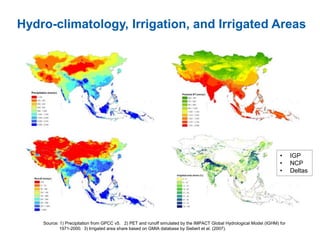
Hydro-climatology, Irrigation, and Irrigated Areas
Source: 1) Precipitation from GPCC v5. 2) PET and runoff simulated by the IMPACT Global Hydrological Model (IGHM) for
1971-2000. 3) Irrigated area share based on GMIA database by Siebert et al. (2007).
• IGP
• NCP
• Deltas
78
80
82
84
86
88
90
1000
1200
1400
1600
1800
2000
2200
2005 2010 2015 2020 2025 2030 2035 2040 2045 2050 2055
Asia - Irrigation consumption World - Irrigation consumption
Asia - Share of irrigation water consumption World - Share of irrigation water consumption
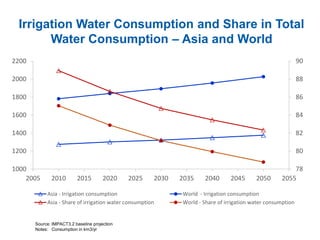
Irrigation Water Consumption and Share in Total
Water Consumption – Asia and World
Source: IMPACT3.2 baseline projection
Notes: Consumption in km3/yr
0
200
400
600
800
1000
1200
2000 2030 2050
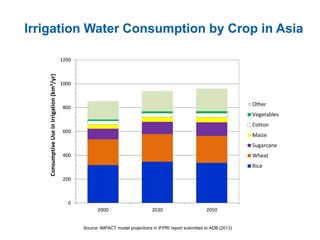
ConsumptiveUseinIrrigation(km3/yr)
Other
Vegetables
Cotton
Maize
Sugarcane
Wheat
Rice
Irrigation Water Consumption by Crop in Asia
Source: IMPACT model projections in IFPRI report submitted to ADB (2013)
0
50
100
150
200
250
2000 2030 2050
ConsumptiveUseinIrrigation(km3/yr)
Other
Soybean
Cotton
Vegetables
Maize
Wheat
Rice
0
50
100
150
200
250
300
350
400
450
500
2000 2030 2050
ConsumptiveUseinIrrigation(km3/yr)
Other
Sub-tropical
fruit
Cotton
Sugarcane
Rice
Wheat
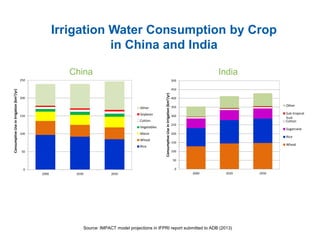
China India
Irrigation Water Consumption by Crop
in China and India
Source: IMPACT model projections in IFPRI report submitted to ADB (2013)
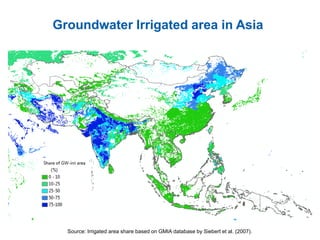
Groundwater Irrigated area in Asia
Source: Irrigated area share based on GMIA database by Siebert et al. (2007).
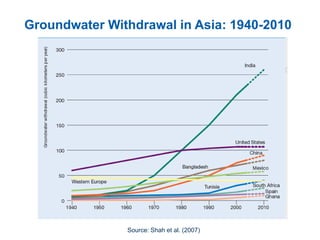
Groundwater Withdrawal in Asia: 1940-2010
Source: Shah et al. (2007)
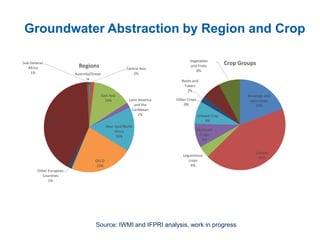
Groundwater Abstraction by Region and Crop
Australia/Ocean
ia
0%
Central Asia
2%
East Asia
14% Latin America
and the
Caribbean
2%
Near East/North
Africa
16%
OECD
23%
Other European
Countries
1%
South Asia
41%
Sub-Saharan
Africa
1%
Regions
Beverage and
spice crops
19%
Cereals
43%
Leguminous
crops
4%
NonFood
Crops
9%
Oilseed Crop
8%
Other Crops
0%
Roots and
Tubers
2%
Sugar
Crops
7%
Vegetables
and Fruits
8%
Crop Groups
Source: IWMI and IFPRI analysis, work in progress
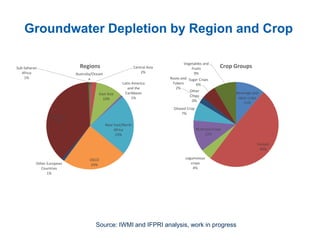
Groundwater Depletion by Region and Crop
Australia/Oceani
a
0%
Central Asia
2%
East Asia
10%
Latin America
and the
Caribbean
1%
Near East/North
Africa
23%
OECD
24%Other European
Countries
1%
South Asia
38%
Sub-Saharan
Africa
1%
Regions
Beverage and
spice crops
11%
Cereals
49%
Leguminous
crops
4%
NonFood Crops
12%
Oilseed Crop
7%
Other
Crops
0%
Roots and
Tubers
2%
Sugar Crops
6%
Vegetables and
Fruits
9%
Crop Groups
Source: IWMI and IFPRI analysis, work in progress
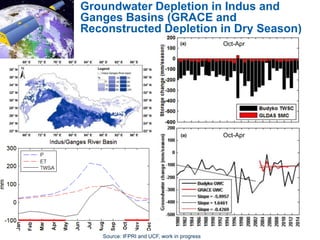
Groundwater Depletion in Indus and
Ganges Basins (GRACE and
Reconstructed Depletion in Dry Season)
Oct-Apr
Oct-Apr
Source: IFPRI and UCF, work in progress
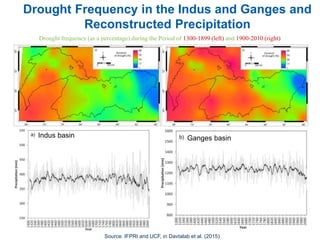
Drought Frequency in the Indus and Ganges and
Reconstructed Precipitation
Drought frequency (as a percentage) during the Period of 1300-1899 (left) and 1900-2010 (right)
Indus basin Ganges basin
Source: IFPRI and UCF, in Davtalab et al. (2015)
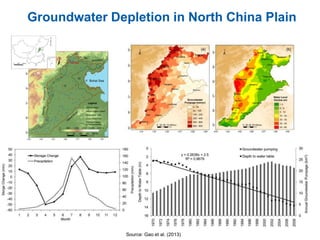
Source: Gao et al. (2013)
Groundwater Depletion in North China Plain
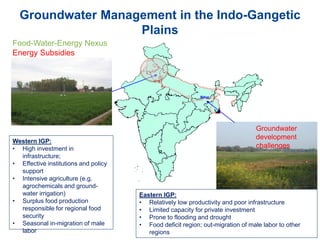
Groundwater Management in the Indo-Gangetic
Plains
Bihar
Western IGP:
• High investment in
infrastructure;
• Effective institutions and policy
support
• Intensive agriculture (e.g.
agrochemicals and ground-
water irrigation)
• Surplus food production
responsible for regional food
security
• Seasonal in-migration of male
labor
Eastern IGP:
• Relatively low productivity and poor infrastructure
• Limited capacity for private investment
• Prone to flooding and drought
• Food deficit region; out-migration of male labor to other
regions
Food-Water-Energy Nexus
Energy Subsidies
Groundwater
development
challenges
Groundwater irrigation Challenges in Eastern IGP
(Vaishali, Bihar)
• Irrigation in Vaishali almost entirely depends on
groundwater; surface water irrigation infrastructure
existing but not functional
• Bihar is an electricity-scarce state; irrigation in
Vaishali has to rely on diesel pumps
• Diesel price is high (~Rs52/l; new pump set
Rs25K~30K)
• Ownership of tubewells and pump sets
• Farmers have little capacity in private investment
• Farmers indicate delayed Monsoon can cause ~80%
production cost increase (rice + wheat)
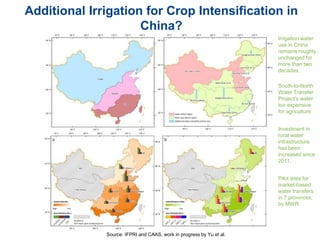
Additional Irrigation for Crop Intensification in
China?
Source: IFPRI and CAAS, work in progress by Yu et al.
Irrigation water
use in China
remains roughly
unchanged for
more than two
decades.
South-to-North
Water Transfer
Project’s water
too expensive
for agriculture.
Investment in
rural water
infrastructure
has been
increased since
2011.
Pilot sites for
market-based
water transfers
in 7 provinces,
by MWR.
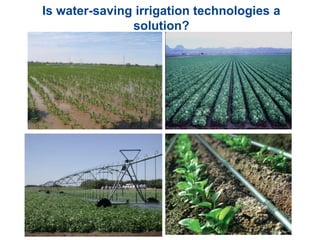
Is water-saving irrigation technologies a
solution?
 Lack of Incentives: Farmers concern economic return
and production risks, not necessarily irrigation water-
saving
 Technologies need to be adapted to local settings
 Technologies need to go hand in hand with agricultural
extension
 Move from water-saving to cost-effectiveness,
including labor-saving, energy-saving, higher yield and
better crop quality, and reduced production risks
 Information and institutional development
Adoption of Irrigation Technologies for Water-
saving in Asia
Conclusions
 Groundwater is critical for agricultural production in Asia,
with increasing withdrawal trends in many countries.
 Depletion of groundwater is a growing challenge to
sustainable water use and agricultural production,
especially in northwestern India and North China Plain.
 Groundwater will become only more important in the
future, with decreasing snowpack (i.e. Himalayas rivers)
and increasing hydroclimatic variability.
 Enhanced monitoring, assessment, and holistic
multisector policies are critical for sustainable
groundwater use and irrigation in Asia.

Tingju Zhu, IFPRI

  • 1.
    Groundwater Use andDepletion in Asia Implications for Irrigated Agriculture Tingju Zhu International Food Policy Research Institute Washington, DC Water Policy for Food Security: A Global Conference, Davis, CA, October 5-6 at UC Davis
  • 2.
     The world'smost populous continent, with 4.4 billion population in 2014  Accounting for 70 percent of the world’s net irrigated area  With 20 million wells, South Asia alone accounts for nearly half of global groundwater used for irrigation  Asia is responsible for the largest share of food production from depleting groundwater, especially in northwestern India and North China Plain  High vulnerability to climate change – Glacier-fed rivers and major river deltas critical for agriculture are to be affected  Growing population and changing to more water- intensive diet Asia – Population, Water, and Agriculture
  • 3.
    Hydro-climatology, Irrigation, andIrrigated Areas Source: 1) Precipitation from GPCC v5. 2) PET and runoff simulated by the IMPACT Global Hydrological Model (IGHM) for 1971-2000. 3) Irrigated area share based on GMIA database by Siebert et al. (2007). • IGP • NCP • Deltas
  • 4.
    78 80 82 84 86 88 90 1000 1200 1400 1600 1800 2000 2200 2005 2010 20152020 2025 2030 2035 2040 2045 2050 2055 Asia - Irrigation consumption World - Irrigation consumption Asia - Share of irrigation water consumption World - Share of irrigation water consumption Irrigation Water Consumption and Share in Total Water Consumption – Asia and World Source: IMPACT3.2 baseline projection Notes: Consumption in km3/yr
  • 5.
    0 200 400 600 800 1000 1200 2000 2030 2050 ConsumptiveUseinIrrigation(km3/yr) Other Vegetables Cotton Maize Sugarcane Wheat Rice IrrigationWater Consumption by Crop in Asia Source: IMPACT model projections in IFPRI report submitted to ADB (2013)
  • 6.
    0 50 100 150 200 250 2000 2030 2050 ConsumptiveUseinIrrigation(km3/yr) Other Soybean Cotton Vegetables Maize Wheat Rice 0 50 100 150 200 250 300 350 400 450 500 20002030 2050 ConsumptiveUseinIrrigation(km3/yr) Other Sub-tropical fruit Cotton Sugarcane Rice Wheat China India Irrigation Water Consumption by Crop in China and India Source: IMPACT model projections in IFPRI report submitted to ADB (2013)
  • 7.
    Groundwater Irrigated areain Asia Source: Irrigated area share based on GMIA database by Siebert et al. (2007).
  • 8.
    Groundwater Withdrawal inAsia: 1940-2010 Source: Shah et al. (2007)
  • 9.
    Groundwater Abstraction byRegion and Crop Australia/Ocean ia 0% Central Asia 2% East Asia 14% Latin America and the Caribbean 2% Near East/North Africa 16% OECD 23% Other European Countries 1% South Asia 41% Sub-Saharan Africa 1% Regions Beverage and spice crops 19% Cereals 43% Leguminous crops 4% NonFood Crops 9% Oilseed Crop 8% Other Crops 0% Roots and Tubers 2% Sugar Crops 7% Vegetables and Fruits 8% Crop Groups Source: IWMI and IFPRI analysis, work in progress
  • 10.
    Groundwater Depletion byRegion and Crop Australia/Oceani a 0% Central Asia 2% East Asia 10% Latin America and the Caribbean 1% Near East/North Africa 23% OECD 24%Other European Countries 1% South Asia 38% Sub-Saharan Africa 1% Regions Beverage and spice crops 11% Cereals 49% Leguminous crops 4% NonFood Crops 12% Oilseed Crop 7% Other Crops 0% Roots and Tubers 2% Sugar Crops 6% Vegetables and Fruits 9% Crop Groups Source: IWMI and IFPRI analysis, work in progress
  • 11.
    Groundwater Depletion inIndus and Ganges Basins (GRACE and Reconstructed Depletion in Dry Season) Oct-Apr Oct-Apr Source: IFPRI and UCF, work in progress
  • 12.
    Drought Frequency inthe Indus and Ganges and Reconstructed Precipitation Drought frequency (as a percentage) during the Period of 1300-1899 (left) and 1900-2010 (right) Indus basin Ganges basin Source: IFPRI and UCF, in Davtalab et al. (2015)
  • 13.
    Source: Gao etal. (2013) Groundwater Depletion in North China Plain
  • 14.
    Groundwater Management inthe Indo-Gangetic Plains Bihar Western IGP: • High investment in infrastructure; • Effective institutions and policy support • Intensive agriculture (e.g. agrochemicals and ground- water irrigation) • Surplus food production responsible for regional food security • Seasonal in-migration of male labor Eastern IGP: • Relatively low productivity and poor infrastructure • Limited capacity for private investment • Prone to flooding and drought • Food deficit region; out-migration of male labor to other regions Food-Water-Energy Nexus Energy Subsidies Groundwater development challenges
  • 15.
    Groundwater irrigation Challengesin Eastern IGP (Vaishali, Bihar) • Irrigation in Vaishali almost entirely depends on groundwater; surface water irrigation infrastructure existing but not functional • Bihar is an electricity-scarce state; irrigation in Vaishali has to rely on diesel pumps • Diesel price is high (~Rs52/l; new pump set Rs25K~30K) • Ownership of tubewells and pump sets • Farmers have little capacity in private investment • Farmers indicate delayed Monsoon can cause ~80% production cost increase (rice + wheat)
  • 16.
    Additional Irrigation forCrop Intensification in China? Source: IFPRI and CAAS, work in progress by Yu et al. Irrigation water use in China remains roughly unchanged for more than two decades. South-to-North Water Transfer Project’s water too expensive for agriculture. Investment in rural water infrastructure has been increased since 2011. Pilot sites for market-based water transfers in 7 provinces, by MWR.
  • 17.
    Is water-saving irrigationtechnologies a solution?
  • 18.
     Lack ofIncentives: Farmers concern economic return and production risks, not necessarily irrigation water- saving  Technologies need to be adapted to local settings  Technologies need to go hand in hand with agricultural extension  Move from water-saving to cost-effectiveness, including labor-saving, energy-saving, higher yield and better crop quality, and reduced production risks  Information and institutional development Adoption of Irrigation Technologies for Water- saving in Asia
  • 19.
    Conclusions  Groundwater iscritical for agricultural production in Asia, with increasing withdrawal trends in many countries.  Depletion of groundwater is a growing challenge to sustainable water use and agricultural production, especially in northwestern India and North China Plain.  Groundwater will become only more important in the future, with decreasing snowpack (i.e. Himalayas rivers) and increasing hydroclimatic variability.  Enhanced monitoring, assessment, and holistic multisector policies are critical for sustainable groundwater use and irrigation in Asia.