Mitigation strategies for livestock in a
global perspective
Meeting on Climate Smart Agriculture
Theun Vellinga, December 1, 2016
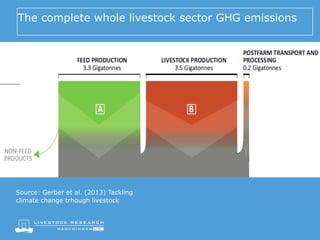
The complete whole livestock sector GHG emissions
Source: Gerber et al. (2013) Tackling
climate change trhough livestock
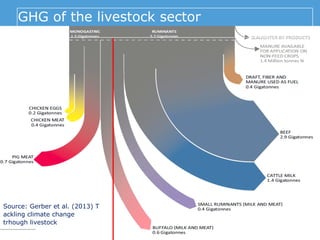
GHG of the livestock sector
Source: Gerber et al. (2013) T
ackling climate change
trhough livestock
DANGER CO2W
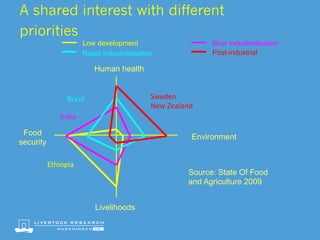
Rapid industrialization
Low development Slow industrialization
Post-industrial
Human health
Livelihoods
Environment
Food
security
A shared interest with different
priorities
Source: State Of Food
and Agriculture 2009
Ethiopia
India
Brazil Sweden
New	Zealand
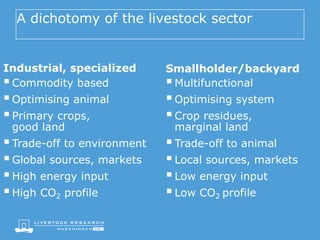
A dichotomy of the livestock sector
Industrial, specialized
§Commodity based
§Optimising animal
§Primary crops,
good land
§Trade-off to environment
§Global sources, markets
§High energy input
§High CO2 profile
Smallholder/backyard
§Multifunctional
§Optimising system
§Crop residues,
marginal land
§Trade-off to animal
§Local sources, markets
§Low energy input
§Low CO2 profile
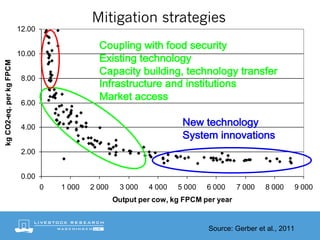
0.00
2.00
4.00
6.00
8.00
10.00
12.00
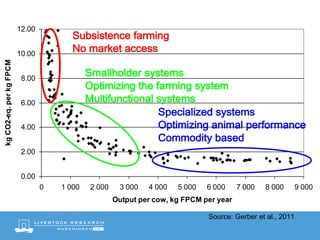
0 1 000 2 000 3 000 4 000 5 000 6 000 7 000 8 000 9 000
Output per cow, kg FPCM per year
kgCO2-eq.perkgFPCM
Smallholder systems
Optimizing the farming system
Multifunctional systems
Subsistence farming
No market access
Specialized systems
Optimizing animal performance
Commodity based
Source: Gerber et al., 2011
0.00
2.00
4.00
6.00
8.00
10.00
12.00
0 1 000 2 000 3 000 4 000 5 000 6 000 7 000 8 000 9 000
Output per cow, kg FPCM per year
kgCO2-eq.perkgFPCM
Coupling with food security
Existing technology
Capacity building, technology transfer
Infrastructure and institutions
Market access
New technology
System innovations
Mitigation strategies
Source: Gerber et al., 2011
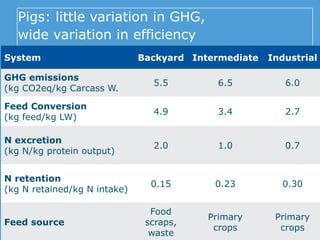
Pigs: little variation in GHG,
wide variation in efficiency
System Backyard Intermediate Industrial
GHG emissions
(kg CO2eq/kg Carcass W.
5.5 6.5 6.0
Feed Conversion
(kg feed/kg LW)
4.9 3.4 2.7
N excretion
(kg N/kg protein output)
2.0 1.0 0.7
N retention
(kg N retained/kg N intake)
0.15 0.23 0.30
Feed source
Food
scraps,
waste
Primary
crops
Primary
crops
Mitigation strategies
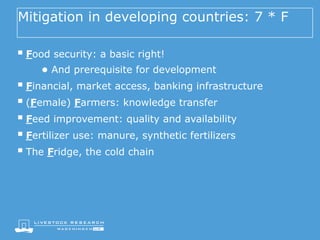
Mitigation in developing countries: 7 * F
§ Food security: a basic right!
● And prerequisite for development
§ Financial, market access, banking infrastructure
§ (Female) Farmers: knowledge transfer
§ Feed improvement: quality and availability
§ Fertilizer use: manure, synthetic fertilizers
§ The Fridge, the cold chain
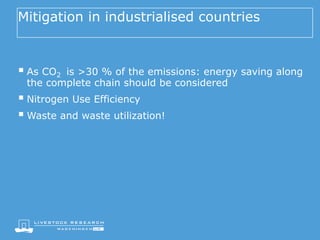
Mitigation in industrialised countries
§ As CO2 is >30 % of the emissions: energy saving along
the complete chain should be considered
§ Nitrogen Use Efficiency
§ Waste and waste utilization!
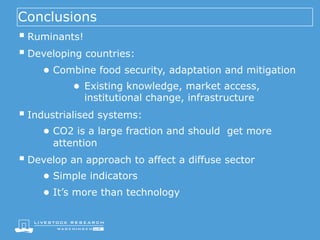
Conclusions
§ Ruminants!
§ Developing countries:
● Combine food security, adaptation and mitigation
● Existing knowledge, market access,
institutional change, infrastructure
§ Industrialised systems:
● CO2 is a large fraction and should get more
attention
§ Develop an approach to affect a diffuse sector
● Simple indicators
● It’s more than technology
Thank you
for listening

Theun Vellinga: Climate-Smart Dairy Webinar

  • 1.
    Mitigation strategies forlivestock in a global perspective Meeting on Climate Smart Agriculture Theun Vellinga, December 1, 2016
  • 2.
    The complete wholelivestock sector GHG emissions Source: Gerber et al. (2013) Tackling climate change trhough livestock
  • 3.
    GHG of thelivestock sector Source: Gerber et al. (2013) T ackling climate change trhough livestock
  • 4.
  • 5.
    Rapid industrialization Low developmentSlow industrialization Post-industrial Human health Livelihoods Environment Food security A shared interest with different priorities Source: State Of Food and Agriculture 2009 Ethiopia India Brazil Sweden New Zealand
  • 6.
    A dichotomy ofthe livestock sector Industrial, specialized §Commodity based §Optimising animal §Primary crops, good land §Trade-off to environment §Global sources, markets §High energy input §High CO2 profile Smallholder/backyard §Multifunctional §Optimising system §Crop residues, marginal land §Trade-off to animal §Local sources, markets §Low energy input §Low CO2 profile
  • 7.
    0.00 2.00 4.00 6.00 8.00 10.00 12.00 0 1 0002 000 3 000 4 000 5 000 6 000 7 000 8 000 9 000 Output per cow, kg FPCM per year kgCO2-eq.perkgFPCM Smallholder systems Optimizing the farming system Multifunctional systems Subsistence farming No market access Specialized systems Optimizing animal performance Commodity based Source: Gerber et al., 2011
  • 8.
    0.00 2.00 4.00 6.00 8.00 10.00 12.00 0 1 0002 000 3 000 4 000 5 000 6 000 7 000 8 000 9 000 Output per cow, kg FPCM per year kgCO2-eq.perkgFPCM Coupling with food security Existing technology Capacity building, technology transfer Infrastructure and institutions Market access New technology System innovations Mitigation strategies Source: Gerber et al., 2011
  • 10.
    Pigs: little variationin GHG, wide variation in efficiency System Backyard Intermediate Industrial GHG emissions (kg CO2eq/kg Carcass W. 5.5 6.5 6.0 Feed Conversion (kg feed/kg LW) 4.9 3.4 2.7 N excretion (kg N/kg protein output) 2.0 1.0 0.7 N retention (kg N retained/kg N intake) 0.15 0.23 0.30 Feed source Food scraps, waste Primary crops Primary crops
  • 11.
  • 12.
    Mitigation in developingcountries: 7 * F § Food security: a basic right! ● And prerequisite for development § Financial, market access, banking infrastructure § (Female) Farmers: knowledge transfer § Feed improvement: quality and availability § Fertilizer use: manure, synthetic fertilizers § The Fridge, the cold chain
  • 13.
    Mitigation in industrialisedcountries § As CO2 is >30 % of the emissions: energy saving along the complete chain should be considered § Nitrogen Use Efficiency § Waste and waste utilization!
  • 14.
    Conclusions § Ruminants! § Developingcountries: ● Combine food security, adaptation and mitigation ● Existing knowledge, market access, institutional change, infrastructure § Industrialised systems: ● CO2 is a large fraction and should get more attention § Develop an approach to affect a diffuse sector ● Simple indicators ● It’s more than technology
  • 15.