Molecular mechanism and physiological functions of clathrin-mediated endocytosis
Harvey T. McMahon & Emmanuel Boucrot
Presented by
Masuma Akter
08/02/17
Clathrin-mediated endocytosis:
 Uptake of material into the cell from the surface using clathrin-coated
vesicles
 It is widely used for the specific uptake of certain substances required
by the cell
 The activated receptor becomes internalised and is transported to late
endosomes and lysosomes for degradation
Clathrin-coated vesicle formation: 5 stages
 Nucleation
 Cargo selection
 Clathrin coat assembly
 Vesicle scission
 Uncoating and clathrin component
recycling
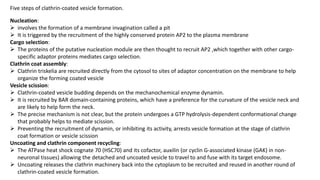
Five steps of clathrin-coated vesicle formation.
Nucleation:
 involves the formation of a membrane invagination called a pit
 It is triggered by the recruitment of the highly conserved protein AP2 to the plasma membrane
Cargo selection:
 The proteins of the putative nucleation module are then thought to recruit AP2 ,which together with other cargo-
specific adaptor proteins mediates cargo selection.
Clathrin coat assembly:
 Clathrin triskelia are recruited directly from the cytosol to sites of adaptor concentration on the membrane to help
organize the forming coated vesicle
Vesicle scission:
 Clathrin-coated vesicle budding depends on the mechanochemical enzyme dynamin.
 It is recruited by BAR domain-containing proteins, which have a preference for the curvature of the vesicle neck and
are likely to help form the neck.
 The precise mechanism is not clear, but the protein undergoes a GTP hydrolysis-dependent conformational change
that probably helps to mediate scission.
 Preventing the recruitment of dynamin, or inhibiting its activity, arrests vesicle formation at the stage of clathrin
coat formation or vesicle scission
Uncoating and clathrin component recycling:
 The ATPase heat shock cognate 70 (HSC70) and its cofactor, auxilin (or cyclin G-associated kinase (GAK) in non-
neuronal tissues) allowing the detached and uncoated vesicle to travel to and fuse with its target endosome.
 Uncoating releases the clathrin machinery back into the cytoplasm to be recruited and reused in another round of
clathrin-coated vesicle formation.
Five steps of clathrin-coated vesicle formation.
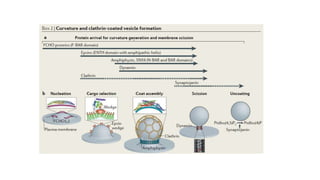
Effects of depletion of different components of the clathrin machinery:
 FCHO protein depletion through RNA interference (RNAi) inhibits AP2 and clathrin recruitment to the plasma membrane
(and both remain diffuse and cytosolic).
 AP2 RNAi abrogates clathrin recruitment to the plasma membrane but not FCHO2 initial focus formation (dense red
spots).
 Clathrin RNAi blocks maturation during cargo selection, when FCHO2 and AP2 are clustered (yellow dots, arrows).
 Dynamin inhibition (by dynasore) blocks clathrin-coated pits at a stage just before membrane scission (white dots,
arrows). AAK, AP2-associated protein kinase 1; ARP2/3, actin-related protein 2/3; DAB2, Disabled homologue 2; HIP1R,
HIP1-related; N-WASP, neural Wiskott–Aldrich syndrome protein; NECAP, adaptin ear-binding coat-associated protein;
SNX9, sorting nexin 9.
Species variations and physiological functions of clathrin-mediated endocytosis:
Clathrin genes: gene expression study in brain cells
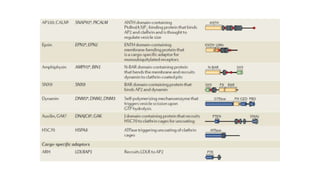
Self-polymerizing protein composed of three heavy and three light chains that form the clathrin triskelion, which can
polymerize into flat lattices or cages
Clathrin genes: gene expression study in brain cells
Self-polymerizing protein composed of three heavy and three light chains that form the clathrin triskelion, which can
polymerize into flat lattices or cages
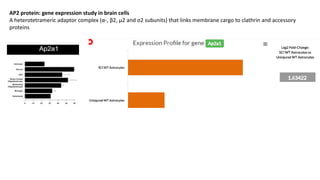
AP2 protein: gene expression study in brain cells
A heterotetrameric adaptor complex (α-, β2, μ2 and σ2 subunits) that links membrane cargo to clathrin and accessory
proteins
Summary and Prospective:
 The importance of clathrin mediated endocytosis (CME) in terms of cognitive function is to recycle synaptic
vesicles after synaptic release, therefore if impaired, CME pathways cause disrupted signalling cascades.
 Neurons with incorrect endocytotic proteins also affect neuronal transmission and endocytosis, which in turn
produce symptoms observed in AD patients. Amyloid Precursor Protein (APP), a type 1 membrane
glycoprotein, is produced in the neuron. If APP is cleaved via the amyloidgenic pathway, by -secertase and -
secretase, A is produced. Amyloid- peptide (A) is noted as the hallmark of Alzheimer’s when produced and
aggregated extracellularly
 A better understanding is required of the initial steps in signal transduction and of the accessory modules that
are associated with clathrin-mediated endocytosis.
 disease proteins pass from cell to cell during the progression of aggregation diseases, such as Alzheimer’s
disease or Huntington’s disease, upregulation of clathrin-mediated endocytosis may promote the degradation
of unwanted material by the cell before it is transmitted.

Receptor mediated internalization

  • 1.
    Molecular mechanism andphysiological functions of clathrin-mediated endocytosis Harvey T. McMahon & Emmanuel Boucrot Presented by Masuma Akter 08/02/17
  • 2.
    Clathrin-mediated endocytosis:  Uptakeof material into the cell from the surface using clathrin-coated vesicles  It is widely used for the specific uptake of certain substances required by the cell  The activated receptor becomes internalised and is transported to late endosomes and lysosomes for degradation
  • 3.
    Clathrin-coated vesicle formation:5 stages  Nucleation  Cargo selection  Clathrin coat assembly  Vesicle scission  Uncoating and clathrin component recycling Five steps of clathrin-coated vesicle formation.
  • 4.
    Nucleation:  involves theformation of a membrane invagination called a pit  It is triggered by the recruitment of the highly conserved protein AP2 to the plasma membrane Cargo selection:  The proteins of the putative nucleation module are then thought to recruit AP2 ,which together with other cargo- specific adaptor proteins mediates cargo selection. Clathrin coat assembly:  Clathrin triskelia are recruited directly from the cytosol to sites of adaptor concentration on the membrane to help organize the forming coated vesicle Vesicle scission:  Clathrin-coated vesicle budding depends on the mechanochemical enzyme dynamin.  It is recruited by BAR domain-containing proteins, which have a preference for the curvature of the vesicle neck and are likely to help form the neck.  The precise mechanism is not clear, but the protein undergoes a GTP hydrolysis-dependent conformational change that probably helps to mediate scission.  Preventing the recruitment of dynamin, or inhibiting its activity, arrests vesicle formation at the stage of clathrin coat formation or vesicle scission Uncoating and clathrin component recycling:  The ATPase heat shock cognate 70 (HSC70) and its cofactor, auxilin (or cyclin G-associated kinase (GAK) in non- neuronal tissues) allowing the detached and uncoated vesicle to travel to and fuse with its target endosome.  Uncoating releases the clathrin machinery back into the cytoplasm to be recruited and reused in another round of clathrin-coated vesicle formation. Five steps of clathrin-coated vesicle formation.
  • 5.
    Effects of depletionof different components of the clathrin machinery:  FCHO protein depletion through RNA interference (RNAi) inhibits AP2 and clathrin recruitment to the plasma membrane (and both remain diffuse and cytosolic).  AP2 RNAi abrogates clathrin recruitment to the plasma membrane but not FCHO2 initial focus formation (dense red spots).  Clathrin RNAi blocks maturation during cargo selection, when FCHO2 and AP2 are clustered (yellow dots, arrows).  Dynamin inhibition (by dynasore) blocks clathrin-coated pits at a stage just before membrane scission (white dots, arrows). AAK, AP2-associated protein kinase 1; ARP2/3, actin-related protein 2/3; DAB2, Disabled homologue 2; HIP1R, HIP1-related; N-WASP, neural Wiskott–Aldrich syndrome protein; NECAP, adaptin ear-binding coat-associated protein; SNX9, sorting nexin 9.
  • 7.
    Species variations andphysiological functions of clathrin-mediated endocytosis:
  • 13.
    Clathrin genes: geneexpression study in brain cells Self-polymerizing protein composed of three heavy and three light chains that form the clathrin triskelion, which can polymerize into flat lattices or cages
  • 14.
    Clathrin genes: geneexpression study in brain cells Self-polymerizing protein composed of three heavy and three light chains that form the clathrin triskelion, which can polymerize into flat lattices or cages
  • 15.
    AP2 protein: geneexpression study in brain cells A heterotetrameric adaptor complex (α-, β2, μ2 and σ2 subunits) that links membrane cargo to clathrin and accessory proteins
  • 16.
    Summary and Prospective: The importance of clathrin mediated endocytosis (CME) in terms of cognitive function is to recycle synaptic vesicles after synaptic release, therefore if impaired, CME pathways cause disrupted signalling cascades.  Neurons with incorrect endocytotic proteins also affect neuronal transmission and endocytosis, which in turn produce symptoms observed in AD patients. Amyloid Precursor Protein (APP), a type 1 membrane glycoprotein, is produced in the neuron. If APP is cleaved via the amyloidgenic pathway, by -secertase and - secretase, A is produced. Amyloid- peptide (A) is noted as the hallmark of Alzheimer’s when produced and aggregated extracellularly  A better understanding is required of the initial steps in signal transduction and of the accessory modules that are associated with clathrin-mediated endocytosis.  disease proteins pass from cell to cell during the progression of aggregation diseases, such as Alzheimer’s disease or Huntington’s disease, upregulation of clathrin-mediated endocytosis may promote the degradation of unwanted material by the cell before it is transmitted.