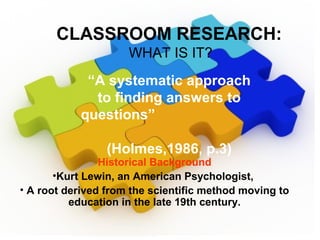
Historical Background
•Kurt Lewin, an American Psychologist,
• A root derived from the scientific method moving to
education in the late 19th century.
CLASSROOM RESEARCH:
WHAT IS IT?
“A systematic approach
to finding answers to
questions”
(Holmes,1986, p.3)
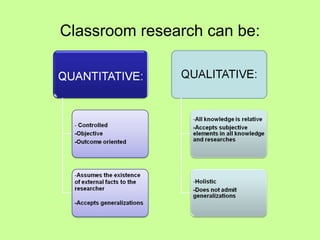
TYPE OF RESEARCH
Classroom research can be:
INSTRUMENTS OF A CLASSROOM
RESEARCH
Needs analysis within classroom research
GROUP’S CONCLUSION
A teacher is running classroom research every time h/she is thinking of designing a
syllabus for a specific course because the data collection instruments should be used to
focus on questions related to who the learners are, why the learners are taking the course,
how they learn, what resources are available, and where and when the ESP course will
take place.
A teacher is running classroom research every time h/she is thinking of designing a
syllabus for a specific course because the data collection instruments should be used to
focus on questions related to who the learners are, why the learners are taking the course,
how they learn, what resources are available, and where and when the ESP course will
take place.
It is necessary that we as teachers develop reflective teaching practices, which help us
to understand the students better as well as to improve the language learning
environment and the view of education through conducting research in our own
classroom.
It is necessary that we as teachers develop reflective teaching practices, which help us
to understand the students better as well as to improve the language learning
environment and the view of education through conducting research in our own
classroom.
Classrooms must be the setting for students to get involved in English
learning and social interaction. That is why, classroom research is an
excellent opportunity to reach this goal.
It is necessary that we ask questions every day about the problem we face,
and take notes about what works and does not with each group of students.
REFERENCE /FURTHER READING
• Allwright, D. & Bailey, K. (1991). Focus on the language classroom: An
introduction to classroom research for language teachers. Cambridge
University Press.
• Chaudron, C. (1988). Second Language Classrooms, Cambridge:
Cambridge University Press.
• Collins, H. (1992). Wide scope analysis: Requirements and feasibility. Study
funded by the Fundacao de Amparo a Pesquisa do Estado de Sao Paulo,
Brasil.whole document.
• Holmes, J. (1986). The teacher as researcher. Sao Paulo: Pontificia
Universidad de Católica de Sao Paulo.
• Hutchinson, T. & Waters, A. (1987). English for Specific Purposes.
Cambridge: Cambridge University PressAllwright, D. (1996). Observation in
the language classroom. London: Longman.
•

Classroom research

  • 1.
    Historical Background •Kurt Lewin,an American Psychologist, • A root derived from the scientific method moving to education in the late 19th century. CLASSROOM RESEARCH: WHAT IS IT? “A systematic approach to finding answers to questions” (Holmes,1986, p.3)
  • 2.
  • 3.
  • 4.
    INSTRUMENTS OF ACLASSROOM RESEARCH
  • 5.
    Needs analysis withinclassroom research
  • 6.
    GROUP’S CONCLUSION A teacheris running classroom research every time h/she is thinking of designing a syllabus for a specific course because the data collection instruments should be used to focus on questions related to who the learners are, why the learners are taking the course, how they learn, what resources are available, and where and when the ESP course will take place. A teacher is running classroom research every time h/she is thinking of designing a syllabus for a specific course because the data collection instruments should be used to focus on questions related to who the learners are, why the learners are taking the course, how they learn, what resources are available, and where and when the ESP course will take place. It is necessary that we as teachers develop reflective teaching practices, which help us to understand the students better as well as to improve the language learning environment and the view of education through conducting research in our own classroom. It is necessary that we as teachers develop reflective teaching practices, which help us to understand the students better as well as to improve the language learning environment and the view of education through conducting research in our own classroom. Classrooms must be the setting for students to get involved in English learning and social interaction. That is why, classroom research is an excellent opportunity to reach this goal. It is necessary that we ask questions every day about the problem we face, and take notes about what works and does not with each group of students.
  • 7.
    REFERENCE /FURTHER READING •Allwright, D. & Bailey, K. (1991). Focus on the language classroom: An introduction to classroom research for language teachers. Cambridge University Press. • Chaudron, C. (1988). Second Language Classrooms, Cambridge: Cambridge University Press. • Collins, H. (1992). Wide scope analysis: Requirements and feasibility. Study funded by the Fundacao de Amparo a Pesquisa do Estado de Sao Paulo, Brasil.whole document. • Holmes, J. (1986). The teacher as researcher. Sao Paulo: Pontificia Universidad de Católica de Sao Paulo. • Hutchinson, T. & Waters, A. (1987). English for Specific Purposes. Cambridge: Cambridge University PressAllwright, D. (1996). Observation in the language classroom. London: Longman. •