CLASSROOM
RESEARCH
Fabio Coelho
English Language Fellow (RELO)
Universitas Negeri Semarang
Reflection and Discussion
When something goes wrong with your
classroom, what do you do?
Reflection and Discussion
What do you already know about action
research or teacher research?
Planning the Project
• Which project should I do?
• What topic should I pick?
How do I Choose my Topic?
• Based on a
problem you have
been facing
• Improvements you
want to make.
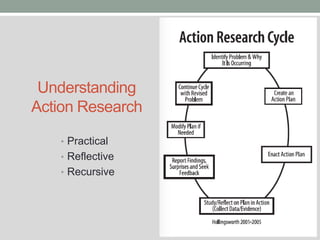
Understanding
Action Research
• Practical
• Reflective
• Recursive
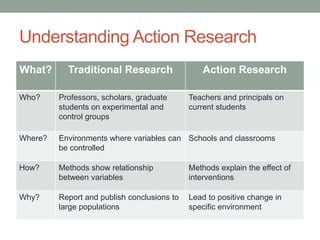
Understanding Action Research
What? Traditional Research Action Research
Who? Professors, scholars, graduate
students on experimental and
control groups
Teachers and principals on
current students
Where? Environments where variables can
be controlled
Schools and classrooms
How? Methods show relationship
between variables
Methods explain the effect of
interventions
Why? Report and publish conclusions to
large populations
Lead to positive change in
specific environment
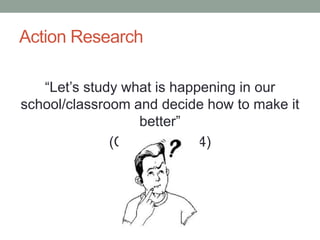
Action Research
“Let’s study what is happening in our
school/classroom and decide how to make it
better”
(Calhoun, 1994)
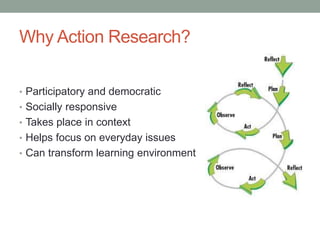
Why Action Research?
• Participatory and democratic
• Socially responsive
• Takes place in context
• Helps focus on everyday issues
• Can transform learning environment
Levels of Action Research
• Individual researcher
• Small groups of
researchers
• Schoolwide research
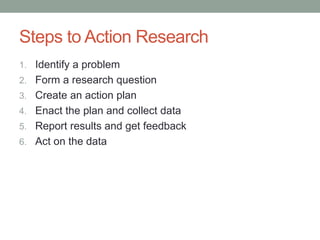
Steps to Action Research
1. Identify a problem
2. Form a research question
3. Create an action plan
4. Enact the plan and collect data
5. Report results and get feedback
6. Act on the data
Identify a Problem
What are some of the common problems I face
when teaching English?
Form a Research Question
• If I (take a certain action), then will students
(demonstrate improvement on the problem)?
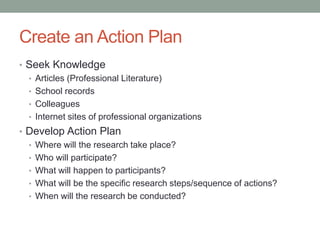
Create an Action Plan
• Seek Knowledge
• Articles (Professional Literature)
• School records
• Colleagues
• Internet sites of professional organizations
• Develop Action Plan
• Where will the research take place?
• Who will participate?
• What will happen to participants?
• What will be the specific research steps/sequence of actions?
• When will the research be conducted?
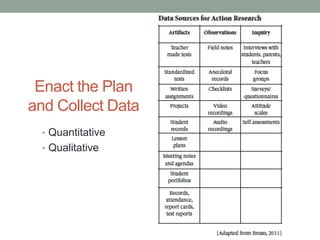
Enact the Plan
and Collect Data
• Quantitative
• Qualitative
Enact the Plan and Collect Data:
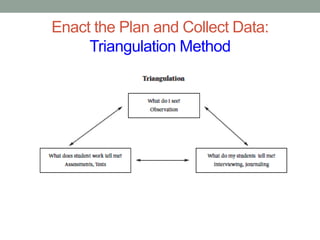
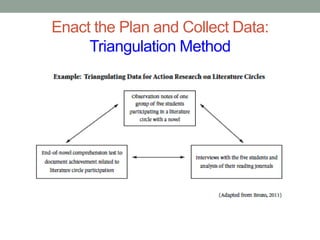
Triangulation Method
• Compensates for imperfection of data gathering tools
• Can increase confidence in results (multiple techniques)
• Can raise follow-up questions (when results fail to match)
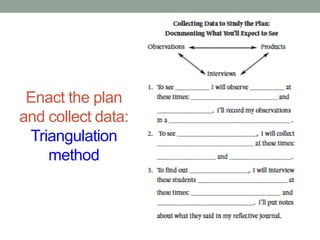
Enact the plan
and collect data:
Triangulation
method
Enact the Plan and Collect Data:
Triangulation Method
Enact the Plan and Collect Data:
Triangulation Method
Report Results and Get Feedback
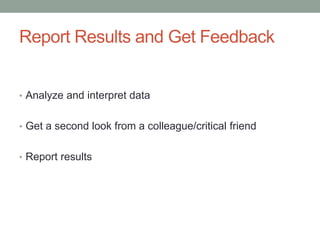
• Analyze and interpret data
• Get a second look from a colleague/critical friend
• Report results
Act on the Evidence
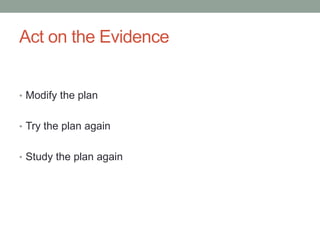
• Modify the plan
• Try the plan again
• Study the plan again
Contact Info
Email address: fabiocoelho.elf@gmail.com
Resources
• Nugent, G.,Malik, S.,Holligsworth, S. (2012). A Practical
Guide to Action Research for Literacy Educators.

Classroom research presentation

  • 1.
    CLASSROOM RESEARCH Fabio Coelho English LanguageFellow (RELO) Universitas Negeri Semarang
  • 2.
    Reflection and Discussion Whensomething goes wrong with your classroom, what do you do?
  • 3.
    Reflection and Discussion Whatdo you already know about action research or teacher research?
  • 4.
    Planning the Project •Which project should I do? • What topic should I pick?
  • 5.
    How do IChoose my Topic? • Based on a problem you have been facing • Improvements you want to make.
  • 6.
  • 7.
    Understanding Action Research What?Traditional Research Action Research Who? Professors, scholars, graduate students on experimental and control groups Teachers and principals on current students Where? Environments where variables can be controlled Schools and classrooms How? Methods show relationship between variables Methods explain the effect of interventions Why? Report and publish conclusions to large populations Lead to positive change in specific environment
  • 8.
    Action Research “Let’s studywhat is happening in our school/classroom and decide how to make it better” (Calhoun, 1994)
  • 9.
    Why Action Research? •Participatory and democratic • Socially responsive • Takes place in context • Helps focus on everyday issues • Can transform learning environment
  • 10.
    Levels of ActionResearch • Individual researcher • Small groups of researchers • Schoolwide research
  • 11.
    Steps to ActionResearch 1. Identify a problem 2. Form a research question 3. Create an action plan 4. Enact the plan and collect data 5. Report results and get feedback 6. Act on the data
  • 12.
    Identify a Problem Whatare some of the common problems I face when teaching English?
  • 13.
    Form a ResearchQuestion • If I (take a certain action), then will students (demonstrate improvement on the problem)?
  • 14.
    Create an ActionPlan • Seek Knowledge • Articles (Professional Literature) • School records • Colleagues • Internet sites of professional organizations • Develop Action Plan • Where will the research take place? • Who will participate? • What will happen to participants? • What will be the specific research steps/sequence of actions? • When will the research be conducted?
  • 15.
    Enact the Plan andCollect Data • Quantitative • Qualitative
  • 16.
    Enact the Planand Collect Data: Triangulation Method • Compensates for imperfection of data gathering tools • Can increase confidence in results (multiple techniques) • Can raise follow-up questions (when results fail to match)
  • 17.
    Enact the plan andcollect data: Triangulation method
  • 18.
    Enact the Planand Collect Data: Triangulation Method
  • 19.
    Enact the Planand Collect Data: Triangulation Method
  • 20.
    Report Results andGet Feedback • Analyze and interpret data • Get a second look from a colleague/critical friend • Report results
  • 21.
    Act on theEvidence • Modify the plan • Try the plan again • Study the plan again
  • 22.
    Contact Info Email address:fabiocoelho.elf@gmail.com
  • 23.
    Resources • Nugent, G.,Malik,S.,Holligsworth, S. (2012). A Practical Guide to Action Research for Literacy Educators.