Lesson Study:
An Uncommon Approach to Common Core


    Jah-Yee Woo and Nicole Knight
     Oakland Unified School District


      Jah-Yee.Woo@ousd.k12.ca.us and Nicole.knight@ousd.k12.ca.us
Understanding Goals
Teachers will...

• understand the lesson study cycle and explore
  ways in which it will support their own inquiry into
  teaching and learning in their classroom/site

• understand an interdisciplinary approach to
  incorporating the Common Core standards into
  their instruction

• understand ways in which teaching argument were
  illuminated by the lesson study cycle.
KWL

• What experience or knowledge do you already
  have about lesson study?

• What are you hoping to learn today?
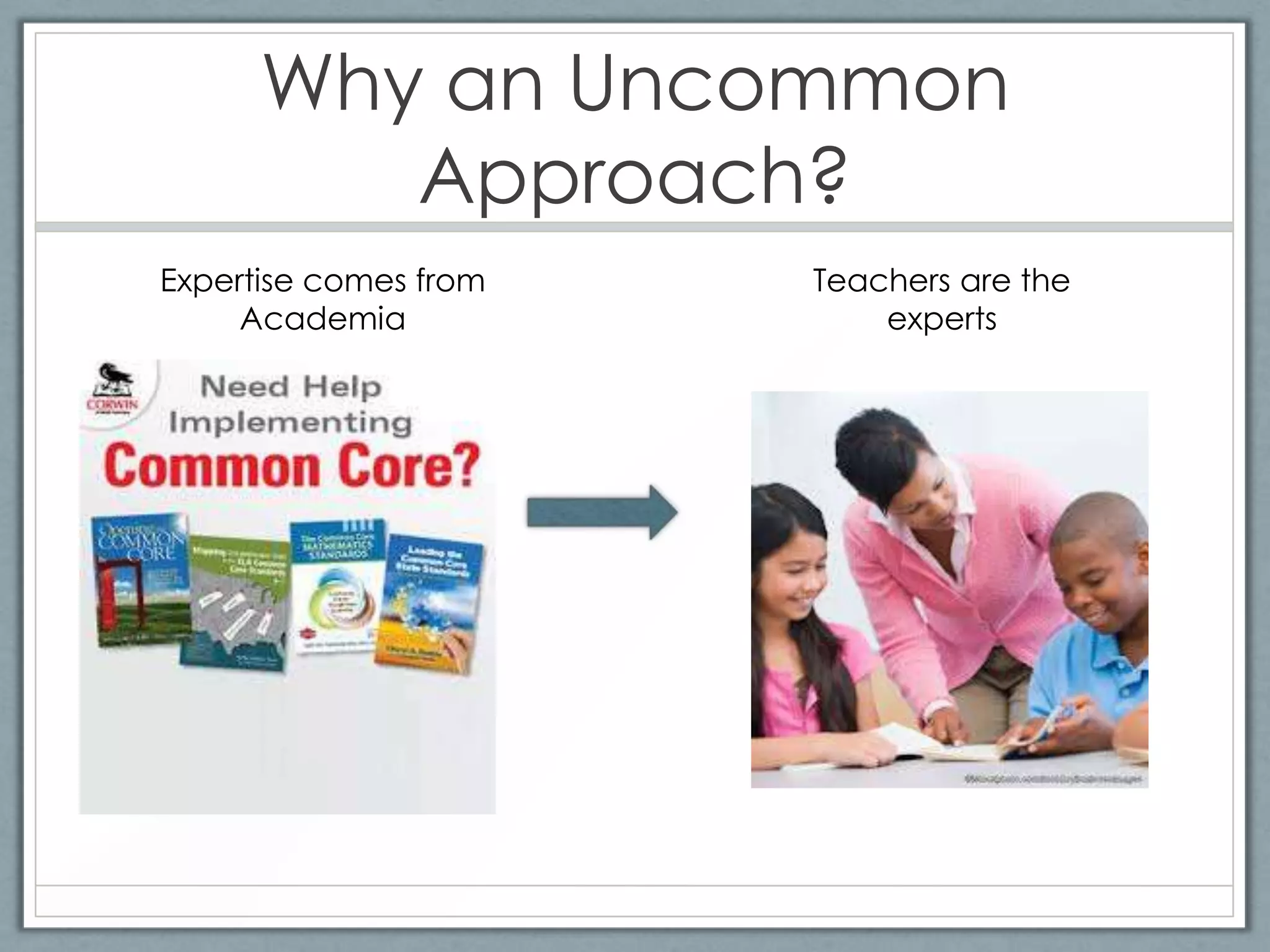
Why an Uncommon
         Approach?
Expertise comes from   Teachers are the
     Academia              experts
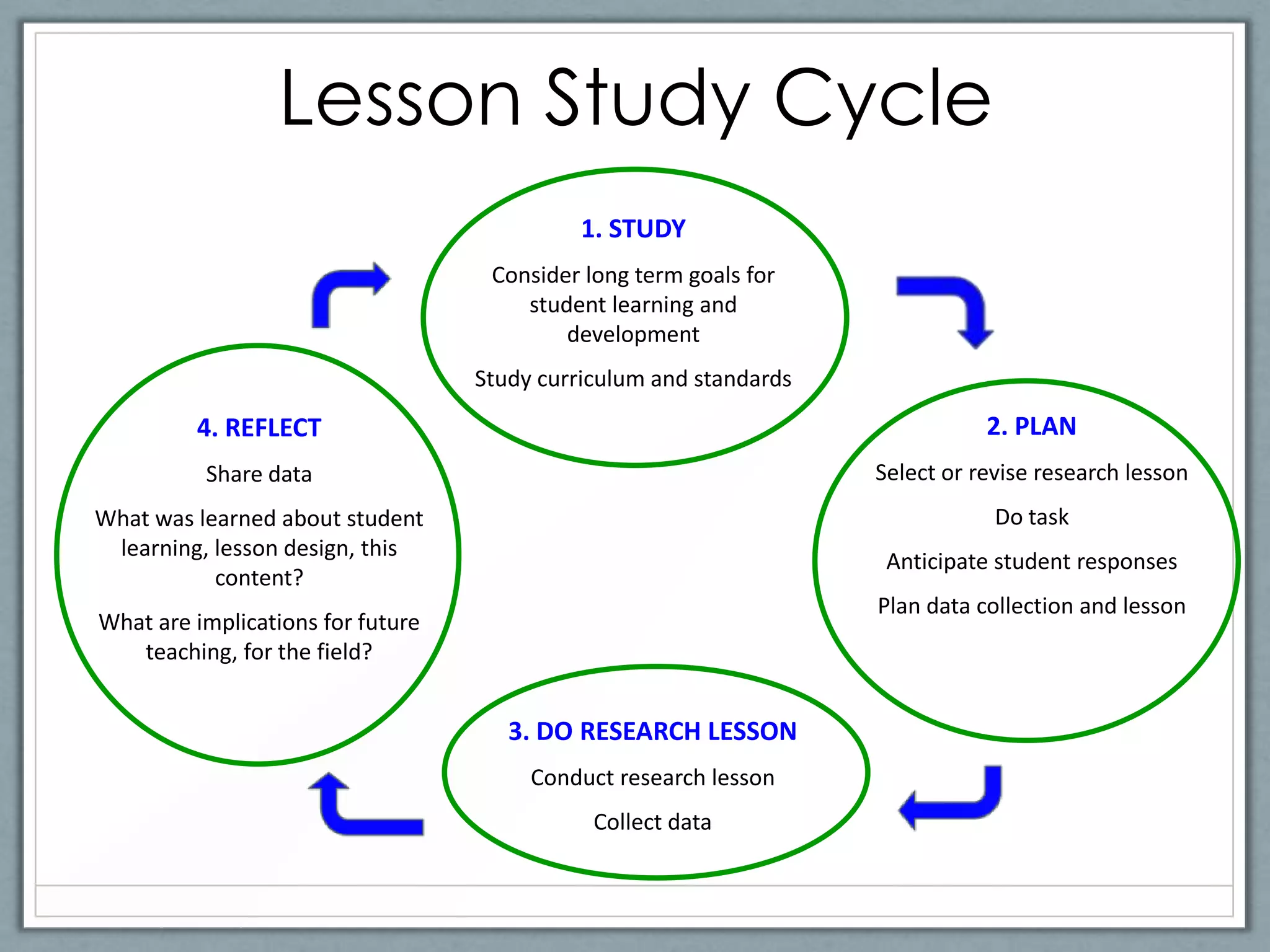
Lesson Study Cycle
                                             1. STUDY
                                    Consider long term goals for
                                       student learning and
                                           development
                                   Study curriculum and standards

         4. REFLECT                                                            2. PLAN
          Share data                                                Select or revise research lesson
What was learned about student                                                  Do task
 learning, lesson design, this
                                                                     Anticipate student responses
           content?
                                                                    Plan data collection and lesson
What are implications for future
   teaching, for the field?


                                      3. DO RESEARCH LESSON
                                        Conduct research lesson
                                              Collect data
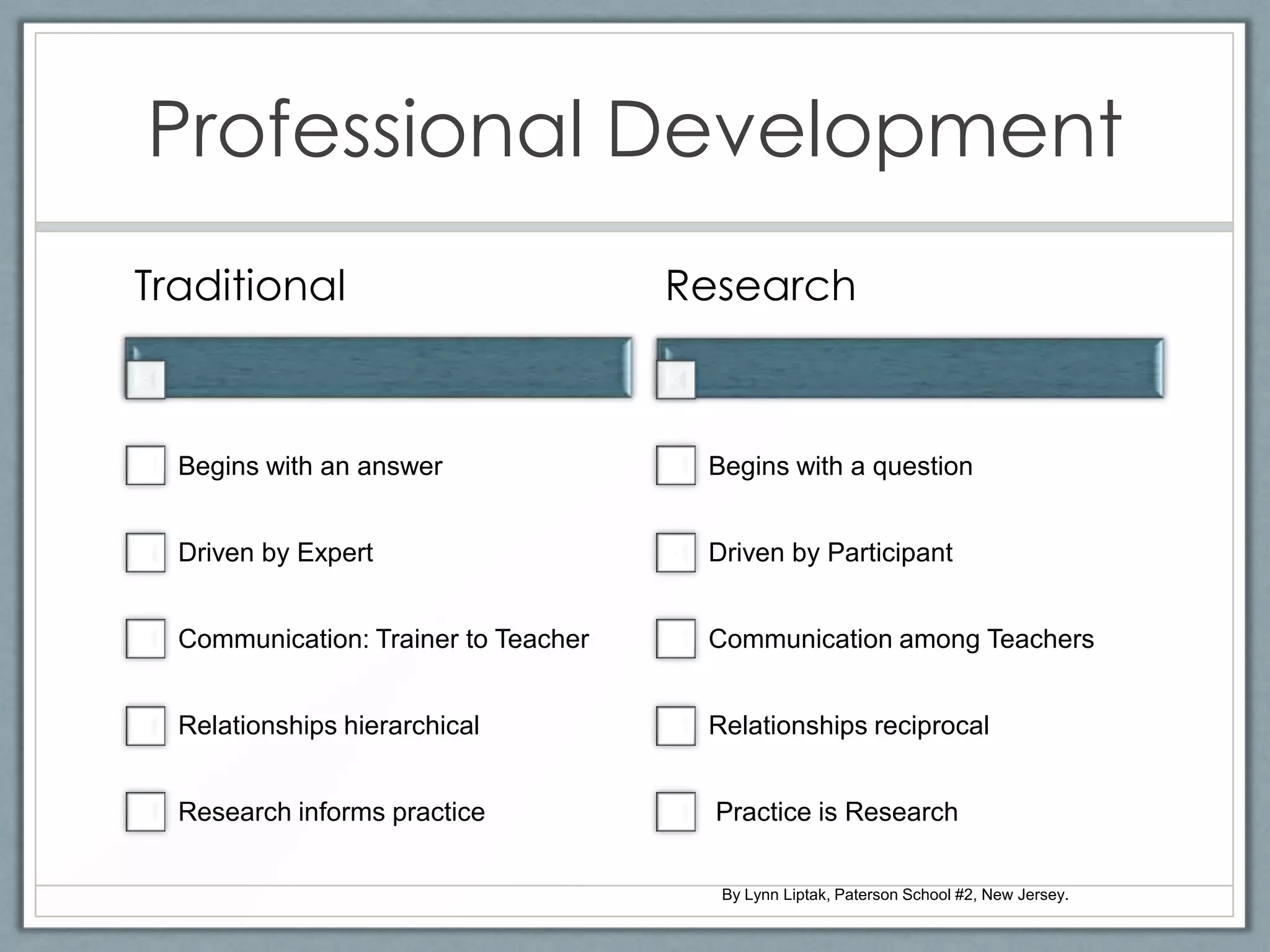
Professional Development
Traditional                           Research


  Begins with an answer                Begins with a question


  Driven by Expert                     Driven by Participant


  Communication: Trainer to Teacher    Communication among Teachers


  Relationships hierarchical           Relationships reciprocal


  Research informs practice             Practice is Research

                                        By Lynn Liptak, Paterson School #2, New Jersey.
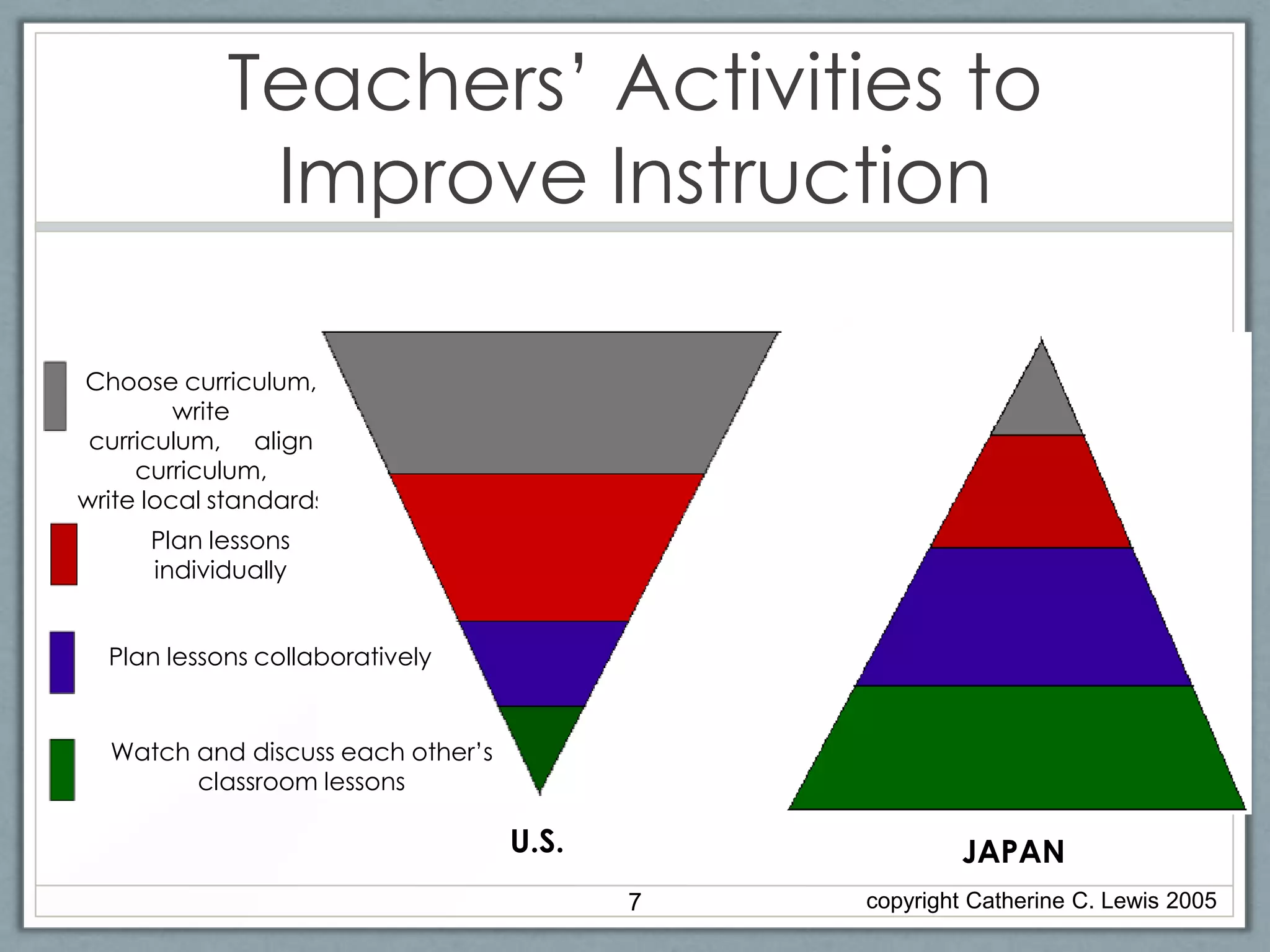
Teachers’ Activities to
             Improve Instruction

Choose curriculum,
         write
 curriculum, align
     curriculum,
write local standards
      Plan lessons
      individually


  Plan lessons collaboratively


  Watch and discuss each other’s
        classroom lessons

                                   U.S.               JAPAN
                                          7   copyright Catherine C. Lewis 2005
Lesson Study in Practice:
      Video Analysis
• What is the student question in each class?
  What are students trying to understand?

• What is the teacher research question in each
  class? What is the teacher trying to
  understand about teaching and learning?
Lesson Study in Practice:
  Connecting to your work
What in this video did you see that supports inquiry
 into teaching and learning? What are teachers
          learning about their practice?

             What questions emerge?

How is this experience similar or different than your
  own professional development experiences?
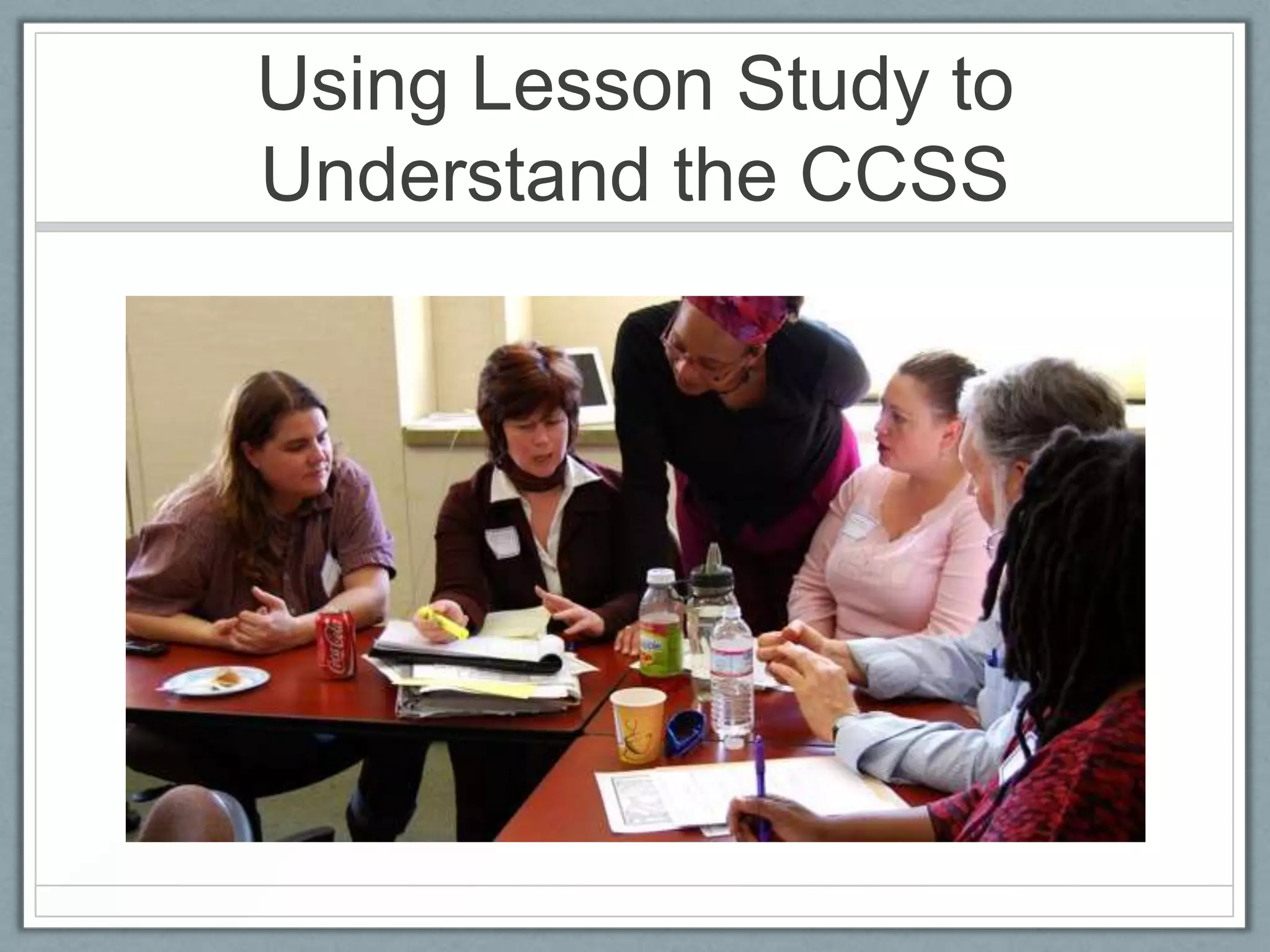
Using Lesson Study to
Understand the CCSS
What are the Common Core
        State Standards?
National set of expectations for student knowledge and skills that
students need to master to succeed in college and career.


Designed by Council of Chief State School Officers and the
National Governors Association for Best Practices, in
collaboration with educational leaders and university partners.


Adopted by CA SBE August 2, 2010


Will officially replace the ELA and Math California State
Standards in 2014-2015, not the History or Science content
standards.
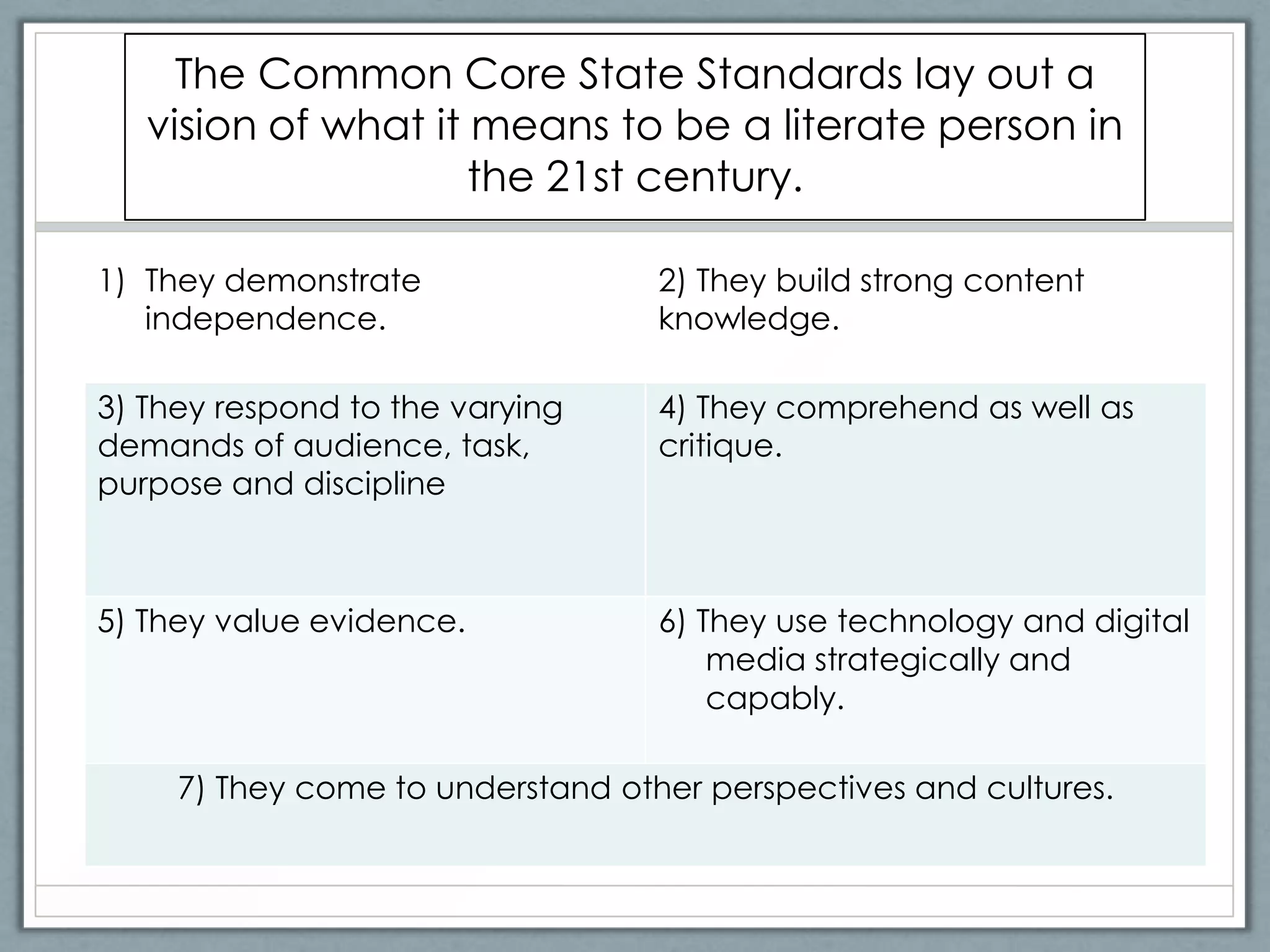
The Common Core State Standards lay out a
   vision of what it means to be a literate person in
                     the 21st century.

1) They demonstrate                2) They build strong content
   independence.                   knowledge.

3) They respond to the varying     4) They comprehend as well as
demands of audience, task,         critique.
purpose and discipline


5) They value evidence.            6) They use technology and digital
                                       media strategically and
                                       capably.

     7) They come to understand other perspectives and cultures.
The Special Place of Argument in the
New Common Core State Standards


Gerald Graff, professor of English and
education, writes that “argument literacy” is
fundamental to being educated. The
university is largely an “argument culture,”

Graff contends; therefore, K–12 schools should
“teach the conflicts” so that students are
adept at understanding and engaging in
argument (both oral and written) when they
enter college.
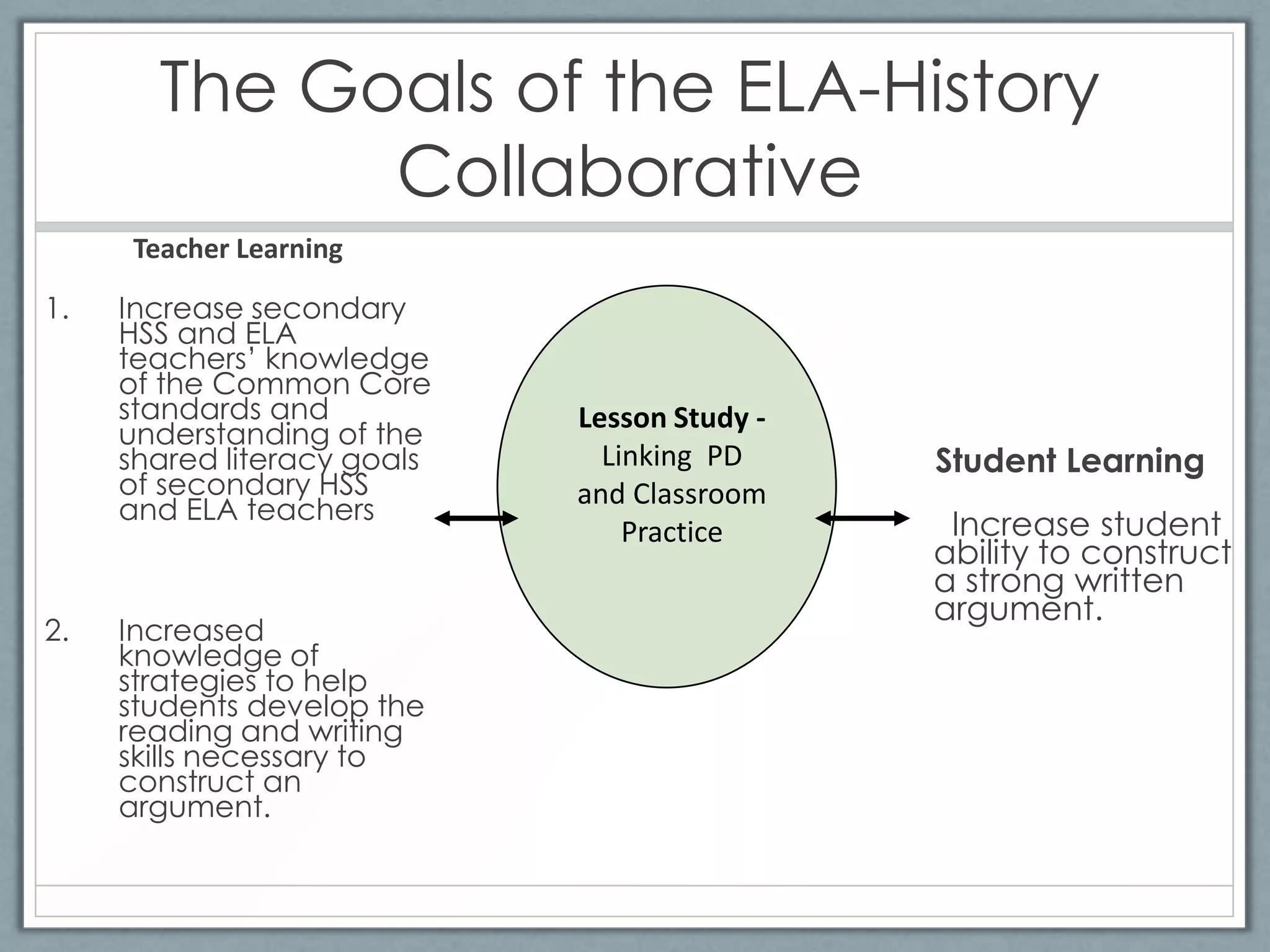
The Goals of the ELA-History
             Collaborative
     Teacher Learning

1.   Increase secondary
     HSS and ELA
     teachers’ knowledge
     of the Common Core
     standards and           Lesson Study -
     understanding of the
     shared literacy goals     Linking PD     Student Learning
     of secondary HSS        and Classroom
     and ELA teachers
                                 Practice      Increase student
                                              ability to construct
                                              a strong written
                                              argument.
2.   Increased
     knowledge of
     strategies to help
     students develop the
     reading and writing
     skills necessary to
     construct an
     argument.
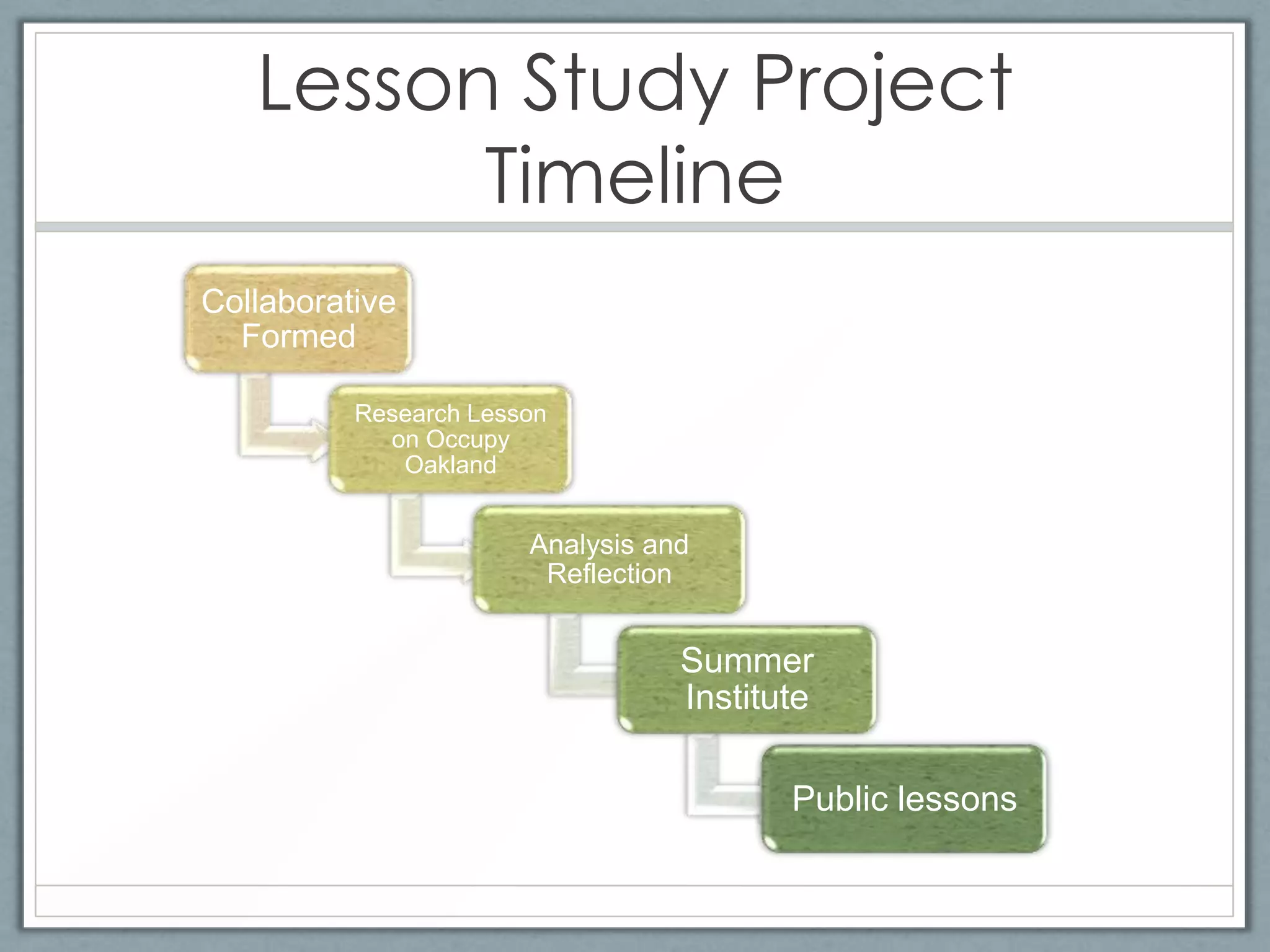
Lesson Study Project
         Timeline
Collaborative
  Formed

          Research Lesson
            on Occupy
             Oakland


                       Analysis and
                        Reflection


                                  Summer
                                  Institute

                                         Public lessons
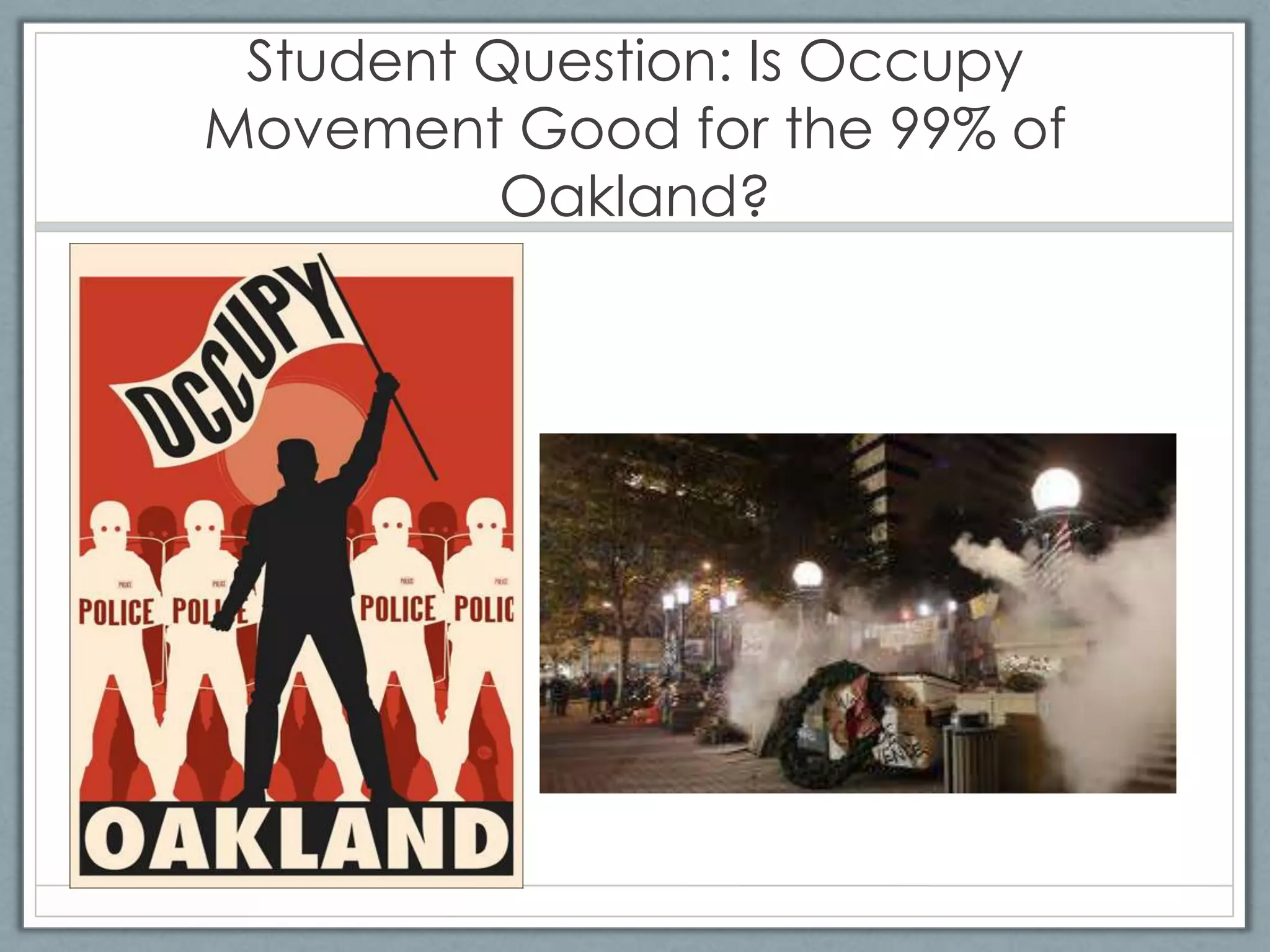
Student Question: Is Occupy
Movement Good for the 99% of
          Oakland?
A Case Study

• Context – Students read 5 documents and write
  an argument-based response in multi-grade
  secondary classrooms
• Teacher Question - To what extent and depth can
  students contrast a range of possibly conflicting
  documents in order to form and support a claim?
• Student Question - What are the main ideas and
  most important points raised by each document?
  What is the bias or point of view of the author/s?
  Is the Occupy Movement good for Oakland?
Occupy Oakland Lesson
         Study Questions
How can we create a sequence of activities in order to write a paragraph
using an evidence sandwich?

When students are provided with sufficient background knowledge, how can
we get them to critically analyze the media?

How can students learn to analyze conflicting points of view?

How can guiding questions lead students to deeper source analysis(as
evidenced by written work, student discussion, etc.)?

How can we help students identify and address conflicting evidence?

How can use use rhetorical appeals as a gauge by which students evaluate
the validity of an argument?

Can instruction of annotating text lead students to writing strong summaries?
New Questions that Emerged
      after Occupy Oakland

•   How does a focus on “frontloading” context, vocabulary and
    conceptual frameworks support student understanding of texts
    and the focus of writing tasks?

•   What classroom structures enhance the role of discussion as a
    key support in helping students move from a close reading of
    texts to comprehension and understanding? How do we both
    structure and encourage the “messiness” of discussion?

•   What graphic organizers can support the development of
    student understanding and analysis, helping to bridge the gap
    between the reading of texts and the development of an
    argument?

•   How does helping students define and understand the relation
    between claim/evidence/argument support their ability to
    develop a thoughtful and coherent argumentative essay?
Lesson Study – Opportunities and
           Challenges
Contacts and Resources to Help
            Get Started
OUSD Teaching American History Grant Website
http://www.teachingamericanhistory.us/index.htm, Stan Pesick, Project
Director, 510 879-8497; stan.pesick@ousd.k12.ca.us
Lesson Study Group at Mills College
http://lessonresearch.net/

Lesson Study Research Group, Teachers College/ Columbia University
http://www.tc.edu/lessonstudy/

Lessons Studied: Lessons Learned - MacComb Intermediate School
District
http://www.misd.net/lessonstudy/process.htm#Introduction

The Lesson Study Project at the University of Wisconsin-La Crosse as part
of the Center for Advancing Teaching & Learning.
http://www.uwlax.edu/sotl/lsp/

An Uncommon Approach to Common Core

  • 1.
    Lesson Study: An UncommonApproach to Common Core Jah-Yee Woo and Nicole Knight Oakland Unified School District Jah-Yee.Woo@ousd.k12.ca.us and Nicole.knight@ousd.k12.ca.us
  • 2.
    Understanding Goals Teachers will... •understand the lesson study cycle and explore ways in which it will support their own inquiry into teaching and learning in their classroom/site • understand an interdisciplinary approach to incorporating the Common Core standards into their instruction • understand ways in which teaching argument were illuminated by the lesson study cycle.
  • 3.
    KWL • What experienceor knowledge do you already have about lesson study? • What are you hoping to learn today?
  • 4.
    Why an Uncommon Approach? Expertise comes from Teachers are the Academia experts
  • 5.
    Lesson Study Cycle 1. STUDY Consider long term goals for student learning and development Study curriculum and standards 4. REFLECT 2. PLAN Share data Select or revise research lesson What was learned about student Do task learning, lesson design, this Anticipate student responses content? Plan data collection and lesson What are implications for future teaching, for the field? 3. DO RESEARCH LESSON Conduct research lesson Collect data
  • 6.
    Professional Development Traditional Research Begins with an answer Begins with a question Driven by Expert Driven by Participant Communication: Trainer to Teacher Communication among Teachers Relationships hierarchical Relationships reciprocal Research informs practice Practice is Research By Lynn Liptak, Paterson School #2, New Jersey.
  • 7.
    Teachers’ Activities to Improve Instruction Choose curriculum, write curriculum, align curriculum, write local standards Plan lessons individually Plan lessons collaboratively Watch and discuss each other’s classroom lessons U.S. JAPAN 7 copyright Catherine C. Lewis 2005
  • 8.
    Lesson Study inPractice: Video Analysis • What is the student question in each class? What are students trying to understand? • What is the teacher research question in each class? What is the teacher trying to understand about teaching and learning?
  • 9.
    Lesson Study inPractice: Connecting to your work What in this video did you see that supports inquiry into teaching and learning? What are teachers learning about their practice? What questions emerge? How is this experience similar or different than your own professional development experiences?
  • 10.
    Using Lesson Studyto Understand the CCSS
  • 11.
    What are theCommon Core State Standards? National set of expectations for student knowledge and skills that students need to master to succeed in college and career. Designed by Council of Chief State School Officers and the National Governors Association for Best Practices, in collaboration with educational leaders and university partners. Adopted by CA SBE August 2, 2010 Will officially replace the ELA and Math California State Standards in 2014-2015, not the History or Science content standards.
  • 12.
    The Common CoreState Standards lay out a vision of what it means to be a literate person in the 21st century. 1) They demonstrate 2) They build strong content independence. knowledge. 3) They respond to the varying 4) They comprehend as well as demands of audience, task, critique. purpose and discipline 5) They value evidence. 6) They use technology and digital media strategically and capably. 7) They come to understand other perspectives and cultures.
  • 13.
    The Special Placeof Argument in the New Common Core State Standards Gerald Graff, professor of English and education, writes that “argument literacy” is fundamental to being educated. The university is largely an “argument culture,” Graff contends; therefore, K–12 schools should “teach the conflicts” so that students are adept at understanding and engaging in argument (both oral and written) when they enter college.
  • 14.
    The Goals ofthe ELA-History Collaborative Teacher Learning 1. Increase secondary HSS and ELA teachers’ knowledge of the Common Core standards and Lesson Study - understanding of the shared literacy goals Linking PD Student Learning of secondary HSS and Classroom and ELA teachers Practice Increase student ability to construct a strong written argument. 2. Increased knowledge of strategies to help students develop the reading and writing skills necessary to construct an argument.
  • 15.
    Lesson Study Project Timeline Collaborative Formed Research Lesson on Occupy Oakland Analysis and Reflection Summer Institute Public lessons
  • 16.
    Student Question: IsOccupy Movement Good for the 99% of Oakland?
  • 17.
    A Case Study •Context – Students read 5 documents and write an argument-based response in multi-grade secondary classrooms • Teacher Question - To what extent and depth can students contrast a range of possibly conflicting documents in order to form and support a claim? • Student Question - What are the main ideas and most important points raised by each document? What is the bias or point of view of the author/s? Is the Occupy Movement good for Oakland?
  • 18.
    Occupy Oakland Lesson Study Questions How can we create a sequence of activities in order to write a paragraph using an evidence sandwich? When students are provided with sufficient background knowledge, how can we get them to critically analyze the media? How can students learn to analyze conflicting points of view? How can guiding questions lead students to deeper source analysis(as evidenced by written work, student discussion, etc.)? How can we help students identify and address conflicting evidence? How can use use rhetorical appeals as a gauge by which students evaluate the validity of an argument? Can instruction of annotating text lead students to writing strong summaries?
  • 19.
    New Questions thatEmerged after Occupy Oakland • How does a focus on “frontloading” context, vocabulary and conceptual frameworks support student understanding of texts and the focus of writing tasks? • What classroom structures enhance the role of discussion as a key support in helping students move from a close reading of texts to comprehension and understanding? How do we both structure and encourage the “messiness” of discussion? • What graphic organizers can support the development of student understanding and analysis, helping to bridge the gap between the reading of texts and the development of an argument? • How does helping students define and understand the relation between claim/evidence/argument support their ability to develop a thoughtful and coherent argumentative essay?
  • 20.
    Lesson Study –Opportunities and Challenges
  • 21.
    Contacts and Resourcesto Help Get Started OUSD Teaching American History Grant Website http://www.teachingamericanhistory.us/index.htm, Stan Pesick, Project Director, 510 879-8497; stan.pesick@ousd.k12.ca.us Lesson Study Group at Mills College http://lessonresearch.net/ Lesson Study Research Group, Teachers College/ Columbia University http://www.tc.edu/lessonstudy/ Lessons Studied: Lessons Learned - MacComb Intermediate School District http://www.misd.net/lessonstudy/process.htm#Introduction The Lesson Study Project at the University of Wisconsin-La Crosse as part of the Center for Advancing Teaching & Learning. http://www.uwlax.edu/sotl/lsp/

Editor's Notes

  • #3 Maybe this is good place for your grouindhog day?
  • #5 Include image and/or text that illustrates how lesson study inverts the paradigm and puts the teacher in the role of the expert. Through lessons study, the practicioners are those that are formulating research questions, gatehring evidence, and drawing conclusions about teachign and learning.
  • #18 Notes: Evidence of learning – were able to have a discussion of unknown terms, students required more documents as background, being provided allowed for teacher to create a structure in order to make a claim, students were able to make a claim supported by documents, some claims more simplistic than others, some were more opinionated without support from documents, students had difficulty capturing conflicting documents in writing except as counterargument or rebuttal; Next Cycle - Revision of research question - keep the question, but revise the lesson; but might split the question into 2 parts, lesson was coming at the documents from a compare/contrast strategy which might not get at the author’s point of view so we need to get better including point of view