CLASSROOM MANAGEMENT FOR –
PEDAGOGIC TRANSACTION
Submitted to,
Mrs Sushma Prabha
Lecturer in natural Science.
Submitted by,
VISAKH.K.R
Submitted on,
25/7/2015
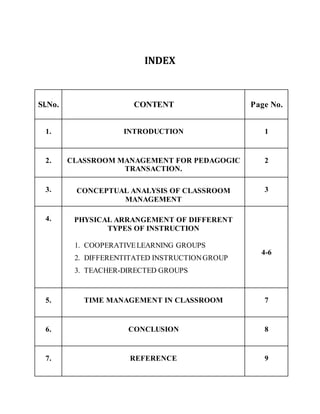
INDEX
Sl.No. CONTENT Page No.
1. INTRODUCTION 1
2. CLASSROOM MANAGEMENT FOR PEDAGOGIC
TRANSACTION.
2
3. CONCEPTUAL ANALYSIS OF CLASSROOM
MANAGEMENT
3
4. PHYSICAL ARRANGEMENT OF DIFFERENT
TYPES OF INSTRUCTION
1. COOPERATIVELEARNING GROUPS
2. DIFFERENTITATED INSTRUCTIONGROUP
3. TEACHER-DIRECTED GROUPS
4-6
5. TIME MANAGEMENT IN CLASSROOM 7
6. CONCLUSION 8
7. REFERENCE 9
INTRODUCTION
Classroom management is a term used by teachers to describe the process
of ensuring that classroom lessons run smoothly despite disruptive behavior by
students. The term also implies the prevention of disruptive behavior. It is possibly
the most difficult aspect of teaching for many teachers, indeed experiencing
problems in this areas causes some to leave teaching altogether. Classroom
management of student conduct are skills that teachers acquire and hone over time.
These skills almost never “jell” until after a minimum of few years of teaching
experience. To be sure, effective teaching requires considerable skill in managing
the myriad of tasks and situations that occur in the classroom each day.
CLASSROOM MANAGEMENT FOR PEDAGOGIC
TRANSACTION.
 Conceptual analysis of classroommanagement.
 Physical arrangement of different types of instruction
 Time management in classroom.
CONCEPTUAL ANALYSIS OF CLASSROOM
MANAGEMENT
The classroom management refers to a process that teachers guarantee the
classroom instruction, the order the effectiveness, deal with some matters, and
arrange the time and space, and some other factors. The traditional viewpoint was
that, the purpose of classroom management is to deal with student’s misbehavior.
In fact, the significance of classroom management and discipline cannot be equal;
the significance of the former is more widespread than the latter one. The
classroom management refers to managing the student, studying in classroom, the
teacher and student’s behavior and the activity; it is the way teachers organize what
goes on in the classroom. It contributes directly to the efficiency of teaching and
learning as the most effective activities can be made almost useless if the teacher
does not organize them efficiently. But discipline has different meanings. In other
words, the teacher adopts certain methods and measures to deal with student’s
misbehavior issues.
PHYSICAL ARRANGEMENT OF DIFFERENT TYPES
OF INSTRUCTION
More frequently a focus in earlier studies of classroom environment, the
physical environment has continued to appear in contemporary studies as an
influence on behavioral and academic outcomes. Current studies of the physical
environment have investigated aspects such as class composition, class size, and
classroom management. Class composition studies examine classroom grouping
methods, including ability grouping of students, single-sex classrooms and
cooperative learning groups. Research has found that classrooms with highly
cooperative groups appear to have students with more positive perceptions of
fairness in grading, stronger class cohesion, and higher degree of social support, as
well as higher achievement scores. Female students have been found to prefer
collaborating wit other students when studying and resolving problems and they
have a stonger preference for teacher support than male students. The primary
school environments tend to use collaborative strategies more frequently and have
higher levels of teacher involvement and support than is found in secondary
schools. Research on single-sex classrooms has been more divided in terms of
academic outcome research. Some studies found that girls do better in math ans
science particularly when separated from male students; other studies found no
achievement differences between genders when either in single-sex or mixed-sex
classrooms. Studies about class size have examined how class size influences
student and teacher behaviors. In general, smaller classes are associated with
students who are less stressed and are more frequently on-task with fewer reported
behavior problems than students in larger classes. Although teachers tend to use
similar instructional strategies whether teaching large or small classes, there is
some evidence to suggest that more class time is spent on administrative tasks for
larger classes, leaving less time available for instruction. Some research has
suggested that differences in academic outcomes based on class size are due to
differences in student behaviors. Overcrowded facilities, too many students in
certain classes, and lack of teacher’s assistants are three major issues cited as
potentially creating problems due to increased stress levels of students and
increased teacher-reported incidences of behavioral problems. These increased
stress levels and behavior problems found in larger classrooms are frequently
accompanied by lower levels of academic achievement. Teacher-to-child ratios are
also of interest to many researchers because the number of reported behavioral
problems seems to increase as class size increases. Many researchers have
observed that large classes, with 30 or more students, tend to have a larger number
of students off task more often with fewer students engaged with the teacher than
children in small classes of 20 students or less. Yet there may be a social cost for
students in small classes; other researchers found that smaller classes also had high
incidences of children engaging in a social and exclusionary behavior. Whether
students are engaging in on-task or disruptive behavior can also be influenced by
effective classroom management instructions and consistency of teacher
enforcement.
Teachers arrange their classrooms based on a number of factors. Most of the
time, a teacher has to randomly arrange the students when the school year starts.
After the teacher gets to know the students, she has several options for grouping
that will suit her lesions and increase student engagement.
1. Cooperative Learning Groups
In this type of classroom arrangement, the teacher can place four student
desks together or use tables so that students know which group they’re in. A
heterogeneous group will consist of a high achieving student, a high average
student, a low average student and a lower achieving student. Teachers can go
by grades or use another measurement, such as effort put forth in class. When
the teacher is signs group work, the idea is that children of higher achievement
will help those with lower achievement. After each grading period the teacher
should assess her students’ achievement levels and place them in different
cooperative learning groups as needed.
2. Differentiated Instruction Groups
Here students should be placed in groups of four, dividing students who
are of similar ability levels so that the teacher can modify work as needed. For
instance, the teacher might assign a reading assignment that’s more advanced to
her students with higher reading levels an a modified assignment to her
struggling readers. Students can be grouped, by interests and ways of learning.
Here Howard Gardner’s eight multiple intelligences visual/spatial,
interpersonal, intrapersonal, mathematical/logical, kinesthetic, naturalist
musical and linguistic are taken into account. Teachers can determine how their
students each learn best and place them with students with similar learning
styles. She should modify her assessments so that students can complete a
project that complements their personal learning styles.
3. Teacher-Directed Groups
Teachers can arrange the classroomto meet their objectives, too. For
instance, at the beginning of the year, the teacher might arrange students
alphabetically so that she can easily take attendance and learn names. An at risk
classroom, or one with multiple behavior issues, might benefit from student
grouping that works to keep students with behavior problems away from each
other.
TIME MANAGEMENT IN CLASSROOM
Teachers can use time management in the classroom to opportunities for
students. When we think of the concept ‘time’ with regard to learning we often
think of pace, in other words, moving quickly through the planned learning
activities. But it’s easy to think that pace means having to rush though an activity,
which sometimes can be a mistake face needs to be appropriate: the learning needs
to proceed briskly, but not be rushed. When considering effective time
management in the classroom as a means of making learning most effective for
students, progression needs to be planned for as well as pace. Progression means
that students are able to move through specific activities making cognitive progress
as they go. Cognitive progress mean that students know more, understand concepts
better, can use what they know in different contexts, or more from lower order
thinking to higher order thinking.
CONCLUSION
Educates have been aware that behavior – problems can keep students from
experiencing the benefits of a productive classroom. Decisions that teachers make
before the beginning of school regarding how the classroom will operate and how
students will interact with others during the school year are critical for a positive
learning environment. Those decisions will have far reaching implications for the
success of the year. Putting together a cohesive plan rather that reaching for
interruptive situations allows time for the teacher to respond thoughtfully when
problems arise. Having time to think about a plan first establishes a foundation for
values and beliefs about working with children and allows teachers to create a
satisfying learning environment.
REFERENCE
 http://en.m.wikipedia.org/
 www.projecfidoalonline.org

Online assignment

  • 1.
    CLASSROOM MANAGEMENT FOR– PEDAGOGIC TRANSACTION Submitted to, Mrs Sushma Prabha Lecturer in natural Science. Submitted by, VISAKH.K.R Submitted on, 25/7/2015
  • 2.
    INDEX Sl.No. CONTENT PageNo. 1. INTRODUCTION 1 2. CLASSROOM MANAGEMENT FOR PEDAGOGIC TRANSACTION. 2 3. CONCEPTUAL ANALYSIS OF CLASSROOM MANAGEMENT 3 4. PHYSICAL ARRANGEMENT OF DIFFERENT TYPES OF INSTRUCTION 1. COOPERATIVELEARNING GROUPS 2. DIFFERENTITATED INSTRUCTIONGROUP 3. TEACHER-DIRECTED GROUPS 4-6 5. TIME MANAGEMENT IN CLASSROOM 7 6. CONCLUSION 8 7. REFERENCE 9
  • 3.
    INTRODUCTION Classroom management isa term used by teachers to describe the process of ensuring that classroom lessons run smoothly despite disruptive behavior by students. The term also implies the prevention of disruptive behavior. It is possibly the most difficult aspect of teaching for many teachers, indeed experiencing problems in this areas causes some to leave teaching altogether. Classroom management of student conduct are skills that teachers acquire and hone over time. These skills almost never “jell” until after a minimum of few years of teaching experience. To be sure, effective teaching requires considerable skill in managing the myriad of tasks and situations that occur in the classroom each day.
  • 4.
    CLASSROOM MANAGEMENT FORPEDAGOGIC TRANSACTION.  Conceptual analysis of classroommanagement.  Physical arrangement of different types of instruction  Time management in classroom.
  • 5.
    CONCEPTUAL ANALYSIS OFCLASSROOM MANAGEMENT The classroom management refers to a process that teachers guarantee the classroom instruction, the order the effectiveness, deal with some matters, and arrange the time and space, and some other factors. The traditional viewpoint was that, the purpose of classroom management is to deal with student’s misbehavior. In fact, the significance of classroom management and discipline cannot be equal; the significance of the former is more widespread than the latter one. The classroom management refers to managing the student, studying in classroom, the teacher and student’s behavior and the activity; it is the way teachers organize what goes on in the classroom. It contributes directly to the efficiency of teaching and learning as the most effective activities can be made almost useless if the teacher does not organize them efficiently. But discipline has different meanings. In other words, the teacher adopts certain methods and measures to deal with student’s misbehavior issues.
  • 6.
    PHYSICAL ARRANGEMENT OFDIFFERENT TYPES OF INSTRUCTION More frequently a focus in earlier studies of classroom environment, the physical environment has continued to appear in contemporary studies as an influence on behavioral and academic outcomes. Current studies of the physical environment have investigated aspects such as class composition, class size, and classroom management. Class composition studies examine classroom grouping methods, including ability grouping of students, single-sex classrooms and cooperative learning groups. Research has found that classrooms with highly cooperative groups appear to have students with more positive perceptions of fairness in grading, stronger class cohesion, and higher degree of social support, as well as higher achievement scores. Female students have been found to prefer collaborating wit other students when studying and resolving problems and they have a stonger preference for teacher support than male students. The primary school environments tend to use collaborative strategies more frequently and have higher levels of teacher involvement and support than is found in secondary schools. Research on single-sex classrooms has been more divided in terms of academic outcome research. Some studies found that girls do better in math ans science particularly when separated from male students; other studies found no achievement differences between genders when either in single-sex or mixed-sex classrooms. Studies about class size have examined how class size influences student and teacher behaviors. In general, smaller classes are associated with students who are less stressed and are more frequently on-task with fewer reported behavior problems than students in larger classes. Although teachers tend to use similar instructional strategies whether teaching large or small classes, there is some evidence to suggest that more class time is spent on administrative tasks for larger classes, leaving less time available for instruction. Some research has suggested that differences in academic outcomes based on class size are due to differences in student behaviors. Overcrowded facilities, too many students in certain classes, and lack of teacher’s assistants are three major issues cited as potentially creating problems due to increased stress levels of students and increased teacher-reported incidences of behavioral problems. These increased stress levels and behavior problems found in larger classrooms are frequently
  • 7.
    accompanied by lowerlevels of academic achievement. Teacher-to-child ratios are also of interest to many researchers because the number of reported behavioral problems seems to increase as class size increases. Many researchers have observed that large classes, with 30 or more students, tend to have a larger number of students off task more often with fewer students engaged with the teacher than children in small classes of 20 students or less. Yet there may be a social cost for students in small classes; other researchers found that smaller classes also had high incidences of children engaging in a social and exclusionary behavior. Whether students are engaging in on-task or disruptive behavior can also be influenced by effective classroom management instructions and consistency of teacher enforcement. Teachers arrange their classrooms based on a number of factors. Most of the time, a teacher has to randomly arrange the students when the school year starts. After the teacher gets to know the students, she has several options for grouping that will suit her lesions and increase student engagement. 1. Cooperative Learning Groups In this type of classroom arrangement, the teacher can place four student desks together or use tables so that students know which group they’re in. A heterogeneous group will consist of a high achieving student, a high average student, a low average student and a lower achieving student. Teachers can go by grades or use another measurement, such as effort put forth in class. When the teacher is signs group work, the idea is that children of higher achievement will help those with lower achievement. After each grading period the teacher should assess her students’ achievement levels and place them in different cooperative learning groups as needed. 2. Differentiated Instruction Groups Here students should be placed in groups of four, dividing students who are of similar ability levels so that the teacher can modify work as needed. For instance, the teacher might assign a reading assignment that’s more advanced to her students with higher reading levels an a modified assignment to her struggling readers. Students can be grouped, by interests and ways of learning. Here Howard Gardner’s eight multiple intelligences visual/spatial,
  • 8.
    interpersonal, intrapersonal, mathematical/logical,kinesthetic, naturalist musical and linguistic are taken into account. Teachers can determine how their students each learn best and place them with students with similar learning styles. She should modify her assessments so that students can complete a project that complements their personal learning styles. 3. Teacher-Directed Groups Teachers can arrange the classroomto meet their objectives, too. For instance, at the beginning of the year, the teacher might arrange students alphabetically so that she can easily take attendance and learn names. An at risk classroom, or one with multiple behavior issues, might benefit from student grouping that works to keep students with behavior problems away from each other.
  • 9.
    TIME MANAGEMENT INCLASSROOM Teachers can use time management in the classroom to opportunities for students. When we think of the concept ‘time’ with regard to learning we often think of pace, in other words, moving quickly through the planned learning activities. But it’s easy to think that pace means having to rush though an activity, which sometimes can be a mistake face needs to be appropriate: the learning needs to proceed briskly, but not be rushed. When considering effective time management in the classroom as a means of making learning most effective for students, progression needs to be planned for as well as pace. Progression means that students are able to move through specific activities making cognitive progress as they go. Cognitive progress mean that students know more, understand concepts better, can use what they know in different contexts, or more from lower order thinking to higher order thinking.
  • 10.
    CONCLUSION Educates have beenaware that behavior – problems can keep students from experiencing the benefits of a productive classroom. Decisions that teachers make before the beginning of school regarding how the classroom will operate and how students will interact with others during the school year are critical for a positive learning environment. Those decisions will have far reaching implications for the success of the year. Putting together a cohesive plan rather that reaching for interruptive situations allows time for the teacher to respond thoughtfully when problems arise. Having time to think about a plan first establishes a foundation for values and beliefs about working with children and allows teachers to create a satisfying learning environment.
  • 11.