Classroom Management
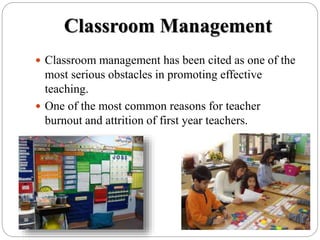
 Classroom management has been cited as one of the
most serious obstacles in promoting effective
teaching.
 One of the most common reasons for teacher
burnout and attrition of first year teachers.
The Problem
 Classroom management is directly linked to student
academic achievement, teacher efficacy, and student
behavior.
Effective Classroom Management
Classroom Management is maintaining order in the
classroom
 Teachers need to create an environment that
promotes learning.
 Teachers are responsible for helping students
manage and direct their own learning.
Why it Works?
Importance of Planning
 Effective classrooms display clearly understood and
monitored rules and procedures.
 Student expectations are explained and implemented.
 The physical space of the classroom is organized and
uncluttered.
 When teachers plan carefullly disruptions are likely to
occur.
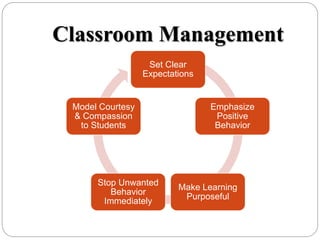
Classroom Management
Set Clear
Expectations
Emphasize
Positive
Behavior
Make Learning
Purposeful
Stop Unwanted
Behavior
Immediately
Model Courtesy
& Compassion
to Students
Ineffective Classroom Management
 No child left behind
makes all student
scores in regards to
state testing
accountable.
 Discipline students
need to be monitored
and discipline needs
to be maintained in
the classroom.
 This makes it hard for
some teachers and
requires good
planning.
The Don’ts of Classroom Management
 Do not publicly discipline a student as this will lead
more off task behaviors.
 Do not lose control of your emotions as they will
learn what buttons of yours to push.
 Only refer students with disciplinary referrals for
major infractions as you are handing over your
problem to someone else.
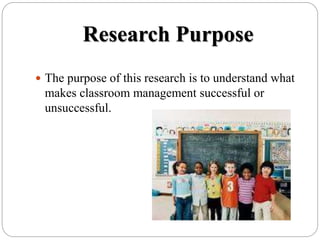
Research Purpose
 The purpose of this research is to understand what
makes classroom management successful or
unsuccessful.
Significance of Study
 This research is important to determine if the lack of
good classroom management has a significant
impact on teacher effectiveness and student learning.
 This is important to demonstrate to teachers that they
need to plan out their instruction and be monitor
student behavior in the classroom.
 Teachers will benefit from this research as they will
see that classroom management is conducive to
learning.
Summary
What we found:
 Effective classroom strategies lead to control of your
classroom where disruptions are likely to occur.
 Ineffective classroom strategies lead to a loss of
control in your classroom and may lead to teacher
burnout.
Bibliography
 Classroom Management Teacher Modules. Retrieved from:
http://www.apa.org/education/k12/classroom-mgmt.aspx
 Conscious Classroom Management [video file]. Retrieved
from:
http://www.youtube.com/watch?v=ZCGWzMft1C8&featur
e=related
 Gabriel, J. G. (n.d.) Top 12 Classroom Management Dos
and Don’ts. Retrieved from:
http://www.teachhub.com/news/article/cat/14/item/17
 Holloway, J. (2009). How NCLB Has Ruined Classroom
Management. Retrieved from:
http://www.associatedcontent.com/article/1606666/how_nc
lb_has_ruined_classroom_management.html
 Kauchak, D. & Eggen, P. (2005) Introduction to Teaching.
2nd ed. Upper Saddle River, NJ, Pearson Education, Inc.

Classroom management

  • 1.
  • 2.
    Classroom Management  Classroommanagement has been cited as one of the most serious obstacles in promoting effective teaching.  One of the most common reasons for teacher burnout and attrition of first year teachers.
  • 3.
    The Problem  Classroommanagement is directly linked to student academic achievement, teacher efficacy, and student behavior.
  • 4.
    Effective Classroom Management ClassroomManagement is maintaining order in the classroom  Teachers need to create an environment that promotes learning.  Teachers are responsible for helping students manage and direct their own learning. Why it Works?
  • 5.
    Importance of Planning Effective classrooms display clearly understood and monitored rules and procedures.  Student expectations are explained and implemented.  The physical space of the classroom is organized and uncluttered.  When teachers plan carefullly disruptions are likely to occur.
  • 6.
    Classroom Management Set Clear Expectations Emphasize Positive Behavior MakeLearning Purposeful Stop Unwanted Behavior Immediately Model Courtesy & Compassion to Students
  • 7.
    Ineffective Classroom Management No child left behind makes all student scores in regards to state testing accountable.  Discipline students need to be monitored and discipline needs to be maintained in the classroom.  This makes it hard for some teachers and requires good planning.
  • 8.
    The Don’ts ofClassroom Management  Do not publicly discipline a student as this will lead more off task behaviors.  Do not lose control of your emotions as they will learn what buttons of yours to push.  Only refer students with disciplinary referrals for major infractions as you are handing over your problem to someone else.
  • 9.
    Research Purpose  Thepurpose of this research is to understand what makes classroom management successful or unsuccessful.
  • 10.
    Significance of Study This research is important to determine if the lack of good classroom management has a significant impact on teacher effectiveness and student learning.  This is important to demonstrate to teachers that they need to plan out their instruction and be monitor student behavior in the classroom.  Teachers will benefit from this research as they will see that classroom management is conducive to learning.
  • 11.
    Summary What we found: Effective classroom strategies lead to control of your classroom where disruptions are likely to occur.  Ineffective classroom strategies lead to a loss of control in your classroom and may lead to teacher burnout.
  • 12.
    Bibliography  Classroom ManagementTeacher Modules. Retrieved from: http://www.apa.org/education/k12/classroom-mgmt.aspx  Conscious Classroom Management [video file]. Retrieved from: http://www.youtube.com/watch?v=ZCGWzMft1C8&featur e=related  Gabriel, J. G. (n.d.) Top 12 Classroom Management Dos and Don’ts. Retrieved from: http://www.teachhub.com/news/article/cat/14/item/17  Holloway, J. (2009). How NCLB Has Ruined Classroom Management. Retrieved from: http://www.associatedcontent.com/article/1606666/how_nc lb_has_ruined_classroom_management.html  Kauchak, D. & Eggen, P. (2005) Introduction to Teaching. 2nd ed. Upper Saddle River, NJ, Pearson Education, Inc.