CLASSIFICATION OF MALOCCLUSION

INDIAN DENTAL ACADEMY
Leader in continuing dental education
www.indiandentalacademy.com
CONTENTS
•
•
•
•

DEFINITIONS
PURPOSE OF CLASSIFYING
SYSTEMS OF CLASSIFICATIONS
LIMITATIONS OF CLASSIFICATION SYSTEMS

• ANGLE CLASSIFICATION REVISITED

www.indiandentalacademy.com
Definitions
Occlusion:
The changing interrelationship of the opposing
surfaces of max & mand.teeth occuring during
movements of mand & the terminal full contact of
max. & mand arches.
Not a static condition
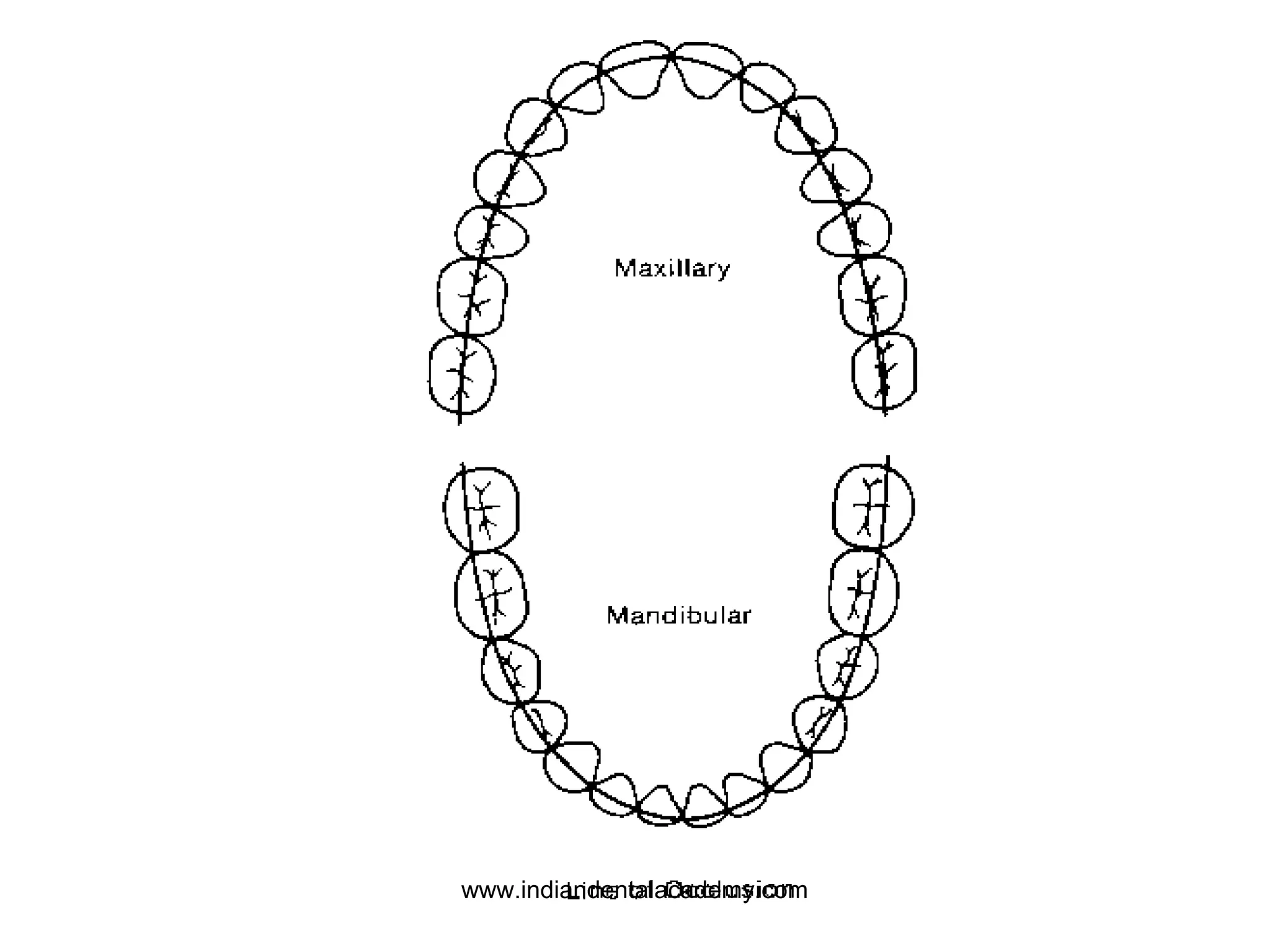
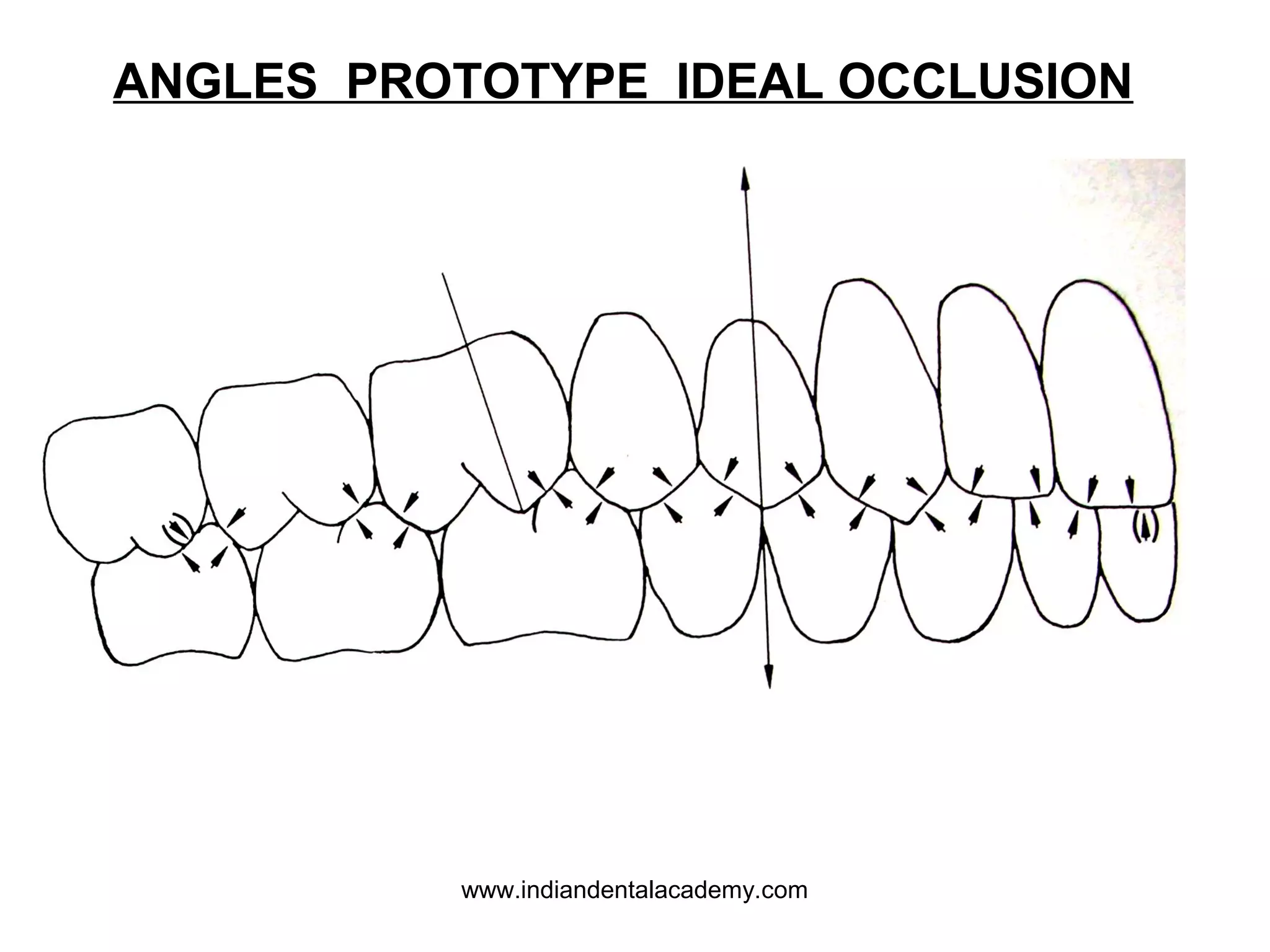
Normal occlusion [angle]: evenly placed rows of
teeth arranged in graceful curve with harmony
between upper & lower arches
www.indiandentalacademy.com
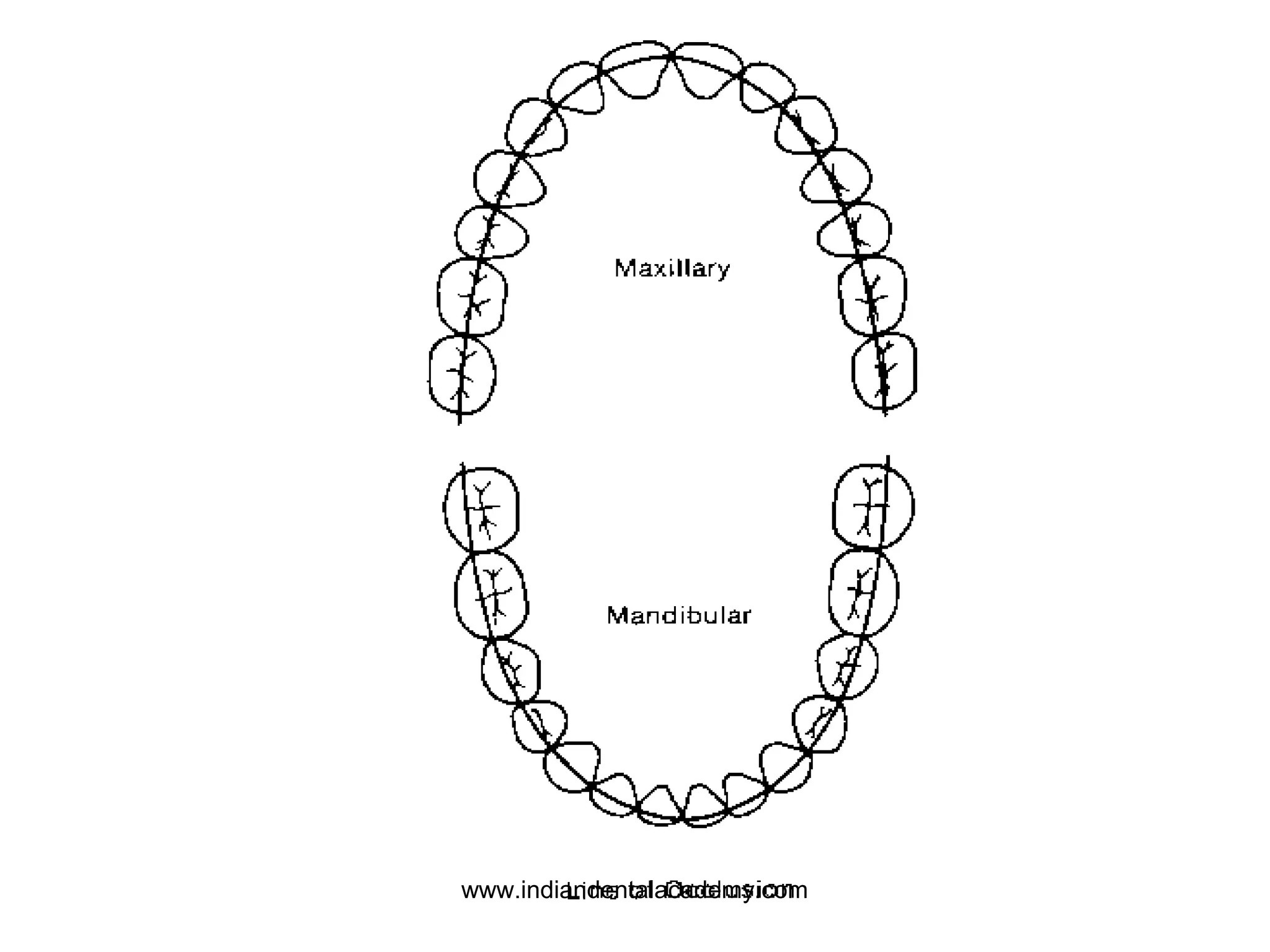
ANGLES PROTOTYPE IDEAL OCCLUSION

www.indiandentalacademy.com
Definitions
Occlusion:
The changing interrelationship of the opposing
surfaces of max & mand.teeth occuring during
movements of mand & the terminal full contact of
max. & mand arches.
Not a static condition
Normal occlusion [angle]: evenly placed rows of
teeth arranged in graceful curve with harmony
between upper & lower arches
www.indiandentalacademy.com
Three factors
1.Occlusal inclined planes of cusps
2.Support given by harmonious size of both arches
3. Influence of muscles
Characteristics of normal occlusion
1. Correct axial position of teeth
2. Normal over jet overbite
3. Normal relationship of individual teeth
4. Normal relationship of dental arches to each
other & to face & cranium

www.indiandentalacademy.com
Malocclusion: An arrangement of teeth in a
dentition &/or relation in the jaws to each other
which is not according to the accepted
morphologic configuration of human maxillodentofacial complex.
Classification: it’s a grouping of clinical cases of
similar appearance for ease in comparison ,
handling & discussion

www.indiandentalacademy.com
Purposes of classification
•
•
•
•
•

Ease of reference
Self communication
For comparison
For traditional reasons
Imp tool in diagnosis –treatment planning

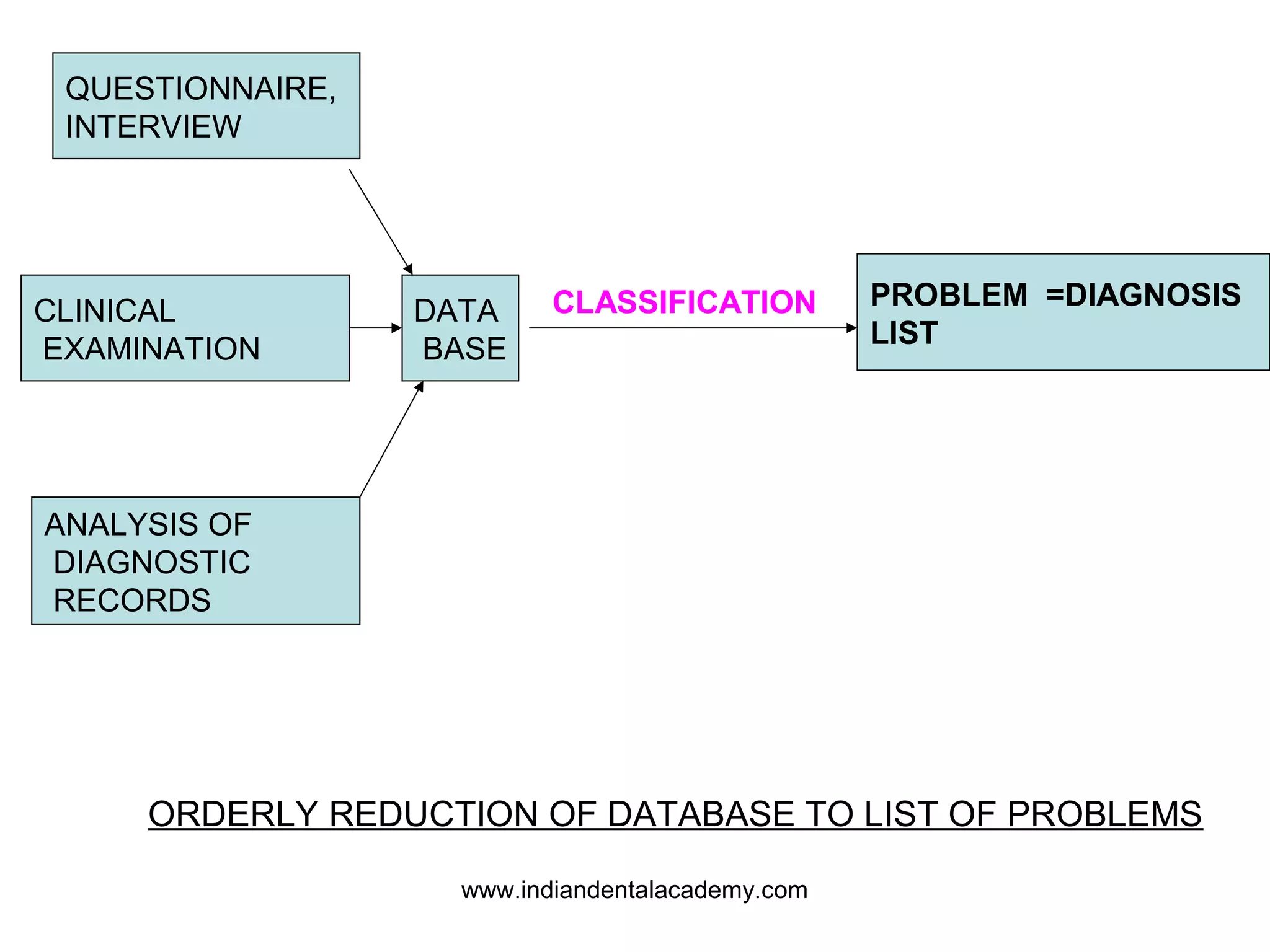
In our concept of diagnosis it can be viewed as
orderly reduction of data base to a list of pt s
problems

www.indiandentalacademy.com
QUESTIONNAIRE,
INTERVIEW

CLINICAL
EXAMINATION

DATA
BASE

CLASSIFICATION

PROBLEM =DIAGNOSIS
LIST

ANALYSIS OF
DIAGNOSTIC
RECORDS

ORDERLY REDUCTION OF DATABASE TO LIST OF PROBLEMS
www.indiandentalacademy.com
WHEN TO CLASSIFY

www.indiandentalacademy.com
Malocclusions are morphologic abnormality
morphology
Malocclusions involve 4 tissue systems
Dental dysplasias
Skeletal
Skeletodental

www.indiandentalacademy.com
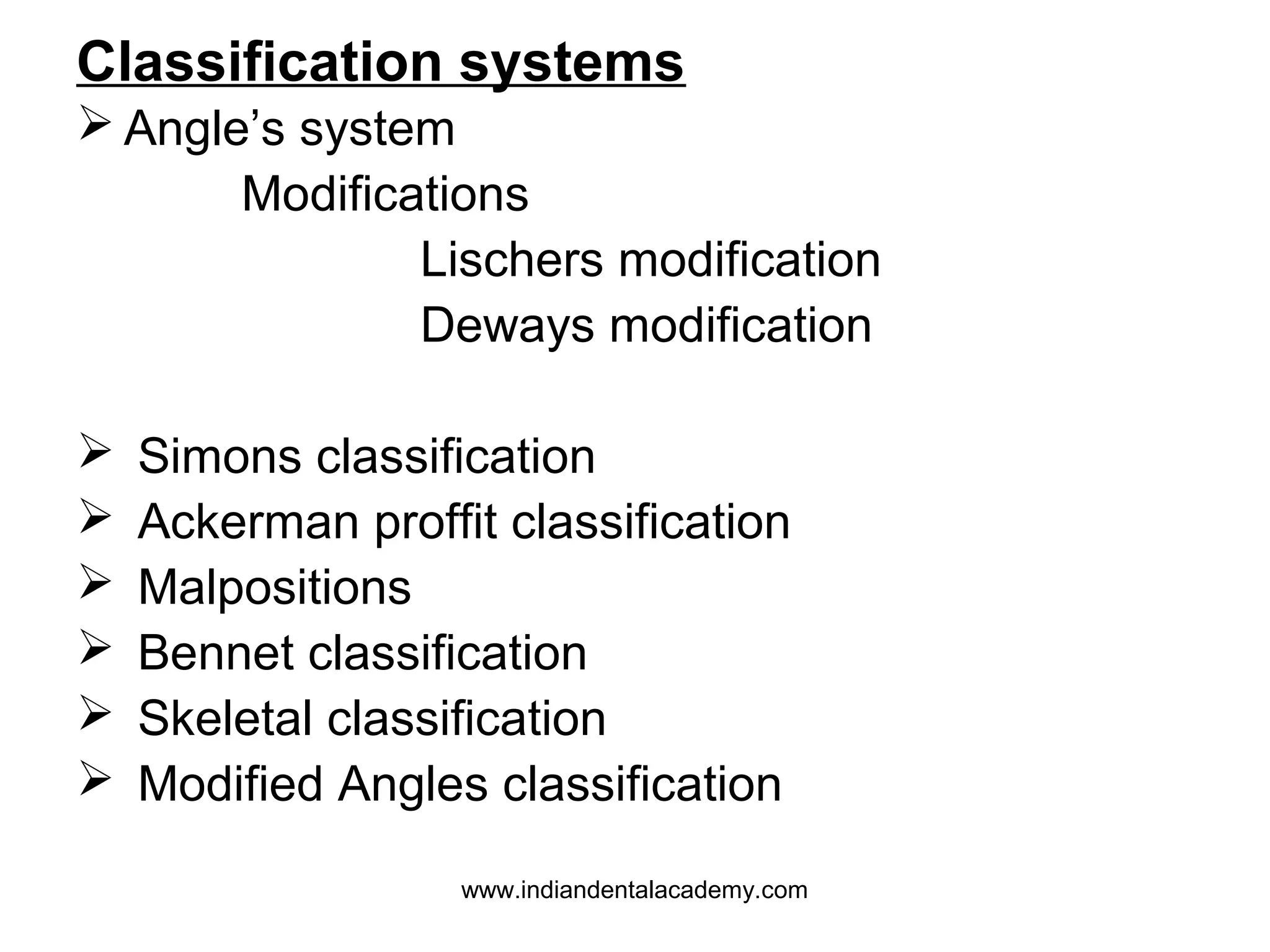
Classification systems
 Angle’s system
Modifications
Lischers modification
Deways modification







Simons classification
Ackerman proffit classification
Malpositions
Bennet classification
Skeletal classification
Modified Angles classification
www.indiandentalacademy.com
Angle’s system
E.H Angle -1899
Most uni. Used.
BASIS: Relationship of 1st per.molar teeth &
alignment of teeth to line of occlusion
Key to occlusion _ max 1st molar
Basically describes the AP relationship
It has 4 groups
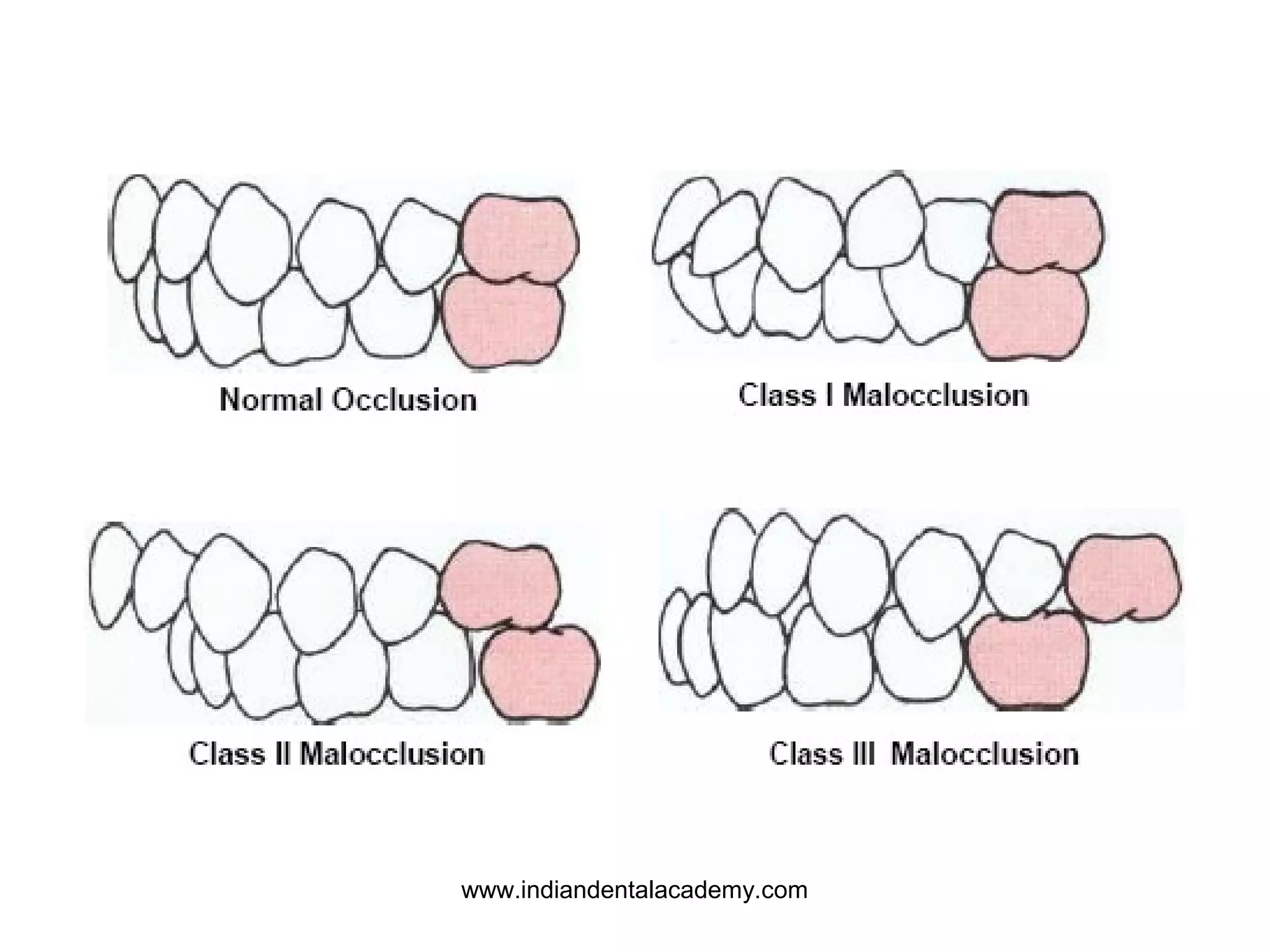
Normal occlusion
Class I malocclusion
Class II malocclusion
www.indiandentalacademy.com
Class III malocclusion
www.indiandentalacademy.com
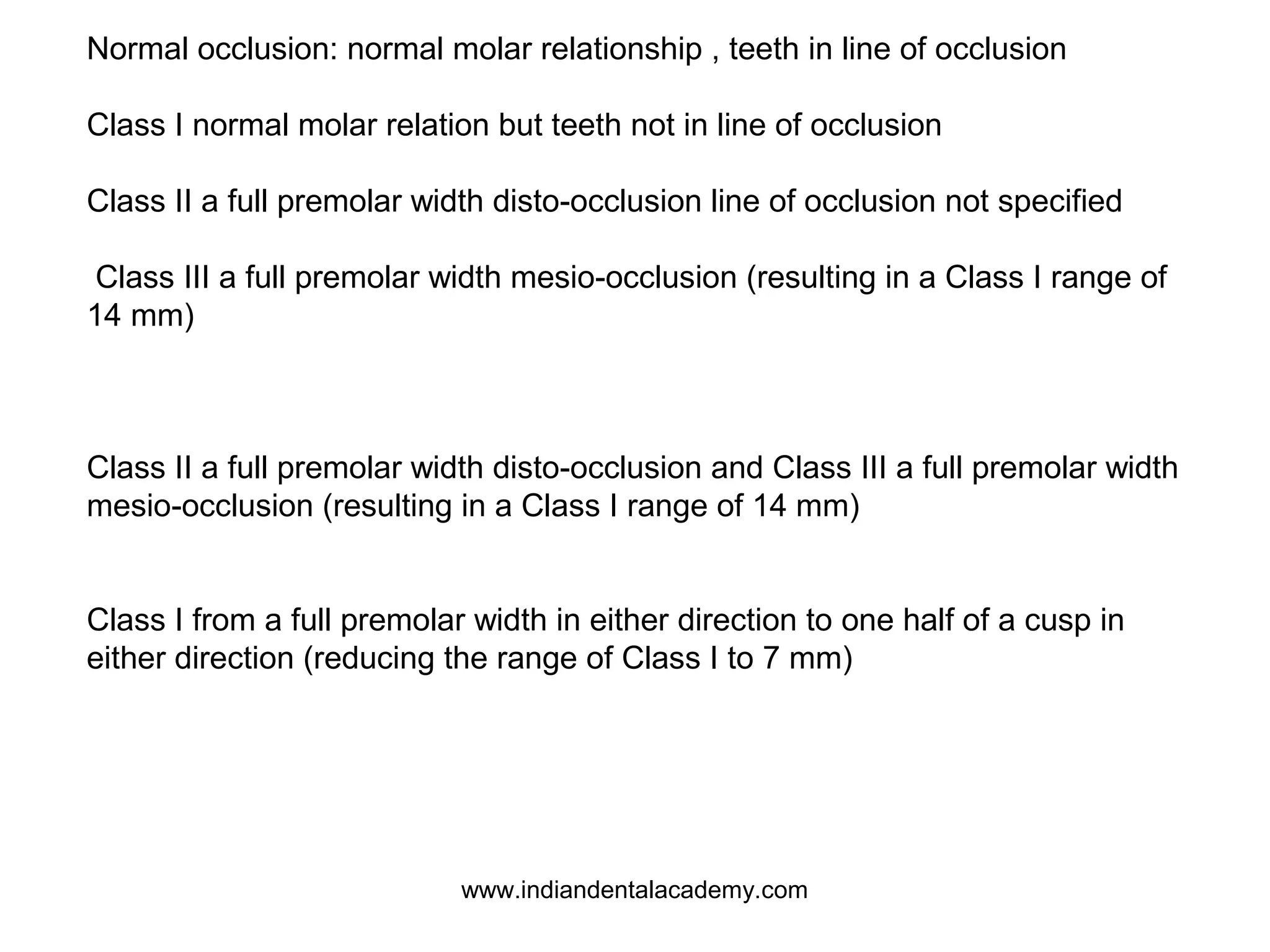
Normal occlusion: normal molar relationship , teeth in line of occlusion
Class I normal molar relation but teeth not in line of occlusion
Class II a full premolar width disto-occlusion line of occlusion not specified
Class III a full premolar width mesio-occlusion (resulting in a Class I range of
14 mm)

Class II a full premolar width disto-occlusion and Class III a full premolar width
mesio-occlusion (resulting in a Class I range of 14 mm)
Class I from a full premolar width in either direction to one half of a cusp in
either direction (reducing the range of Class I to 7 mm)

www.indiandentalacademy.com
Class I malocclusion
• AP relationship of max & mand molars
correct
• Normal AP relationship between max &
mand
• Usually Normal muscle function
• Bimax protrusion
• Diff between normal occlusion & class I

www.indiandentalacademy.com
Class II malocclusion
• Relative MD relations of dental arches abnormal with all lower teeth occluding distal to
normal
Molar relation
Consists of 2 divisions
Same molar relation

www.indiandentalacademy.com
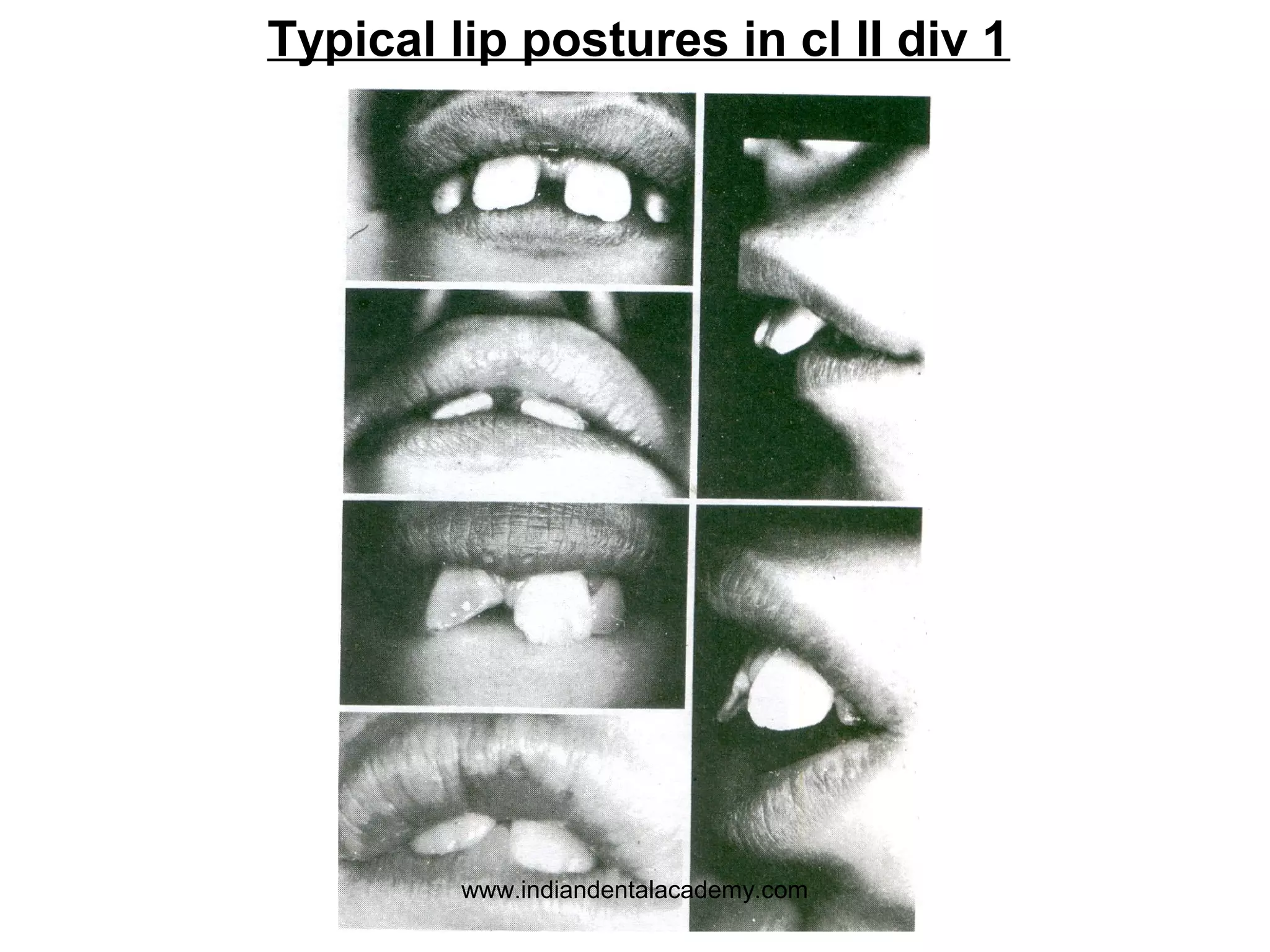
Class II Div I
Mand denture may r may not be normal with respect to
individual teeh
Protrusion of max incisors
Over eruption of incisors
Narrow max arch V shape
Abnormal muscle function
Lower lip cushions upper teeth
Accentuation of max arch
Depending on tongue lower ant may / may not over erupt
Class II Div I sub division

www.indiandentalacademy.com
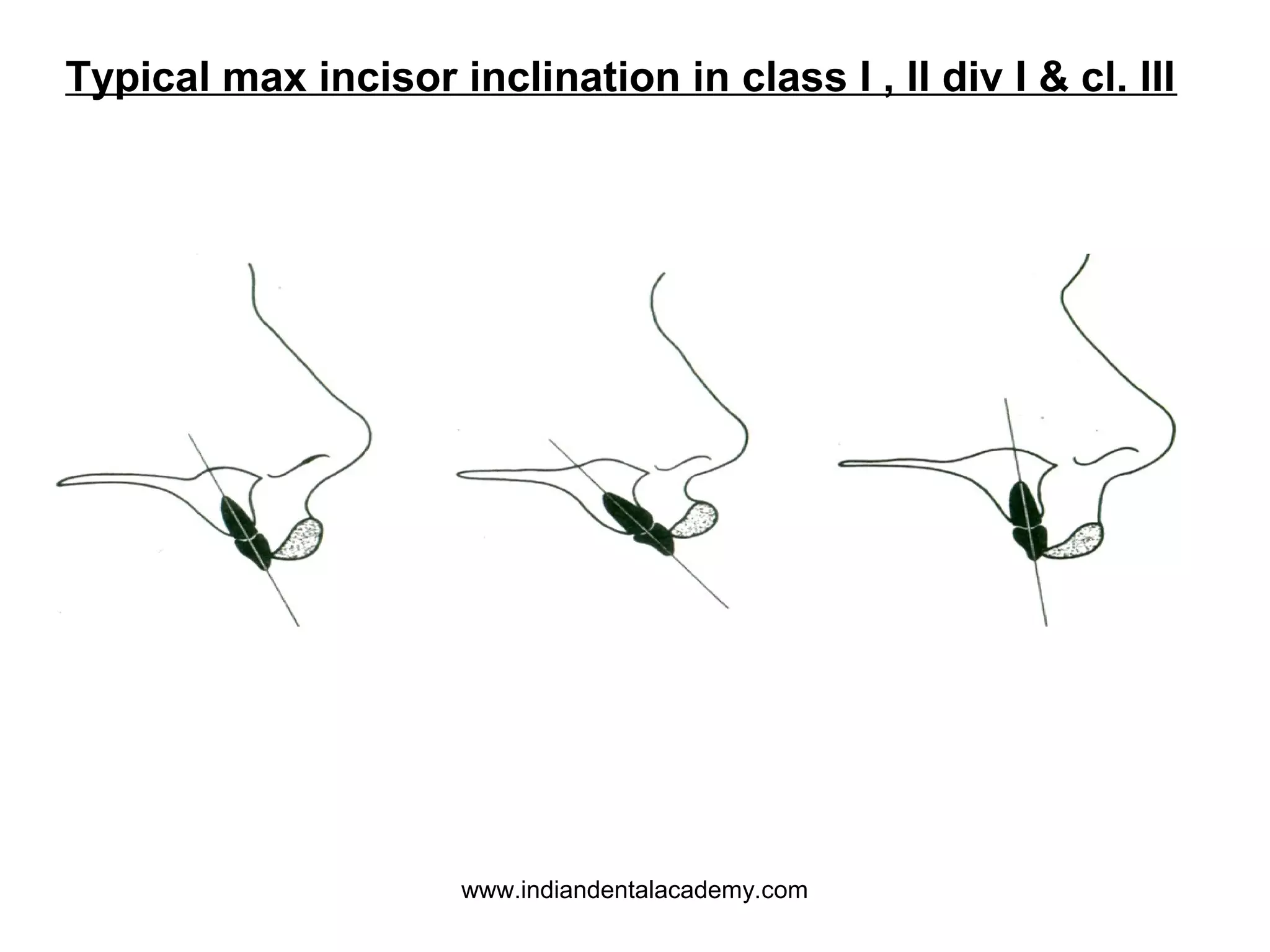
Typical max incisor inclination in class I , II div I & cl. III

www.indiandentalacademy.com
Typical lip postures in cl II div 1

www.indiandentalacademy.com
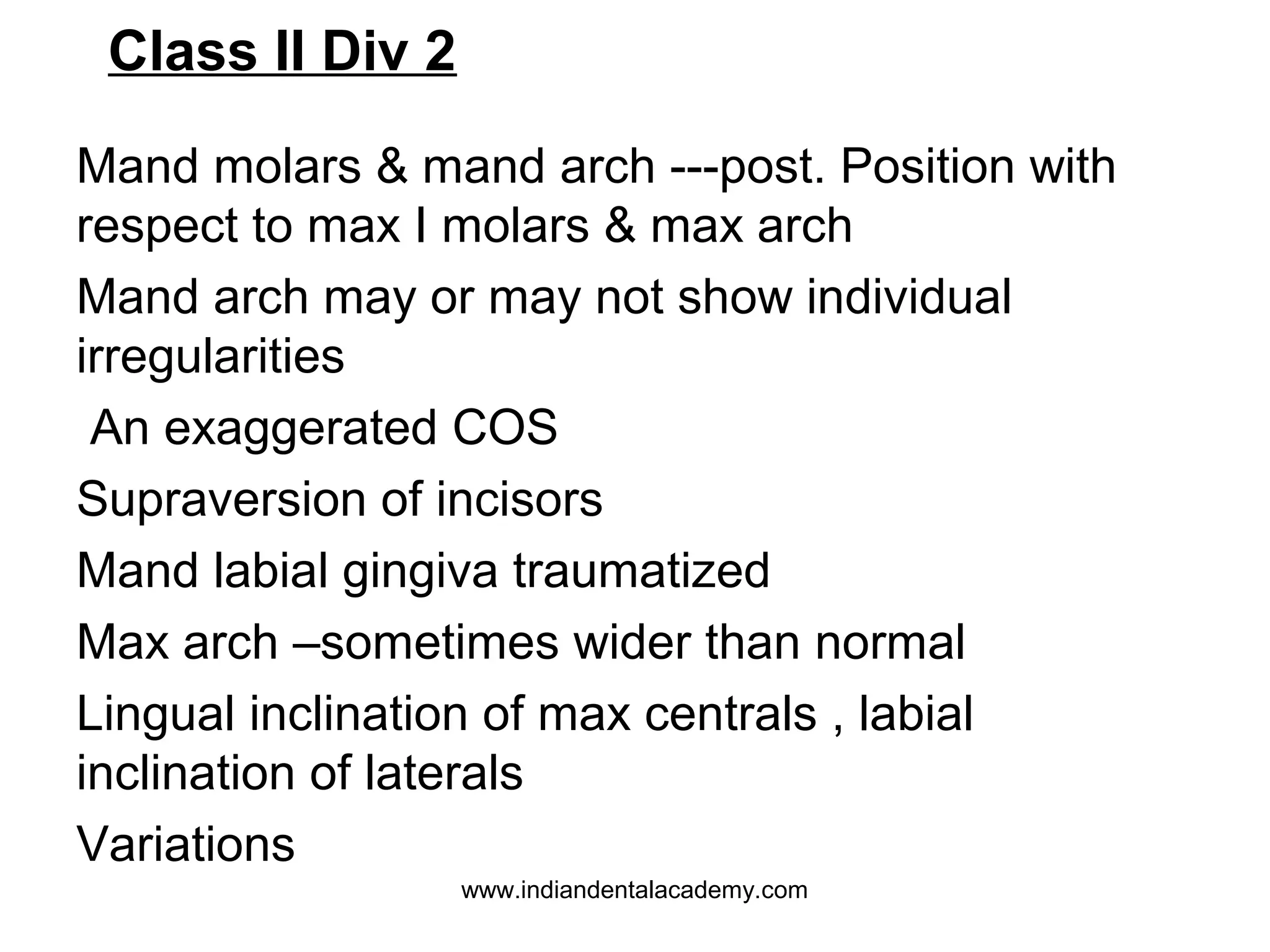
Class II Div 2
Mand molars & mand arch ---post. Position with
respect to max I molars & max arch
Mand arch may or may not show individual
irregularities
An exaggerated COS
Supraversion of incisors
Mand labial gingiva traumatized
Max arch –sometimes wider than normal
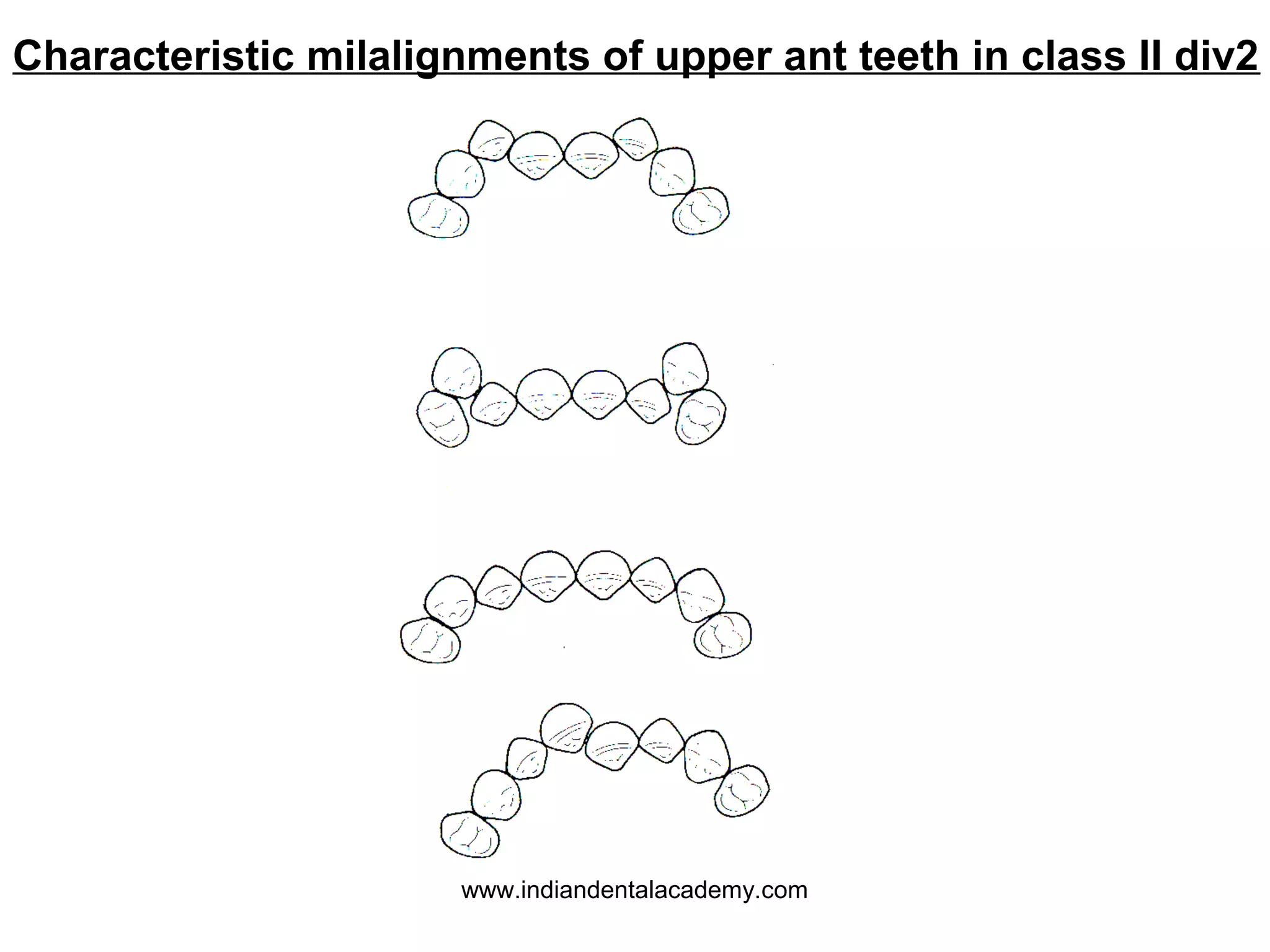
Lingual inclination of max centrals , labial
inclination of laterals
Variations
www.indiandentalacademy.com
Characteristic milalignments of upper ant teeth in class II div2

www.indiandentalacademy.com
Perioral muscle function - normal
Abnormal path of closure due to combination of
lingually inclined max incisors & infraocclusion
of post teeth
Class II Div 2 sub div

www.indiandentalacademy.com
Class III malocclusion
• All the lower teeth occlude mesial to normal the
width of 1 bicuspid tooth or more
• mand # large bodily or situated mesially to an
abnormal degree
• Mand incisors in total cross bite
• Lower ant. # excessively inclined lingually# lip
pressure
• Individual tooth irregularities
• Constricted max arch deficient arch length
• Tongue # floor of the mouth
• Max incisors # more lingually inclined
• constricted max arch
www.indiandentalacademy.com
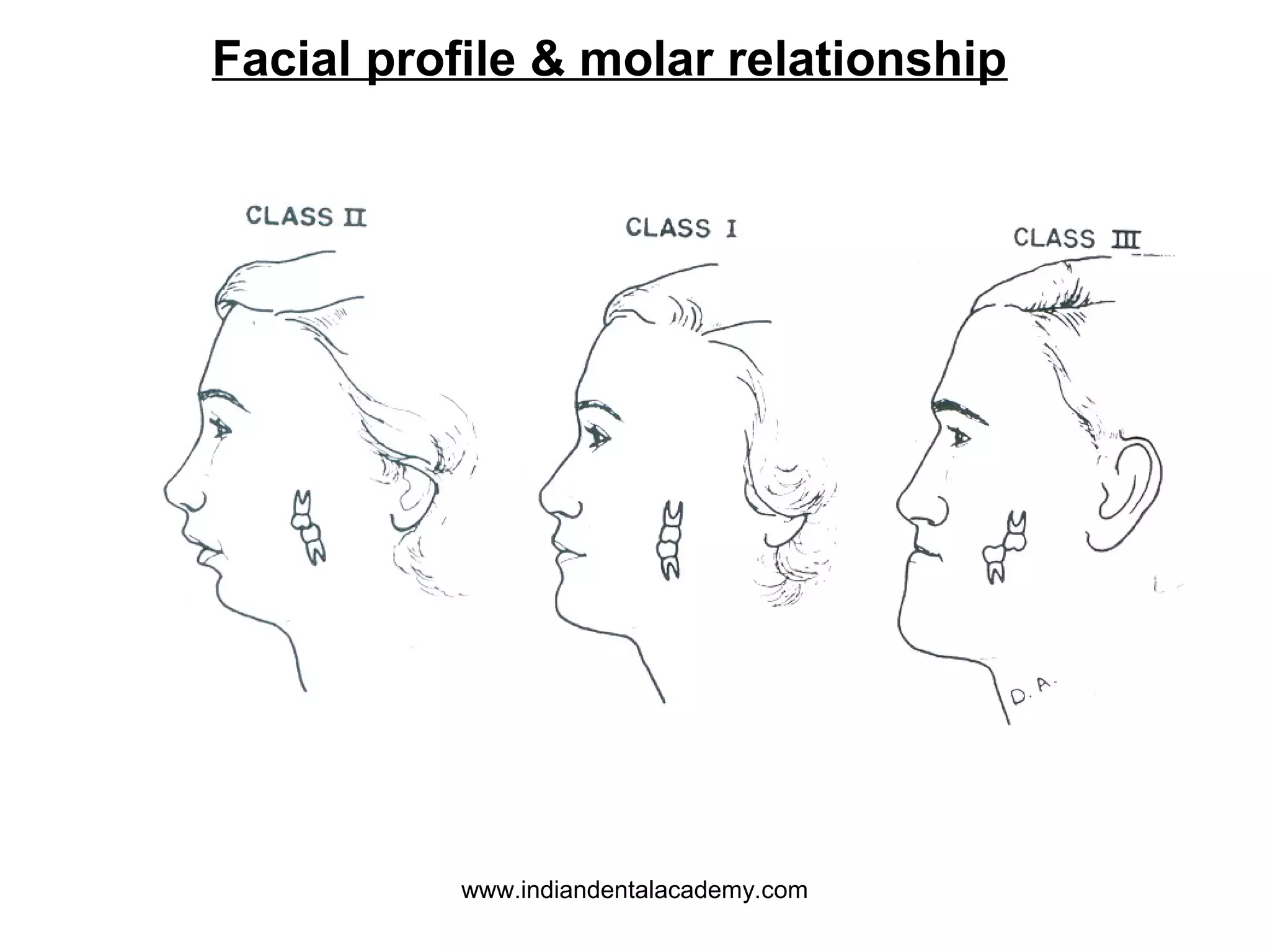
Facial profile & molar relationship

www.indiandentalacademy.com
Pseudo class III

• Postural , habitual class III
• Lingually inclined max incisors gliding
down lingual surfaces of mand incisors on
closure
• Mand guided
ant displacement
• Causes: occlusal prematurities
Premature loss of pri. Posteriors
Enlarged adenoids
www.indiandentalacademy.com
Limitations of angle classification
• Discrepancies in vertical & transverse plane
• Inconsistency or gray areas which are not fully
class II or class III
• Cant be applied if I molars are ext’d or missing
• Max molar may vary in AP relationship
• Individual tooth malpositions # overlooked
• Mixed dentition ?
• Malfunctions of muscles & problems of growth of
bones were overlooked
• Etiology ?
www.indiandentalacademy.com
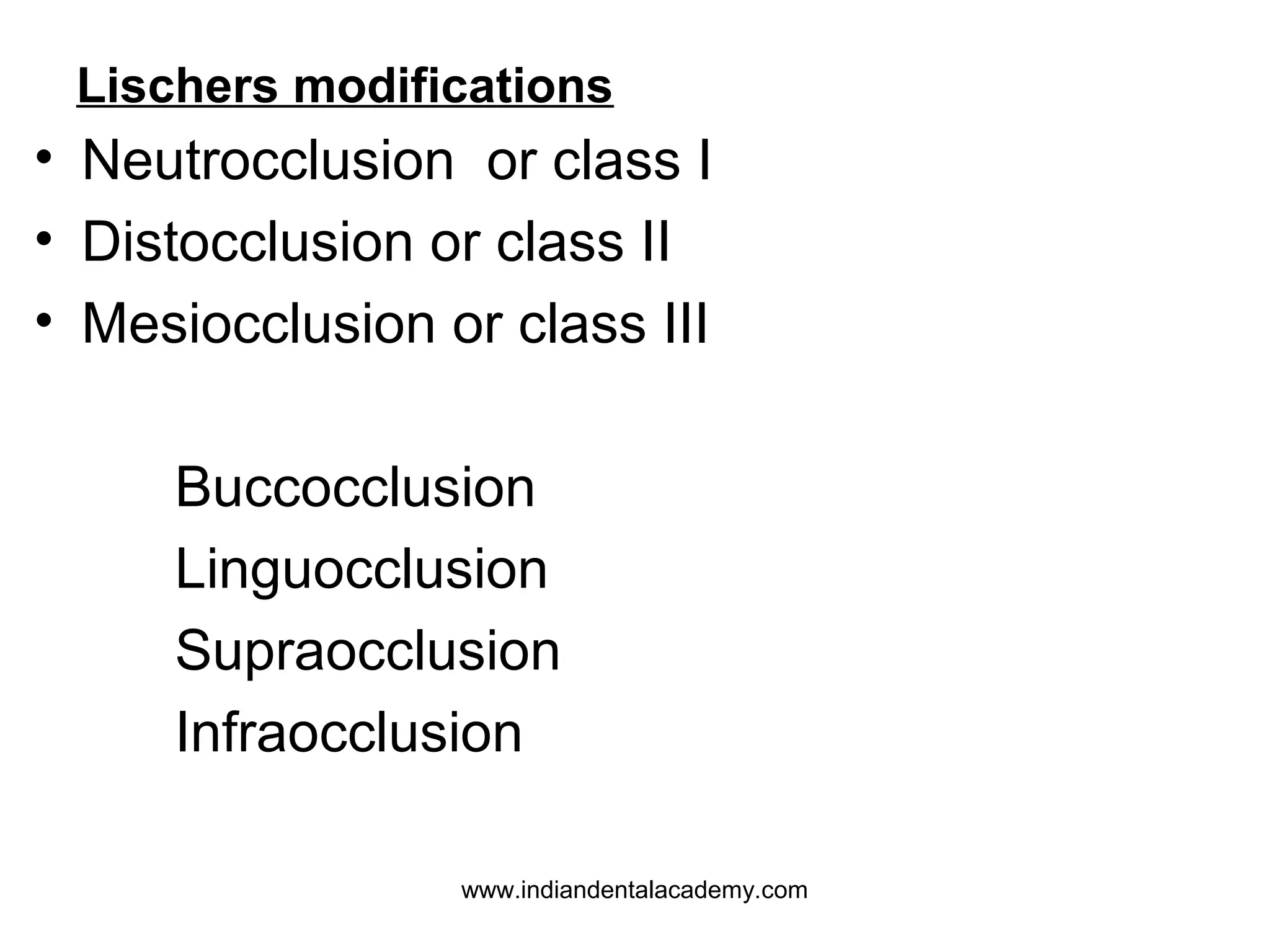
Lischers modifications

• Neutrocclusion or class I
• Distocclusion or class II
• Mesiocclusion or class III
Buccocclusion
Linguocclusion
Supraocclusion
Infraocclusion
www.indiandentalacademy.com
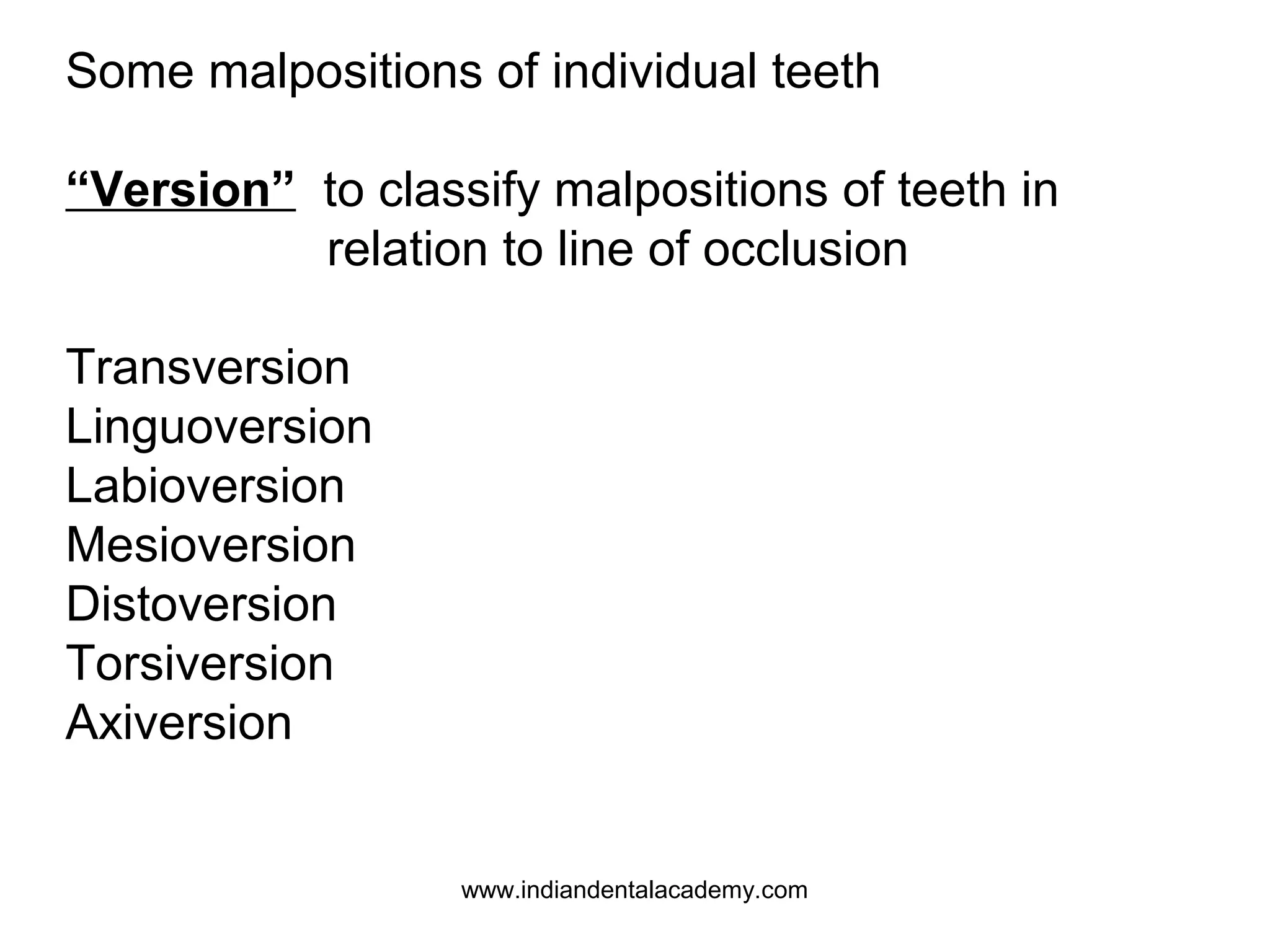
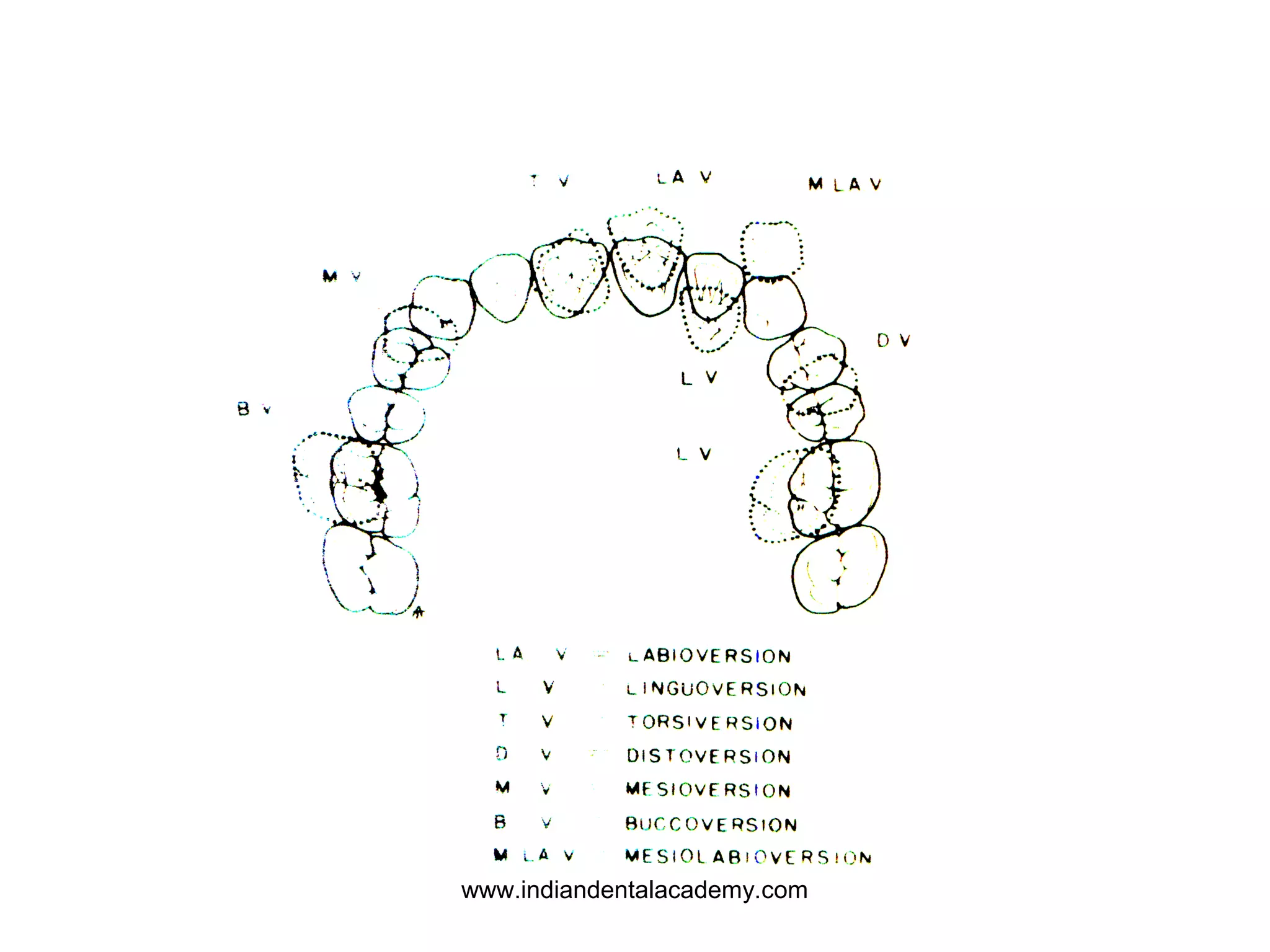
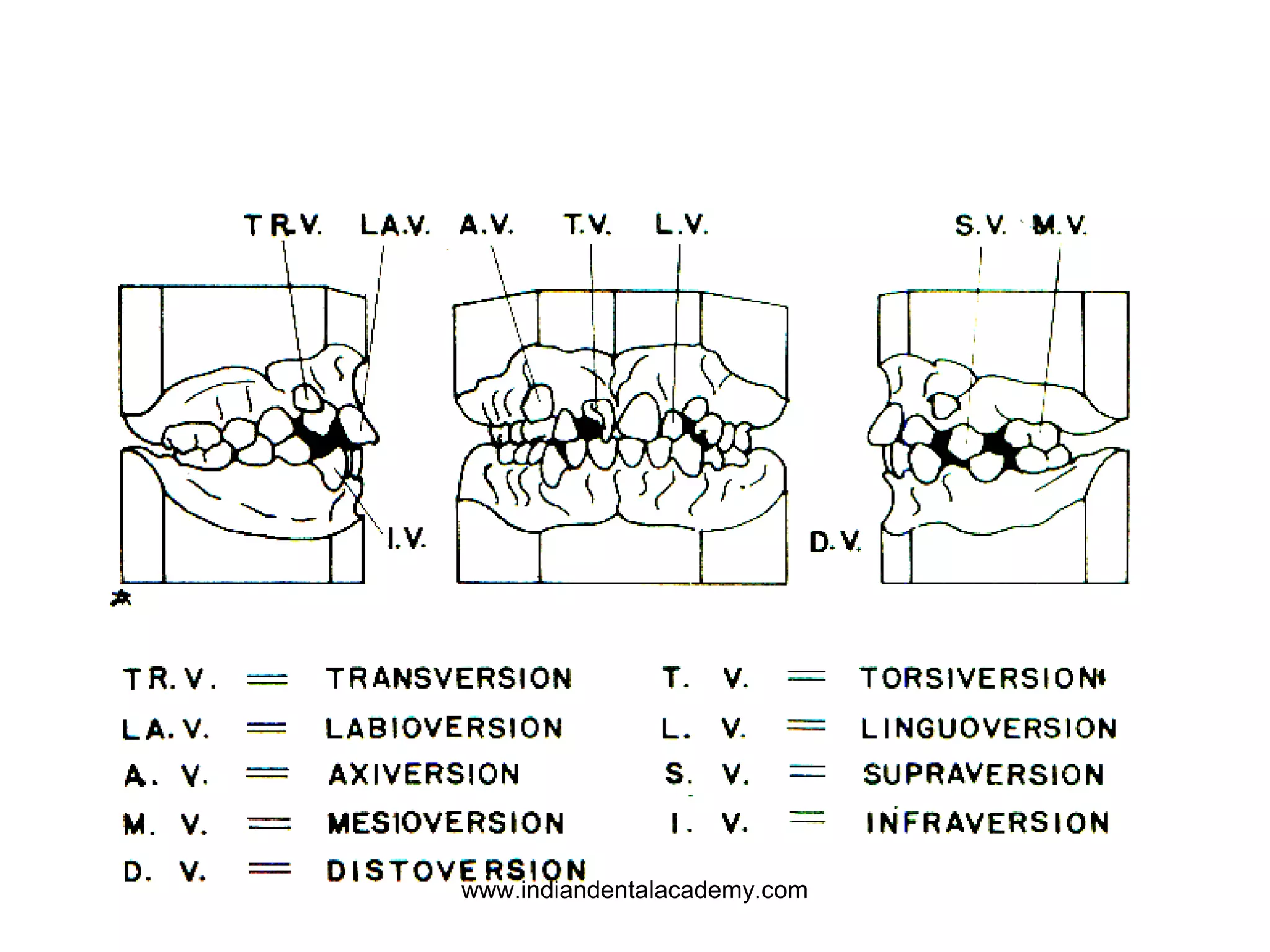
Some malpositions of individual teeth
“Version” to classify malpositions of teeth in
relation to line of occlusion
Transversion
Linguoversion
Labioversion
Mesioversion
Distoversion
Torsiversion
Axiversion

www.indiandentalacademy.com
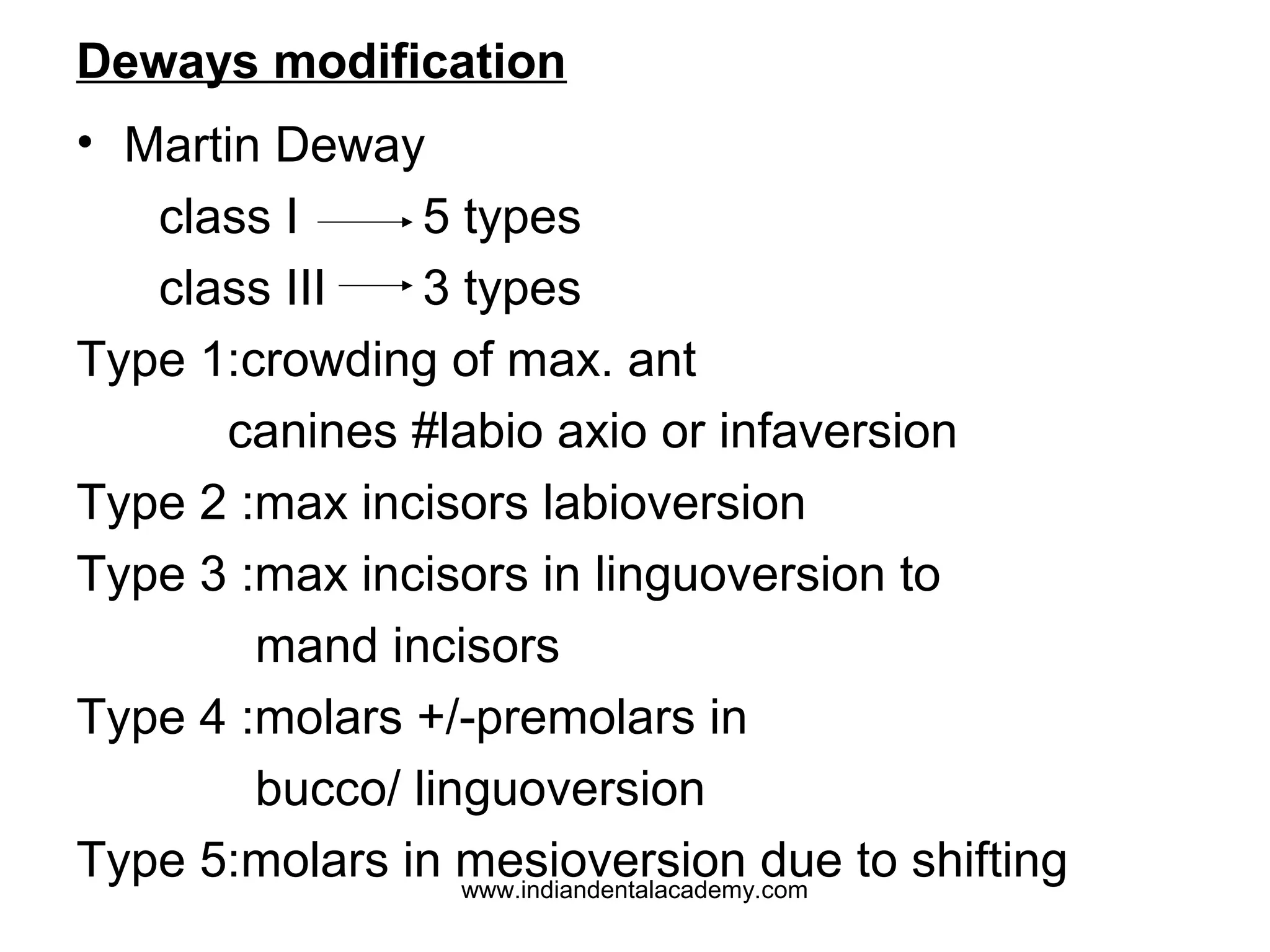
Deways modification
• Martin Deway
class I
5 types
class III
3 types
Type 1:crowding of max. ant
canines #labio axio or infaversion
Type 2 :max incisors labioversion
Type 3 :max incisors in linguoversion to
mand incisors
Type 4 :molars +/-premolars in
bucco/ linguoversion
Type 5:molars in mesioversion due to shifting
www.indiandentalacademy.com
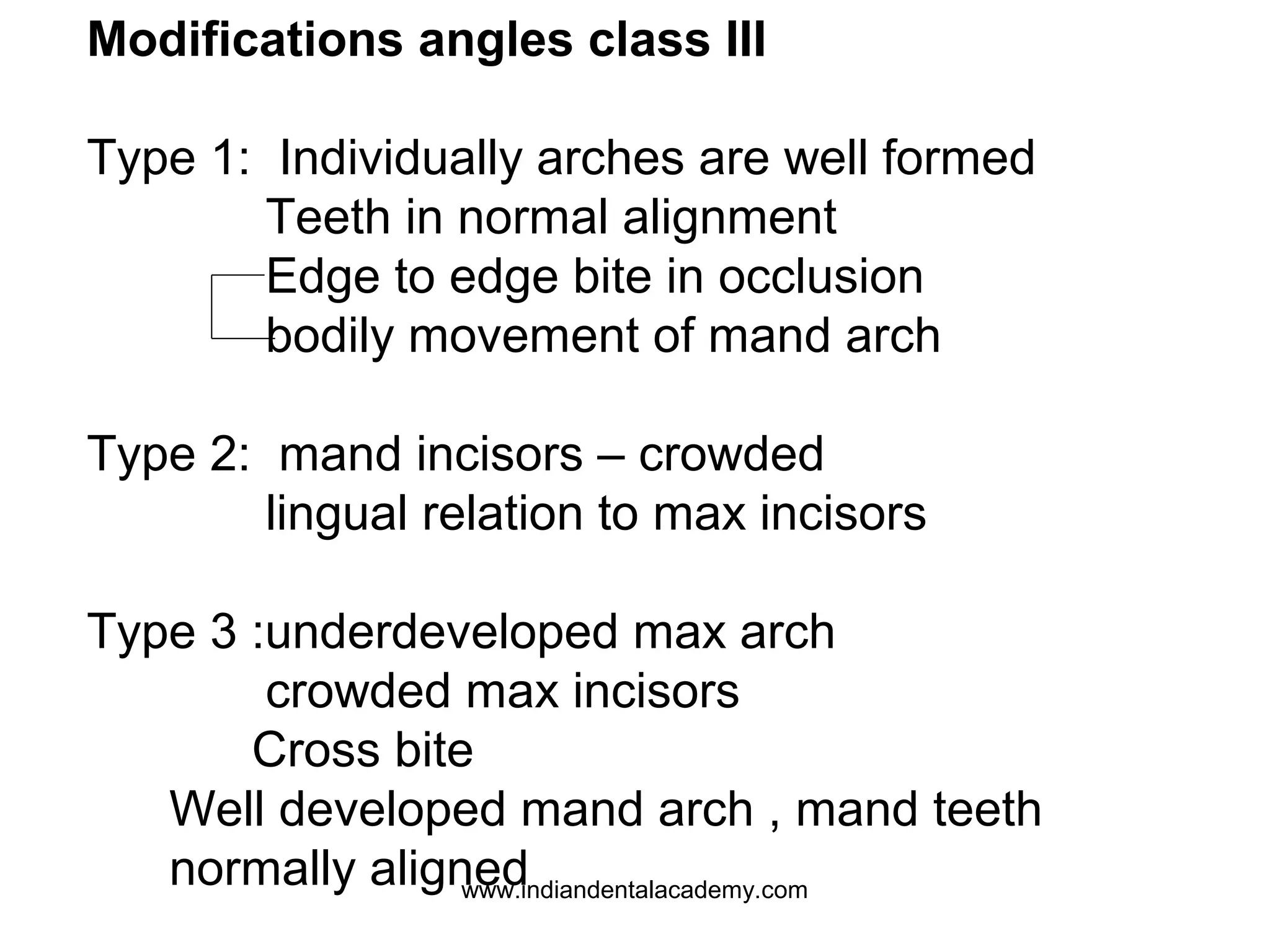
Modifications angles class III
Type 1: Individually arches are well formed
Teeth in normal alignment
Edge to edge bite in occlusion
bodily movement of mand arch
Type 2: mand incisors – crowded
lingual relation to max incisors
Type 3 :underdeveloped max arch
crowded max incisors
Cross bite
Well developed mand arch , mand teeth
normally aligned
www.indiandentalacademy.com
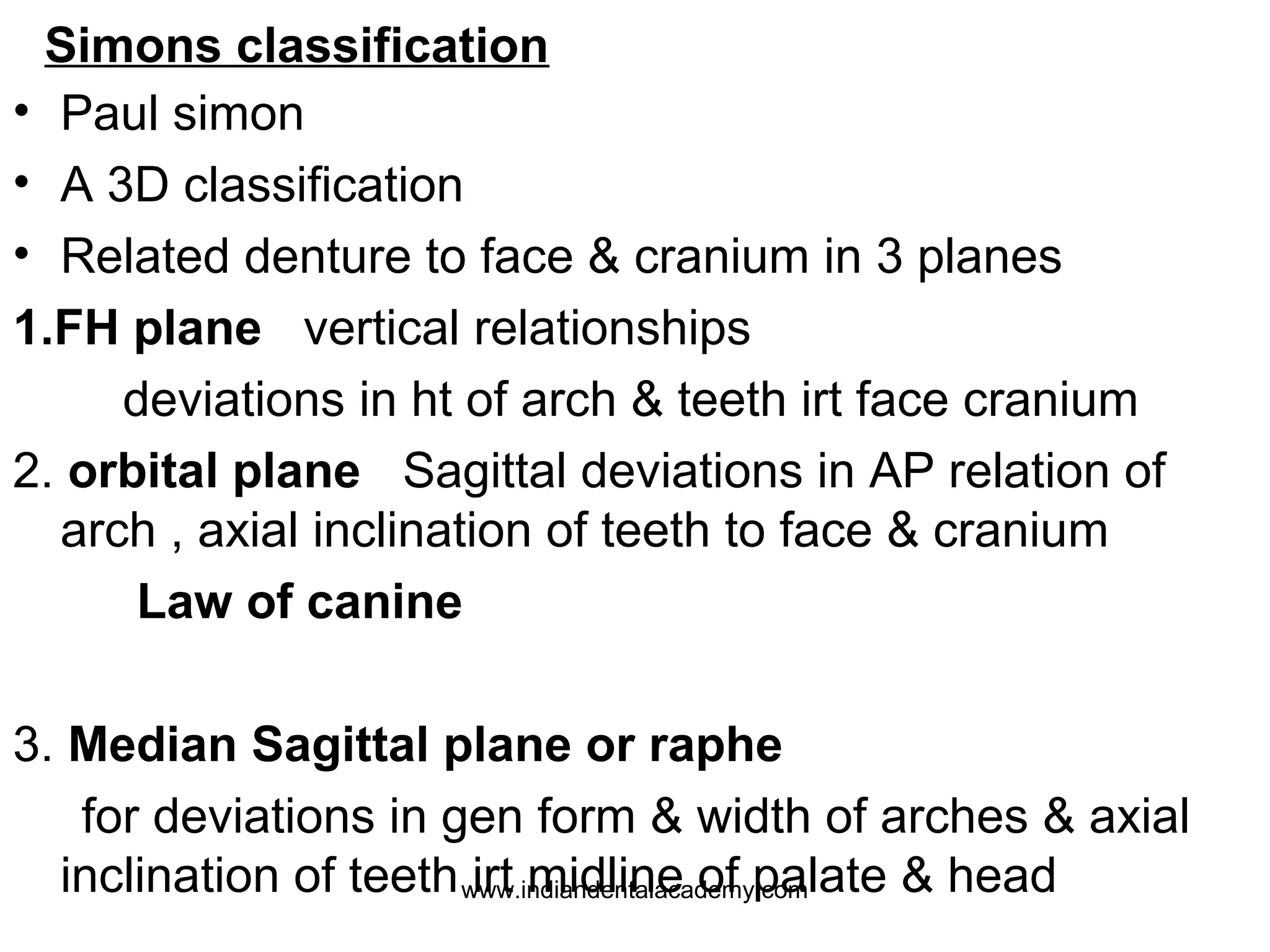
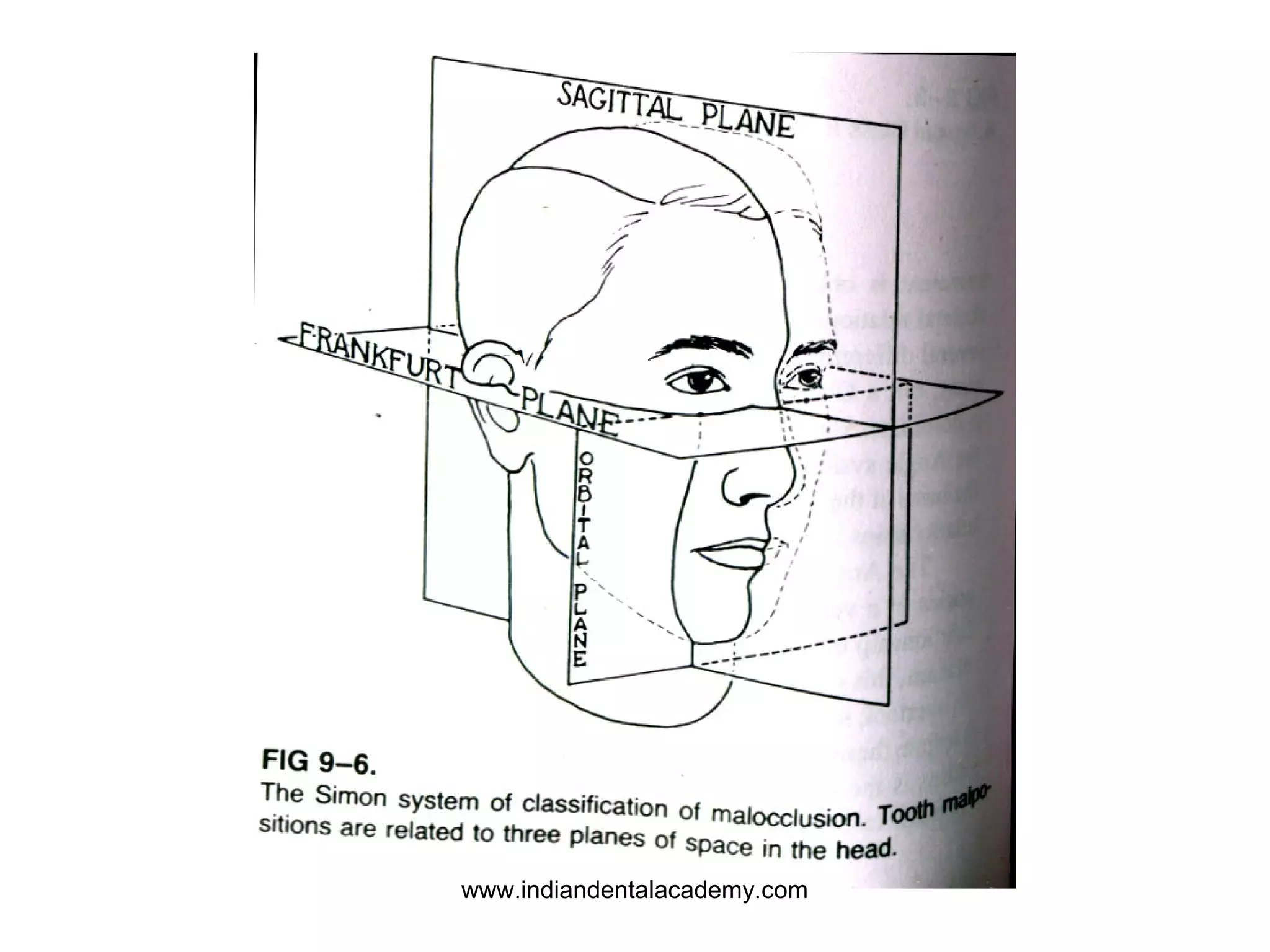
Simons classification
• Paul simon
• A 3D classification
• Related denture to face & cranium in 3 planes
1.FH plane vertical relationships
deviations in ht of arch & teeth irt face cranium
2. orbital plane Sagittal deviations in AP relation of
arch , axial inclination of teeth to face & cranium
Law of canine
3. Median Sagittal plane or raphe
for deviations in gen form & width of arches & axial
inclination of teeth www.indiandentalacademy.com
irt midline of palate & head
www.indiandentalacademy.com
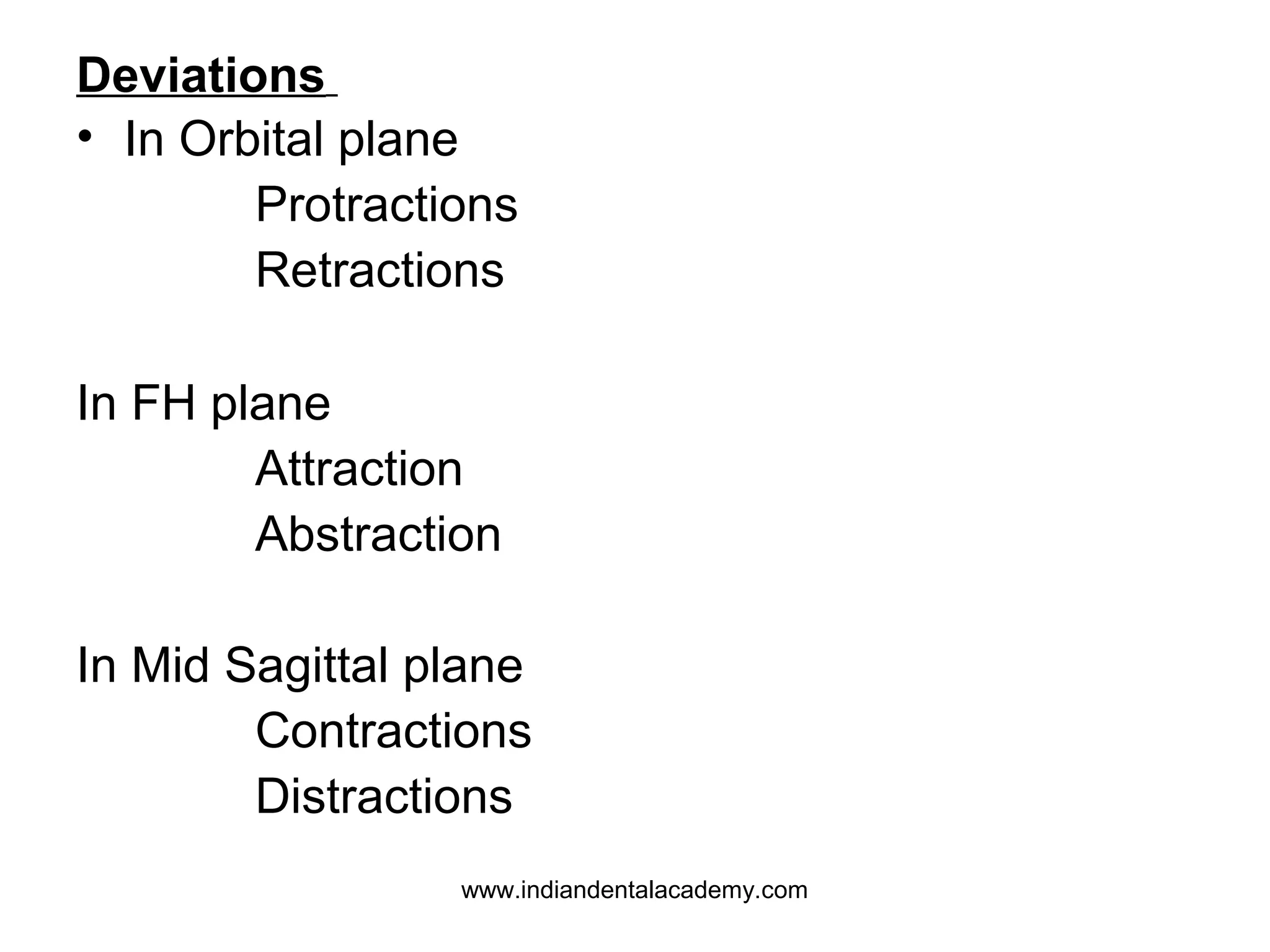
Deviations
• In Orbital plane
Protractions
Retractions
In FH plane
Attraction
Abstraction
In Mid Sagittal plane
Contractions
Distractions
www.indiandentalacademy.com
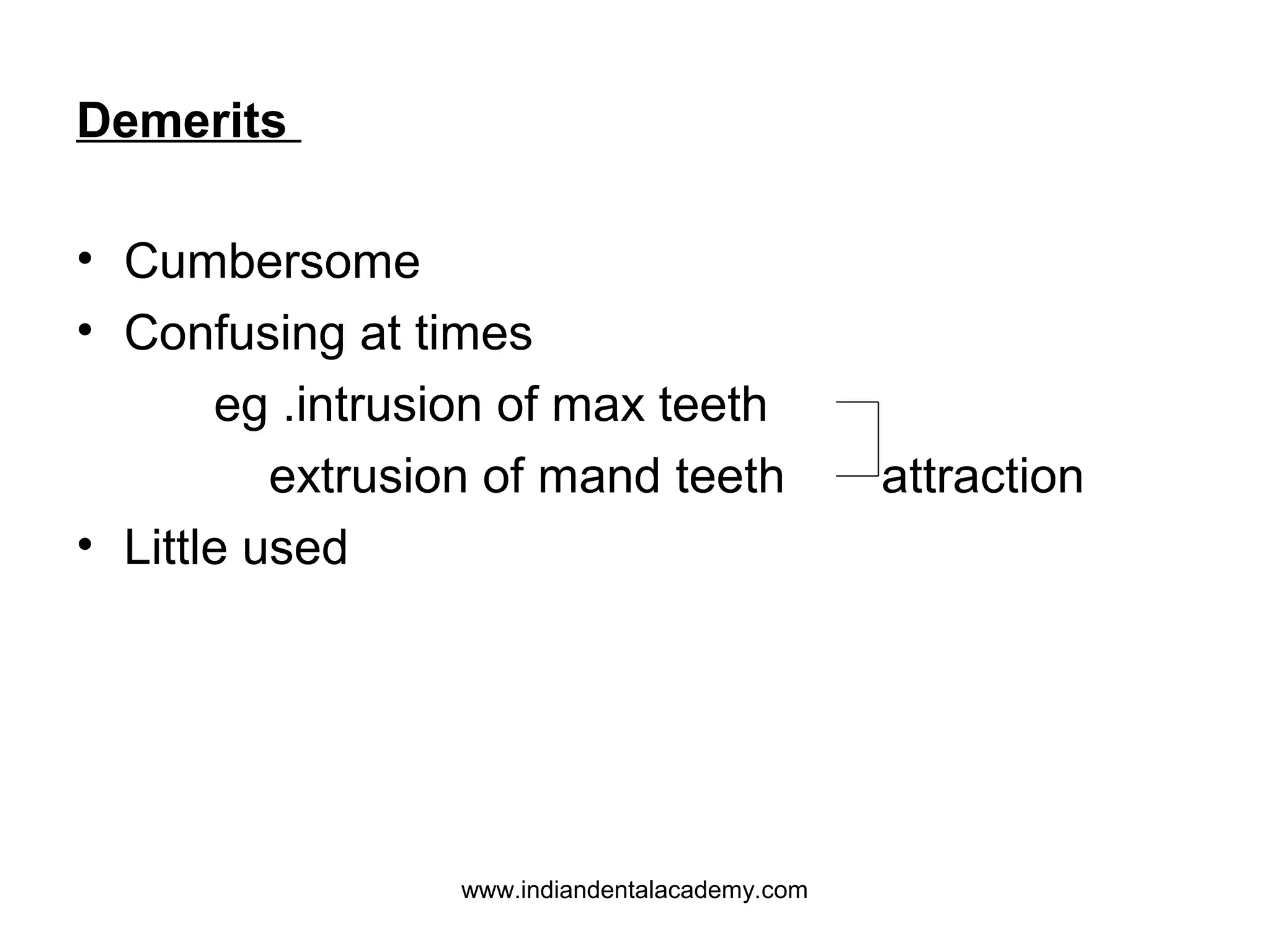
Demerits
• Cumbersome
• Confusing at times
eg .intrusion of max teeth
extrusion of mand teeth
• Little used

www.indiandentalacademy.com

attraction
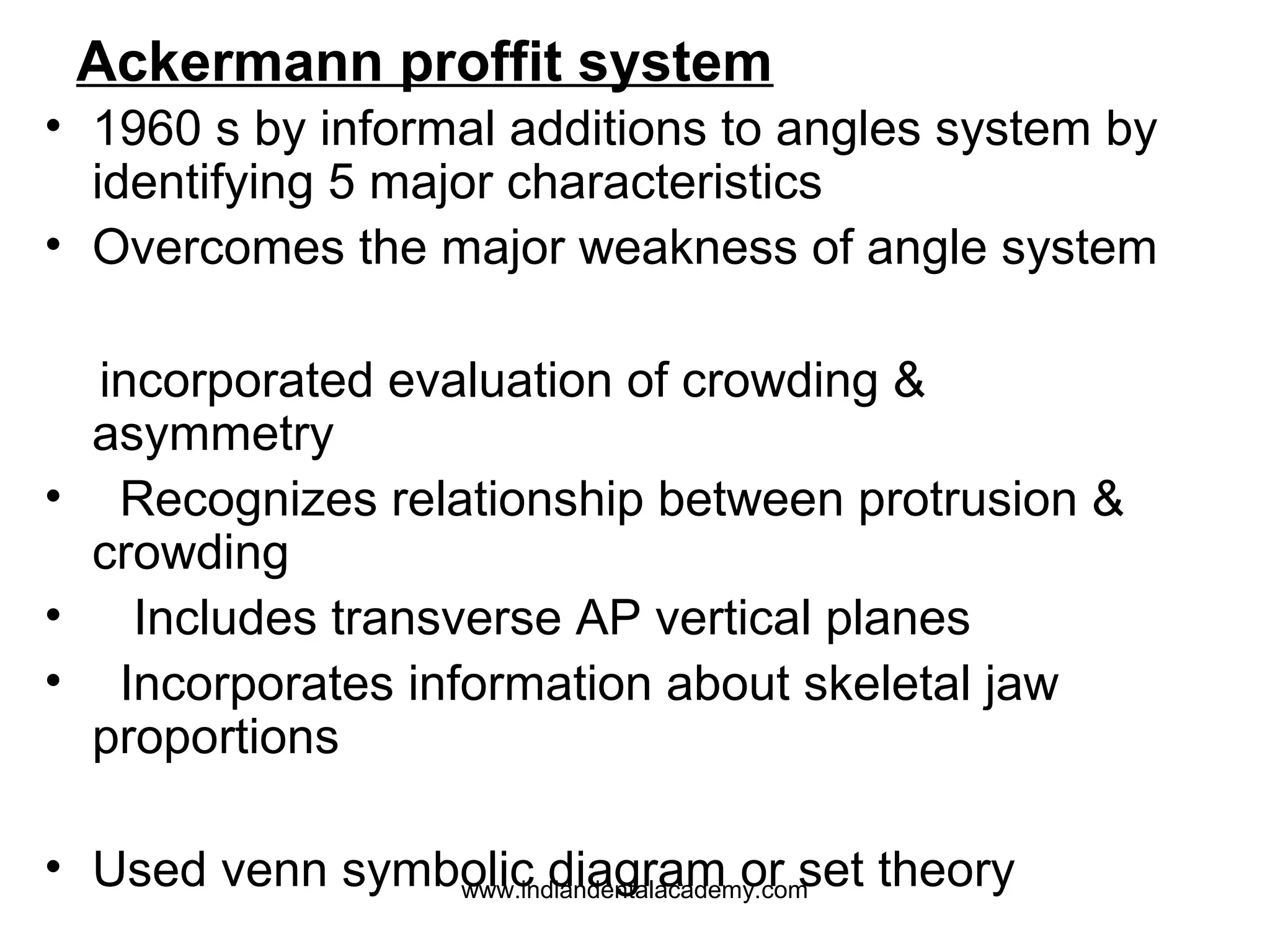
Ackermann proffit system
• 1960 s by informal additions to angles system by
identifying 5 major characteristics
• Overcomes the major weakness of angle system
incorporated evaluation of crowding &
asymmetry
• Recognizes relationship between protrusion &
crowding
• Includes transverse AP vertical planes
• Incorporates information about skeletal jaw
proportions
• Used venn symbolic diagram or set theory
www.indiandentalacademy.com
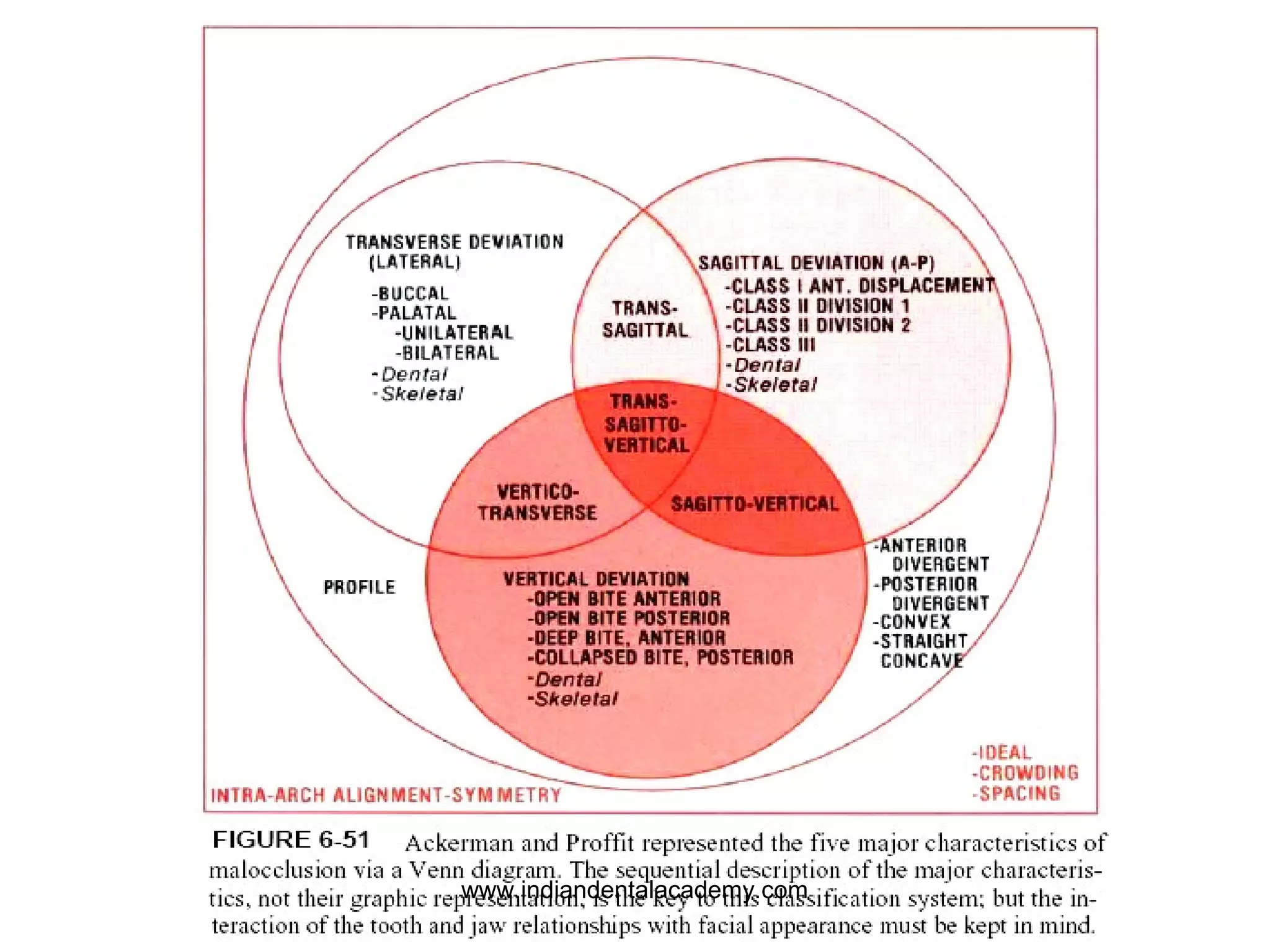
Set is defined on the basis of morphologic
deviations from ideal
Degree of alignment & symmetry are common to all
dentitions
outer envelope /universe [group I]
Profile affected by many malocclusions # major set in
the universe [ group 2]
Deviations in 3 planes of space # represented by 3 to
9 group, which also includes overlapping sub sets
www.indiandentalacademy.com
advantages
• Differentiation is made betw. Ske. & dental
problems
• Teaches a perspective about complexities of
malocclusions
• Readily adaptable to compute processing
• Demerits
• etiology ?
• Analysis is static , a functional analysis must still
be made
www.indiandentalacademy.com
Bennet ‘s classification
• Based on etiology
• 3 classes
• Class I
abnormal position of 1 or more
teeth due to local causes
Class II

Class III

abnormal formation of part / whole
arch due to developmental defects
abnormal relationship of arches
arch & facial contour
abnormal formation of arch
www.indiandentalacademy.com
Skeletal classification
• Class I , class II , class III
• takes relationship of teeth also into consideration

Sk. Class I
• Bones of face & jaws , harmony , & with head
• Profile orthognathic
4 divisions
Div 1. local malrelations of incisors , canine
premolars
Div 2 : max incisor protrusion
Div 3: retroclined max incisors
Div 4: bimax protrusion
www.indiandentalacademy.com
Skeletal class 2 :
sub normal distal mand development in relation to
maxilla
Max. arch narrower than mand
Div 1
Crowding in canine region
Cross bite
Vertical ht
Protrusion of max ant teeth
Retrognathic profile
Div 2 : lingual inclined max incisors
laterals normal / labioversion
Sk. Class 3
Overgrowth of mand, obtuse mand plane ang
Prognathic mand www.indiandentalacademy.com
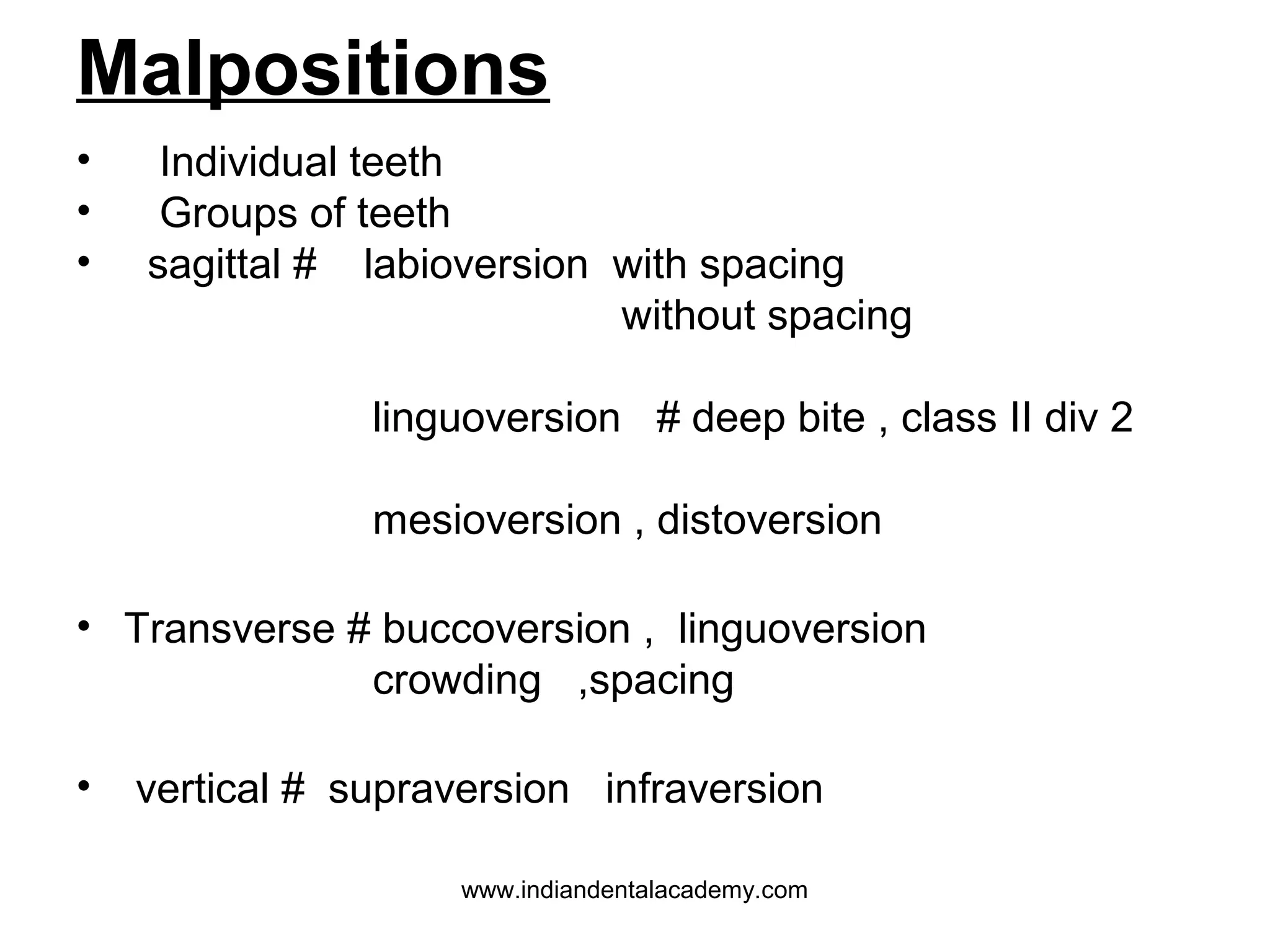
Malpositions
•
•
•

Individual teeth
Groups of teeth
sagittal # labioversion with spacing
without spacing
linguoversion # deep bite , class II div 2
mesioversion , distoversion

• Transverse # buccoversion , linguoversion
crowding ,spacing
•

vertical # supraversion infraversion
www.indiandentalacademy.com
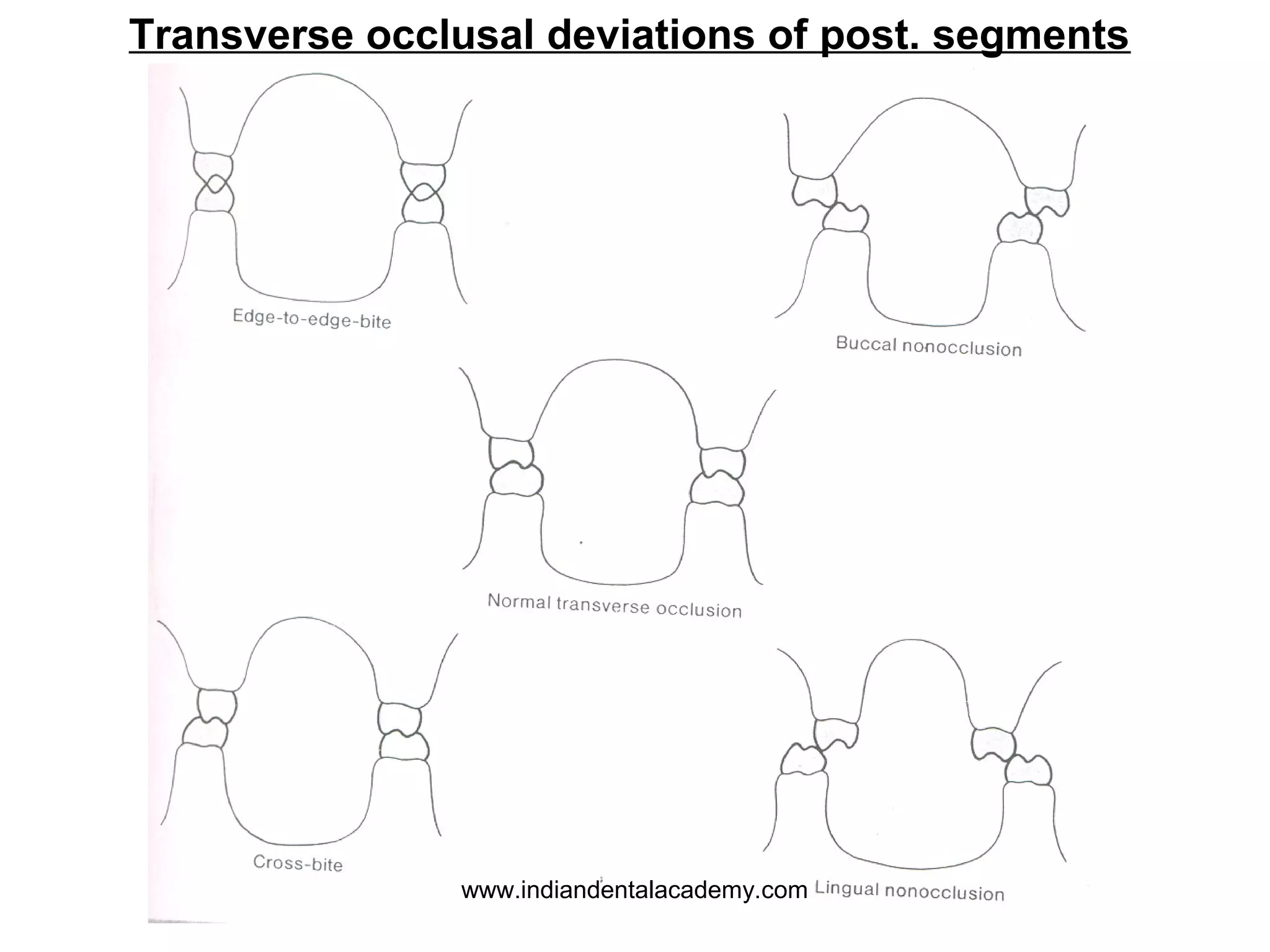
Transverse occlusal deviations of post. segments

www.indiandentalacademy.com
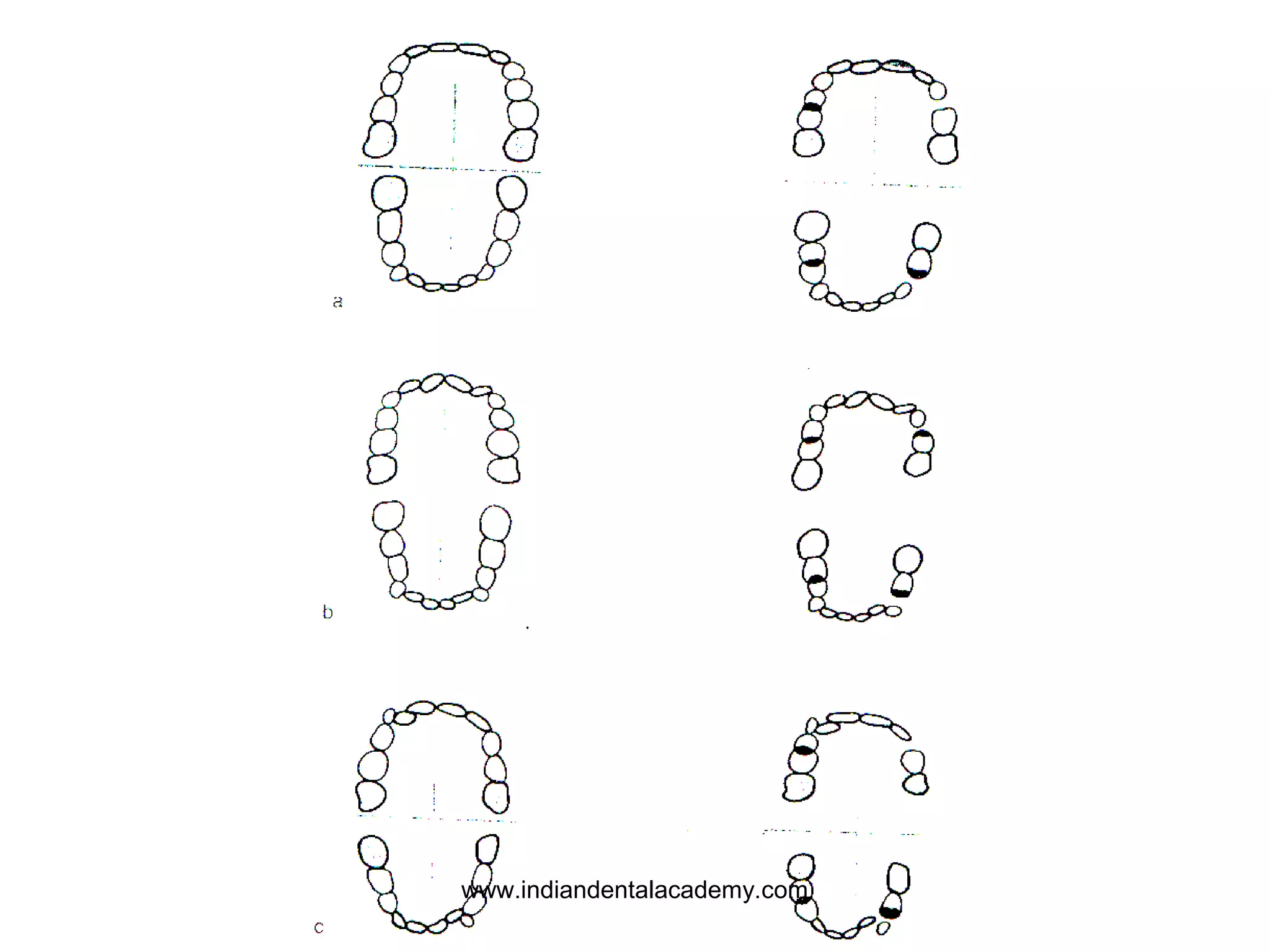
3 categories of crowding [ in mixed dentition ]
I degree crowding
II degree crowding
III degree crowding
On etiology
Primary
hereditary
Secondary mesial drift of post teeth
Tertiary
assoc with 3 rd molar eruption
By taking inclination of teeth
coronal crowding
www.indiandentalacademy.com
apical crowding
www.indiandentalacademy.com
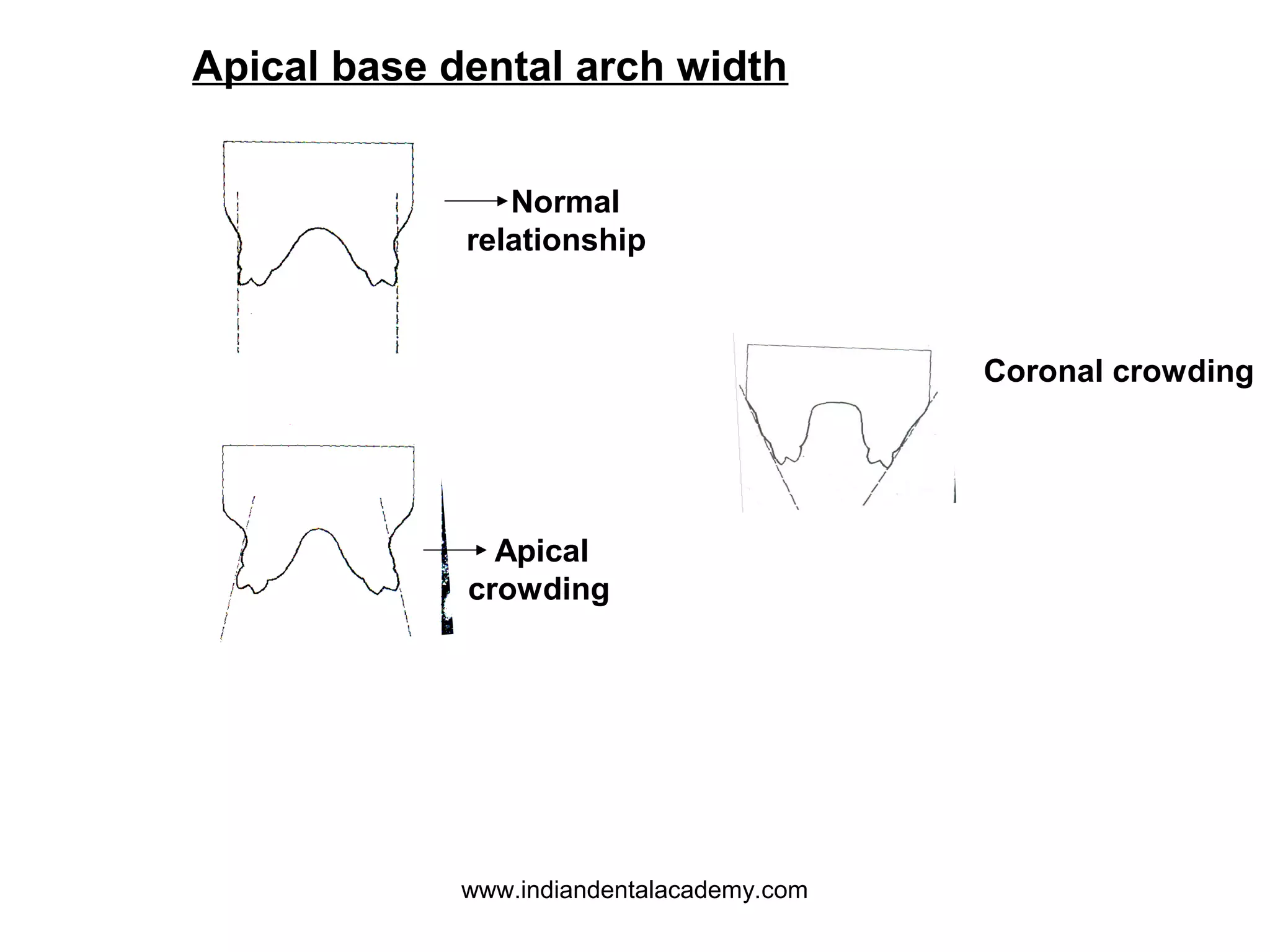
Apical base dental arch width
Normal
relationship

Coronal crowding

Apical
crowding

www.indiandentalacademy.com
Canine relationships
• Class I The distal surface of the mand canine is
with in 1 premolar’s width of the mesial surface
of max canine
• Class II The distal surface of the mand canine is
distal to the mesial surface of max canine by at
least a width of 1 premolar
• Class III The distal surface of the mand canine
is mesial to the mesial surface of max canine by
atleast a width of 1 premolar
www.indiandentalacademy.com
Incisor relationship
• Class I Incisor margins of mand incisors
occlude directly below the middle of the lingual
surfaces of the max incisors
• Class II Incisor margins of mand incisors lie
behind the middle part of lingual surfaces of max
incisors
• Class III Incisor margins of mand incisors lie in
front of the middle part of lingual surfaces of
max incisors
www.indiandentalacademy.com
Leader in continuing dental education

www.indiandentalacademy.com

Classification of malocclusion /certified fixed orthodontic courses by Indian dental academy

  • 1.
    CLASSIFICATION OF MALOCCLUSION INDIANDENTAL ACADEMY Leader in continuing dental education www.indiandentalacademy.com www.indiandentalacademy.com
  • 2.
    CONTENTS • • • • DEFINITIONS PURPOSE OF CLASSIFYING SYSTEMSOF CLASSIFICATIONS LIMITATIONS OF CLASSIFICATION SYSTEMS • ANGLE CLASSIFICATION REVISITED www.indiandentalacademy.com
  • 3.
    Definitions Occlusion: The changing interrelationshipof the opposing surfaces of max & mand.teeth occuring during movements of mand & the terminal full contact of max. & mand arches. Not a static condition Normal occlusion [angle]: evenly placed rows of teeth arranged in graceful curve with harmony between upper & lower arches www.indiandentalacademy.com
  • 4.
  • 5.
    ANGLES PROTOTYPE IDEALOCCLUSION www.indiandentalacademy.com
  • 6.
    Definitions Occlusion: The changing interrelationshipof the opposing surfaces of max & mand.teeth occuring during movements of mand & the terminal full contact of max. & mand arches. Not a static condition Normal occlusion [angle]: evenly placed rows of teeth arranged in graceful curve with harmony between upper & lower arches www.indiandentalacademy.com
  • 7.
    Three factors 1.Occlusal inclinedplanes of cusps 2.Support given by harmonious size of both arches 3. Influence of muscles Characteristics of normal occlusion 1. Correct axial position of teeth 2. Normal over jet overbite 3. Normal relationship of individual teeth 4. Normal relationship of dental arches to each other & to face & cranium www.indiandentalacademy.com
  • 8.
    Malocclusion: An arrangementof teeth in a dentition &/or relation in the jaws to each other which is not according to the accepted morphologic configuration of human maxillodentofacial complex. Classification: it’s a grouping of clinical cases of similar appearance for ease in comparison , handling & discussion www.indiandentalacademy.com
  • 9.
    Purposes of classification • • • • • Easeof reference Self communication For comparison For traditional reasons Imp tool in diagnosis –treatment planning In our concept of diagnosis it can be viewed as orderly reduction of data base to a list of pt s problems www.indiandentalacademy.com
  • 10.
  • 11.
  • 12.
    Malocclusions are morphologicabnormality morphology Malocclusions involve 4 tissue systems Dental dysplasias Skeletal Skeletodental www.indiandentalacademy.com
  • 13.
    Classification systems  Angle’ssystem Modifications Lischers modification Deways modification       Simons classification Ackerman proffit classification Malpositions Bennet classification Skeletal classification Modified Angles classification www.indiandentalacademy.com
  • 14.
    Angle’s system E.H Angle-1899 Most uni. Used. BASIS: Relationship of 1st per.molar teeth & alignment of teeth to line of occlusion Key to occlusion _ max 1st molar Basically describes the AP relationship It has 4 groups Normal occlusion Class I malocclusion Class II malocclusion www.indiandentalacademy.com Class III malocclusion
  • 15.
  • 16.
  • 17.
    Normal occlusion: normalmolar relationship , teeth in line of occlusion Class I normal molar relation but teeth not in line of occlusion Class II a full premolar width disto-occlusion line of occlusion not specified Class III a full premolar width mesio-occlusion (resulting in a Class I range of 14 mm) Class II a full premolar width disto-occlusion and Class III a full premolar width mesio-occlusion (resulting in a Class I range of 14 mm) Class I from a full premolar width in either direction to one half of a cusp in either direction (reducing the range of Class I to 7 mm) www.indiandentalacademy.com
  • 18.
    Class I malocclusion •AP relationship of max & mand molars correct • Normal AP relationship between max & mand • Usually Normal muscle function • Bimax protrusion • Diff between normal occlusion & class I www.indiandentalacademy.com
  • 19.
    Class II malocclusion •Relative MD relations of dental arches abnormal with all lower teeth occluding distal to normal Molar relation Consists of 2 divisions Same molar relation www.indiandentalacademy.com
  • 20.
    Class II DivI Mand denture may r may not be normal with respect to individual teeh Protrusion of max incisors Over eruption of incisors Narrow max arch V shape Abnormal muscle function Lower lip cushions upper teeth Accentuation of max arch Depending on tongue lower ant may / may not over erupt Class II Div I sub division www.indiandentalacademy.com
  • 21.
    Typical max incisorinclination in class I , II div I & cl. III www.indiandentalacademy.com
  • 22.
    Typical lip posturesin cl II div 1 www.indiandentalacademy.com
  • 23.
    Class II Div2 Mand molars & mand arch ---post. Position with respect to max I molars & max arch Mand arch may or may not show individual irregularities An exaggerated COS Supraversion of incisors Mand labial gingiva traumatized Max arch –sometimes wider than normal Lingual inclination of max centrals , labial inclination of laterals Variations www.indiandentalacademy.com
  • 24.
    Characteristic milalignments ofupper ant teeth in class II div2 www.indiandentalacademy.com
  • 25.
    Perioral muscle function- normal Abnormal path of closure due to combination of lingually inclined max incisors & infraocclusion of post teeth Class II Div 2 sub div www.indiandentalacademy.com
  • 26.
    Class III malocclusion •All the lower teeth occlude mesial to normal the width of 1 bicuspid tooth or more • mand # large bodily or situated mesially to an abnormal degree • Mand incisors in total cross bite • Lower ant. # excessively inclined lingually# lip pressure • Individual tooth irregularities • Constricted max arch deficient arch length • Tongue # floor of the mouth • Max incisors # more lingually inclined • constricted max arch www.indiandentalacademy.com
  • 27.
    Facial profile &molar relationship www.indiandentalacademy.com
  • 28.
    Pseudo class III •Postural , habitual class III • Lingually inclined max incisors gliding down lingual surfaces of mand incisors on closure • Mand guided ant displacement • Causes: occlusal prematurities Premature loss of pri. Posteriors Enlarged adenoids www.indiandentalacademy.com
  • 29.
    Limitations of angleclassification • Discrepancies in vertical & transverse plane • Inconsistency or gray areas which are not fully class II or class III • Cant be applied if I molars are ext’d or missing • Max molar may vary in AP relationship • Individual tooth malpositions # overlooked • Mixed dentition ? • Malfunctions of muscles & problems of growth of bones were overlooked • Etiology ? www.indiandentalacademy.com
  • 30.
    Lischers modifications • Neutrocclusionor class I • Distocclusion or class II • Mesiocclusion or class III Buccocclusion Linguocclusion Supraocclusion Infraocclusion www.indiandentalacademy.com
  • 31.
    Some malpositions ofindividual teeth “Version” to classify malpositions of teeth in relation to line of occlusion Transversion Linguoversion Labioversion Mesioversion Distoversion Torsiversion Axiversion www.indiandentalacademy.com
  • 32.
  • 33.
  • 34.
    Deways modification • MartinDeway class I 5 types class III 3 types Type 1:crowding of max. ant canines #labio axio or infaversion Type 2 :max incisors labioversion Type 3 :max incisors in linguoversion to mand incisors Type 4 :molars +/-premolars in bucco/ linguoversion Type 5:molars in mesioversion due to shifting www.indiandentalacademy.com
  • 35.
    Modifications angles classIII Type 1: Individually arches are well formed Teeth in normal alignment Edge to edge bite in occlusion bodily movement of mand arch Type 2: mand incisors – crowded lingual relation to max incisors Type 3 :underdeveloped max arch crowded max incisors Cross bite Well developed mand arch , mand teeth normally aligned www.indiandentalacademy.com
  • 36.
    Simons classification • Paulsimon • A 3D classification • Related denture to face & cranium in 3 planes 1.FH plane vertical relationships deviations in ht of arch & teeth irt face cranium 2. orbital plane Sagittal deviations in AP relation of arch , axial inclination of teeth to face & cranium Law of canine 3. Median Sagittal plane or raphe for deviations in gen form & width of arches & axial inclination of teeth www.indiandentalacademy.com irt midline of palate & head
  • 37.
  • 38.
    Deviations • In Orbitalplane Protractions Retractions In FH plane Attraction Abstraction In Mid Sagittal plane Contractions Distractions www.indiandentalacademy.com
  • 39.
    Demerits • Cumbersome • Confusingat times eg .intrusion of max teeth extrusion of mand teeth • Little used www.indiandentalacademy.com attraction
  • 40.
    Ackermann proffit system •1960 s by informal additions to angles system by identifying 5 major characteristics • Overcomes the major weakness of angle system incorporated evaluation of crowding & asymmetry • Recognizes relationship between protrusion & crowding • Includes transverse AP vertical planes • Incorporates information about skeletal jaw proportions • Used venn symbolic diagram or set theory www.indiandentalacademy.com
  • 41.
    Set is definedon the basis of morphologic deviations from ideal Degree of alignment & symmetry are common to all dentitions outer envelope /universe [group I] Profile affected by many malocclusions # major set in the universe [ group 2] Deviations in 3 planes of space # represented by 3 to 9 group, which also includes overlapping sub sets www.indiandentalacademy.com
  • 42.
  • 43.
    advantages • Differentiation ismade betw. Ske. & dental problems • Teaches a perspective about complexities of malocclusions • Readily adaptable to compute processing • Demerits • etiology ? • Analysis is static , a functional analysis must still be made www.indiandentalacademy.com
  • 44.
    Bennet ‘s classification •Based on etiology • 3 classes • Class I abnormal position of 1 or more teeth due to local causes Class II Class III abnormal formation of part / whole arch due to developmental defects abnormal relationship of arches arch & facial contour abnormal formation of arch www.indiandentalacademy.com
  • 45.
    Skeletal classification • ClassI , class II , class III • takes relationship of teeth also into consideration Sk. Class I • Bones of face & jaws , harmony , & with head • Profile orthognathic 4 divisions Div 1. local malrelations of incisors , canine premolars Div 2 : max incisor protrusion Div 3: retroclined max incisors Div 4: bimax protrusion www.indiandentalacademy.com
  • 46.
    Skeletal class 2: sub normal distal mand development in relation to maxilla Max. arch narrower than mand Div 1 Crowding in canine region Cross bite Vertical ht Protrusion of max ant teeth Retrognathic profile Div 2 : lingual inclined max incisors laterals normal / labioversion Sk. Class 3 Overgrowth of mand, obtuse mand plane ang Prognathic mand www.indiandentalacademy.com
  • 47.
    Malpositions • • • Individual teeth Groups ofteeth sagittal # labioversion with spacing without spacing linguoversion # deep bite , class II div 2 mesioversion , distoversion • Transverse # buccoversion , linguoversion crowding ,spacing • vertical # supraversion infraversion www.indiandentalacademy.com
  • 48.
    Transverse occlusal deviationsof post. segments www.indiandentalacademy.com
  • 49.
    3 categories ofcrowding [ in mixed dentition ] I degree crowding II degree crowding III degree crowding On etiology Primary hereditary Secondary mesial drift of post teeth Tertiary assoc with 3 rd molar eruption By taking inclination of teeth coronal crowding www.indiandentalacademy.com apical crowding
  • 50.
  • 51.
    Apical base dentalarch width Normal relationship Coronal crowding Apical crowding www.indiandentalacademy.com
  • 52.
    Canine relationships • ClassI The distal surface of the mand canine is with in 1 premolar’s width of the mesial surface of max canine • Class II The distal surface of the mand canine is distal to the mesial surface of max canine by at least a width of 1 premolar • Class III The distal surface of the mand canine is mesial to the mesial surface of max canine by atleast a width of 1 premolar www.indiandentalacademy.com
  • 53.
    Incisor relationship • ClassI Incisor margins of mand incisors occlude directly below the middle of the lingual surfaces of the max incisors • Class II Incisor margins of mand incisors lie behind the middle part of lingual surfaces of max incisors • Class III Incisor margins of mand incisors lie in front of the middle part of lingual surfaces of max incisors www.indiandentalacademy.com
  • 54.
    www.indiandentalacademy.com Leader in continuingdental education www.indiandentalacademy.com