CLASSIFICATION OF MALOCCLUSION
Introduction
• In the speciality of orthodontics,the classification of malocclusion
plays several very important roles.classification aids in the diagnosis
and treatment planning of malocclusions by orienting the clinician to
the type and the magnitude of the problems and possible mechanical
problems to these problems..
What is occlusion ?
• Angle defined occlusion as the normal relation of the occlusal inclined
planes of the teeth when the jaws are closed.
What is malocclusion?
• Malocclusion may be defined as –a condition where there is
departure from the normal relation of the teeth to other teeth in the
same dental arch and / or to teeth in the same arch
• The term was coined by Edward H Angle
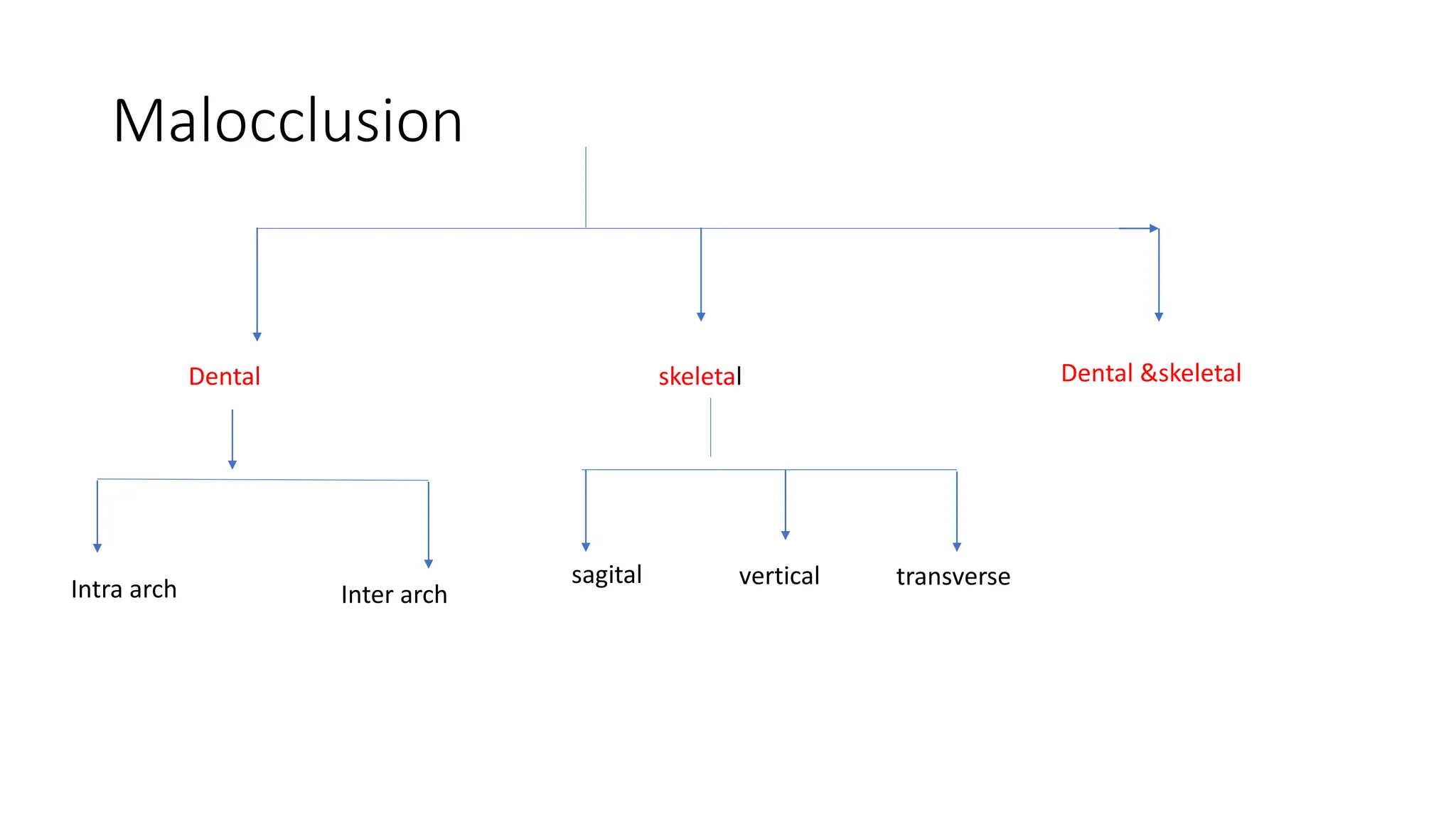
Malocclusion
Dental skeletal Dental &skeletal
Intra arch Inter arch
sagital vertical transverse
Intra arch malocclusions
Includes variation in individual tooth position and a group of teeth
within an arch
• Abnormal inclination
• Abnormal displacements
• Rotations
• Abnormal eruptions
• Transpositions
• crowding
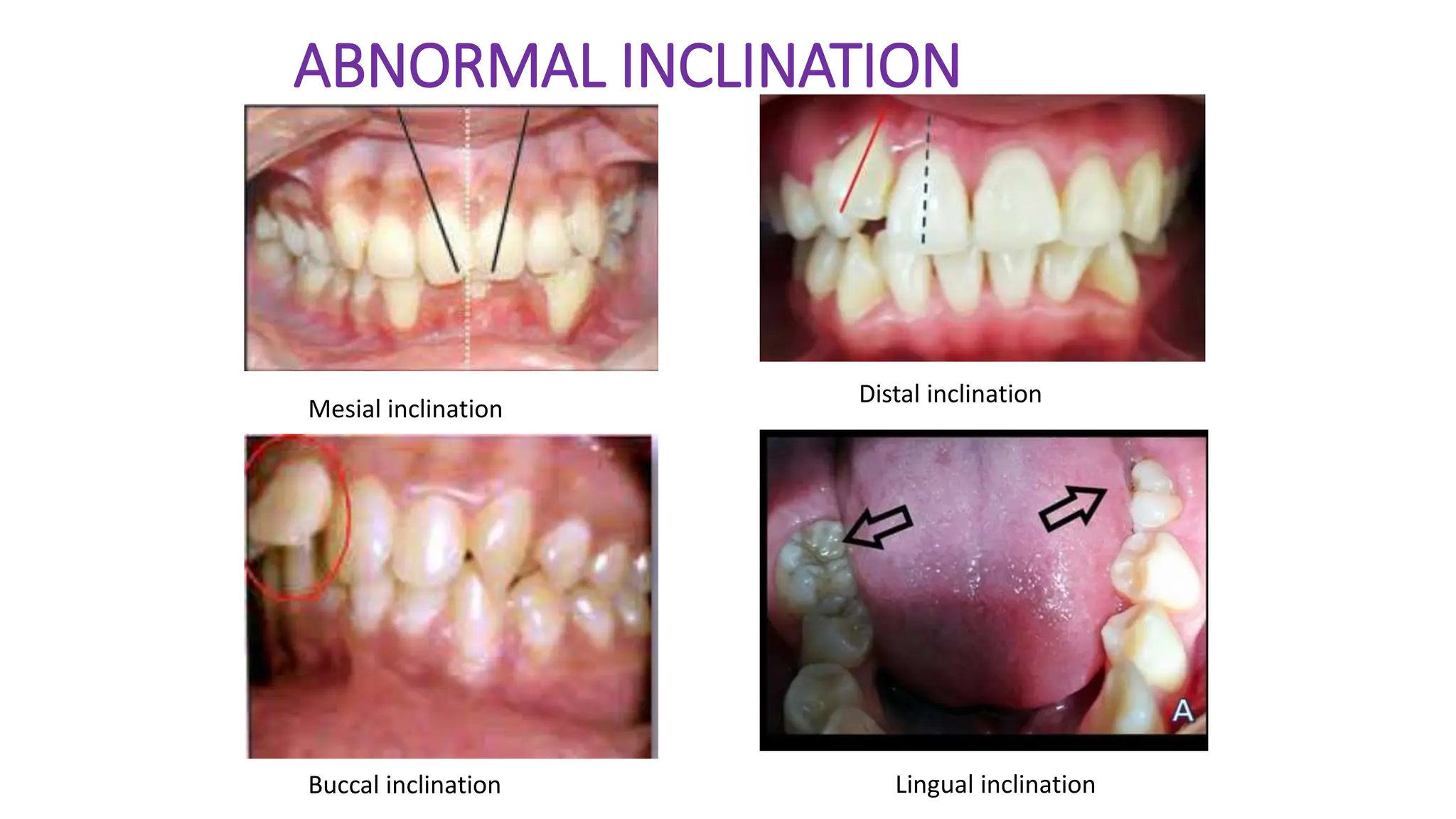
ABNORMAL INCLINATION
Mesial inclination
Distal inclination
Buccal inclination Lingual inclination
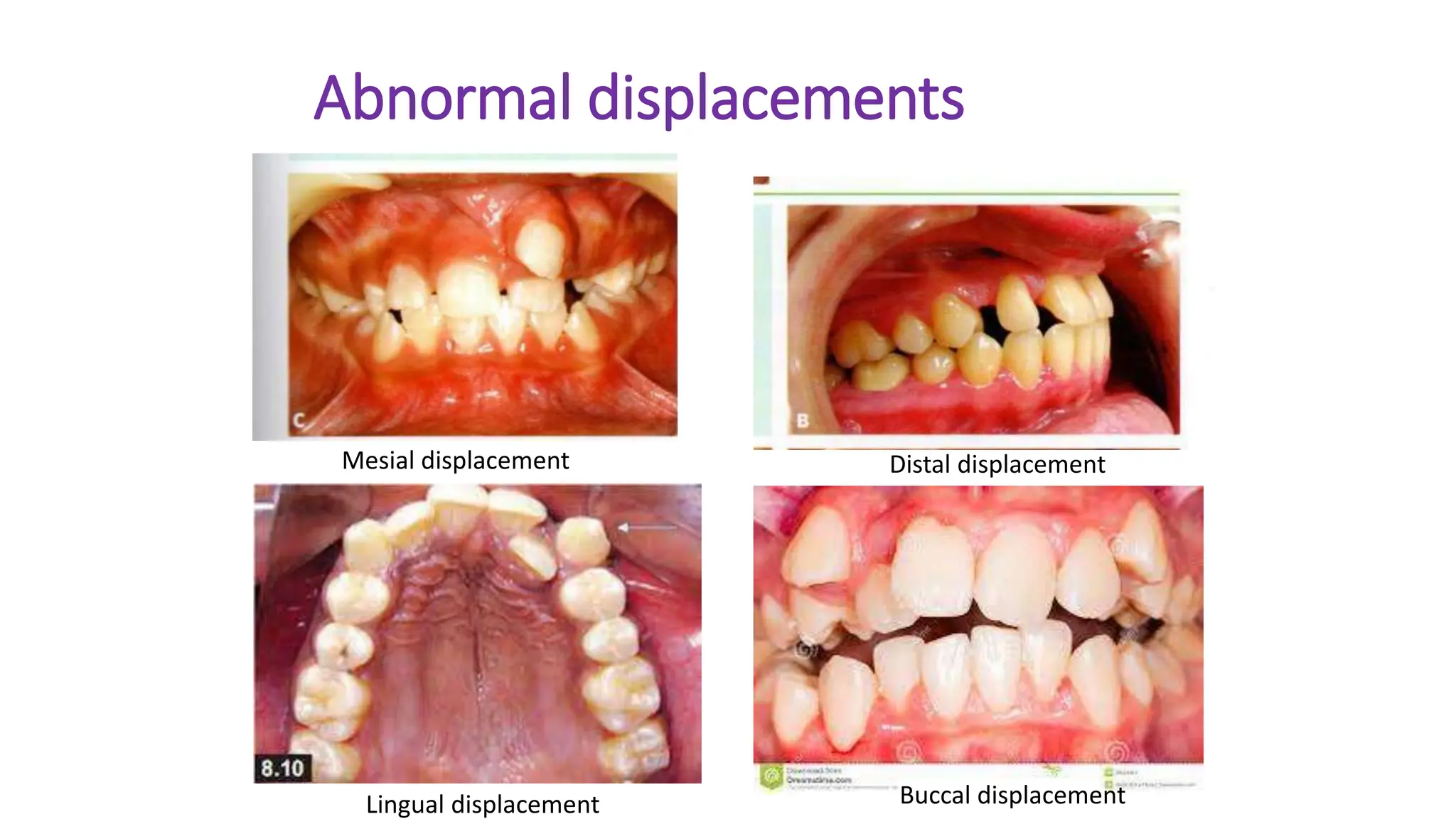
Abnormal displacements
Mesial displacement Distal displacement
Lingual displacement Buccal displacement
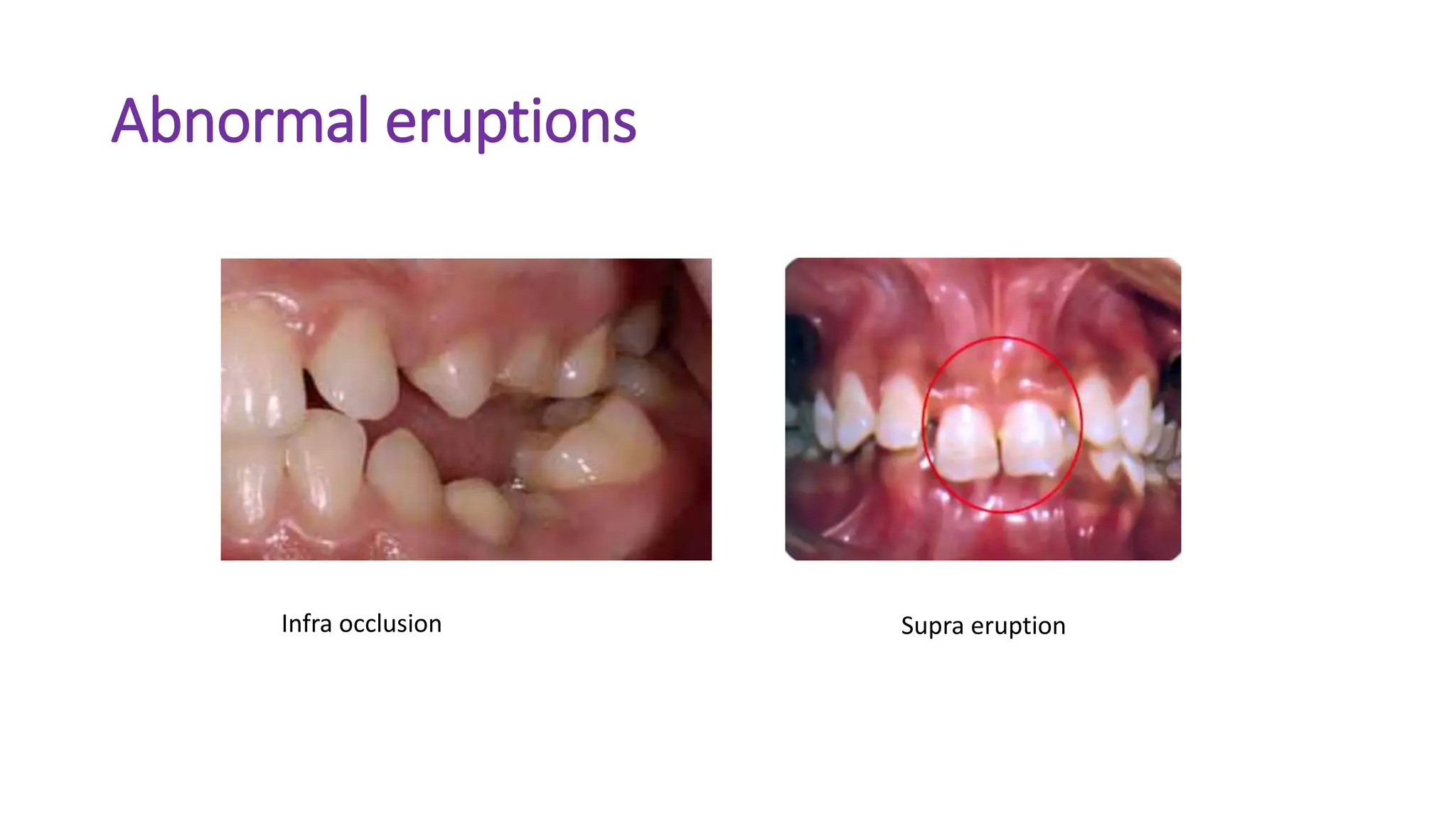
Abnormal eruptions
Infra occlusion Supra eruption
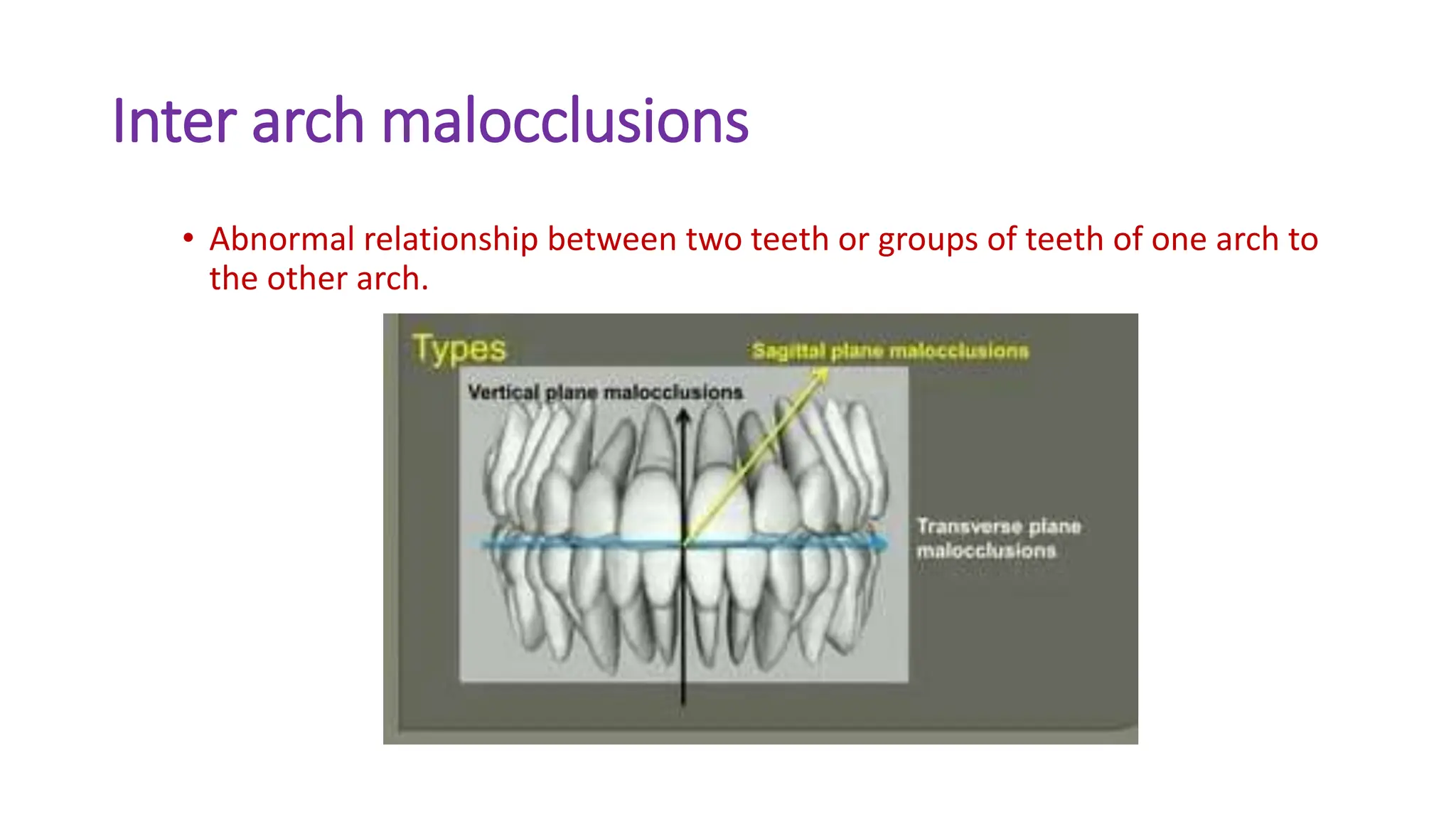
Inter arch malocclusions
• Abnormal relationship between two teeth or groups of teeth of one arch to
the other arch.
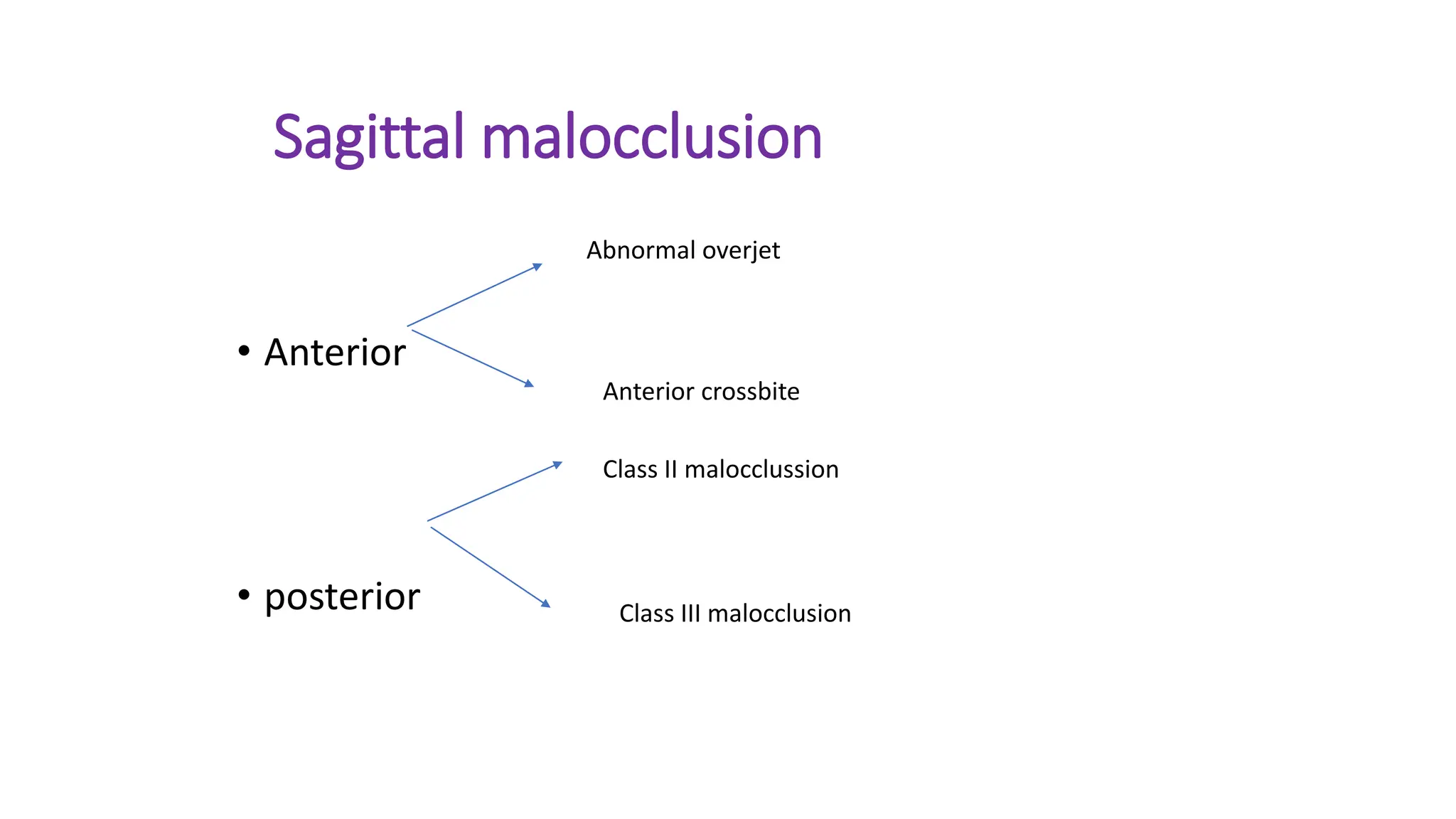
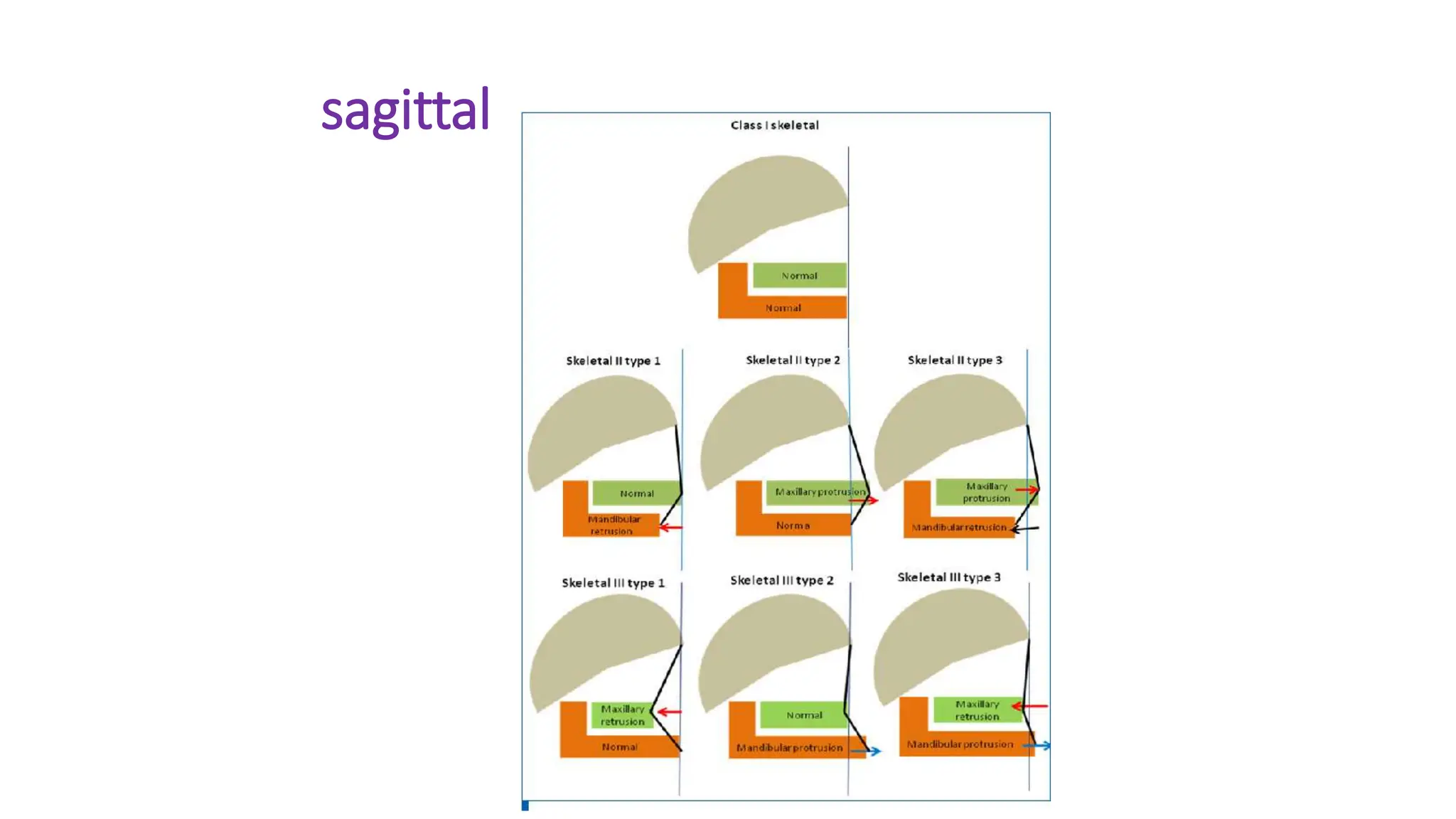
Sagittal malocclusion
• Anterior
• posterior
Abnormal overjet
Anterior crossbite
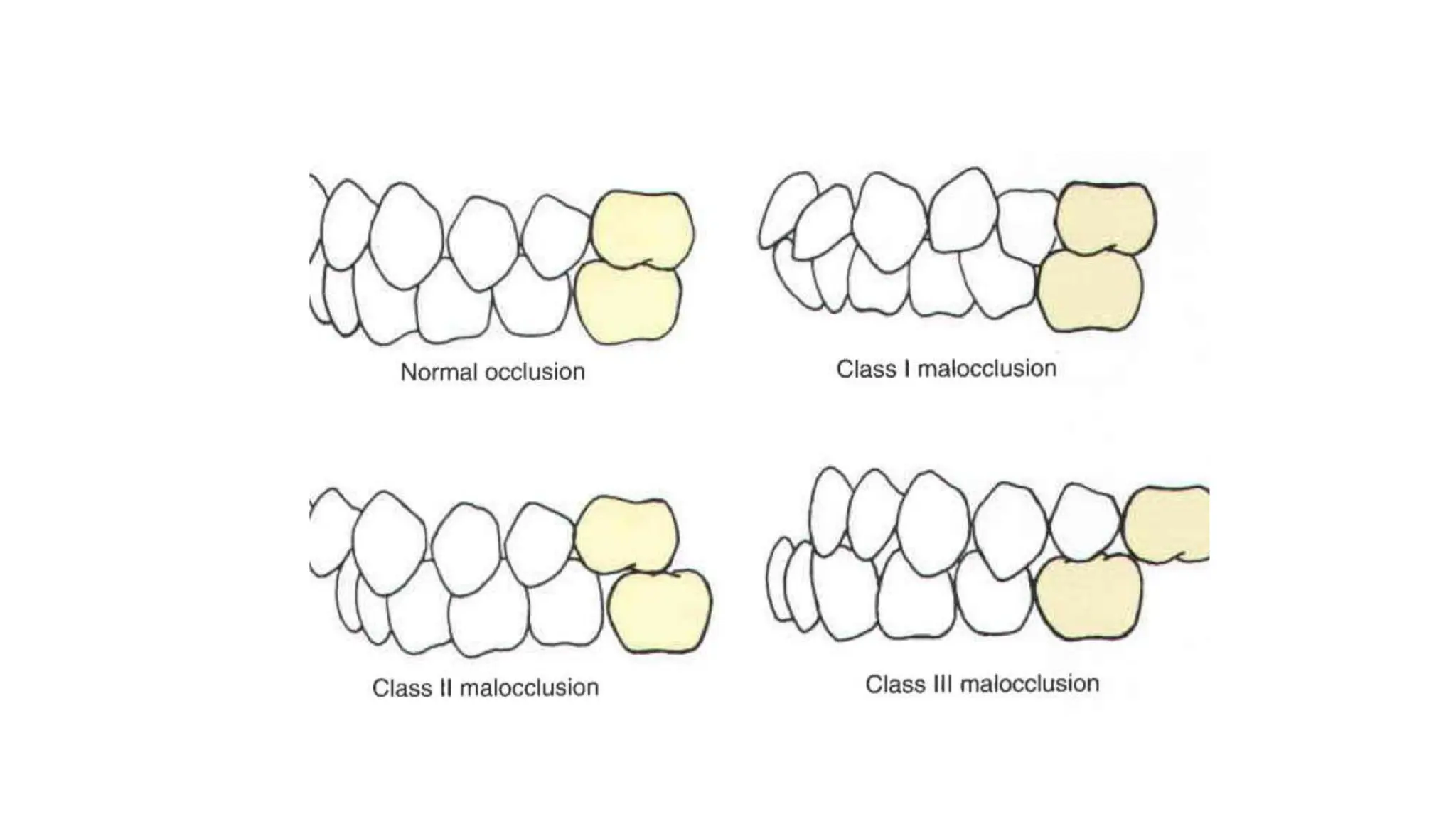
Class II malocclussion
Class III malocclusion
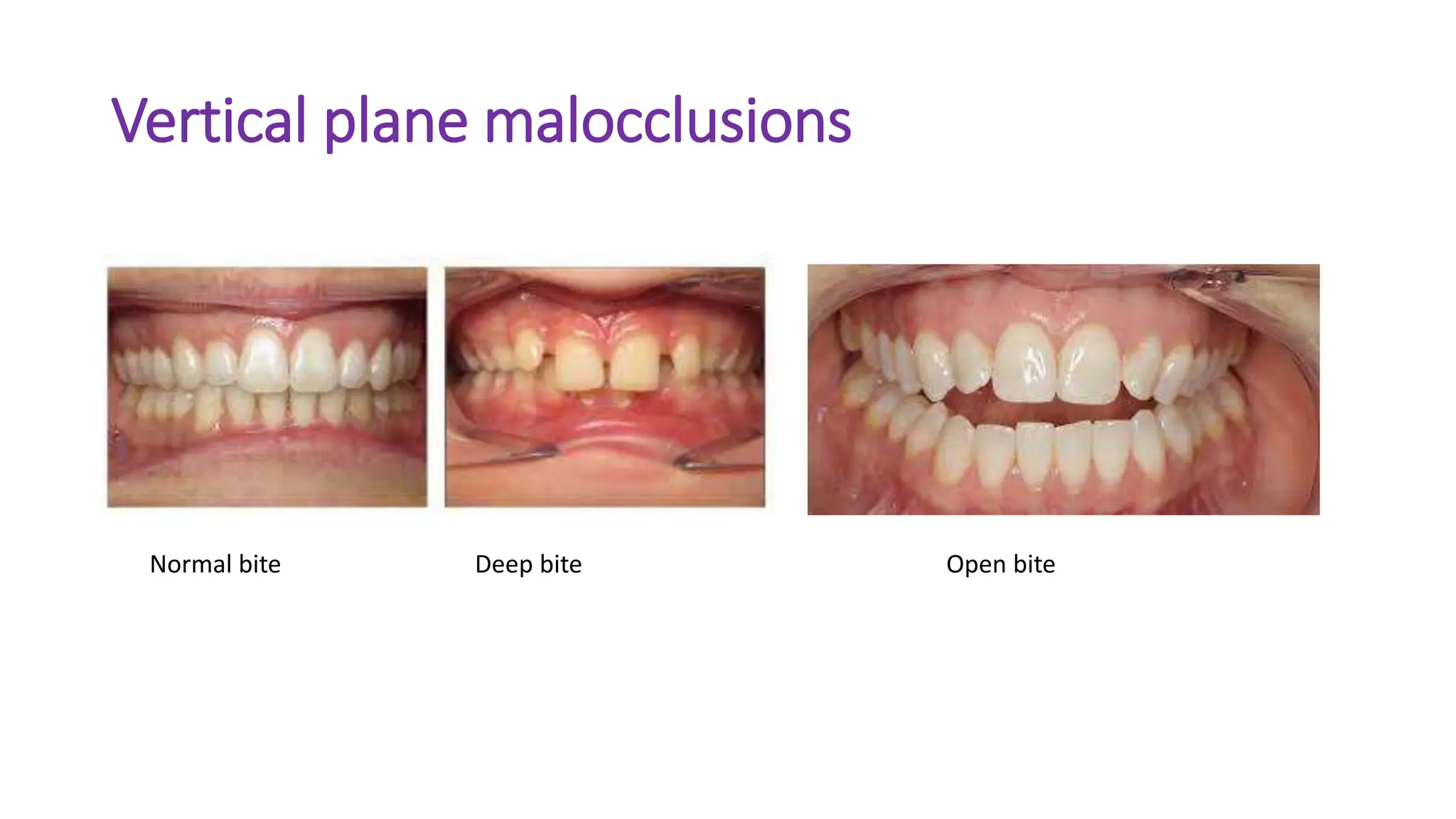
Vertical plane malocclusions
Normal bite Deep bite Open bite
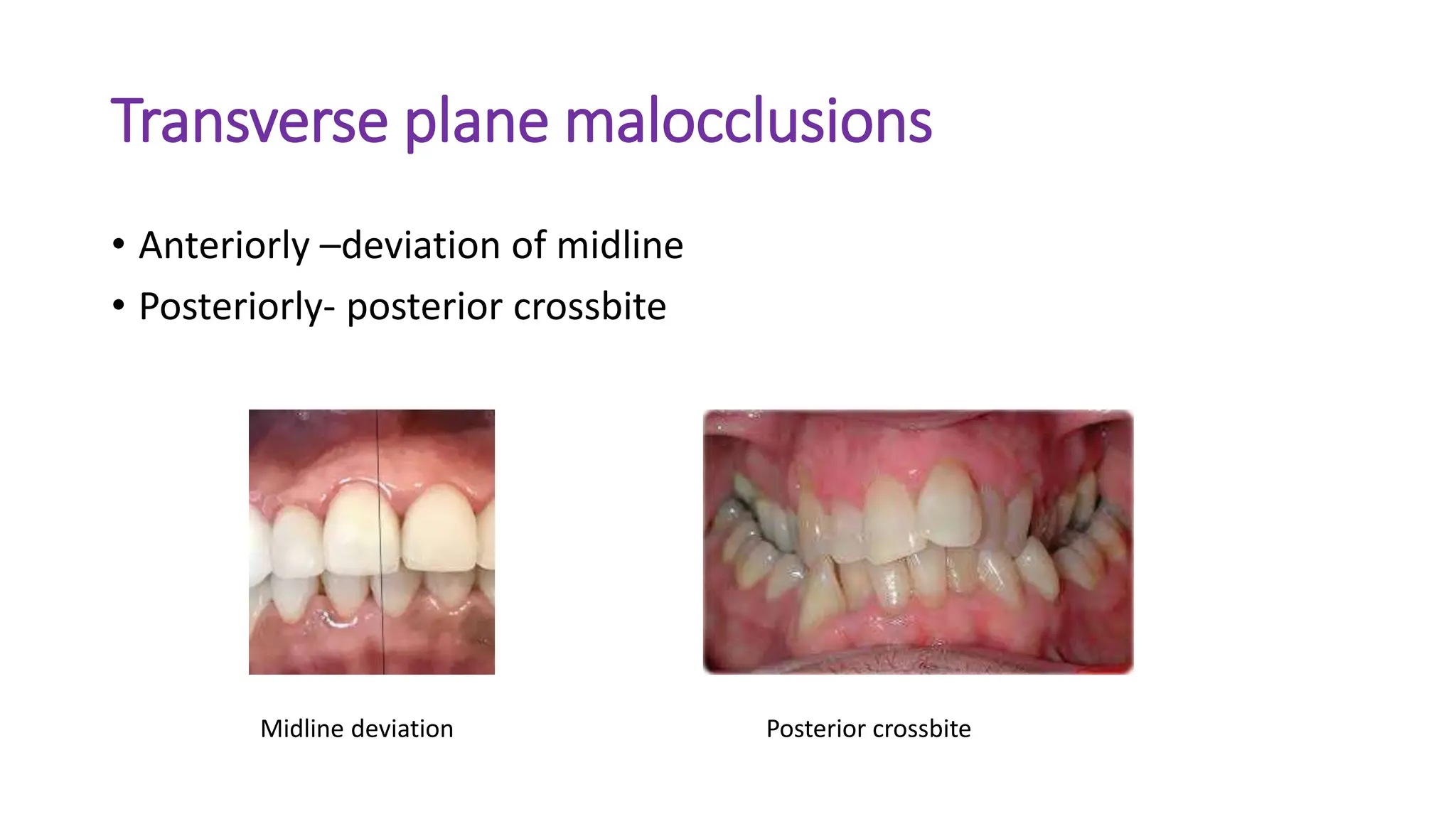
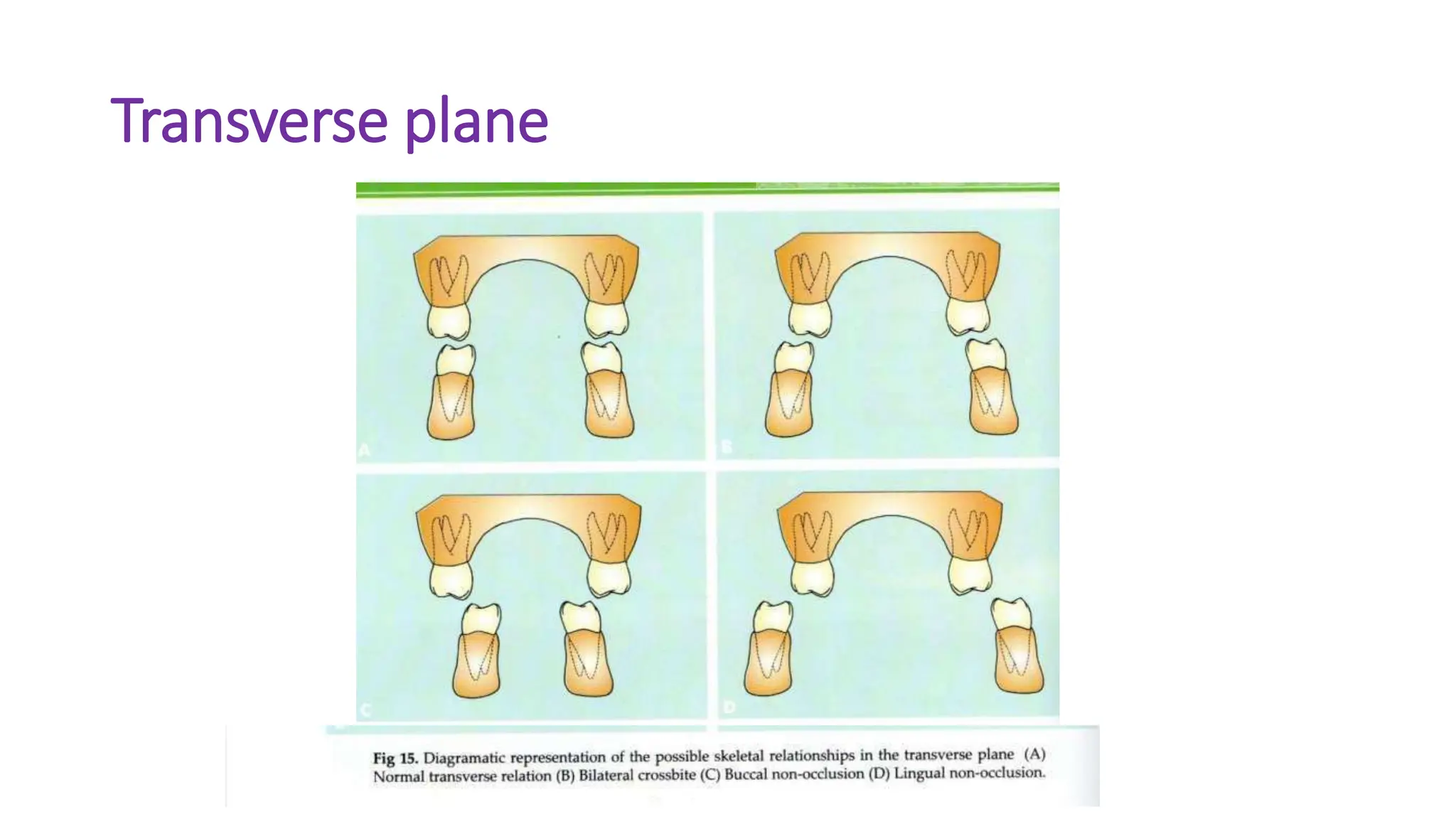
Transverse plane malocclusions
• Anteriorly –deviation of midline
• Posteriorly- posterior crossbite
Midline deviation Posterior crossbite
• Abnormalities in the maxilla or mandible
• The defects can be in size ,position or relationship between the jaws.
• Occur in Sagittal,vertical,and transverse planes
sagittal
Transverse plane
VARIOUS SYSTEMS OF CLASSIFICATION
• ANGLE CLASSIFICATION
• DEWAYS MODIFICATION OF ANGLE CLASSIFICATION
• LISCHER’S MODIFICATION OF CLASSIFICATION
• SIMONS CLASSIFICATION
• BENNETS CLASSIFICATION
• ACKERMAN –PROFIT SYSTEM OF CLASSIFICATION
• THE BRITISH STANDARDS INSTITUTES CLASSIFICATION OF
INCISOR RELATIONSHIP
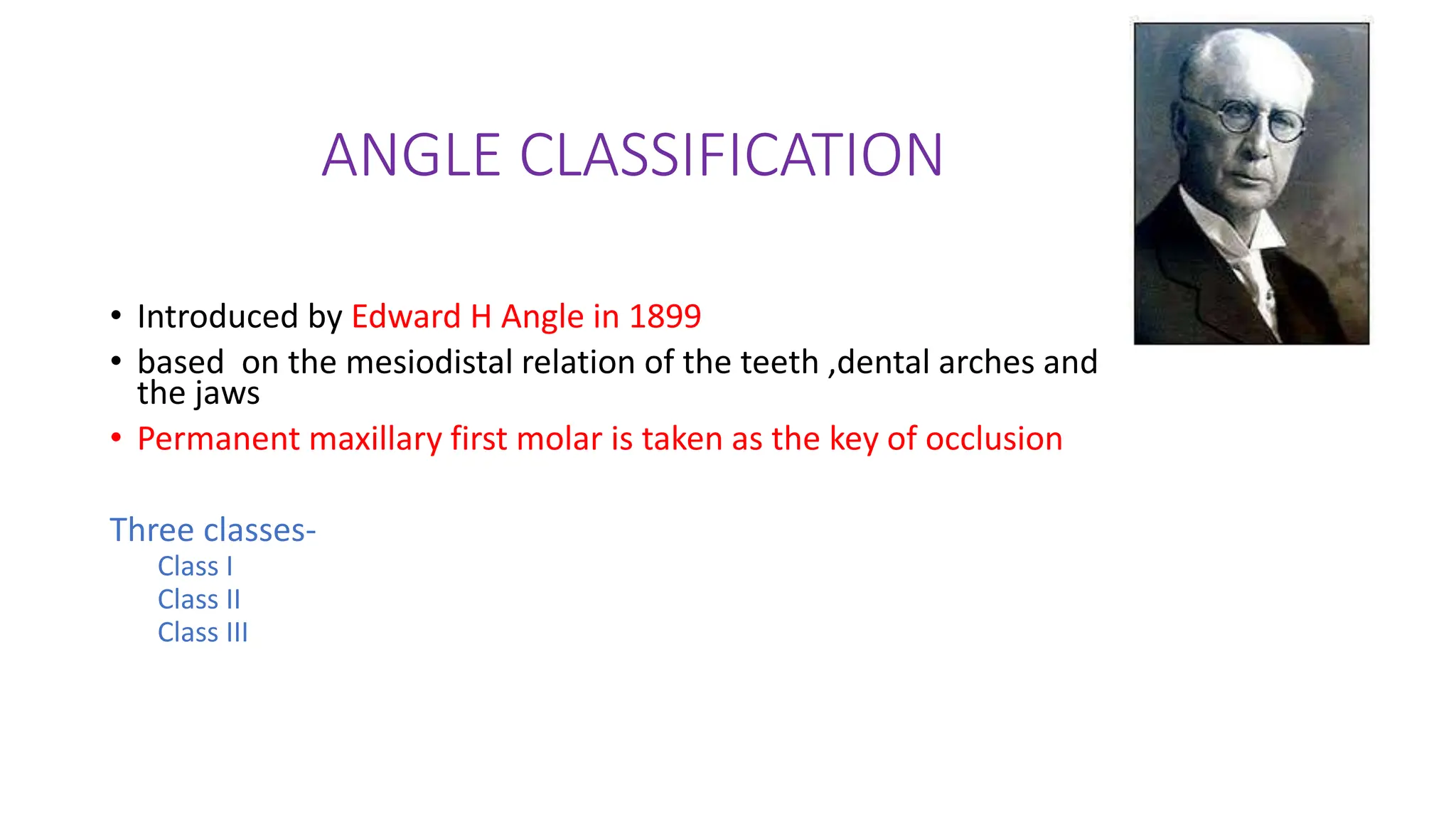
ANGLE CLASSIFICATION
• Introduced by Edward H Angle in 1899
• based on the mesiodistal relation of the teeth ,dental arches and
the jaws
• Permanent maxillary first molar is taken as the key of occlusion
Three classes-
Class I
Class II
Class III
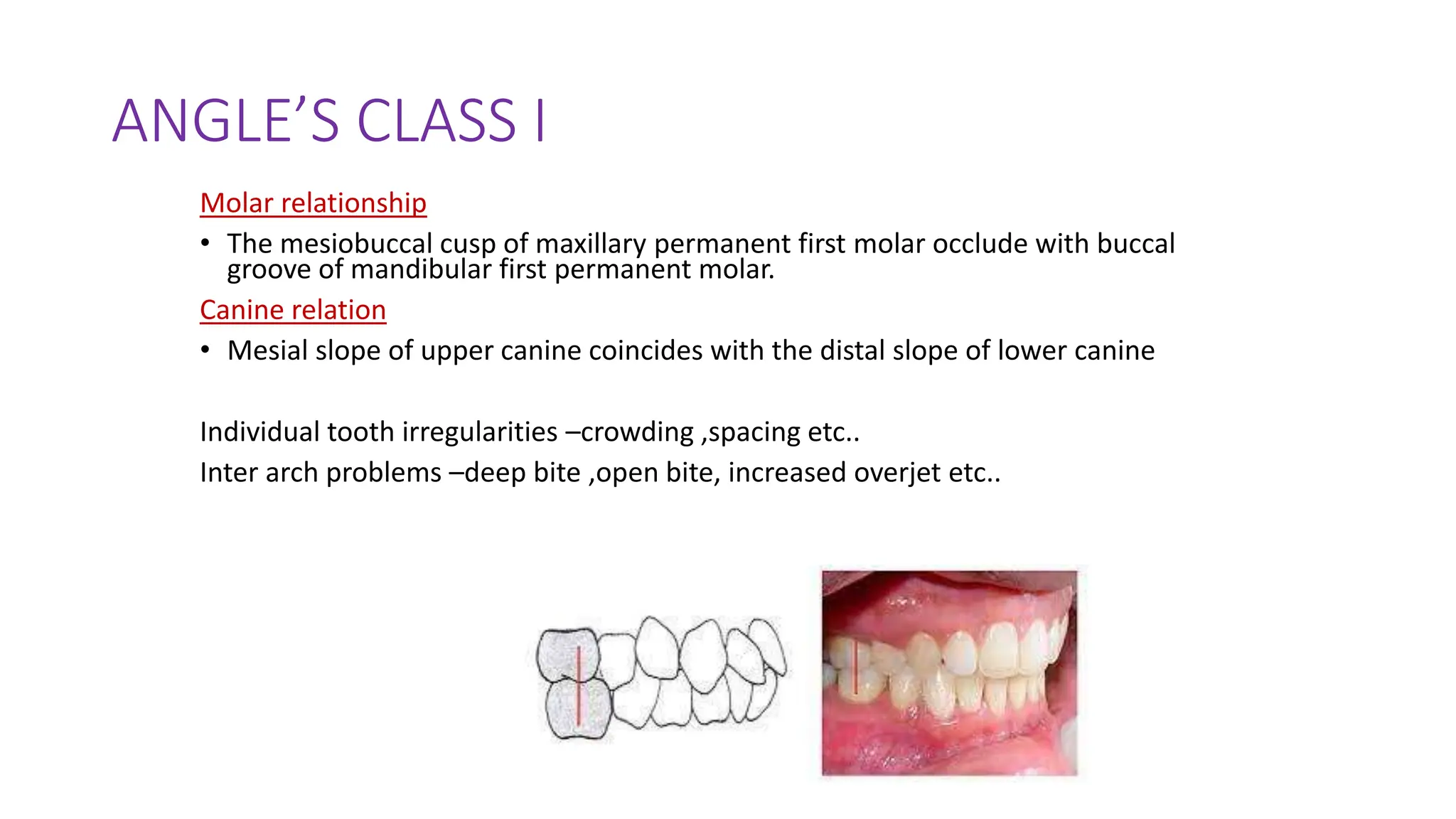
ANGLE’S CLASS I
Molar relationship
• The mesiobuccal cusp of maxillary permanent first molar occlude with buccal
groove of mandibular first permanent molar.
Canine relation
• Mesial slope of upper canine coincides with the distal slope of lower canine
Individual tooth irregularities –crowding ,spacing etc..
Inter arch problems –deep bite ,open bite, increased overjet etc..
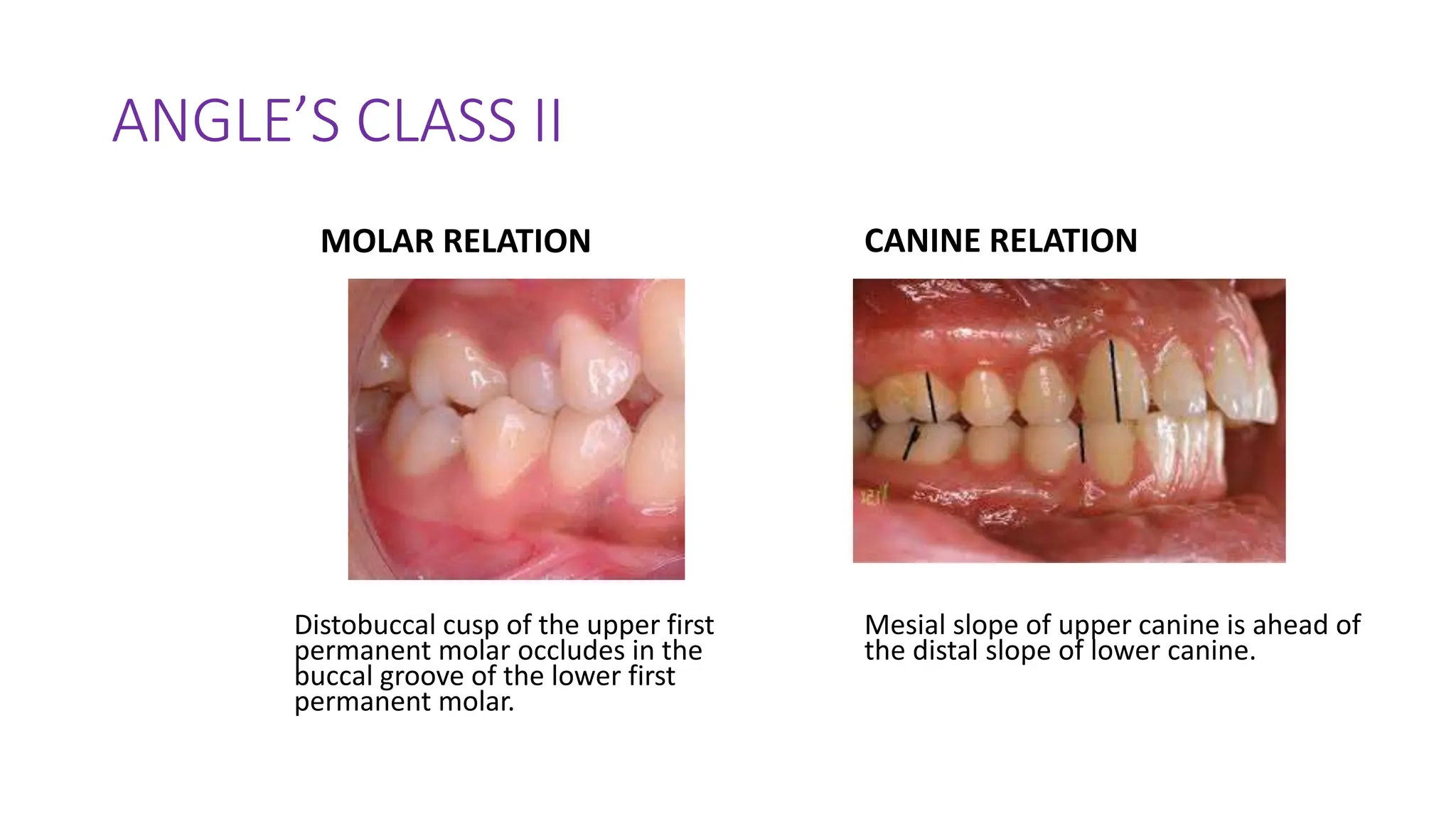
ANGLE’S CLASS II
MOLAR RELATION
Distobuccal cusp of the upper first
permanent molar occludes in the
buccal groove of the lower first
permanent molar.
CANINE RELATION
Mesial slope of upper canine is ahead of
the distal slope of lower canine.
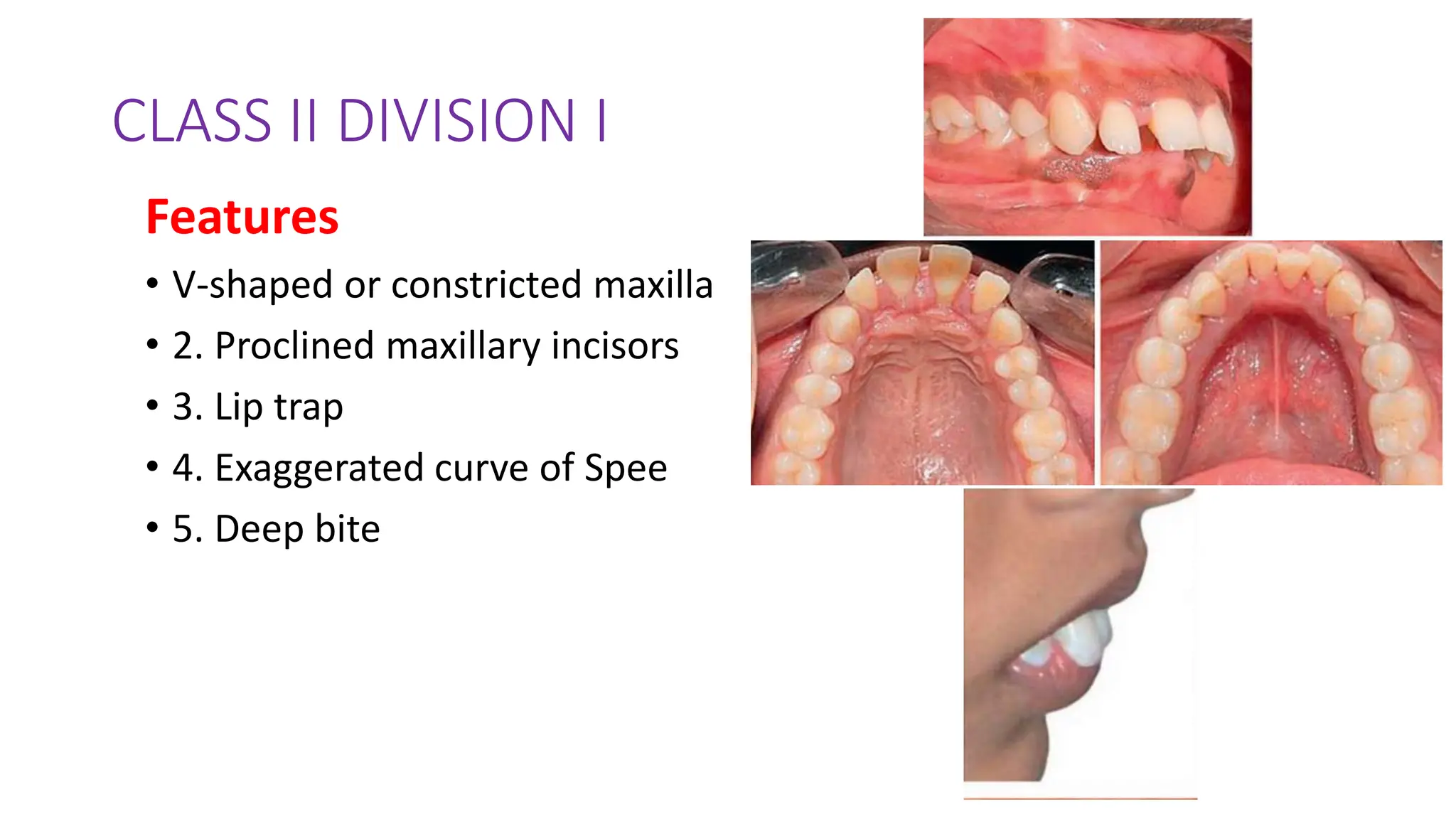
CLASS II DIVISION I
Features
• V-shaped or constricted maxilla
• 2. Proclined maxillary incisors
• 3. Lip trap
• 4. Exaggerated curve of Spee
• 5. Deep bite
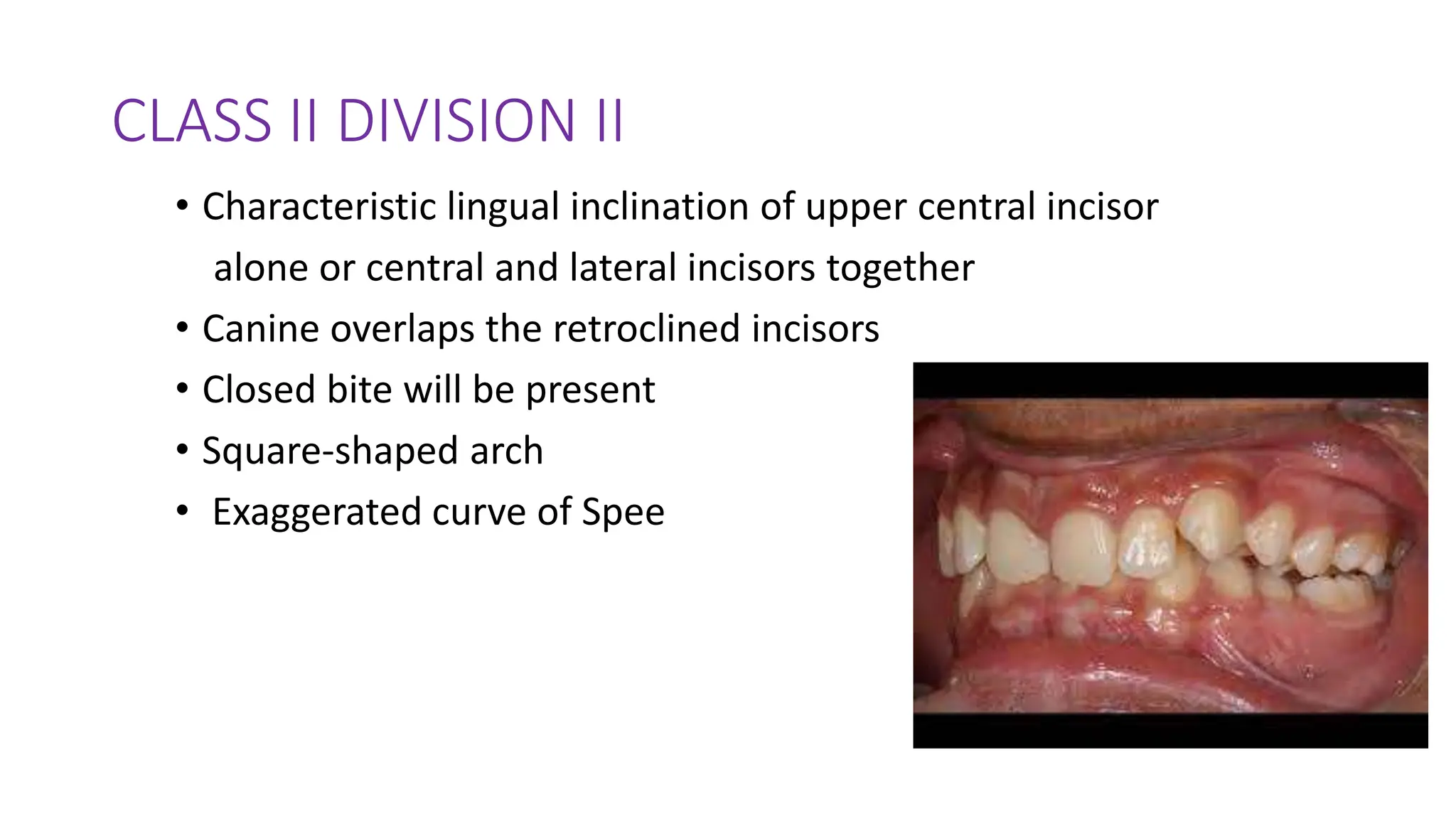
CLASS II DIVISION II
• Characteristic lingual inclination of upper central incisor
alone or central and lateral incisors together
• Canine overlaps the retroclined incisors
• Closed bite will be present
• Square-shaped arch
• Exaggerated curve of Spee
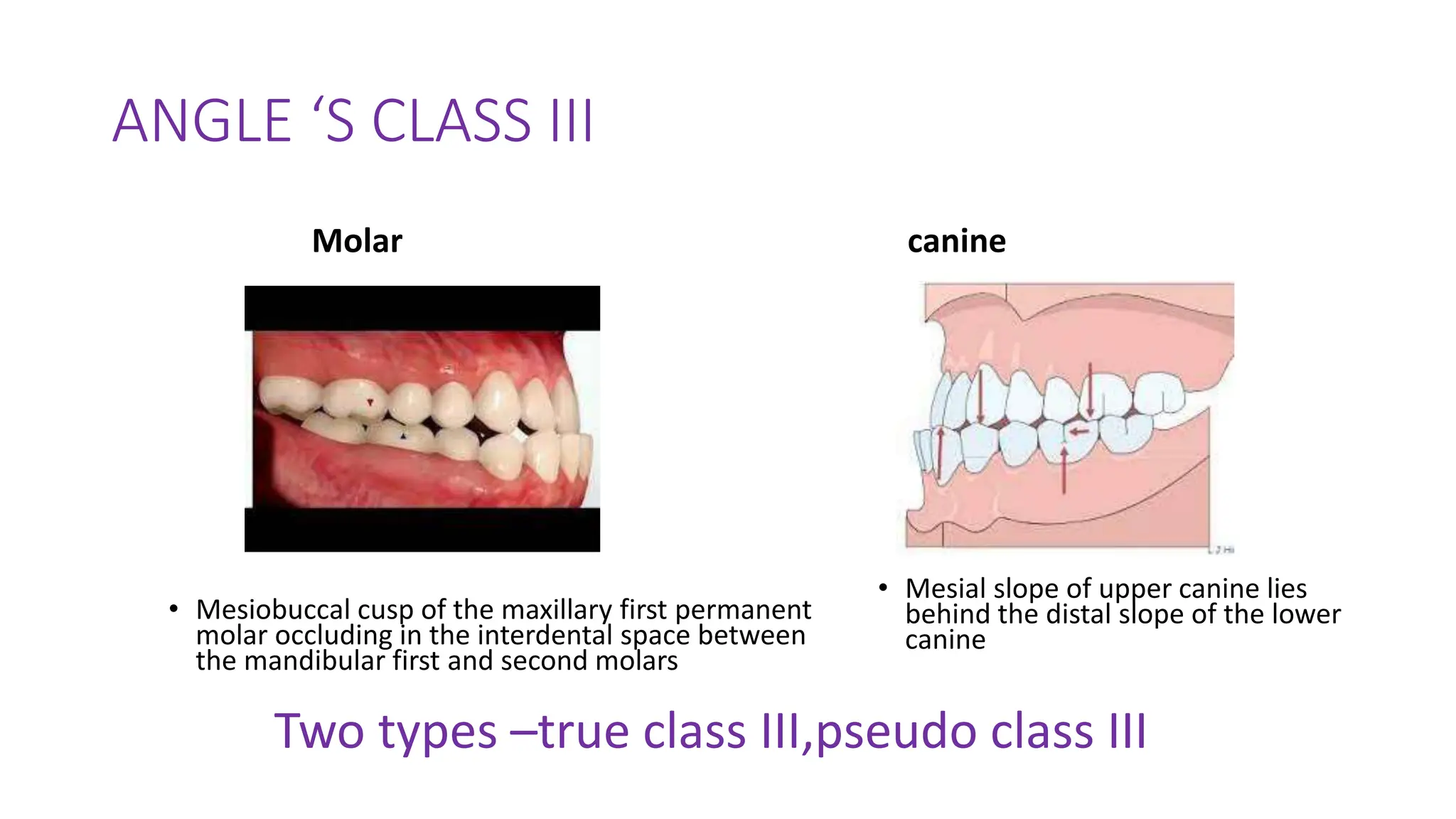
ANGLE ‘S CLASS III
Molar
• Mesiobuccal cusp of the maxillary first permanent
molar occluding in the interdental space between
the mandibular first and second molars
canine
• Mesial slope of upper canine lies
behind the distal slope of the lower
canine
Two types –true class III,pseudo class III
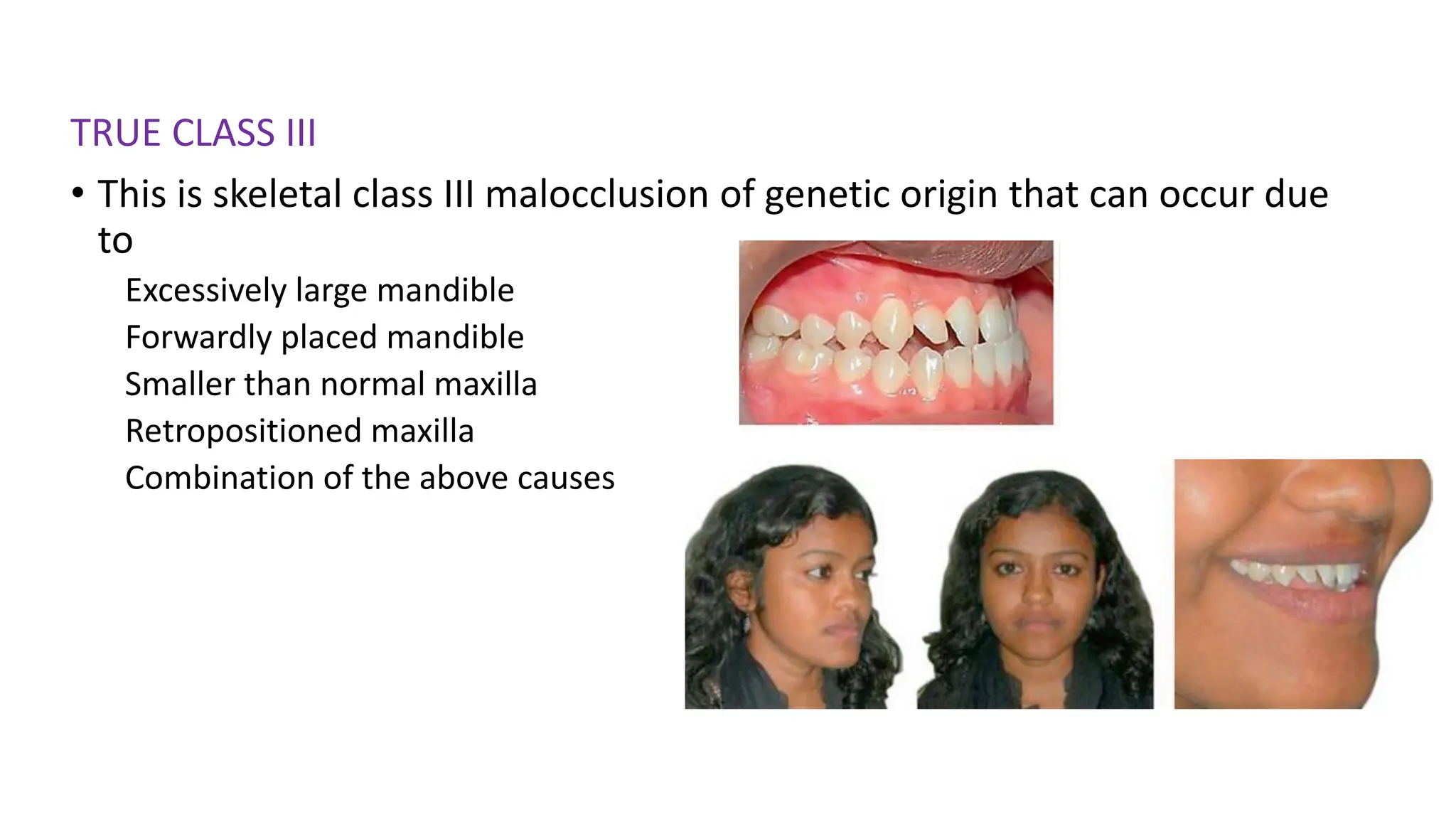
TRUE CLASS III
• This is skeletal class III malocclusion of genetic origin that can occur due
to
Excessively large mandible
Forwardly placed mandible
Smaller than normal maxilla
Retropositioned maxilla
Combination of the above causes
Pseudo class III
• Produced by forward movement of the mandible during jaw closure
• Also called postural or habitual class III malocclusion
Reasons
• Occlusal prematurities
• Premature loss of deciduous posteriors
• Enarged adenoids
Class III subdivision
• Class III molar relation on one side and a class I relation on the other
side.
Advantages of Angle’s System of Classification
1. Angle’s system of classification is the most traditional
and oldest system still in use.
2. It is the most practical and easy to comprehend.
3. It is the most popular of all systems.
4. It is easy to communicate.
5. It is widely used for teaching purpose
Disadvantages or Limitations
1. It disregarded the relationship of the teeth to the face.
2. Malocclusion is a three-dimensional problem, but
Angle considers only sagittal dimension.
3. The position of the maxillary first permanent molar is
not stable as stated by Angle.
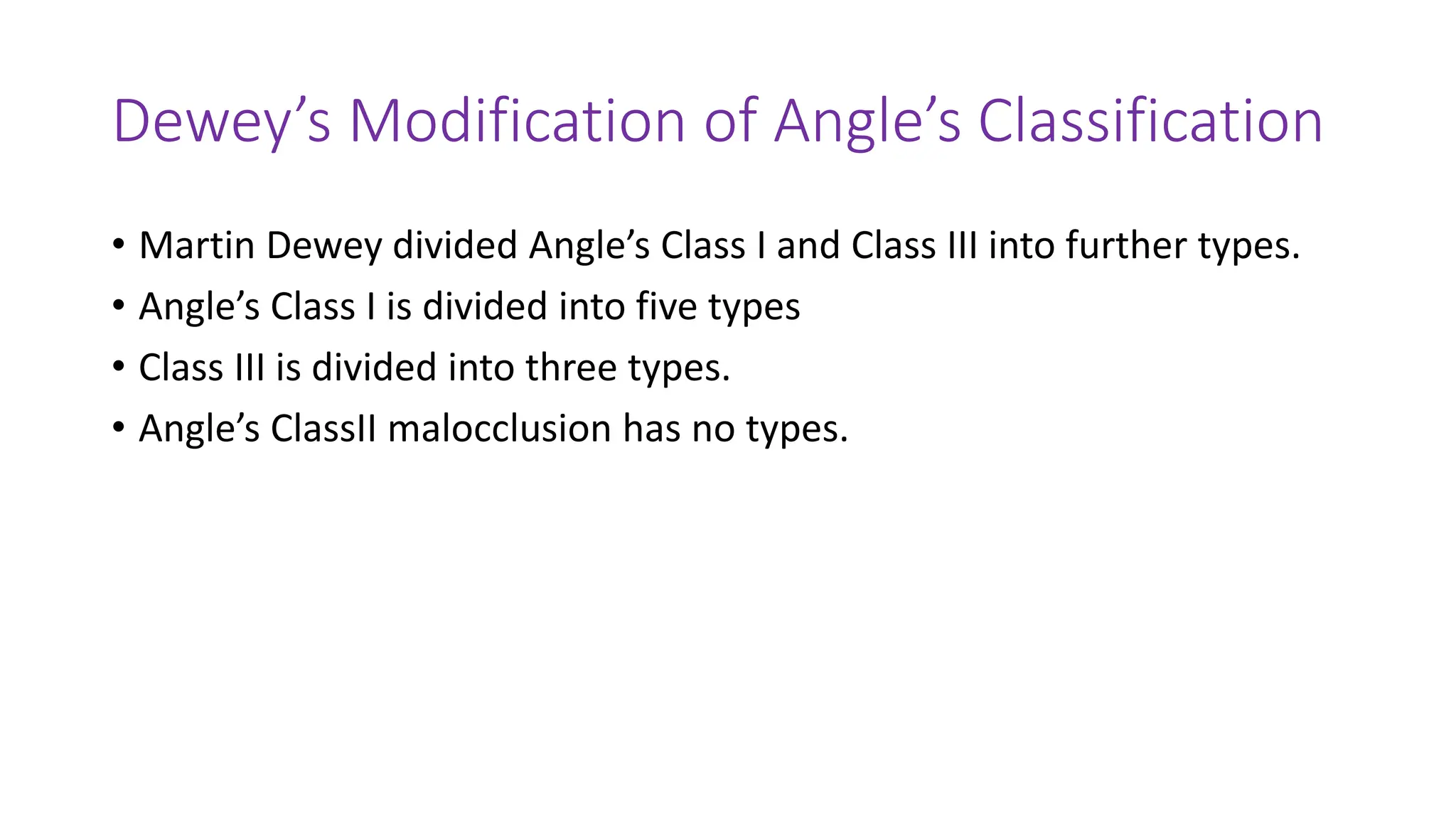
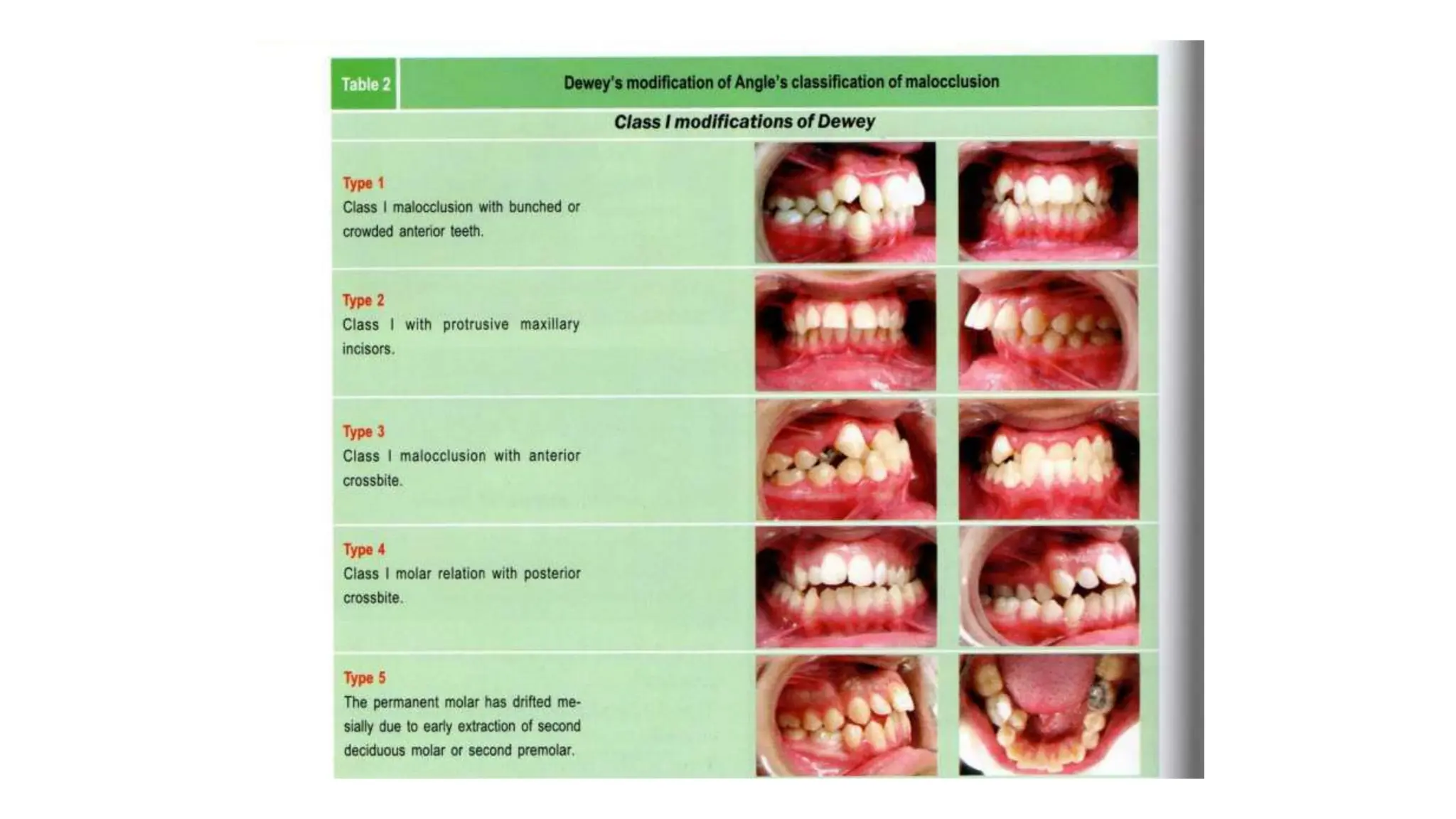
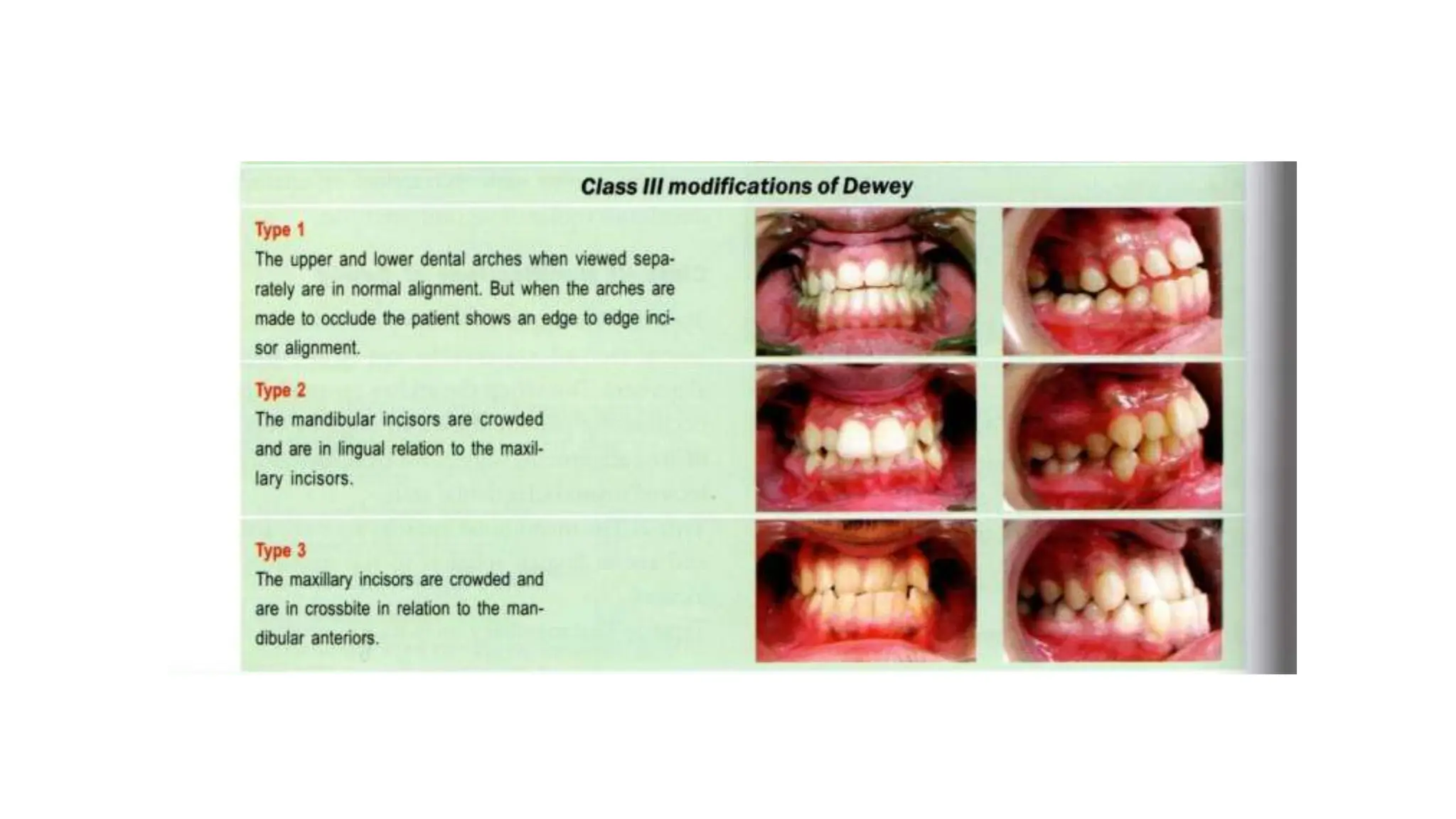
Dewey’s Modification of Angle’s Classification
• Martin Dewey divided Angle’s Class I and Class III into further types.
• Angle’s Class I is divided into five types
• Class III is divided into three types.
• Angle’s ClassII malocclusion has no types.
Lischer’s modification-1933
• Neutro occlusion- angles class I malocclusion
• Distocclusion -angles class II malocclusion
• Mesiocclusion -angles class III malocclusion
• Buccocclusion – buccal placement of a tooth or a group of teeth
• Linguocclusion – lingual placement of a tooth or a group of teeth
• Supraocclusion – when a tooth or a group of teeth have erupted
beyond normal level
• Infraocclusion - when a tooth or group of teeth have not erupted to
normal level
• Mesioversion- mesial to normal position
• Distoversion- distal to normal position
• Transversion- transposition of two teeth
• Axiversion - abnormal axial inclination of a tooth
• Torsiversion- rotation of a tooth around its long axis
Simon’s Classification
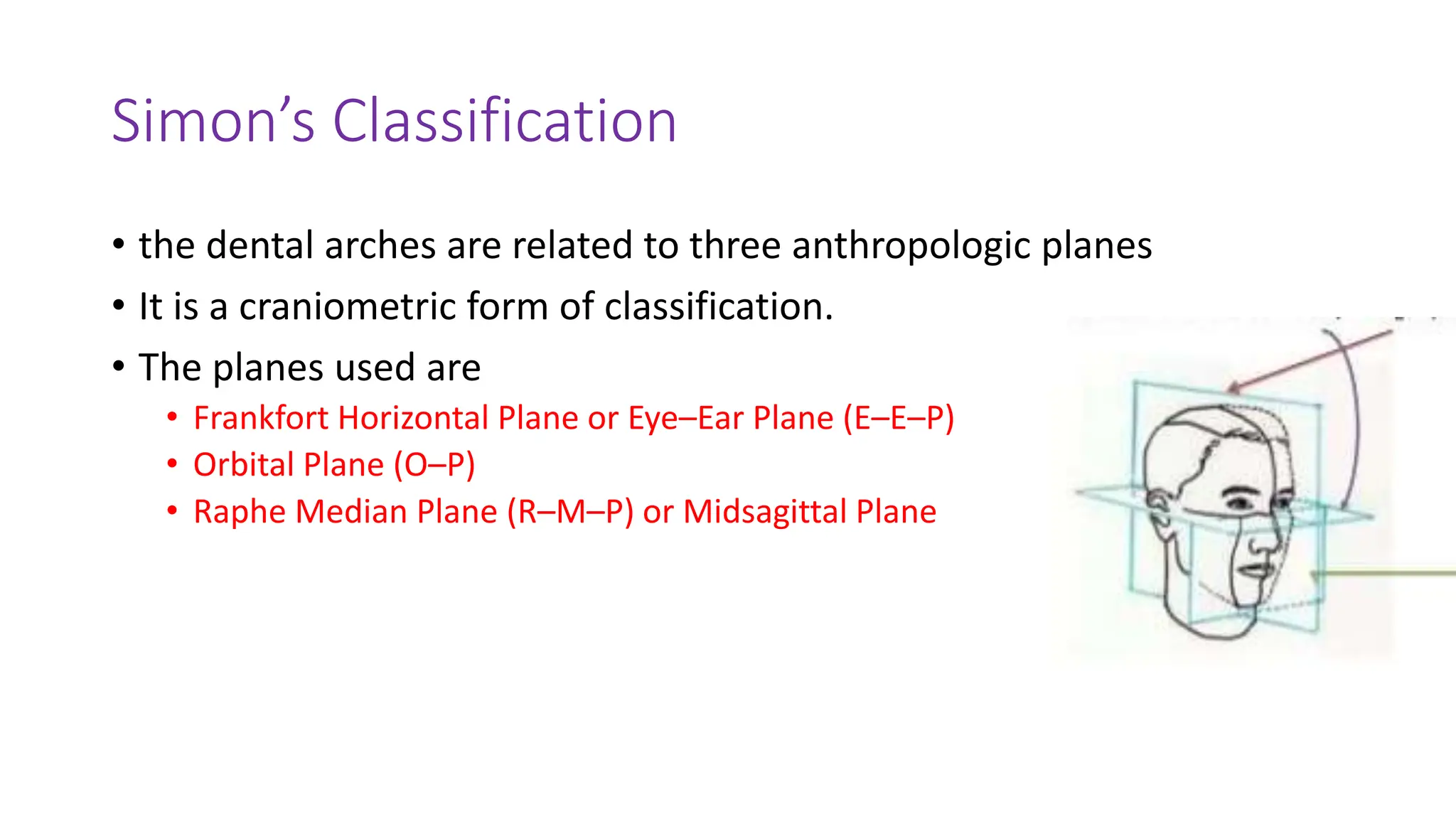
• the dental arches are related to three anthropologic planes
• It is a craniometric form of classification.
• The planes used are
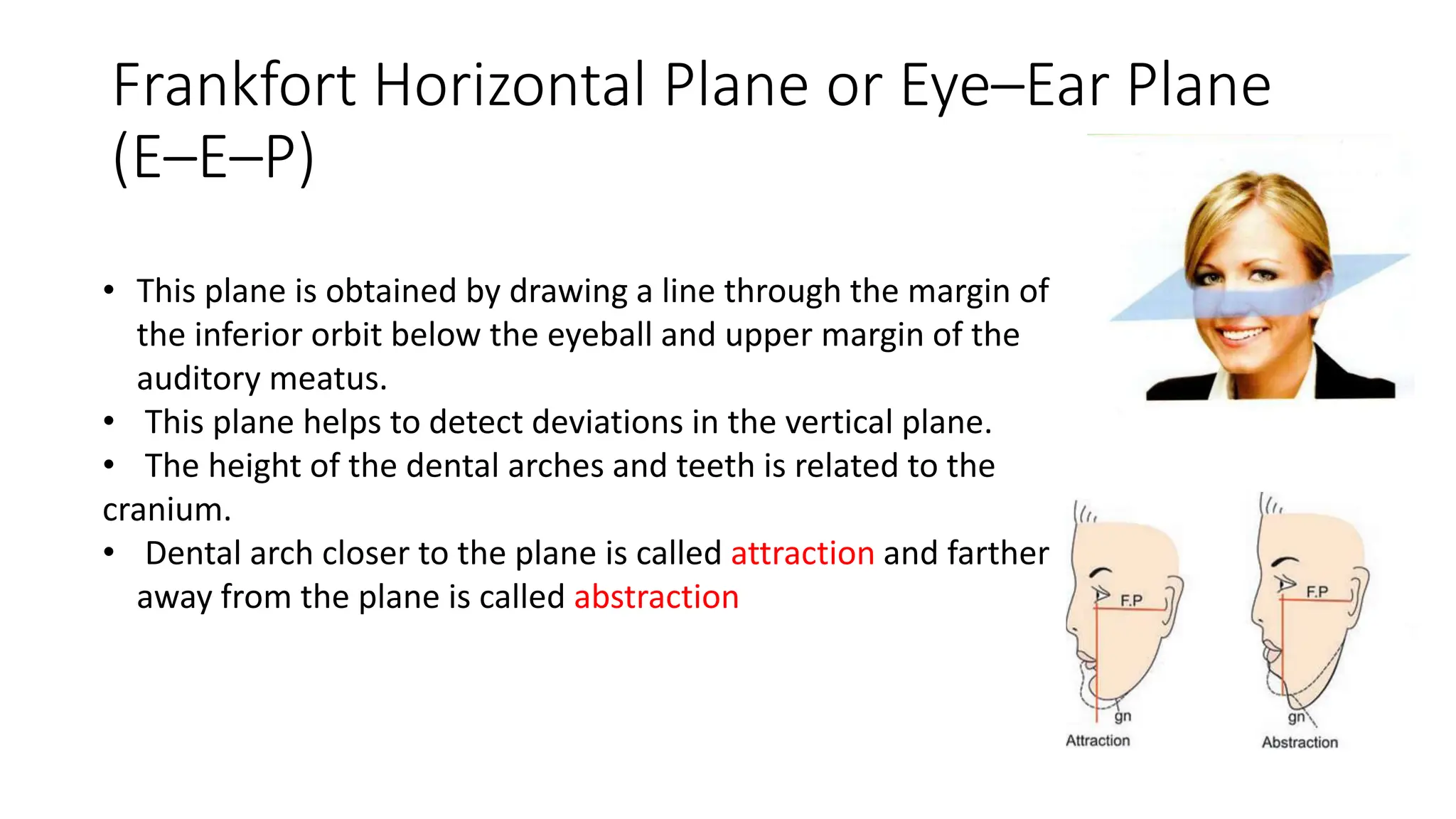
• Frankfort Horizontal Plane or Eye–Ear Plane (E–E–P)
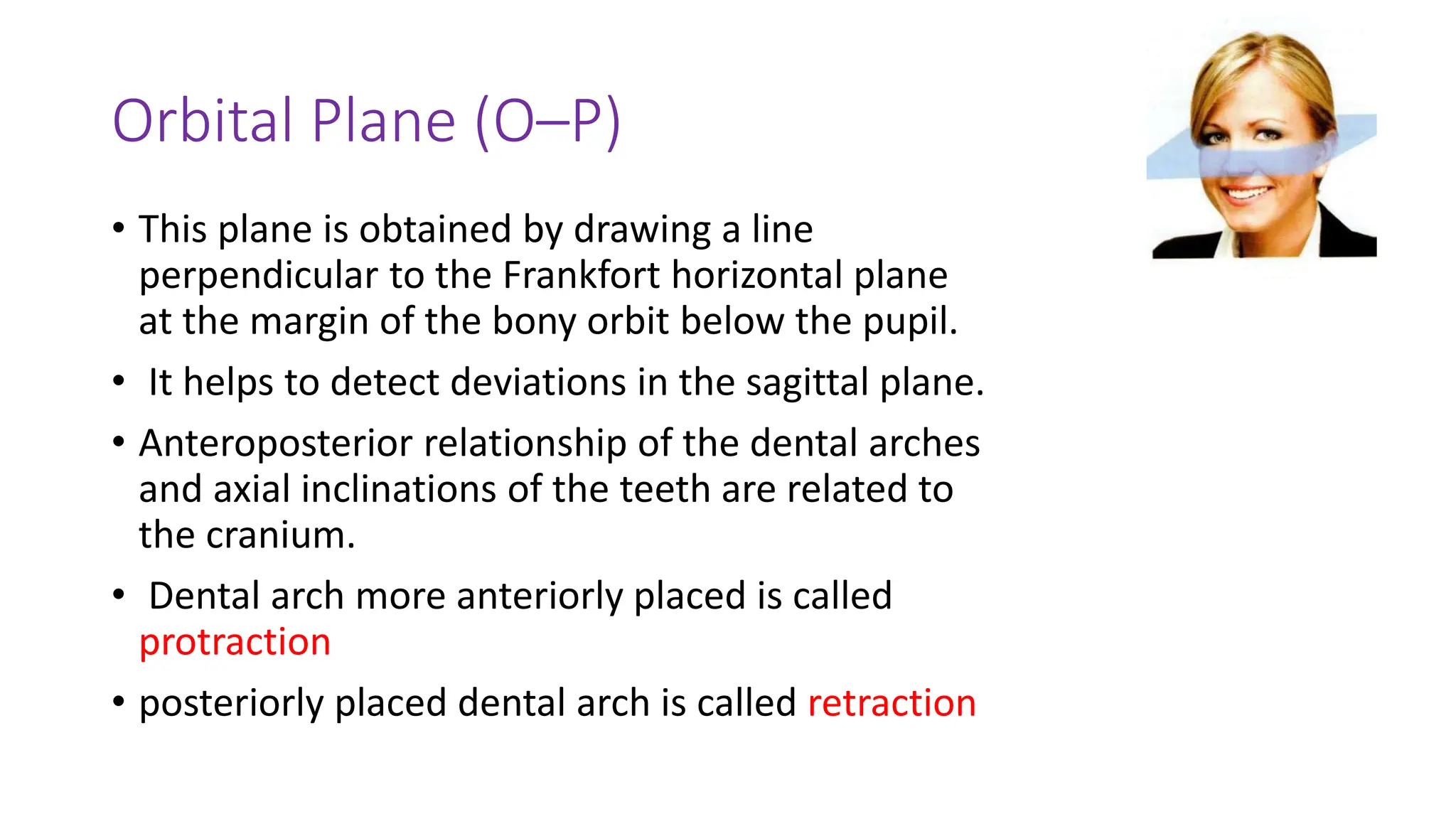
• Orbital Plane (O–P)
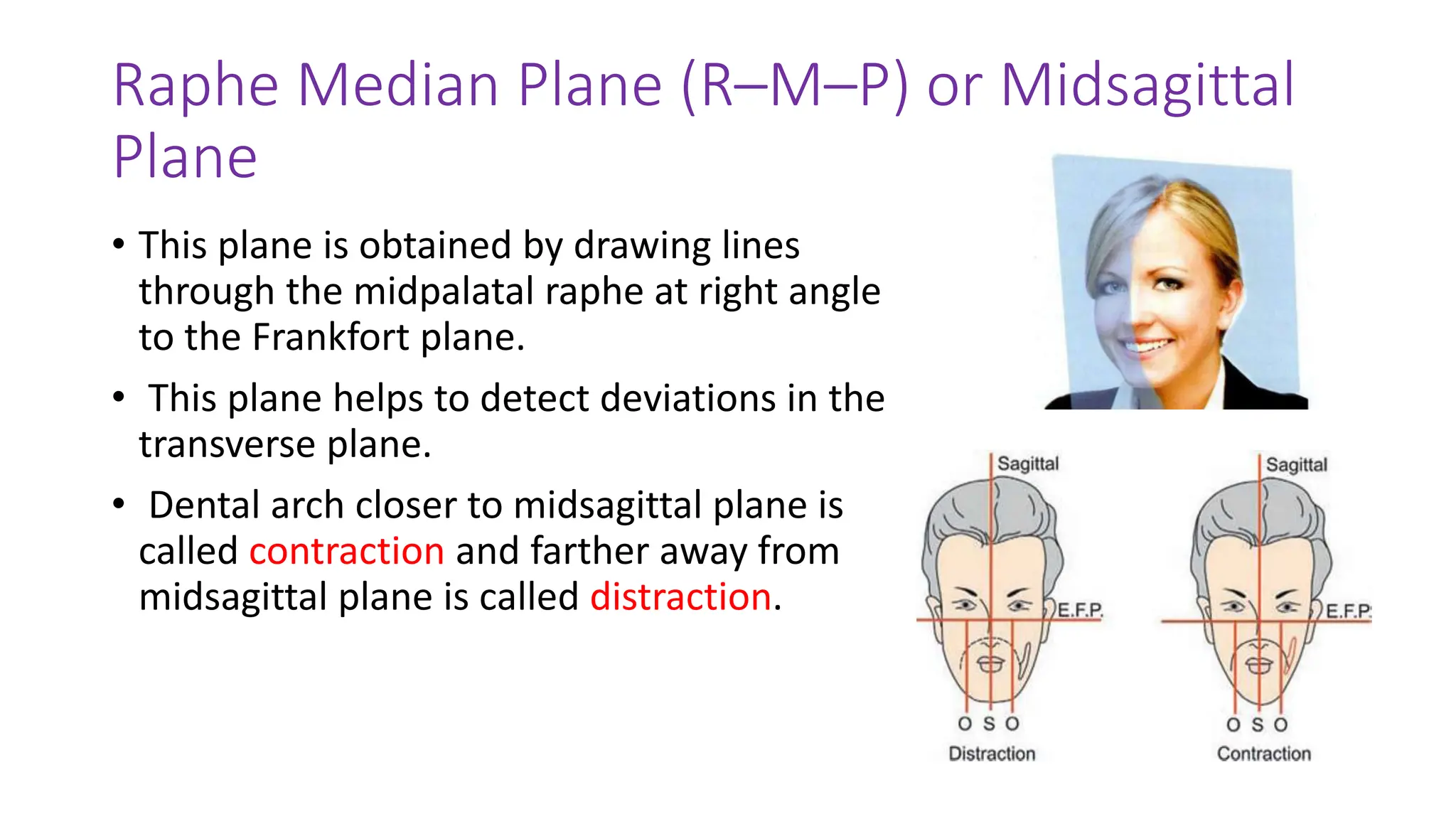
• Raphe Median Plane (R–M–P) or Midsagittal Plane
Frankfort Horizontal Plane or Eye–Ear Plane
(E–E–P)
• This plane is obtained by drawing a line through the margin of
the inferior orbit below the eyeball and upper margin of the
auditory meatus.
• This plane helps to detect deviations in the vertical plane.
• The height of the dental arches and teeth is related to the
cranium.
• Dental arch closer to the plane is called attraction and farther
away from the plane is called abstraction
Orbital Plane (O–P)
• This plane is obtained by drawing a line
perpendicular to the Frankfort horizontal plane
at the margin of the bony orbit below the pupil.
• It helps to detect deviations in the sagittal plane.
• Anteroposterior relationship of the dental arches
and axial inclinations of the teeth are related to
the cranium.
• Dental arch more anteriorly placed is called
protraction
• posteriorly placed dental arch is called retraction
Raphe Median Plane (R–M–P) or Midsagittal
Plane
• This plane is obtained by drawing lines
through the midpalatal raphe at right angle
to the Frankfort plane.
• This plane helps to detect deviations in the
transverse plane.
• Dental arch closer to midsagittal plane is
called contraction and farther away from
midsagittal plane is called distraction.
Law of Canines
• According to Simon, in a normal arch relationship, the orbital plane
passes through the distal aspect of canine.
• This is called ‘law of canines
Bennett’s classification
• Based on etiology
• Class I – abnormal position of one or more teeth due to local causes
• Class II- abnormal formation of a part of or whole of either arch due
to developmental defects of bone
• Class III- abnormal relationship between upper and lower arches ,and
between either arch and facial contour and correlated abnormal
formation of either arch
Ackerman–Proffit Classification System
• Diagrammatic classification of malocclusion to overcome the
limitations of angle’s classification
• Salient features include;
• Transverse as well as vertical Discrepancies can be considered in addition to
antero posterior malrelations.
• Crowding and arch symmetry can be evaluated
• Incisor protrusion is taken into account
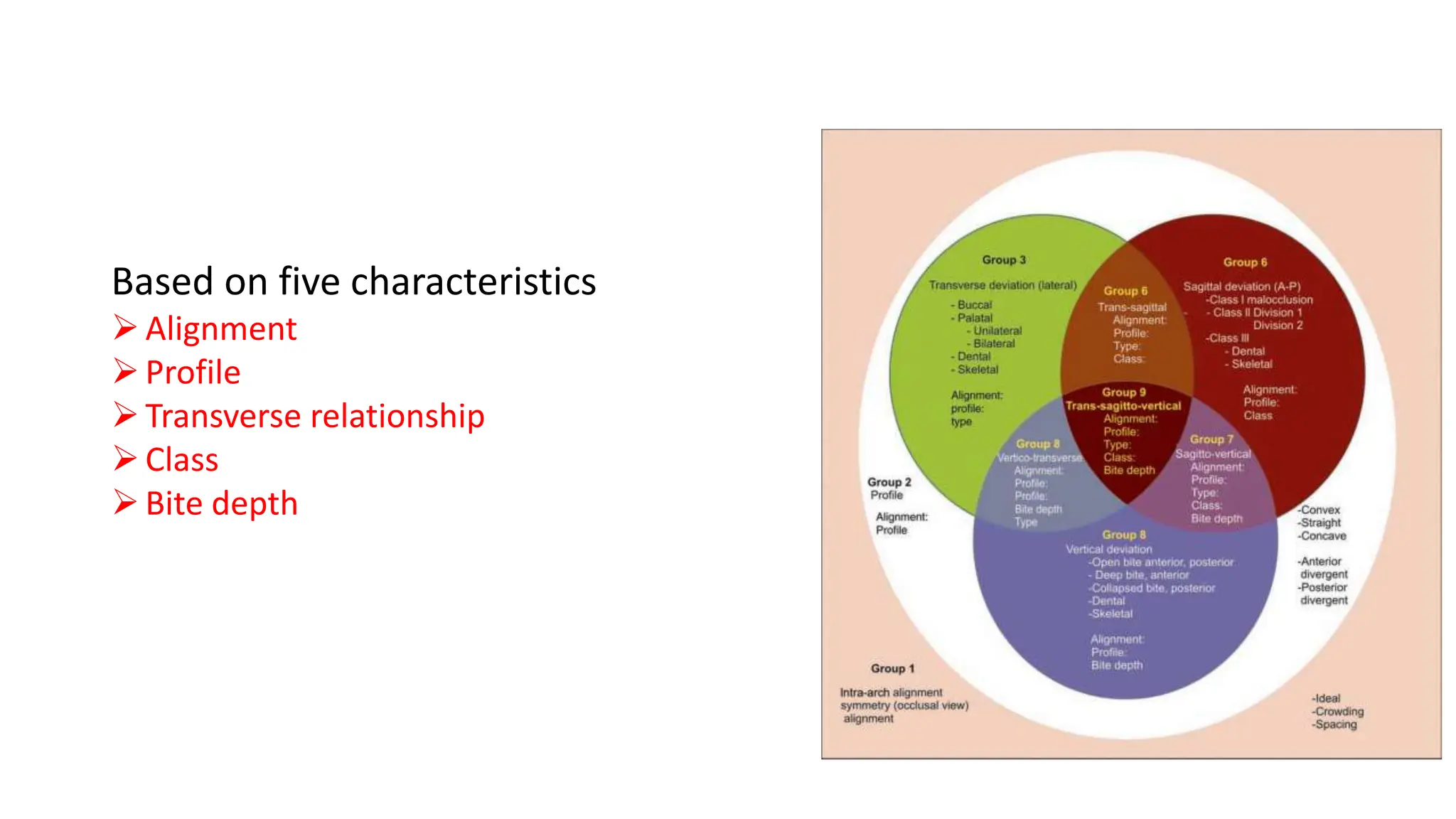
Based on five characteristics
Alignment
Profile
Transverse relationship
Class
Bite depth
Advantages:
1. This classification system is readily adaptable to computer processing
and would require only a numerical scale in programming for
automated data retrieval.
2. Malocclusion is analysed in three dimensions.
3. Soft tissue is also considered by studying the profile and divergence.
Limitations:
1. No account is taken of etiology, which is often vital treatment
information.
2. Since the analysis is essentially static, a functional analysis must still
be made
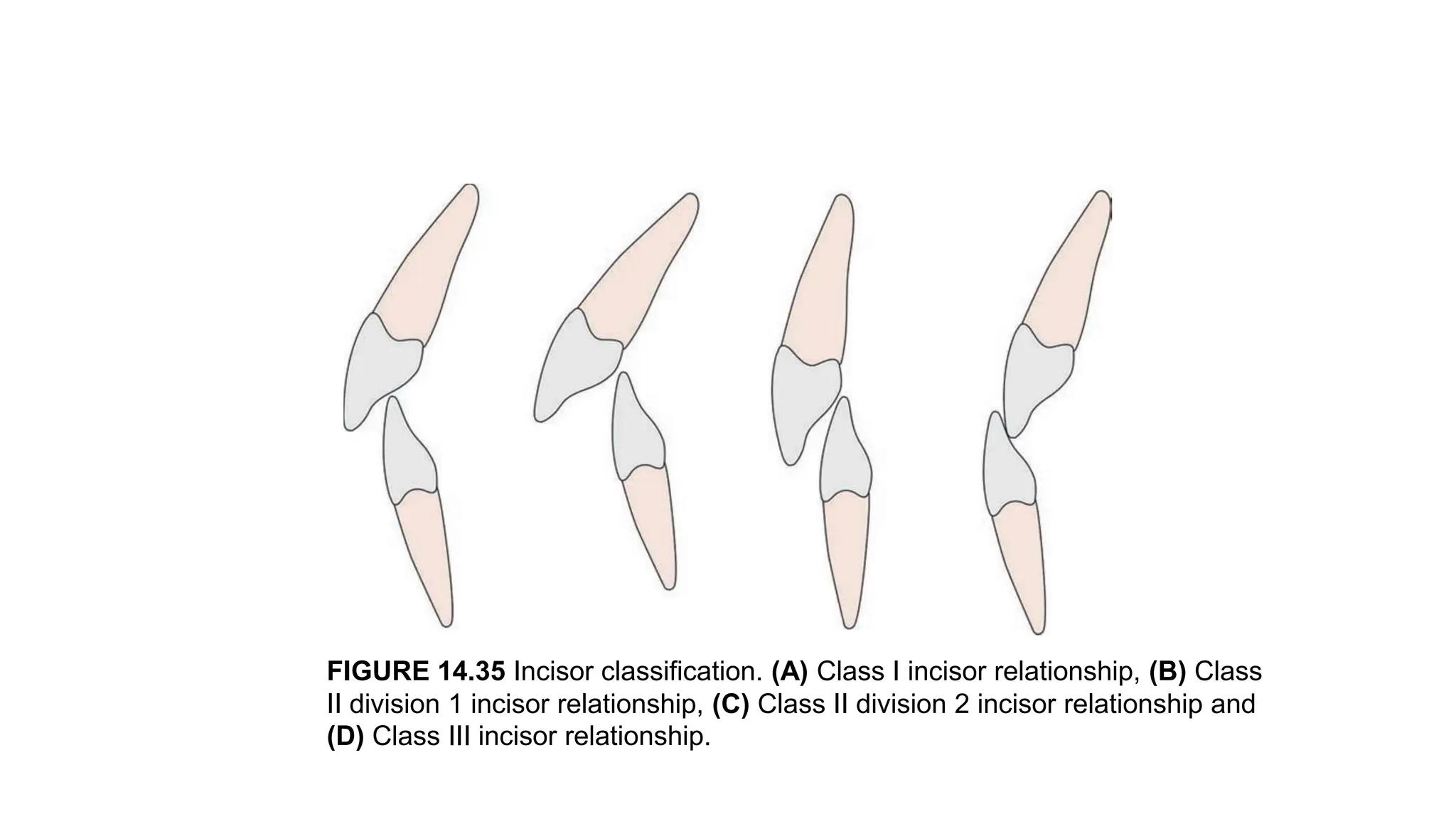
British Standards Institute Classification
(1983)
• introduced by Ballard and Wayman
• Class I: The lower incisor edges occlude with or lie immediately below
the cingulum of the upper central incisors.
• Class II: The lower incisor edges lie posterior to the cingulum
prominence of the upper incisors.
• Division 1: The upper central incisors are proclined or of average inclination.
There is an increase in overjet.
• Division 2: The upper central incisors are retroclined.The overjet is usually
minimal but may be increased.
• Class III: The lower incisor edges lie anterior to the cingulum
prominence of the upper incisor. The overjet is reduced or reversed.
FIGURE 14.35 Incisor classification. (A) Class I incisor relationship, (B) Class
II division 1 incisor relationship, (C) Class II division 2 incisor relationship and
(D) Class III incisor relationship.
conclusion
• As orthodontists,a good knowledge of different systems of
classifications of malocclusion ,its merits and demerits is very
important in making proper diagnosis and effective treatment
planning.

classification of malocclusion in detail.pptx

  • 1.
  • 2.
    Introduction • In thespeciality of orthodontics,the classification of malocclusion plays several very important roles.classification aids in the diagnosis and treatment planning of malocclusions by orienting the clinician to the type and the magnitude of the problems and possible mechanical problems to these problems..
  • 3.
    What is occlusion? • Angle defined occlusion as the normal relation of the occlusal inclined planes of the teeth when the jaws are closed.
  • 4.
    What is malocclusion? •Malocclusion may be defined as –a condition where there is departure from the normal relation of the teeth to other teeth in the same dental arch and / or to teeth in the same arch • The term was coined by Edward H Angle
  • 5.
    Malocclusion Dental skeletal Dental&skeletal Intra arch Inter arch sagital vertical transverse
  • 6.
    Intra arch malocclusions Includesvariation in individual tooth position and a group of teeth within an arch • Abnormal inclination • Abnormal displacements • Rotations • Abnormal eruptions • Transpositions • crowding
  • 7.
    ABNORMAL INCLINATION Mesial inclination Distalinclination Buccal inclination Lingual inclination
  • 8.
    Abnormal displacements Mesial displacementDistal displacement Lingual displacement Buccal displacement
  • 9.
  • 10.
    Inter arch malocclusions •Abnormal relationship between two teeth or groups of teeth of one arch to the other arch.
  • 11.
    Sagittal malocclusion • Anterior •posterior Abnormal overjet Anterior crossbite Class II malocclussion Class III malocclusion
  • 12.
    Vertical plane malocclusions Normalbite Deep bite Open bite
  • 13.
    Transverse plane malocclusions •Anteriorly –deviation of midline • Posteriorly- posterior crossbite Midline deviation Posterior crossbite
  • 15.
    • Abnormalities inthe maxilla or mandible • The defects can be in size ,position or relationship between the jaws. • Occur in Sagittal,vertical,and transverse planes
  • 16.
  • 17.
  • 18.
    VARIOUS SYSTEMS OFCLASSIFICATION • ANGLE CLASSIFICATION • DEWAYS MODIFICATION OF ANGLE CLASSIFICATION • LISCHER’S MODIFICATION OF CLASSIFICATION • SIMONS CLASSIFICATION • BENNETS CLASSIFICATION • ACKERMAN –PROFIT SYSTEM OF CLASSIFICATION • THE BRITISH STANDARDS INSTITUTES CLASSIFICATION OF INCISOR RELATIONSHIP
  • 19.
    ANGLE CLASSIFICATION • Introducedby Edward H Angle in 1899 • based on the mesiodistal relation of the teeth ,dental arches and the jaws • Permanent maxillary first molar is taken as the key of occlusion Three classes- Class I Class II Class III
  • 21.
    ANGLE’S CLASS I Molarrelationship • The mesiobuccal cusp of maxillary permanent first molar occlude with buccal groove of mandibular first permanent molar. Canine relation • Mesial slope of upper canine coincides with the distal slope of lower canine Individual tooth irregularities –crowding ,spacing etc.. Inter arch problems –deep bite ,open bite, increased overjet etc..
  • 22.
    ANGLE’S CLASS II MOLARRELATION Distobuccal cusp of the upper first permanent molar occludes in the buccal groove of the lower first permanent molar. CANINE RELATION Mesial slope of upper canine is ahead of the distal slope of lower canine.
  • 23.
    CLASS II DIVISIONI Features • V-shaped or constricted maxilla • 2. Proclined maxillary incisors • 3. Lip trap • 4. Exaggerated curve of Spee • 5. Deep bite
  • 24.
    CLASS II DIVISIONII • Characteristic lingual inclination of upper central incisor alone or central and lateral incisors together • Canine overlaps the retroclined incisors • Closed bite will be present • Square-shaped arch • Exaggerated curve of Spee
  • 25.
    ANGLE ‘S CLASSIII Molar • Mesiobuccal cusp of the maxillary first permanent molar occluding in the interdental space between the mandibular first and second molars canine • Mesial slope of upper canine lies behind the distal slope of the lower canine Two types –true class III,pseudo class III
  • 26.
    TRUE CLASS III •This is skeletal class III malocclusion of genetic origin that can occur due to Excessively large mandible Forwardly placed mandible Smaller than normal maxilla Retropositioned maxilla Combination of the above causes
  • 27.
    Pseudo class III •Produced by forward movement of the mandible during jaw closure • Also called postural or habitual class III malocclusion Reasons • Occlusal prematurities • Premature loss of deciduous posteriors • Enarged adenoids
  • 28.
    Class III subdivision •Class III molar relation on one side and a class I relation on the other side.
  • 29.
    Advantages of Angle’sSystem of Classification 1. Angle’s system of classification is the most traditional and oldest system still in use. 2. It is the most practical and easy to comprehend. 3. It is the most popular of all systems. 4. It is easy to communicate. 5. It is widely used for teaching purpose
  • 30.
    Disadvantages or Limitations 1.It disregarded the relationship of the teeth to the face. 2. Malocclusion is a three-dimensional problem, but Angle considers only sagittal dimension. 3. The position of the maxillary first permanent molar is not stable as stated by Angle.
  • 31.
    Dewey’s Modification ofAngle’s Classification • Martin Dewey divided Angle’s Class I and Class III into further types. • Angle’s Class I is divided into five types • Class III is divided into three types. • Angle’s ClassII malocclusion has no types.
  • 34.
    Lischer’s modification-1933 • Neutroocclusion- angles class I malocclusion • Distocclusion -angles class II malocclusion • Mesiocclusion -angles class III malocclusion • Buccocclusion – buccal placement of a tooth or a group of teeth • Linguocclusion – lingual placement of a tooth or a group of teeth • Supraocclusion – when a tooth or a group of teeth have erupted beyond normal level • Infraocclusion - when a tooth or group of teeth have not erupted to normal level
  • 35.
    • Mesioversion- mesialto normal position • Distoversion- distal to normal position • Transversion- transposition of two teeth • Axiversion - abnormal axial inclination of a tooth • Torsiversion- rotation of a tooth around its long axis
  • 36.
    Simon’s Classification • thedental arches are related to three anthropologic planes • It is a craniometric form of classification. • The planes used are • Frankfort Horizontal Plane or Eye–Ear Plane (E–E–P) • Orbital Plane (O–P) • Raphe Median Plane (R–M–P) or Midsagittal Plane
  • 37.
    Frankfort Horizontal Planeor Eye–Ear Plane (E–E–P) • This plane is obtained by drawing a line through the margin of the inferior orbit below the eyeball and upper margin of the auditory meatus. • This plane helps to detect deviations in the vertical plane. • The height of the dental arches and teeth is related to the cranium. • Dental arch closer to the plane is called attraction and farther away from the plane is called abstraction
  • 38.
    Orbital Plane (O–P) •This plane is obtained by drawing a line perpendicular to the Frankfort horizontal plane at the margin of the bony orbit below the pupil. • It helps to detect deviations in the sagittal plane. • Anteroposterior relationship of the dental arches and axial inclinations of the teeth are related to the cranium. • Dental arch more anteriorly placed is called protraction • posteriorly placed dental arch is called retraction
  • 39.
    Raphe Median Plane(R–M–P) or Midsagittal Plane • This plane is obtained by drawing lines through the midpalatal raphe at right angle to the Frankfort plane. • This plane helps to detect deviations in the transverse plane. • Dental arch closer to midsagittal plane is called contraction and farther away from midsagittal plane is called distraction.
  • 40.
    Law of Canines •According to Simon, in a normal arch relationship, the orbital plane passes through the distal aspect of canine. • This is called ‘law of canines
  • 41.
    Bennett’s classification • Basedon etiology • Class I – abnormal position of one or more teeth due to local causes • Class II- abnormal formation of a part of or whole of either arch due to developmental defects of bone • Class III- abnormal relationship between upper and lower arches ,and between either arch and facial contour and correlated abnormal formation of either arch
  • 42.
    Ackerman–Proffit Classification System •Diagrammatic classification of malocclusion to overcome the limitations of angle’s classification • Salient features include; • Transverse as well as vertical Discrepancies can be considered in addition to antero posterior malrelations. • Crowding and arch symmetry can be evaluated • Incisor protrusion is taken into account
  • 43.
    Based on fivecharacteristics Alignment Profile Transverse relationship Class Bite depth
  • 44.
    Advantages: 1. This classificationsystem is readily adaptable to computer processing and would require only a numerical scale in programming for automated data retrieval. 2. Malocclusion is analysed in three dimensions. 3. Soft tissue is also considered by studying the profile and divergence.
  • 45.
    Limitations: 1. No accountis taken of etiology, which is often vital treatment information. 2. Since the analysis is essentially static, a functional analysis must still be made
  • 46.
    British Standards InstituteClassification (1983) • introduced by Ballard and Wayman • Class I: The lower incisor edges occlude with or lie immediately below the cingulum of the upper central incisors. • Class II: The lower incisor edges lie posterior to the cingulum prominence of the upper incisors. • Division 1: The upper central incisors are proclined or of average inclination. There is an increase in overjet. • Division 2: The upper central incisors are retroclined.The overjet is usually minimal but may be increased. • Class III: The lower incisor edges lie anterior to the cingulum prominence of the upper incisor. The overjet is reduced or reversed.
  • 47.
    FIGURE 14.35 Incisorclassification. (A) Class I incisor relationship, (B) Class II division 1 incisor relationship, (C) Class II division 2 incisor relationship and (D) Class III incisor relationship.
  • 48.
    conclusion • As orthodontists,agood knowledge of different systems of classifications of malocclusion ,its merits and demerits is very important in making proper diagnosis and effective treatment planning.