Powerpoint Templates
Page 1
Powerpoint Templates

Page 2
Introduction
Jaw relations are defined as any one of
the many relations of the mandible to the
maxillae
Maxillomandibular relationship is
defined as any spatial relationship of the
maxillae to the mandible; any one of the
infinite relationships of the mandible to the
maxilla.
Powerpoint Templates
Page 3
Jaw relation/maxillomandibular
relation
 Types:
1. Orientation relation
2. Vertical relation
3. Horizontal relation
centric relation
eccentric relation—protrusive records
---lateral records.
Powerpoint Templates
Page 4
Clinical significance of jaw relation
• To re-establish the functional position of the
mandible.
• Comfort
• Esthetics
• Phonetics
• Functional efficiency
• Structural balance.
Powerpoint Templates
Page 5
TRIMMING THE UPPER RECORD BLOCK
When trimming the rim there are four main
considerations and they must be taken in the order
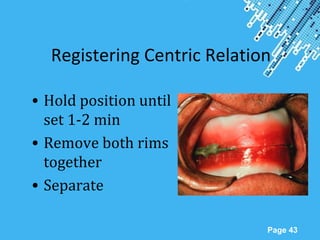
given.
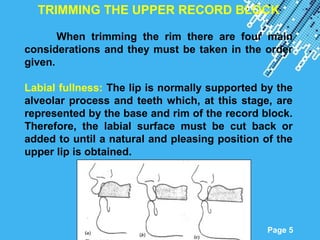
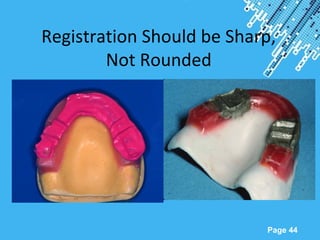
Labial fullness: The lip is normally supported by the
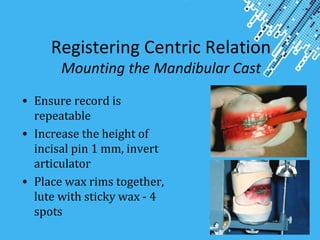
alveolar process and teeth which, at this stage, are
represented by the base and rim of the record block.
Therefore, the labial surface must be cut back or
added to until a natural and pleasing position of the
upper lip is obtained.
Powerpoint Templates
Page 6
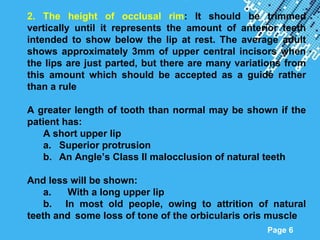
2. The height of occlusal rim: It should be trimmed
vertically until it represents the amount of anterior teeth
intended to show below the lip at rest. The average adult
shows approximately 3mm of upper central incisors when
the lips are just parted, but there are many variations from
this amount which should be accepted as a guide rather
than a rule
A greater length of tooth than normal may be shown if the
patient has:
A short upper lip
a. Superior protrusion
b. An Angle’s Class II malocclusion of natural teeth
And less will be shown:
a. With a long upper lip
b. In most old people, owing to attrition of natural
teeth and some loss of tone of the orbicularis oris muscle
Powerpoint Templates
Page 7
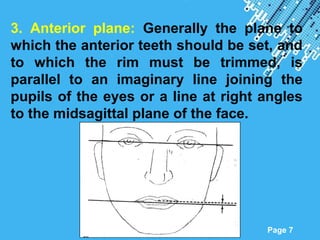
3. Anterior plane: Generally the plane to
which the anterior teeth should be set, and
to which the rim must be trimmed, is
parallel to an imaginary line joining the
pupils of the eyes or a line at right angles
to the midsagittal plane of the face.
Powerpoint Templates
Page 8
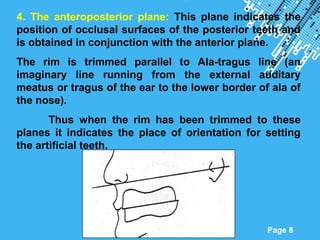
4. The anteroposterior plane: This plane indicates the
position of occlusal surfaces of the posterior teeth and
is obtained in conjunction with the anterior plane.
The rim is trimmed parallel to Ala-tragus line (an
imaginary line running from the external auditary
meatus or tragus of the ear to the lower border of ala of
the nose).
Thus when the rim has been trimmed to these
planes it indicates the place of orientation for setting
the artificial teeth.
Powerpoint Templates
Page 9
GUIDELINES
1. The centre line or midline
In the normal natural dentition, the upper central
incisors have their mesial surfaces in contact with an
imaginary vertical line which bisects the face and, for
esthetic reasons, it is desirable that the artificial
substitutes should occupy the same position.
The following aids are suggested as a help in
deciding where to mark a vertical line on the labial
surface of the upper rim
• Where it is crossed by an imaginary line from the centre
of the brows to the centre of the chin.
• Immediately below the centre of the philtrum
• Immediately below the centre of the labial tubercle
Powerpoint Templates
Page 10
2. High lip line
This is a line just in contact with the lower
border of the upper lip when it is raised as high as
possible unaided, as in smiling or laughing. It is
marked on the labial surface of the rim and indicates
the amount of denture which may be seen under
normal conditions, and thus assists in determining
the length of tooth needed.
3. Canine lines
These mark the corners of the mouth when
the lips are relaxed and are supposed to coincide
with the tips of the upper canine teeth but are only
accurate to within 3 or 4 mm. These lines give some
indication of the width to be taken up by the six
anterior teeth from tip to tip of the canines.
Powerpoint Templates
Page 11
TRIMMING THE LOWER RECORD
BLOCK
Trim the lower block so that it occludes
evenly with the upper, the mandible will be
separated from the maxilla by the same distance
that it was when the natural teeth were in occlusion.
The location of the occlusal plane posteriorly
will ultimately be determined by the height of the
mandibular anterior teeth and anterior 2/3 rd of
retromolar pads. After recording the tentative
occlusal vertical relation and the centric relation
position, the maxillary occlusion rims are oriented
to the opening axis of the jaws with the help of the
face bow.
Powerpoint Templates
Page 12
ORIENTATION RELATIONS
Orientation relations are those that orient the
mandible to the cranium in such a way that when the
mandible is kept in its most posterior unstrained
position, the mandible can rotate in the sagittal plane
around an imaginary transverse axis passing
through or near the condyles
Powerpoint Templates
Page 13
THE FACE BOW
A caliper like instrument used to record the spatial
relationship of the maxillary arch to some anatomic
reference point or points and then transfer this
relationship to an articulator; it orients the dental cast
in the same relationship to the opening axis of the
articulator.
Types of Face bow:
There are two types of face bows.
1. KINEMATIC face bow
2. ARBITRARY face bow -Facial type
-Earpiece type
Powerpoint Templates
Page 14
KINEMATIC FACE BOW
The Kinematic face bow is initially used to accurately locate the
hinge axis.
It is attached to a clutch, which in turn attaches to the mandibular teeth.
As the mandible makes opening and closing movements the condylar styli
move in an arc.
Their position is adjusted until they exhibit pure rotation and not translation,
when the mandible is opened and closed.
The points of rotation are marked on the skin and this determines the true
hinge axis.
The mandibular clutch is removed and the face bow is attached to the
maxillary arch.
The true rotation points are again used to orient the tips of the condylar
styli .
Powerpoint Templates
Page 15
ARBITRARY FACE BOW
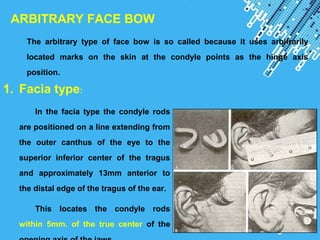
The arbitrary type of face bow is so called because it uses arbitrarily
located marks on the skin at the condyle points as the hinge axis
position.
1. Facia type:
In the facia type the condyle rods
are positioned on a line extending from
the outer canthus of the eye to the
superior inferior center of the tragus
and approximately 13mm anterior to
the distal edge of the tragus of the ear.
This locates the condyle rods
within 5mm. of the true center of the
Powerpoint Templates
Page 16
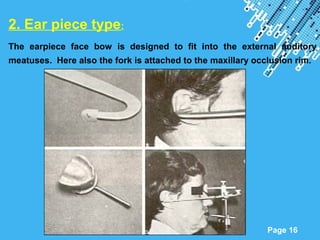
2. Ear piece type:
The earpiece face bow is designed to fit into the external auditory
meatuses. Here also the fork is attached to the maxillary occlusion rim.
Powerpoint Templates
Page 17
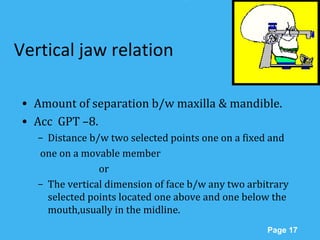
Vertical jaw relation
• Amount of separation b/w maxilla & mandible.
• Acc GPT –8.
– Distance b/w two selected points one on a fixed and
one on a movable member
or
– The vertical dimension of face b/w any two arbitrary
selected points located one above and one below the
mouth,usually in the midline.
Powerpoint Templates
Page 18
Classification
1) Vertical dimension of occlusion
2) Vertical dimension of rest
3) Vertical dimension in the other positions.
 Vertical dimension of occlusion: (GPT-8)
The distance b/w two points when the occluding
members are in contact. OR
It is the relation of the mandible to the maxilla
when the occlusal stops are provided by the
teeth/occlusion.
 Vertical dimension of rest:
The distance b/w two selected point measured
when the mandible is in the physiologic rest
position.
Powerpoint Templates
Page 19
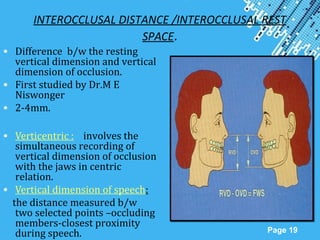
INTEROCCLUSAL DISTANCE /INTEROCCLUSAL REST
SPACE.
• Difference b/w the resting
vertical dimension and vertical
dimension of occlusion.
• First studied by Dr.M E
Niswonger
• 2-4mm.
• Verticentric : involves the
simultaneous recording of
vertical dimension of occlusion
with the jaws in centric
relation.
• Vertical dimension of speech:
the distance measured b/w
two selected points –occluding
members-closest proximity
during speech.
Powerpoint Templates
Page 20
Common factors to consider while recording vertical jaw relation
Position of mandible – influenced by gravity
Patient should be calm, cool, & relaxed
Difficult in neuromuscular disturbances
No one method –accepted.
Powerpoint Templates
Page 21
Methods for recording vertical jaw relation
1) Mechanical methods:
i. Ridge relation:
a) distance of incisive papilla from mandibular incisors
b) parallelism of ridges
ii. Measurement of former dentures
iii. Pre-extraction records-
 Profile radiographs
 Profile photographs
 Casts of teeth in occlusion
 Facial measurements
2) Physiologic methods
Physiologic rest position
Phonetics & esthetics as guide
Swallowing threshold
Tactile sense
Powerpoint Templates
Page 22
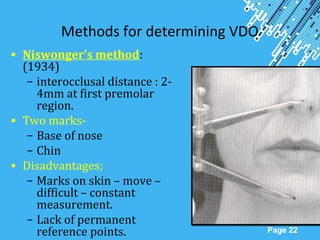
Methods for determining VDO
• Niswonger’s method:
(1934)
– interocclusal distance : 2-
4mm at first premolar
region.
• Two marks-
– Base of nose
– Chin
• Disadvantages;
– Marks on skin – move –
difficult – constant
measurement.
– Lack of permanent
reference points.
Powerpoint Templates
Page 23
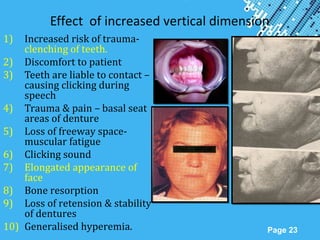
Effect of increased vertical dimension
1) Increased risk of trauma-
clenching of teeth.
2) Discomfort to patient
3) Teeth are liable to contact –
causing clicking during
speech
4) Trauma & pain – basal seat
areas of denture
5) Loss of freeway space-
muscular fatigue
6) Clicking sound
7) Elongated appearance of
face
8) Bone resorption
9) Loss of retension & stability
of dentures
10) Generalised hyperemia.
Powerpoint Templates
Page 24
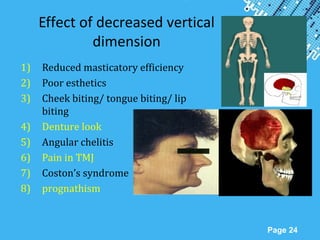
Effect of decreased vertical
dimension
1) Reduced masticatory efficiency
2) Poor esthetics
3) Cheek biting/ tongue biting/ lip
biting
4) Denture look
5) Angular chelitis
6) Pain in TMJ
7) Coston’s syndrome
8) prognathism
Powerpoint Templates
Page 25
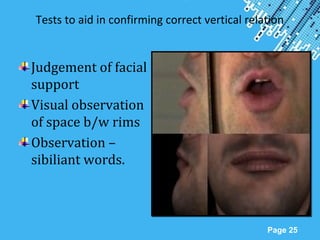
Tests to aid in confirming correct vertical relation
Judgement of facial
support
Visual observation
of space b/w rims
Observation –
sibiliant words.
Powerpoint Templates
Page 26
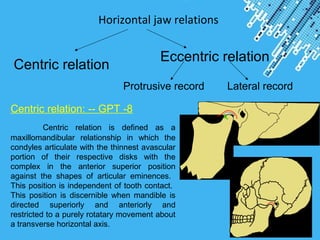
Horizontal jaw relations
Centric relation
Eccentric relation
Protrusive record Lateral record
Centric relation: -- GPT -8
Centric relation is defined as a
maxillomandibular relationship in which the
condyles articulate with the thinnest avascular
portion of their respective disks with the
complex in the anterior superior position
against the shapes of articular eminences.
This position is independent of tooth contact.
This position is discernible when mandible is
directed superiorly and anteriorly and
restricted to a purely rotatary movement about
a transverse horizontal axis.
Powerpoint Templates
Page 27
Methods of recording centric relation
Boucher's :
A) static methods-
Interocclusal record
Central bearing device
Tracing devices
B)functional methods—chew –
in technique
Needles technique
House technique
Essig technique
Patterson technique
Powerpoint Templates
Page 28
Static method
Causes minimal displacement of recording
bases
Intraoral interocclusal records- without
central bearing point –using plaster/wax.
Powerpoint Templates
Page 29
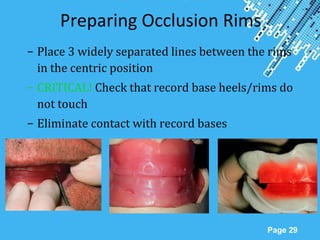
Preparing Occlusion Rims
– Place 3 widely separated lines between the rims
in the centric position
– CRITICAL! Check that record base heels/rims do
not touch
– Eliminate contact with record bases
Powerpoint Templates
Page 30
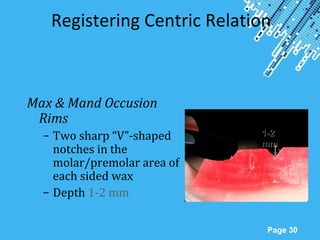
Registering Centric Relation
Max & Mand Occusion
Rims
– Two sharp “V”-shaped
notches in the
molar/premolar area of
each sided wax
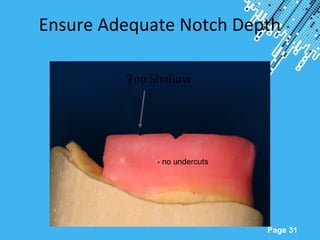
– Depth 1-2 mm
1-21-2
mmmm
Powerpoint Templates
Page 31
Ensure Adequate Notch Depth
Too Shallow
- no undercuts
Powerpoint Templates
Page 32
Registering Centric Relation
– Rehearse making the record without
recording medium
– Place occlusion rims intraorally
– PVS registration material (Memoreg)
over entire occlusal rim
Powerpoint Templates
Page 33
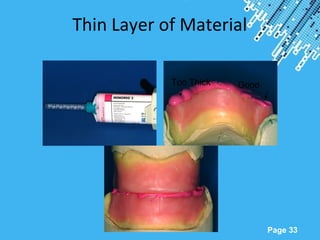
Thin Layer of Material
Too Thick Good
Powerpoint Templates
Page 34
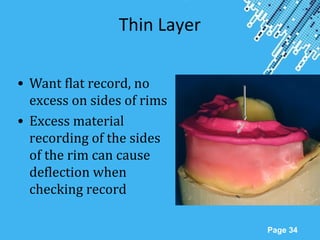
Thin Layer
• Want flat record, no
excess on sides of rims
• Excess material
recording of the sides
of the rim can cause
deflection when
checking record
Powerpoint Templates
Page 35
Making the Record
• Have patient close into record
• Ensure smooth arc of closure, no
horizontal deviations
• Use index fingers to stabilize lower
record base
Powerpoint Templates
Page 40
Registering Centric Relation
Patient opens, relaxes,
and slowly closes
Powerpoint Templates
Page 41
Registering Centric Relation
– Patient closes until rims are almost
touching (1 mm separation)
– Ask patient to stop as soon as this
position has been reached
– Some may not be able to tell when
they contact
Powerpoint Templates
Page 42
Registering Centric Relation
• Never instruct the patient to
bite firmly
• Causes translation or
inaccuracy in the record
Powerpoint Templates
Page 43
Registering Centric Relation
• Hold position until
set 1-2 min
• Remove both rims
together
• Separate
Powerpoint Templates
Page 44
Registration Should be Sharp,
Not Rounded
Powerpoint Templates
Page 45
Registering Centric Relation
Mounting the Mandibular Cast
• Ensure record is
repeatable
• Increase the height of
incisal pin 1 mm, invert
articulator
• Place wax rims together,
lute with sticky wax - 4
spots
Powerpoint Templates
Page 46
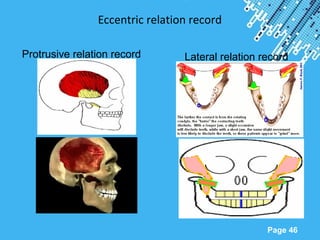
Eccentric relation record
Protrusive relation record Lateral relation record
Powerpoint Templates
Page 47
Methods for recording eccentric jaw relation
Functional method- needles- house & patterson technique
Graphic method
Tactile / direct check record methods
Powerpoint Templates
Page 48
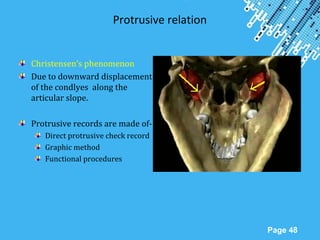
Protrusive relation
Christensen’s phenomenon
Due to downward displacement
of the condlyes along the
articular slope.
Protrusive records are made of-
Direct protrusive check record
Graphic method
Functional procedures
Powerpoint Templates
Page 49
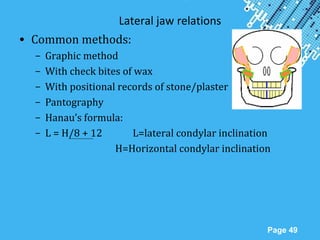
Lateral jaw relations
• Common methods:
– Graphic method
– With check bites of wax
– With positional records of stone/plaster
– Pantography
– Hanau’s formula:
– L = H/8 + 12 L=lateral condylar inclination
H=Horizontal condylar inclination
Powerpoint Templates
Page 50
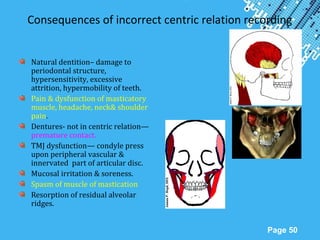
Consequences of incorrect centric relation recording
Natural dentition– damage to
periodontal structure,
hypersensitivity, excessive
attrition, hypermobility of teeth.
Pain & dysfunction of masticatory
muscle, headache, neck& shoulder
pain.
Dentures- not in centric relation—
premature contact.
TMJ dysfunction— condyle press
upon peripheral vascular &
innervated part of articular disc.
Mucosal irritation & soreness.
Spasm of muscle of mastication
Resorption of residual alveolar
ridges.
Powerpoint Templates
Page 51

Jaw relation in complete dentures

  • 1.
  • 2.
    Powerpoint Templates Page 2 Introduction Jawrelations are defined as any one of the many relations of the mandible to the maxillae Maxillomandibular relationship is defined as any spatial relationship of the maxillae to the mandible; any one of the infinite relationships of the mandible to the maxilla.
  • 3.
    Powerpoint Templates Page 3 Jawrelation/maxillomandibular relation  Types: 1. Orientation relation 2. Vertical relation 3. Horizontal relation centric relation eccentric relation—protrusive records ---lateral records.
  • 4.
    Powerpoint Templates Page 4 Clinicalsignificance of jaw relation • To re-establish the functional position of the mandible. • Comfort • Esthetics • Phonetics • Functional efficiency • Structural balance.
  • 5.
    Powerpoint Templates Page 5 TRIMMINGTHE UPPER RECORD BLOCK When trimming the rim there are four main considerations and they must be taken in the order given. Labial fullness: The lip is normally supported by the alveolar process and teeth which, at this stage, are represented by the base and rim of the record block. Therefore, the labial surface must be cut back or added to until a natural and pleasing position of the upper lip is obtained.
  • 6.
    Powerpoint Templates Page 6 2.The height of occlusal rim: It should be trimmed vertically until it represents the amount of anterior teeth intended to show below the lip at rest. The average adult shows approximately 3mm of upper central incisors when the lips are just parted, but there are many variations from this amount which should be accepted as a guide rather than a rule A greater length of tooth than normal may be shown if the patient has: A short upper lip a. Superior protrusion b. An Angle’s Class II malocclusion of natural teeth And less will be shown: a. With a long upper lip b. In most old people, owing to attrition of natural teeth and some loss of tone of the orbicularis oris muscle
  • 7.
    Powerpoint Templates Page 7 3.Anterior plane: Generally the plane to which the anterior teeth should be set, and to which the rim must be trimmed, is parallel to an imaginary line joining the pupils of the eyes or a line at right angles to the midsagittal plane of the face.
  • 8.
    Powerpoint Templates Page 8 4.The anteroposterior plane: This plane indicates the position of occlusal surfaces of the posterior teeth and is obtained in conjunction with the anterior plane. The rim is trimmed parallel to Ala-tragus line (an imaginary line running from the external auditary meatus or tragus of the ear to the lower border of ala of the nose). Thus when the rim has been trimmed to these planes it indicates the place of orientation for setting the artificial teeth.
  • 9.
    Powerpoint Templates Page 9 GUIDELINES 1.The centre line or midline In the normal natural dentition, the upper central incisors have their mesial surfaces in contact with an imaginary vertical line which bisects the face and, for esthetic reasons, it is desirable that the artificial substitutes should occupy the same position. The following aids are suggested as a help in deciding where to mark a vertical line on the labial surface of the upper rim • Where it is crossed by an imaginary line from the centre of the brows to the centre of the chin. • Immediately below the centre of the philtrum • Immediately below the centre of the labial tubercle
  • 10.
    Powerpoint Templates Page 10 2.High lip line This is a line just in contact with the lower border of the upper lip when it is raised as high as possible unaided, as in smiling or laughing. It is marked on the labial surface of the rim and indicates the amount of denture which may be seen under normal conditions, and thus assists in determining the length of tooth needed. 3. Canine lines These mark the corners of the mouth when the lips are relaxed and are supposed to coincide with the tips of the upper canine teeth but are only accurate to within 3 or 4 mm. These lines give some indication of the width to be taken up by the six anterior teeth from tip to tip of the canines.
  • 11.
    Powerpoint Templates Page 11 TRIMMINGTHE LOWER RECORD BLOCK Trim the lower block so that it occludes evenly with the upper, the mandible will be separated from the maxilla by the same distance that it was when the natural teeth were in occlusion. The location of the occlusal plane posteriorly will ultimately be determined by the height of the mandibular anterior teeth and anterior 2/3 rd of retromolar pads. After recording the tentative occlusal vertical relation and the centric relation position, the maxillary occlusion rims are oriented to the opening axis of the jaws with the help of the face bow.
  • 12.
    Powerpoint Templates Page 12 ORIENTATIONRELATIONS Orientation relations are those that orient the mandible to the cranium in such a way that when the mandible is kept in its most posterior unstrained position, the mandible can rotate in the sagittal plane around an imaginary transverse axis passing through or near the condyles
  • 13.
    Powerpoint Templates Page 13 THEFACE BOW A caliper like instrument used to record the spatial relationship of the maxillary arch to some anatomic reference point or points and then transfer this relationship to an articulator; it orients the dental cast in the same relationship to the opening axis of the articulator. Types of Face bow: There are two types of face bows. 1. KINEMATIC face bow 2. ARBITRARY face bow -Facial type -Earpiece type
  • 14.
    Powerpoint Templates Page 14 KINEMATICFACE BOW The Kinematic face bow is initially used to accurately locate the hinge axis. It is attached to a clutch, which in turn attaches to the mandibular teeth. As the mandible makes opening and closing movements the condylar styli move in an arc. Their position is adjusted until they exhibit pure rotation and not translation, when the mandible is opened and closed. The points of rotation are marked on the skin and this determines the true hinge axis. The mandibular clutch is removed and the face bow is attached to the maxillary arch. The true rotation points are again used to orient the tips of the condylar styli .
  • 15.
    Powerpoint Templates Page 15 ARBITRARYFACE BOW The arbitrary type of face bow is so called because it uses arbitrarily located marks on the skin at the condyle points as the hinge axis position. 1. Facia type: In the facia type the condyle rods are positioned on a line extending from the outer canthus of the eye to the superior inferior center of the tragus and approximately 13mm anterior to the distal edge of the tragus of the ear. This locates the condyle rods within 5mm. of the true center of the
  • 16.
    Powerpoint Templates Page 16 2.Ear piece type: The earpiece face bow is designed to fit into the external auditory meatuses. Here also the fork is attached to the maxillary occlusion rim.
  • 17.
    Powerpoint Templates Page 17 Verticaljaw relation • Amount of separation b/w maxilla & mandible. • Acc GPT –8. – Distance b/w two selected points one on a fixed and one on a movable member or – The vertical dimension of face b/w any two arbitrary selected points located one above and one below the mouth,usually in the midline.
  • 18.
    Powerpoint Templates Page 18 Classification 1)Vertical dimension of occlusion 2) Vertical dimension of rest 3) Vertical dimension in the other positions.  Vertical dimension of occlusion: (GPT-8) The distance b/w two points when the occluding members are in contact. OR It is the relation of the mandible to the maxilla when the occlusal stops are provided by the teeth/occlusion.  Vertical dimension of rest: The distance b/w two selected point measured when the mandible is in the physiologic rest position.
  • 19.
    Powerpoint Templates Page 19 INTEROCCLUSALDISTANCE /INTEROCCLUSAL REST SPACE. • Difference b/w the resting vertical dimension and vertical dimension of occlusion. • First studied by Dr.M E Niswonger • 2-4mm. • Verticentric : involves the simultaneous recording of vertical dimension of occlusion with the jaws in centric relation. • Vertical dimension of speech: the distance measured b/w two selected points –occluding members-closest proximity during speech.
  • 20.
    Powerpoint Templates Page 20 Commonfactors to consider while recording vertical jaw relation Position of mandible – influenced by gravity Patient should be calm, cool, & relaxed Difficult in neuromuscular disturbances No one method –accepted.
  • 21.
    Powerpoint Templates Page 21 Methodsfor recording vertical jaw relation 1) Mechanical methods: i. Ridge relation: a) distance of incisive papilla from mandibular incisors b) parallelism of ridges ii. Measurement of former dentures iii. Pre-extraction records-  Profile radiographs  Profile photographs  Casts of teeth in occlusion  Facial measurements 2) Physiologic methods Physiologic rest position Phonetics & esthetics as guide Swallowing threshold Tactile sense
  • 22.
    Powerpoint Templates Page 22 Methodsfor determining VDO • Niswonger’s method: (1934) – interocclusal distance : 2- 4mm at first premolar region. • Two marks- – Base of nose – Chin • Disadvantages; – Marks on skin – move – difficult – constant measurement. – Lack of permanent reference points.
  • 23.
    Powerpoint Templates Page 23 Effectof increased vertical dimension 1) Increased risk of trauma- clenching of teeth. 2) Discomfort to patient 3) Teeth are liable to contact – causing clicking during speech 4) Trauma & pain – basal seat areas of denture 5) Loss of freeway space- muscular fatigue 6) Clicking sound 7) Elongated appearance of face 8) Bone resorption 9) Loss of retension & stability of dentures 10) Generalised hyperemia.
  • 24.
    Powerpoint Templates Page 24 Effectof decreased vertical dimension 1) Reduced masticatory efficiency 2) Poor esthetics 3) Cheek biting/ tongue biting/ lip biting 4) Denture look 5) Angular chelitis 6) Pain in TMJ 7) Coston’s syndrome 8) prognathism
  • 25.
    Powerpoint Templates Page 25 Teststo aid in confirming correct vertical relation Judgement of facial support Visual observation of space b/w rims Observation – sibiliant words.
  • 26.
    Powerpoint Templates Page 26 Horizontaljaw relations Centric relation Eccentric relation Protrusive record Lateral record Centric relation: -- GPT -8 Centric relation is defined as a maxillomandibular relationship in which the condyles articulate with the thinnest avascular portion of their respective disks with the complex in the anterior superior position against the shapes of articular eminences. This position is independent of tooth contact. This position is discernible when mandible is directed superiorly and anteriorly and restricted to a purely rotatary movement about a transverse horizontal axis.
  • 27.
    Powerpoint Templates Page 27 Methodsof recording centric relation Boucher's : A) static methods- Interocclusal record Central bearing device Tracing devices B)functional methods—chew – in technique Needles technique House technique Essig technique Patterson technique
  • 28.
    Powerpoint Templates Page 28 Staticmethod Causes minimal displacement of recording bases Intraoral interocclusal records- without central bearing point –using plaster/wax.
  • 29.
    Powerpoint Templates Page 29 PreparingOcclusion Rims – Place 3 widely separated lines between the rims in the centric position – CRITICAL! Check that record base heels/rims do not touch – Eliminate contact with record bases
  • 30.
    Powerpoint Templates Page 30 RegisteringCentric Relation Max & Mand Occusion Rims – Two sharp “V”-shaped notches in the molar/premolar area of each sided wax – Depth 1-2 mm 1-21-2 mmmm
  • 31.
    Powerpoint Templates Page 31 EnsureAdequate Notch Depth Too Shallow - no undercuts
  • 32.
    Powerpoint Templates Page 32 RegisteringCentric Relation – Rehearse making the record without recording medium – Place occlusion rims intraorally – PVS registration material (Memoreg) over entire occlusal rim
  • 33.
    Powerpoint Templates Page 33 ThinLayer of Material Too Thick Good
  • 34.
    Powerpoint Templates Page 34 ThinLayer • Want flat record, no excess on sides of rims • Excess material recording of the sides of the rim can cause deflection when checking record
  • 35.
    Powerpoint Templates Page 35 Makingthe Record • Have patient close into record • Ensure smooth arc of closure, no horizontal deviations • Use index fingers to stabilize lower record base
  • 36.
    Powerpoint Templates Page 40 RegisteringCentric Relation Patient opens, relaxes, and slowly closes
  • 37.
    Powerpoint Templates Page 41 RegisteringCentric Relation – Patient closes until rims are almost touching (1 mm separation) – Ask patient to stop as soon as this position has been reached – Some may not be able to tell when they contact
  • 38.
    Powerpoint Templates Page 42 RegisteringCentric Relation • Never instruct the patient to bite firmly • Causes translation or inaccuracy in the record
  • 39.
    Powerpoint Templates Page 43 RegisteringCentric Relation • Hold position until set 1-2 min • Remove both rims together • Separate
  • 40.
    Powerpoint Templates Page 44 RegistrationShould be Sharp, Not Rounded
  • 41.
    Powerpoint Templates Page 45 RegisteringCentric Relation Mounting the Mandibular Cast • Ensure record is repeatable • Increase the height of incisal pin 1 mm, invert articulator • Place wax rims together, lute with sticky wax - 4 spots
  • 42.
    Powerpoint Templates Page 46 Eccentricrelation record Protrusive relation record Lateral relation record
  • 43.
    Powerpoint Templates Page 47 Methodsfor recording eccentric jaw relation Functional method- needles- house & patterson technique Graphic method Tactile / direct check record methods
  • 44.
    Powerpoint Templates Page 48 Protrusiverelation Christensen’s phenomenon Due to downward displacement of the condlyes along the articular slope. Protrusive records are made of- Direct protrusive check record Graphic method Functional procedures
  • 45.
    Powerpoint Templates Page 49 Lateraljaw relations • Common methods: – Graphic method – With check bites of wax – With positional records of stone/plaster – Pantography – Hanau’s formula: – L = H/8 + 12 L=lateral condylar inclination H=Horizontal condylar inclination
  • 46.
    Powerpoint Templates Page 50 Consequencesof incorrect centric relation recording Natural dentition– damage to periodontal structure, hypersensitivity, excessive attrition, hypermobility of teeth. Pain & dysfunction of masticatory muscle, headache, neck& shoulder pain. Dentures- not in centric relation— premature contact. TMJ dysfunction— condyle press upon peripheral vascular & innervated part of articular disc. Mucosal irritation & soreness. Spasm of muscle of mastication Resorption of residual alveolar ridges.
  • 47.