
Made by :-
Amit varma
Inder pal singh muzalda
B.D.S final yr
Department of Pedodontics
Govt. College of Dentistry, Indore
NORMAL OCCLUSION
 The relation of the maxillary and mandibular teeth
when the jaws are closed in centric relation without
strain of musculature or displacement of condyles in
their fossa.
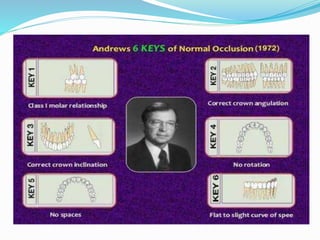
SIX KEYS OF NORMAL
OCCLUSION
1.Molar inter-arch relationship
2.Mesiodistal crown angulation
3.Labiolingual crown inclination
4.Absence of rotation
5.Tight contacts
6.Curve of spee
MALOCCLUSION
 Malposition and imperfect contact of the mandibular
and maxillary teeth
Angle’s system
of
classification of malocclusion
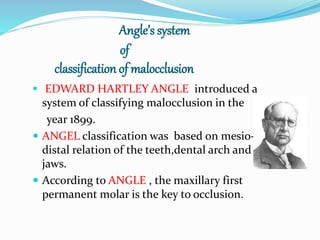
 EDWARD HARTLEY ANGLE introduced a
system of classifying malocclusion in the
year 1899.
 ANGEL classification was based on mesio-
distal relation of the teeth,dental arch and the
jaws.
 According to ANGLE , the maxillary first
permanent molar is the key to occlusion.
 He consider these teeth as fixed anatomical points
within the jaws.
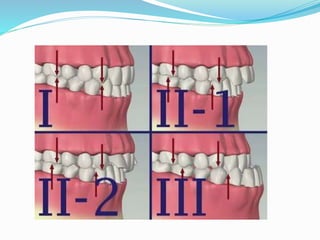
 Based on the relation of the lower first permanent
molar to the upper first permanent molar.
 He classified malocclusion into three main classes
designated by the roman numerials I,II AND III.
 ANGLE’S CLASS I
 ANGLE’S CLASS II
CLASS II, DIVISION 1
CLASS II, DIVISION 2
 ANGLE’S CLASS III
TRUE CLASS III
PSEUDO CLASS IIII
CLASS I MALOCCLUSION
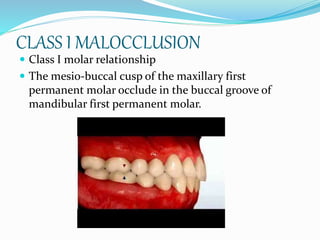
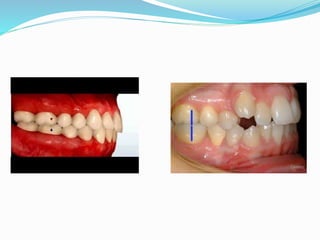
 Class I molar relationship
 The mesio-buccal cusp of the maxillary first
permanent molar occlude in the buccal groove of
mandibular first permanent molar.
 Class I malocclusion can be a discrepancy either within
the arch and or in the transverse or vertical relationship
between the arches
 The patient may exhibit dental irregularities such as
crowding,spacing,rotations,missing tooth etc.
 These patients exhibit normal skeletal relation and also
show normal muscle function.
 Another malocclusion that is most often categorized
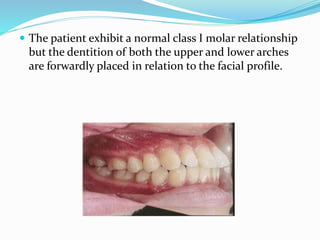
under class I is bimaxillary protrusion.
 The patient exhibit a normal class I molar relationship
but the dentition of both the upper and lower arches
are forwardly placed in relation to the facial profile.
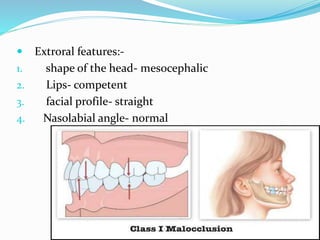
 Extroral features:-
1. shape of the head- mesocephalic
2. Lips- competent
3. facial profile- straight
4. Nasolabial angle- normal
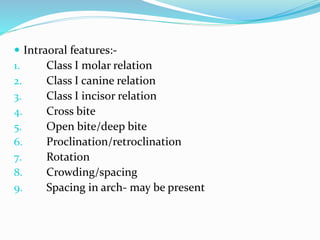
 Intraoral features:-
1. Class I molar relation
2. Class I canine relation
3. Class I incisor relation
4. Cross bite
5. Open bite/deep bite
6. Proclination/retroclination
7. Rotation
8. Crowding/spacing
9. Spacing in arch- may be present
DEWEY’S MODIFICATION
 He divide class I into 5 subtypes and class III into 3
subtypes.
Class I modification:-
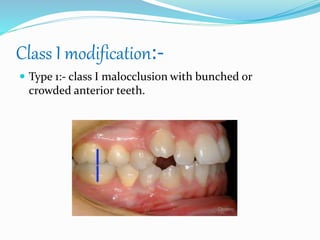
 Type 1:- class I malocclusion with bunched or
crowded anterior teeth.
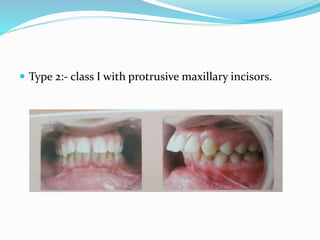
 Type 2:- class I with protrusive maxillary incisors.
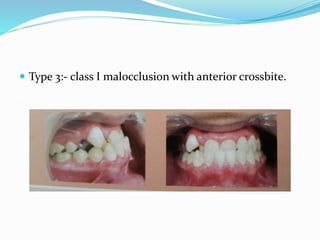
 Type 3:- class I malocclusion with anterior crossbite.
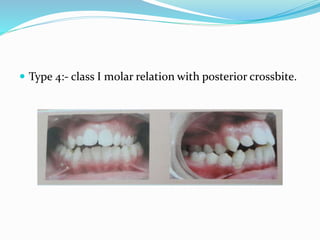
 Type 4:- class I molar relation with posterior crossbite.
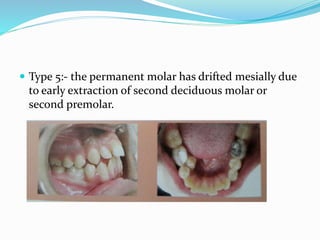
 Type 5:- the permanent molar has drifted mesially due
to early extraction of second deciduous molar or
second premolar.
Class III modification:-
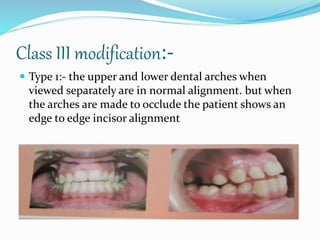
 Type 1:- the upper and lower dental arches when
viewed separately are in normal alignment. but when
the arches are made to occlude the patient shows an
edge to edge incisor alignment
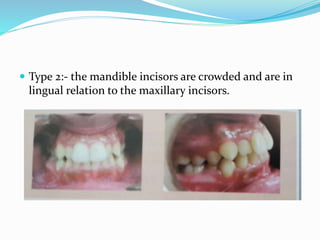
 Type 2:- the mandible incisors are crowded and are in
lingual relation to the maxillary incisors.
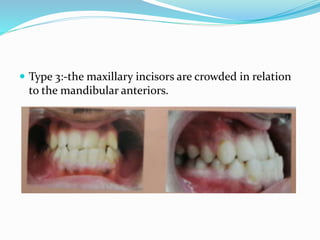
 Type 3:-the maxillary incisors are crowded in relation
to the mandibular anteriors.
Thank you

Classification of malocclusion

  • 1.
    Made by :- Amitvarma Inder pal singh muzalda B.D.S final yr Department of Pedodontics Govt. College of Dentistry, Indore
  • 2.
    NORMAL OCCLUSION  Therelation of the maxillary and mandibular teeth when the jaws are closed in centric relation without strain of musculature or displacement of condyles in their fossa.
  • 3.
    SIX KEYS OFNORMAL OCCLUSION 1.Molar inter-arch relationship 2.Mesiodistal crown angulation 3.Labiolingual crown inclination 4.Absence of rotation 5.Tight contacts 6.Curve of spee
  • 5.
    MALOCCLUSION  Malposition andimperfect contact of the mandibular and maxillary teeth
  • 6.
    Angle’s system of classification ofmalocclusion  EDWARD HARTLEY ANGLE introduced a system of classifying malocclusion in the year 1899.  ANGEL classification was based on mesio- distal relation of the teeth,dental arch and the jaws.  According to ANGLE , the maxillary first permanent molar is the key to occlusion.
  • 7.
     He considerthese teeth as fixed anatomical points within the jaws.  Based on the relation of the lower first permanent molar to the upper first permanent molar.  He classified malocclusion into three main classes designated by the roman numerials I,II AND III.
  • 9.
     ANGLE’S CLASSI  ANGLE’S CLASS II CLASS II, DIVISION 1 CLASS II, DIVISION 2  ANGLE’S CLASS III TRUE CLASS III PSEUDO CLASS IIII
  • 10.
    CLASS I MALOCCLUSION Class I molar relationship  The mesio-buccal cusp of the maxillary first permanent molar occlude in the buccal groove of mandibular first permanent molar.
  • 11.
     Class Imalocclusion can be a discrepancy either within the arch and or in the transverse or vertical relationship between the arches  The patient may exhibit dental irregularities such as crowding,spacing,rotations,missing tooth etc.  These patients exhibit normal skeletal relation and also show normal muscle function.  Another malocclusion that is most often categorized under class I is bimaxillary protrusion.
  • 12.
     The patientexhibit a normal class I molar relationship but the dentition of both the upper and lower arches are forwardly placed in relation to the facial profile.
  • 14.
     Extroral features:- 1.shape of the head- mesocephalic 2. Lips- competent 3. facial profile- straight 4. Nasolabial angle- normal
  • 15.
     Intraoral features:- 1.Class I molar relation 2. Class I canine relation 3. Class I incisor relation 4. Cross bite 5. Open bite/deep bite 6. Proclination/retroclination 7. Rotation 8. Crowding/spacing 9. Spacing in arch- may be present
  • 16.
    DEWEY’S MODIFICATION  Hedivide class I into 5 subtypes and class III into 3 subtypes.
  • 17.
    Class I modification:- Type 1:- class I malocclusion with bunched or crowded anterior teeth.
  • 18.
     Type 2:-class I with protrusive maxillary incisors.
  • 19.
     Type 3:-class I malocclusion with anterior crossbite.
  • 20.
     Type 4:-class I molar relation with posterior crossbite.
  • 21.
     Type 5:-the permanent molar has drifted mesially due to early extraction of second deciduous molar or second premolar.
  • 22.
    Class III modification:- Type 1:- the upper and lower dental arches when viewed separately are in normal alignment. but when the arches are made to occlude the patient shows an edge to edge incisor alignment
  • 23.
     Type 2:-the mandible incisors are crowded and are in lingual relation to the maxillary incisors.
  • 24.
     Type 3:-themaxillary incisors are crowded in relation to the mandibular anteriors.
  • 25.