
Ninth Lecture

Etiology of
Malocclusion
General Causes

1.Evolution:
2. Congenital malformation:
3. Endocrinal disturbances:
4. Nutritional deficiency
5. Pathological Conditions:

March 5, 2012

Dr. Ahmed Basyouni

2
Continue

B. Local Causes

Local Causes
1. Congenital missing teeth:
2. Supernumerary teeth:
3. Teeth of abnormal size and form:
4. Abnormal path of eruption:
5. Abnormal labial frenum:
6. Abnormal pressure habits:
a. Thumb sucking:
b.Tongue thrusting:
c. Nail biting:
d. Abnormal swallowing:
e. Mouth breathing:
March 5, 2012

Dr. Ahmed Basyouni

3
Continue

B. Local Causes

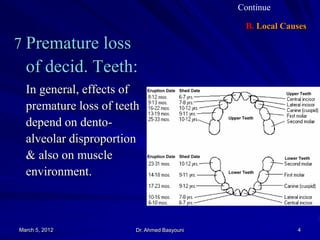
 Premature loss

of decid. Teeth:
In general, effects of
premature loss of teeth
depend on dentoalveolar disproportion
& also on muscle
environment.

March 5, 2012

Dr. Ahmed Basyouni

4
B. Local Causes
7. Premature loss of decid. Teeth:

a. Premature loss of decid. Incisors:
In the maxilla, it is not followed by impaction
of the permanent incisors, but will develop
tongue thrust to provide anterior seal during
swallowing.
While in the mandible, it will result in lack of
forward stimulation & crowding of permanent
incisors and deep overbite.
March 5, 2012

Dr. Ahmed Basyouni

5
B. Local Causes
7. Premature loss of decid. Teeth:

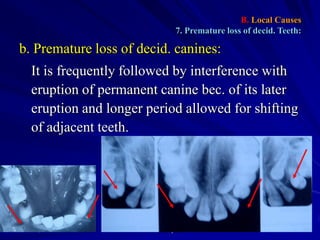
b. Premature loss of decid. canines:
It is frequently followed by interference with
eruption of permanent canine bec. of its later
eruption and longer period allowed for shifting
of adjacent teeth.

March 5, 2012

Dr. Ahmed Basyouni

6
B. Local Causes

7. Premature loss of decid. Teeth:

c. Premature loss of decid. First molar:
Loss, of upp. Ds, rarely followed by impaction
of first premolar, bec. Of relatively their early
eruption and premolars are smaller than their
predecessors.

Loss, of low. Ds, causes collapse of the lower
labial segment.

March 5, 2012

Dr. Ahmed Basyouni

7
B. Local Causes
7. Premature loss of decid. Teeth:

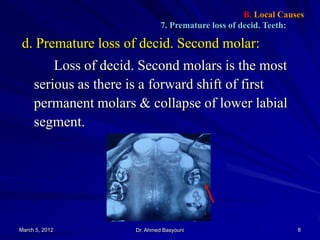
d. Premature loss of decid. Second molar:
Loss of decid. Second molars is the most
serious as there is a forward shift of first
permanent molars & collapse of lower labial
segment.

March 5, 2012

Dr. Ahmed Basyouni

8
B. Local Causes

7. Premature loss of decid. Teeth:
d. Premature loss of decid. Second molar:

Main effects will be:
1. Forward shift and mesial tilting of the lower first
permanent molar & forward shift and mesial rotation
of upp. First permanent molar, resulting in impaction
of second premolars in both arches.
If they are extracted before eruption of first
permanent molars, first permanent molars erupt well
forward with less rotation & tilting.
2. Flattening of lower anterior segment (collapse),
and if unilateral loss, central line may shift toward
affected side. There will be increase in overbite.
There may be crowding of upp. Incisors due to loss of
splinting effect by the lower arch.
March 5, 2012

Dr. Ahmed Basyouni

9
B. Local Causes
7. Premature loss of decid. Teeth:

e. Premature loss of both upper and lower decid.
molars:
It is a predisposing factor in the production of
prenormal occlusion. As the child will try to
bring lower arch forward to be in contact with
upper, so he will protrude the mandible.
This is called false Class III or pseudomesiocclusion.

March 5, 2012

Dr. Ahmed Basyouni

10
B. Local Causes

7 Premature loss of decid. Teeth:
e. Premature loss of both upper and lower decid. molars:

It is distinguished from prenormal occlusion by:
a. Manual retrusion of the mandible.
b. When teeth are occluded, condyles are out of
glenoid fossae.
c. There may be labial inclination of lower
incisors due to pulling action of the muscles to
retrude mandible to its original position.

March 5, 2012

Dr. Ahmed Basyouni

11
B. Local Causes

8. Prolonged retention of decid. Teeth:

Causes:
a. Incomplete root resorption.
b. Ankylosis of decid. Teeth.
c. Absence of permanent teeth.

March 5, 2012

Dr. Ahmed Basyouni

12
B. Local Causes
8. Prolonged retention of decid. Teeth:
Causes:

d. Abnormal path of eruption of permanent teeth.
e. Endocrine disturbances e.g. Hypothyroidism.
f. Cleidocranial dysostosis.
g. Nutritional disturbances.

March 5, 2012

Dr. Ahmed Basyouni

13
B. Local Causes
8. Prolonged retention of decid. Teeth:

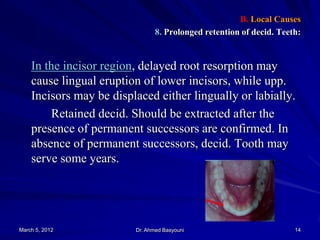
In the incisor region, delayed root resorption may
cause lingual eruption of lower incisors, while upp.
Incisors may be displaced either lingually or labially.
Retained decid. Should be extracted after the
presence of permanent successors are confirmed. In
absence of permanent successors, decid. Tooth may
serve some years.

March 5, 2012

Dr. Ahmed Basyouni

14
B. Local Causes
8. Prolonged retention of decid. Teeth:

Ankylosis results in retention of decid. Tooth,
while neighboring teeth will continue to erupt
leaving this tooth behind, this retained tooth
called “submerged” and is seen usually in
decid. Molars. They are causing malocclusion
and stagnation of food, so such tooth should be
removed, or crowned in case of absence of
permanent successor.
March 5, 2012

Dr. Ahmed Basyouni

15
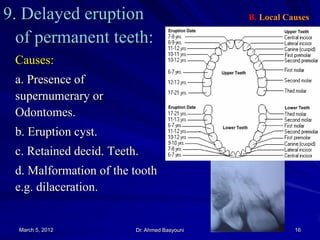
9. Delayed eruption
of permanent teeth:

B. Local Causes

Causes:
a. Presence of
supernumerary or
Odontomes.
b. Eruption cyst.
c. Retained decid. Teeth.
d. Malformation of the tooth
e.g. dilaceration.

March 5, 2012

Dr. Ahmed Basyouni

16
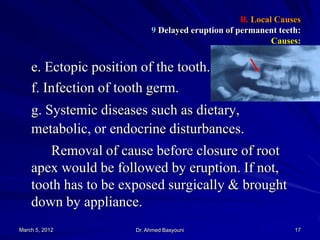
B. Local Causes
9 Delayed eruption of permanent teeth:
Causes:

e. Ectopic position of the tooth.
f. Infection of tooth germ.
g. Systemic diseases such as dietary,
metabolic, or endocrine disturbances.
Removal of cause before closure of root
apex would be followed by eruption. If not,
tooth has to be exposed surgically & brought
down by appliance.
March 5, 2012

Dr. Ahmed Basyouni

17
B. Local Causes

10. Loss of permanent teeth:
a. Incisor teeth:
Loss of upp. Central & lateral incisors will
result in collapse of anterior part of the
dental arch (space being closed by adjacent
teeth).
Loss of a lower incisor is followed by a
similar collapse and loss of intercanine
width.

March 5, 2012

Dr. Ahmed Basyouni

18
B. Local Causes
10. Loss of permanent teeth:

b. Canine teeth:
Loss of an upp. Canine tooth may affect
appearance of the face (Lack of canine
eminence) and if unilateral will produce an
asymmetry.

March 5, 2012

Dr. Ahmed Basyouni

19
B. Local Causes
10. Loss of permanent teeth:

c. Premolar teeth:
First premolars are the teeth most frequently extracted
to relieve incisor crowding and in the treatment of
Angle’s Class II & III malocclusions.
Second premolars are not so often chosen bec.
Resulting contact between first premolars and first
permanent molars is not usually so good as that
between canines and second premolars.
Unilateral loss of a premolar may cause a shift of the
midline.
March 5, 2012

Dr. Ahmed Basyouni

20
B. Local Causes
10. Loss of permanent teeth:

d. First molars:
The most commonly lost teeth by caries are the
first permanent molars.
i. Effects of early loss of upper first molars:
1.The space is filled most by forward
movement of second molar and also to a less
extent by distal movement of second premolar
and teeth in front of it. This tends to reduce the
incisor overbite.
March 5, 2012

Dr. Ahmed Basyouni

21
B. Local Causes
10. Loss of permanent teeth:
d. First molars:

2. If unilateral there may be a shift of the
midline to the affected side.
3. Upper second molar tends to rotate forward
rather than tilt. It rotates around palatal root.

March 5, 2012

Dr. Ahmed Basyouni

22
B. Local Causes
10. Loss of permanent teeth:
d. First molars:

ii. Effects of early loss of lower first molars:
1. The space is filled by mesial tilting of second
molar and distal moving second premolar. There is a
lack of forward development of anterior teeth which
may cause collapse and result in a class II incisor
relationship (increased overjet & overbite).
2. If unilateral the lower midline will shift to the
affected side.

March 5, 2012

Dr. Ahmed Basyouni

23
B. Local Causes
10. Loss of permanent teeth:
d. First molars:

3. lower second molar tends to tilt rather than
rotate forwards.
4. If lost before eruption of lower second
premolar, this tooth drift backwards or fail to
develop forwards leaving large space between
it and the lower first premolar.
5. Opposing maxill. First permanent molars
may overerupt.
The earlier the loss of the first molars, the less
the tilt or rotation of the second molars, when
they erupt forward.
March 5, 2012

Dr. Ahmed Basyouni

24
B. Local Causes
10. Loss of permanent teeth:

e. Second molars:
These teeth are sometimes extracted in the
treatment of certain malocclusions. The third
molars must be present on radiographs and of
good size and position.

March 5, 2012

Dr. Ahmed Basyouni

25
B. Local Causes
10. Loss of permanent teeth:

f. Third molars:
Third molars will be extracted by the
oral surgeon if they become
impacted.

March 5, 2012

Dr. Ahmed Basyouni

26
B. Local Causes

11. Trauma:

Children are prone to accidents and upp. &
low. Incisors are most likely affected from
blows on the mouth.
Generally, direct trauma to jaws and
associated parts may cause:
1. Loss of decid. Teeth & effects will be
similar to those arising from premature loss.

March 5, 2012

Dr. Ahmed Basyouni

27
B. Local Causes
11. Trauma:

2. Permanent incisors may be:
a. Dilacerated.
b. Displaced in the alveolus which may be
fractured.
c. Fractured.
d. Completely lost.

March 5, 2012

Dr. Ahmed Basyouni

28
B. Local Causes
11. Trauma:

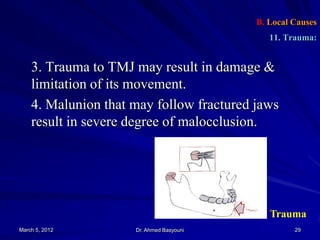
3. Trauma to TMJ may result in damage &
limitation of its movement.
4. Malunion that may follow fractured jaws
result in severe degree of malocclusion.

Trauma
March 5, 2012

Dr. Ahmed Basyouni

29
B. Local Causes

12. Local pathological factors:

Cysts, Odontoms, Tumors
These include:
a. Cysts or tumors in jaws may displace
neighboring teeth creating malocclusion.
b. Scar tissues resulting from burns of lips &
cheeks may contract & upset balance of
musculature.

March 5, 2012

Dr. Ahmed Basyouni

30
B. Local Causes

12. Local pathological factors:

c. Inflammatory conditions causing ankylosis
of TMJ may cause damage of condylar
cartilage (main growth center), mandible
become deficient in affected side, ascending
ramus become short & resulting malocclusion
is severe.

March 5, 2012

Dr. Ahmed Basyouni

31
Summary
General Causes
1.Evolution:
2. Congenital malformation:
3. Endocrinal disturbances:
4. Nutritional deficiency
5. Pathological Conditions:

March 5, 2012

Dr. Ahmed Basyouni

32
B. Local Causes
Summary

Local Causes
1. Congenital missing teeth:
2. Supernumerary teeth:
3. Teeth of abnormal size and form:
4. Abnormal path of eruption:
5. Abnormal labial frenum:
6. Abnormal pressure habits:
a. Thumb sucking:
b. Tongue thrusting:
c. Nail biting:
d. Abnormal swallowing:
e. Mouth breathing:

March 5, 2012

Dr. Ahmed Basyouni

33
B. Local Causes
Summary

7. Premature loss of decid. Teeth:

8. Prolonged retention of decid. Teeth:
9. Delayed eruption of permanent teeth:
10. Loss of permanent teeth:
11. Trauma:

12. Local pathological factors:
March 5, 2012

Dr. Ahmed Basyouni

34
March 5, 2012

Dr. Ahmed Basyouni

35

Etiology of Malocclusion II

  • 1.
  • 2.
    General Causes 1.Evolution: 2. Congenitalmalformation: 3. Endocrinal disturbances: 4. Nutritional deficiency 5. Pathological Conditions: March 5, 2012 Dr. Ahmed Basyouni 2
  • 3.
    Continue B. Local Causes LocalCauses 1. Congenital missing teeth: 2. Supernumerary teeth: 3. Teeth of abnormal size and form: 4. Abnormal path of eruption: 5. Abnormal labial frenum: 6. Abnormal pressure habits: a. Thumb sucking: b.Tongue thrusting: c. Nail biting: d. Abnormal swallowing: e. Mouth breathing: March 5, 2012 Dr. Ahmed Basyouni 3
  • 4.
    Continue B. Local Causes Premature loss of decid. Teeth: In general, effects of premature loss of teeth depend on dentoalveolar disproportion & also on muscle environment. March 5, 2012 Dr. Ahmed Basyouni 4
  • 5.
    B. Local Causes 7.Premature loss of decid. Teeth: a. Premature loss of decid. Incisors: In the maxilla, it is not followed by impaction of the permanent incisors, but will develop tongue thrust to provide anterior seal during swallowing. While in the mandible, it will result in lack of forward stimulation & crowding of permanent incisors and deep overbite. March 5, 2012 Dr. Ahmed Basyouni 5
  • 6.
    B. Local Causes 7.Premature loss of decid. Teeth: b. Premature loss of decid. canines: It is frequently followed by interference with eruption of permanent canine bec. of its later eruption and longer period allowed for shifting of adjacent teeth. March 5, 2012 Dr. Ahmed Basyouni 6
  • 7.
    B. Local Causes 7.Premature loss of decid. Teeth: c. Premature loss of decid. First molar: Loss, of upp. Ds, rarely followed by impaction of first premolar, bec. Of relatively their early eruption and premolars are smaller than their predecessors. Loss, of low. Ds, causes collapse of the lower labial segment. March 5, 2012 Dr. Ahmed Basyouni 7
  • 8.
    B. Local Causes 7.Premature loss of decid. Teeth: d. Premature loss of decid. Second molar: Loss of decid. Second molars is the most serious as there is a forward shift of first permanent molars & collapse of lower labial segment. March 5, 2012 Dr. Ahmed Basyouni 8
  • 9.
    B. Local Causes 7.Premature loss of decid. Teeth: d. Premature loss of decid. Second molar: Main effects will be: 1. Forward shift and mesial tilting of the lower first permanent molar & forward shift and mesial rotation of upp. First permanent molar, resulting in impaction of second premolars in both arches. If they are extracted before eruption of first permanent molars, first permanent molars erupt well forward with less rotation & tilting. 2. Flattening of lower anterior segment (collapse), and if unilateral loss, central line may shift toward affected side. There will be increase in overbite. There may be crowding of upp. Incisors due to loss of splinting effect by the lower arch. March 5, 2012 Dr. Ahmed Basyouni 9
  • 10.
    B. Local Causes 7.Premature loss of decid. Teeth: e. Premature loss of both upper and lower decid. molars: It is a predisposing factor in the production of prenormal occlusion. As the child will try to bring lower arch forward to be in contact with upper, so he will protrude the mandible. This is called false Class III or pseudomesiocclusion. March 5, 2012 Dr. Ahmed Basyouni 10
  • 11.
    B. Local Causes 7Premature loss of decid. Teeth: e. Premature loss of both upper and lower decid. molars: It is distinguished from prenormal occlusion by: a. Manual retrusion of the mandible. b. When teeth are occluded, condyles are out of glenoid fossae. c. There may be labial inclination of lower incisors due to pulling action of the muscles to retrude mandible to its original position. March 5, 2012 Dr. Ahmed Basyouni 11
  • 12.
    B. Local Causes 8.Prolonged retention of decid. Teeth: Causes: a. Incomplete root resorption. b. Ankylosis of decid. Teeth. c. Absence of permanent teeth. March 5, 2012 Dr. Ahmed Basyouni 12
  • 13.
    B. Local Causes 8.Prolonged retention of decid. Teeth: Causes: d. Abnormal path of eruption of permanent teeth. e. Endocrine disturbances e.g. Hypothyroidism. f. Cleidocranial dysostosis. g. Nutritional disturbances. March 5, 2012 Dr. Ahmed Basyouni 13
  • 14.
    B. Local Causes 8.Prolonged retention of decid. Teeth: In the incisor region, delayed root resorption may cause lingual eruption of lower incisors, while upp. Incisors may be displaced either lingually or labially. Retained decid. Should be extracted after the presence of permanent successors are confirmed. In absence of permanent successors, decid. Tooth may serve some years. March 5, 2012 Dr. Ahmed Basyouni 14
  • 15.
    B. Local Causes 8.Prolonged retention of decid. Teeth: Ankylosis results in retention of decid. Tooth, while neighboring teeth will continue to erupt leaving this tooth behind, this retained tooth called “submerged” and is seen usually in decid. Molars. They are causing malocclusion and stagnation of food, so such tooth should be removed, or crowned in case of absence of permanent successor. March 5, 2012 Dr. Ahmed Basyouni 15
  • 16.
    9. Delayed eruption ofpermanent teeth: B. Local Causes Causes: a. Presence of supernumerary or Odontomes. b. Eruption cyst. c. Retained decid. Teeth. d. Malformation of the tooth e.g. dilaceration. March 5, 2012 Dr. Ahmed Basyouni 16
  • 17.
    B. Local Causes 9Delayed eruption of permanent teeth: Causes: e. Ectopic position of the tooth. f. Infection of tooth germ. g. Systemic diseases such as dietary, metabolic, or endocrine disturbances. Removal of cause before closure of root apex would be followed by eruption. If not, tooth has to be exposed surgically & brought down by appliance. March 5, 2012 Dr. Ahmed Basyouni 17
  • 18.
    B. Local Causes 10.Loss of permanent teeth: a. Incisor teeth: Loss of upp. Central & lateral incisors will result in collapse of anterior part of the dental arch (space being closed by adjacent teeth). Loss of a lower incisor is followed by a similar collapse and loss of intercanine width. March 5, 2012 Dr. Ahmed Basyouni 18
  • 19.
    B. Local Causes 10.Loss of permanent teeth: b. Canine teeth: Loss of an upp. Canine tooth may affect appearance of the face (Lack of canine eminence) and if unilateral will produce an asymmetry. March 5, 2012 Dr. Ahmed Basyouni 19
  • 20.
    B. Local Causes 10.Loss of permanent teeth: c. Premolar teeth: First premolars are the teeth most frequently extracted to relieve incisor crowding and in the treatment of Angle’s Class II & III malocclusions. Second premolars are not so often chosen bec. Resulting contact between first premolars and first permanent molars is not usually so good as that between canines and second premolars. Unilateral loss of a premolar may cause a shift of the midline. March 5, 2012 Dr. Ahmed Basyouni 20
  • 21.
    B. Local Causes 10.Loss of permanent teeth: d. First molars: The most commonly lost teeth by caries are the first permanent molars. i. Effects of early loss of upper first molars: 1.The space is filled most by forward movement of second molar and also to a less extent by distal movement of second premolar and teeth in front of it. This tends to reduce the incisor overbite. March 5, 2012 Dr. Ahmed Basyouni 21
  • 22.
    B. Local Causes 10.Loss of permanent teeth: d. First molars: 2. If unilateral there may be a shift of the midline to the affected side. 3. Upper second molar tends to rotate forward rather than tilt. It rotates around palatal root. March 5, 2012 Dr. Ahmed Basyouni 22
  • 23.
    B. Local Causes 10.Loss of permanent teeth: d. First molars: ii. Effects of early loss of lower first molars: 1. The space is filled by mesial tilting of second molar and distal moving second premolar. There is a lack of forward development of anterior teeth which may cause collapse and result in a class II incisor relationship (increased overjet & overbite). 2. If unilateral the lower midline will shift to the affected side. March 5, 2012 Dr. Ahmed Basyouni 23
  • 24.
    B. Local Causes 10.Loss of permanent teeth: d. First molars: 3. lower second molar tends to tilt rather than rotate forwards. 4. If lost before eruption of lower second premolar, this tooth drift backwards or fail to develop forwards leaving large space between it and the lower first premolar. 5. Opposing maxill. First permanent molars may overerupt. The earlier the loss of the first molars, the less the tilt or rotation of the second molars, when they erupt forward. March 5, 2012 Dr. Ahmed Basyouni 24
  • 25.
    B. Local Causes 10.Loss of permanent teeth: e. Second molars: These teeth are sometimes extracted in the treatment of certain malocclusions. The third molars must be present on radiographs and of good size and position. March 5, 2012 Dr. Ahmed Basyouni 25
  • 26.
    B. Local Causes 10.Loss of permanent teeth: f. Third molars: Third molars will be extracted by the oral surgeon if they become impacted. March 5, 2012 Dr. Ahmed Basyouni 26
  • 27.
    B. Local Causes 11.Trauma: Children are prone to accidents and upp. & low. Incisors are most likely affected from blows on the mouth. Generally, direct trauma to jaws and associated parts may cause: 1. Loss of decid. Teeth & effects will be similar to those arising from premature loss. March 5, 2012 Dr. Ahmed Basyouni 27
  • 28.
    B. Local Causes 11.Trauma: 2. Permanent incisors may be: a. Dilacerated. b. Displaced in the alveolus which may be fractured. c. Fractured. d. Completely lost. March 5, 2012 Dr. Ahmed Basyouni 28
  • 29.
    B. Local Causes 11.Trauma: 3. Trauma to TMJ may result in damage & limitation of its movement. 4. Malunion that may follow fractured jaws result in severe degree of malocclusion. Trauma March 5, 2012 Dr. Ahmed Basyouni 29
  • 30.
    B. Local Causes 12.Local pathological factors: Cysts, Odontoms, Tumors These include: a. Cysts or tumors in jaws may displace neighboring teeth creating malocclusion. b. Scar tissues resulting from burns of lips & cheeks may contract & upset balance of musculature. March 5, 2012 Dr. Ahmed Basyouni 30
  • 31.
    B. Local Causes 12.Local pathological factors: c. Inflammatory conditions causing ankylosis of TMJ may cause damage of condylar cartilage (main growth center), mandible become deficient in affected side, ascending ramus become short & resulting malocclusion is severe. March 5, 2012 Dr. Ahmed Basyouni 31
  • 32.
    Summary General Causes 1.Evolution: 2. Congenitalmalformation: 3. Endocrinal disturbances: 4. Nutritional deficiency 5. Pathological Conditions: March 5, 2012 Dr. Ahmed Basyouni 32
  • 33.
    B. Local Causes Summary LocalCauses 1. Congenital missing teeth: 2. Supernumerary teeth: 3. Teeth of abnormal size and form: 4. Abnormal path of eruption: 5. Abnormal labial frenum: 6. Abnormal pressure habits: a. Thumb sucking: b. Tongue thrusting: c. Nail biting: d. Abnormal swallowing: e. Mouth breathing: March 5, 2012 Dr. Ahmed Basyouni 33
  • 34.
    B. Local Causes Summary 7.Premature loss of decid. Teeth: 8. Prolonged retention of decid. Teeth: 9. Delayed eruption of permanent teeth: 10. Loss of permanent teeth: 11. Trauma: 12. Local pathological factors: March 5, 2012 Dr. Ahmed Basyouni 34
  • 35.
    March 5, 2012 Dr.Ahmed Basyouni 35