Organic Based Industries
Polymers
Lec-I By Tehreem Naz
CHEM4134
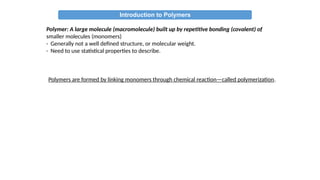
Introduction to Polymers
Polymer: A large molecule (macromolecule) built up by repetitive bonding (covalent) of
smaller molecules (monomers)
· Generally not a well defined structure, or molecular weight.
· Need to use statistical properties to describe.
Polymers are formed by linking monomers through chemical reaction—called polymerization.
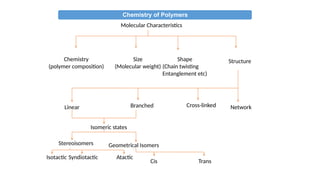
Chemistry of Polymers
Molecular Characteristics
Chemistry
(polymer composition)
Size
(Molecular weight)
Shape
(Chain twisting
Entanglement etc)
Structure
Linear Branched Cross-linked Network
Isomeric states
Stereoisomers Geometrical Isomers
Isotactic Syndiotactic Atactic
Cis Trans
Polymers
WHY POLYMERS?
Polymers are all around us. They serve as the very basis of both plant and animal life as
proteins, nucleic acids, and polysaccharides. In construction they serve as the concrete,
insulation, and wooden and composite beams. At home they are found as the materials
for our pillows, curtains, coatings, wastepaper baskets, water pipes, window glass, and ice
cube trays. In transportation they are present in ever-increasing amounts in our aircraft,
automobiles, ships, and trucks. In communication they form critical components in our
telephones, televisions, computers, compact discs (CDs), newspapers, optical fibers, and
cell phones. Plastics act as favorite materials for our toys such as toy soldiers, plastic
models, toy cars, dolls, skip ropes, etc. Our food is polymer-intense as meats, vegetables,
breads, and cookies. Outside our homes they are present in our flowers, trees, soil,
spiderwebs, and beaches. In fact, it is improbable that a polymer is not involved in your
present activity—reading a paper book, holding a plastic-intense writing device, sitting on
a cloth-covered chair or bed, and if your eyes need corrective vision, glasses of one variety
or another.
Polymers
WHY POLYMERS?
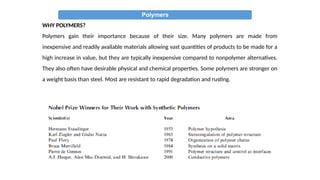
Polymers gain their importance because of their size. Many polymers are made from
inexpensive and readily available materials allowing vast quantities of products to be made for a
high increase in value, but they are typically inexpensive compared to nonpolymer alternatives.
They also often have desirable physical and chemical properties. Some polymers are stronger on
a weight basis than steel. Most are resistant to rapid degradation and rusting.
Polymers
WHY POLYMERS?
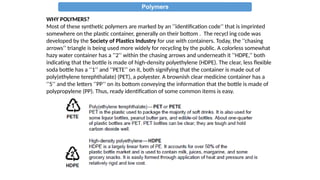
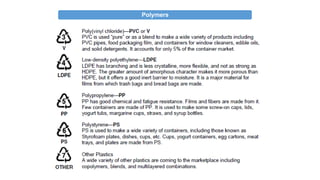
Most of these synthetic polymers are marked by an ‘‘identification code’’ that is imprinted
somewhere on the plastic container, generally on their bottom . The recycl ing code was
developed by the Society of Plastics Industry for use with containers. Today, the ‘‘chasing
arrows’’ triangle is being used more widely for recycling by the public. A colorless somewhat
hazy water container has a ‘‘2’’ within the chasing arrows and underneath it ‘‘HDPE,’’ both
indicating that the bottle is made of high-density polyethylene (HDPE). The clear, less flexible
soda bottle has a ‘‘1’’ and ‘‘PETE’’ on it, both signifying that the container is made out of
poly(ethylene terephthalate) (PET), a polyester. A brownish clear medicine container has a
‘‘5’’ and the letters ‘‘PP’’ on its bottom conveying the information that the bottle is made of
polypropylene (PP). Thus, ready identification of some common items is easy.
Polymers
Classification of Polymers
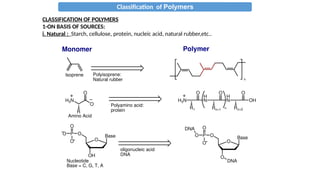
CLASSIFICATION OF POLYMERS
1-ON BASIS OF SOURCES:
i. Natural : Starch, cellulose, protein, nucleic acid, natural rubber,etc..
Monomer Polymer
Isoprene
n
Polyisoprene:
Natural rubber
H3N
O
O
R
Polyamino acid:
protein
H3N
O
H
N
R1
O
H
N
Rn+1
O
OH
Rn+2
n
Amino Acid
Base
O
OH
O
P
O
O
O
oligonucleic acid
DNA
Nucleotide
Base = C, G, T, A
Base
O
O
O
P
O
O
O
DNA
DNA
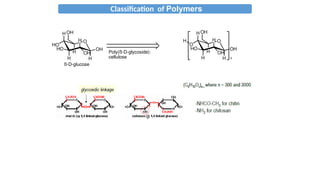
Classification of Polymers
O
H
HO
H
HO
H
H
OH
H
OH
OH
Poly(ß-D-glycoside):
cellulose
O
H
O
H
HO
H
H
OH
H
OH
OH
H
n
ß-D-glucose
Classification of Polymers
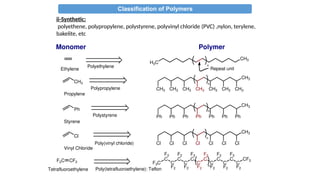
ii-Synthetic:
polyethene, polypropylene, polystyrene, polyvinyl chloride (PVC) ,nylon, terylene,
bakelite, etc
Monomer Polymer
Ethylene
H3C
CH3
n
Repeat unit
Polyethylene
CH3
CH3
n
CH3 CH3 CH3 CH3 CH3 CH3
CH3
Propylene
Polypropylene
Ph
CH3
n
Ph Ph Ph Ph Ph Ph
Ph
Styrene
Polystyrene
Cl
CH3
n
Cl Cl Cl Cl Cl Cl
Cl
Vinyl Chloride
Poly(vinyl chloride)
F2C CF2
Tetrafluoroethylene
F3C
F2
C
C
F2
F2
C
C
F2
F2
C
C
F2
F2
C
C
F2
F2
C
C
F2
F2
C
C
F2
CF3
n
Poly(tetrafluoroethylene): Teflon
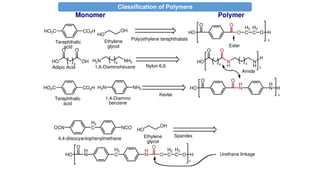
Classification of Polymers
Monomer Polymer
CO2H
HO2C
HO
OH
O O
HO O
H2
C
H2
C O
n
Terephthalic
acid
Ethylene
glycol
Poly(ethylene terephthalate
H
Ester
HO OH
O O
4
H2N NH2
4
Adipic Acid 1,6-Diaminohexane Nylon 6,6
HO N
H
N
H
H
O O
4 4
n
CO2H
HO2C
Terephthalic
acid
NH2
H2N
1,4-Diamino
benzene
Kevlar
O
HO
O
H
N
H
N H
n
Amide
HO
OH
Ethylene
glycol
H2
C
OCN NCO
4,4-diisocyantophenylmethane
Spandex
H2
C
H
N
H
N
O
HO
O
O
H2
C
H2
C O H
n
Urethane linkage
Classification of Polymers
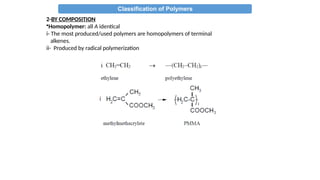
2-BY COMPOSITION
•Homopolymer: all A identical
i- The most produced/used polymers are homopolymers of terminal
alkenes.
ii- Produced by radical polymerization
Classification of Polymers
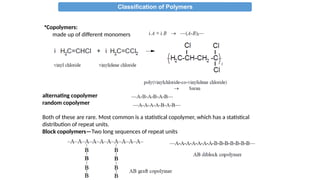
alternating copolymer
random copolymer
Both of these are rare. Most common is a statistical copolymer, which has a statistical
distribution of repeat units.
Block copolymers—Two long sequences of repeat units
•Copolymers:
made up of different monomers
Classification of Polymers
3- ON BASIS OF STRUCTURE:
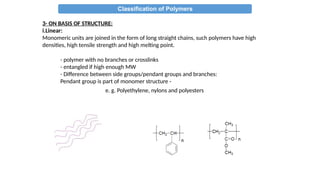
i.Linear:
Monomeric units are joined in the form of long straight chains, such polymers have high
densities, high tensile strength and high melting point.
- polymer with no branches or crosslinks
- entangled if high enough MW
- Difference between side groups/pendant groups and branches:
Pendant group is part of monomer structure -
e. g. Polyethylene, nylons and polyesters
Classification of Polymers
ii.Branched chain:
-are mainly linear in nature but also possess some branches along the main chain (Thus,
branches are composed of complete repeat units “marked with bracket”). e.g. low density
polyethene (LDPE)
-They have densities, lower tensile strength and low melting point
e. g. Amylopectin and glycogen
Classification of Polymers
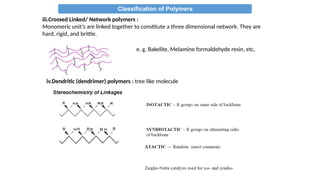
iii.Crossed Linked/ Network polymers :
Monomeric unit’s are linked together to constitute a three dimensional network. They are
hard, rigid, and brittle.
e. g. Bakelite, Melamine formaldehyde resin, etc,
iv.Dendritic (dendrimer) polymers : tree like molecule
Classification of Polymers
4. BY POLYMERIZATION REACTION: (developed by Carothers)
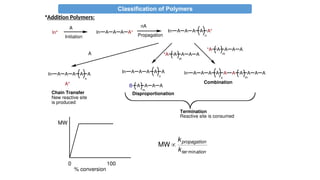
•Addition Polymers:
i-Typically formed by “chain growth” polymerization (sometimes called
addition polymerization)
ii- Same atoms in polymer repeat unit as in monomer
iii-- Usually has an all carbon backbone (w/ pendant groups)
iv-Typically, do not contain functional groups as part of backbone
v- From unsaturated hydrocarbons or olifins
• Condensation Polymers:
i-Typically formed by “step growth” polymerization (sometimes called
condensation polymerization)
ii-Usually fewer atoms vs. the monomer since a small molecule is
eliminated during the polymerization (e.g. water, HCl).
iii-Contain functional groups which react together
e.g. amine, carboxylic acid, hydroxyl, chlorine
iv-Polymer backbone has non-C atoms or NEW
LINKAGES/FUNCTIONAL groups “X”
e.g. amide, ester, ether
A + B X (new functional group formed in bb)
A-R-A + B-R’-B [-R-X-R’-X-]n
A-R-B [-R-X-]n
v- From bi/poly functional monomers
Classification of Polymers
Propagation
nA
In A A A A
n
A*
A A A A A
m
In A A A A
n
A
*A A A A A
m
Combination
*A A A A A
m
In A A A A
n
A
B A A A A
m
Disproportionation
A
In A A A A
n
A
A*
Chain Transfer
New reactive site
is produced
In*
A
Initiation
In A A A A*
MW 
kpropagation
kter mination
MW
% conversion
0 100
Termination
Reactive site is consumed
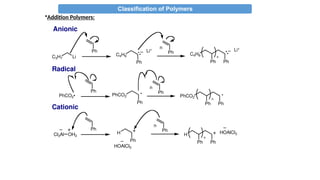
•Addition Polymers:
Classification of Polymers
•Addition Polymers:
Ph
Anionic
C3H7 Li C4H9
Ph
Li+
Ph
n
C4H9
Ph Ph
Li+
n
Ph
Radical
PhCO2•
Ph
n
Ph
Cationic
Cl3Al OH2
H
Ph
HOAlCl3
Ph
n
H
Ph Ph
n
HOAlCl3
PhCO2
Ph
PhCO2
Ph Ph
n
Classification of Polymers
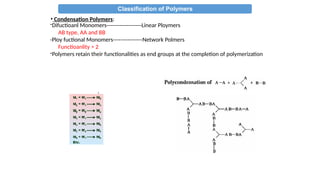
• Condensation Polymers:
-Difuctioanl Monomers-------------------Linear Ploymers
AB type, AA and BB
-Ploy fuctional Monomers----------------Network Polmers
Functioanlity > 2
-Polymers retain their functionalities as end groups at the completion of polymerization
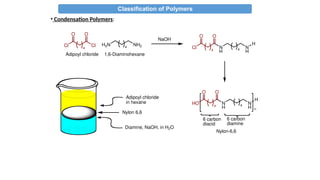
Classification of Polymers
Cl Cl
O O
4
H2N NH2
4
Adipoyl chloride 1,6-Diaminohexane
Cl N
H
N
H
H
O O
4 4
NaOH
HO N
H
N
H
H
O O
4 4
n
6 carbon
diacid
6 carbon
diamine
Nylon-6,6
Diamine, NaOH, in H2O
Adipoyl chloride
in hexane
Nylon 6,6
• Condensation Polymers:
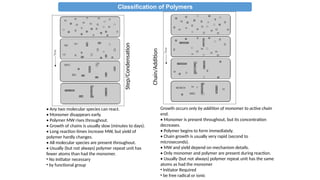
Classification of Polymers
• Any two molecular species can react.
• Monomer disappears early.
• Polymer MW rises throughout.
• Growth of chains is usually slow (minutes to days).
• Long reaction times increase MW, but yield of
polymer hardly changes.
• All molecular species are present throughout.
• Usually (but not always) polymer repeat unit has
fewer atoms than had the monomer.
• No Initiator necessary
• by functional group
Growth occurs only by addition of monomer to active chain
end.
• Monomer is present throughout, but its concentration
decreases.
• Polymer begins to form immediately.
• Chain growth is usually very rapid (second to
microseconds).
• MW and yield depend on mechanism details.
• Only monomer and polymer are present during reaction.
• Usually (but not always) polymer repeat unit has the same
atoms as had the monomer
• Initiator Required
• be free radical or ionic
Step/Condensation
Chain/Addition
Classification of Polymers
5- Based on Interparticle forces/ Ability to be melted / Response to heat:
i-. Elastomer: e.g. Synthetic rubber
1-Polymer chain is held up by weakest attractive forces.
2-They are amorphous polymers having high degree of elasticity.
3- moderately cross-linked
4-can be a thermoplastic or a thermoset depending on the structure
5-such as automotive and industrial seals, gaskets and molded goods,
roofing and belting, aircraft and chemical processing seals, food,
pharmaceutical and semiconductor seals, and wire and cable coatings
ii. Fibers :
1-These are the polymer which have quite strong Interparticle forces such as H - bond .
2- They have high tensile strength and high modulus.
e.g. Nylon
Classification of Polymers
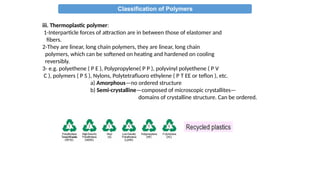
iii. Thermoplastic polymer:
1-Interparticle forces of attraction are in between those of elastomer and
fibers.
2-They are linear, long chain polymers, they are linear, long chain
polymers, which can be softened on heating and hardened on cooling
reversibly.
3- e.g. polyethene ( P E ), Polypropylene( P P ), polyvinyl polyethene ( P V
C ), polymers ( P S ), Nylons, Polytetrafluoro ethylene ( P T EE or teflon ), etc.
a) Amorphous—no ordered structure
b) Semi-crystalline—composed of microscopic crystallites—
domains of crystalline structure. Can be ordered.
Classification of Polymers
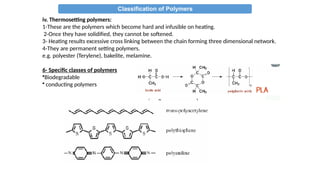
iv. Thermosetting polymers:
1-These are the polymers which become hard and infusible on heating.
2-Once they have solidified, they cannot be softened.
3- Heating results excessive cross linking between the chain forming three dimensional network.
4-They are permanent setting polymers.
e.g. polyester (Terylene), bakelite, melamine.
6- Specific classes of polymers
•Biodegradable
• conducting polymers
Classification of Polymers
Physical Properties of Polymers
•Composed of very large molecules
•Low modulus of elasticity (low stiffness)
•Low tensile and compressive strengths
•Can be crystalline or semi-crystalline structure
•Deformation is very sensitive to temperature
•Low thermal and electrical conductivity(good insulator)
•Low temperatures make plastics brittle
•Plastic deformation
Advantages of Polymers (over metals or ceramics)
•Low density (specific gravity = 1.0 – 1.4) (7.85 for steel)
• Corrosion resistance
• Easy to manufacture, easy to make complex shapes (low temperature to shape)
•Electrical insulation
•Low thermal conductivity
• Low finishing cost (no painting)
• Toughness, ductility
•Optics ( can be transparent) (preferred to glass because of light weight and
toughness) (aircraft windows are plastics)

CHEM4134 Polymers Lec Condensation Addition

  • 2.
  • 3.
    Introduction to Polymers Polymer:A large molecule (macromolecule) built up by repetitive bonding (covalent) of smaller molecules (monomers) · Generally not a well defined structure, or molecular weight. · Need to use statistical properties to describe. Polymers are formed by linking monomers through chemical reaction—called polymerization.
  • 4.
    Chemistry of Polymers MolecularCharacteristics Chemistry (polymer composition) Size (Molecular weight) Shape (Chain twisting Entanglement etc) Structure Linear Branched Cross-linked Network Isomeric states Stereoisomers Geometrical Isomers Isotactic Syndiotactic Atactic Cis Trans
  • 5.
    Polymers WHY POLYMERS? Polymers areall around us. They serve as the very basis of both plant and animal life as proteins, nucleic acids, and polysaccharides. In construction they serve as the concrete, insulation, and wooden and composite beams. At home they are found as the materials for our pillows, curtains, coatings, wastepaper baskets, water pipes, window glass, and ice cube trays. In transportation they are present in ever-increasing amounts in our aircraft, automobiles, ships, and trucks. In communication they form critical components in our telephones, televisions, computers, compact discs (CDs), newspapers, optical fibers, and cell phones. Plastics act as favorite materials for our toys such as toy soldiers, plastic models, toy cars, dolls, skip ropes, etc. Our food is polymer-intense as meats, vegetables, breads, and cookies. Outside our homes they are present in our flowers, trees, soil, spiderwebs, and beaches. In fact, it is improbable that a polymer is not involved in your present activity—reading a paper book, holding a plastic-intense writing device, sitting on a cloth-covered chair or bed, and if your eyes need corrective vision, glasses of one variety or another.
  • 6.
    Polymers WHY POLYMERS? Polymers gaintheir importance because of their size. Many polymers are made from inexpensive and readily available materials allowing vast quantities of products to be made for a high increase in value, but they are typically inexpensive compared to nonpolymer alternatives. They also often have desirable physical and chemical properties. Some polymers are stronger on a weight basis than steel. Most are resistant to rapid degradation and rusting.
  • 7.
    Polymers WHY POLYMERS? Most ofthese synthetic polymers are marked by an ‘‘identification code’’ that is imprinted somewhere on the plastic container, generally on their bottom . The recycl ing code was developed by the Society of Plastics Industry for use with containers. Today, the ‘‘chasing arrows’’ triangle is being used more widely for recycling by the public. A colorless somewhat hazy water container has a ‘‘2’’ within the chasing arrows and underneath it ‘‘HDPE,’’ both indicating that the bottle is made of high-density polyethylene (HDPE). The clear, less flexible soda bottle has a ‘‘1’’ and ‘‘PETE’’ on it, both signifying that the container is made out of poly(ethylene terephthalate) (PET), a polyester. A brownish clear medicine container has a ‘‘5’’ and the letters ‘‘PP’’ on its bottom conveying the information that the bottle is made of polypropylene (PP). Thus, ready identification of some common items is easy.
  • 8.
  • 9.
    Classification of Polymers CLASSIFICATIONOF POLYMERS 1-ON BASIS OF SOURCES: i. Natural : Starch, cellulose, protein, nucleic acid, natural rubber,etc.. Monomer Polymer Isoprene n Polyisoprene: Natural rubber H3N O O R Polyamino acid: protein H3N O H N R1 O H N Rn+1 O OH Rn+2 n Amino Acid Base O OH O P O O O oligonucleic acid DNA Nucleotide Base = C, G, T, A Base O O O P O O O DNA DNA
  • 10.
  • 11.
    Classification of Polymers ii-Synthetic: polyethene,polypropylene, polystyrene, polyvinyl chloride (PVC) ,nylon, terylene, bakelite, etc Monomer Polymer Ethylene H3C CH3 n Repeat unit Polyethylene CH3 CH3 n CH3 CH3 CH3 CH3 CH3 CH3 CH3 Propylene Polypropylene Ph CH3 n Ph Ph Ph Ph Ph Ph Ph Styrene Polystyrene Cl CH3 n Cl Cl Cl Cl Cl Cl Cl Vinyl Chloride Poly(vinyl chloride) F2C CF2 Tetrafluoroethylene F3C F2 C C F2 F2 C C F2 F2 C C F2 F2 C C F2 F2 C C F2 F2 C C F2 CF3 n Poly(tetrafluoroethylene): Teflon
  • 12.
    Classification of Polymers MonomerPolymer CO2H HO2C HO OH O O HO O H2 C H2 C O n Terephthalic acid Ethylene glycol Poly(ethylene terephthalate H Ester HO OH O O 4 H2N NH2 4 Adipic Acid 1,6-Diaminohexane Nylon 6,6 HO N H N H H O O 4 4 n CO2H HO2C Terephthalic acid NH2 H2N 1,4-Diamino benzene Kevlar O HO O H N H N H n Amide HO OH Ethylene glycol H2 C OCN NCO 4,4-diisocyantophenylmethane Spandex H2 C H N H N O HO O O H2 C H2 C O H n Urethane linkage
  • 13.
    Classification of Polymers 2-BYCOMPOSITION •Homopolymer: all A identical i- The most produced/used polymers are homopolymers of terminal alkenes. ii- Produced by radical polymerization
  • 14.
    Classification of Polymers alternatingcopolymer random copolymer Both of these are rare. Most common is a statistical copolymer, which has a statistical distribution of repeat units. Block copolymers—Two long sequences of repeat units •Copolymers: made up of different monomers
  • 15.
    Classification of Polymers 3-ON BASIS OF STRUCTURE: i.Linear: Monomeric units are joined in the form of long straight chains, such polymers have high densities, high tensile strength and high melting point. - polymer with no branches or crosslinks - entangled if high enough MW - Difference between side groups/pendant groups and branches: Pendant group is part of monomer structure - e. g. Polyethylene, nylons and polyesters
  • 16.
    Classification of Polymers ii.Branchedchain: -are mainly linear in nature but also possess some branches along the main chain (Thus, branches are composed of complete repeat units “marked with bracket”). e.g. low density polyethene (LDPE) -They have densities, lower tensile strength and low melting point e. g. Amylopectin and glycogen
  • 17.
    Classification of Polymers iii.CrossedLinked/ Network polymers : Monomeric unit’s are linked together to constitute a three dimensional network. They are hard, rigid, and brittle. e. g. Bakelite, Melamine formaldehyde resin, etc, iv.Dendritic (dendrimer) polymers : tree like molecule
  • 18.
    Classification of Polymers 4.BY POLYMERIZATION REACTION: (developed by Carothers) •Addition Polymers: i-Typically formed by “chain growth” polymerization (sometimes called addition polymerization) ii- Same atoms in polymer repeat unit as in monomer iii-- Usually has an all carbon backbone (w/ pendant groups) iv-Typically, do not contain functional groups as part of backbone v- From unsaturated hydrocarbons or olifins • Condensation Polymers: i-Typically formed by “step growth” polymerization (sometimes called condensation polymerization) ii-Usually fewer atoms vs. the monomer since a small molecule is eliminated during the polymerization (e.g. water, HCl). iii-Contain functional groups which react together e.g. amine, carboxylic acid, hydroxyl, chlorine iv-Polymer backbone has non-C atoms or NEW LINKAGES/FUNCTIONAL groups “X” e.g. amide, ester, ether A + B X (new functional group formed in bb) A-R-A + B-R’-B [-R-X-R’-X-]n A-R-B [-R-X-]n v- From bi/poly functional monomers
  • 19.
    Classification of Polymers Propagation nA InA A A A n A* A A A A A m In A A A A n A *A A A A A m Combination *A A A A A m In A A A A n A B A A A A m Disproportionation A In A A A A n A A* Chain Transfer New reactive site is produced In* A Initiation In A A A A* MW  kpropagation kter mination MW % conversion 0 100 Termination Reactive site is consumed •Addition Polymers:
  • 20.
    Classification of Polymers •AdditionPolymers: Ph Anionic C3H7 Li C4H9 Ph Li+ Ph n C4H9 Ph Ph Li+ n Ph Radical PhCO2• Ph n Ph Cationic Cl3Al OH2 H Ph HOAlCl3 Ph n H Ph Ph n HOAlCl3 PhCO2 Ph PhCO2 Ph Ph n
  • 21.
    Classification of Polymers •Condensation Polymers: -Difuctioanl Monomers-------------------Linear Ploymers AB type, AA and BB -Ploy fuctional Monomers----------------Network Polmers Functioanlity > 2 -Polymers retain their functionalities as end groups at the completion of polymerization
  • 22.
    Classification of Polymers ClCl O O 4 H2N NH2 4 Adipoyl chloride 1,6-Diaminohexane Cl N H N H H O O 4 4 NaOH HO N H N H H O O 4 4 n 6 carbon diacid 6 carbon diamine Nylon-6,6 Diamine, NaOH, in H2O Adipoyl chloride in hexane Nylon 6,6 • Condensation Polymers:
  • 23.
    Classification of Polymers •Any two molecular species can react. • Monomer disappears early. • Polymer MW rises throughout. • Growth of chains is usually slow (minutes to days). • Long reaction times increase MW, but yield of polymer hardly changes. • All molecular species are present throughout. • Usually (but not always) polymer repeat unit has fewer atoms than had the monomer. • No Initiator necessary • by functional group Growth occurs only by addition of monomer to active chain end. • Monomer is present throughout, but its concentration decreases. • Polymer begins to form immediately. • Chain growth is usually very rapid (second to microseconds). • MW and yield depend on mechanism details. • Only monomer and polymer are present during reaction. • Usually (but not always) polymer repeat unit has the same atoms as had the monomer • Initiator Required • be free radical or ionic Step/Condensation Chain/Addition
  • 24.
    Classification of Polymers 5-Based on Interparticle forces/ Ability to be melted / Response to heat: i-. Elastomer: e.g. Synthetic rubber 1-Polymer chain is held up by weakest attractive forces. 2-They are amorphous polymers having high degree of elasticity. 3- moderately cross-linked 4-can be a thermoplastic or a thermoset depending on the structure 5-such as automotive and industrial seals, gaskets and molded goods, roofing and belting, aircraft and chemical processing seals, food, pharmaceutical and semiconductor seals, and wire and cable coatings ii. Fibers : 1-These are the polymer which have quite strong Interparticle forces such as H - bond . 2- They have high tensile strength and high modulus. e.g. Nylon
  • 25.
    Classification of Polymers iii.Thermoplastic polymer: 1-Interparticle forces of attraction are in between those of elastomer and fibers. 2-They are linear, long chain polymers, they are linear, long chain polymers, which can be softened on heating and hardened on cooling reversibly. 3- e.g. polyethene ( P E ), Polypropylene( P P ), polyvinyl polyethene ( P V C ), polymers ( P S ), Nylons, Polytetrafluoro ethylene ( P T EE or teflon ), etc. a) Amorphous—no ordered structure b) Semi-crystalline—composed of microscopic crystallites— domains of crystalline structure. Can be ordered.
  • 26.
    Classification of Polymers iv.Thermosetting polymers: 1-These are the polymers which become hard and infusible on heating. 2-Once they have solidified, they cannot be softened. 3- Heating results excessive cross linking between the chain forming three dimensional network. 4-They are permanent setting polymers. e.g. polyester (Terylene), bakelite, melamine. 6- Specific classes of polymers •Biodegradable • conducting polymers
  • 27.
    Classification of Polymers PhysicalProperties of Polymers •Composed of very large molecules •Low modulus of elasticity (low stiffness) •Low tensile and compressive strengths •Can be crystalline or semi-crystalline structure •Deformation is very sensitive to temperature •Low thermal and electrical conductivity(good insulator) •Low temperatures make plastics brittle •Plastic deformation Advantages of Polymers (over metals or ceramics) •Low density (specific gravity = 1.0 – 1.4) (7.85 for steel) • Corrosion resistance • Easy to manufacture, easy to make complex shapes (low temperature to shape) •Electrical insulation •Low thermal conductivity • Low finishing cost (no painting) • Toughness, ductility •Optics ( can be transparent) (preferred to glass because of light weight and toughness) (aircraft windows are plastics)