Polymer Chemistry
CHEM 3430
1
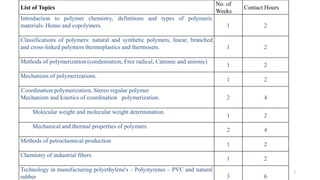
List of Topics
No. of
Weeks
Contact Hours
Introduction to polymer chemistry, definitions and types of polymeric
materials. Homo and copolymers. 1 2
Classifications of polymers: natural and synthetic polymers, linear, branched
and cross-linked polymers thermoplastics and thermosets. 1 2
Methods of polymerization (condensation, Free radical, Cationic and anionic)
1 2
Mechanism of polymerizations.
1 2
Coordination polymerization, Stereo regular polymer
Mechanism and kinetics of coordination polymerization. 2 4
Molecular weight and molecular weight determination.
1 2
Mechanical and thermal properties of polymers.
2 4
Methods of petrochemical production
1 2
Chemistry of industrial fibers
1 2
Technology in manufacturing polyethylene's – Polystyrenes – PVC and natural
rubber 3 6
2
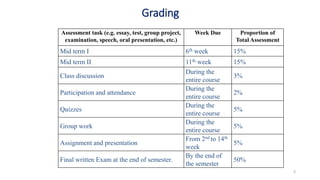
Grading
Assessment task (e.g. essay, test, group project,
examination, speech, oral presentation, etc.)
Week Due Proportion of
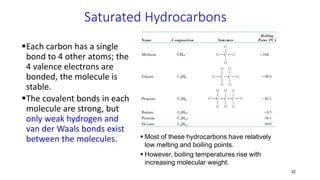
Total Assessment
Mid term I 6th week 15%
Mid term II 11th week 15%
Class discussion
During the
entire course
3%
Participation and attendance
During the
entire course
2%
Quizzes
During the
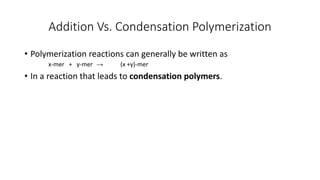
entire course
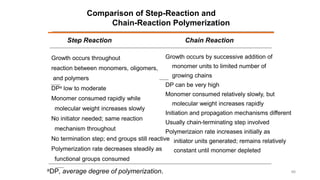
5%
Group work
During the
entire course
5%
Assignment and presentation
From 2nd to 14th
week
5%
Final written Exam at the end of semester.
By the end of
the semester
50%
3
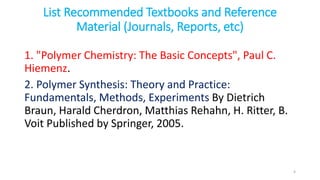
List Recommended Textbooks and Reference
Material (Journals, Reports, etc)
1. "Polymer Chemistry: The Basic Concepts", Paul C.
Hiemenz.
2. Polymer Synthesis: Theory and Practice:
Fundamentals, Methods, Experiments By Dietrich
Braun, Harald Cherdron, Matthias Rehahn, H. Ritter, B.
Voit Published by Springer, 2005.
4
What is polymer Chemistry
• Chemistry of large molecules ( macromolecules).
• “Macromolecules” : molecules existed as a result of covalently linked
smaller units, and possessed unique physical and chemical properties.
• Polymer is macromolecules, but macromolecules may not be a
polymer.
5
What is polymer
• Polymer is compound consisting of long-chain molecules, each
molecule made up of 1000- 10 000 repeating units connected together.
• The word polymer is Greek words poly: many, and meros (reduced to
mer: part.
• Molar mass ranges from 104- 106 g/g-mole.
• Most polymers are based on carbon and are therefore considered
organic compounds.
6
Polymer Chain Lengths
• Many polymer properties are affected by the length of
the polymer chains. For example, the melting
temperature increases with increasing molecular
weight.
• At room temp, polymers with very short chains (roughly
100 g/mol) will exist as liquids.
• Those with weights of 1000 g/mol are typically waxy
solids and soft resins.
• Solid polymers range between 10,000 and several
million g/mol.
• The molecular weight affects the polymer’s properties
(examples: elastic modulus & strength).
7
8
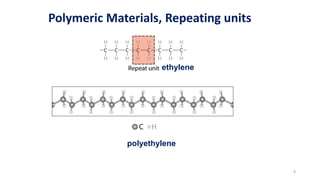
Polymeric Materials, Repeating units
polyethylene
ethylene
9
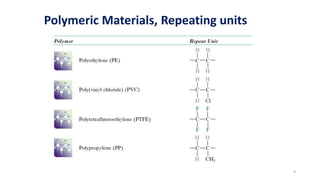
Polymeric Materials, Repeating units
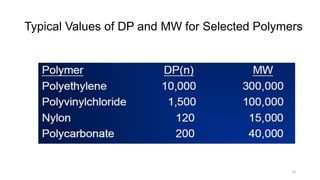
Typical Values of DP and MW for Selected Polymers
10
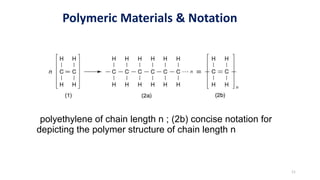
:polyethylene of chain length n ; (2b) concise notation for
depicting the polymer structure of chain length n
11
Polymeric Materials & Notation
12
13
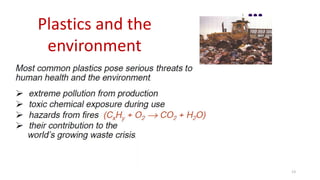
Plastics and the
environment
14
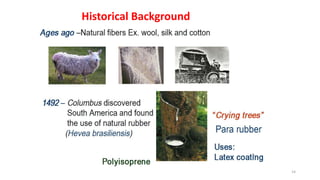
Historical Background
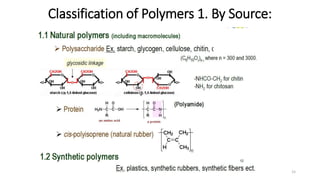
Classification of Polymers 1. By Source:
15
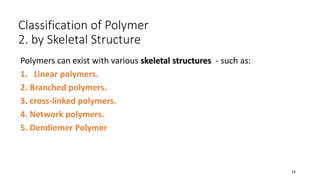
Classification of Polymer
2. by Skeletal Structure
Polymers can exist with various skeletal structures - such as:
1. Linear polymers.
2. Branched polymers.
3. cross-linked polymers.
4. Network polymers.
5. Dendiemer Polymer
16
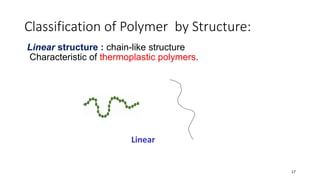
Classification of Polymer by Structure:
Linear structure : chain-like structure
Characteristic of thermoplastic polymers.
17
Linear
Polymer Structure
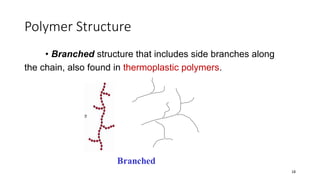
• Branched structure that includes side branches along
the chain, also found in thermoplastic polymers.
18
Polymer Structure
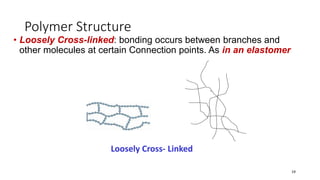
• Loosely Cross-linked: bonding occurs between branches and
other molecules at certain Connection points. As in an elastomer
19
Loosely Cross- Linked
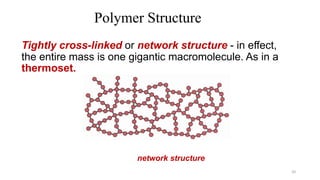
Tightly cross-linked or network structure - in effect,
the entire mass is one gigantic macromolecule. As in a
thermoset.
20
Polymer Structure
network structure
Polymer Structure
21
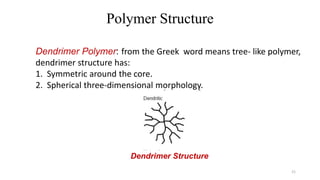
Dendrimer Polymer: from the Greek word means tree- like polymer,
dendrimer structure has:
1. Symmetric around the core.
2. Spherical three-dimensional morphology.
Dendrimer Structure
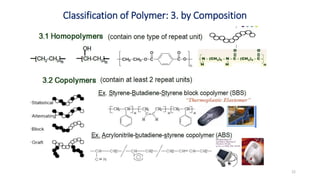
Classification of Polymer: 3. by Composition
22
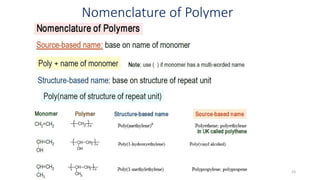
Nomenclature of Polymer
23
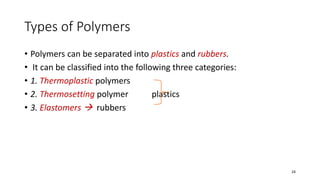
Types of Polymers
• Polymers can be separated into plastics and rubbers.
• It can be classified into the following three categories:
• 1. Thermoplastic polymers
• 2. Thermosetting polymer plastics
• 3. Elastomers  rubbers
24
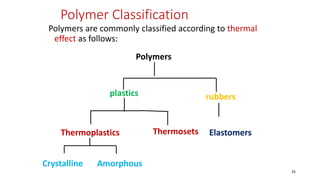
Polymer Classification
Polymers are commonly classified according to thermal
effect as follows:
25
Polymers
Elastomers
Thermosets
Thermoplastics
Crystalline Amorphous
plastics rubbers
Thermoplastics
Thermosetting plastics
• Thermoplastics: Thermoplastics soften when heated, and they
become hard and rigid once again when cooled.
• Example: Polyethylene, PVC, Nylon Uses: Bags, Toys
• Thermosetting plastics: Thermosetting materials do not become softy
on heating.
• Example: Bakelite Uses: Electric switches, Telephone parts, Cooker
handles
26
Effect of Branching on Properties
• Thermoplastic polymers always possess linear or
branched structures, or a mixture of the two
- If Branches increase among the molecules, the polymer
becomes:
- Stronger in the solid state.
- More viscous in liquid state.
.
27
Crystalinity and Properties
•As
As crystallinity is increased in a polymer:
- Density increases.
- Stiffness, strength, and toughness increases.
- Heat resistance increases.
- It becomes opaque (Not transparent).
28
THERMOPLASTICS PROPERTIES
• 1. Formed by addition Polymerization.
• 2. Long chain linear polymers.
• 3. Soften on heating and stiffen on cooling
• They can be moulded into any shape.
• Less than 100% crystallinity, but instead amorphous.
29
THERMOSETTING PLASTICS
30
• 1. Formed by condensation Polymerization.
• 2. Three dimensional network structure joined by
strong covalent bonds
• 3. Do not soften on heating
• 4. Rigid materials
• 5. At high temperature, thermoset plastics
degrade rather than melt.
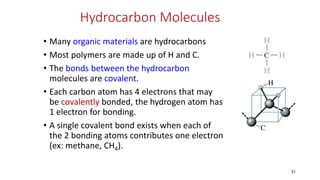
Hydrocarbon Molecules
• Many organic materials are hydrocarbons
• Most polymers are made up of H and C.
• The bonds between the hydrocarbon
molecules are covalent.
• Each carbon atom has 4 electrons that may
be covalently bonded, the hydrogen atom has
1 electron for bonding.
• A single covalent bond exists when each of
the 2 bonding atoms contributes one electron
(ex: methane, CH4).
31
32
Saturated Hydrocarbons
Each carbon has a single
bond to 4 other atoms; the
4 valence electrons are
bonded, the molecule is
stable.
The covalent bonds in each
molecule are strong, but
only weak hydrogen and
van der Waals bonds exist
between the molecules.  Most of these hydrocarbons have relatively
low melting and boiling points.
 However, boiling temperatures rise with
increasing molecular weight.
33
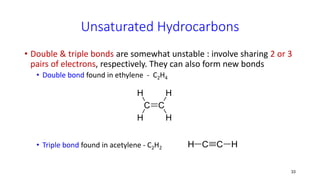
Unsaturated Hydrocarbons
• Double & triple bonds are somewhat unstable : involve sharing 2 or 3
pairs of electrons, respectively. They can also form new bonds
• Double bond found in ethylene - C2H4
• Triple bond found in acetylene - C2H2
C C
H
H
H
H
C C H
H
34
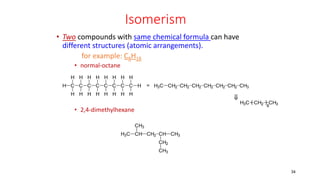
Isomerism
• Two compounds with same chemical formula can have
different structures (atomic arrangements).
for example: C8H18
• normal-octane
• 2,4-dimethylhexane
C C C C C C C C
H
H
H
H
H
H
H
H
H
H
H
H
H
H
H
H
H
H H3C CH2 CH2 CH2 CH2 CH2 CH2 CH3
=
H3C CH
CH3
CH2 CH
CH2
CH3
CH3
H3C CH2 CH3
( )
6

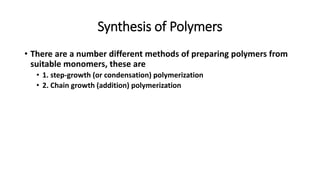
Synthesis of Polymers
• There are a number different methods of preparing polymers from
suitable monomers, these are
• 1. step-growth (or condensation) polymerization
• 2. Chain growth (addition) polymerization
1. Addition: repeating units and monomers are same
• Addition polymerization involves the linking together of molecules, double or
triple chemical bonds
2. Condensation: "step-growth polymerization,
Condensation: repeating units and monomers are not equal,
Example: Reactions of alcohol, amine, or carboxylic acid (or other carboxyl
derivative) functional groups.
36
Polymerization is a process of reacting monomer molecules together in a
chemical reaction to form linear chains or a three-dimensional network of
polymer chains.
Synthesis of Polymers
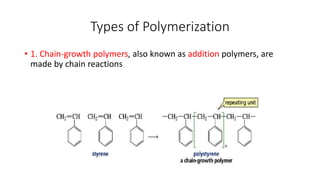
Types of Polymerization
• 1. Chain-growth polymers, also known as addition polymers, are
made by chain reactions
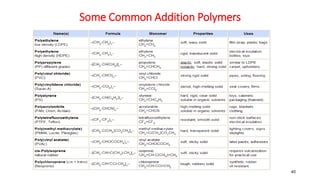
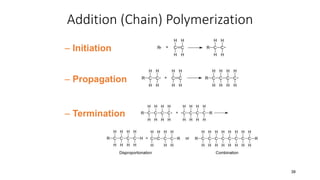
Addition (Chain) Polymerization
– Initiation
– Propagation
– Termination
38
39
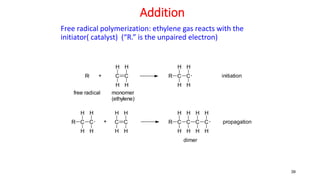
Addition
Free radical polymerization: ethylene gas reacts with the
initiator( catalyst) (“R.” is the unpaired electron)
C C
H H
H
H
monomer
(ethylene)
R +
free radical
R C C
H
H
H
H
initiation
R C C
H
H
H
H
C C
H H
H
H
+ R C C
H
H
H
H
C C
H H
H H
propagation
dimer
Some Common Addition Polymers
40
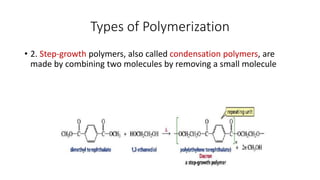
Types of Polymerization
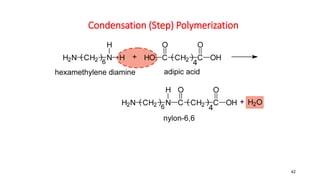
• 2. Step-growth polymers, also called condensation polymers, are
made by combining two molecules by removing a small molecule
Condensation (Step) Polymerization
42
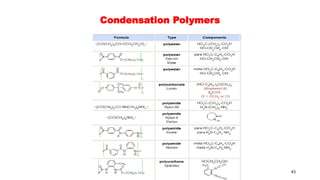
Condensation Polymers
43
Addition Vs. Condensation Polymerization
• In addition polymerization although x may assume any value, y is
confined to unity
• the growing chain can react only with a monomer molecule and
continue its growth
Addition Vs. Condensation Polymerization
• Polymerization reactions can generally be written as
x-mer + y-mer → (x +y)-mer
• In a reaction that leads to condensation polymers.
Comparison of Step-Reaction and
Chain-Reaction Polymerization
Step Reaction Chain Reaction
Growth occurs throughout
reaction between monomers, oligomers,
and polymers
DPa low to moderate
Monomer consumed rapidly while
molecular weight increases slowly
No initiator needed; same reaction
mechanism throughout
No termination step; end groups still reactive
Polymerization rate decreases steadily as
functional groups consumed
Growth occurs by successive addition of
monomer units to limited number of
growing chains
DP can be very high
Monomer consumed relatively slowly, but
molecular weight increases rapidly
Initiation and propagation mechanisms different
Usually chain-terminating step involved
Polymerizaion rate increases initially as
initiator units generated; remains relatively
constant until monomer depleted
aDP, average degree of polymerization. 46

Polymer Chemistry

  • 1.
  • 2.
    List of Topics No.of Weeks Contact Hours Introduction to polymer chemistry, definitions and types of polymeric materials. Homo and copolymers. 1 2 Classifications of polymers: natural and synthetic polymers, linear, branched and cross-linked polymers thermoplastics and thermosets. 1 2 Methods of polymerization (condensation, Free radical, Cationic and anionic) 1 2 Mechanism of polymerizations. 1 2 Coordination polymerization, Stereo regular polymer Mechanism and kinetics of coordination polymerization. 2 4 Molecular weight and molecular weight determination. 1 2 Mechanical and thermal properties of polymers. 2 4 Methods of petrochemical production 1 2 Chemistry of industrial fibers 1 2 Technology in manufacturing polyethylene's – Polystyrenes – PVC and natural rubber 3 6 2
  • 3.
    Grading Assessment task (e.g.essay, test, group project, examination, speech, oral presentation, etc.) Week Due Proportion of Total Assessment Mid term I 6th week 15% Mid term II 11th week 15% Class discussion During the entire course 3% Participation and attendance During the entire course 2% Quizzes During the entire course 5% Group work During the entire course 5% Assignment and presentation From 2nd to 14th week 5% Final written Exam at the end of semester. By the end of the semester 50% 3
  • 4.
    List Recommended Textbooksand Reference Material (Journals, Reports, etc) 1. "Polymer Chemistry: The Basic Concepts", Paul C. Hiemenz. 2. Polymer Synthesis: Theory and Practice: Fundamentals, Methods, Experiments By Dietrich Braun, Harald Cherdron, Matthias Rehahn, H. Ritter, B. Voit Published by Springer, 2005. 4
  • 5.
    What is polymerChemistry • Chemistry of large molecules ( macromolecules). • “Macromolecules” : molecules existed as a result of covalently linked smaller units, and possessed unique physical and chemical properties. • Polymer is macromolecules, but macromolecules may not be a polymer. 5
  • 6.
    What is polymer •Polymer is compound consisting of long-chain molecules, each molecule made up of 1000- 10 000 repeating units connected together. • The word polymer is Greek words poly: many, and meros (reduced to mer: part. • Molar mass ranges from 104- 106 g/g-mole. • Most polymers are based on carbon and are therefore considered organic compounds. 6
  • 7.
    Polymer Chain Lengths •Many polymer properties are affected by the length of the polymer chains. For example, the melting temperature increases with increasing molecular weight. • At room temp, polymers with very short chains (roughly 100 g/mol) will exist as liquids. • Those with weights of 1000 g/mol are typically waxy solids and soft resins. • Solid polymers range between 10,000 and several million g/mol. • The molecular weight affects the polymer’s properties (examples: elastic modulus & strength). 7
  • 8.
    8 Polymeric Materials, Repeatingunits polyethylene ethylene
  • 9.
  • 10.
    Typical Values ofDP and MW for Selected Polymers 10
  • 11.
    :polyethylene of chainlength n ; (2b) concise notation for depicting the polymer structure of chain length n 11 Polymeric Materials & Notation
  • 12.
  • 13.
  • 14.
  • 15.
  • 16.
    Classification of Polymer 2.by Skeletal Structure Polymers can exist with various skeletal structures - such as: 1. Linear polymers. 2. Branched polymers. 3. cross-linked polymers. 4. Network polymers. 5. Dendiemer Polymer 16
  • 17.
    Classification of Polymerby Structure: Linear structure : chain-like structure Characteristic of thermoplastic polymers. 17 Linear
  • 18.
    Polymer Structure • Branchedstructure that includes side branches along the chain, also found in thermoplastic polymers. 18
  • 19.
    Polymer Structure • LooselyCross-linked: bonding occurs between branches and other molecules at certain Connection points. As in an elastomer 19 Loosely Cross- Linked
  • 20.
    Tightly cross-linked ornetwork structure - in effect, the entire mass is one gigantic macromolecule. As in a thermoset. 20 Polymer Structure network structure
  • 21.
    Polymer Structure 21 Dendrimer Polymer:from the Greek word means tree- like polymer, dendrimer structure has: 1. Symmetric around the core. 2. Spherical three-dimensional morphology. Dendrimer Structure
  • 22.
    Classification of Polymer:3. by Composition 22
  • 23.
  • 24.
    Types of Polymers •Polymers can be separated into plastics and rubbers. • It can be classified into the following three categories: • 1. Thermoplastic polymers • 2. Thermosetting polymer plastics • 3. Elastomers  rubbers 24
  • 25.
    Polymer Classification Polymers arecommonly classified according to thermal effect as follows: 25 Polymers Elastomers Thermosets Thermoplastics Crystalline Amorphous plastics rubbers
  • 26.
    Thermoplastics Thermosetting plastics • Thermoplastics:Thermoplastics soften when heated, and they become hard and rigid once again when cooled. • Example: Polyethylene, PVC, Nylon Uses: Bags, Toys • Thermosetting plastics: Thermosetting materials do not become softy on heating. • Example: Bakelite Uses: Electric switches, Telephone parts, Cooker handles 26
  • 27.
    Effect of Branchingon Properties • Thermoplastic polymers always possess linear or branched structures, or a mixture of the two - If Branches increase among the molecules, the polymer becomes: - Stronger in the solid state. - More viscous in liquid state. . 27
  • 28.
    Crystalinity and Properties •As Ascrystallinity is increased in a polymer: - Density increases. - Stiffness, strength, and toughness increases. - Heat resistance increases. - It becomes opaque (Not transparent). 28
  • 29.
    THERMOPLASTICS PROPERTIES • 1.Formed by addition Polymerization. • 2. Long chain linear polymers. • 3. Soften on heating and stiffen on cooling • They can be moulded into any shape. • Less than 100% crystallinity, but instead amorphous. 29
  • 30.
    THERMOSETTING PLASTICS 30 • 1.Formed by condensation Polymerization. • 2. Three dimensional network structure joined by strong covalent bonds • 3. Do not soften on heating • 4. Rigid materials • 5. At high temperature, thermoset plastics degrade rather than melt.
  • 31.
    Hydrocarbon Molecules • Manyorganic materials are hydrocarbons • Most polymers are made up of H and C. • The bonds between the hydrocarbon molecules are covalent. • Each carbon atom has 4 electrons that may be covalently bonded, the hydrogen atom has 1 electron for bonding. • A single covalent bond exists when each of the 2 bonding atoms contributes one electron (ex: methane, CH4). 31
  • 32.
    32 Saturated Hydrocarbons Each carbonhas a single bond to 4 other atoms; the 4 valence electrons are bonded, the molecule is stable. The covalent bonds in each molecule are strong, but only weak hydrogen and van der Waals bonds exist between the molecules.  Most of these hydrocarbons have relatively low melting and boiling points.  However, boiling temperatures rise with increasing molecular weight.
  • 33.
    33 Unsaturated Hydrocarbons • Double& triple bonds are somewhat unstable : involve sharing 2 or 3 pairs of electrons, respectively. They can also form new bonds • Double bond found in ethylene - C2H4 • Triple bond found in acetylene - C2H2 C C H H H H C C H H
  • 34.
    34 Isomerism • Two compoundswith same chemical formula can have different structures (atomic arrangements). for example: C8H18 • normal-octane • 2,4-dimethylhexane C C C C C C C C H H H H H H H H H H H H H H H H H H H3C CH2 CH2 CH2 CH2 CH2 CH2 CH3 = H3C CH CH3 CH2 CH CH2 CH3 CH3 H3C CH2 CH3 ( ) 6 
  • 35.
    Synthesis of Polymers •There are a number different methods of preparing polymers from suitable monomers, these are • 1. step-growth (or condensation) polymerization • 2. Chain growth (addition) polymerization
  • 36.
    1. Addition: repeatingunits and monomers are same • Addition polymerization involves the linking together of molecules, double or triple chemical bonds 2. Condensation: "step-growth polymerization, Condensation: repeating units and monomers are not equal, Example: Reactions of alcohol, amine, or carboxylic acid (or other carboxyl derivative) functional groups. 36 Polymerization is a process of reacting monomer molecules together in a chemical reaction to form linear chains or a three-dimensional network of polymer chains. Synthesis of Polymers
  • 37.
    Types of Polymerization •1. Chain-growth polymers, also known as addition polymers, are made by chain reactions
  • 38.
    Addition (Chain) Polymerization –Initiation – Propagation – Termination 38
  • 39.
    39 Addition Free radical polymerization:ethylene gas reacts with the initiator( catalyst) (“R.” is the unpaired electron) C C H H H H monomer (ethylene) R + free radical R C C H H H H initiation R C C H H H H C C H H H H + R C C H H H H C C H H H H propagation dimer
  • 40.
  • 41.
    Types of Polymerization •2. Step-growth polymers, also called condensation polymers, are made by combining two molecules by removing a small molecule
  • 42.
  • 43.
  • 44.
    Addition Vs. CondensationPolymerization • In addition polymerization although x may assume any value, y is confined to unity • the growing chain can react only with a monomer molecule and continue its growth
  • 45.
    Addition Vs. CondensationPolymerization • Polymerization reactions can generally be written as x-mer + y-mer → (x +y)-mer • In a reaction that leads to condensation polymers.
  • 46.
    Comparison of Step-Reactionand Chain-Reaction Polymerization Step Reaction Chain Reaction Growth occurs throughout reaction between monomers, oligomers, and polymers DPa low to moderate Monomer consumed rapidly while molecular weight increases slowly No initiator needed; same reaction mechanism throughout No termination step; end groups still reactive Polymerization rate decreases steadily as functional groups consumed Growth occurs by successive addition of monomer units to limited number of growing chains DP can be very high Monomer consumed relatively slowly, but molecular weight increases rapidly Initiation and propagation mechanisms different Usually chain-terminating step involved Polymerizaion rate increases initially as initiator units generated; remains relatively constant until monomer depleted aDP, average degree of polymerization. 46