POLYMERS
&
IT’S CLASSIFICATIONS
Presented by
DIVYA MARIAM JOHN
CONTENT
 INTRODUCTION
 POLYMERIZATION
 CHARACTERISTICS OF AN IDEAL POLYMER
 CLASSIFICATION OF POLYMER
1. By Origin
2. By Monomer
3. By Thermal Response
4. By Mode of Formation
5. By Structure
6. By Biodegradability
 OTHER PARAMETERS OF CLASSIFICATION
 CONCLUSION
 REFERENCE
INTRODUCTION
 POLYMER - ancient Greek word “polus”, means “many, much” & “meros”,
meaning “parts”.
 The term was coined in 1833 by Jons Jacob Berzelius.
 Definition - Polymer is a large molecule(macromolecules) composed of
many repeated subunits, known as Monomer.
 The process of formation of polymer is called Polymerization.
 Polymer is used as a synonym for plastic.
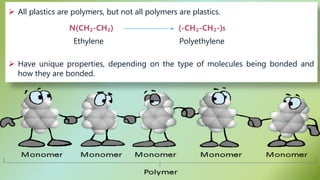
 All plastics are polymers, but not all polymers are plastics.
N(CH₂-CH₂) (-CH₂-CH₂-)s
Ethylene Polyethylene
 Have unique properties, depending on the type of molecules being bonded and
how they are bonded.
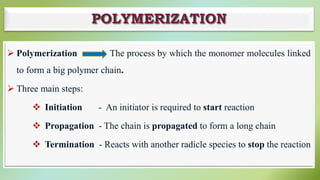
POLYMERIZATION
 Polymerization The process by which the monomer molecules linked
to form a big polymer chain.
 Three main steps:
 Initiation - An initiator is required to start reaction
 Propagation - The chain is propagated to form a long chain
 Termination - Reacts with another radicle species to stop the reaction
CHARACTERISTICS OF AN IDEAL POLYMER
 Should be versatile & possess a wide range of mechanical, physical, chemical properties.
 Should be non-toxic & have good mechanical strength & should be easily administered.
 Should be inexpensive.
 Should be easy to fabricate.
 Should be inert to host tissue and compatible with environment.
CLASSIFICATION OF POLYMERS
1. By Origin
2. By Monomer
3. By Thermal response
4. By Mode of formation
5. By Structure
6. By Biodegradability
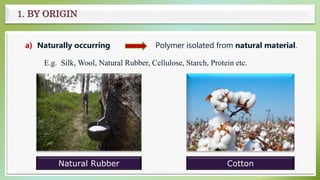
a) Naturally occurring Polymer isolated from natural material.
E.g. Silk, Wool, Natural Rubber, Cellulose, Starch, Protein etc.
1. BY ORIGIN
Cotton
Natural Rubber
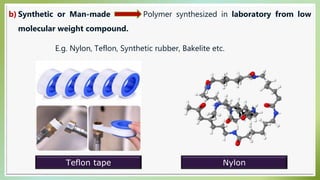
b) Synthetic or Man-made Polymer synthesized in laboratory from low
molecular weight compound.
E.g. Nylon, Teflon, Synthetic rubber, Bakelite etc.
Teflon tape Nylon
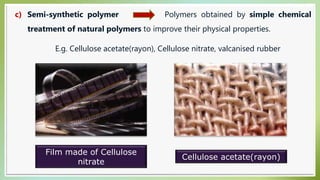
c) Semi-synthetic polymer Polymers obtained by simple chemical
treatment of natural polymers to improve their physical properties.
E.g. Cellulose acetate(rayon), Cellulose nitrate, valcanised rubber
Film made of Cellulose
nitrate
Cellulose acetate(rayon)
2. BY MONOMER
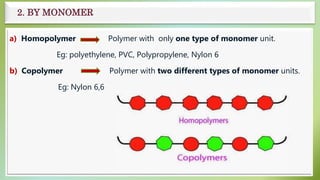
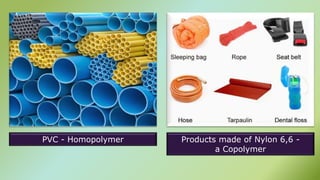
a) Homopolymer Polymer with only one type of monomer unit.
Eg: polyethylene, PVC, Polypropylene, Nylon 6
b) Copolymer Polymer with two different types of monomer units.
Eg: Nylon 6,6
Products made of Nylon 6,6 -
a Copolymer
PVC - Homopolymer
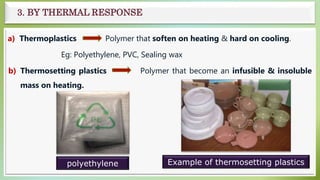
3. BY THERMAL RESPONSE
a) Thermoplastics Polymer that soften on heating & hard on cooling.
Eg: Polyethylene, PVC, Sealing wax
b) Thermosetting plastics Polymer that become an infusible & insoluble
mass on heating.
polyethylene Example of thermosetting plastics
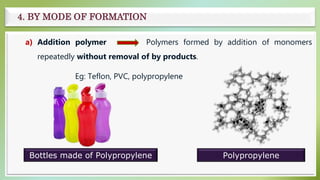
a) Addition polymer Polymers formed by addition of monomers
repeatedly without removal of by products.
Eg: Teflon, PVC, polypropylene
4. BY MODE OF FORMATION
Polypropylene
Bottles made of Polypropylene
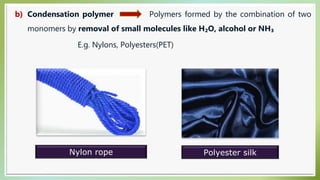
b) Condensation polymer Polymers formed by the combination of two
monomers by removal of small molecules like H₂O, alcohol or NH₃
E.g. Nylons, Polyesters(PET)
Nylon rope Polyester silk
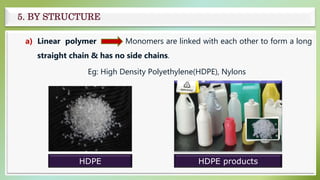
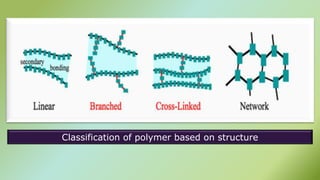
a) Linear polymer Monomers are linked with each other to form a long
straight chain & has no side chains.
Eg: High Density Polyethylene(HDPE), Nylons
5. BY STRUCTURE
HDPE products
HDPE
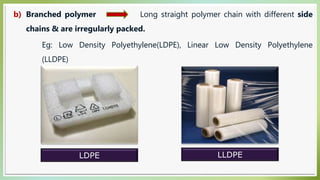
b) Branched polymer Long straight polymer chain with different side
chains & are irregularly packed.
Eg: Low Density Polyethylene(LDPE), Linear Low Density Polyethylene
(LLDPE)
LDPE LLDPE
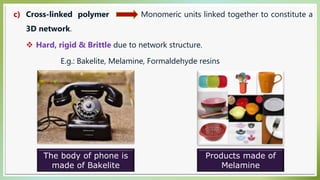
c) Cross-linked polymer Monomeric units linked together to constitute a
3D network.
 Hard, rigid & Brittle due to network structure.
E.g.: Bakelite, Melamine, Formaldehyde resins
The body of phone is
made of Bakelite
Products made of
Melamine
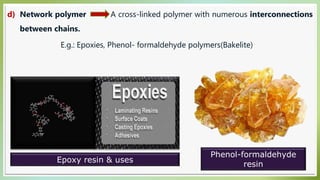
d) Network polymer A cross-linked polymer with numerous interconnections
between chains.
E.g.: Epoxies, Phenol- formaldehyde polymers(Bakelite)
Epoxy resin & uses
Phenol-formaldehyde
resin
Classification of polymer based on structure
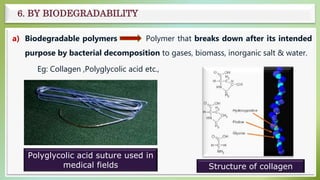
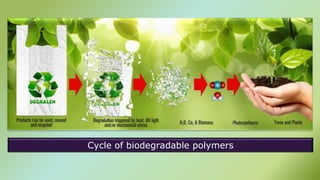
a) Biodegradable polymers Polymer that breaks down after its intended
purpose by bacterial decomposition to gases, biomass, inorganic salt & water.
Eg: Collagen ,Polyglycolic acid etc.,
6. BY BIODEGRADABILITY
Structure of collagen
Polyglycolic acid suture used in
medical fields
Cycle of biodegradable polymers
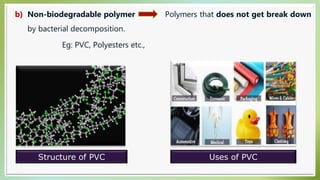
b) Non-biodegradable polymer Polymers that does not get break down
by bacterial decomposition.
Eg: PVC, Polyesters etc.,
Structure of PVC Uses of PVC
7. By Crystallinity
a) Crystalline Monomers arranged in ordered way.
b) Amorphous Monomers arranged in random way.
8. By Backbone Atom
a) Organic Polymer Backbone is made-up of carbon atom.
b) Inorganic Polymer Backbone is made-up of other atom.
OTHER PARAMETERS OF CLASSIFICATION
CONCLUSION
 Polymer is a large chain of monomer units joined together by the process of
polymerization.
 Polymers are very rarely used in pure form.
 Modifications are carried out to improve the properties of the polymers.
 Depending upon the use modifications are done in order to meet the requirements of day
today life.
 Polymers are classified on the bases of origin, structure, types monomer, mode of
formation, degradability etc.,
 Other parameters of classification include by crystallinity & back bone atom
REFERENCES
1. File:///D:/polymerization/polymers.htm
2. File:///D:/polymerization/synthesis.htm
3. Devansh Gupta “classification of polymers” LinkedIn learning
4. Varshaawasar,”Polymer: preparation & uses” LinkedIn Learning
5. byjus.com /“Polymers- Classification, types & properties”
6. Lifescience.com/ What is polymer?/polymers.htm
7. Sirin Mhiri, Majdi Abid ”Thermally reversible and Biodegradable polymers” European Polymer Journal , Science Direct.
8. Elias H-G. “An Introduction to Polymer Science”. Weinheim: VCH;1997.
9. Britannica Articles: “Life: Production of polymers”.
10. Jerome David Odom, “Inorganic Polymer”. Britannica .
Polymers and It's Classification

Polymers and It's Classification

  • 1.
  • 2.
    CONTENT  INTRODUCTION  POLYMERIZATION CHARACTERISTICS OF AN IDEAL POLYMER  CLASSIFICATION OF POLYMER 1. By Origin 2. By Monomer 3. By Thermal Response 4. By Mode of Formation
  • 3.
    5. By Structure 6.By Biodegradability  OTHER PARAMETERS OF CLASSIFICATION  CONCLUSION  REFERENCE
  • 4.
    INTRODUCTION  POLYMER -ancient Greek word “polus”, means “many, much” & “meros”, meaning “parts”.  The term was coined in 1833 by Jons Jacob Berzelius.  Definition - Polymer is a large molecule(macromolecules) composed of many repeated subunits, known as Monomer.  The process of formation of polymer is called Polymerization.  Polymer is used as a synonym for plastic.
  • 5.
     All plasticsare polymers, but not all polymers are plastics. N(CH₂-CH₂) (-CH₂-CH₂-)s Ethylene Polyethylene  Have unique properties, depending on the type of molecules being bonded and how they are bonded.
  • 6.
    POLYMERIZATION  Polymerization Theprocess by which the monomer molecules linked to form a big polymer chain.  Three main steps:  Initiation - An initiator is required to start reaction  Propagation - The chain is propagated to form a long chain  Termination - Reacts with another radicle species to stop the reaction
  • 7.
    CHARACTERISTICS OF ANIDEAL POLYMER  Should be versatile & possess a wide range of mechanical, physical, chemical properties.  Should be non-toxic & have good mechanical strength & should be easily administered.  Should be inexpensive.  Should be easy to fabricate.  Should be inert to host tissue and compatible with environment.
  • 8.
    CLASSIFICATION OF POLYMERS 1.By Origin 2. By Monomer 3. By Thermal response 4. By Mode of formation 5. By Structure 6. By Biodegradability
  • 9.
    a) Naturally occurringPolymer isolated from natural material. E.g. Silk, Wool, Natural Rubber, Cellulose, Starch, Protein etc. 1. BY ORIGIN Cotton Natural Rubber
  • 10.
    b) Synthetic orMan-made Polymer synthesized in laboratory from low molecular weight compound. E.g. Nylon, Teflon, Synthetic rubber, Bakelite etc. Teflon tape Nylon
  • 11.
    c) Semi-synthetic polymerPolymers obtained by simple chemical treatment of natural polymers to improve their physical properties. E.g. Cellulose acetate(rayon), Cellulose nitrate, valcanised rubber Film made of Cellulose nitrate Cellulose acetate(rayon)
  • 12.
    2. BY MONOMER a)Homopolymer Polymer with only one type of monomer unit. Eg: polyethylene, PVC, Polypropylene, Nylon 6 b) Copolymer Polymer with two different types of monomer units. Eg: Nylon 6,6
  • 13.
    Products made ofNylon 6,6 - a Copolymer PVC - Homopolymer
  • 14.
    3. BY THERMALRESPONSE a) Thermoplastics Polymer that soften on heating & hard on cooling. Eg: Polyethylene, PVC, Sealing wax b) Thermosetting plastics Polymer that become an infusible & insoluble mass on heating. polyethylene Example of thermosetting plastics
  • 15.
    a) Addition polymerPolymers formed by addition of monomers repeatedly without removal of by products. Eg: Teflon, PVC, polypropylene 4. BY MODE OF FORMATION Polypropylene Bottles made of Polypropylene
  • 16.
    b) Condensation polymerPolymers formed by the combination of two monomers by removal of small molecules like H₂O, alcohol or NH₃ E.g. Nylons, Polyesters(PET) Nylon rope Polyester silk
  • 17.
    a) Linear polymerMonomers are linked with each other to form a long straight chain & has no side chains. Eg: High Density Polyethylene(HDPE), Nylons 5. BY STRUCTURE HDPE products HDPE
  • 18.
    b) Branched polymerLong straight polymer chain with different side chains & are irregularly packed. Eg: Low Density Polyethylene(LDPE), Linear Low Density Polyethylene (LLDPE) LDPE LLDPE
  • 19.
    c) Cross-linked polymerMonomeric units linked together to constitute a 3D network.  Hard, rigid & Brittle due to network structure. E.g.: Bakelite, Melamine, Formaldehyde resins The body of phone is made of Bakelite Products made of Melamine
  • 20.
    d) Network polymerA cross-linked polymer with numerous interconnections between chains. E.g.: Epoxies, Phenol- formaldehyde polymers(Bakelite) Epoxy resin & uses Phenol-formaldehyde resin
  • 21.
    Classification of polymerbased on structure
  • 22.
    a) Biodegradable polymersPolymer that breaks down after its intended purpose by bacterial decomposition to gases, biomass, inorganic salt & water. Eg: Collagen ,Polyglycolic acid etc., 6. BY BIODEGRADABILITY Structure of collagen Polyglycolic acid suture used in medical fields
  • 23.
  • 24.
    b) Non-biodegradable polymerPolymers that does not get break down by bacterial decomposition. Eg: PVC, Polyesters etc., Structure of PVC Uses of PVC
  • 25.
    7. By Crystallinity a)Crystalline Monomers arranged in ordered way. b) Amorphous Monomers arranged in random way. 8. By Backbone Atom a) Organic Polymer Backbone is made-up of carbon atom. b) Inorganic Polymer Backbone is made-up of other atom. OTHER PARAMETERS OF CLASSIFICATION
  • 26.
    CONCLUSION  Polymer isa large chain of monomer units joined together by the process of polymerization.  Polymers are very rarely used in pure form.  Modifications are carried out to improve the properties of the polymers.  Depending upon the use modifications are done in order to meet the requirements of day today life.  Polymers are classified on the bases of origin, structure, types monomer, mode of formation, degradability etc.,  Other parameters of classification include by crystallinity & back bone atom
  • 27.
    REFERENCES 1. File:///D:/polymerization/polymers.htm 2. File:///D:/polymerization/synthesis.htm 3.Devansh Gupta “classification of polymers” LinkedIn learning 4. Varshaawasar,”Polymer: preparation & uses” LinkedIn Learning 5. byjus.com /“Polymers- Classification, types & properties” 6. Lifescience.com/ What is polymer?/polymers.htm 7. Sirin Mhiri, Majdi Abid ”Thermally reversible and Biodegradable polymers” European Polymer Journal , Science Direct. 8. Elias H-G. “An Introduction to Polymer Science”. Weinheim: VCH;1997. 9. Britannica Articles: “Life: Production of polymers”. 10. Jerome David Odom, “Inorganic Polymer”. Britannica .