Glycosides
• Class: Second Year B. Pharm Sem: IV
• Subject: Pharmacognosy & Phytochemistry – I
• Chapter No.: 3
By: Vipul Dhasade
Department of Pharmacognosy
• Primary metabolites :
• Secondary metabolites : Glycosides, Flavonoids,
Alkaloids, Essential oils, Tannins.
• Phytopharmaceuticals: Significance
Glycosides
They are secondary products formed from one
or more sugar molecules added to a non-sugar
biologically active molecule
– Sugar most commonly found is glucose
– Non-sugar molecule known as the aglycone and may
be
• amino acid derivatives
• steroids
• triterpenes
Glycosides
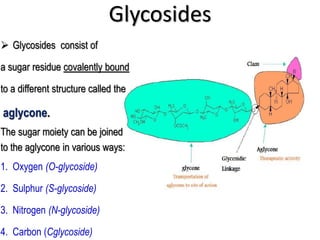
 Glycosides consist of
a sugar residue covalently bound
to a different structure called the
aglycone.
The sugar moiety can be joined
to the aglycone in various ways:
1. Oxygen (O-glycoside)
2. Sulphur (S-glycoside)
3. Nitrogen (N-glycoside)
4. Carbon (Cglycoside)
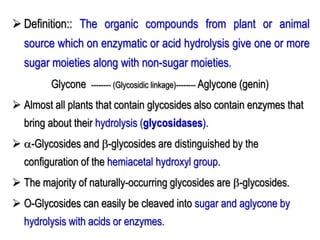
 Definition:: The organic compounds from plant or animal
source which on enzymatic or acid hydrolysis give one or more
sugar moieties along with non-sugar moieties.
Glycone -------- (Glycosidic linkage)-------- Aglycone (genin)
 Almost all plants that contain glycosides also contain enzymes that
bring about their hydrolysis (glycosidases).
 -Glycosides and -glycosides are distinguished by the
configuration of the hemiacetal hydroxyl group.
 The majority of naturally-occurring glycosides are -glycosides.
 O-Glycosides can easily be cleaved into sugar and aglycone by
hydrolysis with acids or enzymes.
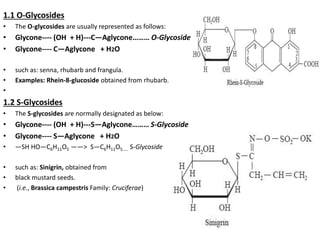
1.1 O-Glycosides
• The O-glycosides are usually represented as follows:
• Glycone---- (OH + H)---C—Aglycone……… O-Glycoside
• Glycone---- C—Aglycone + H2O
• such as: senna, rhubarb and frangula.
• Examples: Rhein-8-glucoside obtained from rhubarb.
•
1.2 S-Glycosides
• The S-glycosides are normally designated as below:
• Glycone---- (OH + H)---S—Aglycone……… S-Glycoside
• Glycone---- S—Aglycone + H2O
• —SH HO—C6H11O5 ——> S—C6H11O5….. S-Glycoside
• such as: Sinigrin, obtained from
• black mustard seeds.
• (i.e., Brassica campestris Family: Cruciferae)
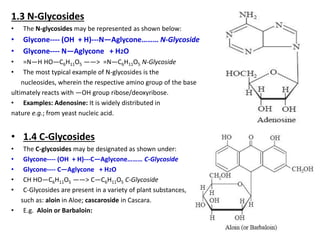
1.3 N-Glycosides
• The N-glycosides may be represented as shown below:
• Glycone---- (OH + H)---N—Aglycone……… N-Glycoside
• Glycone---- N—Aglycone + H2O
• =N—H HO—C6H11O5 ——> =N—C6H11O5 N-Glycoside
• The most typical example of N-glycosides is the
nucleosides, wherein the respective amino group of the base
ultimately reacts with —OH group ribose/deoxyribose.
• Examples: Adenosine: It is widely distributed in
nature e.g.; from yeast nucleic acid.
• 1.4 C-Glycosides
• The C-glycosides may be designated as shown under:
• Glycone---- (OH + H)---C—Aglycone……… C-Glycoside
• Glycone---- C—Aglycone + H2O
• CH HO—C6H11O5 ——> C—C6H11O5 C-Glycoside
• C-Glycosides are present in a variety of plant substances,
such as: aloin in Aloe; cascaroside in Cascara.
• E.g. Aloin or Barbaloin:
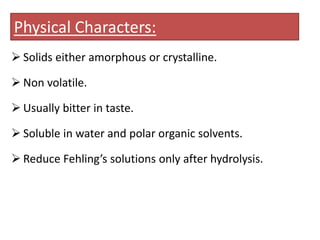
Physical Characters:
 Solids either amorphous or crystalline.
 Non volatile.
 Usually bitter in taste.
 Soluble in water and polar organic solvents.
 Reduce Fehling’s solutions only after hydrolysis.
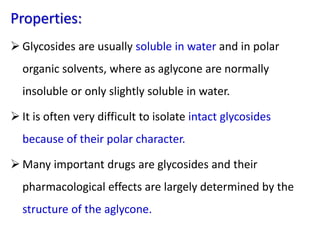
Properties:
 Glycosides are usually soluble in water and in polar
organic solvents, where as aglycone are normally
insoluble or only slightly soluble in water.
 It is often very difficult to isolate intact glycosides
because of their polar character.
 Many important drugs are glycosides and their
pharmacological effects are largely determined by the
structure of the aglycone.
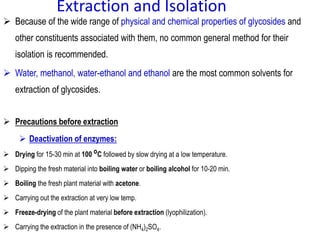
Extraction and Isolation
 Because of the wide range of physical and chemical properties of glycosides and
other constituents associated with them, no common general method for their
isolation is recommended.
 Water, methanol, water-ethanol and ethanol are the most common solvents for
extraction of glycosides.
 Precautions before extraction
 Deactivation of enzymes:
 Drying for 15-30 min at 100 oC followed by slow drying at a low temperature.
 Dipping the fresh material into boiling water or boiling alcohol for 10-20 min.
 Boiling the fresh plant material with acetone.
 Carrying out the extraction at very low temp.
 Freeze-drying of the plant material before extraction (lyophilization).
 Carrying the extraction in the presence of (NH4)2SO4.
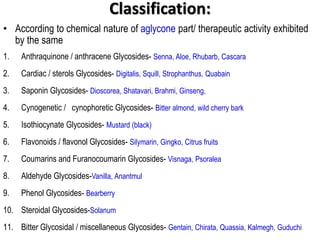
Classification:
• According to chemical nature of aglycone part/ therapeutic activity exhibited
by the same
1. Anthraquinone / anthracene Glycosides- Senna, Aloe, Rhubarb, Cascara
2. Cardiac / sterols Glycosides- Digitalis, Squill, Strophanthus, Quabain
3. Saponin Glycosides- Dioscorea, Shatavari, Brahmi, Ginseng,
4. Cynogenetic / cynophoretic Glycosides- Bitter almond, wild cherry bark
5. Isothiocynate Glycosides- Mustard (black)
6. Flavonoids / flavonol Glycosides- Silymarin, Gingko, Citrus fruits
7. Coumarins and Furanocoumarin Glycosides- Visnaga, Psoralea
8. Aldehyde Glycosides-Vanilla, Anantmul
9. Phenol Glycosides- Bearberry
10. Steroidal Glycosides-Solanum
11. Bitter Glycosidal / miscellaneous Glycosides- Gentain, Chirata, Quassia, Kalmegh, Guduchi
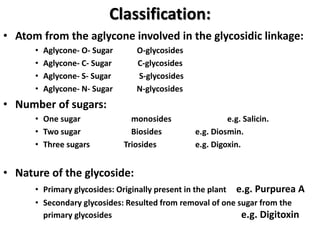
• Atom from the aglycone involved in the glycosidic linkage:
• Aglycone- O- Sugar O-glycosides
• Aglycone- C- Sugar C-glycosides
• Aglycone- S- Sugar S-glycosides
• Aglycone- N- Sugar N-glycosides
• Number of sugars:
• One sugar monosides e.g. Salicin.
• Two sugar Biosides e.g. Diosmin.
• Three sugars Triosides e.g. Digoxin.
• Nature of the glycoside:
• Primary glycosides: Originally present in the plant e.g. Purpurea A
• Secondary glycosides: Resulted from removal of one sugar from the
primary glycosides e.g. Digitoxin
Classification:
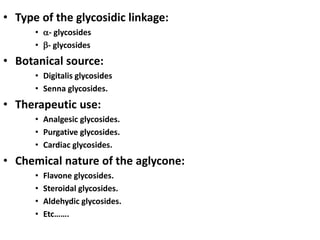
• Type of the glycosidic linkage:
• - glycosides
• - glycosides
• Botanical source:
• Digitalis glycosides
• Senna glycosides.
• Therapeutic use:
• Analgesic glycosides.
• Purgative glycosides.
• Cardiac glycosides.
• Chemical nature of the aglycone:
• Flavone glycosides.
• Steroidal glycosides.
• Aldehydic glycosides.
• Etc…….
According to chemical nature of aglycone part/ therapeutic
activity exhibited by the same
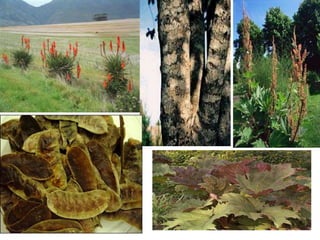
1.Anthraquinone / anthracene Glycosides-
Example: Senna, Aloe, Rhubarb, Cascara
Major class of glycosides. Present mainly in Dicot plants.
These group having aglycone moieties like anthraquinone,
anthrone, dianthrone, anthronol, dianthronol. Oxanthronol.
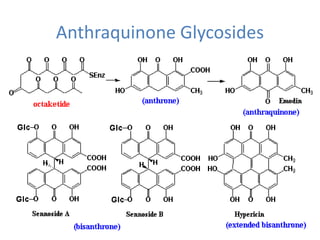
Anthraquinone Glycosides
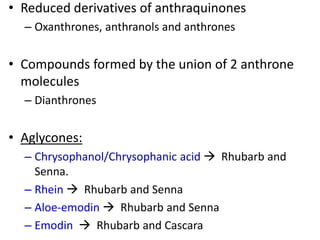
• Reduced derivatives of anthraquinones
– Oxanthrones, anthranols and anthrones
• Compounds formed by the union of 2 anthrone
molecules
– Dianthrones
• Aglycones:
– Chrysophanol/Chrysophanic acid  Rhubarb and
Senna.
– Rhein  Rhubarb and Senna
– Aloe-emodin  Rhubarb and Senna
– Emodin  Rhubarb and Cascara
Anthraquinones –
Chemical Properties
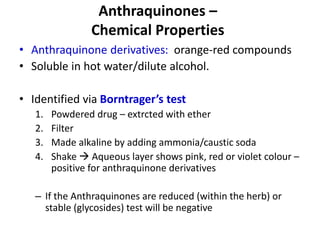
• Anthraquinone derivatives: orange-red compounds
• Soluble in hot water/dilute alcohol.
• Identified via Borntrager’s test
1. Powdered drug – extrcted with ether
2. Filter
3. Made alkaline by adding ammonia/caustic soda
4. Shake  Aqueous layer shows pink, red or violet colour –
positive for anthraquinone derivatives
– If the Anthraquinones are reduced (within the herb) or
stable (glycosides) test will be negative
Senna
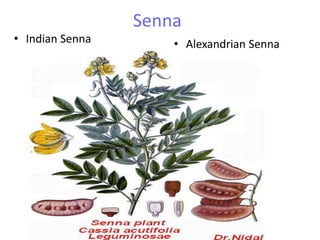
• Indian Senna • Alexandrian Senna
Senna
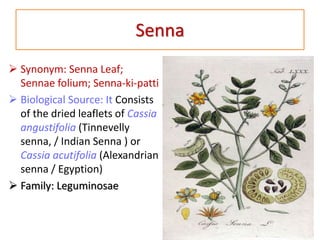
 Synonym: Senna Leaf;
Sennae folium; Senna-ki-patti
 Biological Source: It Consists
of the dried leaflets of Cassia
angustifolia (Tinnevelly
senna, / Indian Senna ) or
Cassia acutifolia (Alexandrian
senna / Egyption)
 Family: Leguminosae
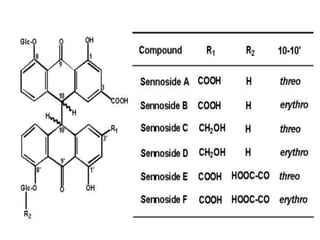
Senna - Constituents
• 2 Active glycosides: Sennoside A
Sennoside B
– Both hydrolyse: 2 molecules glucose + aglycones:
Sennidin A and Sennidin B.
• Sennoside C & Sennoside D
• Rhein
• Aloe-emodin
• Palmidin A (Rhubarb)
Chemical Test: Borntrager’s Test positive due to anthaquinone
in leaves.
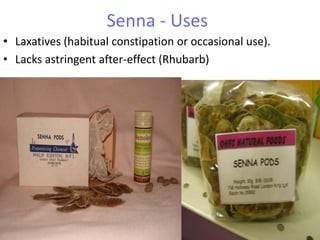
Senna - Uses
• Laxatives (habitual constipation or occasional use).
• Lacks astringent after-effect (Rhubarb)
Senna - Additional
• Medicinal Actions
 Vermifuge, diuretic, febrifuge
 Other uses: laxative candy
(bitter taste).
 Also used to treat flatulence,
gout, fever.
 Topically: poultice prepared
with vinegar to treat pimples.
 NOTE: Senna may cause
urine to become reddish – no
clinical significance.
• Contra-indications
• Gout, colitis, GI inflammation.
 Should not be used with cardiac
glycosides.
 Overdose: nausea, bloody
diarrhoea, vomiting and nephritis.
 Long-term use: dehydration &
electrolyte depletion, worsening
constipation and weakening
intestinal muscles.
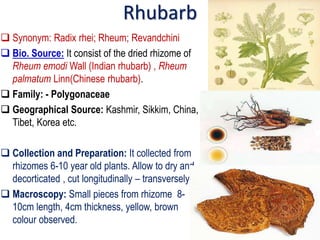
Rhubarb
 Synonym: Radix rhei; Rheum; Revandchini
 Bio. Source: It consist of the dried rhizome of
Rheum emodi Wall (Indian rhubarb) , Rheum
palmatum Linn(Chinese rhubarb).
 Family: - Polygonaceae
 Geographical Source: Kashmir, Sikkim, China,
Tibet, Korea etc.
 Collection and Preparation: It collected from
rhizomes 6-10 year old plants. Allow to dry and
decorticated , cut longitudinally – transversely.
 Macroscopy: Small pieces from rhizome 8-
10cm length, 4cm thickness, yellow, brown
colour observed.
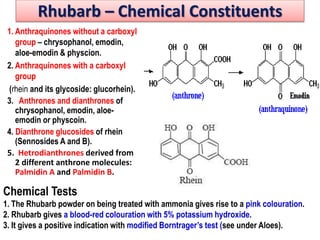
Rhubarb – Chemical Constituents
1. Anthraquinones without a carboxyl
group – chrysophanol, emodin,
aloe-emodin & physcion.
2. Anthraquinones with a carboxyl
group
(rhein and its glycoside: glucorhein).
3. Anthrones and dianthrones of
chrysophanol, emodin, aloe-
emodin or physcoin.
4. Dianthrone glucosides of rhein
(Sennosides A and B).
5. Hetrodianthrones derived from
2 different anthrone molecules:
Palmidin A and Palmidin B.
Chemical Tests
1. The Rhubarb powder on being treated with ammonia gives rise to a pink colouration.
2. Rhubarb gives a blood-red colouration with 5% potassium hydroxide.
3. It gives a positive indication with modified Borntrager’s test (see under Aloes).
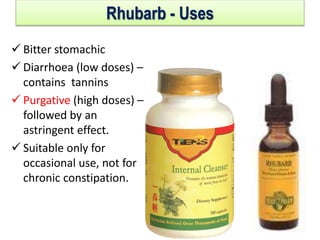
Rhubarb - Uses
 Bitter stomachic
 Diarrhoea (low doses) –
contains tannins
 Purgative (high doses) –
followed by an
astringent effect.
 Suitable only for
occasional use, not for
chronic constipation.
Rhubarb - Additional
• Etymology
– Rheo – Greek, ‘to flow’,
in reference to the
purgative properties.
• Medicinal Actions
– Anti-helminthic, anti-
bacterial, anti-
inflammatory, antiseptic.
• Topical Uses:
– Poultice to treat boils,
burns, wounds. Used to
stop bleeding (tannins –
stypic and astringent).
Used as a mouthwash
for oral ulcers.
• Caution
– Leaves should be
avoided – high calcium
oxalate - toxic
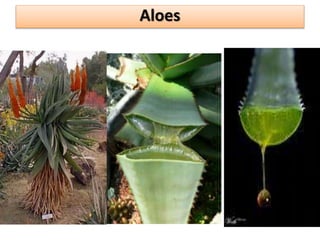
Aloes
1. Aloes:
• Synonym: Aloe, Musabbar, Kumari
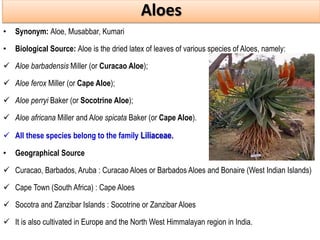
• Biological Source: Aloe is the dried latex of leaves of various species of Aloes, namely:
 Aloe barbadensis Miller (or Curacao Aloe);
 Aloe ferox Miller (or Cape Aloe);
 Aloe perryi Baker (or Socotrine Aloe);
 Aloe africana Miller and Aloe spicata Baker (or Cape Aloe).
 All these species belong to the family Liliaceae.
• Geographical Source
 Curacao, Barbados, Aruba : Curacao Aloes or Barbados Aloes and Bonaire (West Indian Islands)
 Cape Town (South Africa) : Cape Aloes
 Socotra and Zanzibar Islands : Socotrine or Zanzibar Aloes
 It is also cultivated in Europe and the North West Himmalayan region in India.
Aloes
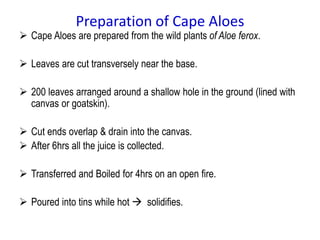
Preparation of Cape Aloes
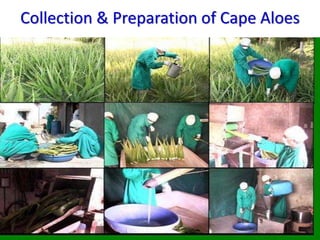
 Cape Aloes are prepared from the wild plants of Aloe ferox.
 Leaves are cut transversely near the base.
 200 leaves arranged around a shallow hole in the ground (lined with
canvas or goatskin).
 Cut ends overlap & drain into the canvas.
 After 6hrs all the juice is collected.
 Transferred and Boiled for 4hrs on an open fire.
 Poured into tins while hot  solidifies.
Collection & Preparation of Cape Aloes
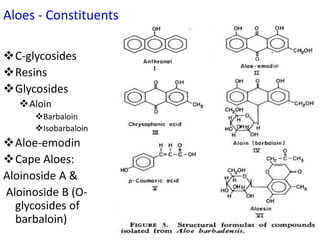
Aloes - Constituents
C-glycosides
Resins
Glycosides
Aloin
Barbaloin
Isobarbaloin
Aloe-emodin
Cape Aloes:
Aloinoside A &
Aloinoside B (O-
glycosides of
barbaloin)
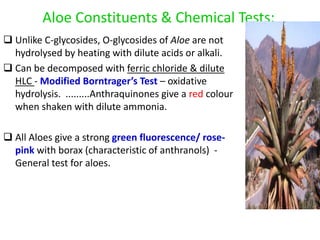
Aloe Constituents & Chemical Tests:
 Unlike C-glycosides, O-glycosides of Aloe are not
hydrolysed by heating with dilute acids or alkali.
 Can be decomposed with ferric chloride & dilute
HLC - Modified Borntrager’s Test – oxidative
hydrolysis. .........Anthraquinones give a red colour
when shaken with dilute ammonia.
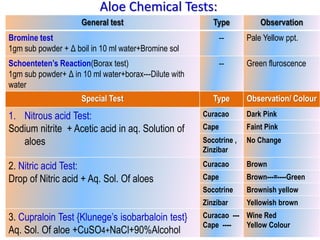
 All Aloes give a strong green fluorescence/ rose-
pink with borax (characteristic of anthranols) -
General test for aloes.
General test Type Observation
Bromine test
1gm sub powder + Δ boil in 10 ml water+Bromine sol
-- Pale Yellow ppt.
Schoenteten’s Reaction(Borax test)
1gm sub powder+ Δ in 10 ml water+borax---Dilute with
water
-- Green fluroscence
Special Test Type Observation/ Colour
1. Nitrous acid Test:
Sodium nitrite + Acetic acid in aq. Solution of
aloes
Curacao Dark Pink
Cape Faint Pink
Socotrine ,
Zinzibar
No Change
2. Nitric acid Test:
Drop of Nitric acid + Aq. Sol. Of aloes
Curacao Brown
Cape Brown---=----Green
Socotrine Brownish yellow
Zinzibar Yellowish brown
3. Cupraloin Test {Klunege’s isobarbaloin test}
Aq. Sol. Of aloe +CuSO4+NaCl+90%Alcohol
Curacao ---
Cape ----
Wine Red
Yellow Colour
Aloe Chemical Tests:
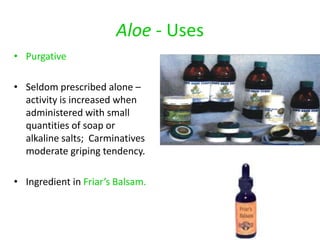
Aloe - Uses
• Purgative
• Seldom prescribed alone –
activity is increased when
administered with small
quantities of soap or
alkaline salts; Carminatives
moderate griping tendency.
• Ingredient in Friar’s Balsam.
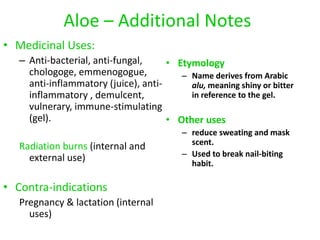
Aloe – Additional Notes
• Medicinal Uses:
– Anti-bacterial, anti-fungal,
chologoge, emmenogogue,
anti-inflammatory (juice), anti-
inflammatory , demulcent,
vulnerary, immune-stimulating
(gel).
Radiation burns (internal and
external use)
• Contra-indications
Pregnancy & lactation (internal
uses)
• Etymology
– Name derives from Arabic
alu, meaning shiny or bitter
in reference to the gel.
• Other uses
– reduce sweating and mask
scent.
– Used to break nail-biting
habit.
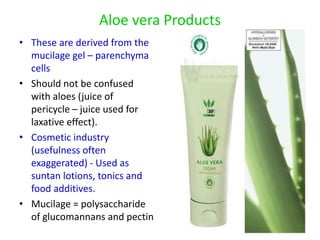
Aloe vera Products
• These are derived from the
mucilage gel – parenchyma
cells
• Should not be confused
with aloes (juice of
pericycle – juice used for
laxative effect).
• Cosmetic industry
(usefulness often
exaggerated) - Used as
suntan lotions, tonics and
food additives.
• Mucilage = polysaccharide
of glucomannans and pectin
Cascara
Other points
1 GLYCOSIDE  SY B. PHARM.ppt

1 GLYCOSIDE SY B. PHARM.ppt

  • 1.
    Glycosides • Class: SecondYear B. Pharm Sem: IV • Subject: Pharmacognosy & Phytochemistry – I • Chapter No.: 3 By: Vipul Dhasade Department of Pharmacognosy
  • 2.
    • Primary metabolites: • Secondary metabolites : Glycosides, Flavonoids, Alkaloids, Essential oils, Tannins. • Phytopharmaceuticals: Significance
  • 3.
    Glycosides They are secondaryproducts formed from one or more sugar molecules added to a non-sugar biologically active molecule – Sugar most commonly found is glucose – Non-sugar molecule known as the aglycone and may be • amino acid derivatives • steroids • triterpenes
  • 4.
    Glycosides  Glycosides consistof a sugar residue covalently bound to a different structure called the aglycone. The sugar moiety can be joined to the aglycone in various ways: 1. Oxygen (O-glycoside) 2. Sulphur (S-glycoside) 3. Nitrogen (N-glycoside) 4. Carbon (Cglycoside)
  • 5.
     Definition:: Theorganic compounds from plant or animal source which on enzymatic or acid hydrolysis give one or more sugar moieties along with non-sugar moieties. Glycone -------- (Glycosidic linkage)-------- Aglycone (genin)  Almost all plants that contain glycosides also contain enzymes that bring about their hydrolysis (glycosidases).  -Glycosides and -glycosides are distinguished by the configuration of the hemiacetal hydroxyl group.  The majority of naturally-occurring glycosides are -glycosides.  O-Glycosides can easily be cleaved into sugar and aglycone by hydrolysis with acids or enzymes.
  • 6.
    1.1 O-Glycosides • TheO-glycosides are usually represented as follows: • Glycone---- (OH + H)---C—Aglycone……… O-Glycoside • Glycone---- C—Aglycone + H2O • such as: senna, rhubarb and frangula. • Examples: Rhein-8-glucoside obtained from rhubarb. • 1.2 S-Glycosides • The S-glycosides are normally designated as below: • Glycone---- (OH + H)---S—Aglycone……… S-Glycoside • Glycone---- S—Aglycone + H2O • —SH HO—C6H11O5 ——> S—C6H11O5….. S-Glycoside • such as: Sinigrin, obtained from • black mustard seeds. • (i.e., Brassica campestris Family: Cruciferae)
  • 7.
    1.3 N-Glycosides • TheN-glycosides may be represented as shown below: • Glycone---- (OH + H)---N—Aglycone……… N-Glycoside • Glycone---- N—Aglycone + H2O • =N—H HO—C6H11O5 ——> =N—C6H11O5 N-Glycoside • The most typical example of N-glycosides is the nucleosides, wherein the respective amino group of the base ultimately reacts with —OH group ribose/deoxyribose. • Examples: Adenosine: It is widely distributed in nature e.g.; from yeast nucleic acid. • 1.4 C-Glycosides • The C-glycosides may be designated as shown under: • Glycone---- (OH + H)---C—Aglycone……… C-Glycoside • Glycone---- C—Aglycone + H2O • CH HO—C6H11O5 ——> C—C6H11O5 C-Glycoside • C-Glycosides are present in a variety of plant substances, such as: aloin in Aloe; cascaroside in Cascara. • E.g. Aloin or Barbaloin:
  • 8.
    Physical Characters:  Solidseither amorphous or crystalline.  Non volatile.  Usually bitter in taste.  Soluble in water and polar organic solvents.  Reduce Fehling’s solutions only after hydrolysis.
  • 9.
    Properties:  Glycosides areusually soluble in water and in polar organic solvents, where as aglycone are normally insoluble or only slightly soluble in water.  It is often very difficult to isolate intact glycosides because of their polar character.  Many important drugs are glycosides and their pharmacological effects are largely determined by the structure of the aglycone.
  • 10.
    Extraction and Isolation Because of the wide range of physical and chemical properties of glycosides and other constituents associated with them, no common general method for their isolation is recommended.  Water, methanol, water-ethanol and ethanol are the most common solvents for extraction of glycosides.  Precautions before extraction  Deactivation of enzymes:  Drying for 15-30 min at 100 oC followed by slow drying at a low temperature.  Dipping the fresh material into boiling water or boiling alcohol for 10-20 min.  Boiling the fresh plant material with acetone.  Carrying out the extraction at very low temp.  Freeze-drying of the plant material before extraction (lyophilization).  Carrying the extraction in the presence of (NH4)2SO4.
  • 11.
    Classification: • According tochemical nature of aglycone part/ therapeutic activity exhibited by the same 1. Anthraquinone / anthracene Glycosides- Senna, Aloe, Rhubarb, Cascara 2. Cardiac / sterols Glycosides- Digitalis, Squill, Strophanthus, Quabain 3. Saponin Glycosides- Dioscorea, Shatavari, Brahmi, Ginseng, 4. Cynogenetic / cynophoretic Glycosides- Bitter almond, wild cherry bark 5. Isothiocynate Glycosides- Mustard (black) 6. Flavonoids / flavonol Glycosides- Silymarin, Gingko, Citrus fruits 7. Coumarins and Furanocoumarin Glycosides- Visnaga, Psoralea 8. Aldehyde Glycosides-Vanilla, Anantmul 9. Phenol Glycosides- Bearberry 10. Steroidal Glycosides-Solanum 11. Bitter Glycosidal / miscellaneous Glycosides- Gentain, Chirata, Quassia, Kalmegh, Guduchi
  • 12.
    • Atom fromthe aglycone involved in the glycosidic linkage: • Aglycone- O- Sugar O-glycosides • Aglycone- C- Sugar C-glycosides • Aglycone- S- Sugar S-glycosides • Aglycone- N- Sugar N-glycosides • Number of sugars: • One sugar monosides e.g. Salicin. • Two sugar Biosides e.g. Diosmin. • Three sugars Triosides e.g. Digoxin. • Nature of the glycoside: • Primary glycosides: Originally present in the plant e.g. Purpurea A • Secondary glycosides: Resulted from removal of one sugar from the primary glycosides e.g. Digitoxin Classification:
  • 13.
    • Type ofthe glycosidic linkage: • - glycosides • - glycosides • Botanical source: • Digitalis glycosides • Senna glycosides. • Therapeutic use: • Analgesic glycosides. • Purgative glycosides. • Cardiac glycosides. • Chemical nature of the aglycone: • Flavone glycosides. • Steroidal glycosides. • Aldehydic glycosides. • Etc…….
  • 14.
    According to chemicalnature of aglycone part/ therapeutic activity exhibited by the same 1.Anthraquinone / anthracene Glycosides- Example: Senna, Aloe, Rhubarb, Cascara Major class of glycosides. Present mainly in Dicot plants. These group having aglycone moieties like anthraquinone, anthrone, dianthrone, anthronol, dianthronol. Oxanthronol.
  • 16.
  • 17.
    • Reduced derivativesof anthraquinones – Oxanthrones, anthranols and anthrones • Compounds formed by the union of 2 anthrone molecules – Dianthrones • Aglycones: – Chrysophanol/Chrysophanic acid  Rhubarb and Senna. – Rhein  Rhubarb and Senna – Aloe-emodin  Rhubarb and Senna – Emodin  Rhubarb and Cascara
  • 18.
    Anthraquinones – Chemical Properties •Anthraquinone derivatives: orange-red compounds • Soluble in hot water/dilute alcohol. • Identified via Borntrager’s test 1. Powdered drug – extrcted with ether 2. Filter 3. Made alkaline by adding ammonia/caustic soda 4. Shake  Aqueous layer shows pink, red or violet colour – positive for anthraquinone derivatives – If the Anthraquinones are reduced (within the herb) or stable (glycosides) test will be negative
  • 19.
    Senna • Indian Senna• Alexandrian Senna
  • 20.
    Senna  Synonym: SennaLeaf; Sennae folium; Senna-ki-patti  Biological Source: It Consists of the dried leaflets of Cassia angustifolia (Tinnevelly senna, / Indian Senna ) or Cassia acutifolia (Alexandrian senna / Egyption)  Family: Leguminosae
  • 21.
    Senna - Constituents •2 Active glycosides: Sennoside A Sennoside B – Both hydrolyse: 2 molecules glucose + aglycones: Sennidin A and Sennidin B. • Sennoside C & Sennoside D • Rhein • Aloe-emodin • Palmidin A (Rhubarb) Chemical Test: Borntrager’s Test positive due to anthaquinone in leaves.
  • 23.
    Senna - Uses •Laxatives (habitual constipation or occasional use). • Lacks astringent after-effect (Rhubarb)
  • 24.
    Senna - Additional •Medicinal Actions  Vermifuge, diuretic, febrifuge  Other uses: laxative candy (bitter taste).  Also used to treat flatulence, gout, fever.  Topically: poultice prepared with vinegar to treat pimples.  NOTE: Senna may cause urine to become reddish – no clinical significance. • Contra-indications • Gout, colitis, GI inflammation.  Should not be used with cardiac glycosides.  Overdose: nausea, bloody diarrhoea, vomiting and nephritis.  Long-term use: dehydration & electrolyte depletion, worsening constipation and weakening intestinal muscles.
  • 25.
    Rhubarb  Synonym: Radixrhei; Rheum; Revandchini  Bio. Source: It consist of the dried rhizome of Rheum emodi Wall (Indian rhubarb) , Rheum palmatum Linn(Chinese rhubarb).  Family: - Polygonaceae  Geographical Source: Kashmir, Sikkim, China, Tibet, Korea etc.  Collection and Preparation: It collected from rhizomes 6-10 year old plants. Allow to dry and decorticated , cut longitudinally – transversely.  Macroscopy: Small pieces from rhizome 8- 10cm length, 4cm thickness, yellow, brown colour observed.
  • 26.
    Rhubarb – ChemicalConstituents 1. Anthraquinones without a carboxyl group – chrysophanol, emodin, aloe-emodin & physcion. 2. Anthraquinones with a carboxyl group (rhein and its glycoside: glucorhein). 3. Anthrones and dianthrones of chrysophanol, emodin, aloe- emodin or physcoin. 4. Dianthrone glucosides of rhein (Sennosides A and B). 5. Hetrodianthrones derived from 2 different anthrone molecules: Palmidin A and Palmidin B. Chemical Tests 1. The Rhubarb powder on being treated with ammonia gives rise to a pink colouration. 2. Rhubarb gives a blood-red colouration with 5% potassium hydroxide. 3. It gives a positive indication with modified Borntrager’s test (see under Aloes).
  • 27.
    Rhubarb - Uses Bitter stomachic  Diarrhoea (low doses) – contains tannins  Purgative (high doses) – followed by an astringent effect.  Suitable only for occasional use, not for chronic constipation.
  • 28.
    Rhubarb - Additional •Etymology – Rheo – Greek, ‘to flow’, in reference to the purgative properties. • Medicinal Actions – Anti-helminthic, anti- bacterial, anti- inflammatory, antiseptic. • Topical Uses: – Poultice to treat boils, burns, wounds. Used to stop bleeding (tannins – stypic and astringent). Used as a mouthwash for oral ulcers. • Caution – Leaves should be avoided – high calcium oxalate - toxic
  • 29.
  • 30.
    1. Aloes: • Synonym:Aloe, Musabbar, Kumari • Biological Source: Aloe is the dried latex of leaves of various species of Aloes, namely:  Aloe barbadensis Miller (or Curacao Aloe);  Aloe ferox Miller (or Cape Aloe);  Aloe perryi Baker (or Socotrine Aloe);  Aloe africana Miller and Aloe spicata Baker (or Cape Aloe).  All these species belong to the family Liliaceae. • Geographical Source  Curacao, Barbados, Aruba : Curacao Aloes or Barbados Aloes and Bonaire (West Indian Islands)  Cape Town (South Africa) : Cape Aloes  Socotra and Zanzibar Islands : Socotrine or Zanzibar Aloes  It is also cultivated in Europe and the North West Himmalayan region in India. Aloes
  • 31.
    Preparation of CapeAloes  Cape Aloes are prepared from the wild plants of Aloe ferox.  Leaves are cut transversely near the base.  200 leaves arranged around a shallow hole in the ground (lined with canvas or goatskin).  Cut ends overlap & drain into the canvas.  After 6hrs all the juice is collected.  Transferred and Boiled for 4hrs on an open fire.  Poured into tins while hot  solidifies.
  • 32.
  • 33.
  • 34.
    Aloe Constituents &Chemical Tests:  Unlike C-glycosides, O-glycosides of Aloe are not hydrolysed by heating with dilute acids or alkali.  Can be decomposed with ferric chloride & dilute HLC - Modified Borntrager’s Test – oxidative hydrolysis. .........Anthraquinones give a red colour when shaken with dilute ammonia.  All Aloes give a strong green fluorescence/ rose- pink with borax (characteristic of anthranols) - General test for aloes.
  • 35.
    General test TypeObservation Bromine test 1gm sub powder + Δ boil in 10 ml water+Bromine sol -- Pale Yellow ppt. Schoenteten’s Reaction(Borax test) 1gm sub powder+ Δ in 10 ml water+borax---Dilute with water -- Green fluroscence Special Test Type Observation/ Colour 1. Nitrous acid Test: Sodium nitrite + Acetic acid in aq. Solution of aloes Curacao Dark Pink Cape Faint Pink Socotrine , Zinzibar No Change 2. Nitric acid Test: Drop of Nitric acid + Aq. Sol. Of aloes Curacao Brown Cape Brown---=----Green Socotrine Brownish yellow Zinzibar Yellowish brown 3. Cupraloin Test {Klunege’s isobarbaloin test} Aq. Sol. Of aloe +CuSO4+NaCl+90%Alcohol Curacao --- Cape ---- Wine Red Yellow Colour Aloe Chemical Tests:
  • 36.
    Aloe - Uses •Purgative • Seldom prescribed alone – activity is increased when administered with small quantities of soap or alkaline salts; Carminatives moderate griping tendency. • Ingredient in Friar’s Balsam.
  • 37.
    Aloe – AdditionalNotes • Medicinal Uses: – Anti-bacterial, anti-fungal, chologoge, emmenogogue, anti-inflammatory (juice), anti- inflammatory , demulcent, vulnerary, immune-stimulating (gel). Radiation burns (internal and external use) • Contra-indications Pregnancy & lactation (internal uses) • Etymology – Name derives from Arabic alu, meaning shiny or bitter in reference to the gel. • Other uses – reduce sweating and mask scent. – Used to break nail-biting habit.
  • 38.
    Aloe vera Products •These are derived from the mucilage gel – parenchyma cells • Should not be confused with aloes (juice of pericycle – juice used for laxative effect). • Cosmetic industry (usefulness often exaggerated) - Used as suntan lotions, tonics and food additives. • Mucilage = polysaccharide of glucomannans and pectin
  • 39.
  • 40.