Pharmacognosy & Phytochemistry-I Deepak Birla
deepakbirla7@gmail.com
1
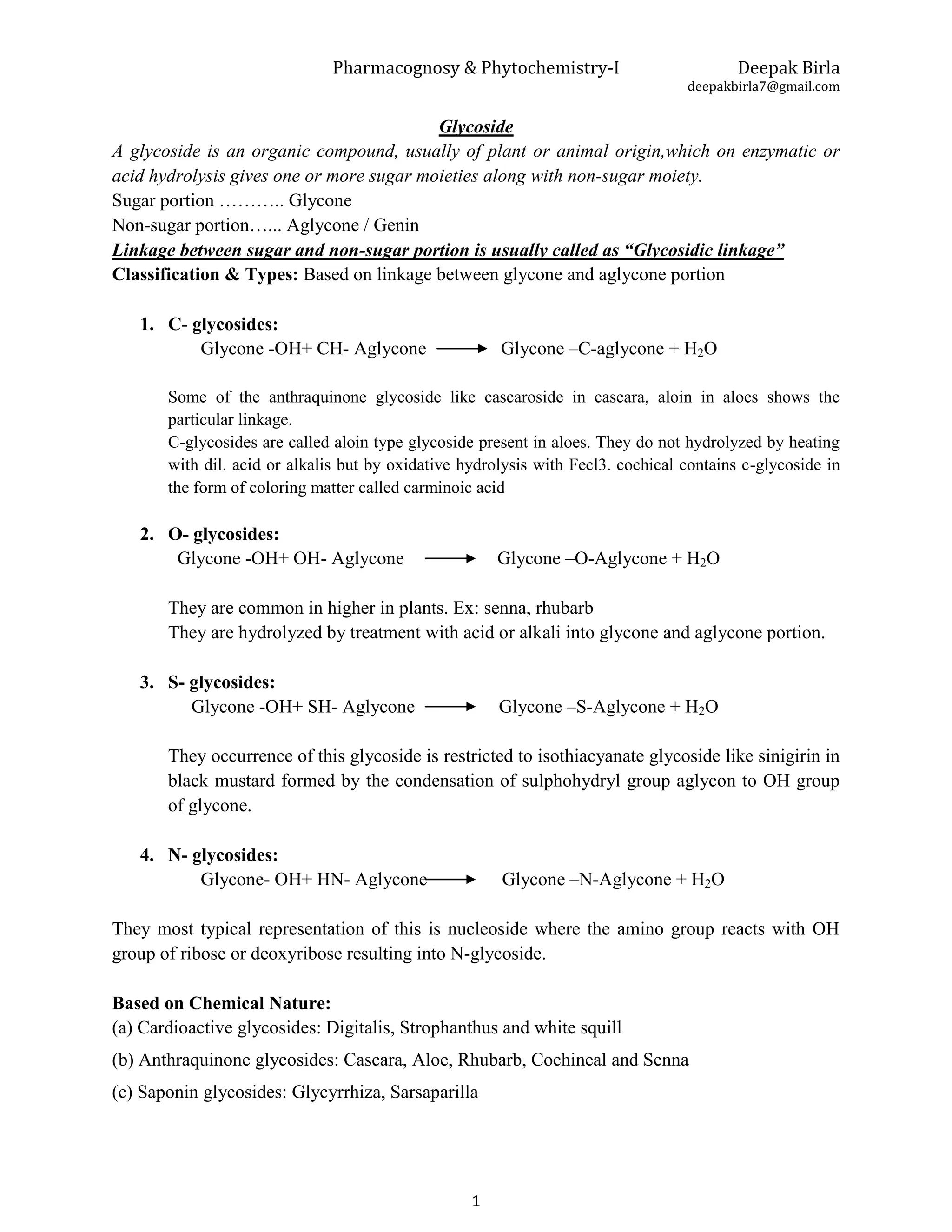
Glycoside
A glycoside is an organic compound, usually of plant or animal origin,which on enzymatic or
acid hydrolysis gives one or more sugar moieties along with non-sugar moiety.
Sugar portion ……….. Glycone
Non-sugar portion…... Aglycone / Genin
Linkage between sugar and non-sugar portion is usually called as “Glycosidic linkage”
Classification & Types: Based on linkage between glycone and aglycone portion
1. C- glycosides:
Glycone -OH+ CH- Aglycone Glycone –C-aglycone + H2O
Some of the anthraquinone glycoside like cascaroside in cascara, aloin in aloes shows the
particular linkage.
C-glycosides are called aloin type glycoside present in aloes. They do not hydrolyzed by heating
with dil. acid or alkalis but by oxidative hydrolysis with Fecl3. cochical contains c-glycoside in
the form of coloring matter called carminoic acid
2. O- glycosides:
Glycone -OH+ OH- Aglycone Glycone –O-Aglycone + H2O
They are common in higher in plants. Ex: senna, rhubarb
They are hydrolyzed by treatment with acid or alkali into glycone and aglycone portion.
3. S- glycosides:
Glycone -OH+ SH- Aglycone Glycone –S-Aglycone + H2O
They occurrence of this glycoside is restricted to isothiacyanate glycoside like sinigirin in
black mustard formed by the condensation of sulphohydryl group aglycon to OH group
of glycone.
4. N- glycosides:
Glycone- OH+ HN- Aglycone Glycone –N-Aglycone + H2O
They most typical representation of this is nucleoside where the amino group reacts with OH
group of ribose or deoxyribose resulting into N-glycoside.
Based on Chemical Nature:
(a) Cardioactive glycosides: Digitalis, Strophanthus and white squill
(b) Anthraquinone glycosides: Cascara, Aloe, Rhubarb, Cochineal and Senna
(c) Saponin glycosides: Glycyrrhiza, Sarsaparilla
Pharmacognosy & Phytochemistry-I Deepak Birla
deepakbirla7@gmail.com
2
(d) Cyanophore glycosides: Wild cherry
(e) Isothiocyanate glycosides: Black Mustard
(f) Lactone glycosides: Cantharide
(g) Aldehyde glycosides: Vanilla
(h) Miscellaneous glycosides: Gentian, Quassia, Dioscorea
Properties: -
1) Glycoside contains sugar but still the physical, chemical and therapeutic activity is based on
aglycon portion. Sugar facilitates the absorption of the glycoside .helping it to reach the site of
action
2) Glycoside are crystalline, amorphous substance which are soluble in water, and dilute alcohol
but in soluble in the Chloroform and ether. The aglycon moiety is insoluble in non polar solvent
like Benzene.
3) Glycosides are easily hydrolyzed by mineral acids, water and enzyme. They show optical
activity normally they are levorotatory.
4) Glycoside cannot reduce Fehling’s solution until they are hydrolyzed.
Functions: -
From biological point of view glycosides play an important role in the life of plants involving its
regulatory, transperatory and protective functions.
Hydrolysis: -
Glycosides are hydrolyzed by acid or alkali and by enzymes resulting in cleavage of glycosidic
linkage. However certain glycosides are broken down or modified.
Isolation of glycosides:
The method by which glycoside are isolated is called stas-otto method. The drug containing
glycoside is finely powdered and subjected to successive extraction in a soxhlet apparatus with
alcohol or suitable solvent. The non-glycosidal impurities which get extracted along with
glycosides are removed by precipitating them with lead acetate solution. The excess of lead
acetate is then removed by passing hydrogen sulphide gas through the extract. Lead gets
precipitated as lead sulphide, which is filtered out. The filtrate contains the glycosides. The
glycoside can be obtained by removal of the solvent under reduced pressure or any other suitable
procedure. Further purification of the isolated glycosides is done by column chromatography.
Pharmacognosy & Phytochemistry-I Deepak Birla
deepakbirla7@gmail.com
3
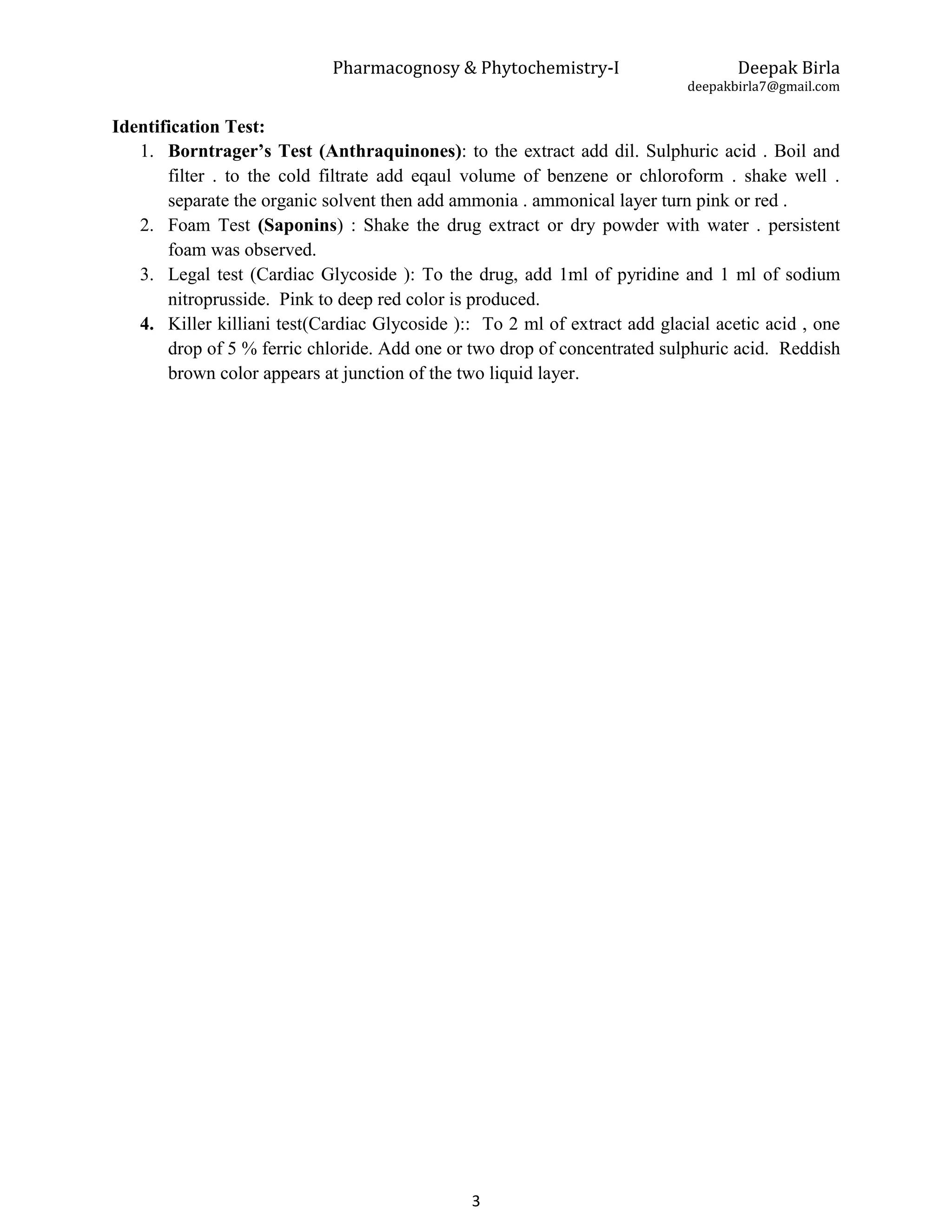
Identification Test:
1. Borntrager’s Test (Anthraquinones): to the extract add dil. Sulphuric acid . Boil and
filter . to the cold filtrate add eqaul volume of benzene or chloroform . shake well .
separate the organic solvent then add ammonia . ammonical layer turn pink or red .
2. Foam Test (Saponins) : Shake the drug extract or dry powder with water . persistent
foam was observed.
3. Legal test (Cardiac Glycoside ): To the drug, add 1ml of pyridine and 1 ml of sodium
nitroprusside. Pink to deep red color is produced.
4. Killer killiani test(Cardiac Glycoside ):: To 2 ml of extract add glacial acetic acid , one
drop of 5 % ferric chloride. Add one or two drop of concentrated sulphuric acid. Reddish
brown color appears at junction of the two liquid layer.

Glycoside

  • 1.
    Pharmacognosy & Phytochemistry-IDeepak Birla deepakbirla7@gmail.com 1 Glycoside A glycoside is an organic compound, usually of plant or animal origin,which on enzymatic or acid hydrolysis gives one or more sugar moieties along with non-sugar moiety. Sugar portion ……….. Glycone Non-sugar portion…... Aglycone / Genin Linkage between sugar and non-sugar portion is usually called as “Glycosidic linkage” Classification & Types: Based on linkage between glycone and aglycone portion 1. C- glycosides: Glycone -OH+ CH- Aglycone Glycone –C-aglycone + H2O Some of the anthraquinone glycoside like cascaroside in cascara, aloin in aloes shows the particular linkage. C-glycosides are called aloin type glycoside present in aloes. They do not hydrolyzed by heating with dil. acid or alkalis but by oxidative hydrolysis with Fecl3. cochical contains c-glycoside in the form of coloring matter called carminoic acid 2. O- glycosides: Glycone -OH+ OH- Aglycone Glycone –O-Aglycone + H2O They are common in higher in plants. Ex: senna, rhubarb They are hydrolyzed by treatment with acid or alkali into glycone and aglycone portion. 3. S- glycosides: Glycone -OH+ SH- Aglycone Glycone –S-Aglycone + H2O They occurrence of this glycoside is restricted to isothiacyanate glycoside like sinigirin in black mustard formed by the condensation of sulphohydryl group aglycon to OH group of glycone. 4. N- glycosides: Glycone- OH+ HN- Aglycone Glycone –N-Aglycone + H2O They most typical representation of this is nucleoside where the amino group reacts with OH group of ribose or deoxyribose resulting into N-glycoside. Based on Chemical Nature: (a) Cardioactive glycosides: Digitalis, Strophanthus and white squill (b) Anthraquinone glycosides: Cascara, Aloe, Rhubarb, Cochineal and Senna (c) Saponin glycosides: Glycyrrhiza, Sarsaparilla
  • 2.
    Pharmacognosy & Phytochemistry-IDeepak Birla deepakbirla7@gmail.com 2 (d) Cyanophore glycosides: Wild cherry (e) Isothiocyanate glycosides: Black Mustard (f) Lactone glycosides: Cantharide (g) Aldehyde glycosides: Vanilla (h) Miscellaneous glycosides: Gentian, Quassia, Dioscorea Properties: - 1) Glycoside contains sugar but still the physical, chemical and therapeutic activity is based on aglycon portion. Sugar facilitates the absorption of the glycoside .helping it to reach the site of action 2) Glycoside are crystalline, amorphous substance which are soluble in water, and dilute alcohol but in soluble in the Chloroform and ether. The aglycon moiety is insoluble in non polar solvent like Benzene. 3) Glycosides are easily hydrolyzed by mineral acids, water and enzyme. They show optical activity normally they are levorotatory. 4) Glycoside cannot reduce Fehling’s solution until they are hydrolyzed. Functions: - From biological point of view glycosides play an important role in the life of plants involving its regulatory, transperatory and protective functions. Hydrolysis: - Glycosides are hydrolyzed by acid or alkali and by enzymes resulting in cleavage of glycosidic linkage. However certain glycosides are broken down or modified. Isolation of glycosides: The method by which glycoside are isolated is called stas-otto method. The drug containing glycoside is finely powdered and subjected to successive extraction in a soxhlet apparatus with alcohol or suitable solvent. The non-glycosidal impurities which get extracted along with glycosides are removed by precipitating them with lead acetate solution. The excess of lead acetate is then removed by passing hydrogen sulphide gas through the extract. Lead gets precipitated as lead sulphide, which is filtered out. The filtrate contains the glycosides. The glycoside can be obtained by removal of the solvent under reduced pressure or any other suitable procedure. Further purification of the isolated glycosides is done by column chromatography.
  • 3.
    Pharmacognosy & Phytochemistry-IDeepak Birla deepakbirla7@gmail.com 3 Identification Test: 1. Borntrager’s Test (Anthraquinones): to the extract add dil. Sulphuric acid . Boil and filter . to the cold filtrate add eqaul volume of benzene or chloroform . shake well . separate the organic solvent then add ammonia . ammonical layer turn pink or red . 2. Foam Test (Saponins) : Shake the drug extract or dry powder with water . persistent foam was observed. 3. Legal test (Cardiac Glycoside ): To the drug, add 1ml of pyridine and 1 ml of sodium nitroprusside. Pink to deep red color is produced. 4. Killer killiani test(Cardiac Glycoside ):: To 2 ml of extract add glacial acetic acid , one drop of 5 % ferric chloride. Add one or two drop of concentrated sulphuric acid. Reddish brown color appears at junction of the two liquid layer.