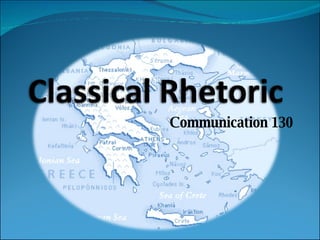
Communication 130
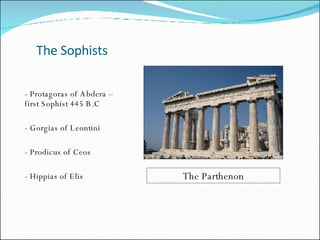
The Sophists - Protagoras of Abdera – first Sophist 445 B.C - Gorgias of Leontini - Prodicus of Ceos - Hippias of Elis The Parthenon
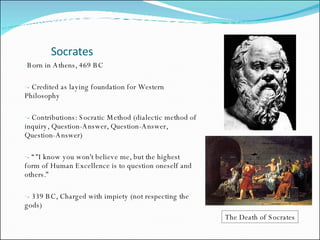
Socrates Born in Athens, 469 BC - Credited as laying foundation for Western Philosophy - Contributions: Socratic Method (dialectic method of inquiry, Question-Answer, Question-Answer, Question-Answer) - “"I know you won't believe me, but the highest form of Human Excellence is to question oneself and others.” - 339 BC, Charged with impiety (not respecting the gods) The Death of Socrates
Plato Born 428 BC. In 399, he left Athens, after Socrates death.  - Returned in 397 to Found the Academy, first institution of higher learning in the Western World - Contributions- - Platonism: Invisible World most intelligible, visible world least knowable  (and easily obscured). People agree on logic and science, divided on moral matters.  - The Allegory of the Cave (from the  Republic ) - Metaphysics- Ultimate reality is spiritual in nature
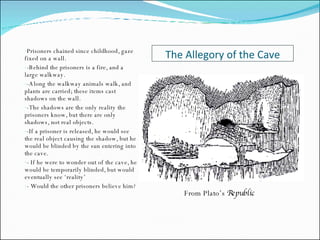
The Allegory of the Cave Prisoners chained since childhood, gaze fixed on a wall. -Behind the prisoners is a fire, and a large walkway. -Along the walkway animals walk, and plants are carried; these items cast shadows on the wall. -The shadows are the only reality the prisoners know, but there are only shadows, not real objects. -If a prisoner is released, he would see the real object causing the shadow, but he would be blinded by the sun entering into the cave. - If he were to wonder out of the cave, he would be temporarily blinded, but would eventually see ‘reality’ - Would the other prisoners believe him? From Plato’s  Republic
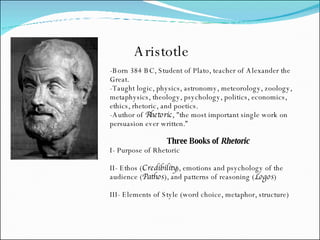
Aristotle -Born 384 BC, Student of Plato, teacher of Alexander the Great.  -Taught logic, physics, astronomy, meteorology, zoology, metaphysics, theology, psychology, politics, economics, ethics, rhetoric, and poetics. -Author of  Rhetoric , "the most important single work on persuasion ever written.” Three Books of  Rhetoric I- Purpose of Rhetoric II- Ethos ( Credibility ), emotions and psychology of the audience ( Pathos ), and patterns of reasoning ( Logos ) III- Elements of Style (word choice, metaphor, structure)
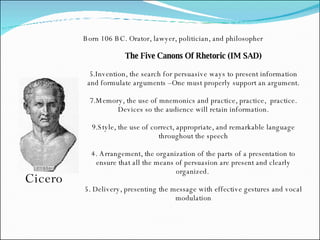
Cicero Born 106 BC. Orator, lawyer, politician, and philosopher The Five Canons Of Rhetoric (IM SAD) Invention, the search for persuasive ways to present information and formulate arguments –One must properly support an argument. Memory, the use of mnemonics and practice, practice,  practice. Devices so the audience will retain information. Style, the use of correct, appropriate, and remarkable language throughout the speech 4. Arrangement, the organization of the parts of a presentation to ensure that all the means of persuasion are present and clearly organized.  5. Delivery, presenting the message with effective gestures and vocal modulation

Classical Rhetoric 97

  • 1.
  • 2.
    The Sophists -Protagoras of Abdera – first Sophist 445 B.C - Gorgias of Leontini - Prodicus of Ceos - Hippias of Elis The Parthenon
  • 3.
    Socrates Born inAthens, 469 BC - Credited as laying foundation for Western Philosophy - Contributions: Socratic Method (dialectic method of inquiry, Question-Answer, Question-Answer, Question-Answer) - “"I know you won't believe me, but the highest form of Human Excellence is to question oneself and others.” - 339 BC, Charged with impiety (not respecting the gods) The Death of Socrates
  • 4.
    Plato Born 428BC. In 399, he left Athens, after Socrates death. - Returned in 397 to Found the Academy, first institution of higher learning in the Western World - Contributions- - Platonism: Invisible World most intelligible, visible world least knowable (and easily obscured). People agree on logic and science, divided on moral matters. - The Allegory of the Cave (from the Republic ) - Metaphysics- Ultimate reality is spiritual in nature
  • 5.
    The Allegory ofthe Cave Prisoners chained since childhood, gaze fixed on a wall. -Behind the prisoners is a fire, and a large walkway. -Along the walkway animals walk, and plants are carried; these items cast shadows on the wall. -The shadows are the only reality the prisoners know, but there are only shadows, not real objects. -If a prisoner is released, he would see the real object causing the shadow, but he would be blinded by the sun entering into the cave. - If he were to wonder out of the cave, he would be temporarily blinded, but would eventually see ‘reality’ - Would the other prisoners believe him? From Plato’s Republic
  • 6.
    Aristotle -Born 384BC, Student of Plato, teacher of Alexander the Great. -Taught logic, physics, astronomy, meteorology, zoology, metaphysics, theology, psychology, politics, economics, ethics, rhetoric, and poetics. -Author of Rhetoric , "the most important single work on persuasion ever written.” Three Books of Rhetoric I- Purpose of Rhetoric II- Ethos ( Credibility ), emotions and psychology of the audience ( Pathos ), and patterns of reasoning ( Logos ) III- Elements of Style (word choice, metaphor, structure)
  • 7.
    Cicero Born 106BC. Orator, lawyer, politician, and philosopher The Five Canons Of Rhetoric (IM SAD) Invention, the search for persuasive ways to present information and formulate arguments –One must properly support an argument. Memory, the use of mnemonics and practice, practice, practice. Devices so the audience will retain information. Style, the use of correct, appropriate, and remarkable language throughout the speech 4. Arrangement, the organization of the parts of a presentation to ensure that all the means of persuasion are present and clearly organized. 5. Delivery, presenting the message with effective gestures and vocal modulation