Plato (d. 347 B.C.E.)
Max Willman
General
- Philosopher in Classical
Greece
- Founder of the Academy of
Athens, the first institution of
higher learning in the Western
World
- Most pivotal figure in the
development of philosophy
- Laid the foundation for
Western philosophy and
science
- Student of Socrates and the
teacher of Aristotle
Biography
- Little is known about Plato’s early life and
education due to the lack of surviving
accounts
- The exact dates of birth are unknown but
it is known that he belonged to an
aristocratic and influential family
- Believed to be born in Athens or Aegina
between 429 and 423 BCE.
- Came from one of the wealthiest and
politically active families
- Father: Ariston, decent from the King of
Athens, Codrus
- Mother: Perictione
Influences
- Primarily influenced by Socrates, to the
extent that Socrates is usually the main
character in many of Plato’s writings
- Also influenced by Heraclitus, Parmenides,
and Pythagoras
- Heraclitus: had some early association with
Heraclitus or of his followers
- Parmenides: strongly influenced by
Parmenides in Plato’s theory of the Forms
- Pythagoras: influences seem evident in his
fascination with mathematics, and in some
of his politics ideals
- Socrates: no influence was greater than that
of Socrates
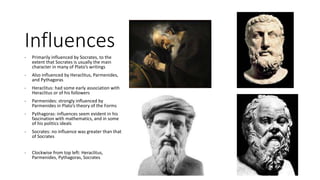
- Clockwise from top left: Heraclitus,
Parmenides, Pythagoras, Socrates
Philosophy
- Often discusses the father-son
relationship and the question of whether
a father’s interest in his sons has much to
with how well his sons turns out
- Several of Plato’s dialogues, Socrates
publicizes the idea that knowledge is a
matter of recollection, and not of
learning, observation, or study
- Theory of Forms
- Refers to the beliefs that the material
world as it seems to us is not the real
world, but only an “image” or “copy” of
the real world
- Metaphysics
- “Platonism” refers to the intellectual
consequences of denying the reality of
the material world
Dialogues
- 35 dialogues and 13 letters have been
ascribed to Plato, however, some doubt
the authenticity of at least a few of them
- His works can usually be grouped into
Early, Middle, and Late period
- Early: Apology (of Socrates), Charmides,
Crito, Euthyphro, Gorgias, (lesser) Hippias
(minor), (Greater) Hippias (major), Ion,
Lches, Lysis, Protagoras
- Middle: Cratylus, Menexenus, Meno,
Parmenides, Phaedo, Phaedrus, Republic,
Symposium, Euthydemus
- Middle/Late: Theaetetus
- Late: Critias, Sophist, Statesman /
Politicus, Timaeus, Philebus, Laws
Quotes
- Wise men talk because they have something
to say; fools, because they have to say
something.
- We can easily forgive a child who is afraid of
the dark; the real tragedy of life is when
men are afraid of the light.
- Be kind, for everyone you meet is fighting a
hard battle.
- Courage is knowing what not to fear.
- Music is a moral law. It gives soul to the
universe, wings to the mind, flight to the
imagination, and charm and gaiety to life
and to everything.
- The beginning is the most important part of
the work.
Works Cited
- http://www.history.com/topics/ancient-history/plato
- http://www.iep.utm.edu/plato/#H3
- http://www.brainyquote.com/quotes/authors/p/plato.html

Plato

  • 1.
    Plato (d. 347B.C.E.) Max Willman
  • 2.
    General - Philosopher inClassical Greece - Founder of the Academy of Athens, the first institution of higher learning in the Western World - Most pivotal figure in the development of philosophy - Laid the foundation for Western philosophy and science - Student of Socrates and the teacher of Aristotle
  • 3.
    Biography - Little isknown about Plato’s early life and education due to the lack of surviving accounts - The exact dates of birth are unknown but it is known that he belonged to an aristocratic and influential family - Believed to be born in Athens or Aegina between 429 and 423 BCE. - Came from one of the wealthiest and politically active families - Father: Ariston, decent from the King of Athens, Codrus - Mother: Perictione
  • 4.
    Influences - Primarily influencedby Socrates, to the extent that Socrates is usually the main character in many of Plato’s writings - Also influenced by Heraclitus, Parmenides, and Pythagoras - Heraclitus: had some early association with Heraclitus or of his followers - Parmenides: strongly influenced by Parmenides in Plato’s theory of the Forms - Pythagoras: influences seem evident in his fascination with mathematics, and in some of his politics ideals - Socrates: no influence was greater than that of Socrates - Clockwise from top left: Heraclitus, Parmenides, Pythagoras, Socrates
  • 5.
    Philosophy - Often discussesthe father-son relationship and the question of whether a father’s interest in his sons has much to with how well his sons turns out - Several of Plato’s dialogues, Socrates publicizes the idea that knowledge is a matter of recollection, and not of learning, observation, or study - Theory of Forms - Refers to the beliefs that the material world as it seems to us is not the real world, but only an “image” or “copy” of the real world - Metaphysics - “Platonism” refers to the intellectual consequences of denying the reality of the material world
  • 6.
    Dialogues - 35 dialoguesand 13 letters have been ascribed to Plato, however, some doubt the authenticity of at least a few of them - His works can usually be grouped into Early, Middle, and Late period - Early: Apology (of Socrates), Charmides, Crito, Euthyphro, Gorgias, (lesser) Hippias (minor), (Greater) Hippias (major), Ion, Lches, Lysis, Protagoras - Middle: Cratylus, Menexenus, Meno, Parmenides, Phaedo, Phaedrus, Republic, Symposium, Euthydemus - Middle/Late: Theaetetus - Late: Critias, Sophist, Statesman / Politicus, Timaeus, Philebus, Laws
  • 7.
    Quotes - Wise mentalk because they have something to say; fools, because they have to say something. - We can easily forgive a child who is afraid of the dark; the real tragedy of life is when men are afraid of the light. - Be kind, for everyone you meet is fighting a hard battle. - Courage is knowing what not to fear. - Music is a moral law. It gives soul to the universe, wings to the mind, flight to the imagination, and charm and gaiety to life and to everything. - The beginning is the most important part of the work.
  • 8.
    Works Cited - http://www.history.com/topics/ancient-history/plato -http://www.iep.utm.edu/plato/#H3 - http://www.brainyquote.com/quotes/authors/p/plato.html