The document discusses the Sophists and Socrates in ancient Athens. It provides background on the Sophists, who charged fees to teach rhetoric and debate skills to the wealthy classes. Their teachings emphasized argument over truth and contributed to tensions in Athens. The most famous Sophist, Protagoras, claimed "man is the measure of all things," which was seen as radical. Socrates took a different approach by questioning people to uncover definitions and ethical standards through logical analysis rather than teaching for pay. He was ultimately tried for heresy and corrupting youth, and executed. Plato was a student of Socrates and founded the Academy in Athens to continue philosophical teachings.






![In 399 B.C., 3 Athenian citizens accused Socrates of (1) “ heresy ” (or “ impiety ” ); (2) did not believe or observe the gods of the polis; and (3) “ corrupted the minds of the youth ” ! According to G.M.A. Grube, “ at the time of his trial and execution in 399 B.C., Socrates was seventy years of age. He had lived through the Periclean Age when Athens was at the pinnacle of her imperial power and her cultural ascendancy, then through twenty-five years of war with Sparta [the Peloponnesian War, 431 - 404 B.C.] and the final defeat of Athens in 405 [404 B.C.], the oligarchic revolution that followed, and, finally, the restoration of democracy. Not surprisingly, Socrates was often confused with these Sophists in the public mind, for both of them were apt to question established and inherited values. But their differences were vital: the Sophists professed to put men on the road to success [and to teach people rhetoric or how to argue with no moral responsibility as long as the Sophists got paid; (Socrates/Plato called them ‘ intellectual prostitutes ’ )], whereas Socrates disclaimed that he taught anything; his conversation aimed at discovering the truth, at acquiring that knowledge and understanding of life and its values that he thought was the very basis of the good life and of philosophy, to him a moral as well as an intellectual pursuit. ” ( The Trial and Death of Socrates, pp. 1-2). Religious Education Support - SLSS](https://image.slidesharecdn.com/topic1-2thesophists-110130012909-phpapp01/85/The-Sophists-10-320.jpg)

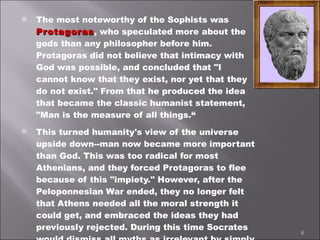
![Plato (427-347 B.C.) born in Athens, of noble birth, yet his youth witnessed the decline and fall of Athens (in 404 B.C., Sparta defeated Athens in the Peloponnesian War; + in 399 B.C., the trial and execution of Socrates, his beloved mentor/master, via “ democratic ” ways, [thus, Plato preferred Spartan timarchy to Athenian democracy (which was with ‘ selfish individualism, civic irresponsibility, diversity, disintegration, dislike of authority, no respect for the authority, class war + lack of cohesion, that is, all negative)]). After the execution of Socrates in 399 B.C., with final disillusionment, Plato left Athens and traveled, including to Syracuse in southern Italy. In 386 B.C., Plato returned to Athens and founded the Academy where he taught for the rest of his life (d. 347 B.C.).](https://image.slidesharecdn.com/topic1-2thesophists-110130012909-phpapp01/85/The-Sophists-12-320.jpg)


