Aristotle (384-322 BCE)Professor:Dr. Eric MendozaReporter:Jocelyn R. MorenoEd. D-EM StudentEARIST Graduate SchoolComparative Philosophy of Education (FS 201)
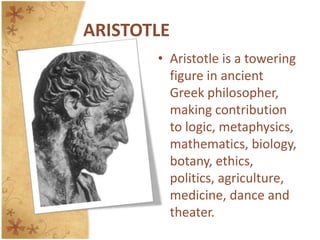
ARISTOTLEAristotle is a towering figure in ancient Greek philosopher, making contribution to logic, metaphysics, mathematics, biology, botany, ethics, politics, agriculture, medicine, dance and theater.
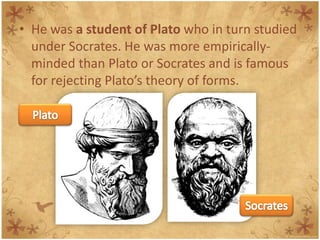
He was a student of Plato who in turn studied under Socrates. He was more empirically-minded than Plato or Socrates and is famous for rejecting Plato’s theory of forms.PlatoSocrates
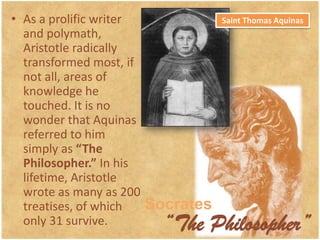
As a prolific writer and polymath, Aristotle radically transformed most, if not all, areas of knowledge he touched. It is no wonder that Aquinas referred to him simply as “The Philosopher.” In his lifetime, Aristotle wrote as many as 200 treatises, of which only 31 survive.Saint Thomas AquinasSocrates“The Philosopher”
Mathematics
Biology
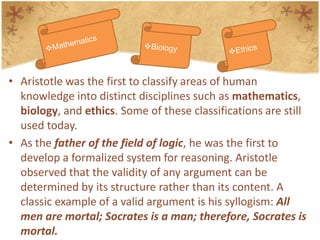
EthicsAristotle was the first to classify areas of human knowledge into distinct disciplines such as mathematics, biology, and ethics. Some of these classifications are still used today.As the father of the field of logic, he was the first to develop a formalized system for reasoning. Aristotle observed that the validity of any argument can be determined by its structure rather than its content. A classic example of a valid argument is his syllogism: All men are mortal; Socrates is a man; therefore, Socrates is mortal.
Aristotle’sLife
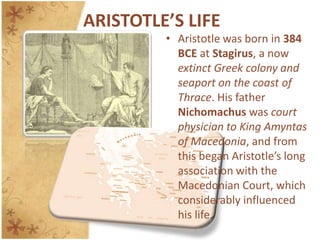
ARISTOTLE’S LIFEAristotle was born in 384 BCE at Stagirus, a now extinct Greek colony and seaport on the coast of Thrace. His father Nichomachuswas court physician to King Amyntas of Macedonia, and from this began Aristotle’s long association with the Macedonian Court, which considerably influenced his life.
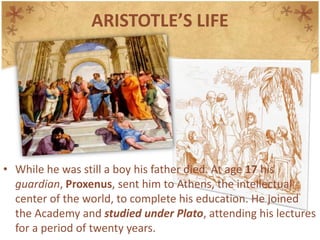
ARISTOTLE’S LIFEWhile he was still a boy his father died. At age 17 his guardian, Proxenus, sent him to Athens, the intellectual center of the world, to complete his education. He joined the Academy and studied under Plato, attending his lectures for a period of twenty years.
Aristotle’sWritings
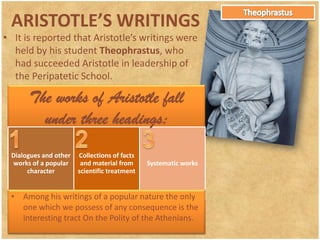
ARISTOTLE’S WRITINGSTheophrastusIt is reported that Aristotle’s writings were held by his student Theophrastus, who had succeeded Aristotle in leadership of the Peripatetic School. The works of Aristotle fall under three headings: 123Among his writings of a popular nature the only one which we possess of any consequence is the interesting tract On the Polity of the Athenians.Aristotle’sLogic
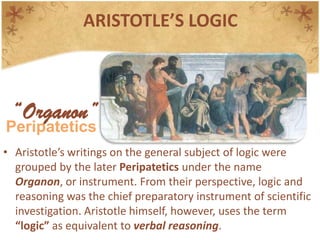
ARISTOTLE’S LOGIC“Organon”PeripateticsAristotle’s writings on the general subject of logic were grouped by the later Peripatetics under the name Organon, or instrument. From their perspective, logic and reasoning was the chief preparatory instrument of scientific investigation. Aristotle himself, however, uses the term “logic” as equivalent to verbal reasoning.Aristotle’sMetaphysics
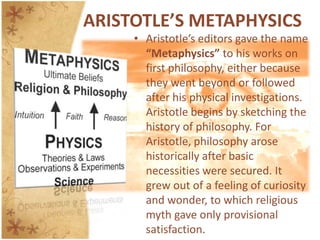
ARISTOTLE’S METAPHYSICSAristotle’s editors gave the name “Metaphysics” to his works on first philosophy, either because they went beyond or followed after his physical investigations. Aristotle begins by sketching the history of philosophy. For Aristotle, philosophy arose historically after basic necessities were secured. It grew out of a feeling of curiosity and wonder, to which religious myth gave only provisional satisfaction.
Aristotle’sPhilosophy ofNature
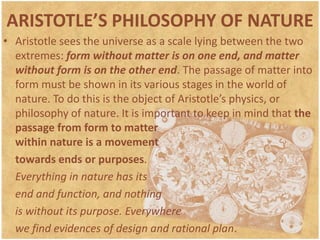
ARISTOTLE’S PHILOSOPHY OF NATUREAristotle sees the universe as a scale lying between the two extremes: form without matter is on one end, and matter without form is on the other end. The passage of matter into form must be shown in its various stages in the world of nature. To do this is the object of Aristotle’s physics, or philosophy of nature. It is important to keep in mind that the passage from form to matter within nature is a movement	towards ends or purposes.Everything in nature has its	end and function, and nothing	is without its purpose. Everywhere	we find evidences of design and rational plan.
Aristotle’sThe Soul andPsychology
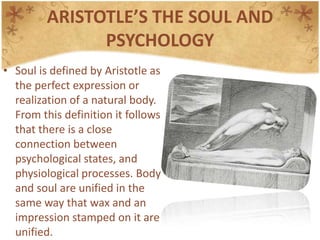
ARISTOTLE’S THE SOUL AND PSYCHOLOGYSoul is defined by Aristotle as the perfect expression or realization of a natural body. From this definition it follows that there is a close connection between psychological states, and physiological processes. Body and soul are unified in the same way that wax and an impression stamped on it are unified.Aristotle’sEthics
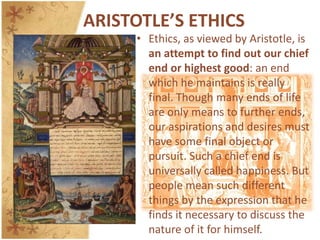
ARISTOTLE’S ETHICSEthics, as viewed by Aristotle, is an attempt to find out our chief end or highest good: an end which he maintains is really final. Though many ends of life are only means to further ends, our aspirations and desires must have some final object or pursuit. Such a chief end is universally called happiness. But people mean such different things by the expression that he finds it necessary to discuss the nature of it for himself.
Aristotle’sPolitics
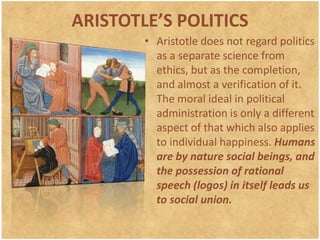
ARISTOTLE’S POLITICSAristotle does not regard politics as a separate science from ethics, but as the completion, and almost a verification of it. The moral ideal in political administration is only a different aspect of that which also applies to individual happiness. Humans are by nature social beings, and the possession of rational speech (logos) in itself leads us to social union.Aristotle’sArt and Poetics
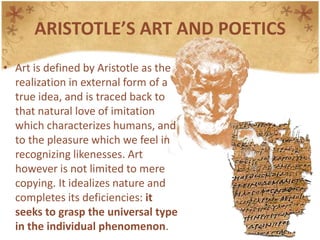
ARISTOTLE’S ART AND POETICSArt is defined by Aristotle as the realization in external form of a true idea, and is traced back to that natural love of imitation which characterizes humans, and to the pleasure which we feel in recognizing likenesses. Art however is not limited to mere copying. It idealizes nature and completes its deficiencies: it seeks to grasp the universal type in the individual phenomenon.
Aristotle (384-322 BCE)

Aristotle (384-322 BCE)

  • 1.
    Aristotle (384-322 BCE)Professor:Dr.Eric MendozaReporter:Jocelyn R. MorenoEd. D-EM StudentEARIST Graduate SchoolComparative Philosophy of Education (FS 201)
  • 2.
    ARISTOTLEAristotle is atowering figure in ancient Greek philosopher, making contribution to logic, metaphysics, mathematics, biology, botany, ethics, politics, agriculture, medicine, dance and theater.
  • 3.
    He was astudent of Plato who in turn studied under Socrates. He was more empirically-minded than Plato or Socrates and is famous for rejecting Plato’s theory of forms.PlatoSocrates
  • 4.
    As a prolificwriter and polymath, Aristotle radically transformed most, if not all, areas of knowledge he touched. It is no wonder that Aquinas referred to him simply as “The Philosopher.” In his lifetime, Aristotle wrote as many as 200 treatises, of which only 31 survive.Saint Thomas AquinasSocrates“The Philosopher”
  • 5.
  • 6.
  • 7.
    EthicsAristotle was thefirst to classify areas of human knowledge into distinct disciplines such as mathematics, biology, and ethics. Some of these classifications are still used today.As the father of the field of logic, he was the first to develop a formalized system for reasoning. Aristotle observed that the validity of any argument can be determined by its structure rather than its content. A classic example of a valid argument is his syllogism: All men are mortal; Socrates is a man; therefore, Socrates is mortal.
  • 8.
  • 9.
    ARISTOTLE’S LIFEAristotle wasborn in 384 BCE at Stagirus, a now extinct Greek colony and seaport on the coast of Thrace. His father Nichomachuswas court physician to King Amyntas of Macedonia, and from this began Aristotle’s long association with the Macedonian Court, which considerably influenced his life.
  • 10.
    ARISTOTLE’S LIFEWhile hewas still a boy his father died. At age 17 his guardian, Proxenus, sent him to Athens, the intellectual center of the world, to complete his education. He joined the Academy and studied under Plato, attending his lectures for a period of twenty years.
  • 11.
  • 12.
    ARISTOTLE’S WRITINGSTheophrastusIt isreported that Aristotle’s writings were held by his student Theophrastus, who had succeeded Aristotle in leadership of the Peripatetic School. The works of Aristotle fall under three headings: 123Among his writings of a popular nature the only one which we possess of any consequence is the interesting tract On the Polity of the Athenians.Aristotle’sLogic
  • 13.
    ARISTOTLE’S LOGIC“Organon”PeripateticsAristotle’s writingson the general subject of logic were grouped by the later Peripatetics under the name Organon, or instrument. From their perspective, logic and reasoning was the chief preparatory instrument of scientific investigation. Aristotle himself, however, uses the term “logic” as equivalent to verbal reasoning.Aristotle’sMetaphysics
  • 14.
    ARISTOTLE’S METAPHYSICSAristotle’s editorsgave the name “Metaphysics” to his works on first philosophy, either because they went beyond or followed after his physical investigations. Aristotle begins by sketching the history of philosophy. For Aristotle, philosophy arose historically after basic necessities were secured. It grew out of a feeling of curiosity and wonder, to which religious myth gave only provisional satisfaction.
  • 15.
  • 16.
    ARISTOTLE’S PHILOSOPHY OFNATUREAristotle sees the universe as a scale lying between the two extremes: form without matter is on one end, and matter without form is on the other end. The passage of matter into form must be shown in its various stages in the world of nature. To do this is the object of Aristotle’s physics, or philosophy of nature. It is important to keep in mind that the passage from form to matter within nature is a movement towards ends or purposes.Everything in nature has its end and function, and nothing is without its purpose. Everywhere we find evidences of design and rational plan.
  • 17.
  • 18.
    ARISTOTLE’S THE SOULAND PSYCHOLOGYSoul is defined by Aristotle as the perfect expression or realization of a natural body. From this definition it follows that there is a close connection between psychological states, and physiological processes. Body and soul are unified in the same way that wax and an impression stamped on it are unified.Aristotle’sEthics
  • 19.
    ARISTOTLE’S ETHICSEthics, asviewed by Aristotle, is an attempt to find out our chief end or highest good: an end which he maintains is really final. Though many ends of life are only means to further ends, our aspirations and desires must have some final object or pursuit. Such a chief end is universally called happiness. But people mean such different things by the expression that he finds it necessary to discuss the nature of it for himself.
  • 20.
  • 21.
    ARISTOTLE’S POLITICSAristotle doesnot regard politics as a separate science from ethics, but as the completion, and almost a verification of it. The moral ideal in political administration is only a different aspect of that which also applies to individual happiness. Humans are by nature social beings, and the possession of rational speech (logos) in itself leads us to social union.Aristotle’sArt and Poetics
  • 22.
    ARISTOTLE’S ART ANDPOETICSArt is defined by Aristotle as the realization in external form of a true idea, and is traced back to that natural love of imitation which characterizes humans, and to the pleasure which we feel in recognizing likenesses. Art however is not limited to mere copying. It idealizes nature and completes its deficiencies: it seeks to grasp the universal type in the individual phenomenon.